

Submitted:
29 September 2026
Posted:
29 September 2026
You are already at the latest version
Abstract
Controlled nuclear fusion remains a primary objective in advanced energy research, traditionally requiring massive external energy inputs for plasma heating and confinement. This study presents an empirical investigation into Tomoiu Internal Confinement Fusion (TICF), a hybrid chemical-thermonuclear approach designed to generate and confine transient, high-temperature microplasmas within a localized hydrogen-air-water environment using internally self-generated acoustic, magnetic and electromagnetic energies without requiring externally supplied electrical power. Systematic experimental testing of multiple reactor configurations—including the Gamma-series architecture—was conducted from 2019 to 2025 across multiple academic and accredited institutional facilities, including the City College of New York (CUNY-CCNY) and the University of Maryland (UMD). Calorimetric measurements and thermal-energy balances demonstrated sustained thermal output-to-input ratios (Q-values) ranging from 2.0 to 8.0 for several reactors configuration. Comprehensive diagnostics tracked reactant mass-flow rates, reactor/exhaust temperatures, exhaust enthalpies, and transient microplasmas electrical signatures. To investigate and isolate the mechanisms responsible for the observed excess thermal energy production, a series of control experiments were conducted. These experiments included varying the water-injection rate, replacing water with inert gases, using deuterium- and boron-depleted water, and substituting the hydrogen fuel stream with carbon monoxide (CO). The addition of water to air-fuel mixtures correlated with anomalous increases in reactor core temperatures and product enthalpies under conditions where the calculated adiabatic flame temperature based upon the respective heat and material balance have decreased. In CO-fueled configurations, where hydrogen was absent, excess thermal signatures persisted, identifying injected water as the primary source of protium. Experimental results demonstrate sustained net-positive thermal energy generation accompanied by the production of positively charged particles. Measurements performed with a Digilert-50 radiation meter detected no gamma radiation, and no indications of neutron-induced activation or structural degradation were observed on reactor components after several hundred hours of operation. The lack of neutron activation and gamma emissions, combined with the observed charged-particle production, is consistent with the hypothesized aneutronic Protium–(_1^15)N fusion channel operating within the TICF reactor.
Keywords:
controlled nuclear fusion
; TICF reactor
; aneutronic fusion
; net-positive thermal energy
INTRODUCTION
Magnetic confinement systems, particularly Tokamaks and Stellarators, laser inertial confinement systems, and magnetized target fusion represent the dominant technological approaches in contemporary nuclear fusion research. Despite decades of development, these systems continue to face major scientific and engineering challenges, including plasma instability, tritium scarcity, extremely high operational power requirements, and material degradation under high energy neutron irradiation and Bremsstrahlung X-ray emission.
Unlike conventional deuterium-tritium fusion systems, TICF utilizes a hybrid chemical-thermonuclear process based on the continuous formation of localized transient high-temperature plasma events through hydrogen-air-water interactions within a confined reaction chamber.
These transient microplasmas are subjected to internally generated acoustic, magnetic, and electromagnetic confinement energies that collectively stabilize plasma evolution without requiring electrical plasma heating and confinement systems.
The thermal energy production substantially exceeds the chemical energy input of the fuel under experimental conditions. The reactor architecture enables the continuous generation of numerous transient micro-thermonuclear fusion events within a single confinement chamber.
Experimental results demonstrate sustained net thermal energy generation accompanied by the production of positively charged particles. Measurements performed with a Digilert-50 radiation meter detected no gamma radiation, and no indications of neutron-induced activation or structural degradation were observed on reactor components after several hundred hours of operation. The lack of neutron activation and gamma emissions, combined with the observed charged-particle production, is consistent with the hypothesized aneutronic Protium– fusion channel operating within the TICF reactor Figure1.
Approximately 6,472 transient microplasmas bursts per second were reported during reactor operation using a Tektronix TDS 2012C oscilloscope (Figure 2). The observed electrical signals are interpreted as evidence of repeated transient plasma events occurring within the reactor. Microplasmas bursts events result in the expulsion of mass and energies, and are associated with rapid changes in pressure, mass transport, and energy within the reaction zone and contribute to the observed thermal behavior of the reactor.
Figure 1.
Gamma-2 reactor tested at CUNY-CCNY showing 11.285 MJ/h excess energy from Protium-N15 fusion reaction.
Figure 1.
Gamma-2 reactor tested at CUNY-CCNY showing 11.285 MJ/h excess energy from Protium-N15 fusion reaction.
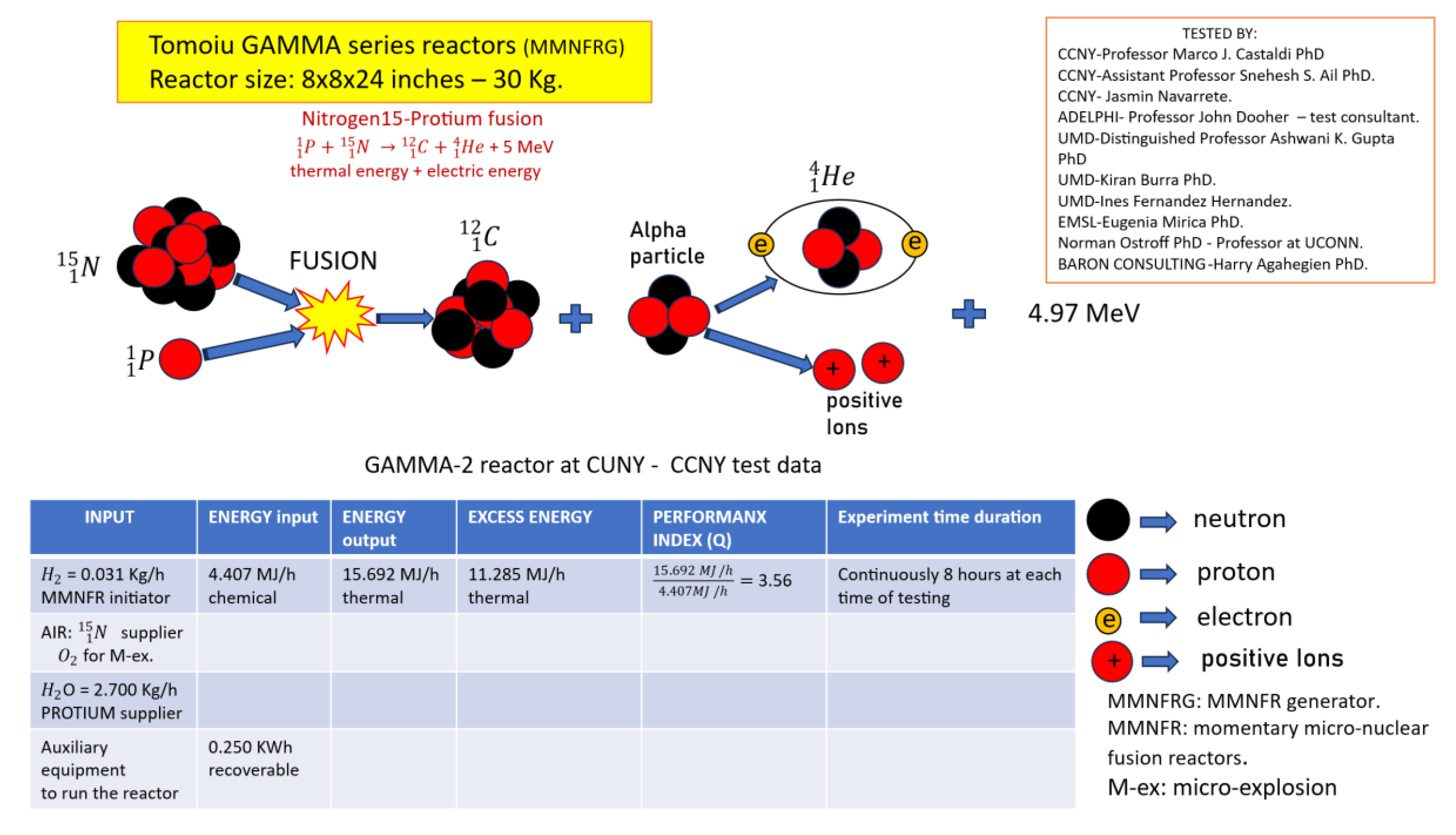
Figure 2.
Continuous formations and burst of microplasmas detected by Tektronix TDS 2012C oscilloscope.
Figure 2.
Continuous formations and burst of microplasmas detected by Tektronix TDS 2012C oscilloscope.
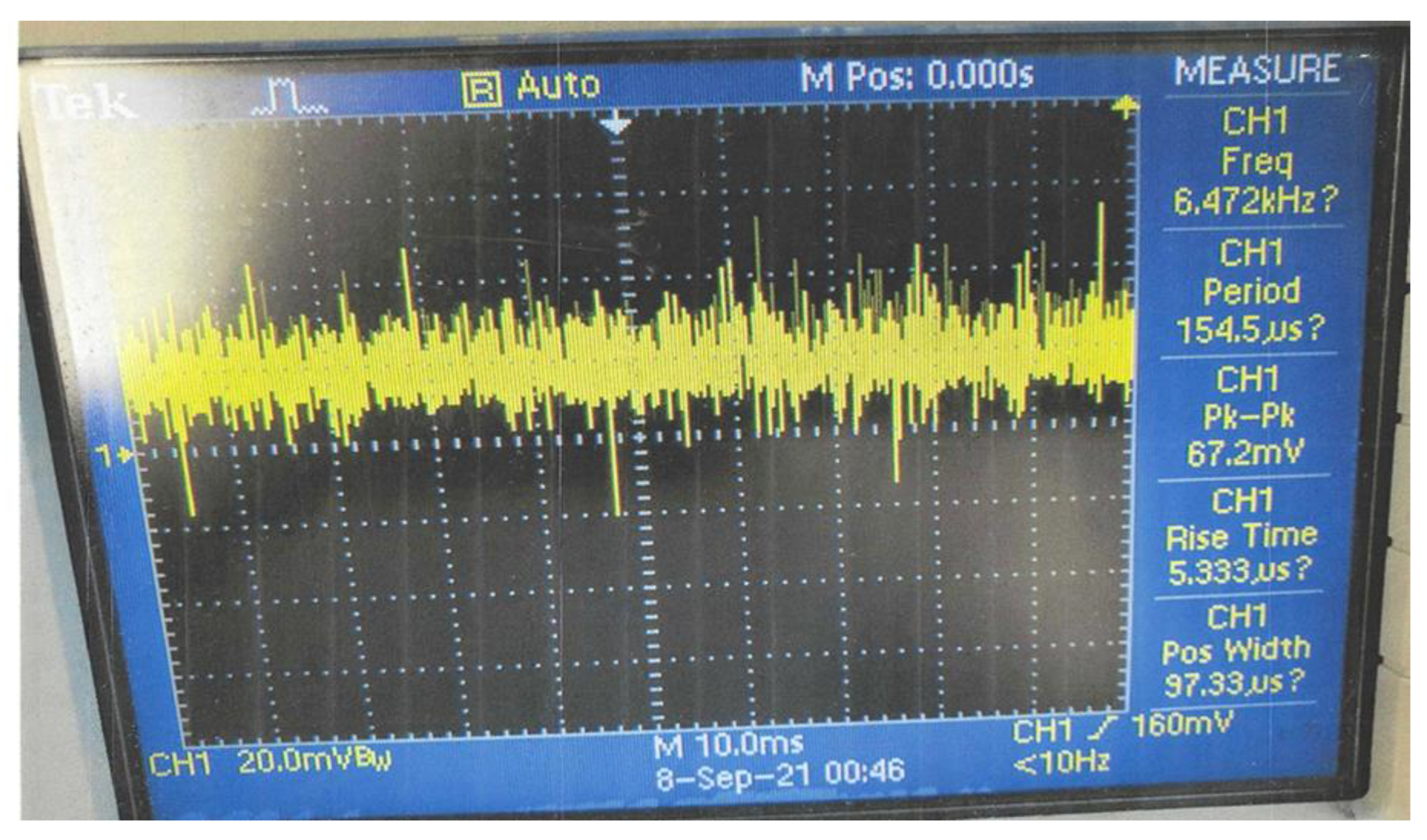
An electrode with an outer diameter of 0.250 inch and a length of 1.250 inch was installed in the reactor chamber and electrically insulated from the reactor wall. The reactor wall was connected to the ground. Measurements obtained using a Tektronix TDS 2012C oscilloscope reviled electrical pulses associated with approximately 6.472 micro-plasmas bursts per second, which result in the expulsion of mass and energies.
Role of Water in the TICF Process
Additional control experiments were performed to evaluate the role of water in the observed energy generation. Substitution of water with inert gases such as argon or helium Figure 3., reportedly eliminated excess thermal output, while increased water-to-fuel ratios enhanced reactor temperature and energy production Figure 9. These findings support the proposed role of hydrogen isotope protium derived from water in the energy-generating process.
The combined observations from the TICF experiments—including transient microplasmas formation, increasing in reactor temperature and thermal output with water addition, the reported absence of neutron activation and gamma radiation—provide a basis for the underlying physical and chemical mechanisms on TICF reactors.
METHODS
TICF Reactor Principle
The TICF process is based on the continuous formation of hydrogen-air-water micropackets that evolve into transient high-temperature microplasmas through a complex internal chemical-thermonuclear mechanism involving micro-chemical reactions, induced acoustic vibrations, energetic high frequency compression waves, micro-cavitation on liquid water, high-energy collisions, magnetic and electromagnetic interactions, and localized thermonuclear events without the need for external electrical energy input.
The reactor system employs hydrogen or hydrogen-containing fuels combined with controlled water injection to generate localized microplasmas events. Water serves as a source of protium participating in the thermonuclear process.
Experimental Evaluation
From 2019 t0 2025 multiple generations of TICF reactors have been subjected to independent experimental evaluation at accredited research institutions, including the City University of New York (CUNY-CCNY) and the University of Maryland, as well as at five independent laboratories and through public demonstrations.
Thermal energy output was determined through enthalpy calculations derived from data generated by the tested TICF reactors. Diagnostic systems included oscilloscopic monitoring of plasmas burst activity, nuclear radiation meter, GC gas analyzer as well as mass and thermal measurements systems used to evaluate and quantify reactors performance.
Several control experiments were conducted:
Replacement of water with inert gases.
Replacement water with Deuterium free and Boron free water.
Replacement of hydrogen with CO.
Variation of water-to-fuel ratios to limit possible thermochemical effect of hydrogen.
Dual water-injection reactor configuration
At the City Collage of New York Combustion and Catalysis laboratory, the thermal energy generated by TICF C-type reactors, and the corresponding heat absorbed by a calorimeter farther demonstrated the continuous generation of net-positive energy Figure 3 and Figure 4.
These experiments were designed to distinguish potential thermochemical effects from the reported excess thermal energy production.
RESULTS AND DISCUSSION
Independent testing of TICF reactors reportedly demonstrated sustained thermal energy output exceeding chemical fuel input under multiple operating configurations. Multiple generations of TICF reactors have been subjected to independent experimental evaluation at accredited research institutions, including the City University of New York (CUNY-CCNY) and the University of Maryland, as well as at five independent laboratories and through public demonstrations.
Certified high-precision diagnostic instruments were utilized throughout these evaluations, and the calibration of all measurement systems was independently verified at each testing site by the testers.
Figure 1. Gamma-2 reactor tested at CUNY-CCNY showing Protium– fusion reaction.
Oscilloscope measurements Figure 2 identified approximately 6,472 electrical signals per second, which are interpreted as evidence of repeated transient microplasmas burst events occurring, supporting the proposed existence of continuous transient microplasmas formation within the reaction chamber.
Figure 3 and Figure 4 display findings from CUNY-CCNY report covering eight TICF reactors tested at CCNY's Combustion and Catalysis Lab between 2019 and 2021 under Professor Marco J. Castaldi PhD and his team.
Figure 5. Gamma-2 reactor tested at CUNY–CCNY by Professor Marco J. Castaldi, PhD, showing 11.285 MJ net energy production , based on reactor exhaust temperature.
Further testing at the University of Maryland, led by Distinguished Professor Ashwani K. Gupta, PhD, confirmed the reactor's operational and thermal performance Figure 6., showing an output-input ratio of Q = 2.15.
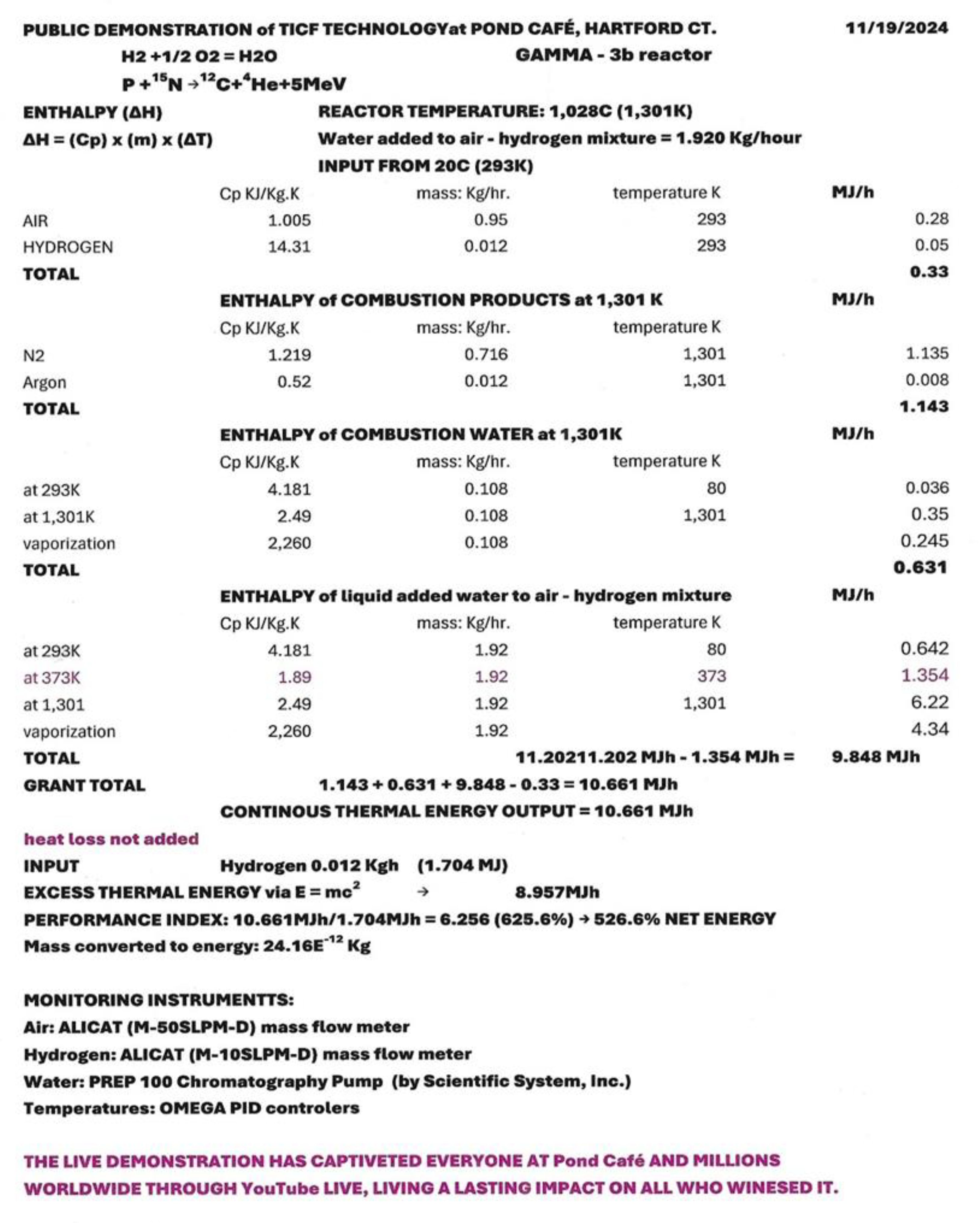
Figure 13. At a public demonstration at Harford Ct. on November 19, 2024, TICF Gamma-3b reactor with an input of 1.704 MJ has continuous output of 8.957 MJh corresponding to a Q-value of 6.256.
A TICF demonstration reactor has been assembled at the Tomoiu Advanced Fusion Energy (TAFE) laboratory and is available for direct observation of continuous net-positive thermal energy production. The reported performance exceeds 800% of thermal energy efficiency under the demonstrated operating conditions, providing an opportunity for researchers, engineers, investors, and energy stakeholders to independently evaluate this emerging technology.
A mini-TICF power plant at the TAFE Corp. facility also demonstrated continuous electrical power generation through TICF fusion process.
Control experiments produced several notable observations:
- Microplasmas are not generated directly from hydrogen or hydrogen-based fuels, as these reactants are completely consumed during the initial microchemical reaction events. Instead, microplasmas are generated from water that is introduced into the fuel-air mixture at the micropackets level.
- The TICF unique approach, which utilizes hydrogen–water fuel mixtures and continuous formation of transient microplasmas, avoid the plasma-instability challenges associated with sustained bulk plasmas while also avoid reactor-material activation and degradation—two significant challenges encountered in mainstream fusion approaches.
- During reactors operation approximately 6.472 transient microplasmas bursts/second have been detected using Tektronix TDS 2012 C oscilloscope, confirming the continuous formations of transient high-temperature microplasmas.
- Radiation monitoring conducted with a Digilert-50 nuclear radiation meter detected no gamma radiation above background levels after several hundreds of hours of TICF reactor operation. The absence of measurable gamma activity indicates that neutron-induced activation of reactor materials was not observed, suggesting that any neutron emissions are below the detection threshold and unlikely to produce radiation hazards or structural degradation of reactor components.
- Replacement of water with inert gases eliminated excess energy production, Fig. 3 and 4.
- The addition of water to the air–fuel mixture increases the temperature of the combustion products and steam exiting the reactor from 957 K to 1,146 K Fig. 8. As the water injection rate increases, the calculated adiabatic flame temperature decreases from 2,179 K to 513 K (CO-air) with increasing water addition Figure 9.
- Replacement of water with Deuterium and Boron depleted water yield net-positive energy production reinforcing the role of protium from light water Figure 3.
- Increased water injection correlated with increased reactor temperature and energy production Figure. 3,4, and 9.
- In the hydrogen-fuel test conducted at the University of Maryland by Distinguished Professor Ashwani K. Gupta, Ph.D. (Figure 6), the measured reactor exhaust temperature was 732 K, whereas the calculated adiabatic flame temperature (AFT) was 90 K—approximately 8.13 times lower than the measured temperature. The AFT represents the theoretical equilibrium temperature attainable from the specified chemical reactants under adiabatic conditions. For hydrogen-air combustion, the expected AFT is approximately 2,520 K under standard conditions. Therefore, the observed temperature behavior cannot be adequately explained solely by the chemical combustion process represented by the corresponding heat and material balance and support a nuclear process mechanism.
- The observed temperature increase is associated with water addition Figure 4, Figure 7, Figure 8 and Figure 9, therefore warrants of the vital role of light water on energy production as a source of protium and a non-chemical energy-release process are contributing to the measured reactor output. These observations are presented as evidence supporting the proposed TICF mechanism.
Analysis of the Gamma-2 reactor Figure 5., test conducted in 2019 at CUNY-CCNY indicate that a 0.3765 mg/h of N15-Protium have participated in the energy-production process yielding 11.285 MJ. The calculated “specific energy” Corresponding specific energy is: with the ratio approximately 211,000 times than the hydrogen HHV, confirming an energy-generation mechanism operating in the nuclear scale.
Figure 3.
Report of evaluations of multiple TICF reactors tested at CUNY-CCNY by Professor Marco J. Castaldi PhD. and his team.
Figure 3.
Report of evaluations of multiple TICF reactors tested at CUNY-CCNY by Professor Marco J. Castaldi PhD. and his team.
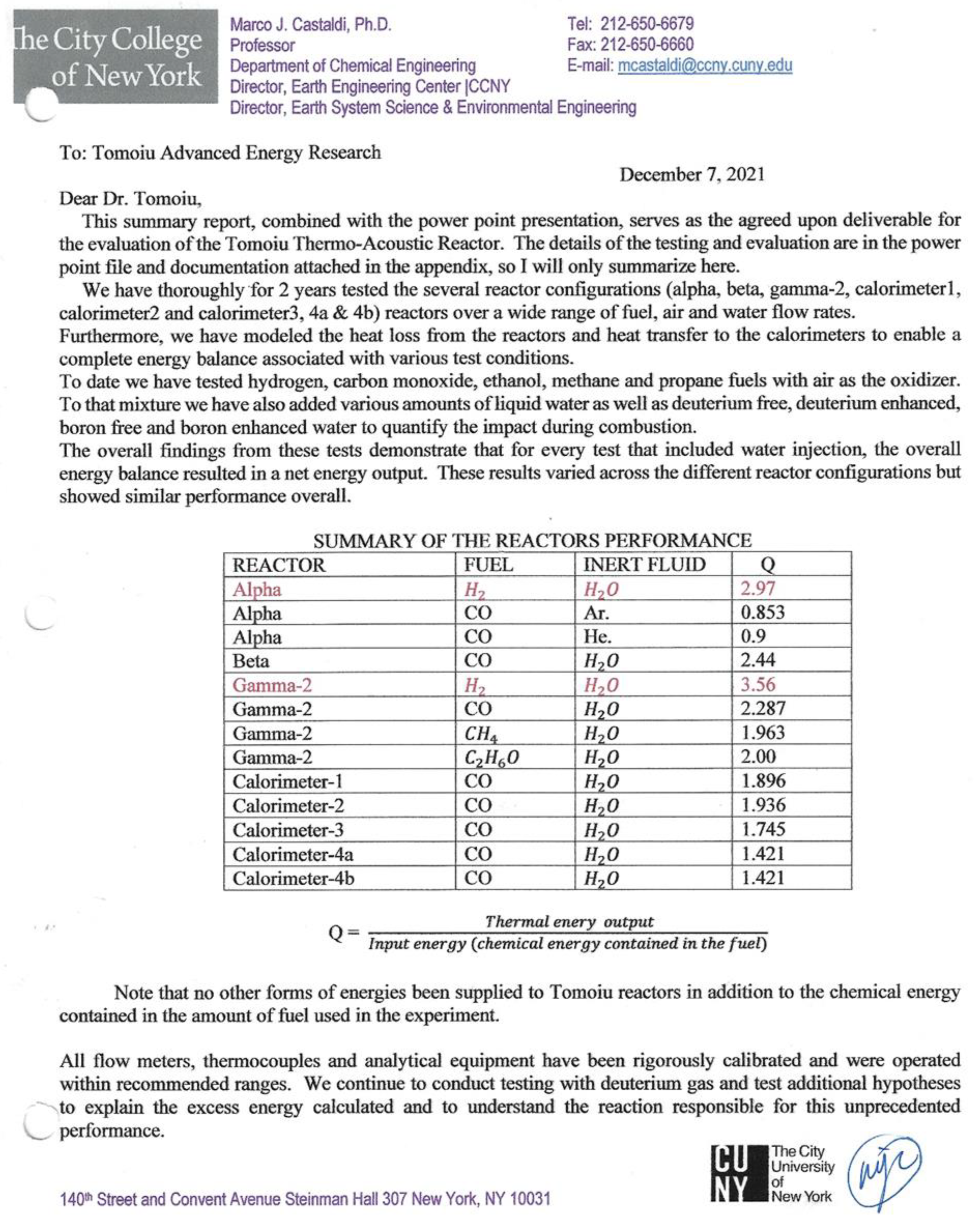
Figure 4.
Continuation of evaluation report made by Professor Marco J. Castaldi PhD.
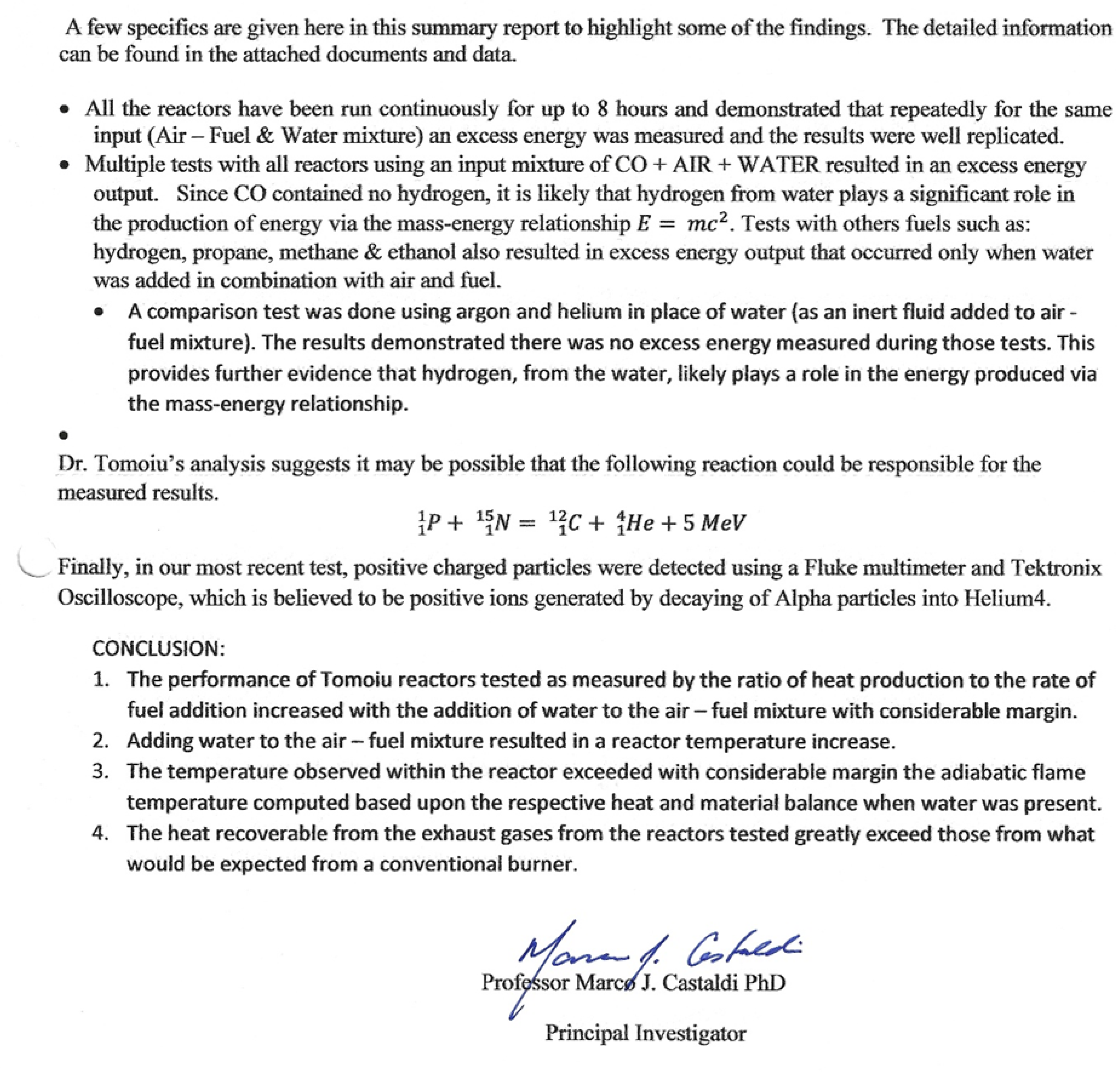
Figure 5.
Enthalpy calculations at CUNY-CCNY for TICF Gamma-2 reactor made by Professor Marco J. Castaldi PhD.
Figure 5.
Enthalpy calculations at CUNY-CCNY for TICF Gamma-2 reactor made by Professor Marco J. Castaldi PhD.
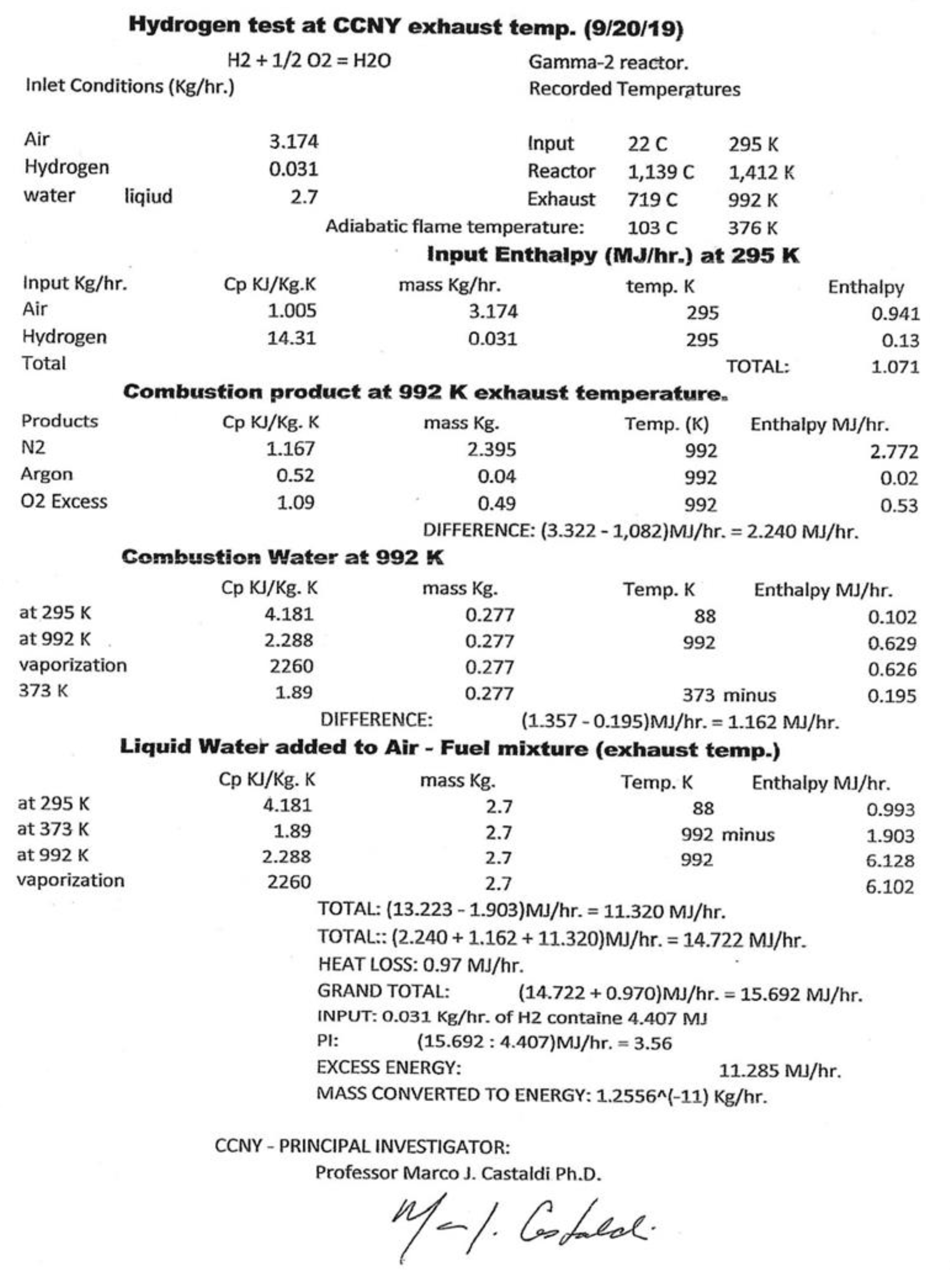
Figure 6.
Evaluation report made by Distinguished Professor Ashwani K. Gupta PhD. at University of Maryland Gamma-3 reactor test.
Figure 6.
Evaluation report made by Distinguished Professor Ashwani K. Gupta PhD. at University of Maryland Gamma-3 reactor test.
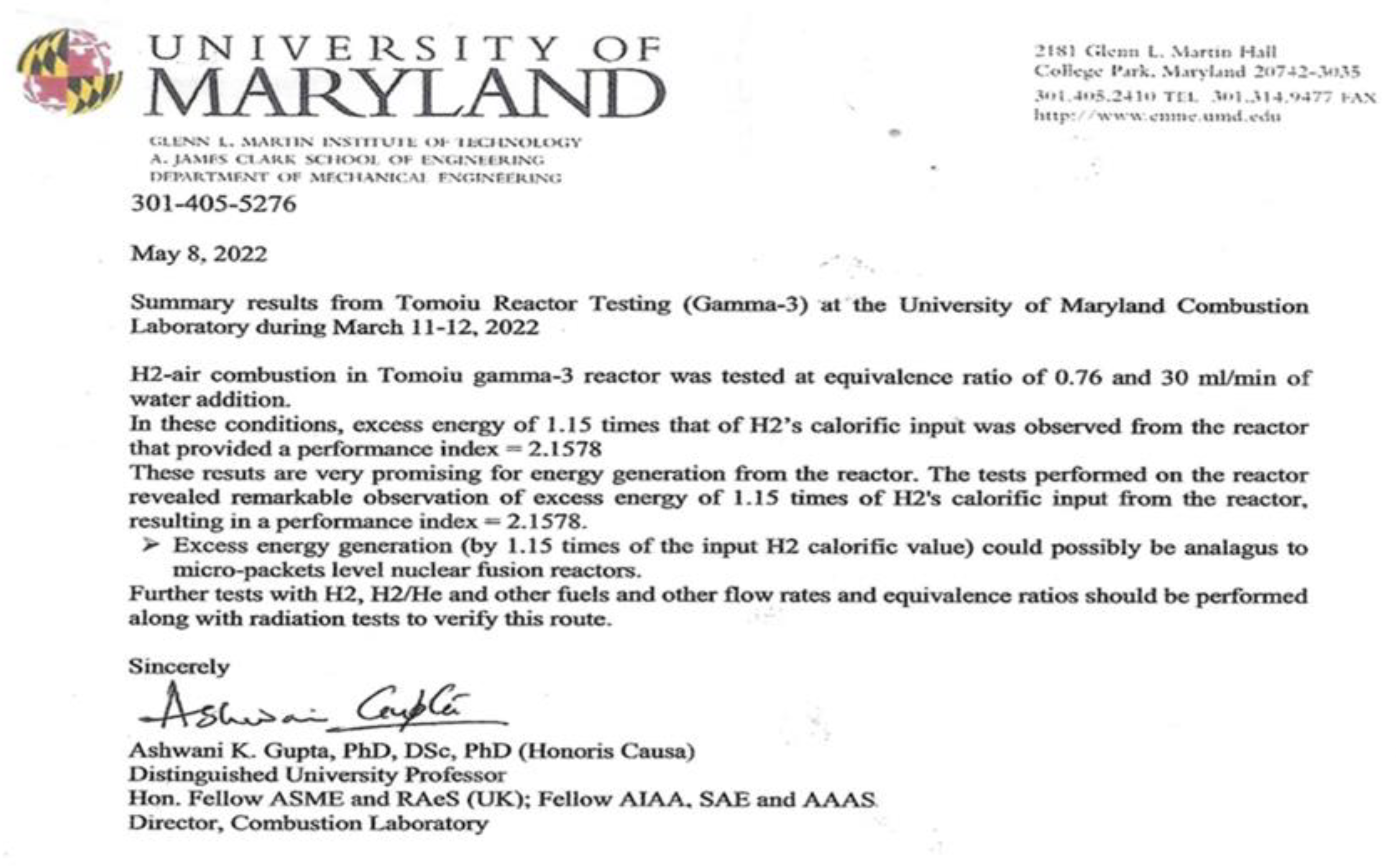
Figure 7.
Comparison between the calculated adiabatic flame temperature (AFT) and the measured exhaust temperature of the Gamma-3 TICF reactor during testing conducted at the University of Maryland by Distinguished Professor Ashwani K. Gupta, PhD, and Dr. Kiran Burra. The reaction products and water vapor exited the reactor at a measured temperature of 732 °C, compared with a calculated adiabatic flame temperature of approximately 90 °C. Thus, the measured exhaust temperature was approximately 8.1 times higher than the calculated AFT.
Figure 7.
Comparison between the calculated adiabatic flame temperature (AFT) and the measured exhaust temperature of the Gamma-3 TICF reactor during testing conducted at the University of Maryland by Distinguished Professor Ashwani K. Gupta, PhD, and Dr. Kiran Burra. The reaction products and water vapor exited the reactor at a measured temperature of 732 °C, compared with a calculated adiabatic flame temperature of approximately 90 °C. Thus, the measured exhaust temperature was approximately 8.1 times higher than the calculated AFT.
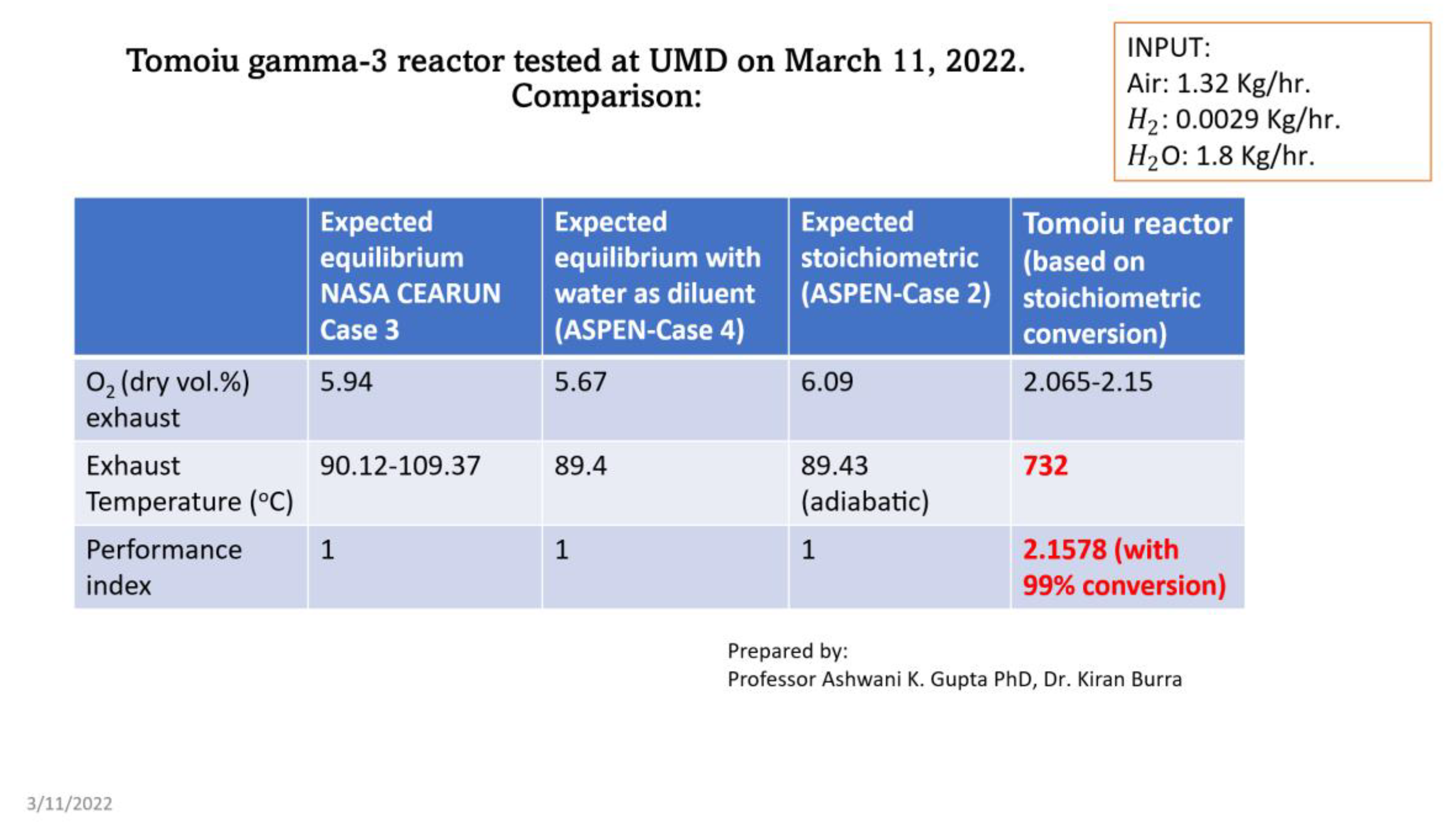
Figure 8.
Reactor temperatures increase with the addition of water to air-fuel mixture (methane, ethanol and CO fuels). Green methane temperature increases from 812 C to 1,209 C, with Methane fuel input from 0.163 Kg/hr. to 0.150 Kg/hr.
Figure 8.
Reactor temperatures increase with the addition of water to air-fuel mixture (methane, ethanol and CO fuels). Green methane temperature increases from 812 C to 1,209 C, with Methane fuel input from 0.163 Kg/hr. to 0.150 Kg/hr.
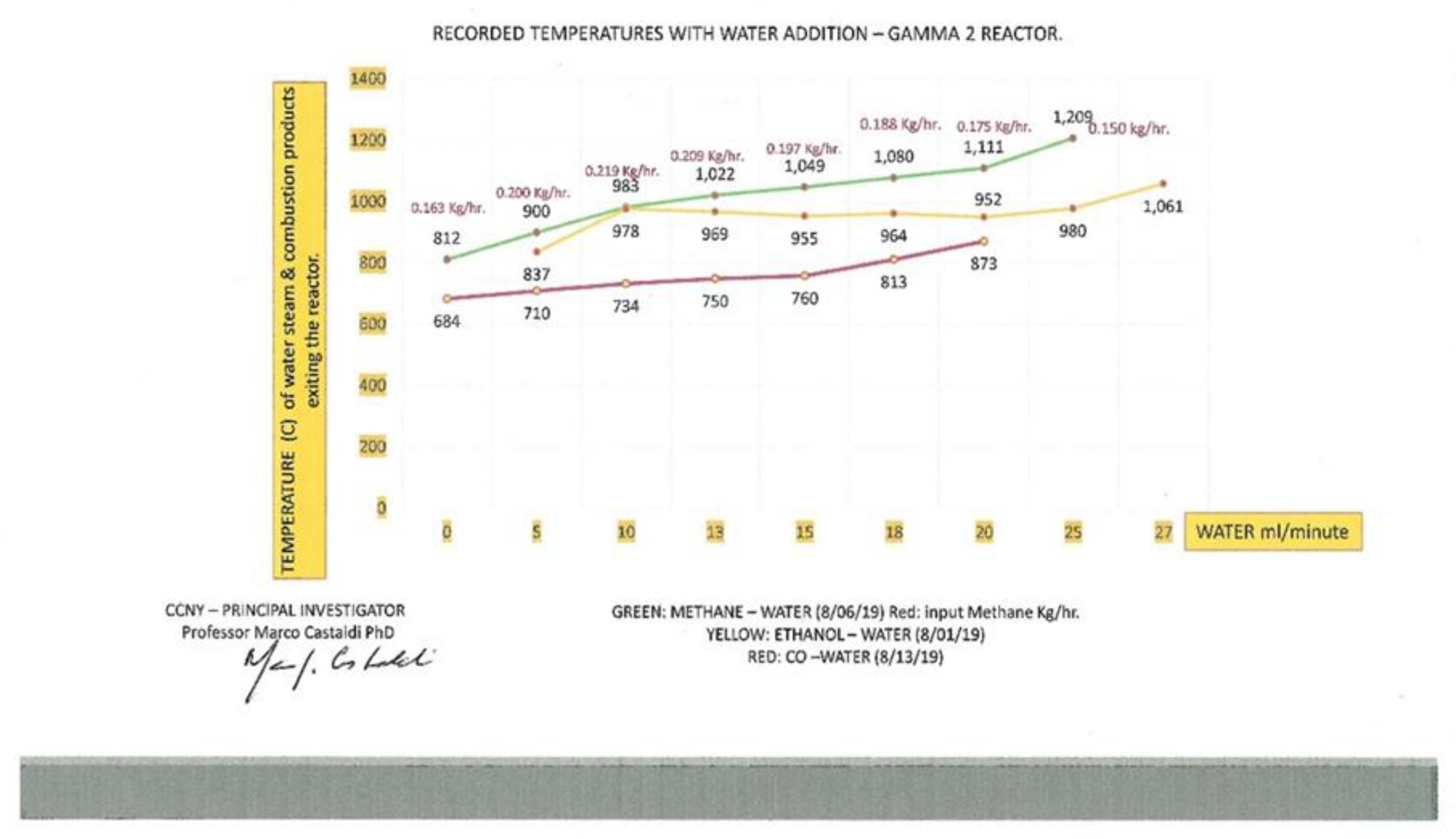
Figure 9.
Gamma-2 reactor configuration with an air–CO–water input mixture, tested at the City College of New York (CCNY) by Professor Marco J. Castaldi PhD. and his research team. Observation: Because CO contains no Hydrogen, by adding water to the air-CO mixture results in an increase in reactor temperature and corresponding enthalpy of water added, reinforcing the role of protium from water.
Figure 9.
Gamma-2 reactor configuration with an air–CO–water input mixture, tested at the City College of New York (CCNY) by Professor Marco J. Castaldi PhD. and his research team. Observation: Because CO contains no Hydrogen, by adding water to the air-CO mixture results in an increase in reactor temperature and corresponding enthalpy of water added, reinforcing the role of protium from water.
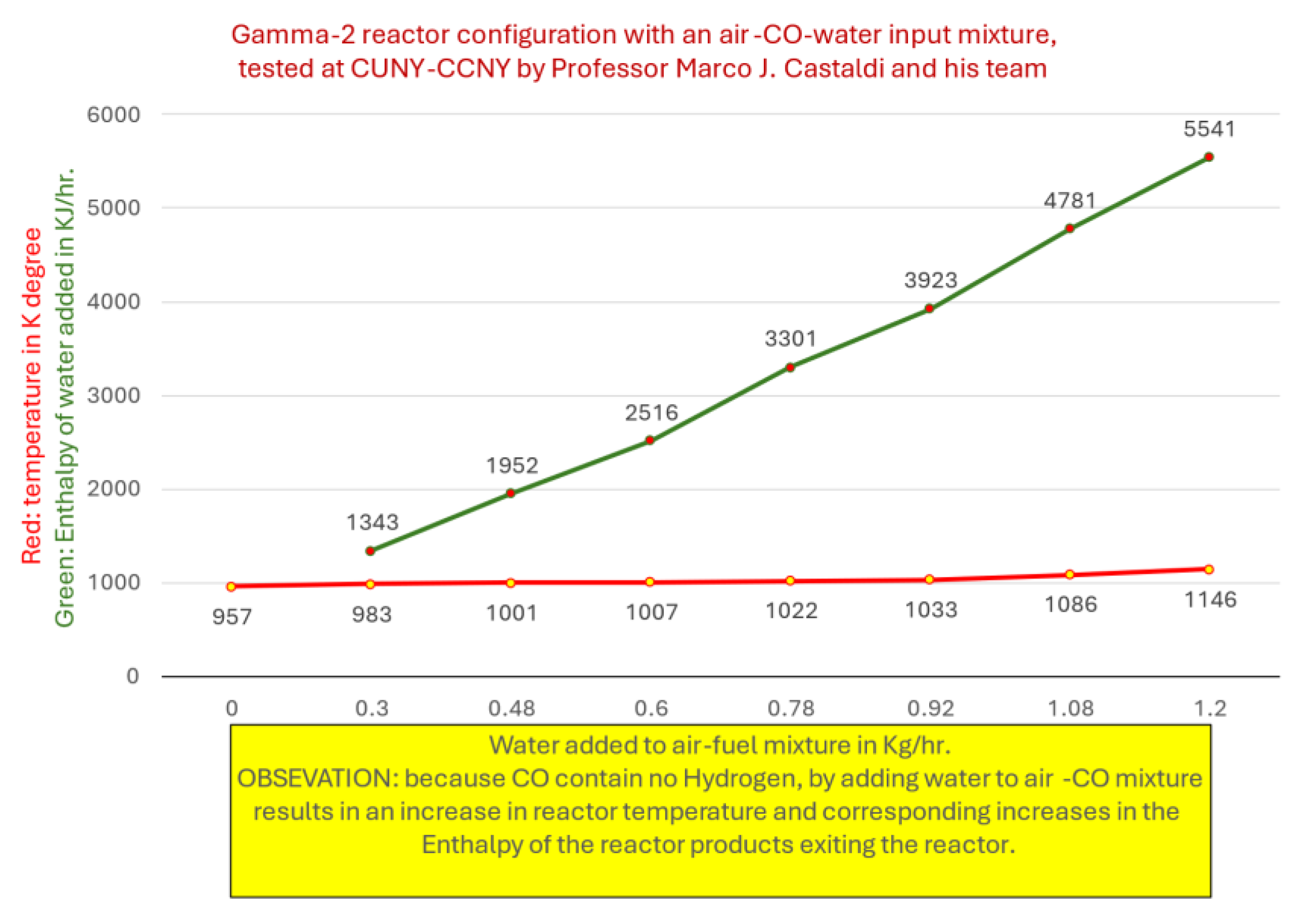
Figure 10.
Adding water to air-CO mixture reactor temperature increases and the corresponding enthalpy of reaction products and water steam exiting the reactor. Adiabatic flame Temperature decreases despite the fact that reactor temperature increases..
Figure 10.
Adding water to air-CO mixture reactor temperature increases and the corresponding enthalpy of reaction products and water steam exiting the reactor. Adiabatic flame Temperature decreases despite the fact that reactor temperature increases..
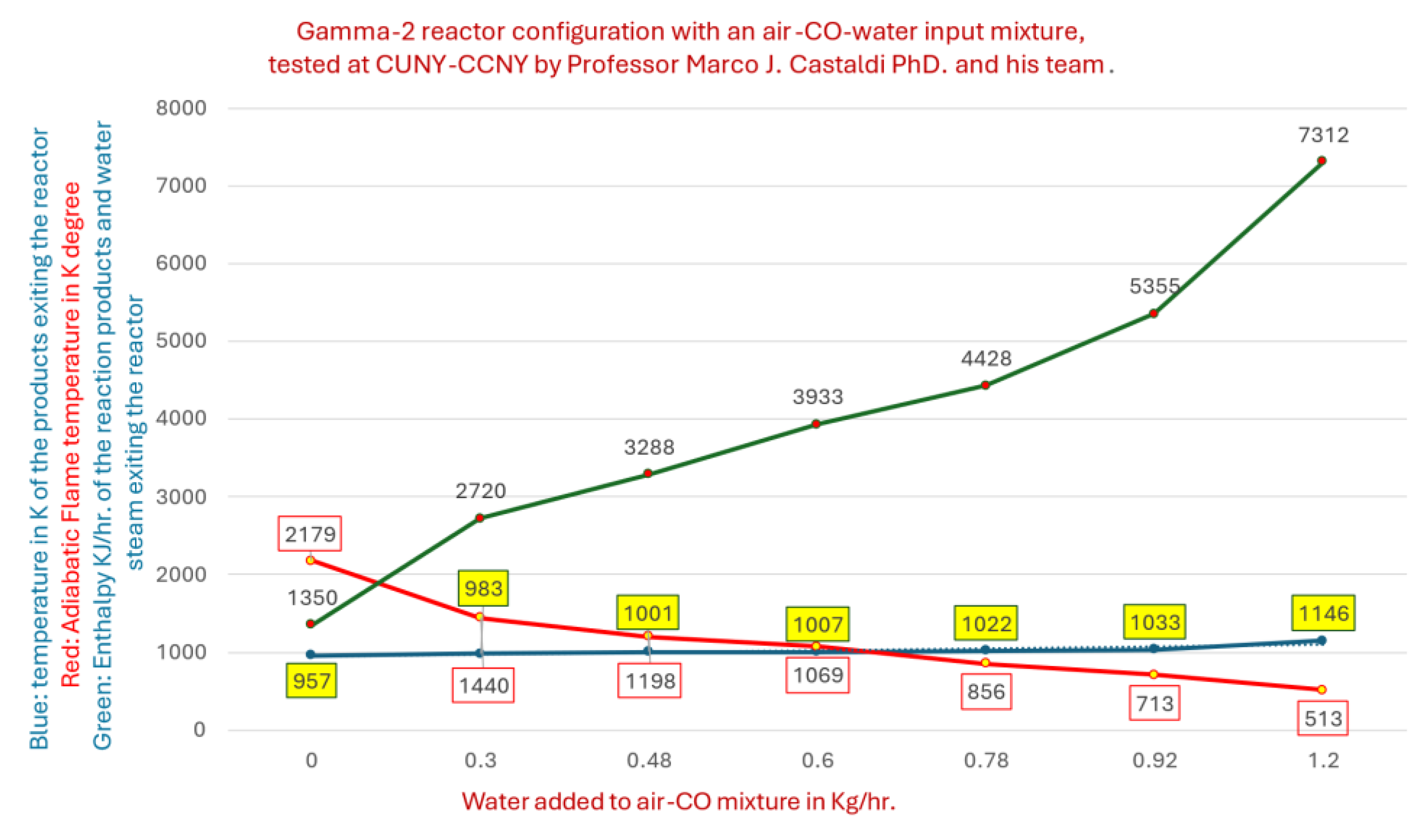
Figure 11.
Data collected by Professor Marco J. Castaldi PhD. and his team at CCNY from running Gamma-2 reactor with Air-CO-H2O mixture.
Figure 11.
Data collected by Professor Marco J. Castaldi PhD. and his team at CCNY from running Gamma-2 reactor with Air-CO-H2O mixture.
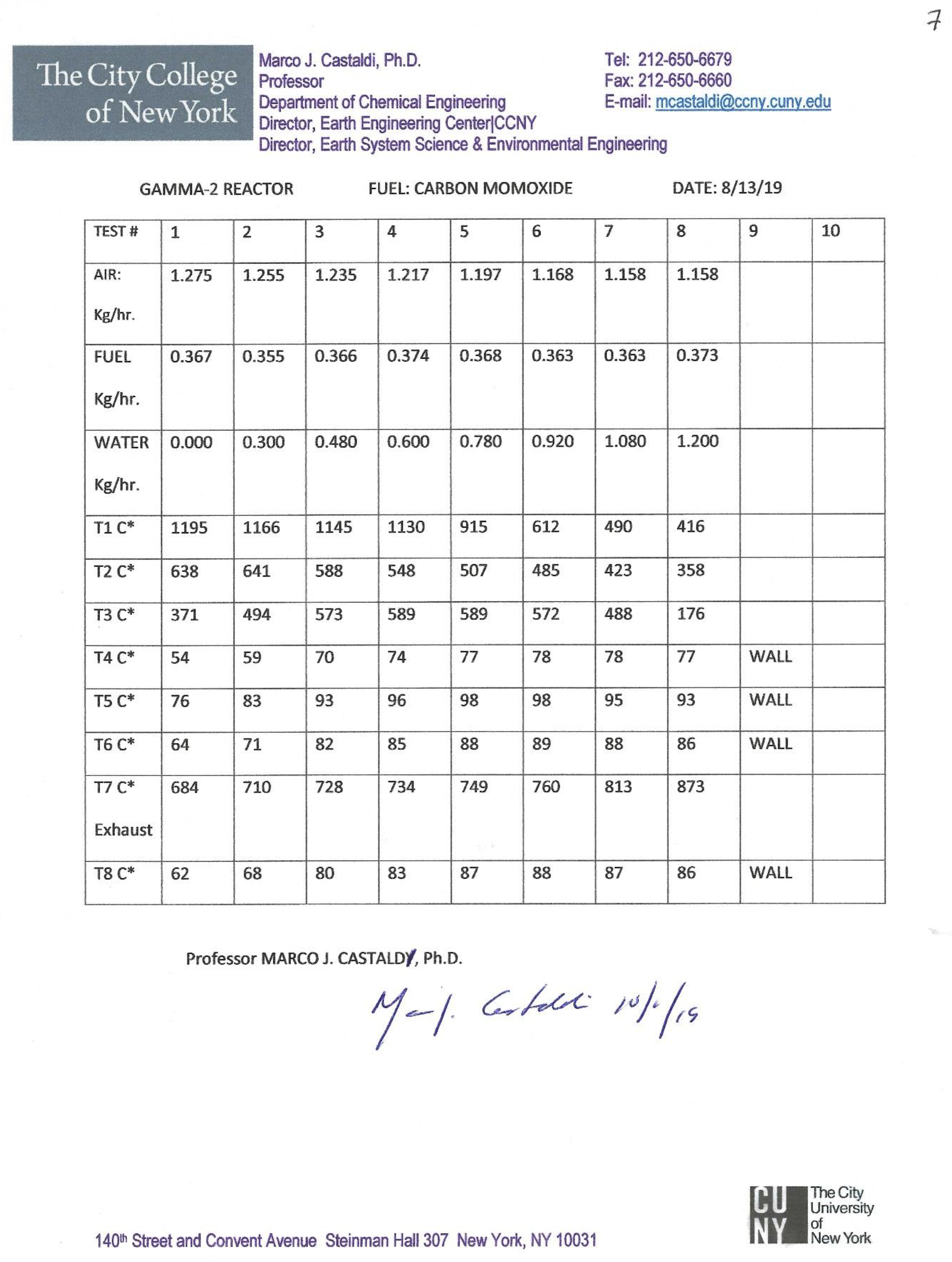
Figure 12.
Enthalpy calculation performed by Professor Marco J. Castaldi, Ph.D., for the air–CO–water mixture experiment conducted with the Gamma-2 TICF reactor at the Combustion and Catalysis Laboratory, The City College of New York.
Figure 12.
Enthalpy calculation performed by Professor Marco J. Castaldi, Ph.D., for the air–CO–water mixture experiment conducted with the Gamma-2 TICF reactor at the Combustion and Catalysis Laboratory, The City College of New York.
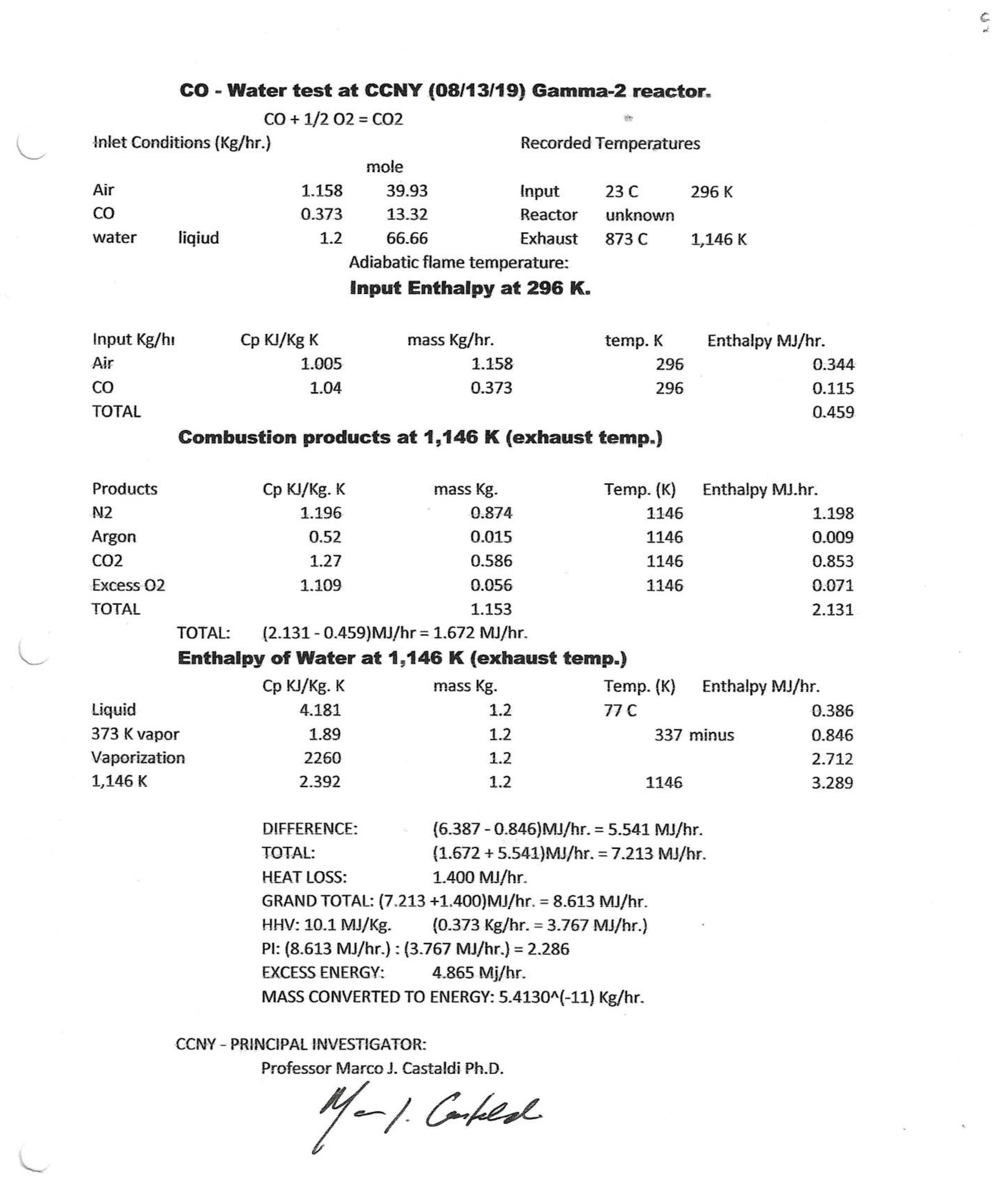
Figure 13.
Enthalpy calculus from Gamma-3b reactor tested at a public demonstration in Hartford Ct.
CONCLUSION
The Tomoiu Internal Confinement Fusion (TICF) process introduces a hybrid chemical-thermonuclear approach based on the continuous generation and confinement of transient hydrogen microplasmas.
Experimental testing conducted between 2019 and 2025 at multiple independent facilities, including the City College of New York and the University of Maryland, reported sustained thermal output-input ratios (Q-values) ranging from 2 to 8 across several reactors configurations.
Sustained excess thermal energy production accompanied by charged particle emissions but without detectable neutron or gamma radiation aligns with aneutronic reaction pathways.
TICF presents a transformative pathway to controlled aneutronic fusion. By achieving continuous, self-sustained confinement of hydrogen-based transient microplasmas, the process has reportedly demonstrated stable continuous positive net-energy production without external electric power input. The reproductible Q-value, verified in independent laboratories, and the absence of detectable neutron or gamma emission set TICF apart from conventional fusion approaches. The results indicate that TICF represents a viable route toward clean and scalable fusion energy production.
I believe Innovation in fusion should not be limited to refining existing technologies. It should also embrace fundamentally different approaches as TICF that accelerate the path toward practical, clean and commercially viable energy generation.
Acknowledgements
The author acknowledges that laboratories were involved in the experimental evaluation of TICF reactor systems, including testing conducted at the City College of New York and the University of Maryland. The author received no financial support for the research and development, validation, authorship, or publication of this work.
References
- Arthur Eddington. The Internal Constitution of the Stars; 1920. [Google Scholar]
- Domenico Batani. Inertial Confinement Fusion: Recent Results and Perspectives; 2024. [Google Scholar]
- Constantin Tomoiu. Overview of the TICF process and reported net-positive energy reactor performance. 2024. [Google Scholar]
- Independent evaluation reports from the City College of New York and the University of Maryland.
- Constantin Tomoiu. Archive from 2013 to 2026 of approximately 2,000 certified documents from independent reactors tests and validations demonstrate continuous net-positive energy production in TICF systems.
- Constantin Tomoiu. Current status report: Seven operational TICF reactors at TAFE Corp.
- A TICF demonstration reactor has been assembled at the Tomoiu Advanced Fusion Energy (TAFE) laboratory and is available for direct observation of continuous net-positive thermal energy production. The reported performance exceeds 800% of thermal energy efficiency under the demonstrated operating conditions, providing an opportunity for researchers, engineers, investors, and energy stakeholders to independently evaluate this emerging technology.
Disclaimer/Publisher’s Note: The statements, opinions and data contained in all publications are solely those of the individual author(s) and contributor(s) and not of MDPI and/or the editor(s). MDPI and/or the editor(s) disclaim responsibility for any injury to people or property resulting from any ideas, methods, instructions or products referred to in the content. |
© 2026 by the author. Licensee MDPI, Basel, Switzerland. This article is an open access article distributed under the terms and conditions of the Creative Commons Attribution (CC BY) license.
Copyright: This open access article is published under a Creative Commons CC BY 4.0 license, which permit the free download, distribution, and reuse, provided that the author and preprint are cited in any reuse.