

Submitted:
25 September 2026
Posted:
29 September 2026
You are already at the latest version
Abstract
Solar flares rapidly convert stored magnetic free energy into electromagnetic radiation, accelerated particles, plasma heating, and bulk plasma motion. Magnetic reconnection provides the established macroscopic framework for changes in magnetic connectivity and associated energy conversion, but an important question concerns the local physical transition that initiates the earliest rapid release as a stressed magnetic system enters reconnection. This study develops Magnetic Breakdown as a proposed threshold-driven mechanism for that transition. Within Photony Theory, internal free electrons associated with current transduce dynamic elemental charge photons into closed magnetic chains. Magnetic chains organize into fibrils and larger current-supported structures such as flux tubes, coronal loops, and flux ropes. Increasing chain density, curvature, compression, twist, interaction, current concentration, or confinement can be accommodated through deformation, redistribution, or magnetic reassignment. Magnetic Breakdown is proposed to occur when such accommodation and continuous reassignment can no longer preserve local magnetic-chain continuity. Conventional electromagnetic and magnetohydrodynamic relations remain the quantitative basis for magnetic energy, current-sheet geometry, and plasma flow. The Photony interpretation adds a proposed structural mechanism for threshold crossing, localized fragmentation, energy release, and subsequent reorganization. Conservation-of-energy relations, Sweet-Parker scaling, modeled flare-energy timelines, and observational constraints are used to develop testable distinctions between Magnetic Breakdown, magnetic reassignment, and macroscopic reconnection.
Keywords:
magnetic breakdown
; magnetic reconnection
; solar flares
; magnetic free energy
; magnetic fibrils
; flux tubes
; flux ropes
; current sheets
; threshold instability
; Photony Theory
1. Introduction
Solar flares release stored magnetic energy over short timescales through electromagnetic radiation, energetic particles, plasma heating, bulk plasma motion, and, in some events, coronal mass ejections. Magnetic reconnection is widely used to describe the associated change in magnetic connectivity and conversion of magnetic free energy into these observable forms [9,19,20]. The classical Sweet-Parker model provides an important conservation-based description of reconnection flow, but its resistive reconnection rate is too slow to represent the full range of rapid energy release observed in the solar corona [17,22]. Modern reconnection theory includes substantially faster plasmoid-mediated, turbulent, Hall, collisionless, and other multiscale regimes [9], yet the physical sequence by which a highly stressed magnetic structure crosses from gradual evolution into rapid localized energy release remains central to flare-onset studies.
This work examines Magnetic Breakdown as a proposed threshold-driven mechanism contributing to that transition. The hypothesis is not that magnetic reconnection is replaced. Rather, Magnetic Breakdown is assigned a more specific role: localized structural failure within a pre-existing, current-supported magnetic organization as the system enters rapid magnetic reconfiguration. Magnetic reassignment describes the redirection of surviving magnetic-chain organization into admissible pathways, while magnetic reconnection retains its conventional macroscopic meaning as a change in magnetic connectivity accompanied by energy conversion.
The distinction is important because breakdown, reassignment, and reconnection need not be identical physical events. They may occur in rapid succession and may overlap substantially in both space and time. The proposed sequence is therefore represented as
The present study develops this sequence using the Photony structural interpretation together with conventional electromagnetic and plasma-physics constraints. The measurable magnetic-energy reservoir is retained in its standard form, current-sheet and outflow relations are treated using magnetohydrodynamic quantities, and Photony Theory is used to propose an underlying organization capable of density, curvature, continuity, reassignment, and fragmentation.
Particular attention is given to colliding or mutually encroaching magnetic structures because they provide a direct geometry for increasing compression, curvature, current concentration, and structural interaction. Collision is not required as the only route to Magnetic Breakdown. Excessive twist, confinement, current concentration, or other loading may also drive a magnetic structure toward the proposed threshold.
2. Photony Framework for Magnetic Organization
2.1. Planck Space, Energy Filaments, and Elemental Charge Photons
Photony Theory proposes a bottom-up physical description beginning with quasi-static Planck Space and fundamental energy filaments. Planck Space is treated as a discrete orthogonally connected substrate at the Planck length scale,
The Manhattan metric provides the discrete geometric constraint on admissible filament propagation. Energy filaments are treated as the fundamental energy structure from which elemental charge photons and larger electromagnetic organizations are formed [12,13,14].
The term filament is reserved for this fundamental energy filament. It is not used in this article as a synonym for a solar magnetic fibril. That distinction is important because magnetic chains, magnetic fibrils, flux tubes, and flux ropes represent successively larger organizational levels.
Elemental charge photons occur in static and dynamic forms. Static elemental charge photons are associated primarily with stored charge and electric-chain organization. Dynamic elemental charge photons participate in current-associated magnetic-chain organization. The term dynamic refers to the configuration and motion state of the elemental charge photon and does not imply alternating current alone.
2.2. Electron Transduction and Magnetic Chains
Within the Photony interpretation, electrons serve as transducers and regulators of electromagnetic chain organization. Internal free electrons associated with current interact with dynamic elemental charge photons and organize them into extended magnetic chains [14].
The essential magnetic-transduction pathway can be represented schematically as
where denotes internal-electron transduction, represents the participating dynamic elemental charge-photon population, and represents a magnetic chain.
Magnetic chains are proposed as closed-loop physical organizations corresponding to the geometry represented macroscopically by magnetic field lines. They do not terminate at isolated magnetic charges. Their continuity must therefore be maintained through loop closure, structural accommodation, reassignment, or collective structural change.
This interpretation does not replace Maxwell’s equations or the conventional definitions of magnetic flux density, current, Lorentz force, or electromagnetic energy. Those relationships remain the macroscopic quantitative constraints. Photony instead proposes a physical organization beneath the field-line representation.
2.3. Chains, Fibrils, and Larger Magnetic Structures
Individual magnetic chains organize into magnetic fibrils. A fibril is therefore an organized bundle of magnetic chains rather than a fundamental energy filament. Groups of fibrils can assemble into larger plasma-containing magnetic structures [14].
The hierarchy used throughout this article is
The larger structures include flux tubes, coronal loops, and flux ropes.
A magnetic fibril is not treated as an empty bundle of field structure. In solar applications, a fibril contains the proposed magnetic-chain organization together with magnetically organized plasma. Depending on atmospheric region and local conditions, that plasma can contain electrons, ions, and partially ionized material. The plasma and magnetic organization therefore form a composite magnetic-plasma structure rather than two mechanically independent systems.
2.4. Classical Photons and the 37.6 THz Transition
A distinction must be maintained between an extended electromagnetic chain and a propagating classical photon. Within the current Photony framework, a classical photon is a propagating chainlet formed from two interlinked elemental charge photons. Extended magnetic chains are not modeled as strings of classical photons.
The characteristic transition frequency is
or
The corresponding free-space wavelength is approximately
2.5. Magnetic Loading, Reassignment, and Breakdown
A current-supported magnetic organization can respond to increasing loading in more than one way. Increasing magnetic field strength does not by itself imply breakdown. Additional loading may initially be accommodated through expansion, deformation, altered chain spacing, current redistribution, or non-destructive reassignment.
The principal possible responses can be represented compactly as
Magnetic reassignment denotes redirection of magnetic chains or fibrils into alternative admissible pathways while sufficient structural continuity is retained. Magnetic Breakdown is proposed only when neither stable accommodation nor continuous reassignment can preserve the local magnetic organization [13,14]. The resulting threshold-driven loss of continuity produces localized fragmentation and releases part of the stored magnetic energy.
This distinction is central to the present article. Threshold crossing does not automatically imply destructive breakdown. A post-threshold structure that can still reorganize into an admissible state follows the reassignment branch. Magnetic Breakdown is the failure branch in which such local continuity can no longer be preserved.
3. Historical and Physical Context
The proposed chain interpretation has historical parallels in the physical imagery used during the development of electromagnetic theory. Faraday [6] treated lines and tubes of force as physically meaningful representations capable of transmitting stress and force through space. Thomson [23] later discussed chains of polarized particles and tubes of electrostatic inductance as physically suggestive structures rather than purely geometrical constructions.
Modern electromagnetic theory does not require literal mechanical tubes in order to predict field behavior. Maxwell’s equations and the associated field quantities provide the experimentally established macroscopic description. Photony Theory therefore does not use these historical analogies as evidence that magnetic chains exist. Their relevance is conceptual: they illustrate the longstanding physical question of whether the successful field-line representation corresponds to an underlying organized structure.
The Photony proposal differs by assigning a specific microscopic interpretation to that question. Dynamic elemental charge photons, internal-electron transduction, magnetic chains, fibrils, and larger magnetic structures are proposed as an organizational hierarchy underlying the measured field quantities. The value of that interpretation ultimately depends on whether it remains consistent with established electromagnetic behavior and produces experimentally distinguishable consequences.
4. Solar Magnetic Structures and Loading
Solar active regions contain pre-existing currents and organized magnetic structures before flare onset. Flux tubes, coronal loops, and twisted flux ropes provide extended regions in which magnetic free energy can be accumulated through flux emergence, shear, current concentration, curvature, compression, stretching, twist, interaction, and confinement [5,18,20,24].
Within the Photony interpretation, a flux tube or flux rope contains many magnetic fibrils, and each fibril contains an organized population of magnetic chains together with its magnetically organized plasma. The physical scale of a fibril is not treated as universal. It depends on the number of participating chains, plasma conditions, magnetic-energy density, and the larger magnetic structure.
Figure 1.
Flux tubes, flux ropes, and fibril structure. In the Photony hierarchy, magnetic chains organize into fibrils, while groups of plasma-containing fibrils form larger current-supported magnetic structures.
Figure 1.
Flux tubes, flux ropes, and fibril structure. In the Photony hierarchy, magnetic chains organize into fibrils, while groups of plasma-containing fibrils form larger current-supported magnetic structures.
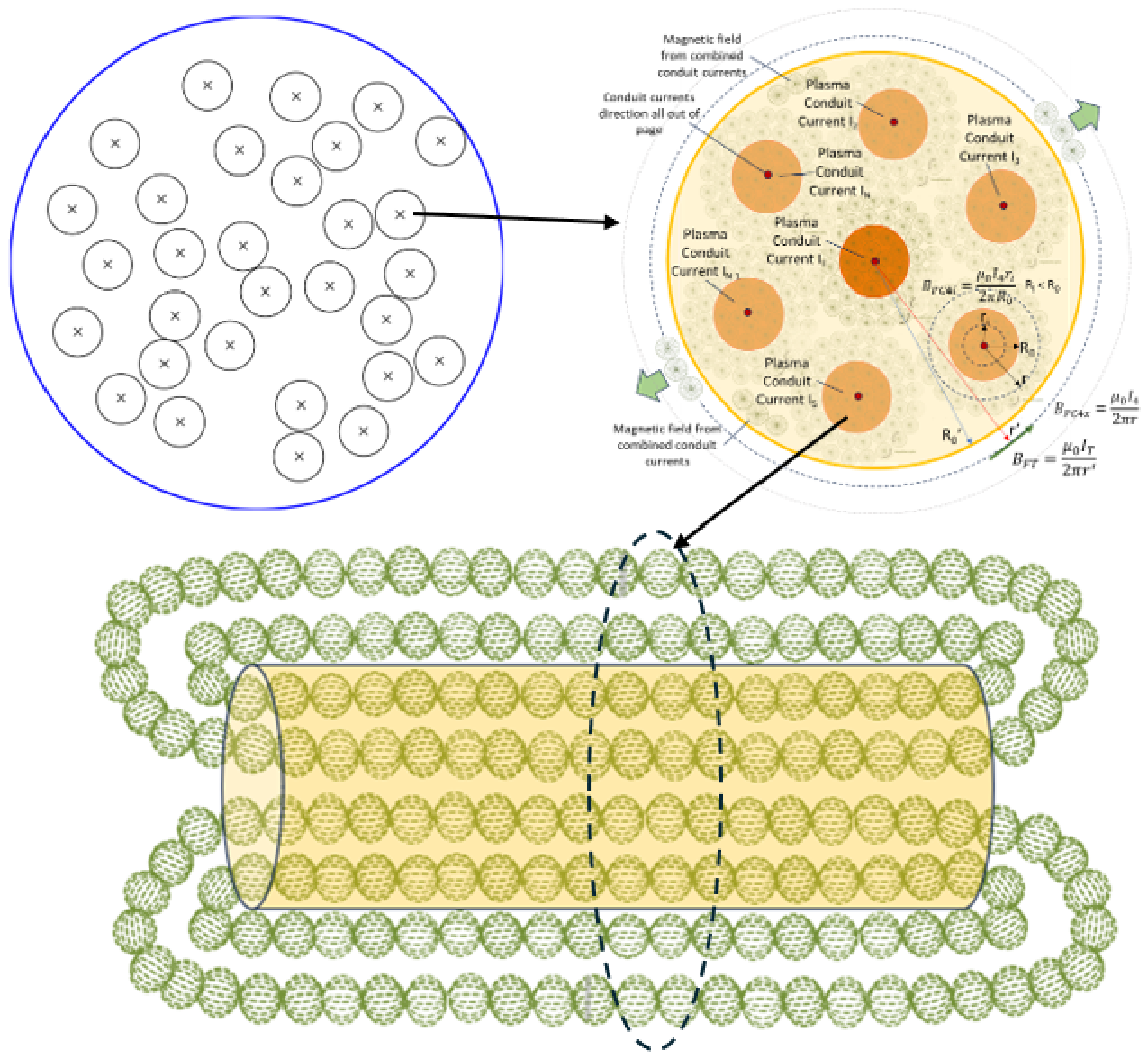
Sunspots are photospheric manifestations of concentrated magnetic flux and commonly occur within magnetically complex active regions. Flux emergence, photospheric motion, sunspot rotation, and shear can progressively load the connected magnetic structures. Interaction between neighboring or emerging magnetic systems can further concentrate current and magnetic stress near polarity-inversion regions and developing current sheets.
In the present framework, colliding or mutually encroaching flux systems provide one route toward Magnetic Breakdown because they can simultaneously increase chain density, curvature, compression, and interaction. Other loading pathways, including excessive twist or confinement within a single magnetic structure, can approach the same general instability regime.
The relevant progression is therefore
Only when the available accommodation and reassignment pathways become insufficient does the proposed breakdown branch become possible.
5. Magnetic Convergence and Flux-Tube Interaction
Magnetic flux systems in active regions can be driven together by flux emergence, photospheric flows, shear, rotation, and larger-scale magnetic evolution. Such convergence can increase current density and create or intensify current sheets. The resulting geometry can support both conventional reconnection processes and the proposed threshold-driven Magnetic Breakdown process.
Figure 2 illustrates the larger-scale convergence geometry used in this article. The figure should be interpreted as a schematic representation of magnetic loading rather than as a claim that buoyancy alone determines reconnection onset.
The current sheet need not be absent before Magnetic Breakdown begins. Current concentration, sheet thinning, limited reconnection, and gradual magnetic reassignment may already be occurring. The proposed distinction concerns the transition from gradual or accommodated evolution to localized threshold-driven failure and rapid energy release.
This allows several processes to develop concurrently:
The model therefore does not require a strict temporal sequence in which all breakdown is completed before any reconnection begins. It instead proposes that localized breakdown can contribute to the transition into a more rapidly reconnecting and reorganizing state.
6. Frozen-In Plasma and Particle Guidance
At magnetohydrodynamic scales with sufficiently high conductivity, solar plasma is commonly described as approximately frozen into the magnetic field. This approximation links plasma motion and magnetic evolution while allowing departures from ideal behavior in current sheets and kinetic-scale regions [9,20].
Within Photony Theory, the frozen-in description is given a structural interpretation. Magnetic chains organize into plasma-containing fibrils, and fibrils assemble into larger flux tubes and flux ropes. Plasma motion within such structures should not be pictured as independent motion relative to an otherwise stationary bundle of chains. The magnetic organization and plasma are treated as parts of a coupled fibril structure whose configuration evolves collectively.
When neighboring fibrils or larger flux systems interact, loading can become concentrated at regions of high curvature, compression, current density, or topological constraint. If the system can still deform or continuously reassign its magnetic organization, continuity is maintained. If no admissible local continuation remains, localized fragmentation becomes possible.
The conventional Larmor radius remains a useful particle-scale measure,
For the non-relativistic limit,
In the Photony interpretation, remains a measure of particle response to the local magnetic organization rather than a replacement for magnetic-chain geometry.
Figure 3.
Larmor-radius and magnetic-chain containment schematic. The Larmor radius remains a conventional particle-dynamics quantity, while the Photony interpretation proposes magnetic chains and fibrils as the underlying magnetic organization guiding the plasma.
Figure 3.
Larmor-radius and magnetic-chain containment schematic. The Larmor radius remains a conventional particle-dynamics quantity, while the Photony interpretation proposes magnetic chains and fibrils as the underlying magnetic organization guiding the plasma.
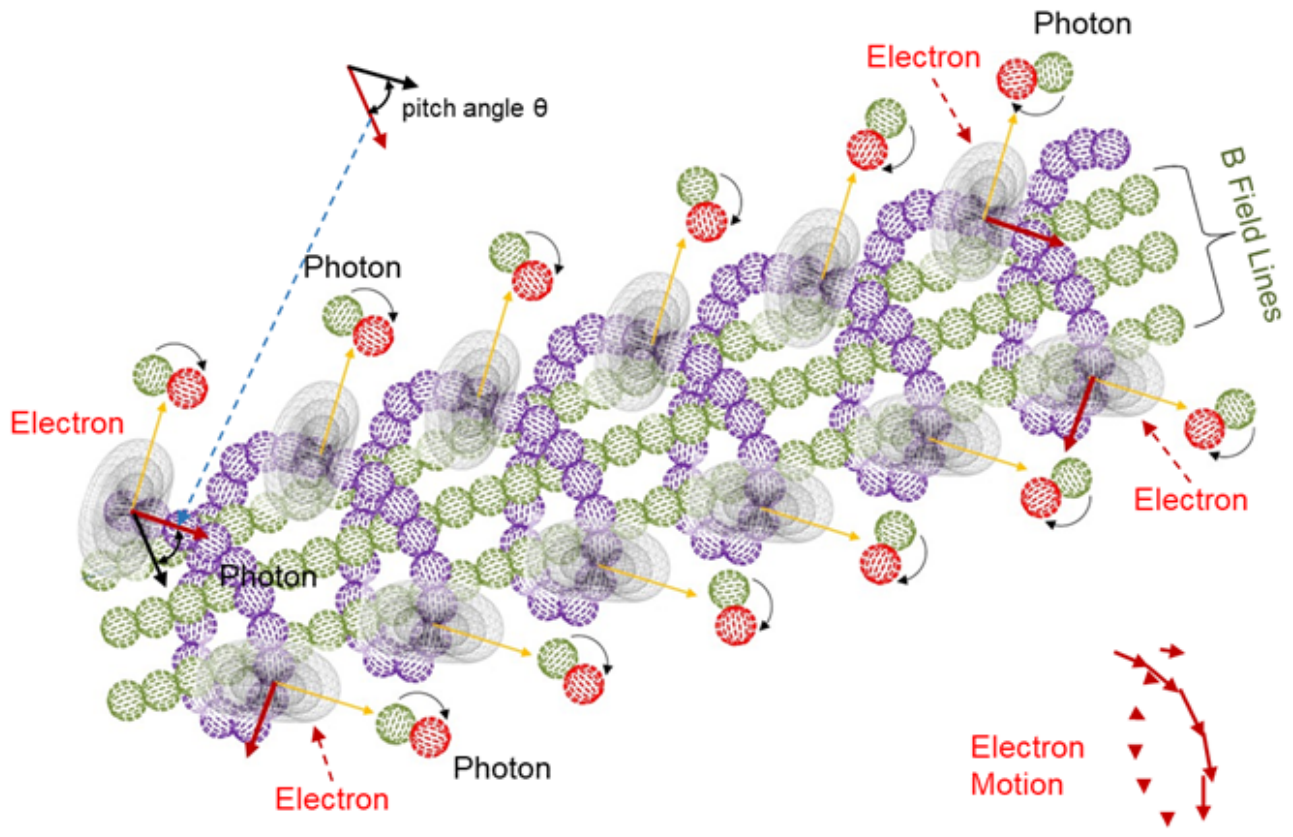
When becomes comparable to a local magnetic-gradient scale, guiding-center behavior can weaken and kinetic effects can become important. Such conditions may occur near current sheets or strongly structured flare regions, but a large Larmor radius is not itself identified here as the Magnetic Breakdown criterion. Breakdown is instead associated with loss of admissible structural continuity in the loaded magnetic organization.
7. Sweet-Parker Reconnection as a Conservation Baseline
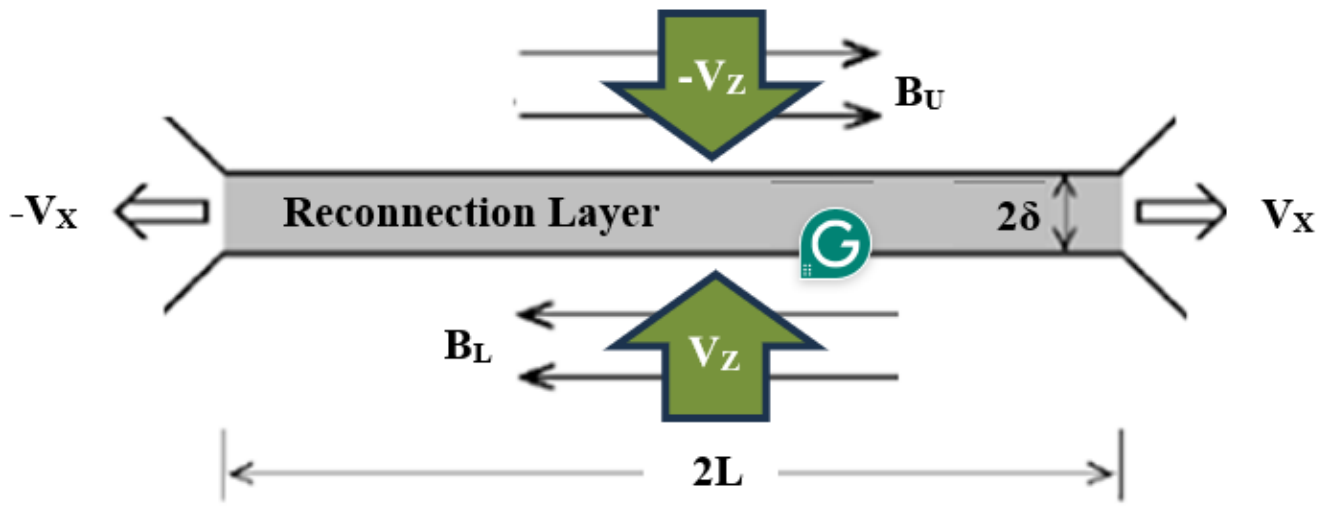
The Sweet-Parker model provides a useful conservation-based baseline for reconnection [17,22]. Oppositely directed magnetic fields converge toward a long, thin current sheet. Plasma enters through the inflow direction and exits along the sheet. In the geometry used here, z is the inflow direction, x is the outflow direction, L is the characteristic longitudinal scale of the layer, and is its characteristic half-thickness.
Figure 4.
Generalized Sweet-Parker reconnection geometry. Plasma enters the current-sheet region with inflow velocity and exits along the sheet with outflow velocity .
Figure 4.
Generalized Sweet-Parker reconnection geometry. Plasma enters the current-sheet region with inflow velocity and exits along the sheet with outflow velocity .
For a steady approximately incompressible configuration, mass conservation gives
For
the relation reduces to
The characteristic outflow speed is of order the Alfvén speed,
This scaling follows from comparison of magnetic and kinetic energy densities,
Thus,
and the Sweet-Parker inflow scaling becomes
Because
the classical resistive Sweet-Parker inflow rate is correspondingly small.
The importance of this result for the present study is not that all magnetic reconnection must proceed at the Sweet-Parker rate. Rather, Sweet-Parker provides a transparent baseline against which a transition to faster energy release and magnetic reorganization can be discussed.
The factor that appears in Gaussian-unit expressions for the Alfvén speed is not used here as evidence for the Photony compression factor. The present article uses SI electromagnetic units throughout this derivation. Any proposed Photony interpretation of the geometric compression factor is therefore conceptually separate from the unit-dependent appearance of in Gaussian electromagnetic equations.
8. Photony Interpretation of the Current-Sheet Region
The Sweet-Parker geometry describes the macroscopic magnetic field, plasma flow, and current-sheet structure. Photony Theory adds a proposed structural interpretation of the magnetic organization entering that region [14].
In the Photony picture, oppositely directed magnetic domains contain magnetic chains and fibrils supported through internal-electron transduction. As the domains converge, local chain density, curvature, compression, current concentration, and interaction can increase. The structure may initially respond through deformation, altered chain spacing, current redistribution, or non-destructive magnetic reassignment.
For a magnetic-field reversal across a layer of characteristic half-thickness , Ampère’s law gives the order-of-magnitude current-density scaling
The total sheet current is obtained by integrating the current density over the appropriate cross-sectional area,
The current should therefore not be identified directly with .
The Photony interpretation does not alter these conventional relationships. Instead, increasing J, increasing magnetic loading, and decreasing current-sheet scale are treated as measurable macroscopic conditions that may correspond to increasing organizational demand on the magnetic-chain and fibril structure.
In the present framework, structural loading may arise through chain density, curvature, compression, stretching, twist, interaction, current concentration, or confinement. A loaded structure does not immediately undergo breakdown. It may first expand, deform, redistribute current, alter chain spacing, or reassign surviving magnetic organization into an alternative admissible pathway.
The proposed local progression is
Magnetic Breakdown is therefore proposed only when neither stable accommodation nor continuous reassignment can preserve local magnetic-chain continuity. The resulting fragmentation can release magnetic energy while simultaneously changing the local current, pressure, confinement, and connectivity conditions under which larger-scale reconnection proceeds.
This interpretation also changes how Figure 5 should be read. The central region is not assumed to contain an abrupt boundary between “breakdown” and “reconnection.” Current-sheet formation, limited reassignment, localized breakdown, particle acceleration, and larger-scale connectivity change may occur in rapid succession or overlap substantially. The proposed distinction is functional rather than strictly temporal.
9. Modeled Energy-Release Timelines
The energy-release timelines used in this article are illustrative models rather than universal flare chronologies. Their purpose is to distinguish a slowly loaded pre-threshold state, a rapid transition into Magnetic Breakdown, continuing energy release and magnetic reorganization, and a declining phase.
For the extended-event model, five stages are retained:
- 1.
- magnetic loading and tension buildup, approximately 0 to 2 min;
- 2.
- localized Magnetic Breakdown onset, beginning near 2 min;
- 3.
- increasing breakdown and magnetic reorganization, approximately 2 to 25 min;
- 4.
- modeled peak energy-release rate near 25 min;
- 5.
- declining release and continuing reconnection or relaxation, approximately 25 to 90 min.
These times are model parameters. They are not proposed as universal flare-onset times or as fixed physical constants of Magnetic Breakdown.
For the rising portion of the extended-event model, let denote the modeled onset time of rapid energy release. For , the phenomenological power function is
The illustrative model parameters are
and
All time quantities in Equation (24) are expressed in the same units. At ,
and for , the rising solution approaches . Equation (24) therefore represents only the modeled growth phase; the declining phase shown in Figure 7 requires a separate decay prescription.
9.1. Illustrative Local Energy-Release Timeline
Figure 6 represents an illustrative localized energy-release episode rather than a direct numerical solution of the Sweet-Parker reconnection equations. Its purpose is to distinguish the instantaneous rate of magnetic-energy release from the cumulative energy released as a local magnetic structure passes through a period of rapid energy conversion.
As shown in Figure 6, the instantaneous energy-release rate rises rapidly, reaches a maximum, and then declines. The cumulative released energy continues to increase while the release rate remains positive and approaches a plateau as the local release subsides.
The cumulative released energy is defined by
where denotes the beginning of the modeled local energy-release interval.
A positive release rate may rise and fall with time, but the cumulative released energy cannot decrease. A decreasing energy curve would instead represent another quantity, such as the magnetic energy remaining in the source region.
Figure 6 should therefore be interpreted as a phenomenological representation of localized energy conversion. It does not assign that release uniquely to Sweet-Parker reconnection. Within the present framework, the modeled interval can include Magnetic Breakdown, magnetic reassignment, current-sheet evolution, and reconnection operating in rapid succession or with substantial temporal overlap.
9.2. Extended High-Energy Flare/Eruption Timeline
Figure 7 extends the illustrative energy-release model from a localized event to a longer-duration flare and eruption sequence. The purpose of the model is to show how a rapid increase in magnetic-energy release associated with threshold crossing can be followed by continuing magnetic reorganization, reconnection, and eventual relaxation.
The model is phenomenological rather than event-specific. In particular, the plotted power and cumulative energy are not intended to assign a GOES flare class. GOES classification is based on the measured peak soft X-ray irradiance in the – nm band, whereas Figure 7 represents an assumed total magnetic-energy release history.
As shown in Figure 7, the energy-release rate rises rapidly after the modeled threshold transition, reaches a maximum, and then declines as the available free magnetic energy is reduced and the system continues to reorganize. The cumulative-energy curve increases monotonically because it represents the time integral of the nonnegative release rate.
The modeled cumulative release approaches approximately J. This value is an assumed illustrative energy scale rather than the inferred energy of a specific observed flare. Its purpose is to demonstrate that an extended event can combine an early rapid-release phase with continuing reconnection and eruption development without requiring those processes to begin or end at sharply separated times.
The phenomenological timeline can be compared with conventional magnetic-energy-flow scaling, although the plotted curve is not derived directly from a single Sweet-Parker inflow calculation.
The phenomenological timeline can be compared with conventional electromagnetic energy-flow scaling, although the plotted curve in Figure 7 is not derived directly from a single Sweet-Parker inflow calculation.
The electromagnetic energy transported into the current-sheet region is most directly described by the Poynting flux. For approximately ideal inflow with , the incoming Poynting-flux magnitude is
If denotes the combined effective inflow area, the corresponding magnetic-energy transfer rate is
Using the conventional magnetic-energy density,
Equation (30) may also be written as
These relations describe the electromagnetic energy supplied to the current-sheet region. They do not, by themselves, determine the Magnetic Breakdown threshold or the fraction of incoming magnetic energy ultimately partitioned among radiation, particle acceleration, plasma heating, bulk motion, magnetic reassignment, and reconnection.
The modeled progression is therefore summarized as
10. Magnetic Breakdown, Threshold Selection, and Energy Conservation
10.1. Magnetic Energy Reservoir
Magnetic Breakdown does not require a separate macroscopic energy reservoir. The measurable magnetic energy remains the conventional magnetic-field energy. For solar plasma whose magnetic permeability is well approximated by , the magnetic-energy density is
For a magnetic structure occupying a volume V,
Only part of the total magnetic energy is generally available for rapid release. The relevant reservoir is the magnetic free energy associated with departure of the current-supported structure from a lower-energy admissible configuration.
Photony Theory proposes a physical organization for that stored magnetic energy through chains, fibrils, and the larger current-supported structures assembled from them [14]. Mechanical descriptions of chain curvature, compression, twist, and continuity therefore describe the proposed organization of the magnetic-energy reservoir. They should not be added as a second independently counted energy reservoir unless a separate contribution can be derived and experimentally established.
10.2. Reduced Geometric Threshold
The Photony Mathematical Compendium introduces a reduced description of approach to magnetic instability using normalized chain density and curvature [13]. The normalized chain-density variable is
and the normalized curvature variable is
A reduced geometric threshold is represented by
Here represents magnetic-chain density, the maximum sustainable chain density for the proposed local configuration, the local curvature, and a critical curvature scale.
Equation (38) is a compact structural threshold rather than a fully calibrated constitutive law. Actual magnetic stability also depends on electron support, current, geometry, confinement, compression, twist, interaction, rate of energy delivery, and the availability of alternative admissible magnetic configurations.
A triggering interaction can include mutual encroachment of neighboring fibrils, excessive twist, strong curvature, concentrated current, or another local condition that exhausts the remaining configurational freedom of the magnetic organization.
10.3. Threshold Crossing and Branch Selection
Threshold crossing and Magnetic Breakdown are not synonymous. A magnetic system that reaches an instability threshold may still possess an admissible alternative organization.
Let A denote whether a sufficiently supported post-threshold reassignment remains available. The branch logic is
When , sufficient continuity can be retained through structural reassignment. When , no sufficiently supported local continuation remains and Magnetic Breakdown becomes the failure branch.
The variable A is branch logic rather than a presently calibrated fundamental physical constant [13]. Its eventual quantitative determination requires measurable proxies for geometry, electron support, current, confinement, field strength, magnetic loading, and local transduction capacity.
10.4. Energy Release and Conservation
Let the magnetic energy immediately before local breakdown be and the residual magnetic energy after the local event be . The released magnetic energy is
Within a defined accounting volume and time interval, conservation of energy requires the decrease in magnetic energy to appear in other forms. A compact accounting relation is
Here represents particle energization, plasma heating, bulk plasma motion, escaping radiation, and energy transferred from the selected accounting region or retained in other electromagnetic forms.
Equation (41) is an energy-accounting relation, not a claim that each observational channel is generated independently. Accelerated electrons and ions, for example, may subsequently produce microwave, hard X-ray, visible, ultraviolet, or gamma-ray signatures through established plasma, collisional, atomic, and nuclear processes.
The proposed local sequence is
Here the plasma response can include particle acceleration, heating, radiation, and bulk motion, while reorganization can include surviving-chain reassignment and macroscopic magnetic reconnection.
Localized failure may also redistribute current, confinement, and magnetic loading into neighboring fibrils. A continuing event can therefore develop as
This sequence allows an initially localized threshold event to expand into a much larger flare-producing magnetic reorganization without requiring the simultaneous failure of an entire magnetic system.
11. Energy Partition and the Path from Breakdown to Observable Release
Figure 8 summarizes the functional sequence developed in the preceding sections. The diagram emphasizes that Magnetic Breakdown is not the automatic consequence of magnetic loading. A loaded magnetic structure may first accommodate the imposed conditions through deformation, redistribution, or magnetic reassignment. Magnetic Breakdown becomes the failure branch only when the local threshold is reached and no admissible continuation can preserve magnetic-chain continuity.
The two branches in Figure 8 should not be interpreted as mutually isolated event histories. Accommodation and reassignment can occur before, during, and after localized breakdown, while the energy and structural changes produced by Magnetic Breakdown can alter the conditions governing subsequent reconnection and eruption development. The feedback path shown at the bottom of the figure represents this continuing modification of current distribution, confinement, loading, and local stability.
The observational consequences of Magnetic Breakdown should be separated from the proposed microscopic fragmentation process itself. Magnetic-chain fragmentation represents the proposed initiating structural failure. Radiation, accelerated particles, heating, plasma motion, shocks, and subsequent magnetic reconfiguration are possible energy-release products and secondary responses.
The distinction is important because an observed electromagnetic photon need not be interpreted as a direct one-to-one fragment of a magnetic chain. Some radiation may be associated more directly with conversion of chain organization into discrete classical photons within the Photony interpretation, while substantial observed flare radiation is produced secondarily by accelerated particles and heated plasma.
The Global Energetics of Solar Flares analysis provides a useful observational energy-partition constraint. Representative mean fractions reported by Aschwanden et al. [2] include approximately 51 percent of dissipated magnetic energy in nonthermal electrons, 17 percent in nonthermal ions, about 7 percent in CME kinetic energy, and about 7 percent in direct plasma heating, with the remaining fraction associated with other terms and uncertainties.
These measured or inferred partitions establish the importance of magnetic free energy and nonthermal particle populations. They do not uniquely identify Magnetic Breakdown as the initiating mechanism. Within the present framework, their relevance is that any viable Magnetic Breakdown model must be capable of feeding the observed particle, thermal, radiative, and bulk-energy channels while remaining consistent with overall energy conservation.
Thermal and nonthermal particle populations should also be distinguished. Thermal electrons and ions are described approximately by equilibrium or near-equilibrium velocity distributions and contribute strongly to heated-plasma emission. Nonthermal populations extend beyond those distributions and are associated with impulsive particle acceleration, hard X-ray production, gyrosynchrotron radiation, and particle precipitation.
The Photony hypothesis therefore makes a temporal and structural proposal rather than merely an energy-budget claim: localized magnetic structural failure may begin rapid magnetic-energy release as the system enters reassignment and reconnection. The observable energy partitions then develop through the subsequent plasma response.
12. Representative Magnetic-Energy Scaling
Extended magnetic chains are not treated here as successions of classical photons at the THz transition frequency. In the current Photony framework, THz represents the proposed chain-to-classical-photon crossover rather than a universal constituent frequency of an extended magnetic chain [13,14].
Flare-scale energy is instead estimated from the conventional magnetic-energy density. To illustrate the energy scale available in a strongly magnetized solar structure, consider the deliberately high reference field
A field of this magnitude is representative of strong photospheric sunspot fields rather than a typical coronal magnetic field [24]. Accordingly, the calculation below should be interpreted as an upper-field energy-scale example, not as a claim that a uniform T magnetic field fills a coronal volume of the assumed dimensions.
The conventional magnetic-energy density is
For the reference value T,
For an illustrative cylindrical region with reference radius
and reference length
the reference volume is
or approximately
The magnetic energy contained in the reference volume is therefore
giving
More generally, the result can be written as the scaling relation
Equation (53) makes explicit that the calculated energy is highly sensitive to magnetic-field strength and to the assumed magnetic volume. The T calculation therefore provides a reference energy scale rather than an event-specific coronal model. Other field strengths and geometries can be evaluated directly from the same relation without changing the underlying energy treatment.
Furthermore, Equation (52) represents the total magnetic energy associated with the assumed field and volume, not the energy automatically available for rapid flare release. The releasable magnetic free energy is only a portion of that total and depends on the difference between the loaded current-supported configuration and an accessible lower-energy state.
This treatment also avoids double counting. Curvature, compression, twist, chain density, and other Photony structural variables characterize magnetic loading and approach to the proposed threshold, while the conventional relation remains the quantitative measure of the stored magnetic-energy reservoir.
13. Flux-Tube Twist, Flux Ropes, and Magnetic Instability
Twist is an important form of magnetic loading in solar active regions. Flux emergence, photospheric shearing motion, sunspot rotation, and helicity injection can progressively increase the winding and current content of magnetic structures [5,24].
A flux rope is characterized by magnetic field that winds about a central axis. Such a structure may emerge from below the photosphere or develop through magnetic evolution and reconnection processes. Increased twist can raise magnetic free energy and can also modify curvature, current distribution, confinement, and interaction with neighboring structures.
Kink instability provides one conventional route by which a sufficiently twisted flux rope can lose stability. Critical twist values depend on geometry, line tying, field profile, aspect ratio, and other structural conditions. In the line-tied loop configuration studied by Török et al. [25], the ideal kink mode develops for an average twist of approximately , or about 1.75 turns. This value should not be treated as a universal boundary for all solar flux ropes.
Within the Photony framework, twist contributes to Magnetic Breakdown through the same general threshold logic as other forms of loading. Increasing twist can increase curvature and local magnetic-chain interaction while reducing the configurational freedom available for stable accommodation.
The progression may be represented as
Crossing a conventional MHD instability threshold does not automatically establish Photony Magnetic Breakdown. The proposed breakdown criterion additionally requires loss of magnetic-chain continuity after stable accommodation and admissible reassignment are no longer sufficient.
This distinction allows conventional kink, torus, tearing, or other instabilities to be treated as macroscopic or intermediate-scale conditions that can increase loading or alter geometry without declaring them identical to chain-level Magnetic Breakdown.
During an eruptive event, twist and magnetic helicity can be redistributed into reconfigured field structures or carried outward with an erupting flux rope and CME [3,8]. Magnetic Breakdown, magnetic reassignment, and reconnection can therefore participate in the same event while retaining distinct functional definitions.
14. Observational Signatures and Constraints
Observations establish that flare energy originates predominantly from stored magnetic free energy and that substantial particle acceleration, heating, radiation, and plasma motion can occur on short timescales. These observations provide essential constraints on the Magnetic Breakdown hypothesis, but they should not be described as direct confirmation of the proposed chain-level mechanism.
The central observational question is whether localized rapid energy release can be identified within a highly loaded magnetic structure as the system enters reassignment and reconnection, before the full large-scale magnetic reconfiguration is complete.
Potentially relevant signatures include early EUV or X-ray brightenings, hard X-ray sources, rapid microwave changes, localized current-sheet evolution, changes in magnetic topology, accelerated electron populations, and later CME or large-scale outflow signatures. Their scientific value lies primarily in their timing, location, and relationship to the evolving magnetic structure.
The Global Energetics of Solar Flares studies provide an important magnetic-energy constraint. The energy-closure ratio reported by Aschwanden et al. [2] is approximately:
where is the nonthermal-particle energy, is direct heating, is CME energy, and is the dissipated magnetic-energy estimate.
Such energy closure supports magnetic free energy as the primary reservoir. It does not determine whether the microscopic onset mechanism is Magnetic Breakdown, resistive reconnection, kinetic reconnection, turbulence, another plasma instability, or some combination.
Similarly, the large nonthermal-electron populations reported in major flares provide a strong constraint on any proposed onset model. Fleishman et al. [7], for example, reported highly efficient electron acceleration throughout a large coronal volume. Within the present article, such observations are regarded as consistent with the requirement that rapid magnetic-energy release can couple efficiently to distributed particle acceleration. They are not treated as unique evidence for magnetic-chain fragmentation.
A decisive observational test would require both spatial and temporal resolution sufficient to establish a sequence resembling
The proposed mechanism would be strengthened if the earliest rapid release consistently localized where magnetic loading, curvature, current concentration, fibril interaction, or confinement was greatest and if that release preceded or accompanied the transition into fast macroscopic reconnection.
Conversely, observations showing that rapid magnetic reconfiguration systematically occurs without such a distinguishable localized threshold stage would weaken the proposed interpretation.
15. Magnetic-Chain Fragmentation and Spectral Consequences
Magnetic Breakdown is proposed to begin locally rather than through simultaneous failure of an entire flux tube, fibril system, or active region. Chain density, curvature, current concentration, twist, plasma conditions, and confinement vary spatially. The first failure should therefore occur where loading is concentrated or where accommodation and reassignment capacity are locally reduced.
Figure 9 illustrates the proposed progression from localized magnetic-chain failure to smaller surviving chain structures, classical-photon formation, and selected secondary particle processes. The figure is schematic and is intended to distinguish structural fragmentation from the subsequent observational consequences of the released energy.
As illustrated in Figure 9, fragmentation does not require simultaneous failure of the complete magnetic structure. An initially localized failure can leave surviving magnetic-chain sections while producing smaller chain structures and elemental charge-photon populations. Where the chain-to-photon condition is reached, two interlinked elemental charge photons form a propagating classical-photon chainlet. Within the Photony framework, the energy and associated extrinsic spin frequency of the resulting classical photon determine its spectral regime, extending from the infrared transition into visible, ultraviolet, X-ray, and gamma-ray energies [12,13,14].
The labeled photon products in Figure 9 therefore represent possible direct Photony products of magnetic-chain fragmentation. They should not be interpreted to mean that every photon observed in the corresponding flare band must have been produced directly by fragmentation. Solar-flare radiation also arises through secondary processes involving accelerated particles, heated plasma, atomic transitions, bremsstrahlung, gyrosynchrotron emission, nuclear interactions, and other established mechanisms [4].
The electrons shown on the right side of Figure 9 represent an additional Photony pathway associated particularly with sufficiently energetic gamma-ray classical photons. In the Photony model, a high-energy classical photon can acquire the additional rotational c-spin required to form the toroidal structure of an electron. During pair production, sufficiently energetic gamma-ray interactions produce an electron and a positron, converting propagating high-energy photon structures into oppositely charged toroidal particle structures [12,13]. Thus, some electrons produced during an energetic breakdown environment may arise through pair production from previously released gamma-ray photons.
This pair-production pathway should be distinguished from acceleration of the much larger population of electrons already present in the solar plasma. Pre-existing electrons can be accelerated by the rapidly changing electromagnetic environment associated with Magnetic Breakdown, magnetic reassignment, and reconnection. Figure 9 therefore does not imply that flare energetic-electron populations originate exclusively through pair production. Rather, it shows pair production as one additional high-energy particle-generation branch available after gamma-ray photon production.
An initially localized failure can also alter neighboring currents, confinement, and magnetic loading. Continued failure may therefore occur through successive threshold crossings rather than through a mechanically specified fracture front traveling at an assumed near-relativistic speed. No universal propagation speed for such a breakdown cascade is presently established in the Photony framework.
It is therefore useful to distinguish three related but different consequences of Magnetic Breakdown:
- 1.
- structural products, including surviving magnetic-chain sections, smaller chain structures, and elemental charge-photon populations;
- 2.
- direct classical-photon products, formed where elemental charge photons reorganize into propagating two-element chainlets across the permitted photon-energy spectrum; and
- 3.
- secondary plasma and particle responses, including acceleration of pre-existing electrons and ions, pair production at sufficiently high photon energies, plasma heating, shocks, bulk motion, and radiation generated through established particle and plasma processes.
This separation is important when Figure 9 is compared with observations. A measured infrared, visible, ultraviolet, X-ray, or gamma-ray photon does not by itself identify which of these pathways produced it. The timing, spectrum, location, particle population, and surrounding plasma conditions are required to distinguish direct Photony photon formation from secondary radiative processes.
An initially localized failure can alter neighboring currents, confinement, and magnetic loading. Continued failure may therefore occur through successive threshold crossings rather than through a mechanically specified fracture front traveling at an assumed near-relativistic speed. No universal propagation speed for such a breakdown cascade is presently established in the Photony framework.
The proposed structural products can include surviving magnetic-chain sections, smaller chainlets, elemental charge-photon populations, and, where the chain-to-photon transition is reached, discrete classical photons. At larger scales, the same event can produce particle acceleration, plasma heating, bulk motion, current redistribution, shocks, and magnetic reassignment.
It is therefore useful to distinguish proposed structural products from observed radiative signatures. The latter frequently arise through well-established secondary plasma processes across the radio through gamma-ray spectrum [4].

Table 1.
Representative spectral signatures associated with solar-flare energy release. These bands diagnose different plasma and particle processes and are not interpreted as a one-to-one spectrum of magnetic-chain fragment sizes.
Table 1.
Representative spectral signatures associated with solar-flare energy release. These bands diagnose different plasma and particle processes and are not interpreted as a one-to-one spectrum of magnetic-chain fragment sizes.
| Band | Representative flare signature |
|---|---|
| Radio | Type II and Type III bursts |
| Microwave | Gyrosynchrotron emission |
| Infrared | Continuum enhancement |
| Visible | White-light flare emission |
| UV and EUV | Line and continuum brightening |
| Soft X-ray | Hot thermal plasma emission |
| Hard X-ray | Nonthermal bremsstrahlung |
| Gamma ray | Nuclear and pion-related emission |
15.1. Radio and Microwave Signatures
Type II and Type III radio bursts occur at frequencies far below the proposed THz chain-to-classical-photon crossover. Within the Photony interpretation, these low-frequency phenomena remain chain-dominated and are not treated as direct emission of discrete classical photons produced by chain fragmentation.
Type III bursts are associated with energetic electron beams propagating through regions of decreasing plasma density, while Type II bursts are associated with propagating shocks [4]. Their relevance to Magnetic Breakdown is therefore indirect but important. Early occurrence can indicate rapid particle acceleration, shock development, or changing magnetic pathways following the onset of magnetic-energy release.
Microwave gyrosynchrotron radiation provides another important diagnostic of accelerated electrons [4]. Its spectrum, polarization, and spatial distribution depend on the energetic-electron population, magnetic-field strength, geometry, and viewing direction. In the present framework, gyrosynchrotron emission is a secondary observational consequence of particle acceleration within the evolving magnetic structure, not a direct fragment of a magnetic chain.
15.2. Infrared, Visible, UV, and EUV Emission
Infrared, visible, ultraviolet, and extreme-ultraviolet brightenings can arise from several physical processes, including plasma heating, atomic excitation and recombination, free-bound emission, free-free emission, and energy deposition by accelerated particles [4].
White-light flare emission is particularly associated with intense energy deposition in the lower solar atmosphere. Within the Magnetic Breakdown hypothesis, such emission can be part of the downstream energy response after magnetic energy has been transferred to particles, radiation, and heated plasma.
The THz transition lies in the infrared and has a specific meaning in the Photony framework: it represents the proposed transition between extended electromagnetic-chain behavior and discrete classical-photon behavior. It should not be interpreted as predicting that flare infrared radiation is uniquely generated at that frequency or that all higher-frequency flare photons originate directly as magnetic-chain fragments.
15.3. Soft and Hard X-Ray Signatures
Soft X-ray emission predominantly diagnoses hot flare plasma [4]. It therefore provides information about thermalization and heating after magnetic energy has begun to be redistributed.
Hard X-ray emission is strongly associated with nonthermal electrons [4]. Accelerated electrons interacting with denser plasma produce bremsstrahlung, particularly at chromospheric footpoints and other dense target regions.
Within the present framework, early hard X-ray emission is potentially important because it constrains the timing of rapid particle acceleration relative to current-sheet formation, magnetic reassignment, and large-scale reconnection. It should not, however, be identified by itself as proof of Magnetic Breakdown.
15.4. Gamma-Ray Signatures
High-energy ions can produce gamma-ray signatures through nuclear excitation, neutron capture, and pion-producing interactions [4]. These emissions demonstrate that major flares can accelerate ions to very high energies.
Within the Magnetic Breakdown framework, gamma-ray emission is treated as a downstream consequence of magnetic-energy conversion into energetic ions and subsequent particle interactions. It is not interpreted as direct evidence that a particular magnetic-chain fragment has become a gamma-ray photon.
This distinction produces a more general observational chain:
As illustrated in Figure 9, direct classical-photon formation is one proposed Photony pathway during magnetic-chain fragmentation. The relative contributions of direct photon formation, secondary plasma radiation, and high-energy particle-production pathways remain open quantitative questions.
16. Operational Criteria for Identifying Magnetic Breakdown
Because radiation, heating, particle acceleration, and plasma motion also occur during conventional reconnection, none of these outcomes alone uniquely identifies Magnetic Breakdown. Identification must instead depend on the pre-event magnetic organization and the temporal sequence of the release.
A candidate Magnetic Breakdown event should therefore satisfy several linked conditions. First, substantial current-supported magnetic organization must already exist before the rapid release. Second, measurable loading should be present through one or more quantities, such as field strength, current concentration, curvature, twist, compression, interaction, or confinement. Third, localized rapid release should begin where that loading is concentrated. Fourth, the initial release should coincide with or precede the larger magnetic reconfiguration identified macroscopically as reconnection.
The proposed distinction can be summarized as
A rapid decrease in magnetic field or current does not automatically establish breakdown. Such changes can also result from externally imposed current reduction, plasma expansion, boundary motion, or already established reconnection. The proposed Magnetic Breakdown interpretation specifically requires evidence that instability of the pre-existing magnetic organization initiates the rapid local release.
The present model, therefore, remains a testable hypothesis. Chain-level constitutive relations and universal numerical breakdown thresholds have not yet been experimentally calibrated. Evaluation must initially rely on conventional measurable quantities and on whether their spatial and temporal evolution reveals the proposed sequence from loading to localized failure and then to broader magnetic reconfiguration.
17. Comparative Framework for Solar Flare Initiation Mechanisms
A useful interpretation of solar-flare initiation must be considered in relation to the established theoretical, observational, and computational frameworks already used in solar physics. These frameworks do not necessarily compete as mutually exclusive descriptions. Many address different spatial scales, temporal stages, or physical aspects of the same evolving magnetic system.
The purpose of this comparison is therefore not to identify one conventional model as universally correct or incorrect. It is to identify the specific physical role proposed for Magnetic Breakdown and to distinguish that role from established descriptions of reconnection, magnetic instability, eruption, particle acceleration, and statistical flare behavior.
17.1. Resistive and Fast Magnetic Reconnection
The Sweet-Parker model provides a classical resistive-MHD description of magnetic reconnection through a long, thin current sheet [17,22]. As discussed earlier, its reconnection inflow rate is constrained by the small geometric ratio , making the classical Sweet-Parker configuration too slow to explain rapid flare energy conversion under typical coronal conditions.
This limitation should not be generalized to all reconnection models. Petschek-type reconnection, plasmoid-mediated reconnection, turbulent reconnection, Hall reconnection, collisionless reconnection, and other kinetic or multiscale mechanisms provide pathways to substantially faster magnetic-energy conversion than the classical Sweet-Parker solution [9].
The question addressed by Magnetic Breakdown is consequently more specific. It concerns whether a localized structural threshold can contribute to the transition from a gradually loaded magnetic configuration into a rapidly releasing and reorganizing state.
In this interpretation,
The two processes may occur in rapid succession or overlap substantially.
17.2. Breakout and Tether-Cutting Models
Breakout and tether-cutting models describe eruption initiation through changes in magnetic connectivity and confinement [1,15]. In breakout configurations, reconnection involving overlying or neighboring magnetic flux can progressively remove confinement from a stressed core structure. In tether-cutting scenarios, reconnection within strongly sheared magnetic fields can contribute to the formation or upward acceleration of a flux rope.
These models provide established mechanisms through which magnetic topology can evolve before or during eruption. Their relevance to the present framework is that such processes can alter local current density, curvature, confinement, and magnetic loading.
Magnetic Breakdown is not proposed as a replacement for these processes. Rather, the Photony hypothesis asks whether localized chain-level structural failure can occur within a magnetic system undergoing the same macroscopic evolution.
17.3. Kink and Torus Instability
Flux-rope instabilities provide another important class of flare and eruption models. Kink instability is associated primarily with excessive internal twist, while torus instability is associated with insufficient confinement by the overlying magnetic field.
For torus instability, the decay index of the external confining field can be written as
where is the relevant external magnetic field and h is height.
Instability becomes possible when the external field decreases sufficiently rapidly with height. A critical decay index of order is obtained for an idealized toroidal current ring, although the precise critical value depends on geometry and other properties of the magnetic system [3,10].
Torus instability therefore describes a macroscopic loss of confinement. Magnetic Breakdown addresses a different proposed level of description: whether local magnetic-chain organization can continue to accommodate the resulting loading and deformation.
Similarly, kink instability can strongly increase curvature, local current concentration, and interaction within a twisted structure without being identified automatically with Magnetic Breakdown. In the present framework, conventional instabilities may create or intensify the conditions that drive a local region toward the proposed breakdown threshold.
17.4. Self-Organized Criticality and Avalanche Models
Self-organized criticality models describe the solar corona as a driven system that can evolve toward marginal stability [11]. Small disturbances can then initiate cascades over a broad range of spatial and energetic scales.
These models have been particularly useful for describing statistical properties of flare populations, including approximately power-law distributions in event energies and occurrence frequencies. Their principal purpose differs from the present Magnetic Breakdown model. They characterize the collective statistical behavior of a driven system rather than specifying a unique microscopic mechanism for each local instability.
There is nevertheless a conceptual connection. The sequence
is compatible with the possibility of avalanche-like development after an initial localized Magnetic Breakdown event.
17.5. Three-Dimensional MHD and Kinetic Modeling
Modern three-dimensional MHD simulations can incorporate flux emergence, shear, current-sheet development, reconnection, instability, eruption, and large-scale plasma response within a common numerical framework. Kinetic and hybrid approaches can resolve additional physics associated with particle-scale reconnection and acceleration [9,21].
These simulations provide essential quantitative tests of proposed flare mechanisms. Their limitations are primarily practical rather than conceptual. No single simulation simultaneously resolves all scales from the active-region dimensions down to electron and smaller microscopic scales while retaining the complete observational complexity of a real solar event.
For the Photony framework, this multiscale problem is particularly important. Magnetic-chain variables are presently proposed structural quantities rather than directly measured plasma variables. Consequently, any future numerical implementation of Magnetic Breakdown will require mappings between the Photony variables and conventional measurable quantities such as B, , curvature, plasma density, temperature, confinement, and energy flow.
17.6. Functional Comparison
Table 2 summarizes the roles and principal constraints of several flare-initiation frameworks. The entries are intended as functional comparisons rather than rankings.
The distinctive Photony proposal is therefore not simply that magnetic energy is stored and released. That is already established. The proposed distinction is that a pre-existing current-supported magnetic organization can reach a local structural limit at which continuity can no longer be preserved through accommodation or reassignment.
The resulting local failure is proposed to contribute to the earliest rapid energy release while changing the conditions under which subsequent reassignment, reconnection, and eruption proceed.
18. Predictive Modeling with Photony Theory: A Proof-of-Concept Framework
A potentially important consequence of the Magnetic Breakdown hypothesis is that threshold-driven energy release may begin sufficiently early to produce measurable precursor behavior before a flare reaches its eventual peak classification. This possibility motivates investigation of early-time flare data as a predictive diagnostic.
The present treatment should be understood as a proof-of-concept framework rather than as a validated operational forecasting algorithm. Synthetic curves can demonstrate mathematical separability, but validation requires independent observations that were not used to construct the reference trajectories.
18.1. GOES Flare Classification
NOAA GOES flare class is based on the peak full-Sun irradiance in the – nm (1–8 Å) soft X-ray band [16]. Let denote the peak GOES soft X-ray flux at Earth.
An M-class event satisfies
while an X-class event satisfies
The numerical factor following the class letter gives the multiplier within that decade. Thus, for example, an M5 event has a peak soft X-ray flux of .
These GOES thresholds must be distinguished from estimates of total magnetic power or total flare energy. A modeled flare power in watts cannot be used directly as the formal GOES classification variable.
18.2. Early-Time Observable
Suppose that an observed GOES soft X-ray time series is represented by . A background-subtracted signal can be defined by
where is an appropriately determined pre-event background.
For comparisons between early-time curve shapes, the signal may be normalized as
where is a specified normalization quantity.
The normalization must be defined before testing and must be applied consistently to training and validation data.
18.3. Early-Time Curve Representation
High-order polynomial extrapolation far outside a short fitted interval can introduce artificial divergence. The present proof-of-concept therefore uses a general early-time representation rather than prescribing a seventh-degree extrapolation over most of a flare duration.
A more general early-time representation is
where m is selected according to the amount and quality of available early-time data.
The purpose of Equation (66) is not to prescribe a universal polynomial order. It provides a compact representation of the early curve for comparison with reference behavior.
Alternative representations, including exponential, spline, physically constrained, or machine-learning models, may ultimately prove preferable once a sufficiently large observational dataset is analyzed.
18.4. Reference-Trajectory Comparison
In a future observational implementation, let and denote normalized reference trajectories constructed from independent populations of observed M-class and X-class flares.
For a set of N early-time samples, the mismatch with reference class can be represented by
A smaller indicates greater similarity to the M-class reference trajectory over the selected early interval, while a smaller indicates greater similarity to the X-class reference trajectory.
This similarity measure is not itself a validated probability of the final flare class.
18.5. Synthetic Interpolation Test
Synthetic curves remain useful for checking whether an algorithm behaves as intended before applying it to real observations. A synthetic trajectory between two reference curves can be written as
where . Values near resemble the M-class template, while values near resemble the X-class template.
Such a test demonstrates mathematical response to controlled mixtures of the reference curves. It does not constitute independent validation because the synthetic data are constructed directly from those same reference trajectories.
18.6. Required Real-Data Validation
A scientifically useful forecasting test requires independent observational data. At minimum, future validation should include:
- 1.
- separate training and testing flare populations;
- 2.
- objectively defined event start and background subtraction;
- 3.
- actual GOES soft X-ray measurements;
- 4.
- evaluation across multiple M- and X-class subclasses;
- 5.
- false-positive and false-negative rates;
- 6.
- classification sensitivity and specificity;
- 7.
- lead time relative to the measured GOES peak;
- 8.
- comparison with simpler baseline prediction methods.
The validation set must contain real flares that were not used to generate the reference trajectories or choose the fitting parameters.
18.7. Relationship to Magnetic Breakdown
The predictive significance of this analysis for Photony Theory is not the mathematical classifier by itself. Similar curve-fitting or machine-learning techniques can be constructed independently of Photony Theory.
The Photony-specific hypothesis is that an identifiable early change in the release profile may correspond physically to the transition
A stronger test would therefore combine the early radiative curve with independent measurements or proxies for magnetic loading. Potentially relevant quantities include magnetic flux density B, current density J, curvature , magnetic shear, and twist, together with current-sheet development, magnetic confinement, and the spatial location of the earliest energetic-particle or radiative signatures. The central predictive question is then not merely whether an early light curve can classify a later GOES peak. It is whether the earliest measurable transition in that curve coincides systematically with a localized magnetic state approaching the proposed Magnetic Breakdown threshold.
18.8. Present Predictive Status
The present model demonstrates a pathway for converting the Magnetic Breakdown hypothesis into a quantitative observational test. It does not yet establish operational flare forecasting capability.
The synthetic analyses should therefore be interpreted as algorithm-development exercises. Demonstration of predictive value requires testing against real, independent flare populations and comparison with existing forecasting approaches.
If early-time divergence between flare populations is subsequently demonstrated in observations, the result would establish a useful empirical predictor. Additional correlation with the proposed magnetic-loading and threshold variables would then be required before that predictive behavior could be attributed specifically to Magnetic Breakdown.
19. Limitations and Falsifiable Tests
The principal limitation of the present Magnetic Breakdown framework is that the proposed chain-level quantities are not yet directly measured by solar instrumentation [14]. Magnetic-chain density, maximum admissible chain density, transduction capacity, and branch admissibility currently function as structural variables within Photony Theory rather than experimentally calibrated constitutive quantities.
Consequently, conventional electromagnetic and plasma measurements must provide the initial observational proxies. These include magnetic flux density, vector magnetic-field structure, electric current density, magnetic shear, curvature, twist, plasma density, temperature, current-sheet geometry, energetic-particle distributions, and time-resolved radiation.
The reduced threshold relation
therefore expresses the proposed structure of the instability condition but does not yet provide a universal numerical threshold that can be calculated directly from solar observations.
The hypothesis is nevertheless testable because it proposes a specific temporal and spatial ordering. The most relevant expected sequence is
The model would be strengthened if high-time-resolution observations repeatedly showed that the earliest rapid energy release originates within strongly loaded magnetic regions before the larger connectivity change is complete.
The model would be weakened if observations instead showed that rapid energy release consistently begins only after macroscopic reconnection is already established, with no distinguishable localized threshold stage.
A second test concerns spatial localization. Magnetic Breakdown predicts that first failure should occur preferentially where loading is concentrated or configurational freedom is reduced, such as regions of strong current concentration, curvature, compression, fibril interaction, twist, or confinement.
A third test concerns event development. If an initially localized breakdown redistributes stress into neighboring structures, the subsequent expansion of the active region should exhibit a causal spatial progression rather than a simultaneous failure of the entire magnetic system.
These tests do not require direct imaging of individual magnetic chains. They require observations capable of distinguishing the temporal relationship between local magnetic loading, rapid energy conversion, and subsequent magnetic reorganization.
20. Conclusions
This study develops Magnetic Breakdown as a proposed threshold-driven mechanism for the earliest rapid release of stored magnetic energy in highly conducting solar magnetic structures.
The framework retains conventional electromagnetic and plasma physics as the quantitative foundation. Magnetic-energy density is described by
while current-sheet development, Alfvén-speed scaling, plasma inflow and outflow, magnetic reconnection, particle acceleration, and radiative processes retain their established macroscopic descriptions.
Photony Theory adds a proposed structural interpretation. Internal free electrons associated with current transduce dynamic elemental charge photons into extended magnetic chains. Magnetic chains organize into fibrils, and fibrils assemble into larger plasma-containing structures including flux tubes, coronal loops, and flux ropes.
Within this hierarchy, increasing current concentration, chain density, curvature, compression, stretching, twist, interaction, or confinement can load an existing magnetic structure. The first response need not be failure. The system may accommodate loading through deformation, redistribution, or magnetic reassignment.
Magnetic Breakdown is proposed only when those available responses can no longer preserve local magnetic-chain continuity. This distinction leads to the functional separation
These processes need not occupy completely separate time intervals. Local breakdown, reassignment, current-sheet evolution, and macroscopic reconnection may occur in rapid succession or overlap substantially.
Extended magnetic chains are not treated as sequences of classical photons at the THz transition frequency. Within the current Photony framework, that frequency instead marks the proposed crossover between extended electromagnetic-chain organization and discrete classical-photon formation [13,14]. Flare-scale stored energy is therefore quantified conventionally through and the affected magnetic volume.
Observed flare radiation is likewise not treated as a one-to-one spectrum of magnetic-chain fragment sizes. Radio emission, gyrosynchrotron radiation, thermal soft X-rays, nonthermal hard X-rays, visible and ultraviolet emission, and gamma rays arise through distinct plasma, atomic, collisional, and nuclear processes. Magnetic Breakdown is proposed as an initiating energy-release mechanism whose downstream consequences can feed these established channels.
Observational studies showing substantial conversion of magnetic free energy into nonthermal particles and other flare-energy components are consistent with the requirement for rapid magnetic-energy conversion, but they do not uniquely establish Magnetic Breakdown. The chain-level mechanism remains a hypothesis requiring independent testing.
The predictive analysis has therefore been reformulated as a proof-of-concept rather than an operational forecasting demonstration. GOES flare class is determined by measured peak soft X-ray flux, not by total modeled flare power. Synthetic template separation can be used to develop an algorithm, but real predictive performance must be established using independent GOES observations, objective background treatment, training-test separation, false-alarm statistics, and comparison with baseline methods.
The principal testable prediction of the Magnetic Breakdown framework is consequently temporal and spatial: the earliest rapid energy release should originate within a highly loaded, pre-existing magnetic structure as local accommodation and reassignment capacity are exhausted, before or during the transition into the larger magnetic reconfiguration conventionally described as reconnection.
If future high-resolution observations identify that sequence consistently, Magnetic Breakdown would provide a candidate physical mechanism for the transition from magnetic loading to rapid flare energy release. If the predicted ordering is not observed, the proposed structural interpretation will require modification or rejection.
References
- Antiochos, S. K.; DeVore, C. R.; Klimchuk, J. A. 1999, A Model for Solar Coronal Mass Ejections. Astrophys. J. 510, 485–493. [CrossRef]
- Aschwanden, M. J.; Caspi, A.; Cohen, C. M. S.; et al. 2017, Global Energetics of Solar Flares. V. Energy Closure in Flares and Coronal Mass Ejections. Astrophys. J. 836, 17. [CrossRef]
- Aulanier, G.; Török, T.; Démoulin, P.; DeLuca, E. E. 2010, Formation of Torus-Unstable Flux Ropes and Electric Currents in Erupting Sigmoids. Astrophys. J. 708, 314–333. [CrossRef]
- Benz, A. O. 2017, Flare Observations. Living Rev. Sol. Phys. 14, 2. [CrossRef]
- Fan, Y. 2009, Magnetic Fields in the Solar Convection Zone. Living Rev. Sol. Phys. 6, 4. [CrossRef]
- Faraday, M. 1852, On the Physical Character of the Lines of Magnetic Force. The London, Edinburgh, and Dublin Philosophical Magazine and Journal of Science, Series 4 3, 401–428. [CrossRef]
- Fleishman, G. D.; Nita, G. M.; Chen, B.; Yu, S.; Gary, D. E. 2022, Solar Flare Accelerates Nearly All Electrons in a Large Coronal Volume. Nature 606, 674–677. [CrossRef]
- Inoue, S.; Kusano, K.; Büchner, J.; Skála, J. 2018, Formation and Dynamics of a Solar Eruptive Flux Tube. Nat. Commun. 9, 174. [CrossRef]
- Ji, H.; Daughton, W.; Jara-Almonte, J.; et al. 2022, Magnetic Reconnection in the Era of Exascale Computing and Multiscale Experiments. Nat. Rev. Phys. 4, 263–282. [CrossRef]
- Kliem, B.; Török, T. 2006, Torus Instability. Phys. Rev. Lett. 96, 255002. [CrossRef]
- Lu, E. T.; Hamilton, R. J. Avalanches and the Distribution of Solar Flares. Astrophys. J. 1991, 380, L89–L92. [Google Scholar] [CrossRef]
- Martin, F. L. Photony Foundations; IngramSpark, 2024. [Google Scholar]
- Martin, F. L. The Photony Mathematical Compendium: Volume VI, A Structural Mathematics of Planck Space, Photon Chains, and Physical Continuity; PC Consulting, 2026a. [Google Scholar] [CrossRef]
- Martin, F. L. The Photony Electromagnetic Compendium: Volume VIII, Beyond Field-Line Descriptions of Electromagnetic Energy Transport, Coupling, and Release; PC Consulting, 2026b. [Google Scholar]
- Moore, R. L.; Sterling, A. C.; Hudson, H. S.; Lemen, J. R. 2001, Onset of the Magnetic Explosion in Solar Flares and Coronal Mass Ejections. Astrophys. J. 552, 833–848. [CrossRef]
- NOAA Space Weather Prediction Center. Space Weather Prediction Center User Guide: Solar X-Ray Flare Classification 2012. [CrossRef]
- Parker, E. N. Sweet’s Mechanism for Merging Magnetic Fields in Conducting Fluids. J. Geophys. Res. 1957, 62, 509–520. [Google Scholar] [CrossRef]
- Parker, E. N. Cosmical Magnetic Fields: Their Origin and Their Activity; Oxford University Press, 1979. [Google Scholar]
- Priest, E. R.; Forbes, T. G. 2002, The Magnetic Nature of Solar Flares. Astron. Astrophys. Rev. 10, 313–377. [CrossRef]
- Priest, E. R. Magnetohydrodynamics of the Sun; Cambridge University Press, 2014. [Google Scholar]
- Schrijver, C. J. 2009, Driving Major Solar Flares and Eruptions: A Review. Adv. Space Res. 43, 739–755. [CrossRef]
- Sweet, P. A. The Neutral Point Theory of Solar Flares, in Electromagnetic Phenomena in Cosmical Physics. In IAU Symposium 6; Lehnert, Ed.; 1958; pp. 123–134. [Google Scholar] [CrossRef]
- Thomson, J. J. Notes on Recent Researches in Electricity and Magnetism: Intended as a Sequel to Professor Clerk-Maxwell’s Treatise on Electricity and Magnetism; Clarendon Press: Oxford, 1893. [Google Scholar]
- Toriumi, S.; Wang, H. 2019, Flare-Productive Active Regions. Living Rev. Sol. Phys. 16, 3. [CrossRef]
- Török, T.; Kliem, B.; Titov, V. S. Ideal Kink Instability of a Magnetic Loop Equilibrium. Astron. Astrophys. 2004, 413, L27–L30. [Google Scholar] [CrossRef]
Figure 2.
Schematic magnetic convergence in a flare-producing active region. Emerging and interacting magnetic structures can increase magnetic loading, current concentration, curvature, compression, and confinement near a developing reconnection region.
Figure 2.
Schematic magnetic convergence in a flare-producing active region. Emerging and interacting magnetic structures can increase magnetic loading, current concentration, curvature, compression, and confinement near a developing reconnection region.
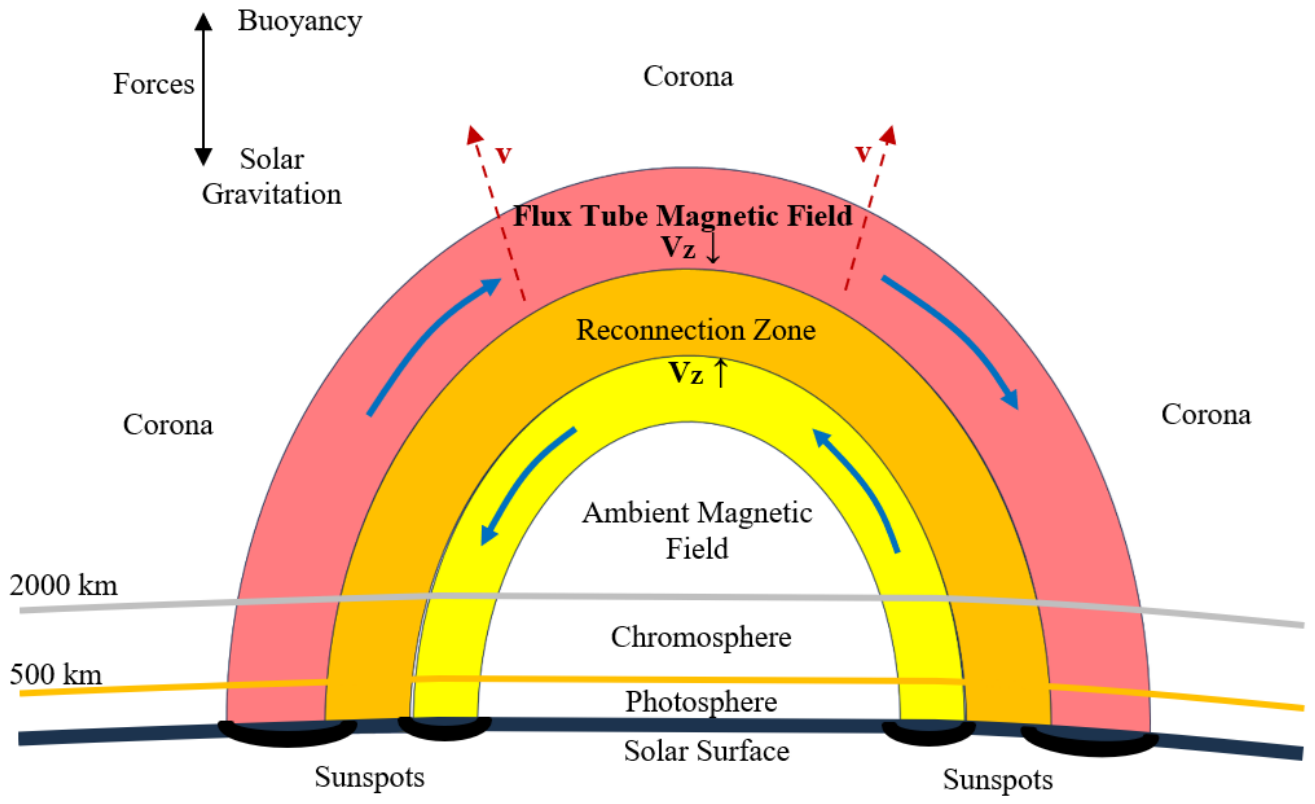
Figure 5.
Photony interpretation of the Sweet-Parker current-sheet geometry. Oppositely directed magnetic-chain and fibril organizations converge toward a region of enhanced loading, where accommodation, reassignment, and possible localized fragmentation can occur.
Figure 5.
Photony interpretation of the Sweet-Parker current-sheet geometry. Oppositely directed magnetic-chain and fibril organizations converge toward a region of enhanced loading, where accommodation, reassignment, and possible localized fragmentation can occur.
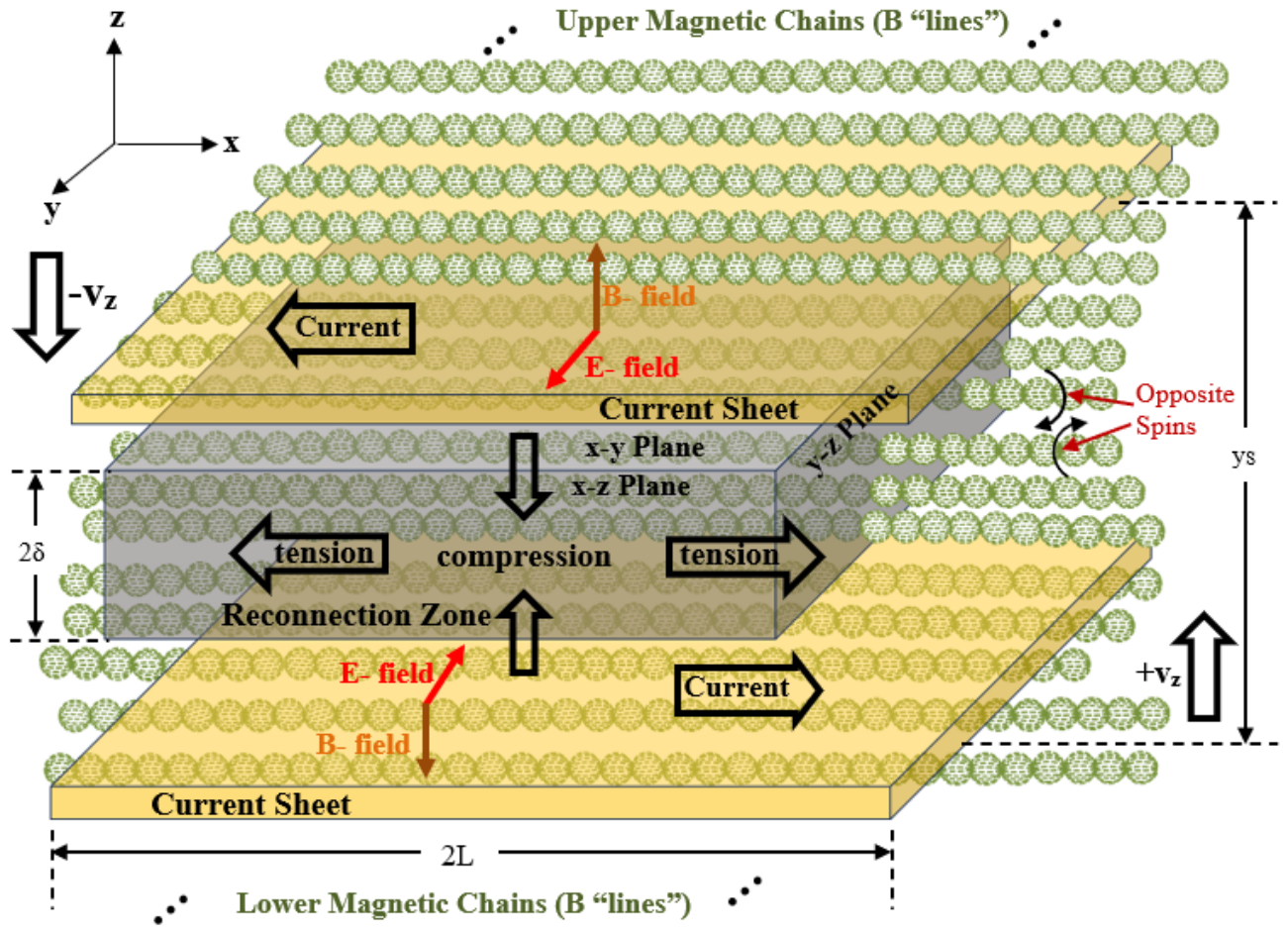
Figure 6.
Illustrative local energy-release timeline. The blue curve represents the instantaneous energy-release rate, while the orange curve represents the cumulative released energy obtained by time integration.
Figure 6.
Illustrative local energy-release timeline. The blue curve represents the instantaneous energy-release rate, while the orange curve represents the cumulative released energy obtained by time integration.
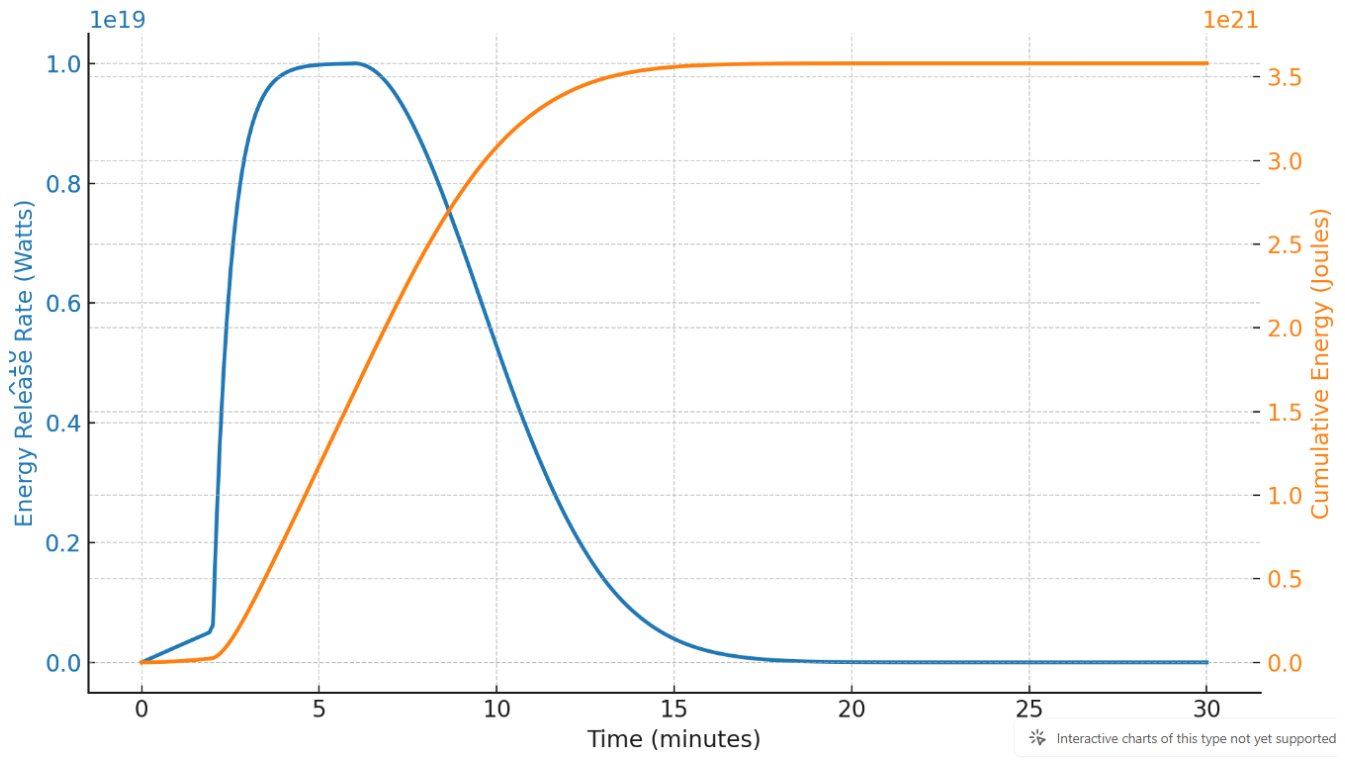
Figure 7.
Illustrative extended high-energy flare and eruption timeline. The red curve represents instantaneous energy-release rate, and the blue curve represents cumulative released energy.
Figure 7.
Illustrative extended high-energy flare and eruption timeline. The red curve represents instantaneous energy-release rate, and the blue curve represents cumulative released energy.
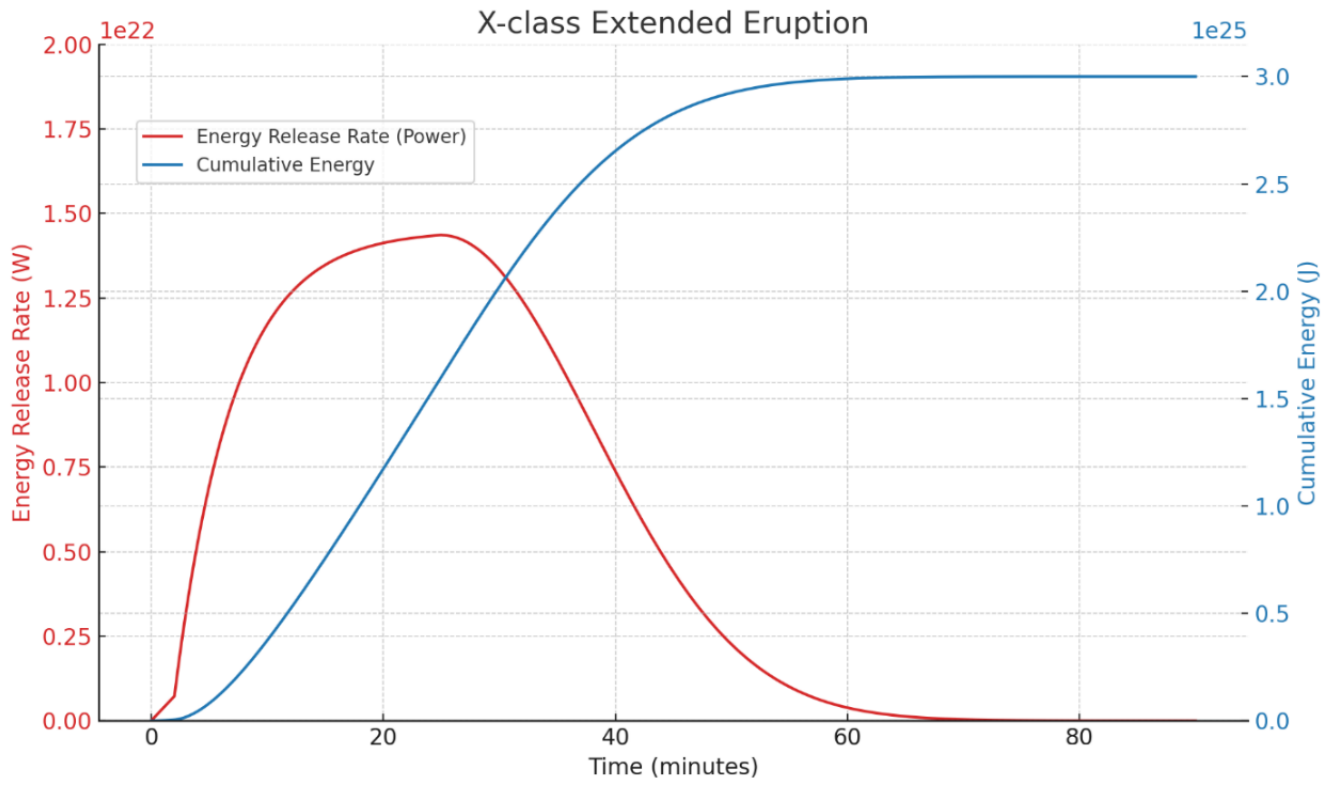
Figure 8.
Schematic overview of the proposed sequence from magnetic loading to reconnection and eruption development. Magnetic loading is first accommodated through deformation, redistribution, or reassignment where sufficient structural capacity remains. If the local threshold is reached and no admissible continuation can preserve magnetic-chain continuity, Magnetic Breakdown provides the failure branch. The resulting energy redistribution can contribute to particle acceleration, plasma heating, radiation, bulk plasma motion, magnetic reassignment, and continuing reconnection. Changes produced by the event can in turn modify the surrounding magnetic environment and contribute to subsequent loading and threshold crossings.
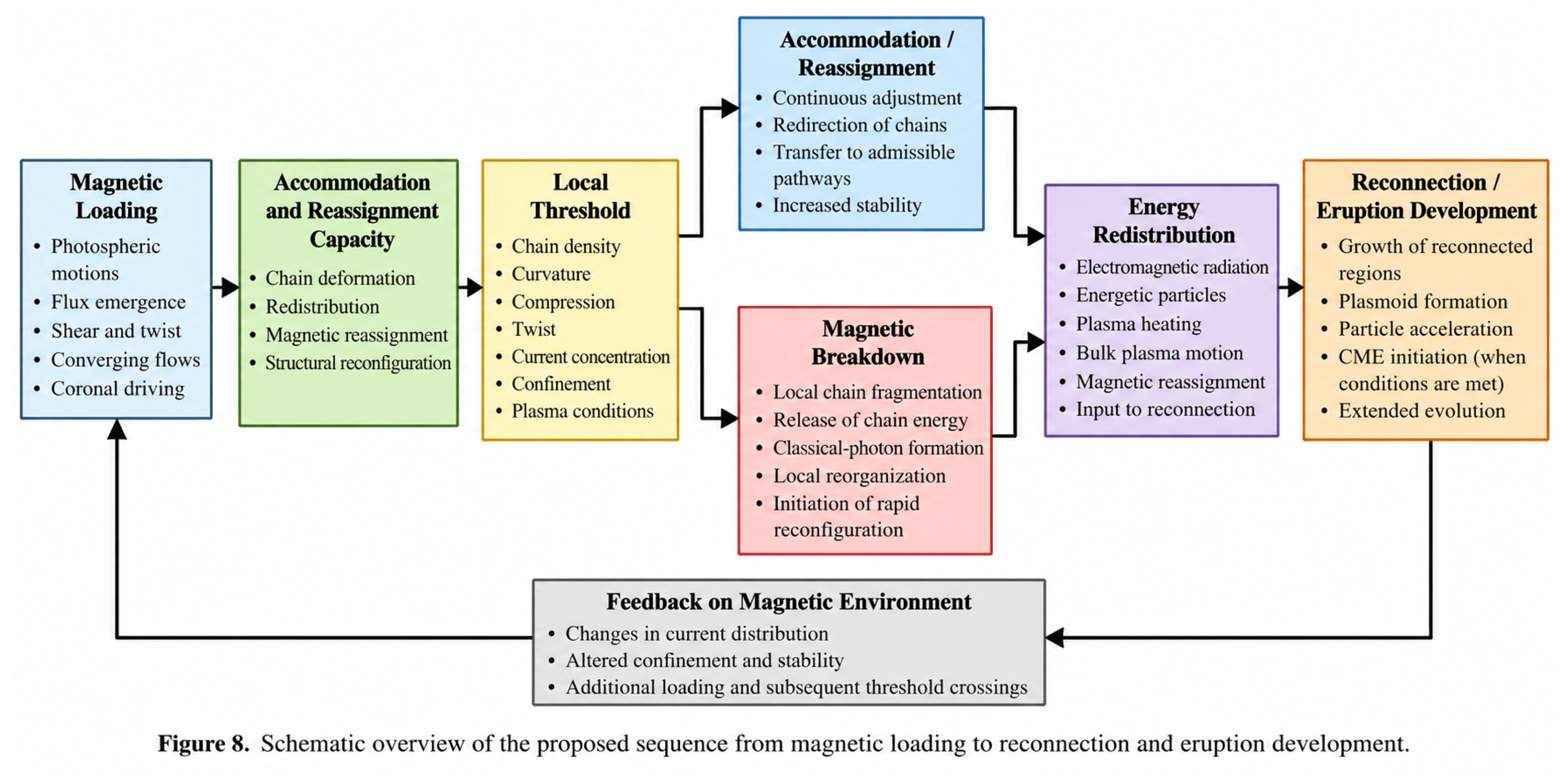
Figure 9.
Schematic Photony pathways following localized magnetic-chain fragmentation during Magnetic Breakdown.
Figure 9.
Schematic Photony pathways following localized magnetic-chain fragmentation during Magnetic Breakdown.
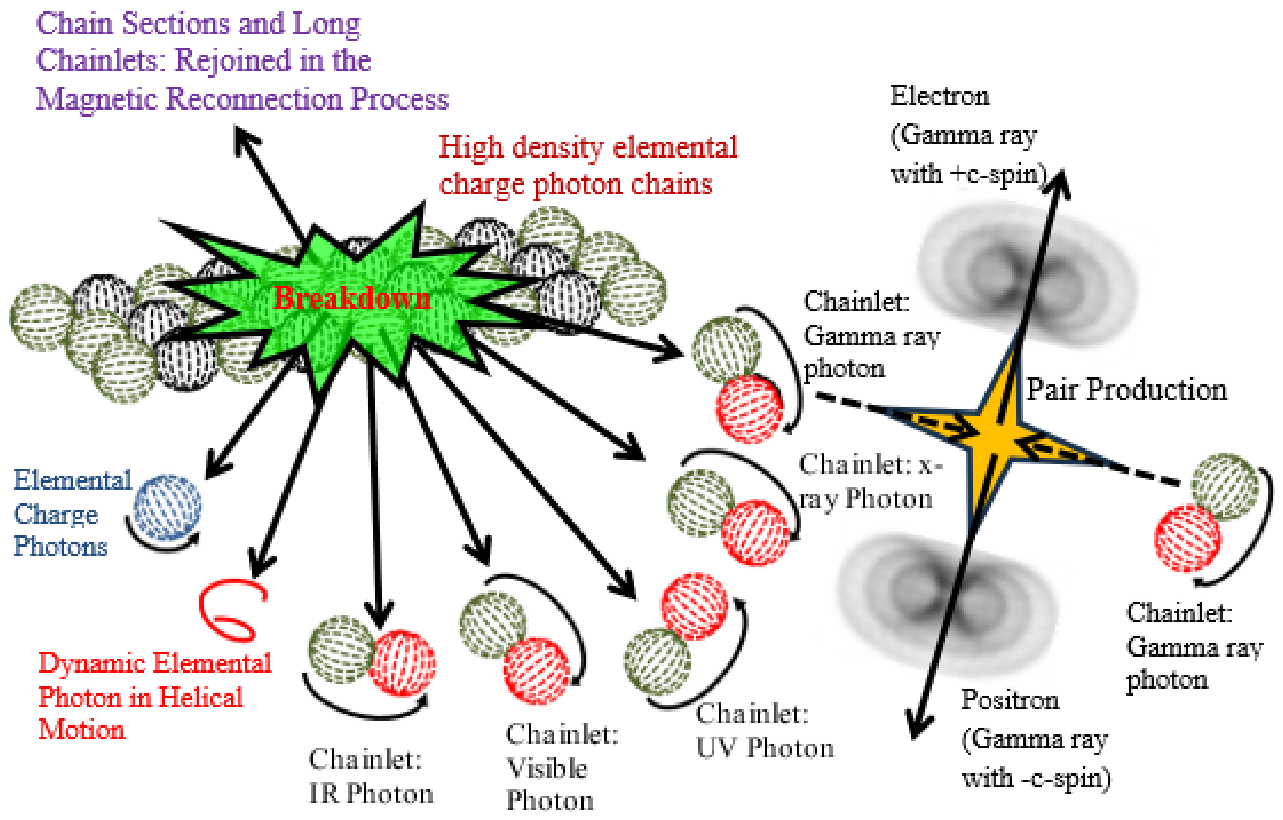
Table 2.
Functional comparison of selected solar-flare initiation and energy-release frameworks. The mechanisms need not be mutually exclusive and may operate at different stages or scales of the same event.
Table 2.
Functional comparison of selected solar-flare initiation and energy-release frameworks. The mechanisms need not be mutually exclusive and may operate at different stages or scales of the same event.
| Framework | Principal role or constraint |
|---|---|
| Sweet-Parker | Classical resistive-reconnection baseline; slow in high-Lundquist-number coronal plasma. |
| Fast reconnection | Allows rapid connectivity change through plasmoid, turbulent, kinetic, Hall, or related processes. |
| Breakout / tether cutting | Changes magnetic connectivity and confinement before or during eruption. |
| Kink / torus instability | Provides macroscopic instability thresholds associated with twist or loss of external confinement. |
| SOC / avalanche | Describes statistical criticality and cascading behavior across many events and scales. |
| 3D MHD / kinetic models | Integrates multiple processes numerically, with resolution and initial-condition limitations. |
| Magnetic Breakdown | Proposes localized threshold-driven loss of magnetic-chain continuity before or during broader reconfiguration. |
Disclaimer/Publisher’s Note: The statements, opinions and data contained in all publications are solely those of the individual author(s) and contributor(s) and not of MDPI and/or the editor(s). MDPI and/or the editor(s) disclaim responsibility for any injury to people or property resulting from any ideas, methods, instructions or products referred to in the content. |
© 2026 by the author. Licensee MDPI, Basel, Switzerland. This article is an open access article distributed under the terms and conditions of the Creative Commons Attribution (CC BY) license.
Copyright: This open access article is published under a Creative Commons CC BY 4.0 license, which permit the free download, distribution, and reuse, provided that the author and preprint are cited in any reuse.