
Submitted:
24 September 2026
Posted:
28 September 2026
You are already at the latest version
Abstract
The Q-ball mechanism of high-Tc superconductivity in cuprates, recently proposed by the author, is farther explored. Euclidean Q-balls are Bose condensed spin/charge density wave fluctuations (SDW/CDW) with zero static mean that arise simultaneously with Cooper/local pairs superconducting condensate for which they serve as the ’pairing glue’. Bose condensates of SDW/CDW fields possess wave-vectors connecting ’nested’ parts of the Fermi surface near van Hove singularities causing pairing of the fermionic states into superconducting Bose condensates. Self-consistency equations for quantum orders periodic in the imaginary Matsubara time fields signify a new development beyond Landau static mean-field order parameter approach. Cooper/local pairs condensation lowers Q-balls total energy relative to not condensed thermal SDW/CDW fluctuations in the same volume. Q-balls’ superconducting condensates cause spectral gap on the nested parts of the Fermi surface in the ’pseudogap’ phase of high-Tc cuprates, where the Q-ball scenario was supported by micro X-ray diffraction data in HgBa2CuO4+y. Scattering on the Q-balls causes: T-linear growth of electrical resistivity, splitting of in-plane phonon brunches into softened and hardened ones and "hourglass" dispersion of spin-wave excitations close to CDW and SDW wave vectors respectively. Diamagnetic response of Q-balls’ gas above Tc is in qualitative accord with experimental data in high-Tc cuprates.
Keywords:
Q-ball
; condensed fluctuation
; condensed ’pairing-glue’
; quantum order parameter
; high Tc cuprates
1. Introduction
It was demonstrated previously [1,2] that electron/hole Fermi surface possessing ’nested’ parts with high enough density of states , e.g., extended Van Hove singularity [3], makes the system unstable to formation of the Euclidean Q-balls (nontopological solitons) that constitute Bose condensed collective spin/charge density wave fluctuations (SDW/CDW) with zero static mean that arise inside a Q-ball simultaneously with Cooper/local pairs superconducting condensate for which they serve as the ’pairing glue’. Bose condensed collective spin/charge density wave fluctuations (SDW/CDW) possess the wave-vectors QDW that connect corresponding ’nested’ regions of the Fermi surface near the van Hove singularities, e.g., in the doped cuprates. Consideration of the self-consistency equations for the quantum order parameters in the form of periodic in the imaginary Matsubara time SDW/CDW semiclassical fields with zero mean actually signifies a new development beyond the Landau static mean-field order parameter approach. Corresponding free energy of the system is introduced then using Euclidean action instead of Landau free energy functional. In a particular case considered below the Bose condensation of the Matsubara time dependent SDW/CDW collective fluctuations forming a Q-ball is accompanied self-consistently by formation of the Cooper/local pair superconducting condensate formed of the - ’nested’ fermionic states, thus making Q-ball formation energetically favourable. The Q-ball SDW/CDW semiclassical field with symmetric bare Hamiltonian rotates with Matsubara bosonic frequency , thus, breaking chiral symmetry along the Matsubara time axis in Euclidean space-time and possessing zero mean. This rotation provides conservation of the Noether "charge" Q proportional to the number of elementary SDW/CDW excitations (spin-waves/phonons) condensed inside the Q-ball. The extra conserved quantity Q (besides the energy) makes the Q-ball volume finite. The temperature T* of the Q-balls condensation is proportional to the inverse correlation length (that defines the fluctuation’s ’mass’) of the SDW/CDW field and is much higher than static bulk SDW/CDW transition temperature [2]. The latter falls down below the dome of superconducting phase transition temperatures Tc defined by the Q-ball induced Cooper/local pairing mechanism of superconductivity [2]. The quintessence of why T* and Tc are relatively high with respect to the Bardeen-Cooper-Schrieffer (BCS) predicted superconducting transition temperature lies in that T* and Tc characterise instability with respect to condensation of the semiclassical Q-ball SDW/CDW field coherently mediating Cooper/local pairing of the ’nested’ fermionic states inside the Q-balls. This picture is drastically different from the BCS scenario of condensation of the Cooper pairs due to coupling of fermions via incoherent gas of single spin waves/phonons. Opening of the pairing energy gap in the fermionic spectrum of the Q-balls on the ’nested’ parts of the Fermi surface simultaneously transforms the whole system into ’pseudogap’ (PG) phase. The condition that the Q-balls field solutions minimise the free energy of the whole system provides the self-consistency equations solved in [1,2], that extend the Ginzburg-Landau static order parameter approach. Previously real and imaginary parts of ’rotating’ in real time order parameter field, that constituted two scalar fields with nonderivative interactions in Minkowski space-time, were considered by Sidney Coleman as a Q-ball ansatz for baryons [4] in the supersymmetric standard model, where conserved Noether charge Q counted the number of baryons associated with the symmetry of the squarks field [4,5,6]. The present paper extends farther theoretical investigation of the Euclidean Q-ball model predictions to the electron transport, phonon/spin dispersions splitting and diamagnetic properties of high-Tc superconductors above Tc. In particular, the T-linear temperature dependence of electrical resistivity in the interval of temperatures above superconducting dome maximum Tc is derived analytically. The diamagnetic behaviour observed experimentally in the "strange metal" phase [7,8] is derived analytically as well. Here we also investigate the changes in the spectra of the quantum spin and phonon excitations due to their scattering on the superconducting condensates inside the Q-balls. In particular, magnetic and phonon dispersions, analytically derived below, demonstrate direct correspondence with the experimentally found famous ’hourglass’ spin-waves dispersion in the vicinities of the SDW antiferromagnetic wave-vectors [9] and splitting into hardened and softened modes of the optical phonons found in the inelastic neutron scattering studies [10,11] in the high-Tc cuprates in the vicinities of the CDW ’nesting’ wave vectors of the Fermi surface regions in the PG phase. It is important to stress here, that unlike in the usual static ’nesting’ scenario with resulting long-ranged SDW/CDW ordering competing with superconducting pairing [12,13], the Q-ball semiclassical fields possess zero static mean values and therefore may belong to the ’local hidden orders’. Hence, the Q-ball induced magnetic and phonon spectral anomalies differ from the conventional Peierls-like pictures of static SDW/CDW formation, where electron-phonon/magnon coupling drives to zero corresponding dispersion branches of the excitations at the ordering wave vector of a static (spin)lattice distortion. Inelastic x-ray scattering studies of the phonon softening in high-Tc cuprates were also considered in relation with phonon coupling to CDW fluctuations, see [14,15,16] and references therein. Previously, the Q-balls theory predictions for X-ray scattering [17] were found in favourable accord with experimental results of X-ray diffraction in high-Tc cuprates superconductors in the heterogenous/PG phase [18,19,20].
The plan of the paper is as follows. In the next Sections II and III a quintessence of the Euclidean Q-balls picture is presented. Analytical derivations of the major parameters of the Q-balls, including temperature dependence of their energy, semiclassical Q-ball field amplitude and related phase diagram of the system possessing Q-balls are presented. In particular, it is demonstrated that the first order transition temperature T* is proportional to the inverse correlation length of the short-range spin/charge density wave fluctuations. An idea of a Matsubara time-dependent semiclassical ‘pairing glue’ between fermions in cuprates, but for an itinerant case, was proposed earlier [24]. Described here superconducting pairing mechanism mediated by semiclassical Q-ball field is distinct from the usual phonon- [25,26] or spin-fermion coupling models [27] considered previously for high-Tc cuprates, based upon exchange with infinitesimal spin- and charge-density excitations [15] or polarons [28] in the usual Fröhlich picture. In section IV the self-consistently determined temperature dependence of the Q-ball field amplitude is used for an analytical derivation of the T-linear temperature dependence of the inverse life-time of fermionic excitations due to scattering on Q-balls in the normal phase. This inverse life-time T-linear temperature dependence is in accord with experimentally measured linear temperature dependence of electrical resistivity in the ’strange metal’ phase [7]. In Section V the paraconductivity calculation method by Alex Abrikosov [30] is used for derivation of electrical resistivity dominated by Q-balls slide. In Section VI diamagnetic response of Q-balls ’gas’ is calculated and qualitative accord with experimental data of L. Li et al. [8] is found. In Section VII the ’hourglass’ like dispersion in the vicinity of antiferromagnetic SDW wave vectors of the magnetic excitations, and splitting of the Cu-O in-plane phonon brunches into the softened and hardened ones close to CDW fluctuations wave vectors in the Brillouin zone are derived analytically and plots generated by Wolfram Mathematica program are presented. Conclusions follow in Section VIII.
2. Euclidean Extension of Landau’s Free Energy Functional Approach
This section contains an overview of the previous work on Q-balls in Euclidean space-time that helps a reader to navigate from the origins of the main expressions to the derivation of the temperature dependences of the field amplitude used to achieve the main results of the present paper. More detailed information is incorporated in the works published previously [1,2,17,20].
The usual Hamiltonian describing interaction between electrons and phonons/spin waves is written in the form [31]:
leading to the effective interaction Hamiltonian used by Eliashberg [26] in the Fröhlich picture [31] of superconductivity mechanism:
where phonon/spin-wave propagator equals [31]:
where the Boltzmann constant is taken for unity . The Q-ball picture of superconductivity proposed recently [1,2,17] considers possibility of Bose-condensation of phonons/spin-waves in some particular points of their Euclidean frequency-momentum phase-space thus leading to a substitution of the creation/annihilation phonon/spin-wave Bose-operators with the Matsubara time - dependent order parameter represented by the Bose-condensate c-number operators :
describing a finite density of the corresponding lattice charge/spin density distortion: . Importantly, the Bose c-number operators in Equation (4) possess chirality along the Matsubara time axis, i.e., the symmetry is broken. This is necessary condition for nonzero conserved Noether "charge" Q to exist along the winding trajectory of the Bose-condensate in Euclidean space leading to a finite Q-ball volume. It is shown in [1,2,17] that the free energy of the system may possess a minimum with respect to amplitude and Q-ball volume . Such a nontrivial minimum arises for a finite volume Q-balls due to condensation of superconducting Cooper/local fermionic pairs, for which the operators play the role of the ’pairing glue’ bosons. Thus, this new mechanism of superconductivity describes the picture of fluctuating semiclassical charge/spin-density waves with a particular Bose frequency inside the Q-balls, represented by operators , that are not at all competing with superconductivity, but on the contrary, are creating it in a self-consistent manner. To see how this happens, one may start from a simple t-U Hubbard Hamiltonian:
and use formally the Hubbard-Stratonovich decoupling procedure with a scalar complex field defined in Equation (4): , that leads either to electrons/holes scattering on SDW field :
or to electrons/holes scattering on CDW field in the crystal lattice:
where the shorthand , and spin factor is missing in the charge - fermion coupling vertex and interaction representation is implied for the fermionic creation/annihilation operators with the hamiltonian (5), but without U-term. The Hubbard-Stratonovich field of a Q-ball nontopological soliton is sought for in the form:
where V is the Q-ball volume that minimises the Euclidean action found below. Thus, besides Matsubara time periodicity , the field is assumed to break chirality along the Matsubara time axis. A simple model Euclidean action for the scalar field , could be written as:
where s is bare propagation velocity, and the ‘mass’ term imposes finite correlation length of the fluctuations. Considering now the Fermi surface with the ’nested’ parts with high enough density of states, e.g., Van Hove singularity [3], being connected by a wave vector , one would customary declare as the next step that field is Matsubara time independent, with a ’nesting’ wave-vector becoming a SDW or CDW wave vector formed under (Peierls-like) phase transition, that forms corresponding energy gap in the fermionic spectrum. Hence, superconductivity would be then considered as a ’competing order’, see e.g., [12,13] for a recent overview. The Q-ball picture approach is drastically different.
2.1. Hubbard-Stratonovich Q-Ball Field as the ’Pairing Glue’
It was shown [1,2] that Euclidean action of the Hubbard-Stratonovich field may develop a semiclassical minimum of the Q-ball universality class (nontopological Euclidean soliton) (8) when simultaneously the fermions that are ’decoupled’ by this field in Equations (6), (7) start locally condense into a Cooper/local pair superconducting condensate. The soliton field is periodic in Matsubara time with zero mean value, and, therefore, is called ’thermodynamic quantum time crystal’ [21,22]. But, most important, besides Matsubara time periodicity , the field is assumed to break chirality along the Matsubara time axis, thus taking the form in Equation (8). The Q-balls with ’counterclockwise’ chiral combination are also allowed as separate objects. After the Hubbard-Stratonovich SDW/CDW field in the above form is inserted into decoupled parts of the t-U Hubbard Hamiltonian Equations (6) and (7) the Cooper paired fermions are integrated out creating an additional energy term in the effective action of the field:
Here is Hamiltonian of the noninteracting fermions on a lattice with the bare dispersion and is the electron pairs contribution to the free energy. The latter is calculated via standard procedure [31] and its result is presented in detail in [1,2]:
where signifies the width of the interval along the energy axis, , with nonzero density of fermionic states obeying the ’nesting’ relation around the chemical potential . Expression (13) is remarkable, since it bears result of the important two step self-consistent ’bootstrap procedure’ [1,2]. Namely, at the first step the following relation is derived using mentioned above procedure for the free energy calculation via integration over a variable coupling strength [31]:
where the loop of Gor’kov anomalous functions describing the condensed paired fermions contains the Q-ball semi-classical field propagator instead of the usual phonon-/spin-wave propagator in the Fröhlich picture [31].
2.2. Eliashberg-like Equation with Q-Ball Field as the ’Pairing Glue’
The second step of the ’bootstrap’ self-consistent procedure would be then to solve the Eliashberg-like equation for the Gor’kov anomalous fermionic Green’s functions with the Q-ball field (8) playing role of the ’pairing glue’ that couples ’nested’ fermionic states on the bare Fermi surface [1,2]:
where :
Here:
The self-energy function is approximated with parabolic function of the bare fermionic dispersion in the vicinity of the Fermi energy:
As it was found previously [24], compare [26], the normal self-energy function leads to renormalisation of the Fermi velocity and the chemical potential shift and could be neglected. Then, using approximation (18) for the self-energy function it is straightforward to convert Equation (15) directly into differential equation of the Mathieu type [1,2]:
exact solutions of which are well known, and the anti-periodicity condition [31] for the sought for solution for the fermionic Green’s function is explicitly indicated. The lowest possible eigenvalue is then [32]:
Hence, a non-zero anti-symmetric solution of Equation (19) with real eigenvalue exists when . This result is remarkable: it follows from relations (15), (18) and (20), that Q-ball of ’glue boson’ condensate possessing amplitude also possesses a Cooper pair condensate characterised with non-zero anomalous Green’s function :
Since non-zero solution for the superconducting gap arises starting from finite amplitude , the Q-ball phase transition is of the first order with respect to the Q-ball field amplitude M. On the other hand, at finite M, that obeys: the density of superconducting condensate inside the Q-ball equals zero. Hence the Q-ball phase transition is of the second order with respect to the density of superconducting condensate inside the Q-ball. Next, at the last step, an amplitude M is substituted with in (20) according to the definition of the formal dimensionless coupling parameter in Equation (14), thus, leading to the final expression in Equations (12), (13):
which is used in the final ’bootstrap’ expression for the effective Q-ball field energy in Equation (13). Hence, now one obtains the effective Euclidean action of the field , that includes contribution from condensed superconducting fermionic pairs, . The action has to be searched for the assumed Q-balls quasi-classical minima:
where , V - is the system volume, . Under these values choice the action (23) would indeed serve to decouple the interaction term in the t-U Hubbard Hamiltonian in Equation (5), that results then in appearance of the term or similar in the Hamiltonians in Equations (6),(7). Hence, the amplitude of the field relates with the local condensed spin/charge densities as: . This in turn imposes upper limit on the amplitude of the field: allowing for the value of a local electron spin/charge that might condense in the SDW/CDW Q-ball fluctuation considered here [29]. The model (23) is invariant under the global phase rotation : . Hence, corresponding ‘Noether charge’ is conserved along the Matsubara time axis [1,2]:
The ‘Noether charge’ conservation causes occurrence of Matsubara time periodic, finite volume Q-ball semiclassical solutions, that otherwise would be banned in D by Derrick theorem [33] in the -independent static case. Indeed, substitution of relation for the charge Q (24) into Euclidean action (23) leads to the expression that possesses minimum at finite Q-ball volume :
Provided the term above is positive, the action is minimised by Q-ball volume :
for which the free energy of the Q-ball field equals:
After cancellation of Q-factor in the last relation in Equation (27) above the following self-consistency equation emerges [2]:
One then substitutes from Equations (12), (13) into self-consistency equation Equation (28) and finds:
The above self-consistency equation was investigated in [1,2] numerically. Below, using approximate expression for the potential energy the dependences will be found analytically and used for calculation of the temperature dependences of electrical resistivity and diamagnetic response of the Q-ball gas above superconducting transition temperture Tc. Simultaneously, condition at marks transition to the bulk superconducting state since the Q-ball volume then diverges according to Equation (26). One important observation is in order. Expression (29) could be obtained in two different cases. Namely, there are two possibilities for the self-energy function : the d-wave symmetric behaviour of superconducting order parameter and the s-wave behaviour of it . The first case realises when spin (SDW) fluctuations couple to the fermions via interaction Hamiltonian (6), while the second case realises when charge (CDW) fluctuations instead of spin fluctuations couple to the fermions via interaction Hamiltonian (7). The particular choice of the two symmetries: , is governed by the demand that contribution to the free energy in (14) due to pairing would be negative. The spin factor is missing in the charge - fermion coupling vertex in (7). This leads to the absence of the factor in the Equation (14) in the CDW Q-ball field case. Hence, in order to keep , as is necessary for the Q-ball formation, one has to compensate for this sign change in the CDW Q-ball field case by the change of the sign of the Green’s functions product in Equation (14). Then, allowing for the structure of the Gor’kov’s anomalous Green’s function in Equations (15), (16) one concludes, that relation between the values of superconducting order parameter in the points connected by the ’nesting’ wave vector should be altered with respect to Q-ball of SDW fluctuation, i.e in case of CDW Q-ball mediated pairing the ’nesting’ wave vector should couple points with the same sign of superconducting order parameter.
3. The Phase Diagram of the Q-Balls Gas
Summarising, Equation (23) was used to describe effective theory of the Fourier components of the leading Q-ball (i.e., short-range) SDW/CDW fluctuations. Explicit expression for was derived and investigated in detail previously [1,2] by integrating out Cooper/local-pairs fluctuations in the ‘nested’ Hubbard model with charge-/spin-fermion interactions. As a result, Q-ball self-consistency Equation (28) was solved and investigated, and it was established that Euclidean Q-balls describe stable semiclassical short-range charge/spin-ordering fluctuations of finite energy that appear at finite temperatures below some temperature T*, found to be [1,2]. Next, it was also found that transition into pseudogap phase at the temperature T* is of the 1st order with respect to the amplitude M of the Q-ball SDW/CDW fluctuation and of 2nd order with respect to the superconducting gap . In particular, the following temperature dependences of these characteristics of the Q-balls were derived from Equations (13), (20) and (28) in the vicinity of the transition temperature T* into Q-ball phase [2] for the CDW/SDW amplitude:
and for the pseudogap :
which follows after substitution of Equation (30) into Equation (20). The above results differ from those presented in [2] by the change of the value of , used previously, for the more precise value in (20).
An expression for the fermionic pairing contribution to the potential energy, , found in Equations (12) and (13) could be approximated away from the temperature in the form:
where now is used for the superconducting gap function :
Hence, substituting the above expression into the pairing-induced effective potential energy of SDW/CDW field in Equation (12), one now finds:
Then, one finds the value of the highest superconducting transition temperature from the Q-ball volume divergence condition in Equation (26):
From where it is straightforward to find:
Now, substituting results from Equation (36) into Equation (33) one finds directly the following relation between the superconducting gap and the temperature :
The above results in Equations (36), (37) are remarkable from two points of view. First, the ratio of reduced superconducting gap in Equation (37) drastically differs from the BCS ratio [25] and compares batter with found for BSCCO high- compounds [34]. Second, expression for in Equation (36) permits, in principle, to infer relation with the isotope effect, since besides the product the expression contains also the SDW/CDW characteristic parameter . Simultaneously, the pseudogap/strange metal transition temperature possesses the same parameter in the numerator. Hence, the isotope effects for and would contain exponents of the opposite signs related with Q-ball parameter . The next application of the approximate expression for the fermionic pairing contribution to the potential energy, , found in Equation (32) is even more impressive.
Namely, substituting Equation (32) into the self-consistency equation (28) one finds:
that trivially leads to the two-branches solution obtained previously (see Figure3 in [1,2])from numerics:
First of all, introducing notation:
one finds the following equation that defines the boundary of the regions in the plane where both brunches in Equation (39) are real:
Thus, one finds that Equation (41) coincides with condition previously obtained numerically [1,2] for the existence of solution of the self-consistency equation (29), see Figure 1. In particular, a straightforward algebra gives from Equation (41) the result for the strength corresponding to the touching point of the temperature boundaries of the strange metal and superconducting dome . Here one notes that at the bulk superconductivity transition temperature found from Equation (35) is below the Q-balls temperature : , which is obvious from the Figure (35), where bulk superconductivity temperatures are plotted with dotted line. It is remarkable, that using neutron scattering results for related with effective superexchange coupling between neighbouring magnetic moments in high-Tc cuprates [35] one finds ’why is high’:
Last, but not the least, it follows from Equation (39) that in the interval , i.e., in the temperatures interval with , the square root in Equation (39) could be expanded in the powers of the second term, which is smaller then unity, leading to the following expression for brunch:
This remarkable result, meaning the linear temperature dependence of the Q-ball field amplitude M, leads to the linear temperature dependence of the electric resistivity due to scattering of electrons on the field Q-balls, as is shown in the next Section IV. The numerical results of finding dependences after substitution into Equation (35) and Equation (38) of the complete expression for the effective potential energy from Equations (12), (13) are plotted in Figure 2.
4. Electron Scattering and Resistivity of Q-Ball Gas
The Q-ball mechanism of the high-Tc superconductivity and pseudo-gap phase in cuprates introduced previously [1,2,17] is in essence a mechanism of Cooper-pairing that occurs due to pairing of fermions via exchange with bosonic fluctuations of spin- or charge density waves (SDW/CDW) condensed locally into Q-balls, the nontopological solitons of thermodynamic quantum time crystals. The conserved Noether charge Q counts the total number of condensed bosonic fluctuations inside the Q-ball, and the basic internal rotation frequency of the Q-ball is bosonic Matsubara frequency of the fundamental Fourier component of the SDW/CDW semiclassical fluctuation. The heterogeneous phase of Q-balls appears below T* temperature and exists down to the temperature , that bounds from below the ’strange metal’ phase. In the optimally doped case coincides with the top of the superconducting dome Tc of the high-Tc cuprates phase diagram [1,2]. Below we demonstrate that influence of Q-balls on the electrical transport in the "strange metal" phase causes "Planckian" [36] linear temperature dependence of the normal metal resistivity [7]. In short, since a Q-ball occupies finite space, there are outside electrons, that are not Cooper paired, and are scattered by the Q-ball SDW/CDW fluctuation. Demonstration of the fact that the T-linear temperature dependence of electrical resistivity of the "strange metal" phase occurs due to electrons scattering on the Q-balls is the focus of the present work. Besides, dragged by electric field (unpinned) CDW Q-balls become sliding charge ’droplets’, and hence, also contribute to the resistive normal current. This effect is considered below as well. Stability of Q-balls was proven for finite temperatures in [1,2] and long before that for the ground state of quantum matter [4,5].
To proceed one uses the Q-ball - fermion interaction Hamiltonian in the form [2]:
where is either antiferromagnetic Brillouin zone SDW nesting wave-vector, or CDW wave-vector connecting the hot spots of the Fermi surface, and , and R, V, M are Q-ball radius, volume and amplitude defined in Equations (8), (24) and found self-consistently. Summation over random coordinates of the Q-ball centres is assumed in Equation (44). The Dyson equation for the Green’s function of electrons scattered on the Q-balls potential is presented in Figure 3. It follows from the well-known impurity scattering procedure [31], that averaging over the coordinates of the Q-ball centres leads to the sum over double-scattered fermions on each Q-ball separately.
In Figure 3 the heavy and thin lines are fermionic temperature Green’s functions and respectively, that depend on the differences of the coordinates after averaging over positions of the Q-balls in space and Matsubara time origin . Dots are vertices of fermion- Q-ball field M interaction introduced in Equation (44). The M-field bosonic Green’s function , that follows from Equation (44) after averaging over positions of the centres of the Q-balls and Matsubara time zero-origin is:
It is remarkable that due to semiclassical nature of the Q-ball fluctuation its Green’s function possesses only single frequency which is self-consistently determined from Equations (28) and (12), (13). Then, taking the Green’s function of the scattered fermions in the form:
where is the chemical potential, and using the Dyson’s equation in Figure 3, one finds the following equation for the self-energy function :
where is density of Q-balls with "charge" Q defined as:
Below it is assumed for simplicity that major scattering involves the fermions that occupy hole pockets in the Brillouin zone of doped cuprates with being approximately magnetic Brillouin zone wave vector [1,2], or and connects hot spots on the Fermi surface. Therefore, it is assumed that both -vectors connect quasiparticle states of the opposite energies with respect to Fermi level, i.e., quasi-holes with quasi-electrons and vice versa : . Hence, using the latter equalities it is straightforward to change integration vector in the integral equation (47): , that leads to:
Then, assuming: , and changing the integration variables (compare [31]):
one rewrites Equation (49) in the form:
Now, allowing for the relation justified aposteriori: , Equation (51) reads:
Next, analytic continuation of Equation (52) to the real axis of frequencies, , gives:
The Q-ball form factor reduces integration over q to the interval and, therefore, allowing for the mesoscopic Q-ball sizes [17]: , it is fare to approximate the above relation expanding to the first order in :
Hence, one finds from Equation (53) the following ’on shell’, , equation for :
Now, assuming to be responsible for electrons damping rate and thus purely imaginary, one finally finds after integration in (55) an equation for :
Using now definition for from Equation (48) and relation , where is Q-ball radius, substituting summation over Q by integration, expressing via M and Q using Equation (24), and allowing for the scaling of the Q-ball amplitude with temperature in Equations (30), (43): , , one finds:
The coefficient in front of in Equation(56) is more elaborate:
Hence,
Solving Equation (56) with the aid of relations (57) and (59) one finds the following relation for the fermionic quasiparticle lifetime due to Q-ball scattering (± sign below is chosen depending on retarded- or advanced Green’s function is considered), :
The above result is remarkable, since it demonstrates that linear temperature dependence of the fermionic inverse lifetime arises due to Q-ball scattering in the whole temperature interval , thus providing origin of the "strange metal" behaviour. The bosonic frequency of the quantum thermodynamic Q-ball time crystal plays the role of a scattering rate for the fermions in the Q-ball semiclassical field, manifesting the prominent ’Planckian’ scattering rate behaviour [36]. It follows also from Equation (45), that plays the role of Fourier components of the Q-ball field propagator modulo Q-ball density . Simultaneously, the CDW/SDW wave vector entering propagator , causes anisotropy of the scattering rate, thus explaining ’quantum nematic’ behaviour known for high- cuprates [37]:
where is electron conductivity tensor.
5. Electron Resistivity Due to Q-Balls Slide
The picture of ’free’ fermions scattered by a gas of randomly distributed in space Q-balls considered in the previous Section might be not complete in the case of Q-balls, that are not pinned to the lattice. Namely, one may consider contribution to the electrical resistivity coming from the slide of the Q-ball CDW as a whole in a weak electric field. To calculate this contribution one may use a method described in [30] by adding potential energy term of a Q-ball charge density in a homogeneous constant electric field: , thus adding an extra term to the Euclidean action in Equation (9) and, correspondingly, modifying the saddle-point equation, that becomes then:
Solving this equation expressed via Fourier transformed function to the first order in potential Fourier component, one finds:
where reads:
Then, to the first order in electric field the Q-ball sliding CDW current density reads:
and hence:
First, expression in Equation(66) is remarkably different from expression for the electrical conductivity due to scattering of the ’free electrons’ on the Q-balls. Namely, the pronounced nematicity of the conductivity tensor in Equation (61) is manifestly absent in Equation (66). This points to a hydrodynamic character of the Q-ball CDW slide in external electric field. Next, it is instructive to apply above result to the vicinity of T* temperature, since the power indices for the temperature dependencies of the Q-ball parameters where found earlier [1,2]. Taking into account that superconducting gap approaches zero at T* according to Equation (31), and following Ginzburg-Landau theory of the superconducting order parameter, see e.g., Chapt.17 [30], one finds that minimal radius of the Q-ball with superconducting condensate inside diverges as [2]:
6. Diamagnetic Response of Q-Ball Gas
It is straightforward to apply presented above picture of Q-ball gas in high-Tc superconductors for description of experimentally discovered diamagnetic behaviour above Tc in cuprates [8,38]. Again, as in Equation (48) using the concept of the phase space of the Q-balls formed by the values of the ’Noether charge’ Q and discrete values of the Matsubara frequencies , , and counting the number of the different ’positions’ of a Q-ball in the real space as , where V is the volume of the system and the Q-ball volume is determined using the ’charge’ Q conservation law Equation (24):
one finds the following expression for the partition function of the Q-balls gas in the temperature range where it exists, , see Figure 1:
The Q-ball energy in the first term of the Boltzmann’s expression in the brackets in Equation (71), , is taken from the self-consistency Equation (27). The lower and upper bounds in the integral over are as follows. The smallest value of is obtained from Equation (70) for the Q-ball of the size bound from below by the Landau correlation length , see Equation (67):
with defined by Equation (31). The upper bound in the integral in Equation (71) is obtained as follows:
where is the maximum radius of a small superconducting sphere [39], at which it remains superconducting in magnetic field H, and is London penetration depth, is critical magnetic field of the bulk superconductor material, is superconducting electrons density, as derived in [1] in accord with Uemura plot behaviour [40], with given in Equation (37), is the bare fermionic density at the Fermi level, m is electron mass, and c is light velocity. The next term, , in the Boltzmann’s expression in the brackets in Equation (71) is the energy of diamagnetic moment in magnetic field H:
where is projection of diamagnetic moment of a Q-ball on the magnetic field direction . The Q-ball is regarded as a small superconducting sphere of radius possessing diamagnetic moment in magnetic field H [39]. In the last equality in Equation (74) R is substituted via the expression obtained from the Q-ball ’charge’ Q conservation relation Equations (24), (70). Composing altogether the above relations one finds the following expression for the free energy of the Q-ball gas:
In the highest temperature interval one takes integer , see Equation (41) and Figure 1, and then for the free energy of the Q-balls gas and density of its diamagnetic moment one finds:
where one has to substitute solution of the self-consistency Equation (27) using e.g., solutions from Equation (30), or in the form of the two-branches solution Equation (39). This leads to the following dependence found numerically from Equations (79), (80) above, see Figure 4.
7. "Hourglass" Magnetic Spectrum and Splitting of the In-Plane Phonon Brunches into the Softened and Hardened Ones Due to Q-Balls Scattering
The scattering of quantum spin excitations and phonons on the condensates of Cooper/local pairs inside the Q-balls induces self-energy, see Figure 5, that consists of closed fermionic loop of Gor’kov’s anomalous Green’s functions F, , the latter are found in Equation (21) above. The difference of the two cases of the Q-balls formed by SDW and CDW fluctuations causes different patterns of the magnons and phonons dispersions in the vicinities of the and wave vectors in the brillouin zone. We start from the case.
7.1. Hourglass Magnetic Spectrum Due to SDW Q-Balls Scattering
The Dyson equation for the Green’s function of magnons/phonons, that will be defined below by a particular choice of the vicinity of the wave-vector and corresponding bare dispersion , takes the form [31]:
where Matsubara bosonic frequency is defined by any integer n and coupling constant describes coupling of spin/phonon excitations to the fermions. Here one important observation is in order.
In the case of the coupling with magnons and the Green’s function with momenta close to the anti-ferromagnetic wave-vector corresponding to SDW fluctuations, one considers component of the magnons Green’s function in the Dyson’s equation (81) above and correspondently the polarisation loop in Equation (83) contains then pre-factor , which is compensated by discussed previously, see end of Section 3 [2], d-wave symmetry of the superconducting order parameter known for cuprates [3]: . On the other hand, when coupling with phonons is considered close to the ’nesting’ wave-vector in the Brillouin zone corresponding to the CDW fluctuations, then the pre-factor is missing in the polarisation loop in Equation (83), and corresponding superconducting order parameter is of s-wave symmetry [20]: , see Figure 6. Hence, the expressions for the polarisation loop and Green’s function of magnons with the wave vectors close to the antiferromagnetic wave-vector in the inverse crystal lattice units take the following form obtained with the use of Equation (21):
Here we first take the bare fermionic dispersion along the ’nesting’ vector close to the bare Fermi surface at the extended Van Hove singularity for a one-dimensional dispersion function: and ’nesting’ condition along the would be then: with the corresponding : , see Figure 6. Hence, calculation of the polarisation loop for along the nesting vector direction in the Van Hove singularity region of energies , i.e., for with could be done along the energy axis with corresponding density of states near the Van Hove singularity . Then, the integral in the Equation (85) takes the form:
Next, making analytic continuation to the axis of real frequencies: in Equations (84), (85) one finds the following expression for the retarded magnons Green’s function , where a new notation is used for brevity:
The above result is remarkable: the poles of the expression in Equation (87) provide two dispersion branches of magnons near the in the Brillouin zone:
When wave-vector of the magnons is taken along the antiferromagnetic SDW nesting vector direction in the vicinity of the bottom of the antiferromagnetic excitations band, i.e., for with , one may approximate the bare magnon dispersion in the form:
introduced already in Equation (9), where s is spin-wave velocity and is the ’magnon mass’ characterising the short range character of antiferromagnetic fluctuations in the doped cuprates. Substituting the above expression from Equation (89) into expression for the magnon dispersion branches in Equation (88) one finds dispersion plotted in Figure 7, that follows famous experimental data for high-Tc cuprates reported long ago [9].
7.2. Splitting of the In-Plane Phonon Dispersion Brunches Due to CDW Q-Balls Scattering
Now, we turn to the splitting of the in-plane phonon dispersion brunches into the softened and hardened ones due to scattering of phonons on the CDW Q-balls close to the wave vectors designated in Figure 6. Obtained theoretical curves of the phonon brunch splitting that follow from Equation (88) are presented in Figure 8. Substituting the bare phonons dispersion:
close to the ’nesting’ wave-vectors into the general expression in Equation (88) one obtains splitting of the in-plane phonon dispersion brunches in the vicinity of these wave-vectors that was studied experimentally [10], compare Figure 8a and Figure4 in [10]. The pole strength of the phonons Green’s function in Equation (87) corresponding to the "hardened" dispersion brunch at in Figure 8a is small and corresponds to the excitation of the phonon by the virtual collapse of two fermions into the Cooper /local pairs condensate inside the Q-ball with transferring the energy twice the superconducting gap to the lattice distortion, see line in the insert Figure 8b. Simultaneously, the "softened" dispersion brunch:
possesses maximum softening at , see Figure 8a, due to the term defined in Equations (86), (87). The higher pole strength of this brunch is plotted in the insert Figure 8b, see line. It is remarkable, that rather different dispersion curves in the figures Figure 7 and Figure 8 are obtained from one and the same Dyson equation (88), but with the different bare dispersions in Equations (89) and (90), and with the different Gor’kov’s functions F, that describe d-wave and s-wave Cooper-pairs condensates inside the SDW and CDW Q-balls respectfully.
7.3. Dynamical Structure Factor of the Q-Balls ’Gas’
Since inelastic pulsed neutron scattering technique provides experimental data for the dynamical structure factor , where is the momentum transfer and is the energy transfer [10], it is possible to compare experiment with the present theoretical results. Namely, is imaginary part of the density-density correlation function, that could be expressed via phonon Green’s function found above in Equation (87) to the lowest order of the perturbation theory with respect to electron-phonon coupling in the following form:
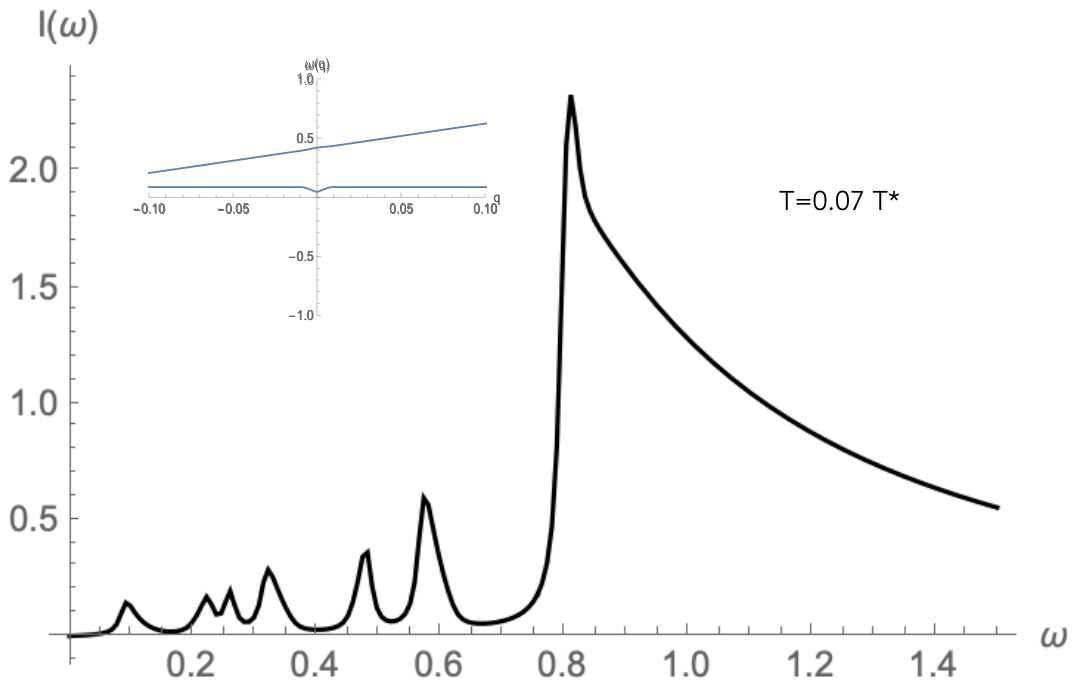
Substituting phonon Green’s functions from Equation (87) and turning to retarded expression in Equation (93) after analytical continuation to real frequency axis, one finds the dynamical structure factor at different temperatures indicated with two arrow bars in the Q-balls phase diagram in Figure 1. Numerical results obtained from Equation (92) with superconducting gap from Equation (31) are presented in Figure 9 and Figure 10.
8. Discussion
To summarise, presented above theory of the quantum orders in the form of periodic in the imaginary Matsubara time SDW/CDW fields signifies a new development beyond the Landau static mean-field order parameter approach. Favourable comparison of the theory with experiment [7,8,9,10,11] indicates that described above picture of free fermions outside the gas of Q-balls with Cooper pairs condensates inside of them below temperature T* opens an avenue for direct investigation of the thermodynamic quantum time crystals [21,22] of SDW/CDW dynamic quantum condensates forming space heterogeneous fluctuations [20]. This realm of new phenomena possesses direct relation to observed physical properties of high-Tc superconductors. In a particular picture related with high-Tc Q-balls scenario, the vanishing density of superconducting condensate at T* leads to inflation of Q-balls sizes, that self-consistently suppresses X-ray Bragg’s peak intensity close to Q-ball phase transition temperature [18]. Linear temperature dependence of electrical resistivity in the Q-balls phase due to scattering of electrons on the SDW/CDW condensates forming the Q-balls is also demonstrated. The T-linear dependence of electrical resistivity arises due to inverse temperature dependence of the Q-ball radius and linear dependences of SDW/CDW Q-ball amplitudes as functions of temperature in the "strange metal" phase. Simultaneously, the Cooper-pairs condensates inside the Q-balls give rise to diamagnetic response in the "strange metal" phase in accord with experiments [8,38]. It is also demonstrated above that scattering of antiferromagnetic spin-waves (magnons) on the superconducting condensates of the Q-balls creates famous "hourglass" dispersion of magnetic excitations close to the antiferromagnetic wave-vectors in the Brillouin zone in accord with experiments [9]. Splitting of the in-plane phonon brunches into the softened and hardened ones close to QCDW wave vectors in the Brillouin zone, as found in the inelastic pulsed neutron scattering experiments [10], is explained above by the scattering of phonons on the superconducting Q-ball condensates and is manifested by the calculated above phonons two-brunch Green’s function and dynamical structure factor , where and is momentum and energy transfer respectively.
Funding
This research was in part supported by Grant No. K2-2022-025 in the framework of the Increase Competitiveness Program of NUST MISIS.
Data Availability Statement
The plots are made by Wolfram Mathematica software program. It is published for open public at: https://doi.org/10.5281/zenodo.22905963
Acknowledgments
The author is grateful to prof. Antonio Bianconi for making available the experimental data on micro X-ray diffraction in high-Tc cuprates prior to publication, to prof. Niven Barisic for presentation of major experimental data on the electronic transport properties in ’strange metal’ phase, to prof. Jan Aarts for valuable discussion of Q-ball CDW slide results, and to prof. Carlo Beenakker and his group for stimulating discussions during the whole work.
Conflicts of Interest
The author declares no conflicts of interest.
References
- Mukhin, S.I. Euclidean Q-Balls of Fluctuating SDW/CDW in the ’Nested’ Hubbard Model of High-Tc Superconductors as the Origin of Pseudogap and Superconducting Behaviors. Condens. Matter 2022, 7, 31. [Google Scholar] [CrossRef]
- Mukhin, S.I. Euclidean Q-balls of electronic spin/charge densities confining superconducting condensates as the origin of pseudogap and high-Tc superconducting behaviours. Ann. Phys. 2022, 447, 169000. [Google Scholar] [CrossRef]
- Gofron, K.; Campuzano, J.C.; Abrikosov, A.A.; Lindroos, M.; Bansil, A.; Ding, H.; Koelling, D.; Dabrowski, B. Observation of an "Extended" Van Hove Singularity in YBa2Cu4O8 by Ultrahigh Energy Resolution Angle-Resolved Photoemission. Phys. Rev. Lett. 1994, 73(24), 3302–3305. [Google Scholar] [CrossRef] [PubMed]
- Coleman, S.R. Q-balls. Nucl. Phys. B 1985, 262, 263–283. [Google Scholar] [CrossRef]
- Rosen, G. Particlelike Solutions to Nonlinear Complex Scalar Field Theories with Positive Definite Energy Densities. J. Math. Phys. 1968, 9, 996. [Google Scholar] [CrossRef]
- Lee, T.D.; Pang, Y. Nontopological solitons. Phys. Rept. 1992, 221, 251–350. [Google Scholar] [CrossRef]
- Barisic, N.; Li, Y.; Yu, G.; Zhao, X.; Dressel, M.; Smontara, A.; Greven, M. Universal sheet resistance and revised phase diagram of the cuprate high-temperature superconductors. PNAS 2013, 110, 12235. [Google Scholar] [CrossRef] [PubMed]
- Li, L.; Wang, Y.; Komiya, S.; Ono, S.; Ando, Y.; Gu, G.D.; Ong, N.P. Diamagnetism and Cooper pairing above Tc in cuprates. Phys. Rev. B 2010, 81, 054510. [Google Scholar] [CrossRef]
- Tranquada, John M.; Xu, Guangyong; Zaliznyak, Igor A. Superconductivity, antiferromagnetism, and neutron scattering. J. Magn. Magn. Mater. 2014, 350, 148–160. [Google Scholar] [CrossRef]
- Chung, J.-H.; Egami, T.; McQueeney, R. J. In-plane anisotropy and temperature dependence of oxygen phonon modes in YBa2Cu3O6.95. Phys. Rev. B 2003, 67, 014517. [Google Scholar] [CrossRef]
- Raichle, M.; Reznik, D.; Lamago, D.; Heid, R.; Li, Y.; Bakr, M.; Ulrich, C.; Hinkov, V.; Hradil, K.; Lin, C.T.; Keimer, B. Highly anisotropic anomaly in the dispersion of the copper-oxygen bond-bending phonon in superconducting YBa2Cu3O7 from inelastic neutron scattering. Phys. Rev. Lett. 2011, 107, 177004. [Google Scholar] [CrossRef] [PubMed]
- Fradkin, E.; Kivelson, S.A.; Tranquada, J.M. Colloquium: Theory of intertwined orders in high temperature superconductors. Rev. Mod. Phys. 2015, 87, 457. [Google Scholar] [CrossRef]
- Matveenko, S.I.; Mukhin, S.I. Pair density wave solution for a self-consistent model. Phys. Rev. B 2025, 111, 125155. [Google Scholar] [CrossRef]
- Sarkar, Saheli; Grandadam, Maxence; Pepin, Catherine. Anomalous softening of phonon dispersion in cuprate superconductors. Phys. Rev. Res. 2021, 3, 013162. [Google Scholar] [CrossRef]
- Seibold, G.; Arpaia, R.; Peng, Y.Y.; Fumagalli, R.; Braicovich, L.; Di Castro, C.; Caprara, S. Strange metal behaviour from charge density fluctuations in cuprates. Commun. Phys. 2021, 4, 1–6. [Google Scholar] [CrossRef]
- Fedele, Martina; Merzoni, Giacomo; Moretti Sala, Marco; Rosa, Francesco; Brookes, Nicholas B.; Lombardi, Floriana; Caprara, Sergio; Ghiringhelli, Giacomo; Arpaia, Riccardo. Electron - phonon coupling revealed by charge density fluctuations in cuprate superconductors. arXiv arXiv:2602.18112v1. [CrossRef]
- Mukhin, S.I. Possible Manifestation of Q-Ball Mechanism of High-Tc Superconductivity in X-ray Diffraction. Condens. Matter 2023, 8, 16. [Google Scholar] [CrossRef]
- Campi, G.; Barba, L.; Zhigadlo, N.D.; Ivanov, A.A.; Menushenkov, A.P.; Bianconi, A. Q-Balls in the pseudogap phase of Superconducting HgBa2CuO4+y. Condens. Matter 2023, 8, 15. [Google Scholar] [CrossRef]
- Campi, G.; Bianconi, A.; Poccia, N.; Bianconi, G.; Barba, L.; Arrighetti, G.; Innocenti, D.; Karpinski, J.; Zhigadlo, N.D.; Kazakov, S.M.; et al. Inhomogeneity of charge-density-wave order and quenched disorder in a high-Tc superconductor. Nature 2015, 525, 359–362. [Google Scholar] [CrossRef] [PubMed]
- Bussmann-Holder, Annette; Haase, Jurgen; Keller, Hugo; Kremer, Reinhard K.; Mukhin, Sergei I.; Menushenkov, Alexey P.; Ivanov, Andrei; Kuznetsov, Alexey; Velasco, Victor; Conradson, Steven D.; Campi, Gaetano; Bianconi, Antonio. Nanoscale Lattice Heterostructure in High-Tc Superconductors. Condens. Matter 2025, 10, 56. [Google Scholar] [CrossRef]
- Efetov, Konstantin B. Mean-field thermodynamic quantum time-space crystal: Spontaneous breaking of time-translation symmetry in a macroscopic fermion system. Phys. Rev. B 2019, 100, 245128. [Google Scholar] [CrossRef]
- Mukhin, S. I.; Galimzyanov, T. R. Classes of metastable thermodynamic quantum time crystals. Phys. Rev. B 2019, 100, 081103. [Google Scholar] [CrossRef]
- McQueeney, R. J.; Petrov, Y.; Egami, T.; Yethiraj, M.; Shirane, G.; Endoh, Y. Anomalous Dispersion of LO Phonons in La1.85Sr0.15CuO4 at Low Temperatures. Phys. Rev. Lett. 1999, 82(3), 628–631. [Google Scholar] [CrossRef]
- Mukhin, S.I. Negative Energy Antiferromagnetic Instantons Forming Cooper-Pairing Glue and Hidden Order in High-Tc Cuprates. Condens. Matter 2018, 3, 39. [Google Scholar] [CrossRef]
- Bardeen, J.; Cooper, L.N.; Schriffer, J.R. Microscopic Theory of Superconductivity. Phys. Rev. 1957, 106, 162–164. [Google Scholar] [CrossRef]
- Eliashberg, G.M. Interactions between electrons and lattice vibrations in a superconductor. JETP 1960, 11, 696–702. [Google Scholar]
- Abanov, A.; Chubukov, A.V.; Schmalian, J. Quantum-critical theory of the spin-fermion model and its application to cuprates: Normal state analysis. Adv. Phys. 2003, 52, 119–218. [Google Scholar] [CrossRef]
- Bianconi, A.; Missori, M. The instability of a 2D electron gas near the critical density for a Wigner polaron crystal giving the quantum state of cuprate superconductors. Solid State Commun. 1994, 91, 287–293. [Google Scholar] [CrossRef]
- The author is grateful to Dr. Louk Rademaker for bringing attention to this matter
- Abrikosov, A.A. Fundamentals of the theory of metals; Elsevier Science Publishers B.V.: P.O. Box 103 1000 AC Amsterdam, The Netherlands, 1988. [Google Scholar]
- Abrikosov, A.A.; Gor’kov, L.P.; Dzyaloshinski, I.E. Methods of Quantum Field Theory in Statistical Physics; Dover Publications: New York, NY, USA, 1963. [Google Scholar]
- Witteker, E.T.; Watson, G.N. A Course of Modern Analysis; Cambridge University Press: Cambridge, UK, 1996. [Google Scholar]
- Derrick, G.H. Comments on nonlinear wave equations as models for elementary particles. J. Math. Phys. 1964, 5, 1252–1254. [Google Scholar] [CrossRef]
- Renner, Ch.; Fischer, O. Vacuum tunneling spectroscopy and asymmetric density of states of Bi2Sr2CaCu2O8+δ. Phys. Rev. B 1995, 51, 9208–9218. [Google Scholar] [CrossRef]
- Tranquada, J. M.; Woo, H.; Perring, T. G.; Goka, H.; Gu, G. D.; Xu, G.; Fujita, M.; Yamada, K. Quantum magnetic excitations from stripes in copper oxide superconductors. Nature 2004, 429, 534–538. [Google Scholar] [CrossRef] [PubMed]
- Zaanen, Jan. Planckian dissipation, minimal viscosity and the transport in cuprate strange metals. SciPost Phys. 2019, 6, 061. [Google Scholar] [CrossRef]
- Hinkov, V.; Haug, D.; Fauque, B.; Bourges, P.; Sidis, Y.; Ivanov, A.; Bernhard, C.; Lin, C. T.; Keimer, B. Electronic liquid crystal state in the high-temperature superconductor YBa2Cu3O6.45. Science 2008, 319, 597. [Google Scholar] [CrossRef] [PubMed]
- Keimer, B.; Kivelson, S.; Norman, M.; Uchida, S.; Zaanen, J. From quantum matter to high-temperature superconductivity in copper oxides. Nature 2015, 518, 179. [Google Scholar] [CrossRef]
- Landau, L. D.; Lifshitz, E. M.; Pitaevskii, L. P. Statistical Physics, Part 2, 3rd ed.; Butterworth-Heinemann, 1980; Vol. 9, ISBN 0-7506-2636-4. [Google Scholar]
- Uemura, Y.J.; Luke, G.M.; Sternlieb, B.J.; Brewer, J.H.; Carolan, J.F.; Hardy, W.; Yu, X.H. Universal correlations between Tc and ns/m* in high-Tc cuprate superconductors. Phys. Rev. Lett. 1989, 62, 2317–2320. [Google Scholar] [PubMed]
- McQueeney, R. J.; Petrov, Y.; Egami, T.; Yethiraj, M.; Shirane, G.; Endoh, Y. Anomalous Dispersion of LO Phonons in La1.85Sr0.15CuO4 at Low Temperatures. Phys. Rev. Lett. 1999, 82, 628. [Google Scholar] [CrossRef]
- Raichle, M.; Reznik, D.; Lamago, D.; Heid, R.; Li, Y.; Bakr, M.; Ulrich, C.; Hinkov, V.; Hradil, K.; Lin, C. T.; Keimer, B. Highly Anisotropic Anomaly in the Dispersion of the Copper-Oxygen Bond-Bending Phonon in Superconducting YBa2Cu3O7 from Inelastic Neutron Scattering. Phys. Rev. Lett. 2011, 107, 177004. [Google Scholar] [CrossRef] [PubMed]
Figure 1.
The phase diagram that follows from Equations (35), (41), where , see text. The dashed line indicates interval of temperatures at coupling constant in which linear temperature dependence is found from Equations (39), (43). Temperature is expressed in units of . The dotted line indicates superconducting transition temperature into bulk superconducting state (infinite Q-ball volume) found from solution of Equation (35). The contour plot as function of is found from Equation (41). The arrows bars indicate points at which dynamic structure factor is calculated from Equation (93) and plotted below in Figure 9 and Figure 10.
Figure 1.
The phase diagram that follows from Equations (35), (41), where , see text. The dashed line indicates interval of temperatures at coupling constant in which linear temperature dependence is found from Equations (39), (43). Temperature is expressed in units of . The dotted line indicates superconducting transition temperature into bulk superconducting state (infinite Q-ball volume) found from solution of Equation (35). The contour plot as function of is found from Equation (41). The arrows bars indicate points at which dynamic structure factor is calculated from Equation (93) and plotted below in Figure 9 and Figure 10.
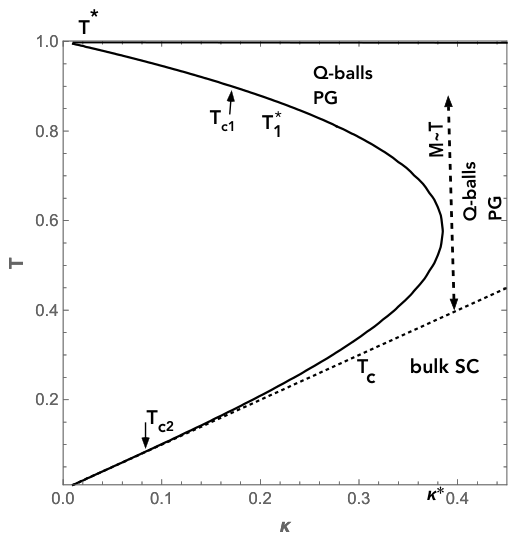
Figure 2.
The numerical solutions of Equations (35) and (38) for the branches (solid lines) and for the (long dashed line) at coupling constant . The dotted line is guide for the eye demonstrating origin of the linear T-dependence of the Q-ball field amplitude M in the interval of temperatures , as found analytically in Equation (43) from approximate expression for the in Equation (32), see text. Temperature is expressed in units of and amplitude M in units of . The inset reminds that only are allowed for the actual solutions due to the limitation for the amplitude of the field related with the local condensed spin/charge densities, see text after Equation (23)
Figure 2.
The numerical solutions of Equations (35) and (38) for the branches (solid lines) and for the (long dashed line) at coupling constant . The dotted line is guide for the eye demonstrating origin of the linear T-dependence of the Q-ball field amplitude M in the interval of temperatures , as found analytically in Equation (43) from approximate expression for the in Equation (32), see text. Temperature is expressed in units of and amplitude M in units of . The inset reminds that only are allowed for the actual solutions due to the limitation for the amplitude of the field related with the local condensed spin/charge densities, see text after Equation (23)
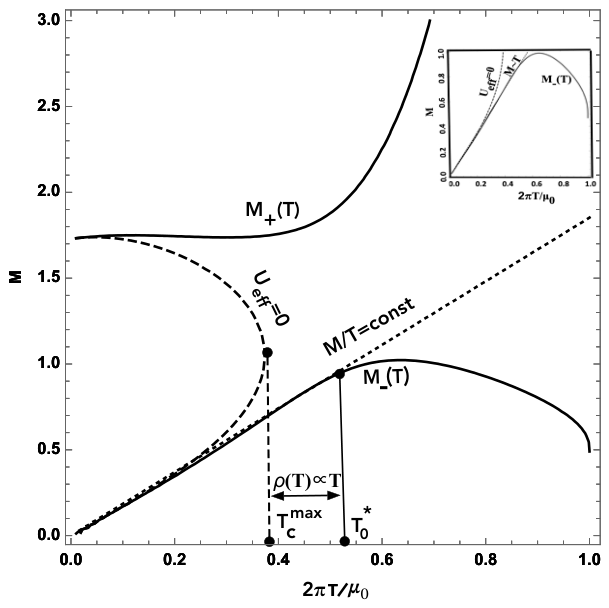
Figure 3.
The Dyson’s equation for a fermion scattering by Q-balls of CDW/SDW bosonic field, see text.
Figure 3.
The Dyson’s equation for a fermion scattering by Q-balls of CDW/SDW bosonic field, see text.

Figure 4.
Density of diamagnetic moment of the Q-balls gas in the PG phase , curves 1-3 correspond to different values of departure of the temperature T from : , indicated in arb. units, see Figure 1 and Equations (30), (79), (80).
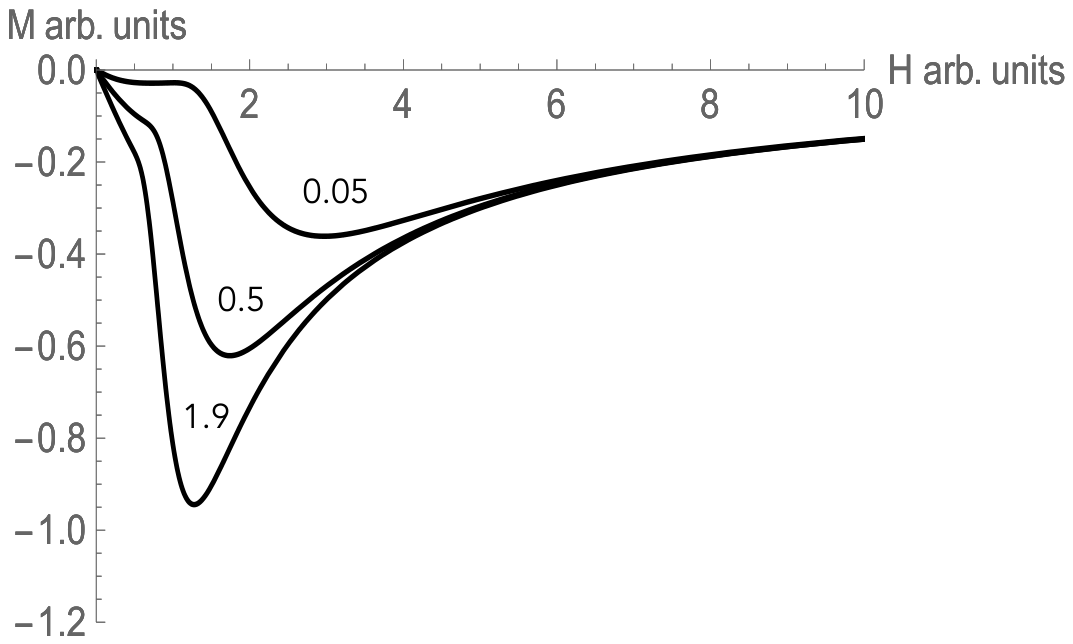
Figure 5.
The Feynman diagram of the Dyson equation for the Green’s function of magnons/phonons with the self-energy (closed fermionic loop of Gor’kov’s anomalous Green’s functions F, ) caused by the presence of superconducting condensates inside the Q-balls of coherently condensed antiferromagnetic/charge density fluctuations with SDW/CDW wave vectors and respectfully.
Figure 5.
The Feynman diagram of the Dyson equation for the Green’s function of magnons/phonons with the self-energy (closed fermionic loop of Gor’kov’s anomalous Green’s functions F, ) caused by the presence of superconducting condensates inside the Q-balls of coherently condensed antiferromagnetic/charge density fluctuations with SDW/CDW wave vectors and respectfully.
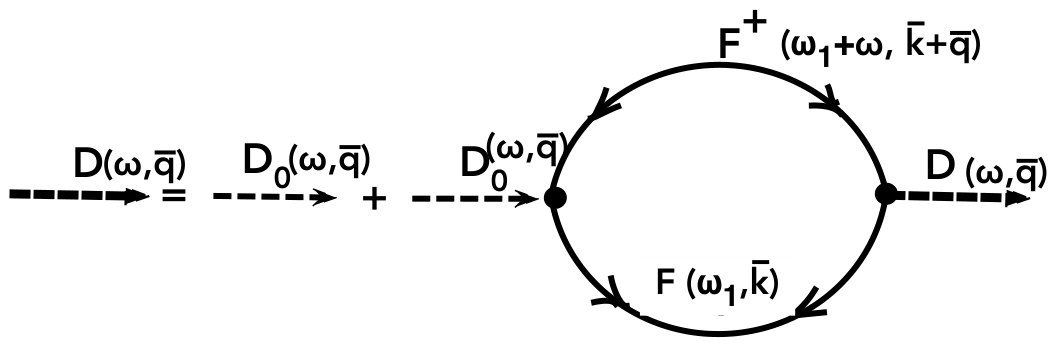
Figure 6.
’Nesting’ wave-vectors in the Brillouin zone of high-Tc cuprates bare Fermi surface. The ± signs mark different sectors of the superconducting order parameter in the case of d-wave pairing symmetry (divided by dashed lines) related with spin-waves (magnons) collective antiferromagnetic fluctuations of the SDW type. The CDW type collective fluctuations wave vectors connect ’nested’/hot-spot regions of the Fermi surface and correspond to s-wave pairing of the superconducting order parameter. See text for explanations.
Figure 6.
’Nesting’ wave-vectors in the Brillouin zone of high-Tc cuprates bare Fermi surface. The ± signs mark different sectors of the superconducting order parameter in the case of d-wave pairing symmetry (divided by dashed lines) related with spin-waves (magnons) collective antiferromagnetic fluctuations of the SDW type. The CDW type collective fluctuations wave vectors connect ’nested’/hot-spot regions of the Fermi surface and correspond to s-wave pairing of the superconducting order parameter. See text for explanations.
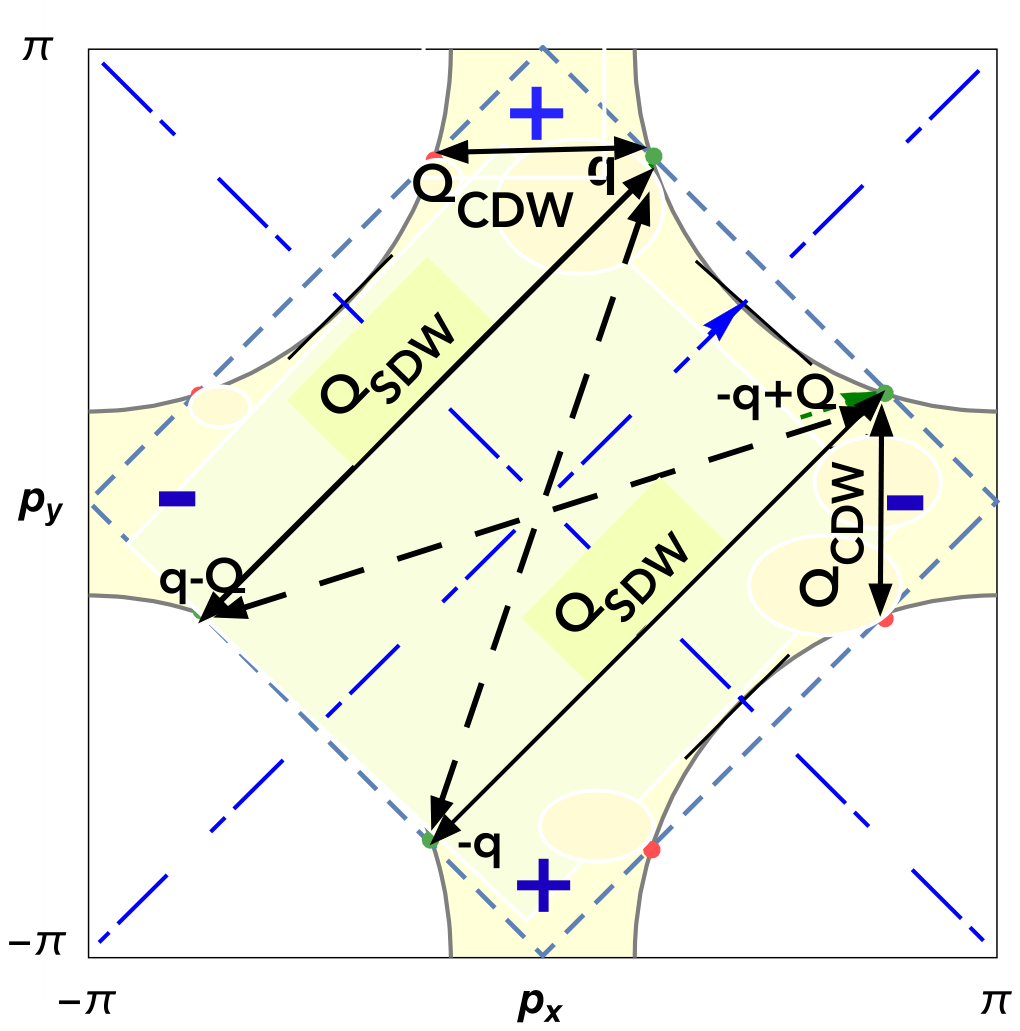
Figure 7.
Calculated hourglass dispersion of magnetic excitations in the vicinity of the wave vector of coherently condensed antiferromagnetic spin density fluctuations forming the Q-balls.
Figure 7.
Calculated hourglass dispersion of magnetic excitations in the vicinity of the wave vector of coherently condensed antiferromagnetic spin density fluctuations forming the Q-balls.
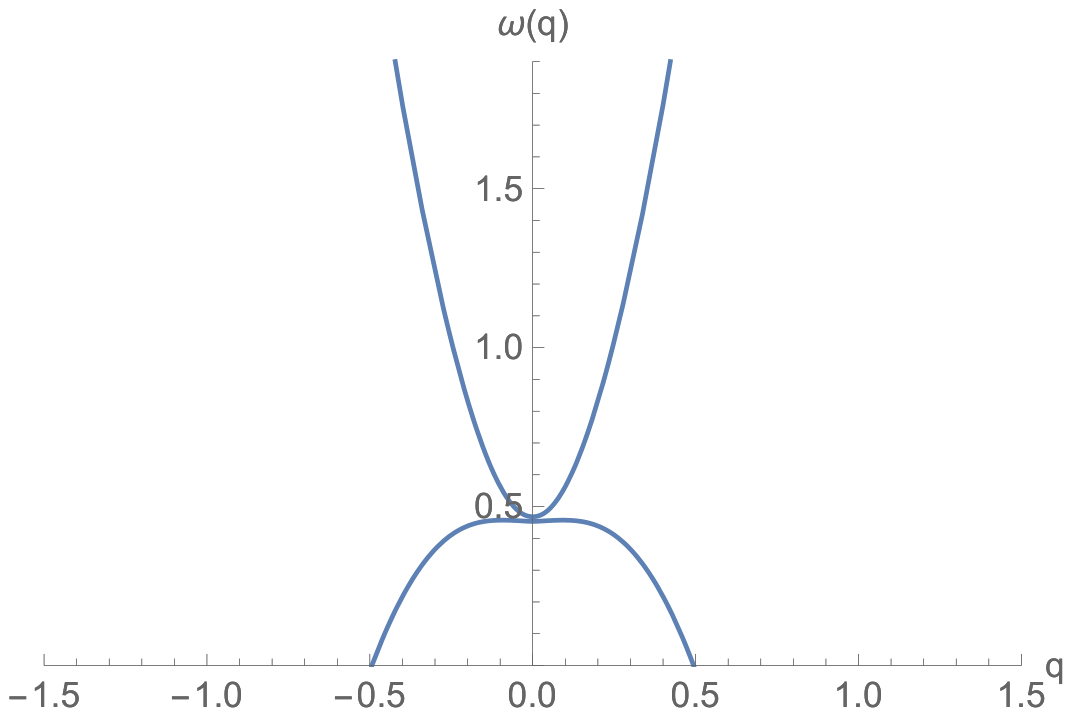
Figure 8.
a. Theoretical curves of the split phonons dispersion into hardened and softened brunches that follow from Equation (88); b) corresponding pole strengths of the hardened and softened phonon modes in the vicinity of the nesting CDW wave-vector , compare [10], Figure4 left panel.
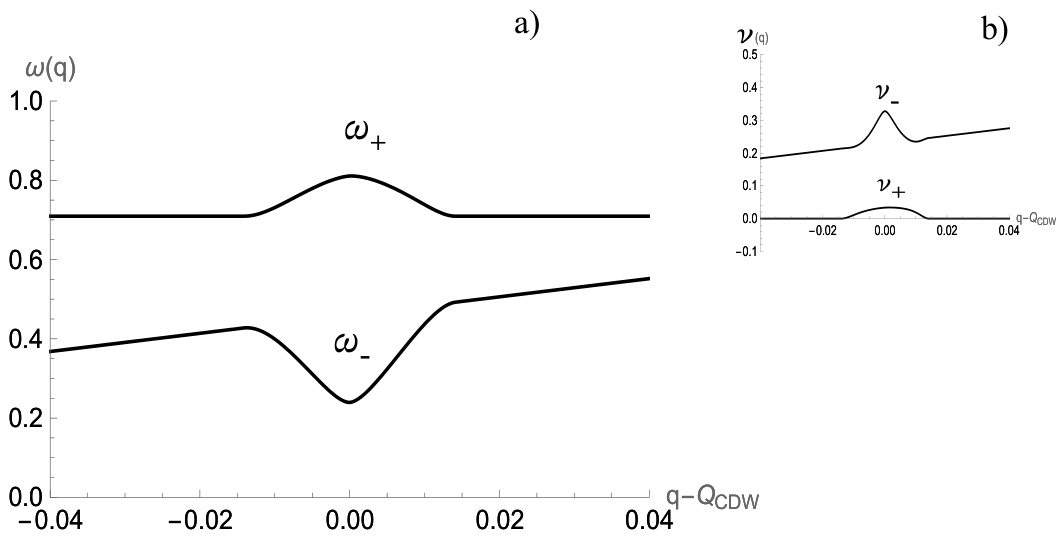
Figure 9.
Dynamic structure factor is calculated from Equation (92) for temperature , at which superconducting gap of Q-ball superconducting condensate reaches maximum in Equation (31), point in Figure 1. The insert represents theoretical curves of the split phonons dispersion into hardened and softened brunches that follow from Equation (88) at this same temperature , compare [10], Figure3.
Figure 9.
Dynamic structure factor is calculated from Equation (92) for temperature , at which superconducting gap of Q-ball superconducting condensate reaches maximum in Equation (31), point in Figure 1. The insert represents theoretical curves of the split phonons dispersion into hardened and softened brunches that follow from Equation (88) at this same temperature , compare [10], Figure3.
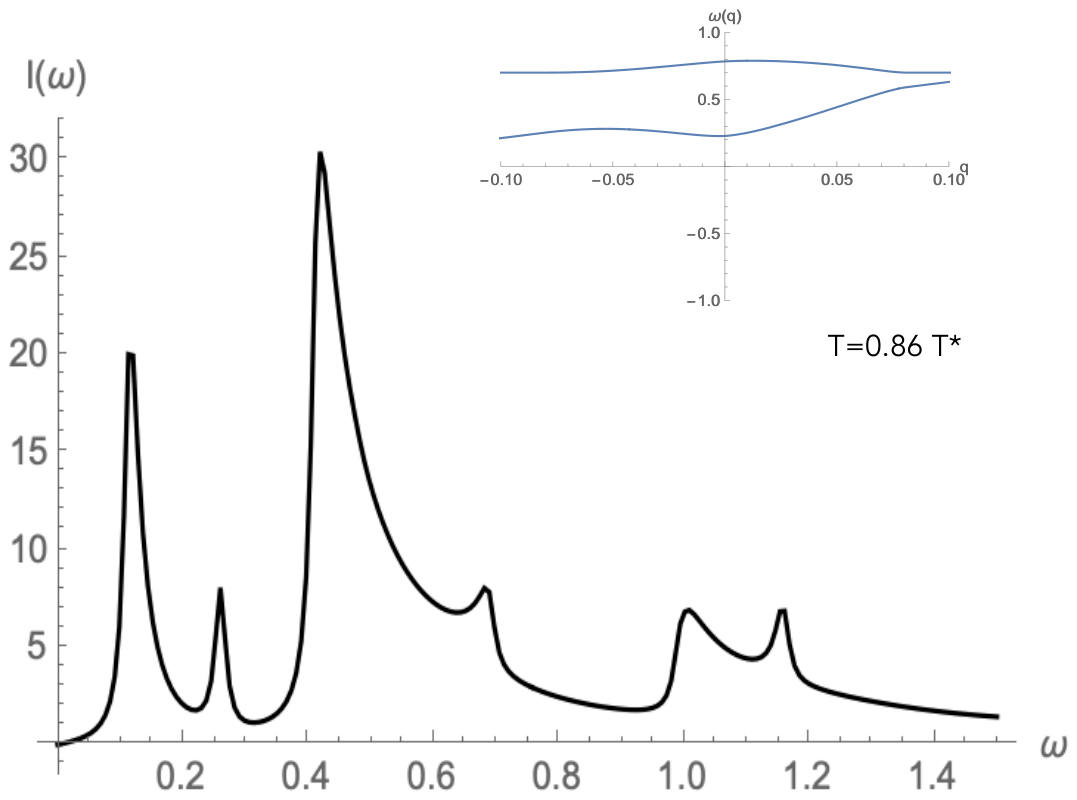
Figure 10.
Dynamic structure factor is calculated from Equation (92) for temperature , at which superconducting gap of Q-ball superconducting condensate approaches minimum in Equation (31), point in Figure 1. The insert represents theoretical curves of the split phonons dispersion into hardened and softened brunches that follow from Equation (88) at this same temperature .
Figure 10.
Dynamic structure factor is calculated from Equation (92) for temperature , at which superconducting gap of Q-ball superconducting condensate approaches minimum in Equation (31), point in Figure 1. The insert represents theoretical curves of the split phonons dispersion into hardened and softened brunches that follow from Equation (88) at this same temperature .
Disclaimer/Publisher’s Note: The statements, opinions and data contained in all publications are solely those of the individual author(s) and contributor(s) and not of MDPI and/or the editor(s). MDPI and/or the editor(s) disclaim responsibility for any injury to people or property resulting from any ideas, methods, instructions or products referred to in the content. |
© 2026 by the authors. Licensee MDPI, Basel, Switzerland. This article is an open access article distributed under the terms and conditions of the Creative Commons Attribution (CC BY) license (http://creativecommons.org/licenses/by/4.0/).
Copyright: This open access article is published under a Creative Commons CC BY 4.0 license, which permit the free download, distribution, and reuse, provided that the author and preprint are cited in any reuse.