
Submitted:
25 September 2026
Posted:
28 September 2026
You are already at the latest version
Abstract
Fish scales are the only common fish-processing residue that supplies both a structurally organised Type I collagen matrix and an apatitic calcium phosphate phase from the same material, and they are discarded in large quantities by producer economies with substantial inland fisheries. This review evaluates what the published literature actually supports regarding the conversion of that residue into regenerative biomaterials, with particular attention to ocular applications. The hierarchical organisation of the scale is examined as the property that both motivates and constrains recovery: because the mineral is distributed through the collagen network rather than layered separately, the separation chemistry chosen for one fraction determines what remains recoverable of the other. Acid-assisted, enzyme-assisted and alternative-solvent extraction routes are compared with respect to product integrity, reagent burden and effluent load, and the lower denaturation temperature of fish collagen is treated as an application-specific characteristic rather than a general advantage or defect. Analytical approaches are reviewed across the conventional toolbox and the terahertz (T-ray) frequency range; illustrative T-ray imaging and spectra of a rohu (Labeo rohita) scale are presented to indicate the class of information the method yields, together with an explicit account of what such measurements cannot establish. The ocular literature is assessed in detail: decellularised fish-scale collagen matrices have progressed through in vitro cytocompatibility, rodent, rabbit and porcine implantation, but no controlled human clinical trial has been reported. A distinction that is frequently blurred is made explicit — fish-scale collagen is a structural biomaterial for the anterior segment, whereas teleost retinal regeneration is a conceptual model of endogenous repair involving no fish-derived implant. Translation is constrained less by extraction chemistry than by feedstock logistics, effluent management, standardised characterisation and regulatory infrastructure, and most published work terminates at laboratory-scale characterisation. For producer economies such as Bangladesh, the realistic near-term entry point is characterised intermediate materials rather than finished medical devices.
Keywords:
fish-scale collagen
; Type I collagen
; marine by-product valorisation
; terahertz spectroscopy
; corneal tissue engineering
; bio cornea
; Müller glia
; hydroxyapatite
; circular bioeconomy
; process scale-up
1. Introduction
Fish processing generates large volumes of by-products — skins, frames, heads, viscera and scales — a substantial proportion of which is discarded or diverted to low-value uses such as fishmeal despite containing structurally organised biopolymers and biominerals [1]. Global production has continued to expand, with aquaculture now supplying the majority of aquatic animals destined for human consumption, so the residue stream is both large and growing [2]. Interest in recovering value from these residues has developed alongside broader efforts to reduce material intensity in manufacturing and to close resource loops within food-processing supply chains [1].
Among the available residue streams, fish scales occupy a distinctive position. They are the only common fish-processing by-product that supplies both an organic protein fraction and a calcium phosphate mineral fraction from the same material [3,4]. Structurally, the scale is a mineralised biocomposite in which a Type I collagen matrix is reinforced by an apatitic phase closely related to bone mineral [4,5]. The collagenous component confers flexibility and biological recognition; the mineral phase provides stiffness and bioactivity. Because this organic–inorganic organisation broadly parallels that of vertebrate hard tissue, fish scales have been examined as a precursor for materials intended to interface with bone and soft tissue [4,5].
Relative to bovine and porcine feedstocks, fish-derived materials are associated with a lower perceived risk of transmitting mammalian pathogens and with fewer cultural and religious restrictions on use, and they are recovered from a residue stream that would otherwise require disposal [3,5]. These are legitimate advantages, but they concern hazard categories rather than product quality, and they do not substitute for the endotoxin, heavy-metal and microbiological control that aquatic feedstocks specifically require.
A second, quite separate line of interest connects fish biology to ophthalmology. Teleost fish retain a capacity for retinal regeneration that mammals have effectively lost: following injury, Müller glia in the fish retina dedifferentiate into proliferating progenitors that regenerate the lost neuron classes [38,39]. This has made the teleost retina a reference system for attempts to reactivate latent regenerative capacity in mammalian tissue. The two strands — fish scales as a source of implantable matrix, and fish retinal biology as a model of endogenous repair — are frequently discussed together because both address vision loss and both take their cue from fish. They are nonetheless independent lines of evidence, and a central aim of this review is to keep them clearly separated.
Despite an expanding literature on extraction and characterisation, the field remains concentrated at laboratory scale. Comparatively little published work addresses process scale-up, effluent management, cost structure, quality systems, or the specific circumstances of producer economies in which the raw material is abundant but the analytical and regulatory infrastructure is still developing. This asymmetry is the central problem addressed here: the constraint on industrial adoption is not primarily whether the target materials can be recovered, but whether they can be recovered reproducibly, cleanly, and to a specification that a purchaser will accept.
Accordingly, this review has four aims. First, it synthesises what is established about the structure of the scale and the principal recovery routes, distinguishing pathways supported by a consistent body of evidence from those that are not. Second, it examines characterisation, including the contribution and the limits of terahertz methods. Third, it assesses the ocular literature in detail and makes explicit the distinction between the material and conceptual contributions of fish biology. Fourth, it considers processing integration, industrial translation and the specific position of producer economies, separating conclusions supported by published data from strategic proposals advanced by the authors. The overall pathway from residue to application is shown in Figure 1.
2. Fish Scales as a Sustainable Biomaterial Feedstock
2.1. Hierarchical Structure and Composition
Fish scales are laminated structures in which an outer, heavily mineralised layer overlies a fibrillar collagenous base plate [4,6]. The organic phase is dominated by Type I collagen, which forms the structural framework of the scale [3,6]. The inorganic phase consists principally of calcium phosphate in an apatitic form, distributed through and around the collagen network rather than segregated as a discrete layer [4,7]. In one reported preparation retaining the native scale geometry, the mass fractions of water, organic matter and inorganic matter were 20.7%, 56.9% and 22.4% respectively [8], although such values are specific to species and preparation and should not be generalised.
The organisation of the base plate is a structurally interesting feature. Collagen fibrils are arranged in lamellae within which orientation is uniform, while successive lamellae are rotated relative to one another, producing a twisted-plywood or Bouligand arrangement [6,7]. The specific geometry is species-dependent: orthogonal plywood arrangements have been described in tilapia, twisted-plywood arrangements with interlamellar angles in the range of roughly 60–75° in several cyprinids and in Arapaima gigas, and double-twisted systems in other taxa [6]. In Arapaima, synchrotron small-angle X-ray scattering during tensile loading has shown that this arrangement governs the scale’s toughness through lamellar rotation, fibril straining and interfibrillar sliding [7]. This architecture is directly relevant to biomedical use, because ordered lamellar collagen is precisely the organisation required in a corneal stromal substitute, a point developed in Section 6.
This hierarchy is summarised in Figure 2, and the compositional and structural components of the scale are set out in Table 1. Compositional values reported for fish scales vary considerably between studies: species, age, habitat, diet and season all influence the collagen-to-mineral ratio and the calcium-to-phosphorus ratio of the mineral phase. This variability is frequently acknowledged in the primary literature but is rarely quantified systematically across species, and it is a material obstacle to specification-driven manufacturing rather than a minor experimental caveat.
The interpenetrating arrangement of the two phases carries a direct processing consequence. Because the mineral is distributed within the collagen matrix rather than layered separately, the separation chemistry chosen for one fraction necessarily determines what remains recoverable of the other. This constraint recurs throughout the review and is treated quantitatively in Section 8.
2.2. Recoverable Fractions and the Status of Evidence
Three recovery targets are discussed in the literature: Type I collagen from the organic matrix; hydroxyapatite and related calcium phosphates from the mineral phase; and, in a smaller number of reports, chitosan obtained by deacetylation of a chitinous residue said to be present in scales of certain species. Their characteristics, recovery routes and reported applications are compared in Table 1.
The evidentiary status of these three routes is not equivalent and treating them as equivalent is a recurring weakness in the applied literature. Collagen recovery is supported by numerous independent reports across multiple species and laboratories [3,8,10], as is hydroxyapatite recovery, principally by calcination but also by chemical routes [4,11]. Fish-scale-derived hydroxyapatite has been characterised as a candidate bone scaffold material [11], and whole decalcified scales have been evaluated as bioabsorbable fixation devices [12].
The chitosan route requires more careful handling than it usually receives. Chitin is the structural polysaccharide of arthropod cuticle, molluscan structures and fungal cell walls; it is not an established structural component of the vertebrate integument, in which the corresponding role is filled by collagen and keratin. Reports of chitosan recovered from fish scales are therefore not straightforwardly consistent with the accepted compositional picture. That said, the empirical literature is not negligible: chitosan has been isolated and characterised from the scales of Prochilodus magdalenae [13], from Labeo rohita [14], and from Nile perch alongside other locally available substrates [15], in each case with infrared, diffraction and thermal characterisation reported.
The appropriate reading is neither dismissal nor uncritical acceptance. What the published work establishes is that a deacetylated, chitosan-like polysaccharide fraction can be recovered from scale material by conventional demineralisation–deproteinisation–deacetylation sequences. What it does not yet establish, in the sources examined here, is the origin of that fraction, its mass balance against the starting material, or its structural identity by methods that discriminate chitin polymorphs from deacetylated protein residues sharing overlapping infrared bands. Confirmation would take the form of unambiguous structural identification — solid-state 13C NMR or diffraction consistent with chitin polymorphs — supported by elemental nitrogen analysis and a closed mass balance. Until then, the route should be described as reported but not independently confirmed at the level of origin, and industrial planning should not depend on it.
Set against other fisheries residues, the distinguishing feature of scales remains the co-presence of both principal fractions. Fish skin is an established and higher-yielding collagen source but carries no mineral phase to recover [3]. Crustacean shells are the conventional industrial source of chitin and chitosan but supply neither Type I collagen nor an apatitic mineral of biomedical interest. Bones and frames carry a substantial mineral fraction but a less accessible and less intact collagen fraction. Fish scales therefore permit a cascading recovery sequence from one feedstock, which is the principal argument for their industrial attractiveness. Whether that theoretical advantage survives contact with process economics is examined in Section 8.
3. Type I Collagen: Extraction, Processing and Properties
3.1. Structural and Biological Characteristics
Collagen is the most extensively investigated product recoverable from fish scales. The scale matrix is dominated by Type I collagen, the same genetic type that predominates in human skin, bone, tendon and cornea, and this correspondence underlies most of the interest in fish scales as a collagen source [3,8]. Reported properties include biocompatibility, enzymatic degradability, low immunogenicity and support for cell attachment and proliferation [3,10]. When extraction is conducted under controlled conditions, the native triple-helical conformation can be retained, which is the property that distinguishes intact collagen from gelatin and hydrolysates and determines whether the product is suitable for scaffold applications [3].
The property that most clearly differentiates fish collagen from mammalian collagen is its lower thermal stability, attributed to reduced imino acid content and correspondingly fewer stabilising interactions within the helix [3]. This relationship is not merely qualitative: across marine teleosts, denaturation temperature correlates with proline, hydroxyproline and serine content and tracks the physiological temperature of the source species [9]. The applied literature tends to present lower thermal stability either as a limitation or as an advantage depending on the argument being made, which is not a satisfactory treatment. It is more accurate to state that a lower denaturation temperature narrows the processing and sterilisation window and restricts use in load bearing or thermally demanding applications, while favouring applications in which rapid resorption or ready digestibility is desirable. Where thermal persistence is required, processing and crosslinking strategies can raise it substantially: a fish-scale collagen membrane prepared by a method that preserved the native scale geometry was reported to have a denaturation temperature of 79.5 °C [8]. Crosslinking in turn introduces its own regulatory considerations regarding residual crosslinker. The suitability of fish-scale collagen is therefore application-specific and should not be asserted in general terms. Table 3 sets out the reported characteristics of fish-scale-derived collagen relative to conventional mammalian sources.
3.2. Comparison of Extraction Approaches
Collagen recovery from scales follows a common sequence: cleaning and removal of non-collagenous protein, demineralisation, solubilisation, recovery by salting-out and dialysis, and drying [3]. The processing train and its control points are shown in Figure 3, and the principal solubilisation variants are compared in Table 2.

Table 2.
Qualitative comparison of collagen extraction approaches reported for fish scales and related fish by-products. The table compares approaches on attributes discussed in the cited sources; it does not report or imply numerical yields, since the reviewed references do not permit a like-for-like numerical comparison.
| Approach | Principle | Reported advantages | Reported or anticipated limitations | Main scale-up consideration |
| Acid-assisted extraction (typically acetic acid) | Solubilisation of the collagen network by disruption of intermolecular bonds under dilute acid [3] | Simple, widely reproduced, no specialised inputs; helix retained under controlled temperature [3] | Long contact times; high acid consumption; acidic effluent requiring neutralisation | Effluent volume and neutralisation cost dominate operating expenditure |
| Enzyme-assisted extraction (typically pepsin) | Proteolytic cleavage of telopeptide regions to release collagen [3] | Milder conditions; improved release from crosslinked matrix; shorter processing | Enzyme cost; risk of over-digestion and loss of helical integrity; requires an inactivation step | Enzyme cost and process-control capability |
| Alternative and green solvent systems (e.g. deep eutectic solvents) | Solubilisation in designed solvent systems intended to replace mineral or organic acids [3] | Lower reagent toxicity reported; potential for solvent recovery | Evidence base preliminary; solvent recovery and recycling not demonstrated in the reviewed sources 1 | Solvent recycling determines both cost and the validity of the environmental claim |
| Decellularisation and decalcification with retention of native geometry | Removal of cellular material and chelation of the mineral phase without dissolving the collagen network [8,34] | Preserves the native lamellar organisation, which is the property of interest for corneal and barrier-membrane use | Product dimensions bounded by scale geometry; not applicable where a solubilised collagen feed is required | Reagent residues require toxicological justification; batch definition is per-scale rather than per-lot |
1 Solvent recovery is the determinant of whether the reduced-toxicity claim holds at production scale, and it is not addressed in the sources examined here. See Section 3.2.
Table 3.
Reported characteristics of fish-scale-derived Type I collagen relative to conventional mammalian sources. Entries are qualitative statements of what the cited literature reports; no numerical performance comparison is asserted, since the reviewed sources do not provide like-for-like measurements.
| Attribute | Fish-scale-derived collagen | Conventional bovine or porcine collagen | Consequence for use |
| Genetic type | Predominantly Type I [3,8] | Predominantly Type I | Correspondence with human skin, bone, tendon and cornea supports substitution in principle |
| Thermal stability | Lower denaturation temperature; correlates with imino acid content and source-species physiological temperature [3,9] | Higher denaturation temperature | Narrows the processing and sterilisation window; favours rapidly resorbing applications; crosslinking or geometry-preserving processing can raise it substantially [8] |
| Zoonotic risk profile | No mammalian transmissible spongiform encephalopathy risk [3] | Recognised hazard category requiring source control | A hazard-category advantage, not a product-quality advantage; aquatic-specific contaminant control remains necessary |
| Cultural and religious acceptability | Fewer restrictions on use [3,8] | Restrictions apply in several contexts | Widens the addressable market in defined segments |
| Native structural organisation | Base plate already organised into oriented lamellae [6,7] | Organisation depends on the source tissue and is usually lost on solubilisation | Directly relevant to corneal and barrier-membrane applications, where lamellar order must otherwise be engineered |
| Feedstock status | Residue stream, currently unpriced [1] | Established commercial supply chain | Low nominal input cost, offset by collection, stabilisation and quality-assurance costs |
| Dimensional constraint | Product dimensions bounded by scale geometry where native architecture is retained | Not dimensionally constrained in the same way | Limits large-area implants; favours tectonic and lamellar indications |
Acid-assisted extraction, typically with acetic acid, remains the reference method because it is simple, requires no specialised inputs and is well described [3]. Its disadvantages are long processing times, substantial acid consumption and an acidic effluent that must be neutralised. Enzyme-assisted extraction, usually with pepsin, cleaves telopeptide regions, shortens processing and can improve recovery from crosslinked matrices; the constraints are enzyme cost, the need for an inactivation step, and the requirement to control proteolysis so that the helix is not degraded [3]. Alternative solvent systems, including deep eutectic solvents, have been proposed as lower-toxicity replacements for conventional acid treatment and have been compared directly with acetic acid extraction [3]. The evidence for these systems remains preliminary in respect of the property that determines whether their environmental claim holds at production scale, namely solvent recovery and recycling; this is not demonstrated in the sources examined here, and the sustainability claim should be regarded as provisional rather than established.
Demineralisation deserves separate emphasis because it is the step that most distinguishes scales from skin as a collagen feedstock. The high calcium content of the scale, present as apatite, must be removed before the collagen network becomes accessible, and chelation with EDTA is the commonly used approach [3]. The completeness of this step conditions everything downstream: residual mineral compromises optical clarity in ocular applications and confounds the mass-balance basis on which yield is reported.
A general observation applies across all these variants. Comparisons between published extraction studies are impeded by inconsistent reporting. Yield may be expressed on a wet, dry or defatted basis; purity may be assessed by different criteria; and helix integrity is not always verified at all. This heterogeneity, rather than any deficiency of the methods themselves, is the main reason that no ranking of extraction approaches by performance can responsibly be given here.
3.3. Purification, Fabrication and Sterilisation
Recovery is followed by salting-out, dialysis against dilute acid or buffer, and drying, most often by lyophilisation. Each step carries a specific risk: incomplete dialysis leaves residual salt that alters subsequent gelation; uncontrolled freezing during lyophilisation determines pore geometry in the dried construct and therefore its behaviour as a scaffold.
Fabrication routes reported for fish-derived collagen include casting into films and membranes, freeze-drying into porous sponges, directional freezing to impose anisotropic pore alignment, electrospinning, and extrusion-based bioprinting [5]. For applications requiring mechanical persistence or resistance to enzymatic degradation in vivo, crosslinking is standard; carbodiimide chemistry (EDC, usually with NHS) is the most frequently reported approach in ocular work, with genipin and dehydrothermal treatment as alternatives.
Terminal sterilisation is an underexamined step in this literature and interacts directly with the thermal-stability constraint discussed above. Moist-heat sterilisation is generally incompatible with an unmodified fish collagen construct; the alternatives — gamma or electron-beam irradiation, ethylene oxide, and supercritical carbon dioxide — each carry the potential to alter crosslink density, degradation rate or residual-chemical burden. Any construct intended for implantation must be characterised after sterilisation rather than before it, and the reviewed literature does not consistently do so.
4. Characterisation of Fish-Scale-Derived Collagen
4.1. The Conventional Analytical Toolbox
No single technique establishes that a recovered material is intact Type I collagen of adequate purity; the assessment is necessarily convergent, and the principal methods and the information each yields are summarised in Table 4 and Figure 4.
Infrared spectroscopy is the workhorse. The amide bands of the polypeptide backbone provide both identification and conformational information: amide A near 3300 cm−1 (N–H stretching), amide B near 2920 cm−1 (C–H stretching), amide I near 1650 cm−1 (predominantly C=O stretching, and the band most used for secondary-structure assessment), amide II near 1550 cm−1 (N–H bending combined with C–N stretching), and amide III near 1240 cm−1 (C–N stretching and N–H bending) [19,20,21]. The ratio of the amide III band to the 1450 cm−1 band is conventionally used as an index of triple-helical integrity, and infrared spectroscopy has been applied specifically to discriminate between collagen types [19]. Lower-frequency bands, sometimes designated amide IV to VI and lying below roughly 750 cm−1, report skeletal vibrations of the backbone and out-of-plane bending modes; these have been characterised in model amide systems by far-infrared spectroscopy [22] and carry information on overall conformation and intermolecular interaction rather than on secondary structure directly.
Electrophoresis under denaturing conditions resolves the α1 and α2 chain pattern and supports assignment to collagen type I. Ultraviolet–visible spectroscopy shows the characteristic peptide-bond absorption in the 210–240 nm region, attributable to C=O, carboxyl and amide functionalities in the polypeptide chains. X-ray diffraction identifies the apatite phase and reports crystallinity in mineral-containing preparations. Scanning electron microscopy with energy-dispersive analysis reports pore architecture and the calcium-to-phosphorus ratio. Differential scanning calorimetry gives the denaturation temperature and is the direct measure of the thermal-stability constraint discussed in Section 3.1 [9], while thermogravimetric analysis resolves the organic-to-mineral mass balance. For ocular applications specifically, transmittance, haze and refractive index measurements are required and are discussed in Section 6.
4.2. Terahertz (T-Ray) Spectroscopy and Imaging
The terahertz region, spanning roughly 0.1 to 30 THz, probes low-energy excitations: collective vibrational modes of macromolecules, hydrogen-bond network dynamics, and librational and torsional motions that are inaccessible to mid-infrared methods sensitive to localised bond vibrations. Terahertz spectroscopy has been applied to collagen since the earliest surveys of biomolecular response in this range, in which the absorbance of collagen, DNA and serum albumin was compared between 0.1 and 2.0 THz [23]; subsequent work has developed the analysis of peptide and protein spectra in this region [24] and its application to biomolecule detection more broadly [27].
Three attributes make the approach attractive for biomaterial characterisation. It is label-free and non-destructive, so the same specimen can be measured and then used. It is strongly sensitive to water, since the dielectric response in this range is dominated by hydrogen-bonded network dynamics, which makes it a candidate probe of hydration state and, by extension, of drying and rehydration processes [26]. And terahertz radiation penetrates many non-conductive, optically opaque materials, permitting sub-surface imaging of structures that visible-light microscopy cannot reach [25,26].
Recent reviews position terahertz spectroscopy and imaging as emerging tools in tissue engineering specifically, for evaluating the mechanical and hydration characteristics of scaffolds non-invasively, while noting that limited penetration depth and system cost currently restrict wider adoption [26]. Continuous-wave terahertz imaging has been demonstrated on biomedical specimens [25]. Instrumentation based on dendrimer dipole excitation has been developed as a compact source and detection route for spectrometry and molecular imaging in this range [28,29].
4.3. An Illustrative Case: T-Ray Imaging and Spectra of a Rohu Scale
To indicate concretely what terahertz measurement of a fish scale yields, illustrative data acquired by one of the present authors (A.R.) on a scale of rohu (Labeo rohita) are reproduced in Figure 5 and Figure 6, extending an earlier account of terahertz approaches to fish-scale valorisation [30]. These are presented as a demonstration of the class of information the technique provides, not as a validated characterisation of a biomaterial product; they have not been subjected to replicate measurement, inter-specimen comparison or cross-validation against the conventional methods of Section 4.1, and no conclusion in this review rests on them.
The imaging modality is a cameraless raster-scanning arrangement rather than a detector array: a single source–detector pair samples the specimen point by point across a grid, and the resulting dataset is reconstructed into two- or three-dimensional images [28,29]. Figure 5 shows the mounted specimen and a nested series of surface fields from approximately 5 mm × 5 mm down to 200 µm × 200 µm, together with a reconstructed volume of 10 × 10 × 8 µm. The concentric ridge pattern characteristic of cyprinid scale growth is resolved at the coarser fields, and progressively finer surface texture at the higher magnifications.
Figure 6a shows a T-ray absorbance spectrum from the same specimen, computed as a Lomb periodogram — an estimator appropriate to unevenly sampled data [29] — over approximately 0.1 to 32 THz. The spectrum is broadband with numerous overlapping features, which is what a heterogeneous biological composite containing protein, mineral and water would be expected to produce. Figure 6b shows an eigen-frequency estimate derived from the same data, in which a sharp rise at low frequency is followed by a plateau at approximately −130 dB extending across the remainder of the range.
Interpretation of these features requires care, and the distinction between what is observed and what is inferred should be maintained. In the raw spectrum, features in the low-frequency region are plausibly associated with collective motions of the collagenous matrix, including inter-chain hydrogen bonding, since collective protein modes are known to fall in this region [23,24]. Features at higher frequency may reflect lattice vibrations of the apatite phase or coupling between mineral and organic matrix. These are proposed assignments consistent with the composition of the specimen; they are not established assignments, because band assignment in this frequency range is model-dependent and, in a multicomponent hydrated sample, individual modes are broadened and overlapped to a degree that precludes unique attribution without corroborating measurement.
The derived spectrum in Figure 6b should be read conservatively. Its dominant characteristic is the low-frequency rise followed by a broad plateau; the plateau most plausibly reflects bulk density and scattering rather than discrete resonances, and the trace does not display well-separated peaks against that background. Claims that specific eigen-frequencies constitute confirmed molecular signatures of collagen or hydroxyapatite in this specimen are therefore not supported by the data as presented and are not made here.
4.4. What Terahertz Methods Can and Cannot Establish
Because terahertz characterisation is sometimes presented in the applied literature as a validation method in its own right, its scope should be stated precisely.
Terahertz methods can plausibly contribute non-destructive detection of gross structural or compositional change between specimens; sensitivity to hydration state, which is relevant to monitoring drying, rehydration and possibly the progress of demineralisation; sub-surface imaging of internal architecture without sectioning; and, in principle, a rapid inline screening signal in a manufacturing setting, where the requirement is to detect deviation from a reference rather than to identify composition ab initio.
Terahertz methods, on the present evidence, cannot substitute for mid-infrared spectroscopy in confirming triple-helical integrity, for diffraction in identifying mineral phase, for calorimetry in determining denaturation temperature, or for electrophoresis in assigning collagen type. Nor does an absorbance spectrum report mechanical properties: absorbance and modulus are not related by any established relation in this system, and inferences from one to the other are unwarranted. The realistic role is complementary — a fast, non-destructive comparator operating alongside, and calibrated against, the established methods summarised in Table 4, not a replacement for them. Realising even that role would require demonstration of measurement reproducibility across specimens and instruments, establishment of a reference spectrum for a material of known specification, and determination of the sensitivity of the response to the process variables of interest. None of these has been reported for fish-scale collagen.
5. Fish-Scale Collagen in Regenerative Medicine
Beyond ophthalmology, fish-derived collagen has been examined across a range of regenerative contexts, and the breadth of that work provides the background against which the ocular evidence should be read. Reported applications are summarised in Table 5.
The general case for fish collagen as a scaffold material rests on its capacity to provide a porous, cell-adhesive substrate with a degradation profile compatible with tissue ingrowth [10]. Advances in scaffold fabrication have extended the range of architectures achievable from fish-derived matrices, and recent reviews position these materials as a response to donor-tissue scarcity across several tissue types [5].
In bone and periodontal applications, the native composite architecture of the scale is itself the point of interest, since the organic–inorganic organisation approximates that of bone. Fish-scale-derived hydroxyapatite has been prepared and characterised as a candidate bone scaffold material [11], and collagen membranes prepared from scales with retention of the native geometry have been evaluated as barrier membranes for guided bone regeneration, with osteogenic differentiation of bone-marrow mesenchymal stem cells assessed in vitro [8]. Decalcified whole scales have been investigated as bioabsorbable fixation devices for fracture [12]. In soft-tissue repair, acellular fish-scale scaffolds loaded with mesenchymal stem cells have been applied to skin flap regeneration [18], and nanoparticles fabricated from tilapia-scale collagen have been evaluated for wound healing, with the retained bioactivity supporting cellular attachment [17].
Two qualifications apply across this literature. First, the great majority of reported work terminates at material characterisation and in vitro assessment, with a smaller body of small-animal work and very little beyond it; the stage of evidence, not merely the existence of a report, is what should govern interpretation, and Table 5 is annotated accordingly. Second, the domains differ sharply in the evidence and regulatory dossier they require. Cosmetic and nutraceutical uses of collagen and its hydrolysates are commercially established and are constrained mainly by purity and specification consistency; wound-contact and implantable applications require biocompatibility testing and quality-system compliance. Conflating these domains overstates the maturity of the field and claims of clinical efficacy for ingested collagen peptides are contested in the wider literature and are not evaluated here.
6. Ocular Regenerative Medicine: Fish-Scale Collagen and the Biocornea
6.1. The Clinical Problem and the Structural Rationale
Corneal opacity is a leading cause of blindness and of moderate-to-severe visual impairment, and the shortage of human donor tissue is severe: recent analysis places the availability at roughly one donor cornea for every seventy patients in need [36]. That gap has driven sustained work on bioengineered alternatives, of which biosynthetic collagen-based implants have reached clinical evaluation — a recombinant human collagen implant was assessed in a phase 1 study with twenty-four-month follow-up, establishing that a collagen scaffold can support host corneal regeneration in humans [37].
The structural rationale for fish scales in this context is specific and worth stating precisely. Corneal transparency and mechanical strength depend on an ordered extracellular matrix of Type I collagen in which fibrils of small and uniform diameter are densely and regularly arranged; disruption of that order produces opacity. The collagenous base plate of the fish scale is not merely a source of Type I collagen but is already organised into lamellae with defined interlamellar orientation [6,7]. It is this pre-existing lamellar order, rather than the collagen content alone, that distinguishes scale-derived matrices from collagen reconstituted from solution, in which comparable order must be imposed by directional freezing, moulding or printing. The pathway from scale to implant is shown in Figure 7.
6.2. Processing Route
The reported route to a corneal matrix differs from the solubilisation route of Section 3 in that the scale architecture is deliberately retained rather than dissolved. Scales — most often from tilapia (Oreochromis spp.), with grass carp also reported — are harvested from processing waste, cleaned, and then decellularised and decalcified by sequential treatment, typically involving sodium hydroxide, phosphate-buffered saline and sodium chloride solutions for cellular removal and EDTA for chelation of the mineral phase [34]. The result is a soft, transparent collagen lamellar matrix. Implants are then trimmed to defined diameter, in reported work by laser punch [34], and may be crosslinked, commonly with carbodiimide chemistry, to improve mechanical properties and resistance to enzymatic degradation in vivo.
6.3. What the Evidence Base Actually Shows
The ocular literature on fish-scale matrices is unusually well developed for a material of this kind, and it is worth setting out by stage rather than in aggregate. Evidence levels are compared in Table 6.
At the level of material properties, a collagen lamellar matrix prepared from grass carp scales was characterised for transparency, refractive index, mechanical properties and cellular compatibility, and judged a plausible candidate for corneal tissue engineering [35]. Light scatter and transmission of a fish-scale-derived collagen matrix have been compared directly with human cornea [34].
At the level of cytocompatibility, a fish-scale-derived collagen matrix was assessed against primary human corneal epithelial and stromal cells obtained from donor corneas, examining direct and indirect cytotoxicity, proliferation, corneal cell phenotype and adhesion markers [32]. Earlier work had established that the scaffold supports repopulation by rabbit corneal stromal cells and has high oxygen permeability [31].
At the level of in vivo evaluation, the material has been examined in a graded sequence of models. Pocket implantation in rats established safety, biocompatibility and regenerative potential, together with an assessment of properties relevant to use as an artificial cornea [31]; in vivo immunogenicity was subsequently characterised [32]. In rabbits, implants were followed for six months, with corneas reported clear at three and six months, no haze or ulceration observed, filling of the interface between implant and host stroma, and no observable immune-cell infiltrate at day 180; the implant remained transparent without apparent fragmentation [33]. In minipigs, the material was used to seal 2 mm full-thickness corneal perforations, with follow-up over several days assessed by slit lamp and optical coherence tomography and confirmed histologically [34].
The stage that has not been reached is equally important. No controlled human clinical trial of a fish-scale-derived corneal implant is identified in the sources examined here. The porcine work was explicitly a short-duration test of tectonic sealing rather than of long-term integration or optical outcome [34], and the authors themselves noted that clinical cases of the specific injury modelled are uncommon. Comparative systematic review of bioengineered corneal grafts in animal models places this class of material within a broader field in which several scaffold strategies remain at preclinical stage [36]. The appropriate summary is that fish-scale-derived collagen matrices have accumulated a consistent and reasonably deep preclinical record across four species, and that this is a stronger position than most candidate corneal biomaterials occupy, but that it is not clinical evidence.
6.4. Constraints Specific to Ocular Use
Four constraints recur and are set out in Figure 7. Geometry is the first and is intrinsic to the feedstock. A scale is a small, curved object of fixed dimensions, so implant diameter and thickness are bounded by the size of available scales; large-diameter grafts cannot be obtained from a single scale, and the curvature of the native scale must be reconciled with corneal curvature. This is a genuine limitation on the range of clinical indications the material can address, and it points toward tectonic and lamellar applications rather than full-thickness replacement.
Thermal stability is the second, and it interacts with sterilisation as discussed in Section 3.3. The processing window is narrow, and any terminal sterilisation step must be shown not to compromise transparency or mechanical performance.
Residual reagents are the third. Decellularisation and decalcification employ hydroxide, chelating and salt solutions, and crosslinking introduces carbodiimide or equivalent chemistry; residues of each require toxicological justification under device regulation, particularly for an implant in contact with the ocular surface.
Variability is the fourth and connects back to Section 2.1. Species, season and farming conditions alter scale composition and lamellar organisation, and therefore transparency and mechanics. Farming tilapia under controlled conditions has been noted as a route to consistency in scale supply, but no accepted release specification for a scale-derived corneal matrix exists, and this — rather than any deficiency in the underlying biology — is the most immediate barrier to clinical translation.
7. Fish Retinal Regeneration as a Biological Model
7.1. The Distinction That Must Be Maintained
The second contribution of fish biology to ophthalmology is conceptual rather than material, and the distinction is made explicit in Figure 8. Fish scales supply a substance that is processed and implanted. Teleost retinal regeneration supplies a mechanism that researchers hope to reproduce in host tissue. No fish-derived material is implanted in the second case, and fish-scale collagen has no demonstrated capacity to induce retinal neurogenesis. The two operate on different segments of the eye, carry different regulatory classifications, and have different failure modes and translational timelines. They are discussed together in this review because both derive from teleost biology and both address vision loss, but treating them as a single programme overstates the maturity of both.
7.2. The Mechanism in Teleost Fish
Müller glia are the principal glial component of the retina, maintaining retinal homeostasis and providing structural support. In mammals, their response to injury is variable and can be protective or detrimental; although they can be induced to proliferate and generate neurons under particular conditions, these responses are insufficient to repair a damaged retina. In teleost fish such as zebrafish, by contrast, injury triggers a reprogramming event that confers retinal stem-cell characteristics, producing a proliferating progenitor population capable of regenerating all major retinal cell types and restoring vision [38].
Mechanistically, the sequence involves dedifferentiation, interkinetic nuclear migration, asymmetric division and subsequent differentiation of progenitors into the lost neuron classes. Growth factors, Wnt ligands and cytokines converge on MAPK/ERK, GSK3β/β-catenin and JAK/STAT signalling to drive injury-dependent expression of ascl1a, a basic helix–loop–helix transcription factor that regulates most aspects of the regenerative programme, including downstream lin28 and let-7 microRNA signalling [38]. Comparative work across vertebrate model systems has established both the conservation and the divergence of these pathways [39], and the zebrafish has become a standard model for ocular translational research spanning repair and regeneration [43].
7.3. Translation to the Mammalian Retina
The translational question is why mammalian Müller glia do not do this and whether they can be induced to. The evidence points to active suppression rather than simple absence of capacity. Ascl1 is not upregulated in adult mouse retina following excitotoxic damage, whereas exogenous expression can reprogramme mammalian Müller glia toward neuronal fates; combining Ascl1 overexpression with histone deacetylase inhibition stimulated functional neuronal regeneration from Müller glia in adult mice [40]. Signalling that is pro-regenerative in zebrafish can be inhibitory in mammals — STAT signalling is a documented example of this species divergence — and microglial activation and other features of the mammalian retinal microenvironment further constrain reprogramming [41]. Recent work has identified intercellular transfer of Prox1 as a mechanism suppressing regenerative potential, with its disruption restoring some capacity [42].
Two cautions are warranted. First, the great majority of this work is in rodent and zebrafish models; no clinical therapy based on Müller glial reprogramming is established, and the efficiency, fidelity and functional integration of reprogrammed cells remain active questions. Second, the specific signalling claims in this area are numerous and not uniformly replicated across models and injury paradigms, so individual mechanistic assertions should be attributed to their model system rather than generalised to the vertebrate retina.
8. Integrated Processing, Scale-Up and Biorefinery Concepts
The argument that fish scales are industrially attractive rests on recovering more than one fraction from a single feedstock. This section examines that argument on its merits, because it is frequently asserted and rarely tested. A cascading arrangement is shown in Figure 9a: controlled demineralisation liberates a calcium-rich liquor from which calcium phosphate can be precipitated, the demineralised residue is solubilised to recover collagen, and the insoluble remainder may be subjected to alkaline treatment.
Three constraints limit how far this concept can be pushed, and they are structural rather than incidental.
First, the separation chemistries compete. Conditions that maximise mineral recovery, particularly direct calcination, destroy the collagen entirely [4]; conditions that preserve collagen integrity require mild demineralisation, which recovers the mineral in dissolved form requiring further processing into a usable solid [3]. A cascade is therefore not a free addition of revenue streams but a compromise in which each fraction is recovered at less than the yield or quality achievable if it were the sole target. The choice between a mineral-first and a collagen-first route is made at the separation step and cannot be deferred.
Second, each additional recovery step adds capital cost, reagent consumption, energy demand and effluent volume. The environmental case for valorisation depends on these burdens remaining smaller than those of the disposal and virgin-material production they displace, which is an empirical question. No life-cycle assessment of fish-scale valorisation was identified in the sources examined here, and in its absence the environmental claim is an assumption rather than a conclusion.
Third, the economics of a multi-product plant are set by its highest-value product, not by the total mass recovered. Recovering a low-value fraction at the expense of the quality of a high-value fraction reduces plant revenue. Integration is therefore justified where the secondary fraction is genuinely additive and where its recovery does not compromise the primary product, and not as a matter of principle.
These constraints do not defeat the integrated concept, but they mean that the design question is which subset of fractions to recover, in what order and at what quality target. Answering it requires process data — closed mass balances at pilot scale, reagent and energy inventories, effluent characterisation — that the current literature does not supply. The barriers and the corresponding technical requirements are set out in Table 7.
9. Industrial Translation in a Producer Economy: The Case of Bangladesh
The generic barriers described above take a particular form in economies where the feedstock is abundant but the supporting infrastructure is not. Bangladesh is a useful test case, and the discussion below separates statements supported by the reviewed literature and official statistics from strategic proposals advanced by the authors; the latter are identified as such and should not be read as findings.
9.1. Feedstock Availability and Logistics
Supported by data. Bangladesh is among the world’s leading fish-producing countries. Total production reached 5.018 million metric tonnes in fiscal year 2023–24, of which inland closed-water aquaculture contributed 59.34%, or 2.978 million tonnes [16]. Production has grown steadily over successive years, and the sector is a significant contributor to agricultural gross domestic product and to employment [16]. Global production trends are consistent with continued expansion of aquaculture as the dominant source of aquatic animals for human consumption [2]. Scales are removed at landing centres, wholesale and retail markets and processing plants, and are ordinarily discarded with other processing waste. The residue is therefore abundant, continuously generated and currently unpriced.
Two qualifications should be attached, because the observation is frequently stated in a form that overstates its practical significance. First, abundance in aggregate is not the same as availability at a plant gate: the material is generated in small quantities at a very large number of dispersed points, and the cost of assembling it into a specification-grade feedstock is a genuine cost rather than a rounding error. Second, mixed-species landings produce a mixed-species scale stream, which propagates the compositional variability discussed in Section 2.1 directly into the process feed. Bangladeshi aquaculture is concentrated in a small number of dominant species, including rohu (Labeo rohita), tilapia and pangas [16], which is favourable for segregation, but the quantity of scale material actually recoverable has not, to the authors’ knowledge, been estimated in the published literature.
Proposed by the authors. Because the residue arises at many dispersed points, a decentralised model — in which washing, drying and size reduction are performed near the point of collection, with stabilised material consolidated at regional processing hubs — is likely to be more workable than centralised collection of wet material. Preliminary drying reduces transport mass and microbial degradation, both of which otherwise erode feedstock quality. This proposal has not been evaluated against alternatives and no collection-cost analysis is offered.
An unresolved issue deserves emphasis. Feedstock quality for biomedical-grade output depends on the time and temperature between removal of the scale and its stabilisation, and on the segregation of species. Neither is currently managed in Bangladeshi fish handling, and neither is addressed in the reviewed literature.
9.2. Domestic Research Base and Processing Capability
Supported by data. Work on scale-derived materials from locally landed species has begun: chitosan has been extracted and characterised from Labeo rohita scales in the South Asian context, with infrared, diffraction, thermal and morphological characterisation reported [14]. Comparable work on locally available substrates elsewhere demonstrates that the analytical methods required are within the reach of university laboratories [13,15]. Published work on fish-scale biomaterials generally, however, is overwhelmingly at laboratory scale, and studies addressing pilot operation, continuous processing or closed mass balance are scarce. Thermal routes to hydroxyapatite use equipment types already present in general manufacturing, which lowers the barrier relative to biochemical extraction [4].
Proposed by the authors. A phased pathway is appropriate, in which locally landed species are first characterised compositionally, a single product line is validated at pilot scale, and additional fractions are added only after the primary line holds specification. The sequence and the decision criterion applicable at each stage are set out in Figure 9b. This is a proposal informed by the reviewed literature, not an evaluated implementation plan, and the criteria are qualitative.
9.3. Market Positioning
Supported by data. Demand exists for marine collagen and hydroxyapatite across biomedical, cosmetic and nutraceutical applications, and fish-derived collagen is favoured in segments where mammalian sources are unacceptable on zoonotic-risk, cultural or religious grounds [1,3,8].
Proposed by the authors. Entry is more plausible through characterised intermediate materials — collagen powders, hydrolysates and hydroxyapatite powders sold to formulators — than through finished medical devices, because the regulatory burden on intermediates is lower and the required quality infrastructure is correspondingly smaller. Movement toward finished products would follow the establishment of quality systems rather than precede it.
No market size, price or share estimate is offered in this review. The reviewed sources do not contain figures that would support such an estimate, and a quantitative market claim should be traceable to a citable market source rather than asserted.
9.4. Enabling Conditions
Materials intended for biomedical, pharmaceutical, cosmetic or food-related use must meet defined specifications for identity, purity, contaminant limits and biological safety, verified by validated analytical methods. For fish-scale-derived products the parameters of interest include, for collagen, molecular weight distribution, helix integrity, and endotoxin and heavy-metal limits; and for hydroxyapatite, phase purity, crystallinity, particle size distribution and trace element content.
Investment in accredited testing capability and in trained analytical personnel is a prerequisite rather than a later refinement, because without it neither process optimisation nor regulatory submission is possible. In the authors’ assessment this is a more binding constraint than access to extraction technology. The enabling conditions required in parallel with technical development are summarised in Figure 9b.
Diverting scales from disposal to processing would create activity along the collection and preprocessing chain and would reduce the organic load presently entering waste streams at markets and processing sites. These are plausible benefits, but their magnitude depends on the volume actually diverted, which is unknown, and on the effluent generated in processing, which is not negligible. Acid demineralisation, alkaline treatment and wash steps generate effluents with substantial chemical and organic loads, and thermal routes carry an energy burden. Where these are untreated, valorisation can shift an environmental burden rather than remove it. The claim that fish-scale valorisation is environmentally beneficial should therefore be made only where effluent treatment is included in the process design and, ideally, where it is supported by life-cycle assessment.
10. Regulatory and Translational Considerations
Three regulatory issues bear specifically on fish-scale-derived materials and are not adequately treated in the applied literature.
The first is classification. A decellularised fish-scale corneal matrix is a xenogeneic tissue-derived implant, and the applicable framework depends on jurisdiction and on whether the material is regarded as a device incorporating a tissue derivative or as a tissue-engineered product. The classification determines the evidence required, and it is not resolved by demonstrating biocompatibility alone. Biomaterial intermediates sold to formulators occupy a different and considerably lighter position, which is the basis for the market-entry proposal in Section 9.3.
The second is source control. Because the feedstock is an aquatic organism, contaminant accumulation in the source animal is a foreseeable hazard, and the dossier for an implantable product would be expected to address heavy metals, residual veterinary compounds and microbiological burden, with traceability to farm or landing site. Farmed material under controlled conditions is more defensible in this respect than material of mixed and unrecorded origin, which bears directly on the collection model discussed in Section 9.1.
The third is process residues and sterilisation. Decellularisation reagents and crosslinkers require toxicological justification, and the sterilisation step must be validated on the finished construct rather than assumed, for the thermal-stability reasons set out in Section 3.3. Characterisation performed before sterilisation does not describe the product that would be implanted.
11. Research Gaps and Future Directions
The obstacles to adoption are, in the authors’ assessment, better characterised as gaps in process and quality data than as deficiencies in materials science. They are summarised in Table 8, and the principal priorities follow in approximate order of dependency.
Species-resolved compositional characterisation. Collagen-to-mineral ratio, lamellar organisation and denaturation temperature vary with species, season and habitat [6,9], yet systematic comparative data across commercially significant species are lacking. Without them, neither species segregation nor process design tolerant of a defined input range is possible.
A minimum reporting standard. Comparability across published extraction studies is poor: yields are reported on inconsistent bases, purity criteria differ, and structural integrity is not always verified. Adoption of a common minimum reporting set — feedstock species and provenance, basis of yield calculation, verification of helix integrity, phase identification for mineral products, and contaminant screening — would materially improve the usefulness of subsequent work. In the authors’ assessment this is the single change that would most improve the field.
Pilot-scale demonstration with closed mass balance. The literature terminates at laboratory scale. Continuous or semi-continuous operation with a closed mass balance, reagent and energy inventories, and effluent characterisation is the missing evidence on which any techno-economic or life-cycle assessment depends.
Techno-economic and life-cycle assessment. Both are largely absent. Assessments should include collection and stabilisation costs, reagent and energy consumption, effluent treatment, quality control, and the counterfactual of current disposal.
Structural verification of the chitosan pathway. As set out in Section 2.2, the origin and mass balance of the reported chitinous fraction require confirmation by methods that discriminate chitin polymorphs from deacetylated protein residues.
Validation of terahertz characterisation against reference methods. For terahertz measurement to function as a quality-control tool rather than a descriptive one, reproducibility across specimens and instruments must be demonstrated, a reference spectrum for a material of known specification established, and the sensitivity of the response to process variables determined, with calibration against the methods in Table 4.
Progression of the ocular evidence base. The preclinical record for scale-derived corneal matrices is comparatively strong but stops short of clinical evaluation [31,32,33,34,35]. The intermediate steps are a defined release specification, validated sterilisation, and longer-duration large-animal studies with optical as well as tectonic endpoints.
12. Conclusions
Fish scales are a defensible feedstock for regenerative biomaterials, but the case for them is narrower and more conditional than it is usually presented. Two recovery routes are well supported — Type I collagen from the organic matrix and hydroxyapatite from the mineral phase — both reported across multiple species and laboratories. A third, chitosan from a chitinous scale fraction, has an empirical literature but lacks confirmation of the fraction’s origin and mass balance, and should not be planned upon as though it were equivalent.
The distinguishing feature of scales relative to other fisheries residues is the co-presence of organic and mineral fractions, which permits cascading recovery. That advantage is real but partial: the separation chemistries compete, so each fraction is recovered at less than its standalone optimum, and every added recovery step increases capital, energy and effluent burden. Integration is a design decision to be justified case by case, not a general principle.
In ophthalmology, the scale offers something more specific than collagen content. Its base plate is already organised into oriented lamellae, which is the property a corneal stromal substitute requires and which reconstituted collagen must be engineered to acquire. Decellularised scale-derived matrices have accumulated a coherent preclinical record spanning in vitro cytocompatibility with human corneal cells and implantation in rats, rabbits and minipigs, which places them ahead of most candidate corneal biomaterials. They have not entered controlled clinical evaluation, and the barriers to doing so are geometric constraint, a narrow thermal processing window, residual-reagent justification and the absence of a release specification — not any deficiency in the underlying biology.
The regenerative capacity of the teleost retina is a separate matter and should be kept separate. It is a model of endogenous repair through Müller glial reprogramming, pursued in host tissue by pharmacological and genetic means. It involves no fish-derived implant, and fish-scale collagen has no demonstrated capacity to induce retinal neurogenesis. Both strands take their cue from teleost biology and both address vision loss, but they converge only at the level of clinical intent.
Terahertz methods offer a label-free, non-destructive and hydration-sensitive probe that is well suited to comparative screening and sub-surface imaging, and plausibly to inline monitoring of drying and demineralisation. On present evidence they do not substitute for infrared spectroscopy, diffraction, calorimetry or electrophoresis in establishing the properties that determine whether a collagen preparation is fit for use, and absorbance data do not report mechanical performance. Their realistic role is complementary and calibrated.
For producer economies, feedstock is not the constraint. The constraints are the logistics of assembling dispersed residue into a specification-grade feed, the absence of pilot-scale process data, limited accredited analytical capacity, undefined regulatory pathways for biomaterial intermediates, and the absence of techno-economic and life-cycle evidence. These are engineering, analytical and institutional problems rather than materials-chemistry problems, and progress in extraction methods alone will not resolve them. A realistic route begins with characterised intermediate materials, supported by species-resolved compositional data and pilot validation, with movement into biomedical grades following the establishment of quality systems rather than preceding it. On that basis, fish-scale valorisation offers a credible but demanding opportunity within the circular bioeconomy.
Author Contributions
Conceptualization, M.R.R. and A.R.; methodology, M.R.R.; literature search and synthesis, M.R.R.; terahertz instrumentation, measurement and analysis of the illustrative data in Figure 5 and Figure 6, A.R.; writing—original draft preparation, M.R.R.; writing—review and editing, M.R.R., M.F. and A.R.; visualization, M.R.R. and A.R.; supervision, M.F. and A.R.; project administration, M.R.R. All authors have read and agreed to the published version of the manuscript.
Funding
This research received no external funding.
Institutional Review Board Statement
Informed Consent Statement
Not applicable.
Data Availability Statement
Acknowledgments
The authors have no acknowledgments to declare.
Conflicts of Interest
A.R. is affiliated with Applied Research & Photonics, Inc., which develops terahertz instrumentation of the type used to acquire illustrative data in Figure 5 and Figure 6. The authors declare no conflict of interest. The funders had no role in the design of the study, in the collection, analysis or interpretation of data, in the writing of the manuscript, or in the decision to publish.
Abbreviations
| Abbreviation | Meaning |
| CW | Continuous wave |
| DES | Deep eutectic solvent |
| DSC | Differential scanning calorimetry |
| EDC | 1-Ethyl-3-(3-dimethylaminopropyl)carbodiimide |
| EDS | Energy-dispersive X-ray spectroscopy |
| EDTA | Ethylenediaminetetraacetic acid |
| FTIR | Fourier-transform infrared |
| HA | Hydroxyapatite |
| LCA | Life-cycle assessment |
| NHS | N-hydroxysuccinimide |
| SEM | Scanning electron microscopy |
| TEA | Techno-economic assessment |
| TGA | Thermogravimetric analysis |
| THz | Terahertz |
| XRD | X-ray diffraction |
References
- Coppola, D.; Lauritano, C.; Esposito, F.P.; Riccio, G.; Rizzo, C.; de Pascale, D. Fish Waste: From Problem to Valuable Resource. Mar. Drugs 2021, 19, 116. [Google Scholar] [CrossRef] [PubMed]
- Food and Agriculture Organization of the United Nations. The State of World Fisheries and Aquaculture 2024 — Blue Transformation in Action; FAO: Rome, Italy, 2024. [Google Scholar] [CrossRef]
- Jafari, H.; Lista, A.; Siekapen, M.M.; Ghaffari-Bohlouli, P.; Nie, L.; Alimoradi, H.; Shavandi, A. Fish Collagen: Extraction, Characterization, and Applications for Biomaterials Engineering. Polymers 2020, 12, 2230. [Google Scholar] [CrossRef] [PubMed]
- Granito, R.N.; Rennó, A.C.M.; Yamamura, H.; de Almeida, M.C.; Menin Ruiz, P.L.; Ribeiro, D.A. Hydroxyapatite from Fish for Bone Tissue Engineering: A Promising Approach. Int. J. Mol. Cell. Med. 2018, 7, 80–90. [Google Scholar] [CrossRef] [PubMed]
- Jo, S.; Hwangbo, H.; Francis, N.; Lee, J.Y.; Pei, M.; Kim, G.H. Fish-Derived Biomaterials for Tissue Engineering: Advances in Scaffold Fabrication and Applications in Regenerative Medicine and Cancer Therapy. Theranostics 2025, 15, 5666. [Google Scholar] [CrossRef] [PubMed]
- Feng, H.; Li, X.; Deng, X.; Li, X.; Guo, J.; Ma, K.; Jiang, B. The Lamellar Structure and Biomimetic Properties of a Fish Scale Matrix. RSC Adv. 2020, 10, 875–885. [Google Scholar] [CrossRef] [PubMed]
- Zimmermann, E.A.; Gludovatz, B.; Schaible, E.; Dave, N.K.N.; Yang, W.; Meyers, M.A.; Ritchie, R.O. Mechanical Adaptability of the Bouligand-Type Structure in Natural Dermal Armour. Nat. Commun. 2013, 4, 2634. [Google Scholar] [CrossRef] [PubMed]
- Chen, L.; Cheng, G.; Meng, S.; Ding, Y. Collagen Membrane Derived from Fish Scales for Application in Bone Tissue Engineering. Polymers 2022, 14, 2532. [Google Scholar] [CrossRef] [PubMed]
- Akita, M.; Nishikawa, Y.; Shigenobu, Y.; Ambe, D.; Morita, T.; Morioka, K.; Adachi, K. Correlation of Proline, Hydroxyproline and Serine Content, Denaturation Temperature and Circular Dichroism Analysis of Type I Collagen with the Physiological Temperature of Marine Teleosts. Food Chem. 2020, 329, 126775. [Google Scholar] [CrossRef] [PubMed]
- Yamada, S.; Yamamoto, K.; Ikeda, T.; Yanagiguchi, K.; Hayashi, Y. Potency of Fish Collagen as a Scaffold for Regenerative Medicine. BioMed Res. Int. 2014, 2014, 302932. [Google Scholar] [CrossRef] [PubMed]
- Pon-On, W.; Suntornsaratoon, P.; Charoenphandhu, N.; Thongbunchoo, J.; Krishnamra, N.; Tang, I.M. Hydroxyapatite from Fish Scale for Potential Use as Bone Scaffold or Regenerative Material. Mater. Sci. Eng. C 2016, 62, 183–189. [Google Scholar] [CrossRef] [PubMed]
- Chou, C.H.; Chen, Y.G.; Lin, C.C.; Lin, S.M.; Yang, K.C.; Chang, S.H. Bioabsorbable Fish Scale for the Internal Fixation of Fracture: A Preliminary Study. Tissue Eng. Part A 2014, 20, 2493–2502. [Google Scholar] [CrossRef] [PubMed]
- Molina-Ramírez, C.; Mazo, P.; Zuluaga, R.; Gañán, P.; Álvarez-Caballero, J. Characterization of Chitosan Extracted from Fish Scales of the Colombian Endemic Species Prochilodus magdalenae as a Novel Source for Antibacterial Starch-Based Films. Polymers 2021, 13, 2079. [Google Scholar] [CrossRef] [PubMed]
- Kumari, S.; Rath, P.K. Extraction and Characterization of Chitin and Chitosan from (Labeo rohita) Fish Scales. Procedia Mater. Sci. 2014, 6, 482–489. [Google Scholar] [CrossRef]
- Ssekatawa, K.; Byarugaba, D.K.; Wampande, E.M.; Moja, T.N.; Nxumalo, E.; Maaza, M.; Sackey, J.; Ejobi, F.; Kirabira, J.B. Isolation and Characterization of Chitosan from Ugandan Edible Mushrooms, Nile Perch Scales and Banana Weevils for Biomedical Applications. Sci. Rep. 2021, 11. [Google Scholar] [CrossRef] [PubMed]
- Department of Fisheries. Yearbook of Fisheries Statistics of Bangladesh 2023–24; Fisheries Resources Survey System; Department of Fisheries, Ministry of Fisheries and Livestock, Government of the People’s Republic of Bangladesh: Dhaka, Bangladesh, 2025. [Google Scholar]
- Shalaby, M.; Hamouda, D.; Khedr, S.M.; Mostafa, H.M.; Saeed, H.; Ghareeb, A.Z. Nanoparticles Fabricated from the Bioactive Tilapia Scale Collagen for Wound Healing: Experimental Approach. PLoS ONE 2023, 18, e0282557. [Google Scholar] [CrossRef] [PubMed]
- Lin, X.; Kong, B.; Zhu, Y.; Zhao, Y. Bioactive Fish Scale Scaffolds with MSCs-Loading for Skin Flap Regeneration. Adv. Sci. 2022, 9, e2201226. [Google Scholar] [CrossRef] [PubMed]
- Belbachir, K.; Noreen, R.; Gouspillou, G.; Petibois, C. Collagen Types Analysis and Differentiation by FTIR Spectroscopy. Anal. Bioanal. Chem. 2009, 395, 829–837. [Google Scholar] [CrossRef] [PubMed]
- Riaz, T.; Zeeshan, R.; Zarif, F.; Ilyas, K.; Muhammad, N.; Safi, S.Z.; Rahim, A.; Rizvi, S.A.A.; Rehman, I.U. FTIR Analysis of Natural and Synthetic Collagen. Appl. Spectrosc. Rev. 2018, 53, 703–746. [Google Scholar] [CrossRef]
- Haris, P.I. Infrared Spectroscopy of Protein Structure. In Encyclopedia of Biophysics; Roberts, G.C.K., Ed.; Springer: Berlin/Heidelberg, Germany, 2013. [Google Scholar] [CrossRef]
- Yatsyna, V.; Bakker, D.J.; Feifel, R.; Rijs, A.M.; Zhaunerchyk, V. Far-Infrared Amide IV–VI Spectroscopy of Isolated 2- and 4-Methylacetanilide. J. Chem. Phys. 2016, 145, 104309. [Google Scholar] [CrossRef] [PubMed]
- Markelz, A.G.; Roitberg, A.; Heilweil, E.J. Pulsed Terahertz Spectroscopy of DNA, Bovine Serum Albumin and Collagen between 0.1 and 2.0 THz. Chem. Phys. Lett. 2000, 320, 42–48. [Google Scholar] [CrossRef]
- Falconer, R.J.; Markelz, A.G. Terahertz Spectroscopic Analysis of Peptides and Proteins. J. Infrared Millim. Terahertz Waves 2012, 33, 973–988. [Google Scholar] [CrossRef]
- Zhang, Y.; Wang, C.; Huai, B.; Wang, S.; Zhang, Y.; Wang, D.; Rong, L.; Zheng, Y. Continuous-Wave THz Imaging for Biomedical Samples. Appl. Sci. 2021, 11, 71. [Google Scholar] [CrossRef]
- Duan, X.; Han, S.; Yuan, Y.; Shen, J.; Dai, Y.; Mi, J.; Wang, Z. Application of Terahertz Spectroscopy and Imaging Techniques in Biomedicine. iScience 2025, 28, 113990. [Google Scholar] [CrossRef] [PubMed]
- Wei, L.; Yu, L.; Jiaoqi, H.; Guorong, H.; Yang, Z.; Weiling, F. Application of Terahertz Spectroscopy in Biomolecule Detection. Front. Lab. Med. 2018, 2, 127–133. [Google Scholar] [CrossRef]
- Rahman, A.; Rahman, A.K.; Tomalia, D.A. Engineering Dendrimers to Produce Dendrimer Dipole Excitation Based Terahertz Radiation Sources Suitable for Spectrometry, Molecular and Biomedical Imaging. Nanoscale Horiz. 2017, 2, 127. [Google Scholar] [CrossRef] [PubMed]
- Rahman, A. Dendrimer Based Terahertz Time-Domain Spectroscopy and Applications in Molecular Characterization. J. Mol. Struct. 2011, 1006, 59–65. [Google Scholar] [CrossRef]
- Rahman, A. Nanotechnology Creates Wealth from Waste: Unlocking the Potential of Fish Scales; technical report; 2025. [Google Scholar] [CrossRef]
- van Essen, T.H.; Lin, C.C.; Hussain, A.K.; et al. A Fish Scale-Derived Collagen Matrix as Artificial Cornea in Rats: Properties and Potential. Invest. Ophthalmol. Vis. Sci. 2013, 54, 3224–3233. [Google Scholar] [CrossRef] [PubMed]
- van Essen, T.H.; van Zijl, L.; Possemiers, T.; Mulder, A.A.; Zwart, S.J.; Chou, C.H.; Lin, C.C.; Lai, H.J.; Luyten, G.P.M.; Tassignon, M.J.; Zakaria, N.; El Ghalbzouri, A.; Jager, M.J. Biocompatibility of a Fish Scale-Derived Artificial Cornea: Cytotoxicity, Cellular Adhesion and Phenotype, and In Vivo Immunogenicity. Biomaterials 2016, 81, 36–45. [Google Scholar] [CrossRef] [PubMed]
- Yuan, F.; Wang, L.; Lin, C.C.; Chou, C.H.; Li, L. A Cornea Substitute Derived from Fish Scale: 6-Month Follow-Up on Rabbit Model. J. Ophthalmol. 2014, 2014, 914542. [Google Scholar] [CrossRef] [PubMed]
- Chen, S.C.; Telinius, N.; Lin, H.T.; Huang, M.C.; Lin, C.C.; Chou, C.H.; Hjortdal, J. Use of Fish Scale-Derived BioCornea to Seal Full-Thickness Corneal Perforations in Pig Models. PLoS ONE 2015, 10, e0143511. [Google Scholar] [CrossRef] [PubMed]
- Cheng, G.; Chen, L.; Feng, H.; Jiang, B.; Ding, Y. Preliminary Study on Fish Scale Collagen Lamellar Matrix as Artificial Cornea. Membranes 2021, 11, 737. [Google Scholar] [CrossRef] [PubMed]
- Anitua, E.; Zalduendo, M.; Alkhraisat, M.H. Advances in Corneal Tissue Engineering: Comparative Performance of Bioengineered Grafts in Animal Models. Medicina 2026, 62, 80. [Google Scholar] [CrossRef] [PubMed]
- Fagerholm, P.; Lagali, N.S.; Merrett, K.; Jackson, W.B.; Munger, R.; Liu, Y.; Polarek, J.W.; Söderqvist, M.; Griffith, M. A Biosynthetic Alternative to Human Donor Tissue for Inducing Corneal Regeneration: 24-Month Follow-Up of a Phase 1 Clinical Study. Sci. Transl. Med. 2010, 2, 46ra61. [Google Scholar] [CrossRef] [PubMed]
- Goldman, D. Müller Glial Cell Reprogramming and Retina Regeneration. Nat. Rev. Neurosci. 2014, 15, 431–442. [Google Scholar] [CrossRef] [PubMed]
- Hamon, A.; Roger, J.E.; Yang, X.J.; Perron, M. Müller Glial Cell-Dependent Regeneration of the Neural Retina: An Overview across Vertebrate Model Systems. Dev. Dyn. 2016, 245, 727–738. [Google Scholar] [CrossRef] [PubMed]
- Jorstad, N.L.; Wilken, M.S.; Grimes, W.N.; Wohl, S.G.; VandenBosch, L.S.; Yoshimatsu, T.; Wong, R.O.; Rieke, F.; Reh, T.A. Stimulation of Functional Neuronal Regeneration from Müller Glia in Adult Mice. Nature 2017, 548, 103–107. [Google Scholar] [CrossRef] [PubMed]
- Guo, Y.-M.; Jiang, X.; Min, J.; Huang, J.; Huang, X.-F.; Ye, L. Advances in the Study of Müller Glia Reprogramming in Mammals. Front. Cell. Neurosci. 2023, 17, 1305896. [Google Scholar] [CrossRef] [PubMed]
- Lee, E.J.; Kim, M.; Park, S.; et al. Restoration of Retinal Regenerative Potential of Müller Glia by Disrupting Intercellular Prox1 Transfer. Nat. Commun. 2025, 16, 2928. [Google Scholar] [CrossRef] [PubMed]
- Balzamino, B.O.; Severino, M.; Cafiero, C.; Coassin, M.; Di Zazzo, A.; Micera, A. The Zebrafish as a Model for Ocular Translational Research: From Retinal Repair to Regeneration. Cells 2025, 14, 1405. [Google Scholar] [CrossRef] [PubMed]
Figure 1.
Conceptual valorisation pathway for fish-scale processing residue, showing pre-processing, organic–mineral separation, the three recovery routes discussed in this review, downstream formulation, and application domains ordered by regulatory and evidentiary burden. Horizontal bars indicate the relative maturity of the evidence base for each route as assessed in Section 2.2; they are qualitative and do not represent measured quantities. The species-segregation step is identified as an author proposal rather than established practice. Conceptual schematic; no yields, purities or economic values are implied.
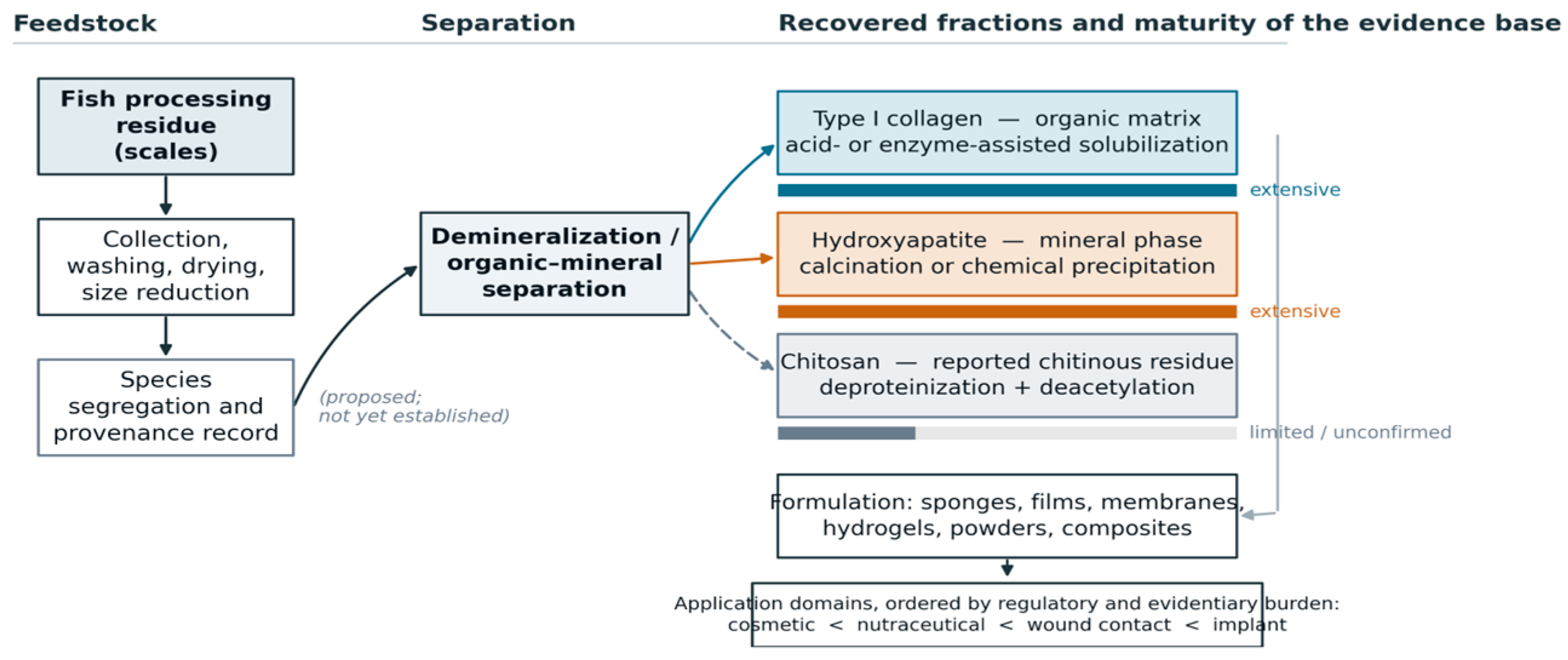
Figure 2.
Hierarchical organization of a teleost fish scale. (a) Whole scale, showing the heavily mineralized anterior field and the collagenous posterior base plate. (b) Cross-section through the scale, showing the limiting or osseous layer of dense calcium phosphate, a transition zone of mineralized collagen, and the base plate in which Type I collagen lamellae are arranged in a twisted-plywood (Bioligand) configuration with fibril orientation rotating between successive lamellae. (c) Mineralized fibril, showing Type I collagen triple helices with plate-like apatite crystallites deposited in and around the fibril. Conceptual schematic redrawn from structural descriptions in the literature [4,6,7,8]; layer thicknesses and fibril dimensions are not to scale, and interlamellar angles are species-dependent (Section 2.1).
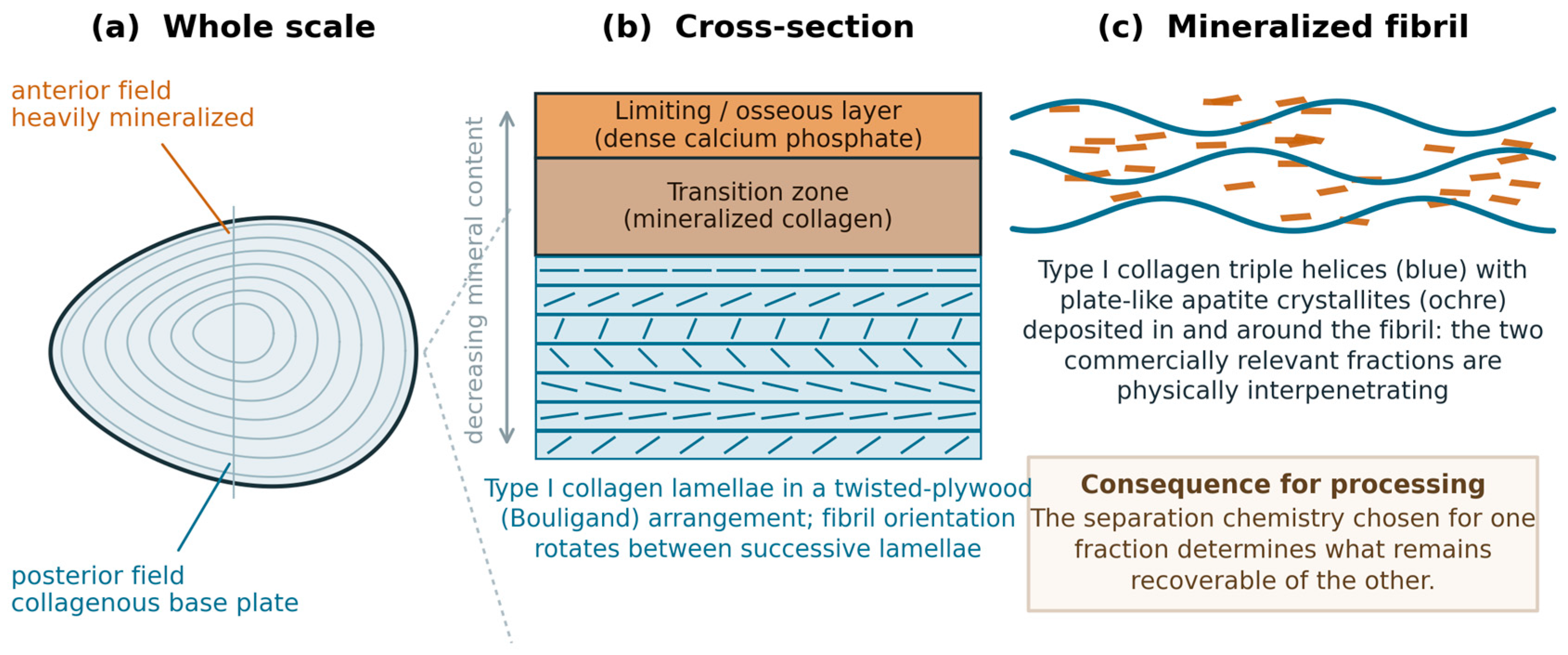
Figure 3.
Collagen recovery and processing train for fish scales, showing the common processing sequence, the principal solubilisation variants and their relative evidentiary status, the critical control points at which product quality is determined, and downstream fabrication and sterilisation. Conceptual schematic based on process descriptions in the cited literature [3,8,9]; no operating conditions, durations or yields are implied.
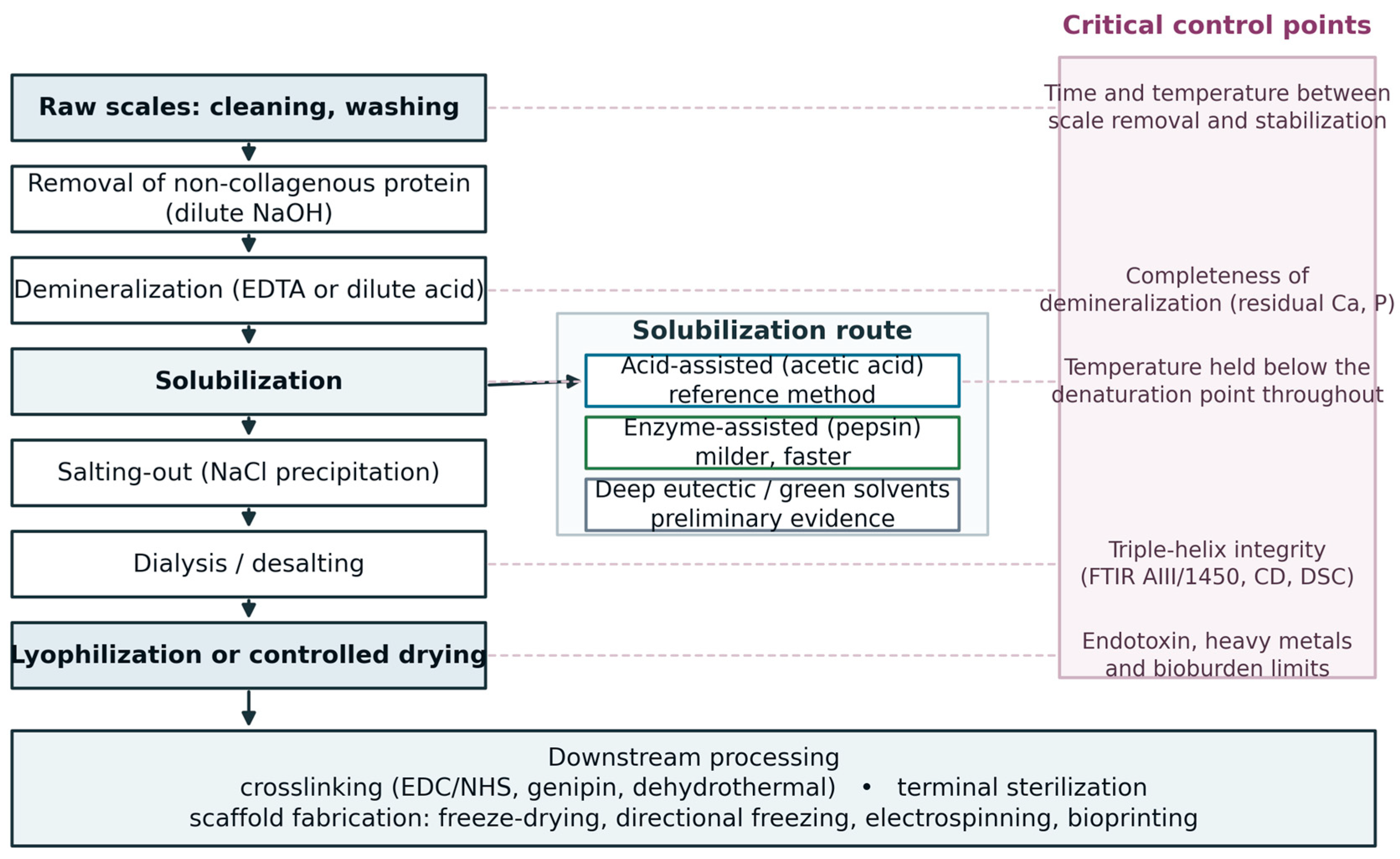
Figure 4.
Characterization toolbox for fish-scale-derived collagen and collagen–mineral materials, grouped by the property probed, with the convergent read-out that the combined methods provide. Terahertz approaches are shown as a fourth, complementary group; the annotation at the foot of the figure states the constraint on their interpretation developed in Section 4.4. Conceptual schematic; see Table 4 for the information each method yields and its principal limitation.
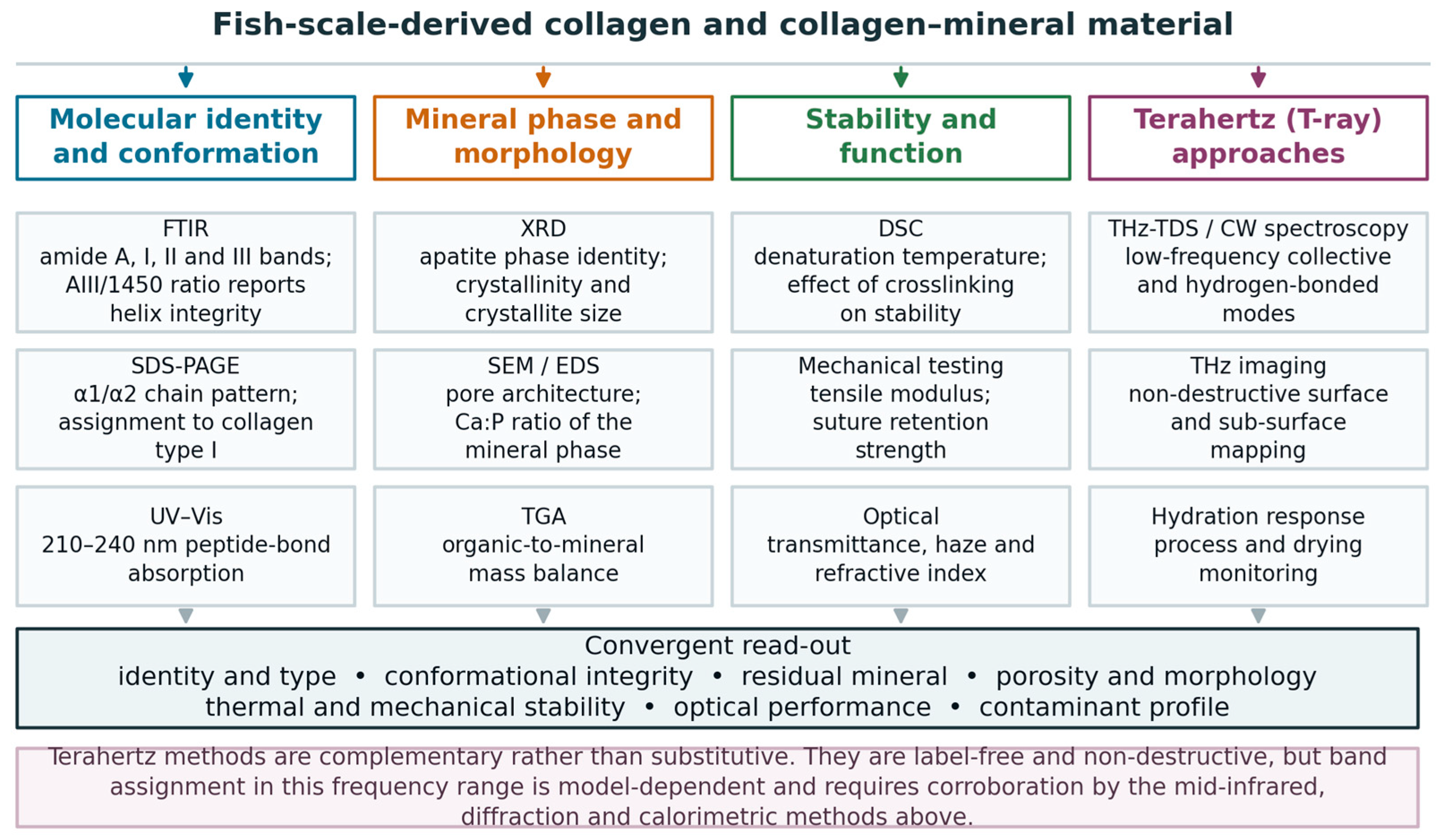
Figure 5.
Illustrative T-ray imaging of a rohu (Labeo Rohita) scale, acquired by one of the present authors using a cameraless raster-scanning terahertz platform [28,29]. (a) Scale mounted on the nanoscanner stage; the violet reflection is an alignment artefact. (b) Surface image over an approximately 5 mm × 5 mm field, resolving the concentric ridge pattern of scale growth. (c) Surface image, 500 µm × 500 µm. (d) Surface image, 200 µm × 200 µm. (e) Reconstructed volume image, 10 × 10 × 8 µm. Scale bars are shown on each panel. These images are presented to illustrate the class of information the technique yields and are not offered as a validated characterization of a biomaterial product; see Section 4.3.
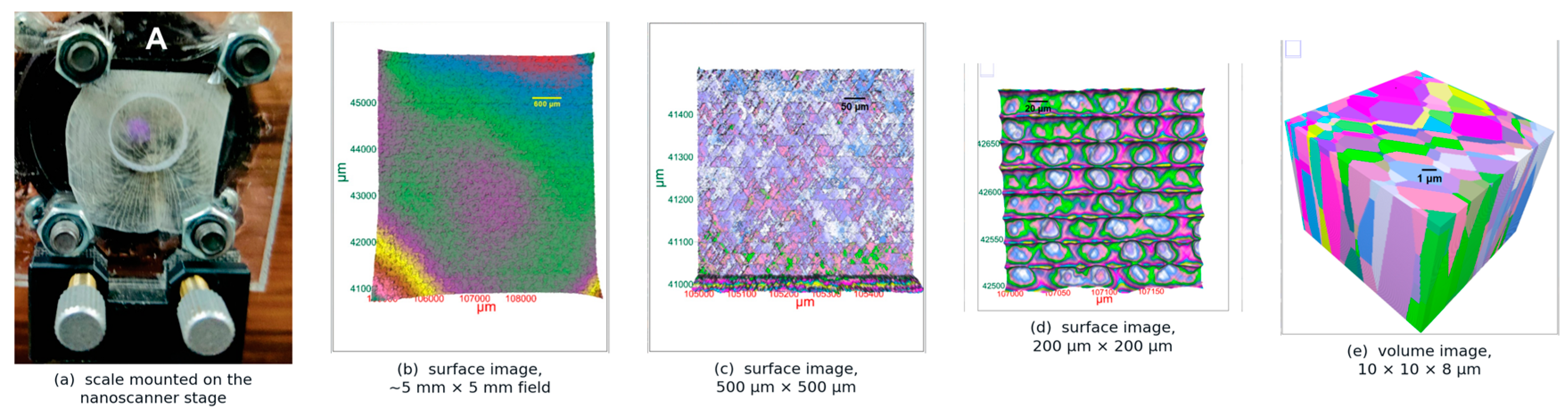
Figure 6.
Illustrative T-ray spectra of the rohu scale specimen shown in Figure 5, acquired by one of the present authors. (a) T-ray absorbance spectrum computed as a Lomb periodogram over approximately 0.1–32 THz, plotted as normalised absorbance in decibels; the broadband, heavily overlapped character is consistent with a heterogeneous composite containing protein, mineral and water. (b) Eigen-frequency absorbance estimate derived from the same dataset, showing a sharp low-frequency rise followed by a plateau at approximately −130 dB. Feature assignments discussed in Section 4.3 are proposed on compositional grounds and are not established; the derived trace does not display well-separated resonances against the plateau, and no molecular identification is claimed from these data.
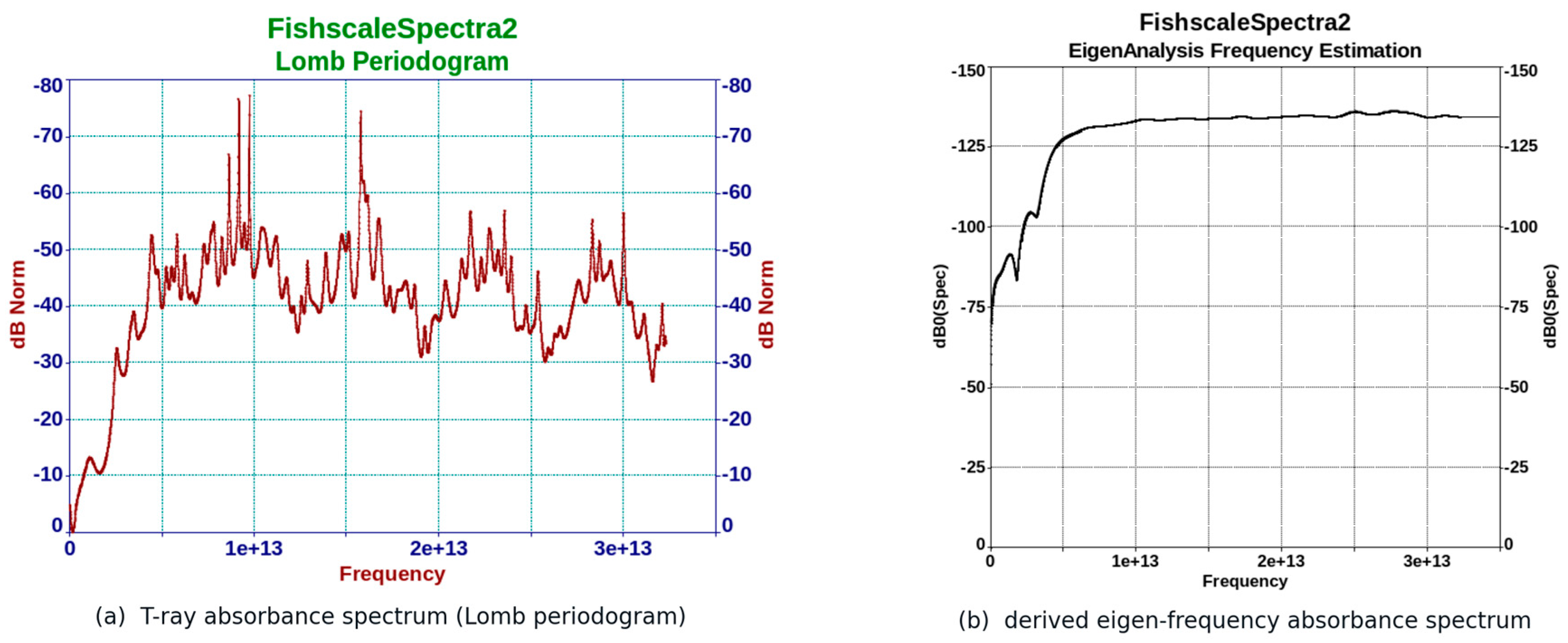
Figure 7.
Pathway from fish scale to bioengineered corneal implant, with the properties that must be demonstrated and the stage of evidence reached in the published literature. Bar length in the evidence panel indicates the extent of published support as assessed in Section 6.3 and Table 6; it is a qualitative indicator and does not represent measured performance. The lower panel sets out the four constraints specific to ocular use discussed in Section 6.4. Conceptual schematic based on the cited literature [31,32,33,34,35].
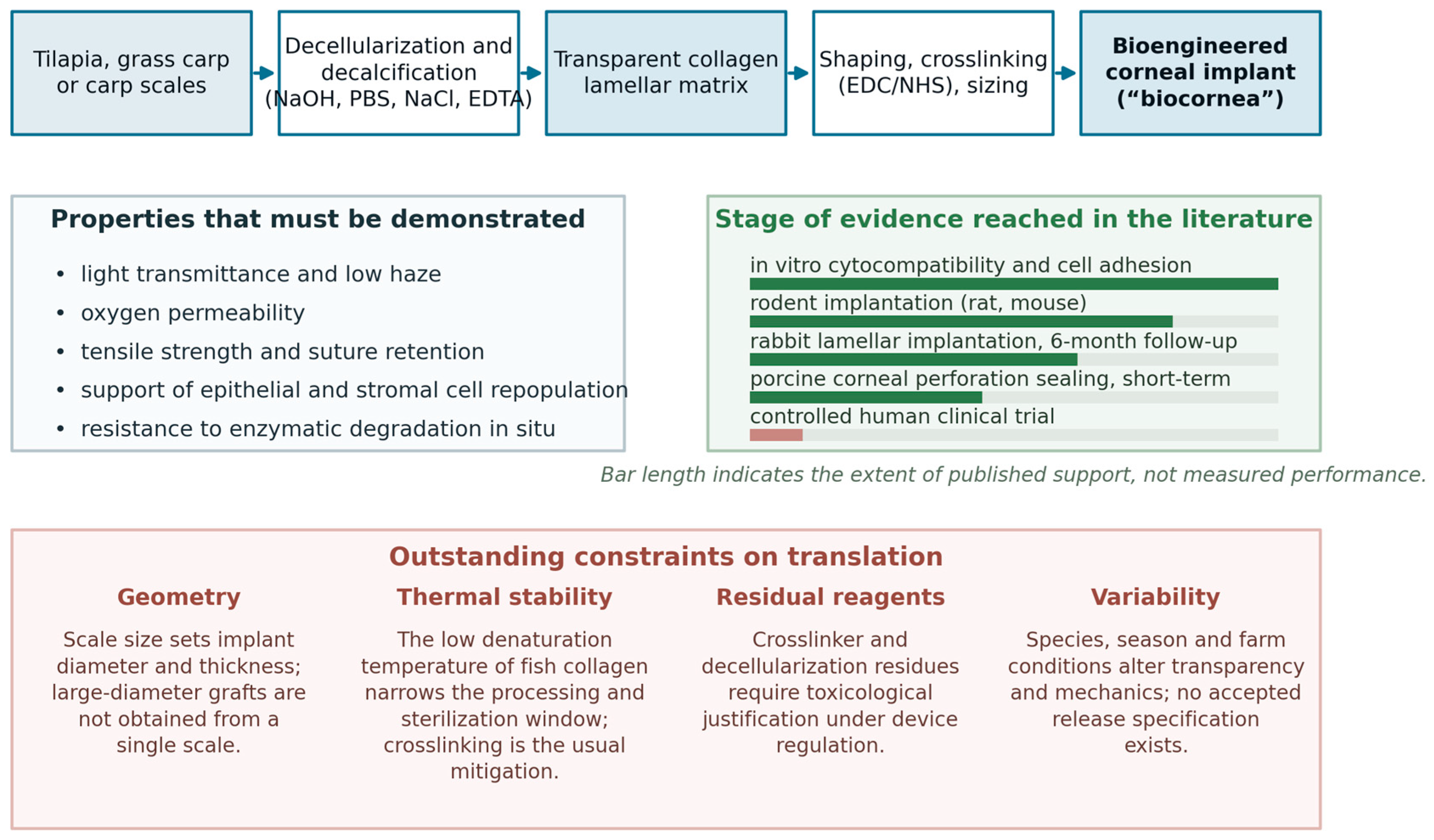
Figure 8.
The distinction between the material and conceptual contributions of teleost biology to ocular regenerative medicine. (A) Fish scales supply the physical substance for an implanted structural biomaterial addressing the anterior segment. (B) Teleost retinal regeneration supplies a mechanism of endogenous repair, in which Müller glia dedifferentiate into progenitors that regenerate lost neuron classes, offering a target for reactivating latent capacity in the mammalian retina; no fish-derived material is implanted. The two are independent lines of evidence with different regulatory classifications, failure modes and translational timelines, converging only at the level of clinical intent. Conceptual schematic based on [31,32,33,34,35] for panel A and [38,39,40,41,42,43] for panel B.
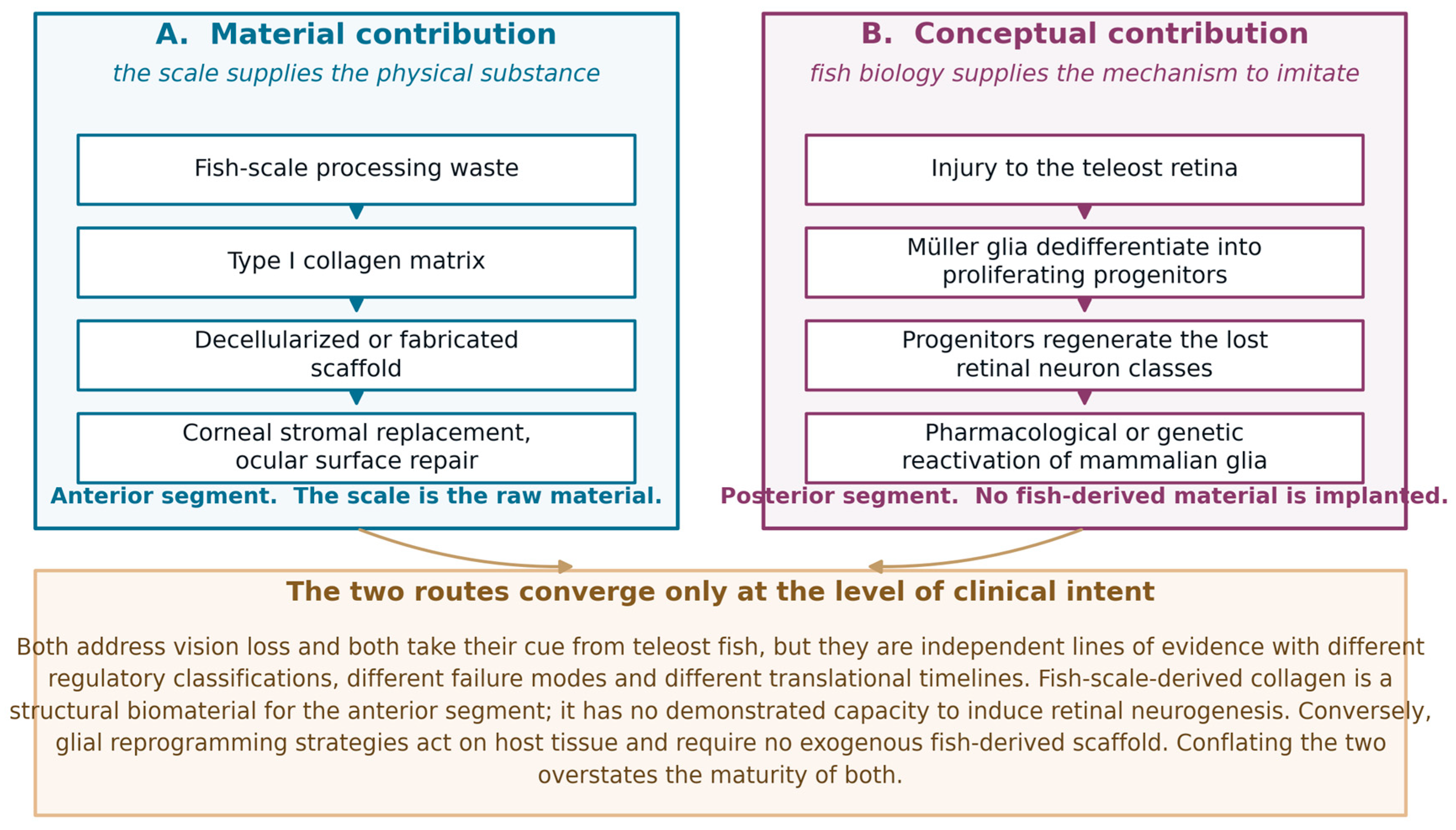
Figure 9.
Integrated processing and translation. (a) Cascading recovery of mineral, organic and insoluble fractions from a single scale feedstock, with the structural trade-offs that constrain cascade design; the bracketed route denotes a pathway whose origin remains unconfirmed (Section 2.2). (b) Proposed translation sequence from feedstock security to a regulated finished product, with the decision criterion applicable at each stage, the point at which most published work terminates, and the enabling conditions required in parallel. Stage sequence and criteria in panel (b) are proposed by the authors; no timelines, costs or capacities are implied.
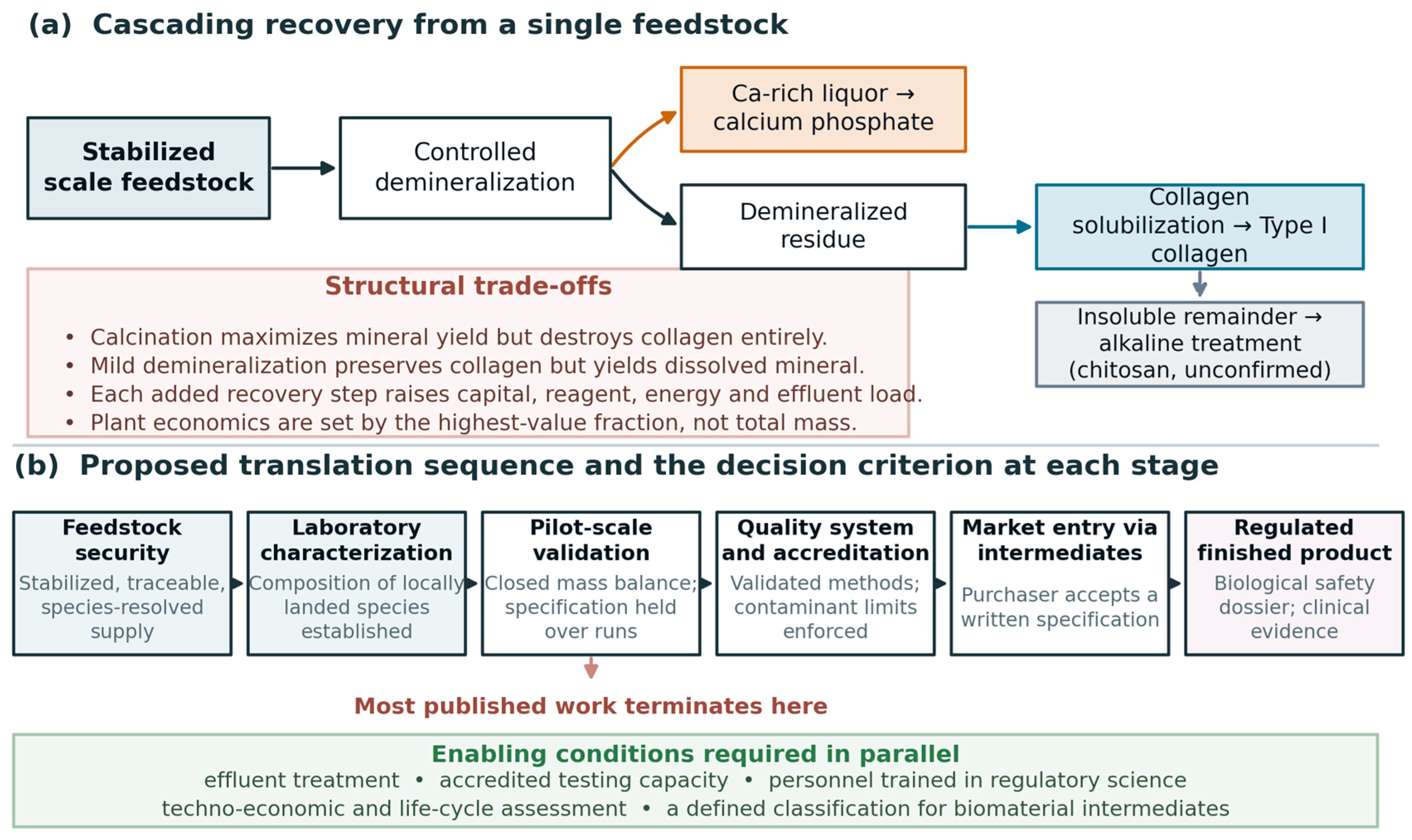
Table 1.
Principal recoverable fractions of fish scales, their reported recovery routes, characteristic properties and application areas. Entries describe qualitative findings reported in the cited literature; no yields, purities or market values are asserted.
Table 1.
Principal recoverable fractions of fish scales, their reported recovery routes, characteristic properties and application areas. Entries describe qualitative findings reported in the cited literature; no yields, purities or market values are asserted.
| Fraction | Origin within the scale | Reported recovery route | Characteristic properties reported | Principal application areas | Maturity of the evidence base |
| Type I collagen | Fibrillar organic matrix of the base plate, organised into oriented lamellae | Demineralisation followed by acid- or enzyme-assisted solubilisation, then salting-out and dialysis [3]; alternatively, decellularisation and decalcification with retention of native geometry [8,34] | Biocompatible, biodegradable, low reported immunogenicity, supports cell adhesion; denaturation temperature lower than mammalian collagen and correlated with source-species physiological temperature [3,9,10] | Scaffolds, wound dressings, hydrogels, corneal matrices, barrier membranes, cosmetic ingredients, hydrolysed peptides [5,8,10,32] | Extensive; multiple species and laboratories |
| Hydroxyapatite and related calcium phosphates | Mineral phase distributed through the collagen network | Calcination or controlled thermal treatment; alternatively chemical deproteinisation and mineral precipitation [4,11] | Bioactive, osteoconductive, bone-like mineral composition; crystallinity and phase purity depend on thermal history [4,11] | Bone graft substitutes, osteoconductive scaffolds, implant coatings, dental materials [4,11,12] | Extensive; thermal route well described |
| Chitosan | Reported chitinous residue in scales of certain species 1 | Demineralisation and deproteinisation followed by alkaline deacetylation [13,14,15] | Biodegradable, antimicrobial, film-forming, chemically modifiable; degree of deacetylation governs solubility and charge density [13,15] | Antimicrobial films, delivery carriers, adsorbents, composite scaffolds [13,15] | Empirical reports available; origin and mass balance of the fraction not independently confirmed 1 |
1 Chitin is not an established structural constituent of the vertebrate integument. Isolation and characterisation of a chitosan-like fraction from scale material has been reported for several species [13,14,15], but the reviewed sources do not establish the origin of that fraction by methods discriminating chitin polymorphs from deacetylated protein residues, nor a closed mass balance against the starting material. See Section 2.2.
Table 4.
Characterisation methods applied to fish-scale-derived collagen and collagen–mineral materials, and the information each provides.
Table 4.
Characterisation methods applied to fish-scale-derived collagen and collagen–mineral materials, and the information each provides.
| Method | Property probed | What it establishes | Principal limitation |
| FTIR spectroscopy | Amide A, B, I, II and III bands; lower-frequency skeletal modes [19,20,21,22] | Identification as collagen; triple-helical integrity via the amide III to 1450 cm−1 ratio; discrimination between collagen types [19] | Band overlap in multicomponent samples; sensitive to hydration and sample preparation |
| SDS-PAGE | α1 and α2 chain pattern | Assignment to collagen type I; detection of degradation to lower-molecular-weight fragments | Does not report conformation in the native state |
| UV–Vis spectroscopy | Peptide-bond absorption at 210–240 nm | Presence of the polypeptide backbone; supports purity assessment | Non-specific; does not distinguish collagen from other proteins |
| X-ray diffraction | Crystalline mineral phase | Apatite phase identification; crystallinity and crystallite size [4] | Uninformative for the organic phase; requires adequate crystallinity |
| SEM with EDS | Surface and pore morphology; elemental composition | Pore architecture relevant to cell infiltration; calcium-to-phosphorus ratio | Surface-weighted; sample preparation can alter apparent morphology |
| Differential scanning calorimetry | Thermal transition | Denaturation temperature; effect of crosslinking or processing on stability [8,9] | Requires careful hydration control; a single transition may mask heterogeneity |
| Thermogravimetric analysis | Mass loss on heating | Organic-to-mineral mass balance; residual moisture | Does not identify the phases present |
| Mechanical testing | Tensile modulus, strength, suture retention | Fitness for the mechanical demands of the intended application | Highly dependent on hydration state and specimen geometry |
| Optical measurement | Transmittance, haze, refractive index | Fitness for ocular use; comparability with native cornea [34,35] | Applicable only to transparent constructs |
| Terahertz spectroscopy and imaging | Collective low-frequency modes; hydrogen-bond network dynamics; sub-surface structure [23,24,25,26,27] | Non-destructive comparative screening; sensitivity to hydration state; sub-surface imaging without sectioning | Band assignment is model-dependent; does not report mechanical properties; requires calibration against the methods above (Section 4.4) |
Table 5.
Reported applications of fish-scale-derived biomaterials in regenerative medicine, with the highest stage of evidence identified in the reviewed sources. Stage descriptors refer to the cited literature only and are not claims about the wider field.
Table 5.
Reported applications of fish-scale-derived biomaterials in regenerative medicine, with the highest stage of evidence identified in the reviewed sources. Stage descriptors refer to the cited literature only and are not claims about the wider field.
| Material and form | Application area | Reported functional basis | Highest stage of evidence in the reviewed sources |
| Collagen sponges, films and hydrogels | Wound dressings, general tissue-engineering scaffolds, delivery matrices | Cell-adhesive porous substrate; degradation compatible with tissue ingrowth [5,10] | Material characterisation and in vitro assessment |
| Collagen membrane retaining native scale geometry | Guided bone and tissue regeneration; barrier membranes | Retained lamellar composite architecture; raised denaturation temperature; osteogenic differentiation of marrow-derived mesenchymal stem cells [8] | In vitro assessment with stem-cell response |
| Tilapia-scale collagen nanoparticles | Wound healing | Retained bioactivity supporting cellular attachment and repair [17] | Experimental in vivo assessment |
| Acellular scale scaffold with mesenchymal stem cells | Skin flap regeneration | Bioactive scaffold supporting cell delivery [18] | In vivo animal assessment |
| Decalcified whole scale | Bioabsorbable fracture fixation | Mechanical competence combined with resorbability [12] | Preliminary in vivo assessment |
| Fish-scale-derived hydroxyapatite | Bone graft substitute; osteoconductive scaffold | Osteoconduction; compositional similarity to bone mineral [4,11] | Material characterisation and in vitro assessment |
| Decellularised, decalcified collagen lamellar matrix | Corneal stromal replacement and tectonic repair | Ordered lamellar Type I collagen with adequate transparency and oxygen permeability [31,32,35] | Large-animal implantation; see Table 6 |
Table 6.
Ocular applications of fish-scale-derived collagen matrices and the level of evidence reported. No entry in this table constitutes clinical evidence in humans.
Table 6.
Ocular applications of fish-scale-derived collagen matrices and the level of evidence reported. No entry in this table constitutes clinical evidence in humans.
| Evidence stage | Model or measurement | Principal findings reported | Reference |
| Material properties | Grass carp scale lamellar matrix | Transparency, refractive index, mechanical properties and cellular compatibility characterised and judged compatible with corneal tissue-engineering requirements | [35] |
| Optical comparison | Light scatter and transmission against human cornea | Scatter and transmission of the scale-derived matrix compared directly with native human corneal tissue | [34] |
| In vitro cytocompatibility | Primary human corneal epithelial and stromal cells from donor corneas | Direct and indirect cytotoxicity, proliferation, corneal cell phenotype and adhesion markers assessed | [32] |
| Cell repopulation and permeability | Rabbit corneal stromal cells | Scaffold supports stromal cell repopulation; high oxygen permeability reported | [31] |
| Small-animal implantation | Rat pocket implantation | Safety, biocompatibility and regenerative potential established; properties relevant to use as an artificial cornea characterised | [31] |
| Immunogenicity in vivo | Rodent model | In vivo immunogenicity of the fish-scale-derived matrix characterised | [32] |
| Medium-term large-animal implantation | Rabbit, six-month follow-up | Corneas clear at three and six months; no haze or ulceration; interface with host stroma filled; no observable immune infiltrate at day 180; implant transparent without apparent fragmentation | [33] |
| Acute tectonic performance | Minipig, 2 mm full-thickness perforation | Perforation sealed and anterior chamber integrity stabilised over the short follow-up period; assessed by slit lamp, optical coherence tomography and histology | [34] |
| Controlled human clinical trial | — | Not identified in the reviewed sources 1 | — |
1 Collagen-based corneal implants of other origin have reached clinical evaluation [37], and bioengineered corneal grafts have been compared systematically in animal models [36], but no controlled clinical trial of a fish-scale-derived implant is identified here. See Section 6.3.
Table 7.
Principal barriers to industrial implementation, the corresponding technical or institutional requirement, and possible responses. Responses are proposals by the authors informed by the cited literature; they have not been evaluated or costed.
Table 7.
Principal barriers to industrial implementation, the corresponding technical or institutional requirement, and possible responses. Responses are proposals by the authors informed by the cited literature; they have not been evaluated or costed.
| Barrier | Nature of the problem | Requirement | Possible response |
| Feedstock variability | Species, season and habitat alter collagen-to-mineral ratio, lamellar organisation and denaturation temperature [6,9] | Species-resolved compositional data for local landings | Baseline characterisation of commercially significant species; species segregation at collection points |
| Dispersed and unmanaged collection | Residue generated in small quantities at many points, with no stabilisation | Reliable supply of stabilised, traceable feedstock | Decentralised washing and drying at collection points feeding regional hubs; provenance records |
| Reagent and effluent burden | Acid–base processing generates significant effluent volumes [3] | Effluent treatment integrated into process design | Neutralisation and treatment at hub level; evaluation of reagent recovery; assessment of lower-burden extraction routes |
| Energy intensity of thermal routes | Calcination is energy-intensive and destroys the organic fraction [4] | Energy-efficient thermal processing; explicit product prioritisation | Optimisation of the calcination profile; selection between mineral-first and collagen-first routes rather than both |
| Absence of pilot-scale data | Literature terminates at laboratory scale | Continuous operation with closed mass balance | Shared pilot facility linked to research institutions |
| Inconsistent characterisation | Non-comparable reporting of yield, purity and structural integrity | Minimum reporting standard; accredited testing | Adoption of a common reporting set; investment in accredited analytical capability |
| Sterilisation of thermally labile constructs | Moist-heat sterilisation is generally incompatible with unmodified fish collagen; alternatives may alter crosslink density or leave residues | Validated terminal sterilisation with post-sterilisation characterisation | Evaluation of irradiation, ethylene oxide and supercritical CO2 routes against a defined specification |
| Undefined regulatory pathway | No established classification for biomaterial intermediates or xenogeneic scale-derived implants | Clear classification and dossier requirements | Engagement between regulators, researchers and industry to define requirements for intermediate materials |
| Absence of economic and environmental evidence | No techno-economic or life-cycle assessment identified in the reviewed sources | Quantified cost and impact assessment | Techno-economic and life-cycle assessment conducted alongside pilot operation |
Table 8.
Research gaps and the corresponding opportunities, in approximate order of dependency.
| Gap | Why it matters | Opportunity |
| No systematic species-resolved compositional dataset | Variability propagates directly into product specification [6,9] | Comparative characterisation across commercially significant species, reported on a common basis |
| Non-comparable reporting across extraction studies | Prevents any evidence-based ranking of extraction routes | A minimum reporting standard covering provenance, yield basis, helix verification, phase identification and contaminant screening |
| No pilot-scale operation with closed mass balance | Blocks both process design and any economic or environmental assessment | Shared pilot facilities generating publishable process data |
| No techno-economic or life-cycle assessment | Environmental and economic claims remain assumptions | Assessment inclusive of collection, effluent treatment and the disposal counterfactual |
| Origin of the reported chitinous fraction unconfirmed | Determines whether the third recovery route exists as described | Structural verification discriminating chitin polymorphs from deacetylated protein residues, with closed mass balance |
| Terahertz characterisation not validated against reference methods | Limits its use to description rather than quality control | Reproducibility studies, reference spectra for material of known specification, and calibration against FTIR, XRD and DSC |
| Sterilisation effects on scale-derived constructs poorly reported | Characterisation before sterilisation does not describe the implanted product | Systematic comparison of terminal sterilisation routes with post-sterilisation characterisation |
| Ocular evidence stops short of clinical evaluation | The preclinical record is strong but cannot support clinical claims [31,32,33,34,35] | Defined release specification, validated sterilisation, and longer-duration large-animal studies with optical endpoints |
| Mechanistic findings in retinal regeneration are model-specific | Species divergence in signalling limits generalisation [38,41] | Cross-model comparison of reprogramming determinants before translational inference |
Disclaimer/Publisher’s Note: The statements, opinions and data contained in all publications are solely those of the individual author(s) and contributor(s) and not of MDPI and/or the editor(s). MDPI and/or the editor(s) disclaim responsibility for any injury to people or property resulting from any ideas, methods, instructions or products referred to in the content. |
© 2026 by the authors. Licensee MDPI, Basel, Switzerland. This article is an open access article distributed under the terms and conditions of the Creative Commons Attribution (CC BY) license (http://creativecommons.org/licenses/by/4.0/).
Copyright: This open access article is published under a Creative Commons CC BY 4.0 license, which permit the free download, distribution, and reuse, provided that the author and preprint are cited in any reuse.