

Submitted:
27 September 2026
Posted:
28 September 2026
You are already at the latest version
Abstract
Introduction: Positive psychology interventions are increasingly used in educational, workplace, and community settings to support well-being, personal growth, resilience, engagement, and other indicators of human development. However, the evidence spans diverse interventions, populations, outcomes, and cultural contexts, and the extent to which positive effects are sustained or transferable remains uncertain.Methods: The researcher-selected databases and information sources were Google Scholar, PubMed (MEDLINE), ERIC. The eligibility protocol restricted publication years to 2020–2026. COSTAQDA recorded source-level retrieval through OpenAlex (250 retrieved; 14323 available), Crossref (250 retrieved; 27071 available). Where researcher-selected sources did not expose a suitable direct bulk-search connector, COSTAQDA used its OpenAlex/Crossref discovery bridge while preserving the researcher-selected source names in the PRISMA record. The identification run recorded 500 records before cross-source deduplication and 487 unique records after deduplication.Results: The synthesis generated one descriptive theme and six analytical themes. Positive psychology interventions were associated with strengthened personal resources; strengths-based reflection supported identity development and intentional growth; positive emotional climates created pathways to engagement and performance; benefits depended on supportive relationships and enabling environments; cultural and situational fit constrained transferability; implementation required preparation, competence, and ethical safeguards; and the evidence supported promise but not definitive claims about long-term human development. Convergence was strongest for self-efficacy, engagement, resilience, and relational support, while divergent findings concerned emotional coexistence, cultural variation, sustainability, and possible harms.Discussion/Conclusion: Positive psychology interventions show promise as context-dependent strategies for human development, but the evidence does not justify universal or definitive causal claims. Transferable implications favour strengths-based, relational, culturally responsive, and institutionally supported implementation.
Keywords:
cultural fit
; human development
; positive psychology interventions
; resilience
; well-being
1. Introduction
Positive psychology has increasingly been applied through coaching, strengths-based activities, positive education, emotional and engagement interventions, self-leadership training, and workplace programmes. The supplied literature links these approaches with psychological capital, self-efficacy, confidence, resilience, enjoyment, engagement, personal growth, flourishing, and work-related functioning. Examples include improvements in psychological capital following micro-coaching, strengthened self-efficacy after scaffolding, relationships between classroom emotional climate and engagement, and associations between positive practices and workplace satisfaction or performance (Corbu et al., 2021; Allagui, 2024; Hosseini et al., 2022; Kumar et al., 2025).
The literature also indicates that positive psychology interventions do not operate independently of their setting. Teacher support, peer relationships, trust, psychological safety, autonomy, teamwork, supervision, institutional resources, and practitioner competence recur as conditions shaping engagement and development (Wang et al., 2021; Radu, 2023; Kritikou & Giovazolias, 2022; Smith et al., 2025). Cultural and situational variation is equally evident. The supplied studies identify Western dominance, limited representation of disadvantaged populations, differences across Japan, Taiwan, the United States, China, Iran, Saudi Arabia, Africa, and other contexts, and the need for locally meaningful approaches (Appiah, 2023; Chen et al., 2020; van Zyl & Salanova, 2022; Lomas et al., 2025).
Important uncertainties remain. Positive emotions may coexist with anxiety or other negative experiences, strengths awareness may create pressure to change, and positive framing may overlook vulnerability or structural conditions (Gregersen, 2020; Fouracres & van Nieuwerburgh, 2020; van Zyl & Rothmann, 2022). The evidence base also contains substantial methodological limitations, including reliance on self-report, cross-sectional designs, inconsistent constructs, incomplete intervention descriptions, limited qualitative work, and sparse evidence about long-term effects. Although the literature reports promising outcomes, it is insufficiently clear which interventions influence which indicators, through what mechanisms, under what conditions, and with what risks.
This systematic review was therefore conducted to synthesise the available evidence on how positive psychology interventions influence human development indicators in individuals. It examines outcomes, benefits, enabling conditions, contextual and institutional factors, implementation barriers, ethical tensions, and gaps in the evidence. The review is needed because the available literature is broad but heterogeneous, and because claims about positive psychology as a strategy for human development require a synthesis that distinguishes association from causation, bibliometric prominence from methodological quality, and transferable implications from direct evidence.
2. Research Objectives
RO1: To examine how Positive psychology interventions influences Human development indicators (e.g., psychological well-being, self-actualization, personal growth, resilience) among Individuals across the lifespan within Educational, workplace, or community settings.
RO2: To identify the principal opportunities, benefits and enabling conditions associated with Positive psychology interventions in relation to Human development indicators (e.g., psychological well-being, self-actualization, personal growth, resilience).
RO3: To analyse the challenges, risks, ethical considerations and implementation barriers associated with Positive psychology interventions for Individuals across the lifespan.
RO4: To examine the contextual, institutional and practice-related factors that shape the adoption and effective use of Positive psychology interventions within Educational, workplace, or community settings.
RO5: To identify gaps in the available evidence and derive implications for future research, policy and practice relevant to Positive Psychology as a Strategy for Human Development.
3. Research Methods
3.1. Review Design
The selected review type was a Systematic Review. The review used a structured search and PRISMA selection workflow, CASP critical appraisal, and verified thematic synthesis. The synthesis was interpretive rather than a quantitative meta-analysis because the supplied evidence was heterogeneous in intervention type, outcome, design, setting, and evidential completeness. (Grant & Booth, 2009; Mfolo & Costa, 2024)
3.2. Search Strategy and Information Sources
The researcher-selected databases and information sources were Google Scholar, PubMed (MEDLINE), ERIC. The eligibility protocol restricted publication years to 2020–2026. COSTAQDA recorded source-level retrieval through OpenAlex (250 retrieved; 14323 available), Crossref (250 retrieved; 27071 available). Where researcher-selected sources did not expose a suitable direct bulk-search connector, COSTAQDA used its OpenAlex/Crossref discovery bridge while preserving the researcher-selected source names in the PRISMA record. The identification run recorded 500 records before cross-source deduplication and 487 unique records after deduplication. The recorded search execution timestamp was 2026-09-26T20:07:01.161Z.
3.3. Inclusion and Exclusion Criteria
Inclusion
- Peer-reviewed journal articles between 2020–2026
- Studies published in English
- Research focusing on positive psychology interventions
- Studies measuring indicators of human development or personal growth
- Empirical studies (quantitative, qualitative, or mixed-methods)
Exclusion
- Peer-reviewed journal articles before 2020
- Non-peer-reviewed literature (e.g., books, editorials, conference abstracts)
- Studies focusing exclusively on clinical psychopathology or psychiatric treatment
- Research not involving a specific positive psychology intervention
- Studies published in languages other than English
- Theoretical or conceptual papers lacking empirical data
3.4. Screening and Study Selection
The PRISMA selection counts are persisted, but the decision rule used during title/abstract screening is not available in the verified audit payload. COSTAQDA therefore reports the recorded workflow counts without reconstructing an unverified screening procedure.
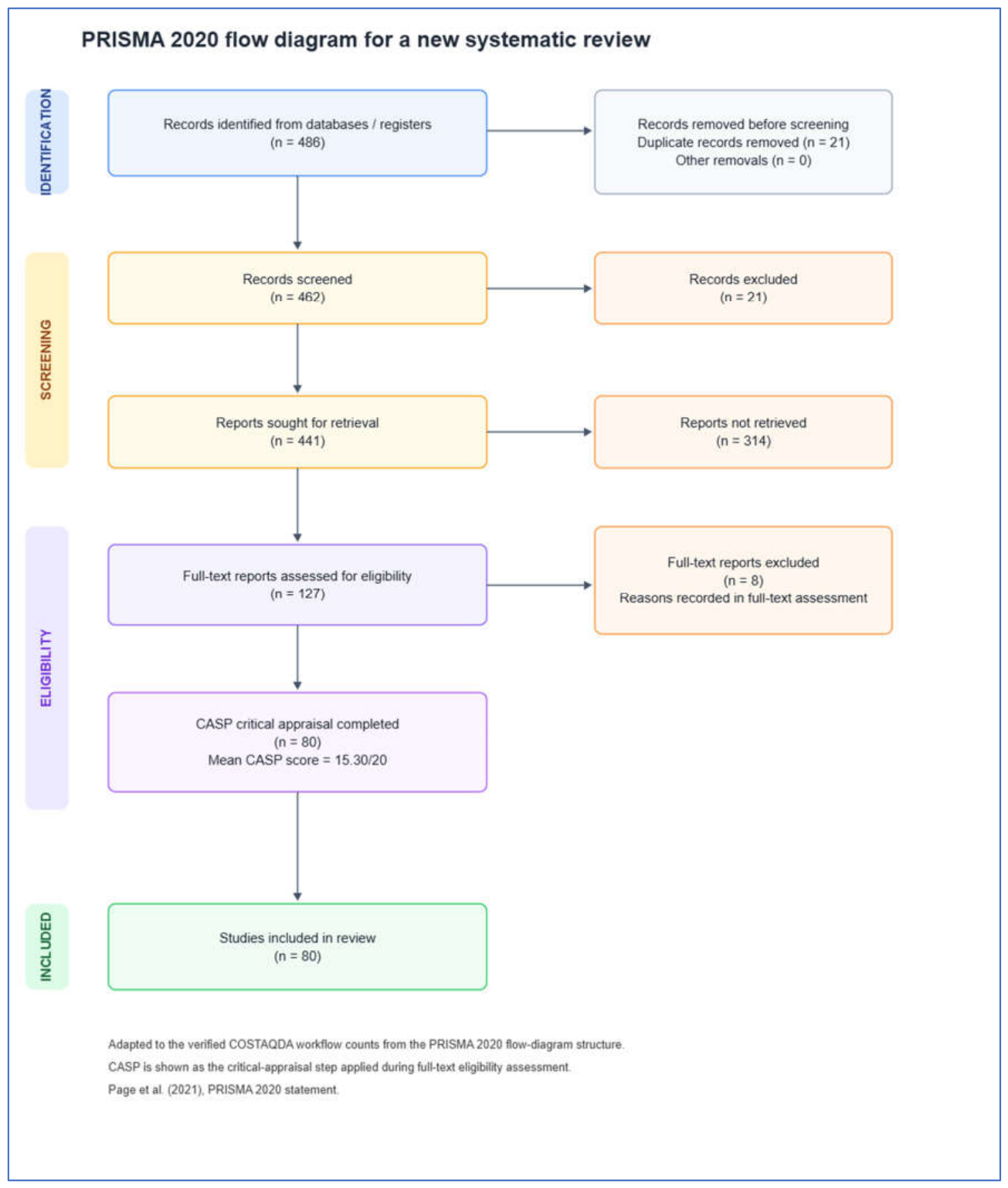
The persisted PRISMA workflow records 486 identified records, 21 duplicates, 462 records screened, 441 reports sought for retrieval, 21 records excluded at the title/abstract stage, 127 full texts assessed, 8 full-text exclusions and 80 included records. These counts describe study selection and are not substantive review findings.
The PRISMA figure displays the persisted workflow of identification, deduplication, screening, retrieval, full-text assessment, exclusion, and inclusion. Its evidence-specific pattern is 486 identified records, 21 duplicates, 462 screened, 441 sought for retrieval, 21 title/abstract exclusions, 127 full texts assessed, 8 full-text exclusions, and 80 included records. The absence of a verified title/abstract decision rule limits reproducibility of that stage, although the selection counts themselves are persisted.
Figure 1.
PRISMA 2020 Flow Diagram — Identification, Screening, Eligibility and Included.Source: COSTAQDA PRISMA Workflow, navigation item 8: PRISMA Flow Diagram; four-stage structure showing Identification, Screening, Eligibility (including CASP critical appraisal) and Included; adapted from PRISMA 2020 (Page et al., 2021).
Figure 1.
PRISMA 2020 Flow Diagram — Identification, Screening, Eligibility and Included.Source: COSTAQDA PRISMA Workflow, navigation item 8: PRISMA Flow Diagram; four-stage structure showing Identification, Screening, Eligibility (including CASP critical appraisal) and Included; adapted from PRISMA 2020 (Page et al., 2021).
3.5. Critical Appraisal
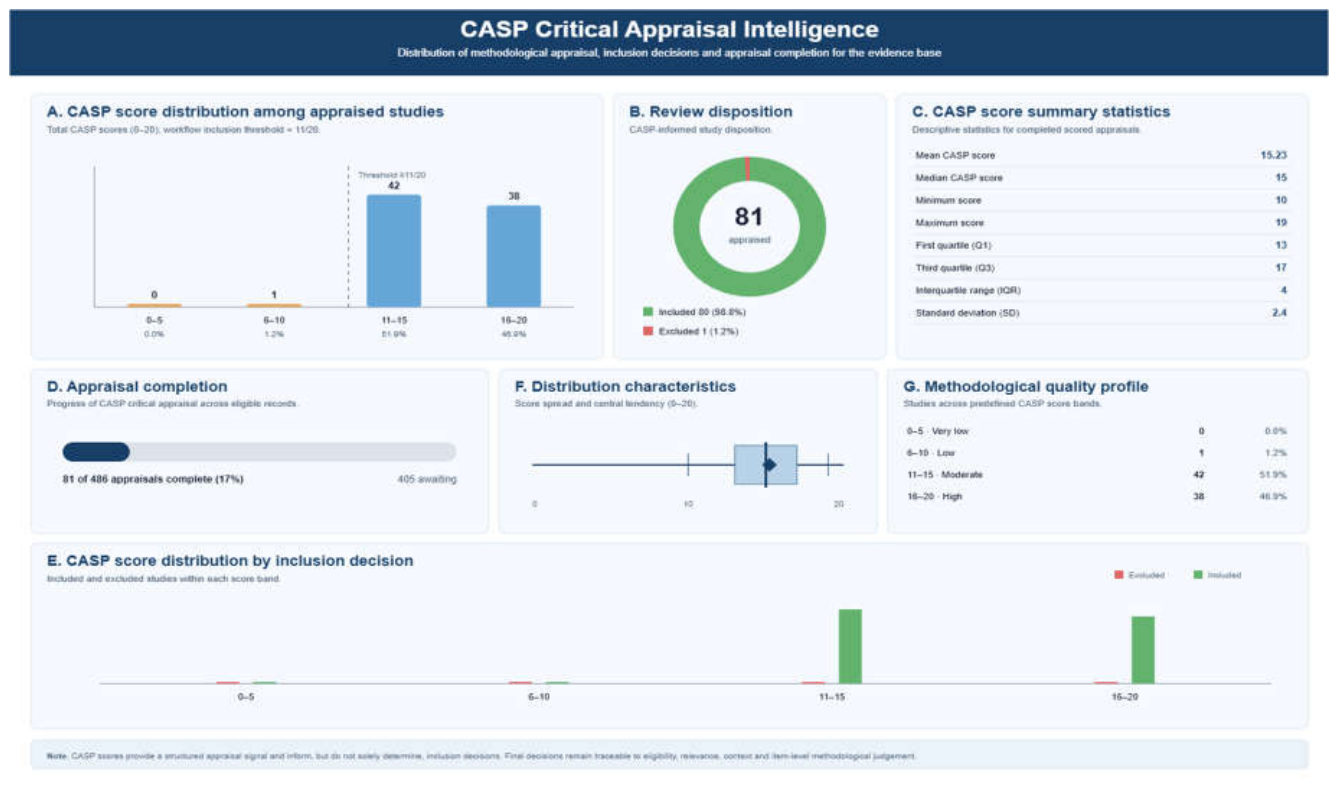
The Critical Appraisal Skills Programme (CASP) was used for critical appraisal in the PRISMA full-text workspace. All 80 of 80 currently included studies had completed CASP appraisals. The mean recorded CASP score was 15.3. Scores ranged from 11 to 19 in the supplied appraisal records. These scores are treated as appraisal outputs rather than unquestioned total-quality measures. The appraisal records frequently identified methodological concerns involving design, measurement, sampling, analysis, intervention detail, or interpretive limitations, and many appraisals were completed conservatively because the configured appraisal service was unavailable. CASP outcomes therefore inform caution and interpretation but do not convert heterogeneous studies into a single definitive quality ranking.
Figure 2.
CASP Critical Appraisal Intelligence — PRISMA Workflow, Step 6: Full-Text Screening. The CASP figure represents completed appraisal across all 80 included studies and a mean score of 15.3. The evidence-specific pattern is a broad spread of scores, from 11 to 19 among the supplied assessments, with methodological concerns recorded across multiple CASP domains. This indicates that the evidence base contains appraised but unevenly documented studies. CASP appraisal strengthens interpretation of limitations, but the scores are not equivalent to intervention effectiveness, causal certainty, or a validated aggregate quality score.
Figure 2.
CASP Critical Appraisal Intelligence — PRISMA Workflow, Step 6: Full-Text Screening. The CASP figure represents completed appraisal across all 80 included studies and a mean score of 15.3. The evidence-specific pattern is a broad spread of scores, from 11 to 19 among the supplied assessments, with methodological concerns recorded across multiple CASP domains. This indicates that the evidence base contains appraised but unevenly documented studies. CASP appraisal strengthens interpretation of limitations, but the scores are not equivalent to intervention effectiveness, causal certainty, or a validated aggregate quality score.
3.6. Data Extraction
Data extraction was not recorded as a separate formal procedure in the supplied workspace. Nevertheless, the verified synthesis demonstrates that finding-level evidence was available: 538 extracted findings from 61 studies were used, and the synthesis retained finding IDs and study IDs. The available extracted material included intervention or practice descriptions, outcomes, contextual conditions, implementation factors, risks, methodological observations, and contradictory findings. Because a standalone extraction form was not supplied, the completeness and consistency of extraction fields cannot be independently verified.
3.7. Data Synthesis and Analysis
Qualitative evidence synthesis was conducted on 538 extracted findings contributed by 61 studies. The COSTAQDA synthesis engine applied thematic synthesis, moving from traceable finding-level evidence to 9 initial codes, 4 categories, 1 descriptive themes and 6 analytical themes.
Theme development was constrained to the extracted finding-level evidence supplied by eligible studies. Each synthesised theme retained supporting study IDs and finding IDs, while contradictory evidence was preserved where identified. Titles, abstracts and bibliographic prominence were not treated as substitutes for extracted qualitative findings.
Recorded synthesis limitations included: The supplied findings are heterogeneous and include empirical studies, reviews, editorials, conceptual papers, and findings that are only indirectly related to positive psychology interventions; therefore, conclusions about causal intervention effects are limited.; Many extracted findings are quantitative associations or methodological statements rather than participant accounts, so the synthesis provides limited insight into lived experience and mechanisms from participants’ perspectives.; Several records contain incomplete text, table fragments, references, or findings without sufficient intervention detail; these were not treated as evidence for stronger causal claims.; The supplied evidence is concentrated in educational and workplace contexts, especially language learning, with comparatively thin evidence for community settings and for children, older adults, and other lifespan groups.; Cultural generalizability is constrained by the reported dominance of WEIRD frameworks and by evidence that emotional constructs and intervention effects vary across cultural and situational contexts.; The evidence base includes both convergence and divergence: positive emotions, engagement, self-efficacy, and resilience are often linked, but positive and negative emotions may coexist, effects may vary by setting, and some interventions may produce harm or limited benefit..
3.8. Bibliometric Intelligence and Confidence in the Evidence Base
Bibliometric intelligence provides a structural view of the evidence base that complements PRISMA selection, critical appraisal and qualitative synthesis. The following analyses examine citation relationships, scholarly influence, evidence connectivity and knowledge development within the included corpus. They provide contextual evidence about the intellectual structure and provenance of the literature and are not substitutes for methodological quality appraisal.
3.8.1. Local Citation Network
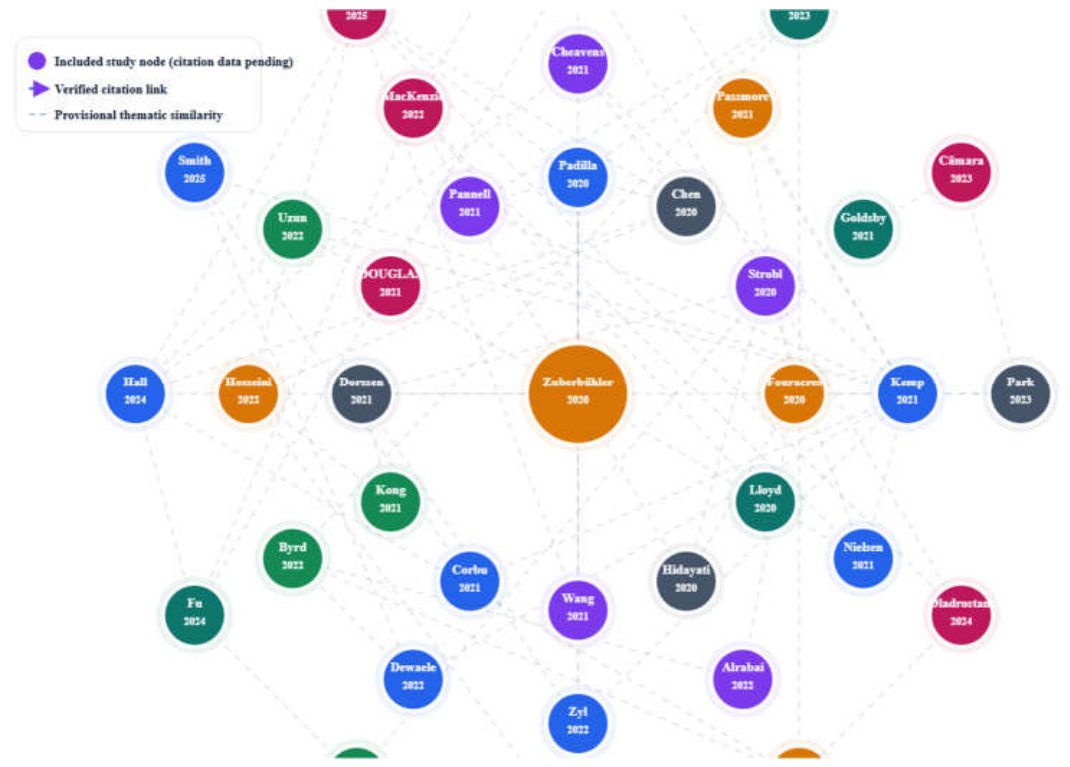
The Local Citation Network maps citation relationships within the included evidence base. It shows how studies are connected within the review corpus and supports examination of intellectual connectedness, centrality, bridging and isolation. These citation relationships describe the structure of the literature and do not, by themselves, establish methodological quality or validity.
Figure 3.
Local Citation Network — Bibliometric Intelligence, Step 12. The Local Citation Network figure is available and is based on 38 included-study nodes and 65 directed links. The supplied interpretation identifies a connected structure containing seminal works, supporting works, and influential works, with the strongest visible pathways linking positive psychology, coaching, language learning, education, self-leadership, workplace, and flourishing research. The network includes a relatively small number of highly connected conceptual entry points and many more peripheral single-cluster studies; however, the supplied data do not provide node-level degree metrics sufficient to label particular studies as central, bridging, or isolated beyond the supplied seminal, supporting, and influential classifications. The network indicates that the evidence base is intellectually connected across adjacent domains, but its 35 clusters also show fragmentation. Because local and global citation counts are both zero, connectedness should not be interpreted as scholarly impact or methodological strength. Source: COSTAQDA PRISMA Workflow, navigation item 12: Bibliometric Intelligence — Local Citation Network.
Figure 3.
Local Citation Network — Bibliometric Intelligence, Step 12. The Local Citation Network figure is available and is based on 38 included-study nodes and 65 directed links. The supplied interpretation identifies a connected structure containing seminal works, supporting works, and influential works, with the strongest visible pathways linking positive psychology, coaching, language learning, education, self-leadership, workplace, and flourishing research. The network includes a relatively small number of highly connected conceptual entry points and many more peripheral single-cluster studies; however, the supplied data do not provide node-level degree metrics sufficient to label particular studies as central, bridging, or isolated beyond the supplied seminal, supporting, and influential classifications. The network indicates that the evidence base is intellectually connected across adjacent domains, but its 35 clusters also show fragmentation. Because local and global citation counts are both zero, connectedness should not be interpreted as scholarly impact or methodological strength. Source: COSTAQDA PRISMA Workflow, navigation item 12: Bibliometric Intelligence — Local Citation Network.
3.8.2. Influence Pyramid
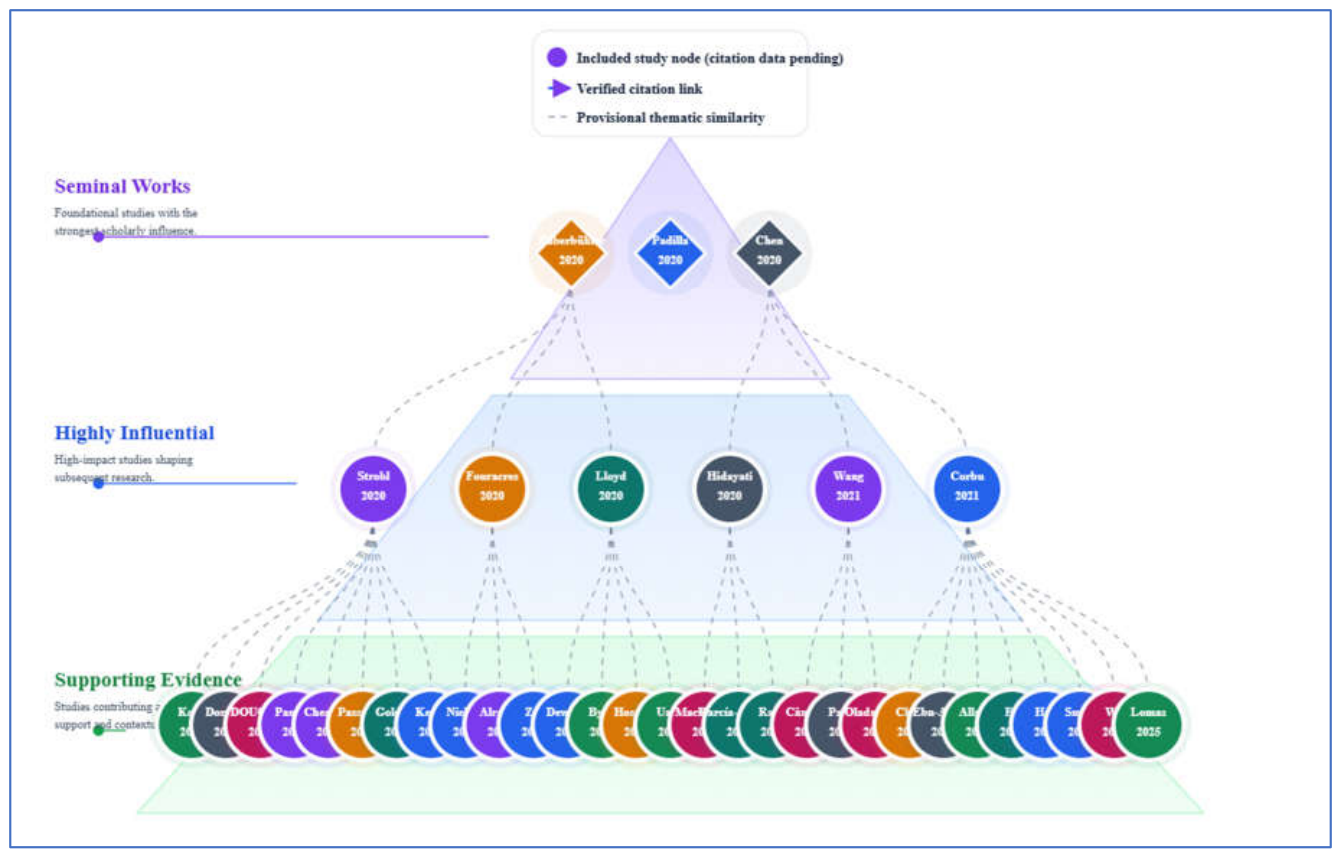
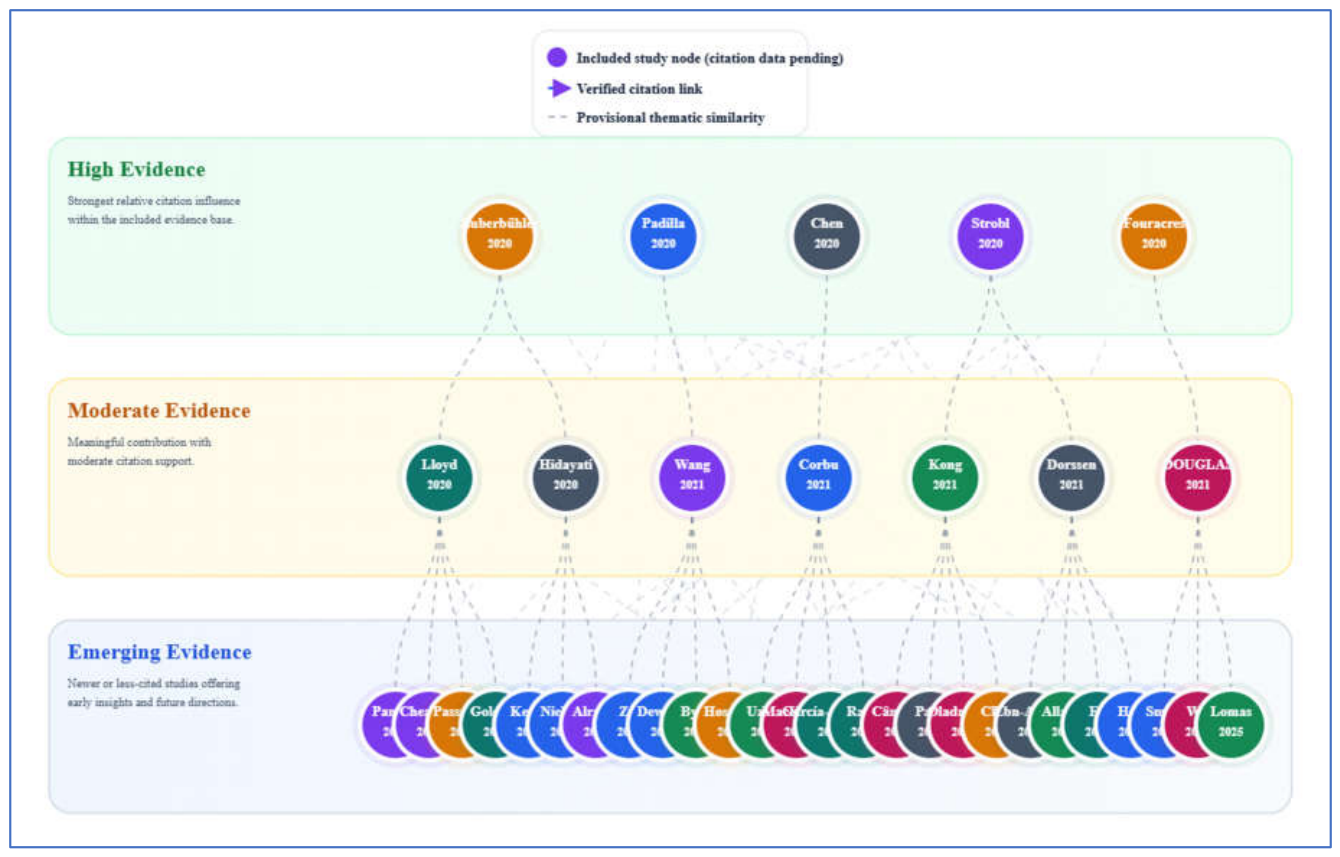
The Influence Pyramid represents the distribution of scholarly influence within the included evidence base. It helps identify how bibliometric prominence is distributed across the reviewed studies. Influence is interpreted separately from methodological quality, which is assessed through critical appraisal.
Figure 4.
Influence Pyramid — Bibliometric Intelligence, Step 12. The Influence Pyramid figure is available. Its verified distribution distinguishes seminal works, supporting works, and influential works within the local evidence structure, but all recorded global and local citation counts and influence scores are zero. Accordingly, the pyramid can be interpreted only as a project-level prominence classification based on the supplied network, not as a citation-impact ranking. It suggests that the evidence base includes a small set of foundational or influential intellectual anchors surrounded by a broader supporting literature. This helps locate the provenance of ideas but cannot increase confidence in intervention effectiveness without corresponding CASP and finding-level support.
Figure 4.
Influence Pyramid — Bibliometric Intelligence, Step 12. The Influence Pyramid figure is available. Its verified distribution distinguishes seminal works, supporting works, and influential works within the local evidence structure, but all recorded global and local citation counts and influence scores are zero. Accordingly, the pyramid can be interpreted only as a project-level prominence classification based on the supplied network, not as a citation-impact ranking. It suggests that the evidence base includes a small set of foundational or influential intellectual anchors surrounded by a broader supporting literature. This helps locate the provenance of ideas but cannot increase confidence in intervention effectiveness without corresponding CASP and finding-level support.
3.8.3. Evidence Strength
The Evidence Strength analysis examines the structure and strength of relationships within the evidence ecosystem assembled for the review. It complements, but does not replace, CASP methodological appraisal and must not be interpreted as a direct estimate of causal effect.
Figure 5.
Evidence Strength Network — Bibliometric Intelligence, Step 12. The Evidence Strength figure is available and should be read as a display of verified relationships among studies and evidence strands. The supplied metrics identify 65 links across 38 nodes and 35 clusters, showing that evidence relationships are present but dispersed across many thematic groupings. These relationships are most useful for identifying convergence and intellectual linkage between coaching, positive education, emotional climate, self-efficacy, resilience, and implementation research. They do not constitute effect estimates, causal pathways, or substitutes for CASP appraisal. Confidence is strengthened where evidence relationships coincide with extracted-finding convergence, and remains limited where links reflect conceptual proximity or indirect evidence. Source: COSTAQDA PRISMA Workflow, navigation item 12: Bibliometric Intelligence — Evidence Strength Network.
Figure 5.
Evidence Strength Network — Bibliometric Intelligence, Step 12. The Evidence Strength figure is available and should be read as a display of verified relationships among studies and evidence strands. The supplied metrics identify 65 links across 38 nodes and 35 clusters, showing that evidence relationships are present but dispersed across many thematic groupings. These relationships are most useful for identifying convergence and intellectual linkage between coaching, positive education, emotional climate, self-efficacy, resilience, and implementation research. They do not constitute effect estimates, causal pathways, or substitutes for CASP appraisal. Confidence is strengthened where evidence relationships coincide with extracted-finding convergence, and remains limited where links reflect conceptual proximity or indirect evidence. Source: COSTAQDA PRISMA Workflow, navigation item 12: Bibliometric Intelligence — Evidence Strength Network.
3.8.4. Knowledge Evolution
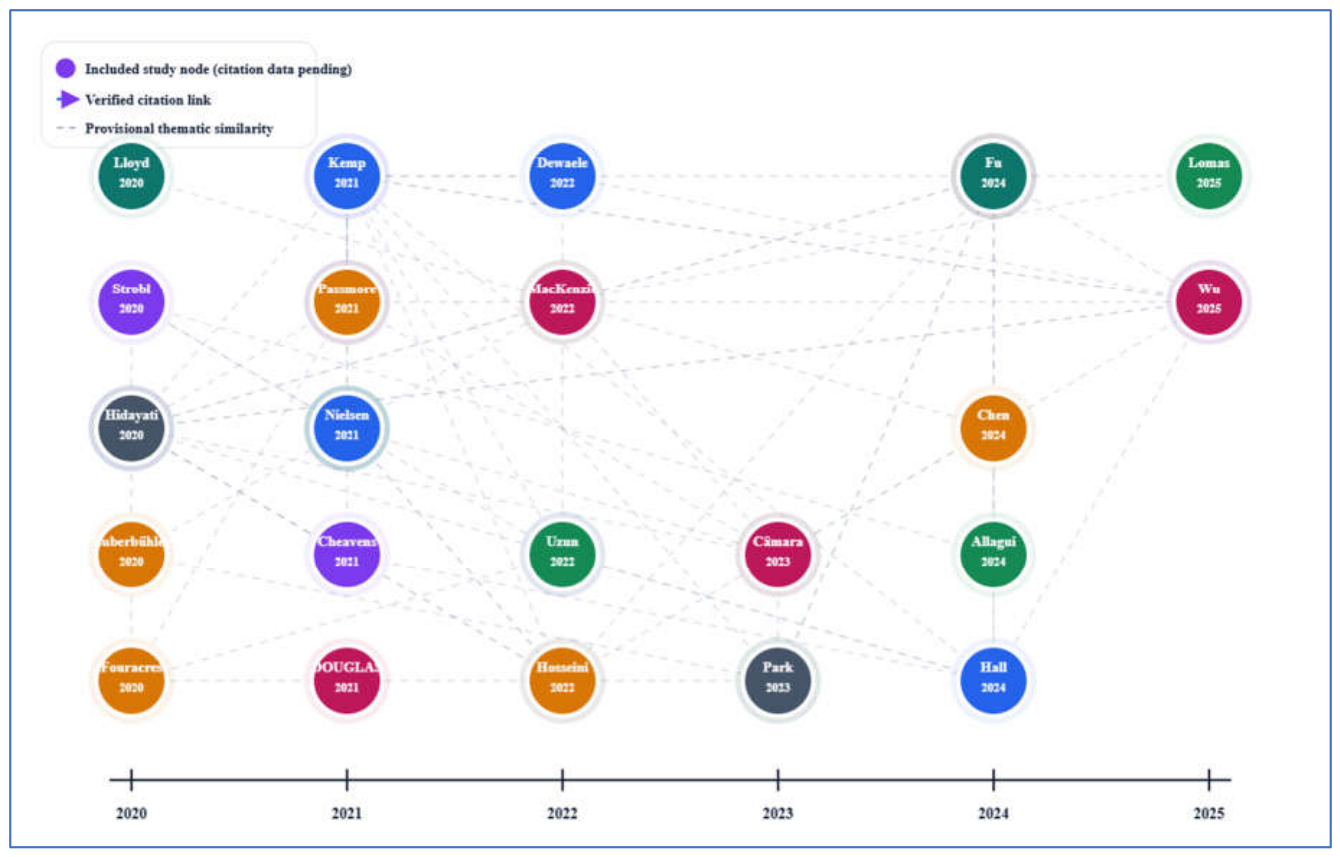
Knowledge Evolution examines the temporal and intellectual development of the included evidence base. It traces how research contributions develop over time and, where supported by the Step 12 data, how later studies extend, connect, challenge or consolidate earlier contributions.
Figure 6.
Knowledge Evolution — Bibliometric Intelligence, Step 12. The Knowledge Evolution Timeline is available and covers included works from 2020 through 2025 in the supplied nodes. The verified pattern moves from early work on coaching, self-leadership, experiential learning, positive education, and emotional or cultural dimensions toward more specific intervention, implementation, measurement, and contextual studies. Later work extends earlier themes through teacher education, technology-mediated learning, community resilience, cross-cultural flourishing measurement, language-learning emotions, and ethical coaching. This progression suggests intellectual consolidation around personal resources and engagement, followed by stronger attention to context, culture, implementation, and measurement. The timeline does not establish that later studies corrected earlier findings, and the zero citation counts limit claims about intellectual influence. Source: COSTAQDA PRISMA Workflow, navigation item 12: Bibliometric Intelligence — Knowledge Evolution.
Figure 6.
Knowledge Evolution — Bibliometric Intelligence, Step 12. The Knowledge Evolution Timeline is available and covers included works from 2020 through 2025 in the supplied nodes. The verified pattern moves from early work on coaching, self-leadership, experiential learning, positive education, and emotional or cultural dimensions toward more specific intervention, implementation, measurement, and contextual studies. Later work extends earlier themes through teacher education, technology-mediated learning, community resilience, cross-cultural flourishing measurement, language-learning emotions, and ethical coaching. This progression suggests intellectual consolidation around personal resources and engagement, followed by stronger attention to context, culture, implementation, and measurement. The timeline does not establish that later studies corrected earlier findings, and the zero citation counts limit claims about intellectual influence. Source: COSTAQDA PRISMA Workflow, navigation item 12: Bibliometric Intelligence — Knowledge Evolution.
3.8.5. Integrated Confidence in the Synthesised Evidence
Integrated confidence is cautious and moderate for the direction of the overall pattern but limited for definitive causal or long-term claims. Confidence is supported by transparent PRISMA selection counts, completed CASP appraisals for all included studies, convergence across findings concerning self-efficacy, engagement, resilience, and relational support, and preservation of divergence and contradiction. Confidence is reduced by heterogeneous evidence, incomplete intervention detail, indirect findings, self-report and cross-sectional designs, limited participant-perspective evidence, sparse long-term follow-up, cultural concentration, and the absence of a recorded standalone extraction procedure.
The Step 12 bibliometric intelligence adds evidence about intellectual structure and provenance but does not replace CASP. It identified 38 included-study nodes, 65 links, 35 thematic clusters, and zero recorded local or global citation counts. The network therefore supports interpretation of thematic connectedness and chronological development, while the zero citation-count fields prevent conclusions about scholarly impact. Influence is treated as bibliometric prominence rather than methodological quality, and evidence-strength relationships are not treated as causal-effect estimates.
4. Findings
4.1. Search and Selection Results
The search identified 486 records, of which 21 duplicates were removed. Of 462 screened records, 441 reports were sought for retrieval; 21 were excluded at title and abstract stage, 127 full texts were assessed, 8 were excluded at full text, and 80 records were included. The verified audit does not expose the title/abstract decision rule, so the counts are reported without reconstructing an unverified screening procedure.
4.2. Characteristics of Included Studies
The 80 included records span educational, workplace, coaching, language-learning, organizational, and community-related settings and include quantitative, qualitative, mixed-methods, review, and conceptual material in the supplied workspace. The verified qualitative synthesis used findings from 61 studies rather than all 80 included records. The extracted evidence is concentrated in educational and workplace contexts, especially language learning, with comparatively thin evidence for community settings and for children, older adults, and other lifespan groups. The available bibliometric workspace contained 38 represented nodes, 65 links, and 35 clusters, indicating broad intellectual coverage but substantial fragmentation.
4.3. Methodological Strengths and Limitations of Included Studies
Methodological strengths include the use of a defined search strategy, explicit inclusion and exclusion criteria, persisted PRISMA counts, completed CASP appraisals for all included studies, finding-level traceability, and preservation of contradictory evidence. Limitations include heterogeneous designs and constructs, frequent reliance on self-report and cross-sectional data, incomplete intervention details, limited long-term follow-up, indirect or methodological findings, sparse participant-perspective evidence, cultural concentration, and the lack of a separately recorded data-extraction procedure. CASP findings indicate that these limitations are distributed across multiple methodological domains rather than reducible to a single score.
4.4. Thematic Synthesis Matrix
Table 1 presents the thematic synthesis matrix linking the verified analytical themes only to studies with verified extracted evidence supporting at least one of the themes displayed in the matrix. Any study with no verified supporting contribution to any displayed theme is excluded, even if it was included elsewhere in the systematic review or qualitative evidence base. Rows represent analytical themes and columns represent theme-contributing studies. A check mark (✓) indicates that at least one verified extracted finding from that study was assigned to the theme; an em dash (—) indicates that the study contributed evidence to the synthesis overall but no supporting extracted finding from that study was assigned to that particular theme. The absence of a supporting assignment must not be interpreted as contradictory evidence. The totals report the number of evidence-contributing studies providing verified support to each theme. The matrix therefore functions as an audit trail between thematic interpretation and the underlying finding-level evidence rather than as a measure of methodological quality or effect size.Table 1.
The most widely supported analytical theme was “Positive emotional climates provide a pathway to engagement and performance”, with verified support from 5 of 21 studies. The least widely distributed theme was “Strengths-based reflection can support identity development and intentional growth”, with verified support from 2 of 21 studies. Differences in the number of supporting studies indicate the distribution of traceable thematic evidence across the included literature, not the relative importance or quality of a theme. Themes supported by fewer studies may still be analytically important when the underlying findings are conceptually rich, contextually distinctive or directly relevant to the review question. Conversely, wider study support indicates cross-study recurrence but does not by itself establish stronger methodological quality. The thematic patterns shown in Table 1 should therefore be interpreted alongside critical appraisal, contextual variation, contradictory findings where verified, and the detailed theme-led discussion that follows.
4.5. RO1: Strengths-Based Reflection Can Support Identity Development and Intentional Growth
The synthesis indicates that strengths-focused and reflective activities can make personal capacities visible and support self-acceptance, identity development, and intended personal change. In the teacher-education intervention, participants engaged in strengths identification, gratitude, meaningful-photo reflection, and PERMA-related activities; in the coaching study, strengths were experienced as becoming more visible and connected to a more secure or authentic sense of self (Oladrostam et al., 2024; Fouracres & van Nieuwerburgh, 2020).
The pattern is not equivalent to demonstrated transformation. Strengths awareness was associated with reflection and intentions to act, but the same awareness could create a perceived obligation to improve, while participants also described change as difficult. The evidence is therefore consistent with a developmental pathway from identification to reflection and possible intentional action, rather than a definitive claim that strengths identification produces durable personal growth.
4.6. RO1: Positive Emotional Climates Provide a Pathway to Engagement and Performance
Across the supplied evidence, positive emotional experiences and supportive learning environments were linked with motivation, communication, participation, engagement, achievement, and resilience. Foreign language enjoyment and classroom social climate were associated with student engagement, while engagement mediated relationships between positive emotion and achievement in Chinese EFL learners (Hosseini et al., 2022; Feng & Hong, 2022). Related evidence connected enjoyment with resilience and linked workplace positive practices with job satisfaction and engagement (Alrabai & Alamer, 2022; Kumar et al., 2025).
The evidence also contains divergence. Positive and negative emotions may coexist, and one Chinese study found enjoyment and anxiety at similar average levels, with lower enjoyment and higher anxiety than a Western comparison sample (Feng & Hong, 2022). The pathway from emotional climate to performance is therefore context-sensitive and largely associational in the cross-sectional studies. This theme addresses RO1 and RO2 while also informing RO4.
4.7. RO2: Human Development Benefits Depend on Supportive Relationships and Enabling Environments
Supportive teacher, coach, peer, and workplace relationships recur across the evidence as enabling conditions. Trust, friendliness, psychological safety, autonomy, collaboration, teacher support, and institutional resources were associated with engagement, self-determination, performance, and well-being (Wang et al., 2021; Smith et al., 2025; Radu, 2023; Kritikou & Giovazolias, 2022). The evidence suggests that positive psychology interventions function as embedded practices rather than isolated techniques.
Convergence is strongest around relational support and autonomy, while divergence concerns controlling language, dismissiveness, unfair judgement, excessive direction, and reward- or punishment-based motivation, which may frustrate psychological needs (Kritikou & Giovazolias, 2022). Methodological limitations include reliance on associations, reviews, and indirect evidence. The theme addresses RO2 and RO4 and limits direct transfer to settings lacking comparable relational or institutional supports.
4.8. RO3: Cultural and Situational Fit Constrains Transferability
The synthesis challenges one-size-fits-all models. Evidence highlights Western dominance, limited representation of disadvantaged groups, cultural differences in emotional expression, developmental variation, and the need to match challenge with participant capability (Appiah, 2023; van Zyl and Salanova, 2022; Gregersen, 2020). Cross-cultural studies show that some relationships appear similar across groups, while levels and patterns of flourishing, hope, self-efficacy, enjoyment, and anxiety differ between Japan, Taiwan, the United States, China, and other contexts (Chen et al., 2020; Feng & Hong, 2022).
These differences address RO3, RO4, and RO5 by showing that transferability is conditional. Cultural adaptation is supported, but evidence remains thin for many communities, disadvantaged populations, children, older adults, and noneducational settings. CASP concerns and the frequent use of self-report measures further limit confidence in claims that an intervention will operate similarly across contexts.
4.9. RO3: Implementation Requires Preparation, Competence, and Ethical Safeguards
Implementation barriers included limited practitioner familiarity, inadequate technical and instructional preparation, learner disengagement, and insufficient support. Evidence from emergency distance education showed that instructors initially lacked knowledge of positive psychology and were overwhelmed by sudden delivery changes, while later improvement was associated with training, reading, and colleague support (Al-Jarf, 2022). Coaching evidence additionally identified supervision, boundary-setting, reflective practice, and practitioner well-being as important safeguards (Smith et al., 2025).
Ethical risks include guilt, indebtedness, embarrassment, pressure to display positivity, and the possibility that positive framing can obscure negative experiences or structural conditions (van Zyl & Rothmann, 2022; Smith et al., 2025). One implementation study also contains a contradictory finding concerning the proportion of instructors who adapted course activities, illustrating uncertainty about the reach of implementation change. The theme directly addresses RO3 and RO4.
4.10. RO5: The Evidence Supports Promise but Not Definitive Claims About Long-Term Human Development
The evidence includes encouraging intervention effects, including sustained psychological capital after micro-coaching, improved self-efficacy following scaffolding, and positive outcomes in controlled or longitudinal designs (Corbu et al., 2021; Allagui, 2024; Zuberbühler et al., 2020). However, the evidence base also reports sparse long-term research, inconsistent constructs, cross-sectional designs, self-report dependence, and limited qualitative explanation of mechanisms (van Zyl & Rothmann, 2022; Zheng, 2021; Amiri & Karfa, 2023).
Long-term human development should therefore not be inferred from short-term changes in confidence, enjoyment, engagement, or behaviour. The mandatory intervention study found widespread behavioural enactment but short-term well-being increases in only 40.6% of participants, with a smaller subgroup sustaining the behaviour (Skarin & Wästlund, 2020). This divergence, together with contradictory evidence concerning persistence, directly addresses RO1, RO3, and RO5.
5. Discussion
The review question asked how positive psychology interventions influence indicators of human development in individuals. Across the six analytical themes, the answer is that interventions are associated with strengthened personal resources, identity-related reflection, engagement, resilience, and performance, but these outcomes are conditional on relationships, institutional support, cultural fit, competent implementation, and ethical safeguards. The evidence is therefore more consistent with a context-dependent contribution to development than with a universal intervention effect.
Strengths-based reflection can support identity development and intentional growth. The cross-study pattern suggests that identifying strengths may move individuals from implicit or taken-for-granted capacities toward conscious awareness and possible use (Oladrostam et al., 2024; Fouracres & van Nieuwerburgh, 2020). This addresses RO1 and RO2 because strengths awareness is linked with self-acceptance, reflection, and personal intentions. However, the same process can produce pressure or a sense of obligation, and the small qualitative evidence base does not demonstrate durable transformation. CASP concerns and limited intervention detail require the interpretation to remain developmental and provisional.
Positive emotional climates provide a pathway to engagement and performance. Findings across language learning, education, and workplace contexts connect enjoyment and positive emotion with motivation, communication, engagement, achievement, and resilience (Hosseini et al., 2022; Feng & Hong, 2022; Radu, 2023). The important qualification is that positive and negative emotions can coexist. The Chinese EFL evidence, including lower enjoyment and higher anxiety than a Western comparison sample, challenges universal assumptions about positivity (Feng & Hong, 2022). The cross-sectional and self-report designs of several studies constrain causal interpretation, so positive emotional climate should be understood as a plausible pathway rather than a guaranteed effect.
Human development benefits depend on supportive relationships and enabling environments. This theme provides the strongest integrative explanation for why similar techniques may produce different outcomes. Teacher support, peer support, trust, autonomy, psychological safety, teamwork, and institutional resources repeatedly appear as enabling conditions (Wang et al., 2021; Smith et al., 2025; Kritikou & Giovazolias, 2022). Conversely, controlling language, dismissiveness, excessive direction, unfair judgement, and reward-based motivation may undermine development. The implication for RO2 and RO4 is that institutions should not treat positive psychology as a package of individual exercises detached from the social environment. Much of the evidence is associational or derived from reviews and conceptual accounts, limiting confidence about the independent effect of any single condition.
Cultural and situational fit constrains transferability. The evidence challenges the assumption that instruments, emotional constructs, or intervention meanings operate identically across cultures. African, Asian, language-learning, and cross-cultural evidence highlights the importance of local values, disadvantaged populations, translation, social conditions, and culturally responsive measurement (Appiah, 2023; Chen et al., 2020; Lomas et al., 2025). This is central to RO3, RO4, and RO5. The evidence supports adaptation, but it does not specify a universal adaptation formula. The WEIRD concentration and uneven representation of community, childhood, older-adult, and disadvantaged populations limit transferability.
Implementation requires preparation, competence, and ethical safeguards. The implementation evidence shows that practitioners may lack familiarity with positive psychology, technical skills, time, training, or supervision, especially during rapid institutional change (Al-Jarf, 2022). The coaching evidence adds boundary-setting, reflective practice, and practitioner well-being as ethical requirements (Smith et al., 2025). This theme addresses RO3 and RO4 by showing that implementation quality is itself a developmental and ethical issue. Positive framing should not require participants to suppress distress, accept structural disadvantage, or display gratitude. The evidence supports training and safeguards, but implementation studies are heterogeneous and often insufficiently detailed.
The evidence supports promise but not definitive claims about long-term human development. Some controlled and longitudinal studies report substantial improvements in psychological capital, self-efficacy, work-related outcomes, or behaviour (Corbu et al., 2021; Zuberbühler et al., 2020; Allagui, 2024). Yet these findings coexist with sparse long-term evidence, measurement problems, cross-sectional designs, inconsistent constructs, and limited participant-perspective research (van Zyl & Rothmann, 2022; Amiri & Karfa, 2023; Zheng, 2021). The mandatory intervention study is particularly important because behavioural enactment was more widespread than sustained well-being change (Skarin & Wästlund, 2020). Thus, RO1 can be answered affirmatively only in terms of promising associations and selected intervention effects, not definitive long-term development.
The Step 12 bibliometric evidence supports this cautious interpretation. The local network contains 65 links among 38 represented included-study nodes and 35 clusters, indicating that the evidence base is connected across coaching, education, language learning, workplace, resilience, and flourishing research but remains fragmented. The influence pyramid identifies intellectual anchors and supporting works, yet recorded local and global citation counts are zero, so prominence cannot be treated as impact. The evidence-strength network displays relationships among strands but is not a causal estimate. The knowledge-evolution timeline shows movement from foundational positive psychology, coaching, and educational work toward more explicit attention to culture, implementation, measurement, and ethics. These bibliometric patterns strengthen understanding of provenance and intellectual structure, while CASP and finding-level convergence remain the basis for methodological confidence.
Integrated confidence is therefore cautious. PRISMA selection is transparent at the level of persisted counts, CASP appraisal is complete for the 80 included studies, and several themes show convergence across settings and methods. However, the absence of a recorded screening rule, the lack of a separately documented extraction procedure, heterogeneous and partly indirect evidence, methodological concerns across CASP domains, limited long-term follow-up, and cultural concentration restrict the strength of causal and universal claims. The review supports a context-sensitive model of positive psychology as a potential contributor to human development, not a settled prescription.
6. Conclusions
Positive psychology interventions are associated with improvements or favourable relationships involving personal resources, identity-related reflection, positive emotion, engagement, resilience, and selected performance or well-being indicators. The effects are not independent of context: supportive relationships, enabling institutions, cultural fit, practitioner competence, preparation, and ethical safeguards shape whether interventions are adopted and experienced as beneficial. The evidence therefore answers the review problem with conditional rather than definitive support. Positive psychology can contribute to human development, but the supplied evidence does not establish universal, causal, or reliably sustained effects across individuals and settings.
7. Recommendations
Practice recommendations should prioritise strengths-based reflection, autonomy-supportive relationships, psychological safety, culturally meaningful activities, and explicit opportunities for participants to choose how positive psychology practices are used. Practitioners should receive preparation, supervision, technical support, and guidance for recognising distress, mixed emotions, and unintended pressure.
Policy recommendations should require positive psychology programmes in educational, workplace, and community settings to include contextual adaptation, stakeholder consultation, ethical safeguards, protection against compulsory positivity, and monitoring of both benefits and harms. Institutions should support relational and organisational conditions rather than treating interventions as individual responsibility alone.
Future research should use longitudinal, mixed-methods, culturally responsive, and where feasible controlled designs. Studies should measure outcomes beyond short-term self-report, examine durability and adverse effects, include children, older adults, disadvantaged groups, and community settings, report intervention components and implementation fidelity in detail, and use measures validated for the relevant cultural context. Research should also clarify mechanisms linking strengths awareness, emotional climate, relationships, engagement, resilience, and longer-term development.
Funding
No funding.
References
- Al-Jarf, R. Positive Psychology in Emergency Distance Education in Saudi Arabia during the Pandemic and Beyond. J. Humanit. Soc. Sci. Stud. 2022, 4, 286–293. [Google Scholar] [CrossRef]
- Allagui, B. A scaffolding intervention to improve self-efficacy in source-based argumentative writing. Front. Psychol. 2024, 15, 1454104. [Google Scholar] [CrossRef] [PubMed]
- Alrabai, F.; Alamer, A. The role of learner character strengths and classroom emotions in L2 resilience. Front. Psychol. 2022, 13, 956216. [Google Scholar] [CrossRef] [PubMed]
- Amiri, E.; El Karfa, A. Flourishing of Positive Psychology in Education: 'Emotional Turn' and Measurement Issues. J. Humanit. Soc. Sci. Stud. 2023, 5, 10–18. [Google Scholar] [CrossRef]
- Appiah, R. Proverbial positive psychology: can we leverage African ancient wisdom to promote flourishing? J. Posit. Psychol. 2023, 19, 995–1010. [Google Scholar] [CrossRef]
- Appiah, R. Proverbial positive psychology: can we leverage African ancient wisdom to promote flourishing? J. Posit. Psychol. 2023, 19, 995–1010. [Google Scholar] [CrossRef]
- Chen, X.; Lake, J.; Padilla, A.M. Self-Views and Positive Psychology Constructs Among Second Language Learners in Japan, Taiwan, and the United States. Front. Psychol. 2020, 11. [Google Scholar] [CrossRef] [PubMed]
- Corbu, A.; Zuberbühler, M.J.P.; Salanova, M. Positive Psychology Micro-Coaching Intervention: Effects on Psychological Capital and Goal-Related Self-Efficacy. Front. Psychol. 2021, 12. [Google Scholar] [CrossRef] [PubMed]
- Feng, E.; Hong, G. Engagement Mediates the Relationship Between Emotion and Achievement of Chinese EFL Learners. Front. Psychol. 2022, 13, 895594. [Google Scholar] [CrossRef] [PubMed]
- Fouracres, A. J.; Nieuwerburgh, C. J. V. The lived experience of self-identifying character strengths through coaching: An interpretative phenomenological analysis. In Radar; Oxford Brookes University, 2020. [Google Scholar] [CrossRef]
- Grant, M.J.; Booth, A. A typology of reviews: an analysis of 14 review types and associated methodologies. Health Inf. Libr. J. 2009, 26, 91–108. [Google Scholar] [CrossRef] [PubMed]
- Gregersen, T. Dynamic properties of language anxiety. Stud. Second. Lang. Learn. Teach. 2020, 10, 67–87. [Google Scholar] [CrossRef]
- Hosseini, H.M.; Fathi, J.; Derakhshesh, A.; Mehraein, S. A model of classroom social climate, foreign language enjoyment, and student engagement among English as a foreign language learners. Front. Psychol. 2022, 13, 933842. [Google Scholar] [CrossRef] [PubMed]
- Kritikou, M.; Giovazolias, T. Emotion regulation, academic buoyancy, and academic adjustment of university students within a self-determination theory framework: A systematic review. Front. Psychol. 2022, 13, 1057697. [Google Scholar] [CrossRef] [PubMed]
- Kumar, P.A.; Angayarkanni, R.; Baranwal, A.; J, S.; T, N. Positive Psychology Interventions in the Workplace: Boosting Job Satisfaction and Engagement. 2025, 15, 26–33. [Google Scholar] [CrossRef]
- Lomas, T.; Bradshaw, M.; Case, B.; Cowden, R.G.; Crabtree, S.; English, C.; Fogleman, A.; Johnson, K.A.; Ritter, Z.; Johnson, B.R.; et al. The development of the Global Flourishing Study questionnaire: charting the evolution of a new 109-item inventory of human flourishing. BMC Glob. Public Health 2025, 3, 1–16. [Google Scholar] [CrossRef] [PubMed]
- Mfolo, L.; Costa, K. Qualitative Evidence Synthesis Using COSTAQDA; 2024. [Google Scholar]
- Oladrostam, E.; Rahmati, T.; Nushi, M. Integrating positive psychology into an English as a foreign language teacher education program. Asian-Pac. J. Second Foreign Lang. Educ. 2024, 9, 1–21. [Google Scholar] [CrossRef]
- Page, M.J.; McKenzie, J.E.; Bossuyt, P.M.; Boutron, I.; Hoffmann, T.C.; Mulrow, C.D.; Shamseer, L.; Tetzlaff, J.M.; Akl, E.A.; Brennan, S.E.; et al. The PRISMA 2020 statement : an updated guideline for reporting systematic reviews. BMJ 2021, 372, n71. [Google Scholar] [CrossRef] [PubMed]
- Radu, C. Fostering a Positive Workplace Culture: Impacts on Performance and Agility. IntechOpen 2023. [Google Scholar] [CrossRef]
- Skarin, F.; Wästlund, E. Increasing Students’ Long-Term Well-Being by Mandatory Intervention – A Positive Psychology Field Study. Front. Psychol. 2020, 11, 553764. [Google Scholar] [CrossRef] [PubMed]
- Smith, W.-A.; McCarthy, S.; Rosefield, M. Positive Psychology Coaching: Embodying Wellbeing and Ethicality. J. Coach. Ethics 2025, 2. [Google Scholar] [CrossRef]
- van Zyl, L.E.; Rothmann, S. Grand Challenges for Positive Psychology: Future Perspectives and Opportunities. Front. Psychol. 2022, 13, 833057. [Google Scholar] [CrossRef] [PubMed]
- van Zyl, L.E.; Salanova, M. Editorial: Facilitating the Third Wave of Positive Psychology: Perspectives on the Future of the Discipline. Front. Psychol. 2022, 13, 963167. [Google Scholar] [CrossRef] [PubMed]
- Wang, Y. A Review of Emotions in Second Language Acquisition from a Positive Psychology Perspective. Int. J. Educ. Humanit. 2024, 4, 287–296. [Google Scholar] [CrossRef]
- Wang, Y.; Derakhshan, A.; Zhang, L.J. Researching and Practicing Positive Psychology in Second/Foreign Language Learning and Teaching: The Past, Current Status and Future Directions. Front. Psychol. 2021, 12. [Google Scholar] [CrossRef] [PubMed]

Table 1.
Thematic Synthesis Matrix.
| THEMATIC SYNTHESIS |
Study One Wang (2021) |
Study Two Zyl (2022) |
Study Three Appiah (2023) |
Study Four Oladrostam (2024) |
Study Five Smith (2025) |
Study Six Sun (2020) |
Study Seven Alrabai (2022) |
Study Eight Zyl (2022) |
Study Nine Radu (2023) |
Study Ten Ebn-Abbasi (2024) |
Study Eleven Hosseini (2022) |
Study Twelve Wu (2025) |
Study Thirteen Strobl (2020) |
Study Fourteen Fouracres (2020) |
Study Fifteen Amiri (2023) |
Study Sixteen Botes (2020) |
Study Seventeen Zheng (2021) |
Study Eighteen Kritikou (2022) |
Study Nineteen Gregersen (2020) |
Study Twenty Al-Jarf (2022) |
Study Twenty One Feng (2022) |
TOTALS |
|
Theme 1 Strengths-based reflection can support identity development and intentional growth Individual developmental outcomes |
— | — | — | ✓ | — | — | — | — | — | — | — | — | — | ✓ | — | — | — | — | — | — | — | 2 |
|
Theme 2 Positive emotional climates provide a pathway to engagement and performance Individual developmental outcomes; Relational and contextual mechanisms |
✓ | — | — | — | — | — | ✓ | — | — | — | ✓ | ✓ | — | — | — | — | — | — | — | — | ✓ | 5 |
|
Theme 3 Human development benefits depend on supportive relationships and enabling environments Relational and contextual mechanisms; Implementation and institutional conditions |
✓ | — | — | — | ✓ | ✓ | — | — | ✓ | — | — | — | — | — | — | — | — | ✓ | — | — | — | 5 |
|
Theme 4 Cultural and situational fit constrains transferability Relational and contextual mechanisms; Risks, ethics, and evidence limitations |
— | — | ✓ | — | — | — | — | ✓ | — | — | — | — | ✓ | — | — | ✓ | — | — | ✓ | — | — | 5 |
|
Theme 5 Implementation requires preparation, competence, and ethical safeguards Implementation and institutional conditions; Risks, ethics, and evidence limitations |
— | ✓ | — | — | ✓ | — | — | — | — | — | — | — | — | — | — | — | — | — | — | ✓ | — | 3 |
|
Theme 6 The evidence supports promise but not definitive claims about long-term human development Risks, ethics, and evidence limitations |
— | ✓ | — | — | — | — | — | ✓ | — | ✓ | — | — | — | — | ✓ | — | ✓ | — | — | — | — | 5 |
Only studies with verified extracted evidence supporting at least one displayed theme are included. ✓ = verified extracted evidence from the study supports the theme; — = the study supports at least one other displayed theme but no verified supporting finding from that study was assigned to this theme. An em dash does not indicate contradictory evidence.
Disclaimer/Publisher’s Note: The statements, opinions and data contained in all publications are solely those of the individual author(s) and contributor(s) and not of MDPI and/or the editor(s). MDPI and/or the editor(s) disclaim responsibility for any injury to people or property resulting from any ideas, methods, instructions or products referred to in the content. |
© 2026 by the authors. Licensee MDPI, Basel, Switzerland. This article is an open access article distributed under the terms and conditions of the Creative Commons Attribution (CC BY) license (http://creativecommons.org/licenses/by/4.0/).
Copyright: This open access article is published under a Creative Commons CC BY 4.0 license, which permit the free download, distribution, and reuse, provided that the author and preprint are cited in any reuse.