

Submitted:
24 September 2026
Posted:
24 September 2026
You are already at the latest version
Abstract
Yawning is a behavior reported in many species of mammals. When a pod of hippos is observed in the evening, one usually sees many hippos yawn with their jaws wide-open. Despite yawning being a very evident behavior in hippos, we know of no major studies focused on the functions of this behavior aside from being an aspect of threatening encounters between adult males. This study focused on yawning in hippos with regard to the functions of brain activation and brain cooling. One study site was along the Luangwa River in South Luangwa National Park in Zambia which had a pod of approximately 40 resident hippos. A second site was at Plettenberg Bay Game Reserve in southern South Africa in July when the temperatures were cool, contrasting with the hot temperatures in Zambia. Only four hippos typically were present at the Plettenberg site. Observations pertained to two non-exclusive functions: that the brain is activated by yawning and that yawning cools the brain, contributing to brain activation. At Luangwa, the frequency of yawning greatly increased just before the hippos left the water in early evening to forage during the night: supporting both the brain activation and brain cooling functions. At Plettenberg, the hippos reclined on the riverbanks during cool days in July, but still yawned just before walking off, going into the river and moving upstream to forage. These data support the brain activation but not the brain cooling functions.
Keywords:
aggression
; brain activation
; brain cooling
; feeding
; foraging
1. Introduction
This study focused on yawning in a group of hippos in a shallow pool about 1- 1 ½ m. deep in Zambia, where the investigators used a hide for closeup viewing of approximately 40 hippos of all ages and sexes (Figure 1). The study site was typical of hippo sites which give them easy access to vegetation on the shore. For many hours of the day hippos quietly rested immobilized in their secure refuge in the water with their eyes, ears, and nostrils elevated above water level.
There are several vivid descriptions of the aggressive encounters between males with wide jaw openings displaying large canine teeth prominently, representing threating behavior. In fighting males clash with their large canine teeth, sometimes incurring some damage to the teeth. This study focuses on yawning in hippos that is completely different in context from the aggressive open jaw, yawning-like display of males,
Yawning is a widely recognized behavior that has been carefully studied in many mammalian and avian species and even some fish. Perusal of the explanations for yawning yields two functions. One is that yawning serves to activate the brain [1,2,3,4]. For example, upon awakening from sleep, yawning enables the animal to move about more effectively, avoid predators, and find forage. Related to this is a second proposed function, that yawning serves to cool the brain, which in some species appears to facilitate functioning of the brain [5,6]. Yawning in hippos has not been examined previously in the context of these two functions and has focused on aggressive displays between pairs of males. We do not focus here on the aggressive display in jaw opening seen between males as this was a rare event in these observations.
For this study, we gathered behavioral yawning data to examine both the brain activation and cooling functions. The primary observations of yawning behavior were made at the site in Zambia in South Luangwa National Park with an established group of about 40 hippos residing in a pool along the Luangwa River, a tributary of the Zambezi River. We used a low hide established near the hippo pool that allowed observers to see the hippos up close at near-eye level with the water and where viewers presumably could not be detected (Figure 1). A second study site was from a vehicle at a location in southern South Africa, in Plettenberg Bay Game Reserve within the Western Cape Reserve, chosen for its cooler temperatures that contrasted with the warm Zambia site, where two adult females, one male, and one young hippo could be viewed at sites along a small river (Figure 2).
2. Methods
2.1. Observations at Warmer Site in Zambia
After pilot observations were made, standardized observations were conducted at the established hippo pool along the Luangwa River. The mean high temperatures there were 82°F (28°C) and lows of 55°F (13°C). About 40 hippos came to stay in the pool during the day, a number varying daily by a few hippos. Individual hippos could not be identified, so bouts of yawning were identified for individuals in the group and calculated on a per-hour, per-individual basis.
Morning observations were conducted for four consecutive days in June and began at 4:30 am just after it was light enough to see the animals and lasted 2 to 3 hours. This was at the time hippos were returning to the pool after foraging during the night and observations lasted until it was estimated that all hippos had returned and were in the water. The evening observations began shortly before the hippos started leaving the pool for night foraging, about 6:00 pm, and lasted one to two hours, when all hippos, except very young ones, had left the pool.
All yawns by members of the group in the pool were counted during both the morning and evening observations. A wide array of jaw openings were observed, ranging from small to medium to wide (Figure 3). During wide yawns with the mouth fully open, often vertically straight up, the hippo occasionally fell backwards. The number of yawns per hippo for the group was tabulated. As mentioned, open jaw aggressive displays between males were rare events, averaging less than one per hour, and were not tabulated as yawns.
2.2. Observations at the Cooler Site in South Africa
This study site was in southernmost South Africa, which is cool in June-August and warmer in December- February. The small reserve, Plettenberg Bay Game Reserve, had a sampling of various wildlife species and the hippos were living south of their typical range. Observations were conducted from 4 to 7 pm in July with mean high temperatures of 63°F (17°C) and lows of 55°F (13°C) in contrast to December with mean high temperatures of 76°F (25°C) and lows of 63°F (18°C). Data on hippo were collected from a vehicle on an elevated roadside during afternoons when the group of hippos was in clear view as they began waking and moving until they moved upstream out of sight to feed in the bush.
The hippos available for observation in July included one adult male, one or two adult females and a young hippo. During the afternoons the hippos were sleeping on the bank of a pool adjacent to a dam in contrast to being in a pool in hot weather. Observations ranged from 1.3 to 2.1 hours, before the hippos left for the water and then would be grazing at night. In the warmer December when hippos also were observed, the hippos were resting in the water when the observations began.
3. Results
3.1. Observations at the Zambian Site
At this site, morning observations on the approximately 40 hippos revealed very infrequent yawning, ranging from 0 to 0.05 yawns per hour per hippo, for a mean of 0.03 yawns per hippo per hour. For the evening observations, yawns were much more frequent, approaching one yawn per hippo per hour. Over the four days of evening observations, the mean number of yawns per hippo per hour ranged from 0.73 to 0.98 with a mean over the four days of 0.85 which is 28 times the number of yawns per hippo in the morning.
3.2. Observations at the South African Site
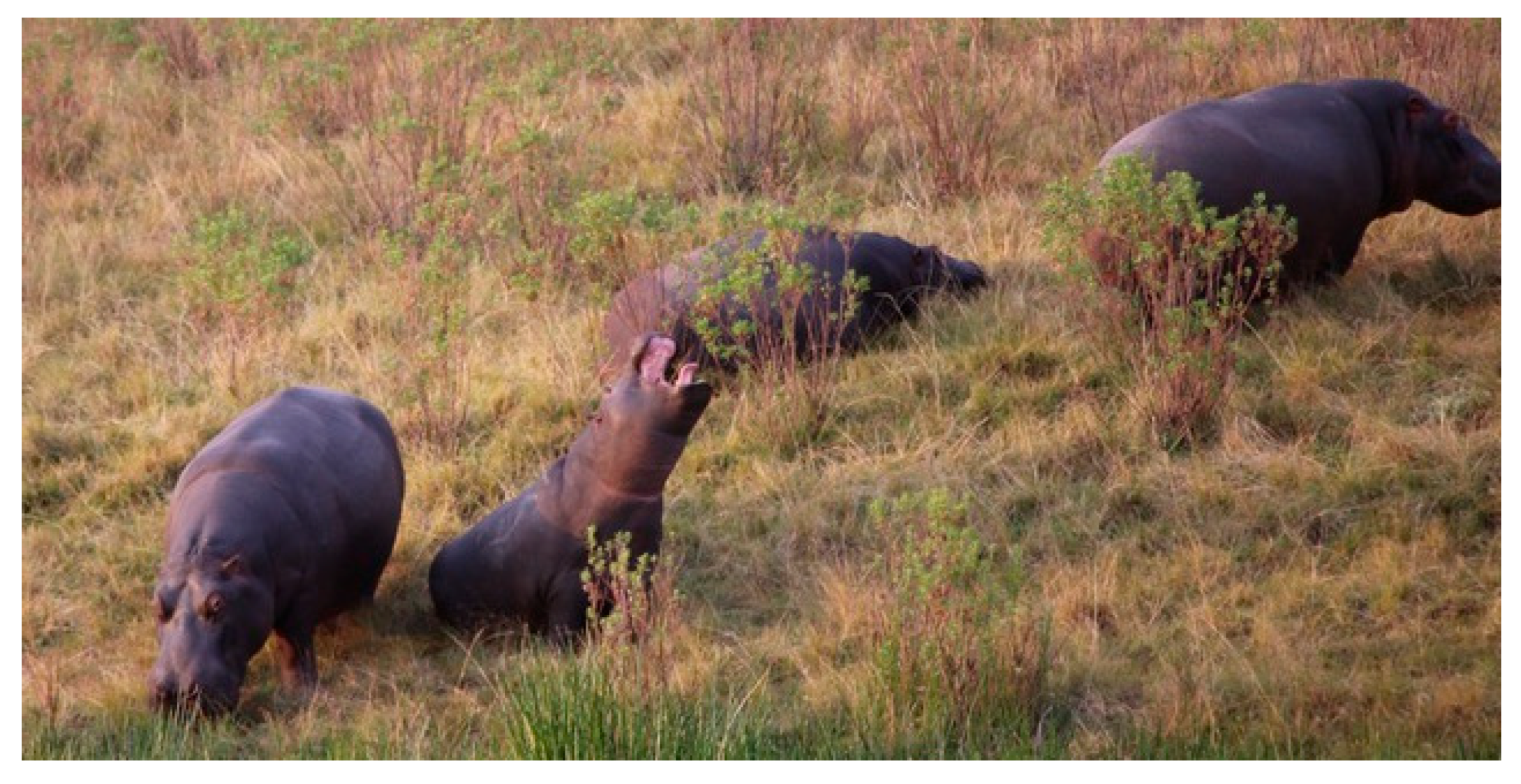
The evening observations, typically on four hippos during the cool season in July, where they initially were sleeping on the bank (Figure 2), revealed that as soon as they aroused, they each yawned one to three times (Figure 4) and then sometime later left the bank, went into the water and moved upstream where they then left the water and foraged for the night. Over five days of evening observations there were 0.4 to 3.80 yawns per hippo per hour, for a mean over the five days of 1.8 yawns per hippo per hour in early evening during the cool season.
In the warm season during early evening observations when the hippos were in the water as they aroused, there were to 1.4-2.2 yawns per hippo per hour, also for a mean of 1.8 yawns per hippo per hour before they moved upstream to leave for foraging. A summary of yawning at the southern South Africa site with a limited number of hippos and with cool temperatures in July where the hippos were sleeping on the riverbank, is that the yawning frequency exceeded that of the hippos in the much warmer Zambia site.
The male, females, and the young hippo in South Africa all yawned. Yawning seemed not to vary with season. In both seasons, the females and young hippo consistently yawned two to four times each day of observations. Yawning in the male was more variable: one afternoon in July yawning 11 times and not yawning at all one day in July and one day in December.
4. Discussion
Studies on hippos address many topics such as maintaining them in captive environments [7,8], the occurrence of flehmen behavior [9], vocal communication among individuals [10] and how the teeth hinder chewing [11]. Interestingly, the extent of jaw-opening that affects the angle of the yawning varies widely among hippos and within individual hippos but is not well-studied.
We believe this is the first systematic study of non-aggressive yawning in this species, a behavior that is easily seen among hippos living in the wild and quite common at the time of day when their bodies are undergoing a transition from resting or sleeping to the actions that are required for foraging, being alert to dangers, and remembering locations.
The occurrence of yawning at the Zambia site was consistent with a function of brain cooling, as well as with brain activation. After the top of the head heats up during the day from being continuously exposed to the sun, the huge increase in yawning just before the hippos leave the pool for nighttime foraging would logically cool the brain through the vasculature system and facilitate activation of the brain for increased nighttime activity and foraging.
The observations of yawning in Zambia were consistent with the brain cooling function, but this did not hold for observations in cooler South Africa, where hippos spent their days resting on the water bank and one would not expect the brain to heat up as much. Despite the cooler temperatures in southern South Africa in July, the yawning rates per hippo exceeded those seen in Zambia, where it was warmer. And in South Africa, the yawning rates during the cooler July when hippos rested on the riverbank were similar to rates in the warmer December when hippos spent the day in the shallow pool.
The observed choice of these hippos to spend all their resting daytime on the bank rather than in the water during the cool July was surprising, as they were sacrificing their preferred tranquil safety of being submerged in shallow water. Nonetheless, this behavior is consistent with reports that they are known to be able to adjust their body temperatures, by leaving the water to get warmer, and going into the water to get cooler [12].
Despite previous research attention largely focusing on male hippos in the context of aggressive interactions, these data from both Zambia and South Africa revealed that yawning is a behavior consistently performed by females and young hippos as well as males in a non-aggressive context. Similar reports on hippo in both South Africa [13] and Ethiopia [14] have reported yawning occurring particularly in the afternoon, more than in the morning, by both males and females. This evidence of yawning by both males and females as well as young hippos demonstrates that yawning fulfills a physiological requirement and is consistent with the concept of yawning as a mechanism for arousing the brain.
As noted, observations of males aggressively confronting each other with open-mouthed displays were infrequent during our observations in Zambia. Yet, dramatic confrontations between male hippos that sometimes lead to serious injuries are well-documented, and yawning-like displays are common during these aggressive encounters. Further investigation would be required to clarify whether the open jaws shown during aggression are associated with a yawn. Such extremely wide-open jaws are almost debilitating for a large male hippo and would not facilitate effective fighting during aggression if the male is falling over due to the extreme position.
With these observations on the signature behavior of hippos, we can now assign a role to the behavior, that of brain activation for hippos that sleep and move little during most of the day but need to become active for a night of foraging, finding their way about and interacting with other animals. Both males and females, as well as younger animals, engage in this behavior predictably in early evening prior to beginning their foraging in the dark for food.
5. Conclusions
Like other mammals, hippos exhibit yawning that is presumably associated with brain activation. This paper confirms that hippos yawn primarily in late afternoon, just when they are rousing from rest at the end of the day and are preparing to venture onto land to forage during the night. Yawns vary in the extent of jaw opening, from very small to extremely large. With the cooler environment during July in the Plettenberg Game Reserve of the Western Cape of South Africa, the hippos uncharacteristically rested on the riverbank but still yawned frequently just before leaving to forage. While it could be possible for yawning to help cool the brain for hippos being exposed to hot sun, yawning persists in male, female, and young hippos who are cool enough to avoid resting in water and are sleeping on a riverbank. Whether more extreme yawns with wider jaw openings play a role in cooling the brain is unknown.
Author Contributions
BLH and LAH: co-wrote first draft; LAH: took field notes; reviewed literature; BLH and LAH both reviewed and edited all drafts of text.
Funding
This project received partial support from the University of California School of Veterinary Medicine departmental funds.
Institutional Review Board Statement
This observational animal study protocol for observations from an animal hide was approved by the Zambian Wildlife Service. At Plettenberg Bay Game Reserve, Paulus in Administration approved access for observational studies of hippos to be made from park vehicles in the Reserve, with assistance of two naturalists.
Acknowledgments
Dr. David Squarre, with the Zambian Wildlife Service at the time of the study, facilitated permission to conduct observations on hippos in South Luangwa National Park. We thank Shenton Safaris for use of their hippo hide and assistance from their naturalists and drivers at varied hours to conduct very early morning observations as well as late evening observations on hippos. At the Plettenberg Bay Game Reserve in the Western Cape Reserve in South Africa, we appreciate assistance and facilitation given by Gertrude Mambi and Mareesa Swart, and as well as Paulus in Administration. The Reserve rangers, Hanel Franken and Evence, assisted in driving a vehicle for observing hippos near the water and shared their knowledge of the hippos’ identities, histories, and behavior. We appreciate Kristen Denninger Snyder sharing her observations on the unexplained absence of yawning by captive hippo.
Conflicts of Interest
The authors declare no conflict of interest.
References
- Provine, R.R. Yawning: The yawn is primal, unstoppable and contagious, revealing the evolutionary and neural basis of empathy and unconscious behavior. Am. Sci. 2005, 93. [Google Scholar]
- Guggisberg, A.G.; Mathis, J.; Herrmann, U.S.; Hess, C.W. The functional relationship between yawning and vigilance. Behav. Brain Res. 2007, 179, 159–166. [Google Scholar] [CrossRef] [PubMed]
- Guggisberg, A.G.; Mathis, J.; Schnider, A.; Hess, C.W. Why do we yawn? Neurosci. Biobehav. Rev. 2010, 34, 1267–1276. [Google Scholar] [CrossRef] [PubMed]
- Flaskerud, J.H. Yawning, why and when? Issues Ment. Health Nurs. 2016, 37, 526–529. [Google Scholar] [CrossRef] [PubMed]
- Gallup, A.C.; Gallup, G.G., Jr. Yawning and thermoregulation. Physiol. Behav. 2008, 95, 10–16. [Google Scholar] [CrossRef] [PubMed]
- Gallup, A.C.; Eldakar, O.T. The thermoregulatory theory of yawning: what we know from over five years of research. Front. Neurosci. 2013, 6, 188. [Google Scholar] [CrossRef] [PubMed]
- Snyder, K.D. The common hippopotamus in the wild and in captivity: conservation for less charismatic species. J. Internat. Wildl. Law Policy 2015, 18, 337–354. [Google Scholar] [CrossRef]
- Lewison, R. Population responses to natural and human-mediated disturbances: assessing the vulnerability of the common hippopotamus (Hippopotamus amphibius). Afr. J. Ecol. 2007, 45, 407–415. [Google Scholar] [CrossRef]
- Zapico, T.A. First documentation of flehmen in a common hippopotamus (Hippopotamus amphibius). Zoo Biol. 1999, 18, 415–420. [Google Scholar] [CrossRef]
- Thevenet, J.; Grimault, N.; Fonseca, P.; Mathevon, N. Voice-mediated interactions in a megaherbivore. Curr. Biol. 2022, 32, 70–71. [Google Scholar] [CrossRef] [PubMed]
- Avedik, A.; Clauss, M. Chewing, dentition and tooth wear in Hippopotamidae (Hippopotamus amphibius and Cheropsis liberiensis). PLoS ONE 2023, 18(10), e0291825. [Google Scholar] [CrossRef] [PubMed]
- Eltringham, S.K. The Hippos: Natural History and Conservation; Abstract Press: London, 1999. [Google Scholar]
- Prinsloo, A.S. Aspects of the spatial and behavioural ecology of Hippopotamus amphibius in the Saint Lucia Estuary, KwaZulu-Natal, South Africa. MS dissertation, University of Cape Town, 2016. Drought 2002-2016Eltringham, S.K. The Hippos: Natural History and Conservation. 1999. Abstract Press, London.
- Mekonen, S., Hailemariam, B. Ecological behaviour of common hippopotamus (Hippopotamus amphibius, LINNAEUS, 1758) in boye wetland, jimma, Ethiopia. 2016 American J Scientific Industrial Res. [CrossRef]
Figure 1.
The viewing hide for hippos in Zambia.
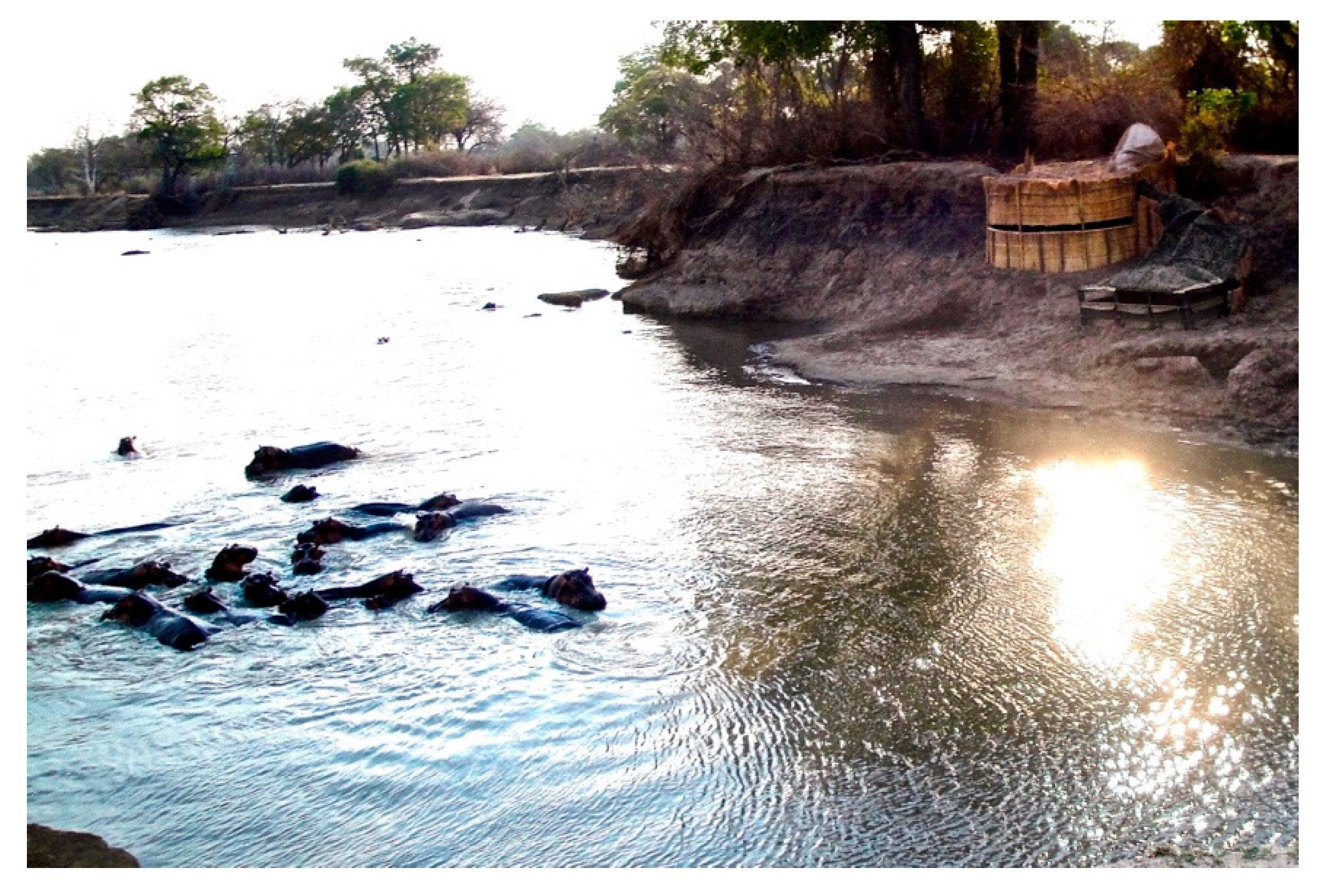
Figure 2.
Small group of hippos at the South African site.
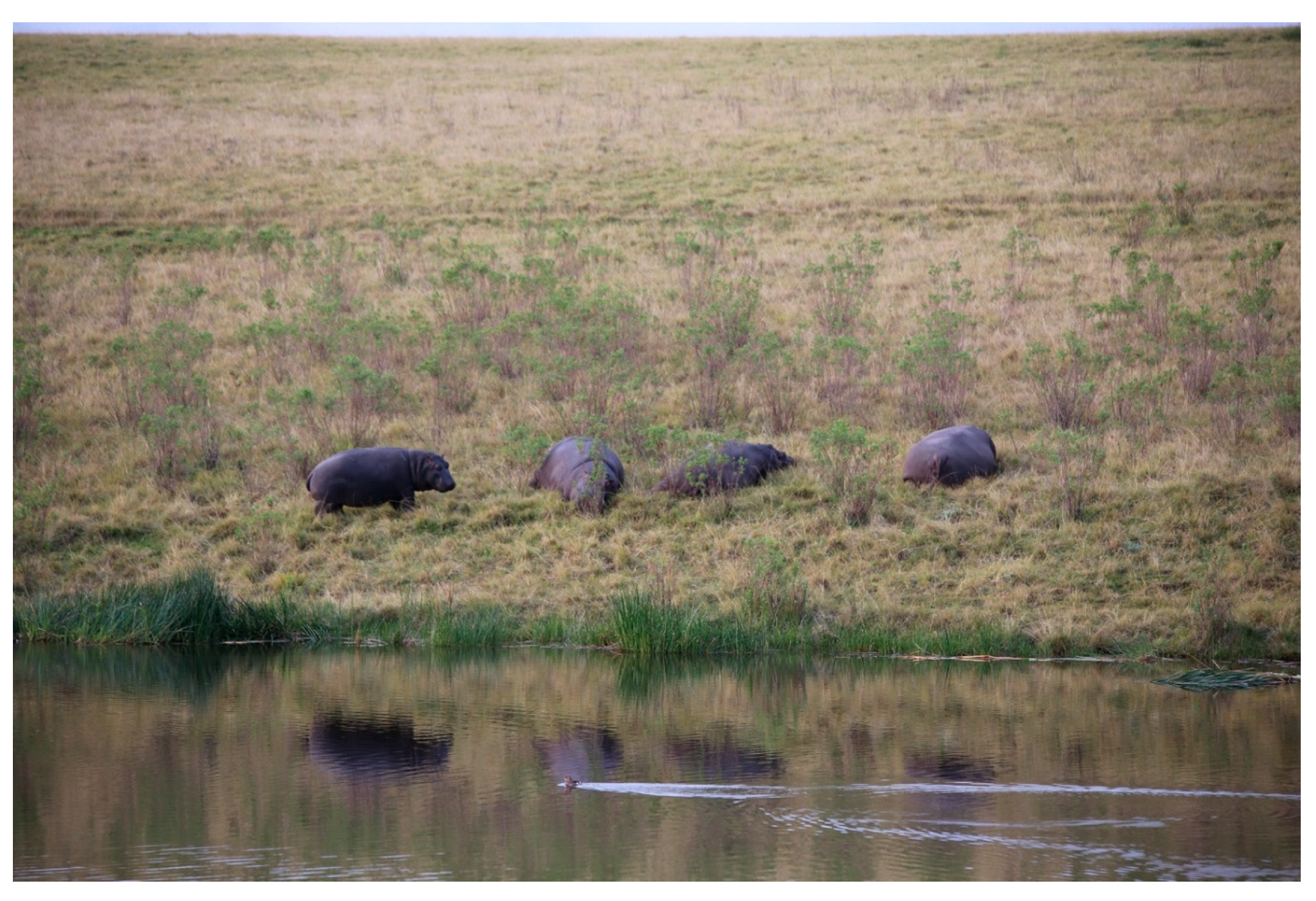
Figure 3.
Hippo yawns vary from medium to large.
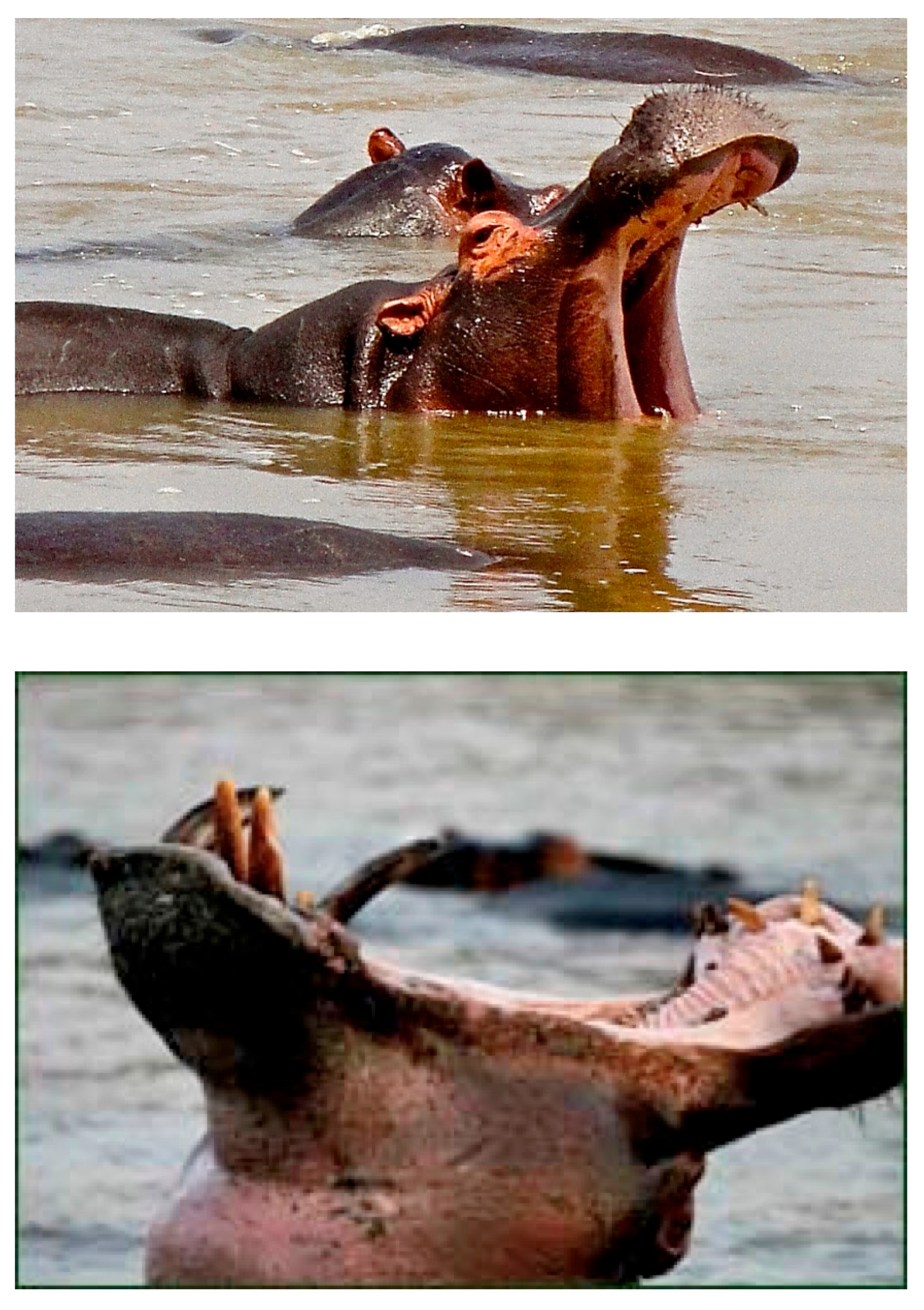
Figure 4.
Yawning upon arousal in the 4 hippos at the South African site.
Disclaimer/Publisher’s Note: The statements, opinions and data contained in all publications are solely those of the individual author(s) and contributor(s) and not of MDPI and/or the editor(s). MDPI and/or the editor(s) disclaim responsibility for any injury to people or property resulting from any ideas, methods, instructions or products referred to in the content. |
© 2026 by the authors. Licensee MDPI, Basel, Switzerland. This article is an open access article distributed under the terms and conditions of the Creative Commons Attribution (CC BY) license (http://creativecommons.org/licenses/by/4.0/).
Copyright: This open access article is published under a Creative Commons CC BY 4.0 license, which permit the free download, distribution, and reuse, provided that the author and preprint are cited in any reuse.