

Submitted:
23 September 2026
Posted:
24 September 2026
You are already at the latest version
Abstract
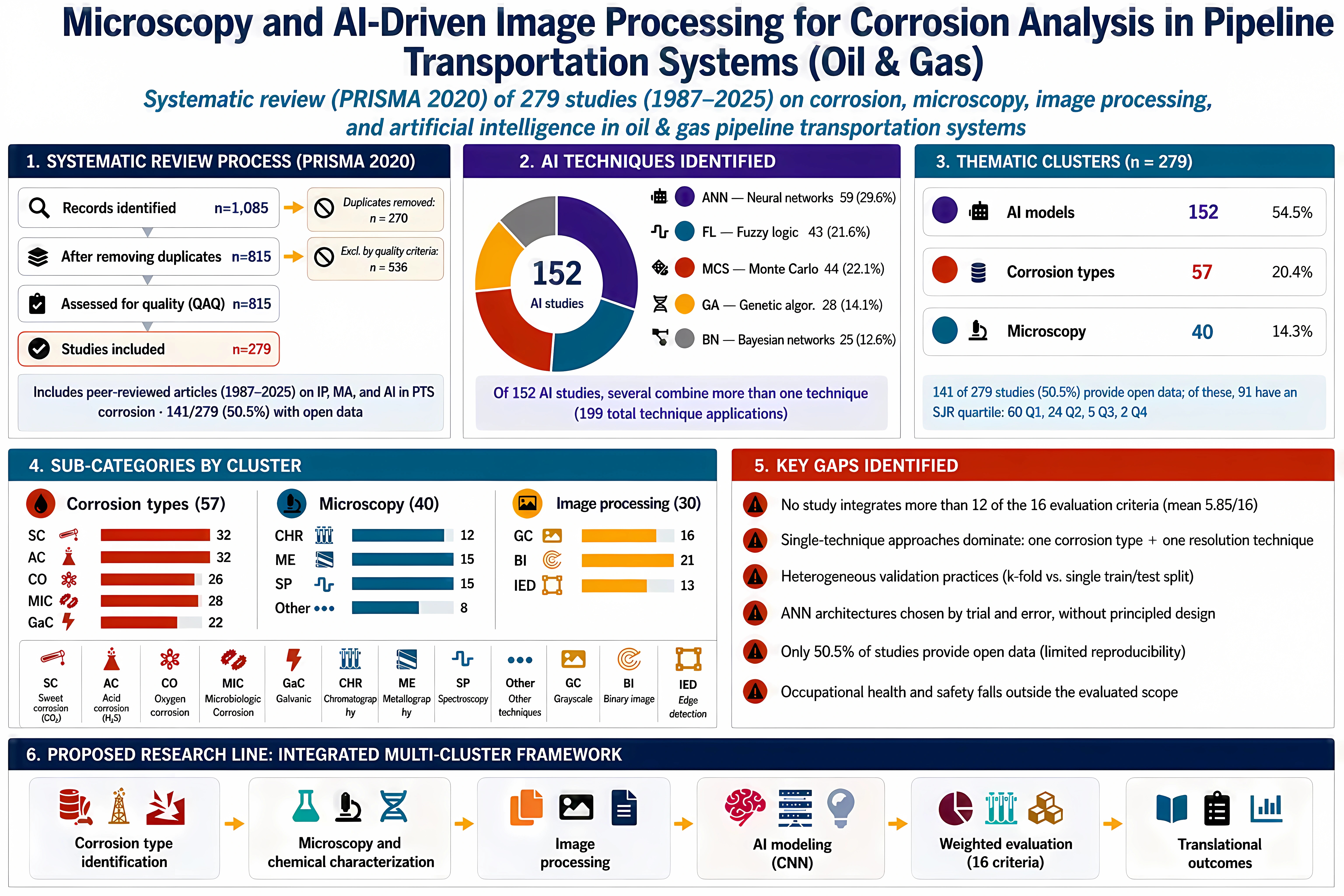
Pipeline transportation systems (PTS) are widely used maritime and land-based means of transport across several industries, including oil and gas, valued for being reliable, economical, and fast. However, operational instability from multiple interacting variables directly affects the mechanical integrity (MI) of these systems through internal and external corrosion (C). Addressing this problem increasingly relies on microscopic analysis (MA), image processing (IP), and artificial intelligence (AI). Together, these support a horizontal approach to reducing uncertainty and subjectivity in identifying, controlling, and monitoring corrosion-related risk factors. Following the PRISMA 2020 guidelines, this work presents a systematic literature review (SLR) of corrosion-related publications in oil and gas PTS spanning 1987–2025. From 1,085 records identified across two databases, 279 studies were retained after duplicate removal and quality assessment. Of these, 141 provide openly available data. A weighted evaluation matrix scoring twenty representative works against sixteen criteria across four thematic clusters—corrosion type, microscopy, image processing, and AI—shows that the number of jointly satisfied criteria ranges from 3 to 12 (mean 5.85 of 16). This indicates that integrated, multi-technique, AI-supported corrosion assessment remains uncommon across three decades of literature. Beyond consolidating the state of the art into a reusable evaluation instrument, this review establishes the theoretical and bibliometric foundation for an applied, multi-part research line that operationalizes several of these clusters on a real pipeline case study.
Keywords:
microscopic analysis (MA)
; image processing (IP)
; artificial intelligence (AI)
; corrosion (C)
; pipeline transportation systems (PTS)
1. Introduction
A Pipeline Transportation System (PTS) includes materials exposed to different environments and adverse operating conditions such as flow, temperature, and pressure. These interactions can compromise infrastructure integrity and cause failures [1]. Corrosion, defined as the destructive attack of a material through reaction with its environment, is a natural hazard closely linked to oil and gas production and transportation facilities [2]. Controlling corrosion in production tubing is essential to maintaining output and preventing loss of well control [3].
"The oil industry is an important economic activity worldwide because it generates numerous jobs, directly and indirectly, from oil extraction to final commercialization. The price of a barrel of oil is based on global supply and demand, which has shown significant changes since 2013" [4]. This information is shown in Figure 1:
"The total annual cost of corrosion in the oil and gas production industry is estimated at $1,372 billion. This breaks down into $589 million in surface piping and facility costs, $463 million annually in downhole, and $320 million in corrosion-related capital expenditures. Effective management will help reduce costs and ensure compliance with safety, health, and environmental policies" [6]. "The PTS are the primary transportation tool of the oil sector. Due to their low cost and the weight-distance relationship of the transported product, they have a high reliability in delivering the product promptly to requested locations. This transport can be by sea, land, or air depending on the company's geographical needs. However, it often becomes unstable under specific working conditions such as operational variations in suction and discharge, and disturbances related to Mechanical Integrity (MI) due to internal or external corrosion effects" [4]. Table 1 shows this information.
The scope of the systematic literature review (SLR) aims to contribute to the knowledge of intelligent monitoring and control processes of PTS by analyzing the modeling of "corrosion" and its impact on the system's mechanical integrity. It uses an integrative approach to help corrosion engineers incorporate artificial intelligence technologies into traditional processes to facilitate decision-making. The research questions (RQ) are classified in Table 2.
2. Materials and Methods
This work aims to develop an SLR on pipeline corrosion issues in specific areas or processes (gas and oil pipelines). The use of microscopic analysis (MA), image processing (IP), and artificial intelligence (AI) techniques as tools to model corrosion is currently a topic of interest for operating and safeguarding the reliability of PTS worldwide. Identifying steel shapes, combinations, and grain size from MA, combined with visual inspection, radiography, or ultrasonic methods using IP to analyze thermodynamic and electrochemical processes, will provide corrosion engineers alternatives to improve flow-assisted corrosion control with AI. This work explores approaches from scientific articles and literature reviews from 1987 to 2024 to identify the advantages of using AI, IP, and MA in the oil and gas industry. The methodology [4] employs a three-phase planning, conducting, and documenting structure. Section 2.1 and Section 2.2 summarize the review protocol.
2.1. Selection of Studies and Quality Assessment
The search criteria combined the "and" operator with the key terms: "Corrosion (C)," "pipeline transportation system in the oil and gas industry (PTS)," "image processing (IP)," "microscopic analysis (MA)," and "artificial intelligence (AI)." The systematic search included two databases, Scopus and Web of Science, to compile peer-reviewed academic articles and reviews published between 1987 and early 2024 in English and Spanish. Titles, abstracts, and keywords had to address the critical search terms. Conference proceedings, book chapters, unpublished manuscripts, and dissertations were excluded. Mendeley was used as a reference-management tool to consolidate results from both databases and remove duplicate records, not as an independent search source.
The search strategy, detailed in Table 4, recovered 1085 records from the two databases. After removing 270 duplicates, 815 records remained for quality assessment. We evaluated each record against the quality assessment questions (QAQ) in Table 3, applied to its title and abstract. Records that did not meet the QAQ criteria were excluded. This process removed 536 records, leaving 279 studies for data extraction. Table 4 summarizes the search results and quality-assessment strategy.

Table 3.
Quality assessment questions.
| Quality Assessment Questions | ID |
| Were the factors that structure corrosion in PTS and their impact on the mechanical integrity of the material mentioned? | QAQ1 |
| When developing microscopic analysis or image processing to analyze corrosive behavior patterns in PTS, were your sampling processes, techniques, tools, or software used to carry out this work detailed? | QAQ2 |
| Are the use of artificial intelligence techniques explained clearly, and how were they helpful in determining the generational behavior of corrosion in the PTS? | QAQ3 |
Table 4.
Results of the search and quality assessment strategy.
| Results | 1987–2024 data range | |
| Web of science core collection search | 501 | TOPIC:(Corrosion) and TOPIC:(Pipeline Transport System in oil and gas industry) and TOPIC:(Mechanical Integrity) and TOPIC:(Artificial Intelligence) and TOPIC: (Sweet corrosión, Acid corrosión, Corrosion to oxygen, Microbiological corrosión and Galvanic corrosión). Timespan: 1987–2024. Indexes: SCI-EXPANDED, SSCI, A&HCI, CPCI-S, CPCISSH.ESCI. |
| SCOPUS search | 584 | (TITLE-ABS-KEY(Corrosion) AND TITLE-ABS-KEY (Pipeline Transport System in oil and gas industry) AND TITLE-ABS-KEY (Mechanical Integrity) AND TITLE-ABS-KEY (Artificial Intelligence) AND TITLE-ABS-KEY (Fault-tolerance Control Systems) AND TITLE-ABS-KEY (Geo location System) AND TITLE-ABS-KEY (Sweet corrosión, Acid corrosión, Corrosion to oxygen, Microbiological corrosión, Galvanic corrosión, Artificial Neural Network, Fuzzy Logic, Bayesian network, Genetic algorithm, Simulation Monte Carlo). Timespan: 1994–2024. Indexes: SCI-EXPANDED, SSCI, A&HCI, CPCI-S, CPCISSH.ESCI. |
| Web of science core collection refinement search | 116 | TOPIC:(Corrosion) and TOPIC:(Pipeline Transport System in oil and gas industry) and TOPIC:(Mechanical Integrity) and TOPIC:(Artificial Intelligence) and TOPIC: (Fault-tolerance Control Systems) and TOPIC:(Geo location System) and TOPIC: (Grayscale, Binary Image or Ultasonic Inspection, Image with Edges Detected or Image with Outlines). Refined by: DOCUMENT TYPES: (ARTICLE OR REVIEW). Timespan: 1999–2023. Indexes: SCI-EXPANDED, SSCI, A&HCI, CPCI-S, CPCI-SSH.ESCI. |
| SCOPUS refinement search | 111 | (TITLE-ABS-KEY(Corrosion) AND TITLE-ABS-KEY (Pipeline Transport System in oil and gas industry) AND TITLE-ABS-KEY (Mechanical Integrity) AND TITLE-ABS-KEY (Artificial Intelligence) AND TITLE-ABS-KEY (Fault-tolerance Control Systems) AND TOPIC: (Chromatography, Metallography, Spectroscopy) AND TITLE-ABS-KEY (Geo location System)). Timespan: 1997–2023. Indexes: SCI-EXPANDED, SSCI, A&HCI, CPCI-S, CPCI-SSH.ESCI. |
| Papers recovered | 1085 | |
| Duplicates | 270 | |
| Papers for quality assessment | 815 | |
| Discarded for no answering the QAQs | 536 | |
| Sample for data extraction | 279 |
The authors developed the questions to align the research methodology with the RQs in Table 2. Our main objective is to meet the RQs' requirements to produce a high-quality evaluation. The work criteria consider both the title and the summary. If the document does not answer the questions, it is rejected. Finally, we obtained a sample of 279 papers for data extraction. Table 4 summarizes the search strategy results and the quality assessment process.
Of the 141 open-data studies, the journal quartile (SJR) was determined for 91 (64.5%): 60 in Q1, 24 in Q2, 5 in Q3, and 2 in Q4. The remaining 50 studies (35.5%) are books, theses, conference proceedings, or sources where the publishing journal could not be reliably identified. Figure 2 shows the PRISMA 2020 flow diagram summarizing the identification, screening, and inclusion process, tracing the reduction from the 1,085 records initially retrieved to the final sample of 279 studies retained for data extraction. Figure 3 provides a graphical summary of the topics of interest, showing that RQ3 is the most relevant study topic in the PTS in the oil and gas industry for this work.
2.2. Analysis and Synthesis
"The analysis group used the deductive procedure for each RQ to define the category scheme. The inferential procedure helped develop categories based on theoretical considerations" [7].
RQ1 analyzed the most recurrent types of corrosion affecting the mechanical integrity of PTS: acid, oxygen, sweet, microbiological, and galvanic. "Corrosion occurs when carbon dioxide dissolves in an aqueous phase, forming carbonic acid, which is corrosive in carbon steel. In acid corrosion, the presence of organic acids with saturated ring structures and one or more carboxylic groups in crude oils is a factor. Oxygen-related corrosion in oil and gas production environments is typically more aggressive than corrosion caused by CO2 or H2S, unlike galvanic corrosion, an electrochemical process linked to oxygen movement. Microbiological corrosion is caused by planktonic microorganisms rather than sessile biofilms in carbon steel" [4].
RQ2 analyzed image processing methods such as grayscale (GC), binary (BI), ultrasound images, and images with edge or contour detection (IED). "A grayscale image is used to mark edges or contours, making data extraction easier" [8]. "The corroded area can be calculated using a binary image by setting thresholds to match the number of corrosion pits identified by visual observation" (Wang et al. 2023), "edge detection, and deep learning for mechanical defects. Image processing involves process improvement steps such as denoising, restoring, contrast enhancement, segmentation, edge detection, or image sharpening" [10].
RQ3 analyzed: The models developed to analyze corrosion behavior in the PTS are supported by intelligent tools such as artificial neural networks (ANN), fuzzy logic (FL), Bayesian networks (BN), genetic algorithms (GA), and Monte Carlo simulations (MCS).
Generally, ANNs target prediction or pattern recognition problems where developing a suitable analytical model is difficult. The Back Propagation neural network finds correlations between two known sets of results and input data. It has three interconnected computing layers called neurons. Each neuron uses a sigmoid transfer function to perform non-linear interpretation (learning) of input signals scaled between 0 and 1. The correlation is achieved through adaptive adjustment (training) of the network connection conductivities called weights [11]. FL methods have been widely used to analyze and evaluate risk indices. The fuzzy inference system (FIS) can solve problems related to exact mathematical models [12]. The basic structure of the FIS type maps input features to input membership functions, input membership functions to rules, rules to output features, and output features to output membership functions, which lead to a single-valued outcome or decision [13]. Bayesian updating simulation techniques quantify power law growth model parameters based on data from multiple inspections at different times [14]. The GA is a heuristic optimization method using genetic evolution patterns [15]. MCS is a widely applied alternative to analytical techniques to determine output distribution parameters from values randomly generated from known input distributions [16].
3. Results
3.1. Impact of Corrosion on Mechanical Integrity in PTSs or Pipelines (RQ1)
RQ1 aims to analyze different corrosion processes, their appearances and forms, control methods and inhibitors, their impact on study processes, and developments in corrosion control applied in PTS. This work mainly addressed sweet corrosion, Acid Corrosion, Oxygen Corrosion, Microbiological Corrosion, and Galvanic Corrosion, as shown in Figure 4. Beyond mechanism-specific studies, the dual focus on mechanical integrity and corrosion prevention reflects a broader operational-reliability need within PEMEX. Recent work has proposed an information-system framework for equipment maintenance to improve operational reliability in the Northeast Marine Region of Mexico [113].
A total of 57 works were analyzed and classified into two groups. The Dyadic group relationship involved pipelines and equipment proportional to those used in the oil and gas industry. The PTS group in the oil industry consists of works aimed at products, oil, and gas pipelines. Each job was weighted by the number of tools used for the corrosion analysis it addressed. Table 5 presents each job's weighting, classification, and reference analyzed to prepare this literature review.
The 57 analyzed works were classified according to the types of corrosion analyzed, year of publication, and group of Dyadic relationships or PTS in the oil industry, see Figure 4.
3.1.1. Analysis and Discussion on SC (Sweet Corrosion)
Sweet-corrosion research on general mechanical systems has focused on fatigue-driven degradation of static and mobile installations exposed to condensed water carrying CO2 and H2S. Inhibitor dosing, both continuous and batch, remains the dominant mitigation strategy despite new inhibitor formulations [17,18]. In pipeline-specific studies, sweet-corrosion severity is modeled as a multivariable function of CO2/H2S partial pressure, temperature, pressure, suspended solids, corrosion-product scale properties, flow regime, pH, and the ionic content of the produced water rather than a single dominant driver [19,20]. This multivariable framing is echoed at the industry level, where effective corrosion management is treated less as a technical afterthought and more as a cost- and compliance-driving priority [6]. Taken together, the sources reviewed for SC point to a shared understanding across both units of analysis: sweet corrosion is inherently a multi-parameter phenomenon, supporting the multi-factor characterization strategy adopted later in this review rather than a single-indicator approach. Several broader treatments of oil-and-gas corrosion management compiled for this review situate sweet corrosion within a wider prevention and control framework, spanning compendium-level treatments of CO2 corrosion to dedicated prevention guides and industry-wide materials overviews [118,122,123,124,127]. Complementing this, several inhibitor- and materials-focused studies examine polymeric and plant-derived inhibitor formulations, alloy selection, and the influence of carbon-steel microstructure on the resulting corrosion-layer behavior [121,128,129,130,147].
A further set of studies addresses sweet-corrosion control from complementary angles. These include internal-corrosion control practice, the microbial contribution to CO2-driven corrosion, multiphase-flow-related mechanistic modeling, and the broader cost and mitigation framework for the industry [126,136,142,145,146].
3.1.2. Analysis and Discussion on AC (Acid Corrosion)
Acid corrosion driven by H2S manifests across a spectrum of failure modes: general corrosion, pitting, and in more severe cases, cracking or blistering. The gas can migrate through cracks and cause downstream environmental damage [21]. Explaining these failure modes requires quantifying the equilibrium constants governing the hydrothermal formation and stability of iron-sulfide corrosion products, since these compounds mediate much of the acid-corrosion mechanism [22]. In pipeline-specific contexts, the same H2S exposure produces sulfide stress cracking in the high-strength steels used for drilling and production. This failure mode occurs at stresses below the material's nominal yield strength [19]. A related but mechanically distinct pathway, stress corrosion cracking, develops under mechanical stress before pitting failure. It is typically investigated using finite-element modeling combined with corrosion analysis and direct measurement [23]. These findings suggest that acid corrosion in pipeline transportation systems (PTS) cannot be fully characterized through chemical analysis alone without accounting for the pipeline's mechanical stress state. This motivates combining chemical characterization with mechanical-integrity evaluation in the broader corrosion-assessment framework developed in this review.
Recent H2S-specific investigations reinforce this stress-mechanism convergence with direct mechanical evidence. Sensitivity testing of X65MS pipeline steel in H2S-containing environments reports a yield-to-tensile ratio (Rt0.5/Rm) of 0.85 alongside a 100% drop-weight tear test performance. This explicitly links hydrogen-induced cracking susceptibility to measurable mechanical property ratios rather than qualitative failure description alone [115]. A parallel study on HSLA X70 steel cracked by hydrogen damage in sour-gas media combined SEM-EDS, optical microscopy, and potentiodynamic polarization to characterize the same failure pathway. It confirms that acid-corrosion cracking in high-strength pipeline steels is best diagnosed through a combined mechanical-microstructural-electrochemical protocol rather than any single technique in isolation [116]. Additional industry-wide treatments consulted for this review frame acid corrosion within broader corrosion-control practice, spanning general impact assessments, prevention guides, materials overviews, and cost-and-consequence frameworks [118,124,127,129,142]. A second set of studies focuses on inhibitor chemistry and material response, covering acid-specific inhibitor reviews, polymeric formulations, alloy selection, carbon-steel microstructure, and aluminized-steel resistance to acid attack [119,121,128,130,134].
3.1.3. Analysis and Discussion on CO (Corrosion to Oxygen)
Oxygen-driven corrosion in industrial equipment is worsened by typical petroleum processing conditions: high temperature, high pressure, multiphase flow, elevated pH, and high ionic concentration, rather than by oxygen exposure alone [24]. Oxygen is only mildly corrosive in air, but once dissolved in water it forms carbonic acid, which is much more aggressive toward carbon steel [21]. In pipelines, oxygen is often present as an impurity in the transported oil or gas rather than introduced externally [2]. The resulting corrosion of carbon steel under multiphase-flow conditions is best explained as an electrochemical process rather than a purely chemical one [25]. These sources show that oxygen-corrosion severity in PTS depends less on oxygen concentration alone and more on the flow regime and phase behavior that determine how and how much oxygen contacts the pipe wall. This supports the need for flow-aware rather than purely compositional monitoring strategies.
This flow-dependent view of oxygen exposure is supported by recent work on hydrogen-damage cracking in HSLA X70 steel under sour-gas conditions. Oxygen-corrosion evidence was found alongside acid-corrosion indicators using potentiodynamic polarization, SEM-EDS, and optical microscopy. This shows that oxygen and acid corrosion mechanisms rarely occur in isolation in real sour-gas service and are best characterized through the same combined diagnostic protocol [116]. Several broader references consulted for this review place oxygen-driven corrosion within general prevention guides, materials overviews, inhibitor-mechanism reviews, and industry cost-and-mitigation frameworks [124,127,129,142,145].
A second group addresses material- and microstructure-related aspects, including thermal-spray coating protection, the influence of carbon-steel microstructure on corrosion layers, alonized-steel resistance, and microbial contributions to CO2-driven attack [125,130,134,136]. The remaining studies focus on inhibitor and process-fluid chemistry, covering crude-oil emulsion behavior, polymeric inhibitor design, Gum-Arabic-based inhibition, and plant-derived inhibitor extracts [120,121,144,147].
3.1.4. Analysis and Discussion on MIC (Microbiological Corrosion)
At the material level, microbiologically influenced corrosion (MIC) produces a broad failure signature: weight loss, cracking, fatigue, and corrosive galvanization. These result from preferential reactivity at grain boundaries compared to grain interiors, deforming the microstructure and progressively degrading mechanical properties until fracture [26,27]. This microstructural mechanism directly relates to the grain-boundary and grain-size analysis used elsewhere in this review as an indirect marker of corrosion severity. At the pipeline-system level, MIC increasingly contributes to internal corrosion, especially in deep offshore installations and in transporting unconventional oil and gas, where water stratification inside the pipe promotes localized microbial activity [28]. The alignment between microstructural evidence (grain-boundary deformation) and operational evidence (water stratification as a trigger) suggests MIC-detection strategies benefit from combining microscopic grain analysis with knowledge of a pipeline's flow regime and water-cut history, rather than relying on either source alone.
Broader industry references consulted for this review frame MIC within general prevention, materials, and inhibitor-mechanism overviews, alongside the sector's overall cost-and-consequence framework [124,127,129,142]. A second group addresses MIC mechanisms directly, covering sulfate-reducing-bacteria attack, offshore case studies, engineering-level overviews of the phenomenon, microbial contributions to CO2/acetate corrosion, and advances in molecular microbiological detection methods [131,132,133,136,137].
The remaining studies extend this evidence base to microstructural influence, standardized working-party guidance on microbiological degradation, biofilm-focused mitigation, electrochemical-noise-based microbial consortium assessment, and the broader mitigation framework for the industry [130,138,139,140,145].
3.1.5. Analysis and Discussion on GaC (Galvanic Corrosion)
Mitigation research on galvanic corrosion in general engineering has focused on protective coatings, such as plasma electrolytic oxidation coatings with or without a polyurethane layer applied to magnesium alloys. It has also focused on two main cathodic-protection strategies: sacrificial (galvanic) anodes, which are more electronegative than the structure they protect, and impressed-current systems [29,30]. In pipelines, coating remains a common mitigation method, but its practical value is limited by cost and the physical impossibility of coating an entire pipeline's length [19]. Galvanic corrosion arises where dissimilar metals are in electrical contact within an aqueous, electrified medium. This condition is common in pipeline equipment that combines multiple metal types. Corrosion inhibitors are often favored over full coating as a more economical protective measure [31]. Comparing the two units of analysis, coating-based protection consistently appears as the first line of defense in both general engineering and PTS-specific contexts. Inhibitor dosing emerges as the pragmatic compromise where coating the full pipeline surface is not economically feasible. Broader references consulted for this review place galvanic corrosion within general prevention, materials, and inhibitor-mechanism overviews, alongside the sector's overall cost framework [124,127,129,142]. The remaining studies address galvanic corrosion mechanisms and mitigation directly, covering the influence of carbon-steel microstructure, the galvanic mechanism underlying localized CO2 corrosion propagation, multi-electrode inhibition testing, and the broader industry mitigation framework [130,141,143,145].
The 57 works analyzed for RQ1 were also classified according to publication year, open-data availability, and unit of analysis (Dyadic relationship or PTS in the oil and gas industry). Figure 5 summarizes this distribution across the five corrosion types addressed in this work.
3.2. Microscopy Used for Detecting Corrosion in PTSs or Pipelines (RQ2)
The objective of RQ2 also consists of the different types of microscopy techniques used to detect corrosion in PTS, such as chromatography, metallography, and spectroscopy. The 40 analyzed works were classified according to the microscopy techniques used, the year of publication, and whether they belong to the Dyadic group—relationship or PTS in the oil industry, as shown in Figure 6.
A total of 40 works were analyzed and classified into two groups. The Dyadic group relates to pipelines and equipment proportional to those used in the oil and gas industry. The PTS group in the oil industry consists of jobs focused on pipelines and equipment in the oil and gas industry. Each job was weighted by the number of tools used for the corrosion analysis it addressed. Table 6 presents each job's weighting, classification, and reference analyzed in this literature review.
3.2.1. Analysis and Discussion on CHR (Chromatography)
Chromatographic techniques serve two related but distinct purposes in the pipeline-corrosion literature. In pipeline-specific studies, gas chromatography–mass spectrometry (GC-MS) is used mainly to fingerprint corrosion inhibitors, distinguishing compounds from the inhibitor itself from the surrounding chemical background, and to quantify the H2S and CO2 produced during corrosion reactions [33,34,35,36]. In the broader (dyadic-relationship) literature, chromatography is applied earlier in the analysis chain. It characterizes the volatile, semi volatile, and thermostable compounds migrating from pipeline materials. When paired with liquid chromatography–mass spectrometry (LC-MS) or high-performance liquid chromatography (HPLC), it extends to characterizing natural, environmentally acceptable inhibitor extracts [32,37,38]. This division of labor—dyadic studies characterizing which compounds are present, PTS studies fingerprinting how those compounds interact with corrosion and inhibition—is consistent with how gas chromatography is used later in this research: to identify corrosive agents in a hydrocarbon stream rather than just confirm their existence. Additional chromatography-based studies reviewed here extend this dual fingerprinting and characterization role to further inhibitor chemistries and corrosion byproducts [265,268,279].
3.2.2. Analysis and Discussion on ME (Metallography)
Metallography plays two roles in the reviewed literature: diagnostic and quality control. As a diagnostic tool, replica testing, a non-destructive metallographic technique gaining traction in the oil and gas sector, monitors in-service microstructural degradation in critical equipment. Etched samples reveal inclusions and unevenly distributed black-spot defects indicative of active corrosion [39,40]. As a quality-control tool, metallography is standard for general process control in stainless steels. Grain-size measurement, phase identification (delta/sigma ferrite), and carbide-distribution assessment serve both as manufacturing checks and, when applied to failed components, as a means to reconstruct the corrosion or oxidation mechanism responsible for failure [41]. When applied to localized corrosion in stainless-steel tubing and combined with diffraction and elemental analysis, metallography can distinguish between pitting, microbiologically induced corrosion, and both trans- and intracrystalline cracking mechanisms [42]. This shows that grain-level microstructural evidence can differentiate not just whether corrosion occurred but which mechanism caused it.
This diagnostic use of metallography for mechanism reconstruction appears in recent sour-service pipeline-steel studies. Optical metallography combined with SEM-EDS has characterized hydrogen-induced cracking in both X65MS and HSLA X70 pipeline steels exposed to H2S-containing environments. This directly links observed microstructural cracking patterns to mechanical properties such as yield-to-tensile ratio and drop-weight tear performance [115,116]. Among the metallography-based studies compiled for this review, one group addresses component-level failure analysis, covering API 5L separator-flowline failure, long-term subsurface-corrosion degradation, tubing-nipple corrosion analysis, and drill-pipe fracture analysis [269,272,274,277].
A second group addresses corrosion mechanisms and protective measures. These include H2S-stripper-column corrosion-sequence modeling, insulation-related corrosion-under-insulation risk assessment, underwater friction-stud-welding electrochemical performance, flexible-pipeline annulus corrosion testing, and cathodic-protection management to avoid hydrogen embrittlement [263,266,267,273,276]. One further study compares magnetic and ultrasonic testing methods for corrosion-cracking detection in gas pipelines [275].
3.2.3. Analysis and Discussion on SP (Spectroscopy)
Spectroscopic methods contribute equally to corrosion-product identification and corrosion-rate quantification in the literature. For marine pipeline transport, Raman spectroscopy identifies FeCO3 and other corrosion-derived oxides and salts on the material surface. Electrochemical impedance spectroscopy (EIS), which applies a small AC perturbation to the corroding system, assesses the relative corrosion resistance of coated versus uncoated cast-iron pipe [43,44]. Beyond identification, Raman spectroscopy combined with vertical scanning interferometry addresses the limitation of single-mean-value corrosion-rate reporting by resolving spatially variable rates—from uniform corrosion to high-density pitting—into rate maps instead of a single scalar figure [45,46]. X-ray photoelectron spectroscopy (XPS) extends this capability to measuring corrosion under coupled mechanical-chemical action, including the effect of nitrite-based inhibitors in composite environments [47]. Collectively, these studies highlight spectroscopy's advantage over bulk chemical or mechanical testing: its ability to resolve corrosion behavior spatially rather than only as an aggregate value. This distinction is directly relevant to the population-level, rather than single-point, characterization pursued elsewhere in this research.
Consistent with this population-level orientation, EDS-coupled SEM analysis combined with potentiodynamic polarization has recently been applied to hydrogen-damage cracks in HSLA X70 pipeline steel under sour-gas conditions, using elemental spectroscopy to confirm the compositional signature of the corrosion products responsible for the observed cracking rather than relying on visual or mechanical evidence alone [116]. Further spectroscopy-based studies reviewed for this work extend this identification-and-quantification role to additional corrosion products and inspection techniques [262,264,270,271,278].
3.3. Image Processing Used for Detecting Corrosion in PTSs or Pipelines (RQ2)
The objective of RQ2 is to analyze different types of image treatments, focusing on grayscale, binary images, ultrasound images, and edge detection analysis. It examines their impact in the case study and developments in corrosion control applied to the PTS. Figure 7 shows the types of image processing analyzed in this work.
A total of 30 works were analyzed and classified into two groups: the Dyadic group relationship, related to pipelines and equipment similar to those used in the oil and gas industry, and the PTS group in the oil industry, which focuses on pipelines and equipment in that sector. Each work was weighted by the number of tools used for corrosion analysis. This information is shown in Table 7 and Table 8, which present each work's weighting, classification, and reference used in this literature review.
The 30 analyzed works were classified according to their image treatments, the year of publication, and whether they belong to the Dyadic group—relationship or PTS in the oil industry, as shown in Figure 8.
3.3.1. AI Models Through Image Processing to Analyze Corrosive Environments
Computer vision applied to corrosion detection covers a set of preprocessing operations: segmentation, filtering, sharpening, illumination correction, noise reduction, contrast enhancement, and rescaling. These aim to make the corroded region easier for a classifier to locate and delineate without adding information beyond the original capture [48]. This approach aligns with the broader use of artificial intelligence in the oil and gas sector, where artificial neural networks, fuzzy logic, and evolutionary algorithms are standard tools for reservoir simulation, drilling optimization and automation, process control, and data mining [50]. Combining these, one methodology pairs advanced data-acquisition hardware with an ANN-based classification framework. Image preprocessing is used only to make the digitized data human-interpretable and computationally manageable, without creating new information beyond sharpening and contrast adjustment [13]. Figure 9 shows this generic corrosion-detection pipeline. To classify the reviewed works consistently, four criteria were applied: whether a study explicitly uses image Pre-Processing (PP), whether it combines two or more Image Processing (IP) techniques, whether it incorporates Artificial Intelligence (AI) in the analysis, and whether Corrosion (C) is the explicit subject of study. The results of this classification are in Table 8.
3.3.2. Analysis and Discussion on GC (Grayscale)
Grayscale conversion is not merely a preprocessing convenience in this literature. Several studies treat grayscale intensity itself as a quantitative corrosion indicator. In pipeline-specific work, grayscale values correlate directly with corrosion depth via column-averaged gray-value profiles. When combined with a Markov-chain model, they extract morphology patterns from treated images that match independently obtained electrochemical measurements. This shows that grayscale-derived features carry physically meaningful corrosion information rather than being a purely visual simplification [9,48,49]. In the broader dyadic literature, grayscale conversion is framed more as an enabling step, improving edge and contour visibility to facilitate subsequent data extraction. It is also noted to be well suited to characterizing early-stage corrosion, where grayscale range correlates with both average and maximum corrosion rate [8,51]. This suggests grayscale analysis occupies a middle ground in the processing pipeline: informative enough to stand alone as an early-detection indicator, yet most useful as a preparatory stage for the edge-detection and binarization steps discussed next.
More directly relevant to structural corrosion detection, a 2025 deep-learning framework for steel-bridge inspection explicitly incorporates grayscale conversion as a discrete processing stage within its detection pipeline. Heatmaps generated via Grad-CAM and refined through K-means clustering are converted to grayscale immediately before binarization, isolating corrosion regions from background clutter [117]. This confirms that even within an end-to-end deep-learning pipeline, grayscale conversion remains a necessary intermediate representation rather than being superseded by learned feature extraction alone. The remaining grayscale-based studies compiled for this review extend this quantitative role to additional materials, defect types, and detection pipelines [253,257,258].
3.3.3. Analysis and Discussion on BI (Binary Image or Ultrasonic Inspection)
Binary-image and ultrasonic methods share a goal of reducing a continuous inspection signal to a discrete, classifiable defect map but use different instrumentation. In-line ultrasonic inspection combines complex sensing hardware with dedicated software to orient, process, and manage inspection data at project scale. Offline variants apply a phaseless delay peak-extraction algorithm to compute wall thickness and render it as a false-color image, then classify defects against American Petroleum Institute templates [52,53]. Image-processing literature converges on the same discretization logic from a computational angle: images are binarized against a set threshold, region growth is seeded from a center point, irrelevant information is filtered out, and pixel boundaries are refined via least-squares fitting to isolate corrosion extent [10,54]. A recurring caveat across both strands is the trade-off between detection accuracy and computation time. Several sources flag this as the binding constraint for deploying these methods in real, industrial-scale applications rather than controlled laboratory settings [55]. This constraint is directly relevant to any inspection system intended for field use.
This pipeline illustrates the binarization step in a fully automated context. After grayscale conversion, the clustered heatmap output is transformed into a binary (bi-level) image to separate corrosion pixels from the background. The resulting regions are bounded and compared against ground-truth masks via Intersection-over-Union, reporting a mean IoU of 0.731. This outperforms benchmark U-Net (0.633) and EfficientDet (0.640) segmentation models on the same steel-corrosion dataset [117]. This result reinforces the finding that binarization, even within a modern deep-learning pipeline, remains the discretization step that ultimately determines localization accuracy.
3.3.4. Analysis and Discussion on IED (Image with Edges Detected or Image with Outlines)
Edge detection is framed as the step that converts a binarized image into an interpretable corrosion boundary, though the literature acknowledges its limitations. In pipelines, computer vision applied to crude-oil pipelines requires a robust edge-detection algorithm because it must reliably locate corrosion boundaries across all possible image outputs [48,56]. The dyadic-relationship literature adds a practical nuance: edge processing on already-binarized images allows corrosion type to be inferred from the dimensions of the resulting contours. However, the uneven, irregular distribution typical of real corrosion pits means these contours often blend into the image background. This requires improved image focus as a precondition for reliable edge detection [8,57]. This limitation—that edge detection depends on the focus and binarization quality feeding into it—reinforces why grayscale conversion and binarization are necessary upstream steps rather than optional preprocessing. The remaining edge-detection studies compiled for this review extend this boundary-delineation approach to additional corrosion morphologies and image-acquisition conditions [253,257,259,260,261].
3.4. Impact of Using Artificial Intelligence for Detecting Corrosion in PTSs or Pipelines (RQ3)
RQ3 analyzes different artificial intelligence techniques, including artificial neural networks, fuzzy logic, Bayesian networks, genetic algorithms, and Monte Carlo simulation. Figure 10 shows an intelligent system applied to pipeline corrosion. Section A represents the ANN that classifies different types of corrosion by weighting input variables through feedback. Section B shows a genetic algorithm that optimizes the ANN results. Section C presents financial scenarios using Monte Carlo simulation applied to sections A and B.
A total of 152 works were analyzed and classified into two groups: the Dyadic group relationship, related to pipelines and equipment proportional to those used in the oil and gas industry, and the PTS group in the oil industry, which includes jobs directed at pipelines and equipment in the oil and gas industry. Each job was weighted by the number of tools used for the corrosion analysis in that job. Table 9 presents each job's weighting, classification, and reference analyzed for this literature review.
The 152 analyzed works were classified according to the artificial intelligence technique used, the year of publication, and the Dyadic group relationship or PTS in the oil industry, see Figure 11.
3.4.1. AI Models for Corrosive Environment Analysis
Artificial intelligence's track record outside the energy sector, spanning medical diagnosis, fraud detection, credit approval, and robotics, has translated into a broad set of upstream oil and gas applications. These include pressure transient analysis, well-log interpretation, reservoir characterization, and stimulation-candidate selection [62]. Within this landscape, neural networks, fuzzy logic, and genetic algorithms are consistently identified as the most mature tools available to petroleum engineers [63]. Artificial neural networks are particularly valued for their ability to generalize to inputs not seen during training, a property especially useful given the heterogeneity of geoscience and petroleum-engineering data [64]. Structurally, a neural network is a layered arrangement of interconnected processing units (neurons) that stores experimental patterns as connection weights. These weights are refined iteratively during training until the network's output converges on a target value [65]. One representative implementation extends this basic architecture into a five-step automated interpretation pipeline: image acquisition, preprocessing, neural-network-based defect recognition, post-processing, and a suggestive repair mechanism based on an adaptive neuro-fuzzy inference system. This illustrates that ANN-based classification is rarely deployed in isolation but rather as one stage within a broader image-to-decision pipeline [13].
Comparing performance metrics across these AI paradigms is complicated by a broader, well-documented issue in the ML literature. Systematic reviews of machine-learning models, even outside the energy sector, consistently report that inconsistent reporting standards—such as varying train/validation/test definitions, absent confidence intervals, and non-uniform evaluation metrics—make like-for-like comparison between studies difficult. This methodological challenge applies equally to comparing ANN, FL, BN, GA, and MCS-based corrosion models and to diagnostic ML models in other domains [111]. This caveat reinforces the need to apply the explicit quality-assessment criteria introduced earlier in this review (Section 2.1) when interpreting the comparative results presented below.
3.4.2. Advantages
The principal advantage AI techniques offer over conventional deterministic modeling is their capacity to handle problems that cannot be formulated as explicit, rule-based algorithms [64]. For example, evolutionary algorithms identify field-relevant patterns empirically through iterative prediction, evaluation, and rejection, rather than requiring the pattern to be specified a priori [50]. This flexibility is especially valuable for modeling corrosion-defect behavior, which is commonly split into two distinct stochastic processes. Defect generation is modeled as a non-homogeneous Poisson process, and subsequent defect growth is modeled as a non-homogeneous gamma process once a defect exists [66]. Growth is further characterized by a power-law function of time. Its parameters are estimated via Bayesian updating and Markov Chain Monte Carlo simulation from multiple inspections performed at different times [14]. This approach combines two AI/statistical techniques surveyed in this review (Bayesian inference and Monte Carlo simulation) within a single growth model, illustrating that these techniques are often complementary rather than competing choices.
3.4.3. Disadvantages
Set against these advantages, AI-based corrosion modeling has three recurring costs. First, building a reliable model requires a broad range of training data [63]. This is often the main constraint in practice since pipeline inspection data is scarce and expensive to collect compared to other industrial domains. Second, the classification task is complex because multiple, sometimes overlapping, defect types (delamination, cracking, debonding, corrosion) must be distinguished within the same image or signal. This complicates both data labeling and model interpretation [13]. Third, when defect categories are unknown in advance, the problem shifts from classification to clustering. This means identifying groups of data with high within-group similarity and low between-group similarity under unsupervised learning, which is a harder and less validated task than supervised classification [64]. Table 10 further subclassifies the ANN-based studies reviewed, showing that deep neural classifiers (DNCs) and generative adversarial networks (GANs) appear more frequently than convolutional neural networks (CNNs). The working hypothesis here is that CNNs require an image-preprocessing pipeline (Figure 9) that is not accessible to every research group, whereas DNCs and GANs need only a training database, lowering the practical barrier to adoption.
3.4.4. Analysis and Discussion on ANN (Artificial Neural Networks)
Applying ANNs to pipeline reliability assessment addresses a key gap: inspection data alone carries substantial uncertainty. Statistical models built on ANN outputs narrow the gap between predicted and actual corrosion growth [67]. Beyond growth prediction, ANN outputs have been combined with expert-system logic to build knowledge-based inspection systems that evaluate overall pipeline condition [68]. Independent component analysis, borrowed from signal processing and speech enhancement, exploits higher-order statistical structure in the input data to improve ANN performance on feature-extraction tasks [69]. The dyadic-relationship literature tempers this optimism with two practical caveats. First, ANN architecture is typically selected through trial and error rather than principled design, limiting generalization across contexts [58]. Second, hidden-layer size involves a trade-off: too few neurons underfit the training data, while too many cause overfitting [70]. Despite these caveats, the overall trend is that increased computing power has made automated, ANN-based feature recognition in pipeline inspection more accessible than purely statistical or rule-based alternatives [13].
Within the ANN-based literature compiled for this review, a first group of studies applies neural networks specifically to CO2-corrosion-rate prediction, covering gas-pipeline corrosion forecasting, crude-oil effects on CO2 corrosion, and inhibition-knowledge extraction from flow-line and pipeline-steel data [148,155,156,157,158]. A second group focuses on defect and failure classification, applying ANN schemes to internal-corrosion profiling, MFL-signal-based weld-defect detection, finite-element-coupled interacting-defect analysis, corroded-pipeline failure classification, and theoretical/experimental verification of coated buried-pipeline failures [159,164,165,171,172].
A third group applies ANN methods to leak detection and signal processing, including inner-corrosion-rate forecasting, radial-basis-function leak localization, acoustic leak-magnitude prediction, wet-gas-piping root-cause modeling, and GRNN-based acoustic location algorithms [160,168,173,178,179]. A fourth group addresses pipeline risk and reliability assessment, spanning fuzzy-neural failure-rate prediction, expert-system-based failure analysis, probabilistic CO2-corrosion modeling, probabilistic reliability assessment, and closed-form-versus-surrogate reliability comparisons [153,154,163,166,176]. A fifth group applies ANN techniques to metal-loss and inspection-data modeling, including wet-gas gathering-pipeline corrosion assessment, TOLC metal-loss database analysis, gas-conducting-pipeline metal-loss evaluation, and stray-current-density prediction for buried pipelines [167,175,177,180,181].
A sixth group extends ANN modeling to broader facility and process contexts, covering fuzzy-corrosion modeling, computational-intelligence safety surveys, sulfuric-acid dew-point prediction, gas-transport pipeline pressure-signal modeling, and natural-gas storage-facility design [150,152,170,183,184]. Two further studies apply wavelet-basis-function and finite-element-coupled ANN models to gas-pipeline inspection-signal characterization and internal-corrosion simulation, respectively [182,185]. An eighth group situates ANN-based methods within broader upstream applications, including transport-facility control, PVT-correlation forecasting, well-log-based stress-profile determination, drilling-system design, and shale hydrocarbon-production forecasting [190,199,202,203,210].
The remaining studies provide broader AI overviews and forecasting applications. These include evolutionary-computing surveys, fuzzy-logic and ANN pressure-drop evaluation, AI and data-mining applications in exploration and production, oil-pipeline failure prediction, and unpiggable-pipeline condition forecasting [206,207,208,209,223].
3.4.5. Analysis and Discussion on FL (Fuzzy Logic)
Fuzzy logic's main appeal in pipeline risk assessment is its ability to formalize uncertainty directly instead of forcing risk factors into crisp categories. The Muhlbauer method, in particular, has become the standard for identifying critical factors driving oil and gas pipeline risk within this framework [71]. More generally, fuzzy logic translates natural-language risk descriptions into mathematical equivalents, simplifying otherwise intractable problems while preserving accuracy in modeling real-world system behavior [65]. The dyadic-relationship literature explains the mechanics: fuzzy models are commonly built using a learn-by-example approach where training datasets progressively refine the rule base [72]. This occurs through a fuzzification–defuzzification cycle in which sharp (crisp) values and fuzzy sets are converted back and forth, combining into a systematic method for evaluating imprecise information [73]. Compared with the ANN findings above, fuzzy logic and neural networks address complementary weaknesses. ANNs excel at pattern recognition from data but offer little interpretability. Fuzzy logic offers interpretable, rule-based reasoning but depends on expert-defined categories. This explains why several sources cited across both subsections describe hybrid neuro-fuzzy systems rather than either technique alone.
Among the fuzzy-logic-based studies compiled for this review, a first group addresses leak detection and safety assessment, including fuzzy-system-based leak detection, fuzzy-Bayesian safety assessment, computational-intelligence safety surveys, expert-system failure analysis, and AI-based pipeline risk assessment in the Colombian oil network [149,151,152,154,162].
A second group focuses on pipeline failure-rate and risk modeling, covering fuzzy-neural failure-rate prediction, sustainability-oriented bow-tie risk analysis, and multiple fuzzy-logic approaches to estimating corrosion failure likelihood [153,161,186,187,188]. A third group extends fuzzy-logic applications to broader petroleum-engineering contexts, including virtual-intelligence applications, fluid-catalytic-cracking process control, hybrid computational-intelligence reservoir characterization, PVT-correlation forecasting, and well-log-based stress-profile determination [191,195,198,199,202]. A fourth group addresses risk and safety analysis directly, covering fuzzy-Petri-net-based transportation risk evaluation, fuzzy fault-tree analysis, fuzzy-risk-based safety-investment assessment, fuzzy-logic-controlled cathodic protection, and fuzzy reliability analysis of corroded pipes [194,197,200,204,205].
A fifth group situates fuzzy logic within broader AI overviews, including fuzzy-enhanced corrosion modeling, AI-based facility-operation control, drilling-system design reviews, evolutionary-computing surveys, and AI-and-data-mining applications in exploration and production [150,190,203,206,208]. The remaining studies address pipeline external-corrosion-rate prediction, fuzzy-logic-and-ANN pressure-drop evaluation, condition-based maintenance decision support, and hybrid Bayesian-fuzzy risk analysis of submarine pipeline corrosion [201,207,237,239].
3.4.6. Analysis and Discussion on BN (Bayesian Networks)
Bayesian networks extend the gamma-process corrosion-growth models discussed under “Advantages” into a hierarchical structure that assimilates evidence from multiple repeated online inspections instead of a single inspection snapshot [74]. Beyond growth modeling, BNs have been applied to human-factors risk in pipeline operations, ranking errors most in need of operational control based on their contribution to failure risk [75]. In the wider reliability-engineering literature, BNs are increasingly favored over classical methods such as fault trees and Markov chains [76]. Their graphical structure makes dependencies between maintenance processes explicit and allows the analysis to be modularized, evaluated piece by piece rather than as a single monolithic model [77]. This modularity is arguably BNs' most distinctive advantage compared to other AI techniques surveyed here: unlike ANNs (largely opaque) or fuzzy logic (rule-based but not inherently probabilistic), BNs make the probabilistic dependency structure of a corrosion-risk model directly inspectable.
This inspectable dependency structure has recently been extended to pitting-corrosion risk. An integrated Bayesian belief network coupled with GIS data uses Bayesian neural networks to model external pitting corrosion across a large-scale gas-pipeline network (~316,000 km of pipelines). It stratifies failure probability into low (0–0.1: 68.9% of cases), medium (0.1–0.4: 11.2%), and high (0.4–1.0: 20.0%) risk bands. This demonstrates that the modular, probabilistic structure scales effectively to network-wide risk assessment rather than single-pipe analysis [114]. Among the Bayesian-network studies compiled for this review, a first group addresses corrosion-probability and growth modeling, including MIC-potential assessment, quantitative corrosion-probability estimation, dynamic linear growth modeling, hierarchical growth modeling from in-line inspection data, and time-dependent reliability assessment under imperfect inspection [217,219,236,238,242].
A second group applies Bayesian networks to pipeline risk and safety scenarios, covering submarine leakage risk analysis, discrete-time security-vulnerability assessment, subsea blowout-preventer risk assessment, third-party-damage risk identification, and pipeline leak-detection data fusion [220,221,222,224,227].
A third group addresses structural-integrity and fault-diagnosis applications, including fuzzy-Bayesian safety assessment, integrated structural-integrity failure-probability estimation, clustering-based external-corrosion-depth calibration, Bayesian failure-type identification, and fault-tree-coupled Bayesian fault diagnosis [151,174,196,225,228]. The remaining two studies apply dynamic Bayesian networks to management-risk feedback in the oil industry and to hybrid Bayesian risk analysis of submarine-pipeline corrosion [226,239].
3.4.7. Analysis and Discussion on GA (Genetic Algorithms)
Genetic algorithms formalize Darwinian natural selection as a search procedure combining artificial survival-of-the-fittest with abstracted genetic operators. They have recently been extended to corrosion problems driven by microbiological influence in the oil and gas sector [78]. Their advantage over gradient-based optimization methods lies in their ability to search disjoint feasible domains and operate directly on irregular, non-smooth objective functions without requiring gradient information [79]. This is especially useful for corrosion-related optimization problems, whose objective landscapes are rarely smooth. A related variant, multigenic genetic programming, goes further by producing an explicit, interpretable model rather than a black-box output. It is recommended specifically for benchmarking against other AI techniques applied to well-drilling problems [80]. Positioned alongside ANNs and fuzzy logic, GAs occupy a distinct role in this literature. Rather than modeling corrosion behavior directly, they are most often used to optimize the parameters of another model, as seen in the ANN–GA hybrid architecture illustrated in Figure 10. This reinforces their characterization as an optimization layer rather than a standalone predictive technique.
Among the genetic-algorithm studies compiled for this review, a first group addresses pipeline-route optimization, including constraint-handling route design, obstacle-aware least-cost routing, biofouling-assessment route modeling, and slope-stability-aware route optimization [212,214,216,218].
A second group applies genetic algorithms to maintenance and corrosion-risk optimization, covering wet-gas gathering-pipeline corrosion assessment, hybrid preventive-maintenance optimization, and multi-level maintenance-plan optimization under external corrosion [167,193,215].
A third group situates genetic algorithms within broader AI applications, including hybrid reservoir-characterization models, drilling-system design reviews, evolutionary-computing surveys, and AI-and-data-mining applications in exploration and production [198,203,206,208]. The remaining two studies apply game-theoretic and genetic-algorithm methods to oil-and-gas project decision-making and fossil-fuel demand estimation, respectively [211,213].
3.4.8. Analysis and Discussion on MCS (Monte Carlo Simulation)
Monte Carlo simulation's core contribution in this literature is translating expert or historical uncertainty into a quantified, iterative estimate of pipeline condition [81]. In structural applications, this means treating crack size, material yield strength, fracture toughness, internal pressure, and crack geometry as random variables and propagating them through repeated iterations to estimate the probability of failure by cracking [82]. In reliability applications, discrete random numbers drawn from historical data combined with a Brownian random-walk model have been used to predict both the corrosion rate and the mean time between failures for oil and gas pipelines [83]. Outside the purely technical domain, MCS has progressively replaced decision-tree analysis as the preferred method for petroleum-project economic valuation [84]. In financial risk assessment, it propagates probability distributions over reservoir parameters, capital and operating costs, and oil prices to reveal how sensitive a project's net present value is to each factor [85]. This logic is directly analogous to the economic Monte Carlo module discussed elsewhere in this research. A further, less obvious application extends MCS to predicting the physical properties of heavier hydrocarbon components (more than ten carbon atoms), which make up most diesel and kerosene fractions [59]. Taken together, these five uses illustrate MCS's versatility across the technical-to-financial spectrum. The same core simulation logic underlies structural failure prediction, reliability estimation, and economic risk analysis, which is why it recurs as a shared methodological thread across both the mechanical and economic modules of the applied system built elsewhere in this research.
Among the Monte Carlo-based studies compiled for this review, a first group addresses corrosion-growth and structural-reliability modeling, including gamma-distribution-based integrity assessment, dynamic linear growth modeling, hierarchical Bayesian growth modeling, pit-depth-growth reliability estimation, and time-dependent reliability assessment [234,236,238,240,242].
A second group addresses pipeline design and fitness-for-service assessment, covering probabilistic condition-assessment models, subsea corrosion-risk design, onshore natural-gas pipeline design optimization, fitness-for-service assessment, and anti-corrosion coating life assessment [229,233,243,244,249]. A third group extends this reliability focus to seismicity-aware risk assessment, in-line-inspection performance calibration, mechanical-damage reliability modeling, land-pipeline reliability analysis in Mexico, and reliability analysis of cracked and corroded pipelines [231,235,241,245,248].
A fourth group applies Monte Carlo methods to economic and drilling-risk contexts, including molecular-simulation applications, least-squares option valuation, stuck-pipe drilling-risk quantification, RAM simulation modeling, and probabilistic longevity estimation of cracked oil pipelines [230,232,246,250,252].
A fifth group applies stochastic and Monte Carlo simulation to laboratory- and materials-scale corrosion problems, covering probabilistic CO2-corrosion modeling, stress-corrosion-cracking simulation in welded metals, stochastic failure analysis of defected pipelines, and DFT-coupled Monte Carlo inhibitor-potential simulation [163,169,189,192]. The remaining studies address condition-based maintenance decision support, topological gas-supply-network reliability analysis, and comparative corrosion-control case studies from a North Sea injection-water pipeline [237,247,251].
4. Discussion
Building on the search and screening process detailed in Section 2.1 (Figure 2), the final corpus of 279 studies spans four thematic clusters: 84 works on intelligent AI-based models, 26 on corrosion processes, 20 on microscopy processes, and 11 on image-processing techniques for pipeline inspection. Of these, 141 studies (50.5%) provide openly available data. To translate this thematic breadth into a single comparative instrument, Table 11 presents a weighted evaluation of twenty representative works, five per thematic cluster, scored against the sixteen assessment criteria introduced in Section 3.
Within Table 11, the twenty representative works are organized as follows:
— Documents 1–5 represent the literature most directly addressing corrosion types affecting PTS, their operational impact, and the mitigation measures available for each.
— Documents 6–10 represent AI applications, evaluated by corrosion-model type and by their demonstrated efficiency at controlling, monitoring, or predicting operational and financial outcomes.
— Documents 11–15 represent the image-processing techniques used to inspect, analyze, and estimate the generational behavior of corrosion in internal and external pipeline environments.
— Documents 16–20 represent the microscopic techniques, methods, and treatments most used for microstructural analysis of grain deformation resulting from erosion, creep, and thermal effects in ducts.
Across these twenty benchmarks works, the number of criteria satisfied ranges from 3 to 12 (mean 5.85 of 16). No single reviewed work integrates more than 12 of the 16 assessment criteria simultaneously. The majority combine at most one corrosion type with one resolution technique, without concurrent AI integration. This ceiling is the central finding this review contributes to the field: joint integration of multiple corrosion types, multiple resolution techniques, and AI-based decision support within a single validated framework remains the exception rather than the rule across the three decades of literature surveyed.
Beyond the applied research it accompanies, this review's contribution to the literature is threefold. First, it consolidates three decades of largely single-technique studies into a common sixteen-criterion evaluation framework (Table 11), offering future reviewers and practitioners a reusable instrument for benchmarking new work against the same four thematic clusters — corrosion type, microscopy, image processing, and AI — rather than assessing each study on its own incomparable terms. Second, by quantifying the integration ceiling observed across the twenty benchmarked works (3–12 of 16 criteria, mean 5.85), it converts a previously qualitative impression—that corrosion research in PTS remains fragmented across disciplines—into an explicit, reproducible finding that subsequent systematic reviews can test, update, or refute as the literature grows. Third, the search and screening protocol documented in Section 2.1 (Figure 2) and applied through Table 5, Table 6, Table 7, Table 8, Table 9 and Table 10 offers a replicable methodology for future bibliometric work in adjacent domains, whether or not extended into an applied system. These contributions are bounded by the scope of the search strategy: the corpus was drawn from two databases (Scopus, Web of Science) over a defined period, so the review characterizes the segment of the literature captured by that search rather than the totality of corrosion-related AI research. Extending the search to additional databases, languages, or a longer time window remains an open task for future updates of this evaluation framework.
Figure 12 traces how the four thematic clusters have evolved relative to one another over time. Image processing shows a sustained upward trend driven by its versatility and the pace of technological advances. Corrosion, microscopy, and AI developed largely as separate strands until approximately 2014. After that, their trends began to move together, reflecting a shift toward studies that combine AI-based modeling with corrosion-specific microscopic evidence rather than treating each as an isolated research topic.
Read together, Table 11 and Figure 12 support the same conclusion from two angles: the literature is converging toward integrated, AI-supported, multi-technique corrosion assessment, but no reviewed work has yet achieved full integration across all four thematic clusters simultaneously. This review's systematic corpus functions as the theoretical and bibliometric foundation for the applied research line it accompanies. Part 1 of this series operationalizes the mechanical-characterization and chemical-identification clusters — hardness and metallographic testing combined with gas chromatography — into a validated case study on a real pipeline segment. Part 2, currently in development, is expected to extend this integration into the image-processing and AI clusters surveyed here through the convolutional-neural-network classification module outlined in the applied system's methodology. In this sense, the integration gap quantified in Table 11 is not merely descriptive: it defines the specific scope the remainder of this research line sets out to fill.
The efficiency metrics self-reported across the reviewed AI-based corrosion-detection literature also served as practical validation for the applied research line. The accuracy, precision, and loss figures reported by the highest-scoring AI-based studies in Table 11 — notably the computer-vision and image-processing work satisfying 12 of the 16 criteria [48] — established a realistic efficiency benchmark against which the convolutional-neural-network module of the applied system could be judged, rather than an arbitrarily chosen target. In this sense, the review's contribution goes beyond cataloging existing techniques: it provides comparative performance reference points to determine whether a newly developed model is competitive with the state of the art it builds upon.
At a more granular level, the comparative analysis of metallography's dual diagnostic and quality-control roles — grain-size measurement and phase identification under standardized conventions — together with chromatography's inhibitor-fingerprinting and corrosive-agent-quantification roles, directly informed the specific techniques carried forward into the applied research line. Rockwell/Vickers hardness testing combined with grain-size analysis and GC-MS-based agent identification became the mechanical- and chemical-characterization modules of Part 1. Spectroscopy, though reviewed alongside these techniques, was not carried forward into the applied system. This illustrates that the review's contribution acts as much as a selection filter as a synthesis: it narrows a broader technique landscape to the combination best supported by the reviewed evidence for this specific application.
Occupational health and safety considerations, while central to pipeline operation, fell outside the sixteen-criterion evaluation framework applied in this review and were not systematically assessed across the reviewed corpus. This is an explicit scope boundary rather than an oversight. Incorporating a dedicated safety and health dimension would require its own set of assessment criteria and likely its own literature search strategy. It remains an open dimension for future extensions of this review and the applied research line it accompanies.
A related methodological constraint concerns how the reviewed AI-based convolutional-neural-network studies could be compared. Because these studies report performance on non-standardized datasets, splits, and metrics, this review was limited to comparing each study's self-reported efficiency values rather than conducting a formal, statistically pooled cross-study evaluation. This constraint, common to systematic reviews of deep-learning literature more broadly [111,112], is detailed further under Limitations.
Limitations
The comparative analysis of AI-based corrosion-detection studies in this review faces a specific methodological constraint. Unlike systematic reviews in fields with standardized effect-size measures and comparable outcome definitions, formal quantitative meta-analysis of the reviewed CNN studies was not feasible. This issue is common: systematic reviews of machine-learning evidence report that heterogeneity in algorithms, data, and outcomes—different architectures, datasets, validation strategies, and performance metrics—hinders statistical pooling. They recommend narrative synthesis over meta-analysis when models lack standardized external validation [111]. Reviews in similarly heterogeneous imaging domains have made the same choice. For example, a systematic review of deep-learning models for prostate-cancer detection on MRI found that heterogeneity in datasets, validation strategies, and performance metrics prevented meta-analysis or statistical pooling, so a narrative synthesis was used instead [112].
This heterogeneity is worsened in corrosion-detection literature by inconsistent validation practices. Some CNN-based studies report performance from repeated k-fold cross-validation, while others use a single train/test split. These methods are not statistically comparable without variance estimates that only cross-validation provides. Therefore, comparison of the reviewed CNN-based corrosion-detection works was limited to the efficiency values each study reports—usually a single-point accuracy, precision, or loss figure—rather than a pooled, cross-validated, or statistically weighted comparison. This limitation should be considered when interpreting the relative standing of any individual CNN-based work discussed above. It also highlights a methodological gap for future reviews: adopting standardized reporting and validation conventions—mandatory cross-validation, shared benchmark datasets, and confidence-interval reporting—would enable future reviews to move from narrative to quantitative, meta-analytic synthesis of CNN-based corrosion-detection performance.
5. Conclusions
The quality-assessment criteria applied in this review filtered out superficial contributions and allowed the retained 279 studies to be addressed with the depth needed to discuss corrosion-relevant techniques, tools, and methodologies in pipeline transportation systems. Corrosion remains a stochastic and probabilistic phenomenon whose treatment draws on surface science, metallurgy and materials science, electrochemistry, thermodynamics and kinetics, mechanics, hydrodynamics, and chemistry [2].
The bibliographic evidence confirms the growing relevance of AI in modeling corrosive behavior in pipelines, especially where conventional monitoring techniques fail to provide accurate, timely solutions [86]. Combining image processing with microscopy improves the treatment and interpretation of binary, scalar, and granular corrosion data, supporting mesh-based estimation of corrosive impact across a system. No single technique captures all the information a comprehensive corrosion assessment requires. Instead, the literature points to combining multiple approaches under varying operational and environmental conditions for reliable detection, evaluation, and prediction [48]. The weighted evaluation matrix developed in this review formalizes this: across the twenty benchmarked works, no single study integrates more than 12 of the 16 assessment criteria spanning corrosion type, microscopy, image processing, and AI. This underscores that fully integrated, multi-technique corrosion assessment remains the exception rather than the norm in the literature surveyed.
This review's four-cluster classification and weighted evaluation framework are offered as a reusable tool for future bibliometric work in the field, independent of any single implementation. They also define the specific scope that the accompanying applied research line aims to fill. Part 1 already operationalizes the mechanical-characterization and chemical-identification clusters on a real pipeline case study. Part 2, in development, is expected to extend this integration into image processing and AI through a CNN classification module. Occupational health and safety considerations and the cross-study statistical evaluation of AI-based models remain outside the present scope, as discussed under Limitations, and are identified as priorities for future work. We apologize to any authors whose contributions were inadvertently omitted from this review. We hope this encourages further multidisciplinary research within this audience through a comprehensive, integrative approach.
Supplementary Materials
The following supporting information can be downloaded at the website of this paper posted on Preprints.org.
Author Contributions
Conceptualization, I.P.E.; methodology, J.J.C.G. and A.A.A.L.; software, J.J.C.G.; validation, A.A.A.L., J.J.C.G. and O.V.M.; formal analysis, A.E.B.M. and O.V.M.; investigation, I.P.E. and A.E.B.M.; resources, A.E.B.M.; data curation, I.P.E.; writing—original draft preparation, I.P.E.; writing—review and editing, J.J.C.G., A.A.A.L. and O.V.M.; visualization, I.P.E.; supervision, A.A.A.L.; project administration, A.A.A.L.. This research received no external funding. All authors have read and agreed to the published version of the manuscript. Narrative summary: Isaí Pardo-Escandón (I.P.E.) led the conceptualization of the study, curated and purified the collected data, conducted the literature review, drafted the manuscript, and produced the illustrations, tables, and figures. Jonathan J. Cid-Galiot (J.J.C.G.) and Alberto A. Aguilar-Lasserre (A.A.A.L.) contributed to the methodological design, provided intellectual input on the application of the evaluation model, and critically revised the manuscript; A.A.A.L. additionally supervised the project and coordinated its administration. Alina E. Badillo-Márquez (A.E.B.M.) supplied information and data, contributed to the design of the manuscript, and provided subject-matter expertise to the architecture of the systematic literature review. Oscar Vélez-Mora (O.V.M.) participated in data processing and interpretation, contributed to the discussion of results, and critically revised the manuscript. All authors have read and approved the final version of the manuscript.
Funding
This research received no external funding.
Institutional Review Board Statement
Not applicable.
Informed Consent Statement
Not applicable.
Data Availability Statement
No new data were created in this study, as it is a systematic literature review.
Conflicts of Interest
The authors declare no conflicts of interest.
Abbreviations
The following abbreviations are used in this manuscript:
| A | Article or Conference Proceeding |
| AC | Acid Corrosion |
| AI | Artificial Intelligence |
| ANN | Artificial Neural Network |
| B | Book or Thesis |
| BI | Binary Image or Ultrasonic Inspection |
| BN | Bayesian Network |
| C | Corrosion |
| CHR | Chromatography |
| CNN | Convolutional Neural Networks |
| CO | Corrosion to Oxygen |
| DNC | Differentiable Memory Neural Networks |
| FIS | Fuzzy Inference System |
| FL | Fuzzy Logic |
| GA | Genetic Algorithm |
| GaC | Galvanic Corrosion |
| GAN | Generative Adversarial Networks |
| GC | Grayscale |
| IED | Image with Edges Detected or Image with Outlines |
| IP | Image Processing |
| MA | Microscopy or Microscopy Analysis AI |
| MCS | Monte Carlo Simulation |
| ME | Metallography |
| MI | Mechanical Integrity |
| MIC | Microbiological Corrosion |
| PP | Pre-Processing |
| PTS | Pipeline Transport System |
| QAQ | Quality Assessment Questions |
| R | Review |
| RC | Research Questions |
| RQ | Investigation Questions |
| SC | Sweet Corrosion |
| SLR | Systematic Literature Review |
| SP | Spectroscopy |
References
- Papavinasam, S. Corrosion Control in the Oil and Gas Industry, 1st ed.; Elsevier Inc., 2013; vol. 1. [Google Scholar] [CrossRef]
- Popoola, L. T.; Grema, A. S.; Latinwo, G. K.; Gutti, B.; Balogun, A. S. Corrosion problems during oil and gas production and its mitigation; Springer, 27 Sep 2013. [Google Scholar] [CrossRef]
- Smith, L. Control of corrosion in oil and gas production tubing. Br. Corros. J. 1999, vol. 34(no. 4). [Google Scholar] [CrossRef]
- Cid-Galiot, J. J.; Aguilar-Lasserre, A. A.; Rodriguez-Jarquin, J. P.; Villanueva-Vasquez, D.; Posada-Gomez, R.; Juarez-Martinez, U. Fault-Tolerance Techniques and Global Positioning Systems Based on Artificial Intelligence for the Analysis of Corrosion Impact on the Pipelines of Oil and Gas Industry. J. Press. Vessel Technol. Trans. ASME 2021, vol. 143(no. 2). [Google Scholar] [CrossRef]
- OPEC, "Annual Statistical Bulletin" and countryeconomy.com, "OPEC Reference Basket annual average price. 2026.
- Perez, T. E. Corrosion in the oil and gas industry: An increasing challenge for materials. JOM 2013, vol. 65(no. 8), 1033–1042. [Google Scholar] [CrossRef]
- Mayring, P. Qualitative Content Analysis: Theoretical Background and Procedures; 2015. [Google Scholar] [CrossRef]
- Álvarez Katia, Aguilar Alberto; Posada Rubén. Sistema de identificación de corrosión mediante el uso de procesamiento de imágenes en los materiales empleados en una Cortadora de Corte de aceros y metales no ferrosos por medio de láser de fibra óptica. Orizaba 2022. [Google Scholar]
- Wang, J.; et al. Development of facile image processing techniques regarding crevice corrosion of U75V high-speed rail steel. J. Mater. Res. Technol. 2023, vol. 22, 48–60. [Google Scholar] [CrossRef]
- Xia, D. H.; et al. Review-material degradation assessed by digital image processing: Fundamentals, progresses, and challenges; Tianjin, 15 Sep 2020. [Google Scholar] [CrossRef]
- Nesić, S.; Postlethwaite, J.; Vrhovac, M. CO2 corrosion of carbon steel - from mechanistic to empirical modelling. Corros. Rev. 1997, vol. 15, no. 1–2. [Google Scholar] [CrossRef]
- Fayaz, M.; et al. Water supply pipeline risk index assessment based on cohesive hierarchical fuzzy inference system. Processes 2019, vol. 7(no. 4). [Google Scholar] [CrossRef]
- Kumar, S.; Taheri, F. Neuro-fuzzy approaches for pipeline condition assessment. Nondestruct. Test. Eval. 2007, vol. 22(no. 1), 35–60. [Google Scholar] [CrossRef]
- Al-Amin, M.; Zhou, W. Evaluating the system reliability of corroding pipelines based on inspection data. Struct. Infrastruct. Eng. 2014, vol. 10(no. 9), 1161–1175. [Google Scholar] [CrossRef]
- Moinian, F.; et al. Gas turbine preventive maintenance optimization using genetic algorithm. Int. J. Syst. Assur. Eng. Manag. 2017, vol. 8(no. 3). [Google Scholar] [CrossRef]
- Shabarchin; Tesfamariam, S. Internal corrosion hazard assessment of oil & gas pipelines using Bayesian belief network model. J. Loss Prev. Process Ind. 2016, vol. 40, 479–495. [Google Scholar] [CrossRef]
- Bęben, D. The influence of temperature on degradation of oil and gas tubing made of l80-1 steel. Energies 2021, vol. 14(no. 20). [Google Scholar] [CrossRef]
- Corrosion in the Petrochemical Industry. 2020. [CrossRef]
- Muthukumar, N. Petroleum Products Transporting Pipeline Corrosion-A Review. In The Role of Colloidal Systems in Environmental Protection; 2014. [Google Scholar] [CrossRef]
- Peña Ballesteros, D.; Fuentes, C. Predicción de la corrosión por co2 + h2s en tuberias de acero al carbono. Sci. Et. Tech. 2007, vol. 4(no. 36). [Google Scholar]
- Groysman. Corrosion problems and solutions in oil, gas, refining and petrochemical industry. Koroze A Ochr. Mater. 2017, vol. 61(no. 3), 100–117. [Google Scholar] [CrossRef]
- Sun, W.; et al. Equilibrium expressions related to the solubility of the sour corrosion product mackinawite. Ind. Eng. Chem. Res. 2008, vol. 47(no. 5). [Google Scholar] [CrossRef]
- Li, Z.; et al. Stress corrosion cracking failure of X80 carbon steel U-bend caused by Desulfovibrio vulgaris biocorrosion. J. Mater. Sci. Technol. 2024, vol. 174. [Google Scholar] [CrossRef]
- Nasirpouri, F.; et al. Assessment of localized corrosion in carbon steel tube-grade AISI 1045 used in output oil-gas separator vessel of desalination unit in oil refinery industry. Eng. Fail Anal. 2014, vol. 40. [Google Scholar] [CrossRef]
- Gao, M.; Pang, X.; Gao, K. The growth mechanism of CO2 corrosion product films. Corros. Sci. 2011, vol. 53(no. 2). [Google Scholar] [CrossRef]
- Tuttle, R. N. Corrosion in oil and gas production. In SPE Reprint Series; Jul 1997; Volume no. 46, pp. 756–762. [Google Scholar]
- Mesquita, C. M. SÍNTESE DE DERIVADOS ISATÍNICOS COMO POTENCIAIS INIBIDORES DE CORROSÃO DO AÇO-CARBONO PARA APLICAÇÃO NA INDÚSTRIA DE PETRÓLEO E GÁS. J. Mater. Process Technol. 2018, vol. 1(no. 1). [Google Scholar]
- Muthukumar, N.; et al. Microbiologically influenced corrosion in petroleum product pipelines - A review. 2003. [Google Scholar] [PubMed]
- Liang, J.; et al. Galvanic corrosion behavior of AZ31 Mg alloy coupled with mild steel: effect of coatings. J. Mater. Res. Technol. 2023, vol. 24, 7745–7755. [Google Scholar] [CrossRef]
- Laoun, B.; Niboucha, K.; Serir, L. Cathodic protection of a buried pipeline by solar energy. J. Renew. Energies 2023, vol. 12(no. 1). [Google Scholar] [CrossRef]
- Carrillo Salgado, ""Estudio del Mecanismo de Inhibición de Corrosión Galvánica en," Universidad Autónoma de Baja California. Instituto de Ingeniería, vol. 1, pp. 1–157, 2012, Accessed: Mar. 16, 2024. [Online]. Available: MXL109751.pdf (10.12 MB).
- Honarvar Nazari, M.; et al. Mechanism of corrosion protection in chloride solution by an apple-based green inhibitor: experimental and theoretical studies. J. Infrastruct. Preserv. Resil. 2020, vol. 1(no. 1), 1–19. [Google Scholar] [CrossRef]
- Gong, Y.; Yang, Z. G.; Meng, X. H. Failure analysis of one peculiar 'Yin-Yang' corrosion morphology on heat exchanger tubes in purified terephthalic acid (PTA) dryer. Eng. Fail Anal. 2013, vol. 31, 203–210. [Google Scholar] [CrossRef]
- Achour, M.; et al. Understanding the corrosion inhibitor partitioning in oil and gas pipelines. Society of Petroleum Engineers - 13th Abu Dhabi International Petroleum Exhibition and Conference, ADIPEC 2008; pp. 945–951. [CrossRef]
- Mirgorod, Y. A.; Storozhenko, A. M.; Condrea, E. P. Acid Corrosion Inhibitor from Tobacco Waste for Steel of Oil Pipes. Surf. Eng. Appl. Electrochem. 2023, vol. 59(no. 1). [Google Scholar] [CrossRef]
- Morgan, H.; et al. The Effect of Variable Oxygen Impurities on Microbial Activity in Conditions Resembling Geological Storage Sites. In Energy Procedia; 2017. [Google Scholar] [CrossRef]
- Diera, T.; et al. A non-target screening study of high-density polyethylene pipes revealed rubber compounds as main contaminant in a drinking water distribution system. Water Res. 2023, vol. 229, 26–41. [Google Scholar] [CrossRef] [PubMed]
- Baran, E.; Cakir, A.; Yazici, B. Inhibitory effect of Gentiana olivieri extracts on the corrosion of mild steel in 0.5 M HCl: Electrochemical and phytochemical evaluation. Arab. J. Chem. 2019, vol. 12(no. 8). [Google Scholar] [CrossRef]
- Awi, N. B.; Ismail, A. B. Visibility of Corrosion Cracking Properties by Replication Method. AIP Conference Proceedings, 2023. [Google Scholar] [CrossRef]
- Feng, Q.; et al. Failure analysis and simulation model of pinhole corrosion of the refined oil pipeline. Eng. Fail Anal. 2019, vol. 106. [Google Scholar] [CrossRef]
- Weidmann, E.; Guesnier, A.; Taylor, B. Metallographic Preparation of Stainless Steel. In Struers Application Notes; 2016; Volume no. Beraha II, pp. 4–6. [Google Scholar]
- Geiplova, H.; Vlachova, M.; Piskova, A. Identification of Corrosion Mechanisms of Stainless Steel with Metallography Cross Sections. Solid State Phenom. 2023, vol. 341, 19–24. [Google Scholar] [CrossRef]
- Fideles, F. F. de M.; et al. Influence of the Morphology of Eutectoid Steels on Corrosion Resistance in NaCl Aqueous Medium with and without CO2. Metals 2023, vol. 13(no. 10). [Google Scholar] [CrossRef]
- Ammar, U.; et al. Electrochemical study of polymer and ceramic-based nanocomposite coatings for corrosion protection of cast iron pipeline. Materials 2018, vol. 9(no. 3). [Google Scholar] [CrossRef] [PubMed]
- Edwards, H. G. M. Case Study: Prehistoric Art, in Raman Spectroscopy in Archaeology and Art History. In Raman Spectroscopy in Archaeology and Art History; 2005; vol. 1, pp. 84–96. [Google Scholar]
- Heuer; Luttge, A. Kinetics of pipeline steel corrosion studied by Raman spectroscopy-coupled vertical scanning interferometry. npj Mater. Degrad. 2018, vol. 2(no. 1). [Google Scholar] [CrossRef]
- Mei, et al. Study on electrochemical characteristics of reinforced concrete corrosion under the action of carbonation and chloride. Case Stud. Constr. Mater. 2022, vol. 17. [Google Scholar] [CrossRef]
- Ali, A. I. M.; et al. Computer Vision and Image Processing Approaches for Corrosion Detection; 10 Oct 2023. [Google Scholar] [CrossRef]
- Choi, Y.; Kim, S. S. Morphological analysis and classification of types of surface corrosion damage by digital image processing. Corros. Sci. 2005, vol. 47(no. 1), 1–15. [Google Scholar] [CrossRef]
- Braswell, G. Artificial Intelligence Comes of Age in Oil and Gas. J. Pet. Technol. 2013, vol. 65(no. 01). [Google Scholar] [CrossRef]
- Xu, S.; Weng, Y. Relativity between image grayscale and corrosion characteristics. J. Chin. Soc. Corros. Prot. 2006, vol. 26(no. 6), 321–324. [Google Scholar]
- Dai, B.; et al. An ultrasonic in-line inspection system on crude oil pipelines. In Proceedings of the 26th Chinese Control Conference, CCC 2007, 2007. [Google Scholar] [CrossRef]
- Lei, H.; et al. Ultrasonic pig for submarine oil pipeline corrosion inspection. Russ. J. Nondestruct. Test. 2009, vol. 45(no. 4). [Google Scholar] [CrossRef]
- Yin, F. Inspection Robot for Submarine Pipeline Based on Machine Vision. in Journal of Physics: Conference Series, 2021. [Google Scholar] [CrossRef]
- Alam, A.; et al. An algorithm to detect and identify defects of industrial pipes using image processing. In SKIMA 2014; IEEE, Dec 2014; pp. 1–5. [Google Scholar] [CrossRef]
- Obaid, H.; Hamad, A. H. Internet of Things Based Oil Pipeline Spill Detection System Using Deep Learning and LAB Colour Algorithm. Iraqi J. Electr. Electron. Eng. 2024, vol. 20(no. 1), 1–10. [Google Scholar] [CrossRef]
- Qian, et al. Corrosion Damage Assessment of AerMet100 Steel Based on Image Analysis. IOP Conference Series: Materials Science and Engineering, 2018. [Google Scholar] [CrossRef]
- Dehghani, S. A. M.; et al. Minimum miscibility pressure prediction based on a hybrid neural genetic algorithm. Chem. Eng. Res. Des. 2008, vol. 86(no. 2), 173–185. [Google Scholar] [CrossRef]
- Ungerer. From organic geochemistry to statistical thermodynamics: The development of simulation methods for the petroleum industry. Oil Gas. Sci. Technol. 2003, vol. 58(no. 2), 271–297. [Google Scholar] [CrossRef]
- Chamkalani, et al. An intelligent approach for optimal prediction of gas deviation factor using particle swarm optimization and genetic algorithm. J. Nat. Gas. Sci. Eng. 2013, vol. 14, 132–143. [Google Scholar] [CrossRef]
- Jamshidi, et al. Developing a new fuzzy inference system for pipeline risk assessment. J. Loss Prev. Process Ind. 2013, vol. 26(no. 1), 197–208. [Google Scholar] [CrossRef]
- Mohaghegh, S. D.; Khazaeni, Y. Application of Artificial Intelligence in the upstream oil and gas industry. In Artificial Intelligence: Approaches, Tools, and Applications, 3rd ed.; Nova Science Publishers, Inc, 2011; vol. 3 ch. 18, pp. 231–267. [Google Scholar]
- Ebrahimi, M.; Sajedian, A. Use of fuzzy logic for predicting two-phase inflow performance relationship of horizontal oil wells. In SPE TT; 2010; pp. 943–952. [Google Scholar] [CrossRef]
- Cranganu; Breaban, M. E.; Luchian, H. Artificial intelligent approaches in petroleum geosciences, 1st edition.; Springer International Publishing, 2015; vol. 1. [Google Scholar] [CrossRef]
- MohamadiBaghmolaei, M.; et al. Assessing and optimization of pipeline system performance using intelligent systems. J. Nat. Gas. Sci. Eng. 2014, vol. 18, 64–76. [Google Scholar] [CrossRef]
- Qin, H.; Zhou, W. Reliability analysis of corroding pipelines considering the growth and generation of corrosion defects. In Proceedings of the Biennial International Pipeline Conference, IPC, Calgary, Dec. 2014; pp. 1–10. [Google Scholar] [CrossRef]
- Din, M. M.; et al. An artificial neural network modeling for pipeline corrosion growth prediction. ARPN J. Eng. Appl. Sci. 2015, vol. 10(no. 2). [Google Scholar]
- Mao, et al. Signal processing and defect analysis of pipeline inspection applying magnetic flux leakage methods. Intell. Serv. Robot 2014, vol. 7(no. 4). [Google Scholar] [CrossRef]
- Chen, T.; Que, P.; Liu, Q. Pipeline defects diagnosis based on feature extraction and neural-network fusion. Russ. J. Nondestruct. Test. 2006, vol. 42(no. 5). [Google Scholar] [CrossRef]
- Wang, et al. Study of electrochemical corrosion on Q235A steel under stray current excitation using combined analysis by electrochemical impedance spectroscopy and artificial neural network. Constr. Build. Mater. 2020, vol. 247, 1–14. [Google Scholar] [CrossRef]
- Raeihagh, H.; Behbahaninia, A.; Aleagha, M. M. Application of the Fuzzy Inference System in Risk Assessment of Sour Gas Pipelines. J. Health Saf. At. Work 2023, vol. 13(no. 2). [Google Scholar]
- Rammay, M. H.; Al-Nuaim, S. Flow regime prediction using fuzzy logic and modification in beggs and brill multiphase correlation. International Petroleum Technology Conference, IPTC 2015, 2015. [Google Scholar] [CrossRef]
- Liu, Y.; Hu, H.; Zhang, D. A rule based fuzzy synthetic evaluation method for risk assessment in pipeline transport. Transport 2014, vol. 29(no. 4). [Google Scholar] [CrossRef]
- Qin, H.; Zhou, W.; Zhang, S. Bayesian inferences of generation and growth of corrosion defects on energy pipelines based on imperfect inspection data. Reliab Eng. Syst. Saf. 2015, vol. 144. [Google Scholar] [CrossRef]
- Alaw, A.; Sulaiman, N. S.; Tan, H. INCORPORATION OF HUMAN FACTORS IN RISK ANALYSIS OF OIL AND GAS PIPELINE USING BAYESIAN NETWORK. J. Chem. Eng. Ind. Biotechnol. 2018, vol. 4(no. 1). [Google Scholar] [CrossRef]
- Nassaj; Barabady, J. Fault tree analysis of oil and gas distillation tower and application of Bayesian Networks. IEEE International Conference on Industrial Engineering and Engineering Management, 2016. [Google Scholar] [CrossRef]
- Andrews, J.; Fecarotti, C. System design and maintenance modelling for safety in extended life operation. Reliab Eng. Syst. Saf. 2017, vol. 163. [Google Scholar] [CrossRef]
- Zhu, X.; Kilbane, J. J. Molecular tools in microbial corrosion; 2004. [Google Scholar] [CrossRef]
- Ak, R.; et al. NSGA-II-trained neural network approach to the estimation of prediction intervals of scale deposition rate in oil & gas equipment. Expert Syst. Appl. 2013, vol. 40(no. 4). [Google Scholar] [CrossRef]
- Agwu, E.; et al. Artificial intelligence techniques and their applications in drilling fluid engineering: A review. 2018. [Google Scholar] [CrossRef]
- El-Abbasy, M. S.; et al. A condition assessment model for oil and gas pipelines using integrated simulation and analytic network process. Struct. Infrastruct. Eng. 2015, vol. 11(no. 3), 263–281. [Google Scholar] [CrossRef]
- Dong, Y.; Yu, D.; Gao, H. Comparison of methods of failure probability of oil and gas transmission pipeline with defects. Jixie Qiangdu/Journal Mech. Strength 2006, vol. 28(no. 1), 118–122. [Google Scholar]
- Ossai, C. I. Pipeline Corrosion Prediction And Reliability Analysis: A Systematic Approach With Monte Carlo Simulation And Degradation Models. Int. J. Sci. Technol. Res. 2013, vol. 2. [Google Scholar]
- Mudford, B. S. Valuing and Comparing Oil and Gas Opportunities: A Comparison of Decision Tree and Simulation Methodologies; 2000. [Google Scholar] [CrossRef]
- Motta, R.; et al. Investment and Risk Analysis Applied to the Petroleum Industry. SPE - Asia Pacific Oil and Gas Conference, 2000. [Google Scholar] [CrossRef]
- Khalaf, Hussein; et al. Emerging AI technologies for corrosion monitoring in oil and gas industry: A comprehensive review. 2024. [Google Scholar] [CrossRef]
- Luo, J.; et al. Electrochemical corrosion behaviors of the X90 linepipe steel in NS4 solution. Nat. Gas. Ind. B 2016, vol. 3(no. 4), 346–351. [Google Scholar] [CrossRef]
- Vieira, R. E.; et al. Experiments for sand erosion model improvement for elbows in gas production, low-liquid loading and annular flow conditions. NACE - International Corrosion Conference Series, San Antonio, Texas, Mar. 2014; pp. 9–13. [Google Scholar]
- Harriett, J. D.; Corugedo, A. C.; Montero, Y. A. Sensores electroquímicos para determinar velocidad de corrosión in situ en agua acompañante del petróleo. Rev. Cuba. De Ing. 2016, vol. VII, no. 1. [Google Scholar]
- Carmona, E.; et al. Análisis comparativo de recubrimientos duros de DLC y TiSiCN frente al desgaste y a la corrosión. Matéria (Rio de Janeiro) 2023, vol. 28(no. 1). [Google Scholar] [CrossRef]
- Simović, R.; et al. Black Pine (Pinus nigra) Essential Oil as a Green Corrosion Inhibitor for Carbon Steel. Metals 2023, vol. 13(no. 3), 1–12. [Google Scholar] [CrossRef]
- Liu, Y.; et al. Effect of ginger extract as green inhibitor on chloride-induced corrosion of carbon steel in simulated concrete pore solutions. J. Clean Prod. 2019, vol. 214, 2–10. [Google Scholar] [CrossRef]
- Li, Y.; Wu, Y.; Zhang, D. Pipe Thread Parameter Detection System Based on Machine Vision. J. Phys. Conf. Ser. 2022, 2–8. [Google Scholar] [CrossRef]
- Zhu, Y.; et al. Metal pitting corrosion characterized by scanning acoustic microscopy and binary image processing. In Corrosion Science; 2020; pp. 1–8. [Google Scholar] [CrossRef]
- Hoang, N. D. Image Processing-Based Pitting Corrosion Detection Using Metaheuristic Optimized Multilevel Image Thresholding and Machine-Learning Approaches. Math. Probl. Eng. 2020, vol. 2020. [Google Scholar] [CrossRef]
- Wang, K.; et al. Intelligent Evaluation of Marine Corrosion of Q420 Steel Based on Image Recognition Method. Coatings 2022, vol. 12(no. 7). [Google Scholar] [CrossRef]
- Hosallimath, V. V.; Awati, A.; Patil, M. R. Investigation of Corrosion Intensity on Metal Structures Using Image Processing Algorithms. In Proceedings of the 2022 3rd International Conference on Communication, Computing and Industry 4.0, C2I4 2022, 2022. [Google Scholar] [CrossRef]
- Guo, J.; Wang, N.; Wang, Z. Image identification technology of corrosion in hydraulic steel structure. J. Hohai Univ. 2012, vol. 40(no. 5). [Google Scholar] [CrossRef]
- Crognale, M.; et al. Damage detection with image processing: a comparative study. Earthq. Eng. Eng. Vib. 2023, vol. 22(no. 2), 333–345. [Google Scholar] [CrossRef]
- Zhu, L.; Liu, H. Y.; Yuan, P. X. Study on image identification method of in-service pipeline corrosion fault. Proceedings - 2nd International Conference on Information Technology and Computer Science, ITCS 2010, Aug. 2010; IEEE: Kiev; pp. 182–185. [Google Scholar] [CrossRef]
- Lu, S.; et al. An Estimation Method of Defect Size from MFL Image Using Visual Transformation Convolutional Neural Network. IEEE Trans. Ind. Inf. 2019, vol. 15(no. 1), 213–224. [Google Scholar] [CrossRef]
- Fenyvesi, L. L.; et al. A risk-based approach to maintenance planning utilizing in-line inspection data. In Proceedings of the Biennial International Pipeline Conference, IPC, Alberta, Dec. 2004; pp. 2609–2619. [Google Scholar] [CrossRef]
- Park, K.; et al. Quantitative and Probabilistic approach for Underground Pipeline management Optimization. Comput. Aided Chem. Eng. 2018, vol. 44, 1549–1554. [Google Scholar] [CrossRef]
- Dong, Y.; Yu, D.; Gao, H. Estimation of failure probability of oil and gas pipeline with defects by Monte-Carlo simulation. Jixie Gongcheng Xuebao/Chinese J. Mech. Eng. 2004, vol. 40(no. 2), 136–140. [Google Scholar] [CrossRef]
- Garmbis, G. A probabilistic approach for eol fracture analysis of subsea pipelines. Rio Pipeline Conference and Exposition, Technical Papers, 2017; pp. 24–33. [Google Scholar]
- Cid-Galiot, J. J.; et al. Decision support system to evaluate a vandalized and deteriorated oil pipeline transportation system using artificial intelligence techniques. Part 1: modeling. Corros. Rev. 2022, vol. 40(no. 5), 453–473. [Google Scholar] [CrossRef]
- Brondel, D.; et al. Corrosion in the oil industry. Oilfield Rev. 1994, vol. 6(no. 2), 4–18. [Google Scholar]
- Fakoya, M. F.; Shah, S. N. Emergence of nanotechnology in the oil and gas industry: Emphasis on the application of silica nanoparticles; Elsevier Inc, 29 Nov 2017. [Google Scholar] [CrossRef]
- Bahadori. Essentials of Coating, Painting, and Lining for the Oil, Gas and Petrochemical Industries, 1st ed.; Elsevier Inc.: Waltham, 2015; vol. 1. [Google Scholar] [CrossRef]
- Azam, M. A.; Safie, N. E. Effect of Sulfur Content in the Crude Oil to the Corrosion Behaviour of Internal Surface of API 5L X65 Petroleum Pipeline Steel. Manuf. Technol. 2021, vol. 21(no. 5), 1–13. [Google Scholar] [CrossRef]
- Yankam, M. Bridging the gap: methodological challenges and innovations in systematic reviews of machine learning models in healthcare. Front. Artif. Intell. vol. 9(2026), Art. no. 1739192. [CrossRef] [PubMed]
- Molière, S.; et al. A Systematic Review of the Diagnostic Accuracy of Deep Learning Models for the Automatic Detection, Localization, and Characterization of Clinically Significant Prostate Cancer on Magnetic Resonance Imaging. Eur. Urol. Oncol. 2025, vol. 8, 1182–1202. [Google Scholar] [CrossRef] [PubMed]
- Avalos-Bravo, V.; Arjona García, J. C. Preliminary Analysis of Operational Reliability in PEMEX as a Basis for Proposing the Creation of an Information System for the Maintenance of Equipment for Oil Drilling and Production in the Northeast Marine Region of Mexico. In Communications in Computer and Information Science; 2026. [Google Scholar] [CrossRef]
- Woldesellasse, H.; Tesfamariam, S. Risk assessment of gas pipeline using an integrated Bayesian belief network and GIS: Using Bayesian neural networks for external pitting corrosion modelling. Can. J. Chem. Eng. 2025, vol. 103(no. 1). [Google Scholar] [CrossRef]
- Xu, Y.; et al. Sensitivity to hydrogen induced cracking, and corrosion performance of an X65MS pipeline steel in H2S containing environment. J. Pipeline Sci. Eng. 2026, vol. 6(no. 1). [Google Scholar] [CrossRef]
- Quispe-Avilés, J. M.; Imata-Condori, R.; Mamani-Quiñones, G. A.; Canahua-Loza, H.; Gonzales-Condori, E. G.; Ariza-Echeverri, E. A. Analysis of cracks caused by hydrogen damage in HSLA X70 in sour gas media using conventional and non-destructive techniques. Gas. Sci. Eng. 2026, vol. 145. [Google Scholar] [CrossRef]
- Hacıefendioğlu, K.; Özgan, K.; Mostofi, S.; Altunışık, A. C. Rapid Detection of Corrosion on Steel Bridges Using a Deep Learning Method. Appl. Sci. 2025, vol. 15(no. 22), Art. no. 11929. [Google Scholar] [CrossRef]
- Kermani; Harrop, M. D. The Impact of Corrosion on Oil and Gas Industry. In SPE Production & Operations; 1996. [Google Scholar] [CrossRef]
- Finšgar, M.; Jackson, J. Application of corrosion inhibitors for steels in acidic media for the oil and gas industry: A review. Corros. Sci. 2014. [Google Scholar] [CrossRef]
- Wong, S. F.; Lim, J. S.; Dol, S. S. Crude oil emulsion: A review on formation, classification and stability of water-in-oil emulsions. J. Pet. Sci. Eng. 2015. [Google Scholar] [CrossRef]
- Tiu, B. D. B.; Advincula, R. C. Polymeric corrosion inhibitors for the oil and gas industry: Design principles and mechanism. In Reactive and Functional Polymers; 2015. [Google Scholar] [CrossRef]
- Kermani, M. B.; Morshed, A. Carbon Dioxide Corrosion in Oil and Gas Production - A Compendium. 2003, vol. 59(no. 8), 659–683. [Google Scholar] [CrossRef]
- Abd El-Lateef, H. M.; Abbasov, V. M.; Aliyeva, L. I.; Ismayilov, T. A. Corrosion Protection of Steel Pipelines Against CO 2 Corrosion-A Review. Chem. J. 2012. [Google Scholar]
- Speight, J. G. Oil and Gas Corrosion Prevention. In Oil and Gas Corrosion Prevention; 2014. [Google Scholar] [CrossRef]
- Hardwicke, U.; Lau, Y. C. Advances in thermal spray coatings for gas turbines and energy generation: A review. In Journal of Thermal Spray Technology; 2013. [Google Scholar] [CrossRef]
- Nyborg, R. Controlling Internal Corrosion in Oil and Gas Pipelines. Oil & Gas Review, 2005. [Google Scholar]
- Javaherdashti, R.; Nwaoha, C.; Tan, H. Corrosion and Materials in the Oil and Gas Industries. In Materials and Corrosion; 2013. [Google Scholar] [CrossRef]
- Bhavsar, R. B.; Collins, A.; Silverman, S. Use of Alloy 718 and 725 in Oil and Gas Industry. Superalloys 718, 625, 706 and Various Derivatives (2001). 2001. [Google Scholar] [CrossRef]
- Dariva, C. G.; Galio, A. F. Corrosion Inhibitors - Principles, Mechanisms and Applications. In Developments in Corrosion Protection; 2014; pp. 365–380. [Google Scholar] [CrossRef] [PubMed]
- López, A.; Schreiner, W. H.; de Sánchez, S. R. R.; Simison, S. N. N. The influence of carbon steel microstructure on corrosion layers. In Applied Surface Science; 2003. [Google Scholar] [CrossRef]
- Enning, D.; Garrelfs, J. Corrosion of iron by sulfate-reducing bacteria: New views of an old problem. In Applied and Environmental Microbiology; 2014. [Google Scholar] [CrossRef] [PubMed]
- Skovhus, T. L.; Eckert, R. B.; Rodrigues, E. Management and control of microbiologically influenced corrosion (MIC) in the oil and gas industry-Overview and a North Sea case study. J. Biotechnol. 2017. [Google Scholar] [CrossRef] [PubMed]
- Javaherdashti, R. Microbiologically Influenced Corrosion - An Engineering Insight. In Engineering Materials and Processes; 2008. [Google Scholar] [CrossRef] [PubMed]
- Cortés, R.; Rodríguez, R.; Capra, A. CARACTERIZACIÓN DE ACEROS ALONIZADOS RESISTENTES A LA CORROSIÓN UTILIZADOS EN LA INDUSTRIA DEL PETRÓLEO. Rev. Fac. De Ing.-Univ. De Tarapacá 2004, vol. 12(no. 1). [Google Scholar] [CrossRef]
- Turnbull; Slavcheva, E.; Shone, B. Factors Controlling Naphthenic Acid Corrosion; Corrosion, 1998. [Google Scholar] [CrossRef]
- Suflita, J. M.; Phelps, T. J.; Little, B. Carbon dioxide corrosion and acetate: A hypothesis on the influence of microorganisms; Corrosion, 2008. [Google Scholar] [CrossRef]
- Eckert, R. B.; Skovhus, T. L. Advances in the application of molecular microbiological methods in the oil and gas industry and links to microbiologically influenced corrosion. Int. Biodeterior. Biodegrad. 2018. [Google Scholar] [CrossRef]
- European Federation of Corrosion. European Federation of Corrosion Publications NUMBER 9 A Working Party Report on Microbiological Degradation of Materials and Methods of Protection; The Institute of Materials, European Federation of, 1991. [Google Scholar]
- Eckert, R. B. Emphasis on biofilms can improve mitigation of microbiologically influenced corrosion in oil and gas industry. In Corrosion Engineering, Science and Technology; 2015. [Google Scholar] [CrossRef]
- Gayosso, M. J. H.; Olivares, G. Z.; Ordaz, N. R.; Ramirez, C. J.; Esquivel, R. G.; Viveros, A. P. Microbial consortium influence upon steel corrosion rate, using polarisation resistance and electrochemical noise techniques. Electrochimica Acta 2004. [Google Scholar] [CrossRef]
- Han, J.; Brown, B. N.; Nešić, S. Investigation of the galvanic mechanism for localized carbon dioxide corrosion propagation using the artificial pit technique; Corrosion, 2010. [Google Scholar] [CrossRef]
- Sastri, V. S. Challenges in Corrosion: Costs, Causes, Consequences, and Control. In Challenges in Corrosion: Costs, Causes, Consequences, and Control; 2015. [Google Scholar] [CrossRef]
- Turnbull; Hinds, G.; Cooling, P.; Zhou, S. A multi-electrode approach to evaluating inhibition of underdeposit corrosion in CO2 environments. Corrosion 2009. [Google Scholar] [CrossRef]
- Shen; Alvarez, V.; Koenig, J. D. B.; Luo, J. L. Gum Arabic as corrosion inhibitor in the oil industry: experimental and theoretical studies. Corros. Eng. Sci. Technol. 2019, vol. 54(no. 5). [Google Scholar] [CrossRef]
- Nagalakshmi, T.; Sivasakthi, A. Corrosion Control, Prevention and Mitigation in Oil & Gas Industry. 2019, vol. 9(no. 2), 1568–1572. [Google Scholar] [CrossRef]
- Obaseki, M.; Nwankwojike, B. N.; Abam, F. I. Diagnostic and prognostic development of a mechanistic model for multiphase flow in oil-gas pipelines. J. King Saud Univ.-Eng. Sci. 2022, vol. 34(no. 8). [Google Scholar] [CrossRef]
- Subekti, N.; Soedarsono, J. W.; Riastuti, R.; Sianipar, F. D. Development of environmental friendly corrosion inhibitor from the extract of areca flower for mild steel in acidic media. East.-Eur. J. Enterp. Technol. 2020, vol. 2, no. 6–104. [Google Scholar] [CrossRef]
- Supriyatman, D.; Adji, K.; Rochim, S. SPE 158453 Artificial Neural Networks for Corrosion Rate Prediction in Gas Pipelines. 2012. [Google Scholar] [CrossRef]
- Da Silva, H. V.; Morroka, C. K.; Guilherme, I. R.; Da Fonseca, T. C.; Mendes, J. R. P. Leak detection in pretroleum pipelines using a fuzzy system. J. Pet. Sci. Eng. 2005, 223–238. [Google Scholar] [CrossRef]
- Hajizadeh, Y. Neural networks can enhance fuzzy corrosion modelling. Oil Gas. Eur. Mag. 2007, vol. 33(no. 2), 76–78. [Google Scholar] [CrossRef]
- Kabir, R. Sadiq; Tesfamariam, S. A fuzzy Bayesian belief network for safety assessment of oil and gas pipelines. Struct. Infrastruct. Eng. 2016, vol. 12(no. 8), 874–889. [Google Scholar] [CrossRef]
- Mohamed; Hamdi, M. S. Using Computational Intelligence for the Safety Assessment of Oil and Gas Pipelines: A Survey; 2017. [Google Scholar] [CrossRef]
- Peng, X.; Zhang, P.; Chen, L. Long-Distance Oil/Gas Pipeline Failure Rate Prediction Based on Fuzzy Neural Network Model. 2009 WRI World Congress on Computer Science and Information Engineering, 2009; pp. 651–655. [Google Scholar] [CrossRef]
- Castellanos, V.; Albiter, A.; Hernández, P.; Barrera, G. Failure analysis expert system for onshore pipelines. Part - I: Structured database and knowledge acquisition. Expert Syst. With Appl. 2011, vol. 38(no. 9), 11085–11090. [Google Scholar] [CrossRef]
- Hernández, S.; Nešić, S.; Weckman, G.; Ghai, V. Use of artificial neural networks for predicting crude oil effect on carbon dioxide corrosion of carbon steels. Corrosion 2006, vol. 62(no. 6), 467–482. [Google Scholar] [CrossRef]
- Chamkalani; Nareh'ei, M. A.; Chamkalani, R.; Zargari, M. H.; Dehestani-Ardakani, M. R.; Farzam, M. Soft computing method for prediction of co2 corrosion in flow lines based on neural network approach. Chem. Eng. Commun. 2013, vol. 200(no. 6), 731–747. [Google Scholar] [CrossRef]
- Weckman; Young, W.; Hernández, S.; Rangwala, M.; Ghai, V. Extracting knowledge from carbon dioxide corrosion inhibition with artificial neural networks. Int. J. Ind. Eng. Theory Appl. Pract. 2010, vol. 17(no. 1), 69–79. [Google Scholar]
- Bassam; Ortega-Toledo, D.; Hernandez, J. A.; Gonzalez-Rodriguez, J. G.; Uruchurtu, J. Artificial neural network for the evaluation of CO2 corrosion in a pipeline steel. J. Solid State Electrochem. 2009, vol. 13(no. 5), 773–780. [Google Scholar] [CrossRef]
- De Masi; Vichi, R.; Gentile, M.; Bruschi, R.; Gabetta, G. A Neural Network Predictive Model of Pipeline Internal Corrosion Profile. 2014 First International Conference on Systems Informatics, Modelling, and Simulation, 2014; pp. 18–23. [Google Scholar] [CrossRef]
- Liu; Wang, H.; Yuan, Z. Forecast model for inner corrosion rate of oil pipeline based on PSO-SVM. Int. J. Simulation and Process Modelling, 2012; pp. 74–80. [Google Scholar]
- Shahriar, R. Sadiq; Tesfamariam, S. Risk analysis for oil & gas pipelines: A sustainability assessment approach using fuzzy based bow-tie analysis. J. Loss Prev. Process Ind. 2012, vol. 25(no. 3), 505–523. [Google Scholar] [CrossRef]
- Urbina, G.; Aoyama, A. Pipeline Risk Assessment Using Artificial Intelligence : A Case from the Colombian Oil Network. 2017, vol. 00(no. 00), 1–7. [Google Scholar] [CrossRef]
- Nesic, S.; Nordsveen, M.; Maxwell, N.; Vrhovac, M. Probabilistic modelling of CO2 corrosion laboratory data using neural networks. In Corrosion Science; 2001. [Google Scholar] [CrossRef]
- Carvalho, A.; Rebello, J. M. A.; Sagrilo, L. V. S.; Camerini, C. S.; Miranda, I. V. J. MFL signals and artificial neural networks applied to detection and classification of pipe weld defects. In NDT and E International; 2006. [Google Scholar] [CrossRef]
- Silva, R. C. C.; Guerreiro, J. N. C.; Loula, A. F. D. A study of pipe interacting corrosion defects using the FEM and neural networks. In Advances in Engineering Software; 2007. [Google Scholar] [CrossRef]
- Sinha, S. K.; Pandey, M. D. Probabilistic neural network for reliability assessment of oil and gas pipelines. In Computer-Aided Civil and Infrastructure Engineering; 2002. [Google Scholar] [CrossRef]
- Liao; Yao, Q.; Wu, X.; Jia, W. A numerical corrosion rate prediction method for direct assessment of wet gas gathering pipelines internal corrosion; Energies, 2012. [Google Scholar] [CrossRef]
- Santos, R. B.; Rupp, M.; Bonzi, S. J.; Maria, A.; Fileti, F. Comparison Between Multilayer Feedforward Neural Networks and a Radial Basis Function Network to Detect and Locate Leaks in Pipelines Transporting Gas. In Chemical Engineering Transactios; 2013. [Google Scholar] [CrossRef]
- Fujii, T.; Ogasawara, N.; Tohgo, K.; Shimamura, Y. Monte Carlo simulation of stress corrosion cracking in welded metals. Int. J. Mech. Sci. 2023. [Google Scholar] [CrossRef]
- ZareNezhad; Aminian, A. A multi-layer feed forward neural network model for accurate prediction of flue gas sulfuric acid dew points in process industries. In Applied Thermal Engineering; 2010. [Google Scholar] [CrossRef]
- Xu, W. Z.; Li, C. B.; Choung, J.; Lee, J. M. Corroded pipeline failure analysis using artificial neural network scheme. In Advances in Engineering Software; 2017. [Google Scholar] [CrossRef]
- Castañeda, H.; Urquidi-Macdonald, M. Detecting external failures in coated, buried pipelines: Theoretical model and experimental verification; Corrosion, 2004. [Google Scholar] [CrossRef]
- Santos, R. B.; De Sousa, E. O.; Da Silva, F. V.; Da Cruz, S. L.; Fileti, A. M. F. Detection and on-line prediction of leak magnitude in a gas pipeline using an acoustic method and neural network data processing. Braz. J. Chem. Eng. 2014. [Google Scholar] [CrossRef]
- Dundulis; Žutautaitė, I.; Janulionis, R.; Ušpuras, E.; Rimkevičius, S.; Eid, M. Integrated failure probability estimation based on structural integrity analysis and failure data: Natural gas pipeline case. In Reliability Engineering & System Safety; 2016. [Google Scholar] [CrossRef]
- Liao; Cao, B.; Liu, Z. An effective internal corrosion rate prediction model for the wet natural gas gathering pipeline. Proceedings - 2011 International Conference on Computational and Information Sciences, ICCIS 2011, 2011. [Google Scholar] [CrossRef]
- Abdelatif Hassanien, S. S.; Adeeb, S. Probabilistic-based assessment of corroded pipelines: A comparison between closed form and surrogate limit states. In Proceedings of the Biennial International Pipeline Conference, IPC, 2007. [Google Scholar] [CrossRef]
- Silakorn; Puncreobutr, T.; Rakthanmanon, T.; Punpruk, S.; Chanvanichskul, C. IPTC-18658-MS The Application of ANN Artificial Neural Network to Pipeline TOLC Metal Loss Database. International Petroleum Technology Conference, 2016. [Google Scholar]
- Ifezue; Tobins, F. H. Corrosion in Wet Gas Piping: Root Cause, Mitigation, and Neural Network Prediction Modeling. In Journal of Failure Analysis and Prevention; 2016. [Google Scholar] [CrossRef]
- Wang, L.-N.; Gao, X.-W.; Liu, T. Acoustic location algorithm in gas pipelines based on the GRNN of LPV model approach. Dongbei Daxue Xuebao/Journal of Northeastern University, 2013. [Google Scholar]
- Zhang, W.; Guo, J. T.; Huang, S. L. Application of neural network in metal loss evaluation for gas conducting pipelines. In Lecture Notes in Computer Science (Including Subseries Lecture Notes in Artificial Intelligence and Lecture Notes in Bioinformatics); 2006. [Google Scholar] [CrossRef]
- Cao, L.; Zhu, Q. J.; Zhang, S. T.; Hou, B. R. BP neural network predictive model for stray current density of a buried metallic pipeline. In Anti-Corrosion Methods and Materials; 2010. [Google Scholar] [CrossRef]
- Hwang; Mandayam, S.; Udpa, S. S.; Udpa, L.; Lord, W.; Atzal, M. Characterization of gas pipeline inspection signals using wavelet basis function neural networks. In NDT and E International; 2000. [Google Scholar] [CrossRef]
- Wang, J.-R.; Wang, T.; Wang, J.-Z. Hybrid modeling of gas transport pipeline based on pressure signals. In Beijing Ligong Daxue Xuebao/Transaction of Beijing Institute of Technology; 2014. [Google Scholar]
- Mann, W., III; Ayala, L. F. Intelligent design and modelling of natural gas storage facilities. Int. J. Model. Simul. 2009. [Google Scholar] [CrossRef]
- Altabey, W. A. FE and ANN model of ECS to simulate the pipelines suffer from internal corrosion. In Structural Monitoring and Maintenance; 2016. [Google Scholar] [CrossRef]
- Zhou; Wu, W.; Liu, D.; Li, K.; Qiao, Q. Estimation of corrosion failure likelihood of oil and gas pipeline based on fuzzy logic approach. In Engineering Failure Analysis; 2016. [Google Scholar] [CrossRef]
- Jana, K.; Bej, B.; Wahab, M. H. A.; Mukherjee, A. Novel type-2 fuzzy logic approach for inference of corrosion failure likelihood of oil and gas pipeline industry. In Engineering Failure Analysis; 2017. [Google Scholar] [CrossRef]
- Bertuccio, M. V. B.; Moraleda. Risk assessment of corrosion in oil and gas pipelines using fuzzy logic. 2012, vol. 47(no. 7), 553–559. [Google Scholar] [CrossRef]
- Mahmoodian; Li, C. Q. Stochastic failure analysis of defected oil and gas pipelines. In Handbook of Materials Failure Analysis with Case Studies from the Oil and Gas Industry; 2015. [Google Scholar] [CrossRef]
- Neuroth; MacConnell, P.; Stronach, F.; Vamplew, P. Improved modelling and control of oil and gas transport facility operations using artificial intelligence. In Knowledge-Based Systems; 2000. [Google Scholar] [CrossRef]
- Mohaghegh. Virtual-Intelligence Applications in Petroleum Engineering: Part 3-Fuzzy Logic. In Journal of Petroleum Technology; 2000. [Google Scholar] [CrossRef]
- Oyeneyin, E. DFT and Monte Carlo Simulations on the Corrosion Inhibitive Potentials of some Furan-based Carbohydrazide Derivatives. Lett. Appl. NanoBioScience 2023, vol. 12(no. 4). [Google Scholar] [CrossRef]
- Sánchez; Goti, A.; Oyarbide-Zubillaga, A. Hybrid genetic algorithms for preventive maintenance optimization. In Proceedings of the European Safety and Reliability Conference 2007, ESREL 2007 - Risk, Reliability and Societal Safety, 2007. [Google Scholar]
- Guo, Y.; Meng, X.; Wang, D.; Meng, T.; Liu, S.; He, R. Comprehensive risk evaluation of long-distance oil and gas transportation pipelines using a fuzzy Petri net model. J. Nat. Gas. Sci. Eng. 2016. [Google Scholar] [CrossRef]
- Taşkin; Kubat, C.; Uygun, Ö.; Arslankaya, S. FUZZYFCC: Fuzzy logic control of a fluid catalytic cracking unit (FCCU) to improve dynamic performance. In Computers and Chemical Engineering; 2006. [Google Scholar] [CrossRef]
- Wang; Yajima, A.; Liang, R. Y.; Castaneda, H. A Bayesian model framework for calibrating ultrasonic in-line inspection data and estimating actual external corrosion depth in buried pipeline utilizing a clustering technique. Struct. Saf. 2015. [Google Scholar] [CrossRef]
- Lavasani, M. R. M.; Wang, J.; Yang, Z.; Finlay, J. Application of Fuzzy Fault Tree Analysis on Oil and Gas. Int. J. Mar. Sci Eng, 2011. [Google Scholar]
- Anifowose, A.; Labadin, J.; Abdulraheem, A. Non-linear feature selection-based hybrid computational intelligence models for improved natural gas reservoir characterization. J. Nat. Gas. Sci. Eng. 2014. [Google Scholar] [CrossRef]
- El-Sebakhy, A. Data mining in forecasting PVT correlations of crude oil systems based on Type1 fuzzy logic inference systems. In Computers and Geosciences; 2009. [Google Scholar] [CrossRef]
- Urbina, Guzman; Aoyama, A. Measuring the benefit of investing in pipeline safety using fuzzy risk assessment. J. Loss Prev. Process Ind. 2017. [Google Scholar] [CrossRef]
- Biezma, M. V.; Agudo, D.; Barron, G. A Fuzzy Logic method: Predicting pipeline external corrosion rate. Int. J. Press. Vessel. Pip. 2018. [Google Scholar] [CrossRef]
- Mohaghegh, D.; Popa, A.; Gaskari, R.; Wolhart, S.; Siegfried, B.; Ameri, S. Determining in-situ stress profiles of hydrocarbon reservoirs from geophysical well logs using intelligent systems. IEEE International Conference on Neural Networks - Conference Proceedings, 2004. [Google Scholar] [CrossRef]
- Bello; Teodoriu, C.; Yaqoob, T.; Oppelt, J.; Holzmann, J.; Obiwanne, A. Application of Artificial Intelligence Techniques in Drilling System Design and Operations: A State of the Art Review and Future Research Pathways. SPE Nigeria Annual International Conference and Exhibition, 2016. [Google Scholar] [CrossRef]
- Akcayol, M. A. Application of fuzzy logic controlled cathodic protection on Iraq-Turkey crude oil pipeline. In Applied Intelligence; 2006. [Google Scholar] [CrossRef]
- Maneesh; Tore, M. Fuzzy reliability analysis of corroded oil and gas pipes. Saf. Reliab. RISK Anal. THEORY METHODS Appl. 2009, VOLS 1–4. [Google Scholar] [CrossRef]
- Lopes, R. L.; Nikhalat-Jahromi, H.; Jorge, A. M. An Overview of Evolutionary Computing for Interpretation in the Oil and Gas Industry. In Proceedings of the Ninth International C\, 2016. [Google Scholar] [CrossRef]
- Attia, M.; Abdulraheem, A.; Al-Neaim, S. A. Evaluation of the Pressure Drop due to Multi Phase Flow in Horizontal Pipes Using Fuzzy Logic and Neural Networks. SPE Middle East Oil and Gas Show and Conference, 2013. [Google Scholar]
- Mohaghegh, S. D.; Al-Fattah, S. M.; Popa, A. S. Artificial Intelligence & Data Mining Applications in the E&P Industry," Getting Up to Speed. 2011. [Google Scholar] [PubMed]
- Senouci; Elabbasy, M.; Elwakil, E.; Abdrabou, B.; Zayed, T. A model for predicting failure of oil pipelines. In Structure and Infrastructure Engineering; 2014. [Google Scholar] [CrossRef]
- Panja; Velasco, R.; Pathak, M.; Deo, M. Application of artificial intelligence to forecast hydrocarbon production from shales; Petroleum, 2017. [Google Scholar] [CrossRef]
- Castillo, L.; Dorao, C. A. Decision-making in the oil and gas projects based on game theory: Conceptual process design. In Energy Conversion and Management; 2013. [Google Scholar] [CrossRef]
- De Lucena, R. R.; Baioco, J. S.; De Lima, B. S. L. P.; Albrecht, C. H.; Jacob, B. P. Optimal design of submarine pipeline routes by genetic algorithm with different constraint handling techniques. In Advances in Engineering Software; 2014. [Google Scholar] [CrossRef]
- Canyurt, E.; Ozturk, H. K. Application of genetic algorithm (GA) technique on demand estimation of fossil fuels in Turkey. In Energy Policy; 2008. [Google Scholar] [CrossRef]
- Kang, Y.; Lee, B. S. Optimisation of pipeline route in the presence of obstacles based on a least cost path algorithm and laplacian smoothing. Int. J. Nav. Archit. Ocean Eng. 2017. [Google Scholar] [CrossRef]
- Liu, X.; Zheng, J.; Fu, J.; Ji, J.; Chen, G. Multi-level optimization of maintenance plan for natural gas pipeline systems subject to external corrosion. J. Nat. Gas. Sci. Eng. 2018. [Google Scholar] [CrossRef]
- Opher; Ostfeld, A. A coupled model tree (MT) genetic algorithm (GA) scheme for biofouling assessment in pipelines. In Water Research; 2011. [Google Scholar] [CrossRef] [PubMed]
- Taleb-Berrouane, M.; Khan, F.; Hawboldt, K.; Eckert, R.; Skovhus, T. L. Model for microbiologically influenced corrosion potential assessment for the oil and gas industry. In Corrosion Engineering Science and Technology; 2018. [Google Scholar] [CrossRef]
- Rocha, D. M.; Cardoso, C. D. O.; Borges, R. G.; Baioco, J. S.; Coutinho, S.; Albrecht, C. H.; Jacob, B. P. Optimization of Submarine Pipeline Routes Considering Slope Stability. In Proceedings of the Annual Offshore Technology Conference, 2015. [Google Scholar]
- Ayello; Jain, S.; Sridhar, N.; Koch, G. H. Quantitive assessment of corrosion probability - A Bayesian network approach; Corrosion, 2014. [Google Scholar] [CrossRef] [PubMed]
- Li, X.; Chen, G.; Zhu, H. Quantitative risk analysis on leakage failure of submarine oil and gas pipelines using Bayesian network. In Process Safety and Environmental Protection; 2016. [Google Scholar] [CrossRef]
- Fakhravar, D.; Khakzad, N.; Reniers, G.; Cozzani, V. Security vulnerability assessment of gas pipelines using Discrete-time Bayesian network. In Process Safety and Environmental Protection; 2017. [Google Scholar] [CrossRef]
- Cai; Liu, Y.; Liu, Z.; Tian, X.; Zhang, Y.; Ji, R. Application of bayesian networks in quantitative risk assessment of subsea blowout preventer operations. In Risk Analysis; 2013. [Google Scholar] [CrossRef] [PubMed]
- El-Abbasy, M. S.; Senouci, A.; Zayed, T.; Parvizsedghy, L.; Mirahadi, F. Unpiggable Oil and Gas Pipeline Condition Forecasting Models. J. Perform. Constr. Facil. 2016. [Google Scholar] [CrossRef]
- Guo, X.; Zhang, L.; Liang, W.; Haugen, S. Risk identification of third-party damage on oil and gas pipelines through the Bayesian network. J. Loss Prev. Process Ind. 2018. [Google Scholar] [CrossRef]
- Breton, T.; Sanchez-Gheno, J. C.; Alamilla, J. L.; Alvarez-Ramirez, J. Identification of failure type in corroded pipelines: A Bayesian probabilistic approach. J. Hazard. Mater. 2010. [Google Scholar] [CrossRef] [PubMed]
- Hanea, A. Hanea; Ale, B.; Sillem, S.; Lin, P. H.; Van Gulijk, C.; Hudson, P. Using dynamic bayesian networks to implement feedback in a management risk model for the oil industry. 11th International Probabilistic Safety Assessment and Management Conference and the Annual European Safety and Reliability Conference 2012, PSAM11 ESREL 2012, 2012. [Google Scholar]
- Guerriero, M.; Wheeler, F.; Koste, G.; Dekate, S.; Choudhury, N. Bayesian data fusion for pipeline leak detection. FUSION 2016 - 19th International Conference on Information Fusion, Proceedings, 2016. [Google Scholar]
- Chiremsel, Z.; Nait Said, R.; Chiremsel, R. Probabilistic Fault Diagnosis of Safety Instrumented Systems based on Fault Tree Analysis and Bayesian Network. J. Fail. Anal. Prev. 2016. [Google Scholar] [CrossRef]
- Pandey, M. D. Probabilistic models for condition assessment of oil and gas pipelines. In NDT and E International; 1998. [Google Scholar] [CrossRef]
- Ungerer; Tavitian, B.; Boutin, A. Applications of molecular simulation in the oil and gas industry; IFP Publications, 2005. [Google Scholar]
- Shabarchin; Tesfamariam, S. Risk assessment of oil and gas pipelines with consideration of induced seismicity and internal corrosion. J. Loss Prev. Process Ind. 2017. [Google Scholar] [CrossRef]
- Willigers; Bratvold, R. Valuing Oil and Gas Options by Least-Squares Monte Carlo Simulation. In SPE Projects Facilities & Construction; 2009. [Google Scholar] [CrossRef]
- Hasan, S.; Sweet, L.; Hults, J.; Valbuena, G.; Singh, B. Corrosion risk-based subsea pipeline design. Int. J. Press. Vessel. Pip. 2018. [Google Scholar] [CrossRef]
- Younsi; Chebouba, A.; Zemmour, N.; Smati, A. Pipeline integrity assessment using probabilistic transformation method and corrosion growth modeling through gamma distribution. In Oil and Gas Facilities; 2013. [Google Scholar] [CrossRef]
- Caleyo, F.; Alfonso, L.; Espina-Hernández, J. H.; Hallen, J. M. Criteria for performance assessment and calibration of in-line inspections of oil and gas pipelines. In Measurement Science and Technology; 2007. [Google Scholar] [CrossRef]
- Zhang, S.; Zhou, W. Bayesian dynamic linear model for growth of corrosion defects on energy pipelines. In Reliability Engineering and System Safety; 2014. [Google Scholar] [CrossRef]
- Parvizsedghy; Senouci, A.; Zayed, T.; Mirahadi, S. F.; El-Abbasy, M. S. Condition-based maintenance decision support system for oil and gas pipelines. In Structure and Infrastructure Engineering; 2015. [Google Scholar] [CrossRef]
- Al-Amin; Zhou, W.; Zhang, S.; Kariyawasam, S.; Wang, H. Hierarchical Bayesian Corrosion Growth Model Based on In-Line Inspection Data. J. Press. Vessel Technol. 2014. [Google Scholar] [CrossRef]
- Wang; He, X.; Li, Y.; Shuai, J. Risk analysis on corrosion of submarine oil and gas pipelines based on hybrid Bayesian network. Ocean Eng. 2022. [Google Scholar] [CrossRef]
- Ossai, I.; Boswell, B.; Davies, I. J. Estimation of internal pit depth growth and reliability of aged oil and gas pipelines - A Monte Carlo simulation approach. Corrosion 2015. [Google Scholar] [CrossRef] [PubMed]
- Bazán, F. A. V.; Beck, A. T. Reliability of pipelines under corrosion and mechanical damage. In Applications of Statistics and Probability in Civil Engineering - Proceedings of the 11th International Conference on Applications of Statistics and Probability in Civil Engineering, 2011. [Google Scholar]
- Zhang, S.; Kariyawasam, S.; Zhou, W. Time - dependent Reliability Assessment for Corroding Pipelines Based on Imperfect Inspection Data. 12th International Conference on Applications of Statistics and Probability in Civil Engineering, ICASP12, 2015. [Google Scholar]
- Zhou; Nessim, M. A. Optimal Design of Onshore Natural Gas Pipelines. J. Press. Vessel Technol. 2011. [Google Scholar] [CrossRef]
- Semiga, V.; Dinovitzer, A. Probabilistic Fitness-For-Service Assessment of Pipeline. 9th International Pipeline Conference, 2012. [Google Scholar] [CrossRef]
- De Leon; Cortes, C. Reliability Analysis of Land Pipelines for Hydrocarbons Transportation in Mexico. Proceedings of IPC 2004 International Pipeline Conference, 2004. [Google Scholar] [CrossRef]
- Wisnie, P.; Zhu, Z. Quantifying Stuck Pipe Risk in Gulf of Mexico Oil and Gas Drilling. Proceedings of SPE Annual Technical Conference and Exhibition, 1994. [Google Scholar] [CrossRef]
- Fan; Gong, J.; Wu, Y.; Kong, W. Gas supply reliability analysis of the Shaanxi-Beijing gas pipeline network based on the simplified topological structure. In Natural Gas Industry; 2017. [Google Scholar] [CrossRef]
- Zhang, L.; Adey, R. Reliability analysis of pipelines containing cracks and corrosion defects. International Gas Research Conference Proceedings, 2008. [Google Scholar]
- Modiri, B.; Mohammad, M. P.; Yazdani, M.; Nasirpouri, F.; Salehpour, F. Piping anti-corrosion coating life assessment. ASME International Mechanical Engineering Congress and Exposition, Proceedings (IMECE), 2014. [Google Scholar] [CrossRef]
- Jones, B. M.; Ferrari, A.-M. Value of Reliability, Availability and Maintainability (RAM) Simulation Models in Pipeline Systems. In Proceedings of the 11th International Pipeline Conference, 2017; Vol. 2. [Google Scholar] [CrossRef]
- Roalkvam; Drønen, K. Two case studies of corrosion from an injection water pipeline in the north sea: Corrosion control due to operation management and high corrosion potential due to nitrate mitigation. In Microbiologically Influenced Corrosion in the Upstream Oil and Gas Industry; 2017. [Google Scholar] [CrossRef]
- Malyukova, G.; Timashev, S. A. Probabilistic longevity of an oil pipeline with crack subjected to internal corrosion; American Society of Mechanical Engineers, Pressure Vessels and Piping Division (Publication) PVP, 1999. [Google Scholar]
- Cueva, Jimenez; Cabrera, D. Ochoa. Determinacion Del Nivel De Corrosion De Las Lineas De Vapor En El Area De Vulcanizacion De La Empresa Continental Tire Andina S. 2014. [Google Scholar]
- Daniyan; Balogun, V.; Ererughurie, O. K.; Daniyan, L.; Oladapo, B. I. Development of an inline inspection robot for the detection of pipeline defects. J. Facil. Manag. 2022, vol. 20(no. 2). [Google Scholar] [CrossRef]
- Livadiotis, S.; Ebrahimkhanlou, A.; Salamone, S. Structural health monitoring of pipelines by means of helical guided ultrasonic waves and an algebraic reconstruction technique. 2019, 1885–1892. [Google Scholar]
- Gao; Zhang, J. Q. A Sparse Model of Guided Wave Tomography for Corrosion Mapping in Structure Health Monitoring Applications. 2019, vol. 9(no. 15). [Google Scholar] [CrossRef]
- Ju, H. J.; Choi, J. S. Experimental Study of Cavitation Damage to Marine Propellers Based on the Rotational Speed in the Coastal Waters. Machines 2022, vol. 10(no. 9). [Google Scholar] [CrossRef]
- Naulia, S.; Roy, A.; Watada, J.; Aziz, I. B. A. A Pixel-Wise k-Immediate Neighbour-Based Image Analysis Approach for Identifying Rock Pores and Fractures from Grayscale Image Samples. Algorithms 2023, vol. 16(no. 1). [Google Scholar] [CrossRef]
- Lei, S.; Guo, Y.; Liu, Y.; Li, F.; Zhang, G.; Yang, D. Detection of Mechanical Defects of High Voltage Circuit Breaker based on Improved Edge Detection and Deep Learning Algorithms. ICEPE-ST 2022 - 2022 6th International Conference on Electric Power Equipment - Switching Technology, 2022. [Google Scholar] [CrossRef]
- Shan-Chun, W.; Jian, W.; Tao, L.; Shan-Ben, C. Application of image morphology in detecting and extracting the initial welding position. J. Shanghai Jiaotong Univ. (Science) 2012, vol. 17(no. 3). [Google Scholar] [CrossRef]
- Kirstein, S.; Müller, K.; Walecki-Mingers, M.; Deserno, T. M. Robust adaptive flow line detection in sewer pipes. Autom. Constr. 2012, vol. 21(no. 1). [Google Scholar] [CrossRef]
- Mishra; Yavas, D.; Bastawros, A. F.; Hebert, K. R. Electrochemical impedance spectroscopy analysis of corrosion product layer formation on pipeline steel. Electrochimica Acta 2020. [Google Scholar] [CrossRef]
- Liu, W.; Lyu, Y.; Duan, Z.; Li, W.; Yu, W. Investigation of corrosion sequence in the overhead pipeline of H2S stripper column through CFD models. Eng. Fail. Anal. 2022. [Google Scholar] [CrossRef]
- Khouzani, M. K.; Bahrami, A.; Hosseini-Abari, A.; Khandouzi, M.; Taheri, P. Microbiologically influenced corrosion of a pipeline in a petrochemical plant. Metals 2019, vol. 9(no. 4). [Google Scholar] [CrossRef]
- Liu; Chen, H.; Yao, L.; Wei, Z.; Lou, L.; Shan, Y.; Endalkachew, S. D.; Mallikarjuna, N.; Hu, B.; Zhou, X. The spatial distribution of pollutants in pipe-scale of large-diameter pipelines in a drinking water distribution system. J. Hazard. Mater. 2016. [Google Scholar] [CrossRef] [PubMed]
- Wardani, S.; Syuryana, E. P.; Sutarno, S.; Nugroho, B.; Zatnika, G. G.; Pratama, G. V.; Suardana, M. S. F. Risk Assessment Strategy for Corrosion Under Insulation of Nano Technology Insulation on Geothermal Pipeline. J. Mech. Eng. Sci. Innov. 2022, vol. 2(no. 2). [Google Scholar] [CrossRef]
- Dai, T.; Gu, Y.; Gao, H.; Liu, K.; Xie, X.; Jiao, X. Electrochemical performance of underwater friction stud welding joint in CO2 saturated NaCl solution. J. Chin. Soc. Corros. Prot. 2021, vol. 41(no. 1). [Google Scholar] [CrossRef]
- Zamrudy, W.; Rahmatullah, A.; Prayitno, P.; Wibowo, A. A. Analysis of the condensate phase in offshore pipe gas company. IOP Conf. Ser. Mater. Sci. Eng. 2021, vol. 1073(no. 1). [Google Scholar] [CrossRef]
- Nasrazadani, S.; Akhtar, M. A.; Patel, A.; Ezell, C. Failure Analysis of API 5L (Grade B) Oil Field Separator Flowline Pipe. J. Fail. Anal. Prev. 2018, vol. 18(no. 4). [Google Scholar] [CrossRef]
- Javidi, M.; Chamanfar, R.; Bekhrad, S. Investigation on the efficiency of corrosion inhibitor in CO2 corrosion of carbon steel in the presence of iron carbonate scale. J. Nat. Gas. Sci. Eng. 2019. [Google Scholar] [CrossRef]
- Yang; Zhang, D.; Fan, H.; Tan, Z.; Xing, S.; Guan, X.; Jiang, X. Investigating the micro-turbulent corrosion mechanism of pipeline defects based on a combined experimental and simulation approach. J. Nat. Gas. Sci. Eng. 2022. [Google Scholar] [CrossRef]
- Zhukov, V.; Chaplygin, K. K.; Konovalov, S. V.; Chen, D.; Voronin, S. V. Subsurface Corrosion as the Main Degradation Process of 17GS Pipeline Steel after 50 Years of Operation. J. Surf. Investig. 2021, vol. 15(no. 4). [Google Scholar] [CrossRef]
- Clements; Ethridge, A. D. Corrosion testing of armour wire in simulated annulus environments of flexible pipelines - An update. In Proceedings of the International Conference on Offshore Mechanics and Arctic Engineering - OMAE, 2003. [Google Scholar] [CrossRef]
- Hu, T.; Liu, H. T.; Zhao, M. F.; Geng, H. L.; Xiong, M. X.; Lou, E. B. Corrosion Analysis and Prevention of Tubing Nipples in Four Wells. J. Phys. Conf. Ser. 2023, vol. 2594(no. 1). [Google Scholar] [CrossRef]
- Khoroshikh, V.; Surkov, Y. P.; Rybalko, V. G.; Vaulin, S. L.; Kizinger, R.; Gol'dshtejn, S. R. Comparison of results of magnetic and ultrasonic testing gas pipeline subjected to corrosion cracking. Defektoskopiya 1997. [Google Scholar]
- Moneta; Coniglio, S. Cathodic Protection Management to avoid Hydrogen Embrittlement. Rio Pipeline Conference and Exposition, Technical Papers, 2019. [Google Scholar]
- Wang; Feng, Y.; Yan, X.; Peng, H.; Luan, Z. Failure analysis on pipe body fracture of S135 drill pipe in west-east gas pipeline for direction crossing. In ICPTT 2012: Better Pipeline Infrastructure for a Better Life - Proceedings of the International Conference on Pipelines and Trenchless Technology 2012, 2013. [Google Scholar] [CrossRef]
- Chen, T.; Sun, L.; Li, Q.; Liu, C.; Liu, Z.; Cheng, X.; Li, X. Comprehensive analysis of corrosion failure of blast furnace gas pipeline in a steel plant. Eng. Fail. Anal. 2023. [Google Scholar] [CrossRef]
- Vorobyova, V.; Skiba, M.; Gnatko, E. Agri-food wastes extract as sustainable-green inhibitors corrosion of steel in sodium chloride solution: Aclose look at the mechanism of inhibiting action. South Afr. J. Chem. Eng. 2023. [Google Scholar] [CrossRef]
Figure 1.
Average annual price of OPEC crude oil from 2018 to 2025 (in U.S. dollars per barrel) Based on Ref. [5].
Figure 1.
Average annual price of OPEC crude oil from 2018 to 2025 (in U.S. dollars per barrel) Based on Ref. [5].
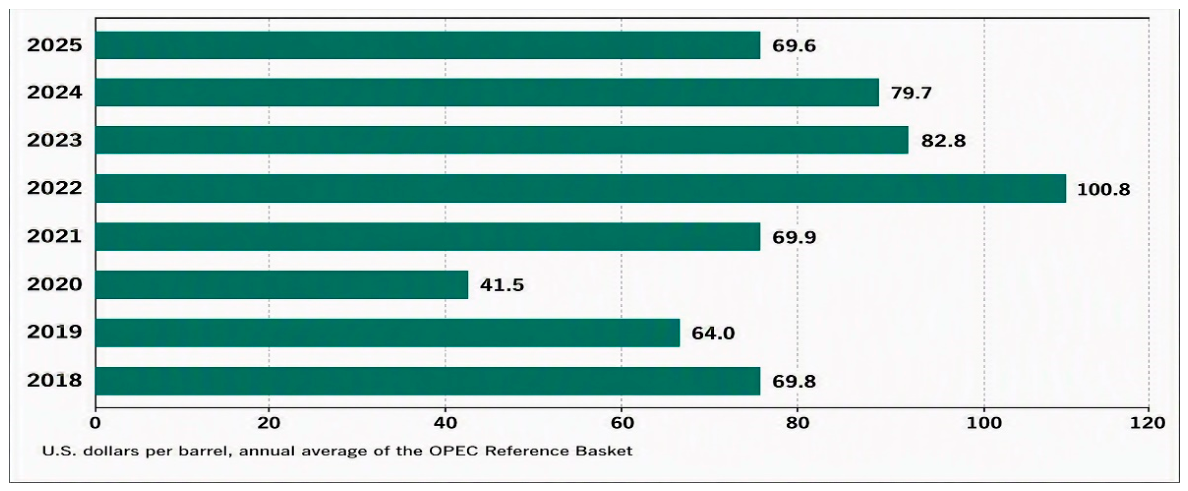
Figure 2.
Identification, screening, and inclusion of studies (PRISMA 2020).
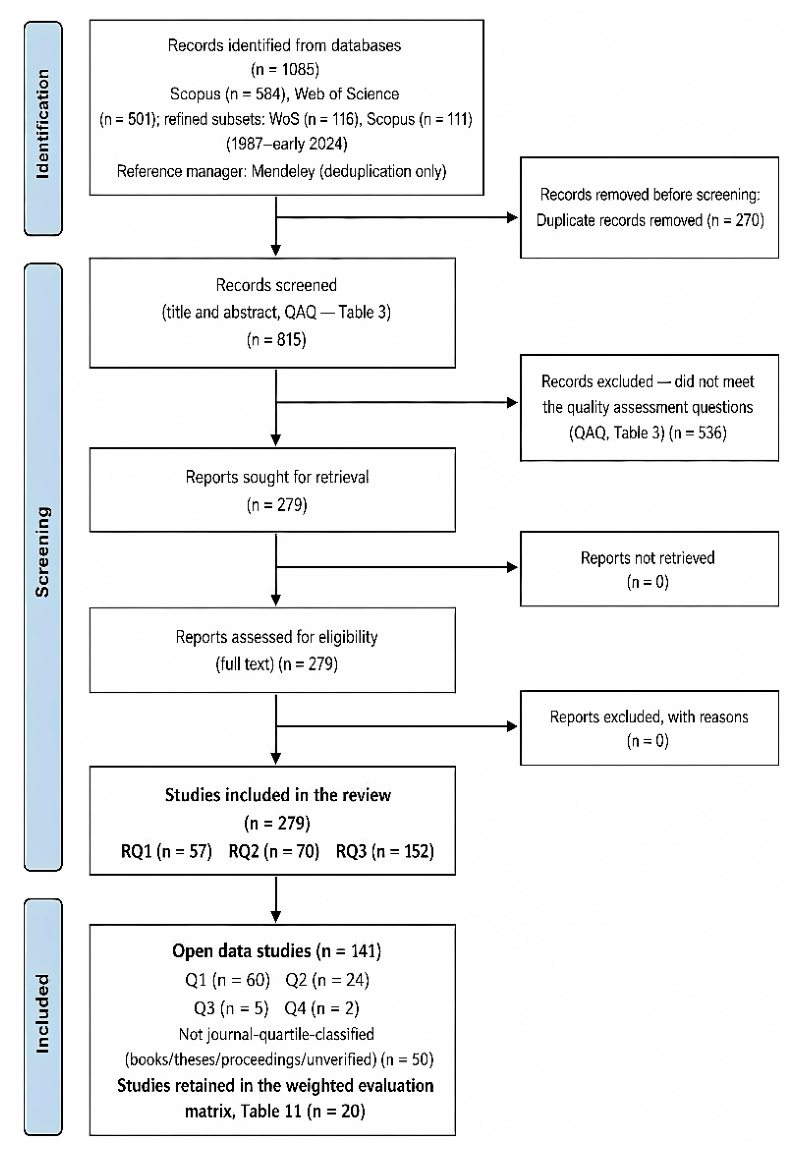
Figure 3.
Analysis of the work of study in SLR (RQs).
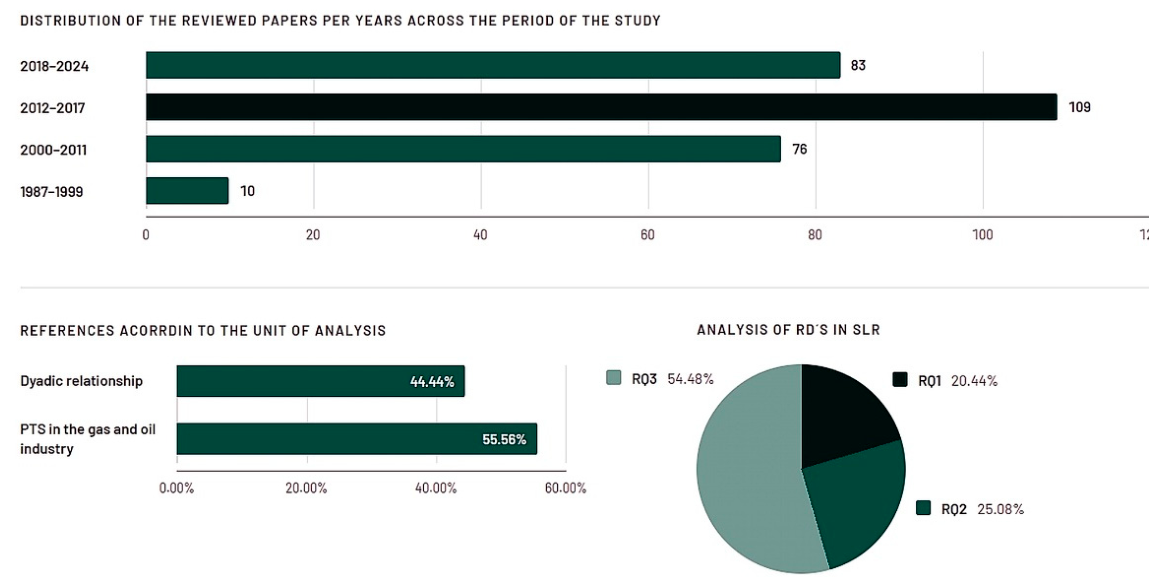
Figure 4.
Types of corrosion, C (Corrosion); SC (Sweet corrosion – CO2); AC (Acid corrosion – H2S); CO (Corrosion to oxygen - O2); MIC (Microbiological corrosion - MIC); Gac (Galvanic corrosion), Based on: [2,6].
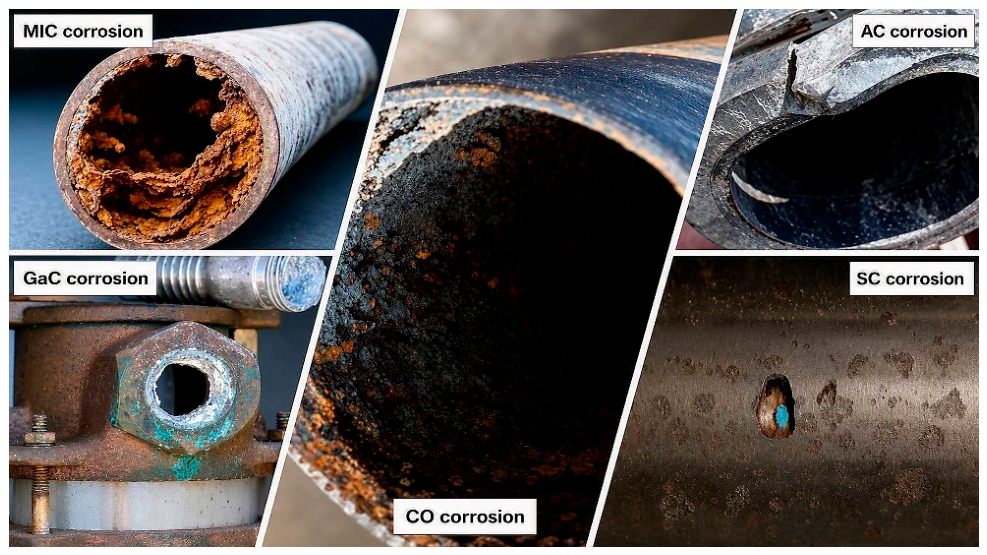
Figure 5.
Corrosion processes in pipelines of the gas and oil industry (RQ1). C (Corrosion); SC (Sweet corrosion – CO2); AC (Acid corrosion – H2S); CO (Corrosion to oxygen - O2); MIC (Microbiological corrosion - MIC); GaC (Galvanic corrosion).
Figure 5.
Corrosion processes in pipelines of the gas and oil industry (RQ1). C (Corrosion); SC (Sweet corrosion – CO2); AC (Acid corrosion – H2S); CO (Corrosion to oxygen - O2); MIC (Microbiological corrosion - MIC); GaC (Galvanic corrosion).
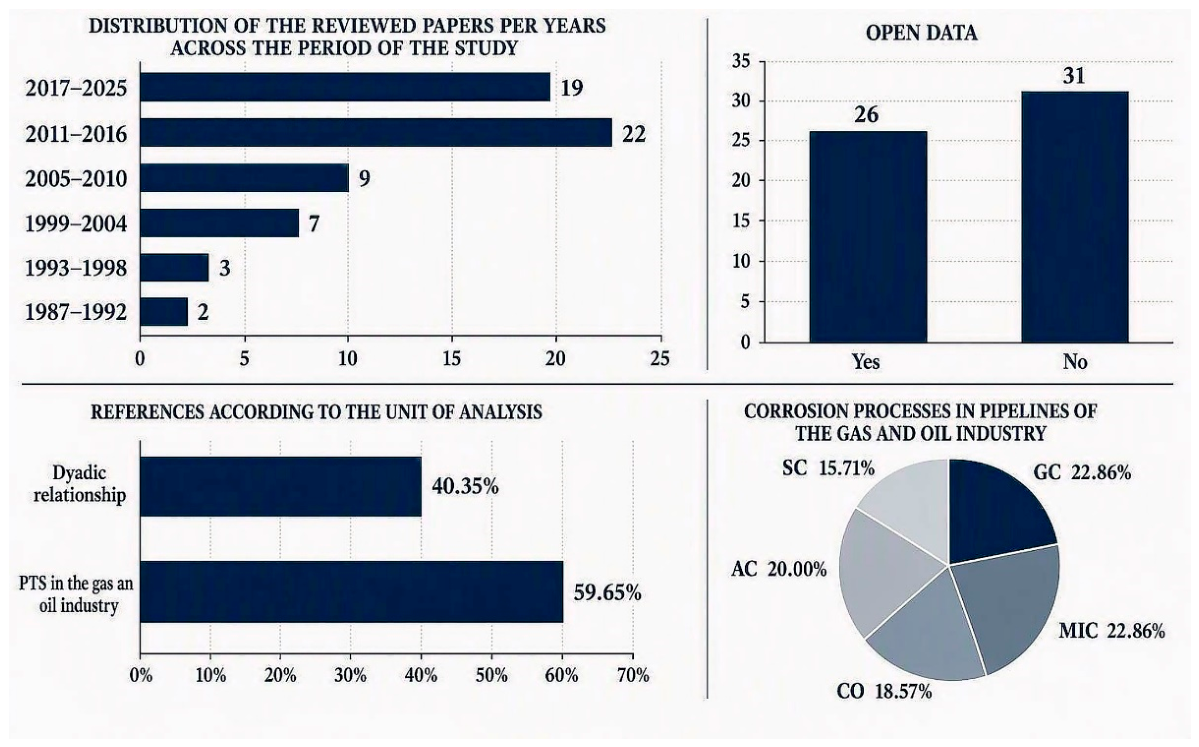
Figure 6.
Analysis of the work of study on microscopy (RQ2). CHR (Chromatography); ME (Metallography); SP (Spectroscopy); Other (Fluorescence Microscopy – Scanning tunneling microscopy – Others); Based on: [10,32,33].
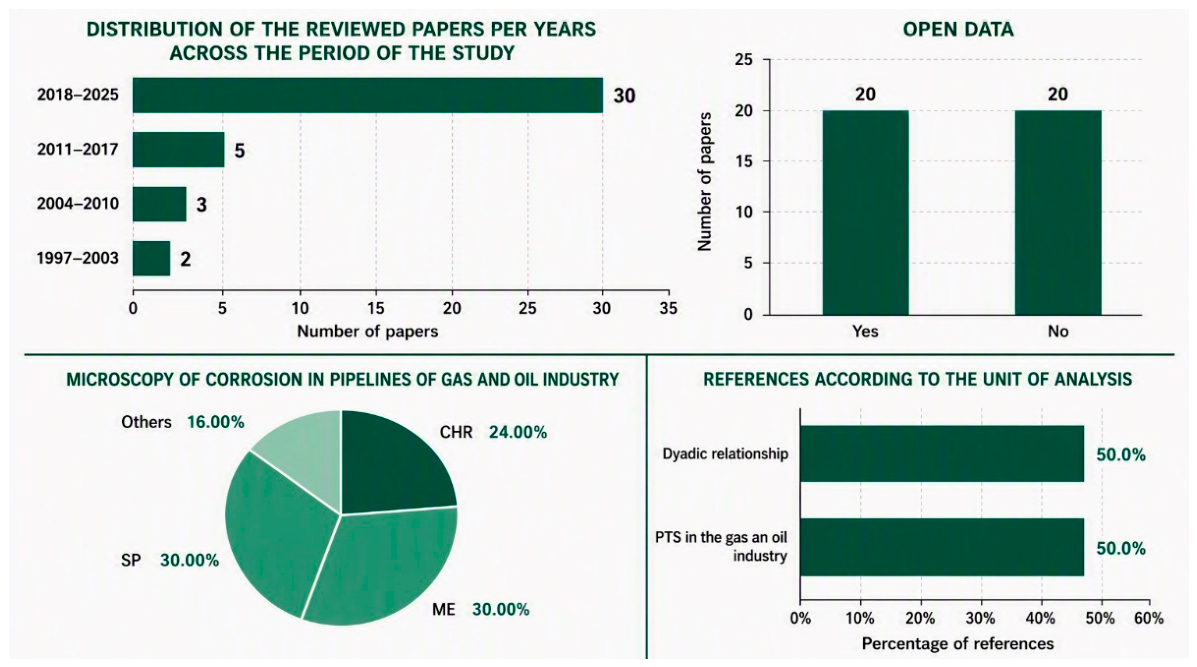
Figure 7.
Image processing of corrosion in pipelines of gas and oil industry. GC (Grayscale); BI (Binary Image or Ultrasonic Inspection); IED (Image with Edges Detected or Image with Outlines).
Figure 7.
Image processing of corrosion in pipelines of gas and oil industry. GC (Grayscale); BI (Binary Image or Ultrasonic Inspection); IED (Image with Edges Detected or Image with Outlines).
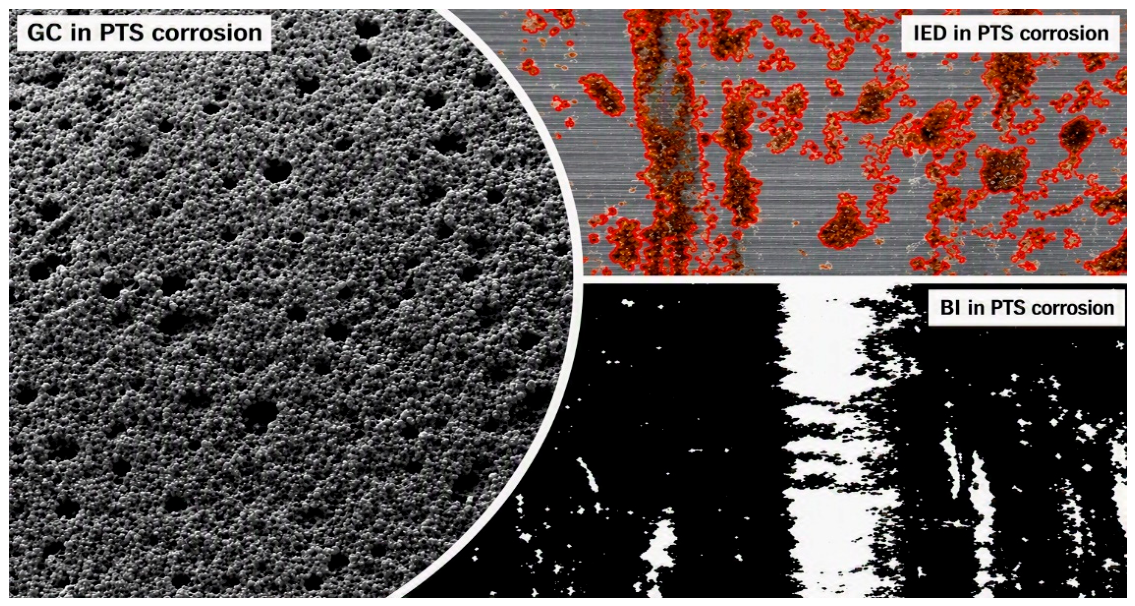
Figure 8.
Analysis of the work of study on image processing (RQ2). GC(Grayscale); BI (Binary Image or Ultrasonic Inspection); IED (Image with Edges Detected or Image with Outlines); Based on: [48,49].
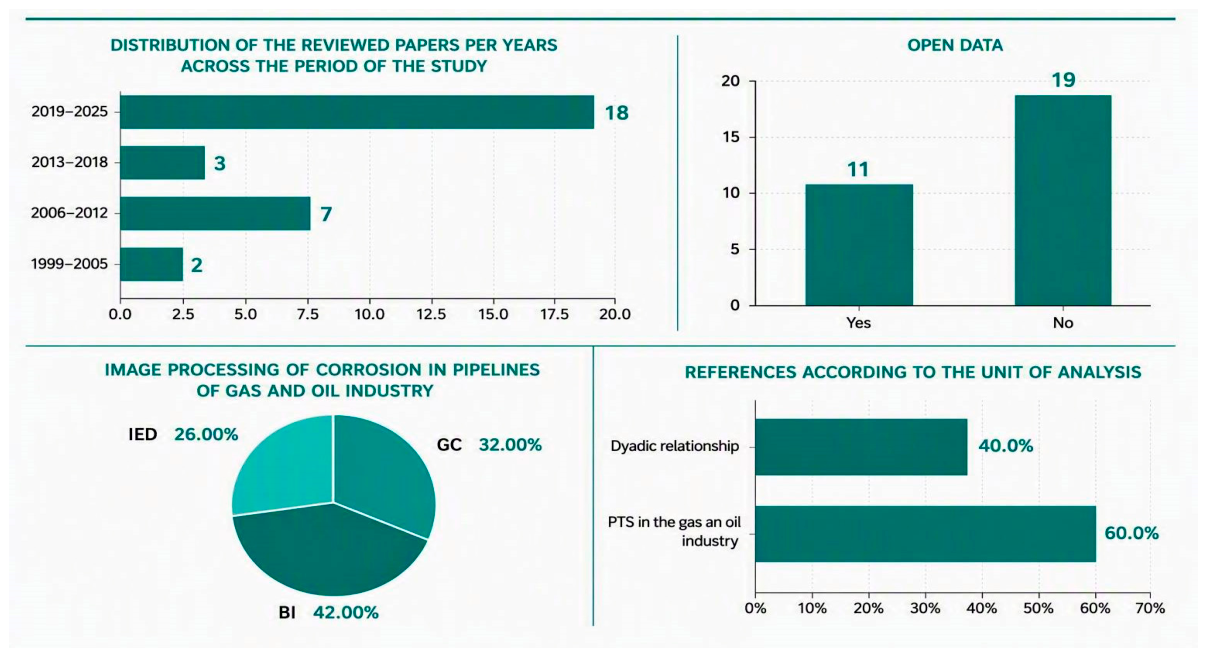
Figure 9.
Image processing of corrosion in pipelines of gas and oil industry.
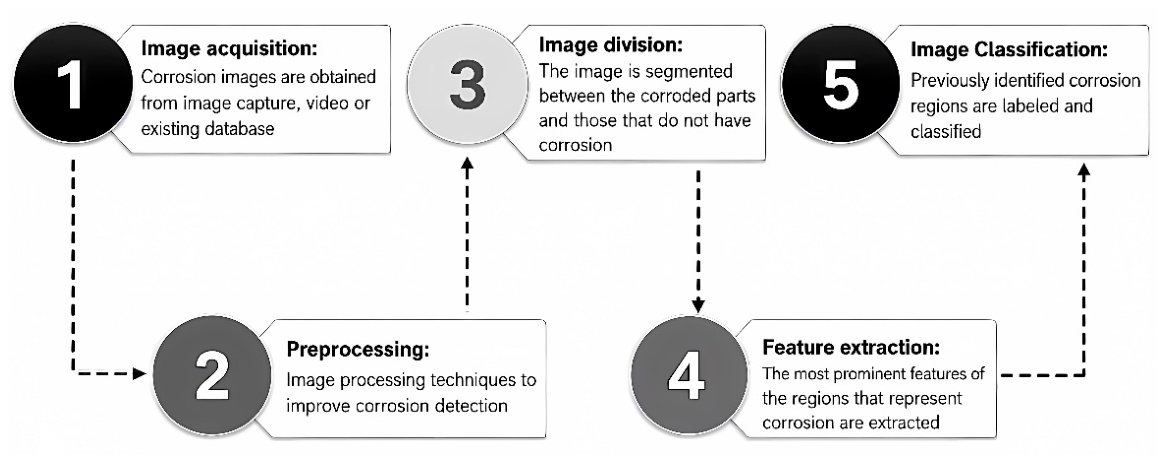
Figure 10.
Corrosion detection process through images.
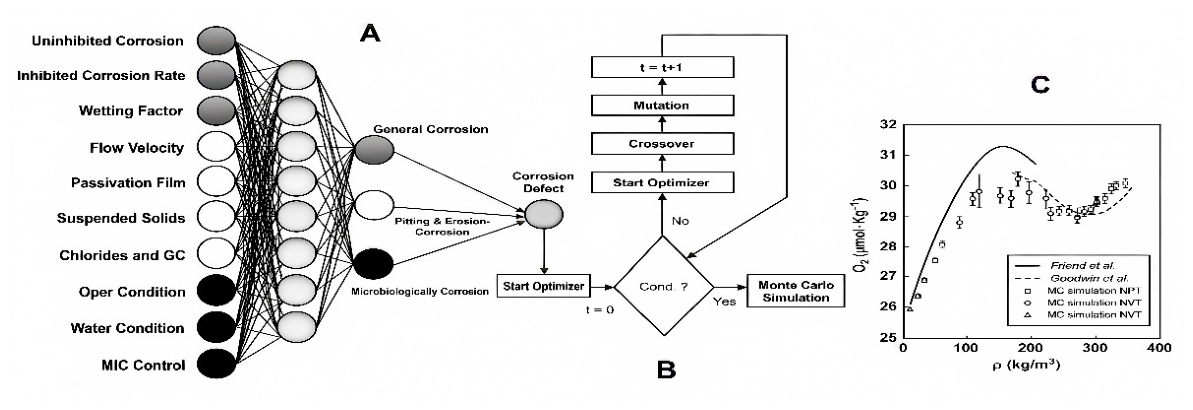
Figure 11.
Analysis of the work of study on artificial intelligence techniques (RQ3). ANN (Artificial Neural Network); FL (Fuzzy Logic); BN (Bayesian network); AG (Genetic algorithm); MCS (Monte Carlo Simulation); Based on: [16,58,59,60,61].
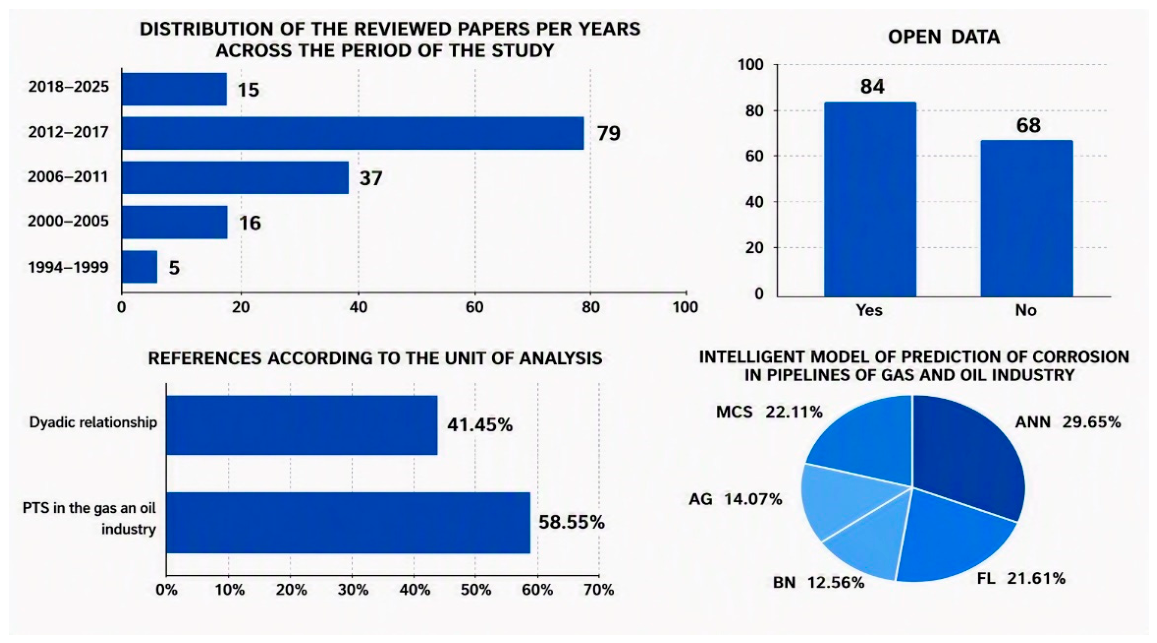
Figure 12.
Time Relationship of: Corrosion, Image Processing, AI, and Microscopy.
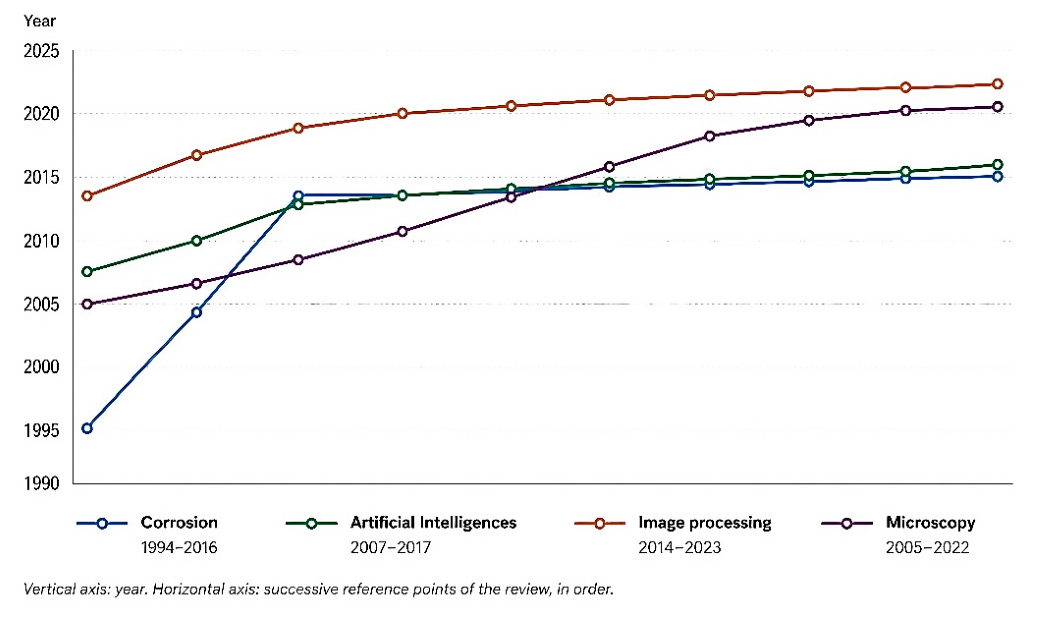
Table 1.
Based on ref. [4] Order of importance of means of transport.
Table 1.
Based on ref. [4] Order of importance of means of transport.
|
Speed (Delivery time) |
Reliability (Delivery on time) |
Capacity (Diversity of products) |
Availability (Geographical diversity) |
Cost (Ton-Mile) |
Total | |
| Railway | 3 | 4 | 2 | 2 | 3 | 14 |
| Ship | 4 | 5 | 1 | 4 | 1 | 15 |
| Truck | 2 | 2 | 3 | 1 | 4 | 12 |
| PTS | 5 | 1 | 5 | 5 | 2 | 18 |
| Airplane | 1 | 3 | 4 | 3 | 5 | 16 |
Table 2.
Investigation questions.
| ID | Question |
| RQ1 | What types of corrosion have the greatest impact on PTS? |
| RQ2 | How were microscopic analysis and image processing used to analyze corrosion in PTS? |
| RQ3 | What is the impact of using artificial intelligence when diagnosing corrosion behavior in PTS? |
Table 5.
CORROSION PROCESSES IN PIPES OF THE GAS AND OIL INDUSTRY.
| C issue | Type | SC | AC | CO | MIC | GaC | No. | OD |
Dyadic relationship |
PTS in the oil industry |
| 52.– Electrochemical corrosion behaviors of the X90 linepipe steel in NS4 solution | A | ● | 1 | ✓ | [87] | |||||
| 53.– Experiments for Sand Erosion Model Improvement for Elbows in Gas Production, Low-Liquid Loading and Annular Flow Conditions | A | ● | 1 | [88] | ||||||
| 54.– Sensores electroquímicos para determinar velocidad de corrosión in situ en agua acompañante del petróleo | A | ● | 1 | [89] | ||||||
| 55.– Corrosion in Oil and Gas Production | A | ● | ● | ● | ● | ● | 5 | ✓ | [26] | |
| 56.– Análisis comparativo de recubrimientos duros de DLC y TiSiCN frente al desgaste y a la corrosión | A | ● | 1 | [90] | ||||||
| 57.– Síntese de derivados isatínnicos como potenciais inibidores de corrosão do aco-carbono para aplicacão na indútria de petróleo e gãs | B | ● | 1 | [27] | ||||||
| Total (57) | 32 | 32 | 26 | 28 | 22 | 140 | 26 | 23 | 34 |
Note: PTS (Pipeline Transport System); C (Corrosion); SC (Sweet corrosion – CO2); AC (Acid corrosion – H2S); CO (Corrosion to oxygen - O2); MIC (Microbiological corrosion - MIC); Gac (Galvanic corrosion); OD (Open Data); (Type: A (Article, Conference Proceedings) R (Review) B (Book, Thesis).
Table 6.
Microscopy processes in pipes of the gas and oil industry.
| C issue | Type | CHR | ME | SP | Others | No. | OD | Dyadic relationship | PTS in the oil industry |
| 37.– Black Pine (Pinus nigra) Essential Oil as a Green Corrosion Inhibitor for Carbon Steel | A | ● | 1 | [91] | |||||
| 38.– Effect of ginger extract as green inhibitor on chloride-induced corrosion of carbon steel in simulated concrete pore solutions | A | ● | ● | 2 | ✓ | [92] | |||
| 39.– Identification of Corrosion Mechanisms of Stainless Steel with Metallography Cross Sections | A | ● | 1 | [42] | |||||
| 40.– Metallographic Preparation of Stainless Steel | A | ● | 1 | [41] | |||||
| Total (40) | 12 | 15 | 15 | 8 | 50 | 20 | 20 | 20 |
Note: PTS (Pipeline Transport System); CHR (Chromatography); ME (Metallography); SP (Spectroscopy); Other (Fluorescence Microscopy – Scanning tunnelling microscopy – Others); (Type: A (Article, Conference Proceedings) R (Review) B (Book, Thesis).
Table 7.
Image processing of prediction of corrosion in pipelines of the gas and oil industry.
| C issue | Type | GC | BI | IED | No. | OD |
Dyadic relationship |
PTS in the oil industry |
| 25.– Pipe Thread Parameter Detection System Based on Machine Vision | A | ● | ● | ● | 3 | [93] | ||
| 26.– Metal pitting corrosion characterized by scanning acoustic microscopy and binary image processing | A | ● | ● | 2 | ✓ | [94] | ||
| 27.– Image Processing-Based Pitting Corrosion Detection Using Metaheuristic Optimized Multilevel Image Thresholding and Machine-Learning Approaches | A | ● | 1 | ✓ | [95] | |||
| 28.– Intelligent Evaluation of Marine Corrosion of Q420 Steel Based on Image Recognition Method | A | ● | 1 | ✓ | [96] | |||
| 29.– Investigation of Corrosion Intensity on Metal Structures Using Image Processing Algorithms | A | ● | ● | 2 | [97] | |||
| 30.– Image identification technology of corrosion in hydraulic steel structure | A | ● | ● | 2 | ✓ | [98] | ||
| Total (30) | 16 | 21 | 13 | 50 | 11 | 18 | 12 |
Note: PTS (Pipeline Transport System); GC (Grayscale); BI (Binary Image or Ultasonic Inspection); IED (Image with Edges Detected or Image with Outlines); OD (Open Data); (Type: A (Article, Conference Proceedings) R (Review) B (Book, Thesis).
Table 8.
Image processing and ai for prediction of corrosion in pipelines of the gas and oil industry.
Table 8.
Image processing and ai for prediction of corrosion in pipelines of the gas and oil industry.
| C issue | Type | PP | IP | AI | C | No. | OD | Author(s) |
| 1.– Neuro-fuzzy approaches for pipeline condition assessment | A | ● | ● | ● | ● | 4 | ✓ | [13] |
| 2.– Computer Vision and Image Processing Approaches for Corrosion Detection | R | ● | ● | ● | ● | 4 | [48] | |
| 3.– Review-material degradation assessed by digital image processing: Fundamentals, progresses, and challenges | R | ● | ● | ● | ● | 4 | ✓ | [10] |
| 4.– Damage detection with image processing: a comparative study | A | ● | ● | ● | ● | 4 | ✓ | [99] |
| 5.– Corrosion Damage Assessment of AerMet100 Steel Based on Image Analysis | A | ● | ● | ● | ● | 4 | [57] | |
| 6.– Investigation of Corrosion Intensity on Metal Structures Using Image Processing Algorithms | A | ● | ● | ● | ● | 4 | [97] | |
| 7.– Sistema de identificación de corrosión mediante el uso de procesamiento de imágenes en los materiales empleados en una Cortadora de Corte de aceros y metales no ferrosos por medio de láser de fibra óptica. | B | ● | ● | ● | ● | 4 | [8] | |
| 8.– Study on image identification method of in-service pipeline corrosion fault | A | ● | ● | ● | ● | 4 | [100] | |
| 9.– An Estimation Method of Defect Size from MFL Image Using Visual Transformation Convolutional Neural Network | A | ● | ● | ● | 3 | ✓ | [101] | |
| 10.– Morphological analysis and classification of types of surface corrosion damage by digital image processing | A | ● | ● | ● | 3 | ✓ | [49] | |
| 11.– Metal pitting corrosion characterized by scanning acoustic microscopy and binary image processing | A | ● | ● | ● | 3 | ✓ | [94] |
Note: OD (Open Data); PP (Pre-Processing); IP (Image Processing); AI (Artificial Intelligence); C (Corrosion); Type: A (Article, Conference Proceedings) R (Review) B (Book, Thesis).
Table 9.
Intelligent models of prediction of corrosion in pipelines of the gas and oil industry.
| C issue | Type | ANN | FL | BN | AG | MCS | No. | OD |
Dyadic relationship |
PTS in the oil industry |
| 148.– Comparison of methods of failure probability of oil and gas transmission pipeline with defects | A | ● | 1 | [82] | ||||||
| 149.– A risk-based approach to maintenance planning utilizing in-line inspection data | A | ● | 1 | [102] | ||||||
| 150.– Quantitative and Probabilistic approach for Underground Pipeline management Optimization | B | ● | 1 | ✓ | [103] | |||||
| 151.– Estimation of failure probability of oil and gas pipeline with defects by Monte-Carlo simulation | A | ● | 1 | [104] | ||||||
| 152.– A probabilistic approach for eol fracture analysis of subsea pipelines | A | ● | 1 | [105] | ||||||
| Total (152) | 59 | 43 | 25 | 28 | 44 | 199 | 84 | 63 | 89 |
Note: PTS (Pipeline Transport System); C (Corrosion); ANN (Artificial Neural Network); FL (Fuzzy Logic); BN (Bayesian network); AG (Genetic algorithm); MCS (Monte Carlo Simulation); OD (Open Data) (Type: A (Article, Conference Proceedings) R (Review) B (Book, Thesis).
Table 10.
Ann sub classification.
| C issue | Type | CNN | DNC | GAN | No. | OD | Author(s) |
| 55.– Pipeline defects diagnosis based on feature extraction and neural-network fusion | A | ● | 1 | ✓ | [69] | ||
| 56.– An Estimation Method of Defect Size from MFL Image Using Visual Transformation Convolutional Neural Network | A | ● | 1 | ✓ | [101] | ||
| 57.– CO2 corrosion of carbon steel - from mechanistic to empirical modelling | R | ● | 1 | [11] | |||
| 58.– Decision support system to evaluate a vandalized and deteriorated oil pipeline transportation system using artificial intelligence techniques. Part 1: modeling | A | ● | 1 | [106] | |||
| 59.– Study of electrochemical corrosion on Q235A steel under stray current excitation using combined analysis by electrochemical impedance spectroscopy and artificial neural network | A | ● | 1 | ✓ | [70] | ||
| Total | 3 | 21 | 52 | 77 | 32 | 58 |
Note: OD (Open Data); ANN (Artificial Neural Network); CNN (Convolutional Neural Networks); DNC (Differentiable Memory Neural Networks); GAN (Generative Adversarial Networks and Others); Type: A (Article, Conference Proceedings) R (Review) B (Book, Thesis).
Table 11.
Weighting of the analyzed works.
| C issue | Type | SC | AC | CO | MIC | GC | ANN | FL | BN | AG | SMC | GC | BI | IED | CHR | ME | SP | No. | Author |
| 1.– Corrosion in the Oil Industry | R | ● | ● | ● | ● | ● | 5 | [107] | |||||||||||
| 2.– Corrosion problems during oil and gas production and its mitigation | R | ● | ● | ● | ● | ● | 5 | [2] | |||||||||||
| 3.– Corrosion Control in the Oil and Gas Industry | B | ● | ● | ● | ● | ● | 5 | [1] | |||||||||||
| 4.– Emergence of nanotechnology in the oil and gas industry: Emphasis on the application of silica nanoparticles | A | ● | ● | ● | ● | ● | ● | ● | 7 | [108] | |||||||||
| 5.– Essentials of Coating, Painting, and Lining for the Oil, Gas and Petrochemical Industries | B | ● | ● | ● | ● | ● | ● | 6 | [109] | ||||||||||
| 6.– Neuro-fuzzy approaches for pipeline condition assessment | A | ● | ● | ● | ● | ● | ● | 6 | [13] | ||||||||||
| 7.– Assessing and optimization of pipeline system performance using intelligent systems | A | ● | ● | ● | ● | 4 | [65] | ||||||||||||
| 8.– Internal corrosion hazard assessment of oil & gas pipelines using Bayesian belief network model | A | ● | ● | ● | ● | ● | 5 | [16] | |||||||||||
| 9.– Use of Fuzzy Logic for Predicting Two Phase Inflow Performance Relationship of Horizontal Oil Wells | R | ● | ● | ● | 3 | [63] | |||||||||||||
| 10.– Artificial intelligent approaches in petroleum geosciences | A | ● | ● | ● | ● | ● | 5 | [64] | |||||||||||
| 11.– Computer Vision and Image Processing Approaches for Corrosion Detection | R | ● | ● | ● | ● | ● | ● | ● | ● | ● | ● | ● | ● | 12 | [48] | ||||
| 12.– Development of facile image processing techniques regarding crevice corrosion of U75V high-speed rail steel | A | ● | ● | ● | ● | ● | 5 | [9] | |||||||||||
| 13.– An algorithm to detect and identify defects of industrial pipes using image processing | A | ● | ● | ● | 3 | [55] | |||||||||||||
| 14.– Pipe Thread Parameter Detection System Based on Machine Vision | A | ● | ● | ● | 3 | [93] | |||||||||||||
| 15.– Review-material degradation assessed by digital image processing: Fundamentals, progresses, and challenges | R | ● | ● | ● | ● | ● | ● | ● | ● | ● | ● | 10 | [10] | ||||||
| 16.– Case Study: Prehistoric Art, in Raman Spectroscopy in Archaeology and Art History | R | ● | ● | ● | ● | ● | ● | 6 | [45] | ||||||||||
| 17.– Understanding the corrosion inhibitor partitioning in oil and gas pipelines | A | ● | ● | ● | ● | ● | ● | ● | 7 | [34] | |||||||||
| 18.– Failure analysis of one peculiar 'Yin-Yang' corrosion morphology on heat exchanger tubes in purified terephthalic acid (PTA) dryer | A | ● | ● | ● | ● | ● | ● | 6 | [33] | ||||||||||
| 19.– Mechanism of corrosion protection in chloride solution by an apple-based green inhibitor: experimental and theoretical studies | A | ● | ● | ● | ● | ● | ● | ● | 7 | [32] | |||||||||
| 20.– Effect of Sulfur Content in the Crude Oil to the Corrosion Behaviour of Internal Surface of API 5L X65 Petroleum Pipeline Steel | A | ● | ● | ● | ● | ● | ● | ● | 7 | [110] | |||||||||
| Intelligent systems to support determining generational corrosion behaviors based on metalographic and microscopy analysis – literature review | R | ● | ● | ● | ● | ● | ● | ● | ● | ● | ● | ● | ● | ● | ● | ● | ● | 16 | (Review presented) |
| No. | 17 | 13 | 15 | 13 | 13 | 7 | 5 | 2 | 7 | 2 | 9 | 8 | 6 | 4 | 2 | 10 |
Disclaimer/Publisher’s Note: The statements, opinions and data contained in all publications are solely those of the individual author(s) and contributor(s) and not of MDPI and/or the editor(s). MDPI and/or the editor(s) disclaim responsibility for any injury to people or property resulting from any ideas, methods, instructions or products referred to in the content. |
© 2026 by the authors. Licensee MDPI, Basel, Switzerland. This article is an open access article distributed under the terms and conditions of the Creative Commons Attribution (CC BY) license (http://creativecommons.org/licenses/by/4.0/).
Copyright: This open access article is published under a Creative Commons CC BY 4.0 license, which permit the free download, distribution, and reuse, provided that the author and preprint are cited in any reuse.