

Submitted:
23 September 2026
Posted:
24 September 2026
You are already at the latest version
Abstract
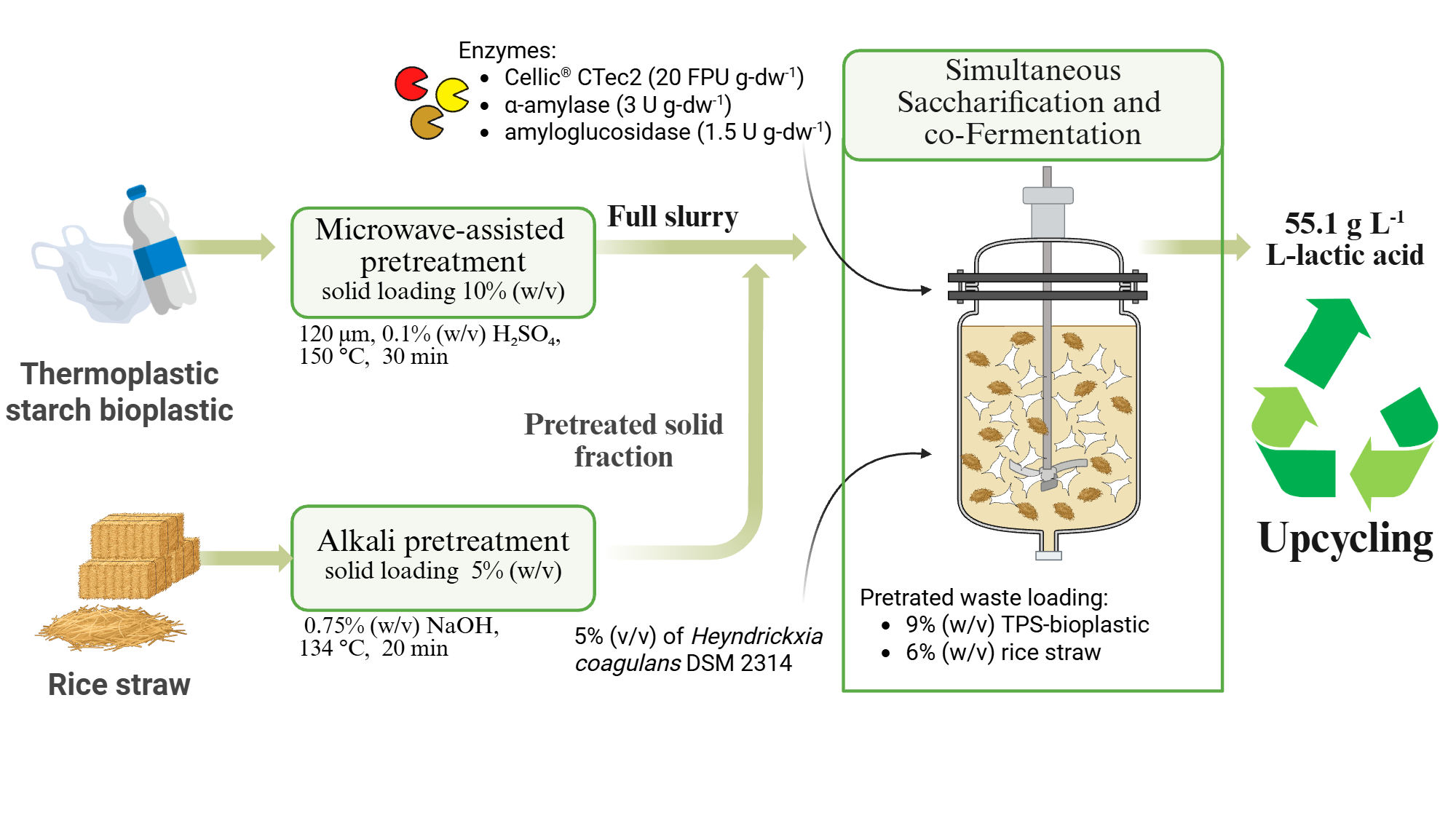
This study evaluates the feasibility of microbial upcycling of thermoplastic starch-based bioplastics (TPS-BP) by converting them into lactic acid (LA). To enhance the accessibility of the starch fraction within the bioplastic matrix, microwave-assisted pretreatments were optimized using a 24⁻1 fractional factorial design. Optimal pretreatment conditions were identified as 150 °C with 0.1% H2SO4 for 30 min, which enabled the release of 17.5 g L⁻¹ glucose within 24 h of saccharification. Among the evaluated strains, Heyndrickxia coagulans was identified as the superior producer at pH 6.0, achieving a maximum volumetric productivity of 8.25 g L⁻¹ h⁻¹ and a yield of 0.91 g g⁻¹. To enhance carbon availability and overcome the low starch content (≈20%) of commercial TPS-BP, a co-fermentation strategy with rice straw was implemented. While separate hydrolysis and fermentation (SHF) were limited by carbon catabolite repression, simultaneous saccharification and fermentation (SSF) intensified production. By utilizing TPS-BP pretreatment slurry as the liquid phase for rice straw saccharification, a final LA concentration of 55.1 ± 0.7 g L⁻¹ was achieved. This co-valorization strategy demonstrates a feasible route for integrating bioplastic waste into circular biorefineries while effectively mitigating the seasonal availability of agricultural residues.
Keywords:
Heyndrickxia coagulans
; lactic acid
; microbial upcycling
; microwave-assisted pretreatment
; rice straw
; simultaneous saccharification and fermentation
; thermoplastic starch-based bioplastic
1. Introduction
Global plastic production reached 430.9 million tons in 2024 [1] with packaging accounting for ~40% of the demand [2]. Around 90% of plastics are derived from fossil resources, and end-of-life treatments (landfill and incineration) intensify environmental impacts and contribute to uncontrolled pollution, particularly in marine ecosystems [1,3]. In response, the European Union is promoting a transition toward a circular plastics economy, aiming for all plastic packaging to be recyclable by 2030 and encouraging the use of renewable feedstocks [4]. In this context, the bioplastic market is expanding because it enables biotechnological recycling approaches as an alternative to conventional end-of-life routes [5,6]. Starch, a plant-based polymer composed of amylose and amylopectin, is a major compound of thermoplastic starch (TPS), the most biodegradable and one of the most commonly used bioplastics [6,7]. TPS is produced by mixing starch with 25-35% plasticizers through thermal processing and can be blended with biodegradable polymers to improve mechanical properties [8] yielding TPS-based bioplastic (TPS-BP) blends.
Biotechnological recycling includes approaches such as microbial upcycling, defined as the conversion of bioplastics into high-value chemicals through microorganisms. Despite its potential, the fermentative valorization of starch-based bioplastics requires pretreatment (mechanical, thermal, or chemical) to enhance microbial degradation [6]. Among these pretreatment methods, microwave-assisted pretreatment has emerged as a promising technique due to its rapid heat transfer, its reduced energy consumption [9], and its compatibility with dilute alkaline or acidic solutions that enhance polymer disruption and release fermentable compounds [10,11]. The use of liquefying (amylase) and saccharifying (amyloglucosidase) enzymes is additionally required to release metabolizable glucose prior to fermentation [12,13]. One of the most promising products of TPS-BP upcycling is lactic acid (LA). Among the two isomeric forms (L- and D-) of this acid, the L-form is particularly valued in food and medical applications [14]. Microbial pathways offer advantages over chemical synthesis, such as milder operating conditions, use of renewable residues, and the ability to obtain optically pure isomers [15]. LA-producing bacteria are primarily mesophilic species, such as Lacticaseibacillus and Levilactobacillus, which typically grow at 37-43 °C and pH 5.0-7.0 [16]. Thermophilic strains, such as Heyndrickxia coagulans (formerly Bacillus coagulans), are also of interest because they require fewer nutrients and can operate at high temperatures (50-55 °C), thereby reducing the need for sterilization and associated processing costs [17]. Despite the growing interest in microbial upcycling strategies, TPS-BP have been predominantly investigated under anaerobic digestion frameworks [18,19,20], whereas their conversion into high-value platform chemicals remains largely unexplored. The presence of plasticizers and other polymeric components within the TPS-BP structure reduces its starch content, thereby limiting the availability of fermentable sugars and potentially restricting the synthesis of bioproducts when used as a sole substrate. Therefore, the integration of additional carbon sources should be explored to enhance process performance.
In this context, lignocellulosic biomass represents an abundant and readily available alternative feedstock for LA production. These materials, mainly composed of cellulose (35-50%), hemicellulose (25-40%) and lignin (10-25%) [21], also require pretreatment and saccharification steps due to their recalcitrant structure. Similarly, both starch-based and lignocellulosic substrates rely on enzymatic hydrolysis to release fermentable sugars prior to fermentation. Conventionally, saccharification and fermentation are performed separately. However, sugar accumulation can inhibit enzymatic activity and increase processing time, leading to the development of simultaneous saccharification and fermentation (SSF) processes [22]. SSF has recently been applied to starch-rich and lignocellulosic wastes, often employing H. coagulans to overcome the optimum temperature difference in both stages [12,23,24]. When combined with a co-substrate strategy, in which different raw materials are processed simultaneously, overall process performance can be enhanced [25].
The scope of this work was to evaluate the feasibility of microbial upcycling of TPS-BP via LA fermentation. First, two microwave-assisted chemical pretreatments and two bacterial strains were compared to enhance TPS-BP saccharification and LA production, respectively. Based on these results, the separate hydrolysis and fermentation (SHF) process was applied to pretreated TPS-BP alone as well as to its co-fermentation with rice straw as a lignocellulosic co-substrate. In a subsequent stage, co-fermentation was further evaluated under simultaneous saccharification and fermentation (SSF) conditions to overcome the limitations associated with low sugar availability and process inefficiencies, and to provide an integrated strategy for enhancing LA production from bioplastic waste.
2. Materials and Methods
2.1. Materials
Micronized commercial TPS-BP (Mater-Bi® EF04P) was provided at two particle sizes (120 and 500 μm) by the Plastics Technology Institute (AIMPLAS, Spain). Rice straw was provided by local farmers of the Albufera Natural Park (Spain) and was dried, milled (100-500 μm) and stored according to Valles et al. [26]. The starch content of TPS-BP and the cellulose and hemicellulose content of rice straw were determined by acid hydrolysis according to the procedure reported by the National Renewable Energy Laboratory [27], In brief, the carbohydrate composition was determined by a two-step acid hydrolysis to fractionate the material and quantify the resulting sugar monomers, which were subsequently converted to their corresponding polysaccharide equivalents using the anhydrous correction factors (0.90 for cellulose/starch and 0.88 for hemicellulose). The enzymes α-amylase (360 U mL-1) from Aspergillus oryzae and amyloglucosidase (260 U mL-1) from A. niger were purchased from Sigma-Aldrich (USA). The cellulase-based enzyme blend Cellic® CTec2 (119 FPU mL-1) was purchased from Novonesis (Denmark).
2.2. Pretreatment and Enzymatic Saccharification
Two microwave-assisted chemical pretreatments (alkali and acid) were compared for TPS-BP processing using a Multiwave GO Plus digestion system (Anton Paar, Spain). The microwave operated at a frequency of 2455 MHz (maximum power of 1000 W), using a heating ramp of 13 °C min⁻¹. It was equipped with the rotor 12HVT50 (Anton Paar, Spain) and has capacity for 12 PTFE-TFM 50-mL vessels. TPS-BP was pretreated at a solid loading of 10% (w/v). The pretreatment conditions were defined based on a 2⁴⁻¹ fractional factorial design summarized in Table 1 (resolution IV, 8 experimental runs), in which reagent loading (NaOH and H2SO4; 0.1-0.3% w/v), particle size of TPS-BP (120-500 μm), reaction temperature (90–150 °C), and reaction time (15-30 min) were evaluated as independent variables. The concentration of glucose released after 48 h of the subsequent enzymatic saccharification step was selected as the response variable. The experimental design and statistical analyses were performed using Origin Pro v.2023b software (OriginLab Corporation, USA). Afterwards, the pH of the pretreatment slurry was adjusted to 6.0 and stored at -20 °C. Structural changes of selected samples were observed by Fourier Transform Infrared Spectroscopy (FT-IR) and Scanning electron microscope (SEM) analysis. In the case of rice straw, it was pretreated at a solid loading of 5% (w/v) with NaOH (0.75% w/v) and subjected to 134 °C for 20 min in an autoclave (MED20, J.P. Selecta, Spain) as previously described elsewhere [28]. The solid fraction was recovered by centrifugation at 2934 g for 6 min (Mega Star 3.0, VWR, Germany) and washed to pH 6.5 with deionized water. Pretreated rice straw was dried and then stored at -20 °C.
Enzymatic saccharification assays were conducted in a G-25 orbital shaker (New Brunswick Scientific, USA). These assays were performed at 50 °C and 150 rpm for 48 h using 1-L conical flasks. Slurry derived from TPS-BP pretreatment was hydrolyzed at pH 5.2 (16 mM acetate buffer) with amyloglucosidase and α-amylase loadings of 1.5 and 3.0 U g-dw-1, respectively. Pretreated rice straw was hydrolyzed at pH 5.5 (50 mM acetate buffer) by using Cellic® CTec2 with a loading of 15 FPU g-dw-1 at two different solid loadings: 8% (w/v) when fermenting as the sole substrate or 12% (w/v) when co-fermenting with TPS-BP. The higher loading in the co-fermentation was selected to start at a similar glucose:xylose concentration as fermenting rice straw alone and thus compensates the lower sugar content of TPS-BP. All hydrolysates were centrifuged at 2934 g for 6 min, filtered through 1.2 μm and stored at 4 °C. Hydrolysates were sterilized at 121 °C for 10 min before fermentation. For the co-fermentation, the TPS-BP and rice straw hydrolysates mixture was established at a volumetric ratio of 1:1.5.
2.3. Microorganisms and Inoculum Preparation
The homofermentative LA bacterial strains L. rhamnosus CECT 288 and H. coagulans DSM 2314 were supplied by the Spanish Collection of Type Cultures (CECT, Spain) and the German Collection of Microorganisms and Cell Cultures (DSMZ, Germany), respectively. Both strains were stored at -80 °C in their appropriate medium with 20% (v/v) glycerol. Cryopreservation of L. rhamnosus was carried out using MRS medium, consisted of 10 g L-1 peptone, 10 g L-1 beef extract, 5 g L-1 yeast extract, 20 g L-1 glucose, 2 g L-1 triammonium citrate, 5 g L-1 sodium acetate, 0.2 g L-1 MgSO4·7H2O, 0.05 g L-1 MnSO4·H2O and 2 g L-1 K2HPO4. In the case of H. coagulans, the DSMZ medium 1 was used, consisting of 5 g L-1 peptone and 3 g L-1 meat extract.
Inoculum of L. rhamnosus was prepared in 50-mL serum bottles containing 40 mL of MRS medium flushed with pure nitrogen to ensure anaerobic conditions. Before fermentation, bottles were statically incubated at 42 °C for 24 h. H. coagulans was cultured aerobically at 50 °C and 150 rpm for 24 h using 100-mL conical flasks with 20 mL of modified MRS medium consisting of 20 g L-1 yeast extract, 0.2 g L-1 triammonium citrate, 0.5 g L-1 sodium acetate, 0.02 g L-1 NaCl, 0.2 g L-1 MgSO4·7H2O, 0.05 g L-1 MnSO4·H2O and 2 g L-1 K2HPO4. All media were sterilized at 121 °C for 20 min in an autoclave.
2.4. Fermentation
2.4.1. Experimental Set-Up and Operational Conditions
Fermentations were carried out in a 1-L stirred tank reactor (STR) with a working volume of 700 mL. In the experiments with L. rhamnosus, MRS medium was employed with different amounts of glucose. For H. coagulans, modified MRS medium was used. Each bioreactor and media were autoclaved (121 °C for 10 min) before inoculation with 5% (v/v) of actively growing cells. Prior to inoculating L. rhamnosus, the medium was sparged with nitrogen to remove dissolved oxygen. Fermentations were carried out at 42 °C for L. rhamnosus and 50 °C for H. coagulans, at 120 rpm for a maximum of 51 h. The pH was controlled by a Tris-compatible flat pH sensor and LoggerPro software (Vernier, USA) to keep pH above the set point value by automatic addition of 10 M NaOH.
2.4.2. Strain Selection
A preliminary comparison was carried out to determine the most suitable strain (L. rhamnosus or H. coagulans) for L-LA production. Glucose was added at an initial concentration of 40-55 g L-1 as the sole carbon source. For each bacterial strain, the pH control throughout the fermentation was evaluated at three different values: 5.5 ± 0.1, 6.0 ± 0.1 and 6.5 ± 0.1. Based on these results, H. coagulans and a controlled pH of 6.0 ± 0.1 were selected for subsequent experiments.
2.4.3. Fermentation by SHF
TPS-BP and rice straw hydrolysates were fermented with the selected strain. A volume of 630 mL of each type of hydrolysate (single-substrate fermentation) or mixture of both (co-fermentation) was used. The hydrolysates were supplemented with the corresponding modified MRS medium components excluding for glucose, which was provided by the hydrolysate itself and inoculated to a final working volume of 700 mL. Single-substrate fermentation was carried out with a yeast extract concentration of 20 g L-1. In the co-substrate fermentation, four different yeast extract concentrations (20, 10, 5 and 1 g L-1) were tested to assess the potential for reducing yeast extract requirements, thereby reducing associated costs. From these results, yeast extract concentration was established at 5 g L-1 for evaluating the SSF configuration. All experiments were conducted in duplicate.
2.4.4. Co-Substrate Fermentation by SSF
In this configuration, pretreated TPS-BP and rice straw were simultaneously co-hydrolyzed and co-fermented in the same reactor with the selected strain. Pretreated rice straw was mixed with 630 mL of slurry derived from TPS-BP pretreatment to achieve a final solid loading of 9% (w/v) for TPS-BP and 6% (w/v) for rice straw. The mixture was supplemented with modified MRS medium and subsequently inoculated at a final working volume of 700 mL. For TPS-BP hydrolysis, enzymes were added at loadings of 1.5 U g-dw-1 for amyloglucosidase and 3 U g-dw-1 for α-amylase; whereas rice straw saccharification was carried out with 20 FPU g-dw-1 of Cellic® CTec2. Experiments were carried out in duplicate.
2.5. Analytical Methods
Carbohydrate composition of the two wastes was determined by analyzing released sugars (glucose, xylose, arabinose, maltose and cellobiose) after acid hydrolysis. Performance of the pretreatment was evaluated by analyzing released sugars in 1.5-mL samples collected during enzymatic saccharification. Fermentation was monitored by analyzing sugars, organic acids and alcohols (LA, acetic acid, 2,3-butanediol [2,3-BDO], ethanol, glycerol) and potential inhibitory compounds (levulinic acid, furfural and 5-hydroxymethylfurfural [5-HMF]) from 1-mL samples withdrawn periodically. Samples were centrifuged (6,800 g for 5 min) and filtered through 0.22 μm before analysis. The concentration of analytes was determined by high performance liquid chromatography (Agilent HPLC 1100 Series, Agilent Technologies, USA) equipped with an Aminex® HPX-87H column (300 mm × 7.8 mm, Bio-Rad Laboratories Inc., USA) with a refractive index detector and diode array detector. The column was operated at 50 °C using 1.6 mM H2SO4 as mobile phase at a flow rate of 0.6 mL min-1. Quantification was performed using external calibration curves prepared from commercially available analytical standards. The stereospecificity of LA was determined by HPLC using the column Chirex 3126 (150 mm x 4.6 mm, Phenomenex Inc., USA) at 25°C and a diode array detector at 254 nm. The mobile phase was 1 mM Copper (II) sulfate at a flow rate of 1 mL min-1. An L-lactic acid standard and a racemic D/L-lactic acid standard were used to identify the retention times of the individual enantiomers and confirm peak assignment.
FT-IR analyses were carried out to determine the TPS-BP structure and to identify chemical changes after pretreatment. The analyses were performed using an ATR-FT-IR spectrometer (ATR Agilent Cary 630 FTIR spectrometer, Agilent, USA) over the range of 650–4000 cm-1 with spectral resolution of 4 cm-1. SEM S-4800 (Hitachi, Japan) was used to examine surface morphology of TPS-BP before and after pretreatment. Samples were coated with Au/Pd by sputtering before analysis at an accelerating voltage of 10 kV.
3. Results and Discussion
3.1. Microwave-Assisted Pretreatment of TPS-BP
The effects of reagent loading (X1), particle size (X2), temperature (X3), and reaction time (X4) on the alkali and acid microwave-assisted pretreatments of TPS-BP were evaluated by using a 24-1 fractional factorial design for each reagent, with the concentration of glucose released after enzymatic hydrolysis as the response variable. Table 1 summarizes the glucose concentrations after 24 and 48 h of saccharification for both chemical reagents (NaOH and H₂SO₄) used in the pretreatment step. ANOVA analysis (Table S1) revealed that temperature was the only statistically significant factor (p<0.05) under both alkaline and acidic pretreatments, whereas reagent loading, particle size, and reaction time showed no statistically significant effects within the studied ranges. For both pretreatments, the best results were consistently obtained at 150 °C. In the case of the alkaline pretreatment, the highest glucose concentration (17.6 g L⁻¹ after 48 h of saccharification, Run 6) was achieved using the highest chemical dose (0.3% w/v), the shortest reaction time (15 min), and the smallest particle size (120 µm). Slightly higher glucose concentrations were obtained with the acid pretreatment, with a maximum of 18.0 g L⁻¹ of glucose (Run 5) after 48 h of enzymatic saccharification when the pretreatment was performed with the lowest chemical dose (0.1% w/v), the longest reaction time (30 min), and the smallest particle size (120 µm). Notably, under these conditions, 17.5 g L⁻¹ of glucose was already released after 24 h, which is comparable to the maximum glucose concentration obtained after 48 h for the alkaline pretreatment. Overall, the acid pretreatment showed superior performance not only in terms of final glucose concentration but also regarding the rate of glucose release. Therefore, microwave-assisted pretreatment using 0.1% (w/v) H₂SO₄ at 150 °C for 30 min was selected for subsequent experiments, using TPS-BP with a particle size of 120 µm and a solid loading of 10% (w/v). SEM images further confirmed the structural modifications induced by the microwave-assisted pretreatments (see Supplementary Materials, Figure S1). The untreated TPS-BP exhibited a compact and relatively smooth surface (Figure S1a). After NaOH pretreatment, the material showed a rougher morphology with the appearance of cracks and localized cavities (Figure S1b), suggesting partial disruption of the bioplastic structure. In contrast, H₂SO₄ pretreatment generated a highly porous surface with numerous cavities distributed throughout the material (Figure S1c), indicating a more extensive structural alteration.

Table 1.
24-1 fractional factorial design matrix related to the NaOH pretreatments and H2SO4 pretreatments of 10% (w/v) TPS-BP along with the values of released glucose (g L-1) at 24 and 48 h of enzymatic hydrolysis.
Table 1.
24-1 fractional factorial design matrix related to the NaOH pretreatments and H2SO4 pretreatments of 10% (w/v) TPS-BP along with the values of released glucose (g L-1) at 24 and 48 h of enzymatic hydrolysis.
| With NaOH | |||||||
| Run | Real values1 | ||||||
| X1 | X2 | X3 | X4 | Glucose (g L-1) | |||
| 24 h | 48 h | ||||||
| 1 | 0.1 | 120 | 90 | 15 | 7.0 | 8.5 | |
| 2 | 0.3 | 120 | 90 | 30 | 12.3 | 12.6 | |
| 3 | 0.1 | 500 | 90 | 30 | 3.7 | 4.5 | |
| 4 | 0.3 | 500 | 90 | 15 | 9.5 | 10.3 | |
| 5 | 0.1 | 120 | 150 | 30 | 16.4 | 17.1 | |
| 6 | 0.3 | 120 | 150 | 15 | 17.0 | 17.6 | |
| 7 | 0.1 | 500 | 150 | 15 | 15.0 | 15.4 | |
| 8 | 0.3 | 500 | 150 | 30 | 16.2 | 16.9 | |
| With H2SO4 | |||||||
| Run | Real values1 | ||||||
| X1 | X2 | X3 | X4 | Glucose (g L-1) | |||
| 24 h | 48 h | ||||||
| 1 | 0.1 | 120 | 90 | 15 | 7.9 | 9.3 | |
| 2 | 0.3 | 120 | 90 | 30 | 9.1 | 9.7 | |
| 3 | 0.1 | 500 | 90 | 30 | 4.4 | 5.3 | |
| 4 | 0.3 | 500 | 90 | 15 | 5.8 | 6.8 | |
| 5 | 0.1 | 120 | 150 | 30 | 17.5 | 18.0 | |
| 6 | 0.3 | 120 | 150 | 15 | 14.1 | 14.8 | |
| 7 | 0.1 | 500 | 150 | 15 | 13.4 | 13.8 | |
| 8 | 0.3 | 500 | 150 | 30 | 14.0 | 14.1 | |
1 X1: reagent loading (% w/v); X2: particle size (µm); X3: temperature (°C); X4: time (min).
For the commercial TPS-BP used in this study (Mater-Bi® EF04P), glucose concentrations after pretreatment and enzymatic saccharification remained below 20 g L⁻¹ in all experiments. This limited sugar release was related to the low content of starch used on the formulation of these bioplastics. Carbohydrate characterization of commercial Mater-Bi® EF04P resulted in a starch content of 20.9 ± 3.5% (w/w) (Figure S2, Supplementary Materials). Similar TPS-BP formulations, such as Mater-Bi® NF803, contain around 20% starch, 70% poly(butylene adipate-co-terephthalate) (PBAT), and 10% additives, mainly plasticizers [29]. For the selected H2SO4 pretreatment (Run 5), the glucose digestibility was 77.5%. In addition to glucose, minor amounts of other sugars were detected after hydrolysis, including the monosaccharides xylose (0.76 g L⁻¹) and arabinose (0.27 g L⁻¹), as well as the disaccharide maltose (0.31 g L⁻¹). These secondary sugars suggest the presence of residual polysaccharides within the Mater-Bi® EF04P formulation. 5-HMF was detected at traces (<0.01 g L⁻¹), which are unlikely to exert inhibitory effects on subsequent fermentation. Moreover, the chemical hydrolysis of the biopolymer matrix generated a soluble derivative (accounting for approximately 9% of the total chromatographic area) that was found to be highly recalcitrant during subsequent fermentation assays. FT-IR spectroscopy indicated that Mater-Bi® EF04P (TPS-BP) consists of a blend of TPS and PBAT, with minor additive contributions, as evidenced by the broad O–H stretching band (~3300 cm⁻¹) and C–O vibration (~995 cm⁻¹) associated with starch [30] together with the intense carbonyl (C=O) absorption band at ~1710 cm⁻¹ characteristic of PBAT (see Supplementary Materials, Figure S3) [20,31]. Following microwave-assisted acid or alkaline pretreatment, the starch-related absorption bands were markedly reduced (particularly under H2SO4 conditions), whereas the prominent PBAT carbonyl band remained largely unchanged. This demonstrates the selective hydrolysis of the TPS fraction and the bulk preservation of the polyester matrix, although minor cleavage of the PBAT network or its additives likely accounts for the soluble recalcitrant derivative observed during fermentation. Consequently, the relatively low starch content inherently restricts the concentration of glucose that can be obtained from this waste, which may limit its standalone application for production of value-added chemicals via fermentative routes.
Considering that agro-industrial residues are abundant, easily accessible and contain significantly higher proportions of structural carbohydrates, their integration into the microbial upcycling of TPS-BP emerges as a promising strategy to enhance the availability of fermentable sugars. Rice straw, for instance, contains 32.9 ± 0.8 wt% cellulose and 17.3 ± 0.2 wt% hemicellulose, which is approximately more than twice as high than the starch fraction in TPS-BP (see Figure S2, Supplementary Materials). Pretreated rice straw composition was 53.5% cellulose and 22.3% hemicellulose, and corresponding to carbohydrate recoveries of 81.5% and 64.6% for cellulose and hemicellulose respectively. Hydrolysate contained 39.0 ± 0.1 g L⁻¹ of glucose and 14.3 ± 0.1 g L⁻¹ of pentoses (12.8 g L⁻¹ of xylose and 1.5 g L⁻¹ of arabinose) along with 5.2 ± 0.1 g L⁻¹ of cellobiose. This is in line with the results reported in our previous studies for alkaline pretreatment of rice straw [32,33]. Neither levulinic acid nor furfural was detected, whereas 5-HMF was detected only at trace levels (<0.01 g L⁻¹), suggesting a negligible impact on microbial activity. Glucose and pentose (xylose+arabinose) digestibility achieved were 82.1% and 70.6%, respectively. Therefore, co-fermentation of TPS-BP with a sugar-rich substrate such as rice straw could improve carbon availability, enhance LA production, and provide a feasible strategy for integrating bioplastic waste into broader biorefinery schemes. Thus, the co-fermentation of TPS-BP and rice straw hydrolysates for LA production was further explored. Prior to evaluating the fermentation of individual or mixed hydrolysates, a comparative assessment of two L-LA-producing strains was conducted using glucose as a model substrate in order to determine their intrinsic performance and optimal operating pH.
3.2. Comparison of Bacterial Strains on Lactic Acid Production
The time-course data of glucose consumption and LA production at different controlled pH values (5.5, 6.0, and 6.5) are shown in Figure 1a for L. rhamnosus and in Figure 1b for H. coagulans. Both strains exhibited efficient glucose conversion closely followed by LA formation. For L. rhamnosus (Figure 1a), nearly complete glucose depletion was achieved at pH 6.5 and 6.0 within approximately 11-11.5 h, while a similar consumption profile was observed at pH 5.5 (~12 h), with comparable final LA concentrations across all conditions. For H. coagulans (Figure 1b), pH had a greater impact on glucose consumption and LA production. At pH 6.5 and 6.0, complete depletion within 7.5-8.5 h was observed, with the highest LA production observed under these conditions. In contrast, at pH 5.5, glucose depletion occurred later (~14 h) and LA formation was correspondingly delayed. Chiral HPLC analysis confirmed that lactic acid was produced with 99.77% L-stereospecificity for H. coagulans and 97.69% for L. rhamnosus (see Supplementary Materials, Figure S4).
The overall performance of both microorganisms was evaluated in terms of yield and maximum productivity and those performance parameters are summarized in Table 2. Both strains achieved high lactate yields (0.85-0.93 g g⁻¹), approaching the theoretical maximum yield (1.00 g g⁻¹) expected for homofermentative LA bacteria, thereby confirming efficient glucose-to-lactate conversion [34,35]. The maximum volumetric productivity obtained for L. rhamnosus was 7.77 g L⁻¹ h⁻¹, achieved at a pH of 6.0 ± 0.1, which is comparable to values reported for SHF fermentations with this species. For instance, a productivity of 5.41 g L⁻¹ h⁻¹ has been observed using apple pomace hydrolysates, where the high content of naturally present free glucose and fructose allowed L. rhamnosus CECT 288 to reach 32.5 g L⁻¹ of LA in only 6 hours [36]. By using the same strain, lower productivities (~2.47 g L⁻¹ h⁻¹) were also reported using white wine vinification lees as the sole nutrient source. Although the process reached a significantly higher final titer of 105.5 g L⁻¹, the productivity was limited by a longer fermentation time (42 h) required to adapt to the complex waste-derived media [37]. Nevertheless, at a controlled pH of 6.0 ± 0.1, H. coagulans outperformed L. rhamnosus in terms of maximum volumetric productivity (8.25 vs. 7.77 g L⁻¹ h⁻¹). A productivity of 3.4 g L⁻¹ h⁻¹ was reported by Coelho et al. [38] at the same pH level by fermenting 100 g L-1 of fructose with H. coagulans arr4, while a higher value of 5.7 g L⁻¹ h⁻¹ was obtained at a pH of 6.5. Our result of 7.73 g L⁻¹ h⁻¹ at pH 6.5 was higher than the values reported in several other systems, such as the 1.66-2.03 g L⁻¹ h⁻¹ observed by Xu and Xu [39] during glucose and beet molasses co-fermentation with H. coagulans H-1, or the 2.6 g L⁻¹ h⁻¹ achieved by Ou et al. [40] in batch glucose fermentations with H. coagulans 36D1. Although H. coagulans and L. rhamnosus exhibited comparable conversion efficiencies by using glucose as the sole carbon source, H. coagulans showed superior productivity and shorter fermentation times. Beyond kinetic performance, the thermophilic growth of H. coagulans offers operational advantages, including reduced contamination risk and improved compatibility with enzymatic saccharification temperatures [17,41]. While TPS-BP hydrolysates primarily contain glucose, rice straw hydrolysates yield a mixture of hexoses and pentoses. In the context of co-substrate strategies combining TPS-BP with lignocellulosic residues, selecting a microbial strain capable of efficiently metabolizing both sugar fractions becomes essential to maximize fermentation performance under mixed-substrate conditions. In this regard, H. coagulans has a significant advantage as its ability to metabolize pentoses makes it particularly suitable for fermentations involving rice straw hydrolysates containing mixed hexose and pentose sugars. In addition to its higher productivity, the broader substrate utilization capacity of H. coagulans supports its selection for the fermentation of TPS-BP and TPS-BP/rice straw hydrolysates in subsequent SHF and SSF experiments.
3.3. Co-Fermentation of TPS-BP and Rice Straw Hydrolysates by SHF
As a preliminary step prior to co-fermentation, SHF experiments were performed separately using TPS-BP hydrolysates alone to evaluate its fermentability, or rice straw hydrolysates to assess the ability of H. coagulans to utilize pentoses (xylose and arabinose). The time-course profiles of monosaccharide consumption and LA production are shown in Figure 2a for TPS-BP and in Figure 2b for rice straw. When TPS-BP hydrolysate was used as substrate (Figure 2a), LA reached a maximum concentration of 14.2 g L⁻¹, corresponding to a yield of 0.87 g g⁻¹. This value is comparable to that obtained with pure glucose (0.91 g g⁻¹). The chiral HPLC measurements corroborated the high LA stereoselectivity, with 99.68% of the produced LA corresponding to the L-isomer. Although the LA concentration was limited by the low starch content of TPS-BP, these results demonstrate the potential valorization of TPS-based bioplastic residues into a high-value platform chemical. To the best of our knowledge, the production of LA from TPS-BP hydrolysates has not been previously reported, thereby broadening the spectrum of waste-derived substrates that can be integrated into biorefinery schemes and offering a complementary carbon source that may mitigate the seasonal variability typical of agricultural lignocellulosic residues.
The rice straw hydrolysate (Figure 2b) differed markedly in composition, containing both hexoses (glucose, 33.8 g L⁻¹) and pentoses (xylose, 11.1 g L⁻¹; arabinose, 1.2 g L⁻¹), which led to sequential sugar utilization due to carbon catabolite repression (CCR). As expected, cellobiose (coming from hydrolysate and nutrient media) was not metabolized. After an initial lag phase of approximately 4 h, glucose was preferentially consumed during the next 5 h of fermentation. This resulted in the production of approximately 32.2 g L⁻¹ of LA, with a yield of 0.95 g g⁻¹, referred to glucose, and a maximum productivity of 8.26 g L⁻¹ h⁻¹. The slightly higher yield observed from rice straw hydrolysate compared to pure glucose can be attributed to the minor contribution of xylose and arabinose to lactic acid formation during this period. After glucose depletion, pentose sugars (xylose and arabinose) fermentation proceeded at a lower rate (0.66 g L⁻¹ h⁻¹) but higher yield 0.99 g g⁻¹ likely reflecting the combined effect of CCR relief and the transition to the stationary phase, which minimized carbon diversion towards biomass synthesis and favored LA production. The final LA concentration reached 42.1 g L⁻¹, with an overall yield of 0.91 g g⁻¹ and an L-isomer stereospecificity of 99.89%. Considering the total process time (48 h of enzymatic saccharification and 24 h of fermentation), the overall process productivity was 0.58 g L⁻¹ h⁻¹. Although global yields remained high, process efficiency was reduced by the sequential metabolism of sugars, a well-known bottleneck in mixed-sugar fermentations, typically associated with lignocellulosic feedstocks. When comparing both individual substrates, TPS-BP hydrolysate enabled efficient monosaccharide conversion (0.87 g g⁻¹) but resulted in a final LA concentration 66.2% lower than that obtained with rice straw (14.2 vs. 42.1 g L⁻¹), reflecting the limited carbohydrate availability of TPS-BP. In contrast, rice straw hydrolysate supported nearly threefold higher titers, although at the expense of CCR-driven sequential metabolism. LA production from rice straw hydrolysates by SHF has been previously reported. Kim et al. [42] obtained 30.5 g L⁻¹ of LA from acid-pretreated rice straw hydrolysate with a yield of 0.92 g g⁻¹ using Lactobacillus brevis ATCC 14869, which is approximately 27.5% lower in final concentration compared to the 42.1 g L⁻¹ achieved in the present study. Chen et al. [43] reported 53.95 g L⁻¹ with a productivity of 1.80 g L⁻¹ h⁻¹ using L. rhamnosus CICC 6003 after alkaline pretreatment, representing about 28.1% higher titers than those obtained here, although with a comparable productivity (1.80 g L⁻¹ h⁻¹ vs. 2.00 g L⁻¹ h⁻¹, considering 20 h of fermentation and excluding the initial 4 h lag phase). More recently, Zhao et al. [44] achieved 23.9 g L⁻¹ with a productivity of 1.33 g L⁻¹ h⁻¹ using Enterococcus faecium QU 50, corresponding to titers approximately 43.2% lower and productivity about 33.5% lower than in the present work. Overall, the performance obtained here falls within the upper range of reported values for SHF of rice straw hydrolysates, confirming the suitability of H. coagulans for consuming lignocellulosic substrates.
Based on these results, the co-fermentation of both hydrolysates under SHF conditions was evaluated. TPS-BP and rice straw hydrolysates were mixed at a volumetric ratio of 1:1.5, corresponding to initial concentrations of 38.5 g L⁻¹ glucose, 10.0 g L⁻¹ xylose and 1.3 g L⁻¹ arabinose (Figure 2c). As observed for rice straw alone (Figure 2b), the co-fermentation profile also exhibited CCR. After the lag phase (0-4 h), LA production was primarily associated with glucose consumption up to 11 h, reaching 35.1 g L⁻¹, while the further increase up to 42.1 g L⁻¹ was associated with pentose conversion. Maximum LA productivities were 7.75 g L⁻¹ h⁻¹ for glucose and 0.46 g L⁻¹ h⁻¹ for xylose and arabinose. The final LA concentration (42.1 g L⁻¹) was identical to that obtained with rice straw alone, while the overall yield (0.85 g g⁻¹) was comparable to that of rice straw (0.91 g g⁻¹). The produced lactic acid exhibited an L-isomer stereospecificity of 99.74%. When considering the total process duration (48 h of enzymatic saccharification followed by the fermentation stage), the overall process productivity remained comparable (0.57 vs. 0.58 g L⁻¹ h⁻¹).
LA selectivity remained above 90% wt in all fermentations, with values of 93.6, 94.0 and 90.3% for TPS-BP hydrolysate, rice straw hydrolysate and its combinations. Apart from LA, two minor metabolites (2,3-BDO and ethanol) were detected in all fermentation assays and were considered when determining microbial selectivity toward LA. The formation of these compounds has previously been reported in H. coagulans fermentations as minor by-products arising from alternative pyruvate-utilization pathways [45,46]. Representative chromatograms illustrating the detected peaks are provided in the Supplementary Materials (Figure S5). To ensure an accurate quantification of the system, small variations in glycerol and acetic acid concentrations were also monitored over time and accounted for in the carbon balance calculations. Consequently, carbon recoveries ranged from 93.2 to 96.7% (see Supplementary Materials, Table S2), indicating a good agreement in the carbon balance. The unaccounted carbon fraction can be primarily attributed to biomass formation, together with a minor unidentified compound detected in the chromatograms (designated as peak 11, Figure S5). Other minor residual peaks corresponding to non-fermentable sugars from the waste streams and the yeast extract were observed after glucose and xylose depletion (designated as peaks 8-10, Figure S5); likewise, a recalcitrant component originating from TPS-PBAT hydrolysis was detected throughout the fermentations using this waste (designated as peak 7, Figure S5). These latter compounds were qualitatively identified but excluded from the carbon balance calculations. These results confirm that H. coagulans DSM 2314 efficiently directed carbon flux towards LA production regardless of the substrate composition [24,38,39,40].
Other studies have successfully leveraged co-substrate strategies to enhance LA production with easily fermentable substrates. For instance, Ma et al. [47] reported a positive synergy when co-fermenting food waste and spent mushroom substance at a 1:2 ratio, achieving an LA concentration 39% higher than the weighted average of individual substrates due to the optimization of the C/N ratio. Similarly, the co-feeding of beet molasses and glucose was found to increase productivity by 22% in H. coagulans fermentations, as the secondary substrate provided essential minerals and osmoprotectants. [39] In this sense, TPS-BP is a more complex material due to the presence of non-fermentable components and the combined use of substrates did not result in additional improvements beyond those expected from their individual contributions. However, the persistence of CCR in our study, triggered by the high initial glucose levels (38.5 g L⁻¹), aligns with observations commonly reported for mixed-sugar fermentations derived from lignocellulosic hydrolysates. Zhao et al. [44] described that glucose-rich media of rice straw hydrolysates impose a metabolic hierarchy that delays pentose assimilation. The disparity between glucose- and xylose-associated productivities observed in our system (7.75 and 0.46 g L⁻¹ h⁻¹, respectively) indicates that the pentose consumption phase kinetically governed the overall process duration. Such kinetic limitations have also been documented in SHF co-fermentations, where improvements in pentose conversion often require explicit mitigation of CCR rather than simple substrate blending. For example, Wang et al. [48] demonstrated that replacing glucose with alternative disaccharides such as cellobiose enabled simultaneous sugar utilization and markedly enhanced LA productivity, underscoring that substrate composition and uptake regulation, rather than total carbohydrate availability, dictate process efficiency under CCR-prone conditions. Therefore, although SHF co-fermentation increased the accessible carbohydrate pool, it did not fundamentally alter the regulatory constraints imposed by CCR. The observed 196% increase in final LA concentration relative to TPS-BP alone primarily reflects the higher carbohydrate contribution from rice straw rather than a true synergistic interaction. Overall, this study provides a first proof-of-concept for the microbial upcycling of TPS-BP to LA, opening a new avenue for the valorization of this type of bioplastic waste.
3.4. Effect of Yeast Extract Content
Yeast extract is one of the most widely used sources of organic nitrogen, amino acids, and B vitamins in the LA fermentation process. Some studies have indicated that nutrient supplementation can represent up to 30% of total operating costs, while yeast extract alone may account for as much as 38% [49,50]. Following the successful co-fermentation of TPS-BP and rice straw hydrolysates under nutrient-rich conditions (20 g L⁻¹ yeast extract), additional experiments were performed to evaluate whether yeast extract supplementation could be reduced without compromising fermentation performance. Yeast extract concentration was reduced to 10, 5, and 1 g L⁻¹ and compared to the initially dose of 20 g L-1. Carbon balance analysis confirmed that carbon recoveries remained consistently high, ranging from 92.5 to 95.1% (see Supplementary Materials, Table S2). Data showed that reducing yeast extract from 20 to 5 g L⁻¹ did not significantly affect LA production (p>0.05), as similar final concentrations were obtained (average 43.6 ± 1.3 g L⁻¹) with a LA yield of 0.86 ± 0.02 g g⁻¹ (Figure 2c; Figure 3a,b). These results indicate that yeast extract supplementation can be reduced fourfold without compromising fermentation efficiency. In contrast, further reduction to 1 g L⁻¹ resulted in a 14% decrease in final LA concentration (37.3 g L⁻¹), statistically significant (p<0.05) (Figure 3c). Moreover, a pronounced delay in glucose consumption was also observed, which extended until 28 h, decreasing productivity from 7.75 to 1.03 g L⁻¹ h⁻¹. LA selectivity revealed an inverse relationship between yeast extract concentration and LA selectivity, as it progressively increased from 90.3 to 95.7 wt% as the yeast extract concentration was reduced from 20 to 1 g L⁻¹ (see Supplementary Materials, Table S2). Since no deterioration in LA concentration or productivity was observed at yeast extract concentrations ≥5 g L⁻¹, this level appears sufficient to satisfy the nitrogen and vitamin requirements. Therefore, reducing the yeast extract concentration to 5 g L⁻¹ can substantially lower operating costs in a potential large-scale process while maintaining high LA productivity and selectivity. In this regard, Wang et al. [51] observed that increasing yeast extract concentrations above 5 g L⁻¹ did not significantly enhance LA production by L. rhamnosus. Likewise, Jiang et al. [52] demonstrated that yeast extract could be partially or completely replaced by lower-cost nitrogen sources such as peanut meal in Bacillus coagulans fermentations without negatively affecting yields. From a process economics perspective, reducing yeast extract from 20 to 5 g L⁻¹ represents a substantial opportunity for lowering operating costs, given the significant contribution of yeast extract to media formulation expenses. Further reductions of yeast extract dose within the expected range (1-5 g L-1) or substitution strategies using cheaper nitrogen sources (e.g., corn steep liquor) may provide additional cost benefits and merit future investigation [53]. In this work and for subsequent SSF experiments, the yeast extract concentration was fixed at a value of 5 g L⁻¹.
3.5. Co-Fermentation of Pretreated TPS-BP and Rice Straw by SSF
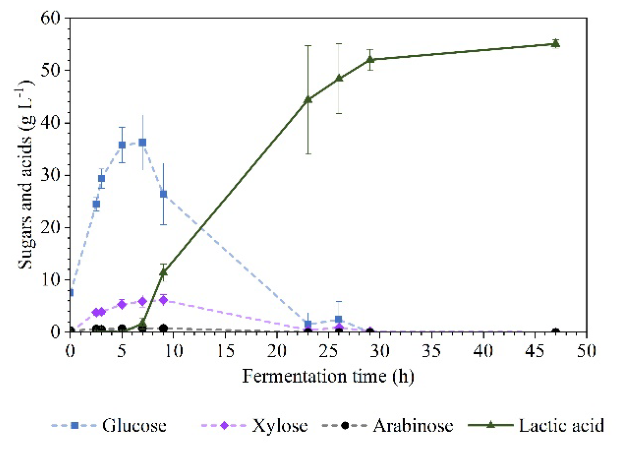
SSF may attenuate CCR effects by enabling the gradual release of fermentable sugars during co-saccharification and their simultaneous consumption, thereby reducing the initial glucose-driven metabolic hierarchy typically observed in SHF systems. The implementation of this one-step strategy was possible due to the similar pH and temperature requirements of the enzymes involved in TPS-BP starch and rice straw cellulose/hemicellulose hydrolysis and the selected conditions for H. coagulans, enabling simultaneous substrate conversion and microbial fermentation. Figure 4 illustrates the time-course profile of sugar consumption and LA production during SSF. An initial glucose concentration of 7.5 ± 0.6 g L⁻¹ was detected prior enzyme addition (t=0 h) due to the partial hydrolysis of starch on the microwave-assisted acid pretreatment of TPS-BP. Inoculation with H. coagulans was delayed by 3 h after enzyme addition, thereby allowing a pre-saccharification period (29.4 ± 1.8 g L⁻¹ glucose, 4.0 ± 0.5 g L⁻¹ xylose, 0.6 ± 0.1 g L⁻¹ arabinose) that reduced medium viscosity and increased sugar availability before the onset of fermentation. Due to the initial lag phase, glucose conversion into LA became the rate-limiting step, leading to a peak glucose concentration of 36.2 ± 5.3 g L⁻¹ at 7 h, while pentoses (xylose+arabinose) accumulated progressively due to CCR. Full monosaccharide consumption was observed at the end of fermentation. Interestingly, rice straw digestibility seems to be enhanced as residual cellobiose at the end of the fermentation (1.8 ± 0.1 g L⁻¹) was lower than in SHF assays (5.2 ± 0.6 g L⁻¹). Although temporary deviations in LA production were observed between duplicates at 23 h (Standard dev. ± 10.4 g L⁻¹), the final LA concentrations eventually converged after 47 h. The initial variability is likely attributable to the heterogeneity of the TPS-BP/rice straw mixture, which may have influenced early-stage kinetics. Notably, the SSF co-fermentation strategy enhanced LA production, reaching a final concentration of 55.1 ± 0.7 g L⁻¹, compared to the predicted concentration of 48.4 g L⁻¹ calculated from sugar digestibility and LA yield obtained in SHF assays. One-third of this enhancement can be attributed to the greater conversion of cellobiose into glucose and subsequently into LA, whereas the remaining two-thirds might arise from an increased LA yield and/or enhanced cellulose/hemicellulose digestibility under SSF conditions. LA selectivity remained high at 95.0 wt% and the chiral composition was found to be 99.73% L-isomer LA, confirming that carbon flux was predominantly directed towards L-LA production. The overall process productivity reached 1.17 g L⁻¹ h⁻¹, doubling that of the SHF co-fermenting configuration (0.57 g L⁻¹ h⁻¹).
The integration of saccharification and fermentation into a single process substantially reduces the overall reaction time and attenuates the impact of sequential sugar utilization observed under SHF configurations. Moreover, the SSF configuration achieved higher LA titers by using the TPS-BP pretreatment slurry as both the reaction medium and an additional carbon source, thereby improving water usage and consolidating unit operations into a single reactor. In contrast, the SHF configuration relies on water-diluted rice straw hydrolysates generated in a separate saccharification step, where water is used as the reaction medium and does not contribute additional fermentable carbon to the fermentation step. As illustrated in the mass balance (Scheme 1), processing 1 kilogram of raw rice straw under the SSF reactor composition (9% w/v TPS-BP and 6% w/v rice straw) can incorporate 751 g of TPS-BP as co-substrate, compared to only 278 g under SHF conditions. This difference in substrate mixture ratio directly increases the total fermentable carbon input available per kilogram of lignocellulosic feedstock, enhancing LA production from 330 g (SHF) to 460 g (SSF) despite equivalent rice straw loading. Under the final reactor composition (9% w/v TPS-BP and 6% w/v rice straw), the slurry derived from TPS-BP pretreatment provides a soluble starch-derived carbon fraction that complements the sugars released from rice straw during saccharification. Unlike SHF systems, where the liquid phase mainly consists of process water, the SSF configuration inherently incorporates these organic compounds, thereby increasing the total carbon availability for fermentation. Consequently, LA production reflects the integrated substrate carbon pool rather than rice straw conversion alone. Beyond process intensification, this co-valorization strategy offers broader sustainability benefits by upcycling end-of-life TPS-BP waste into a fermentable carbon source through the replacement of process water with bioplastic-derived slurry. In addition, it buffers the impact of seasonal rice straw availability by decoupling LA production from lignocellulosic input alone, and establishes a feasible route for integrating bioplastic waste streams into circular biorefineries.
Table 3 summarizes representative SSF studies employing either single substrates or co-substrate strategies for LA production, providing a comparative framework for evaluating process performance across different cultivation approaches. This study is the first to report SSF co-fermentation of TPS-BP with a lignocellulosic waste. Regarding single-substrate SSF, literature on rice straw shows titers ranging from 50.0 g L⁻¹ to 61.0 g L⁻¹ [24,54]. Our result (55.1 g L⁻¹) is well within this range, confirming that the integration of TPS-BP does not compromise the high conversion efficiency typical of rice straw-based systems. Other starchy or lignocellulosic wastes have yielded higher product titers, such as the 110.0 g L⁻¹ achieved from cassava bagasse [12] or 91.56 g L⁻¹ from paddy rice [13]. However, these studies employed substrates with significantly higher carbohydrate availability or more intense liquefaction steps, and do not involve TPS-based bioplastics, which are intrinsically more complex due to the presence of non-fermentable polymeric components. In our case, the TPS-BP matrix contains ≈70% PBAT, which remains non-fermentable under the applied conditions, making the achievement of 55.1 g L⁻¹ a remarkable result for a process involving high proportions of inert polymeric material. Furthermore, SSF-based co-valorization strategies involving two distinct biowastes remain scarce in literature, which limits direct quantitative comparisons with previous studies. Nevertheless, existing literature offers valuable context. Naomi David et al. [55] investigated the SSF co-valorization of corn cob waste and dairy wastewater, where the liquid effluent served as both a moisture source and a provider of residual organic nutrients. Under these conditions, LA concentrations of 11.15 ± 0.42 g L-1 were obtained using L. plantarum. Similarly, Lian et al. [56] reported 31.18 g L-1 of LA from the co-fermentation of swine manure and apple waste by a mixed microbial community dominated by Clostridium and Lactobacillus species. Higher product titers have been described in co-substrate SSF systems. Wang et al. [25] reported that co-substrate SSF of food waste and Sophora flavescens residues significantly enhanced LA production, achieving values approximately 80% higher than those obtained with single-substrate systems, despite identical solid loadings. This improvement was primarily attributed to nutritional complementation, as food waste provided readily assimilable nitrogen sources that stimulated the growth and metabolic activity of Lactobacillus casei. In comparison, although the final LA concentration obtained in the present study (55.1 g L⁻¹) was about 18% lower, the overall fermentation time was reduced by more than 70% (26 h vs. 96 h), ultimately resulting in a markedly higher process productivity. This highlights a distinct kinetic advantage of the TPS-BP/rice straw system in SSF cultivation, where moderate final titers were compensated by high conversion rates. In the present case, the performance of the TPS-BP/rice straw system appears primarily governed by substrate-driven sugar availability rather than synergistic metabolic interactions, yielding a better performance consistent with additive effects rather than true synergy. The research presented here represents the first proof-of-concept configuration for the production of LA from TPS-BP wastes via fermentation. Despite the large-scale production of this material, its biotechnological valorization via microbial upcycling has remained largely unexplored to date. The final LA concentrations obtained confirm the feasibility of co-valorizing TPS-BP and rice straw hydrolysates, yielding process performances comparable to those achieved with single rice straw-based fermentations.
4. Conclusions
This research demonstrates the feasibility of microbial upcycling of TPS-BP into LA. Microwave-assisted acid pretreatment (150 °C, 0.1% H₂SO₄) effectively releases fermentable sugars from bioplastic waste. By implementing an SSF process using H. coagulans for the co-fermentation of TPS-BP and rice straw, a final LA concentration of 55.1 g L⁻¹ was achieved. This co-valorization approach provides a dual benefit: it creates a recycling alternative compared with conventional end-of-life routes for bioplastic waste and provides a stable carbon source to mitigate the inherent seasonal availability of agricultural residues like rice straw.
Supplementary Materials
The following supporting information can be downloaded at the website of this paper posted on Preprints.org, Table S1: ANOVA results of the 24-1 fractional factorial design for NaOH and H2SO4 pretreatments of TPS-BP, including regression coefficients and statistical significance analysis; Figure S1: SEM micrographs of untreated and pretreated TPS-BP samples; Figure S2: carbohydrate composition of TPS-BP and rice straw; Figure S3: FT-IR spectra of untreated and pretreated TPS-BP samples, along with pure PBAT and potato starch reference standards; Figure S4: Chiral HPLC chromatograms confirming the preferential production of L-lactic acid; Figure S5: representative HPLC chromatograms of co-substrate fermentations carried out by H. coagulans; and Table S2: carbon mass balance and lactic acid selectivity calculations.
Author Contributions
Conceptualization, F.J.A.-H., A.A., P.S.-V., P.F., M.G.-P. and C.G.; Methodology, C.S., F.J.A.-H., A.A., P.S.-V., P.F., M.G.-P. and C.G.; Formal Analysis, C.S., P.S.-V and M.G.-P.; Investigation, C.S., F.J.A.-H. and M.G.-P.; Validation, M.G.-P., P.F. and P.S.-V.; Data Curation, C.S and C.G.; Writing – Original Draft Preparation, C.S.; Writing – Review & Editing, F.J.A.-H and C.G.; Supervision, F.J.A.-H. and C.G.; Project Administration, C.G.; Funding Acquisition, F.J.A.-H. and C.G.
Funding
This work was supported by Grant PID2021-122454OB-I00 funded by MICIU/AEI/10.13039/501100011033 and by ERDF/EU. This research also received funding from Conselleria d'Educació, Cultura, Universitat i Ocupació, Generalitat Valenciana, Spain (Grant number Project CIAICO/2023/131) and Agencia Valenciana de la Innovación (Grant number Project INNEST/2021/16). M. García-Puchol acknowledges the Ministerio de Ciencia, Innovación y Universidades for his PhD contract (Grant PRE2022-104225 funded by MICIU/AEI/10.13039/501100011033 and by ESF+).
Institutional Review Board Statement
Not applicable.
Informed Consent Statement
Not applicable.
Data Availability Statement
Data will be made available by the authors on reasonable request.
Acknowledgments
During the preparation of this manuscript, the author(s) used Claude (Sonnet 5, Anthropic) for the purposes of language refinement, grammar improvement, and enhancement of writing clarity. The authors have reviewed and edited the output and take full responsibility for the content of this publication. The authors gratefully acknowledge the Servei Central de Suport a la Investigació Experimental (SCSIE) of the Universitat de València for its technical support in conducting the SEM and FT-IR analyses.
Conflicts of Interest
The authors declare no conflicts of interest.
Abbreviations
The following abbreviations are used in this manuscript:
| 2,3-BDO | 2,3-butanediol |
| 5-HMF | 5-hydroxymethylfurfural |
| CCR | Carbon catabolite repression |
| FT-IR | Fourier transform infrared spectroscopy |
| HPLC | High-performance liquid chromatography |
| LA | Lactic acid |
| PBAT | Poly(butylene adipate-co-terephthalate) |
| SEM | Scanning electron microscope/microscopy |
| SHF | Separate hydrolysis and fermentation |
| SSF | Simultaneous saccharification and fermentation |
| STR | Stirred tank reactor |
| TPS | Thermoplastic starch |
| TPS-BP | Thermoplastic starch-based bioplastic |
References
- Plastics Europe. Plastics the Fast Facts 2025 Global and European Plastics Production and Economic Indicators; Plastics Europe, 2025. [Google Scholar]
- European Environment Agency. Nearly 40 Percent of Plastic Demand Comes from the Production of Plastic Packaging. Available online: https://www.eea.europa.eu/en/analysis/maps-and-charts/nearly-40-percent-of-plastic (accessed on 4 November 2025).
- Rosenboom, J.-G.; Langer, R.; Traverso, G. Bioplastics for a Circular Economy. Nat. Rev. Mater. 2022, 7, 117–137. [Google Scholar] [CrossRef] [PubMed]
- Crippa, M.; De Wilde, B.; Koopmans, R.; Leyssens, J.; Muncke, J.; Ritschkoff, A.-C.; Van Doorsselaer, K.; Velis, C.; Wagner, M. A Circular Economy for Plastics – Insights from Research and Innovation to Inform Policy and Funding Decisions; De Smet, M., Linder, M., Eds.; European Commission: Brussels, Belgium., 2019. [Google Scholar]
- Ballerstedt, H.; Tiso, T.; Wierckx, N.; Wei, R.; Averous, L.; Bornscheuer, U.; O’Connor, K.; Floehr, T.; Jupke, A.; Klankermayer, J.; et al. MIXed Plastics Biodegradation and UPcycling Using Microbial Communities: EU Horizon 2020 Project MIX-UP Started January 2020. Environ. Sci. Eur. 2021, 33, 99. [Google Scholar] [CrossRef] [PubMed]
- García-Depraect, O.; Bordel, S.; Lebrero, R.; Santos-Beneit, F.; Börner, R.A.; Börner, T.; Muñoz, R. Inspired by Nature: Microbial Production, Degradation and Valorization of Biodegradable Bioplastics for Life-Cycle-Engineered Products. Biotechnol. Adv. 2021, 53, 107772. [Google Scholar] [CrossRef] [PubMed]
- Merchan, A.L.; Fischöder, T.; Hee, J.; Lehnertz, M.S.; Osterthun, O.; Pielsticker, S.; Schleier, J.; Tiso, T.; Blank, L.M.; Klankermayer, J.; et al. Chemical Recycling of Bioplastics: Technical Opportunities to Preserve Chemical Functionality as Path towards a Circular Economy. Green Chem. 2022, 24, 9428–9449. [Google Scholar] [CrossRef]
- Zhang, Y.; Rempel, C.; Liu, Q. Thermoplastic Starch Processing and Characteristics—A Review. Crit. Rev. Food Sci. Nutr. 2014, 54, 1353–1370. [Google Scholar] [CrossRef] [PubMed]
- Kang, M.J.; Kim, H.T.; Lee, M.-W.; Kim, K.-A.; Khang, T.U.; Song, H.M.; Park, S.J.; Joo, J.C.; Cha, H.G. A Chemo-Microbial Hybrid Process for the Production of 2-Pyrone-4,6-Dicarboxylic Acid as a Promising Bioplastic Monomer from PET Waste. Green Chem. 2020, 22, 3461–3469. [Google Scholar] [CrossRef]
- Boonsombuti, A.; Luengnaruemitchai, A.; Wongkasemjit, S. Enhancement of Enzymatic Hydrolysis of Corncob by Microwave-Assisted Alkali Pretreatment and Its Effect in Morphology. Cellulose 2013, 20, 1957–1966. [Google Scholar] [CrossRef]
- Chen, W.-H.; Ye, S.-C.; Sheen, H.-K. Hydrolysis Characteristics of Sugarcane Bagasse Pretreated by Dilute Acid Solution in a Microwave Irradiation Environment. Appl. Energy 2012, 93, 237–244. [Google Scholar] [CrossRef]
- Chen, H.; Chen, B.; Su, Z.; Wang, K.; Wang, B.; Wang, Y.; Si, Z.; Wu, Y.; Cai, D.; Qin, P. Efficient Lactic Acid Production from Cassava Bagasse by Mixed Culture of Bacillus Coagulans and Lactobacillus Rhamnosus Using Stepwise pH Controlled Simultaneous Saccharification and Co-Fermentation. Ind. Crops Prod. 2020, 146, 112175. [Google Scholar] [CrossRef]
- Sun, Y.; Liu, H.; Yang, Y.; Zhou, X.; Xiu, Z. High-Efficient L-Lactic Acid Production from Inedible Starchy Biomass by One-Step Open Fermentation Using Thermotolerant Lactobacillus Rhamnosus DUT1908. Bioprocess Biosyst. Eng. 2021, 44, 1935–1941. [Google Scholar] [CrossRef] [PubMed]
- Mazzoli, R.; Bosco, F.; Mizrahi, I.; Bayer, E.A.; Pessione, E. Towards Lactic Acid Bacteria-Based Biorefineries. Biotechnol. Adv. 2014, 32, 1216–1236. [Google Scholar] [CrossRef] [PubMed]
- Ahmad, A.; Banat, F.; Taher, H. A Review on the Lactic Acid Fermentation from Low-Cost Renewable Materials: Recent Developments and Challenges. Environ. Technol. Innov. 2020, 20, 101138. [Google Scholar] [CrossRef]
- Abdel-Rahman, M.A.; Tashiro, Y.; Sonomoto, K. Lactic Acid Production from Lignocellulose-Derived Sugars Using Lactic Acid Bacteria: Overview and Limits. J. Biotechnol. 2011, 156, 286–301. [Google Scholar] [CrossRef] [PubMed]
- Abedi, E.; Hashemi, S.M.B. Lactic Acid Production – Producing Microorganisms and Substrates Sources-State of Art. Heliyon 2020, 6, e04974. [Google Scholar] [CrossRef] [PubMed]
- Habarakada Liyanage, T.U.; Dada, O.; Abeysinghe, S.; Liu, H.; Yu, L.; Chen, S. Digestibility and Fate of Biodegradable Plastic Mulch Films in Thermophilic Anaerobic Digestion 2024. [CrossRef] [PubMed]
- Lee, E.S.; Park, S.Y.; Kim, C.G. Comparison of Anaerobic Digestion of Starch- and Petro-Based Bioplastic under Hydrogen-Rich Conditions. Waste Manag. 2024, 175, 133–145. [Google Scholar] [CrossRef] [PubMed]
- Zeng, W.; De Leeuw, K.D.; Strik, D.P.B.T.B. Biorefining of Thermoplastic Starch via Depolymerization and Methane Arrested Anaerobic Digestion. ACS Sustain. Chem. Eng. 2025, 13, 8116–8127. [Google Scholar] [CrossRef]
- Jayakumar, M.; Gindaba, G.T.; Gebeyehu, K.B.; Periyasamy, S.; Jabesa, A.; Baskar, G.; John, B.I.; Pugazhendhi, A. Bioethanol Production from Agricultural Residues as Lignocellulosic Biomass Feedstock’s Waste Valorization Approach: A Comprehensive Review. Sci. Total Environ. 2023, 879, 163158. [Google Scholar] [CrossRef] [PubMed]
- Eş, I.; Khaneghah, A.M.; Barba, F.J.; Saraiva, J.A.; Sant’Ana, A.S.; Hashemi, S.M.B. Recent Advancements in Lactic Acid Production - a Review. Food Res. Int. 2018, 107, 763–770. [Google Scholar] [CrossRef] [PubMed]
- Anuar, L.H.; Anwar, N.A.K.K.; Low, K.L.; Yusof, N.M.; Idris, A. Lactic Acid Production from Sequential Inorganic Salt Pretreated Oil Palm Empty Fruit Bunch via Simultaneous Saccharification and Fermentation. Bioprocess. Biomass Technol. 2022, 1, 1–6. [Google Scholar] [CrossRef]
- Chen, H.; Huo, W.; Wang, B.; Wang, Y.; Wen, H.; Cai, D.; Zhang, C.; Wu, Y.; Qin, P. L-Lactic Acid Production by Simultaneous Saccharification and Fermentation of Dilute Ethylediamine Pre-Treated Rice Straw. Ind. Crops Prod. 2019, 141, 111749. [Google Scholar] [CrossRef]
- Wang, J.; Chang, Q.; Yu, M.; Niu, R.; Wu, C.; Wang, Q. SSF Production of L-Lactic Acid from Food Waste and Sophoraflavescens Residues. Procedia Environ. Sci. 2016, 31, 122–126. [Google Scholar] [CrossRef]
- Valles, A.; Álvarez-Hornos, F.J.; Martínez-Soria, V.; Marzal, P.; Gabaldón, C. Comparison of Simultaneous Saccharification and Fermentation and Separate Hydrolysis and Fermentation Processes for Butanol Production from Rice Straw. Fuel 2020, 282. [Google Scholar] [CrossRef]
- Sluiter, A.; Hames, B.; Ruiz, R.; Scarlata, C.; Sluiter, J.; Templeton, D.; Crocker, D. others Determination of Structural Carbohydrates and Lignin in Biomass; 2008; pp. 1–16. [Google Scholar]
- Valles, A.; Capilla, M.; Álvarez-Hornos, F.J.; García-Puchol, M.; San-Valero, P.; Gabaldón, C. Optimization of Alkali Pretreatment to Enhance Rice Straw Conversion to Butanol. Biomass Bioenergy 2021, 150. [Google Scholar] [CrossRef]
- Elfehri Borchani, K.; Carrot, C.; Jaziri, M. Biocomposites of Alfa Fibers Dispersed in the Mater-Bi® Type Bioplastic: Morphology, Mechanical and Thermal Properties. Compos. Part Appl. Sci. Manuf. 2015, 78, 371–379. [Google Scholar] [CrossRef]
- M. Quispe, M.; V. L髉ez, O.; A. Villar, M. Oxidative Degradation of Thermoplastic Starch Induced by UV Radiation. J. Renew. Mater. 2019, 7, 383–391. [Google Scholar] [CrossRef]
- Ruggero, F.; Carretti, E.; Gori, R.; Lotti, T.; Lubello, C. Monitoring of Degradation of Starch-Based Biopolymer Film under Different Composting Conditions, Using TGA, FTIR and SEM Analysis. Chemosphere 2020, 246, 125770. [Google Scholar] [CrossRef] [PubMed]
- Capilla, M.; Silvestre, C.; Valles, A.; Álvarez-Hornos, F.J.; San-Valero, P.; Gabaldón, C. The Influence of Sugar Composition and pH Regulation in Batch and Continuous Acetone–Butanol–Ethanol Fermentation. Fermentation 2022, 8, 226. [Google Scholar] [CrossRef]
- Silvestre, C.; Niedermeier, L.; Capilla, M.; Gabaldón, C.; Álvarez-Hornos, J. Enhanced Biobutanol Production from Rice Straw with a Two-stage Packed-bed Fermenter Coupled with In-line Gas Stripping. J. Chem. Technol. Biotechnol. 2025, 100, 1393–1402. [Google Scholar] [CrossRef]
- Castillo Martinez, F.A.; Balciunas, E.M.; Salgado, J.M.; Domínguez González, J.M.; Converti, A.; Oliveira, R.P.D.S. Lactic Acid Properties, Applications and Production: A Review. Trends Food Sci. Technol. 2013, 30, 70–83. [Google Scholar] [CrossRef]
- Orozco, F.G.; Valadez-González, A.; Domínguez-Maldonado, J.A.; Zuluaga, F.; Figueroa-Oyosa, L.E.; Alzate-Gaviria, L.M. Lactic Acid Yield Using Different Bacterial Strains, Its Purification, and Polymerization through Ring-Opening Reactions. Int. J. Polym. Sci. 2014, 2014, 1–7. [Google Scholar] [CrossRef]
- Gullón, B.; Yáñez, R.; Alonso, J.L.; Parajó, J.C. L-Lactic Acid Production from Apple Pomace by Sequential Hydrolysis and Fermentation. Bioresour. Technol. 2008, 99, 308–319. [Google Scholar] [CrossRef] [PubMed]
- Bustos, G.; Moldes, A.B.; Cruz, J.M.; Domínguez, J.M. Formulation of Low-Cost Fermentative Media for Lactic Acid Production with Lactobacillus Rhamnosus Using Vinification Lees as Nutrients. J. Agric. Food Chem. 2004, 52, 801–808. [Google Scholar] [CrossRef] [PubMed]
- Coelho, L.F.; Beitel, S.M.; Sass, D.C.; Neto, P.M.A.; Contiero, J. High-Titer and Productivity of l-(+)-Lactic Acid Using Exponential Fed-Batch Fermentation with Bacillus Coagulans Arr4, a New Thermotolerant Bacterial Strain. 3 Biotech 2018, 8, 213. [Google Scholar] [CrossRef] [PubMed]
- Xu, K.; Xu, P. Betaine and Beet Molasses Enhance L-Lactic Acid Production by Bacillus Coagulans. PLoS ONE 2014, 9, e100731. [Google Scholar] [CrossRef] [PubMed]
- Ou, M.S.; Ingram, L.O.; Shanmugam, K.T. L(+)-Lactic Acid Production from Non-Food Carbohydrates by Thermotolerant Bacillus Coagulans. J. Ind. Microbiol. Biotechnol. 2011, 38, 599–605. [Google Scholar] [CrossRef] [PubMed]
- Rawoof, S.A.A.; Kumar, P.S.; Vo, D.N.; Devaraj, K.; Mani, Y.; Devaraj, T.; Subramanian, S. Production of Optically Pure Lactic Acid by Microbial Fermentation: A Review. Environ. Chem. Lett. 2021, 19, 539–556. [Google Scholar] [CrossRef]
- Kim, J.-H.; Block, D.E.; Shoemaker, S.P.; Mills, D.A. Conversion of Rice Straw to Bio-Based Chemicals: An Integrated Process Using Lactobacillus Brevis. Appl. Microbiol. Biotechnol. 2010, 86, 1375–1385. [Google Scholar] [CrossRef] [PubMed]
- Chen, X.; Xue, Y.; Hu, J.; Tsang, Y.F.; Gao, M.-T. Release of Polyphenols Is the Major Factor Influencing the Bioconversion of Rice Straw to Lactic Acid. Appl. Biochem. Biotechnol. 2017, 183, 685–698. [Google Scholar] [CrossRef] [PubMed]
- Zhao, T.; Tashiro, Y.; Abdel-Rahman, M.A.; Tan, J.; Hanamiya, M.; Sonomoto, K. Efficient Open Integrated Lactic Acid Fermentation of Undetoxified Semi-Hydrolysate of Rice Straw Using Thermophilic Enterococcus Faecium QU 50. Ind. Crops Prod. 2023, 196, 116494. [Google Scholar] [CrossRef]
- Su, Y.; Rhee, M.S.; Ingram, L.O.; Shanmugam, K.T. Physiological and Fermentation Properties of Bacillus Coagulans and a Mutant Lacking Fermentative Lactate Dehydrogenase Activity. J. Ind. Microbiol. Biotechnol. 2011, 38, 441–450. [Google Scholar] [CrossRef] [PubMed]
- Wang, Q.; Ingram, L.O.; Shanmugam, K.T. Evolution of D-Lactate Dehydrogenase Activity from Glycerol Dehydrogenase and Its Utility for D-Lactate Production from Lignocellulose. Proc. Natl. Acad. Sci. 2011, 108, 18920–18925. [Google Scholar] [CrossRef] [PubMed]
- Ma, X.; Gao, M.; Wang, N.; Liu, S.; Wang, Q.; Sun, X. Lactic Acid Production from Co-Fermentation of Food Waste and Spent Mushroom Substance with Aspergillus Niger Cellulase. Bioresour. Technol. 2021, 337, 125365. [Google Scholar] [CrossRef] [PubMed]
- Wang, Y.; Abdel-Rahman, M.A.; Tashiro, Y.; Xiao, Y.; Zendo, T.; Sakai, K.; Sonomoto, K. L-(+)-Lactic Acid Production by Co-Fermentation of Cellobiose and Xylose without Carbon Catabolite Repression Using Enterococcus Mundtii QU 25. RSC Adv. 2014, 4, 22013–22021. [Google Scholar] [CrossRef]
- Tang, Y.; Zhu, L.; Zhang, W.; Shang, X.; Jiang, J. Integrated Process of Starch Ethanol and Cellulosic Lactic Acid for Ethanol and Lactic Acid Production. Appl. Microbiol. Biotechnol. 2013, 97, 1923–1932. [Google Scholar] [CrossRef] [PubMed]
- Tejayadi, S.; Cheryan, M. Lactic Acid from Cheese Whey Permeate. Productivity and Economics of a Continuous Membrane Bioreactor. Appl. Microbiol. Biotechnol. 1995, 43, 242–248. [Google Scholar] [CrossRef]
- Wang, Q.; Zou, D.; Ma, H.; Ji, Y.; Wang, X. Simultaneous Saccharification and Fermentation of Corn Straw to Lactic Acid. Chem. Biochem. Eng. Q. 2010, 24, 371–376. [Google Scholar]
- Jiang, S.; Xu, P.; Tao, F. L-Lactic Acid Production by Bacillus Coagulans through Simultaneous Saccharification and Fermentation of Lignocellulosic Corncob Residue. Bioresour. Technol. Rep. 2019, 6, 131–137. [Google Scholar] [CrossRef]
- Li, Z.; Lu, J.; Yang, Z.; Han, L.; Tan, T. Utilization of White Rice Bran for Production of L-Lactic Acid. Biomass Bioenergy 2012, 39, 53–58. [Google Scholar] [CrossRef]
- Tu, W.-L.; Hsu, T.-C.; Wang, C.-A.; Guo, G.-L.; Chao, Y. Using Novel Lactobacillus Plantarum to Produce Lactic Acid from Lignocellulosic Biomass in an Integrated Simultaneous Saccharification and Fermentation Process. BioResources 2019, 14, 3873–3885. [Google Scholar] [CrossRef]
- Naomi David, A.; Sewsynker-Sukai, Y.; Gueguim Kana, E.B. Co-Valorization of Corn Cobs and Dairy Wastewater for Simultaneous Saccharification and Lactic Acid Production: Process Optimization and Kinetic Assessment. Bioresour. Technol. 2022, 348, 126815. [Google Scholar] [CrossRef] [PubMed]
- Lian, T.; Zhang, W.; Cao, Q.; Wang, S.; Yin, F.; Chen, Y.; Zhou, T.; Dong, H. Optimization of Lactate Production from Co-Fermentation of Swine Manure with Apple Waste and Dynamics of Microbial Communities. Bioresour. Technol. 2021, 336, 125307. [Google Scholar] [CrossRef] [PubMed]
Figure 1.
Time-course data of glucose consumption and lactic acid production during batch fermentations by a) L. rhamnosus CECT 288, and b) H. coagulans DSM 2314 in synthetic glucose medium at different controlled pH values (5.5, 6.0, and 6.5).
Figure 1.
Time-course data of glucose consumption and lactic acid production during batch fermentations by a) L. rhamnosus CECT 288, and b) H. coagulans DSM 2314 in synthetic glucose medium at different controlled pH values (5.5, 6.0, and 6.5).
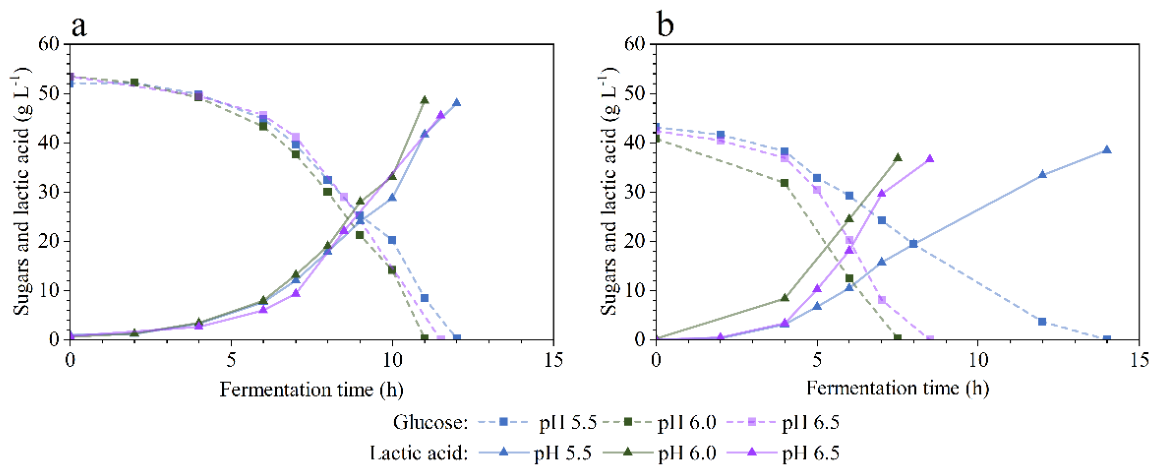
Figure 2.
Time-course data of sugar consumption and lactic acid production during SHF fermentations by H. coagulans DSM 2314 using a) thermoplastic starch-based bioplastic (TPS-BP) hydrolysate, and b) rice straw hydrolysate, and c) their mixture in a volumetric ratio TPS-BP:rice straw of 1:1.5.
Figure 2.
Time-course data of sugar consumption and lactic acid production during SHF fermentations by H. coagulans DSM 2314 using a) thermoplastic starch-based bioplastic (TPS-BP) hydrolysate, and b) rice straw hydrolysate, and c) their mixture in a volumetric ratio TPS-BP:rice straw of 1:1.5.
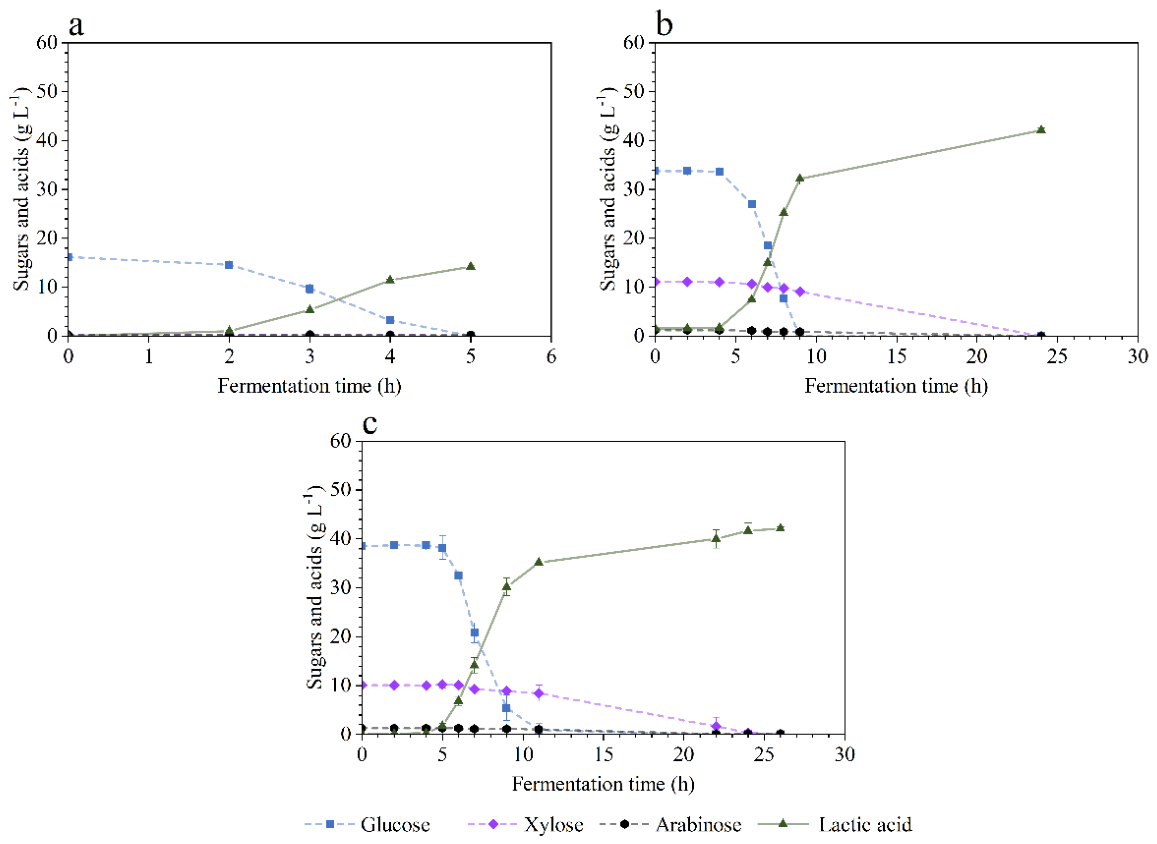
Figure 3.
Time-course data of sugar consumption and lactic acid production during SHF co-fermentation of thermoplastic starch-based bioplastic (TPS-BP) and rice straw hydrolysate with yeast extract concentration of a) 10, b) 5, and c) 1 g L-1.
Figure 3.
Time-course data of sugar consumption and lactic acid production during SHF co-fermentation of thermoplastic starch-based bioplastic (TPS-BP) and rice straw hydrolysate with yeast extract concentration of a) 10, b) 5, and c) 1 g L-1.
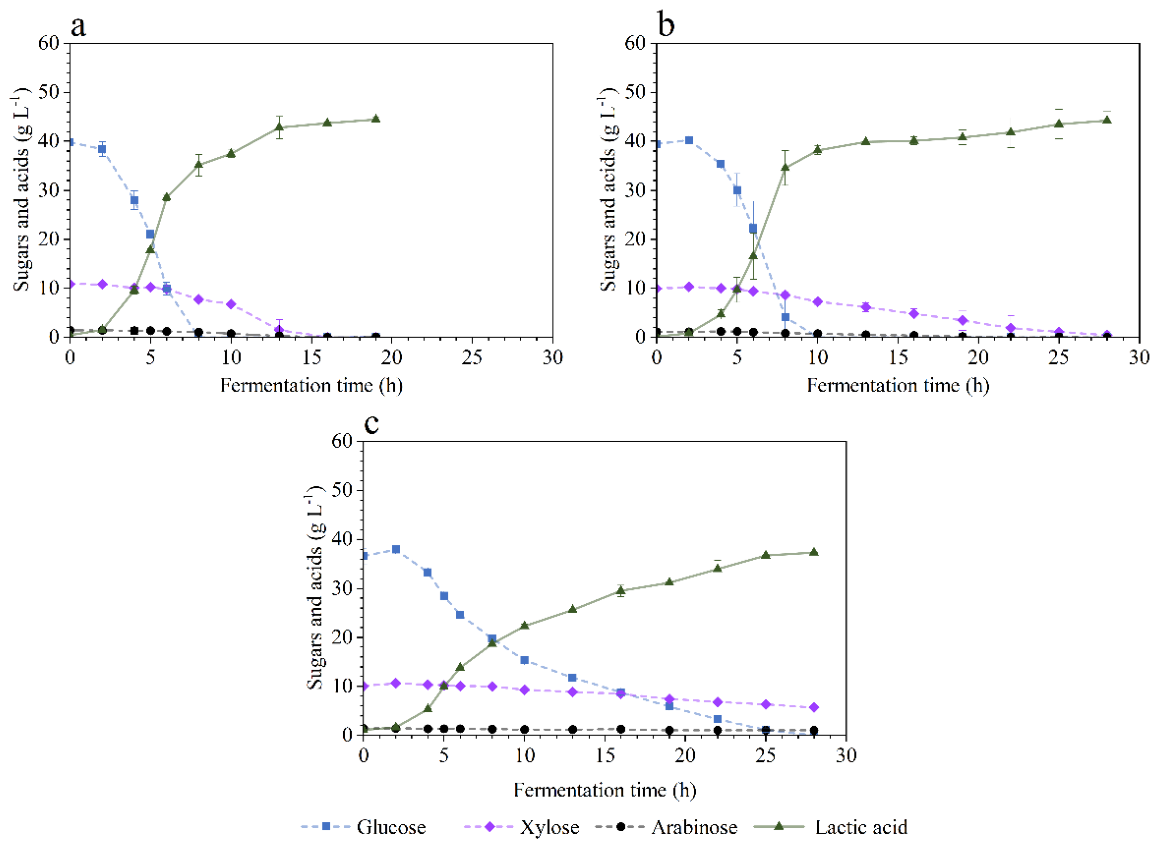
Figure 4.
Time-course data of sugar consumption and lactic acid production during SSF co-fermentation of thermoplastic starch-based bioplastic (TPS-BP) and rice straw.
Figure 4.
Time-course data of sugar consumption and lactic acid production during SSF co-fermentation of thermoplastic starch-based bioplastic (TPS-BP) and rice straw.
Scheme 1.
Model mass balance of separate hydrolysis and fermentation (SHF) and simultaneous saccharification and fermentation (SSF) configurations for the co-valorization of thermoplastic starch-based bioplastic (TPS-BP) and rice straw. Basis: 1 kg raw rice straw.
Scheme 1.
Model mass balance of separate hydrolysis and fermentation (SHF) and simultaneous saccharification and fermentation (SSF) configurations for the co-valorization of thermoplastic starch-based bioplastic (TPS-BP) and rice straw. Basis: 1 kg raw rice straw.
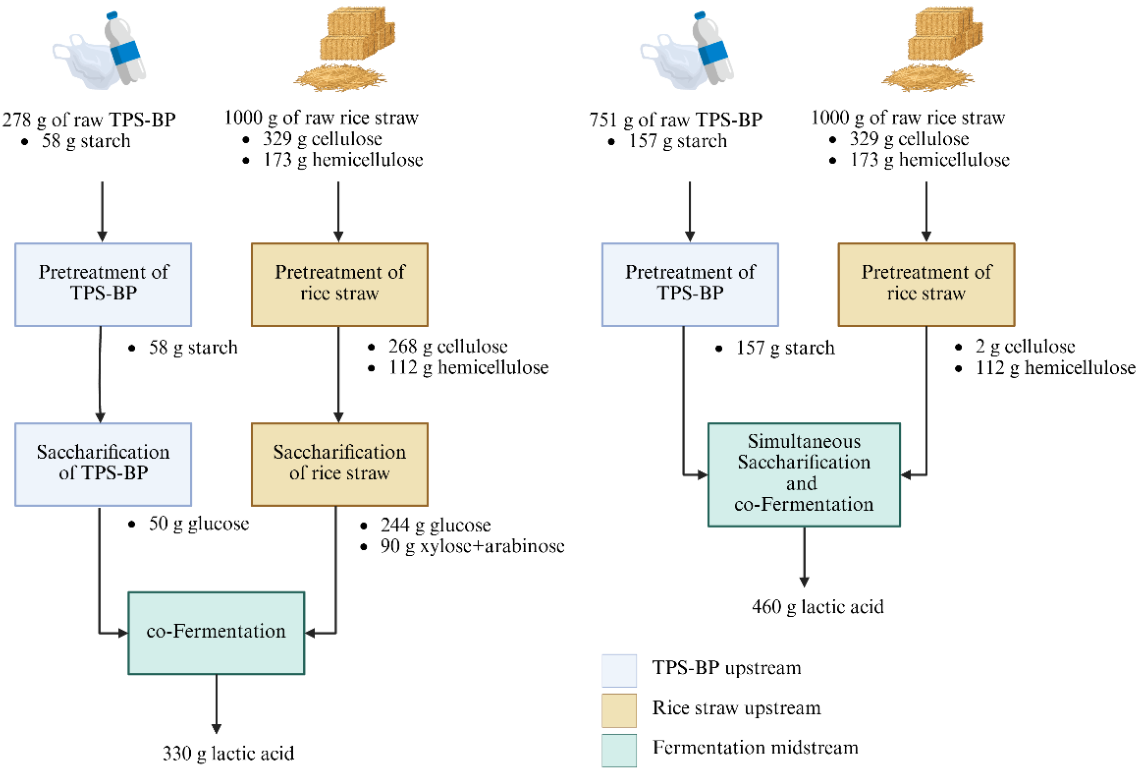
Table 2.
Lactic acid yields and maximum volumetric productivities of L. rhamnosus CECT 288 and H. coagulans DSM 2314 at different pH values.
Table 2.
Lactic acid yields and maximum volumetric productivities of L. rhamnosus CECT 288 and H. coagulans DSM 2314 at different pH values.
| Strain | pH | Lactic acid | |
| Yield | Maximum Productivity | ||
| (g g-1) | (g L-1 h-1) | ||
|
L. rhamnosus CECT288 |
5.5 | 0.93 | 6.83 |
| 6.0 | 0.91 | 7.77 | |
| 6.5 | 0.85 | 7.45 | |
|
H. coagulans DSM2314 |
5.5 | 0.89 | 2.84 |
| 6.0 | 0.91 | 8.25 | |
| 6.5 | 0.86 | 7.73 | |
Table 3.
Comparison of lactic acid fermentation through single-substrate and co-substrate SSF from different feedstocks.
Table 3.
Comparison of lactic acid fermentation through single-substrate and co-substrate SSF from different feedstocks.
| Fermentation | Substrate | Pretreatment | Biomass | Enzyme | Microorganism | Lactic acid | Reference | |
| method | loading | loading | Production | Productivity | ||||
| (w/v) | (g L-1) | (g L-1 h-1) | ||||||
| Single-substrate | Rice straw | Dilute ethylenediamine | 10%e | Cellulase (16 FPU g-dw-1) | H. coagulans LA-15-2i | 50.00 | 2.50 | Chen et al.[24] |
| Rice straw | Dilute H2SO4 | 17%d | Cellic CTec3 (15 FPU g cellulose-1) |
L. plantarumi | 61.00 | 0.63 | Tu et al.[54] | |
| Oil palm empty fruit bunches | Two-step chemicala | 5%e | Cellulase (50 FPU g-dw-1) | H. coagulans DSM 2314 | 46.66 | 0.65 | Anuar et al.[23] | |
| Cassava bagasse | Liquefaction with amylaseb | 5%f | Glucoamylase (12 U g-dw-1) and cellulase (6 FPU g-dw-1) | H. coagulans LA-15-2i | 110.00 | 1.29 | Chen et al.[12] | |
| Paddy rice | Liquefaction with Liquozyme COFCO LpHc | 20%d | SuHong GA COFCO HP (65.3 U g-dw-1) | L. rhamnosus DUT1908i | 91.56 | 2.86 | Sun et al. [13] | |
| Co-substrate |
Corn cob wastes and dairy wastewater | Steam-assisted green liquor dregs and paper wastewater | 10% | Cellic CTec2 (10 FPU g-dw⁻¹) | L. plantarum ATCC 14917 | 11.15 | 0.46 | Naomi David et al.[55] |
| Swine manure and apple waste | pulverization/ homogenization | - | - | Mixed communityj |
31.18 | - | Lian et al.[56] | |
| Sophoraflavescens and food waste | Dilute NaOH | 10%g | Cellulase (-) and amylase (-) | L. casei 6106 | 67.50 | 0.70 | Wang et al.[25] | |
| Rice straw and TPS-BP | Dilute NaOH (rice straw) and dilute H2SO4 (TPS-BP) | 15%h | Cellic CTec2 (20 FPU g-dw-1), α-amylase (3 U g-dw-1) and Amyloglucosidase (1.5 U g-dw-1) | H. coagulans DSM 2314 | 55.08 | 1.17 | This study | |
a Sequential method with inorganic salt (Na3PO4.12H2O and FeCl3) b Enzyme loading: 12 U g-dw-1 c Enzyme loading: 61.5 U g-dw-1 d No phase separation was performed after pretreatment e Phase of interest: solid f Phase of interest: liquid g After pretreatment of sophoraflavescens residues, food waste was added in a mixing ratio of 1.5:1 h Pretreated rice straw was mixed with slurry derived from TPS-BP pretreatment i Not commercially available j Lactobacillus and Clostridium.
Disclaimer/Publisher’s Note: The statements, opinions and data contained in all publications are solely those of the individual author(s) and contributor(s) and not of MDPI and/or the editor(s). MDPI and/or the editor(s) disclaim responsibility for any injury to people or property resulting from any ideas, methods, instructions or products referred to in the content. |
© 2026 by the authors. Licensee MDPI, Basel, Switzerland. This article is an open access article distributed under the terms and conditions of the Creative Commons Attribution (CC BY) license (http://creativecommons.org/licenses/by/4.0/).
Copyright: This open access article is published under a Creative Commons CC BY 4.0 license, which permit the free download, distribution, and reuse, provided that the author and preprint are cited in any reuse.