

Submitted:
23 September 2026
Posted:
24 September 2026
You are already at the latest version
Abstract
The European Union (EU) recently adopted Regulation (EU) 2026/1388 for plants developed with new genomic techniques (NGTs). Under this Regulation, Category 1 NGT plants are exempt from most EU requirements applicable to genetically modified organisms, provided that they meet, among other things, the criteria of equivalence defined in Annex I. Although these criteria consist of simplified molecular characteristics and numerical thresholds, their molecular, analytical, and regulatory verification is more demanding than the legislative wording may suggest at a first glance. Demonstrating compliance requires comprehensive identification of relevant genetic modifications, alignment with genome annotations, evaluation of the gene pool for conventional breeding, assessment of polyploid genomes, and attribution of genetic changes to the use of NGTs. Accordingly, enforcement of Annex I will require robust technical guidance defining sequencing standards, bioinformatic tasks, annotation requirements, attribution specifications, and harmonized counting methodologies. To this end, we propose a seven-step workflow from data-generation to regulatory evaluation in order to ensure a reliable and standardized verification process for Category 1 NGT categorization.
Keywords:
European Union
; Regulation (EU) 2026/1388
; Annex I
; plant
; new genomic techniques
; CRISPR/Cas
; genetically modified organism
Introduction
Genetically modified organisms (GMOs) intended for the environmental release or commercialization in the European Union (EU) are regulated under Directive 2001/18/EC and subsequent implementation legislation (European Parliament and Council of the European Union, 2001, 2003). Recently, the European Parliament and the Council of the EU adopted Regulation (EU) 2026/1388 (hereafter also referred to as the Regulation), which will in future govern the deliberate release and placing on the market of a subset of genetically modified (GM) plants and their products obtained by certain new genomic techniques (NGTs) (European Parliament and Council of the European Union, 2026). After publication in the Official Journal of the EU on 26 June 2026, the Regulation (EU) 2026/1388 entered into force 20 days later, and will apply from 17 July 2028 after a two-year transition period. During the preceding legislative negotiations, several important provisions concerning the practical implementation of the new framework were deferred to subsequent implementing and delegated acts. The transition period therefore provides the timeframe for developing these acts, together with technical guidance and operational verification procedures, to support the consistent implementation of Regulation (EU) 2026/1388 across the EU Member States. For this purpose, the European Commission has published an Implementation Strategy, outlining the planned actions, timelines, and indicative milestones at EU and Member State level (European Commission, 2026).
Regulation (EU) 2026/1388 establishes a new two-tier classification system—alongside the existing GMO framework—to substantially streamline the authorization for plants generated by certain NGTs, which are according to Article 3(9) collectively referred to as ‘NGT plants’ (European Parliament and Council of the European Union, 2026). Consequently, GM plants generated with other techniques than NGTs and those “containing any genetic material originating from outside the gene pool for conventional breeding purposes” are specifically excluded and not subject to Regulation (EU) 2026/1388 (European Parliament and Council of the European Union, 2026). The most significant reform aimed at reducing bureaucracy is that ‘Category 1 NGT plants’ (NGT1) are to be considered equivalent to conventionally bred plants and will accordingly be exempt from most EU GMO regulatory requirements, such as the obligation to conduct a comprehensive risk assessment. ‘Category 2 NGT plants’ (NGT2) that do not meet the criteria for NGT1 but fall within the scope of the Regulation, will be subject to an adapted authorization procedure that provides, for example, for a case-by-case risk assessment.
If an NGT plant meets the essential requirements of the Regulation, its classification into NGT1 and NGT2, as well as the distinction between these categories, is based primarily on the fulfillment of Annexes I and II. Thereby, NGT1 plants must be verified as equivalent to conventionally bred plants, while NGT2 plants must be identified as more complex than NGT1 plants. To this end, genetic modifications considered to be equivalent are defined by the newly introduced “criteria of equivalence of NGT plants to conventional plants” set forth in Annex I to Regulation (EU) 2026/1388 (Box 1) (European Parliament and Council of the European Union, 2026). These criteria define molecular characteristics and corresponding numerical thresholds that must be met in NGT1 plants or, if exceeded, result in an NGT2 classification. In addition, the presence of certain traits specified in Annex II (herbicide tolerance and production of known insecticidal substances) results in exclusion from NGT1 and classification as NGT2 (European Parliament and Council of the European Union, 2026).
Box 1. Original text of Annex I under Regulation (EU) 2026/1388
Regulation (EU) 2026/1388
ANNEX I
Criteria of equivalence of NGT plants to conventional plants
An NGT plant is considered equivalent to conventional plants if the genetic modifications introduced by the new genomic techniques meet the following conditions:
- (1)
-
In the case of plants obtained by targeted mutagenesis, the genetic modifications are the following:
- (a)
- substitution or insertion of no more than 20 nucleotides;
- (b)
- deletion of any number of nucleotides.
The number of those genetic modifications does not exceed a limit of three for each protein-coding sequence, taking into account that genetic modifications in introns and regulatory sequences are not subject to that limit.
- (2)
-
In the case of plants obtained by cisgenesis, the genetic modifications:
- (a)
-
consist of one or more of the following types:
- insertion of continuous DNA sequences existing in the gene pool for conventional breeding purposes;
- substitution of endogenous DNA sequences with continuous DNA sequences existing in the gene pool for conventional breeding purposes;
- inversion or translocation of continuous endogenous DNA sequences; and
- (b)
-
fulfil one or both of the following conditions:
- they result in a combination of DNA sequences that occurs in the gene pool for conventional breeding purposes;
- they do not lead to interruptions of endogenous genes, including interruptions that create chimeric proteins.
- (3)
- The number of genetic modifications referred to in points 1 and 2 in any combination does not exceed 20 per monoploid genome.
To obtain a declaration of NGT1 status, a ‘verification request’ must be submitted either to the competent authority of the Member State for deliberate release for any purpose other than placing on the market (Article 6) or to the European Food Safety Authority (EFSA), referred to as ‘the Authority’ in the Regulation, where placing an NGT1 product on the market is requested (Article 7) (European Parliament and Council of the European Union, 2026). For the sake of simplicity, these institutions will hereafter be collectively referred to as verifying authorities and NGT1 will always include both the plant and its products. After submission, the verifying authorities review the application and accompanying documents against the general requirements for NGT plants and those specific for NGT1, including Annexes I and II.
This review focuses on the molecular verification requirements set forth in Annex I of Regulation (EU) 2026/1388, which establish compliance with NGT1 status on the assumption of equivalence with conventionally bred plants. When referring to a potential declaration of NGT1 status in this review, it must, however, always be viewed in light of the prior fulfillment of the requirements of the Regulation, including Annex II. Although the equivalence criteria appear to define simplified molecular characteristics and numerical thresholds, demonstrating compliance requires a more complex evidentiary process. We analyze which molecular data need to be generated, what information bioinformatic analysis need to provide, and how these findings are evaluated and translated into regulatory decisions. By linking the molecular, analytical, and regulatory dimensions of verification, this review identifies key requirements and areas in need of harmonized standards and interpretations to ensure consistent assessment outcomes. We thus provide practical considerations for the science-based and reproducible implementation of NGT1 verification under Regulation (EU) 2026/1388.
Changing aim of molecular characterization under EU GMO legislation
Implementation of the Regulation (EU) 2026/1388 including the verification of NGT1 has been initiated with the official publication of the Implementation Strategy by the European Commission (European Commission, 2026). Given the molecular basis of the equivalence criteria, the assessment and confirmation of compliance requires a molecular characterization of the genetic modifications present in a putative NGT1 plant. Existing expertise and guidance on GMO molecular characterization represent a starting point for considerations on future molecular characterization to ensure NGT1 compliance. Under current EU regulatory practices, molecular characterization is an essential part of the authorization process for GM plants and products (European Parliament and Council of the European Union, 2001; European Commission, 2013). It aims to assess detailed information on the genetic modification and, where applicable, the resulting transformation event, including the transformation method, inserted DNA sequences, copy number, and insertion loci (Table 1). Molecular analyses is also used to assess unintended modifications, such as vector backbone integration, disruption of endogenous genes, and the creation of new open reading frames (European Commission, 2013). Additional guidance documents from the EFSA further specify data expectations regarding sequencing quality, bioinformatic analyses, and characterization of genomic insertions (EFSA Panel on Genetically Modified Organisms, 2011; European Food Safety Authority, 2024, 2025).
Many of these analytical methods used in GMO enforcement in the EU remain applicable under Regulation (EU) 2026/1388. However, the scientific questions relevant for NGT1 verification differ fundamentally from previous regulatory requirements. Molecular characterization under the existing GMO framework provides information on the genetic modification and the resulting GMO as part of the information required for risk assessment, whereas NGT1 verification focuses on demonstrating compliance with the equivalence criteria of Annex I irrespective of any risks (Table 1). The purpose of molecular characterization, thus, shifts from a risk-oriented to a criteria-oriented approach, which also has implications for the molecular data required. Several analytical questions arising from Annex I have no direct counterpart under Directive 2001/18/EC (Table 1). Consequently, implementation of Annex I requires not only existing molecular characterization approaches but also new technical standards and regulatory guidance.
Criteria of Equivalence Under Annex I
Annex I of Regulation (EU) 2026/1388 defines the equivalence criteria under which an NGT plant may be classified as NGT1 (Box 1) or, if these criteria are exceeded, may be classified as NGT2 (European Parliament and Council of the European Union, 2026). A fundamental prerequisite to enter the compliance assessment based on Annex I is that the submitted NGT plant is not transgenic. Transgenesis is defined by “inserting genetic material from non-crossable species” (European Parliament and Council of the European Union, 2026). The definition of transgenes also includes “any genetic material originating from outside the gene pool for conventional breeding purposes that might have been temporarily inserted during the development of that plant“ (European Parliament and Council of the European Union, 2026). The absence of any transgenic sequence in the putative NGT1 plant thus needs to be verified.
Annex I covers ‘targeted mutagenesis’, which results in one or more sequence changes at targeted locations in the genome. More specifically, the permissible genetic modifications include substitutions and insertions of up to 20 nucleotides, as well as deletions of any length (European Parliament and Council of the European Union, 2026). It is important to note that the allowed number of such genetic changes depends on the genomic location. While up to 20 of these modifications are possible in intergenic regions, regulatory sequences, and introns, no more than three modifications are allowed per protein-coding sequence.
Under Annex I, possible cisgenesis applications include the substitution or insertion of ‘continuous DNA sequences’ derived from the ‘gene pool for conventional breeding purposes’ (European Parliament and Council of the European Union, 2026). In addition, inversions or translocations of ‘continuous endogenous DNA sequences’ are permitted. In any case, cisgenic modifications must result in a “combination of DNA sequences that occurs in the gene pool for conventional breeding purposes” and/or does “not lead to interruptions of endogenous genes”. Furthermore, recital (18) explicitly states that the criteria of Annex I should “exclude intragenic plants, including those that produce chimeric proteins, from category 1 NGT plants” (European Parliament and Council of the European Union, 2026).
According to Annex I, the number and any combination of genetic modifications per NGT1 plant may “not exceed 20 per monoploid genome” (European Parliament and Council of the European Union, 2026). No spacing rule is applied to individual genetic modifications, so the individual changes could theoretically be placed directly next to one another. If the total limit is exceeded, the plant is excluded from NGT1; and an independent application would be required for classification as NGT2 (European Parliament and Council of the European Union, 2026). However, since the maximum number of possible genetic modifications increases with ploidy level, the overall limit for individual polyploid species must be determined, and all the genetic modifications must be assessed for compliance with the NGT1 criteria.
One of the most significant amendments introduced during the preceding regulatory negotiations concerns the counting parameters to fulfill the numerical threshold defining the total number of allowed genetic modifications per NGT1 plant. According to the European Commission’s original proposal from 2023 the counting focused on “DNA sequences sharing sequence similarity with the targeted site that can be predicted by bioinformatic tools” (European Commission, 2023). This operational wording was replaced in the adopted Regulation (EU) 2026/1388 with a broader formulation: “the genetic modifications introduced by the new genomic techniques” (European Parliament and Council of the European Union, 2026). The revised wording of Annex I shifts the focus of the verification from determining predicted (off-)target sites to an interpretation of which genetic modifications are attributable to the application of NGTs. This attribution directly affects which modifications are classified as relevant for the Annex I compliance assessment.
Practical Verification Considerations
Central to the verification of NGT1 status is the compliance with Annex I. In practice, this involves a series of interrelated data-generation, analytical, and regulatory tasks (Figure 1):
- (A)
- Generation of genome data
- (1)
- Identifying all genetic changes and types of modifications.
- (B)
- Characterization by molecular analysis
- (2)
- Excluding transgenic or residual transformation-associated sequences.
- (3)
- Assessing the gene pool for conventional breeding purposes.
- (4)
- Determining affected endogenous genes.
- (5)
- Accounting for polyploid genomes.
- (C)
- Evaluation for regulatory decision
- (6)
- Determining which modifications were introduced by NGT.
- (7)
- Counting relevant genetic modifications.
Although these tasks are presented as separate chapters below, they are highly interdependent and, in many cases, build up on one another. For example, a final, reliable count of relevant genetic modifications (Point 7) requires that all genetic changes have first been recorded (Point 1) and attributed to the use of NGTs (Point 6). The verifying authority must be able to evaluate whether the evidence submitted by the applicants demonstrates compliance with the Annex I criteria or whether a declaration of the NGT1 status must be rejected. Possible reasons could be that the numerical thresholds have been exceeded, in which case registration as an NGT2 might be required, or that the GM plant remains subject to Directive 2001/18/EC, for example because residual transformation-associated sequences are present. An insufficient availability of molecular data or misinterpretation during the analysis phase can have direct impact on subsequent regulatory decisions and the declaration of NGT1 status. The following sections therefore examine the key data requirements as well as the principles of bioinformatic analysis and regulatory evaluation (Figure 1).
(1) Identifying all genetic changes and types of modifications
NGT1 verification under Annex I first requires the comprehensive identification of all genetic modifications present in the respective plant, because only identified sequence changes can subsequently be classified and counted in accordance with the equivalence criteria. Reliable identification of genome-wide sequence changes requires the direct comparison of a putative NGT1 plant with the unmodified parental line used for genome-editing or transformation. The genome of the parental line represents the true pre-editing baseline, allowing sequence differences introduced during the genome editing process to be distinguished from pre-existing natural genetic variation in a plant species (Schreiber et al., 2024). A comparison with a species reference genome alone is generally insufficient because cultivated plants and breeding lines may differ from a reference genome by hundreds of thousands to several million naturally occurring sequence modifications, depending on the species and germplasm (Ossowski et al., 2008; Subbaiyan et al., 2012). Even comprehensive pangenome resources can be biased or limited and would therefore be unable to capture the natural genomic diversity (Bayer et al., 2020). Without an appropriate parental baseline, naturally occurring polymorphisms may be misclassified as NGT-related genetic modifications, leading to substantial overestimation of the number of relevant genetic modifications.
Comprehensive identification of all relevant genetic modifications requires whole-genome sequencing (WGS) of both the NGT plant and its parental line, followed by comparative bioinformatic analysis. While short-read sequencing can detect single-nucleotide polymorphisms and small insertions or deletions (also called indels) well, long-read sequencing is increasingly becoming the preferred approach to reliably resolve larger insertions, deletions, inversions, translocations, repetitive regions, and other complex structural variants, which may remain undetected or ambiguously assembled using short-read sequencing only (Alonge et al., 2020; Amarasinghe et al., 2020). Of note, although long-read sequencing generally has higher per-base error rates than short-read sequencing, error rates vary by sequencing platform, and recent developments in high-fidelity consensus sequencing have reduced this difference. A strategically coordinated combination of short- and long-read WGS thus can exploit the complementary strengths of both approaches and thereby provide a more comprehensive basis for the genome-wide detection and characterization of genetic modifications than either sequencing approach alone.
From a technical perspective, sequence identification, variant calling, and detection sensitivity ultimately depend on sequencing depth, genome assembly quality, and bioinformatic filtering parameters (Krusche et al., 2019). Existing EFSA guidance documents on molecular characterization provide an important methodological foundation for sequencing quality, bioinformatic analyses, and characterization of genomic insertions (European Food Safety Authority, 2024, 2025). However, they do not address methodology questions, which are directly related to Annex I-specific requirements, such as genome-wide variant calling or quality requirements for long-read WGS. Future technical guidance will therefore need to define minimum performance requirements for molecular characterization tailored for NGT1 verification. These may include sequencing platform features (e.g. PacBio HiFi or Oxford Nanopore), minimum sequencing coverage, assembly quality metrics (e.g. QV or BUSCO completeness), and variant calling performance (Michael and VanBuren, 2020; Rhie et al., 2021). Such requirements should, however, be formulated as technology-neutral performance criteria rather than platform- or method specific prescriptions, allowing implementation to evolve with future advances in sequencing and bioinformatic systems.
By design, targeted sequencing approaches investigate only selected genomic regions in a biased manner and therefore cannot detect unexpected genetic modifications elsewhere in the genome. It is important to note that although targeted polymerase chain reaction (PCR) followed by Sanger sequencing or amplicon-based next-generation sequencing is currently an established tool in GMO molecular characterization, these targeted approaches are not sufficient on their own to demonstrate Annex I compliance. They are primarily suited for confirming expected on-target edits, validating genetic modifications identified by WGS, or examining predicted off-target sites. Importantly, also primer design and off-target prediction inherently require prior knowledge of the parental genome sequence, because only known genomic regions can be evaluated for primer binding, guide RNA specificity, or potential off-target sites (Manghwar et al., 2020).
Following identification, all genetic modifications need to be classified according to their molecular characteristics, i.e. as insertions, deletions, or substitutions in relation to the parental genome. In addition, the size and sequence of any genetic change needs to be determined. This data-generation step is a key prerequisite to not only provide an overview of the total scope of genetic modifications in a putative NGT1 plant but also to enable the subsequent analytical steps.
(2) Excluding transgenic or residual transformation-associated sequences
Demonstrating the absence of transgenic sequences is a fundamental prerequisite not only for the NGT1 status, but for compliance with the scope of Regulation (EU) 2026/1388 in general. Consequently, every GM plant planned to qualify as an NGT plant must be assessed for any unintended integration of transgenic DNA, including small fragments of plasmid DNA, vector backbone sequences, selectable markers, repair templates, or other transformation-associated residues. Such sequences may integrate unintentionally during genome editing or transformation (Banakar et al., 2019; Jupe et al., 2019).
Historically, Commission Implementing Regulation (EU) No 503/2013 explicitly identifies Southern blot analysis as the standard method for determining insert copy number and characterizing transgene integration events during GMO molecular characterization under Directive 2001/18/EC (European Commission, 2013). However, Southern blot has limited sensitivity for detecting small insertions, complex rearrangements, integrations located within repetitive genomic regions, or fragmented sequences that are more likely to happen in NGT-generated plants (Kovalic et al., 2012; Chu and Agapito-Tenfen, 2022). Likewise, targeted enrichment or probe-based sequencing approaches depend on prior sequence knowledge or assumptions on where sequence changes might be located. As a consequence, unbiased WGS currently represents the gold standard and fit-for-purpose analytical approach (Kovalic et al., 2012). All sequence changes identified relative to the parental genome should subsequently be compared with databases containing vector backbones, repair templates, selectable markers, and other transformation-associated DNA to determine their origin (European Commission, 2013; European Food Safety Authority, 2024).
Since transgenesis constitutes an exclusion criterion under Regulation (EU) 2026/1388, applicants should disclose all nucleic acid sequences used during the genome editing process, including transiently introduced constructs. This would increase the transparency of the verification process and facilitate a robust assessment of potential transformation-derived residues with sufficient confidence. In the delegated regulation it must be clarified whether this disclosure requirement will be part of the information requirements (European Commission, 2026).
(3) Assessing the gene pool for conventional breeding purposes
Annex I permits cisgenesis provided that the inserted or substituted sequence is either a form of “inversion or translocation of continuous endogenous DNA sequences” or the ‘continuous DNA sequence’ originates from the ‘gene pool for conventional breeding purposes’ (European Parliament and Council of the European Union, 2026). The concept of a ‘gene pool for conventional breeding purposes’ has not been used in practice to date, and its applicability may vary depending on the plant species and breeding system. Consequently, determining compliance will require case-by-case biological evaluation.
To this end, applicants must provide detailed information on the donor and recipient plant of a cisgene. Relevant evidence may include documented crossability, historical use in conventional breeding programs, or according to Article 3(12) the successful application of “advanced techniques such as embryo rescue, induced polyploidy and bridge crosses” (European Parliament and Council of the European Union, 2026). Based on the provided data, verifying authorities must be able to assess whether the donor plant species belongs to the respective gene pool of the recipient plant.
However, donor eligibility alone does not establish that a particular DNA sequence originates from this gene pool. The origin of the inserted or substituted sequence must therefore be established separately, for example by comparison with available WGS data or, where necessary, targeted sequencing of the donor genotype. Public sequence databases may support such comparisons, but sequence identity alone does not necessarily establish the biological provenance of the reference material or demonstrate that the sequence was present in the conventional-breeding gene pool. This distinction is particularly relevant where donor material has previously undergone genetic engineering, because the final donor genome may contain genetic changes that were not present in the original breeding material.
If the sequence can be demonstrated to originate from the relevant gene pool, the modification can be regarded as cisgenic under Annex I. If the inserted or substituted sequence originates from outside the gene pool for conventional breeding purposes, the modification cannot be classified as cisgenic in the sense of Annex I and the respective plant must therefore be excluded from the scope of NGT1. Whether a plant may qualify instead as NGT2 or remains subject to the existing GMO legislation must be determined independently under the applicable regulatory pathway provided for in Regulation (EU) 2026/1388.
In contrast to earlier cisgenesis techniques that relied on classical transformation systems, modern NGT strategies can introduce cisgenic sequences without intentionally integrating transgenic elements. The best-known NGT example is the targeted gene-editing technique Clustered Regularly Interspaced Short Palindromic Repeats (CRISPR) / CRISPR-associated system (Cas). DNA repair following targeted insertion using CRISPR/Cas may, however, generate small indels at the junction sites and, in some cases, partial integration of repair templates (Banakar et al., 2019; Permyakova et al., 2022). Consequently, applicants and verifying authorities must assess not only the identity and origin of the inserted cisgenic sequence, but also the integrity of both insertion borders. Any unintended sequence changes at these borders must be identified and evaluated as independent genetic modifications under Annex I.
Another objective of the equivalence criteria is to “exclude intragenic plants” from NGT1 (European Parliament and Council of the European Union, 2026). Intragenic plants are specified in the Regulation under recital (3) as the “insertion of continuous DNA sequences other than complete genes (for example promoters or regulatory sequences)” into an endogenous gene, which “leads to the formation of a rearranged gene in the recipient plant” (European Parliament and Council of the European Union, 2026). To this end, Annex I clarifies that cisgenic genetic modifications must “result in a combination of DNA sequences that occurs in the gene pool for conventional breeding purposes” and/or do not “create chimeric proteins” (European Parliament and Council of the European Union, 2026). This wording implies that only native cisgenic sequences found in the gene pool are permitted, and that any additional modifications are prohibited. It would be necessary to clarify how these provisions can be reconciled with the general approval under point 3 of Annex I allowing ‘any combination’ of targeted mutagenesis and cisgenesis (Box 1) (European Parliament and Council of the European Union, 2026). Future delegated acts should therefore clarify whether targeted mutagenesis within a cisgene is generally prohibited, generally permissible, or permissible only at insertion junctions as repair-associated sequence scars. If considered generally permissible, the resulting modifications would still need to comply with the Annex I criteria. For example, any additional insertions or substitutions in a cisgene must not exceed 20 nucleotides.
(4) Determining affected endogenous genes
A central aspect of Annex I compliance is determining whether, in the case of cisgenesis, endogenous genes are interrupted (point 2(b)(ii)) or, in the case of targeted mutagenesis, whether no more than three genetic modifications affect individual protein-coding sequences (point 1) (Box 1). Applicants must therefore map sequence changes onto genome annotations to establish whether they occur within coding or non-coding genes, regulatory regions, or intergenic regions. This assessment, however, depends directly on the underlying genome annotation. Genome annotations, including their quality, are not static and may differ between databases, genome assemblies, and annotation pipelines due to differences in evidence sources, prediction algorithms, and gene model definitions (Yandell and Ence, 2012). For example, exon–intron boundaries, transcript models, and coding-sequence definitions may differ across annotation pipelines. Furthermore, improved genome assemblies and new transcriptomic evidence can lead to revised gene structures and additional isoforms in later annotation releases (Florea et al., 2011). Consequently, whether a modification is considered to affect a coding sequence may depend on the annotation resource selected for analysis.
In addition, in non-model plants, gene annotation often relies on computational prediction combined with homology-based approaches using annotated genomes from related species (Yandell and Ence, 2012). Coding regions are inferred through sequence similarity, transcriptome data, and conserved gene models, followed by automated annotation pipelines. The quality of these annotations depends strongly on the availability and evolutionary proximity of suitable reference genomes. For wild plants or genetically diverse populations, suitable reference annotations may be unavailable or only distantly related, increasing the risk of incomplete or incorrect gene descriptions. As a result, even high-quality WGS data of a putative NGT1 plant and the parental line may not always permit an unambiguous classification of identified genetic modifications as affecting coding or non-coding regions.
Annex I specifies that introns and regulatory sequences—such as promoters—are not subject to the restriction of three modifications for protein-coding sequences. However, it needs to be clarified how the three-modification limit is used for untranslated regions that are usually part of the first and terminal exon but are not translated into a protein. The Regulation also does not clearly define which genomic regions belong to an endogenous gene for the purpose of assessing whether a gene has been disrupted. While it should be clear that the term ‘endogenous gene’ refers not only to protein-coding genes but also to non-coding genes, the extent of the respective genes regulatory regions remains unclear. Gene promoters vary considerably in length, and there is no standard size. The core promoter in plants typically spans 50–100 bp around the transcription start site, while the proximal promoter extends to 1 kb upstream and further (Yamamoto et al., 2011).
Consequently, future implementation of Annex I will require an operational definition of which genomic regions are considered relevant when assessing interruption of endogenous genes and protein-coding sequences. Without harmonized annotation standards and clear definitions of protected genomic regions, identical sequence modifications could be interpreted differently by different applicants or verifying authorities solely because different annotation resources or operational criteria were applied.
(5) Accounting for polyploid genomes
The application of Annex I becomes particularly complex in polyploid crop species, which constitute a substantial proportion of global agriculture. Polyploid plants possess more than two chromosome sets and thus contain multiple related copies of most genes, called homeologs, distributed across different subgenomes (van de Peer et al., 2017). Genome editing frequently targets multiple homoeologous gene copies simultaneously to achieve measurable phenotypic effects (Sánchez-León et al., 2018). The same genomic complexity complicates Annex I verification because highly similar homoeologous sequences must first be distinguished before genetic modifications can be assigned, classified, and counted (Uauy et al., 2017). Important examples include hexaploid bread wheat (Triticum aestivum L.; AABBDD genomes), allotetraploid oilseed rape (Brassica napus L.; AACC genomes), tetraploid potato (Solanum tuberosum L.), and allo-octoploid cultivated strawberry (Fragaria × ananassa; 2n = 8x = 56). In wheat, for example, corresponding loci across subgenomes frequently share sequence identities exceeding 95% (International Wheat Genome Sequencing Consortium, 2018).
In cases of major structural changes or polyploidy, WGS becomes inevitable for a reliable assessment of all genetic changes. When sequencing only with short-read lengths, it may be impossible to unambiguously assign changes to specific subgenomes (International Wheat Genome Sequencing Consortium, 2018). Long-read sequencing substantially improves genome assembly, subgenome assignment, and structural variant detection, and currently represents the most comprehensive approach for Annex I verification, particularly in polyploid species (Amarasinghe et al., 2020).
(6) Determining which modifications were introduced by NGT
In the adopted version of Annex I of the Regulation (EU) 2026/1388, an additional verification requirement was introduced by referring to permissible genetic modifications as “introduced by the new genomic techniques” (European Parliament and Council of the European Union, 2026). Consequently, applicants and verifying authorities must determine not only which genetic modifications are present but also whether they originated from the NGT editing process itself. This represents a novel attribution issue that does not arise in the same way under the current GMO framework (Table 1). Both the current GMO framework and the new Regulation are triggered by the technique used to produce the plant. Yet, once application of NGTs has triggered Regulation (EU) 2026/1388, the resulting genetic changes are not automatically attributed to the NGT; rather, Annex I effectively requires an assessment to determine which changes are to be assigned to the NGT (European Parliament and Council of the European Union, 2001; European Commission, 2013).
Although it was pointed out during the legislative process that it is not always possible to unambiguously determine the origin of genetic modifications, this challenge is now part of the verification process. To enable a standardized procedure for the attribution of a genetic modification, we propose that all detected genetic modifications should first be categorized into two groups: first, changes that are clearly associated with NGT and allow for a straight forward evaluation; and second, those changes whose origin is uncertain and for which additional measures must be considered. Modifications for which a clear NGT assignment would be possible are, for example, intended, repair-associated, and changes at predictable off-target sites..
Intended genetic modifications are the planned changes that are made at the targeted site in the genome using NGTs. The distinction between intended and repair-associated changes depends, however, on the NGT approach applied. Repair-associated edits are sequence changes that arise during the repair of an NGT-induced DNA break. In side-directed nucleases 1 (SDN-1) applications, such repair outcomes can constitute the intended edit itself: the objective is to generate small, random sequence changes through the cell's endogenous repair mechanisms (Cardi et al., 2023). In SDN-3 applications, by contrast, the intended outcome may be the targeted insertion of a defined sequence, such as a cisgene, while additional sequence changes at the insertion junctions may arise as unintended by-products of the repair process. Although these changes are not themselves intended, they are mechanistically associated with the NGT application and should therefore be considered as NGT-attributed modifications.
Off-target edits are unintended changes occurring at locations other than the intended target site, but as a direct consequence and thus attributable to the NGT process. As they are an unplanned byproduct, their unambiguous attribution, however, poses a challenge. Although numerous off-target prediction algorithms are available, their performance and predictions depend on applied parameters and do not always reflect experimentally observed editing outcomes (Hsu et al., 2013; Wienert et al., 2019). In any case, predicting off-target effects requires prior knowledge of the parental genome sequence, as computational assessment of guide RNA specificity and potential off-target sites is necessarily limited to genomic regions for which sequence information is available. Studies on genome editing have also demonstrated that CRISPR-induced double-strand break repair can generate unintended and unpredictable deletions, inversions, rearrangements, and chromosomal translocations, some of which may occur outside the intended target site (Kosicki et al., 2018; Leibowitz et al., 2021; Chu and Agapito-Tenfen, 2022). Consequently, NGT attribution cannot rely exclusively on bioinformatic off-target prediction, but needs an independent, unbiased approach that takes the surrounding genomic region into account.
Current molecular methods can reliably detect and characterize newly introduced sequence changes, but cannot determine the biological process by which they arose. We therefore propose first identifying all differences between the NGT plant and the parental line, and then determining whether these changes are in any way related to NGT and other genome-editing techniques used in the developmental process (e.g. Agrobacterium transformation) or not. For all changes such an attribution or exclusion approach is necessary to avoid biases introduced by a priori bioinformatic predictions. This procedure would give effect to the decision made during the legislative process to remove the term “targeted site that can be predicted by bioinfomatic tools” from Annex I by conducting such an objective and combinatorial analysis. Implementation will require clear operational criteria, which should specify, for example, the degree of sequence similarity at which a genomic locus is considered a potential off-target site, or how far away a detected genetic modification may be located from a predicted off-target site while remaining attributable to the NGTs.
Ultimately, classification will require a combination of scientific evidence and regulatory convention. The establishment of transparent decisions will be essential for consistent, reproducible, and harmonized implementation of Annex I. Thus, guidelines developed now need to be very clear on what they consider “genetic modifications introduced by new genomic techniques” and how to deal with genetic modifications which cannot unambiguously attributed to the NGT process. Additionally, attribution methods and off-target specifications should be constantly updated to ongoing scientific and technical developments.
(7) Counting of relevant genetic modifications
A central requirement of Annex I is that NGT1 plants must not contain more than 20 genetic modifications per monoploid genome introduced by NGTs (European Parliament and Council of the European Union, 2026). Compliance with this numerical threshold can only be assessed if all genetic modifications have first been molecularly identified (step 1), bioinformatically analyzed (steps 2 to 5), and attributed to the use of NGTs based on regulatory conventions (step 6). Counting represents the final step of the verification process leading to the regulatory decision on the declaration of the NGT1 status (Figure 1). While only the NGT-attributed genetic modifications need to be considered relevant for counting, counting cannot be inferred directly from a list of NGT-attributed genetic changes. Instead, implementation requires an operational methodology that translates the legal criterion into reproducible counting practice. Depending on how this methodology is defined, the number of counted modifications may differ substantially.
A key task is the delineation of individual genetic modifications. Since Annex I does not define a minimum distance between adjacent modifications, each modification must be evaluated independently of its proximity to adjacent modifications. In individual cases, however, it could be difficult to define where one modification ends and the next one begins. This ambiguity becomes particularly relevant for larger insertions that could theoretically be interpreted either as one continuous modification or as several adjacent insertions meeting the individual size limits.
Consequently, a uniform interpretation of Annex I requires clear methodological parameters before numerical thresholds can be applied consistently, thereby reducing the risk of divergent verification outcomes for comparable NGT plants. This issue is not merely a matter of establishing clear guidelines between applicants and verifying authorities. The competent authorities of all Member States, EFSA, and the European Commission—which becomes involved according to Article 6 if reasoned objections are raised—must also develop a common understanding of how to interpret the criteria and count the genetic modifications.
Recommendations
Technical guidance specifically addressing Annex I verification should be developed separately from, but complementary to, the existing GMO molecular characterization framework. Such guidance should:
- specify minimum sequencing coverage, quality requirements, and error-rate handling for WGS analysis;
- establish reporting requirements for demonstrating absence of residual transgenic sequences;
- establish standards for acceptable genome annotations and bioinformatic workflows;
- define standardized variant-calling parameters and filtering thresholds;
- clarify treatment of structural variants and deletion boundaries;
- clarify acceptable evidence for gene pool inclusion in cisgenic applications;
- define approaches for evaluating polyploid genomes and homoeologous edits;
- clarify the procedure on how to interpret the origin of genetic modifications and their attribution to NGT;
- and define operational methodologies for counting genetic modifications.
Without such standards, differences in data quality, analytical workflows, or regulatory evaluation could impede efficient assessment and lead to divergent outcomes for comparable NGT plants. Especially the attribution of genetic modifications to the use of NGT is currently not adequately specified and may thus leave room for divergent interpretations and, potentially, legal disputes and a lack of predictability for the categorization of NGT plants. Moreover, the molecular, analytical, and regulatory verification demands must be met within fixed procedural timeframes specified in Article 6 and Article 7 (European Parliament and Council of the European Union, 2026). In support of a transparent verification process, this creates a need for standardized applicant dossiers, which explicitly describe the following:
- the parental baseline genome used for comparison;
- annotation sources and software versions;
- sequencing strategies and coverage;
- evidence supporting claims regarding the respective gene pool for conventional breeding purposes;
- and attribution approaches used according to standardized EU specifications as the basis for counting relevant genetic modification.
The Implementation Strategy published by the European Commission provides insights into the ongoing development of the delegated acts and technical guidance and indicates at which stages over the next two years the recommendations outlined above could be incorporated into the implementation process (European Commission, 2026). Periodic review of implementation experience will be necessary to identify recurring methodological problems, take advantage of latest technical developments, and support future clarification through delegated acts. Importantly, Annex I is not the sole determining factor for the declaration of NGT1 status, as Annex II also plays a decisive role. If a potential NGT1 plant exhibits traits listed in Annex II—herbicide tolerance and the production of known insecticidal substances—it shall be excluded immediately. Here, too, the necessary and scientifically sound measures for trait assessment must be implemented.
Outlook
Annex I of the adopted Regulation (EU) 2026/1388 represents a fundamental shift in molecular characterization under GMO legislation in the EU: from risk-assessing gene editing events towards the verification of molecular criteria to declare an NGT1 status. As the legislative negotiations have reached final adoption, attention has now shifted from political debates to technical implementation. While the NGT1 concept of equivalence is intended to streamline oversight for certain NGT plants in the EU, its practical implementation will require molecular, analytical, and regulatory tasks that are considerably more demanding than the simplified molecular characteristics and numerical thresholds under Annex I alone may suggest.
The implementation phase will be decisive to operationally resolve several central questions. These include which sequencing and annotation standards are considered sufficient, how unintended genetic changes and residual transformation-associated sequences should be excluded, how genetic modifications (in polyploid genomes) should be counted, and to what extent causal attribution of detected genetic modifications to NGT is scientifically achievable using current molecular and bioinformatic methods. Clarifying key methodological questions at an early stage will influence how reliably Annex I can be applied in practice. Importantly, many of these matters cannot be clarified solely through legislative wording, but will depend on the delegated acts and guidance documents, as well as practical experience gained during early notification procedures. Regulatory authorities, EFSA working groups, reference laboratories, developers, and molecular risk assessors will need to establish operational standards that are scientifically sound and reproducible across diverse plant species and genome types. A technically robust and transparent verification system will be important for ensuring regulatory predictability for applicants and for achieving comparable outcomes by the verifying authorities declaring an NGT1 status.
Declarations
Funding
The author(s) declare no financial support was received for the research, authorship, and/or publication of this article.
Author’s Contributions
JM conceptualized the manuscript, analyzed the scientific literature, wrote the original draft, and controlled the writing-review and -editing. SS conceptualized the manuscript, analyzed the scientific literature, and contributed to the manuscript writing. All authors read and approved the final manuscript.
Ethics Approval and Consent to Participate
Not applicable.
Consent for Publication
Not applicable.
Availability of Data and Material
Not applicable.
Acknowledgments
We thank Sarah Agapito, Margret Engelhard, Mathias Otto, Guy Reeves, and Luise Zühl for critical comments regarding the manuscript.
Competing Interests
The authors declare that they have no competing interests.
References
- Alonge, M.; Wang, X.; Benoit, M.; Soyk, S.; Pereira, L.; Zhang, L.; et al. Major Impacts Of Widespread Structural Variation On Gene Expression And Crop Improvement In Tomato. Cell 2020, 182, 145–161. [Google Scholar] [CrossRef] [PubMed]
- Amarasinghe, S.L.; Su, S.; Dong, X.; Zappia, L.; Ritchie, M.E.; And Gouil, Q. Opportunities And Challenges In Long-Read Sequencing Data Analysis. Genome Biol. 2020, 21, 30. [Google Scholar] [CrossRef] [PubMed]
- Banakar, R.; Eggenberger, A.L.; Lee, K.; Wright, D.A.; Murugan, K.; Zarecor, S.; Et, A. High-Frequency Random Dna Insertions Upon Co-Delivery Of Crispr-Cas9 Ribonucleoprotein And Selectable Marker Plasmid In Rice. Sci. Rep. 2019, 9, 19902. [Google Scholar] [CrossRef] [PubMed]
- Bayer, P.E.; Golicz, A.A.; Scheben, A.; Batley, J.; And Edwards, D. Plant Pan-Genomes Are The New Reference. Nat. Plants 2020, 6, 914–920. [Google Scholar] [CrossRef] [PubMed]
- Cardi, T.; Murovec, J.; Bakhsh, A.; Boniecka, J.; Bruegmann, T.; Bull, S.E.; Et, A. Crispr/Cas-Mediated Plant Genome Editing: Outstanding Challenges A Decade After Implementation. Trends Plant Sci. 2023, 28, 1144–1165. [Google Scholar] [CrossRef] [PubMed]
- Chu, P.; And Agapito-Tenfen, S.Z. Unintended Genomic Outcomes In Current And Next Generation Gm Techniques: A Systematic Review. Plants 2022. [Google Scholar] [CrossRef] [PubMed]
- Efsa Panel On Genetically Modified Organisms Guidance For Risk Assessment Of Food And Feed From Genetically Modified Plants. Efsa J. 2011. [CrossRef] [PubMed]
- European Commission. Commission Implementing Regulation (Eu) No 503/2013 Of 3 April 2013 On Applications For Authorisation Of Genetically Modified Food And Feed In Accordance With Regulation (Ec) No 1829/2003 And Amending Commission Regulations (Ec) No 641/2004 And (Ec) No 1981/2006. 2013. [Google Scholar] [PubMed]
- European Commission. Annexes To The Proposal For A Regulation Of The European Parliament And Of The Council On Plants Obtained By Certain New Genomic Techniques And Their Food And Feed, And Amending Regulation (Eu) 2017/625 2023. [CrossRef]
- European Commission. Implement. Strategy Regul. (Eu) 2026/1388 On Plants Obtained By Certain New Genomic Techniques And Their Products. 2026.
- European Food Safety Authority. Technical Note On The Quality Of Dna Sequencing For The Molecular Characterisation Of Genetically Modified Plants. Efsa J. 2024. [Google Scholar] [CrossRef] [PubMed]
- European Food Safety Authority. Risk Assessment Considerations For Rnai-Based Genetically Modified Plants. Efs2 2025. [Google Scholar] [CrossRef] [PubMed]
- European Parliament And Council Of The European Union. Directive 2001/18/Ec On The Deliberate Release Into The Environment Of Genetically Modified Organisms And Repealing Council Directive 90/220/Eec. 2001.
- European Parliament And Council Of The European Union. Regulation (Ec No 1829/2003 Of The European Parliament And Of The Council Of 22 September 2003 On Genetically Modified Food And Feed 2003. [CrossRef]
- European Parliament And Council Of The European Union. Regulation 2017/6252026.
- Florea, L.; Souvorov, A.; Kalbfleisch, T.S.; And Salzberg, S.L. Genome Assembly Has A Major Impact On Gene Content: A Comparison Of Annotation In Two Bos Taurus Assemblies. PLoS ONE 2011, 6, E21400. [Google Scholar] [CrossRef] [PubMed]
- Hsu, P.D.; Scott, D.A.; Weinstein, J.A.; Ran, F.A.; Konermann, S.; Agarwala, V.; Et, A. Dna Targeting Specificity Of Rna-Guided Cas9 Nucleases. Nat. Biotechnol. 2013, 31, 827–832. [Google Scholar] [CrossRef] [PubMed]
- International Wheat Genome Sequencing Consortium. Shifting The Limits In Wheat Research And Breeding Using A Fully Annotated Reference Genome. Science 2018, 361. [Google Scholar] [CrossRef] [PubMed]
- Jupe, F.; Rivkin, A.C.; Michael, T.P.; Zander, M.; Motley, S.T.; Sandoval, J.P.; Et, A. The Complex Architecture And Epigenomic Impact Of Plant T-Dna Insertions. PLoS Genet 2019, 15, E1007819. [Google Scholar] [CrossRef] [PubMed]
- Kosicki, M.; Tomberg, K.; And Bradley, A. Repair Of Double-Strand Breaks Induced By Crispr-Cas9 Leads To Large Deletions And Complex Rearrangements. Nat. Biotechnol. 2018, 36, 765–771. [Google Scholar] [CrossRef] [PubMed]
- Kovalic, D.; Garnaat, C.; Guo, L.; Yan, Y.; Groat, J.; Silvanovich, A.; Et, A. The Use Of Next Generation Sequencing And Junction Sequence Analysis Bioinformatics To Achieve Molecular Characterization Of Crops Improved Through Modern Biotechnology. Plant Genome 2012, 5. [Google Scholar] [CrossRef]
- Krusche, P.; Trigg, L.; Boutros, P.C.; Mason, C.E.; De La Vega, F.M.; Moore, B.L.; Et, A. Best Practices For Benchmarking Germline Small-Variant Calls In Human Genomes. Nat. Biotechnol. 2019, 37, 555–560. [Google Scholar] [CrossRef] [PubMed]
- Leibowitz, M.L.; Papathanasiou, S.; Doerfler, P.A.; Blaine, L.J.; Sun, L.; Yao, Y.; Et, A. Chromothripsis As An On-Target Consequence Of Crispr-Cas9 Genome Editing. Nat. Genet 2021, 53, 895–905. [Google Scholar] [CrossRef] [PubMed]
- Manghwar, H.; Li, B.; Ding, X.; Hussain, A.; Lindsey, K.; Zhang, X.; et al. Crispr/Cas Systems In Genome Editing: Methodologies And Tools For Sgrna Design, Off-Target Evaluation, And Strategies To Mitigate Off-Target Effects. Adv. Sci. (Weinh) 2020, 7, 1902312. [Google Scholar] [CrossRef] [PubMed]
- Michael, T.P.; And Vanburen, R. Building Near-Complete Plant Genomes. Curr. Opin. Plant Biol. 2020, 54, 26–33. [Google Scholar] [CrossRef] [PubMed]
- Ossowski, S.; Schneeberger, K.; Clark, R.M.; Lanz, C.; Warthmann, N.; And Weigel, D. Sequencing Of Natural Strains Of Arabidopsis Thaliana With Short Reads. Genome Res. 2008, 18, 2024–2033. [Google Scholar] [CrossRef] [PubMed]
- Permyakova, N.V.; Marenkova, T.V.; Belavin, P.A.; Zagorskaya, A.A.; Sidorchuk, Y.V.; And Deineko, E.V. Crispr/Cas9-Mediated Targeted Dna Integration: Rearrangements At The Junction Of Plant And Plasmid Dna. Int. J. Mol. Sci. 2022. [Google Scholar] [CrossRef] [PubMed]
- Rhie, A.; Mccarthy, S.A.; Fedrigo, O.; Damas, J.; Formenti, G.; Koren, S.; et al. Towards Complete And Error-Free Genome Assemblies Of All Vertebrate Species. Nature 2021, 737–746. [Google Scholar] [CrossRef] [PubMed]
- Sánchez-León, S.; Gil-Humanes, J.; Ozuna, C.V.; Giménez, M.J.; Sousa, C.; Voytas, D.F.; Et, A. Low-Gluten, Nontransgenic Wheat Engineered With Crispr/Cas9. Plant Biotechnol. J. 2018, 16, 902–910. [Google Scholar] [CrossRef] [PubMed]
- Schreiber, M.; Jayakodi, M.; Stein, N.; And Mascher, M. Plant Pangenomes For Crop Improvement, Biodiversity And Evolution. Nat. Rev. Genet 2024, 25, 563–577. [Google Scholar] [CrossRef] [PubMed]
- Subbaiyan, G.K.; Waters, D.L.E.; Katiyar, S.K.; Sadananda, A.R.; Vaddadi, S.; And Henry, R.J. Genome-Wide Dna Polymorphisms In Elite Indica Rice Inbreds Discovered By Whole-Genome Sequencing. Plant Biotechnol. J. 2012, 10, 623–634. [Google Scholar] [CrossRef] [PubMed]
- Uauy, C.; Wulff, B.B.H.; And Dubcovsky, J. Combining Traditional Mutagenesis With New High-Throughput Sequencing And Genome Editing To Reveal Hidden Variation In Polyploid Wheat. Annu. Rev. Genet. 2017, 51, 435–454. [Google Scholar] [CrossRef] [PubMed]
- Van De Peer, Y.; Mizrachi, E.; And Marchal, K. The Evolutionary Significance Of Polyploidy. Nat. Rev. Genet 2017, 18, 411–424. [Google Scholar] [CrossRef] [PubMed]
- Wienert, B.; Wyman, S.K.; Richardson, C.D.; Yeh, C.D.; Akcakaya, P.; Porritt, M.J.; Et, A. Unbiased Detection Of Crispr Off-Targets In Vivo Using Discover-Seq. Science 2019, 364, 286–289. [Google Scholar] [CrossRef] [PubMed]
- Yamamoto, Y.Y.; Yoshioka, Y.; Hyakumachi, M.; And Obokata, J. Characteristics Of Core Promoter Types With Respect To Gene Structure And Expression In Arabidopsis Thaliana. Dna Res. 2011, 18, 333–342. [Google Scholar] [CrossRef] [PubMed]
- Yandell, M.; And Ence, D. A Beginner’s Guide To Eukaryotic Genome Annotation. Nat. Rev. Genet 2012, 13, 329–342. [Google Scholar] [CrossRef] [PubMed]
Figure 1.
Proposed workflow for the verification of NGT1 status in accordance with Annex I under Regulation (EU) 2026/1388. The comprehensive assessment of a putative NGT1 plant for compliance with the equivalence criteria of Annex I involves a series of interrelated data-generation (A), analytical (B), and regulatory (C) tasks. Key checkpoints must be passed to ensure that the required data are available and that relevant exclusion conditions are assessed. Applying clearly defined evaluation rules should support robust and reproducible regulatory decision-making to enable declaration of NGT1 status. (Note that any declaration of NGT1 status always requires prior compliance with Annex II).
Figure 1.
Proposed workflow for the verification of NGT1 status in accordance with Annex I under Regulation (EU) 2026/1388. The comprehensive assessment of a putative NGT1 plant for compliance with the equivalence criteria of Annex I involves a series of interrelated data-generation (A), analytical (B), and regulatory (C) tasks. Key checkpoints must be passed to ensure that the required data are available and that relevant exclusion conditions are assessed. Applying clearly defined evaluation rules should support robust and reproducible regulatory decision-making to enable declaration of NGT1 status. (Note that any declaration of NGT1 status always requires prior compliance with Annex II).
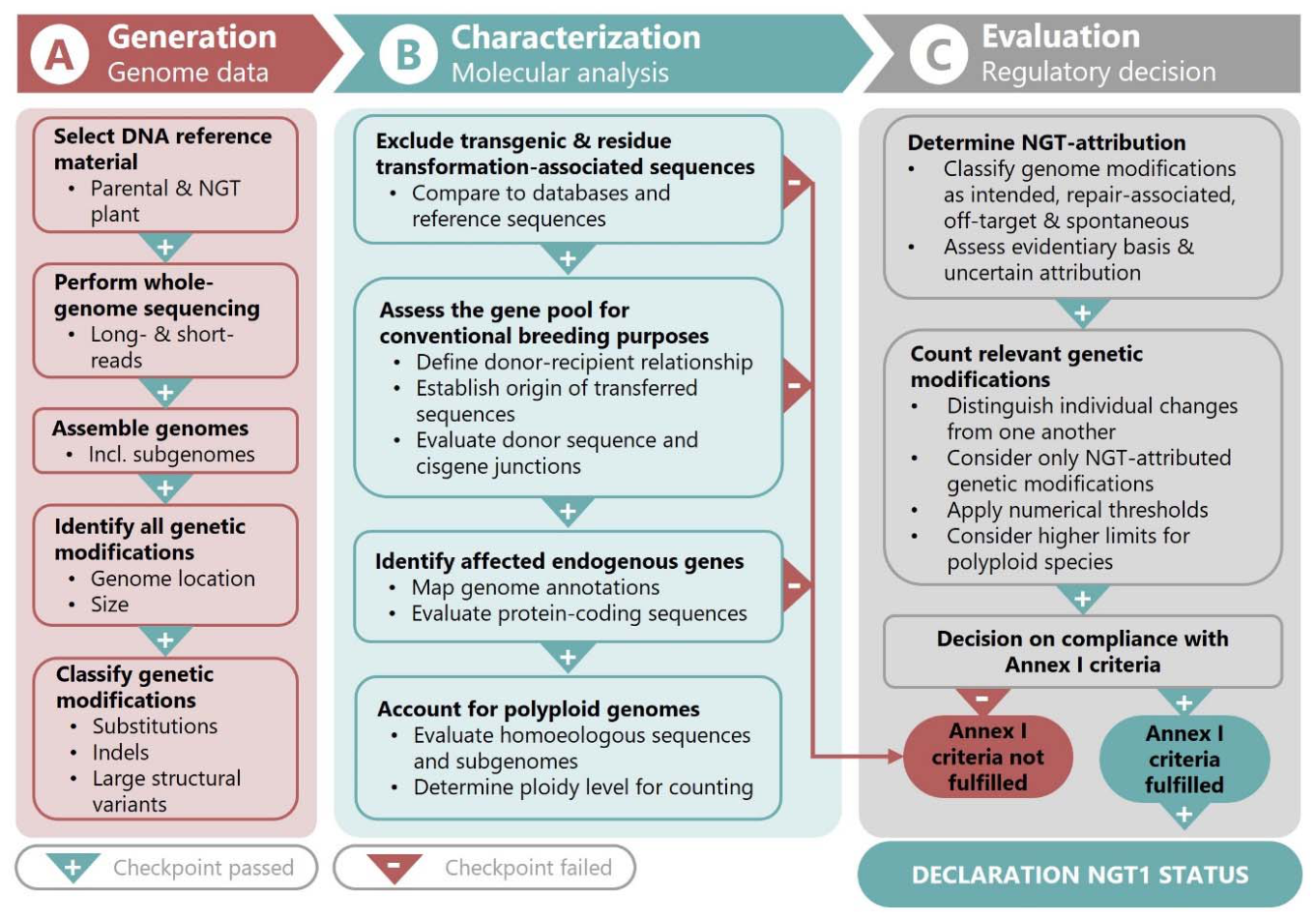

Table 1.
Comparison of primary aspects of molecular characterization under EU GMO legislation.
| MOLECULAR CHARACTERIZATION | DIRECTIVE 2001/18/EC |
REGULATION (EU) 2026/1388 (ANNEX I) |
|---|---|---|
| GENOMIC LOCATIONS | Determine event insertion sites and copy number | Identify all genetic modifications relative to the parental genome |
| GENETIC MODIFICATION | Determine event sequence, structure, and integrity | Categorize DNA changes (e.g. insertions or deletions) |
| AFFECTED GENES | Identify disrupted genes relevant for risk assessment | Identify interrupted endogenous genes and genetic modifications within protein-coding sequences |
| SEQUENCE IDENTITY | Confirm described sequence origin, identity, and stability | Demonstrate that DNA sequences originate from the gene pool for conventional breeding purposes; exclude transgenic & residual transformation-associated sequences |
| PROTEIN EXPRESSION | Identify new open reading frames, potential toxins, or allergens relevant for risk assessment | Identify endogenous gene interruption causing chimeric proteins |
| ATTRIBUTION | - | Evaluate attribution of genetic changes to NGT |
| COUNTING | - | Count relevant genetic modifications |
| REGULATORY AIM | Support GMO risk assessment | Ensure compliance with Annex I |
Disclaimer/Publisher’s Note: The statements, opinions and data contained in all publications are solely those of the individual author(s) and contributor(s) and not of MDPI and/or the editor(s). MDPI and/or the editor(s) disclaim responsibility for any injury to people or property resulting from any ideas, methods, instructions or products referred to in the content. |
© 2026 by the authors. Licensee MDPI, Basel, Switzerland. This article is an open access article distributed under the terms and conditions of the Creative Commons Attribution (CC BY) license (http://creativecommons.org/licenses/by/4.0/).
Copyright: This open access article is published under a Creative Commons CC BY 4.0 license, which permit the free download, distribution, and reuse, provided that the author and preprint are cited in any reuse.