

Submitted:
23 September 2026
Posted:
24 September 2026
You are already at the latest version
Abstract
Bisphenol A (BPA, 2,2-bis(4-hydroxyphenyl) propane) is a synthetic intermediate used worldwide in the industrial production of polycarbonates and epoxy resins. Its extensive use has led to systemic accumulation across various environmental matrices, leading to significant toxicological concerns resulting from its well-documented role as an endocrine disruptor associated with metabolic disorders, reproductive abnormalities, and oncogenic risks. Consequently, worldwide, the need to develop robust and highly sensitive analytical tools for the detection of trace amounts of BPA has proven essential for both environmental monitoring and the protection of public health. Building on our previously reported MnPc-His-CPE biomimetic sensor, this study presents the design, electrochemical characterization, structural analysis, and electroanalytical evaluation of a novel cobalt phthalocyanine–histidine-modified carbon paste electrode (CoPc-His-CPE), with particular emphasis on elucidating the role of the central metal ion in metallophthalocyanine-based sensors for trace-level BPA determination. To our knowledge, this constitutes the first systematic structural and mechanistic investigation of a CoPc-His-CPE platform for BPA sensing. The integration of histidine into the CoPc-CPE matrix induces a synergistic effect that significantly enhances the electrochemical performance relative to conventional configurations. The structural and morphological properties of the resulting composite were investigated by FT-IR, UV–Vis spectroscopy, and SEM, while charge transfer dynamics were elucidated through cyclic voltammetry, chronocoulometry, and electrochemical impedance spectroscopy (EIS). Under optimized square wave voltammetry (SWV) conditions, the sensor exhibited a broad linear range from 8.10-8 to 4.10-5 mol L⁻¹, with a detection limit of 4.78 nmol L⁻¹ (S/N = 3). The sensor further demonstrated selectivity and stability (RSD = 5.0%, n = 10), and its practical utility was validated through the analysis of real environmental samples, yielding recovery rates ranging from 91.10% to 106.40%.
Keywords:
biomimetic sensor
; bisphenol A
; cobalt phthalocyanine
; histidine
; carbon paste electrode
; square wave voltammetry
; aqueous matrices
1. Introduction
Bisphenol A [2,2-bis(4-hydroxyphenyl) propane], which is known as BPA, plays an important role in modern industrial chemistry, where it is mainly used as a monomer in the synthesis of polycarbonate plastics and epoxy resins, and as well as a constituent of certain flame-retardant formulations [1,2]. Its widespread incorporation into consumer products, which includes food packaging, beverage containers, infant feeding bottles, and electronic components, creates multiple pathways for human exposure, primarily through leaching into foodstuffs and aqueous media [2]. From a toxicological standpoint, BPA is a well-known xenoestrogen, capable of interfering with endogenous hormonal signaling by binding to estrogen receptors, thereby disrupting endocrine homeostasis [2,3]. Chronic or developmental exposure has been associated with reproductive dysfunction, polycystic ovary syndrome, genital malformations, and increased susceptibility to hormone-dependent malignancies [4]. These health concerns have intensified regulatory oversight of BPA in many jurisdictions, but significant gaps persist in low- and middle-income countries. In Burkina Faso, recent environmental surveys have documented BPA concentrations between 2 and 8 mg/L in industrial wastewater and surface water sources [5], with levels that substantially exceed the thresholds (EFSA: 0.2 ng/kg BW/day; USEPA: 50 µg/kg BW/day) recommended by international health authorities [6,7]. This situation is exacerbated by the rapid expansion of BPA-dependent industries, including the manufacture of plastic packaging and paints, in the absence of adequate regulatory standards for discharges and specialized monitoring infrastructure.
In this context, the development of sensitive and field-deployable analytical tools for quantifying trace amounts of BPA represents both an environmental and public health priority. Reference methods currently used for this purpose, including liquid chromatography-mass spectrometry (LC-MS) [8], high-performance liquid chromatography (HPLC) [2], gas chromatography-mass spectrometry (GC-MS) [9], and enzyme-linked immunosorbent assays (ELISA) [10], offer well-recognized reliability and sensitivity. Nevertheless, their routine deployment is constrained by the need for expensive instrumentation, complex sample preparation protocols, and rigorous maintenance, which collectively limit their applicability in resource-limited or field settings. These practical barriers have motivated the development of electrochemical sensors based on chemically modified electrodes (CMEs), which combine adequate sensitivity with operational simplicity, low fabrication cost, rapid response, and amenability to miniaturization, most notably in modified glassy carbon electrodes (GCEs), screen-printed electrodes (SPEs), and carbon paste electrodes (CPEs) [11]. Among the available substrates, carbon paste electrodes (CPEs) have attracted sustained interest due to their ease of preparation, low cost, renewable surface, and exceptional versatility in accommodating various electroactive modifiers [12,13,14,15,16,17,18]. The strategic incorporation of such modifiers into the carbonaceous matrix enables synergistic enhancement of electron transfer kinetics and analyte recognition. Recent literature highlights a growing interest in molecularly imprinted electrochemical sensors (MIES) for BPA detection [19]. These platforms rely on the generation of tailored recognition sites within a polymeric matrix to achieve selective binding. Nevertheless, as underscored in reference [19], the practical deployment of MIES remains constrained by notable operational limitations. Key challenges include the lack of standardized protocols for molecularly imprinted polymer (MIP) synthesis, which compromises batch-to-batch reproducibility, therefore leading to suboptimal stability and diminished selectivity when operating in complex real-world samples containing interfering compounds.
In the past, advancements in biosensor technology relied on the incorporation of biological elements into carbon-based or alternative matrices to enhance analytical performance. The practical deployment of these biosensors was hampered by several critical limitations. These include the inherent instability of biological entities on electrode surfaces, slow response kinetics, and insufficient detection limits. Furthermore, the rigorous extraction and purification processes required for natural enzymes often prevent their large-scale application, as maintaining biological activity and interfacial stability remains a major operational constraint. To address these limitations, a promising alternative has emerged in the form of biomimetic systems. By incorporating redox substances or synthetic materials designed to mimic the catalytic centers of natural enzymes, researchers can replicate essential biocatalytic functions within a more robust artificial framework [20]. Over the past few years, these devices have attracted considerable interest, mainly due to their impressive analytical capabilities, including their exceptional selectivity, low detection limits, and inherent portability. By bridging the gap between synthetic chemistry and biology, these biomimetic catalysts achieve performance levels comparable to those of natural enzyme systems, while overcoming the fragility generally associated with biological components. Mechanistically, they work by lowering activation energy barriers, thereby streamlining the electro-oxidation of target analytes at the electrode interface. This strategic shift toward synthetic catalysts that mimic biological functions has paved the way for a diverse range of biomimetic sensors [15,19,21,22,23,24,25,26,27,28,29,30].
A particularly productive approach for modifying CPEs relies on the use of metallophthalocyanines (MPc), a class of planar macrocyclic compounds with 18 π bonds capable of mimicking the oxidoreductase activity of natural enzymes. By lowering the activation energy barriers of analyte electro-oxidation, MPcs act as biomimetic catalysts that confer increased selectivity and sensitivity to the resulting sensor platforms [31]. Their structural robustness, tolerance to variations in pH and temperature, and compatibility with cost-effective fabrication methods make them well suited for integration into CPE-based systems [31]. The electrocatalytic performance of MPc-modified electrodes has been demonstrated for a range of analytes, including dopamine, ascorbic acid, artemisinin, as well as various pesticides and pharmaceutical compounds on substrates such as glassy carbon (GCE), boron-doped diamond (BDD), pyrolytic graphite, and indium tin oxide (ITO) [5,17,31,32,33,34,35]. For BPA detection specifically, the combination of MPc with CPE has been explored by several research groups [20,36]. Notably, Santos et al. [20] demonstrated that nitrogenous axial ligands — histidine (His) and imidazole (Imi) — could modulate the reactivity of the manganese metal center in MnPc-modified carbon paste, resulting in a markedly improved catalytic response toward phenolic compounds. Building on this principle, our group recently reported for the first time a MnPc-His-CPE biomimetic sensor for trace-level BPA determination in aqueous media, providing detailed electrochemical and structural characterization of the sensing interface [37]. That study established that L-His coordinates axially and reversibly to MnIIPc, facilitating the MnII→MnIII transition and generating a MnIIIPc-His complex with superior catalytic activity toward BPA oxidation.
Substituting the central metal ion in the phthalocyanine structure constitutes a rational strategy for modulating the electrochemical behavior of the resulting phthalocyanine -modified carbon paste composite, since the redox potential, coordination chemistry, and catalytic efficiency of MPcs are critically dependent on the nature of the metal center. Cobalt phthalocyanine (CoPc) is of particular interest in this context because the CoIII/CoII redox couple is electrochemically accessible within a suitable potential window [38,39]. Furthermore, cobalt centers in metallophthalocyanine complexes are known to engage in axial coordination with a variety of donor ligands, including nitrogen-donating species such as imidazole and pyridine [40,41,42,43], which serve as established structural templates for the imidazolyl side chain of histidine. However, the nature of the axial coordination in the CoPc–histidine composite is not necessarily limited to Co–N ligation. Indeed, histidine is a bifunctional amino acid that can coordinate through either the imidazolyl nitrogen or the carboxylate oxygen, the latter becoming a particularly strong anionic donor upon deprotonation of the –CO₂H group to yield –CO₂⁻. In the specific context of metallophthalocyanines, where the cobalt center is already σ-saturated by the four isoindole nitrogens of the Pc macrocycle, the competitive advantage of neutral imidazole over an anionic carboxylate donor is substantially diminished. Additionally, axial steric constraints further disfavor the bulky imidazole ring, which requires a strict perpendicular orientation, relative to the more compact carboxylate oxygen. Consequently, Co–O coordination via the deprotonated carboxylate of histidine represents a chemically consistent and physically well-grounded binding mode in this system. While Co–N coordination through the imidazolyl nitrogen cannot be rigorously excluded, and both MPc–N(His) and MPc–O(His) binding sites may coexist within the composite material, the dominant coordination mode accessible within the spectral window employed in this work is discussed in light of the FTIR evidence presented herein. Although the axial ligation behavior of CoPc broadly parallels that reported for the MnPc system, the two systems remain chemically distinct in terms of coordination geometry, metal oxidation state preferences, and ligand-field effects. In addition, given that the electrochemical behavior of CoPc-His composites integrated into CPE-based platforms for BPA detection remains largely unexplored, it is of considerable scientific interest to systematically investigate and assess their analytical performance, and to draw a meaningful comparison with the previously reported MnPc-His-CPE platform [37]. An early study by Yin et al. [36] reported BPA sensing using a CoPc-CPE system and attributed the observed response to a Co(III)Pc-mediated oxidation mechanism. More recently, Dhouha Jemmeli et al. developed a sensor incorporating a CoPc derivative (cobalt phthalocyanine tetracarboxylic-polyacrylamide, or CoPc-PAA) into a carbon paste matrix for the detection of BPA in dairy samples [44]. Nevertheless, these studies have collectively failed to provide a systematic characterization of the electrode surface morphology and chemical composition, thus leaving fundamental mechanistic aspects insufficiently addressed.
This study addresses this gap by extending our previously reported MnPc-His-CPE framework [37] to a CoPc-His-CPE composite, with the dual aim of providing comprehensive structural and mechanistic characterization and evaluating its analytical performance for BPA quantification. To the best of our knowledge, this is the first study to report on a CoPc-His-CPE system applied to BPA analysis in aqueous media. Charge transfer dynamics were investigated by cyclic voltammetry (CV) and electrochemical impedance spectroscopy (EIS) using potassium ferricyanide as a redox probe, while the BPA oxidation mechanism was characterized by chronocoulometry, enabling determination of the adsorption capacity (Γads), standard heterogeneous rate constant (ks), diffusion coefficient (D), and reaction stoichiometry. Structural and morphological properties of the composite were characterized by FT-IR, UV–Vis spectroscopy, and scanning electron microscopy (SEM). Analytical performance was assessed under optimized square wave voltammetry (SWV) conditions, and the practical utility of the sensor was demonstrated through BPA quantification in real environmental water samples, with cross-validation against HPLC. Furthermore, a rigorous comparative analysis between the two composites, namely CoPc-His and MnPc-His, will be systematically conducted throughout the course of this investigation.
2. Materials and Methods
2.1. Instruments and Chemicals
Electrochemical Impedance Spectroscopy (EIS) and chronocoulometric (CC) measurements were carried out with a mini-potentiostat (PSTrace 5.7.2001). Cyclic voltammetry (CV) and square-wave voltammetry (SWV) were performed on a 910 PSTAT mini potentiostat. All experiments were conducted using a conventional three-electrode cell (10 mL plastic vessel): the working electrode (bare CPE, CoPc-CPE, or CoPc-His-CPE), a platinum wire counter electrode, and an Ag/AgCl (sat. KCl) reference electrode (0.197 vs. NHE, 25 °C) [45]. All potentials reported hereafter are referenced to Ag/AgCl.
Surface morphology and elemental composition were examined by scanning electron microscopy (SEM, Hitachi SU8020) coupled with energy-dispersive X-ray spectroscopy (EDX, Thermo Scientific SDD detector, Mons, Belgium). UV–Vis absorption spectra were recorded using a Shimadzu UV-2250 spectrophotometer, and FTIR spectra using a Shimadzu FTIR-8400S. BPA quantification in real matrices was validated by HPLC (Agilent HP 1100) equipped with a Luna C18 column and a diode-array detector (DAD).
Cobalt (II) phthalocyanine (CoPc), L-histidine, BPA, and graphite powder were of analytical grade, sourced from Sigma-Aldrich (France), Alfa Aesar (Germany), and VWR (France), and used as received. A 0.2 mol/L BPA stock solution was prepared in absolute ethanol and stored at 4 °C in the dark; working solutions were prepared fresh daily by appropriate dilution in PBS/ethanol (80/20 v/v). All aqueous preparations were made using Milli-Q water (18.2 MΩ·cm).
2.2. Sensor Construction
The unmodified carbon paste electrode (CPE) was prepared by mixing 2.00 g of graphite powder with 1.20 g of kerosene. Homogenization was performed manually in an agate mortar using a pestle for 15 to 20 minutes until a homogeneous paste was obtained. A fraction of this mixture was then packed into the cavity at the tip of a 3 mm diameter glass tube. Before each use, the electrode surface was smoothed by polishing on abrasive paper and then rinsed with distilled water.
The modified carbon paste (CoPc-His-CPE) was prepared using 2.00 g of graphite, 0.051 g of CoPc, and 0.153 g of L-His. Crucially, the solid modifiers were first intimately mixed with the graphite powder before incorporating 1.20 g of the liquid binder (oil). The mixture then underwent manual trituration in an agate mortar for 15 to 20 minutes to ensure perfect homogeneity. A fraction of the CoPc-His-CPE composite was introduced by compaction into the end of a glass tube (d = 3 mm). Electrical contact was established by inserting a platinum wire into the opposite end of the tube. The active surface of the electrode was smoothed by polishing on abrasive paper until a uniform and shiny appearance was achieved, followed by careful rinsing with distilled water. Between measurements, the electrodes were stored dry in a refrigerator at 4 °C.
2.3. Methods and Analytical Procedure
2.3.1. Basic Electrochemical Interfacial Techniques
Electrochemical systems are classified by their standard rate constant k° relative to scan rate. For a fast (reversible) system (k° > 0.3 v1/2), the anodic peak current follows the Randles–Ševčík equation (SI1):
where n is the number of electrons transferred, S the electrode area (cm²), D the diffusion coefficient (cm²/s), Csol the bulk concentration (mol/cm³), and v the scan rate (V/s). For a reversible system, ΔEp = 59/n mV, and the ratio of cathodic to anodic peak currents equals unity.
Ip,a = 2.69 x 10⁵ n3/2 S D1/2 Csol v1/2
For a fully irreversible system (k° < 2.10⁻⁵ v¹/²), no reverse peak is observed and the oxidation peak current is given by:
where α is the coefficient of charge transfer, and na is the number of electron transferred in the rate-determining step. Peak potential shifts anodically with increasing scan rate, and the peak width satisfies the equation (Ep represents the peak potential, and Ep/2 is the half-peak potential (I = Ip/2)):
Ip,a = 2.99 x 10⁵ n (α.na)¹/² S D¹/² Csol v¹/²
|Ep,a – Ep/2| = 47.7/(α.na) mv
As demonstrated in Section 3.3.5, BPA undergoes adsorptive accumulation followed by irreversible oxidation. The peak current Ip,a, the potential Ep,a, and the half-peak width ∆EP,1/2 , for a surface-confined irreversible process, are respectively:
where Γads is the surface concentration of the adsorbed species, and ks is the standard heterogeneous rate constant [46]. Equation (5) is the Laviron's equation (SI1).
Square-wave voltammetry (SWV) superimposes a symmetrical pulse train on a staircase potential ramp (with an amplitude between 5 and 50 mV). Net current (ΔI = Ifwd – Irev) is recorded as a function of potential, yielding a peak centered near the formal potential E°':
The net peak current ΔIp scales linearly with bulk concentration, making SWV intrinsically more sensitive than CV and less susceptible to capacitive background.
Chronocoulometry (CC) was used to determine the effective electrode area, the diffusion coefficient, and the faradaic charge of adsorbed BPA. Charge–time data were analyzed via Anson plots (Q vs t) according to [47]:
where A is the effective surface area of the working electrode, n is the number of electrons exchanged, F is the Faraday constant (96,485 C/mol), C is the substrate concentration, D is the diffusion coefficient, Qdl and Qads are the capacitive charge and the adsorptive charge, respectively.
2.3.2. Analytical Procedure
Measurements were performed in a 2 mmol/L BPA solution prepared in PBS/EtOH (80/20 v/v, PBS: 0.2 mol/L, pH 7.4) containing 0.1 mol/L Na₂SO₄ as supporting electrolyte.
Detection comprised two sequential steps. First, BPA was pre-concentrated on the CoPc-His-CPE surface by holding the potential at +0.200 V for 120 s under quiescent conditions (optimization details are provided in Section 3.3.4). SWV was then recorded from +0.300 to +0.700 V; the resulting oxidation peak at +0.440 V served as the analytical signal. The carbon paste surface was renewed after each measurement to prevent fouling and ensure reproducibility.
2.4. Preparation of Real Water Samples
Water samples representing a range of matrices (tap water, commercially bottled and sachet-packaged water, dam water, and industrial effluents from plastics manufacturing facilities) were collected at selected sites across Ouagadougou, with particular focus on the Kossodo and Gounghin industrial zones as well as the Tanghin dam. After filtration to remove suspended particulates, samples were stored at 7 °C. For analysis, 5 mL of each sample was spiked with 10 mL of BPA standard solution and diluted to a final volume of 15 mL with PBS (pH 7.4)/EtOH (80/20 v/v). Quantification relied on the standard addition method to compensate for matrix effects.
3. Results and Discussion
3.1. Characterization of CoPc-CPE and CoPc-His-CPE Modified Electrodes
3.1.1. Morphology of Bare CPE and CoPc-His-CPE
Scanning electron microscopy (SEM) was employed to study the surface morphology of the bare CPE and CoPc-His-CPE working electrodes. Figure 1 displays the surface morphology of the bare CPE (A) and the CoPc-His-CPE (B). Figure 1A clearly shows that the graphite particles are randomly arranged in a loose structure. On the CoPc-His-CPE surface (Figure 1B), the carbon paste modified with the CoPc-His compound appears compact and uniformly distributed, providing a structure conducive to a significant increase in the effective surface area.
The elemental chemical composition (in weight percentage) of the CoPc-His-CPE surface (Figure 2) was determined by energy-dispersive X-ray microanalysis (EDX). The results indicate a predominance of carbon in the CoPc-His-CPE, along with the presence of elements such as cobalt (Co) and nitrogen (N). Trace amounts of iron (Fe) and silicon (Si) were also detected, which are likely impurities. These microanalysis results confirm the successful modification of the carbon paste within the CoPc-His-CPE system.
3.1.2. Fourier-Transform Infrared Spectroscopy (FT-IR)
In the Supporting Information (SI2), we present the molecular structures of cobalt phthalocyanine (SI2.A), L-histidine (SI2.B), and bisphenol A (SI2.C).
Figure 3 shows the Fourier-Transform Infrared (FT-IR) spectra of pure L-histidine (L-His), carbon paste modified with CoPc (CoPc-CPE), and carbon paste modified with CoPc-His (CoPc-His-CPE). The FT-IR spectrum of pure L-histidine (Figure 3a) shows a broad O-H stretching band around 3200 and absorption bands at 2907 and 1630 associated with the N-H bond of the aromatic amine [48]. This spectrum also exhibits a band around 1420 cm⁻¹ associated with the symmetric carboxylate (–COO⁻) stretching and C–H in-plane bending [49]. In the spectrum of CoPc-CPE (Figure 3b), the intense peaks observed at 1542 cm⁻¹ and 1060 cm⁻¹ are assigned to the C–H bending vibration and the C–N bond stretching within the pyrrole group, respectively, whereas the peak at 1332 cm⁻¹ is attributed to the (C–C) bond vibrations of the isoindole ring [50]. The FTIR spectrum of CoPc-His-CPE (Figure 3c) retains nearly all characteristic vibrational bands of both CoPc and L-His, while providing indirect spectroscopic evidence of electronic perturbation upon coordination of L-His to CoPc. This is reflected by a shift of the symmetric carboxylate stretching band from 1420 to 1415 cm⁻¹, as well as a shift of the N–H stretching band of the aromatic amine from 2907 to 2914 cm⁻¹. Furthermore, the axial coordination of L-histidine (L-His) through its imidazole ring disrupts the initial square planar geometry of CoPc (D₄h symmetry), which normally stabilizes the electronic charge distribution [51]. This distortion results in a slight displacement of the cobalt ion out of the macrocycle plane [52]. The resulting geometric rearrangement, combined with charge transfer induced by the axial ligand, alters the local polarization of the C–C and C–N bonds, whose stretching modes are initially observed at 1332 and 1060 cm⁻¹ in pristine CoPc. The consequent reduction in the transition dipole moment (dµ/dx) during vibration leads to a marked weakening, or even the complete disappearance, of these two bands, as observed in Figure 3c. This phenomenon is enhanced, on the one hand, by the screening effect of the intrinsic bonds of L-His (C=O, N–H, C–H, NH₂), and, on the other hand, by the steric and electronic constraints exerted on the conjugated network, whose rigidification restricts the amplitude of motion.
While the broad O–H stretching band of the carboxylic acid group, initially observed at 3200 cm⁻¹ in the L-His spectrum (Figure 3a), is absent in the CoPc–His–CPE spectrum, a weak peak at 479 cm⁻¹ is observed in Figure 3c, assigned to a ν(Co–O) vibration arising from coordination between the cobalt center and the oxygen of the carboxylate group of L-His [53,54]. The disappearance of the O–H stretching band strongly suggests that the carboxylic acid group of histidine undergoes deprotonation upon coordination with the central cobalt of CoPc, generating a –COO⁻ moiety. This assignment is supported by the electronic and geometric structure of CoPc. The complex possesses D₄ₕ symmetry, with the Co²⁺ ion occupying the center of a planar aromatic macrocycle. The four isoindole nitrogen atoms coordinate cobalt in the equatorial plane, generating a pseudo-square planar ligand field, while two axial positions, one above and one below the molecular plane, remain sterically and electronically accessible to exogenous ligands. In this ligand field, Co²⁺ (d⁷) adopts a low-spin ground state (S = 1/2), with the unpaired electron residing in the d_z² orbital. This orbital is oriented along the axial axis and constitutes the primary acceptor site for axial ligand donation. Deprotonation of –COOH yields –COO⁻, a strong anionic σ-donor whose donation orbital, a symmetric combination of the two oxygen lone pairs of a₁ symmetry in local C₂ᵥ, overlaps effectively with the d_z² orbital along the axial direction, providing a chemically well-grounded rationale for the observed ν(Co–O) band at 479 cm⁻¹ [53,54,55].
Beyond Co–O ligation, the imidazolyl side chain of histidine offers an alternative coordination pathway that cannot be dismissed. The π-nitrogen of the imidazole ring carries a lone pair in the sp² plane, which can engage in a dative σ-bond with the d_z² orbital of cobalt along the axial axis, in a manner fully analogous to that reported for imidazole and pyridine ligands coordinated to metallophthalocyanines [40,41,42,43]. Such a Co–N interaction would give rise to a characteristic ν(Co–N) stretching band expected in the 250–350 cm⁻¹ range [56]. However, this region falls below the lower boundary of the mid-infrared window employed in the present work (4000–400 cm⁻¹), and consequently ν(Co–N) cannot be detected under the current experimental conditions. This represents an instrumental limitation of the spectral range used, rather than an absence of such coordination in the material. Accessing this spectral region will require complementary far-infrared measurements (400–10 cm⁻¹), which are planned for future investigations.
Taken together, the FTIR data presented herein establish Co–O coordination through the deprotonated carboxylate of histidine as the spectroscopically accessible and dominant binding mode in the CoPc–His–CPE composite. The concurrent presence of Co–N coordination via the imidazolyl nitrogen, while not detectable within the current spectral window, remains physically plausible and cannot be excluded. Both MPc–O(His) and MPc–N(His) binding populations may therefore coexist within the material, with the relative proportion of each being a subject for future far-infrared and, potentially, resonance Raman investigations.
These results are consistent with those reported in our previous study on the MnPc–His system [37], suggesting that, despite the chemical distinctions between the two complexes, particularly with respect to coordination geometry, metal oxidation state preferences, and ligand-field effects, histidine coordinates as an axial ligand to both CoPc and MnPc through its deprotonated carboxylate, in a metal-center-mediated binding mode (M–O axial).
3.1.3. Cyclic Voltammetry
The electrochemical behaviors of the bare CPE, CoPc-CPE, and CoPc-His-CPE were investigated by cyclic voltammetry using [Fe] as a redox probe. The ferricyanide/ferrocyanide couple ([Fe) is recognized as a highly reversible and kinetically fast redox system on various substrates [57,58]. However, its behavior can slightly deviate from an ideal fast one-electron process because the redox couple is known to have a more complex mechanism that involves adsorption of species [58].
Figure 4A shows the cyclic voltammograms of the different carbon paste systems (bare CPE, CoPc-CPE, and CoPc-His-CPE) in a solution containing 2 mmol/L of [Fe] and 0.1 mol/L of KCl over a potential range from -0.200 to 0.600 V, at a scan rate of 50 mV/s. Curve (a) shows the cyclic voltammogram of the bare CPE, exhibiting a pair of well-defined voltammetric peaks with a cathodic peak potential (Ep,c) at 0.088 V and an anodic peak potential (Ep,a) at 0.230 V. The peak-to-peak separation (Ep) is 0.142 V. Curve (b) shows the cyclic voltammogram of CoPc-CPE with Ep,c, Ep,a, and Ep values around 0.102 V, 0.196 V, and 0.094 V, respectively. This Ep value represents a slight decrease compared to that of the unmodified CPE. Curve (c) represents the cyclic voltammogram of CoPc-His-CPE with Ep,c, Ep,a, and Ep values around 0.178 V, 0.252 V, and 0.074 V, respectively. Compared to the bare CPE and CoPc-CPE systems, the peak current in the CoPc-His-CPE system significantly increased, while the peak-to-peak separation potential decreased. These results reveal that the CoPc-His system significantly enhances the electrical conductivity of the electrode, thereby facilitating the electron transfer process at the CoPc-His-CPE / (2 mmol/L [Fe], 0.1 M KCl) interface.
While an ideal one-electron system yields a ΔEp of 0.059 V, the observed value of 0.074 V at 35–50 mV/s indicates that reversibility is maintained within acceptable experimental limits for CV. Furthermore, calculations from 35 to 100 mV/s yield a formal potential for the [Fe couple of 0.215 V vs. Ag/AgCl (approx. 0.412 V vs. NHE). These values are consistent with the [Fe redox potential reported in the literature [59] (V vs. NHE). In addition, the symmetry between the anodic and cathodic peak heights (Table 1) confirms that a satisfactory reversible behavior is achieved at the CoPc-His-CPE/[Feinterface.
Figure 4B shows the cyclic voltammograms of CoPc-His-CPE in a solution containing 2 mmol/L of [Fe] and 0.1 mol/L of KCl, at various scan rates (from 35 to 100 mV/s) and within a potential range from -0.200 to 0.600 V. The anodic peak current (Ipa) and the cathodic peak current (Ipc), extracted from Figure 4B, are plotted as a function of the square root of the scan rates () in Figure 4C. The obtained regression curves are straight lines, indicating that the kinetics of the interfacial process is controlled by the diffusion of the [Feredox species. For a purely diffusion-controlled process, the plot should intersect the origin. The presence of a small y-intercept suggests a slight deviation from ideal behavior, likely due to secondary processes that remain non-dominant [60].
The electroactive surface areas of the bare CPE, CoPc-CPE, and CoPc-His-CPE systems were estimated according to the slopes of the Ip,a
versus, based on the Randles–Ševčík equation (1).
Accordingly, the active surface areas for the bare CPE, CoPc-CPE, and CoPc-His-CPE systems were estimated to be 0.0282 , 0.0424 , and 0.0784, respectively (Figure 4D). This indicates that the active surface area of the carbon paste electrode increases progressively and significantly in the presence of CoPc and the CoPc-His complex.
Table 2 summarizes the ΔEp values reported in the literature for various modified electrode systems evaluated using the [Fe(CN)₆]³⁻/⁴⁻ redox probe in cyclic voltammetry. Table 2 also includes the MnPc-His-CPE system.
AuNPs-MOF-CPE: Gold nanoparticles-metal-organic framework-carbon paste electrode.
GQD-IL-CPE : Graphene quantum dots-ionic liquid-carbon paste electrode.
FeNi3-BiOCl-CuS-CPE : Iron-nickel alloy nanoparticles-bismuth oxychloride-copper sulfide-carbon paste electrode.
Porphyridium-cruentum-CPE : Porphyridium cruentum-carbon paste electrode
CoPc-His-CPE : Cobalt phthalocyanine histidine-modified carbon paste composite
MnPc-His-CPE : Manganese phthalocyanine histidine-modified carbon paste composite
Across the surveyed systems, ΔEp values range from 74 mV to 155 mV, reflecting considerable variability in electron transfer kinetics depending on the nature of the electrode modifier. Among the systems based on gold nanoparticles, AuNPs-GCE exhibits a ΔEp of 87 mV, while the incorporation of a metal-organic framework in AuNPs-MOF-CPE results in a notably higher value of 134 mV, suggesting that the added structural complexity of the MOF matrix somewhat hinders interfacial electron transfer. Carbon-based composite electrodes incorporating organic or biological modifiers, such as PQG-IL-CPE (155 mV) and Porphyridium-cruentum-CPE (154 mV), display the largest ΔEp values in the series, indicative of comparatively slower electron transfer kinetics at these interfaces. The FeNi₃-BiOCl-CuS-CPE system yields an intermediate value of 115 mV.
In contrast, the metallophthalocyanine-histidine composite electrodes developed in this study and in our previous study [37] demonstrate markedly superior electrochemical behavior. MnPc-His-CPE achieves a ΔEp of 80 mV [37], while CoPc-His-CPE attains the lowest value in the entire series at 74 mV, outperforming all reference systems included in the comparison. These results underscore the beneficial role of axial histidine coordination to the central metal ion in facilitating rapid and reversible electron transfer at the electrode–electrolyte interface. The quasi-reversible behavior observed for CoPc-His-CPE, approaching the theoretical threshold of 59 mV for an ideal one-electron reversible process, highlights the efficiency of the composite architecture developed in this study in promoting interfacial charge transfer.
3.1.4. Electrochemical Impedance Spectroscopy (EIS)
The resistive properties of the bare CPE, CoPc-CPE, and CoPc-His-CPE interfaces were investigated by electrochemical impedance spectroscopy (EIS). The Nyquist plots recorded in 10 mmol/L [Fe(CN)₆]³⁻/⁴⁻ solution containing 0.1 mol/L KCl (Figure 5) exhibit two distinct kinetic regimes, indicative of a system controlled by both charge transfer and mass diffusion. The spectra were fitted using the equivalent circuit shown in Figure 6, comprising the solution resistance (Rs), the double-layer capacitance (Cdl), and the charge-transfer resistance (Rct) in series with the Warburg impedance (Zw).
At high frequencies, a semicircle is observed, corresponding to the capacitive response of the interface in parallel with Rct. The diameter of this semicircle decreases progressively from the bare electrode (a) to the modified surfaces (b and c), indicating that the incorporation of CoPc and the CoPc-His assembly reduces the energy barrier for electron transfer and enhances the interfacial redox kinetics.
At low frequencies, a linear tail attributed to the Warburg impedance (Zw) is apparent, confirming that the electrochemical process is partially governed by the diffusion of [Fe(CN)₆]³⁻/⁴⁻ species from the bulk solution to the electrode surface.
Quantitative analysis yields a charge-transfer resistance of 7,497 Ω for the bare CPE (curve a), which decreases to 3,680 Ω upon modification with CoPc (curve b) and further to 1,648 Ω for the CoPc-His-CPE (curve c). This progressive reduction confirms that the binary modification effectively lowers the kinetic barrier to electron transfer at the electrode–electrolyte interface.
Overall, these results demonstrate that the successive incorporation of cobalt phthalocyanine and histidine onto the carbon paste electrode significantly improves its interfacial conductivity. The lowest Rct value obtained for CoPc-His-CPE is consistent with the enhanced electrochemical activity observed in the cyclic voltammetry measurements.
As demonstrated in Section 3.1.2, histidine coordinates axially to both CoPc and MnPc through the respective metal centers. A key question then arises regarding the extent to which the nature of the central metal governs the charge transfer characteristics, specifically the charge transfers resistances (Rct) and the double-layer capacitances (Cdl), as probed by the ferri/ferrocyanide redox couple. Table 3 summarizes the Cdl and Rct values fitted using the equivalent circuit for both systems CoPc-His-CPE and MnPc-His-CPE.
The values of 5.898 µF (≈ 5.9 µF) and 6.946 µF (≈ 6.9 µF) fall within the typical range reported for planar and carbon paste electrodes (a few µF to a few tens of µF). This is entirely consistent with the nature of carbon paste electrodes (CPE): their porous and rough microstructure creates an extended electrochemical interface, increasing the real active surface area relative to the apparent geometric surface. These values indicate that both electrodes exhibit a well-developed electroactive surface area, which is favorable for detection and catalysis.
CoPc-His-CPE exhibits an Rct of 1.648 kΩ, approximately 9% lower than the Rct value of MnPc-His-CPE (1.812 kΩ), confirming that cobalt phthalocyanine more effectively facilitates electron transfer to and from the [Fe(CN)₆]³⁻/⁴⁻ redox probe. Since the apparent heterogeneous rate constant k⁰ is inversely proportional to Rct, CoPc-His-CPE proves kinetically more favorable. Additionally, CoPc-His-CPE exhibits a Cdl of 6.946 µF, representing a 17.8% increase relative to MnPc-His-CPE (5.898 µF), which reflects a larger electroactive surface area for the cobalt-based electrode. This difference may be attributed to a more uniform dispersion of CoPc within the carbon paste matrix, or to a His–CoPc interaction that gives rise to a slightly distinct surface morphology. It should also be noted that a higher Cdl implies a greater background capacitive current, which must be carefully subtracted during voltammetric measurements. The time constant τ = Rct × Cdl is approximately 11.446 ms, indicating that the charge transfer process relaxes very slowly, being dominated by the substantial interfacial capacitance. The slightly longer time constant observed for CoPc can be attributed to its higher Cdl, which offsets the gain achieved in Rct. Notably, CoPc-His-CPE simultaneously combines a lower Rct and a larger Cdl, a doubly advantageous configuration for biosensor or sensing applications, as it couples enhanced interfacial kinetics with a larger reactive surface area. This analysis further corroborates the preceding conclusion that CoPc-His-CPE is the superior electrode with respect to the ferri/ferrocyanide redox probe, exhibiting both higher interfacial conductivity and a more extensively developed electroactive surface area.
3.2. Determination of BPA Using the CoPc-His-CPE Modified Electrode
3.2.1. Cyclic Voltammetry
The electrochemical responses of BPA at various electrodes—including bare CPE, CoPc–CPE, and CoPc–His–CPE—were investigated using cyclic voltammetry, as shown in Figure 7. The comparative energy diagram of electron transfer from BPA to the electrodes for the three configurations is represented along a vertical energy axis (Figure 8), where the BPA HOMO constitutes a donor level common to all three systems since the same analyte is involved.
When 2 mmol/L BPA was added to an EtOH/phosphate buffer solution (pH 7.4) containing 0.1 mol/L , a single oxidation peak was observed at all electrodes within the potential window ranging from 0.200 to 0.800 V. This reveals that the BPA oxidation reaction is completely irreversible, aligns with previous studies [66,67,68,69].
Regarding the bare CPE (Figure 7a), the oxidation peak potential is observed at approximately +0.506 V with a low peak current intensity. At the bare carbon paste surface, no specific interaction with BPA occurs beyond weak physisorption on the graphite basal planes. Under these conditions, electron transfer proceeds via an outer-sphere mechanism, requiring BPA to approach the electrode surface at a suitable distance and orientation to enable electron tunneling. The resulting high overpotential is consistent with the large Marcus reorganization energy associated with direct electron transfer from BPA to the unmodified carbon surface.
Compared to the bare electrode, the oxidation peak potential of BPA at the CoPc–CPE (Figure 7b) shifts notably toward less positive values, stabilizing at approximately +0.474 V. Incorporating CoPc into the carbon matrix introduces a redox-active mediator with a well-defined Co(II)/Co(III) couple (Figure 8b). CoPc acts as an inner-sphere mediator: BPA adsorbs in the vicinity of the cobalt center, and electron transfer proceeds through the Co redox center rather than directly to the carbon surface. The Co(II/III) redox couple lies at an intermediate redox potential between the oxidation potential of BPA and the Fermi level of the carbon substrate, thereby lowering the activation barrier for electron transfer by 32 mV. The resulting cathodic shift in oxidation potential provides direct evidence of the intrinsic electrocatalytic activity of CoPc toward BPA oxidation. Furthermore, the concurrent enhancement of the peak current intensity indicates that modification of the carbon matrix not only improves electron transfer kinetics but also increases the effective electroactive surface area, thereby enhancing the overall sensitivity of the sensor toward BPA.
The addition of axial histidine shifts this intermediate level closer in energy to the BPA HOMO and further shortens the first transfer step, lowering Ep,a by an additional 20 mV, for a cumulative decrease of 52 mV relative to bare CPE. The origin of the superior electrocatalytic performance observed at CoPc–His–CPE (Figure 7c) can be attributed to three synergistic effects arising from axial ligation of histidine to the cobalt center. The first effect is electronic in nature. The σ-donor character of the coordinated histidine, acting through the deprotonated carboxylate as established in Section 3.2.4, increases the electron density at the cobalt center, thereby shifting the Co(II/III) redox potential catholically. As a consequence, a lower applied potential (approximately +0.455 V) is required to reach the oxidation threshold of BPA (Figure 8c), which accounts for the observed negative shift in Ep,a relative to CoPc–CPE. The second effect concerns the pre-concentration and adsorption geometry of BPA at the electrode surface. As discussed in Section 3.2.4, the Lewis acid character of the Co(III) center in the pentacoordinate CoPc–His intermediate promotes specific adsorption of BPA via axial Co(III)···HO–BPA interaction. This enforces a favorable orbital alignment between the phenolic lone pairs of BPA and the d_z² orbital of cobalt, substantially reducing the inner-sphere reorganization energy associated with electron transfer and thereby lowering the kinetic barrier of the oxidation step. The third effect is thermodynamic and relates to the stabilization of the oxidized intermediate. Axial coordination by histidine stabilizes the Co(III)Pc–His intermediate in a well-defined pentacoordinate configuration, lowering the free energy of the oxidized state ΔG° and rendering the first electron transfer thermodynamically more favorable. This stabilization directly contributes to the cathodic shift of the oxidation peak potential and to the marked enhancement of the anodic peak current, the latter reflecting both improved electron transfer kinetics and increased local BPA concentration at the modified electrode surface. Collectively, these three cooperative effects account for the significantly enhanced electrocatalytic activity and sensitivity of CoPc–His–CPE toward BPA oxidation. These observations are consistent with previously reported results [70].
It is noteworthy that the maximum oxidation current of BPA completely disappeared during the second cyclic potential scan at the CoPc-His-CPE. This observation can be explained by a fouling phenomenon, whereby the oxidation products of BPA contaminate the electrode surface, thus obstructing the analyte's access to the surface. Similar behavior has been previously observed for the anodic oxidation of BPA [71]. Consequently, as recommended by the analytical procedure, the analysis of BPA in our subsequent experiments was based on the oxidation peak current from the first anodic scan. Following an accumulation phase, the anodic voltammogram, using square-wave voltammetry (SWV), was recorded for BPA determination. This anodic voltammogram exhibits a peak height proportional to the BPA concentration in the solution.
3.2.2. Scanning Electron Microscopy (SEM)
Scanning Electron Microscopy (SEM) was used to compare the microstructure of the CoPc-His-CPE before and during the BPA accumulation step, thereby confirming the presence of the analyte on the modified electrode surface. Figure 9 shows the SEM images of the CoPc-His-CPE system before (Figure 9A) and after BPA accumulation (Figure 9B). In both images, closely intertwined aggregates are observed, indicating that the accumulation process does not induce macroscopic morphological changes visible at this resolution scale. The porous structure formed by these intertwined aggregates is maintained, which is conducive to the efficient diffusion of the analyte toward the cobalt catalytic centers. However, a slight densification of the surface in Figure 9B could be attributed to the presence of adsorbed BPA molecules.
3.2.3. Fourier-Transform Infrared Spectroscopy (FT-IR)
Figure 10 shows the FT-IR spectra of the following systems: pure BPA, CoPc-His-CPE, CoPc-His-CPE after BPA accumulation (CoPc-His-CPE/BPAacc), and CoPc-His-CPE after BPA oxidation (CoPc-His-CPE/BPAox). The spectrum of pure BPA (Figure 10a) exhibits four typical main bands at 3215, 2815, 1439, and 1206 . The broad band observed around 3215 is attributed to the O-H stretching of the phenolic group. The band observed around 2815 cm⁻¹ is attributed to the C–H stretching of the alkane group. The band at 1439 is attributed to the C-H scissoring (bending) deformation of the methyl groups of the isopropylidene bridge (-C(CH₃)₂-) in the BPA molecule, while the intense peak at 1206 actually contains two overlapping vibrational contributions: the stretching vibration of the carbon–oxygen bond of the phenolic group and the C–O–H deformation-bending vibration. Together, this band at 1206 cm⁻¹ confirms the presence of a phenolic –OH group in the molecule [72]. The infrared spectrum of the CoPc-His-CPE system (Figure 10b) is consistent with that reported in Figure 3c, displaying absorption bands at 2914 and 1415 cm⁻¹, previously assigned to the N–H stretching of the aromatic amine and the symmetric carboxylate stretching, respectively, which reflect the electronic perturbation of L-histidine upon coordination to CoPc. This is further supported by the weakening or disappearance of the bands at 1332 and 1060 cm⁻¹, previously assigned in CoPc to the C–C stretching vibration of the isoindole ring and the C–N stretching mode of the pyrrole ring, respectively. Furthermore, a weak absorption band observed at 479 cm‒1 is assigned to the Co–O stretching vibration [53,54,55], which arises from the coordination of the metallic center (Co) with the oxygen atom of the carboxylate group of L-histidine, following deprotonation of its carboxylic acid moiety.
The FT-IR spectrum of CoPc-His-CPE after BPA accumulation (CoPc-His-CPE/BPAacc, Figure 10c) shows three characteristic bands: the band at 479 cm⁻¹ attributed to the ν(Co–O) stretching vibration, and a band around 1415 cm⁻¹ witch was associated with the small shift of the symmetric carboxylate (–COO⁻) stretching and C–H in-plane bending, and a band at 2914 cm⁻¹ attributed to the N–H stretching of the aromatic amine.
The retention of the ν(Co–O) band at 479 cm⁻¹ indicates that the Co–O(His) coordination bond is preserved upon BPA adsorption, suggesting that BPA does not substitute the histidine ligand at the cobalt center. Instead, BPA is likely held at the electrode surface through non-covalent interactions, including π–π stacking with the CoPc macrocycle and hydrogen bonding involving the phenolic –OH groups. Notably, the broad ν(O–H) band observed at 3215 cm⁻¹ in the pure BPA spectrum (Figure 10a) is absent in the CoPc-His-CPE/BPAacc spectrum. This disappearance suggests that the phenolic –OH group of BPA is involved in the interaction with the electrode surface, possibly through coordination or strong hydrogen bonding with the cobalt center of CoPc-His, rather than remaining as a free hydroxyl group. Taken together, these observations are consistent with BPA accumulating on the CoPc-His carbon paste surface through a combination of non-covalent interactions and phenolic –OH involvement.
Similarly, the FT-IR spectrum of CoPc-His-CPE after BPA oxidation (CoPc-His-CPE/BPAox, Figure 10d) displays several significant bands. The bands at 1629 cm⁻¹ and 1419 cm⁻¹ are retained, attributed respectively to the δ(N–H) bending vibration of the amine group of L-His, and to the overlapping δ(C–H) in-plane bending and ν(C=C) skeletal stretching of the aromatic rings (Figure 3c). A new band appears at 1709 cm⁻¹, characteristic of the ν(C=O) stretching vibration of a carbonyl group, consistent with the formation of a ketonic oxidation product [73]. Notably, the ν(Co–O) band at 479 cm⁻¹, previously assigned to the coordination between the cobalt center and the carboxylic oxygen of L-His, is no longer observed in this spectrum. The disappearance of the ν(Co–O) band suggests that BPA oxidation induces a structural reorganization at the cobalt coordination site, possibly due to the release of oxidation by-products or a modification of the electrode surface layer following the electrochemical process. The appearance of the 1709 cm⁻¹ band indicates that BPA undergoes oxidative transformation, leading to the formation of a ketone-containing product. Based on comparisons with structurally related compounds reported in the literature, these spectral observations provide valuable insight into the mechanism of BPA electrooxidation on CoPc-His-CPE, in which ring-opening or side-chain oxidation pathways may lead to ketonic species as final or intermediate products.
3.2.4. Oxidation Mechanism of BPA at the CoPc-His-CPE Modified Electrode
Figure 11 shows the UV-visible spectra of Co(II)Pc (a), CoPc + L-His (b), and CoPc + L-His + BPA (c) recorded in ethanol. The UV-visible spectra of metallophthalocyanines (MPcs) exhibit two types of characteristic bands: the B-band (between 300–350 nm) and the Q-band (between 600–750 nm) [74,75]. In Figure 11, all cobalt phthalocyanine complex spectra display well-defined absorption peaks characteristic of monomeric metallophthalocyanines, featuring an intense band in the visible region (Q-band) around 680 nm and a broad band in the Soret region (B-band) around 310 nm. However, upon adding L-His to the CoPc solution in ethanol, a slight peak appears at approximately 500 nm, accompanied by a minor red-shift from 680 to 685 nm upon L-His coordination. These minor shifts could be associated with a weak interaction between the electrons of CoPc and L-His, following the axial ligation between the central metal and L-His (Co → L-His), resulting in a weakening of the intramolecular perturbation within the CoPc-His molecule. Bartosz Przyby et al., Jan Janczak et al., and Meltem Göksel et al. [75,76,77] have previously observed this phenomenon. In addition to the Q and B bands, all spectra exhibit a weak vibrational feature around 500 nm. Similar results have been reported earlier. Anucha et al. conducted the synthesis, characterization, and photocatalytic evaluation of manganese (III) phthalocyanine for the degradation of bisphenol A under UV irradiation [78]. The authors observed a vibrational peak at 501 nm in the spectrum of manganese phthalocyanine in DMSO, which they attributed to the metal-to-ligand charge transfer (MLCT) process within the manganese phthalocyanine (MnL) [78]. E. Güzel et al. investigated the electronic absorption spectra of non-peripherally substituted phthalocyanine complexes (ZnPc, InPc, CoPc, CuPc, and MnPc) in THF. According to the authors, the MnPc spectrum showed an absorption peak at 524 nm, attributable to the metal-to-ligand charge transfer phenomenon (Mn L) [79]. In 2018, Sen et al. synthesized and characterized a new series of manganese phthalocyanines (MnPc) using electronic absorption spectroscopy [80]. The UV-visible spectra of the four monomeric MnPc derivatives displayed broad bands between 498 and 530 nm, which the authors attributed to the metal-to-ligand (L) charge transfer (MLCT) phenomenon (Mn L) [80]. These observations are consistent with literature data indicating that the absorption peak observed at 500 nm in the UV-visible spectra of CoPc and CoPc-His, in the presence or absence of BPA in ethanol, can be assigned to an MLCT transition within the cobalt phthalocyanine (CoL). Furthermore, the spectrum of CoPc-His recorded in ethanol in the presence of BPA (Figure 11c) reveals the appearance of a new absorption band around 555 nm. The absence of this signal for CoPc alone, as well as for CoPc-His in the absence of BPA, confirms the specificity of this transition. The band at 555 nm provides evidence for the formation of a complex in which BPA acts as an axial ligand. This phenomenon has been well-documented in previous studies, which consistently associate such transitions with modification of the axial coordination sphere of the cobalt center. In 2018, Bawa et al. prepared gold phthalocyanine (AuPc) and a series of its complexes bearing axial pyridine (Py) and substituted pyridine (R-Py) ligands in DMF and DMSO [81]. The UV-vis spectral analysis revealed the emergence of a new absorption band around 575 nm in the spectra of complexes with axial ligands, which was absent in the AuPc spectrum. The authors attributed this new band to a metal-to-axial ligand charge transfer transition (M → Lax, in which Lax and CT represent axial ligand and charge transfer, respectively) [81]. In 2019, Mc Kearney et al. investigated the position of the Q-absorption band in ether- and thioether-substituted Mn(III)Pc species based on axial ligand chemistry. The UV-vis spectral analysis of Mn(III)PcX complexes with axial ligands in organic solvents allowed the authors to identify a new absorption band between 557 and 595 nm, attributable to a metal-to-axial ligand charge transfer transition (MnLax) [82]. Consequently, the absorption band observed around 555 nm in the spectrum of CoPc-His in the presence of BPA in ethanol can be assigned to a charge transfer transition from the metallic center to the axial ligand Lax, which in this case is BPA (Co → BPA). Therefore, in the presence of BPA, the Co(III)Pc-His complex becomes hexacoordinated, with both L-His and BPA acting as axial ligands. The Co(III) center in CoPc-His axially coordinates to the phenolic oxygen (OH) atom of the BPA molecule.
In this study, the interaction between Co(II)Pc and L-His in ethanol likely leads to the formation of an axial coordination between the central metal and L-His (Co ⟶ His) in the first step. Here, the L-His molecule acts as an axial ligand for the CoPc. The primary interaction is essentially a coordination bond involving the L-His oxygen (O in the O-H of the carboxylic acid –COOH group) and the Co metallic center within the CoPc, leading to the formation of Co(II)Pc-His. In the second step, the oxidation of Co(II)Pc-His to the Co(III)Pc-His complex occurs with high yield.
Drawing upon our experimental data and established literature, we propose a plausible mechanism for the electrocatalytic oxidation of BPA mediated by the CoPc-His complex, as detailed in Scheme 1. His binds to Co(II)Pc and induces a Co(II) → Co(III) oxidation with release of one electron toward the carbon paste. As previously analyzed in Section 3.1.2, the deprotonation of the –COOH group of histidine releases –COO⁻, which axially coordinates Co(II) via its dz² orbital. The strong σ-donation from the anionic carboxylate pushes the dz² orbital upward in energy, expelling its single electron toward the π*(Pc) orbitals and subsequently toward the carbon paste. In Co(III)Pc-His (b), the dz² orbital is vacant. It is precisely this vacancy that enables BPA adsorption and subsequent electron transfer. At the preconcentration step at 0.2 V, corresponding to the formation of compound (c), two Co(III)Pc-His units bind to BPA through its phenolic –OH groups. This interaction is dative/coordinative in nature: O(BPA lone pair) → Co(III)(dz², empty). BPA acts as a bridge between two Co(III)Pc-His centers, with both phenolic oxygen atoms occupying the axial positions trans to histidine on each cobalt.
It is important to distinguish, within the overall process occurring at Ep,a = +0.454 V, between a purely chemical step and the subsequent electrochemical step that produces the measured current. In the chemical step, each phenolate oxygen of the bridging BPA transfers one electron to its adjacent, coordinatively unsaturated Co(III) center, reducing it to Co(II) (species (b′), dz¹, SOMO) with concomitant release of two protons and formation of quinone. This intramolecular electron transfer does not, by itself, contribute to the faradaic current, since no charge crosses the electrode–solution interface at this stage. The resulting Co(II)Pc-His species (b′) is then reoxidized at the electrode surface (2(b′) → 2(b) + 2e⁻), regenerating the Co(III)Pc-His mediator (b) and releasing the two electrons that constitute the anodic peak current at +0.454 V. Combining the chemical and electrochemical steps yields the overall stoichiometry (c) → 2(b) + quinone + 2e⁻ + 2H⁺, consistent with the two-electron, two-proton process (n = m = 2) established independently from the pH-dependence study (Section 3.3.4).
This two-step description (chemical BPA → Co(III) electron transfer, followed by electrochemical Co(II) → Co(III) reoxidation at the electrode) is consistent with a classical EC′ catalytic mechanism, in which the metallophthalocyanine acts as a regenerable redox mediator rather than as a simple adsorption site. It also provides a natural explanation for the apparent single-electron character of the rate-determining step identified from the SWV/CV peak-width analysis (SI3): since BPA bridges two chemically independent Co(III) centers, each behaving as an equivalent, spatially separated Co(III)/Co(II) couple, the overall two-electron oxidation proceeds as two structurally distinct, but kinetically similar, one-electron transfers — one per cobalt center — rather than as two sequential transfers at a single redox site.
The mechanism depicted in Scheme 1 clarifies the fate of the two electrons released during BPA oxidation: rather than being transferred directly and simultaneously from BPA to the electrode, they first reduce the two Co(III) centers of the [Co(III)Pc-His]₂–BPA adduct to Co(II) in a purely chemical step, before being returned to the electrode during electrochemical reoxidation of the mediator at +0.454 V, a value 52 mV lower than that required in the absence of catalyst. It is indeed the dz² orbital that accepts electrons from BPA, but it can do so precisely because it is vacant in Co(III)Pc-His, and not because it is partially occupied. The Co(III)(dz², empty) ↔ Co(II)(dz¹, SOMO) cycle constitutes the redox core of the mechanism, and histidine plays a dual role: it initially triggers the Co(II) → Co(III) oxidation that vacates the dz² orbital (step 1), and it stabilizes the Co(III) center between successive turnovers of the catalytic cycle, which is key to the catalytic efficiency of CoPc-His-CPE.
This mediator-regeneration mechanism also accounts for the loss of the BPA oxidation signal observed on the second cyclic scan (Section 3.2.1). Efficient turnover of the catalytic cycle depicted in Scheme 1 requires desorption of the quinone product to free the regenerated Co(III)Pc-His site for a new BPA molecule. When this desorption step is incomplete, quinone (or its further degradation products) remains adsorbed on, or in the immediate vicinity of, the regenerated cobalt center, sterically or electronically blocking subsequent BPA coordination. This fouling phenomenon, consistent with reports for the anodic oxidation of BPA at other substrates [71], explains why the catalytic cycle proposed here operates efficiently over a single anodic scan but requires renewal of the carbon paste surface between successive measurements, as specified in the analytical procedure (Section 2.3.2).
3.3. Optimization of Analytical Parameters for BPA Determination
3.3.1. Influence of the Supporting Electrolyte Type
The conductivity of the solution is linked to the mobility of ions under the influence of an electric field. It constitutes a key factor influencing the efficiency of electrochemical processes. This parameter depends on both the nature and the concentration of the supporting electrolyte. Supporting electrolytes are known to enhance the electrocatalytic response of modified electrodes for the detection of specific analytes by increasing the catalytic current response and/or lowering the detection potential. In this section, the range of supporting electrolytes tested includes: 0.1 mol/L, 0.1 mol/L, 0.1 mol/L, 0.1 mol/L, 0.1 mol/L, NaCl 0.1 mol/L, KCl 0.1 mol/L, and 0.1 mol/L. Table 4 summarizes the electrochemical response characteristics of CoPc-His-CPE in a phosphate buffer solution at pH 7.4. The dependence of the current response on the nature of the anions and cations used was examined. As shown in Table 4, the highest current response and the lowest peak potential were obtained using 0.1 mol/L as the supporting electrolyte. This behavior indicates that the anions are responsible for the increased redox activity at the modified electrode surface. Based on these results, 0.1 mol/L was selected as the supporting electrolyte for all subsequent BPA electrocatalytic experiments.
3.3.2. Effect of the Supporting Electrolyte Concentration
The second parameter investigated is the effect of the supporting electrolyte concentration on the sensitivity of the proposed method.
Sodium sulfate () was selected as the supporting electrolyte for this study. This choice was motivated by its high solubility, low cost, and availability, while also aligning with green chemistry principles due to its eco-friendly nature. From an electroanalytical perspective, ensures a constant ionic strength and high conductivity, which minimizes the solution resistance () within the equivalent circuit. Furthermore, its chemical inertness provides a wide potential window, preventing any electrochemical interference with the oxidation signals of BPA or the phthalocyanine mediators. To investigate the influence of the supporting electrolyte concentration, various concentrations (0.01, 0.05, 0.1, 0.2, 0.5, and 1.0 mol/L) were tested. The results (Figure 12) show that the sensitivity of the method increases as the concentration rises from 0.01 to 0.1 mol/L. Conversely, when the concentration exceeds 0.1 mol/L, the sensitivity decreases. Thus, the BPA peak intensity reaches its maximum value at a supporting electrolyte concentration of 0.1 mol/L. Based on these findings, a concentration of 0.1 mol/L was selected for all subsequent experiments.
3.3.3. Effect of the CoPc-His Modifier Loading on BPA Determination
The effect of the CoPc-His mass percentage in the total mass of the carbon paste electrode (the CoPc-His/carbon paste ratio), ranging from 1% to 9%, on the oxidation current response of 2 mmol/L BPA in 0.2 mol/L phosphate buffer (PBS, pH 7.4; 0.1 mol/L as supporting electrolyte) was investigated by cyclic voltammetry at a scan rate of 80 mV/s} within the potential range from 0.200 to 0.800 V. As shown in Figure 13, the current response increases with the CoPc-His content until the modifier mass reaches approximately 6% of the total paste mass, then decreases significantly as the amount of CoPc-His further increases.
The effective surface area increases due to the higher quantity of CoPc-His. As a result, the number of BPA adsorption sites rises, leading to an improved adsorption capacity of the modified carbon paste electrode. A higher density of oxidation sites results in an enhanced electrocatalytic oxidation current response for BPA. However, an excess of modifier around the graphite particles leads to a decrease in the electrode's effective surface area, thereby reducing the BPA electrocatalytic oxidation current. Although the exact origin of this surface area reduction is not yet formally established, it could be attributed to a loss of homogeneity in the composite mass resulting from CoPc-His overloading. Since the critical modifier percentage beyond which the effective surface area of the modified carbon paste electrode decreases is not known a priori, it must be determined experimentally.
In this study, the CoPc-His compound was first optimized with a CoPc: His mass ratio of 1:3. Subsequently, the mass ratio of CoPc-His relative to the carbon paste was optimized. In agreement with the increase in current response, we observed that the number of adsorption sites increases when the modifier mass percentage (mass of CoPc-His within the CoPc-His-carbon paste composite) is between 1% and 6% (1% mass % CoPc-His 6%). Conversely, an excess of CoPc-His particles (mass % CoPc-His 6%) surrounding the graphite powder surface leads to a decrease in the effective surface area of the modified carbon paste electrode. This phenomenon has been previously reported for the electro-oxidation of various substrates in several systems: BPA at a carbon paste electrode modified with (5, 10, 15, 20-tetrakis [(4-methoxyphenyl)] porphyrinato) cadmium(II) complex ([Cd(TMPP)]) [83], atomoxetine at an iron oxide nanoparticle-enriched carbon paste electrode [84], phenolic substrates at a CTAB-modified carbon paste electrode [85], amitrole at a carbon paste electrode modified with iron(II) phthalocyanine nanoparticles (nanoFePc-CPE) [86], BPA at a carbon paste electrode modified with titanium nanorods (TiO2 NRs-CPE) [87], bisphenol A at a CoPc-modified carbon paste electrode (CoPc-CPE) [36], and BPA at a multi-walled carbon nanotube paste electrode modified with zinc/aluminum/quinclorac nanocomposite layers [32].
These results demonstrate that the proportion of each component in the mixture (the CoPc-His to carbon paste ratio) directly influences the most critical electrochemical characteristics of a chemically modified carbon paste electrode, notably the anodic peak current, measurement reproducibility, and the electroactive surface area available for BPA oxidation. Consequently, a modified carbon paste electrode with a CoPc-His ratio of 6% w/w was used throughout this study.
3.3.4. Effect of pH on BPA Determination
The optimal pH value for BPA determination depends on the molecular form of BPA and, consequently, on the number of protons and electrons involved in the BPA oxidation mechanism at the CoPc-His-CPE/BPA interface. For this reason, we first established the relationship between the oxidation peak potential and pH, which allows the determination of the anodic peak potential slope as a function of the pH value. It is then straightforward, using the Nernst equation (9) [88], to determine the ratio between the number of protons and electrons involved in BPA oxidation.
The effect of the phosphate buffer pH on the CoPc-His-CPE current response for the oxidation of 2 mmol/L BPA, with 0.1 mol/L as the supporting electrolyte, was investigated across a pH range of 6.4 to 8.0, and a potential range from 0.200 to 0.800 V using cyclic voltammetry at a scan rate of 80 mV/s. It was observed that the maximum oxidation current gradually increased as the pH rose from 6.4 to 7.4. However, as the pH increased further toward 8.0, the oxidation peak current decreased (Figure 14). The optimal pH value obtained is consistent with those of real water samples, which are typically around 7.0. BPA has two pKa values (approximately 9.7 and 10.4) and therefore exists in the environment as either an anion or a neutral molecule, depending on the pH. Issaka G. et al. reported that BPA molecules exist in their neutral molecular form at pH 8, their mono-ionized form at 8 pH 10, and their di-ionic form at pH 10 [5,37]. In this study, an optimal pH of 7.4 was obtained. Consequently, the adsorption of BPA onto the CoPc-His-CPE surface favors its neutral molecular form. As illustrated in Scheme 1, BPA in its neutral form is positioned between two CoPc-His units. This spatial configuration promotes close interaction between the active centers and the phenolic groups of the analyte. Within this confined environment, the oxidation of BPA into a quinone derivative (ketone) occurs via a mechanism involving the global release of two protons and two electrons. This concerted process, facilitated by the proximity of the histidine functional groups acting as proton acceptors, confirms the previously established reaction stoichiometry and justifies the enhanced sensitivity of the sensor.
The relationship between the oxidation peak potential and pH is illustrated in Figure 14. As shown in Figure 14, within the selected pH range, the maximum oxidation potential of BPA shifts toward lower values as the pH increases. This implies that protons are involved in the redox process at the CoPc-His-CPE/BPA interface. Furthermore, the plot of the BPA anodic peak potential as a function of pH follows a linear correlation, according to the following equation:
The theoretical slope value can be obtained from the Nernst equation (9). By differentiating the experimental potential E with respect to pH, according to equation (9), we obtain the following equality:
This results in an m/n ratio approaching unity, suggesting that an equal number of electrons and protons are involved in the electro-oxidation of BPA at the CoPc-His-CPE. To clarify the underlying electron-transfer mechanism, two observations are particularly informative. Both the pathways outlined in Scheme 1 and the established optimal pH indicate that the specific BPA configuration (CoPc-His-BPA-His-CoPc) constrains the oxidation process to a balanced release of electrons and protons. Consequently, it can be inferred that m = n = 2, confirming that the oxidation of BPA proceeds via a two-electron, two-proton mechanism.
3.3.5. Effect of Scan Rate on BPA Determination
The analysis of the slope of the regression line log (Ipa) = f(log (v)) is a standard method in voltammetry for determining the charge transfer kinetics and the transport mode of species toward the electrode. The effect of scan rate on the oxidation of 2 mmol/L BPA in 0.2 mol/L phosphate buffer (pH 7.4, 0.1 mol/L as supporting electrolyte) was evaluated by cyclic voltammetry. As shown in Figure 15, the plot of log (Ipa) as a function of log (v) yields a regression line with a slope of 0.89 within the scan rate range from 20 to 150 mV/s. This value of 0.89 confirms that the electrochemical system follows a mixed regime (diffusion and adsorption), dominated by the adsorption of electroactive species onto the electrode surface. This result demonstrates the high capacity of CoPc-His-CPE to preconcentrate BPA traces at its surface, thereby enhancing its quantitative detection performance. However, the deviation from 1.0 (the missing 0.11 value) suggests kinetic limitations, a diffusive contribution, or lateral interactions between the adsorbed molecules. For subsequent experiments, a scan rate of 80 mV/s was selected.
3.3.6. Influence of Accumulation Potential and Time on BPA Determination
To evaluate the influence of the accumulation potential on BPA determination, the maximum oxidation current of 2 mmol/L BPA at the CoPc-His-CPE/BPA interface was measured by CV within the potential range from -0.40 to +0.40 V (in a 0.2 mol/L phosphate buffer, pH 7.4, 0.1 mol/L as supporting electrolyte, with an accumulation time of 120 s). Figure 16A shows that the BPA oxidation peak current increases remarkably as the accumulation potential rises from -0.40 to 0.200 V. However, the oxidation peak current decreases when the accumulation potential exceeds 0.200 V. Consequently, an accumulation potential of 0.200 V was selected as the optimal value for BPA determination in subsequent experiments.
To evaluate the effect of accumulation time on BPA determination, the maximum oxidation current of 2 mmol/L BPA at the CoPc-His-CPE/BPA interface was determined by CV at an accumulation potential of 0.200 V, using various accumulation times ranging from 30 to 240 s (in a 0.2 mol/L phosphate buffer, pH 7.4, 0.1 mol/L as the supporting electrolyte). Figure 16B shows that the oxidation peak current gradually increased as the accumulation time rose from 20 to 120 s. However, the oxidation peak current slightly decreased when the accumulation time exceeded 120 s. This phenomenon can be explained by the obstructive adsorption of BPA, leading to the passivation of the CoPc-His-CPE surface. This fouling hinders electron transfer, thereby reducing the sensor's sensitivity. This behavior is consistent with observations reported for BPA detection on other substrates, notably glassy carbon electrodes modified with rGO-Ag/poly-L-lysine nanocomposites [68], graphene nanoribbons associated with Au-Cu clusters [89], or a CTAB-modified CPE [85]. To balance sensitivity with analysis speed, an optimal accumulation time of 120 s was therefore selected for the remainder of the study. The optimization of accumulation conditions enhances the amount of BPA adsorbed onto the electrode surface, thus increasing measurement sensitivity and lowering the limit of detection.
3.4. Determination of Electrochemical Parameters Corresponding to the Electrode Reaction
3.4.1. Number of Transferred Electrons (N) and Protons (M) – Charge Transfer Coefficient ()
In the plot shown in Figure 17, a linear correlation between the peak potential (Ep,a) and the natural logarithm of the scan rate (ln v) was observed within the scan rate range from 20 to 150 mV. Experimentally, the linear regression equation was determined as follows:
The preceding analysis has established two fundamental characteristics of BPA oxidation at the CoPc-His-CPE: the irreversibility of the electrode process and its adsorption-controlled nature. Given this behavior, the anodic peak potential (Ep,a) can be described according to Laviron’s equation (5).
The experimental expression establishes a linear correlation between Ep,a and ln v, where the slope of the regression line corresponds to RT/(naF). In the Laviron’s treatment, na denotes the number of electrons transferred in the rate-determining step, rather than the overall electron stoichiometry of the reaction. Assuming a symmetric energy barrier ( ≈ 0.5), commonly taken for a fully irreversible electrode process [45], this treatment alone cannot unambiguously establish na, since only the product na is experimentally accessible; this kinetic parameter is discussed together with an independent estimate derived from the Ip,a–W1/2 relationship in SI3. The overall number of electrons and protons transferred during BPA oxidation (n = m = 2) was instead established independently from the pH-dependence of the electrochemical response, consistent with a two-electron, two-proton oxidation process, in agreement with Scheme 1.
3.4.2. Effective Surface Area of CoPc-His-CPE – Diffusion Coefficient (D) – Adsorption Capacity () and Standard Heterogeneous Rate Constant ()
To determine key electrochemical reaction parameters, such as the faradic charge () of the species adsorbed on the electrode surface, the diffusion coefficient (D), and the effective surface area (A) of the electrode, chronocoulometry (CC) experiments (Q vs )) were performed. Subsequently, the values of these parameters were calculated using Anson's equation (8) [47].
The effective surface areas of the bare CPE and CoPc-His-CPE systems were first determined using a solution containing 1.0 mol/L KCl and 0.1 mmol/L as a redox probe. The corresponding plots are presented in Figure 18A and 18B. Figure 18A shows the charge (Q) versus time (t) plot, while Figure 18B shows the charge (Q) versus the square root of time () plot. The experimental linear regression equations (Figure 18B) are as follows:
Q(t1/2) = 1.823 t1/2 – 0.19 (curve (a) for bare CPE)
Q(t1/2) = 3.848 t1/2 – 0.10 (curve (b) for CoPc-His-CPE)
By fitting the slopes of plots (a) and (b) to Anson’s equation (8), the effective surface areas for the bare carbon paste electrode and the CoPc-His-CPE were 0.060 cm² and 0.128 cm², respectively. These values demonstrate that incorporating the CoPc-His complex nearly doubles the electroactive surface area—a gain that likely accounts for the enhanced BPA adsorption observed at the electrode surface.
In a second step, CC experiments were also conducted on the CoPc-His-CPE in an EtOH/phosphate buffer (pH 7.4, 0.1 mol/L as the supporting electrolyte) in the presence and absence of 0.5 mmol/L BPA. The objectives were to determine the BPA diffusion coefficient (D), the adsorption capacity (), and the standard heterogeneous rate constant (). Figure 18C shows the Q vs. t plots in the absence and presence of 0.5 mmol/L BPA, while Figure 18D shows Q vs. . The linear regression equation for the CoPc-His-CPE system is as follows:
Given that n = 2, A = 0.128 , and C = 0.5 mmol/L, the diffusion coefficient (D) was calculated to be 1.55 . This result indicates a high mass transfer rate, facilitated by the presence of CoPc-His within the carbon paste. Linear regression of Q against t¹ᐟ² in the diffusion-controlled region (Figure 18D) yields Q = 54.89·t¹ᐟ² − 3.37 µC (R² = 0.998). The extrapolated intercept is nominally negative, a consequence of the pronounced early-time curvature associated with double-layer charging, which a single linear fit cannot accurately capture down to t = 0, a limitation inherent to single-step chronocoulometric (Anson-type) analysis, where the capacitive and faradaic/adsorptive contributions are superimposed at short times and cannot be perfectly separated by extrapolation alone. Accordingly, |Q(t=0)| was used to calculate . To verify that this estimate is not an artifact of linear extrapolation, we additionally fitted the raw data to a non-linear model incorporating an explicit capacitive term, Q(t) = A(1 − exp(−t/τ)) + m·t¹ᐟ² (SI4). This analysis confirms that the single-potential-step method does not allow the capacitive and faradaic/adsorptive contributions to be fully and unambiguously deconvoluted, supporting the more standard and reproducible linear-regression estimate as the value adopted here ( ≈ 127–141 pmol·cm⁻² (≈1.3 × 10⁻¹⁰ mol cm⁻²)). Independent confirmation of Qdl, for instance via electrochemical impedance spectroscopy (EIS) at the interface or a double-potential-step experiment, would further narrow this range, though it is not required to support the adopted value as the working result of the present study. This value of the adsorption capacity ( ≈1.3 × 10⁻¹⁰ mol cm⁻²) suggests that the CoPc-His complex possesses a high adsorption affinity for BPA. The standard heterogeneous rate constant () for the irreversible oxidation of BPA at the modified electrode was calculated based on Equation (5) [46]. Because an independent, rigorously determined formal potential (E°') is not yet available for this system, the heterogeneous electron-transfer rate constant ks could only be estimated with limited precision. Depending on the assumed value of E°' (0.406–0.420 V), ks falls within an illustrative range of 0.46 – 0.79 s⁻¹. A precise value will require an independent determination of E°' (DPV, SWV, or a reversible reference redox couple). These values are physically consistent with an adsorbed species system (typically 10‒1 to 102 s‒1 in the literature).
The main electrochemical parameters controlling BPA adsorption and oxidation at the CoPc-His-CPE surface — specifically the surface adsorption capacity (), the diffusion coefficient (D), and the effective electroactive area (Aeff) — are compared with those reported for the MnPc-His-CPE counterpart [37]: ≈ 95–100 pmol·cm⁻² (≈ 0.95–1.0 × 10⁻¹⁰ mol·cm⁻²); = 0.55 – 0.81.s-1 (E°′ range 0.412–0.422 V); D = 1.69 x ; Aeff = 0.125 cm². A close examination reveals that CoPc-His-CPE and MnPc-His-CPE display closely related electrochemical performance, both providing a comparable roughly two-fold enhancement of the electroactive surface area relative to the bare CPE and BPA electron-transfer kinetics of the same order of magnitude. Two distinctions stand out: CoPc-His-CPE retains a markedly higher BPA adsorption capacity (≈127–141 vs ≈95–100 pmol cm⁻², a ~25–30% difference), while MnPc-His-CPE combines a modestly higher apparent diffusion coefficient with marginally faster interfacial electron-transfer kinetics. Overall, these findings highlight a complementary rather than identical behavior in mass transport and adsorption: CoPc-His-CPE drives BPA pre-concentration primarily via enhanced surface adsorption, while MnPc-His-CPE couples accelerated BPA transport to the surface with improved charge transfer at the modified interface.
3.5. Analytical Performance
3.5.1. Reproducibility, Stability, and Interference Studies
To evaluate the reliability of the proposed method, the reproducibility and storage stability of the CoPc-His-CPE were investigated using cyclic voltammetry. The relative standard deviation (RSD) of the modified electrode's response for BPA oxidation at concentrations ranging from 0.02 to 40 μmol/L was 5.0% for 10 successive measurements with the same modified electrode, demonstrating the excellent repeatability of the CoPc-His-CPE. To further assess stability, the current response of the modified electrode was measured using 40 μmol/L BPA after storage at 4 °C in a refrigerator for 15 days. The electrode retained 94.0% of its initial current response. However, the current response dropped to 78% after extending the storage time to 28 days under the same conditions. This phenomenon indicates the good stability of the sensor. Furthermore, selectivity studies were conducted in the presence of a 100-fold excess of various interfering ions, including Na+, K+, Ca2+, Mg2+, Fe3+, Al3+, Zn2+, Pb2+, Cu2+, SO42- and NO3- (Table 5). The results demonstrate that these species do not significantly affect the signal of 40 μmol/L BPA, as the current variations remain below 4.6%.
I = ; = 7.06 µA : oxidation peak current of BPA in the presence of the interfering ion ; I/Ip % : Relative signal variation (percentage).
3.5.2. Calibration and Limit of Detection
SWV was applied for the determination of BPA at the CoPc-His-CPE/BPA interface. Figure 19A shows the voltammograms obtained for various BPA concentrations at pH 7.4. The peak current increases linearly with the BPA concentration (Figure 19B) within the linear range from 8 mol/L to 4 mol/L. The corresponding linear regression equation is as follows:
The limit of detection (LOD) was 4.78 nM, based on a signal-to-noise ratio of 3. To contextualize these results, the linear range and LOD of the CoPc-His-CPE system were compared against several previously reported carbon paste electrodes for BPA sensing (Table 6).
When comparing the analytical performance of the sensors listed in Table 6, it is essential to bear in mind that a lower LOD value reflects superior sensitivity, as it indicates the ability to detect BPA at increasingly trace concentrations. On this basis, MnPc-His-CPE (LOD = 0.00463 µmol/L) marginally outperforms CoPc-His-CPE (LOD = 0.00478 µmol/L), with a difference of approximately 3% in favor of the former. Regarding the linear range, MnPc-His-CPE (0.02–50 µmol/L) also extends slightly beyond that of CoPc-His-CPE (0.08–40 µmol/L), offering a broader dynamic detection window. Despite this marginal difference, both electrodes rank among the most sensitive systems reported to date for BPA electrochemical sensing, clearly surpassing several well-established platforms such as MWCNT-CPE (LOD = 4.4 µmol/L), Thio-Tyr-CPE (LOD = 0.15 µmol/L), and NiO-NTC-CPE (LOD = 0.09 µmol/L). Only TiO₂-SWCNTs/HMH/CPE achieves a lower LOD (0.001 µmol/L), albeit at the cost of a more complex fabrication procedure.
Overall, the electrochemical and analytical data indicate that CoPc-His-CPE and MnPc-His-CPE do not perform identically, but rather in a complementary manner. The detection limit (4.78 vs. 4.63 nM) and the effective electroactive area (0.128 vs. 0.125 cm²) differ only marginally (≤3%), confirming that both electrodes offer comparable sensitivity and a similarly well-developed electroactive surface. In contrast, the diffusion coefficient and the standard heterogeneous rate constant (ks) differ by a more substantial ~8% in favor of MnPc-His-CPE, the BPA adsorption capacity () is ~25–30% higher for CoPc-His-CPE, and the lower bound of the linear range differs by a factor of four (0.08 vs. 0.02 µmol/L). These larger discrepancies exceed typical experimental uncertainty and point to genuine, metal-dependent differences in BPA adsorption and transport behavior, discussed further in Section 3.6. Despite these differences, both electrodes remain highly sensitive and constitute viable, high-performing platforms for BPA determination in real-world analytical contexts.
3.5.3. Precision
The precision of the sensor was also evaluated by comparing it with the HPLC technique for the analysis of the same water samples spiked with 10, 20, 30, 40, and 50 mmol/L of BPA. As shown in Figure 19C, the BPA concentration values measured by the developed sensor are approximately identical to the results obtained by HPLC, with respective recovery rates of 88.90%, 96.40%, 98.06%, 99.20%, and 99.74% for the sensor, and 98.20%, 99.30%, 99.80%, 99.82%, and 100% for HPLC. These recovery rates, obtained on a separate series of spiked tap-water samples for direct comparison with HPLC, are consistent with those obtained in the broader multi-matrix validation study presented in Section 3.5.4 (Table 7). Due to its excellent reproducibility, stability, and selectivity against interferences, the CoPc-His-CPE is suitable for practical analytical applications.
Figure 19.
(A) Square Wave Voltammograms (SWV) for CoPc-His-CPE in BPA solutions at various concentrations. (B) Plot of the peak current versus BPA concentration corresponding to Figure 19A. (C) Plots of the measured BPA concentration as a function of the spiked BPA concentration in the samples: using the standard HPLC method (red curve) and the developed sensor (blue curve).
Figure 19.
(A) Square Wave Voltammograms (SWV) for CoPc-His-CPE in BPA solutions at various concentrations. (B) Plot of the peak current versus BPA concentration corresponding to Figure 19A. (C) Plots of the measured BPA concentration as a function of the spiked BPA concentration in the samples: using the standard HPLC method (red curve) and the developed sensor (blue curve).
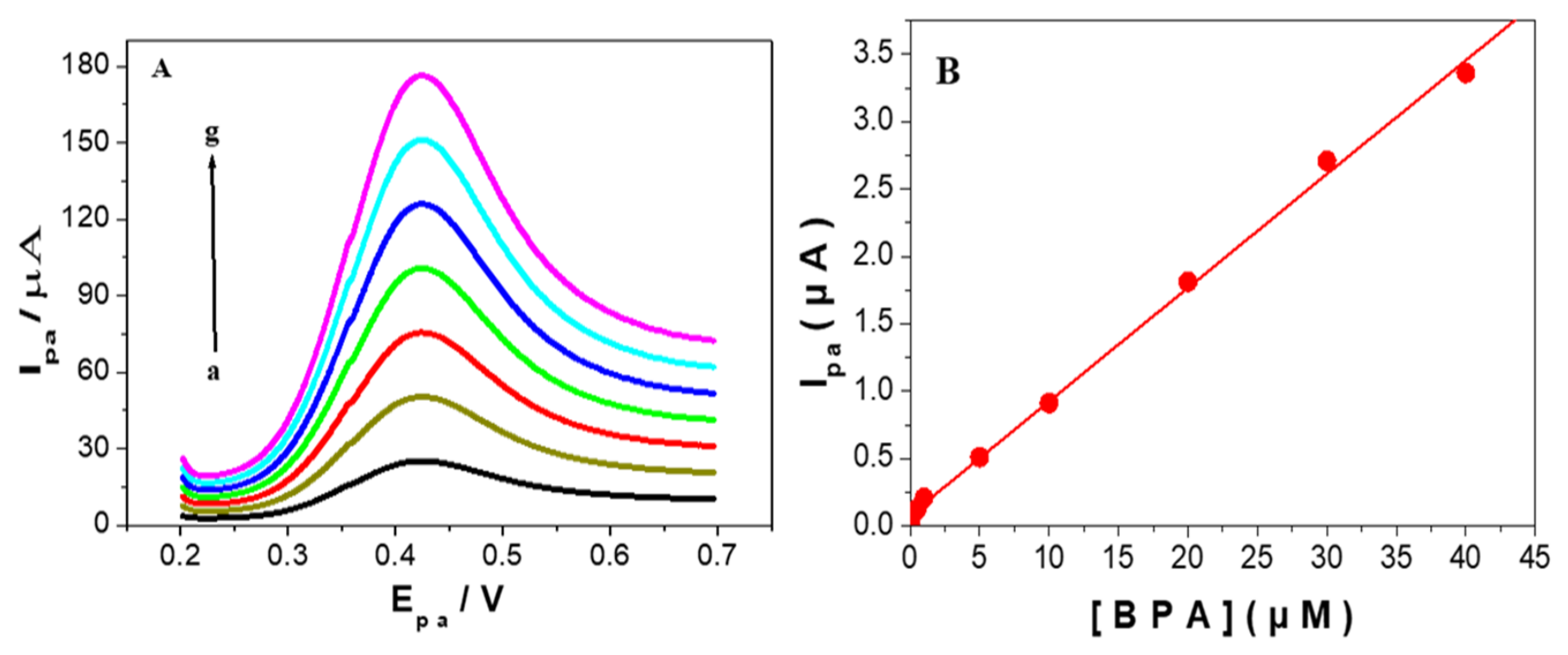
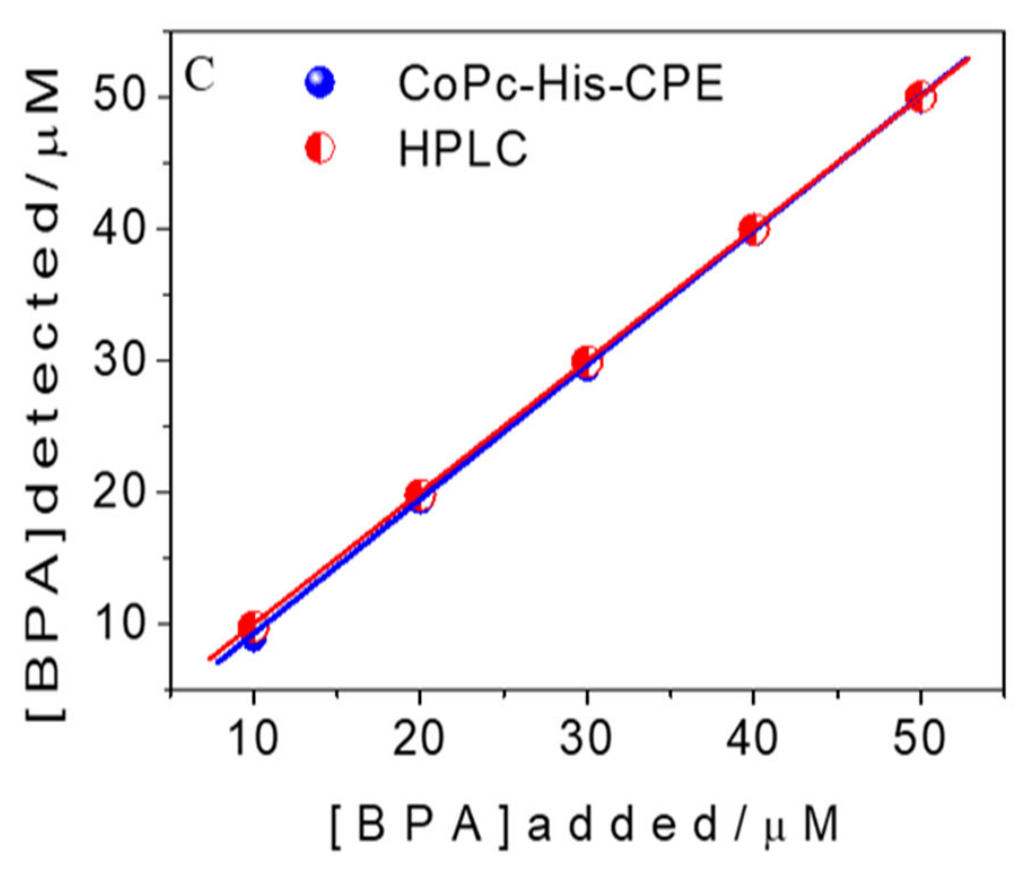
3.5.4. Analysis of BPA in Real Water Samples
To assess the practical utility of the proposed method, the electrochemical sensor was applied to the determination of BPA in various environmental matrices, including tap water, bottled mineral water, sachet-packaged water, dam water, and plastic industry effluent. Under optimized conditions, a recovery study was conducted following the aforementioned analytical protocol. As summarized in Table 7, recovery rates ranged between 91.1% and 106.4%. These findings underscore the sensor's sensitivity, selectivity, and overall precision, confirming its suitability for routine environmental monitoring.

Table 6.
Comparison of different modified carbon paste electrodes for BPA determination.
| Sensor | Linear range (µmol/L) |
Limit of detection (µmol/L) | Reference |
| CMK3-nanoCILPE | 0.2-150 | 0.05 | [12] |
| CoPc-CPE | 0.0875-0.125 | 0.01 | [36] |
| Ce-ZnO-CPE | 0.5-62 | 0.018 | [70] |
| ZnO CNTs -IL-CPE | 0.002-700 | 0.009 | [90] |
| Thio-Tyr-CPE | 0.15-45 | 0.15 | [91] |
| Bi2WO6-CPE | 0.07-1.3 | 0.02 | [92] |
| nAg–PVP-CPE | 0.04-1 | 0.025 | [93] |
| MWCNT-CPE | 30.0-3.0 | 4.4 | [94] |
| NiO-NTC-CPE α-MoO3-CPE TiO2-SWCNTs/HMH/CPE |
0.5-800.0 0.03-1.6 0.003-450 |
0.09 0.015 0.001 |
[95] [96] [97] |
| MnPc-His-CPE | 0.02−50 | 0.00463 | [37] |
| CoPc-His-CPE | 0.08-40 | 0.00478 | This study |
CNTs: Carbon nanotubes ; ZnO: Zinc oxide ; : Bismuth tungstate ; Ce-ZnO: Cerium-doped zinc oxide nanorods (nanotiges) ; Thio-Tyr: Thionine-tyrosinase ; CoPc: Cobalt phthalocyanine ; CdO NPs: Cadmium oxide nanoparticles ; CMK-3: Mesoporous carbon ; Ag-PVP NPs: Polyvinylpyrrolidone-stabilized silver nanoparticles (nAg–PVP) ; Mo : Molybdenum trioxide ; IL-GO: Ionic liquid-functionalized graphene oxide ; OMS (HMS): Ordered mesoporous silicas (Hexagonal Mesoporous Silica) ; TiO2 : Titanium dioxide ; SWCNTs : Single-Walled Carbon Nanotubes ; HMH : 1-hexyl-3-methylimidazolium hexafluorophosphate.
Table 7.
Determination of BPA in real water samples using the CoPc-His-CPE.
| Sample | [BPA]added/µM | [BPA]detected/µM | Recovery (%) |
| S1 | 10 | 9.11 | 91.10 |
| S2 | 10 | 10.19 | 101.90 |
| S3 | 10 | 9.85 | 98.50 |
| S4 | 10 | 9.66 | 96.60 |
| S5 | 10 | 10.64 | 106.40 |
: Tap water; : Bottled water; : Plastic bag water; : Dam water; : Plastic factory wastewater
3.6. Central Metal Ion Effect: Reconciling Interfacial and Analyte-Specific Electrochemistry
A central objective of this work was to elucidate the role of the central metal ion in metallophthalocyanine-based biomimetic sensors, through a direct comparison with the previously reported MnPc-His-CPE platform [37]. This comparison reveals two distinct, and only partially convergent, levels of behavior that must be clearly distinguished. At the level of the bare electrode–electrolyte interface, probed by cyclic voltammetry and electrochemical impedance spectroscopy using the ferri/ferrocyanide couple, the nature of the central metal has a measurable and non-negligible influence: CoPc-His-CPE displays a smaller peak-to-peak separation (ΔEp = 74 vs. 80 mV), a 9% lower charge-transfer resistance, and an 18% higher double-layer capacitance than its manganese counterpart, indicating genuinely faster interfacial electron-transfer kinetics and a more developed electroactive surface for the cobalt-based composite. At the level of BPA-specific electrocatalysis and quantification, the picture is more nuanced than a simple equivalence: the detection limit (4.78 vs. 4.63 nM) and the effective electroactive area (0.128 vs. 0.125 cm²) differ only marginally (≤3%), but the diffusion coefficient (1.55 vs. 1.69 × 10⁻⁵ cm² s⁻¹) and the standard heterogeneous rate constant (0.46–0.79 vs. 0.55–0.81 s⁻¹) are both modestly, yet consistently, higher for MnPc-His-CPE (~8%), while the BPA adsorption capacity is markedly higher for CoPc-His-CPE ( ≈ 127–141 vs. 95–100 pmol cm⁻², a 25–30% difference), and the linear range extends further for MnPc-His-CPE, particularly at its lower bound (0.02 vs. 0.08 µmol/L, a four-fold difference).
This more detailed picture is chemically meaningful rather than contradictory. Measured with the ferri/ferrocyanide probe, the interfacial kinetics reveal the composite's intrinsic conductivity and effective surface area, governed primarily by the metal center's electronic structure and its effect on the carbon paste matrix; here cobalt is unambiguously favored. BPA sensing, however, depends on a distinct, coupled set of chemical events: axial coordination of histidine to the metal, BPA adsorption at the resulting vacant axial site, and the electron-transfer/proton-loss sequence detailed in Scheme 1. These steps do not respond uniformly to the identity of the central metal. The vacant dz² orbital of Co(III)Pc-His, which drives strong BPA binding through dative O(BPA)→Co(III) coordination (Section 3.2.4), plausibly accounts for the higher observed for CoPc-His-CPE: a more strongly bound, more slowly exchanging BPA adduct favors adsorption capacity but does not necessarily accelerate mass transport or interfacial electron transfer to the electrode, consistent with the slightly higher D and ks obtained for MnPc-His-CPE. In other words, the central metal ion does not act as a neutral spectator in BPA sensing; rather, it modulates the relative weight of adsorption versus diffusion/kinetics within the same overall reaction sequence, cobalt favoring pre-concentration through stronger BPA binding, manganese favoring faster analyte transport and mediator turnover.
This distinction refines, rather than negates, the conclusion that CoPc-His-CPE constitutes a fully viable alternative to MnPc-His-CPE. The two platforms are not strictly interchangeable, but complementary: the parameters most directly relevant to sensitivity, LOD and effective surface area, remain closely matched (≤3%) between the two metal centers, while the more mechanistically distinct parameters (, D, ks, and the extent of the linear range ) differ by amounts that exceed typical experimental uncertainty and reflect genuine, metal-dependent differences in the balance between BPA adsorption and BPA transport/electron-transfer kinetics. From a practical standpoint, CoPc-His-CPE, with its higher adsorption capacity and faster interfacial kinetics toward the ferri/ferrocyanide probe, is arguably better suited to applications privileging pre-concentration and interfacial conductivity, whereas MnPc-His-CPE, with its marginally faster BPA diffusion/kinetics and broader linear range, may be preferable when a wider dynamic range is required. Both metal centers nonetheless deliver comparably low detection limits, confirming that histidine axial coordination provides a robust, broadly metal-tolerant catalytic pathway for BPA oxidation, while still leaving room for metal-specific fine-tuning of the sensor's adsorption and transport characteristics, an added degree of design flexibility for future biomimetic carbon paste sensors targeting phenolic endocrine disruptors.
4. Conclusions
This study reports the development of an electrochemical sensor based on a novel cobalt phthalocyanine/histidine-modified carbon paste biomimetic composite (CoPc–His–CPE). Beyond the fabrication of a biomimetic sensing platform, the study provides insight into the chemical interactions responsible for the stability of the composite architecture. FTIR characterization establishes Co–O coordination through the deprotonated carboxylate of histidine as the spectroscopically dominant axial binding mode in the CoPc–His-CPE composite, consistent with the electronic and geometric structure of CoPc and the anionic donor character of the –COO⁻ moiety generated upon deprotonation of the –COOH group. While Co–N coordination via the imidazolyl nitrogen cannot be excluded — and both MPc–O(His) and MPc–N(His) binding populations may coexist within the material — this question remains open to far-infrared investigations beyond the spectral window employed in the present work. The incorporation of the CoPc–His modifier, characterized by a high specific surface area and good intrinsic conductivity, resulted in a significant enhancement of the oxidation current response toward Bisphenol A (BPA) relative to the unmodified electrode.
Following systematic optimization of the experimental parameters, the CoPc-His-CPE exhibited a well-defined linear response over the concentration range of 8.10⁻⁸ to 4.10⁻⁵ mol/L, with a detection limit of 4.78 nmol/L. Kinetic analysis further indicates that the proposed electrode compares favorably with several previously reported carbon-based modified sensors. The practical applicability of the method was confirmed through analysis of real water samples, with recovery rates ranging from 91.1% to 106.4%, reflecting satisfactory selectivity and stability under realistic conditions.
Comparison with the MnPc-His-CPE platform described in the literature provides a better understanding of the role of the central metal ion in this class of biomimetic sensors (Section 3.6): while cobalt confers measurably faster interfacial electron-transfer kinetics and a stronger BPA adsorption capacity than manganese, and manganese in turn offers marginally faster BPA diffusion/kinetics and a broader linear range, both metal centers deliver comparably low detection limits, reflecting a shared, histidine-driven catalytic pathway for BPA oxidation. This establishes cobalt phthalocyanine as a fully viable, and electronically more conductive, alternative to its manganese counterpart for sensitive BPA electrochemical determination, and points to histidine axial coordination, rather than the specific identity of the metal center, as the key design element governing analyte recognition in this family of biomimetic sensors, with the choice of metal offering a further degree of fine-tuning between adsorption-driven pre-concentration and diffusion-driven sensitivity.
Author Contributions
Conceptualization, A.S.M., C.B., A.A.M., and B.G.; Methodology, A.S.M., C.B., A.A.M., and B.G.; Investigation, A.S.M. and C.B.; Writing—Original Draft Preparation, A.S.M.; Writing—Review and Editing, A.S.M., C.B., A.A.M., and B.G.; Supervision, B.G.; Funding Acquisition, B.G.
Funding
The authors thank the International Science Program (ISP, Uppsala, Sweden) for providing financial support.
Declaration of Competing Interest
The authors declare no conflicts of interest.
Data availability
Data will be made available upon request.
References
- Gupta, A.; Singh, A.; Mishra, V.K. Impact of Bisphenol-A in the environment and its removal through biological agents: A review. Environ. Qual. Manag. 2024, 34, e22246. [Google Scholar] [CrossRef]
- Rodriguez, R.; Castillo, E.; Sinuco, D. Validation of an HPLC Method for Determination of Bisphenol-A Migration from Baby Feeding Bottles. Anal. Meth. Anal. Meth. Chem. 2019, 1989042. [Google Scholar] [CrossRef] [PubMed]
- Balabanic, D.; Filipic, M.; Klemencic, A. Genotoxic activity of endocrine disrupting compounds commonlypresent in paper mill effluents. Sci. Total Environ. 2021, 794, 148489. [Google Scholar] [CrossRef] [PubMed]
- Peters, A.E.; Ford, E.A.; Roman, S.D.; Bromfield, E.G.; Nixon, B.; Pringle, K.G.; Sutherland, J.M. Impact of Bisphenol A and its alternatives on oocyte health: a scoping review. Hum. Reprod. Updat. 2024, 30(6), 653–691. [Google Scholar] [CrossRef] [PubMed]
- Issaka, G.; Brahima, S.; Adama, Y.; Boubie, G.; Dickson, A. Removal of bisphenol A by adsorption on organically modified clays from Burkina Faso. Bioremediation Journal. 2021, 25(1), 22–47. [Google Scholar] [CrossRef]
- Chen, H.C.; Chang, J.W.; Lin, Y.J.; Chang, W.T.; Huang, H.; Chen, C.Y.; Huang, P.C. Reference values and exposure risk of bisphenol A and its substitutes in Taiwan: Taiwan environmental survey for Toxicants (TESTs) 2013–2016. Ecotoxicol. Environ. Saf. 2025, 307, 119401. [Google Scholar] [CrossRef] [PubMed]
- Yüksel, S.; Kabay, N.; Yüksel, M. Removal of bisphenol A (BPA) from water by various nanofiltration (NF) and reverse osmosis (RO) membranes. J. Hazard. Mater. 2013, 263, 307–310. [Google Scholar] [CrossRef] [PubMed]
- Dreolin, N.; Aznar, M.; Moret, S.; Nerin, C. Development and validation of a LC-MS/ MS method for the analysis of bisphenol A in polyethylene terephthalate. Food Chem. 2019, 274, 246–253. [Google Scholar] [CrossRef]
- Bojke, A.; Littwin, M.; Szpiech, A.; Duljas, E.; Jasinski, P.; Wittstock, I.; Jazdzewska, O.; Galer-Tatarowicz, K. Determination of bisphenol A (BPA) in Gdynia harbor waters using gas chromatography-mass spectrometry (GC-MS). Water 2023, 15, 2958. [Google Scholar] [CrossRef]
- Hassani, S.; Maqbool, F.; Salek-Maghsoudi, A.; Rahmani, S.; Shadboorestan, A.; Nili- Ahmadabadi, A.; Amini, M.; Norouzi, P.; Abdollahi, M. Alteration of hepatocellular antioxidant gene expression pattern and biomarkers of oxidative damage in diazinon-induced acute toxicity in Wistar rat: a time-course mechanistic study. EXCLI J. 2018, 17, 57–71. [Google Scholar] [CrossRef]
- Gugoasa, L.A.D. Review—Electrochemical Sensors for Determination of the Endocrine Disruptor. Bisphenol A. J. Electrochem. Soc. 2020, 167, 037506. [Google Scholar] [CrossRef]
- Li, Y.; Zhai, X.; Liu, X.; Wang, L.; Liu, H.; Wang, H. Electrochemical determination of bisphenol A at ordered mesoporous carbon modified nano-carbon ionic liquid paste electrode. Talanta 2016, 362–369. [Google Scholar] [CrossRef] [PubMed]
- Mourati, R.; Oularbi, L.; Achargui, N.; el Krati, M.; Younssi, S.; Tahiri, S.; el Rhazi, M. Carbon Paste Electrode Modified with Al- and Si-rich. Water Treatment Sludge for Bisphenol-A Detection. J. Environ. Chem. Eng. 2022, 10(4), 108072. [Google Scholar] [CrossRef]
- Jahani, P.M.; Beitollahi, H.; Nejad, F.G. Voltammetric determination of bisphenol A using a modified carbon paste electrode. Int. J. Environ. Anal. Chem. 2025, 105(10), 2229–2242. [Google Scholar] [CrossRef]
- Rejab, F.; Dardouri, N.E.; Rouis, A.; Echabaane, M.; Nasri, H.; Lakard, B.; Ben Halima, H.; Jaffrezic-Renault, N.A. Selective electrochemical sensor for the detection of bisphenol A based on cadmium (II) (bromophenyl)porphyrin and gold nanoparticles. Micromachines 2024, 15, 1508. [Google Scholar] [CrossRef] [PubMed]
- Baki, Z.A.; Omari, K.W.; Al Ana, S.A.M.; Omar Korbag, S.M.S.; Makhloufi, R.; Mudhafar, M.; Aljanaby, A.A.J.; Elzainy, A.; El Sadik, A. Electrochemical approaches for determination of bisphenol A. J. Environ. Bioanal. Electrochem. 2026, 2(1), 1–14. [Google Scholar] [CrossRef]
- Achargui, N.; Chkairi, W.; Chafiki, W.; Elbasri, M.; AlamiYounssi, S.; El Rhazi, M. Electrochemical behavior of carbon paste electrode modified with Carbon Nanofibers: Application to detection of Bisphenol A. Int. J. Eng. Res. Appl. 2026, 6(12), 23–29. [Google Scholar]
- Shruthi Vishwanath, M.; Kumara Swamy, B.E.; Vishnumurthy, K.A. Electrochemical detection of bisphenol A in the presence of catechol and hydroquinone on a carbon paste electrode modified with copper oxide. Mater. Chem. Phys. 2022, 289, 126443. [Google Scholar] [CrossRef]
- Pan, Y.; Wu, M.; Shi, M.; Shi, P.; Zhao, N.; Zhu, Y.; Karimi-Maleh, H.; Ye, C.; Lin, C.-T.; Fu, L. An Overview to Molecularly Imprinted Electrochemical Sensors for the Detection of Bisphenol A. Sensors 2023, 23, 8656. [Google Scholar] [CrossRef] [PubMed]
- Santos, W.R.; Sousa, A.L.; Sotomayor, M.T.; Damos, F.S.; Tanaka, S.M.C.N.; Kubota, L.T.; Tanaka, A.A. Manganese Phthalocyanine as a Biomimetic Electrocatalyst for Phenols in the Development of an Amperometric Sensor. J. Braz. Chem. Soc. 2009, 20(6), 1180–1187. [Google Scholar] [CrossRef]
- Lahcen, A.A.; Amine, A. Biomimetic Sensors Based On Molecularly Imprinting Polymers For Environmental Monitoring. Eighth International Workshop on “Biosensors for Food Safety and Environmental Monitoring, 2017; 1. [Google Scholar]
- Sengel, T.Y.; Guler, E.; Arslan, M.; Pinar Gumus, Z.; Sanli, S.; Aldemir, E.; Akbulut, H.; Demirkol, D.O.; Coskunol, H.; Timur, S.; Yagci, Y. Biomimetic-electrochemical-sensory-platform for biomolecule free cocaine testing. Mater. Sci. Eng. C. 2018, 90, 211–218. [Google Scholar] [CrossRef] [PubMed]
- Tudanca, A.M.J.; Caraballo, R.M.; Herrera, F.C.; Giudici, P.; Hamer, M. Low-cost biomimetic sensor based on copper porphyrin-modified graphite electrodes for electrochemical detection of glyphosate in aqueous samples. RSC Adv. 2025, 15, 30482. [Google Scholar] [CrossRef] [PubMed]
- Andrei, V.; Sharpe, E.; Vasilescu, A.; Andreescu, S. A single use electrochemical sensor based on biomimetic nanoceria for the detection of wine antioxidants. Talanta 2016, 112–118. [Google Scholar] [CrossRef] [PubMed]
- Bräuer, B.; Unger, C.; Werner, M.; Lieberzeit, P.A. Biomimetic Sensors to Detect Bioanalytes in Real-Life Samples Using Molecularly Imprinted Polymers: A Review. Sensors 2021, 21, 5550. [Google Scholar] [CrossRef] [PubMed]
- Kanoun, O.; Lazarevic-Pašti, T.; Pašti, I.; Nasraoui, S.; Talbi, M.; Brahem, A.; Adiraju, A.; Sheremet, E.; Rodriguez, R.D.; Ben Ali, M.; Al-Hamry, A. A Review of Nanocomposite-Modified Electrochemical Sensors for Water Quality Monitoring. Sensors 2021, 21, 4131. [Google Scholar] [CrossRef] [PubMed]
- Goktürk, I.; Asır, S.; Türkmen, D.; Denizli, A.; Yılmaz, F. Molecularly imprinted biomimetic plasmonic sensor decorated with gold nanoparticles for selective and sensitive detection of bisphenol A. Talanta 2024, 10, 100379. [Google Scholar] [CrossRef]
- Xiong, Y.; Wang, Q.; Duan, M.; Xu, J.; Chen, J.; Fang, S. Preparation of Molecularly Imprinted Microspheres as Biomimetic Recognition Material for In Situ Adsorption and Selective Chemiluminescence Determination of Bisphenol A. Polymers 2018, 10, 780. [Google Scholar] [CrossRef] [PubMed]
- Beduk, T.; Gomes, M.; De Oliveira Filho, J.I.; Shetty, S.S.; Khushaim, W.; Garcia-Ramirez, R.; Durmus, C.; Ait Lahcen, A.; Salama, K.N. A Portable Molecularly Imprinted Sensor for On- Site and Wireless Environmental Bisphenol A Monitoring. Front. Chem. 2022, 10, 833899. [Google Scholar] [CrossRef] [PubMed]
- Tajik, S.; Beitollahi, H.; Nejad, F.G.; Zhang, K.; Le, Q.V.; Jang, H.W.; Kim, S.Y.; Shokouhimehr, M. Recent Advances in Electrochemical Sensors and Biosensors for the Detection of Bisphenol A. Sensors 2020, 20(12), 3364. [Google Scholar] [CrossRef] [PubMed]
- Wu, H.; Geng, Q.; He, X.; Zhang, M.; Maksimenko, S. Recent Advances in Metal Phthalocyanine for Sensing Applications. Nanomaterials 2026, 16(5), 312. [Google Scholar] [CrossRef] [PubMed]
- Zainul, R.; Abd Azis, N.; Md Isa, I.; Hashim, N.; Ahmad, M.S.; Saidin, M.I.; Mukdasai, S. An electrode made of multi-walled carbon nanotube paste modified with a multilayer zinc/aluminum-quinclorac nanocomposite for the electrochemical determination of bisphenol A. Sensors 2019, 19, 941. [Google Scholar] [CrossRef] [PubMed]
- Ivanova, V.; Klyamer, D.; Tunç, G.; Gürbüz, F.D.; Atilla, D.; Gürek, A.G.; Sukhikh, A.; Basova, T. Films of substituted zinc phthalocyanines as active layers of chemiresistive sensors for ammonia detection. New J. Chem. 2023, 47, 19633–19645. [Google Scholar] [CrossRef]
- Damphathik, C.; Butmee, P.; Kunpatee, K.; Kalcher, K.; Ortne, A.; Kerr, M.; Jitcharoen, J.; Samphao, A. An electrochemical sensor for the voltammetric determination of artemisinin based on carbon materials and cobalt phthalocyanine. Microchim Acta 2022, 189(6), 224. [Google Scholar] [CrossRef] [PubMed]
- Sun, X.; Sun, Y.; Zhao, Z. Highly Sensitive Electrochemical Sensor Based on a Solvent-Processing Cobalt Phthalocyanine for Detection of Ascorbic Acid. IEEE Sens. Journal. 2024, 24(5), 5806–5812. [Google Scholar] [CrossRef]
- Yin, H.S.; Zhou, Y.L.; Ai, S.Y. Preparation and characteristics of a cobalt phthalocyanine-modified carbon paste electrode for the detection of bisphenol A. J. Electroanal. Chem. 2009, 626, 80–88. [Google Scholar] [CrossRef]
- Moustapha, A.S.; Bakouan, C.; Mahamane, A.A.; Guel, B. A manganese phthalocyanine histidine composite-modified carbon paste electrode as a biomimetic sensor for bisphenol A determination. Results Chem. 2025, 13, 101927. [Google Scholar] [CrossRef]
- Liu, W.; Hempstead, M. R.; W. Nevin, W. A.; Melnik, M.; Lever, A. B. P.; Leznoff, C. C. Disproportionation, Electrochemistry, and Electronic Coupling involving Mononuclear and Binuclear Cobalt Phthalocyanine Derivatives. J. CHEM. SOC. DALTON TRANS. 1987, 2511–2518. [Google Scholar] [CrossRef]
- Acar, E. T.; Tabakoglu, T. A.; Atilla, D.; Yuksel, F.; Atun, G. Synthesis, Electrochemistry and Electrocatalytic Activity of Cobalt Phthalocyanine Complexes - Effects of Substituents for Oxygen Reduction Reaction. Polyhedron 2018, 114–124. [Google Scholar] [CrossRef]
- Kang, H.; Staples-West, A.; Washington, A.; Chris Turchiano, C.; Cooksy, A.; Huang, J.; Gu, J. Enhancing CO2 Reduction Efficiency on Cobalt Phthalocyanine via Axial Ligation. ChemCatChem 2023, 15(14), 1–7. [Google Scholar] [CrossRef]
- Bezzu, C.G.; Kariuki, B.M.; Helliwell, M.; Tuna, F.; Warren, J.E.; Alland; McKeown, N.B. In-situ coordination chemistry within cobalt-containing phthalocyanine nanoporous crystals. CrystEngComm 2013, 15, 1545–1550. [Google Scholar] [CrossRef]
- Liu, Y.; Deb, A.; Leung, K.Y.; Nie, W.; Dean, W.S.; Penner-Hahn, J.E.; McCrory, C. Determining the Coordination Environment and Electronic Structure of Polymer-Encapsulated Cobalt Phthalocyanine under Electrocatalytic CO2 Reduction Conditions using In Situ X-Ray Absorption Spectroscopy. Dalton Trans. 2020, 49, 16329–16339. [Google Scholar] [CrossRef] [PubMed]
- Cruz, K.E.R.; Liu, Y.; Soucy, T.L.; Zimmerman, P.M.; McCror, C.C. Increasing the CO2 Reduction Activity of Cobalt Phthalocyanine by Modulating the σ-Donor Strength of Axially Coordinating Ligands. ACS Catal. 2021, 11(21), 13203–13216. [Google Scholar] [CrossRef]
- Jemmeli, D.; Dridi, C.; Abbas, M.N.; DempseyE. Development of highly sensitive and selective bisphenol A sensor based on a cobalt phthalocyanine-modified carbon paste electrode: application in dairy analysis. Anal. Methods. 2021, 13, 4674. [Google Scholar] [CrossRef] [PubMed]
- Bard, A.J.; Faulkner, L.R. Electrochemical Methods: Fundamentals and Applications, 2nd ed.; John Wiley & Sons, 2001. [Google Scholar]
- Laviron, E. General expression of the linear potential sweep voltammetric responses for the irreversible electron transfer of immobilized redox couples. J. Electroanal. Chem. Interfacial Electrochem. 1979, 101, 19–28. [Google Scholar] [CrossRef]
- Anson, Fred C.; Osteryoung, Robert A. Chronocoulometry: A convenient, rapid and reliable technique for detection and determination of adsorbed reactants. J. Chem. Educ. 1983, 60(4), 293. [Google Scholar] [CrossRef]
- Moura, M.J.S.; Vasques, R.B.; Levy, M.M.; Magalhães, S.J.M.; Pascoal, C.V.P.; Almeida-Neto, F.W.Q.; Lima-Neto, P.; Medeiros, S.L.S.; Salomão, E.C.C.S.; Barros, E.B.; Araújo, W.S. Study of the Efficiency of the Amino Acid L-Histidine as a Corrosion Inhibitor of 1018 Carbon Steel in Saline Solution Without and with CO2 Saturation. Mater. Res. 2024, 27, e20240135. [Google Scholar] [CrossRef]
- Mesu, J. G.; Visser, T.; Soulimani, F.; Weckhuysen, B. M. Infrared and Raman spectroscopic study of pH-induced structural changes of L-histidine in aqueous environment. Vib. Spectrosc. 2005, 39(1), 114–125. [Google Scholar] [CrossRef]
- Kumar, A.; Samanta, S.; Latha, S.; Debnath, A.K.; Singh, A.; Muthe, K.P.; Barshilia, H.C. Enhanced Cl2 sensitivity of cobalt-phthalocyanine film by utilizing a porous nanostructured surface fabricated on glass. RSC Adv. 2017, 7, 4135. [Google Scholar] [CrossRef]
- Rivera Cruz, Kevin E.; Liu, Yingshuo; Soucy, Taylor L.; Zimmerman, Paul M.; Mc Crory, Charles C. L. Increasing the CO2 Reduction Activity of Cobalt Phthalocyanine by Modulating the σ-donor Strength of Axially Coordinating Ligands. ACS Catal. 2021, 11(21), 13203–13216. [Google Scholar] [CrossRef]
- Yang, H.; Guo, N.; Xi, S.; Wu, Y.; Yao, B.; He, Q.; Zhang, C.; Wang, L. Potential-driven structural distortion in cobalt phthalocyanine for electrocatalytic CO2/CO reduction towards methanol. Nat. Commun. 2024, 15(1), 7703. [Google Scholar] [CrossRef] [PubMed]
- MESSALI Ep MAIZA, Salima. Design of new electrode materials based on electropolymerizable patterns - Application of these modified electrodes in electrocatalysis. Presented to the Faculty of Technology Department of Process Engineering, Ferhat Abbas University Setif-1, Algerian Republic; p. 75.
- Tümer, M.; Çelik, C.; Köksal, H.; et al. Transition metal complexes of bidentate Schiff base ligands. Transit. Metal. Chem. 1999, 24, 525–532. [Google Scholar] [CrossRef]
- Sekota, M.; Nyokong, T. The study of the interactions of cobalt(ll)tetrasulfophthalocyanine with cysteine and histidine. Polyhedron 1997, 16(19), 3279–3284. [Google Scholar] [CrossRef]
- Nakamoto, K. Infrared and Raman spectra of inorganic and coordination compound: Part B. Applications in coordination, organometallic, and bioinorganic chemistry; John Wiley & Sons, 2009. [Google Scholar] [CrossRef]
- Koç, Y.; Morali, U.; Erol, S.; Avci, H. Study of the electrochemical behavior of ferricyanide/potassium ferrocyanide redox probes on a screen-printed carbon electrode using cyclic voltammetry and electrochemical impedance spectroscopy. Turk. J. Chem. 2021, 45(6), 1895–1915. [Google Scholar] [CrossRef] [PubMed]
- N'dri, S.R.; Coulibaly, M.; Yao, N.A.; Bamba, D.; Zoro, G.E. Redox Characterization of the Ferri/Ferrocyanide System on the P-type Silicon Paste Electrode for Biosensor Application. J. Mater. Sci. Res. Rev. 2022, 5(3), 366–374. [Google Scholar]
- Parsons, R.; Jordan, J. Standard Potential in Aqueous Solutions, New-York, USA, 1985.
- Rooney, M.B.; Coomber, D.C.; Bond, A.M. Achievement of Near-Reversible Behavior for the [Fe(CN)6]3-/4- Redox Couple Using Cyclic Voltammetry at Glassy Carbon, Gold, and Platinum Macrodisk Electrodes in the Absence of Added Supporting Electrolyte. Anal. Chem. 2000, 72(15), 3486–3491. [Google Scholar] [CrossRef] [PubMed]
- Zou, J.; Zhao, G.Q.; Teng, J.; Liu, Q.; Jiang, X.Y.; Jiao, F.P.; Yu, J.G. Highly sensitive detection of bisphenol A in real water samples based on insitu assembled graphene nanoplatelets and gold nanoparticles composite. Microchem. Journal. 2019, 145, 693–702. [Google Scholar] [CrossRef]
- Da Silva, C.T.P.; Veregue, F.R.; Aguiar, L.W.; Meneguin, J.G.; Moises, M.P.; Favaro, S.L.; Radovanovic, E.; Girotto, E.M.; Rinaldi, A.W. Metal organic framework composite with gold nanoparticles as electrochemical material for determination of bisphenol A and their oxidation behavior study. New. J. Chem. 2016, 1–7. [Google Scholar] [CrossRef]
- Mahmoudi-Moghaddam, H.; Tajik, S.; Beitollahi, H. A new electrochemical DNA biosensor based on modified carbon paste electrode using graphene quantum dots and ionic liquid for determination of topotecan. Microchem. J. 2019, 150, 104085. [Google Scholar] [CrossRef]
- Malakootian, M.; Hamzeh, S.; Mahmoudi-Moghaddam, Hadi. A Novel Electrochemical Sensor Based on FeNi3/CuS/BiOCl Modified Carbon Paste Electrode for Determination of Bisphenol A. Electroanalysis 2020, 32, 1–9. [Google Scholar] [CrossRef]
- Zaib, M.; Athar, M.M. Electrochemical characterization of a Porphyridium cruentum-modified carbon paste electrode by cyclic voltammetry. Instrum. Sci. Technol. 2017, 46(4), 408–425. [Google Scholar] [CrossRef]
- Huang, J.; Zhang, T.; Dong, G.; Zhu, S.; Yan, F.; Liu, J. Direct and Sensitive Electrochemical Detection of Bisphenol A in Complex Environmental Samples Using a Simple and Convenient Nanochannel- Modified Electrode. Front. Chem. 2022, 10, 900282. [Google Scholar] [CrossRef] [PubMed]
- Freitas, J.M.; Wachter, N.; Rocha-Filho, R.C. Determination of bisphenol S, simultaneously to bisphenol A in different water matrices or solely in electrolyzed solutions, using a cathodically pretreated boron-doped diamond electrode. Talanta 2020, 217, 121041. [Google Scholar] [CrossRef] [PubMed]
- Li, Y.; Wang, H.; Yan, B.; Zhang, H. An electrochemical sensor for the determination of bisphenol A using glassy carbon electrode modified with reduced graphene oxide-silver/poly-L-lysine nanocomposites. J. Electroanal. Chem. 2017, 805, 39–46. [Google Scholar] [CrossRef]
- Ghanam, A.; Lahcen, A.A.; Amine, A. Electroanalytical determination of Bisphenol A: Investigation of electrode surface fouling using various carbon materials. J. Electroanal. Chem.. 2017, 789(15), 58–66. [Google Scholar] [CrossRef]
- Zhou, Y.Z.; Hao, C.; Dang, Y.; Chen, S. Study on Electrocatalysis of Environmental Hormone BPA Based on Fluent-Electron-Transfer Ce-Doped ZnO Nanorods. J. Electrochem. Soc. 2018, 165(14), 962–968. [Google Scholar] [CrossRef]
- Dodevska, T. Electrochemical Sensors for Bisphenol A Analysis in Foods and Beverages-a New Approach in Food Quality Control. Acta Chim. Slov. 2025, 72(2), 217–237. [Google Scholar] [CrossRef] [PubMed]
- Ramzan, U.; Xiangzhao, W. Molecular vibrations of bisphenol “S” revealed by FTIR spectroscopy and their correlation with bisphenol “A” disclosed by principal component analysis. Appl. Opt. 2018, 57(18), D20–D26. [Google Scholar] [CrossRef] [PubMed]
- Smith, B.C. The Infrared Spectra of Polymers, VII: Polymers with Carbonyl (C=O) Bonds. Spectroscopy 2022, 37(8), 10–13. [Google Scholar] [CrossRef]
- Saglam, M.B.; Inan Bektas, K.; Uysal, A.; Guler, H.I.; Saglam, A.; Biyiklioglu, Z. Synthesis, Characterization, Electrochemical Properties Of Metal-Free And Metallophthalocyanines Bearing 2-Benzylphenoxy Substituents And Investigation Of Their Biological Activities. Rev. Roum. Chim. 2018, 63(10), 881–895. [Google Scholar]
- Göksel, M.; Biyiklioglu, Z.; Durmuş, M. The water-soluble axially disubstituted silicon phthalocyanines: photophysicochemical properties and in vitro studies. J. Biol. Inorg. Chem. 2017, 22, 953–967. [Google Scholar] [CrossRef] [PubMed]
- Przyby, B.; Janczak, J. Complexes of zinc phthalocyanine with monoaxially coordinated imidazole-derivative ligands. Dye. Pigm 2016, 130, 54–62. Available online: https://. [CrossRef]
- Janczak, J. Peripherally octamethyl zinc(II) phthalocyanines with various axial substituents. Polyhedron 2021, 197, 115024. [Google Scholar] [CrossRef]
- Anucha, C.B.; Altin, I.; Biyiklioglu, Z.; Bacaksiz, E.; Polat, I.; Stathopoulos, V.N. Synthesis, Characterization, and Photocatalytic Evaluation of Manganese (III) Phthalocyanine Sensitized ZnWO4 (ZnWO4MnPc) for Bisphenol A Degradation under UV Irradiation. Nanomaterials 2020, 10, 2139. [Google Scholar] [CrossRef]
- Güzel, E.; Koçyigit, U.M.; Taslimi, P.; ˙Gülçin, I.; Erkan, S.; Nebioglu, M.; Arslan, B.S.; Şişman, İ. Phthalocyanine complexes with (4-isopropylbenzyl) oxy substituents: preparation and evaluation of anti-carbonic anhydrase, anticholinesterase enzymes and molecular docking studies, Biomolecular Structure and Dynamics. J. Biomol. Struct. Dyn. 2022, 40(2), 733–741. [Google Scholar] [CrossRef] [PubMed]
- Sen, P.; Yildiz, S.Z. Substituted manganese phthalocyanines as bleach catalysts: synthesis, characterization and the investigation of de-aggregation behavior with LiCl in solutions. Res. Chem. Intermed. 2019, 45, 687–707. [Google Scholar] [CrossRef]
- Bawa, A.S.; Bayo-Bangoura, M.; Ouemega, B.; Bayo, K. Preparation and vibrational and electronic studies of gold phthalocyanine complexes with axial pyridine and substituted pyridine ligands. Int. J. Biol. Chem. Sci. 2018, 12, 1516–1527. Available online: https://. [CrossRef]
- Mc Kearney, D.; Zhou, W.; Zellman, C.; Williams, V.F.; Leznoff, D.B. Facile tuning of strong near-IR absorption wavelengths in manganese (III) phthalocyanines via axial ligand exchange. Chem. Commun. 2019, 55, 6696. [Google Scholar] [CrossRef]
- Jemmeli, D.; Mchiri, C.; Dridi, C.; Nasri, H.; Dempsey, E. Development of a new bisphenol A electrochemical sensor based on a cadmium (II) porphyrin modified carbon paste electrode. RSC Adv. 2023, 10, 31740. [Google Scholar] [CrossRef]
- Abumelha, H.M.; Alorabi, A.Q.; Alessa, H.; Alamrani, N.A.; Alharbi, A.; Keshk, A.A.; El-Metwaly, N.M. Novel Iron Oxide Nanoparticle-Fortified Carbon Paste Electrode for the Sensitive Voltammetric Determination of Atomoxetine. ACS Omega 2023, 8, 19006−19015. Available online: https://orcid.org/0000-0002-0619-6206. [CrossRef] [PubMed]
- Abdou, I. Development and comparison of analytical techniques for the determination of pollutants and micropollutants in water. Hadj Lakhdar Univ.-BATNA 1 2020, 103–105. [Google Scholar]
- Siswan, M.; Ozoemen, K.I.; Nyokong, T. Electrocatalytic behaviour of carbon paste electrode modified with iron(II) phthalocyanine (FePc) nanoparticles towards the detection of amitrole. Talanta 2006, 69(5), 1136–1142. [Google Scholar] [CrossRef]
- Fadillah, G.; Triana, S.; Chasanah, U.; Saleh, T.A. Titania-nanorods modified carbon paste electrode for the sensitive voltammetric determination of BPA in exposed bottled water. Sens. Bio-Sens. Res. 2020, 30, 100391. [Google Scholar] [CrossRef]
- Bard, A.J.; Faulkner, L.R. Electrochemical Methods: Fundamentals and Applications , 2nd ed.; John Wiley & Sons: New York, 2011; p. 864. [Google Scholar]
- Mahmoudi, E.; Hajian, A.; Rezaei, M.; Afkhami, A.; Amine, A.; Bagheri, H. A novel platform based on graphene nano-ribbons/protein capped Au-Cu bimetallic nanoclusters: application to the sensitive electro-chemical determination of bisphenol A. Microchem J. 2019, 145, 242–251. [Google Scholar] [CrossRef]
- Najafi, M.; Khalilzadeh, M.A.; Karimi-Maleh, H. A new strategy for determination of bisphenol A in the presence of Sudan I using a ZnO/CNTs/ionic liquid paste electrode in food samples. Food Chem. 2014, 158, 125–131. [Google Scholar] [CrossRef]
- Portaccio, M.; Di Tuoro, D.; Arduini, F.; Lepore, M.; Mita, D.G.; Dian, N.; Mita, L.; Moscon, D. A thionine-modified carbon paste amperometric biosensor for catechol and bisphenol A determination. Biosens. Bioelectron. 2010, 25(9), 2003–2008. [Google Scholar] [CrossRef] [PubMed]
- Peng, L.; Dong, S.; Xie, H.; Gu, G.; He, Z.; Lu, J.; Huang, T. Sensitive simultaneous determination of diethylstilbestrol and bisphenol A based on Bi2WO6 nanoplates modified carbon paste electrode. J. Electroanal. Chem. 2014, 726, 15–20. [Google Scholar] [CrossRef]
- Ianesko, F.; Alves de Lima, C.; Antoniazzi, C.; Santana, E.R.; Piovesan, J.V.; Spinelli, A.; Galli, A.; Guimaraes de Castro, E. Simultaneous Electrochemical Determination of Hydroquinone and Bisphenol A using a Carbon Paste Electrode Modified with Silver Nanoparticles. Electroanalysis 2018, 30, 1–11. [Google Scholar] [CrossRef]
- Srinivas, J.; Mascarenhas, R.J.; Souza, O.D.; Satpati, A.K.; Mekhalif, Z. Electrocatalytic Oxidation of Bisphenol A at Oxidized Multi-walled Carbon Nanotube Modified Carbon Paste Electrode. Anal. Chem. Lett. 2017, 7(1), 52–64. [Google Scholar] [CrossRef]
- Beitollahi, H.; Tajik, S. Construction of a nanostructure-based electrochemical sensor for voltammetric determination of bisphenol A. Environ. Monit. Assess. 2015, 187, 257. [Google Scholar] [CrossRef] [PubMed]
- Antoniazzi, C.; Alves de Lima, C.; Marangoni, R.; De Castro, E.G.; Santana, E.R.; Spinelli, A. Molybdenum trioxide incorporated in a carbon paste as a sensitive device for bisphenol A monitoring. Microchem. Journal. 2020, 159, 105528. [Google Scholar] [CrossRef]
- Nasehi, P.; Moghaddam, M.S.; Rezaei-savadkouhi, N.; Alizadeh, M.; Yazdani, M.N.; Agheli, H. Monitoring of Bisphenol A in Water and Soft Drink Products Using Electrochemical Sensor Amplified with TiO2-SWCNTs and Ionic Liquid. J. Food Meas. Charact. 2022, 16, 2440–2445. [Google Scholar] [CrossRef]
Figure 1.
SEM images of: A) bare CPE and B) CoPc-His-CPE.
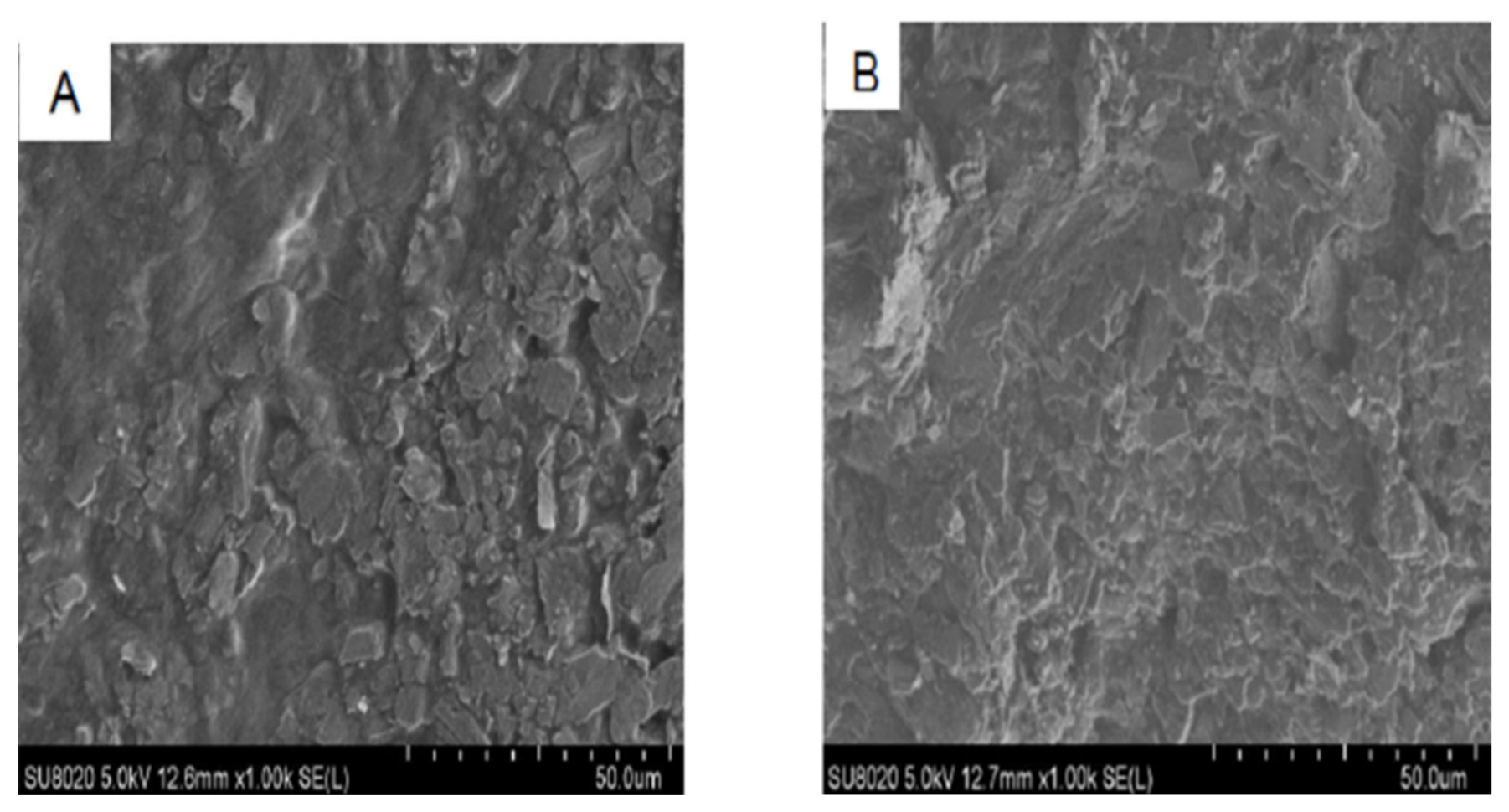
Figure 2.
EDX spectrum showing the elemental composition (wt%) of the CoPc-His-CPE surface.
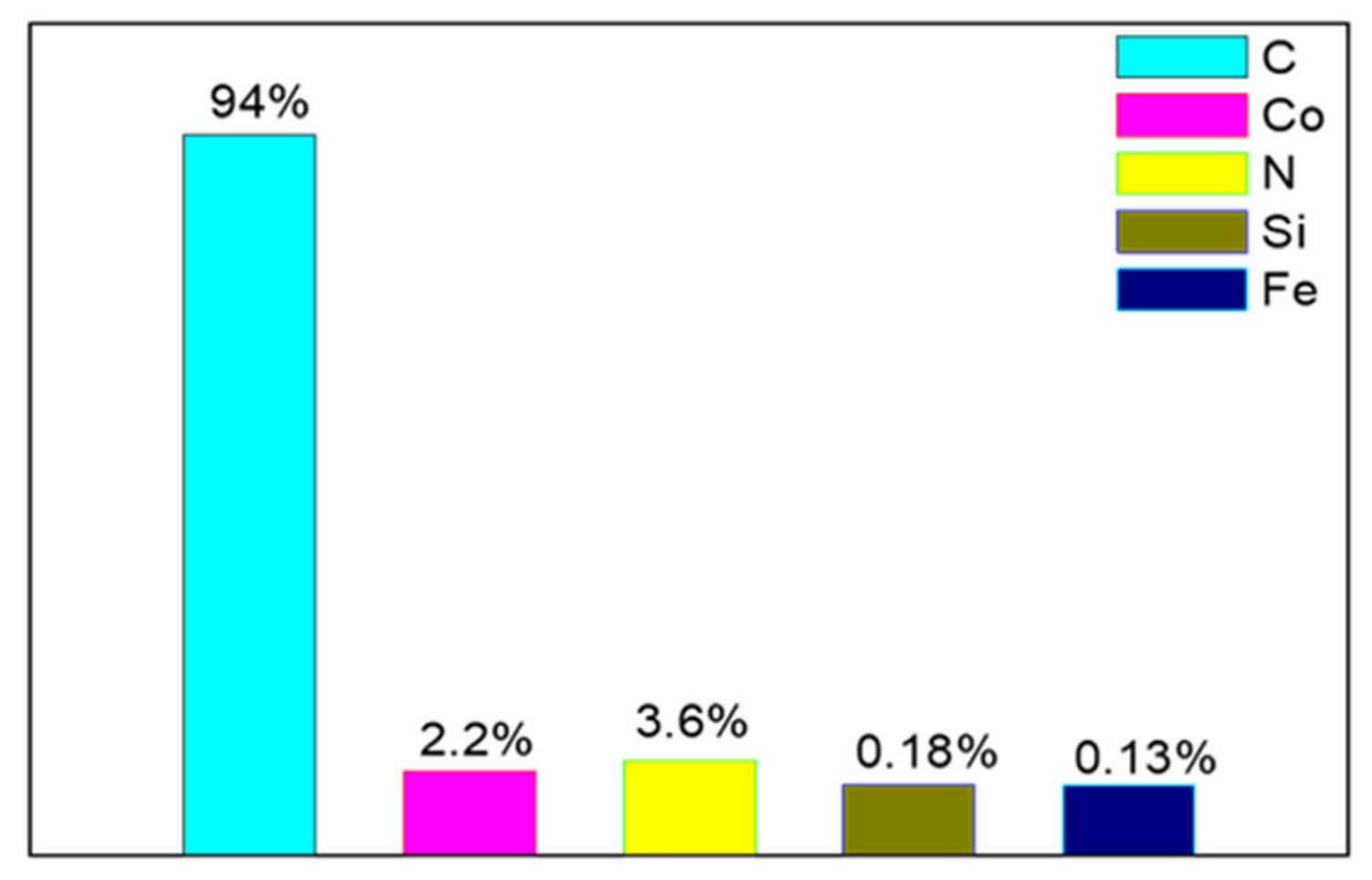
Figure 3.
FT-IR spectra of: a) pure L-His; b) CoPc-CPE; and c) CoPc-His-CPE.
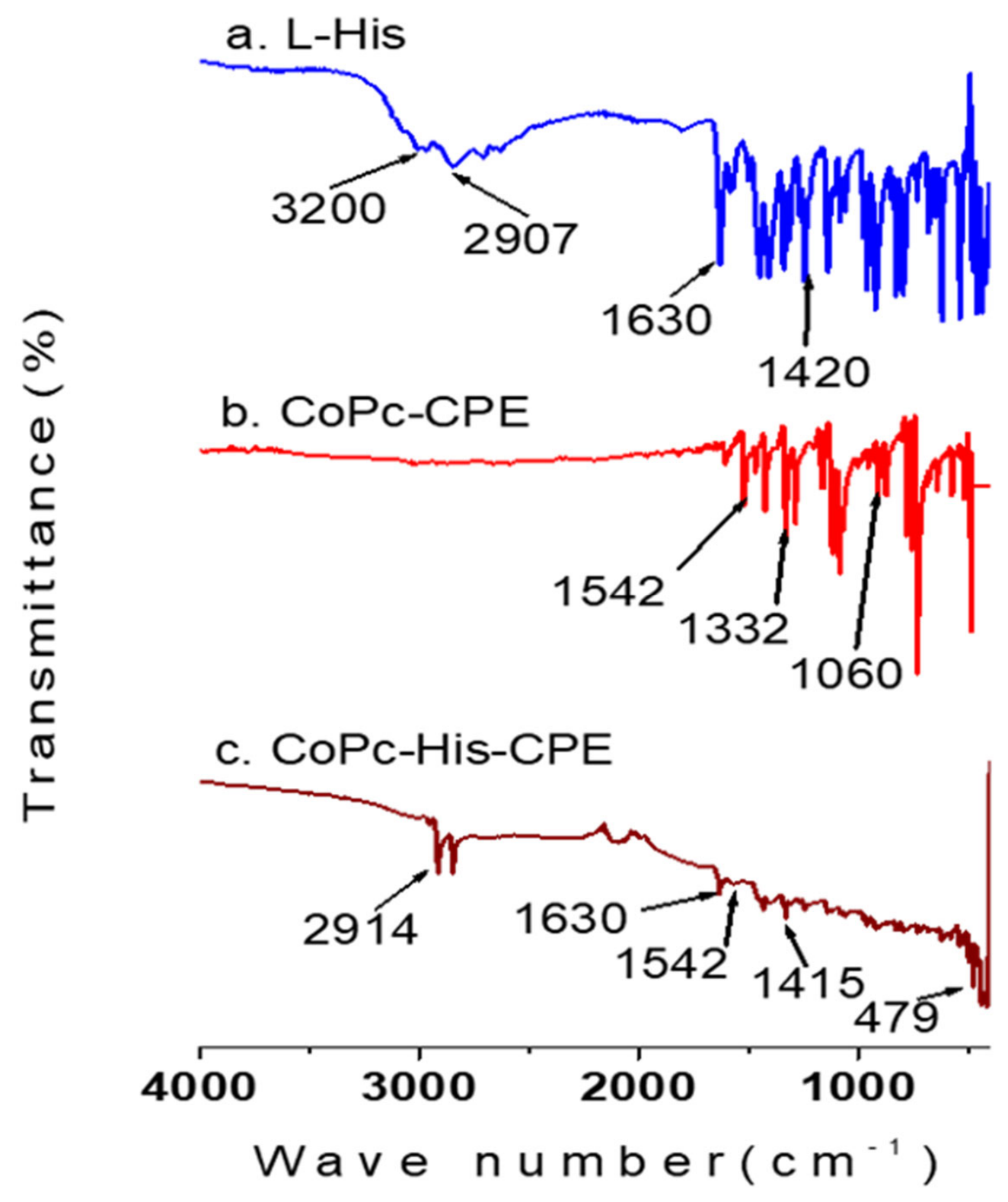
Figure 4.
Cyclic voltammograms of various electrodes in a 2.0 mmol/L [Fe] + 0.1mol/L KCl solution (A). Cyclic voltammograms at the CoPc-His-CPE/ (2.0 mmol/L [Fe] + 0.1mol/L KCl) interface at various scan rates ranging from 30 to 100 mV/s with a potential range of [-0.200, 0.600] V (B), along with a plot of Ip,a vs. corresponding to Figure 4B (C). Additionally, the figure includes bar charts of the electroactive surface areas of the electrodes, determined (at a scan rate of 50 mV/s) from the cyclic voltammograms in Figure 4B (D).
Figure 4.
Cyclic voltammograms of various electrodes in a 2.0 mmol/L [Fe] + 0.1mol/L KCl solution (A). Cyclic voltammograms at the CoPc-His-CPE/ (2.0 mmol/L [Fe] + 0.1mol/L KCl) interface at various scan rates ranging from 30 to 100 mV/s with a potential range of [-0.200, 0.600] V (B), along with a plot of Ip,a vs. corresponding to Figure 4B (C). Additionally, the figure includes bar charts of the electroactive surface areas of the electrodes, determined (at a scan rate of 50 mV/s) from the cyclic voltammograms in Figure 4B (D).
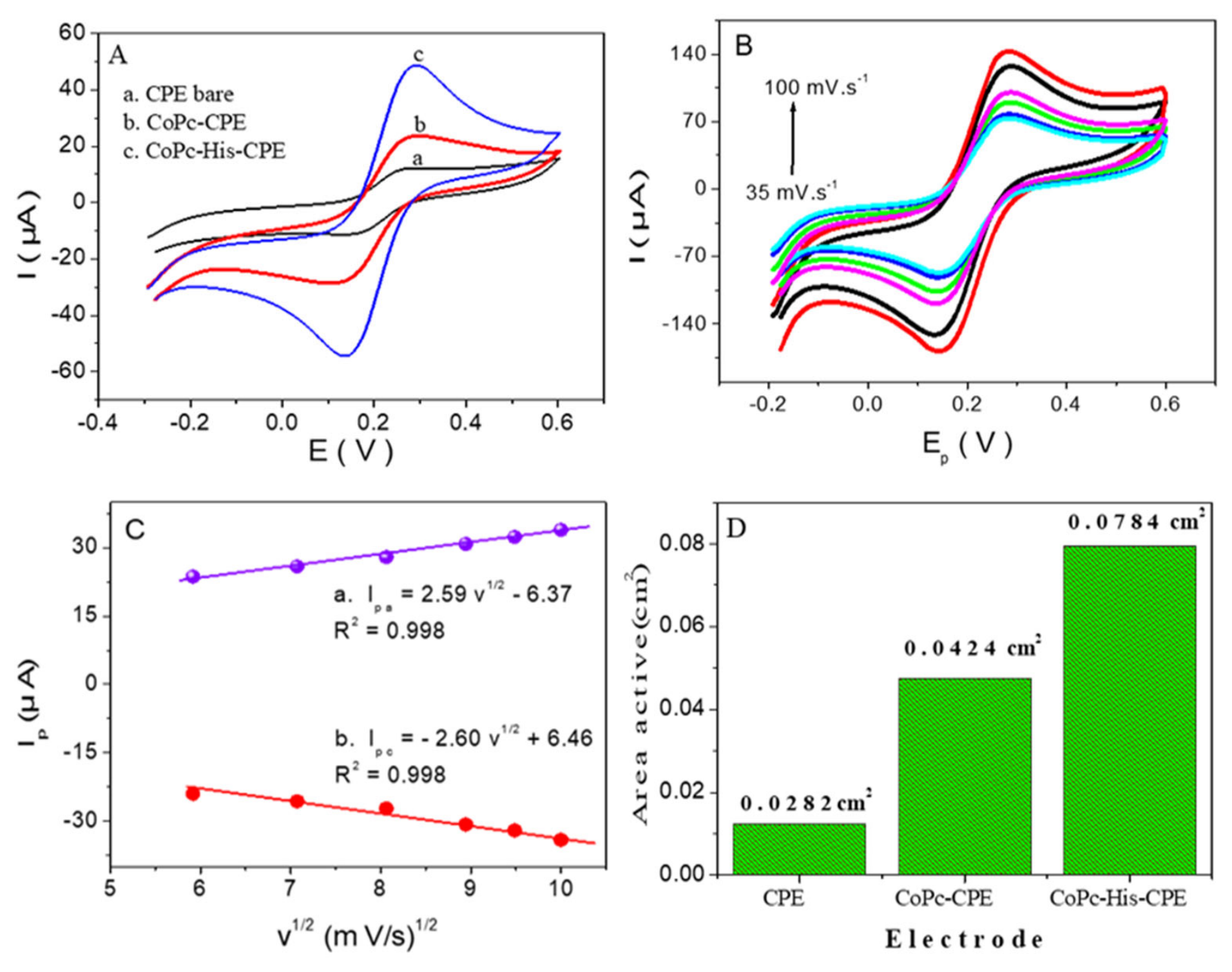
Figure 5.
Nyquist plots of: (a) bare CPE, (b) CoPc-CPE, and (c) CoPc-His-CPE in a phosphate buffer (0.1 mol/L KCl, pH 7.4) containing 2 mmol/L [Fe].
Figure 5.
Nyquist plots of: (a) bare CPE, (b) CoPc-CPE, and (c) CoPc-His-CPE in a phosphate buffer (0.1 mol/L KCl, pH 7.4) containing 2 mmol/L [Fe].
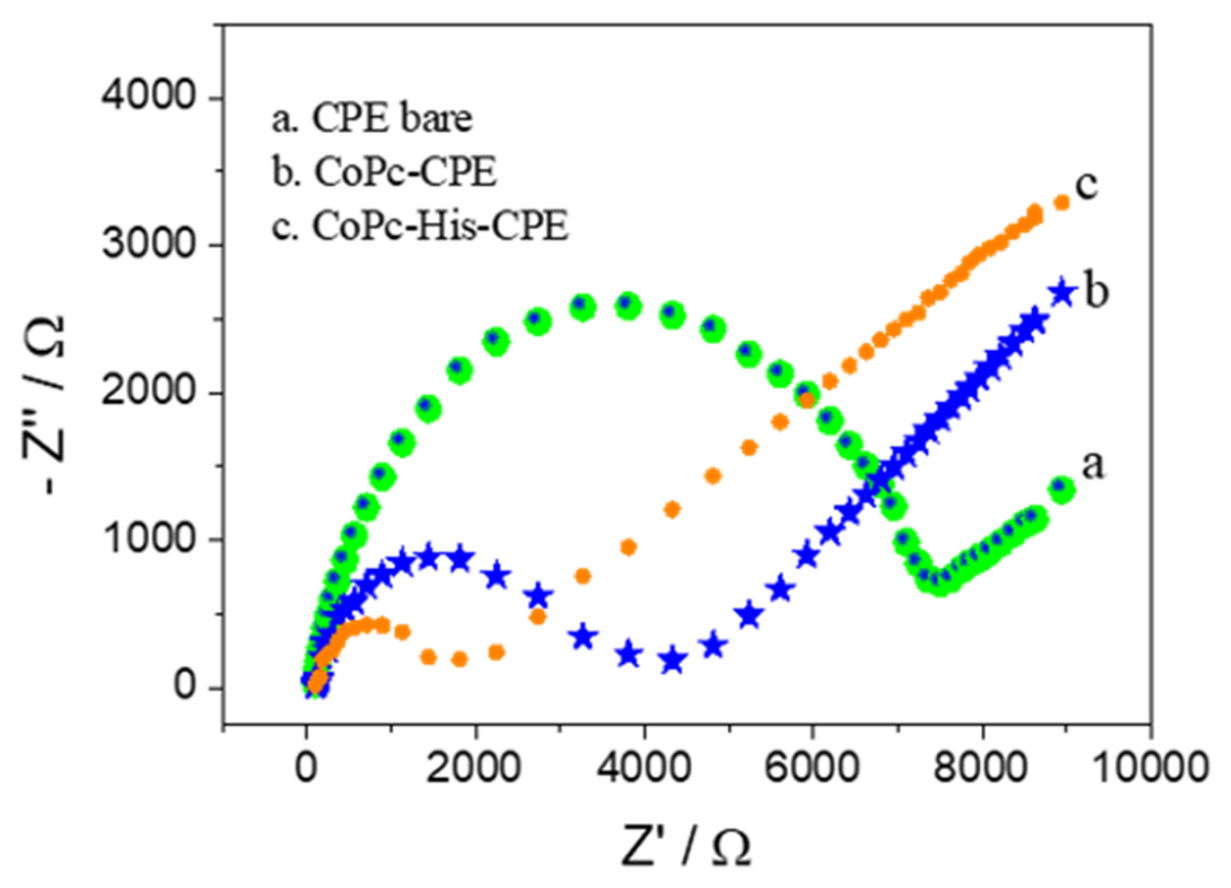
Figure 6.
Equivalent electrical circuit of the CoPc-His-CPE/([Fe) system. With: Electrolyte resistance; : Constant Phase Element (CPE) representing the double-layer capacitance; : Charge transfer resistance; : Warburg impedance.
Figure 6.
Equivalent electrical circuit of the CoPc-His-CPE/([Fe) system. With: Electrolyte resistance; : Constant Phase Element (CPE) representing the double-layer capacitance; : Charge transfer resistance; : Warburg impedance.
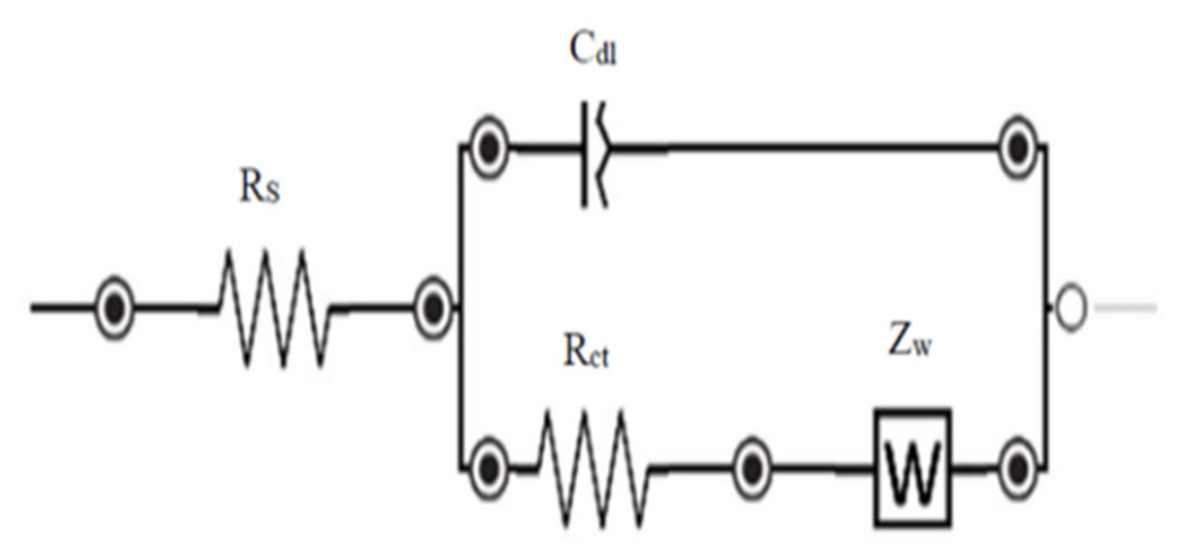
Figure 7.
Cyclic voltammograms obtained with: a) bare CPE, b) CoPc-CPE, and c) CoPc-His-CPE in a phosphate buffer (0.1 mol/L , pH 7.4) in the presence of 2 mmol/L BPA.
Figure 7.
Cyclic voltammograms obtained with: a) bare CPE, b) CoPc-CPE, and c) CoPc-His-CPE in a phosphate buffer (0.1 mol/L , pH 7.4) in the presence of 2 mmol/L BPA.
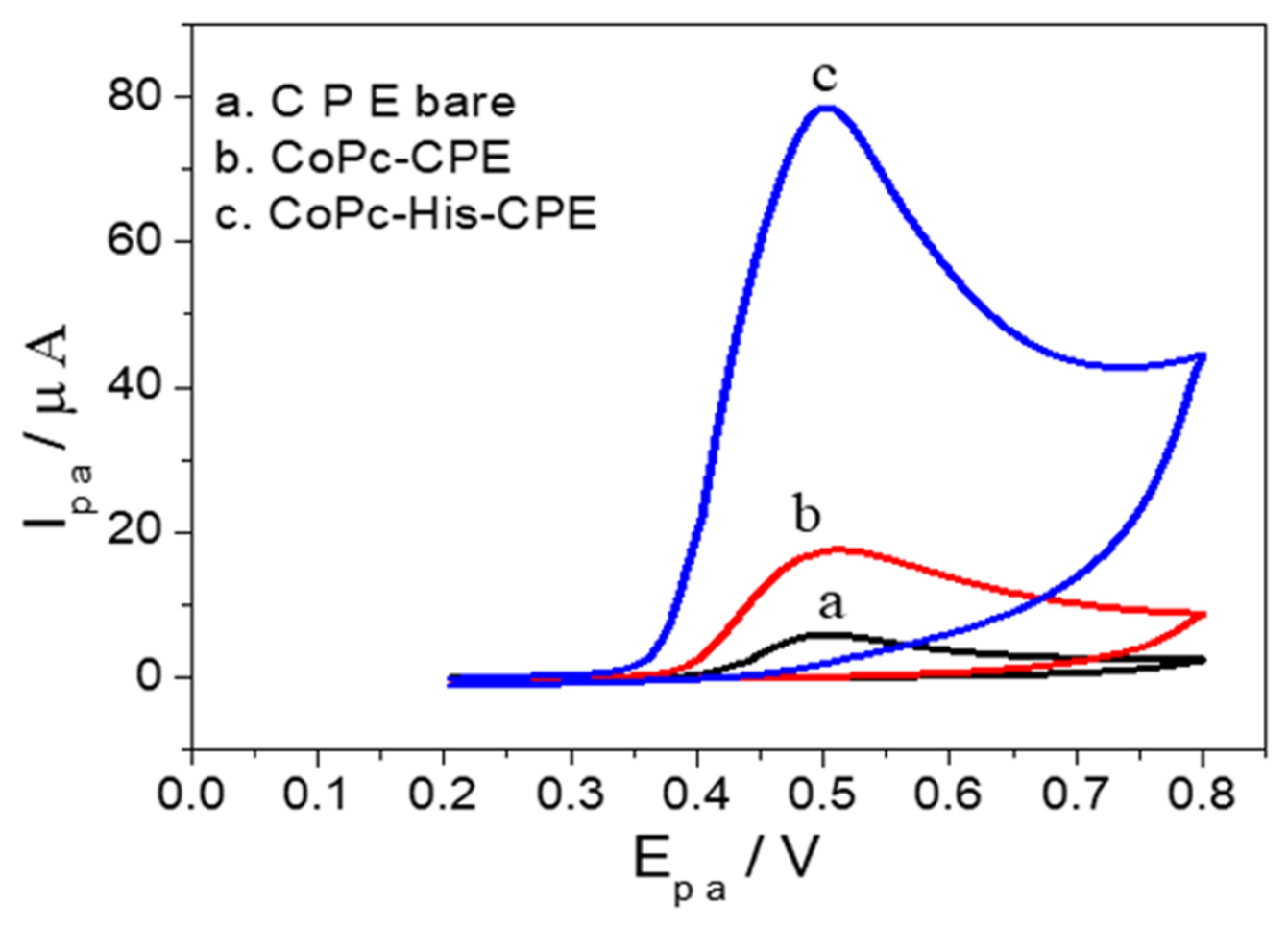
Figure 8.
Comparative energy diagram of the electron transfers from BPA to the electrode for the three configurations a) Bare CPE (Ep,a = +0.506 V); b) CoPc-CPE (Ep,a = +0.474 V); c) CoPc-His-CPE (Ep,a = +0.454 V). Dashed line: BPA HOMO, common donor level to all three systems. The colored segment represents the intermediate redox level of the Co(II)/Co(III) couple acting as an inner-sphere mediator for CoPc–CPE and CoPc–His–CPE, the latter being shifted cathodically by the σ electron donation of the axial histidine. Right axis: E(eV vs vacuum) = —(4.20 + E vs Ag/AgCl).
Figure 8.
Comparative energy diagram of the electron transfers from BPA to the electrode for the three configurations a) Bare CPE (Ep,a = +0.506 V); b) CoPc-CPE (Ep,a = +0.474 V); c) CoPc-His-CPE (Ep,a = +0.454 V). Dashed line: BPA HOMO, common donor level to all three systems. The colored segment represents the intermediate redox level of the Co(II)/Co(III) couple acting as an inner-sphere mediator for CoPc–CPE and CoPc–His–CPE, the latter being shifted cathodically by the σ electron donation of the axial histidine. Right axis: E(eV vs vacuum) = —(4.20 + E vs Ag/AgCl).
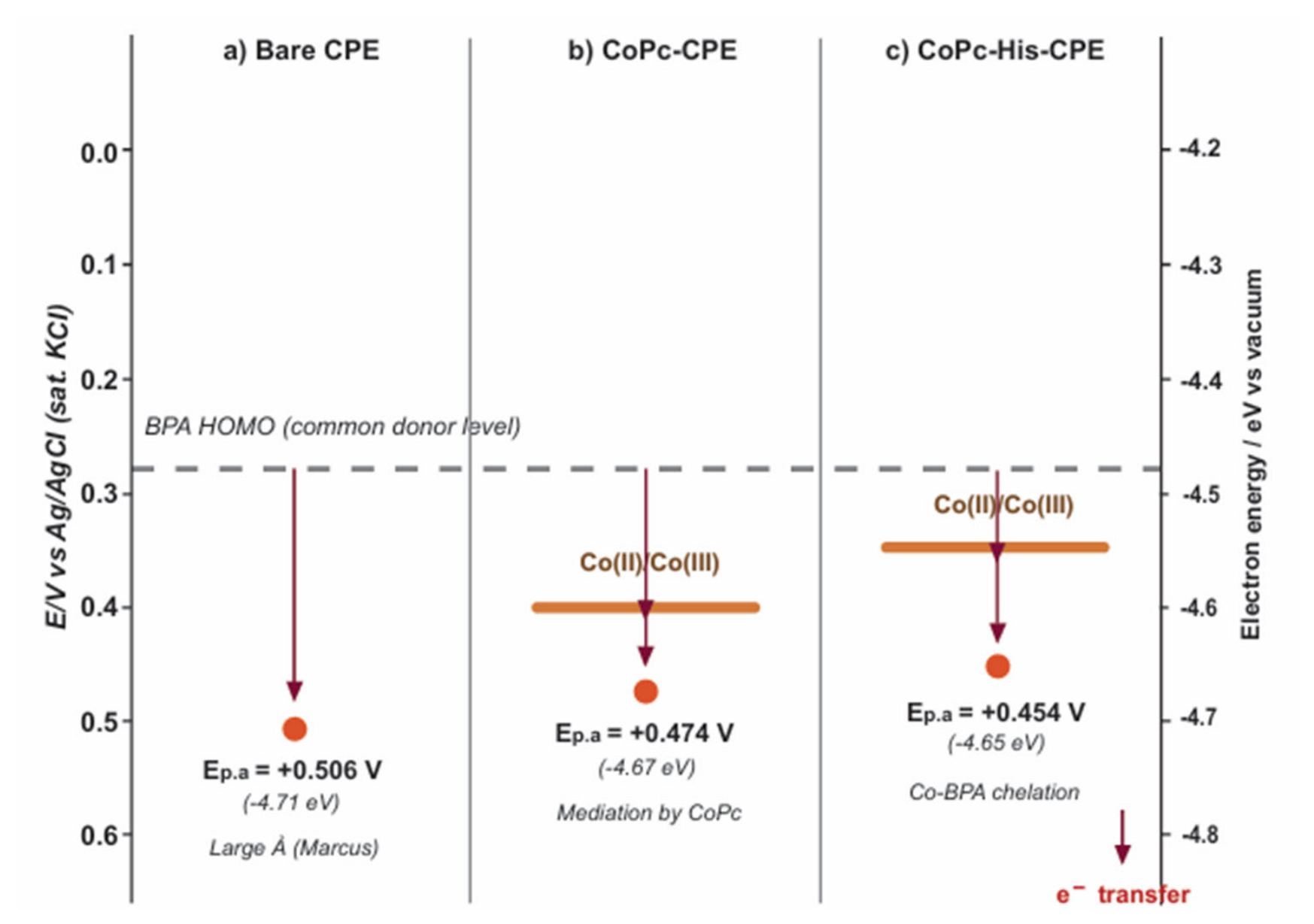
Figure 9.
SEM images of: A) CoPc-His-CPE, and B) CoPc-His-CPE/BPAacc.
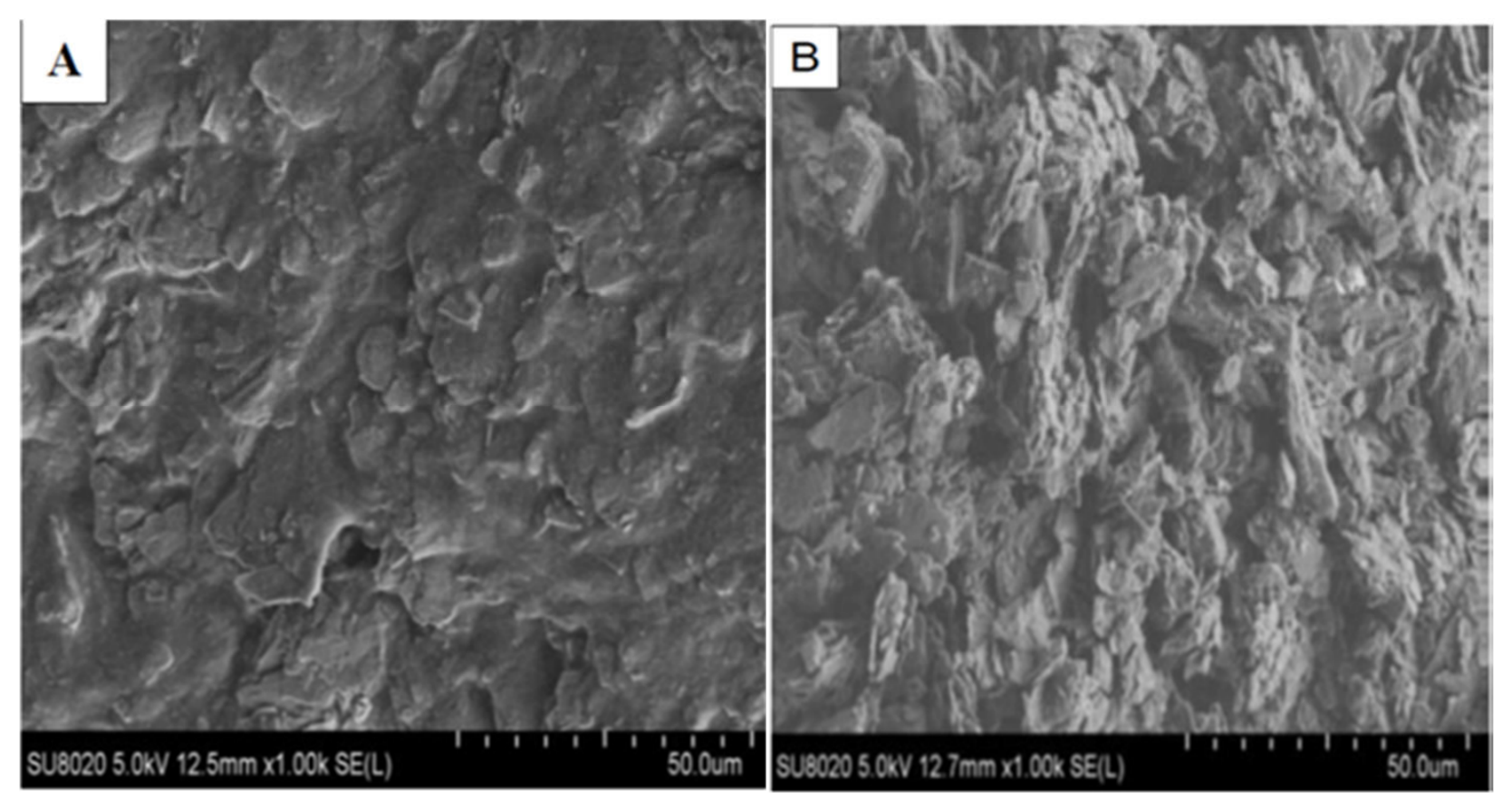
Figure 10.
FT-IR spectra of : (a) pure BPA, (b) CoPc-His-CPE, (c) CoPc-His-CPE/BPAacc, and (d) CoPc-His-CPE/BPAox.
Figure 10.
FT-IR spectra of : (a) pure BPA, (b) CoPc-His-CPE, (c) CoPc-His-CPE/BPAacc, and (d) CoPc-His-CPE/BPAox.
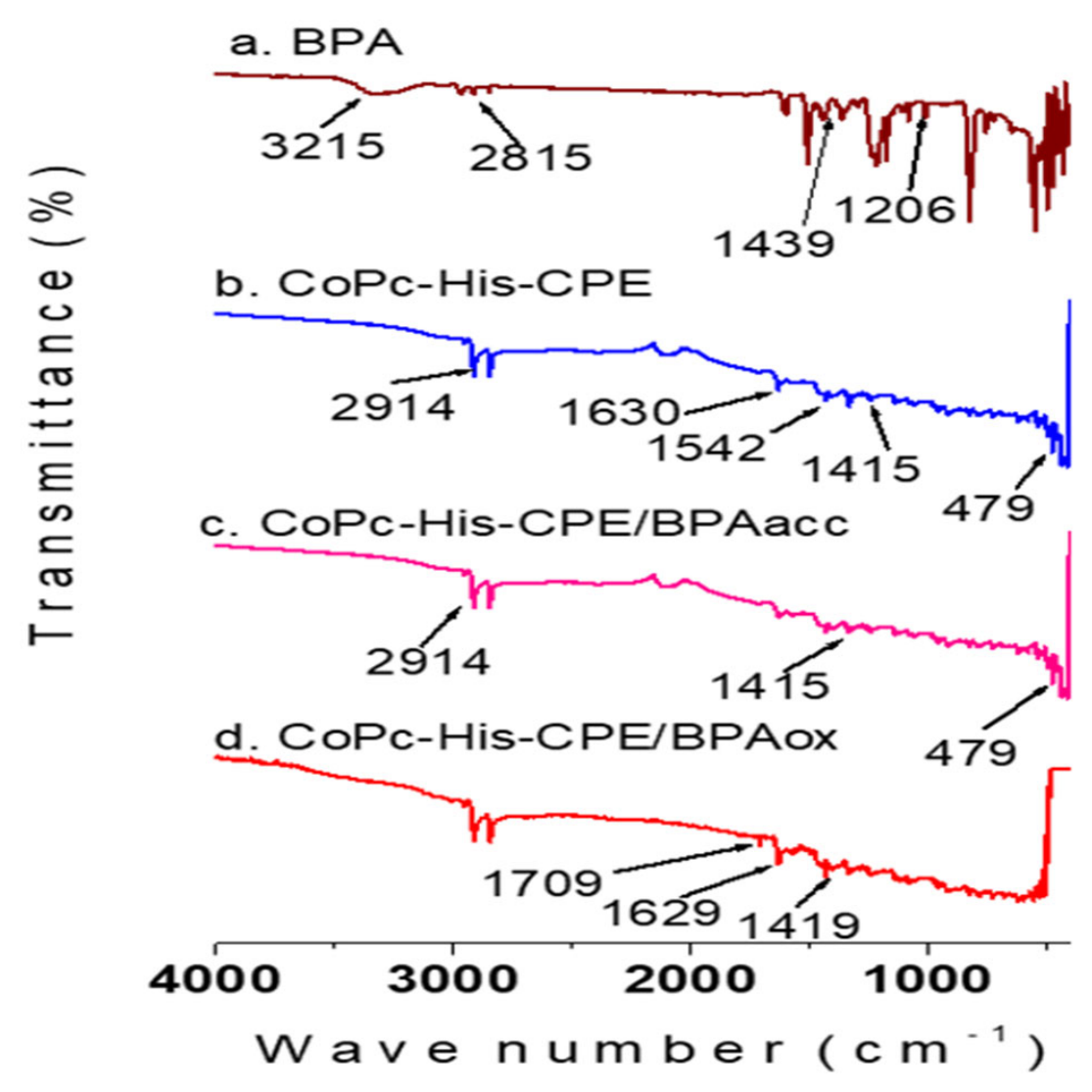
Figure 11.
UV-vis absorption spectra of CoPc (curve a, black) and CoPc-His in the absence (curve b, red) and presence (curve c, green) of BPA in ethanol.
Figure 11.
UV-vis absorption spectra of CoPc (curve a, black) and CoPc-His in the absence (curve b, red) and presence (curve c, green) of BPA in ethanol.
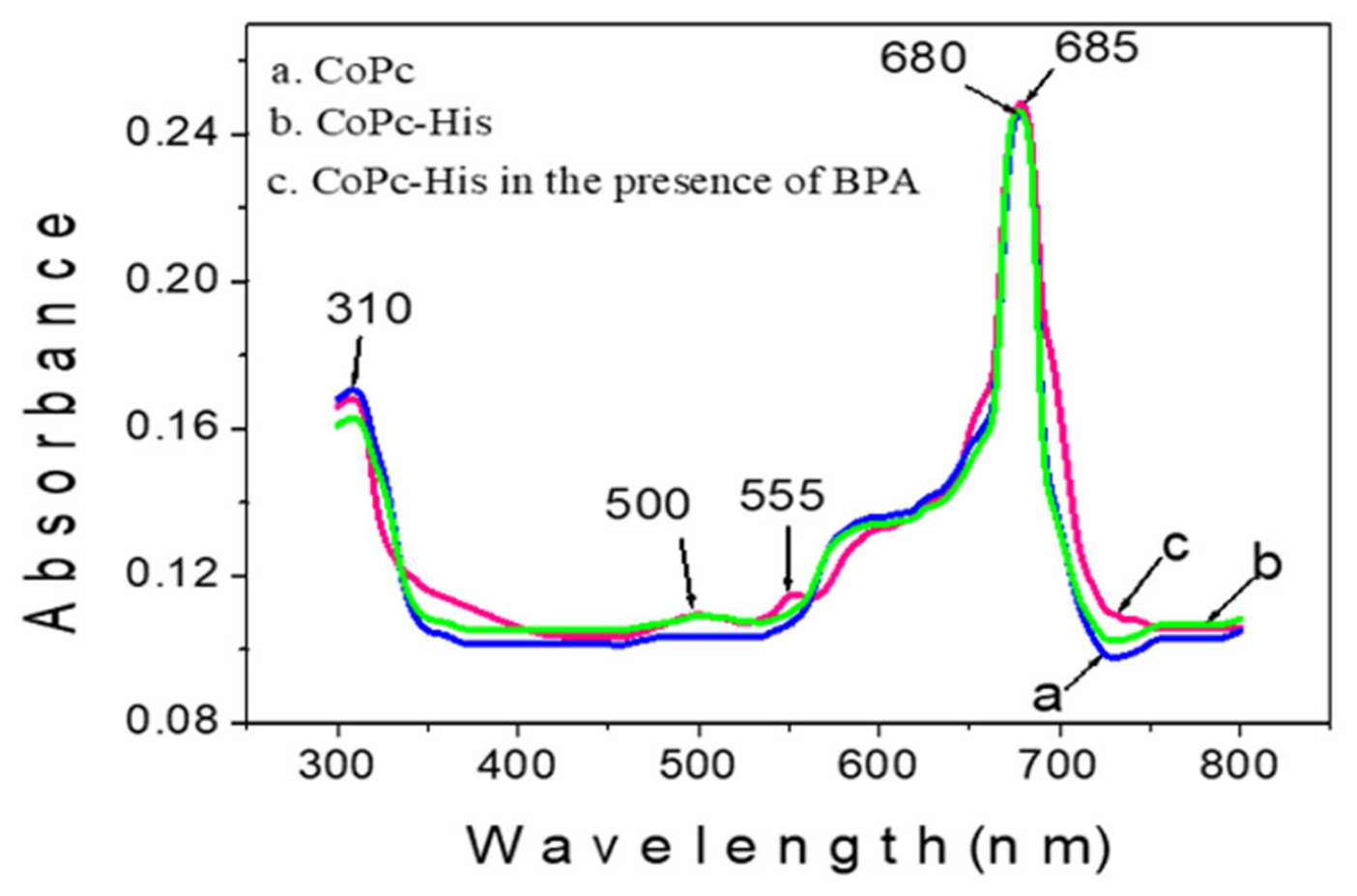
Scheme 1.
Proposed mechanism for the oxidation of BPA at CoPc-His-CPE.
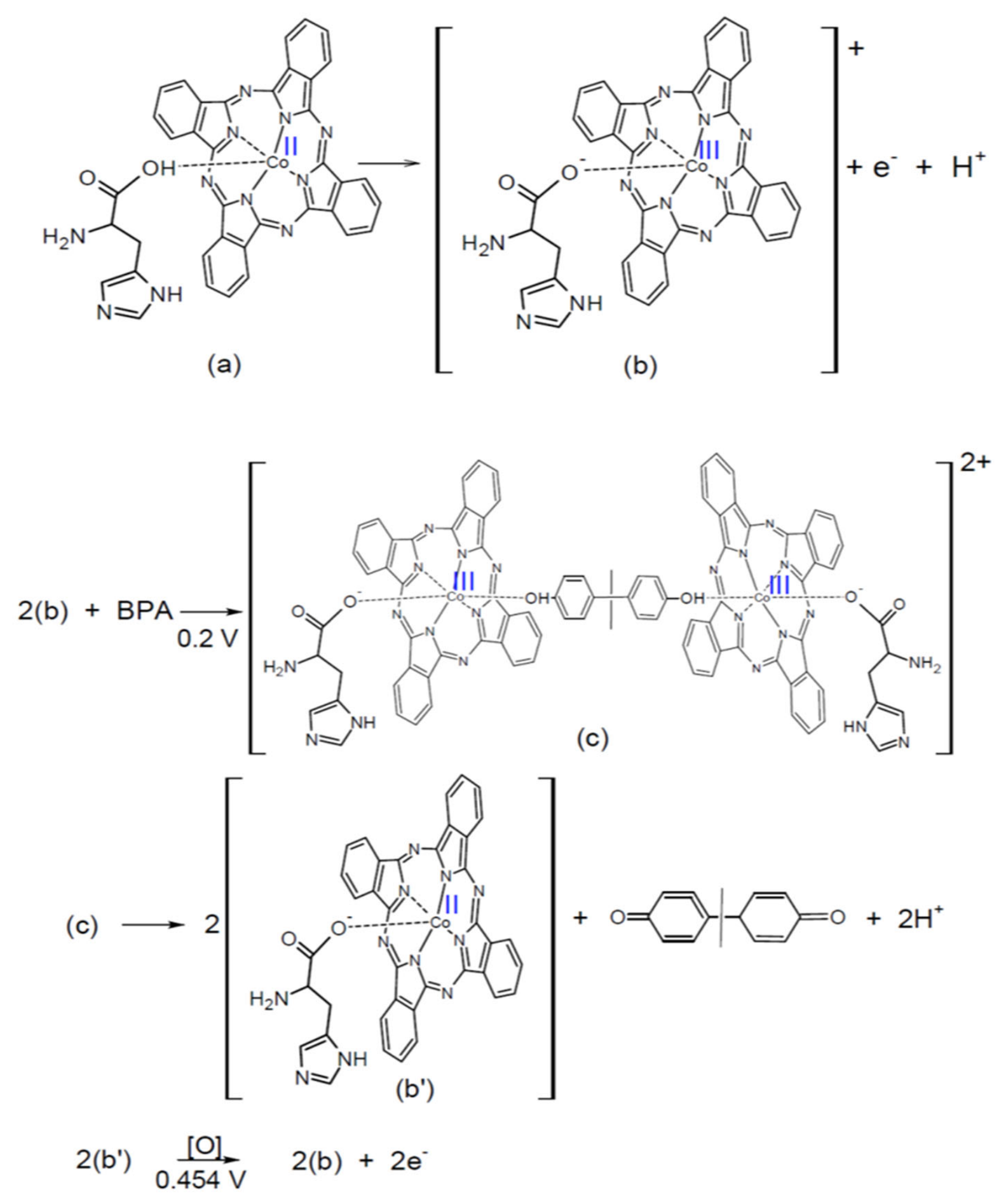
Figure 12.
Effect of supporting electrolyte concentration on the peak intensity in a PBS solution containing 2 mmol/L BPA.
Figure 12.
Effect of supporting electrolyte concentration on the peak intensity in a PBS solution containing 2 mmol/L BPA.
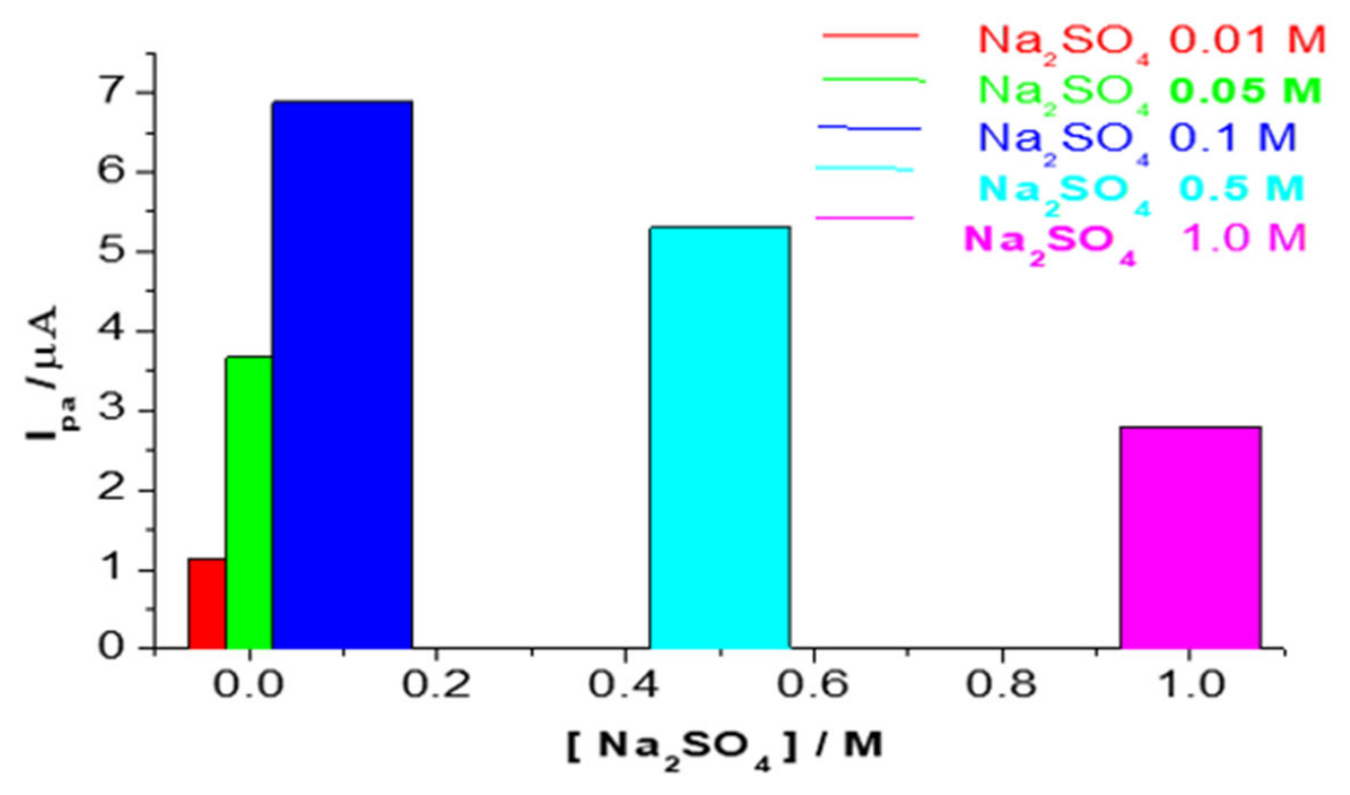
Figure 13.
Plot of BPA oxidation current as a function of CoPc-His content.
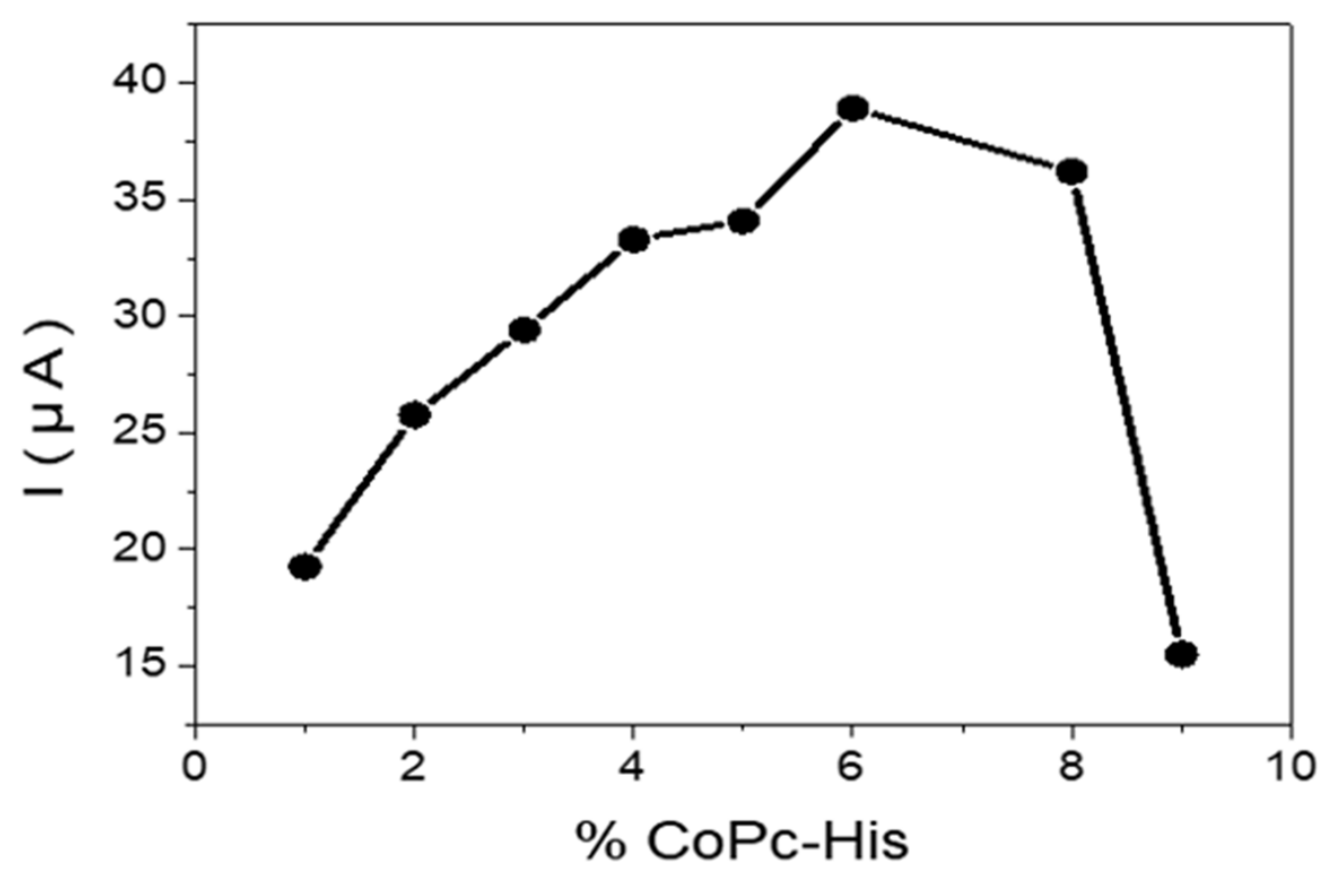
Figure 14.
Plots of Ep vs. pH (curve b) and Ip vs. pH (curve a).
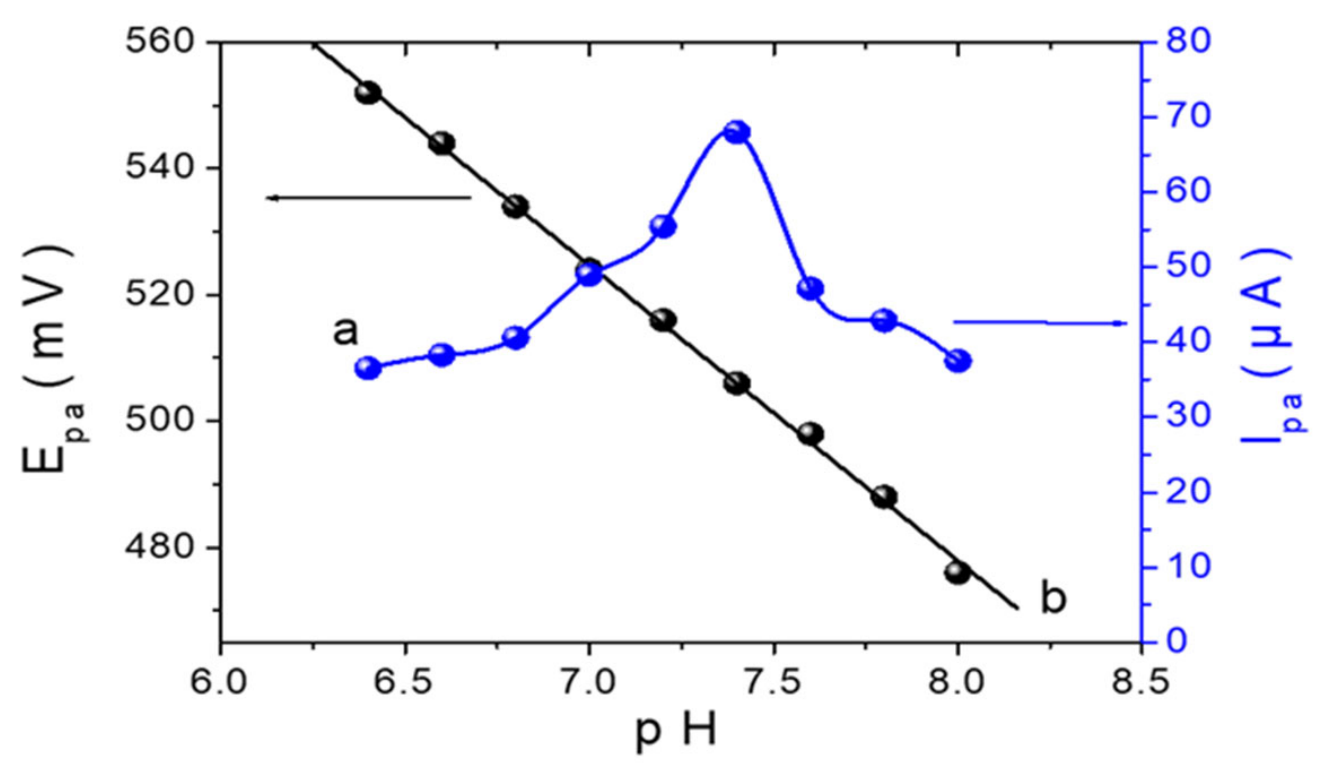
Figure 15.
Plot of log (Ipa) vs. log (v).
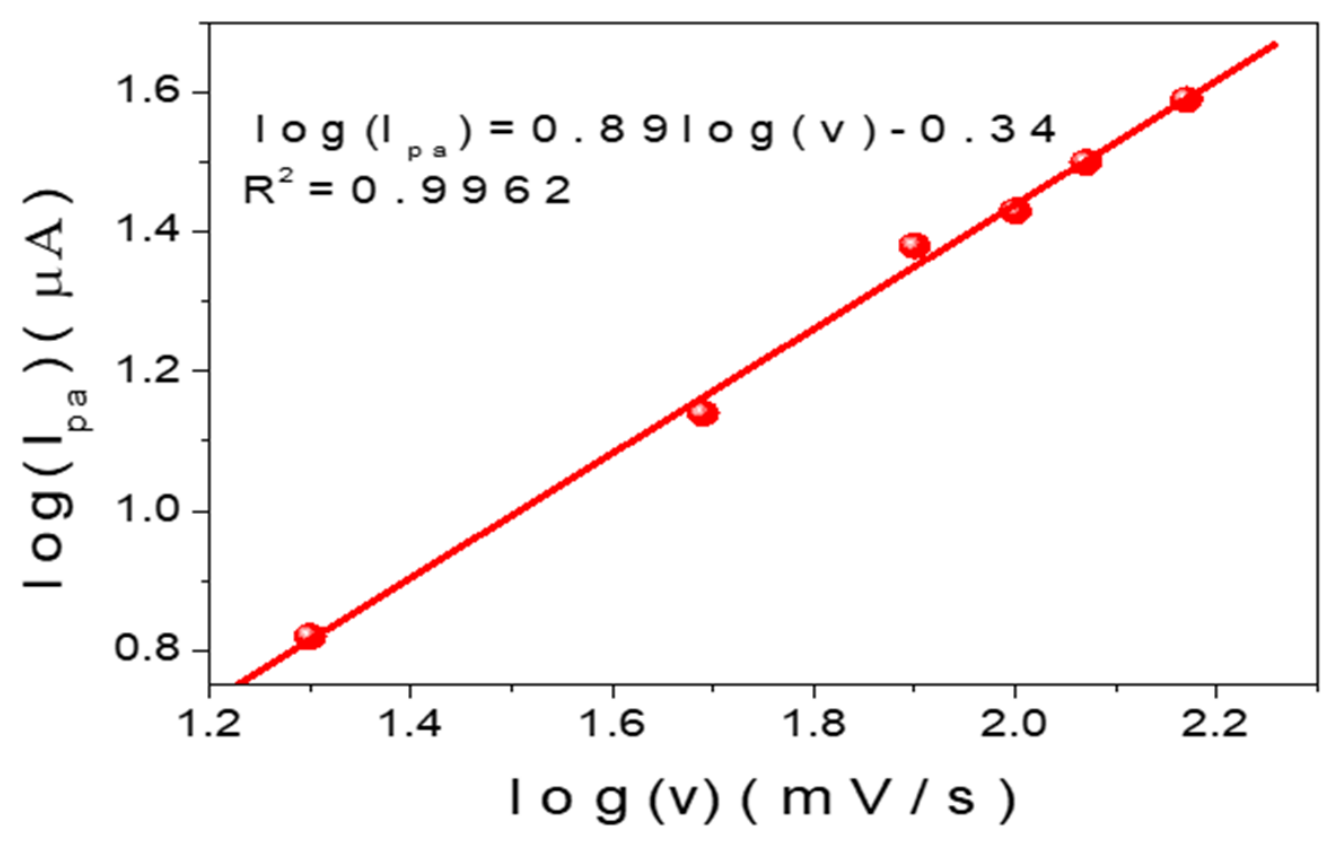
Figure 16.
. A) Variation of peak current as a function of accumulation potential (), B) Variation of peak current as a function of accumulation time ().
Figure 16.
. A) Variation of peak current as a function of accumulation potential (), B) Variation of peak current as a function of accumulation time ().
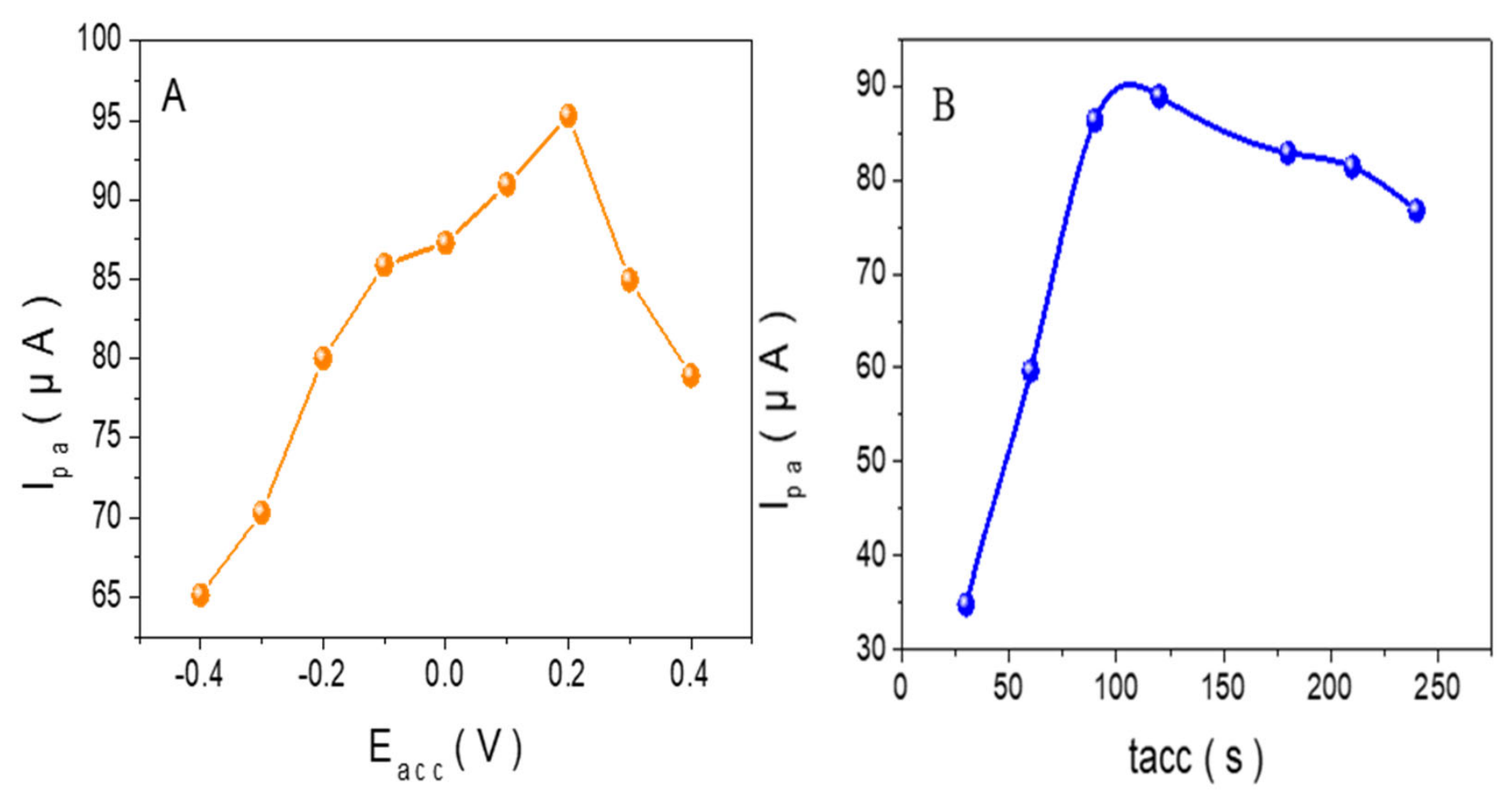
Figure 17.
Plot of BPA oxidation potential versus ln v obtained at the CoPc-His-CPE/BPA interface, with scan rates ranging from 20 to 150 mV/s.
Figure 17.
Plot of BPA oxidation potential versus ln v obtained at the CoPc-His-CPE/BPA interface, with scan rates ranging from 20 to 150 mV/s.
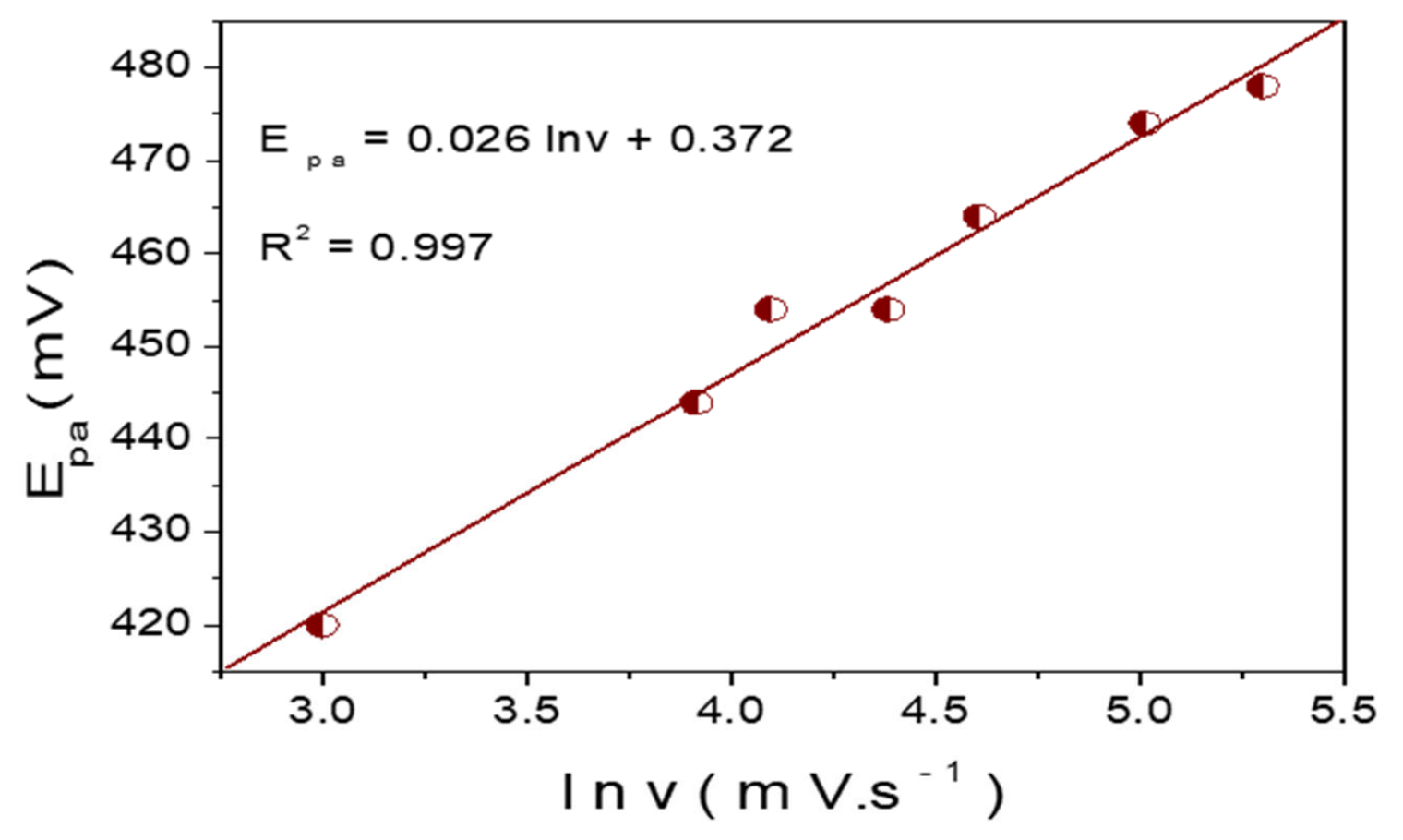
Figure 18.
(A) Q–t curves for (a) bare CPE and (b) CoPc-His-CPE in 0.1 mM containing 0.1 mol/L KCl. (B) Q– plots for (a) bare CPE and (b) CoPc-His-CPE corresponding to Figure 18A. (C) Q–t curves for CoPc-His-CPE in EtOH/phosphate buffer (pH 7.4, 20/80% v/v), 0.1 mol/L as supporting electrolyte, (a) in the absence and (b) in the presence of 0.5 mmol/L BPA. (D) Q– plots corresponding to Figure 18C.
Figure 18.
(A) Q–t curves for (a) bare CPE and (b) CoPc-His-CPE in 0.1 mM containing 0.1 mol/L KCl. (B) Q– plots for (a) bare CPE and (b) CoPc-His-CPE corresponding to Figure 18A. (C) Q–t curves for CoPc-His-CPE in EtOH/phosphate buffer (pH 7.4, 20/80% v/v), 0.1 mol/L as supporting electrolyte, (a) in the absence and (b) in the presence of 0.5 mmol/L BPA. (D) Q– plots corresponding to Figure 18C.
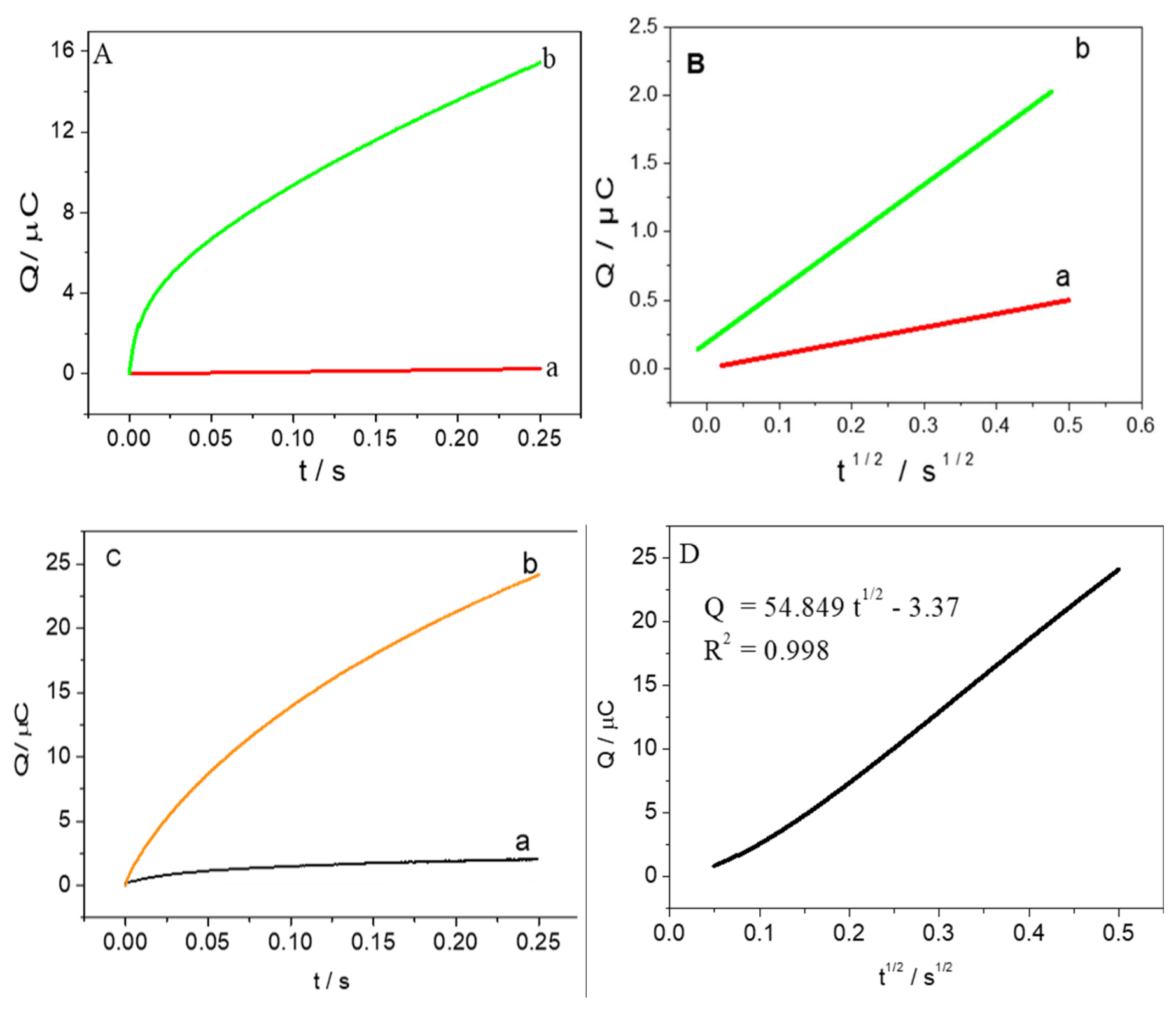
Table 1.
Electrochemical data derived from the study of cyclic voltammograms as a function of scan rate.
Table 1.
Electrochemical data derived from the study of cyclic voltammograms as a function of scan rate.
| v (mV/s) |
Ip,c (μA/cm2) |
Ep,c (mV) |
Ip,a (μA/cm2) |
Ep,a (mV) |
ΔEp (mV) |
E° (mV) |
Ip a/Ip,c | Ip,c/Ipa |
| 35 | -20.95 | 178 | 21.14 | 252 | 74 | 216 | -1.00 | -0.99 |
| 50 | -25.88 | 178 | 25.92 | 252 | 74 | 216 | -1.00 | -0.99 |
| 65 | -28.14 | 177 | 27.78 | 253 | 76 | 215 | -0.98 | -1.01 |
| 80 | -29.36 | 174 | 29.92 | 254 | 80 | 214 | -1.01 | -0.98 |
| 90 | -32.62 | 174 | 32.38 | 256 | 82 | 215 | -0.99 | -1.00 |
| 100 | -34.08 | 174 | 34.12 | 256 | 82 | 215 | -1.00 | -0.99 |
ΔEp = |Ep,a − Ep,c| ; E° = ½ (Ep,a + Ep,c).
Table 2.
Ep values reported in the literature describing the reversibility behavior of systems using [Fe as a redox probe in cyclic voltammetry studies.
Table 2.
Ep values reported in the literature describing the reversibility behavior of systems using [Fe as a redox probe in cyclic voltammetry studies.
| Systems | ΔEp (mV) | Reference |
| AuNPs-GCE | 87 | [61] |
| AuNPs-MOF-CPE | 134 | [62] |
| PQG-IL-CPE | 155 | [63] |
| FeNi3-BiOCl-CuS-E/CPE | 115 | [64] |
| Porphyridium-cruentum-CPE | 154 | [65] |
| MnPc-His-CPE | 80 | [37] |
| CoPc –His-CPE | 74 | This study |
Table 3.
Comparison of Rct and Cdl values reported for both systems CoPc-His-CPE and MnPc-His-CPE using [Fe as a redox probe in EIS studies.
Table 3.
Comparison of Rct and Cdl values reported for both systems CoPc-His-CPE and MnPc-His-CPE using [Fe as a redox probe in EIS studies.
| Systems | Rct (kΩ) | Cdl (µF) | Time constant (ms) | Reference |
| MnPc-His-CPE | 1.812 | 5.898 | ~10.680 | [37] |
| CoPc –His-CPE | 1.648 | 6.946 | ~11.446 | This study |
Table 4.
Effect of different supporting electrolytes (0.1 mol/L) on the peak height and peak potential shift of 2 mmol/L BPA at CoPc-His-CPE in a 0.2 mol/L phosphate buffer/ethanol solution (pH 7.4).
Table 4.
Effect of different supporting electrolytes (0.1 mol/L) on the peak height and peak potential shift of 2 mmol/L BPA at CoPc-His-CPE in a 0.2 mol/L phosphate buffer/ethanol solution (pH 7.4).
| Supporting electrolyte | Peak current (μA) | Peak potential (V) |
| KClO4 | 12.43 | 0.464 |
| Na2SO4 | 15.12 | 0.454 |
| K2SO4 KNO3 NaClO4 NaCl KCl NaNO3 |
15.09 10 .93 11.36 13 .18 14.08 9.76 |
0.456 0.524 0.498 0.490 0.476 0.492 |
Table 5.
Interference effect of various ions (at a 100-fold excess) on the BPA oxidation peak current (Ip).
Table 5.
Interference effect of various ions (at a 100-fold excess) on the BPA oxidation peak current (Ip).
| Ion | Na+ | K+ | Ca2+ | Mg2+ | Cu2+ | Fe3+ | Al3+ | Pb2+ | Zn2+ | SO42− | |
| 7.07 | 7.10 | 7.08 | 7.08 | 6.94 | 6.99 | 6.76 | 7.11 | 7.12 | 7.14 | 6.79 | |
| 0.14 | 0.56 | 0.28 | 0.28 | -1.70 | -0.99 | -4.24 | 0.70 | 0.84 | 1.13 | -3.82 |
Disclaimer/Publisher’s Note: The statements, opinions and data contained in all publications are solely those of the individual author(s) and contributor(s) and not of MDPI and/or the editor(s). MDPI and/or the editor(s) disclaim responsibility for any injury to people or property resulting from any ideas, methods, instructions or products referred to in the content. |
© 2026 by the authors. Licensee MDPI, Basel, Switzerland. This article is an open access article distributed under the terms and conditions of the Creative Commons Attribution (CC BY) license (http://creativecommons.org/licenses/by/4.0/).
Copyright: This open access article is published under a Creative Commons CC BY 4.0 license, which permit the free download, distribution, and reuse, provided that the author and preprint are cited in any reuse.