

Submitted:
23 September 2026
Posted:
23 September 2026
You are already at the latest version
Abstract
Essential challenges persist in systems biology, especially data and model integration. These issues may explain the lack of a universally accepted framework in modern biology for organizing the dynamic behaviors of whole organisms and diseases across scales. This paper proposes Complementary Regulatory Dynamics (CRD) as an integrative theory for studying how complex adaptive systems generate necessary changes while preserving viable functions. CRD assigns functional activator and regulator roles to processes relative to a defined system boundary and focal outcome. The theory is organized around five provisional, testable principles. CRD may help integrate and enrich models from established theories, including nonlinear dynamical systems theory, homeostasis and allostasis, and resilience theory. CRD could provide a common logic for organizing complex biological networks. It may help identify causal variables and build explicit bridges linking multiple scales. As a falsifiable theory, it can improve experimental design and clinical testing by shifting from static biomarkers to dynamical biopatterns and time-sensitive approaches. In translational settings, this could help detect early-warning signals, transition-prone states, and intervention windows. Therapeutic strategies can focus on systems-based biotargets to restore dynamic balance. CRD theory may provide potentially unifying guidance for translating systems biology into dynamical systems medicine.
Keywords:
Complementary Regulatory Dynamics (CRD)
; systems biology
; nonlinear dynamics
; dynamical systems medicine
; dynamical biopatterns
; homeostasis
; allostasis
; robustness
; resilience
; feedback
1. Introduction: Persistent Challenges in Systems Biology
Over the past few decades, systems biology has advanced significantly, particularly in network analysis [1,2,3]. These advances have led to key breakthroughs, including models of genetic switches and genotype-phenotype relationships in simpler organisms [4,5]. However, essential challenges persist, especially data and model integration [6]. Although heterogeneous biomedical data are abundant, explanatory integration remains limited. Genomic, proteomic, and pathophysiological data differ in scale, timing, and causal interpretation. Statistical combination does not equate to integrating them into a systematic, predictive framework for understanding biological behavior [6]. Reproducibility and semantic interoperability further constrain the portability and cumulative use of these models [7].
Biological systems are dynamic, and static descriptions often fail to capture time-dependent functions and processes, especially disease and treatment-response trajectories. Feedback delays and oscillations can cause the same measured variable to mean different things at different time points [8]. Dynamical systems theory provides tools for describing these variations, including attractors, bifurcations, and limit cycles [8,9]. However, these mathematical methods often cannot specify which biological variables or functional roles are causally meaningful within the model.
Systems biology in the single-cell era has enhanced our ability to measure heterogeneity at higher resolution. However, single-cell technologies have also highlighted integration challenges, complicating rather than simplifying the multiscale integration problem. Detailed molecular profiles alone do not define the multicellular, spatiotemporal, and organism-level processes underlying disease [10,11]. Instead, immune coordination, cancer progression, and responses to therapy often arise from interactions among diverse cells and their environments [10,11].
Currently, most practical biomedicine still relies on linear strategies. These methodologies typically involve identifying a target, measuring an average response, and linking a biomarker to a static outcome. Treatments often focus on a specific pathway, organ, or diagnosis in relative isolation. These strategies can be effective initially. However, their limitations become clear through off-target effects, compensatory pathway activation, and the emergence of drug resistance.
Drug resistance is revealing because it shows that intervention is not a single, linear event [12]. Perturbed systems may reroute signaling pathways, modify feedback strengths, or alter their microenvironments. Similarly, adverse effects can arise because a target participates in multiple processes across tissues and timescales. These phenomena demonstrate that targets are embedded within systems whose overall regulatory organization is often only partially understood.
Most importantly, translating systems approaches into routine clinical practice is challenging. A molecular pathway may be well studied in cell lines or animal models, but it can behave differently in humans because of variations in tissue architecture, immune activity, and environmental conditions. Systematic, patient-specific models have not yet become a standard foundation for diagnosis or treatment.
These issues may explain the lack of a universally accepted framework in modern biology for organizing the dynamic behaviors of whole organisms and diseases across scales. While theories such as evolutionary theory, homeostasis, and molecular genetics provide crucial explanations [13], each is most useful within specific domains, levels, or processes. No single theory can provide a common functional language to connect adaptation, recovery, and failure across molecular, cellular, tissue, organ, organismal, and ecological levels. Addressing these challenges requires a systems-based, dynamical framework that is both comprehensive and descriptive. This paper proposes Complementary Regulatory Dynamics (CRD) as an integrative theory that operates at a higher level of abstraction while supporting detailed insights.
2. The Complementary Regulatory Dynamics (CRD) Theory
The Complementary Regulatory Dynamics (CRD) theory begins by examining one of biology’s most fundamental questions. This question asks how a living system can be sufficiently responsive to act and adapt while remaining coherent enough to avoid instability or loss of recoverability.
To answer this question, CRD’s basic unit is an outcome-relative functional relationship. Across living systems and scales, two essential types of functions drive change. One involves processes that activate or amplify, while the other involves processes that regulate, inhibit, or restore. Change may result from interactions between these two types of functions.
In the CRD theory, these two types of functional processes are designated as activator and regulator roles, but these roles are analytic categories rather than fixed entities. They may be distributed across networks, assigned differently depending on the specific outcome under study, or reversed under different conditions. However, CRD is not about two physical parts of every system. It is a conceptual theory that describes the most basic common feature of complex adaptive systems (CAS).
Existing theories address various aspects of this common feature, including homeostasis, positive and negative feedback, and resilience [13,14,15,16,17]. However, these approaches are usually applied at specific levels, within particular mechanisms, mathematical formalisms, or disciplinary contexts. Taken together, these theories show that living systems repeatedly confront the same general problem: they must generate change while preventing destructive instability. They need to preserve organization while remaining adaptive. They need to recover from disturbance without losing the capacity to respond.
The CRD theory proposes that these existing theories often instantiate a more general functional architecture comprising complementary activating and regulating processes. It extracts the shared elements from the existing theories to avoid the systems problem (“only seeing the trees but not the forest”) discussed earlier.
To support both generalization and description, the CRD theory proposed here includes five principles. These principles are functional complementarity, mutual regulation, dynamic balance, threshold-dependent transformation, and multiscale recurrence. Together, they suggest that biological stability is not a static equilibrium. Instead, it is often maintained through ongoing, context-dependent activity, delayed feedback, and sometimes oscillation. They also suggest that a system may undergo a qualitative regime shift when gain, delay, or external pressure crosses a threshold.
CRD’s distinctive claim is falsifiable. It can be tested by assessing whether its functional classification improves variable selection, cross-scale modeling, and perturbation design compared with established approaches. CRD may provide a common logic for selecting meaningful variables, defining system boundaries, and identifying candidate regulatory relations, either before or during formal modeling. It may help current systems biology move from an expanding collection of detailed models toward a more coherent and reusable explanatory framework.
In summary, CRD is a theory of the functional and dynamical relations underlying change, adaptation, and transformation, rather than a theory of fixed biological “parts.” In this sense, CRD may be provisionally regarded as an integrative meta-framework, or a candidate “theory of existing theories.” Its purpose is to extract and formalize the shared functional logic of existing theories where such logic is genuinely present. This higher-level abstraction may be general enough to address integration problems while remaining sufficiently descriptive for pragmatic applications without sacrificing detail.
3. Basic Terminology and the Five Principles of Complementary Regulatory Dynamics
Complementary Regulatory Dynamics (CRD) identifies recurrent functional roles relative to a specified outcome within a defined system. This outcome-relative formulation is essential. The same molecule, cell type, or physiological process may assume different roles over time and across environments. For example, inflammation can activate antimicrobial defenses immediately after infection, which is beneficial. However, it can also cause progressive tissue damage when it persists after the original threat has been controlled [13]. Likewise, anti-inflammatory activity may support resolution in one context but impair pathogen clearance if imposed too early or too strongly [18,19]. Thus, CRD assigns roles to dynamical functions within a particular dynamic context, rather than permanently to biological entities. Table 1 lists some basic terms used in CRD theory.
CRD thus distinguishes functional role from mechanism. A mechanism explains how a process operates, such as inhibitory phosphorylation or renal sodium excretion. A CRD functional role specifies what that process does relative to a defined outcome, i.e., whether it activates, promotes, limits, inhibits, or restores. In this paper, the term “activator/regulator role processes” refers to processes that serve as activators or regulators. These role assignments emphasize that these functions are context-dependent rather than permanent, as roles can change. This distinction allows comparisons across systems without assuming identical molecules, network topologies, or causal pathways. Figure 1 illustrates the minimal outcome-relative functional architecture of Complementary Regulatory Dynamics (CRD).
3.1. Principle 1: Functional Complementarity
The first CRD principle is that biologically meaningful change often depends on processes with counterbalancing yet jointly necessary functions. An activator-role process activates, excites, or propagates, while a regulator-role process regulates, inhibits, or resolves. Their interaction shapes the conditions, boundaries, timing, magnitude, or termination of change. Their relationship is therefore not necessarily one of simple opposition. It is a relationship of functional complementarity, i.e., mutual support and dependency. Each is defined in relation to the other, and each contains the “seed” of the other, as one can recruit the other (see also Section 3.2).
Cell proliferation illustrates this point. Growth-factor signaling, cyclin-dependent kinase activity, and mitogenic transcription are essential for development, tissue regeneration, and repair [20]. Conversely, cell-cycle checkpoints, DNA-damage responses, apoptosis, and tissue-level constraints are also necessary [21]. These mechanisms determine when proliferation is safe, spatially appropriate, and compatible with organismal integrity. These processes are not simply “pro-growth” and “anti-growth.” Together, they organize viable growth. Both sides are necessary for normal functioning.
Cancer can be understood, in part, as a failure of this coordination. In cancer, proliferative and survival processes often become insufficiently constrained by cell-cycle arrest, immune surveillance, or tissue architecture [22].
Existing homeostatic, developmental, and systems-biological theories indirectly support functional complementarity. These theories recognize that viable function typically requires more than maximal activation or maximal inhibition [13,14,15,16,17]. Compared with these theories, the CRD principle of complementary relationships may offer a more explicit, systematic, and dynamic view of the network motifs and regulatory circuits they describe.
3.2. Principle 2: Mutual Regulation
The second CRD principle is that the activating and regulating roles often regulate or adjust one another, directly or indirectly. These mutual regulations include feedback, resource competition, adaptation, and mechanical constraints within the shared environment. The term “mutual regulation” does not require symmetrical effects. One type of process may act more rapidly, more strongly, or more locally than the other, and various components may mediate their interactions.
For example, immune functions such as inflammation depend on reciprocal regulation [18,19]. Inflammatory mediators recruit and activate immune cells. These cells may alter pathogen burden, vascular permeability, and the signals that sustain or suppress the response. Immune resolution is not simply the absence of activation. It involves active mediator production, cellular reprogramming, efferocytosis, and repair processes [18]. These processes may alter the conditions under which further inflammatory activity occurs. Thus, regulation may change activation, while activation may create the conditions that recruit or modify regulation, forming a mutually regulated relationship.
This principle links CRD to cybernetics, control theory, and feedback biology. However, CRD is broader than a simple negative-feedback label. It asks which functional roles are coupled around a focal outcome, whether the coupling is effective, and how changes in strength, delay, or saturation alter the system’s behavior. It can therefore help explicitly identify comparable functional roles across different biological implementations, adding detail while remaining integrative. These questions may be critical for designing biological perturbations in laboratory experiments and clinical practice.
3.3. Principle 3: Dynamic Balance
The third principle is that adaptive stability is dynamic, not static. A viable system may exhibit ongoing adjustment, delayed correction, or alternating dominance between the two roles. Dynamic balance, therefore, does not imply that the activator and regulator variables are equal, constant, or simultaneously maximal. Rather, it means that their changing relationships support a well-defined functional outcome across disturbances and over time.
Homeostasis offers a classic example. Physiological variables, including temperature and blood pressure, are maintained within viable ranges through continuous sensing and adjustment rather than biological inactivity [14,16]. Allostasis extends this view by emphasizing that organisms often preserve long-term viability through anticipatory, context-sensitive changes [23]. Stress responses, energy redistribution, and immune mobilization can be adaptive when recruited and terminated appropriately. However, they may be costly or pathogenic when prolonged, excessive, or poorly coordinated, thereby disrupting the dynamic balance.
CRD extends beyond and enriches homeostasis in two respects. First, its focal outcome need not be the constancy of a single variable. For example, wound healing, immune defense, and behavioral adaptation require both directional changes and stabilization, which must be described as trajectories across multiple variables. Second, CRD explicitly includes processes that redirect, filter, or selectively enable change, rather than only those that return a variable to a prior set point. Thus, homeostasis may represent a major subclass of CRD-like architecture, but not the whole proposed theory.
Compared with allostasis theory, CRD may be more descriptive here, clearly detailing the roles and interactions involved in change, even though it is more abstract. This may help us better understand what, why, how, and where (e.g., in which direction) changes occur. This functional architecture could also link allostatic concepts to molecular feedback circuits, cellular stress responses, tissue repair, and immune regulation across levels.
Robustness and resilience are measurable outcomes of successful dynamic balance. Robustness is the maintenance of function despite disturbance [24,25], while resilience is the capacity to recover after disturbance [17]. Both may depend on appropriately timed and coupled regulatory processes. However, neither is identical to CRD.
In comparison, robustness is an outcome or property [24,25] (see also Figure 1), while CRD may help explain how that property arises. CRD holds that robustness cannot be inferred from strong inhibition or strong buffering alone. Excessive regulation may suppress necessary adaptation, whereas weak regulation may allow runaway activation. The key question is whether coupling between activating and regulatory processes preserves proper function under specified perturbations.
Similarly, this approach may help explain the detailed “what, why, how, and where” mechanisms that underlie resilience. A vulnerable system may exhibit weakened regulatory capacity, excessive regulatory suppression, delayed or destructive feedback, or impaired coordination across scales. Understanding these relationships could make robustness and resilience measurable outcomes for testing CRD-derived models.
3.4. Principle 4: Threshold-Dependent Transformation
The fourth principle is that changes in activation, regulation, coupling, delay, saturation, or external pressure may produce qualitative, not merely proportional, effects. A system may shift from repair to fibrosis or from a transient stress response to chronic dysregulation [26]. CRD calls these qualitative changes transformations.
Nonlinear dynamical systems theory provides the formal basis for this principle. Feedback, time delay, and multistability can produce switches, oscillations, excitable responses, and abrupt transitions between alternative system states [4,8]. A small additional perturbation can therefore have a trivial effect within one regime but trigger a major transition when the system reaches a threshold.
For example, a regulatory circuit may shift from a graded response to sustained chronic inflammation, fibrosis, or unregulated proliferation [26]. These are not cases of “too much activation.” They may result from altered timing, regulatory saturation, failed termination, or altered coupling between inflammatory and repair processes. Thus, these transformations may stem from changes described in the first three principles that give this theory its name, “Complementary Regulatory Dynamics.”
This fourth principle highlights nonlinear possibilities that linear, static, or single-time-point descriptions may overlook. Moreover, CRD may help integrate and enrich the study of nonlinear dynamics by identifying candidate variables and couplings, thereby making quantifications more biologically meaningful.
3.5. Principle 5: Multiscale Recurrence (Functional Fractality)
The fifth principle is that CRD-type functional relations may recur across levels of organization, from molecular networks and cells to tissues, organs, organisms, and social and ecological environments. At each level, different mechanisms may implement these similar functional relations. This is a hypothesis of multiscale recurrence, not a claim that the same pair operates identically at every scale. In mathematics, the term “fractal” refers to geometric patterns that exhibit self-similarity [27]. Recurrent activator-regulator-like patterns in CRD resemble fractals in their self-similarity, but they are functional rather than geometric or structural.
For example, receptor desensitization can limit signaling at the molecular scale [28]. Inhibitory interneurons and synaptic adaptation can shape amplification at the circuit scale [29]. Autonomic and endocrine feedback can regulate whole-body stress responses [30]. Behavioral avoidance, sleep, or social support can alter exposure and recovery at the organismal scale [31]. These processes are mechanistically distinct. Yet each may contribute to the broader outcome of enabling a response without destructive persistence or loss of coherence. Each exhibits activator-regulator-like recurring patterns.
Furthermore, functional activities and processes at one level can influence or propagate to those at the same and/or other levels. The functional processes with activator and regulator roles at one level can also be embedded within, contribute to, or be modulated by other processes at the same and/or other levels. This is called “nested processes,” which may include activation within activation, activation within regulation, regulation within activation, and regulation within regulation (see also Table 1). For example, activating specialized pro-resolving mediators (SPMs) to halt inflammation and promote debris clearance [18] can be “activation within regulation.” Alterations in nested processes could serve as meaningful biopatterns for diagnosis.
Multiscale systems biology has repeatedly shown that biological outcomes emerge from interactions across levels rather than from isolated molecular events [1,32]. CRD adds detailed comparative questions. Specifically, can an activator-regulator relationship at one scale be linked to a coupled relationship at another scale through explicit causal bridges, aggregation rules, or falsifiable predictions? Such questions underscore that multiscale linkages must be demonstrated and detailed, not inferred from verbal resemblance. A molecular feedback loop does not automatically explain an organ-level regulatory pattern, and a similarly structured relationship across scales may have entirely different causes.
3.6. Summary: Implications and Boundary Conditions
Figure 2 summarizes the five provisional principles that define CRD as an integrative, functional, and dynamic architecture of responsive stability. Together, these principles specify the minimal operational structure that makes CRD a theory of dynamical relations rather than a broad observation of opposing processes. These principles are essential for this purpose.
Functional complementarity explains why both roles are necessary. It prevents CRD from treating regulation as merely “negative” or activation as inherently beneficial. Adaptive outcomes often require coordination between activating and regulating functions.
Mutual regulation makes the relationship causal and dynamic. Without interactions such as feedback, competition, inhibition, or environmental mediation, there is only a list of separate processes rather than a functional CRD architecture.
Dynamic balance describes the target condition. Biological health and function rarely require equal or static activity. They need appropriately coordinated responsiveness, restraint, and recovery over time.
Threshold-dependent transformation explains why imbalance can produce qualitative changes, not just “more” or “less” output. Altered coupling, delay, saturation, or external pressure can shift a system toward chronic dysfunction, collapse, or a different stable state.
Multiscale recurrence supports CRD’s integrative features. It enables comparison of similar functional problems across molecules, cells, tissues, organisms, and environments. It also explicitly acknowledges that each level may use different mechanisms.
In summary, complementarity and mutual regulation define the two essential functional types and their relationships. Dynamic balance underlies adaptive performance. Transformation explains nonlinear failure and reorganization. Multiscale recurrence makes CRD a cross-domain research framework. Remove any one principle, and CRD loses an essential part of its explanatory scope. These principles are presented here as testable organizing elements of CRD theory.
4. Discussion: How CRD May Help Meet the Challenges in Systems Biology
Systems biology has transformed biomedicine by shifting analysis from isolated molecules to interacting networks, feedback mechanisms, and multilevel organizations. Yet its central challenges remain substantial. Biological data are heterogeneous and high-dimensional. Measurements are often sparse over time. Causal direction is difficult to infer from correlation. Mechanisms operate across molecular, cellular, tissue, organismal, and environmental scales. Large network models can become too complex to interpret or translate into experimentally testable hypotheses [1,32,33].
CRD may provide a reusable functional architecture for organizing the complexity of biological systems around the central question of change and viability. This section discusses how the CRD theory may help address the challenges in systems biology.
4.1. Functional Complementarity as a Guide for Network Reduction and Hypothesis Selection
A persistent challenge in systems biology is that increasingly heterogeneous datasets can yield long lists (e.g., of genes and pathways) without clear integrative functional organization. A network can contain thousands of measured variables, yet only a small subset drives a particular dynamical outcome, such as pathological persistence. CRD may help structure this problem by defining a system boundary and a focal outcome before assigning functional roles.
The first CRD principle, functional complementarity, helps address the interpretive challenge posed by network reduction. Biological networks are rarely organized as simple positive-versus-negative pathways. A process that constrains one outcome may enable another. For example, a pathway that suppresses proliferation or amplification may support genomic or immunological integrity [18,19,21]. Therefore, CRD does not recommend categorizing variables as permanently beneficial or harmful. Instead, complementarity highlights functions that are jointly necessary.
This may be useful when multiple candidate regulators are identified without a principled basis for prioritization. CRD suggests that high-priority candidates are not simply those with the largest expression change or greatest network centrality. Instead, they may be the most perturbing processes that alter the coupling between activation-type and regulation-type functions. This approach aligns with systems biology’s focus on network functions [3] and makes the responsiveness-coherence problem more explicit. It may help shift the field from linear approaches to nonlinear, dynamical, and systems-based methods. Such analyses could identify factors that push the system toward failed adaptation, chronicity, or loss of recovery. These factors can then serve as dynamical biomarkers [34].
4.2. Mutual Regulation as a Bridge from Association to Causal Testing
Another major hurdle in systems biology is distinguishing association from causation. Multi-omics studies can identify co-expression, correlation, or predictive signatures. However, these patterns do not prove that one process regulates another or that either causes the focal phenotype. This limitation is especially serious in systems with feedback, hidden variables, cell-type heterogeneity, and changing time scales.
CRD’s second principle, mutual regulation, may improve causal testing by requiring evidence that altering one role changes the other, their coupling, or the focal outcome. Relevant tests may include selective perturbation, time-series measurements, and dose-response analyses.
This requirement can improve how we use systems biology data. Current approaches often ask only whether a network predicts disease status. A CRD-guided study can ask whether perturbing an activator-role process, a regulator-role process, or their timing yields distinct predicted effects. For example, chronic inflammation may reflect inadequate resolution rather than merely excessive activation [18]. Then, enhancing a pro-resolving pathway may improve recovery dynamics and control inflammation more effectively than broadly suppressing inflammatory activation. These systems-based predictions can be tested experimentally.
4.3. Dynamic Balance as a Correction to Static Biomarker Thinking
Systems biology often relies on cross-sectional comparisons of healthy and diseased tissues, treated and untreated cells, or molecular subgroups [1,2,3]. These designs are valuable, but they may obscure time-dependent processes such as adaptation, oscillation, and recovery. A single measurement may not reveal whether a high value reflects effective activation, unsuccessful compensation, or a transition to a new pathological state.
The third CRD principle, dynamic balance, shifts attention from static levels to trajectories and relationships over time. It asks whether a system can respond to perturbations, avoid destructive overshoot, and recover or reorganize appropriately afterward. In this sense, dynamic balance is not a fixed ratio between two static biomarkers. Rather, it is a measurable property of coordinated performance across changing conditions.
This perspective may help identify more informative biopatterns (see also Table 1). For instance, rather than defining disease solely by an elevated inflammatory marker, a study might measure the timing of onset, peak amplitude, and the slope of resolution. Researchers may also examine recovery time, recurrence, and responsiveness to a second challenge. These measurements more closely reflect the dynamical properties that determine resilience and clinical transitions. Such understanding may also help improve current therapeutic strategies by moving away from a linear focus on “blocking a molecule,” which often leads to severe side effects. Instead, nonlinear dynamical strategies can target imbalanced processes through systems-based treatments (see also Section 5).
4.4. Threshold-Dependent Transformation and the Problem of Disease-State Transitions
Proportional deviations from the norm often cannot characterize biomedical disorders. For instance, cancer progression, immune dysregulation, and treatment resistance may involve abrupt state transitions or alternative stable states. Nonlinear systems theory already provides tools for analyzing these states. CRD may help clarify which alterations in the functional activation-regulation architecture drive these phenomena.
The fourth principle, threshold-dependent transformation, suggests assessing not only activator- and regulator-role activities but also coupling strength, feedback delay, compensatory capacity, and external pressure. A system may tolerate substantial activation while regulation remains timely and effective, then shift rapidly once regulatory capacity is delayed, saturated, or uncoupled.
This can sharpen experimental design. Rather than testing a single intervention at a single dose and time point, experiments can vary the timing and sequence of perturbations. For example, perturb the activator-role process first and the regulator-role process later, then vice versa; weaken coupling; increase delay; or combine modest perturbations across scales. The resulting responses may reveal thresholds that are invisible in conventional linear analyses. In translational settings, this could help detect early-warning signals, transition-prone states, and intervention windows.
4.5. Multiscale Recurrence as a Disciplined Framework for Integration
A central ambition of systems biology is to link molecular mechanisms to cellular states, tissue functions, organismal physiology, behaviors, and diseases. This is challenging because variables vary across scales and causal effects may not propagate linearly upward. In addition, higher-level phenotypes may depend on factors absent from lower-level models.
CRD’s fifth principle, multiscale recurrence, may serve as an organizing hypothesis. Related functional problems in activator- and regulator-role processes may recur across scales, even when the detailed mechanisms differ.
For example, molecular receptor desensitization, neural gain control, and behavioral recovery may all contribute to an organism’s ability to mount a healthy stress response [28,29,30,31]. CRD may help build explicit bridges among them. Specifically, a multiscale CRD analysis may help identify the focal outcome at each scale and the activator- and regulator-role processes at that scale. Such analysis may enable a more complete view of the variables responsible at various scales. It may help elucidate the causal variables linking one scale to the next, as well as the temporal scales at which those links operate (see also Section 5).
This would make CRD a useful discipline for countering both reductionism and vague holism. It does not assume that a single molecular mechanism directly explains the organism, nor does it treat scales as disconnected descriptions. Rather than a vague holistic statement that “everything is connected,” it can help explain what, how, and why changes at one scale may influence other scales. In addition, it may help predict where changes would occur (and in which direction) across scales.
Table 2 summarizes CRD’s potential contributions to addressing the challenges in systems biology, as discussed in the Introduction and this section. For instance, CRD may help identify conditions, such as rerouting and delayed regulation, that contribute to drug resistance. It may also help define dynamical biopatterns (see also Table 1), including recovery rates and transition risks. As a falsifiable theory, CRD can be tested using various methods, as illustrated in Table 2.
5. Conclusions and Future Directions: From Comparative and Translational Systems Biology to Dynamical Systems Medicine
In conclusion, CRD may help address fragmentation across biomedical subfields. Terms such as homeostasis, allostasis, resilience, adaptation, and feedback are widely used yet often carry domain-specific meanings or denote effects rather than causes [13,14,15,16,17]. CRD may provide a common comparative logic for assessing how complex adaptive systems (CAS) enable necessary changes while preserving sufficient coherence and recoverability.
Conventional diagnosis often classifies patients using a threshold, an anatomical lesion, a molecular subtype, or a symptom cluster. These classifications are necessary but may obscure the disease’s temporal organization. Two patients can share the same diagnosis and similar biomarkers at a single time point yet differ substantially in regulatory reserve, recovery speed, or susceptibility to abrupt transitions.
CRD highlights these trajectory-level features. In an inflammatory disorder, for example, elevated inflammatory markers may reflect either an early defense response or a delayed resolution [18]. The clinically relevant distinction is therefore not simply “high versus low inflammation.” Instead, it may also be critical to discern the time-dependent relationships among activation, resolution, repair, symptoms, and organ function.
This could support a shift from static disease labels to dynamical biopatterns, as illustrated in Table 3. Such a shift from disease categories to patient trajectories may help translate systems biology into dynamical systems medicine [34].
Specifically, CRD may help us understand how biological processes change over time through interacting variables, feedback loops, nonlinearities, and multiscale organization. This understanding can inform clinically meaningful investigations. CRD may help explain why patients with similar diagnoses follow different trajectories. It asks when a compensated state is likely to decompensate and why an intervention may help one patient but cause rebound, toxicity, or nonresponse in another. It may help determine how to time, sequence, or adapt treatment as the patient’s condition changes. These strategies may pave the way for personalized medicine.
This CRD framing aligns with the long-standing concept of dynamical disease [35,36]. Pathology may arise not only from structural damage or abnormal component levels but also when an otherwise normal regulatory system enters a pathological dynamical regime. Such a regime may result from changes in feedback, delays, gain, or coupling.
For instance, cancer and drug resistance represent a clinically important pathological counterpart. Tumors are not merely collections of rapidly dividing cells. They are evolving, heterogeneous systems that can alter signaling pathways, reprogram metabolism, and select resistant subclones under treatment pressure [12,37]. A therapy may suppress one driver yet inadvertently expose compensatory signaling or disrupt regulatory processes elsewhere. In CRD terms, resistance and adverse effects are candidate consequences of network-level reorganization when an intervention alters activation, regulation, or the coupling between them.
Figure 3 summarizes the translational pathway from systems biology to dynamical systems medicine and illustrates how CRD can support this process. Clinical translation can become a model-guided intervention loop, moving from measuring trajectories to testing intervention sequences. CRD can help assign roles relative to a defined focal outcome and identify bridging variables across spatiotemporal scales. Therapeutic strategies can then use systems-based biotargets that focus on dynamical biopatterns to correct disrupted balance.
Specifically, to adjust excessive or deficient activation or regulatory processes (see Table 3), strategies can suppress or strengthen them rather than relying solely on “blocking” methods. For example, to treat chronic inflammation, an effective strategy could be to enhance pro-resolving pathways [18] when regulatory processes are deficient, rather than simply blocking inflammatory activators. On the other hand, prolonged microbial infections may result from overly strong anti-inflammatory activity of immune-resolution factors, which may impair pathogen clearance [18,19]. In this case, inhibiting immune-resolution factors in the regulatory process could be more effective and efficient than antibiotics alone, which often drive drug resistance.
Based on these strategies, the same disease with different dynamical biopatterns may require different treatments, a key principle of personalized medicine. Conversely, different diseases with similar biopatterns may need similar treatments. This shift in focus from diseases to biopatterns may also help guide drug repurposing.
As a future direction, CRD could contribute to translational systems biology by adding a reproducible functional layer linking mechanistic models to clinical trajectories. It may help integrate dynamical modeling, systems biology, network medicine, and quantitative systems pharmacology [38]. Therefore, CRD may serve as an integrative functional vocabulary and provide potentially unifying guidance for experimental design and clinical testing in dynamical systems medicine.
Funding
This research received no external funding.
Data Availability Statement
This research contains no human or animal data.
Conflicts of Interest
The author declares no conflict of interest.
Abbreviations
| CRD | Complementary Regulatory Dynamics |
| CAS | Complex adaptive systems |
| SPMs | Specialized pro-resolving mediators |
References
- Kitano, H. Systems biology: A brief overview. Science 2002, 295(5560), 1662–1664. [Google Scholar] [CrossRef]
- Westerhoff, H. V.; Palsson, B. Ø. The evolution of molecular biology into systems biology. Nat. Biotechnol. 2004, 22(10), 1249–1252. [Google Scholar] [CrossRef]
- Alon, U. Network motifs: Theory and experimental approaches. Nat. Rev. Genet. 2007, 8(6), 450–461. [Google Scholar] [CrossRef]
- Tyson, J. J.; Chen, K. C.; Novák, B. Sniffers, buzzers, toggles and blinkers: Dynamics of regulatory and signaling pathways in the cell. Curr. Opin. Cell Biol. 2003, 15(2), 221–231. [Google Scholar] [CrossRef]
- Karr, J. R.; Sanghvi, J. C.; Macklin, D. N. A whole-cell computational model predicts phenotype from genotype. Cell 2012, 150(2), 389–401. [Google Scholar] [CrossRef]
- Saccenti, E. Specialty grand challenge: Data and model integration in systems biology. Front. Syst. Biol. 2021, 1, 800894. [Google Scholar] [CrossRef]
- Tiwari, K.; Kananathan, S.; Roberts, M. G.; et al. Reproducibility in systems biology modelling. Mol. Syst. Biol. 2021, 17(2), e9982. [Google Scholar] [CrossRef]
- Novák, B.; Tyson, J. J. Design principles of biochemical oscillators. Nat. Rev. Mol. Cell Biol. 2008, 9(12), 981–991. [Google Scholar] [CrossRef]
- Jaeger, J.; Monk, N. Bioattractors: Dynamical systems theory and the evolution of regulatory processes. J. Physiol. 2014, 592(11), 2267–2281. [Google Scholar] [CrossRef]
- Macklin, P. Key challenges facing data-driven multicellular systems biology. GigaScience 2019, 8(10), giz127. [Google Scholar] [CrossRef]
- Fischer, D. S.; Villanueva, M. A.; Winter, P. S.; Shalek, A. K. Adapting systems biology to address the complexity of human disease in the single-cell era. Nat. Rev. Genet. 2025, 26(8), 514–531. [Google Scholar] [CrossRef]
- Derbal, Y. Adaptive control of tumor growth. Cancer Control J. Moffitt Cancer Cent. 2024, 31, 10732748241230869. [Google Scholar] [CrossRef]
- Kotas, M. E.; Medzhitov, R. Homeostasis, inflammation, and disease susceptibility. Cell 2015, 160(5), 816–827. [Google Scholar] [CrossRef]
- Cannon, W. B. The wisdom of the body; W. W. Norton: New York, USA, 1932. [Google Scholar]
- Kaplan, S.; Bren, A.; Dekel, E.; Alon, U. The incoherent feed-forward loop can generate non-monotonic input functions for genes. Mol. Syst. Biol. 2008, 4, 203. [Google Scholar] [CrossRef]
- Billman, G. E. Homeostasis: The underappreciated and far too often ignored central organizing principle of physiology. Front. Physiol. 2020, 11, 200. [Google Scholar] [CrossRef]
- Reed, J. M.; Wolfe, B. E.; Romero, L. M. Is resilience a unifying concept for the biological sciences? iScience 2024, 27(5), 109478. [Google Scholar] [CrossRef]
- Serhan, C. N.; Levy, B. D. Resolvins in inflammation: Emergence of the pro-resolving superfamily of mediators. J. Clin. Invest. 2018, 128(7), 2657–2669. [Google Scholar] [CrossRef]
- Kuchar, E.; Karlikowska-Skwarnik, M.; Wawrzuta, D. Anti-inflammatory therapy of infections. Encycl. Infect. Immun. 2022, 791–797. [Google Scholar] [CrossRef]
- Tchakarska, G.; Sola, B. The double dealing of cyclin D1. Cell Cycle 2020, 19(2), 163–178. [Google Scholar] [CrossRef]
- Enoch, T.; Norbury, C. Cellular responses to DNA damage: Cell-cycle checkpoints, apoptosis and the roles of p53 and ATM. Trends Biochem. Sci. 1995, 20(10), 426–430. [Google Scholar] [CrossRef]
- Ramu, D.; Shan, T. W.; Hirpara, J. L.; Pervaiz, S. Cellular senescence: Silent operator and therapeutic target in cancer. IUBMB Life 2021, 73(3), 530–542. [Google Scholar] [CrossRef]
- McEwen, B. S.; Wingfield, J. C. The concept of allostasis in biology and biomedicine. Horm. Behav. 2003, 43(1), 2–15. [Google Scholar] [CrossRef]
- Kitano, H. Biological robustness. Nat. Rev. Genet. 2004, 5(11), 826–837. [Google Scholar] [CrossRef]
- Kitano, H. Towards a theory of biological robustness. Mol. Syst. Biol. 2007, 3, 137. [Google Scholar] [CrossRef]
- Taru, V.; Szabo, G.; Mehal, W.; Reiberger, T. Inflammasomes in chronic liver disease: Hepatic injury, fibrosis progression and systemic inflammation. J. Hepatol. 2024, 81(5), 895–910. [Google Scholar] [CrossRef]
- Strogatz, S. H. Nonlinear dynamics and chaos: With applications to physics, biology, chemistry, and engineering, 2nd ed.; Westview Press, USA, 2015. [Google Scholar]
- Freedman, N. J.; Lefkowitz, R. J. Desensitization of G protein-coupled receptors. Recent Prog. Horm. Res. 1996, 51, 319–353. [Google Scholar]
- Müller, L.; Di Benedetto, S. Neuroimmune crosstalk in chronic neuroinflammation: Microglial interactions and immune modulation. Front. Cell. Neurosci. 2025, 19, 1575022. [Google Scholar] [CrossRef]
- Herman, J. P.; McKlveen, J. M.; Solomon, M. B.; Carvalho-Netto, E.; Myers, B. Neural regulation of the stress response: Glucocorticoid feedback mechanisms. Braz. J. Med. Biol. Res. 2012, 45(4), 292–298. [Google Scholar] [CrossRef]
- Yu, X.; Nollet, M.; Franks, N. P.; Wisden, W. Sleep and the recovery from stress. Neuron 2025, 113(18), 2910–2926. [Google Scholar] [CrossRef]
- Hartwell, L. H.; Hopfield, J. J.; Leibler, S.; Murray, A. W. From molecular to modular cell biology. Nature 1999, 402 (6761 Suppl.), C47–C52. [Google Scholar] [CrossRef]
- Pinu, F. R.; Beale, D. J.; Paten, A. M.; et al. Systems biology and multi-omics integration: Viewpoints from the metabolomics research community. Metabolites 2019, 9(4), 76. [Google Scholar] [CrossRef]
- Yan, Q. From pharmacogenomics and systems biology to personalized care: A framework of systems and dynamical medicine. Methods Mol. Biol. 2014, 1175, 3–17. [Google Scholar] [CrossRef]
- Mackey, M. C.; Glass, L. Oscillation and chaos in physiological control systems. Science 1977, 197(4300), 287–289. [Google Scholar] [CrossRef]
- Bélair, J.; Glass, L.; an der Heiden, U.; Milton, J. Dynamical disease: Identification, temporal aspects and treatment strategies of human illness. Chaos 1995, 5(1), 1–7. [Google Scholar] [CrossRef]
- Aguiari, G.; Bianchi, N.; Franzese, O. Determinants of colorectal cancer: An integrative immunometabolic framework linking biomarkers, therapy, and the diet-microbiota axis. Cells 2026, 15(12), 1074. [Google Scholar] [CrossRef]
- Gadkar, K.; Kirouac, D.; Parrott, N.; Ramanujan, S. Quantitative systems pharmacology: A promising approach for translational pharmacology. Drug Discov. Today Technol. 2016, 21–22, 57–65. [Google Scholar] [CrossRef]
Figure 1.
Minimal outcome-relative functional architecture of Complementary Regulatory Dynamics (CRD). Inputs and conditions may influence a system within a defined boundary. The functional Activator role may activate, excite, amplify, or propagate. The functional Regulator role may regulate, inhibit, resolve, or restore. The two role types interact through mutual support (complementarity) and mutual regulation, providing feedback. They may eventually coordinate change. Factors such as coupling, timing, delay, and context may shape the trajectory of change. The focal outcome may include robustness, resilience, and adaptive function over time.
Figure 1.
Minimal outcome-relative functional architecture of Complementary Regulatory Dynamics (CRD). Inputs and conditions may influence a system within a defined boundary. The functional Activator role may activate, excite, amplify, or propagate. The functional Regulator role may regulate, inhibit, resolve, or restore. The two role types interact through mutual support (complementarity) and mutual regulation, providing feedback. They may eventually coordinate change. Factors such as coupling, timing, delay, and context may shape the trajectory of change. The focal outcome may include robustness, resilience, and adaptive function over time.
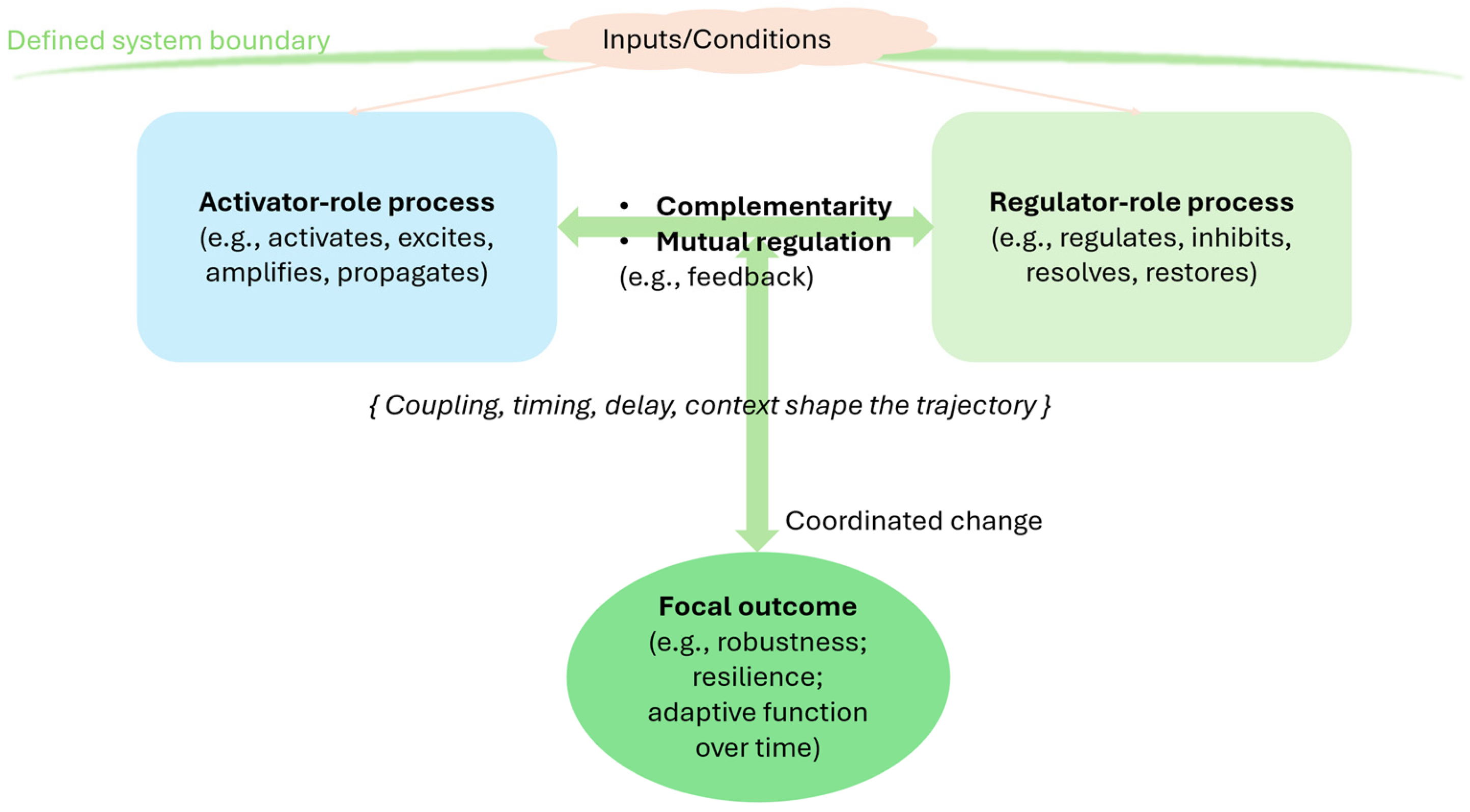
Figure 2.
The five provisional principles of CRD as an integrative dynamic architecture.
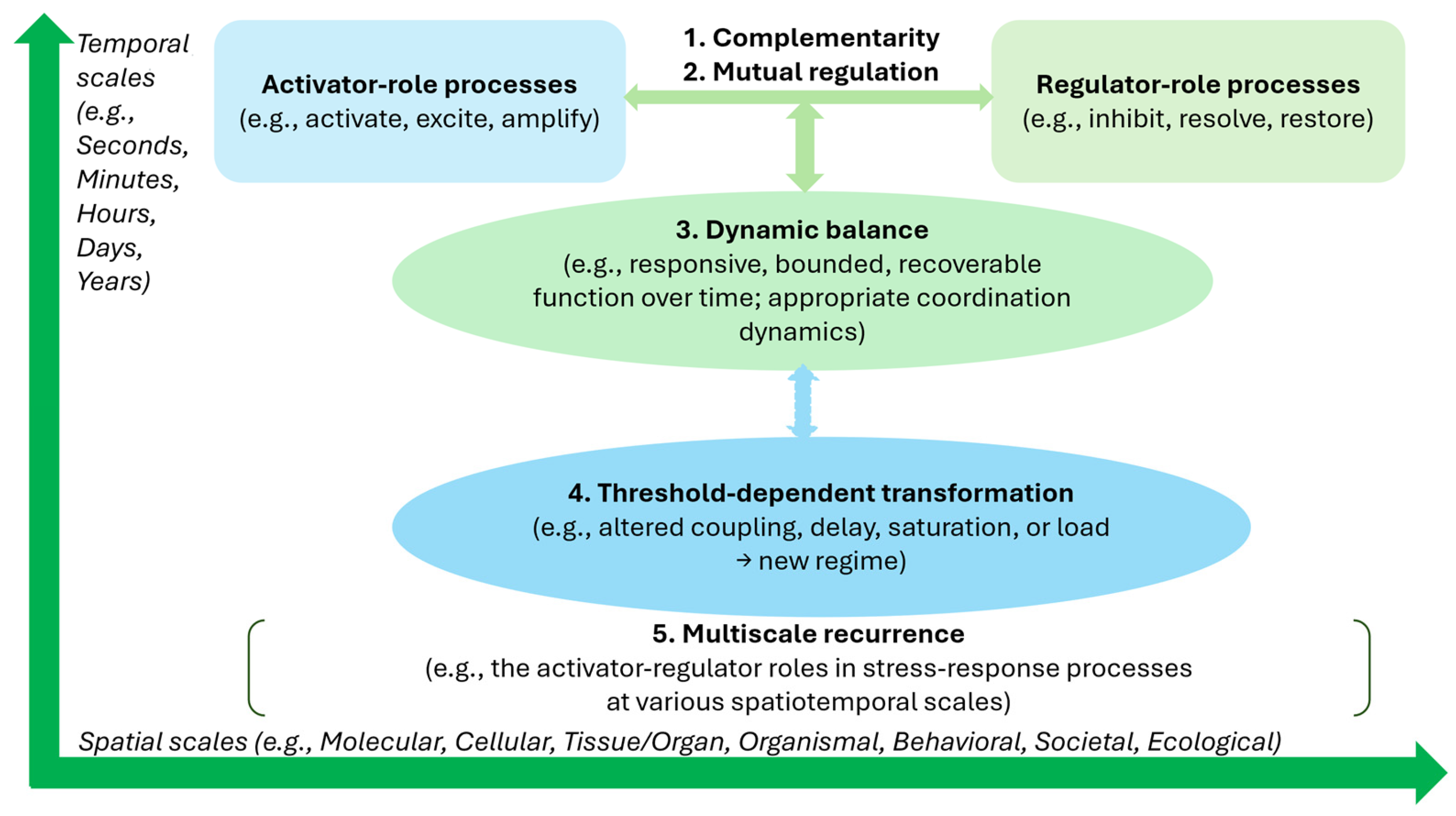
Figure 3.
A CRD-guided pathway from systems biology to dynamical systems medicine. Systemic causal linkages can be established among molecular networks, cellular states, tissue and organ functions, patient trajectories, and treatment timing. At each level, processes that act as activators and regulators can be identified, with explicit “bridging variables” linking the levels.
Figure 3.
A CRD-guided pathway from systems biology to dynamical systems medicine. Systemic causal linkages can be established among molecular networks, cellular states, tissue and organ functions, patient trajectories, and treatment timing. At each level, processes that act as activators and regulators can be identified, with explicit “bridging variables” linking the levels.
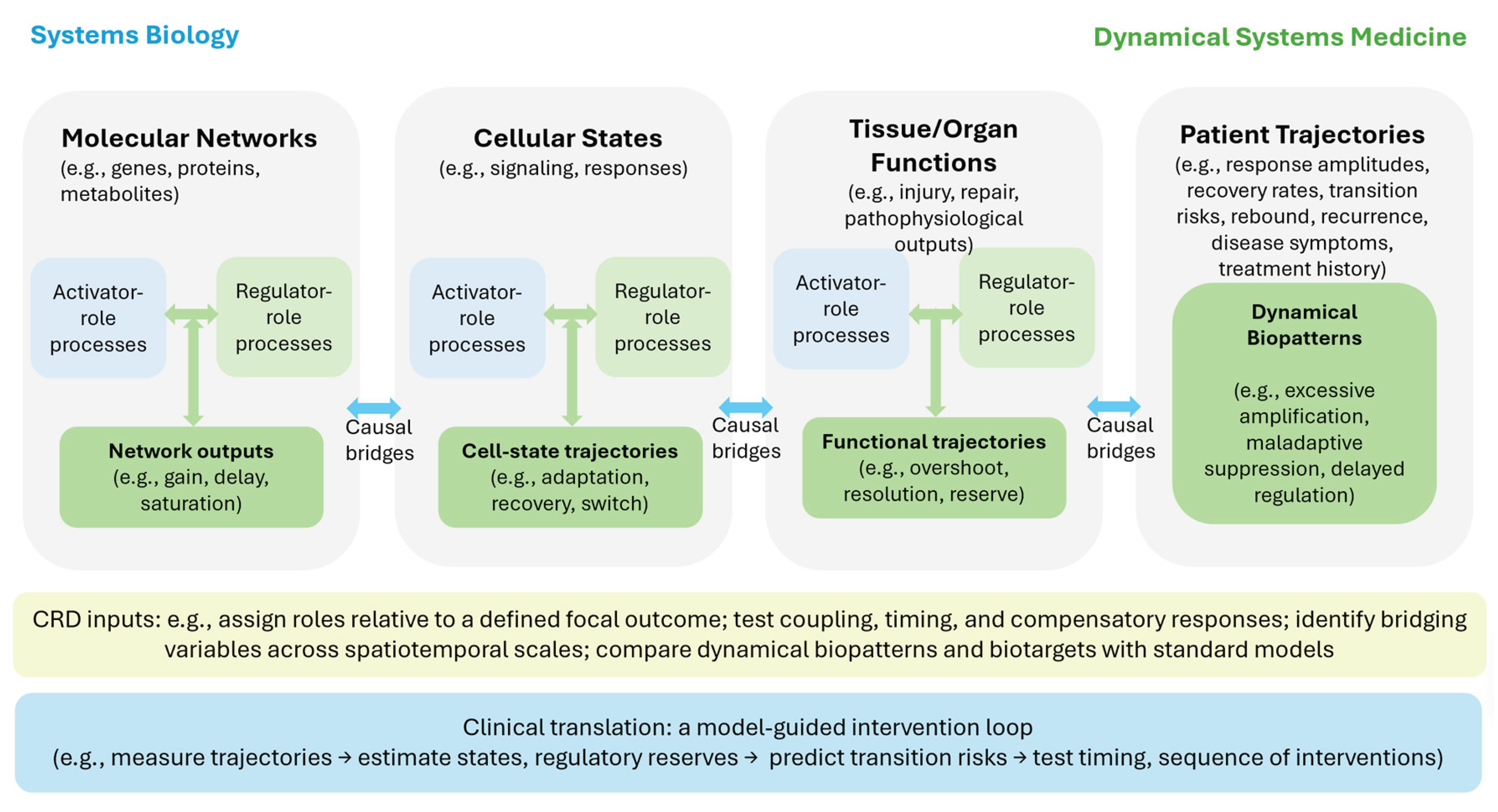

Table 1.
Basic Terminology of the CRD Theory.
| Term | CRD definition |
| System boundary | The empirically specified set of functional components, processes, and spatiotemporal scales included in an analysis. |
| Focal outcome | The biologically meaningful resulting condition, function, or trajectory against which the roles of activator and regulator are assigned. |
| Process | A temporally extended activity, interaction, or transformation rather than just a single molecule or structure. |
| Activator role | A functional process that, relative to the focal outcome, activates, excites, amplifies, propagates, mobilizes, or promotes. |
| Regulator role | A functional process that, relative to the activating process, regulates, inhibits, filters, redirects, terminates, or restores. |
| Activator/Regulator role processes | Functional processes that play activator or regulatory roles. Such role assignments emphasize that they are context-dependent and that roles can change. |
| Activator–regulator relation | A coupled, outcome-relative functional relationship between activating and regulating processes. |
| Coupling | The causal influence through which activator and regulator roles interact with one another or jointly affect the focal outcome, directly or distributed through intermediate processes. |
| Dynamic balance | A condition in which responsiveness and regulatory constraint are sufficiently coordinated to maintain viable function over time. It does not mean immobility, equal force, or a fixed numerical ratio. |
| Transformation | A qualitative change in system behavior/organization when thresholds in activation, regulation, coupling, or external pressure are crossed. |
| Multiscale recurrence | The possibility that analogous activator–regulator relations recur across levels of organization, while being implemented by different mechanisms at each level. |
| Nested processes | The functional processes with activator or regulatory roles at one level can be embedded within, contribute to, or be modulated by other processes at the same and/or other levels. Examples include activation within regulation and regulation within activation. |
| Functional architecture | The organized relationships among roles, couplings, feedback, delays, and constraints that produce system-level dynamics. |
| Dynamical biopatterns | The characteristic dynamical patterns of activating or regulatory processes in a biosystem boundary. Abnormal biopatterns may include excessiveness or deficiencies in activator- and/or regulator-role processes. |
| Dynamical biotargets | Dynamical biotargets may enable systems-based therapies by restoring dynamic balance in abnormal biopatterns. |
Table 2.
CRD’s Potential Contributions to Systems Biology.
| Systems-biology challenges | Potential CRD contributions | Examples of tests |
| High-dimensional networks and heterogeneous data | Prioritize variables by their candidate activator- and regulator-roles, coupling, and outcomes | Compare CRD-guided feature selections with established network and statistical approaches |
| Correlation without causation | Require perturbation-based tests of mutual regulation and predicted results | Demonstrate causal effects, rule out plausible alternatives |
| Static measurement | Focus on timing, delay, overshoot, recovery, and state transitions | Show that dynamic CRD measures improve explanations or predictions over cross-sectional measures |
| Multiscale fragmentation | Map outcome-relative roles and relationships at successive scales and specify causal bridges | Test whether cross-scale mappings predict higher-level behaviors |
| Drug resistance and side effects | Identify possible rerouting, delayed regulation, and intervention-timing effects | Validate predictions in independent experimental and clinical datasets |
| Limited translation to medicine | Define dynamical biopatterns, e.g., recovery rates, regulatory reserve, and transition risks | Demonstrate prospective clinical usefulness beyond existing biomarkers and models |
Table 3.
Examples of Dynamical Biopatterns and Possible CRD Interpretations.
| Examples of dynamical biopatterns | Examples of possible CRD interpretations | Potential clinical measurements |
| Excessive amplification (e.g., sustained activation/chronicity) | Activator-role processes exceed timely regulatory capacity; insufficient or uncoupled regulatory capacity | Peak response, rate of rise, tissue injury markers |
| Maladaptive suppression (e.g., excessive suppression, nonresponse) | Regulation dominates early enough to prevent a needed response | Impaired pathogen clearance, poor wound healing, inadequate stress response |
| Delayed regulation (e.g., overshoot, oscillation) | Regulatory processes are present but recruited too slowly; a phase lag allows overshoot; feedback creates repeated corrections | Phase lag between activation and containment |
| Regulatory insufficiency | Constraint, resolution, or restoration cannot meet system demand | Failure to return to the functional range |
| Compensated instability | The function appears preserved but requires increasing regulatory effort | Reduced reserves during challenge testing |
| Transition-prone state | Coupling, delay, saturation, or external load may approach a critical condition/threshold | Increasing variance, slowing recovery, recurrent near-failures |
| Threshold-dependent transition to a pathological regime | Gradual loss of coupling or a growing external load can produce an abrupt qualitative change in the system’s behavior | Disease symptoms, treatment responses |
Disclaimer/Publisher’s Note: The statements, opinions and data contained in all publications are solely those of the individual author(s) and contributor(s) and not of MDPI and/or the editor(s). MDPI and/or the editor(s) disclaim responsibility for any injury to people or property resulting from any ideas, methods, instructions or products referred to in the content. |
© 2026 by the author. Licensee MDPI, Basel, Switzerland. This article is an open access article distributed under the terms and conditions of the Creative Commons Attribution (CC BY) license.
Copyright: This open access article is published under a Creative Commons CC BY 4.0 license, which permit the free download, distribution, and reuse, provided that the author and preprint are cited in any reuse.