

Submitted:
22 September 2026
Posted:
23 September 2026
You are already at the latest version
Abstract
Plant growth-promoting rhizobacteria (PGPR) can support crop growth and protection, but their performance varies across strains, hosts, soils, and management conditions. Colonization measurements can help explain this variation, although persistence, microbial function, and plant benefit are distinct outcomes. This critical review examines how genome-informed models could prioritize strains for defined colonization tasks. We connect the ecology of dispersal, attachment, competition, and persistence with phenotype measurements, sequence representations, and validation design. Protein language models, DNA-based encoders, pan-genome features, and multi-task learning provide candidate tools, supported mainly by applications to related prediction problems. Their value for strain-level persistence must be assessed against phenotype-based and simpler genomic baselines under matched evaluation conditions. We organize the evidence around three application directions, examine assumptions about laboratory-to-field transfer, functional annotation, and trait independence, and propose a metadata schema and benchmark framework. Independent strain and soil holdouts, endpoint-specific measurements, and prospective field studies are central to assessing added predictive value. The resulting framework is a proposal for testing when genomic information and model complexity improve strain prioritization, with scope determined by the available labels and validation setting.
Keywords:
plant growth-promoting rhizobacteria
; rhizosphere colonization
; colonization fitness
; genome-informed prediction
; deep learning
; protein language models
1. Introduction
Plant growth-promoting rhizobacteria (PGPR) can influence nutrient acquisition, pathogen suppression, and plant responses to stress. Root-associated Bacillus biocontrol and rhizobacteria-induced resistance illustrate different mechanisms through which microorganisms affect plant health [1,2]. Growth and nutrient responses have also been measured in crops such as maize and tomato [3,4]. The effects depend on the organism, host, and conditions tested; they are not universal properties of all PGPR. Introduced populations encounter resident communities, heterogeneous soils, and changing host physiology, while formulation and delivery influence the material that reaches the plant [5,6]. Colonization, expression of a microbial function, and the resulting plant response are related endpoints that require separate measurements.
The practical selection question is which candidate strains merit further testing for a specified crop and environment. Mechanistic screens address components of this question, including resource use, attachment, motility, and antagonism [7,8]. A strong result for one component can support a useful candidate without fully describing its later population dynamics. Conversely, a strain can perform well through a combination of moderate traits or a mechanism that the original screen did not measure. A review of prediction methods should therefore evaluate what the available assays support, how contextual information changes that interpretation, and whether additional inputs improve selection.
Conventional selection has produced useful outcomes and often already combines several measurements. Khalid and colleagues selected rhizobacteria for wheat using auxin-related screening and plant responses, followed by pot and field evaluation [9]. Dey and colleagues assessed multiple growth-promoting traits, root-associated colonization, and peanut performance in a panel of Pseudomonas strains [10]. These examples support the value of phenotype-led selection within their tested systems. They also provide relevant comparators for genomic approaches, whose added value should be demonstrated rather than assumed.
Genomic information offers a complementary basis for strain comparison. Plant-associated genomes contain variation in gene content and sequence that may be relevant to colonization, while host and environmental data describe the conditions in which that variation is expressed. These relationships fit within the broader ecology of the rhizosphere and plant-associated microbiomes [11,12,13]. Root traits can also change following inoculation, creating feedback between the plant habitat and microbial activity [14]. The proposed use of sequence is to test whether genomic features add information for a defined outcome, not to infer plant benefit directly from the presence of a gene or from a persistence score.
This review examines genome-informed prediction as a complement to phenotype screening. We organize the task around a strain, host, soil context, sampling compartment, and observation window. Colonization biology motivates candidate variables; related prediction studies illustrate feasible methods; and the proposed framework specifies how their value could be evaluated. The practical criterion is whether genomic inputs improve prediction or reduce the experimental effort required to identify useful strains. Simple predictors, well-designed phenotype screens, and unsuccessful modeling attempts are therefore integral comparators.
This is a critical narrative review organized around screening, colonization processes, genomic prediction, community inference, and data standards. Table S1 lists the search concepts and associated keywords. Strain-linked colonization measurements inform endpoint and prediction requirements; plant-response studies without strain-tracking data inform agronomic relevance. Adjacent learning studies provide methodological precedents within their own organisms, inputs, and test settings.
The role of phenotype measurements changes with the question being asked. They can identify a mechanism, serve as model inputs, define an outcome, or independently evaluate a prediction. These uses are compatible, provided the experiment distinguishes information available at selection from the outcome being predicted. A prioritization model can assist allocation of trials while leaving the plant-performance decision dependent on those trials. Its value is conditional on the target, the candidate collection, and the experimental budget; it should not be inferred solely from the choice of a deep architecture.
Related reviews already connect microbial traits, community ecology, artificial intelligence, and field translation. Ma and colleagues cover AI applications to microbial traits and community analysis, including synthetic-community design and hologenome-based selection [15]. Fouad and colleagues integrate rhizosphere ecology, consortium design, formulation, multi-omics, AI-assisted optimization, and field validation [16]. The present review shares these themes and focuses its synthesis on named-strain colonization endpoints, the distinct inputs of candidate models, and the evidence needed to compare predictions across strain–environment settings. Figure 1 maps this organization. The contribution is the explicit connection between task definition, measurement, and evaluation.
The overlap also extends to endpoint definition and validation. Atav’s robustness review distinguishes delivery, establishment, persistence, and functional expression and relates them to formulation and validation [17]. Etesami’s response–effect trait framework addresses prediction of rhizosphere function and the links between traits and outcomes [18]. Earlier PGPR syntheses connect biological mechanisms with commercialization, and method reviews compare approaches for measuring colonization and persistence [19,20]. Here, the emphasis is on comparing the evidence for specific model inputs and outputs and identifying which generalization claim each validation design can support.
2. Phenotype Screening and Its Scope of Inference
Phenotype-led selection uses measurable activities to identify candidates for plant testing. Existing studies often combine several traits, colonization measurements, and plant responses, so the literature cannot be reduced to isolated plate screens [10,21,22]. The relevant limitation is whether an assay measures the quantity required for a later decision. Growth on a medium, inhibition of a target organism, and maintenance on a growing root differ in experimental support even when they are biologically connected. The proposed prediction workflow retains these measurements while asking which combinations are informative for a specified colonization endpoint.
Conventional screening has produced positive field outcomes in several tested systems. In wheat, rhizobacteria selected under controlled conditions improved growth and yield at naturally saline sites [23]. Greenhouse and field studies in different soils have also documented plant responses to inoculation [24,25]. A multi-season maize study found beneficial responses to selected strains, including a promising isolate without detectable phosphate-solubilizing activity in the reported screen [26]. These results show why a negative result for one conventional trait should not automatically exclude a strain. They also show that genomic methods must be compared with established selection procedures that can already produce useful outcomes.
An assay-defined trait is an incomplete proxy when the target depends on other processes. In Pseudomonas fluorescens F113, mutants impaired in biofilm formation on abiotic surfaces retained efficient competitive root colonization [27]. Related mutants also separated competitive colonization from biocontrol performance, illustrating that these outcomes cannot be treated as interchangeable [28]. Antibiotic or lipopeptide production provides another example: identifying a compound and its activity does not establish its accumulation or effect in a particular soil [29,30]. Measurements of cyclic lipopeptides in bulk soil and the sugar-beet rhizosphere demonstrate the importance of substrate and time for interpreting in-situ production [31].
Trait relationships can be positive, negative, or conditional. Cyclic di-GMP participates in regulation linking motility and surface-associated lifestyles, but it does not impose the same trade-off in every organism [32]. In Bacillus velezensis SQR9, disruption of luxS reduced motility, biofilm formation, and colonization together, with restoration by autoinducer-2 under the tested conditions [33]. Quorum-sensing studies in rhizobia and other root-associated bacteria also connect signaling with gene expression and extracellular activities [34,35,36]. Density, signal turnover, and growth conditions are therefore relevant measurements. A model should learn the observed relationship among traits rather than impose a universal opposition between motility and attachment.
Environmental transfer can alter the response of a candidate even when its identity is unchanged. Inoculation of Sulla spinosissima produced different treatment responses in sterile sand and contaminated soil [37]. A greenhouse onion study found that a bacterial treatment and its combination with seaweed extract could have different effects, including growth inhibition under one treatment [38]. These are context-specific plant outcomes, not direct observations that a named strain failed to persist. Similarly, nonsignificant growth responses in a short maize formulation experiment cannot establish either biological equivalence or death of the inoculant [39]. Reporting the endpoint and its uncertainty prevents such results from being misclassified when constructing training labels.
Screening also depends on formulation, dose, and application route. A candidate selected as a fresh culture may be delivered as a coating or carrier preparation, with consequences for exposure and population recovery [5,40]. Endophytic behavior is relevant for some strains and applications, but root-surface colonization can support other functions [41]. Selection studies should record these conditions so that an apparent strain effect is not detached from the treatment that produced it. Genomic identity is one part of this record and does not substitute for formulation or inoculation metadata.
Production and delivery evidence should be retained at its own scale. Fermentation and inoculant-quality reviews address the manufacture of a viable preparation [42]; encapsulation experiments can compare protection and release under controlled conditions [43]. Seed-coating trials then assess a treatment applied to a crop, such as the two-year potato study by Hu and colleagues [44]. These stages provide complementary observations, but a storage-survival result is not a field-persistence label. Recording the formulation and delivered dose is particularly important when the same strain appears in several experiments.
Experimental throughput creates a prioritization problem whenever the candidate collection exceeds the testing budget. A fitted model could help allocate measurements, but its comparison should include simple selection rules and existing experimental enrichment. Competitive tomato-root enrichment, for example, yielded Bacillus strains with sustained populations and greenhouse biocontrol activity in the reported study [45]. Such a procedure is a relevant phenotype-based comparator. The question is whether a computational shortlist produces more useful candidates per tested strain, or identifies candidates that the comparator misses, under equivalent validation conditions.
The main limitation of an isolated screen is the scope of the inference drawn from it. Trait assays, colonization measurements, and plant responses provide complementary evidence. Figure 2 organizes the contextual factors that can affect transfer. Table 1 summarizes the measured quantities and their limitations, with additional measurement considerations in Text S1.
Assay interpretation also requires appropriate negative evidence. A nonsignificant inoculation effect on yield is a result about the measured plant response, whereas failure to detect a strain is a result conditioned on the detection method. A sweet-corn study reporting no overall significant PGPR-concentration effect, for example, does not identify a colonization mechanism [46]. Preserving these distinctions allows positive, null, and adverse responses to contribute to a balanced synthesis. It also avoids constructing an apparently precise colonization label from an agronomic observation that never tracked the organism.
Uncertainty belongs to the experimental design as well as to the model. Replicates within one assay estimate variability under that protocol; they do not estimate variation across untested soils or seasons. Conversely, multi-environment experiments can quantify those additional sources when the sampling and analysis support them. A prediction score should carry the same contextual boundary as the measurements used to evaluate it. Adding a neural network does not expand that boundary automatically.
3. Colonization Processes, Context, and Measurement
Colonization can be organized into interacting processes of dispersal, attachment, establishment, competition, and persistence. Mutant and competition studies identify contributions of particular traits under specified conditions [47,48]. Figure 3 uses these processes as a conceptual structure for connecting mechanisms, environmental modifiers, and measurements [49,50]. The route can differ among strain–host systems, and entry into the endosphere is optional.
Delivery and early survival determine the population available for colonization. Alginate encapsulation improved survival and wheat-root colonization of P. fluorescens in the conditions studied by van Elsas and colleagues, illustrating why carrier effects belong alongside strain properties [51]. Early movement can also matter: flagellar defects impaired potato-root colonization in a plant-growth-stimulating pseudomonad, and chemotactic motility contributed to initiation of wheat-root colonization by Azospirillum brasilense [52,53]. These experiments identify particular organism–host dependencies. They do not establish that all inoculants require the same motility system or that an early motility advantage guarantees later population maintenance.
Root chemistry provides a context for movement and expression. Organic acids in banana exudates affected chemotaxis, biofilm formation, and colonization by Bacillus amyloliquefaciens NJN-6 [54]. Receptor studies linked recognition of particular organic acids to competitive colonization in P. fluorescens, while work in SQR9 identified exudate compounds and their corresponding chemoreceptors [55,56]. Root-secreted compounds also mediate interactions among cucumber, beneficial Bacillus, and a fungal pathogen [57]. Thus, an informative trait can be a response to a specified host chemical environment. Root exudates and plant defense signaling have long been recognized as influences on rhizosphere communities [49,58]; genomic prediction builds on that ecological knowledge.
Host responses can also change the local environment after inoculation or pathogen challenge. In cucumber, pathogen infection enhanced SQR9 colonization, with experiments implicating particular organic acids in chemotaxis and biofilm responses [59]. Plant–microbe communication increased bacterial auxin synthesis in another SQR9 study, and a targeted bacterial mutation altered the corresponding root response [60]. Experiments with sugarcane exudates likewise connected specific amino acids to bacterial behavior and plant-associated outcomes [61]. These findings support treating host chemistry as a measured interaction context. They do not establish that a response observed for one bacterium and exudate transfers unchanged to another pair.
Surface attachment and root occupation should be resolved in space and time. Flagellar synthesis genes affect competitive colonization in F113, and microscopy of WCS365 describes patterns of occupation along gnotobiotic tomato roots [50,62]. Fluorescently marked FZB42 displays different colonization patterns across plant hosts [63]. Physical studies of near-surface movement provide additional mechanisms linking motility and attachment, although their experimental settings differ from living roots [64,65]. The F113 biofilm counterexample cautions against treating biomass on an artificial surface as a necessary intermediate in every root-colonization route [27]. Root measurements are needed to determine whether an assay-defined attachment phenotype transfers to the intended habitat.
Spatial patterns can distinguish strains even when aggregate counts are similar. Fluorescently marked antagonists occupied different sugar-beet root microhabitats, while phenotypic selection and phase variation occurred during F113 colonization of alfalfa [66,67]. Earlier comparisons of plant-colonizing Bacillus also linked strain identity to survival and colonization observations [68]. Such evidence makes a single static strain descriptor incomplete for some questions. General reviews of flagellar function describe several physiological roles of movement [69]; the contribution relevant to prediction still needs to be established for the assay and root habitat being modeled.
Resource acquisition and resident organisms can alter establishment. Amino-acid auxotrophs of WCS365 showed impaired tomato-root-tip colonization in a gnotobiotic system, with supplementation providing evidence for the specific nutritional limitation [48]. In a different interaction, fusaric-acid-producing Fusarium affected antibiotic-biosynthesis gene expression in Pseudomonas, while chemotaxis toward fusaric acid contributed to colonization of fungal hyphae [70,71]. These studies connect nutrition or neighboring organisms to particular processes; they do not measure a universal competitive score. Reviews of root colonization and biocontrol describe this broader interaction context [72,73,74].
Persistence describes population maintenance over a defined observation window. The window may cover early establishment, a crop season, or repeated seasons, depending on when microbial activity is relevant. A harvest-time count supports an endpoint, while repeated sampling is needed to distinguish early increase, decline, and recovery. Population abundance also differs from function. In the wheat rhizosphere, production of 2,4-diacetylphloroglucinol was related to the density of the inoculated pseudomonad in the tested system [75]; that relationship needs validation before it is used as a proxy elsewhere. Host responses add another level: ethylene-related changes following root colonization did not fully explain the measured induced resistance, and ACC-deaminase effects differed among root-development endpoints [76,77]. A sustained population is therefore neither a complete mechanism nor a sufficient demonstration of plant benefit.
Soil and host effects can interact. Wheat microbiome surveys across eight soils and a study of Populus genotypes in contrasting soils illustrate context-dependent community assembly [78,79]. Soil origin and host genotype also influenced different microbiome compartments in Medicago truncatula [80]. Agricultural management can modify these relationships, including community structure and nitrogen-cycling patterns [81]. These community-level studies motivate measuring environmental covariates; they do not establish a genomic predictor for an introduced strain. Relevant covariates should follow the experiment, with soil chemistry, moisture, host identity, and management recorded where they affect the intended comparison. Domestication and plant breeding provide further reasons to consider host background explicitly [12,82].
Broader surveys help identify the environmental variation that a candidate model may encounter. Work in Populus and soybean separates effects of tissue habitat, genotype, and soil background [83,84], while a large Southern Hemisphere survey relates microbial diversity to climate, vegetation, and soil properties [85]. Studies of pecan rootstocks and selenium-accumulating Astragalus further illustrate host- and compartment-dependent community responses [86,87]. These are covariate-selection precedents, not demonstrations that adding every recorded variable improves prediction. A colonization study should state which variables are measured, which are missing, and which settings lie outside its observed range.
Direct comparisons help connect process measurements to selection. Competitive enrichment of tomato roots produced candidates with both colonization and disease-suppression evidence [45]. Disruption of abrB in SQR9 altered chemotaxis, biofilm formation, root colonization, and biocontrol in the tested system [88]. In PsJN, quorum sensing and auxin degradation contributed to colonization and plant growth promotion [47]. These examples justify measuring several outcomes in a shared strain panel. A proposed model can then test whether intermediate traits improve endpoint prediction, while controls distinguish generalized growth defects from a more specific colonization effect.
Sampling time is part of the phenotype definition. Immunofluorescence and confocal observations of barley roots followed two pseudomonads over the first week, revealing spatial changes without evidence of competition between those strains under the tested conditions [89]. Maize biocontrol experiments also measured colonization at multiple root locations and later time points [90]. Short-term barley microcosms tracked an introduced DR54 population alongside community-level measurements and found transient effects [91]. Existing work therefore already includes temporal and spatial designs. The modeling challenge is to preserve that information when observations are collated. An endpoint model cannot retrospectively identify the trajectory that produced the endpoint, and a time-series model requires sufficiently resolved longitudinal labels.
Time dependence also occurs in the host-associated community. Plant age and genotype affected bacterial succession in the Arabidopsis rhizosphere, and plant nitrogen uptake was associated with community assembly during grass growth [92,93]. These observations support retaining developmental stage and sampling time. For a longitudinal prediction, the task should specify whether it forecasts a future population, summarizes maintenance over an interval, or classifies a trajectory. Each option uses different labels and may require different sampling density.
Compartment definitions distinguish bulk soil, rhizosphere soil, the rhizoplane, and internal root tissues. A lipopolysaccharide study in WCS417r examined endophytic tomato-root colonization, and PsJN has been followed from the grapevine rhizosphere into above-ground tissues [94,95]. These are specific routes, not obligatory stages for all PGPR. Banana imaging studies and crop microbiome surveys likewise illustrate differences among strain distributions and root-associated compartments [96,97]. Pooling these observations into one abundance value can conceal which habitat was occupied. A model should retain the sampling compartment and recovery procedure, especially when surface disinfection, root washing, or soil separation affects the material measured.
Measurement adds a further distinction between presence, viability, and activity. Work with GFP-marked pseudomonads in the barley rhizosphere combined localization, cultivation, and activity measurements, showing that these properties can diverge with water conditions [98]. Persistent members of the natural common-bean rhizosphere microbiome have also been identified across space and time, but persistence of a community taxon is not the same label as survival of an introduced, named strain [99]. Root-exudate-mediated plant–soil feedbacks can carry effects across plant generations without demonstrating that the inoculated population itself survived that entire period [100]. These distinctions prevent mechanistically different observations from being merged into one persistence category.
Community context can be represented at different levels. Establishment of a beneficial Pseudomonas in wheat changed a species-rich soil community under contrasting nutrient conditions, while seed-borne bacteria have been linked to niche partitioning and facilitation during wheat microbiome assembly [101,102]. Consumer–resource simulations of community coalescence provide related mechanistic hypotheses about competition and cooperation, with different evidence from these plant experiments [103]. A single-strain task may use resident-community summaries; a consortium-design task may need explicit member identities. Relational models are an optional extension to compare with additive or composition-based models. Their usefulness depends on the question and measurements, not on an assumption that reconstructing every interaction is always necessary.
4. Genome-Informed Prediction: Representations and Modeling Options
Genome-informed modeling separates the input representation from the prediction target. Sequence can be summarized by predefined counts, functional annotations, gene-content matrices, or learned representations. Each can be paired with a simple or complex predictor. The evaluation question is whether an input and model combination improves a defined colonization task under independent testing. Deep learning is one candidate approach within this comparison, particularly for learning features from large unlabeled sequence collections.
A genome accession can provide a stable link between a strain and measurements made in different studies. Consistent sequence processing supports comparisons across isolates, while assembly quality, gene calling, and strain identity still require verification. Genome-based features are therefore candidate reusable inputs; their predictive value depends on labels and on the target setting. Phenotypic measurements remain necessary both to fit models and to evaluate the candidates they prioritize.
A representation determines which variation the predictor can access. Fixed k-mer counts summarize sequence composition without requiring functional annotation, but discard positional information. Gene-content features describe the presence or absence of inferred gene families and depend on assembly and annotation choices. Pan-genome comparisons within the B. amyloliquefaciens group illustrate biologically relevant gene-content variation without constituting a validated colonization-prediction model [104]. Learned protein representations capture amino-acid regularities at the protein level [105,106]. Pooling them over a genome can lose information about gene order or regulation, so a protein embedding and a nucleotide model should not be described as equivalent views of a strain.
Related sequence-to-phenotype applications establish useful precedents but also define the limits of the analogy. Whole-genome models of antimicrobial resistance predict an assay-specific bacterial phenotype and can compare linear, tree-based, and deep methods [107]. Transfer-learning work using simulated human genotype–phenotype data addresses a different population and target [108]. These studies support evaluating reusable representations and appropriate baselines. They do not provide evidence that colonization labels have the same sample-size requirements or environmental stability.
Representation learning can use abundant unlabeled sequence to initialize a predictor whose labeled dataset is smaller. Protein language models, including SeqVec and the ESM family, have transferred information to protein-level tasks [106,109]. For a colonization study, the relevant alternatives include a frozen encoder with a regularized downstream model, partial fine-tuning, or end-to-end training. The amount of fitted capacity should be considered alongside independent sample size. An unannotated region can enter a sequence representation, but this inclusion neither identifies its biological function nor establishes that it improves prediction. Feature ablation and matched held-out comparisons are needed to test that contribution.
The modeled input also determines which adjacent methods are informative. DeepBind learns sequence-specific binding predictions from nucleotide inputs, whereas DeepGS predicts plant phenotypes from genotype markers [110,111]. Deep phenotyping with temporal plant images is a third task, using images rather than genomic sequence [112]. These distinctions matter when describing transferable components: an image model may assist phenotype extraction, but it does not demonstrate a DNA representation. Method transfer requires matching the input type and target, followed by an evaluation on the colonization data of interest.
Ranking is useful when the decision is to select a limited number of strains for further testing. Pairwise and listwise objectives directly optimize aspects of ordering, while regression and classification models can also produce useful rankings [113]. These approaches should be compared using the same candidate sets and an endpoint relevant to selection, such as top-ranked enrichment or rank correlation. Stable ordering can be useful even when absolute predictions are imperfect, but systematic errors across soils still matter when candidates are compared across contexts.
Multi-task learning (MTL) can share information across correlated endpoints through a common representation and task-specific outputs. It does not enforce ecological trade-offs, and separately fitted models do not imply that the underlying traits are biologically independent. Benefits depend on task relatedness, label quality, and loss weighting. Negative transfer occurs when joint training harms one or more tasks; single-task baselines and per-task performance reports are therefore needed [114]. Gradient-conflict methods are one possible optimization strategy, not a guarantee of biological consistency [115].
Uncertainty should be evaluated for the output being reported. Ensembles provide one way to examine model variability, but agreement among models does not demonstrate calibration. Classification probabilities can be checked with reliability diagrams and probability-calibration measures [116,117]. Conformal prediction can produce prediction sets or intervals with marginal coverage under appropriate exchangeability conditions [118]. Those guarantees do not automatically extend to new soils or lineages under distribution shift. Coverage, interval width, and performance in the intended external settings therefore require separate reporting.
Gene-fitness experiments and community experiments supply different kinds of evidence for model development. Barcoded transposon sequencing measures the relative fitness of pooled mutants under specified conditions; the units are mutant lineages, not a consortium of naturally distinct PGPR strains [119,120,121,122]. These measurements can identify conditional gene contributions and support genotype–phenotype modeling. Community models additionally require member identities and interaction-relevant measurements. Co-occurrence networks offer candidate statistical relationships, but shared environmental responses and compositional data can generate edges without direct biological interactions [123,124]. Integrating these inputs into a model of root colonization remains a hypothesis to evaluate. Figure 4 summarizes the proposed components.
Statistical analysis of transposon libraries also depends on the question. Bayesian gene-essentiality analysis and ARTIST illustrate approaches for estimating essential or condition-dependent regions from insertion data [125,126]. A gene-fitness value within one genetic background is different from the relative performance of naturally distinct strains. If mutant data are used to inform genomic features, the aggregation and transfer assumptions should be stated. Otherwise, a large number of mutant observations can give the misleading impression of broad strain diversity while representing a narrow genomic background.
Phenotype data define the supervised target and the conditions under which model outputs can be interpreted. ProteinGym illustrates how measurements from many protein experiments can be organized into explicit benchmark tasks while retaining assay distinctions [127]. A colonization benchmark needs analogous clarity about its observational unit and outcome. The same strain can have several labels from different hosts, soils, times, or assay types. Reusing those observations is informative when the model accounts for their structure; simply treating them as independent observations of one universal fitness value changes the question being answered.
Prediction and causal interpretation should be assessed separately. A model can produce useful held-out rankings from correlates without identifying the intervention that would change colonization. Conversely, a validated mechanism in one strain may add little predictive information across a diverse candidate collection. Combining mechanistic constraints with learning is a possible strategy, as discussed for genome-scale metabolic models, but the constraints and their domain of validity must be specified [128]. For colonization, a proposed hybrid model should be compared with both its unconstrained predictor and the mechanistic component to determine which information contributes.
The composition of the training set deserves explicit reporting. If only successful inoculations or measurable populations are retained, a model has little evidence about failure or the detection boundary. This is a risk of selection, not an established quantitative estimate of publication bias in PGPR. Dataset construction should retain eligible null and adverse outcomes, document exclusions, and distinguish missing measurements from observations below detection. Candidate ascertainment also matters: strains selected for a particular trait represent a different distribution from an unselected collection. Independent evaluation should reflect the collection from which future candidates will actually be drawn.
Curated gene and pathway features paired with linear models or random forests provide relevant baselines. Feature importance can aid inspection, although random forests are not intrinsically transparent and correlated predictors complicate interpretation.
A relevant bacterial example is the random-forest classification of plant-associated lifestyles in Pseudomonas. The development set contained 91 genomes, and the selected model used 28 genome-derived features. Predictions were subsequently made for 75 additional genomes: one set of 25 strains with known lifestyle information and another of 50 strains including phenotypically unclassified and bioremediation isolates [129]. These predictions do not constitute validation on 75 independently labeled strains. The task classified lifestyles; it did not measure root persistence or compare deep sequence models.
Fixed k-mer frequencies and composition vectors provide predefined sequence features. Convolutional architectures instead learn features from nucleotide sequence, as illustrated by promoter-recognition tasks [130].
Protein language models learn from amino-acid sequences. UniRep uses an autoregressive multiplicative long short-term memory (mLSTM) architecture, whereas the ESM family and several ProtTrans models use Transformers [105,106,131,132]. Using protein embeddings to represent a strain requires an explicit aggregation rule across its proteins. DNA models use nucleotide inputs: DNABERT, for example, learns contextual representations of k-mer tokens for regulatory-sequence tasks [133]. Such results motivate testing nucleotide representations in bacteria; they do not establish root-colonization prediction.
Pan-genome gene-presence features form a separate representation of variation across a population. Their use with support vector machines for host-source classification in Brucella illustrates a bacterial genotype–phenotype application, without demonstrating a deep colonization model [134]. Relational models can represent candidate strain associations, with co-occurrence edges interpreted as inferred statistical relationships [123,124]. These adjacent methods motivate evaluating an integrated sequence-to-persistence workflow. Table 2 compares candidate representations and their evaluation needs. Text S2 summarizes suggested reporting fields.
Training design needs to address label error, limited supervision, and distribution shift. Paired measurements or repeat assays can help estimate reproducibility, while assay-stratified evaluation reveals whether performance depends on one protocol. Pretraining uses unlabeled sequence, but supervised labels are still required to test the target task. Domain-generalization methods such as invariant-risk objectives are candidates to evaluate [135]. DomainBed results emphasize the importance of strong empirical-risk baselines and model-selection procedures in assessing such methods [136]. Neither methodological literature guarantees transfer to unfamiliar soils. Hyperparameter selection, preprocessing, and feature selection must use development data, with the external test reserved for the final comparison.
The computational cost of scoring an additional strain can be low once its genome has been processed and a model trained. Reusable representations make this a plausible advantage for large candidate collections, although the cost depends on model size, hardware, and whether embeddings must be recomputed. Sequencing and analysis costs have changed substantially over time [137,138]; these trends do not establish that sequencing is always cheaper than an individual assay. Total screening cost also includes curation, phenotype generation, training, and prospective validation. The practical comparison is the cost of identifying a useful candidate under a fixed experimental budget, measured against the existing selection workflow.
Attribution, perturbation, and mechanism require different evidence. Saliency, integrated gradients, and related methods describe how a fitted model responds to its inputs; their stability across fitting runs and correlated features should be assessed [139,140,141]. Attention weights alone do not establish an explanation of either the model or the organism [142,143]. A targeted deletion or expression change can test whether a nominated feature affects the measured phenotype in a specified genetic and environmental background. Mechanistic interpretation may additionally require complementation, controls for growth effects, and evidence linking the intervention to the proposed process. Agreement between attribution and one perturbation is therefore distinct from a complete causal account. Report these evidence levels separately.
5. Applications to Traits, Molecular Measurements, and Communities
Three application directions address different questions: prediction of individual traits, integration of molecular and phenotypic measurements, and inference about communities (Figure 5). Their data requirements depend on the target and experimental setting. A single-trait assay may provide a clear label, a multi-omics study may help investigate a mechanism, and a community experiment may address mixture-dependent effects. These directions can be developed independently or linked where their measurements support a common question.
Model choice should follow the target and observation structure. Continuous endpoint measurements support regression; ordinal selection decisions can be evaluated with ranking metrics and optionally ranking losses. Several related measurements on overlapping strain panels make multi-task learning a candidate, with separate models as comparators. For strain-by-soil observations, environmental covariates, interaction terms, and hierarchical or conditional models offer alternatives. The choice between measured soil inputs and random effects depends on which settings will be available at prediction time. Each formulation needs evaluation at the level of the intended generalization claim.
Method choice depends on both the representation and the available labels. Linear predictors and tree ensembles on fixed features provide useful comparators for small datasets. Convolutional models can learn sequence patterns, whereas recurrent and attention-based architectures represent order or longer context within their implemented receptive fields. Architecture names alone do not establish that an entire bacterial genome has been modeled effectively. Relational models add assumptions about how nodes and edges are constructed. Models should report sequence windows, aggregation, feature dimensions, and fitted parameters so that performance differences can be interpreted. A frozen protein representation with a simple predictor is a distinct option from fine-tuning a large encoder [105,109].
Single-trait tasks can use motility, surface-associated biomass, or growth under a specified stress as labels. Root-associated experiments already supply examples of regulated motility, biofilm formation, and related phenotypes [33,88]. The task must preserve the protocol, unit, conditions, and strain identity. Existing mechanistic measurements motivate prediction but do not themselves demonstrate the accuracy of a sequence model. Suitable comparisons include a prevalence or mean baseline, taxonomy-informed prediction, fixed sequence features, and the measured screening traits available at selection. Performance on one trait should be reported independently of any claim about root persistence or plant benefit.
Multi-omics studies can connect genomic potential with expression and chemical context. Transcriptomic analysis of SQR9 during exudate-induced biofilm formation and genome/transcriptome analysis of surfactin biosynthesis provide examples of condition-dependent molecular information [144,145]. Metabolomic and metagenomic measurements linked to experimental treatments can help examine community function, as in work on metabolites and diseased rhizosphere assembly [146]. These studies motivate candidate inputs and mechanistic questions. Predictive fusion requires matched observations at the relevant strain, sample, and time, with the best single modality as a comparator. Missing modalities and differences in measurement scale need an explicit analysis strategy, not an assumption that every additional molecular layer improves the model.
Paired host and microbial measurements offer several kinds of mechanistic context. Olive-root transcription changed following colonization by PICF7, whereas tomato field work examined defense metabolites after bacterial inoculation under nematode pressure [147,148]. Metatranscriptomic studies of willow in contaminated soils and exudate experiments in rhizoremediation identify additional environment-dependent expression patterns [149,150]. The experimental unit in these studies differs from a library of independent strain genomes. Their value for a prediction dataset depends on preserving sample matching, treatments, and the actual response variable. Combining molecular layers cannot compensate for a mismatch between those units.
Community inference addresses composition-dependent colonization and function. Emmenegger and colleagues provide an adjacent plant example: random forests and elastic-net models predicted pathogen colonization and plant protection in an Arabidopsis phyllosphere system using designed communities drawn from a 35-strain pool [151]. The study included 136 five-member communities and tested predictions in additional combinations. Its inputs described community membership or abundance, rather than a sequence-based deep representation. Generalization to new combinations of members from the same pool does not establish transfer to previously unseen member strains, root systems, or field soils. For root-associated consortia, a corresponding evaluation would need documented inoculant members, resident-community context, and outcomes measured in the intended compartment. Designed synthetic communities can help isolate composition effects, while transfer to non-sterile soil remains a separate question.
Plant-community experiments provide additional ecological constraints for this direction. In a rhizosphere disease-suppression study, communities assembled under different processes differed in robustness to inoculation conditions [152]. Such designs can expose composition and context effects that a genome-only predictor would need to address. However, disease suppression is a functional outcome, and stable suppression does not by itself define the persistence of every consortium member. Studies should state whether the target is member abundance, invasion of a pathogen, a community function, or a plant response before assessing model performance.
Other plant studies illustrate both potential applications and evidential limits. A pear-rootstock study linked host genotype, potassium limitation, and a Bacillaceae synthetic community to plant performance [153]. A citrus study associated genotype-dependent drought responses with microbiome restructuring, with correlation-based evidence requiring caution about causal interpretation [154]. Genomic and experimental characterization of Methylobacterium 2A provides a further example of complementary sequence and plant observations [155]. These cases inform task selection and candidate variables, but they do not independently validate an integrated deep-learning pipeline.
Interpretation is useful when it changes an experimental decision. A feature attribution can suggest a candidate locus, a measured environmental variable can identify a setting where predictions are unreliable, and a simple model can reveal that an elaborate representation adds little information. These uses require checks appropriate to the interpretation being offered. Accurate selection and mechanistic explanation are different objectives; neither should be treated as an automatic consequence of the other.
Evaluation should retain the unit of the task. A single-trait predictor is tested on independently held-out strains or genomic groups, with classification or regression metrics appropriate to its label. A multi-omics model should show the contribution of fusion against its strongest individual modality under matched splits. A community predictor can be tested on new mixtures of familiar members or on mixtures containing previously unseen members; these are different generalization claims [151]. Attribution-based mechanistic claims need a separate experimental test. Splitting at the required biological level prevents the performance estimate from silently answering an easier question.
Data acquisition should follow the same distinctions. Culture collections and assay records can supply candidate strain identities and measurements, but labels need curation before reuse. Paired molecular studies can support multi-omics questions when sample identities and measurement conditions are preserved. Designed communities require complete member manifests, inoculation details, and a clear definition of the resident background. Missing pairings can limit a fusion analysis even when each individual dataset is large. These constraints help select a feasible initial task.
Costs should be reported separately for input generation, curation, computation, and validation. Reusing public sequence and a fitted model can make additional in-silico scores inexpensive. Matched multi-omics measurements and designed community experiments require additional sampling and laboratory work, whose scale depends on the question. A pilot can identify which measurements improve selection sufficiently to justify their expense.
6. Three Assumptions to Test
Three assumptions merit direct examination: that an assay phenotype transfers to the intended environment, that available annotations capture the relevant predictive information, and that traits can be treated as independent for the task (Figure 6). These are modeling and inference choices. Existing root-colonization reviews already discuss ecological context and genetic determinants [7,156,157]. The proposed framework turns those concerns into comparisons that a particular dataset can support.
The first assumption concerns transfer between experimental settings. A biofilm measurement on an artificial surface and competitive occupation of a living root can disagree, as the F113 experiments show [27]. Conversely, conventional screening has produced positive field outcomes in specified environments [23,26]. A useful test compares the same candidates across relevant settings and reports the degree of agreement and uncertainty. The scope of the conclusion is determined by the hosts, soils, protocols, and seasons actually evaluated.
The second assumption concerns annotation coverage. In-vivo expression technology identified rhizosphere-induced genes in P. fluorescens, including genes without recognized homologs in that study [158]. This motivates evaluating information beyond familiar pathways, while induced expression remains distinct from a demonstrated causal requirement. Receptor and mutant studies provide more specific evidence for particular colonization functions [48,55]. A predictive comparison can test curated features against a representation that includes additional sequence, keeping labels and splits fixed. The result concerns incremental information in that representation, not the proportion of all colonization mechanisms that remains unknown.
The third assumption concerns trait dependence. Regulatory coupling can generate several relationships: shared positive responses in SQR9, context-dependent signal effects in Serratia, and differences between competitive colonization and biocontrol in F113 [28,33,36]. A correlation matrix describes the measured panel but cannot by itself distinguish resource trade-offs from shared regulation or environmental confounding. Comparing separate and shared-task models tests whether the observed dependence is useful for prediction. Per-task performance and negative transfer remain necessary outcomes of that comparison.
The choice of input should follow these tests. Measured traits, annotated gene content, sequence features, and environmental variables can be informative alone or in combination. Deep models may learn nonlinear relationships when the data support them; simpler models may be sufficient or more stable with limited independent observations. The fair comparison holds the target, split, and available information constant where possible. The resulting evidence can support a genomic contribution, a particular model, or a simpler phenotype-based workflow.
These checks also guide interpretation of a negative result. Failure of a genomic representation to improve one endpoint does not invalidate the endpoint or imply that genes are biologically irrelevant. It may reflect inadequate variation, noisy measurements, unmeasured context, or a task already well predicted by available traits. Further experiments should be chosen according to which explanation is testable. A modeling result is most useful when its boundary identifies the next measurement or limits an unnecessary expansion of the workflow.
7. Data Requirements and Benchmark Design
A colonization-prediction dataset needs linked sequences, measurements, and context. Resource categories appear in Table S2, and challenges with candidate evaluation designs are combined in Table S3. General microbiome audits have identified weaknesses in sequence-data and metadata sharing [159]. The specific question for a colonization dataset is whether its strain identifiers, measurement definitions, and environmental records support the intended comparison. Article or genome counts alone cannot answer it.
Shared benchmarks provide methodological precedents for organizing comparisons. ImageNet supported common image-classification evaluation, CAMI compares metagenomic methods, and ProteinGym organizes protein-fitness tasks [127,160,161]. Their tasks differ from introduced-strain colonization. A corresponding benchmark here would need a defined endpoint, reusable records, appropriate independent holdouts, and accessible baseline implementations. The proposed design addresses those requirements.
Colonization measurements can differ in target quantity as well as protocol. CFU counts describe the culturable fraction under the plating conditions; qPCR measures target DNA; fluorescence depends on reporter behavior and detection; relative abundance also changes when other community members change. These readouts are not interchangeable labels [20]. Consistent metadata can make records discoverable and linkable, but comparability requires compatible compartments, sampling windows, units, and validated measurement procedures. Where several assays are retained, use assay-specific endpoints or justify a measurement model using paired calibration data. Treating every difference as a batch effect can conceal a biological difference in what was measured.
Paired measurement designs can clarify these relationships before data pooling. A microcosm comparison using glass beads and clay particles showed that experimental substrate affects the ability to recover exudates while following community dynamics [162]. The implication for dataset design is specific: the sampling platform can determine which modalities are observed together. An absent exudate measurement in one system should not be treated as a biological zero. Likewise, apparent compatibility of sequence and phenotype tables is insufficient if sampling dates or experimental populations differ. A small set of carefully paired observations can help establish which transformations are defensible before a larger integration effort.
The split must reflect the source of dependence among observations. In an adjacent gut-community study, colonization outcomes were predicted from baseline community composition using donor-level separation, with reported random-forest discrimination around AUROC 0.86 [163]. This illustrates evaluation across independent biological units in an in-vitro system. It is not evidence for the same performance in root-associated communities. A PGPR dataset requires its own assessment of strain relatedness, repeated contexts, and experimental blocks. The appropriate holdout depends on whether future use concerns new strains, new soils, or new combinations.
Linkage requires a strain identity that survives differences in naming across repositories and experiments. Sequence accessions, culture-collection identifiers, and laboratory strain aliases should be reconciled without assuming that a shared species name identifies the same isolate. The measured preparation also matters: a mutant, a marked derivative, and its parental strain can share most of a genome while representing distinct experimental entities. Records should preserve these relationships and the source of each match. Ambiguous links can remain in a provenance table without being assigned a training label until their identity is resolved.
Table 3 proposes a compact record linking strain identity, host, soil context, inoculation, sampling, and the measured endpoint. Existing sequence-metadata standards provide a starting point for provenance and environmental descriptors [164,165]. Colonization-specific fields still need explicit definitions and validation. A shared identifier enables linkage; measurement compatibility determines whether the linked records can be analyzed together.
Sample-size requirements depend on label noise, task complexity, representation, and the intended generalization setting. A small, carefully measured strain panel can support a pilot model, a baseline comparison, or independent evaluation. Frozen pretrained representations and regularized predictors may need fewer fitted parameters than end-to-end sequence training, but learning curves and repeated grouped validation are needed to assess whether more data improve performance. Report counts of records, independent strains or genomic groups, hosts, soils, sites, and seasons separately. Repeated measurements improve estimation within a strain–context combination without creating new independent strains. Closely related genomes and repeated field observations must be grouped appropriately when defining training and test sets [166]. The benchmark should preserve replicate-level observations, assay information, and the sampling window so that uncertainty can be estimated at the correct experimental level.
Data contributions need citable accessions, clear licenses, documented provenance, and recognition of curation work [167,168]. A benchmark could adopt these practices through a versioned contribution agreement and a concise reporting checklist. The proposed arrangement is a practical option for coordinating datasets.
Generalization requires distinct holdout designs (Table 4). Novel strains in familiar soils test genomic transfer; familiar strains in new soils test environmental transfer. A new pairing of a familiar strain and familiar soil tests recombination. Joint novelty is stricter: both the strain or genomic group and the soil or site must be absent from model development. These settings should be named separately, even when a study can evaluate only a subset. Figure S1 shows the separation between development and independent evaluation.
For shortlisting, calculate rank correlation and top-ranked enrichment within a defined candidate set sharing the host, compartment, sampling window, and evaluation context [113]. Report the number of candidates and ties, the selected fraction, and the reference selection rule. Summarize performance across soil–host contexts using a prespecified aggregation and show context-level results. Estimate uncertainty by resampling independent strains or experimental blocks, as appropriate, rather than treating repeated measurements as independent. Continuous abundance outputs require error measures and interval coverage; a specified event such as detection above a threshold supports probability calibration and expected calibration error [116]. ECE is not a measure of calibration for an unscaled ranking score. Comparisons should report paired differences with uncertainty.
A public benchmark can coexist with restricted strain collections if its terms define what is released, which uses are permitted, and how results can be audited. Data owners would need to agree on these conditions before contribution.
Contributed records should undergo checks for identifiers, units, ranges, duplicates, and missing values before release. A versioned audit trail can retain corrections and make exclusions visible. Repeated measurement of a shared strain panel across laboratories could estimate protocol-dependent variability, provided the sampling design and endpoint are agreed in advance. This is a proposed quality-control procedure, not an established low-cost solution. FAIR data principles and sequence-metadata standards support discoverability and reuse, while the benchmark still needs task-specific decisions about measurement compatibility [164,167,169].
8. A Proposed Prediction Workflow and Evaluation Roadmap
The proposed workflow connects data curation, encoding, model comparison, interpretation, and prospective evaluation (Figure 7). Each stage has a different question: whether records support a shared endpoint, whether a representation adds information, whether a model improves prediction, and whether the resulting shortlist is useful in the intended setting. A pilot can implement these comparisons without committing to the full computational or institutional design in advance.
The evaluation should also preserve cases where establishment and benefit separate. Endophytic root colonization by Herbaspirillum frisingense was documented without an unambiguous growth-promoting result in the preliminary greenhouse tests [170]. A series of sugar-beet field trials reported limited and variable disease-control performance of a commercial Bacillus treatment, and a two-year melon study found improvements in some traits without a significant total-yield response [171,172]. These outcomes concern different interventions and endpoints, so they should not be pooled as one failure category. They do demonstrate why colonization measurements and plant outcomes must remain separate throughout the proposed validation workflow.
The data layer defines eligible observations and preserves provenance. The encoding layer specifies the sequence or gene-content view and the environmental variables available for the task. The learning layer compares candidate methods with fixed-feature and phenotype-based baselines. Attribution identifies model-dependent hypotheses for separate experimental testing. Validation then measures predictive performance and, where relevant, plant responses in the intended settings. The metadata fields in Table 3, evaluation settings in Table 4, and experimental checks in Table S3 guide these decisions.
A matched benchmark can test two separate questions. First, compare phenotype-only inputs with genomic and environmental inputs while holding the model class and evaluation split as constant as practicable. Second, compare deep and simpler models using the same input information and training data. For one illustrative task, define persistence as strain-specific culturable abundance in the rhizosphere at harvest, with the inoculation-to-harvest interval and unit fixed for the comparison. Repeated earlier samples characterize the trajectory but are distinct outputs. Candidate methods can then be evaluated across soils and seasons on identical independent holdouts. Other compartments, windows, or measurements define different legitimate tasks. Similar performance would limit evidence for added information or architectural complexity under those conditions. Report paired performance differences and their uncertainty, including the possibility that a simpler model is sufficient. Soil and season counts should follow the intended generalization claim and feasible replication.
Multi-task learning is an optional implementation of the learning layer. A shared model of motility, biofilm formation, competition, and persistence may borrow useful information, but performance must be compared with separate models at each endpoint [114,115]. Evidence of negative transfer supports retaining a simpler task-specific model. Attribution can then identify candidate features for experimental follow-up, independently of whether the best predictor is deep or shallow.
Prospective measurements can update the training set and expose failure regions. Retraining may improve performance, leave it unchanged, or reduce it under a changed data distribution. Each new release therefore needs comparison with the previous model on an independent evaluation set. A pilot should determine whether the available inputs support useful selection before expansion into a larger screening program.
Validation settings define the scope of a prediction claim. Laboratory evaluation establishes performance under the tested laboratory conditions. Semi-in-situ experiments can add non-sterile soil, resident communities, or more realistic delivery while retaining experimental control. Field trials evaluate performance under the relevant site, crop, season, and management conditions. A laboratory model remains a prediction model before field testing; its evidence does not yet support a field-performance claim. These settings answer different questions.
The roadmap follows evidence dependencies. Initial work establishes an endpoint, a usable pilot dataset, and baseline performance. Later work can evaluate additional modalities or task sharing where paired measurements are available. Prospective trials test whether the resulting selection rule improves the yield of useful candidates under a fixed budget. Expansion to routine screening is justified only if that benefit persists in independent evaluations.
A maintained benchmark needs versioned data, documented curation decisions, and reproducible model releases. Responsibilities can be assigned for record review, split construction, and independent evaluation. Data citation and provenance standards support these activities [167,168]. The proposed responsibilities describe how the workflow could be maintained.
Benchmark design can favor the methods chosen by its developers, and repeated tuning to a leaderboard can reduce the independence of its evaluation. Publishing task rationales, comparing several baseline families, and reserving an independently managed test set can make these risks more visible. Contribution requirements should also be proportionate to a pilot, so that record completeness does not become a reason to discard valid small studies. Infrastructure should expand after the task has shown value, with curation and measurement costs assessed alongside predictive gains. These are proposed safeguards; their effectiveness must be evaluated during implementation.
An illustrative cycle could rank forty candidate strains for three soils, then measure the selected panel in controlled soil experiments before advancing a subset to field evaluation. These counts illustrate logistics and are not minimum requirements. Including low-ranked or randomly selected controls allows assessment of shortlist enrichment. Outcomes, including unsuccessful colonization, enter the next data release with their measurement definitions and provenance. Retraining is followed by independent comparison with the preceding model and simple baselines. Attribution may nominate loci for a separate perturbation experiment. The cycle can support expansion, a revised endpoint, or stopping a modeling approach whose incremental value remains small.
9. Discussion
Variation in inoculant performance motivates closer links between colonization measurements, genomic information, and field evaluation. The evidence reviewed here supports studying these links, but does not establish that a genome-informed model will outperform a well-designed phenotype screen. The proposed framework makes that comparison explicit. Its contribution is an organization of prediction tasks, measurements, and evaluation criteria that can be tested with shared strain–environment data.
The evidence has three distinct roles. Root-colonization experiments identify biological processes and measurement requirements for a prediction task. Genome-based bacterial lifestyle classification and learning in designed plant-associated communities demonstrate related prediction problems under their own study conditions [129,151]. Protein and nucleotide representation methods supply candidate computational inputs [105,106,133]. Together, these studies motivate the proposed framework. Its added value for root-colonization prediction, transfer to independent soils, and improvement of prospective strain selection require direct evaluation.
Phenotype measurements remain the basis for evaluating colonization and plant benefit. Previous ecological and mechanistic work already recognizes host context, strain interactions, and spatially structured colonization [8,74,156]. The additional question is how to organize these observations into comparable prediction tasks. This framing preserves the value of existing experiments and permits a useful result in which conventional traits or a simple model are sufficient.
The proposed benchmark can also produce misleading confidence. Convenience sampling, related genomes across splits, repeated use of a public test set, and endpoint changes can inflate apparent performance. Independent evaluation, frozen test records, and comparison with simple baselines address different parts of this problem [166]. A model that performs poorly outside its development setting should be reported with that restricted scope. Negative results are useful for deciding whether additional genomic information, a different endpoint, or further data collection is justified.
Interpretation can connect a prediction exercise to biological follow-up, but the evidence must stay at the level of the test. A stable attribution is a property of a fitted model. A targeted intervention can test the effect of a nominated feature, and a mechanistic explanation requires evidence for the proposed process. Root-colonization perturbations such as the SQR9 abrB study illustrate the value of linking genotype, behavior, and plant-associated outcomes experimentally [88]. They do not guarantee that a model trained across strains will nominate the same factors. Predictive performance and mechanistic usefulness should therefore be reported as separate contributions.
Genetic and signaling experiments further illustrate this separation. Surfactin-related perturbations linked signaling to carbon-catabolite regulation in Bacillus, while exopolysaccharide-associated treatments affected drought responses in maize [173,174]. These studies address specific processes, not a general guarantee that an attributed pathway will improve field performance. A mechanistic follow-up should therefore state the intervention, background, controls, and endpoint, with replication adequate to distinguish a targeted effect from altered growth or exposure.
An unresolved question is how much incremental information sequence contains for a specified colonization task. If environmental or formulation variables dominate the measured outcome, a genome-only model may add little beyond context and baseline traits. Expression studies show that root-derived substrates can alter microbial gene activity, while plant–soil feedbacks can modify the biological setting [100,144,175]. These observations motivate conditional prediction but do not quantify its learnable ceiling. Learning curves, input ablations, and independent evaluation can distinguish limited labels from persistently small added value. A pilot that finds no advantage for deep learning can still identify a useful simpler predictor or a more informative measurement.
Implementation can begin with a limited, well-defined dataset. Experimental groups can preserve accession-linked measurements and unsuccessful outcomes; curators can document identifiers and provenance; and model developers can publish splits, baselines, and the scope of validated predictions. Shared comparison projects in microbial metagenomics and protein engineering provide examples of evaluation infrastructure, not guarantees of transfer to PGPR [127,161]. The decision to expand should depend on the cost and reproducibility of the pilot, including whether its shortlisted candidates outperform the comparison selection rule.
10. Conclusions
Colonization is a context-dependent process involving dispersal, attachment, interactions with residents, and population dynamics. A useful screening endpoint therefore specifies the strain, host, sampling compartment, environmental conditions, and observation window. Persistence measurements can inform strain prioritization, while microbial function and plant benefit require their own evidence. Conventional assays remain essential for generating those measurements and can provide effective predictors in settings where the measured trait is relevant.
Genome-informed prediction offers a way to compare candidate strains using sequence features alongside phenotypic and environmental information. Protein and DNA representations, pan-genome features, and multi-task models have different data requirements and limitations. Their performance in adjacent tasks motivates evaluation for colonization, but the benefit of each component must be established for the intended task. Matched comparisons with phenotype-based and simpler genomic baselines distinguish the value of additional information from the value of a more complex architecture.
The proposed framework links data curation, model development, interpretation, and prospective evaluation. Initial studies should test whether candidate rankings improve selection under a defined experimental budget. Independent strain and soil holdouts assess specific forms of generalization, while field studies establish the scope of agricultural claims. Model attributions can guide experimental questions, and unsuccessful predictions can reveal limits of the available features or labels. Culture collections provide candidates for this work. Suitability for field application depends on subsequent evaluation.
Progress should be judged by reproducible improvements in the target setting and by clear reporting of where prediction remains unreliable. Shared metadata and compatible measurements can support that assessment. A pilot that finds little added genomic signal, or no advantage for deep learning, can still identify an effective simpler predictor and guide the scale of further work.
Author Contributions
Conceptualization, Z.G., T.S., X.W., J.L. and T.I.; methodology, Z.G., M.H., T.L., X.F., Z.Z. and T.I.; literature search and screening, X.W., Z.Z., L.L., J.L., K.L.H., J.N.S., Z.P., Z.M., M.C., W.G., Y.Y. and T.I.; formal analysis, Z.Z., T.I., M.H. and T.L.; data curation, Z.M., M.C., W.G. and Y.Y.; writing—original draft preparation, X.W., Z.Z., L.L., J.L., K.L.H., T.I. and T.S.; writing—review and editing, all authors; visualization, K.L.H., Z.P., M.H. and X.F.; supervision, Z.G., M.H., T.L., X.F. and T.S.; project administration, Z.G. and T.S.
Funding
This research received no external funding.
Institutional Review Board Statement
Not applicable.
Informed Consent Statement
Not applicable.
Data Availability Statement
The references compiled for this review are provided as a BibTeX file (references.bib) accompanying the manuscript. The search concepts and associated keywords, resource inventory, and challenge matrix are provided in the Supplementary Material. No new experimental data were generated.
Acknowledgments
OpenAI Codex (GPT-6) was used to assist with language polishing, formatting, and reference checking.
Conflicts of Interest
The authors declare no conflicts of interest.
Supplementary Materials
The following supporting information can be downloaded at the website of this paper posted on Preprints.org: Table S1: search concepts and associated keywords; Table S2: resource inventory with example repositories; Table S3: challenge matrix with candidate validation designs; Figure S1: proposed benchmark structure; Text S1: limitations of current colonization assays; Text S2: suggested reporting fields for colonization-prediction studies.
References
- Chowdhury, S.; Hartmann, A.; Gao, X.; Borriss, R. Biocontrol mechanism by root-associated Bacillus amyloliquefaciens FZB42 – a review. Front. Microbiol. 2015, 6. [Google Scholar] [CrossRef] [PubMed]
- Bakker, P.; Doornbos, R.; Zamioudis, C.; Berendsen, R.; Pieterse, C. Induced Systemic Resistance and the Rhizosphere Microbiome. Plant Pathol. J. 2013, 29, 136–143. [Google Scholar] [CrossRef] [PubMed]
- Biari, A.; Gholami, A.; Rahmani, H. Growth Promotion and Enhanced Nutrient Uptake of Maize (Zea maysL.) by Application of Plant Growth Promoting Rhizobacteria in Arid Region of Iran. J. Biol. Sci. 2008, 8, 1015–1020. [Google Scholar] [CrossRef]
- Adesemoye, A.; Torbert, H.; Kloepper, J. Plant Growth-Promoting Rhizobacteria Allow Reduced Application Rates of Chemical Fertilizers. Microb. Ecol. 2009, 58, 921–929. [Google Scholar] [CrossRef] [PubMed]
- Bashan, Y.; de Bashan, L.; Prabhu, S.; Hernandez, J. Advances in plant growth-promoting bacterial inoculant technology: formulations and practical perspectives (1998–2013). Plant Soil 2014, 378, 1–33. [Google Scholar] [CrossRef]
- Trivedi, P.; Leach, J.; Tringe, S.; Sa, T.; Singh, B. Plant–microbiome interactions: from community assembly to plant health. Nat. Rev. Microbiol. 2020, 18, 607–621. [Google Scholar] [CrossRef] [PubMed]
- Santoyo, G.; Urtis-Flores, C.; Loeza-Lara, P.; Orozco-Mosqueda, M.; Glick, B. Rhizosphere Colonization Determinants by Plant Growth-Promoting Rhizobacteria (PGPR). Biology 2021, 10, 475. [Google Scholar] [CrossRef] [PubMed]
- Benizri, E.; Baudoin, E.; Guckert, A. Root Colonization by Inoculated Plant Growth-Promoting Rhizobacteria. Biocontrol Sci. Technol. 2001, 11, 557–574. [Google Scholar] [CrossRef]
- Khalid, A.; Arshad, M.; Zahir, Z. Screening plant growth-promoting rhizobacteria for improving growth and yield of wheat. J. Appl. Microbiol. 2004, 96, 473–480. [Google Scholar] [CrossRef] [PubMed]
- Dey, R.; Pal, K.; Bhatt, D.; Chauhan, S. Growth promotion and yield enhancement of peanut (Arachis hypogaea L.) by application of plant growth-promoting rhizobacteria. Microbiol. Res. 2004, 159, 371–394. [Google Scholar] [CrossRef] [PubMed]
- Mendes, R.; Garbeva, P.; Raaijmakers, J. The rhizosphere microbiome: significance of plant beneficial, plant pathogenic, and human pathogenic microorganisms. FEMS Microbiol. Rev. 2013, 37, 634–663. [Google Scholar] [CrossRef] [PubMed]
- Bakker, M.; Manter, D.; Sheflin, A.; Weir, T.; Vivanco, J. Harnessing the rhizosphere microbiome through plant breeding and agricultural management. Plant Soil 2012, 360, 1–13. [Google Scholar] [CrossRef]
- Ribeiro, R.C.; Matos, J.P.C.; Martins, D.V.d.S.; Canellas, L.P.; Olivares, F.L. Microbial inoculants and root microbiome: a path to sustainable agroecosystem management. npj Sustain. Agric. 2026, 4, 51. [Google Scholar] [CrossRef]
- Grover, M.; Bodhankar, S.; Sharma, A.; Sharma, P.; Singh, J.; Nain, L. PGPR Mediated Alterations in Root Traits: Way Toward Sustainable Crop Production. Front. Sustain. Food Syst. 2021, 4, 618230. [Google Scholar] [CrossRef]
- Ma, J.; Qiao, J.; Cao, Y.; Cheng, Z. Harnessing artificial intelligence to decode the rhizosphere microbiome. aBIOTECH 2026, 7, 100005. [Google Scholar] [CrossRef] [PubMed]
- Fouad, N.; Elzayat, E.M.; Amr, D.; El-Khishin, D.A.; Radwan, K.H.; Youssef, A.; Khalaf, A.A.; Ahmed, H.A.; Radwan, E.H.; Tawkaz, S.; et al. Rhizosphere Microbiome Engineering for Climate-Smart Agriculture: From Synthetic Consortia to Precision Decision Support. Microorganisms 2026, 14, 1138. [Google Scholar] [CrossRef] [PubMed]
- Atav, V. Engineering robustness in microbial biofertilizers: Lab to field failure modes, formulation design rules, and technology readiness level validation. Rhizosphere 2026, 38, 101366. [Google Scholar] [CrossRef]
- Etesami, H. A predictive response-effect trait framework for rhizosphere function: From descriptive diversity to mechanistic prediction. Rhizosphere 2026, 38, 101343. [Google Scholar] [CrossRef]
- Backer, R.; Rokem, J.S.; Ilangumaran, G.; Lamont, J.; Praslickova, D.; Ricci, E.; Subramanian, S.; Smith, D.L. Plant Growth-Promoting Rhizobacteria: Context, Mechanisms of Action, and Roadmap to Commercialization of Biostimulants for Sustainable Agriculture. Front. Plant Sci. 2018, 9, 1473. [Google Scholar] [CrossRef] [PubMed]
- Romano, I.; Ventorino, V.; Pepe, O. Effectiveness of Plant Beneficial Microbes: Overview of the Methodological Approaches for the Assessment of Root Colonization and Persistence. Front. Plant Sci. 2020, 11, 6. [Google Scholar] [CrossRef] [PubMed]
- Dinesh, R.; Anandaraj, M.; Kumar, A.; Bini, Y.; Subila, K.; Aravind, R. Isolation, characterization, and evaluation of multi-trait plant growth promoting rhizobacteria for their growth promoting and disease suppressing effects on ginger. Microbiol. Res. 2015, 173, 34–43. [Google Scholar] [CrossRef] [PubMed]
- Usha Rani, M. Screening of rhizobacteria containing plant growth promoting (PGPR) traits in rhizosphere soils and their role in enhancing growth of pigeon pea. Afr. J. Biotechnol. 2012, 11. [Google Scholar] [CrossRef]
- Nadeem, S.; Zahir, Z.; Naveed, M.; Nawaz, S. Mitigation of salinity-induced negative impact on the growth and yield of wheat by plant growth-promoting rhizobacteria in naturally saline conditions. Ann. Microbiol. 2012, 63, 225–232. [Google Scholar] [CrossRef]
- Çakmakçi, R.; Dönmez, F.; Aydın, A.; Şahin, F. Growth promotion of plants by plant growth-promoting rhizobacteria under greenhouse and two different field soil conditions. Soil Biol. Biochem. 2006, 38, 1482–1487. [Google Scholar] [CrossRef]
- Kokalis-Burelle, N.; Vavrina, C.; Rosskopf, E.; Shelby, R. Field evaluation of plant growth-promoting Rhizobacteria amended transplant mixes and soil solarization for tomato and pepper production in Florida. Plant Soil 2002, 238, 257–266. [Google Scholar] [CrossRef]
- Breedt, G.; Labuschagne, N.; Coutinho, T. Seed treatment with selected plant growth-promoting rhizobacteria increases maize yield in the field. Ann. Appl. Biol. 2017, 171, 229–236. [Google Scholar] [CrossRef]
- Barahona, E.; Navazo, A.; Yousef-Coronado, F.; Aguirre de Cárcer, D.; Martínez-Granero, F.; Espinosa-Urgel, M.; Martín, M.; Rivilla, R. Efficient rhizosphere colonization by Pseudomonas fluorescens f113 mutants unable to form biofilms on abiotic surfaces. Environ. Microbiol. 2010, 12, 3185–3195. [Google Scholar] [CrossRef] [PubMed]
- Barahona, E.; Navazo, A.; Martínez-Granero, F.; Zea-Bonilla, T.; Pérez-Jiménez, R.M.; Martín, M.; Rivilla, R. Pseudomonas fluorescens F113 Mutant with Enhanced Competitive Colonization Ability and Improved Biocontrol Activity against Fungal Root Pathogens. Appl. Environ. Microbiol. 2011, 77, 5412–5419. [Google Scholar] [CrossRef] [PubMed]
- Hiradate, S.; Yoshida, S.; Sugie, H.; Yada, H.; Fujii, Y. Mulberry anthracnose antagonists (iturins) produced by Bacillus amyloliquefaciens RC-2. Phytochemistry 2002, 61, 693–698. [Google Scholar] [CrossRef] [PubMed]
- Sutyak, K.; Wirawan, R.; Aroutcheva, A.; Chikindas, M. Isolation of the Bacillus subtilis antimicrobial peptide subtilosin from the dairy product-derived Bacillus amyloliquefaciens. J. Appl. Microbiol. 2008, 104, 1067–1074. [Google Scholar] [CrossRef] [PubMed]
- Nielsen, T.; Sørensen, J. Production of Cyclic Lipopeptides by Pseudomonas fluorescens Strains in Bulk Soil and in the Sugar Beet Rhizosphere. Appl. Environ. Microbiol. 2003, 69, 861–868. [Google Scholar] [CrossRef] [PubMed]
- Römling, U.; Galperin, M.Y.; Gomelsky, M. Cyclic di-GMP: the First 25 Years of a Universal Bacterial Second Messenger. Microbiol. Mol. Biol. Rev. 2013, 77, 1–52. [Google Scholar] [CrossRef] [PubMed]
- Xiong, Q.; Liu, D.; Zhang, H.; Dong, X.; Zhang, G.; Liu, Y.; Zhang, R. Quorum sensing signal autoinducer-2 promotes root colonization of Bacillus velezensis SQR9 by affecting biofilm formation and motility. Appl. Microbiol. Biotechnol. 2020, 104, 7177–7185. [Google Scholar] [CrossRef] [PubMed]
- Rodelas, B.; Lithgow, J.K.; Wisniewski-Dye, F.; Hardman, A.; Wilkinson, A.; Economou, A.; Williams, P.; Downie, J.A. Analysis of Quorum-Sensing-Dependent Control of Rhizosphere-Expressed ( rhi ) Genes in Rhizobium leguminosarum bv. viciae. J. Bacteriol. 1999, 181, 3816–3823. [Google Scholar] [CrossRef] [PubMed]
- DeAngelis, K.; Lindow, S.; Firestone, M. Bacterial quorum sensing and nitrogen cycling in rhizosphere soil. FEMS Microbiol. Ecol. 2008, 66, 197–207. [Google Scholar] [CrossRef] [PubMed]
- Müller, H.; Westendorf, C.; Leitner, E.; Chernin, L.; Riedel, K.; Schmidt, S.; Eberl, L.; Berg, G. Quorum-sensing effects in the antagonistic rhizosphere bacterium Serratia plymuthica HRO-C48. FEMS Microbiol. Ecol. 2009, 67, 468–478. [Google Scholar] [CrossRef] [PubMed]
- Oubohssaine, M.; Sbabou, L.; Aurag, J. Native Heavy Metal-Tolerant Plant Growth Promoting Rhizobacteria Improves Sulla spinosissima (L.) Growth in Post-Mining Contaminated Soils. Microorganisms 2022, 10, 838. [Google Scholar] [CrossRef] [PubMed]
- Gupta, S.; Stirk, W.; Plačková, L.; Kulkarni, M.; Doležal, K.; van Staden, J. Interactive effects of plant growth-promoting rhizobacteria and a seaweed extract on the growth and physiology of Allium cepa L. (onion). J. Plant Physiol. 2021, 262, 153437. [Google Scholar] [CrossRef] [PubMed]
- Ajuzieogu, C.; Oviyaibo, M. Laboratory scale evaluation of coco peat-plant growth promoting rhizobacteria formulations for plant growth under water stress condition. Discov. Chem. 2026, 3, 192. [Google Scholar] [CrossRef]
- Catroux, G.; Hartmann, A.; Revellin, C. Trends in rhizobial inoculant production and use. Plant Soil 2001, 230, 21–30. [Google Scholar] [CrossRef]
- Compant, S.; Clément, C.; Sessitsch, A. Plant growth-promoting bacteria in the rhizo- and endosphere of plants: Their role, colonization, mechanisms involved and prospects for utilization. Soil Biol. Biochem. 2010, 42, 669–678. [Google Scholar] [CrossRef]
- Vassileva, M.; Malusà, E.; Sas-Paszt, L.; Trzcinski, P.; Galvez, A.; Flor-Peregrin, E.; Shilev, S.; Canfora, L.; Mocali, S.; Vassilev, N. Fermentation Strategies to Improve Soil Bio-Inoculant Production and Quality. Microorganisms 2021, 9, 1254. [Google Scholar] [CrossRef] [PubMed]
- Saberi Riseh, R.; Fathi, F. Biopolymer-based multilayer capsules for protection and controlled release of Pseudomonas fluorescens T17-4 and Bacillus velezensis VRU1. Sci. Rep. 2026, 16, 7338. [Google Scholar] [CrossRef] [PubMed]
- Hu, J.; Xiang, C.; Lu, Y.; Jia, M.; Feng, Z.; Zhang, S. Seed coating with plant growth-promoting rhizobacteria enhances potato (Solanum tuberosum L.) growth and yield. Front. Microbiol. 2026, 16, 1738090. [Google Scholar] [CrossRef] [PubMed]
- Tan, S.; Jiang, Y.; Song, S.; Huang, J.; Ling, N.; Xu, Y.; Shen, Q. Two Bacillus amyloliquefaciens strains isolated using the competitive tomato root enrichment method and their effects on suppressing Ralstonia solanacearum and promoting tomato plant growth. Crop Prot. 2013, 43, 134–140. [Google Scholar] [CrossRef]
- Prakoso, T.; Alpandari, H.; Alfalakhi, A. Response of Planting Spatial and PGPR (Plant Growth Promoting Rhizobacteria) Concentration of Bamboo Roots on The Growth and Yield of Sweet Corn. Nabatia 2026, 14, 74–84. [Google Scholar] [CrossRef]
- Zúñiga, A.; Poupin, M.J.; Donoso, R.; Ledger, T.; Guiliani, N.; Gutiérrez, R.A.; González, B. Quorum Sensing and Indole-3-Acetic Acid Degradation Play a Role in Colonization and Plant Growth Promotion of Arabidopsis thaliana by Burkholderia phytofirmans PsJN. Mol. Plant-Microbe Interact. 2013, 26, 546–553. [Google Scholar] [CrossRef] [PubMed]
- Simons, M.; Permentier, H.; de Weger, L.; Wijffelman, C.; Lugtenberg, B. Amino Acid Synthesis Is Necessary for Tomato Root Colonization by Pseudomonas fluorescens Strain WCS365. Mol. Plant-Microbe Interact. 1997, 10, 102–106. [Google Scholar] [CrossRef]
- Hassan, M.; McInroy, J.; Kloepper, J. The Interactions of Rhizodeposits with Plant Growth-Promoting Rhizobacteria in the Rhizosphere: A Review. Agriculture 2019, 9, 142. [Google Scholar] [CrossRef]
- Capdevila, S.; Martínez-Granero, F.; Sánchez-Contreras, M.; Rivilla, R.; Martín, M. Analysis of Pseudomonas fluorescens F113 genes implicated in flagellar filament synthesis and their role in competitive root colonization. Microbiology 2004, 150, 3889–3897. [Google Scholar] [CrossRef] [PubMed]
- van Elsas, J.D.; Trevors, J.; Jain, D.; Wolters, A.; Heijnen, C.; van Overbeek, L. Survival of, and root colonization by, alginate-encapsulated Pseudomonas fluorescens cells following introduction into soil. Biol. Fertil. Soils 1992, 14, 14–22. [Google Scholar] [CrossRef]
- De Weger, L.A.; van der Vlugt, C.; Wijfjes, A.; Bakker, P.; Schippers, B.; Lugtenberg, B. Flagella of a plant-growth-stimulating Pseudomonas fluorescens strain are required for colonization of potato roots. J. Bacteriol. 1987, 169, 2769–2773. [Google Scholar] [CrossRef] [PubMed]
- Van de Broek, A.; Lambrecht, M.; Vanderleyden, J. Bacterial chemotactic motility is important for the initiation of wheat root colonization by Azospirillum brasilense. Microbiology 1998, 144, 2599–2606. [Google Scholar] [CrossRef] [PubMed]
- Yuan, J.; Zhang, N.; Huang, Q.; Raza, W.; Li, R.; Vivanco, J.M.; Shen, Q. Organic acids from root exudates of banana help root colonization of PGPR strain Bacillus amyloliquefaciens NJN-6. Sci. Rep. 2015, 5, 13438. [Google Scholar] [CrossRef] [PubMed]
- Oku, S.; Komatsu, A.; Nakashimada, Y.; Tajima, T.; Kato, J. Identification of Pseudomonas fluorescens Chemotaxis Sensory Proteins for Malate, Succinate, and Fumarate, and Their Involvement in Root Colonization. Microbes Environ. 2014, 29, 413–419. [Google Scholar] [CrossRef] [PubMed]
- Feng, H.; Zhang, N.; Du, W.; Zhang, H.; Liu, Y.; Fu, R.; Shao, J.; Zhang, G.; Shen, Q.; Zhang, R. Identification of Chemotaxis Compounds in Root Exudates and Their Sensing Chemoreceptors in Plant-Growth-Promoting Rhizobacteria Bacillus amyloliquefaciens SQR9. Mol. Plant-Microbe Interact. 2018, 31, 995–1005. [Google Scholar] [CrossRef] [PubMed]
- Liu, Y.; Chen, L.; Wu, G.; Feng, H.; Zhang, G.; Shen, Q.; Zhang, R. Identification of Root-Secreted Compounds Involved in the Communication Between Cucumber, the Beneficial Bacillus amyloliquefaciens, and the Soil-Borne Pathogen Fusarium oxysporum. Mol. Plant-Microbe Interact. 2017, 30, 53–62. [Google Scholar] [CrossRef] [PubMed]
- Doornbos, R.; van Loon, L.; Bakker, P. Impact of root exudates and plant defense signaling on bacterial communities in the rhizosphere. A review. Agron. Sustain. Dev. 2011, 32, 227–243. [Google Scholar] [CrossRef]
- Liu, Y.; Zhang, N.; Qiu, M.; Feng, H.; Vivanco, J.M.; Shen, Q.; Zhang, R. Enhanced rhizosphere colonization of beneficial Bacillus amyloliquefaciens SQR9 by pathogen infection. FEMS Microbiol. Lett. 2014, 353, 49–56. [Google Scholar] [CrossRef] [PubMed]
- Liu, Y.; Chen, L.; Zhang, N.; Li, Z.; Zhang, G.; Xu, Y.; Shen, Q.; Zhang, R. Plant-Microbe Communication Enhances Auxin Biosynthesis by a Root-Associated Bacterium, Bacillus amyloliquefaciens SQR9. Mol. Plant-Microbe Interact. 2016, 29, 324–330. [Google Scholar] [CrossRef] [PubMed]
- Huang, X.; Su, Y.; Liu, M.; Wei, J.; Zhang, Q.; Zhu, W.; Yuan, G.; Li, Y.; Dong, D.; Xing, Y. Specific amino acids identified in root exudates promote sugarcane growth by enhancing Klebsiella variicola DX120E colonization and modulating rhizosphere bacterial community. Ind. Crops Prod. 2026, 242, 123019. [Google Scholar] [CrossRef]
- Chin-A-Woeng, T.; de Priester, W.; van der Bij, A.; Lugtenberg, B. Description of the Colonization of a Gnotobiotic Tomato Rhizosphere by Pseudomonas fluorescens Biocontrol Strain WCS365, Using Scanning Electron Microscopy. Mol. Plant-Microbe Interact. 1997, 10, 79–86. [Google Scholar] [CrossRef]
- Fan, B.; Chen, X.; Budiharjo, A.; Bleiss, W.; Vater, J.; Borriss, R. Efficient colonization of plant roots by the plant growth promoting bacterium Bacillus amyloliquefaciens FZB42, engineered to express green fluorescent protein. J. Biotechnol. 2011, 151, 303–311. [Google Scholar] [CrossRef] [PubMed]
- Conrad, J. Physics of bacterial near-surface motility using flagella and type IV pili: implications for biofilm formation. Res. Microbiol. 2012, 163, 619–629. [Google Scholar] [CrossRef] [PubMed]
- Mitchell, J.; Kogure, K. Bacterial motility: links to the environment and a driving force for microbial physics. FEMS Microbiol. Ecol. 2006, 55, 3–16. [Google Scholar] [CrossRef] [PubMed]
- Zachow, C.; Fatehi, J.; Cardinale, M.; Tilcher, R.; Berg, G. Strain-specific colonization pattern of Rhizoctonia antagonists in the root system of sugar beet. FEMS Microbiol. Ecol. 2010, 74, 124–135. [Google Scholar] [CrossRef] [PubMed]
- Sánchez-Contreras, M.; Martín, M.; Villacieros, M.; O’Gara, F.; Bonilla, I.; Rivilla, R. Phenotypic Selection and Phase Variation Occur during Alfalfa Root Colonization by Pseudomonas fluorescens F113. J. Bacteriol. 2002, 184, 1587–1596. [Google Scholar] [CrossRef] [PubMed]
- Reva, O.; Dixelius, C.; Meijer, J.; Priest, F. Taxonomic characterization and plant colonizing abilities of some bacteria related to Bacillus amyloliquefaciens and Bacillus subtilis. FEMS Microbiol. Ecol. 2004, 48, 249–259. [Google Scholar] [CrossRef] [PubMed]
- Colin, R.; Ni, B.; Laganenka, L.; Sourjik, V. Multiple functions of flagellar motility and chemotaxis in bacterial physiology. FEMS Microbiol. Rev. 2021, 45, fuab038. [Google Scholar] [CrossRef] [PubMed]
- Notz, R.; Maurhofer, M.; Dubach, H.; Haas, D.; Défago, G. Fusaric Acid-Producing Strains of Fusarium oxysporum Alter 2,4-Diacetylphloroglucinol Biosynthetic Gene Expression in Pseudomonas fluorescens CHA0 In Vitro and in the Rhizosphere of Wheat. Appl. Environ. Microbiol. 2002, 68, 2229–2235. [Google Scholar] [CrossRef] [PubMed]
- de Weert, S.; Kuiper, I.; Lagendijk, E.; Lamers, G.; Lugtenberg, B. Role of Chemotaxis Toward Fusaric Acid in Colonization of Hyphae of Fusarium oxysporum f. sp. radicis-lycopersici by Pseudomonas fluorescens WCS365. Mol. Plant-Microbe Interact. 2004, 17, 1185–1191. [Google Scholar] [CrossRef] [PubMed]
- Weller, D.M. Biological Control of Soilborne Plant Pathogens in the Rhizosphere with Bacteria. Annu. Rev. Phytopathol. 1988, 26, 379–407. [Google Scholar] [CrossRef]
- Raaijmakers, J.M.; Paulitz, T.C.; Steinberg, C.; Alabouvette, C.; Moënne-Loccoz, Y. The rhizosphere: a playground and battlefield for soilborne pathogens and beneficial microorganisms. Plant Soil 2009, 321, 341–361. [Google Scholar] [CrossRef]
- Dutta, S.; Podile, A. Plant Growth Promoting Rhizobacteria (PGPR): the bugs to debug the root zone. Crit. Rev. Microbiol. 2010, 36, 232–244. [Google Scholar] [CrossRef] [PubMed]
- Raaijmakers, J.; Bonsall, R.; Weller, D. Effect of Population Density of Pseudomonas fluorescens on Production of 2,4-Diacetylphloroglucinol in the Rhizosphere of Wheat. Phytopathology 1999, 89, 470–475. [Google Scholar] [CrossRef] [PubMed]
- Hase, S.; van Pelt, J.; van Loon, L.; Pieterse, C. Colonization of Arabidopsis roots by Pseudomonas fluorescens primes the plant to produce higher levels of ethylene upon pathogen infection. Physiol. Mol. Plant Pathol. 2003, 62, 219–226. [Google Scholar] [CrossRef]
- Contesto, C.; Desbrosses, G.; Lefoulon, C.; Béna, G.; Borel, F.; Galland, M.; Gamet, L.; Varoquaux, F.; Touraine, B. Effects of rhizobacterial ACC deaminase activity on Arabidopsis indicate that ethylene mediates local root responses to plant growth-promoting rhizobacteria. Plant Sci. 2008, 175, 178–189. [Google Scholar] [CrossRef]
- Simonin, M.; Dasilva, C.; Terzi, V.; Ngonkeu, E.L.M.; Diouf, D.; Kane, A.; Béna, G.; Moulin, L. Influence of plant genotype and soil on the wheat rhizosphere microbiome: evidences for a core microbiome across eight African and European soils. FEMS Microbiol. Ecol. 2020, 96, fiaa067. [Google Scholar] [CrossRef] [PubMed]
- Veach, A.M.; Morris, R.; Yip, D.Z.; Yang, Z.K.; Engle, N.L.; Cregger, M.A.; Tschaplinski, T.J.; Schadt, C.W. Rhizosphere microbiomes diverge among Populus trichocarpa plant-host genotypes and chemotypes, but it depends on soil origin. Microbiome 2019, 7, 76. [Google Scholar] [CrossRef] [PubMed]
- Brown, S.; Grillo, M.; Podowski, J.; Heath, K. Soil origin and plant genotype structure distinct microbiome compartments in the model legume Medicago truncatula. Microbiome 2020, 8, 139. [Google Scholar] [CrossRef] [PubMed]
- Schmidt, J.; Kent, A.; Brisson, V.; Gaudin, A. Agricultural management and plant selection interactively affect rhizosphere microbial community structure and nitrogen cycling. Microbiome 2019, 7, 146. [Google Scholar] [CrossRef] [PubMed]
- Pérez-Jaramillo, J.; Mendes, R.; Raaijmakers, J. Impact of plant domestication on rhizosphere microbiome assembly and functions. Plant Mol. Biol. 2015, 90, 635–644. [Google Scholar] [CrossRef] [PubMed]
- Cregger, M.A.; Veach, A.M.; Yang, Z.K.; Crouch, M.J.; Vilgalys, R.; Tuskan, G.A.; Schadt, C.W. The Populus holobiont: dissecting the effects of plant niches and genotype on the microbiome. Microbiome 2018, 6, 31. [Google Scholar] [CrossRef] [PubMed]
- Liu, F.; Hewezi, T.; Lebeis, S.; Pantalone, V.; Grewal, P.; Staton, M. Soil indigenous microbiome and plant genotypes cooperatively modify soybean rhizosphere microbiome assembly. BMC Microbiol. 2019, 19, 201. [Google Scholar] [CrossRef] [PubMed]
- Delgado-Baquerizo, M.; Reith, F.; Dennis, P.G.; Hamonts, K.; Powell, J.R.; Young, A.; Singh, B.K.; Bissett, A. Ecological drivers of soil microbial diversity and soil biological networks in the Southern Hemisphere. Ecology 2018, 99, 583–596. [Google Scholar] [CrossRef] [PubMed]
- Gabriel, P.; Velasco-Cruz, C.; Randall, J. Host genotype and environment shape rhizosphere and root microbiome composition of pecan rootstocks. Front. Microbiomes 2026, 5, 1778537. [Google Scholar] [CrossRef] [PubMed]
- Dotson, C.; Kurowski, C.; Grillo, M. Effect of selenium hyperaccumulation on the root endophytic and rhizosphere microbiome of two Astragalus species. Plant Biol. 2026, plb.70263. [Google Scholar] [CrossRef] [PubMed]
- Weng, J.; Wang, Y.; Li, J.; Shen, Q.; Zhang, R. Enhanced root colonization and biocontrol activity of Bacillus amyloliquefaciens SQR9 by abrB gene disruption. Appl. Microbiol. Biotechnol. 2012, 97, 8823–8830. [Google Scholar] [CrossRef] [PubMed]
- Hansen, M.; Kragelund, L.; Nybroe, O.; Sørensen, J. Early colonization of barley roots by Pseudomonas fluorescens studied by immunofluorescence technique and confocal laser scanning microscopy. FEMS Microbiol. Ecol. 1997, 23, 353–360. [Google Scholar] [CrossRef]
- Pal, K.; Tilak, K.; Saxcna, A.; Dey, R.; Singh, C. Suppression of maize root diseases caused by Macrophomina phaseolina, Fusarium moniliforme and Fusarium graminearum by plant growth promoting rhizobacteria. Microbiol. Res. 2001, 156, 209–223. [Google Scholar] [CrossRef] [PubMed]
- Johansen, A.; Olsson, S. Using Phospholipid Fatty Acid Technique to Study Short-Term Effects of the Biological Control Agent Pseudomonas fluorescens DR54 on the Microbial Microbiota in Barley Rhizosphere. Microb. Ecol. 2005, 49, 272–281. [Google Scholar] [CrossRef] [PubMed]
- Micallef, S.; Channer, S.; Shiaris, M.; Colón-Carmona, A. Plant age and genotype impact the progression of bacterial community succession in the Arabidopsis rhizosphere. Plant Signal. Behav. 2009, 4, 777–780. [Google Scholar] [CrossRef]
- Bell, C.; Asao, S.; Calderon, F.; Wolk, B.; Wallenstein, M. Plant nitrogen uptake drives rhizosphere bacterial community assembly during plant growth. Soil Biol. Biochem. 2015, 85, 170–182. [Google Scholar] [CrossRef]
- DUIJFF, B.; GIANINAZZI-PEARSON, V.; LEMANCEAU, P. Involvement of the outer membrane lipopolysaccharides in the endophytic colonization of tomato roots by biocontrol Pseudomonas fluorescens strain WCS417r. New Phytol. 1997, 135, 325–334. [Google Scholar] [CrossRef]
- Compant, S.; Kaplan, H.; Sessitsch, A.; Nowak, J.; Ait Barka, E.; Clément, C. Endophytic colonization of Vitis vinifera L. by Burkholderia phytofirmans strain PsJN: from the rhizosphere to inflorescence tissues. FEMS Microbiol. Ecol. 2008, 63, 84–93. [Google Scholar] [CrossRef] [PubMed]
- Gamez, R.; Cardinale, M.; Montes, M.; Ramirez, S.; Schnell, S.; Rodriguez, F. Screening, plant growth promotion and root colonization pattern of two rhizobacteria (Pseudomonas fluorescens Ps006 and Bacillus amyloliquefaciens Bs006) on banana cv. Williams (Musa acuminata Colla). Microbiol. Res. 2019, 220, 12–20. [Google Scholar] [CrossRef] [PubMed]
- Cordero, J.; de Freitas, J.; Germida, J. Bacterial microbiome associated with the rhizosphere and root interior of crops in Saskatchewan, Canada. Can. J. Microbiol. 2020, 66, 71–85. [Google Scholar] [CrossRef] [PubMed]
- Normander, B.; Hendriksen, N.; Nybroe, O. Green Fluorescent Protein-Marked Pseudomonas fluorescens: Localization, Viability, and Activity in the Natural Barley Rhizosphere. Appl. Environ. Microbiol. 1999, 65, 4646–4651. [Google Scholar] [CrossRef] [PubMed]
- Stopnisek, N.; Shade, A. Persistent microbiome members in the common bean rhizosphere: an integrated analysis of space, time, and plant genotype. ISME J. 2021, 15, 2708–2722. [Google Scholar] [CrossRef] [PubMed]
- Hu, L.; Robert, C.A.M.; Cadot, S.; Zhang, X.; Ye, M.; Li, B.; Manzo, D.; Chervet, N.; Steinger, T.; van der Heijden, M.G.A.; et al. Root exudate metabolites drive plant-soil feedbacks on growth and defense by shaping the rhizosphere microbiota. Nat. Commun. 2018, 9, 2738. [Google Scholar] [CrossRef] [PubMed]
- Garrido-Sanz, D.; Čaušević, S.; Vacheron, J.; Heiman, C.M.; Sentchilo, V.; van der Meer, J.R.; Keel, C. Changes in structure and assembly of a species-rich soil natural community with contrasting nutrient availability upon establishment of a plant-beneficial Pseudomonas in the wheat rhizosphere. Microbiome 2023, 11, 214. [Google Scholar] [CrossRef] [PubMed]
- Garrido-Sanz, D.; Keel, C. Seed-borne bacteria drive wheat rhizosphere microbiome assembly via niche partitioning and facilitation. Nat. Microbiol. 2025, 10, 1130–1144. [Google Scholar] [CrossRef] [PubMed]
- Lechón-Alonso, P.; Clegg, T.; Cook, J.; Smith, T.P.; Pawar, S. The role of competition versus cooperation in microbial community coalescence. PLoS Comput. Biol. 2021, 17, e1009584. [Google Scholar] [CrossRef] [PubMed]
- Chun, B.; Kim, K.; Jeong, S.; Jeon, C. Genomic and metabolic features of the Bacillus amyloliquefaciens group– B. amyloliquefaciens, B. velezensis, and B. siamensis– revealed by pan-genome analysis. Food Microbiol. 2019, 77, 146–157. [Google Scholar] [CrossRef] [PubMed]
- Alley, E.C.; Khimulya, G.; Biswas, S.; AlQuraishi, M.; Church, G.M. Unified rational protein engineering with sequence-based deep representation learning. Nat. Methods 2019, 16, 1315–1322. [Google Scholar] [CrossRef] [PubMed]
- Rives, A.; Meier, J.; Sercu, T.; Goyal, S.; Lin, Z.; Liu, J.; Guo, D.; Ott, M.; Zitnick, C.L.; Ma, J.; et al. Biological structure and function emerge from scaling unsupervised learning to 250 million protein sequences. Proc. Natl. Acad. Sci. 2021, 118, e2016239118. [Google Scholar] [CrossRef] [PubMed]
- Ren, Y.; Chakraborty, T.; Doijad, S.; Falgenhauer, L.; Falgenhauer, J.; Goesmann, A.; Hauschild, A.C.; Schwengers, O.; Heider, D. Prediction of antimicrobial resistance based on whole-genome sequencing and machine learning. Bioinformatics 2022, 38, 325–334. [Google Scholar] [CrossRef] [PubMed]
- Muneeb, M.; Feng, S.; Henschel, A. Transfer learning for genotype–phenotype prediction using deep learning models. BMC Bioinform. 2022, 23, 511. [Google Scholar] [CrossRef] [PubMed]
- Heinzinger, M.; Elnaggar, A.; Wang, Y.; Dallago, C.; Nechaev, D.; Matthes, F.; Rost, B. Modeling aspects of the language of life through transfer-learning protein sequences. BMC Bioinform. 2019, 20, 723. [Google Scholar] [CrossRef] [PubMed]
- Alipanahi, B.; Delong, A.; Weirauch, M.T.; Frey, B.J. Predicting the sequence specificities of DNA- and RNA-binding proteins by deep learning. Nat. Biotechnol. 2015, 33, 831–838. [Google Scholar] [CrossRef] [PubMed]
- Ma, W.; Qiu, Z.; Song, J.; Li, J.; Cheng, Q.; Zhai, J.; Ma, C. A deep convolutional neural network approach for predicting phenotypes from genotypes. Planta 2018, 248, 1307–1318. [Google Scholar] [CrossRef] [PubMed]
- Taghavi Namin, S.; Esmaeilzadeh, M.; Najafi, M.; Brown, T.B.; Borevitz, J.O. Deep phenotyping: deep learning for temporal phenotype/genotype classification. Plant Methods 2018, 14, 66. [Google Scholar] [CrossRef] [PubMed]
- Liu, T.Y. Learning to Rank for Information Retrieval. Found. Trends Inf. Retr. 2009, 3, 225–331. [Google Scholar] [CrossRef]
- Ruder, S. An Overview of Multi-Task Learning in Deep Neural Networks. arXiv (Cornell University), 2017. [CrossRef]
- Yu, T.; Kumar, S.; Gupta, A.; Levine, S.; Hausman, K.; Finn, C. Gradient Surgery for Multi-Task Learning. arXiv (Cornell University), 2020. [CrossRef]
- Guo, C.; Pleiss, G.; Sun, Y.; Weinberger, K.Q. On Calibration of Modern Neural Networks. In Proceedings of the Proceedings of the 34th International Conference on Machine Learning. PMLR, 2017, Vol. 70, Proceedings of Machine Learning Research, pp. 1321–1330.
- Silva Filho, T.; Song, H.; Perello-Nieto, M.; Santos-Rodriguez, R.; Kull, M.; Flach, P. Classifier calibration: a survey on how to assess and improve predicted class probabilities. Mach. Learn. 2023, 112, 3211–3260. [Google Scholar] [CrossRef]
- Angelopoulos, A.N.; Bates, S. Conformal Prediction: A Gentle Introduction. Found. Trends Mach. Learn. 2023, 16, 494–591. [Google Scholar] [CrossRef]
- Wetmore, K.M.; Price, M.N.; Waters, R.J.; Lamson, J.S.; He, J.; Hoover, C.A.; Blow, M.J.; Bristow, J.; Butland, G.; Arkin, A.P.; et al. Rapid Quantification of Mutant Fitness in Diverse Bacteria by Sequencing Randomly Bar-Coded Transposons. mBio 2015, 6, e00306–15. [Google Scholar] [CrossRef] [PubMed]
- Cain, A.K.; Barquist, L.; Goodman, A.L.; Paulsen, I.T.; Parkhill, J.; van Opijnen, T. A decade of advances in transposon-insertion sequencing. Nat. Rev. Genet. 2020, 21, 526–540. [Google Scholar] [CrossRef] [PubMed]
- Bleem, A.; Kato, R.; Kellermyer, Z.A.; Katahira, R.; Miyamoto, M.; Niinuma, K.; Kamimura, N.; Masai, E.; Beckham, G.T. Multiplexed fitness profiling by RB-TnSeq elucidates pathways for lignin-related aromatic catabolism in Sphingobium sp. SYK-6. Cell Rep. 2023, 42, 112847. [Google Scholar] [CrossRef] [PubMed]
- Borchert, A.J.; Bleem, A.C.; Lim, H.G.; Rychel, K.; Dooley, K.D.; Kellermyer, Z.A.; Hodges, T.L.; Palsson, B.O.; Beckham, G.T. Machine learning analysis of RB-TnSeq fitness data predicts functional gene modules in Pseudomonas putida KT2440. mSystems 2024, 9, e00942–23. [Google Scholar] [CrossRef] [PubMed]
- Kurtz, Z.D.; Müller, C.L.; Miraldi, E.R.; Littman, D.R.; Blaser, M.J.; Bonneau, R.A. Sparse and Compositionally Robust Inference of Microbial Ecological Networks. PLoS Comput. Biol. 2015, 11, e1004226. [Google Scholar] [CrossRef] [PubMed]
- Goberna, M.; Verdú, M. Cautionary notes on the use of co-occurrence networks in soil ecology. Soil Biol. Biochem. 2022, 166, 108534. [Google Scholar] [CrossRef]
- DeJesus, M.A.; Zhang, Y.J.; Sassetti, C.M.; Rubin, E.J.; Sacchettini, J.C.; Ioerger, T.R. Bayesian analysis of gene essentiality based on sequencing of transposon insertion libraries. Bioinformatics 2013, 29, 695–703. [Google Scholar] [CrossRef] [PubMed]
- Pritchard, J.R.; Chao, M.C.; Abel, S.; Davis, B.M.; Baranowski, C.; Zhang, Y.J.; Rubin, E.J.; Waldor, M.K. ARTIST: High-Resolution Genome-Wide Assessment of Fitness Using Transposon-Insertion Sequencing. PLoS Genet. 2014, 10, e1004782. [Google Scholar] [CrossRef] [PubMed]
- Notin, P.; Kollasch, A.W.; Ritter, D.; van Niekerk, L.; Paul, S.; Spinner, H.; Rollins, N.; Shaw, A.; Weitzman, R.; Frazer, J.; et al. ProteinGym: Large-Scale Benchmarks for Protein Design and Fitness Prediction. bioRxiv 2023. [Google Scholar] [CrossRef] [PubMed]
- Zampieri, G.; Vijayakumar, S.; Yaneske, E.; Angione, C. Machine and deep learning meet genome-scale metabolic modeling. PLoS Comput. Biol. 2019, 15, e1007084. [Google Scholar] [CrossRef] [PubMed]
- Poncheewin, W.; van Diepeningen, A.D.; van der Lee, T.A.J.; Suarez-Diez, M.; Schaap, P.J. Classification of the plant-associated lifestyle of Pseudomonas strains using genome properties and machine learning. Sci. Rep. 2022, 12, 10857. [Google Scholar] [CrossRef] [PubMed]
- Umarov, R.K.; Solovyev, V.V. Recognition of prokaryotic and eukaryotic promoters using convolutional deep learning neural networks. PLoS ONE 2017, 12, e0171410. [Google Scholar] [CrossRef] [PubMed]
- Lin, Z.; Akin, H.; Rao, R.; Hie, B.; Zhu, Z.; Lu, W.; Smetanin, N.; Verkuil, R.; Kabeli, O.; Shmueli, Y.; et al. Evolutionary-scale prediction of atomic-level protein structure with a language model. Science 2023, 379, 1123–1130. [Google Scholar] [CrossRef] [PubMed]
- Elnaggar, A.; Heinzinger, M.; Dallago, C.; Rehawi, G.; Wang, Y.; Jones, L.; Gibbs, T.; Feher, T.; Angerer, C.; Steinegger, M.; et al. ProtTrans: Toward Understanding the Language of Life Through Self-Supervised Learning. IEEE Trans. Pattern Anal. Mach. Intell. 2022, 44, 7112–7127. [Google Scholar] [CrossRef] [PubMed]
- Ji, Y.; Zhou, Z.; Liu, H.; Davuluri, R.V. DNABERT: pre-trained Bidirectional Encoder Representations from Transformers model for DNA-language in genome. Bioinformatics 2021, 37, 2112–2120. [Google Scholar] [CrossRef] [PubMed]
- Han, C.; Lu, S.; Hu, P.; Chang, J.; Zou, D.; Li, F.; Li, Y.; Lu, Q.; Ren, H. Machine learning based on pangenome-wide association studies reveals the impact of host source on the zoonotic potential of closely related bacterial pathogens. Commun. Biol. 2025, 8, 1253. [Google Scholar] [CrossRef] [PubMed]
- Arjovsky, M.; Bottou, L.; Gulrajani, I.; López-Paz, D. Invariant Risk Minimization. arXiv (Cornell University), 2019. [CrossRef]
- Gulrajani, I.; López-Paz, D. In Search of Lost Domain Generalization. arXiv (Cornell University), 2020. [CrossRef]
- Muir, P.; Li, S.; Lou, S.; Wang, D.; Spakowicz, D.J.; Salichos, L.; Zhang, J.; Weinstock, G.M.; Isaacs, F.; Rozowsky, J.; et al. The real cost of sequencing: scaling computation to keep pace with data generation. Genome Biol. 2016, 17, 53. [Google Scholar] [CrossRef] [PubMed]
- Goodwin, S.; McPherson, J.D.; McCombie, W.R. Coming of age: ten years of next-generation sequencing technologies. Nat. Rev. Genet. 2016, 17, 333–351. [Google Scholar] [CrossRef] [PubMed]
- Simonyan, K.; Vedaldi, A.; Zisserman, A. Deep Inside Convolutional Networks: Visualising Image Classification Models and Saliency Maps. arXiv (Cornell University), 2013. [CrossRef]
- Sundararajan, M.; Taly, A.; Yan, Q. Axiomatic Attribution for Deep Networks. arXiv (Cornell University), 2017. [CrossRef]
- Shrikumar, A.; Greenside, P.; Kundaje, A. Learning Important Features Through Propagating Activation Differences. arXiv (Cornell University), 2017. [CrossRef]
- Jain, S.; Wallace, B.C. Attention is not Explanation. In Proceedings of the Proceedings of the 2019 Conference of the North American Chapter of the Association for Computational Linguistics: Human Language Technologies, Volume 1 (Long and Short Papers), 2019, pp. 3543–3556. [CrossRef]
- Wiegreffe, S.; Pinter, Y. Attention is not not Explanation. In Proceedings of the Proceedings of the 2019 Conference on Empirical Methods in Natural Language Processing and the 9th International Joint Conference on Natural Language Processing (EMNLP-IJCNLP), 2019, pp. 11–20. [CrossRef]
- Zhang, N.; Yang, D.; Wang, D.; Miao, Y.; Shao, J.; Zhou, X.; Xu, Z.; Li, Q.; Feng, H.; Li, S.; et al. Whole transcriptomic analysis of the plant-beneficial rhizobacterium Bacillus amyloliquefaciens SQR9 during enhanced biofilm formation regulated by maize root exudates. BMC Genom. 2015, 16, 685. [Google Scholar] [CrossRef] [PubMed]
- Zhi, Y.; Wu, Q.; Xu, Y. Genome and transcriptome analysis of surfactin biosynthesis in Bacillus amyloliquefaciens MT45. Sci. Rep. 2017, 7, 40976. [Google Scholar] [CrossRef] [PubMed]
- Wen, T.; Xie, P.; Penton, C.R.; Hale, L.; Thomashow, L.S.; Yang, S.; Ding, Z.; Su, Y.; Yuan, J.; Shen, Q. Specific metabolites drive the deterministic assembly of diseased rhizosphere microbiome through weakening microbial degradation of autotoxin. Microbiome 2022, 10, 177. [Google Scholar] [CrossRef] [PubMed]
- Schilirò, E.; Ferrara, M.; Nigro, F.; Mercado-Blanco, J. Genetic Responses Induced in Olive Roots upon Colonization by the Biocontrol Endophytic Bacterium Pseudomonas fluorescens PICF7. PLoS ONE 2012, 7, e48646. [Google Scholar] [CrossRef] [PubMed]
- Khanna, K.; Sharma, A.; Ohri, P.; Bhardwaj, R.; Abd_Allah, E.F.; Hashem, A.; Ahmad, P. Impact of Plant Growth Promoting Rhizobacteria in the Orchestration of Lycopersicon esculentum Mill. Resistance to Plant Parasitic Nematodes: A Metabolomic Approach to Evaluate Defense Responses Under Field Conditions. Biomolecules 2019, 9, 676. [Google Scholar] [CrossRef] [PubMed]
- Yergeau, E.; Tremblay, J.; Joly, S.; Labrecque, M.; Maynard, C.; Pitre, F.E.; St-Arnaud, M.; Greer, C.W. Soil contamination alters the willow root and rhizosphere metatranscriptome and the root–rhizosphere interactome. ISME J. 2018, 12, 869–884. [Google Scholar] [CrossRef] [PubMed]
- Uribe, M.; Peñuela, G.; Pino, N. Plant root exudates drive changes in rhizobacterial gene expression: effects on hydrocarbon degradation and plant growth-promoting rhizobacteria traits in rhizoremediation. J. Soils Sediments 2026, 26, 68. [Google Scholar] [CrossRef]
- Emmenegger, B.; Massoni, J.; Pestalozzi, C.M.; Bortfeld-Miller, M.; Maier, B.A.; Vorholt, J.A. Identifying microbiota community patterns important for plant protection using synthetic communities and machine learning. Nat. Commun. 2023, 14, 7983. [Google Scholar] [CrossRef] [PubMed]
- Ai, J.; Huang, J.; Wang, C.; Wang, X.; Zhao, Y.; Wei, G.; Li, Z. Deterministic assembly of rhizosphere bacterial community enables predictable and stable suppression of Verticillium wilt via microbial homeostasis. Microbiome 2026, 14, 188. [Google Scholar] [CrossRef] [PubMed]
- Xu, H.; Yang, H.; Shi, Y.; Hu, X.; Zhang, L.; Li, P.; Ma, Y.; Yang, T.; Xu, Y.; Dong, C.; et al. Genotype-Dependent Rhizosphere Microbiome Assembly Improves Potassium Use Efficiency in Pear Rootstocks Under Low Potassium Stress. Plant Cell Environ. 2026, pce.70499. [Google Scholar] [CrossRef] [PubMed]
- Teng, Y.; Zhu, K.; Fang, K.; Verma, K.K.; Chang, X.; huang, Z.; Liu, Y. Host genotype modulates melatonin-associated drought resilience in citrus accompanied by rhizosphere microbiome restructuring. Plant Physiol. Biochem. 2026, 238, 111587. [Google Scholar] [CrossRef] [PubMed]
- Grossi, C.; Fantino, E.; Serral, F.; Zawoznik, M.; Fernandez do Porto, D.; Ulloa, R. Methylobacterium sp. 2A Is a Plant Growth-Promoting Rhizobacteria That Has the Potential to Improve Potato Crop Yield Under Adverse Conditions. Front. Plant Sci. 2020, 11, 71. [Google Scholar] [CrossRef] [PubMed]
- Zboralski, A.; Filion, M. Genetic factors involved in rhizosphere colonization by phytobeneficial Pseudomonas spp. Comput. Struct. Biotechnol. J. 2020, 18, 3539–3554. [Google Scholar] [CrossRef] [PubMed]
- de Weert, S.; Bloemberg, G.V. Rhizosphere competence and the role of root colonization in biocontrol. In Plant-Associated Bacteria; Springer Netherlands, 2007; pp. 317–333. [Google Scholar] [CrossRef]
- Rainey, P. Adaptation of Pseudomonas fluorescens to the plant rhizosphere. Environ. Microbiol. 1999, 1, 243–257. [Google Scholar] [CrossRef] [PubMed]
- Kim, L.; Lavrinienko, A.; Sebechlebska, Z.; Stoltenberg, S.; Bokulich, N.A. Tier-based standards for FAIR sequence data and metadata sharing in microbiome research. Nucleic Acids Res. 2025, 53, gkaf777. [Google Scholar] [CrossRef] [PubMed]
- Krizhevsky, A.; Sutskever, I.; Hinton, G.E. ImageNet classification with deep convolutional neural networks. Commun. ACM 2017, 60, 84–90. [Google Scholar] [CrossRef]
- Meyer, F.; Fritz, A.; Deng, Z.L.; Koslicki, D.; Lesker, T.R.; Gurevich, A.; Robertson, G.; Alser, M.; Antipov, D.; Beghini, F.; et al. Critical Assessment of Metagenome Interpretation: the second round of challenges. Nat. Methods 2022, 19, 429–440. [Google Scholar] [CrossRef] [PubMed]
- Joller, C.; Waelchli, J.; Zamboni, N.; Sasse, J.; Schlaeppi, K. Glass bead-based microcosms enable simultaneous profiling of root exudate and microbiome dynamics. Rhizosphere 2026, 38, 101363. [Google Scholar] [CrossRef]
- Wu, L.; Wang, X.W.; Tao, Z.; Wang, T.; Zuo, W.; Zeng, Y.; Liu, Y.Y.; Dai, L. Data-driven prediction of colonization outcomes for complex microbial communities. Nat. Commun. 2024, 15, 2406. [Google Scholar] [CrossRef] [PubMed]
- Field, D.; Garrity, G.; Gray, T.; Morrison, N.; Selengut, J.; Sterk, P.; Tatusova, T.; Thomson, N.; Allen, M.J.; Angiuoli, S.V.; et al. The minimum information about a genome sequence (MIGS) specification. Nat. Biotechnol. 2008, 26, 541–547. [Google Scholar] [CrossRef] [PubMed]
- Yilmaz, P.; Kottmann, R.; Field, D.; Knight, R.; Cole, J.R.; Amaral-Zettler, L.; Gilbert, J.A.; Karsch-Mizrachi, I.; Johnston, A.; Cochrane, G.; et al. Minimum information about a marker gene sequence (MIMARKS) and minimum information about any (x) sequence (MIxS) specifications. Nat. Biotechnol. 2011, 29, 415–420. [Google Scholar] [CrossRef] [PubMed]
- Kaufman, S.; Rosset, S.; Perlich, C.; Stitelman, O. Leakage in data mining. ACM Trans. Knowl. Discov. From Data 2012, 6, 1–21. [Google Scholar] [CrossRef]
- Wilkinson, M.D.; Dumontier, M.; Aalbersberg, I.J.; Appleton, G.; Axton, M.; Baak, A.; Blomberg, N.; Boiten, J.W.; da Silva Santos, L.B.; Bourne, P.E.; et al. The FAIR Guiding Principles for scientific data management and stewardship. Sci. Data 2016, 3, 160018. [Google Scholar] [CrossRef] [PubMed]
- Cousijn, H.; Kenall, A.; Ganley, E.; Harrison, M.; Kernohan, D.; Lemberger, T.; Murphy, F.; Polischuk, P.; Taylor, S.; Martone, M.; et al. A data citation roadmap for scientific publishers. Sci. Data 2018, 5, 180259. [Google Scholar] [CrossRef] [PubMed]
- Jorge, F.; Brealey, J.C.; Brindley, P.J.; Buysse, M.; Cantacessi, C.; Duron, O.; Fichorova, R.; Fitzpatrick, C.R.; Hahn, M.; Hunter, C.; et al. MIxS-SA: a MIxS extension defining the minimum information standard for sequence data from symbiont-associated micro-organisms. ISME Commun. 2022, 2, 9. [Google Scholar] [CrossRef] [PubMed]
- Rothballer, M.; Eckert, B.; Schmid, M.; Fekete, A.; Schloter, M.; Lehner, A.; Pollmann, S.; Hartmann, A. Endophytic root colonization of gramineous plants by Herbaspirillum frisingense. FEMS Microbiol. Ecol. 2008, 66, 85–95. [Google Scholar] [CrossRef] [PubMed]
- Heick, T.; Hansen, A.; Matzen, N.; Jørgensen, L. Control of powdery mildew and rust in sugar beet using Bacillus amyloliquefaciens and sulphur. Biol. Control 2026, 219, 106097. [Google Scholar] [CrossRef]
- Altuntaş, O.; Kutsal, I. Enhancing plant growth, nutrient uptake, and stress resilience in melon through plant growth-promoting rhizobacteria: a two-year comprehensive study. J. Plant Nutr. 2026, 49, 1746–1760. [Google Scholar] [CrossRef]
- Chen, B.; Wen, J.; Zhao, X.; Ding, J.; Qi, G. Surfactin: A Quorum-Sensing Signal Molecule to Relieve CCR in Bacillus amyloliquefaciens. Front. Microbiol. 2020, 11, 631. [Google Scholar] [CrossRef] [PubMed]
- Naseem, H.; Bano, A. Role of plant growth-promoting rhizobacteria and their exopolysaccharide in drought tolerance of maize. J. Plant Interact. 2014, 9, 689–701. [Google Scholar] [CrossRef]
- Kamath, R.; Schnoor, J.; Alvarez, P. Effect of Root-Derived Substrates on the Expression of nah-lux Genes in Pseudomonas fluorescens HK44: Implications for PAH Biodegradation in the Rhizosphere. Environ. Sci. Technol. 2004, 38, 1740–1745. [Google Scholar] [CrossRef] [PubMed]
Figure 1.
From phenotype screening to persistence ranking. The seven thematic sections connect colonization biology, genomic information, modeling options, data resources, and validation. The central panel links genotype and environmental context to a proposed persistence-ranking task. Its curves illustrate conceptual relationships. Laboratory, semi-in-situ, and field studies provide successive settings for evaluating rankings and examining model attributions.
Figure 1.
From phenotype screening to persistence ranking. The seven thematic sections connect colonization biology, genomic information, modeling options, data resources, and validation. The central panel links genotype and environmental context to a proposed persistence-ranking task. Its curves illustrate conceptual relationships. Laboratory, semi-in-situ, and field studies provide successive settings for evaluating rankings and examining model attributions.
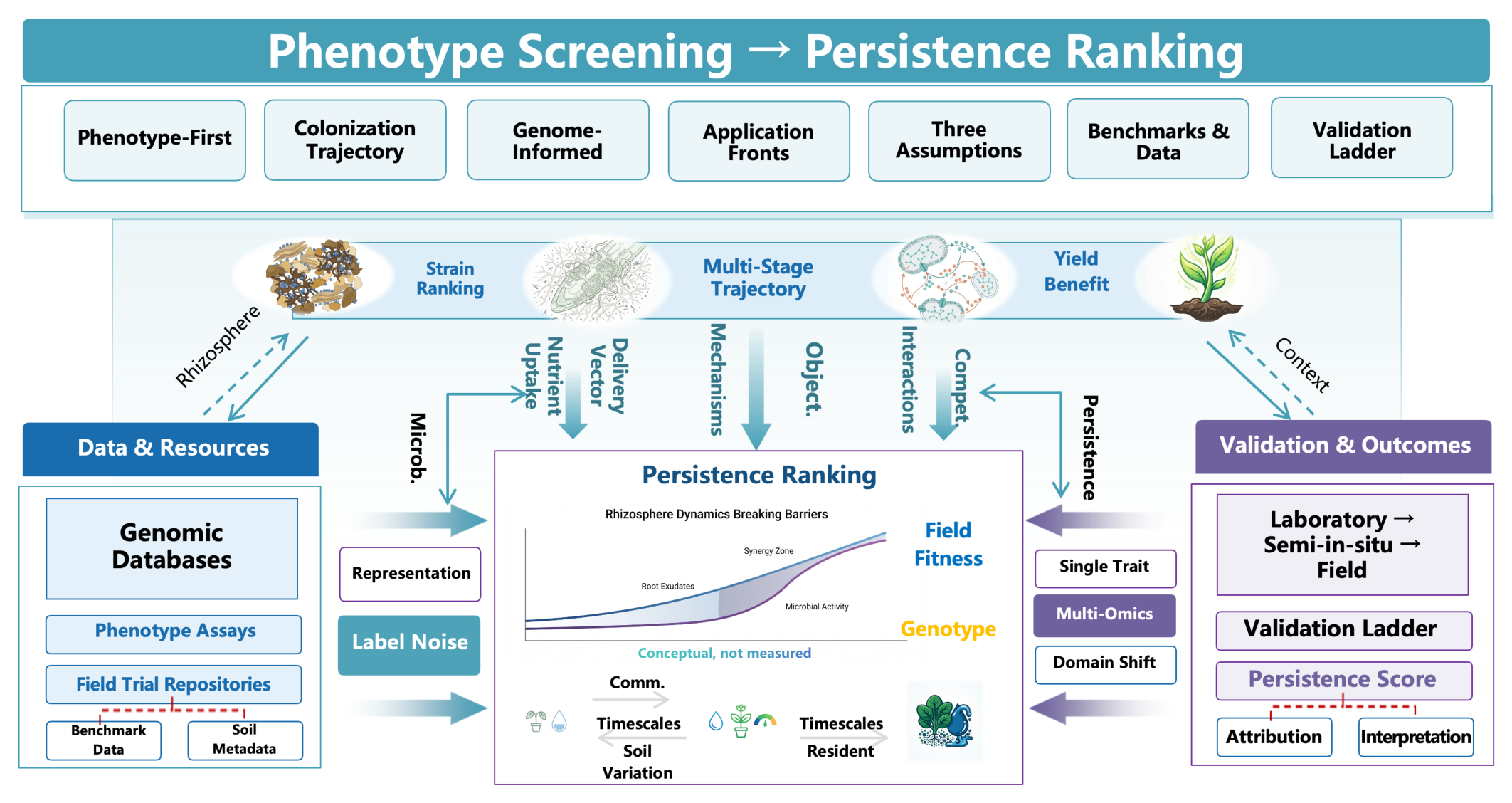
Figure 2.
Screening limitations and study context. Single-assay conditions, trait interactions, and environmental variation can affect how screening results transfer to field conditions. The central panels illustrate biological and environmental considerations, while the right panel identifies implementation constraints. The lower band organizes study design, field cost, ranking models, genome scale, and validation settings as considerations for strain prioritization.
Figure 2.
Screening limitations and study context. Single-assay conditions, trait interactions, and environmental variation can affect how screening results transfer to field conditions. The central panels illustrate biological and environmental considerations, while the right panel identifies implementation constraints. The lower band organizes study design, field cost, ranking models, genome scale, and validation settings as considerations for strain prioritization.
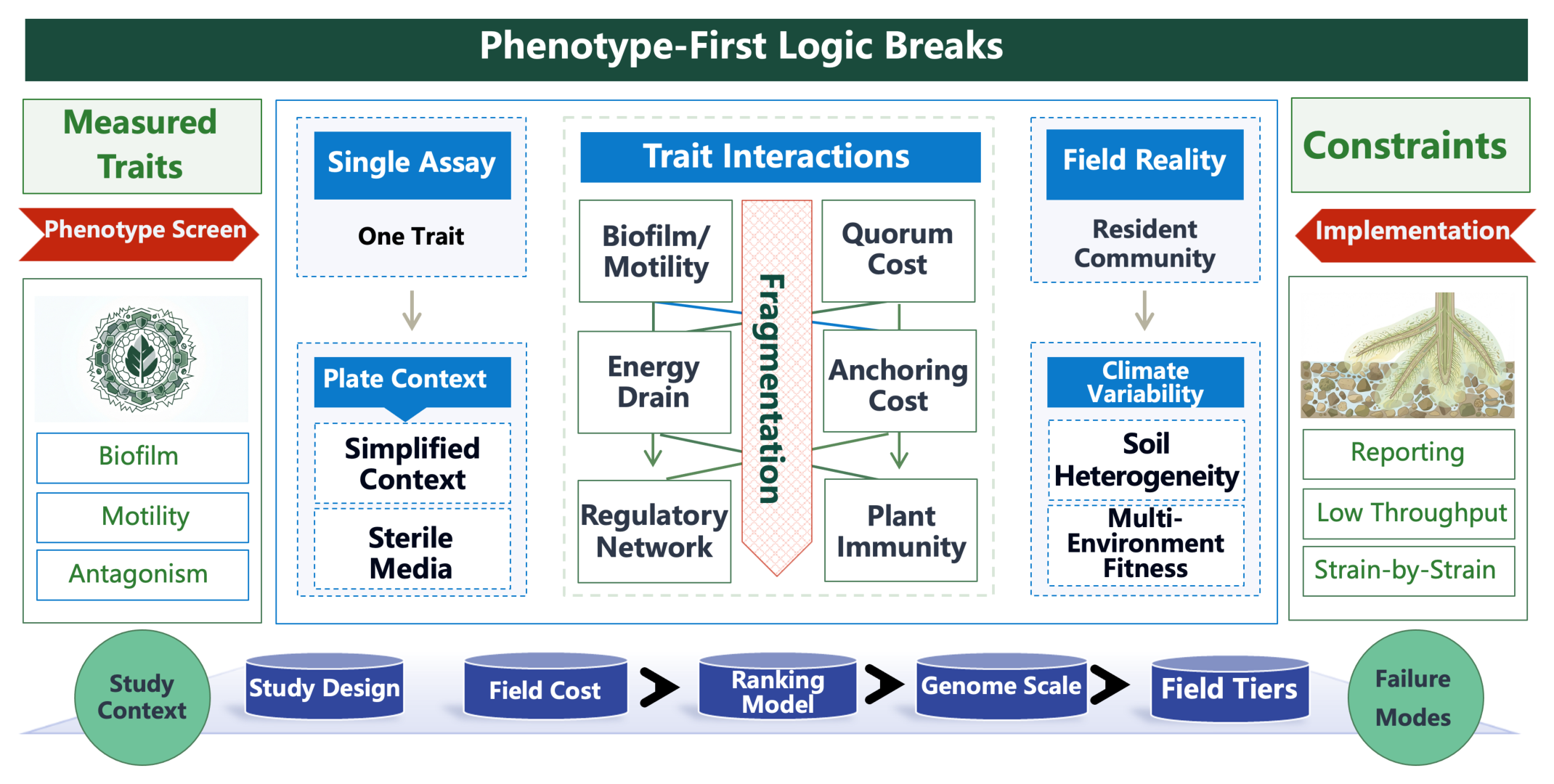
Figure 3.
Colonization processes, environmental modifiers, and distinct measurements. Dispersal, attachment, competition, and persistence organize the conceptual trajectory. Entry into the endosphere is optional and depends on the strain–host system. Colony-forming unit (CFU) counts, relative abundance (Rel. Abundance), and fluorescence intensity (Fluorescence Int.) measure different properties. Persistence endpoints and time courses require a defined sampling compartment and observation window. Plant responses are evaluated separately. The lower labels identify mechanisms (Mech.), including quorum sensing (Quorum Sens.), and the roles of timescale, spatial structure (Spatial Struct.), and interaction networks (Interaction Netw.).
Figure 3.
Colonization processes, environmental modifiers, and distinct measurements. Dispersal, attachment, competition, and persistence organize the conceptual trajectory. Entry into the endosphere is optional and depends on the strain–host system. Colony-forming unit (CFU) counts, relative abundance (Rel. Abundance), and fluorescence intensity (Fluorescence Int.) measure different properties. Persistence endpoints and time courses require a defined sampling compartment and observation window. Plant responses are evaluated separately. The lower labels identify mechanisms (Mech.), including quorum sensing (Quorum Sens.), and the roles of timescale, spatial structure (Spatial Struct.), and interaction networks (Interaction Netw.).
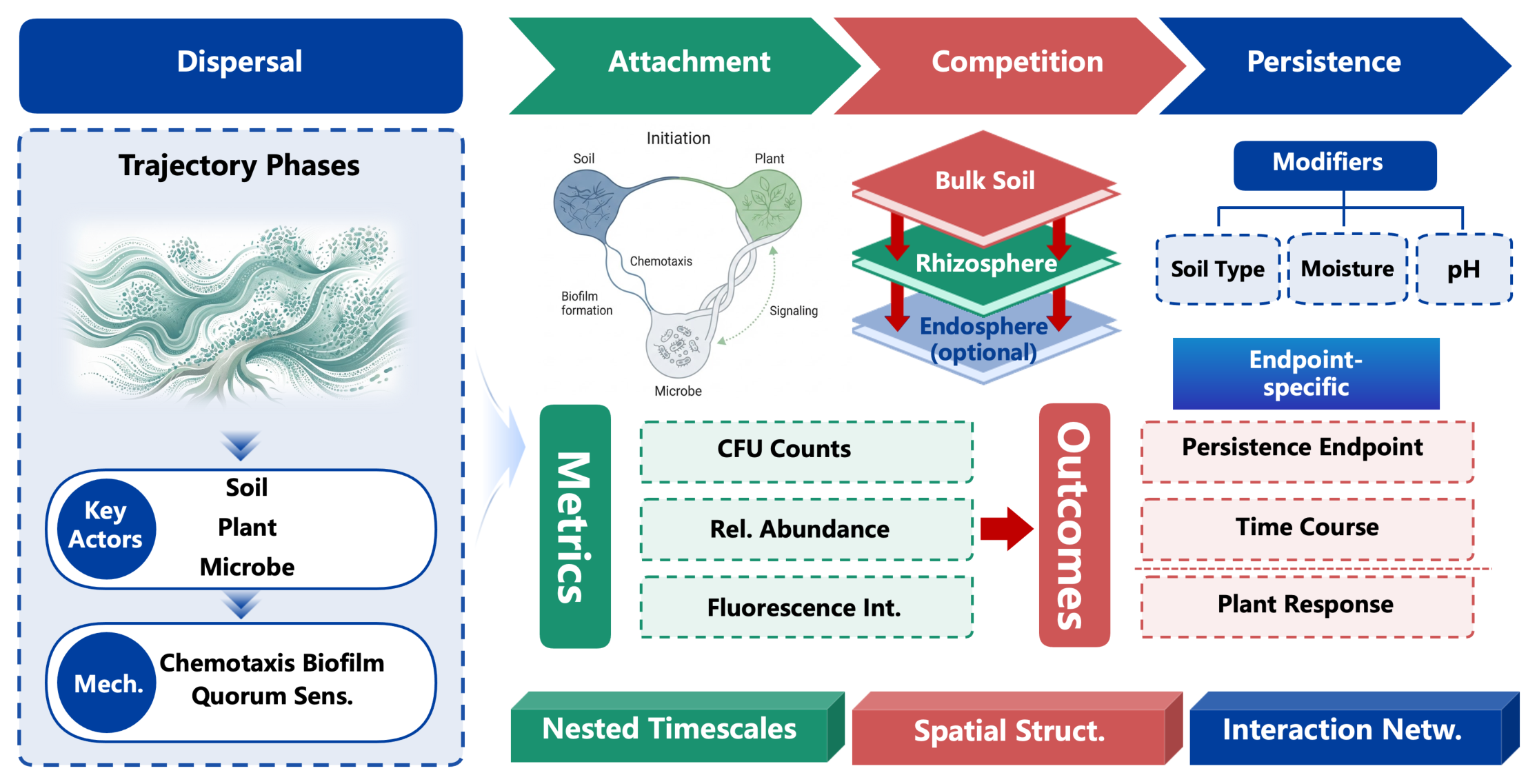
Figure 4.
Candidate components of genome-informed strain prioritization. The upper panels connect the prediction task, genomic input, and feature representation. The lower panels distinguish fixed k-mer features, learned embeddings, and pan-genome gene-content views, which can be paired with phenotype labels and task-specific environmental information. Protein-level and genome-level representations require different inputs and aggregation choices. Deep sequence, multi-omics, and community models are candidate approaches to evaluate against simpler baselines for a defined ranking task.
Figure 4.
Candidate components of genome-informed strain prioritization. The upper panels connect the prediction task, genomic input, and feature representation. The lower panels distinguish fixed k-mer features, learned embeddings, and pan-genome gene-content views, which can be paired with phenotype labels and task-specific environmental information. Protein-level and genome-level representations require different inputs and aggregation choices. Deep sequence, multi-omics, and community models are candidate approaches to evaluate against simpler baselines for a defined ranking task.
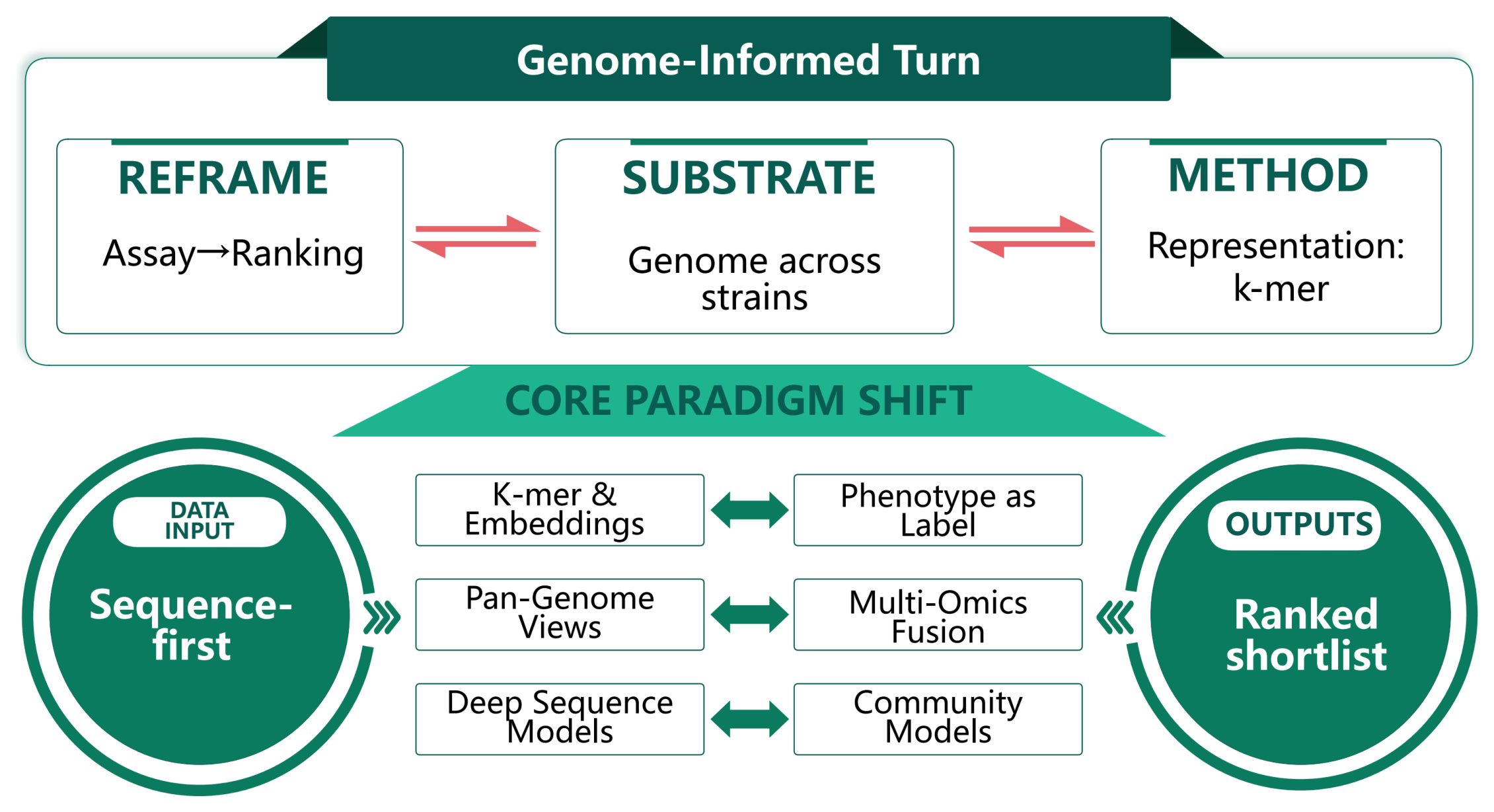
Figure 5.
Three application directions for colonization-related prediction. Single-trait prediction, multi-omics analysis, and community inference address different research questions. Example tasks include biofilm formation, motility, stress survival, and synthetic-community behavior. Evaluation uses held-out strains and explicit baselines, with throughput assessed alongside data-generation and validation costs. Task difficulty depends on the endpoint, available labels, and intended setting. Claims about field application require evaluation under the corresponding field conditions.
Figure 5.
Three application directions for colonization-related prediction. Single-trait prediction, multi-omics analysis, and community inference address different research questions. Example tasks include biofilm formation, motility, stress survival, and synthetic-community behavior. Evaluation uses held-out strains and explicit baselines, with throughput assessed alongside data-generation and validation costs. Task difficulty depends on the endpoint, available labels, and intended setting. Claims about field application require evaluation under the corresponding field conditions.
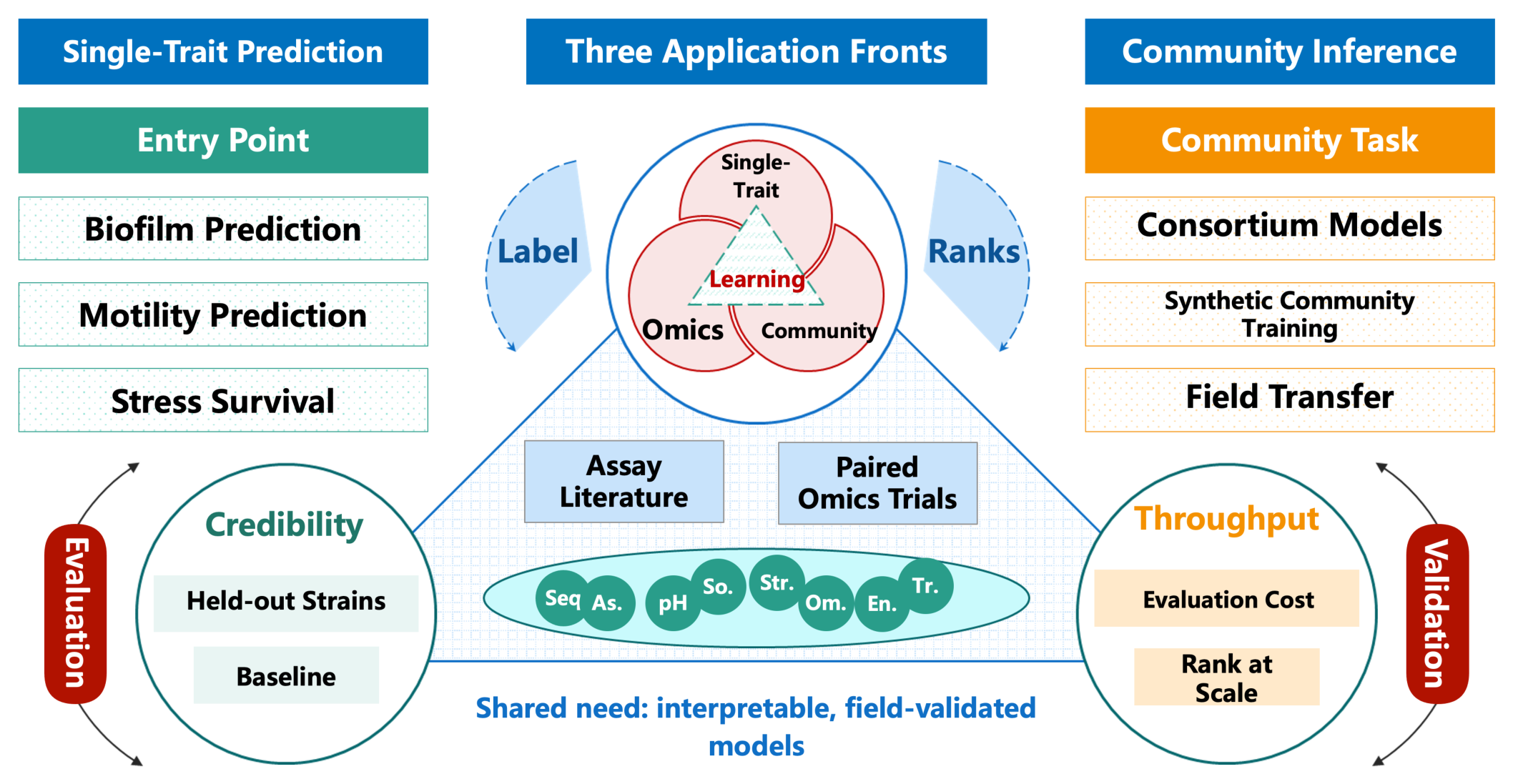
Figure 6.
Three assumptions to examine in colonization prediction. The panels address transfer from laboratory assays to field conditions, the predictive information captured by functional annotations, and dependencies among traits. Suggested checks include measurements across contexts, assessment of unannotated features, and comparisons of single-task and multi-task models. Model attribution identifies candidates for further experimental testing. The right-hand labels summarize potential limitations, and the lower band highlights the distinctions that motivate these checks.
Figure 6.
Three assumptions to examine in colonization prediction. The panels address transfer from laboratory assays to field conditions, the predictive information captured by functional annotations, and dependencies among traits. Suggested checks include measurements across contexts, assessment of unannotated features, and comparisons of single-task and multi-task models. Model attribution identifies candidates for further experimental testing. The right-hand labels summarize potential limitations, and the lower band highlights the distinctions that motivate these checks.
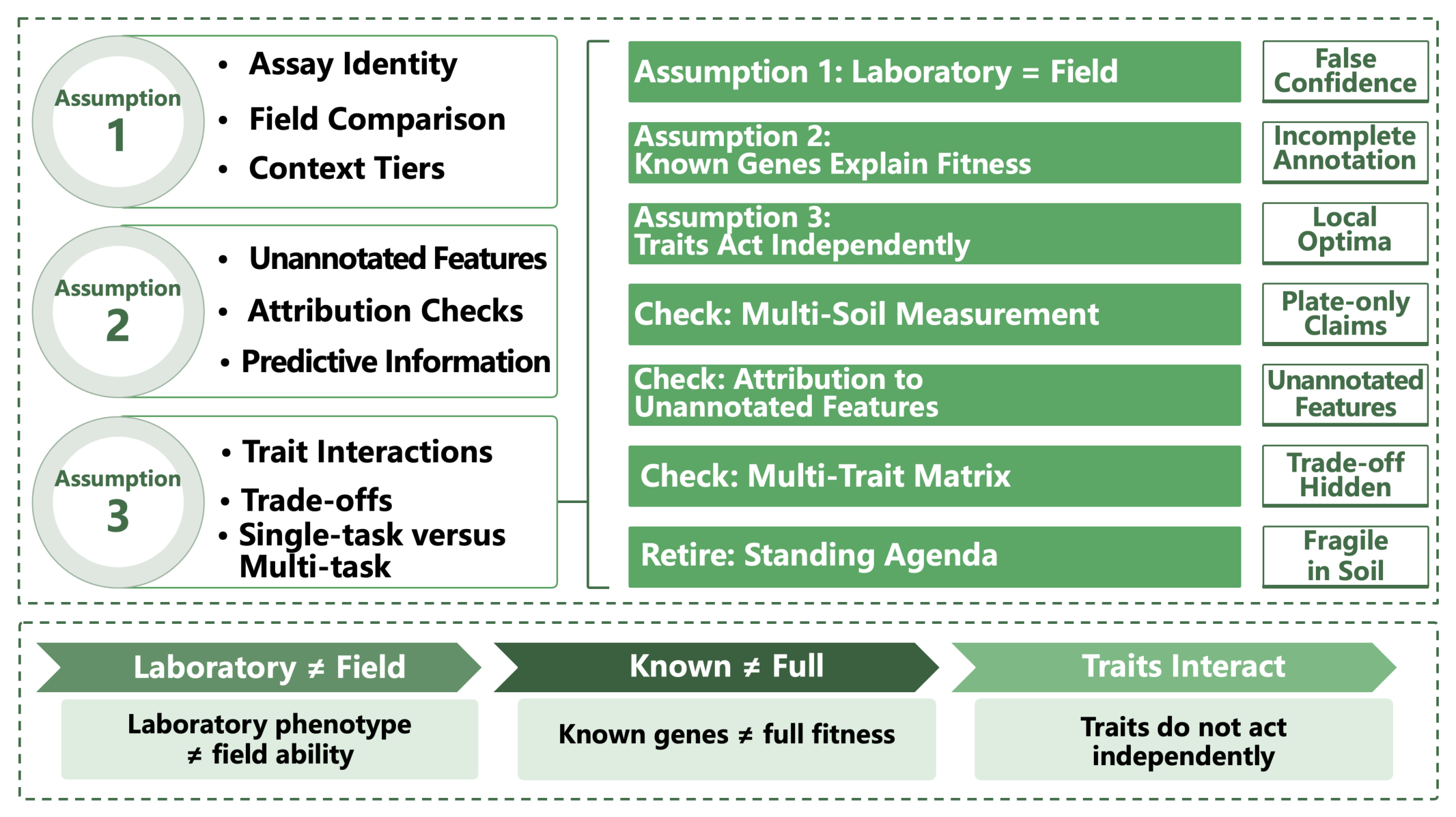
Figure 7.
Proposed workflow, planned outputs, and evaluation roadmap. Data, encoding, learning, attribution, and validation connect three objectives: establishing benchmark datasets and baselines, evaluating multi-modal models, and testing prospective screening value. Laboratory, semi-in-situ, and field studies provide validation settings matched to the intended use. Planned outputs are linked genome–phenotype–soil records, a ranking toolkit, and an attribution toolkit. Resources (Res.), benchmarks (Bench.), objectives (Obj.), standardized datasets (Std), and laboratory studies (Lab) are abbreviated in the figure.
Figure 7.
Proposed workflow, planned outputs, and evaluation roadmap. Data, encoding, learning, attribution, and validation connect three objectives: establishing benchmark datasets and baselines, evaluating multi-modal models, and testing prospective screening value. Laboratory, semi-in-situ, and field studies provide validation settings matched to the intended use. Planned outputs are linked genome–phenotype–soil records, a ranking toolkit, and an attribution toolkit. Resources (Res.), benchmarks (Bench.), objectives (Obj.), standardized datasets (Std), and laboratory studies (Lab) are abbreviated in the figure.
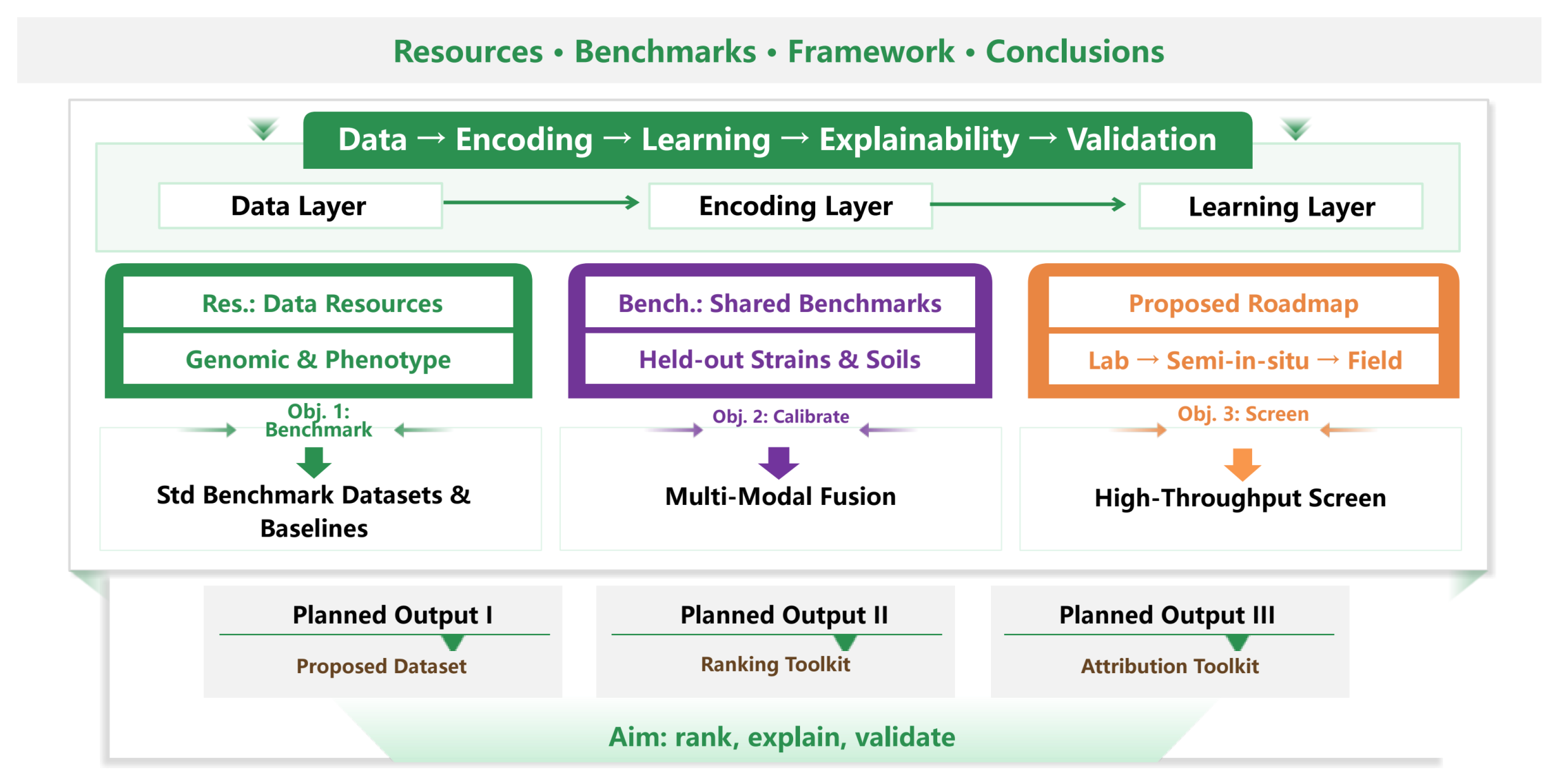

Table 1.
Measurements relevant to rhizosphere colonization and the limits of transferring their interpretation between studies.
Table 1.
Measurements relevant to rhizosphere colonization and the limits of transferring their interpretation between studies.
| Assay | Trait or stage captured | Principal limitation | Useful follow-up or control |
|---|---|---|---|
| Plate antagonism | Inhibition of a specified target organism | Includes an opponent; omits soil structure and the full resident community | Test the same target interaction in the relevant substrate |
| Swimming or sliding motility | Movement under the assay conditions | Medium and geometry differ from the root habitat | Root-associated movement and colonization |
| Microtiter biofilm | Surface-associated biomass | Artificial surface; growth can affect the readout | Root localization and growth controls |
| Gnotobiotic system | Colonization in a controlled microbial setting | Simplified background and growth conditions | Comparison with a relevant resident community |
| Greenhouse pot assay | Root populations and/or plant responses | Scope depends on soil, design, and measured endpoint | Replicated contexts and strain-specific tracking |
| Strain-targeted qPCR | Target DNA abundance in a sampled compartment | DNA may remain after cell death; specificity and extraction affect estimates | Requires validated primers and controls |
| Synthetic community | Composition-dependent populations or functions | Selected members and simplified context | Independent mixtures or new members, as specified |
| Multi-site field trial | Colonization and/or agronomic performance | Inference limited to tested sites and management | Prespecified outcomes, controls, and site-level uncertainty |
Table 2.
Candidate representations and model components for colonization prediction. Fixed-feature baselines, learned representations, and interpretation methods have different inputs and evaluation requirements. Their inclusion does not imply validated performance on root-persistence tasks.
Table 2.
Candidate representations and model components for colonization prediction. Fixed-feature baselines, learned representations, and interpretation methods have different inputs and evaluation requirements. Their inclusion does not imply validated performance on root-persistence tasks.
| Component | Contribution to a persistence target | Evaluation consideration |
|---|---|---|
| K-mer and composition features | Fixed sequence-composition baseline, including unannotated regions | Ignores gene order and context; no stage resolution |
| Protein language model embeddings | Transferable representation of protein function learned from large unlabeled corpora | Coverage of the target taxa and added persistence-prediction signal require evaluation |
| Pan-genome and gene presence encoders | Represents presence, absence and variation across a species rather than against one reference | Related strains can inflate performance; genomic-group holdouts test broader transfer |
| Convolutional and recurrent sequence models | Learn motifs and local context that annotation based features discard | Effective context depends on architecture, input window, and aggregation |
| Transformer genome language models | Contextual nucleotide representations within the modeled sequence window | Transfer and overfitting depend on pretraining, task data, and genomic-group holdouts |
| Relational models over strain networks | Represents strain–strain interaction and community context | Graph construction is observer dependent and edge labels are rarely measured |
| Multi task heads over traits and stages | May share signal across related endpoints; does not enforce ecological trade-offs | Negative transfer when tasks are unrelated; needs gradient conflict monitoring |
| Post hoc attribution | Identifies model-dependent features for follow-up | Model-relative; perturbation can test phenotype effects, with additional evidence needed for mechanism |
Table 3.
Minimal metadata schema for a colonization record. Linked records still require compatible measurement definitions before pooling. Vocabulary examples indicate possible alignments; they do not establish equivalence between assays.
Table 3.
Minimal metadata schema for a colonization record. Linked records still require compatible measurement definitions before pooling. Vocabulary examples indicate possible alignments; they do not establish equivalence between assays.
| Field | Type and controlled vocabulary | Why the model needs it |
|---|---|---|
| strain genome accession | String, INSDC or RefSeq identifier | Joins sequence to label and gives the strain a portable identity |
| host species and cultivar | String, with cultivar where defined | Defines the selection environment the ranking is conditioned on |
| soil class | Controlled, aligned to WRB class with pH and organic carbon | Makes soil an explicit covariate rather than an unmodelled nuisance |
| inoculum density | Numeric with unit, CFU per gram of seed or soil | Sets the starting population the persistence trajectory begins from |
| sampling time and window | Numeric time since inoculation, with event dates | Defines the endpoint window; repeated observations support trajectory analysis |
| colonization metric | Controlled: CFU, qPCR copies, relative abundance, fluorescence | Identifies the measured quantity; use compatible endpoints or validated cross-assay calibration |
| metric unit | Controlled, for example CFU per gram of root fresh weight | Supports comparison when protocols, compartments, and denominators are compatible |
| compartment | Controlled: rhizosphere, rhizoplane, endosphere, bulk soil | Separates habitats that differ ecologically and in measurement difficulty |
| replicate and source identifiers | Strain group, block, plot/site, season, source accession and version | Identifies independent units, permits grouped splits, and preserves provenance |
| persistence score | Numeric, derived, with its definition recorded | Prespecified endpoint or summary, with compartment, unit, and observation window |
Table 4.
Independent evaluation settings for a proposed colonization benchmark. Each setting addresses a different generalization question. Report output-appropriate metrics, matched baseline comparisons, and uncertainty; universal pass values are not prescribed.
Table 4.
Independent evaluation settings for a proposed colonization benchmark. Each setting addresses a different generalization question. Report output-appropriate metrics, matched baseline comparisons, and uncertainty; universal pass values are not prescribed.
| Tier | Held-out unit | Question it answers | Evaluation to report |
|---|---|---|---|
| Tier 1 | Held out strains in soils seen in training | Can the model rank a novel genome in a familiar soil? | Within-context rank correlation and enrichment against matched baselines |
| Tier 2 | Strains seen in training, held out soils | Does the ranking survive a change of soil? | Per-soil performance and uncertainty, with a prespecified cross-soil summary |
| Tier 3 | Both strain/genomic group and soil/site absent from development | Does the model transfer when both units are new? | Performance when both units are new; compare the same candidates and endpoints |
| Frozen set | Independent test outcomes protected from model development | Protects the leaderboard against overfitting | Rescored once per cycle and published alongside the leaderboard |
Disclaimer/Publisher’s Note: The statements, opinions and data contained in all publications are solely those of the individual author(s) and contributor(s) and not of MDPI and/or the editor(s). MDPI and/or the editor(s) disclaim responsibility for any injury to people or property resulting from any ideas, methods, instructions or products referred to in the content. |
© 2026 by the authors. Licensee MDPI, Basel, Switzerland. This article is an open access article distributed under the terms and conditions of the Creative Commons Attribution (CC BY) license (http://creativecommons.org/licenses/by/4.0/).
Copyright: This open access article is published under a Creative Commons CC BY 4.0 license, which permit the free download, distribution, and reuse, provided that the author and preprint are cited in any reuse.