

Submitted:
22 September 2026
Posted:
23 September 2026
You are already at the latest version
Abstract
Microalgae are emerging photosynthetic chassis for sustainable bioproduction and biological research. Yet, relative to plant and animal systems, their development as broadly engineerable platforms remains constrained, with many advances still limited to organism-specific or compartment-specific demonstrations. This review asks why this gap persists and how it may be closed. We evaluate genome engineering across the three genetic compartments of the microalgal cell—the nuclear genome, plastid genome, and mitochondrial genome. For every compartment, we trace the progression such as from random mutagenesis and programmable nucleases, including ZFNs and TALENs, to CRISPR/Cas systems and DSB-independent platforms such as base and prime editors. We distinguish broadly transferable engineering principles from host-specific implementation details and evaluate their applicability under the compartment-specific constraints of microalgae. Recurrent barriers include inefficient delivery, limited control over DSB repair outcomes, unstable transgene expression, and the limited availability of well-characterized genomic safe harbor loci across microalgal species, as well as guide RNA delivery barriers, multicopy organellar genomes, and compartment-specific DNA repair constraints in chloroplasts and mitochondria. From this comparative analysis, we outline a practical roadmap based on technologies already proven in other systems: compact RNA-guided platforms such as TIGR–Tas to reduce cargo burden, protein-only base editors including DdCBE, TALED, and CyDENT for organellar genomes, genomic safe harbor loci for stable expression, and transient delivery or tightly regulated or inducible systems to restrict prolonged nuclease activity and minimize associated fitness costs. By integrating nuclear, plastid, and mitochondrial engineering within a single cross-kingdom framework, we highlight the potential of microalgae not only as industrial production hosts but also as versatile experimental systems for advancing next-generation genome engineering technologies.
Keywords:
microalgae
; Chlamydomonas reinhardtii
; genome engineering
; chloroplast genome engineering
; mitochondrial genome engineering
; genome engineering tool
Introduction
Microalgae are a diverse group of photosynthetic eukaryotes that inhabit a wide range of aquatic and terrestrial environments. They are characterized by remarkable metabolic versatility, rapid growth, and efficient carbon fixation through photosynthesis. As major contributors to global biogeochemical cycles, microalgae play important roles in global carbon fixation and oxygen production. In addition, they are valuable sources of high value biomolecules, including carotenoids, polyunsaturated fatty acids, polysaccharides, and recombinant proteins.
Realizing the full potential of microalgae for applications in biomanufacturing and environmental remediation requires precise genome manipulation. The nucleus, plastid, and mitochondrion differ in their structural organization, genome copy number, and regulatory mechanisms, presenting distinct challenges and opportunities for genome engineering.
Despite this promise, progress in microalgal genome engineering has been limited by several technical barriers. For nuclear genome modification, challenges remain species- and system-dependent, and potential adverse effects of prolonged nuclease expression. In contrast, organelle genome engineering presents a distinct set of constraints. Although homologous recombination (HR) enables precise modification of organellar genomes in several microalgal systems, the broader application of programmable editing tools remains limited by organelle-specific delivery barriers, including the efficient delivery of guide RNAs for CRISPR-based approaches, as well as the challenge of achieving homoplasmy in multicopy organellar genomes. More broadly, the substantial biological diversity of microalgae, including differences in cell architecture and DNA repair mechanisms, often necessitates species-specific optimization of genome engineering strategies.
Previous reviews have mainly summarized gene editing tools that have been applied to microalgae. Building on previous tool-centered summaries, this review treats the nucleus, plastid, and mitochondrion as distinct engineering environments. It summarizes the historical development of genetic engineering tools used in microalgal systems, evaluates their current limitations and discusses relevant advances in plant and animal systems that may inform emerging strategies in microalgae.
Nuclear Genome Engineering
Genome engineering allows precise control of metabolic pathways and complex traits through targeted genome manipulation (Table 1) [1]. In particular, engineering the nuclear genome, the primary repository of genetic information, is emphasized for its potential to redesign metabolic pathways and stably control polygenic traits [2]. Direct modification enable heritable preservation of target traits across generations, providing a foundation for practical bioengineering applications [3].
Early approaches, such as random mutagenesis, were limited by the unpredictable locations and nature of induced mutations [4]. The development of protein-based tools like Zinc-Finger Nucleases (ZFNs) and Transcription Activator-Like Effector Nucleases (TALENs), followed by RNA-guided CRISPR/Cas9, enabled programmable targeting and cleavage of DNA at specific loci [5,6]. The introduction of alternative nucleases such as Cas12a (Cpf1) expanded PAM recognition, allowing more flexible genome engineering [7]. In addition, DSB independent technologies, including base editing and prime editing, enable targeted nucleotide substitutions and other precise sequence modifications without requiring DSBs [8]. These advances allow sophisticated control beyond gene knockouts, including regulatory element engineering, point mutations, and both gain and loss of function modifications [2].
Nuclear Genome Engineering in Microalgae
Microalgal nuclear engineering remains constrained by species-dependent transformation efficiency, unstable transgene expression, and differences in DNA repair pathway usage [5]. Overcoming these limitations is important for achieving controlled and reproducible manipulation of gene function and expression [9].
Historical Development of Nuclear Genome Engineering in Microalgae
Before the advent of programmable nucleases, random mutagenesis induced by physical or chemical agents, together with genetic crossing, formed the basis of classical genetic studies in microalgae [10]. Although these approaches lack precise control over the location and nature of induced mutations, they remain useful for mutant generation and genetic analysis [11].
ZFNs were the first widely used class of programmable nucleases. Each ZFN consists of an engineered zinc-finger array, in which individual zinc fingers typically recognize three base pairs, fused to the FokI nuclease domain [12]. A pair of ZFNs binds two adjacent DNA half-sites, allowing FokI dimerization and generation of a site-specific DSB [12]. ZFNs were first demonstrated in 1996 and were subsequently applied to C. reinhardtii in 2013 for targeted disruption of the Channelrhodopsin-1 (COP3) gene (Figure 1A) [13].
TALENs use a conceptually similar paired-nuclease architecture but replace zinc-finger arrays with transcription activator-like effector (TALE) repeats [14]. Each TALE repeat recognizes a single nucleotide through its repeat-variable diresidue (RVD), providing a relatively straightforward one-repeat–one-base recognition code [15]. Two TALE–FokI monomers bind opposing DNA half-sites, enabling FokI dimerization and DSB formation [14]. TALEN-mediated genome engineering was first demonstrated in 2010 and was applied to the diatom Phaeodactylum tricornutum in 2014, enabling targeted mutagenesis and targeted gene insertion [16]. Although TALENs simplified target recognition compared with ZFNs, their long and repetitive DNA-binding arrays increase construct-assembly complexity and cargo size, which can complicate their implementation in microalgae [17].
Following the biochemical demonstration of programmable Cas9 cleavage in 2012 and genome editing in eukaryotic cells in 2013, CRISPR–Cas9 was first demonstrated in C. reinhardtii in 2014, although the recovery frequency was extremely low [18]. CRISPR/Cas9 enables efficient target recognition through guide RNA (gRNA), greatly simplifying gene knockout [19]. Cas9, derived from the bacterial adaptive immune system, recognizes the protospacer adjacent motif (PAM) and uses gRNA hybridization to guide DNA cleavage [17,20]. Early studies mainly focused on knockout strategies, including the 2014 disruption of the FKBP12 gene in the cell-wall-deficient C. reinhardtii [18,21]. Subsequent donor-mediated editing strategies further expanded CRISPR-based engineering beyond gene disruption toward targeted sequence insertion and replacement [22].
In contrast to the early difficulties with constitutive Cas9 expression in C. reinhardtii, stable Cas9-expressing lines were successfully established in Nannochloropsis gaditana using endogenous constitutive regulatory elements, with no apparent impairment of biomass or lipid productivity [23]. Stable CRISPR/Cas9 systems were also established relatively early in diatoms [2]. In P. tricornutum, genomic integration of Cas9 and sgRNA expression cassettes enabled sustained Cas9 expression and efficient targeted mutagenesis [2]. Similarly, in Thalassiosira pseudonana, stable expression of Cas9 and sgRNAs supported efficient gene disruption, including biallelic editing [24].
In early studies of C. reinhardtii, constitutive vector-driven Cas9 expression was associated with poor recovery of edited transformants, raising concerns about Cas9-associated toxicity in this species [18,20]. This prompted the exploration of direct Cas9 ribonucleoprotein (RNP) complexes delivery in C. reinhardtii, with efficient RNP-mediated editing reported in 2016 [25]. Beyond these delivery strategies, catalytically modified CRISPR systems broadened CRISPR applications beyond DNA cleavage. For example, dCas9 mediated transcriptional regulation in C. reinhardtii was reported in 2017 [26]. These developments mark a shift in microalgal genome engineering, where Cas9 functions as a versatile regulatory platform rather than solely a cleavage tool [26].
Beyond Cas9, Cas12a has further expanded the genome engineering toolkit [7]. Cas12a recognizes T-rich PAM sequences and generates staggered DSBs with 5′ overhangs, thereby expanding the range of targetable sequences [7]. In 2017, Cas12a (Cpf1) was successfully applied for targeted genome engineering in C. reinhardtii [27]. More recently, Cas12a was extended to the diatom P. tricornutum, where a Cas12a-based system enabled highly efficient gene knockout, multiplex editing, and HDR-mediated gene integration [28].
Limitations of Nuclear Genome Engineering in Microalgae
Although CRISPR/Cas technologies enable highly precise genome engineering in many organisms, their application in microalgae remains comparatively limited [1,11]. Major bottlenecks remain in three areas: delivery efficiency, DSB repair and HDR-mediated integration, and stable regulation of transgene expression [29,30,31].
Following nuclease-induced DSBs, end-joining pathways often compete with homology-directed repair, limiting the efficiency of precise donor-mediated integration [30,31]. Repair outcomes can include small insertions or deletions and, in some contexts, capture of exogenous DNA at the cleavage site [30,31]. Homology-directed precise integration generally remains less efficient and more condition-dependent than mutagenic editing, with efficiencies varying across species, loci, and donor designs [32].
In addition, stable transgene expression is often constrained by random integration and epigenetic silencing [33,34]. In some microalgal species, transgenes frequently integrate at non-target sites through end-joining pathways, resulting in position-dependent variation in expression and transgene silencing among independent transformants [28,30,31,32,33]. These limitations have been reported in both C. reinhardtii and Chlorella spp. Notably, in Chlorella spp., both Agrobacterium-mediated transformation and electroporation have often been associated with random integration of recombinant DNA, potentially leading to gene silencing and position effects [35]. Moreover, introduced transgenes may be lost over successive generations, highlighting persistent challenges in achieving stable and reproducible nuclear transformation [36]. However, stable maintenance of integrated DNA during long-term continuous subculture without selection pressure has also been reported when split inserts and triple homologous recombination were used [37].
As a result, heterogeneous expression patterns are commonly observed among clones transformed with the same vector, complicating phenotype interpretation [34]. Epigenetic silencing further represents a major barrier to stable transgene expression in microalgae, particularly in C. reinhardtii [33]. Integrated transgenes often show rapid decline in expression due to nuclear genome defense mechanisms that recognize foreign DNA [33]. Several epigenetic mechanisms, including changes in histone modifications and chromatin state, have been implicated in this repression [38,39]. Consequently, stable transgene expression across generations remains difficult to achieve [34].
Efficient intracellular delivery remains a major species-dependent challenge in microalgal genome engineering [11]. Many microalgal species possess cell walls and complex cell-envelope structures that can hinder the entry of foreign DNA and proteins [40]. Strategies such as enzymatic cell wall digestion or the use of cell-wall-deficient mutants have been developed to improve transformation efficiency, but these approaches often reduce cell viability and compromise recovery of stable transformants [40].,[41] Accordingly, physical delivery methods, including electroporation, glass bead agitation, and particle bombardment are predominantly used [5].
Although CRISPR based genome engineering has advanced significantly in many organisms, its application in microalgae is more complex when vector-based systems require stable Cas nuclease expression [5]. In early studies of C. reinhardtii, constitutive vector-driven Cas9 expression was associated with poor recovery of transformants, raising concerns about Cas9-associated toxicity [25]. To overcome these issues, transient CRISPR delivery strategies have gained attention. The use of preassembled Cas9-sgRNA RNP complexes enables DNA-free genome engineering, when no exogenous DNA is co-delivered, while avoiding prolonged nuclease expression [42]. The transient nature of RNP-mediated editing limits the duration of nuclease activity, thereby avoiding prolonged Cas9 expression and potentially reducing off-target effects [22]. RNP-based engineering has therefore emerged as a promising strategy for microalgae such as C. reinhardtii, enabling effective gene engineering [22].
However, RNP delivery also presents limitations. Efficient RNP delivery can nevertheless remain challenging because macromolecular uptake is strongly influenced by species-specific cell-envelope properties [43].,[44] For example, in Coccomyxa sp. strain KJ, the relatively low efficiency of Cas9–gRNA RNP-mediated genome editing was reported to be associated with inefficient intracellular RNP delivery and subsequent nuclear translocation of the RNP complex [45]. Because RNPs themselves do not provide a selectable marker, recovery of edited cells may require phenotype-based selection or co-delivery of a selectable DNA cassette [46].
Nuclear Genome Engineering in Plants
In contrast, many plants possess biological properties, such as somatic dedifferentiation and whole-plant regeneration, that allow successfully engineered cells to be regenerated into whole plants [47]. Although plant cells also have rigid cell walls, specialized transformation and regeneration systems have enabled effective genome engineering in many plant species [48,49]. Plant nuclear genome engineering has progressed from fundamental studies to practical applications, including improving disease resistance, enhancing yield, redesigning metabolic pathways, and accelerating crop breeding [47]. Examples include the knockout of susceptibility genes for powdery mildew resistance and engineering of yield-related loci to increase rice productivity [50,51]. Moreover, CRISPR technologies now enable diverse strategies in plants, including knockout, knock-in, base editing, and prime editing [48]. In particular, base and prime editing allow precise sequence modifications without requiring DSBs [52].
Advances in Plant Nuclear Genome Engineering Relevant to Microalgae
Plant cells possess rigid cell walls that limit direct genome engineering, especially during early developmental stages, requiring plant-specific delivery methods rather than those used in animals [48,49]. Agrobacterium tumefaciens–mediated transformation has become the most widely used approach to overcome this barrier (Figure 1A) [48]. Its natural T-DNA transfer system enables efficient delivery of foreign DNA into the plant nuclear genome, resulting in relatively high transformation efficiency and, in many cases, stable transgene expression [49]. Importantly, it allows DNA delivery without the extensive physical disruption associated methods [53]. Additional techniques, including particle bombardment and protoplast-based methods using electroporation or PEG treatment, have also been applied, enabling scalable CRISPR/Cas9 based genome engineering in plants [54].
Plant nuclear genome engineering has progressed through successive technological stages [55]. In the early 2000s, ZFNs demonstrated the feasibility of targeted genome cleavage [56]. In 2005, ZFN-mediated genome modification under a heat-shock promoter was reported in Arabidopsis [56]. The development of TALENs in the early 2010s improved DNA recognition flexibility, and by 2011, targeted gene modifications, including knockouts, were reported in species such as Arabidopsis and Nicotiana tabacum (N. tabacum) [57]. However, both ZFNs and TALENs require the engineering of target-specific DNA-binding proteins, making construct design and assembly more laborious than RNA-guided CRISPR systems [55].
A major breakthrough occurred in 2013 with the successful application of CRISPR/Cas9 in plants, leading to the rapid expansion of genome engineering [58]. The introduction of alternative nucleases, including Cas12a (Cpf1) [59]. In 2017, CRISPR-Cpf1 systems were validated in plants such as soybean and tobacco, and LbCpf1 was shown to induce biallelic mutations in rice [60].
Since 2017, base editing technologies have enabled precise nucleotide substitutions in plants, exemplified by editing of the phytoene desaturase (PDS) gene in rice and tomato [61]. Cytosine and adenine base editors convert C to T and A to G, respectively, without introducing double strand breaks [62].
Following the introduction of prime editing in 2019, plant-adapted prime editing systems were reported in 2020 [63]. This system uses an nCas9–reverse transcriptase fusion together with a prime editing guide RNA (pegRNA) containing a primer binding site and reverse transcription template to enable targeted insertions, deletions, and substitutions [64]. Together, these advances have shifted plant genome engineering from simple gene disruption toward precise genetic design [65].
Nuclear Genome Engineering in Animals
Animal genome engineering has progressed rapidly from fundamental research toward diverse practical applications [20]. It now extends beyond basic research toward translational and clinical applications, including disease modeling, gene therapy, and cancer immunotherapy [1]. In human and mammalian cells, CRISPR-based tools enable diverse genome modifications, such as knockout, knock-in, base editing, and prime editing [66].
Several factors have driven this advancement, such as understanding and treating genetic disorders, cancers, and other human diseases [67]. In addition, the availability of standardized model organisms and well-developed research infrastructure has accelerated progress [68]. Organisms such as mice, zebrafish, and Drosophila are well characterized, with established protocols for embryonic manipulation, cell culture, phenotyping, and strain maintenance, enabling rapid adoption of new technologies [20,68].
Furthermore, HDR can be exploited in mammalian cells for donor-mediated precise sequence insertion or replacement [69]. Although HDR efficiency varies with cell type and cell-cycle state, well-established cell culture and selection systems have facilitated the recovery of precisely modified cells [69].,[70]
Advances in Animal Nuclear Genome Engineering Relevant to Microalgae
Delivery methods in animal systems are diverse and can be broadly classified into physical, viral, and non-viral chemical strategies [17]. Physical approaches include microinjection, which directly introduces engineering tools into cells or embryos using a glass needle, and electroporation, which applies electric pulses to create transient membrane pores for molecular entry (Figure 1A) [71,72]. Among viral methods, adeno-associated virus (AAV) has been widely used for in vivo delivery of genome engineering components [73]. Non-viral chemical strategies use carriers such as lipid nanoparticles (LNPs) and cationic lipid-based reagents to package and deliver genome engineering components [74]. Physical and non-viral delivery methods can also support RNP-based approaches, in which preassembled Cas protein–gRNA complexes are directly introduced, enabling transient nuclease activity and potentially reducing prolonged off-target activity [75].
Animal genome engineering has advanced through the combined development of precise DNA cleavage tools and efficient delivery systems. ZFNs enabled early targeted genome editing, with in vivo applications reported in Drosophila melanogaster in 2002 [6,12]. The introduction of TALENs in 2011 further expanded precision editing, including applications in Danio rerio [76]. A major advance followed in 2013 with the rapid adoption of CRISPR/Cas9 across animal systems, substantially simplifying programmable genome engineering [77].
Subsequent developments further enhanced precision. Cytosine base editors (CBEs), introduced in 2016, enabled targeted C to T substitutions in mammalian cells and were later applied to organisms such as mice and pigs [8,78]. In 2021, adenine base editors (ABEs) corrected the pathogenic mutation and substantially extended lifespan in a progeria mouse model [79]. Prime editing, introduced in 2019, enabled precise insertions, deletions, and substitutions without double-strand breaks and has been applied in both human and mouse systems [66,80].
More recently, the TIGR–Tas system, reported in 2025, introduced a distinct RNA-guided DNA-targeting mechanism in which a tandem-spacer tigRNA recognizes both strands of the target DNA [81]. The TIGR–Tas family comprises several modular effector types, including TasA, TasH, and TasR [81]. All three contain a conserved Nop domain associated with tigRNA recognition, whereas TasH and TasR additionally harbor HNH and RuvC nuclease domains, respectively; TasA lacks an identifiable nuclease fusion. Accordingly, TasH and TasR function as tigRNA-guided DNA nucleases, while the biological role of TasA remains less well defined [81]. One characterized TasR effector is only 331 amino acids long, substantially smaller than SpCas9, and enables PAM-independent target recognition and programmable DNA cleavage [81]. TasH similarly mediates tandem-spacer-dependent DNA cleavage without a detectable target-adjacent motif requirement [81]. Structural characterization of TasH further showed that its Nop domain participates in precursor tigRNA processing, whereas its HNH domain mediates target DNA cleavage [82]. Although genome-editing activity was modest in the initial demonstration, indel formation was observed at several endogenous human loci, including B2M and CXCR4 [81].
Other compact transposon-derived RNA-guided nucleases include TnpB, a putative ancestor of Cas12, and IscB, a putative ancestor of Cas9, whereas Fanzor represents a related eukaryotic transposon-encoded nuclease [83]. These nucleases have also been repurposed for genome editing in mammalian cells but generally require orthologue-specific target-adjacent motifs and guide architectures [84]. Their small size may reduce the DNA or RNP cargo burden associated with delivery into microalgal cells, although their activity and compatibility remain to be validated in algal systems.
Future of Microalgal Nuclear Genome Engineering
Despite remaining technical challenges in microalgal nuclear genome engineering, selected microalgal systems offer useful experimental features for evaluating emerging genome engineering technologies [33]. In several model species, haploid or haploid-dominant life cycles, short generation times, and rapid proliferation allow recessive engineered alleles to be directly assessed at the phenotypic level, while also increasing sensitivity to deleterious or lethal mutations [85]. Although much recent work has focused on strain improvement and production of valuable compounds, these experimental features could also support the systematic evaluation and optimization of emerging nuclear genome engineering strategies [5].
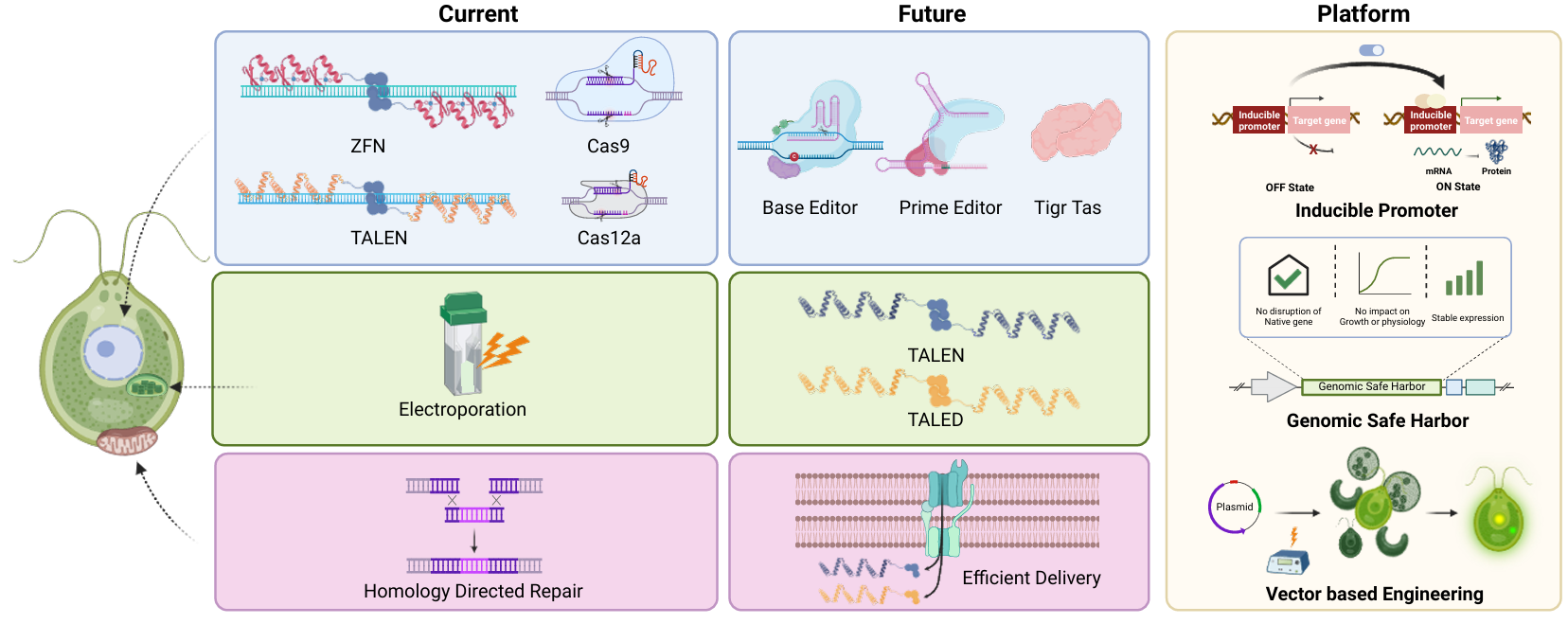
Realizing this potential will require coordinated advances in several key areas [5]. Improvements in delivery technologies capable of overcoming species-specific cell-envelope barriers, together with refinements in RNP-based delivery strategies, could alleviate current technical bottlenecks [25]. In parallel, improving control over DSB repair outcomes and mitigating off-target editing will be important for increasing engineering precision and reproducibility [30]. An additional limitation is the limited availability of well-characterized genomic safe harbor loci across microalgal species [34]. These loci support targeted transgene integration and predictable expression without substantially perturbing endogenous gene function or cellular fitness (Figure 2A) [34]. In the absence of defined safe harbor sites, transgene insertion in microalgae remains largely random, leading to variable expression, position effects, and unintended genomic disruption [34].
Therefore, expanding the identification and functional validation of genomic safe harbor loci across diverse microalgal species represents an important direction for future nuclear genome engineering [5]. For example, in Nannochloropsis, genomic safe harbors have been reported at the T1 transcriptional hotspot in Nannochloropsis salina and the chromosome 3 rDNA cistron in Nannochloropsis oceanica, enabling targeted integration and robust transgene expression [86,87]. However, while effects on growth, lipid content, and other characteristics have been evaluated, whether integration at these loci affects neighboring endogenous genes remains insufficiently characterized, indicating that further functional validation is required [86]. In P. tricornutum, studies have also identified insertion loci associated with stable and high-level transgene expression; however, no genomic region has yet been definitively validated as a genomic safe harbor [88]. Such loci could facilitate reliable transgene expression, comparative evaluation of genome engineering tools, and scalable strain development [33]. As technical advances accumulate, the rapid growth and haploid genetics of selected microalgal models will provide powerful advantages for dissecting DNA repair mechanisms and rigorously benchmarking next-generation genome engineering technologies (Figure 2A) [85]. Together, these advances could strengthen the role of microalgae both as biotechnology platforms and as experimental systems for evaluating and refining emerging nuclear genome engineering technologies [46].
Plastome Engineering
The chloroplast is a defining organelle of plants and algae and represents a remarkable product of evolutionary innovation [89]. Plastids ultimately trace their origin to a cyanobacterial endosymbiosis approximately 1–1.5 billion years ago, followed by extensive diversification through primary and secondary endosymbiotic events [89].
Beyond their central role in photosynthesis, chloroplasts function as major metabolic hubs that support a wide range of essential biosynthetic pathways [90]. These include the synthesis of terpenoids, carbohydrates, and tetrapyrroles [90]. Through these activities, chloroplasts contribute not only to cellular growth and development but also to environmental adaptation and stress responses, highlighting their broader physiological significance [91]. In particular, plastomes offer several engineering-relevant features, including high genome copy number, prokaryotic-like gene expression, metabolic compartmentalization, and the potential for reduced position effects through targeted integration [91].
A key molecular feature of plastome engineering is that foreign DNA integration largely relies on HR (Table 2) [92,93]. In chloroplasts, HR is a precise DNA repair and integration pathway where DNA molecules recombine with plastome sequences through flanking regions of sequence homology [92,93]. Homologous flanking sequences direct foreign DNA to defined plastome loci, enabling precise sequence replacement or transgene integration [92,93]. The strong reliance of conventional plastome transformation on HR, however, also imposes practical constraints [93]. Unlike nuclear genome editing, precise plastome modification does not necessarily require a programmable nuclease, because homologous donor DNA can directly mediate targeted sequence replacement or integration. However, the requirement for homologous donor DNA adds design and delivery constraints, particularly when introducing small sequence changes or modifying multiple loci [94].
Plastome Engineering in Microalgae
The plastome is organized into protein–DNA complexes known as nucleoids and is present in multiple copies; C. reinhardtii, for example, contains approximately 80 plastome copies per cell [95]. Algal plastomes show substantial diversity in both genome size and gene content. Although many plastomes fall within approximately 100–200 kb, substantial lineage-specific variation occurs [93]. For example, the C. reinhardtii plastome is approximately 205 kb and contains 99 annotated genes [96].
Historical Development of Plastome Engineering in Microalgae
The first stable chloroplast transformation in microalgae was established in C. reinhardtii in 1988 using mutants of the chloroplast atpB gene, which encodes the β subunit of ATP synthase [97]. Cells were transformed by biolistic delivery using tungsten microprojectiles coated with chloroplast DNA carrying the wild type atpB gene to restore photosynthetic competence in mutant strains via HR (Figure 1B) [97]. While simpler and less expensive methods, such as vortexing with glass beads, were later developed, they generally showed lower transformation efficiencies than particle bombardment [98]. However, electroporation was successfully adapted for the marine microalga N. oceanica in 2018, demonstrating that electroporation can support targeted plastome transformation in certain microalgal systems [99]. In 1991, the introduction of the aadA cassette, which provides resistance to spectinomycin and streptomycin, decoupled engineering from photosynthesis rescue and was also adopted in other spectinomycin sensitive microalgae such as Euglena gracilis and H. pluvialis [100,101]. The toolkit further expanded in 2000 with the aphA-6 marker conferring kanamycin resistance [102].
More recently, a geminivirus-inspired extrachromosomal expression system based on rolling-circle replication was developed to enhance heterologous protein accumulation in the C. reinhardtii chloroplast [103].
Recent advances also include a high throughput automated Design-Build-Test workflow for chloroplast engineering has been established, allowing the parallel construction and analysis of thousands of transplastomic C. reinhardtii strains [104,105]. Tobramycin selection yielded approximately tenfold more transformant colonies than spectinomycin under the tested conditions [104,105]. In addition, more than 140 chloroplast regulatory elements have been characterized and integrated into a MoClo framework, enabling modular assembly of gene combinations at multiple insertion sites and transgene stacking [104,105]. The platform has enabled the development of synthetic chloroplast promoters and engineering of a photorespiratory pathway, resulting in a threefold increase in biomass yield [104,105]. Furthermore, the identification of naturally occurring bidirectional promoter regions in C. reinhardtii has provided new tools for chemical regulation and multigene expression [106].
Limitations of Plastome Engineering in Microalgae
A major limitation of microalgal plastome engineering is the difficulty of establishing robust and broadly applicable transformation strategies across diverse algal lineages [95,107]. Transformation methods optimized in one species are often not directly applicable to others because of substantial differences in cell architecture and plastome biology [95,107]. This limitation is particularly relevant to Nannochloropsis, whose small cell size makes conventional biolistic plastome transformation challenging [99]. As an alternative, electroporation-mediated chloroplast transformation was established in N. oceanica, enabling stable and site-specific integration of foreign DNA into the plastome [99].
In C. vulgaris, electroporation-mediated plastome transformation has also been achieved, although further improvements in transformation efficiency and transgene expression remain necessary. Biolistic transformation has also been used to generate stable homoplasmic transformants. Nevertheless, biolistic transformation requires expensive equipment and has been applied only to a limited number of microalgal species, including C. reinhardtii, Porphyridium purpureum, H. pluvialis, Tetraselmis subcordiformis, and C. vulgaris [97,100,108,109,110]. Consequently, developing efficient, cost effective, and broadly applicable plastome transformation methods remains a major technical challenge.
Beyond DNA delivery, obtaining stable homoplasmic transformants is another major bottleneck [111]. Because plastid genomes exist in multiple copies within each organelle and cell, initial transformation typically generates heteroplasmic states in which only a subset of plastome copies carry the engineered allele [111]. The persistence of wild-type plastome copies can reduce the effective dosage of the engineered allele and complicate phenotypic analysis, often requiring additional rounds of selection to achieve homoplasmy [111]. This significantly slows strain development and complicates downstream applications [111]. For example, in C. vulgaris, repeated selection was required to obtain homoplasmic transformants [110]. This requirement can substantially delay strain development and complicate downstream applications [110].
In addition, genome editing technologies such as CRISPR/Cas systems, highly effective in nuclear genomes, remain difficult to apply to chloroplasts [112,113]. Although Cas9 fused with a chloroplast transit peptide can be targeted to the organelle, the delivery of guide RNAs remains a major challenge [112,113]. Moreover, DSB repair in chloroplasts differs from that in nuclear genomes. Although conventional plastome transformation relies strongly on homologous recombination, nuclease-induced DSBs can also be resolved through microhomology-mediated or other nonhomologous repair mechanisms [114]. Nevertheless, the difficulty of delivering RNA components remains a major barrier to the broader application of CRISPR-based plastome editing [114].
Plastome Engineering in Plants
In most land plants, the plastome is approximately 120–160 kb and is typically represented as a circular genome map [115]. In photosynthetic tissues, a single mesophyll cell typically contains around 50–100 chloroplasts, each of which carries multiple copies of the plastid genome [95]. As a consequence, plant cells can contain several hundred to several thousand plastome copies, depending on cell type and developmental stage [95]. This high copy number frequently results in heteroplasmic transformants at early stages of plastome engineering, necessitating repeated rounds of selection to achieve homoplasmy, the state in which all plastome copies carry the same genetic modification [116,117].
Advances in Plant Plastome Engineering Relevant to Microalgae
In plants, stable plastid transformation was first achieved in N. tabacum using biolistic delivery of DNA-coated particles, followed by HR-mediated integration into the plastid genome (Figure 1B) [118]. Although particle bombardment can physically deliver DNA across diverse plant species, a universally applicable plastid transformation protocol has not yet been established, and most stable transformation systems still rely on biolistic delivery [119,120]. Alternative approaches have also been explored. PEG-mediated stable plastid transformation was demonstrated in tobacco protoplasts in 1993, whereas electroporation enabled DNA uptake and expression in isolated spinach chloroplasts in 1996 [119,120]. Stable plastid transformation has been established in several dicot species, including members of Nicotiana, Solanum lycopersicum, Solanum tuberosum, Lactuca sativa, and Arabidopsis thaliana [121,122,123,124,125]. Plastid transformation remains particularly challenging in monocots, although stable transplastomic plants have been reported in rice [126].
To address these limitations, alternative plastid genome engineering strategies are being explored [127]. Because guide RNA delivery limits CRISPR based editing in organelles, attention has shifted toward RNA-free, protein-based programmable editing systems [127]. Nuclear-encoded proteins can be efficiently targeted to chloroplasts using transit peptides [127]. Using this strategy, chloroplast-targeted TALENs introduced site-specific DSBs in tobacco plastid DNA, with repair occurring through homologous recombination and microhomology-mediated recombination rather than canonical NHEJ [118]. More recently, base editing systems combining TALE domains with cytosine or adenine deaminases have enabled precise C:G to T:A or A:T to G:C conversions without inducing DSBs [113,128,129]. Cytosine editors include dimeric systems such as cpDdCBE ptpTALECD and ptpTALECD_v2, as well as monomeric editors like mTCBE and mTCBE-T [113]. Dual-function editors such as mTCABE-T enable both cytosine and adenine conversions [130]. Adenine base editors, including dimeric TALEDs and monomeric mTALEAD, mediate A to G editing but may introduce unintended C to T changes [131]. Improved systems such as pTABE_v6 and (monomeric) UDG–TALED reduce these unwanted conversion [131,132]. However, some TALE-based editors that act on double-stranded DNA can modify bases on both strands within the editing window, reducing strand specificity [133]. The cpCyDENT system improves strand specificity by generating ssDNA, though efficiency remains relatively low [133].
In addition to plastome DNA editing, programmable RNA editing has emerged as a complementary strategy for manipulating chloroplast gene expression [134]. Engineered pentatricopeptide repeat (PPR) editing factors enable programmable, site specific RNA editing in chloroplasts and mitochondria, offering a complementary approach [134]. Overall, plant plastome engineering has expanded from classical transformation to programmable editing systems, with RNA-independent protein-based tools providing an alternative where CRISPR/Cas technologies remain constrained by guide RNA delivery.
These advances are particularly relevant to microalgal plastome engineering because they demonstrate that RNA-independent, chloroplast-targeted protein editors can expand precise editing capabilities without requiring guide RNA import [113].
Future of Plastome Engineering in Microalgae
Looking forward, chloroplast engineering in microalgae is expected to play an increasingly important role in addressing global challenges related to climate change and sustainability [135]. To further enhance photosynthetic efficiency, targeting the carbon-concentrating mechanisms is essential. The pyrenoid, a specialized structure containing the CO2 fixing enzyme Rubisco, enhances carbon fixation by concentrating CO2 around the enzyme [136]. Because the Rubisco large subunit is plastome-encoded in C. reinhardtii and many other photosynthetic eukaryotes, plastome engineering provides a direct route for modifying this central carbon-fixing enzyme [137]. Efforts to reconstruct carboxysome- and pyrenoid-based CCMs in plant chloroplasts are also defining minimal components and design principles that may inform future engineering of carbon fixation in microalgae [136].
Chloroplast compartmentalization can also facilitate the accumulation of certain heterologous proteins that may interfere with cellular function when expressed in other compartments [138,139]. For example, the cholera toxin B subunit, a candidate oral vaccine component, can accumulate at high levels in the chloroplast without toxicity, whereas nuclear expression leads to toxicity even at low levels [138,139]. From ecological perspective, plastome engineering also offers biosafety advantages compared with nuclear genome modification [140]. In microalgae, such advantages are better framed in terms of plastid-localized transgene containment and reduced transmission of engineered plastome traits in species with uniparental organelle inheritance [140]. These features position algal chloroplasts as valuable platforms both for fundamental research and scalable, environmentally relevant biotechnology.
For future plastome engineering, a critical distinction should be made between DNA integration efficiency and plastome genotype fixation. In multicopy chloroplast genomes, an engineered allele may be successfully introduced but remain functionally weak if it persists only as a minor heteroplasmic population. Therefore, future studies should report not only the number of primary transformants, but also the kinetics of heteroplasmy resolution, the fraction of engineered plastome copies, and the stability of the engineered genotype and, where applicable, transgene expression during and after selection.This would allow plastome engineering efficiency to be compared more quantitatively across species, selectable markers, insertion sites, and delivery methods.
In addition, ex vivo whole plastome assembly and engineering has emerged as a new approach to chloroplast engineering [141]. Although methods for delivering engineered whole plastomes into chloroplasts and maintaining them stably have not yet been established, the entire 117-kb plastome of P. tricornutum has been assembled and engineered ex vivo, enabling the rapid generation of designer chloroplast genomes [141]. This approach provides a foundation for large-scale plastome redesign, including multigene insertion, genome refactoring, and the development of synthetic chloroplast genomes for future metabolic and photosynthetic engineering [141].
Mitochondrial Genome Engineering
Over the past five decades, studies of mitochondrial biochemistry have established mitochondria as semi-autonomous organelles central to cellular and organismal life [142,143]. They play key roles in oxidative phosphorylation and ATP production, while also supporting sugar and fatty acid catabolism, and the expression of their own genome [142,144,145]. Mitochondria operate under dual genetic control, requiring coordination between nuclear and mitochondrial genes [142]. In humans, mtDNA mutations are linked to severe hereditary diseases, while in plants, mitochondrial genomes can harbor genetic determinants of cytoplasmic male sterility (CMS), an important trait for hybrid seed production [146,147]. Despite advances in nuclear genome engineering, mitochondrial genome manipulation remains limited [148]. Stable mitochondrial transformation remains restricted to a limited number of experimental systems, reflecting persistent challenges in cargo delivery, selection, and recovery of engineered mitochondrial genotypes [149,150]. Recent genome engineering technologies, including programmable nucleases and base editors, offer new possibilities for mtDNA manipulation (Table 3) [131,151]. However, mitochondrial genomes present distinct constraints, including multicopy organization, dynamic nucleoid distribution, lineage-dependent genome architecture, and complex control of genome copy number [150].
Mitochondrial Genome Engineering in Microalgae
In microalgae, yet mitochondrial genome engineering remains far less developed than nuclear or chloroplast genome engineering [152,153]. In this context, C. reinhardtii serves as a valuable model for studying mitochondrial genome function and engineering [152]. It possesses a compact, linear mitochondrial genome of approximately 15.8 kb encoding eight proteins, making it a tractable system for linking mitochondrial genotype to cellular function [154]. Although mitochondrial transformation was initially inefficient, subsequent optimization of biolistic transformation substantially improved transformation efficiency and enabled site-directed modification of mitochondrial genes [153]. Under optimized biolistic conditions, transformation efficiencies of approximately 100–250 transformants per microgram of DNA have been reported [153].
Historical Development of Mitochondrial Genome Engineering in Microalgae
In microalgae, mtDNA engineering has been established primarily in C. reinhardtii, beginning with biolistic DNA delivery progressing from phenotypic rescue to site-directed mutagenesis using PCR-derived donor fragments (Figure 1C) [155]. Pioneering investigations in the early 1990s used the dum-1 mutant, a respiratory deficient strain with a terminal deletion extending from the end of the mitochondrial genome and affecting the cob gene, which encodes cytochrome b, a key subunit of respiratory Complex III. Homologous donor DNA, including PCR-derived fragments, subsequently enabled site-directed mitochondrial mutagenesis through HR [149]. This PCR based strategy allowed for the direct introduction of site specific modifications encoded within the donor fragment [149]. Researchers employed HDR mediated transformation to introduce nucleotide substitutions in cob (conferring resistance to respiratory inhibitors) and to generate targeted deletions in nd4 (a Complex I subunit) to elucidate its role in electron transport [149]. Despite these advances, biolistic DNA delivery followed by HR remains the only routinely established approach for stable mitochondrial genome transformation in C. reinhardtii, while alternative programmable editing strategies have yet to be established [149,153].
Additionally, although this approach does not constitute direct mitochondrial genome engineering in microalgae, the complete mitochondrial genome of P. tricornutum has been cloned and engineered in Saccharomyces cerevisiae and subsequently maintained in Escherichia coli, providing a foundation for whole-mitochondrial-genome engineering in algae [156]. However, the efficient delivery of such engineered genomes into mitochondria remains to be established [156].
Limitations of mtDNA Engineering in Microalgae
A major barrier of mitochondrial genome engineering in microalgae is the difficulty of delivering genetic material across mitochondrial membranes [157]. The double membrane system and selective import machinery restrict entry of exogenous nucleic acids [157]. While proteins can be targeted to mitochondria using mitochondrial targeting sequences (MTSs), reliable delivery of engineered guide RNAs into the mitochondrial matrix has not been established, limiting conventional RNA-guided CRISPR applications [158]. This limitation has motivated the development of guide-RNA-independent programmable nucleases and base editors based on protein–DNA recognition in other eukaryotic systems, providing potential strategies for future microalgal mitochondrial engineering [159]. In addition, mitochondrial genome architecture itself can constrain genome engineering. The mitochondrial genome of C. reinhardtii is relatively small and simple, with few repetitive sequences, which facilitates genome synthesis and manipulation [160]. In contrast, the larger and repeat-rich mitochondrial genome of P. tricornutum can complicate genome-scale engineering [161].
Another practical constraint is the recovery and stable selection of engineered mitochondrial genotypes [155,162]. Because mtDNA is present in multiple copies per cell, introduced variants may initially coexist with unmodified genomes, and their relative abundance can influence the resulting phenotype [162]. However, the dynamics of engineered mtDNA segregation and fixation remain poorly characterized across microalgal species [153]. In C. reinhardtii, mitochondrial transformation is further limited by the lengthy selection process and the limited availability of selectable markers [153]. These constraints slow the recovery and validation of engineered mitochondrial strains and restrict the broader establishment of mitochondrial genome engineering in microalgae [153].
Mitochondrial Genome Engineering in Plants
Plant mtDNA presents a unique context for genome engineering because of its exceptionally large, repeat-rich, and highly recombinogenic architecture [163]. Unlike the relatively compact and structurally stable mitochondrial genomes of animals, plant mtDNA exists as a dynamic mixture of alternative genomic conformations and subgenomic molecules generated through repeat-mediated recombination [164]. This multipartite and dynamic organization results in substantial structural plasticity [164].
Homologous recombination plays a major role in plant mitochondrial genome maintenance and DSB repair [165,166]. Consistent with this repair behavior, mitoTALEN-induced DSBs in plant mitochondria have been resolved through HR between repeated sequences, often generating large deletions and alternative genome configurations rather than small local indels [167]. Instead, it typically activates extensive recombination among repeated regions, leading to large scale genome rearrangements [167]. This repair behavior has important implications for mitochondrial engineering: rather than producing precise edits, induced breaks often reshape genome architecture [168]. Therefore, engineering strategies in plant mitochondria must account for this intrinsic recombination-driven plasticity [169].
Advances in Plant Mitochondrial Genome Engineering Relevant to Microalgae
The consequences of recombination driven mitochondrial genome maintenance are clearly illustrated by the use of nuclease based tools such as mitoTALENs (Figure 1C) [164]. These observations indicate that nuclease-based approaches are effective for targeted gene disruption but generally do not enable predetermined nucleotide substitutions [170]. A well-known example is BT-type CMS in rice, in which mitoTALEN-mediated orf79 deletion restored male fertility [170]. Cleavage at these loci promotes recombination-mediated loss or rearrangement of CMS associated open reading frames, leading to phenotypic recovery through genome architecture remodeling rather than precise nucleotide correction [170]. These observations indicate that nuclease based approaches primarily induce structural rearrangements and lack nucleotide level precision [164].
To enable more precise editing, DSB free strategies have been developed, particularly mitochondrial base editors [164,169]. The adaptation of DddA-derived cytosine base editors (DdCBEs) systems allows targeted C to T conversion, resulting in corresponding G to A changes on the complementary strand without introducing DNA breaks, thereby avoiding recombination mediated repair pathways [131]. More recently, TALE-based adenine editors have enabled targeted A-to-G substitutions in plant mitochondrial genomes [171].
Despite these advances, translating molecular edits into stable agronomic traits remains limited by genetic constraints [164,169]. A practical challenge is the recovery of homoplasmic or near-homoplasmic edited lines, because initial mitochondrial editing can generate mixtures of edited and wild-type genome copies [147]. Furthermore, the predominantly uniparental inheritance of plant mitochondria limits the recombination of mitochondrial alleles through conventional sexual breeding [147]. For applications requiring stable and predictable inheritance, recovery of homoplasmic edited lines is therefore an important objective [169].
These advances are relevant to microalgal mitochondrial engineering because protein-only TALE-based editors provide a strategy for programmable mtDNA modification without requiring mitochondrial guide RNA delivery [159].
Mitochondrial Genome Engineering in Animals
In contrast to the dynamic, multipartite architecture of plant mitochondria, the mammalian, including human, mitochondrial genome is a highly conserved, compact circular molecule of approximately 16.5 kb [145,172]. It contains little non-coding DNA and lacks introns [172]. Because mitochondria are central to cellular metabolism, mutations in animal mtDNA are linked to a spectrum of severe, often fatal, metabolic disorders and myopathies [173,174]. A major challenge for mammalian mitochondrial genome engineering is that targeted DSBs are predominantly followed by rapid degradation of the cleaved mtDNA rather than efficient repair [151]. Unlike in plant systems, induced DSBs in mammalian mitochondria typically trigger the rapid linearization and degradation of the DNA molecule rather than repair or remodeling [151].
Advances in Animal Mitochondrial Genome Engineering Relevant to Microalgae
Animal mitochondrial genome engineering has been strongly driven by the need to understand and potentially treat mitochondrial genetic disorders [175]. However, the inefficient repair of targeted mtDNA DSBs has strongly shaped technological development [175]. Since induced DSBs precipitate DNA elimination rather than integration, early animal mitochondrial engineering focused not on gene insertion but on nuclease-mediated heteroplasmy shifting [151]. Nuclease-based strategies, including mitochondria-targeted zinc-finger nucleases (mitoZFNs), TALENs (mitoTALENs), and more recently mitoARCUS nucleases, use allele-specific cleavage to selectively deplete mutant mtDNA and shift heteroplasmy below pathogenic thresholds. (Figure 1C) [151,176]. This approach has provided proof-of-concept for reducing pathogenic mtDNA loads in the germline and potentially limiting transmission of mitochondrial disease [176]. However, excessive nuclease activity can cause transient mtDNA depletion, creating a need to balance heteroplasmy shifting with preservation of mitochondrial genome copy number [176,177].
To enable direct nucleotide modification without DSB-induced mtDNA depletion or guide RNA delivery, RNA-free, DSB-independent mitochondrial base editors have been developed [177,178]. DdCBEs established this platform by enabling targeted conversion of cytosine to thymine, with the corresponding change of guanine to adenine on the opposite strand, followed by the development of TALEDs, which mediate A to G conversions and the complementary T to C substitutions [131,159]. However, these editors can introduce unintended mtDNA or nuclear DNA off-target edits as well as bystander substitutions within the editing window [178]. Consequently, newer systems such as CyDENT and mitoBEs have focused on strand-selective editing and improved control over editing specificity [133,178].
Current limitations in animal systems primarily center on delivery [175]. Delivery remains a major challenge, particularly for large, multicomponent TALE-based editors that may require separate or split vector systems for in vivo delivery [151]. While nanoparticle based delivery strategies are being explored, the DSB-free design principles established in animal mitochondrial engineering have not yet been applied to microalgae [179]. These animal mtDNA editing systems provide a useful framework for microalgal tool development by highlighting the need to balance editor cargo size, organelle targeting efficiency, and delivery compatibility, particularly in species where HR-based mtDNA engineering is inefficient or unavailable.
Future of Microalgae Mitochondrial Genome Engineering
Microalgal mitochondrial genome engineering is particularly relevant to sustainable biotechnology because of mitochondrial respiration and metabolite production directly influence strain performance [180]. These traits are coordinated by nuclear–mitochondrial interactions and organelle signaling networks, making direct mtDNA manipulation a complementary approach for dissecting the contribution of mitochondria-encoded components to these processes [180].
Beyond their biotechnological importance, microalgae, particularly C. reinhardtii, serve as powerful model systems for studying mitochondrial biology [180]. Because respiratory complex subunits are highly conserved across eukaryotes, C. reinhardtii has been successfully utilized to reconstruct human complex I mutations, such as an ND4 Leu157Pro substitution, enabling analysis of effects [181]. Studies of both mitochondrial- and nuclear-encoded respiratory subunits have further established C. reinhardtii as a useful model for dissecting complex I function and assembly, including the consequences of selected disease-associated mutations [182].. Ultimately, these insights underscore the value of microalgae as genetically tractable platforms capable of advancing both basic medical science and organelle-targeted biotechnology.
Future progress will require expanding the limited toolkit for direct and precise manipulation of microalgal mtDNA [180]. Direct mtDNA engineering could enable controlled modification of mitochondria-encoded respiratory components and facilitate analysis of their effects on respiration, redox balance, and cellular physiology [180]. However, efficient and precise mitochondrial genome manipulation in microalgae remains challenging due to molecular delivery, editing efficiency and specificity, and the recovery and stable maintenance of engineered mitochondrial genotypes (Figure 2C) [157,183]. Advances in organelle targeted genome engineering and deeper understanding of mitochondrial biology are expected to establish microalgal mitochondrial engineering as a valuable tool for studying respiratory function and improving biotechnology-relevant traits.
An important future direction is to separate mitochondrial editing activity from mitochondrial genotype selection. Because mitochondrial genomes are multicopy, an initial editing event may modify only a subset of mtDNA molecules, and editing efficiency therefore does not necessarily predict the final genotype composition. The frequency of edited genomes may subsequently change through mtDNA replication and segregation, cellular selection, and differences in mitochondrial fitness. Future microalgal mitochondrial engineering should therefore combine molecular detection of edited mtDNA with quantitative tracking of allele frequency and respiratory phenotyping over time. This approach would clarify whether current bottlenecks arise from editor delivery, editing chemistry, heteroplasmy resolution, or negative selection against edited mitochondrial genomes.
Conclusions
From a genome engineering perspective, many genetically tractable microalgae possess useful features, including haploid or haploid-dominant life stages, rapid growth, unicellular organization, and relatively simple cultivation. These features support genetic manipulation for applications ranging from fundamental functional studies to metabolic engineering and bioproduction. Nevertheless, genome engineering capabilities remain uneven across microalgal species and cellular compartments, with relatively few broadly applicable platforms.
This review compares genome engineering across the nucleus, plastome, and mitochondrial genome in microalgae and other eukaryotic systems. Across these compartments, different engineering barriers predominate. Nuclear engineering is constrained by species-dependent delivery, variable transgene expression, competition between DNA repair pathways, and, in some systems, adverse effects associated with prolonged nuclease expression. Plastome engineering benefits from HR-mediated targeted integration in established microalgal models, whereas programmable RNA-guided editing remains constrained by the lack of reliable guide RNA delivery into chloroplasts. Direct mitochondrial genome engineering is even more restricted across microalgae, with stable transformation established primarily in C. reinhardtii. Advances in plant and animal organelle engineering demonstrate that guide-RNA-independent protein editors can provide programmable alternatives when organellar RNA delivery is limiting.
Many emerging genome engineering technologies remain unexplored or incompletely developed in microalgae. For nuclear genome engineering, compact systems such as TIGR–Tas may offer opportunities to reduce delivery constraints associated with larger genome-editing proteins, although their utility in microalgae remains to be established (Figure 3A). Base and prime editing systems provide additional opportunities for DSB-independent sequence modification. For organelle genomes, guide-RNA-independent protein-based editors, including DdCBE- and TALE-derived systems, represent particularly attractive strategies because they avoid the requirement for guide RNA import.
The development of these tools should proceed together with improved delivery and expression strategies. Transient RNP delivery and vector-based expression should be viewed as complementary rather than competing approaches. RNP delivery limits prolonged nuclease exposure and can support DNA-free editing when no exogenous DNA is co-delivered, whereas stable or episomal expression systems can facilitate selectable strain recovery and intracellular production of genome-editing components. Importantly, RNPs themselves do not encode selectable markers, but they can be combined with phenotype-based selection, endogenous co-selection, or co-delivery of selectable DNA. In C. reinhardtii, for example, Cas9 RNPs have been co-delivered with hygromycin-resistance vectors for recovery of edited cells.
Stable expression strategies nevertheless present their own challenges. In C. reinhardtii, epigenetic silencing of exogenous DNA can strongly reduce nuclear transgene expression, although expression strains such as UVM4 and UVM11 partially overcome this barrier. Expanding the identification and validation of genomic safe harbor loci across microalgal species could further improve the predictability of stable transgene expression; a genetic safe harbor at the LHCBM1 locus has recently been demonstrated in C. reinhardtii. In some systems, particularly early studies of C. reinhardtii, prolonged Cas9 expression has also been associated with poor transformant recovery and possible cytotoxicity, supporting the development of temporally controlled expression strategies. More orthogonal and tightly tunable inducible systems could allow genome-editor activity to be controlled while minimizing perturbation of cellular physiology.
Future progress will therefore depend not on a single universal editing platform, but on matching genome-editing chemistry with species- and compartment-specific requirements for delivery, expression, DNA repair, and genotype recovery. A balanced microalgal genome engineering toolkit could combine transient RNP delivery, stable or inducible vector-based expression, validated genomic integration sites, and nuclear-encoded organelle-targeted protein editors. As these technologies mature, microalgae can serve both as scalable biotechnology platforms and as experimental systems for developing and evaluating genome engineering strategies across distinct cellular genomes.
Acknowledgments
We apologize to colleagues whose work could not be presented here owing to space limitations. We express our gratitude to all the members. This research was supported by grants from the Institute for Basic Science (IBS-R021-D1-2026-a00) to H.-S.L. and E.Y.K., the National Research Foundation of Korea (RS-2024-00338015) to H.-S.L., the Research Fund for International Scientists (RFIS), National Natural Science Foundation of China (NSFC), China (32350610246), and the Kunshan Science and Technology Bureau, China (kssc20230207) to E.Y.K. No conflict of interest is declared.
Conflicts of Interest
The authors declared that they have no conflicts of interest to this work.
References
- Doudna, J.A. and E. Charpentier, Genome editing. The new frontier of genome engineering with CRISPR-Cas9. Science, 2014. 346(6213): p. 1258096.
- Nymark, M., et al., A CRISPR/Cas9 system adapted for gene editing in marine algae. Sci Rep, 2016. 6: p. 24951.
- Pu, Z., et al., Application of CRISPR/Cas9 gene editing system in microalgal metabolic engineering and synthetic strategies of functional food ingredients. Biotechnol Adv, 2026: p. 108796.
- Trovao, M., et al., Random Mutagenesis as a Promising Tool for Microalgal Strain Improvement towards Industrial Production. Mar Drugs, 2022. 20(7).
- Nievergelt, A.P., Genome editing in the green alga Chlamydomonas: past, present practice and future prospects. Plant J, 2025. 122(1): p. e70140.
- Bibikova, M., et al., Targeted chromosomal cleavage and mutagenesis in Drosophila using zinc-finger nucleases. Genetics, 2002. 161(3): p. 1169–75.
- Zetsche, B., et al., Cpf1 is a single RNA-guided endonuclease of a class 2 CRISPR-Cas system. Cell, 2015. 163(3): p. 759–71.
- Komor, A.C., et al., Programmable editing of a target base in genomic DNA without double-stranded DNA cleavage. Nature, 2016. 533(7603): p. 420–4.
- Khalil, A.M., The genome editing revolution: review. J Genet Eng Biotechnol, 2020. 18(1): p. 68.
- Lewin, R.A., Ultraviolet induced mutations in Chlamydomonas moewusii Gerloff. J Gen Microbiol, 1952. 6(3-4): p. 233–48.
- Jeon, S., et al., Current status and perspectives of genome editing technology for microalgae. Biotechnol Biofuels, 2017. 10: p. 267.
- Kim, Y.G., J. Cha, and S. Chandrasegaran, Hybrid restriction enzymes: zinc finger fusions to Fok I cleavage domain. Proc Natl Acad Sci U S A, 1996. 93(3): p. 1156–60.
- Sizova, I., et al., Nuclear gene targeting in Chlamydomonas using engineered zinc-finger nucleases. Plant J, 2013. 73(5): p. 873–82.
- Christian, M., et al., Targeting DNA double-strand breaks with TAL effector nucleases. Genetics, 2010. 186(2): p. 757–761.
- Boch, J., et al., Breaking the code of DNA binding specificity of TAL-type III effectors. Science, 2009. 326(5959): p. 1509–12.
- Daboussi, F., et al., Genome engineering empowers the diatom Phaeodactylum tricornutum for biotechnology. Nat Commun, 2014. 5: p. 3831.
- Gaj, T., C.A. Gersbach, and C.F. Barbas, 3rd, ZFN, TALEN, and CRISPR/Cas-based methods for genome engineering. Trends Biotechnol, 2013. 31(7): p. 397–405.
- Jiang, W., et al., Successful transient expression of Cas9 and single guide RNA genes in Chlamydomonas reinhardtii. Eukaryot Cell, 2014. 13(11): p. 1465–9.
- Patel, V.K., et al., CRISPR-Cas9 System for Genome Engineering of Photosynthetic Microalgae. Mol Biotechnol, 2019. 61(8): p. 541–561.
- Hsu, P.D., E.S. Lander, and F. Zhang, Development and applications of CRISPR-Cas9 for genome engineering. Cell, 2014. 157(6): p. 1262–1278.
- Feng, Z., et al., Efficient genome editing in plants using a CRISPR/Cas system. Cell Res, 2013. 23(10): p. 1229–32.
- Zadabbas Shahabadi, H., et al., Site-specific gene knock-in and bacterial phytase gene expression in Chlamydomonas reinhardtii via Cas9 RNP-mediated HDR. Front Plant Sci, 2023. 14: p. 1150436.
- Verruto, J., et al., Unrestrained markerless trait stacking in Nannochloropsis gaditana through combined genome editing and marker recycling technologies. Proc Natl Acad Sci U S A, 2018. 115(30): p. E7015–E7022.
- Hopes, A., et al., Editing of the urease gene by CRISPR-Cas in the diatom Thalassiosira pseudonana. Plant Methods, 2016. 12: p. 49.
- Shin, S.-E., et al., CRISPR/Cas9-induced knockout and knock-in mutations in Chlamydomonas reinhardtii. Scientific reports, 2016. 6(1): p. 27810.
- Kao, P.H. and I.S. Ng, CRISPRi mediated phosphoenolpyruvate carboxylase regulation to enhance the production of lipid in Chlamydomonas reinhardtii. Bioresour Technol, 2017. 245(Pt B): p. 1527–1537.
- Ferenczi, A., et al., Efficient targeted DNA editing and replacement in Chlamydomonas reinhardtii using Cpf1 ribonucleoproteins and single-stranded DNA. Proc Natl Acad Sci U S A, 2017. 114(51): p. 13567–13572.
- Trevisan, N., et al., A modular all-in-one genetic engineering tool for the diatom Phaeodactylum tricornutum based on CRISPR-Cas12a. Trends Biotechnol, 2026.
- Kim, H., et al., CRISPR/Cpf1-mediated DNA-free plant genome editing. Nat Commun, 2017. 8: p. 14406.
- Nievergelt, A.P., et al., Efficient precision editing of endogenous Chlamydomonas reinhardtii genes with CRISPR-Cas. Cell Rep Methods, 2023. 3(8): p. 100562.
- Xue, C. and E.C. Greene, DNA Repair Pathway Choices in CRISPR-Cas9-Mediated Genome Editing. Trends Genet, 2021. 37(7): p. 639–656.
- Naduthodi, M.I.S., et al., CRISPR-Cas ribonucleoprotein mediated homology-directed repair for efficient targeted genome editing in microalgae Nannochloropsis oceanica IMET1. Biotechnol Biofuels, 2019. 12: p. 66.
- Neupert, J., et al., An epigenetic gene silencing pathway selectively acting on transgenic DNA in the green alga Chlamydomonas. Nat Commun, 2020. 11(1): p. 6269.
- Neupert, J., D. Karcher, and R. Bock, Generation of Chlamydomonas strains that efficiently express nuclear transgenes. Plant J, 2009. 57(6): p. 1140–50.
- Chen, C. and V.C. Ward, Recombinant Protein Expression and Its Biotechnological Applications in Chlorella spp. SynBio, 2024. 2(2): p. 223–239.
- Cui, X., et al., High-Efficiency Genome Editing of Chlorella sp. by CRISPR/Cas9. Plant Biotechnol J, 2026. 24(4): p. 2123–2125.
- Kim, M.-J., et al., Enhancement of Chlorella transformation efficacy by insert fragmentation. Algal Research, 2023. 72: p. 103146.
- Ferrari, M., et al., DNA Methylation in Algae and Its Impact on Abiotic Stress Responses. Plants (Basel), 2023. 12(2).
- Schroda, M., RNA silencing in Chlamydomonas: mechanisms and tools. Curr Genet, 2006. 49(2): p. 69–84.
- Kindle, K.L., High-frequency nuclear transformation of Chlamydomonas reinhardtii. Proc Natl Acad Sci U S A, 1990. 87(3): p. 1228–32.
- Matsuda, Y., et al., Cell wall lytic enzyme released by mating gametes of Chlamydomonas reinhardtii is a metalloprotease and digests the sodium perchlorate-insoluble component of cell wall. J Biol Chem, 1985. 260(10): p. 6373–7.
- Baek, K., et al., DNA-free two-gene knockout in Chlamydomonas reinhardtii via CRISPR-Cas9 ribonucleoproteins. Sci Rep, 2016. 6: p. 30620.
- Ramakrishnan, M., et al., CRISPR RNP-Mediated Transgene-Free Genome Editing in Plants: Advances, Challenges and Future Directions for Tree Species. Plant Cell Environ, 2025.
- Tran, Q.G., et al., Progress and challenges in CRISPR/Cas applications in microalgae. J Microbiol, 2025. 63(3): p. e2501028.
- Yoshimitsu, Y., J. Abe, and S. Harayama, Cas9-guide RNA ribonucleoprotein-induced genome editing in the industrial green alga Coccomyxa sp. strain KJ. Biotechnol Biofuels, 2018. 11: p. 326.
- Jeong, B.R., J. Jang, and E. Jin, Genome engineering via gene editing technologies in microalgae. Bioresour Technol, 2023. 373: p. 128701.
- Tsakirpaloglou, N., E.M. Septiningsih, and M.J. Thomson, Guidelines for Performing CRISPR/Cas9 Genome Editing for Gene Validation and Trait Improvement in Crops. Plants (Basel), 2023. 12(20).
- Nadakuduti, S.S. and F. Enciso-Rodriguez, Advances in Genome Editing With CRISPR Systems and Transformation Technologies for Plant DNA Manipulation. Front Plant Sci, 2020. 11: p. 637159.
- Gelvin, S.B., Agrobacterium-mediated plant transformation: the biology behind the “gene-jockeying” tool. Microbiol Mol Biol Rev, 2003. 67(1): p. 16–37, table of contents.
- Wan, D.Y., et al., CRISPR/Cas9-mediated mutagenesis of VvMLO3 results in enhanced resistance to powdery mildew in grapevine (Vitis vinifera). Hortic Res, 2020. 7: p. 116.
- Li, M., et al., Reassessment of the Four Yield-related Genes Gn1a, DEP1, GS3, and IPA1 in Rice Using a CRISPR/Cas9 System. Front Plant Sci, 2016. 7: p. 377.
- Li, J., et al., Plant base editing and prime editing: The current status and future perspectives. J Integr Plant Biol, 2023. 65(2): p. 444–467.
- Lacroix, B. and V. Citovsky, Pathways of DNA Transfer to Plants from Agrobacterium tumefaciens and Related Bacterial Species. Annu Rev Phytopathol, 2019. 57: p. 231–251.
- Laforest, L.C. and S.S. Nadakuduti, Advances in Delivery Mechanisms of CRISPR Gene-Editing Reagents in Plants. Front Genome Ed, 2022. 4: p. 830178.
- Zess, E. and M. Begemann, CRISPR-Cas9 and beyond: what’s next in plant genome engineering. In Vitro Cellular & Developmental Biology-Plant, 2021. 57(4): p. 584–594.
- Lloyd, A., et al., Targeted mutagenesis using zinc-finger nucleases in Arabidopsis. Proc Natl Acad Sci U S A, 2005. 102(6): p. 2232–7.
- Cermak, T., et al., Efficient design and assembly of custom TALEN and other TAL effector-based constructs for DNA targeting. Nucleic Acids Res, 2011. 39(12): p. e82.
- Shan, Q., et al., Targeted genome modification of crop plants using a CRISPR-Cas system. Nat Biotechnol, 2013. 31(8): p. 686–8.
- Endo, A., et al., Efficient targeted mutagenesis of rice and tobacco genomes using Cpf1 from Francisella novicida. Sci Rep, 2016. 6: p. 38169.
- Tang, X., et al., A CRISPR-Cpf1 system for efficient genome editing and transcriptional repression in plants. Nat Plants, 2017. 3: p. 17103.
- Zong, Y., et al., Precise base editing in rice, wheat and maize with a Cas9-cytidine deaminase fusion. Nat Biotechnol, 2017. 35(5): p. 438–440.
- Molla, K.A., et al., Precise plant genome editing using base editors and prime editors. Nat Plants, 2021. 7(9): p. 1166–1187.
- Anzalone, A.V., et al., Search-and-replace genome editing without double-strand breaks or donor DNA. Nature, 2019. 576(7785): p. 149–157.
- Vats, S., et al., Prime editing in plants: prospects and challenges. J Exp Bot, 2024. 75(17): p. 5344–5356.
- Lin, Q., et al., Prime genome editing in rice and wheat. Nat Biotechnol, 2020. 38(5): p. 582–585.
- Anzalone, A.V., L.W. Koblan, and D.R. Liu, Genome editing with CRISPR-Cas nucleases, base editors, transposases and prime editors. Nat Biotechnol, 2020. 38(7): p. 824–844.
- Abdelnour, S.A., et al., The Potential of CRISPR/Cas9 Gene Editing as a Treatment Strategy for Inherited Diseases. Front Cell Dev Biol, 2021. 9: p. 699597.
- Capecchi, M.R., Gene targeting in mice: functional analysis of the mammalian genome for the twenty-first century. Nat Rev Genet, 2005. 6(6): p. 507–12.
- Jasin, M. and R. Rothstein, Repair of strand breaks by homologous recombination. Cold Spring Harb Perspect Biol, 2013. 5(11): p. a012740.
- Ceccaldi, R., B. Rondinelli, and A.D. D’Andrea, Repair Pathway Choices and Consequences at the Double-Strand Break. Trends Cell Biol, 2016. 26(1): p. 52–64.
- Gordon, J.W., et al., Genetic transformation of mouse embryos by microinjection of purified DNA. Proc Natl Acad Sci U S A, 1980. 77(12): p. 7380–4.
- Neumann, E., et al., Gene transfer into mouse lyoma cells by electroporation in high electric fields. EMBO J, 1982. 1(7): p. 841–5.
- Chirico, J. and J.P. Trempe, Optimization of packaging of adeno-associated virus gene therapy vectors using plasmid transfections. J Virol Methods, 1998. 76(1-2): p. 31–41.
- Felgner, P.L., et al., Lipofection: a highly efficient, lipid-mediated DNA-transfection procedure. Proc Natl Acad Sci U S A, 1987. 84(21): p. 7413–7.
- Kim, S., et al., Highly efficient RNA-guided genome editing in human cells via delivery of purified Cas9 ribonucleoproteins. Genome Res, 2014. 24(6): p. 1012–9.
- Huang, P., et al., Heritable gene targeting in zebrafish using customized TALENs. Nat Biotechnol, 2011. 29(8): p. 699–700.
- Cong, L., et al., Multiplex genome engineering using CRISPR/Cas systems. Science, 2013. 339(6121): p. 819–23.
- Xie, J., et al., Efficient base editing for multiple genes and loci in pigs using base editors. Nat Commun, 2019. 10(1): p. 2852.
- Koblan, L.W., et al., In vivo base editing rescues Hutchinson-Gilford progeria syndrome in mice. Nature, 2021. 589(7843): p. 608–614.
- Gao, P., et al., Prime editing in mice reveals the essentiality of a single base in driving tissue-specific gene expression. Genome Biol, 2021. 22(1): p. 83.
- Faure, G., et al., TIGR-Tas: A family of modular RNA-guided DNA-targeting systems in prokaryotes and their viruses. Science, 2025. 388(6746): p. eadv9789.
- Yang, J., et al., Molecular basis for dual-spacer-guided target cleavage by the TIGR-TasH system. Mol Cell, 2026. 86(7): p. 1217–1229 e6.
- Altae-Tran, H., et al., The widespread IS200/IS605 transposon family encodes diverse programmable RNA-guided endonucleases. Science, 2021. 374(6563): p. 57–65.
- Karvelis, T., et al., Transposon-associated TnpB is a programmable RNA-guided DNA endonuclease. Nature, 2021. 599(7886): p. 692–696.
- Merchant, S.S., et al., The Chlamydomonas genome reveals the evolution of key animal and plant functions. Science, 2007. 318(5848): p. 245–250.
- Ryu, A.J., et al., Safe-Harboring based novel genetic toolkit for Nannochloropsis salina CCMP1776: Efficient overexpression of transgene via CRISPR/Cas9-Mediated Knock-in at the transcriptional hotspot. Bioresour Technol, 2021. 340: p. 125676.
- Sudfeld, C., et al., The nucleolus as a genomic safe harbor for strong gene expression in Nannochloropsis oceanica. Mol Plant, 2022. 15(2): p. 340–353.
- Defrel, G., et al., Identification of Loci Enabling Stable and High-Level Heterologous Gene Expression. Front Bioeng Biotechnol, 2021. 9: p. 734902.
- Sato, N., Are cyanobacteria an ancestor of chloroplasts or just one of the gene donors for plants and algae? Genes, 2021. 12(6): p. 823.
- Füssy, Z., T. Faitová, and M. Oborník, Subcellular compartments interplay for carbon and nitrogen allocation in Chromera velia and Vitrella brassicaformis. Genome biology and evolution, 2019. 11(7): p. 1765–1779.
- Serrano, I., C. Audran, and S. Rivas, Chloroplasts at work during plant innate immunity. Journal of experimental botany, 2016. 67(13): p. 3845–3854.
- Rowan, B.A., D.J. Oldenburg, and A.J. Bendich, RecA maintains the integrity of chloroplast DNA molecules in Arabidopsis. J Exp Bot, 2010. 61(10): p. 2575–88.
- Daniell, H., M.S. Khan, and L. Allison, Milestones in chloroplast genetic engineering: an environmentally friendly era in biotechnology. Trends Plant Sci, 2002. 7(2): p. 84–91.
- Odom, O.W., et al., Chlamydomonas chloroplasts can use short dispersed repeats and multiple pathways to repair a double-strand break in the genome. The Plant Journal, 2008. 53(5): p. 842–853.
- Jackson, H.O., et al., The algal chloroplast as a testbed for synthetic biology designs aimed at radically rewiring plant metabolism. Frontiers in Plant Science, 2021. 12: p. 708370.
- Olejniczak, S.A., et al., Chloroplasts: state of research and practical applications of plastome sequencing. Planta, 2016. 244(3): p. 517–527.
- Boynton, J.E., et al., Chloroplast transformation in Chlamydomonas with high velocity microprojectiles. Science, 1988. 240(4858): p. 1534–1538.
- Kindle, K.L., K.L. Richards, and D.B. Stern, Engineering the chloroplast genome: techniques and capabilities for chloroplast transformation in Chlamydomonas reinhardtii. Proceedings of the National Academy of Sciences, 1991. 88(5): p. 1721–1725.
- Gan, Q., et al., Engineering the Chloroplast Genome of Oleaginous Marine Microalga Nannochloropsis oceanica. Front Plant Sci, 2018. 9: p. 439.
- Gutierrez, C.L., et al., Chloroplast genetic tool for the green microalgae Haematococcus pluvialis (Chlorophyceae, Volvocales) 1. Journal of phycology, 2012. 48(4): p. 976–983.
- Doetsch, N.A., et al., Chloroplast transformation in Euglena gracilis: splicing of a group III twintron transcribed from a transgenic psbK operon. Current genetics, 2001. 39(1): p. 49–60.
- Bateman, J.M. and S. Purton, Tools for chloroplast transformation in Chlamydomonas: expression vectors and a new dominant selectable marker. Molecular and General Genetics MGG, 2000. 263(3): p. 404–410.
- Jiang, Y., et al., Expressing exogenous gene in Chlamydomonas reinhardtii chloroplast with viral replication elements. Bioresource Technology, 2025. 434: p. 132784.
- Inckemann, R.M., et al., A modular high-throughput approach for advancing synthetic biology in the chloroplast of Chlamydomonas. Nature Plants, 2025: p. 1–18.
- Melero-Cobo, X., et al., MoCloro: an extension of the Chlamydomonas reinhardtii modular cloning toolkit for microalgal chloroplast engineering. Physiologia plantarum, 2025. 177(1): p. e70088.
- Tazon, A.W., et al., Engineering bidirectional chloroplast promoters for tunable co-expression of multiple genes in microalgae (Chlamydomonas reinhardtii). Communications Biology, 2026.
- Forner, J. and R. Bock, Editing mitochondrial and chloroplast genomes. EMBO reports, 2026. 27(2): p. 269–275.
- Lapidot, M., et al., Stable chloroplast transformation of the unicellular red alga Porphyridium species. Plant physiology, 2002. 129(1): p. 7–12.
- Cui, Y., S. Qin, and P. Jiang, Chloroplast transformation of Platymonas (Tetraselmis) subcordiformis with the bar gene as selectable marker. PloS one, 2014. 9(6): p. e98607.
- Wang, K., et al., The chloroplast genetic engineering of a unicellular green alga Chlorella vulgaris with two foreign peptides co-expression. Algal Research, 2021. 54: p. 102214.
- Mosey, M., et al., Methodological review of genetic engineering approaches for non-model algae. Algal Research, 2021. 54: p. 102221.
- Dorogova, N.V. and Y.V. Sidorchuk, The search of a molecular “Swiss Knife” for chloroplast genomic editing. Horticulturae, 2023. 9(12): p. 1338.
- Kang, B.C., et al., Chloroplast and mitochondrial DNA editing in plants. Nat Plants, 2021. 7(7): p. 899–905.
- Yoo, B.-C., et al., Cas9/gRNA-mediated genome editing of yeast mitochondria and Chlamydomonas chloroplasts. PeerJ, 2020. 8: p. e8362.
- Wicke, S., et al., The evolution of the plastid chromosome in land plants: gene content, gene order, gene function. Plant molecular biology, 2011. 76(3): p. 273–297.
- Rozov, S., Y.V. Sidorchuk, and E. Deineko, Transplastomic plants: Problems of production and their solution. Russian Journal of Plant Physiology, 2022. 69(2): p. 20.
- Broz, A.K., et al., Sorting of mitochondrial and plastid heteroplasmy in Arabidopsis is extremely rapid and depends on MSH1 activity. Proceedings of the National Academy of Sciences, 2022. 119(34): p. e2206973119.
- Svab, Z. and P. Maliga, High-frequency plastid transformation in tobacco by selection for a chimeric aadA gene. Proceedings of the National Academy of Sciences, 1993. 90(3): p. 913–917.
- Golds, T., P. Maliga, and H.-U. Koop, Stable plastid transformation in PEG-treated protoplasts of Nicotiana tabacum. Bio/technology, 1993. 11(1): p. 95–97.
- To, K.Y., et al., Introduction and expression of foreign DNA in isolated spinach chloroplasts by electroporation. The Plant Journal, 1996. 10(4): p. 737–743.
- Luo, Q., et al., Development of chloroplast transformation for five species in the genus Nicotiana. Plant J, 2025. 124(2): p. e70542.
- Tanwar, N., et al., Chloroplast transformation in new cultivars of tomato through particle bombardment. 3 Biotech, 2024. 14(4): p. 120.
- Min, S.R., et al., Production of stable chloroplast-transformed plants in potato (Solanum tuberosum L. Journal of Plant Biotechnology, 2011. 38(1).
- Kanamoto, H., et al., Efficient and stable transformation of Lactuca sativa L. cv. Cisco (lettuce) plastids. Transgenic Res, 2006. 15(2): p. 205–17.
- Ruf, S., X. Kroop, and R. Bock, Chloroplast Transformation in Arabidopsis. Curr Protoc, 2021. 1(4): p. e103.
- Odahara, M., et al., Functional peptide-mediated plastid transformation in tobacco, rice, and kenaf. Frontiers in plant science, 2022. 13: p. 989310.
- Li, H.-m. and C.-C. Chiu, Protein transport into chloroplasts. Annual review of plant biology, 2010. 61(1): p. 157–180.
- Nakazato, I., et al., Targeted base editing in the plastid genome of Arabidopsis thaliana. Nature Plants, 2021. 7(7): p. 906–913.
- Nakazato, I., et al., Characterization and development of a plastid genome base editor, ptpTALECD. The Plant Journal, 2023. 115(4): p. 1151–1162.
- Wang, X., et al., Broad range plastid genome editing with monomeric TALE-linked cytosine and dual base editors. Plant Biotechnol J, 2024. 22(9): p. 2441–2443.
- Mok, B.Y., et al., A bacterial cytidine deaminase toxin enables CRISPR-free mitochondrial base editing. Nature, 2020. 583(7817): p. 631–637.
- Zhang, D. and J. Boch, Development of TALE-adenine base editors in plants. Plant Biotechnol J, 2024. 22(5): p. 1067–1077.
- Hu, J., et al., Strand-preferred base editing of organellar and nuclear genomes using CyDENT. Nat Biotechnol, 2024. 42(6): p. 936–945.
- Mathieu, S., et al., De novo RNA base editing in plant organelles with engineered synthetic P-type PPR editing factors. Nucleic Acids Res, 2025. 53(7).
- Sun, Z., et al., Nanoplastics inhibit carbon fixation in algae: The effect of aging. Heliyon, 2024. 10(8): p. e29814.
- Catherall, E., et al., From algae to plants: understanding pyrenoid-based CO(2)-concentrating mechanisms. Trends Biochem Sci, 2025. 50(1): p. 33–45.
- Whitney, S.M. and T.J. Andrews, Plastome-encoded bacterial ribulose-1,5-bisphosphate carboxylase/oxygenase (RubisCO) supports photosynthesis and growth in tobacco. Proc Natl Acad Sci U S A, 2001. 98(25): p. 14738–43.
- Siddiqui, A., et al., Engineering microalgae through chloroplast transformation to produce high-value industrial products. Biotechnology and Applied Biochemistry, 2020. 67(1): p. 30–40.
- Sun, M., et al., Foot-and-mouth disease virus VP1 protein fused with cholera toxin B subunit expressed in Chlamydomonas reinhardtii chloroplast. Biotechnology letters, 2003. 25(13): p. 1087–1092.
- Maliga, P., Engineering the plastid genome of higher plants. Current opinion in plant biology, 2002. 5(2): p. 164–172.
- Walker, E.J.L., et al., Design and assembly of the 117-kb Phaeodactylum tricornutum chloroplast genome. Plant Physiol, 2024. 194(4): p. 2217–2228.
- Nunnari, J. and A. Suomalainen, Mitochondria: in sickness and in health. Cell, 2012. 148(6): p. 1145–1159.
- McBride, H.M., M. Neuspiel, and S. Wasiak, Mitochondria: more than just a powerhouse. Current biology, 2006. 16(14): p. R551–R560.
- Spinelli, J.B. and M.C. Haigis, The multifaceted contributions of mitochondria to cellular metabolism. Nature cell biology, 2018. 20(7): p. 745–754.
- Falkenberg, M., N.-G. Larsson, and C.M. Gustafsson, DNA replication and transcription in mammalian mitochondria. Annu. Rev. Biochem., 2007. 76(1): p. 679–699.
- Schon, E.A., S. DiMauro, and M. Hirano, Human mitochondrial DNA: roles of inherited and somatic mutations. Nature Reviews Genetics, 2012. 13(12): p. 878–890.
- McCauley, D.E., Paternal leakage, heteroplasmy, and the evolution of plant mitochondrial genomes. New Phytologist, 2013. 200(4): p. 966–977.
- Patananan, A.N., et al., Modifying the mitochondrial genome. Cell metabolism, 2016. 23(5): p. 785–796.
- Remacle, C., et al., High-efficiency biolistic transformation of Chlamydomonas mitochondria can be used to insert mutations in complex I genes. Proceedings of the National Academy of Sciences, 2006. 103(12): p. 4771–4776.
- Seel, A., et al., Regulation with cell size ensures mitochondrial DNA homeostasis during cell growth. Nature Structural & Molecular Biology, 2023. 30(10): p. 1549–1560.
- Bacman, S.R., et al., MitoTALEN reduces mutant mtDNA load and restores tRNAAla levels in a mouse model of heteroplasmic mtDNA mutation. Nature medicine, 2018. 24(11): p. 1696–1700.
- Salomé, P.A. and S.S. Merchant, A series of fortunate events: introducing Chlamydomonas as a reference organism. The Plant Cell, 2019. 31(8): p. 1682–1707.
- Bonnefoy, N. and C. Remacle, Biolistic Transformation of Chlamydomonas reinhardtii and Saccharomyces cerevisiae Mitochondria. Methods Mol Biol, 2023. 2615: p. 345–364.
- Vahrenholz, C., et al., Mitochondrial DNA of Chlamydomonas reinhardtii: the structure of the ends of the linear 15.8-kb genome suggests mechanisms for DNA replication. Current genetics, 1993. 24(3): p. 241–247.
- Randolph-Anderson, B.L., et al., Further characterization of the respiratory deficient dum-1 mutation of Chlamydomonas reinhardtii and its use as a recipient for mitochondrial transformation. Mol Gen Genet, 1993. 236(2-3): p. 235–44.
- Cochrane, R.R., et al., Rapid method for generating designer algal mitochondrial genomes. Algal Research, 2020. 50: p. 102014.
- Verechshagina, N., et al., Import of proteins and nucleic acids into mitochondria. Biochemistry (Moscow), 2018. 83(6): p. 643–661.
- Schmidt, O., N. Pfanner, and C. Meisinger, Mitochondrial protein import: from proteomics to functional mechanisms. Nature reviews Molecular cell biology, 2010. 11(9): p. 655–667.
- Cho, S.I., et al., Targeted A-to-G base editing in human mitochondrial DNA with programmable deaminases. Cell, 2022. 185(10): p. 1764–1776 e12.
- Wang, Q., et al., Chemical synthesis of left arm of Chlamydomonas reinhardtii mitochondrial genome and in vivo functional analysis. Front Microbiol, 2022. 13: p. 1064497.
- Oudot-Le Secq, M.P. and B.R. Green, Complex repeat structures and novel features in the mitochondrial genomes of the diatoms Phaeodactylum tricornutum and Thalassiosira pseudonana. Gene, 2011. 476(1-2): p. 20–6.
- Stewart, J.B. and P.F. Chinnery, The dynamics of mitochondrial DNA heteroplasmy: implications for human health and disease. Nat Rev Genet, 2015. 16(9): p. 530–42.
- Sloan, D.B., One ring to rule them all? Genome sequencing provides new insights into the ‘master circle’model of plant mitochondrial DNA structure. New phytologist, 2013. 200(4): p. 978–985.
- Arimura, S.-i., Effects of mitoTALENs-directed double-strand breaks on plant mitochondrial genomes. Genes, 2021. 12(2): p. 153.
- Gualberto, J.M. and K.J. Newton, Plant mitochondrial genomes: dynamics and mechanisms of mutation. Annual review of plant biology, 2017. 68: p. 225–252.
- Maréchal, A. and N. Brisson, Recombination and the maintenance of plant organelle genome stability. New Phytologist, 2010. 186(2): p. 299–317.
- Kazama, T., et al., Curing cytoplasmic male sterility via TALEN-mediated mitochondrial genome editing. Nature plants, 2019. 5(7): p. 722–730.
- Arimura, S.-i. and I. Nakazato, Genome editing of plant mitochondrial and chloroplast genomes. Plant and Cell Physiology, 2024. 65(4): p. 477–483.
- Forner, J., Genome modification in plant mitochondria. Plant Physiology, 2025. 198(2): p. kiaf197.
- Omukai, S., et al., Disruption of mitochondrial open reading frame 352 partially restores pollen development in cytoplasmic male sterile rice. Plant physiology, 2021. 187(1): p. 236–246.
- Zhou, C., et al., Targeted A-to-G base editing in the organellar genomes of Arabidopsis with monomeric programmable deaminases. Plant Physiol, 2024. 194(4): p. 2278–2287.
- Anderson, S., et al., Sequence and organization of the human mitochondrial genome. Nature, 1981. 290(5806): p. 457–465.
- Gorman, G.S., et al., Mitochondrial diseases. Nature reviews Disease primers, 2016. 2(1): p. 1–22.
- Wallace, D.C., Mitochondrial diseases in man and mouse. Science, 1999. 283(5407): p. 1482–1488.
- Moraes, C.T., Tools for editing the mammalian mitochondrial genome. Human molecular genetics, 2024. 33(R1): p. R92–R99.
- Zekonyte, U., et al., Mitochondrial targeted meganuclease as a platform to eliminate mutant mtDNA in vivo. Nature communications, 2021. 12(1): p. 3210.
- Jackson, C.B., et al., Therapeutic manipulation of mtDNA heteroplasmy: a shifting perspective. Trends in molecular medicine, 2020. 26(7): p. 698–709.
- Yi, Z., et al., Strand-selective base editing of human mitochondrial DNA using mitoBEs. Nature Biotechnology, 2024. 42(3): p. 498–509.
- Norota, K., et al., Lipid nanoparticle delivery of the CRISPR/Cas9 system directly into the mitochondria of cells carrying m. 7778G> T mutation in MtDNA (mt-Atp8). Scientific Reports, 2025. 15(1): p. 18717.
- Gomez-Casati, D.F., J. Barchiesi, and M.V. Busi, Mitochondria and chloroplasts function in microalgae energy production. PeerJ, 2022. 10: p. e14576.
- Funes, S., L.G. Franzen, and D. Gonzalez-Halphen, Chlamydomonas reinhardtii: the model of choice to study mitochondria from unicellular photosynthetic organisms. Methods Mol Biol, 2007. 372: p. 137–49.
- Subrahmanian, N., et al., Chlamydomonas reinhardtii as a plant model system to study mitochondrial complex I dysfunction. Plant Direct, 2020. 4(2): p. e00200.
- Larosa, V., et al., Mitochondria affect photosynthetic electron transport and photosensitivity in a green alga. Plant Physiology, 2018. 176(3): p. 2305–2314.
Disclaimer/Publisher’s Note: The statements, opinions and data contained in all publications are solely those of the individual author(s) and contributor(s) and not of MDPI and/or the editor(s). MDPI and/or the editor(s) disclaim responsibility for any injury to people or property resulting from any ideas, methods, instructions or products referred to in the content. |
© 2026 by the authors. Licensee MDPI, Basel, Switzerland. This article is an open access article distributed under the terms and conditions of the Creative Commons Attribution (CC BY) license (http://creativecommons.org/licenses/by/4.0/).
Copyright: This open access article is published under a Creative Commons CC BY 4.0 license, which permit the free download, distribution, and reuse, provided that the author and preprint are cited in any reuse.