
Submitted:
22 September 2026
Posted:
23 September 2026
You are already at the latest version
Abstract
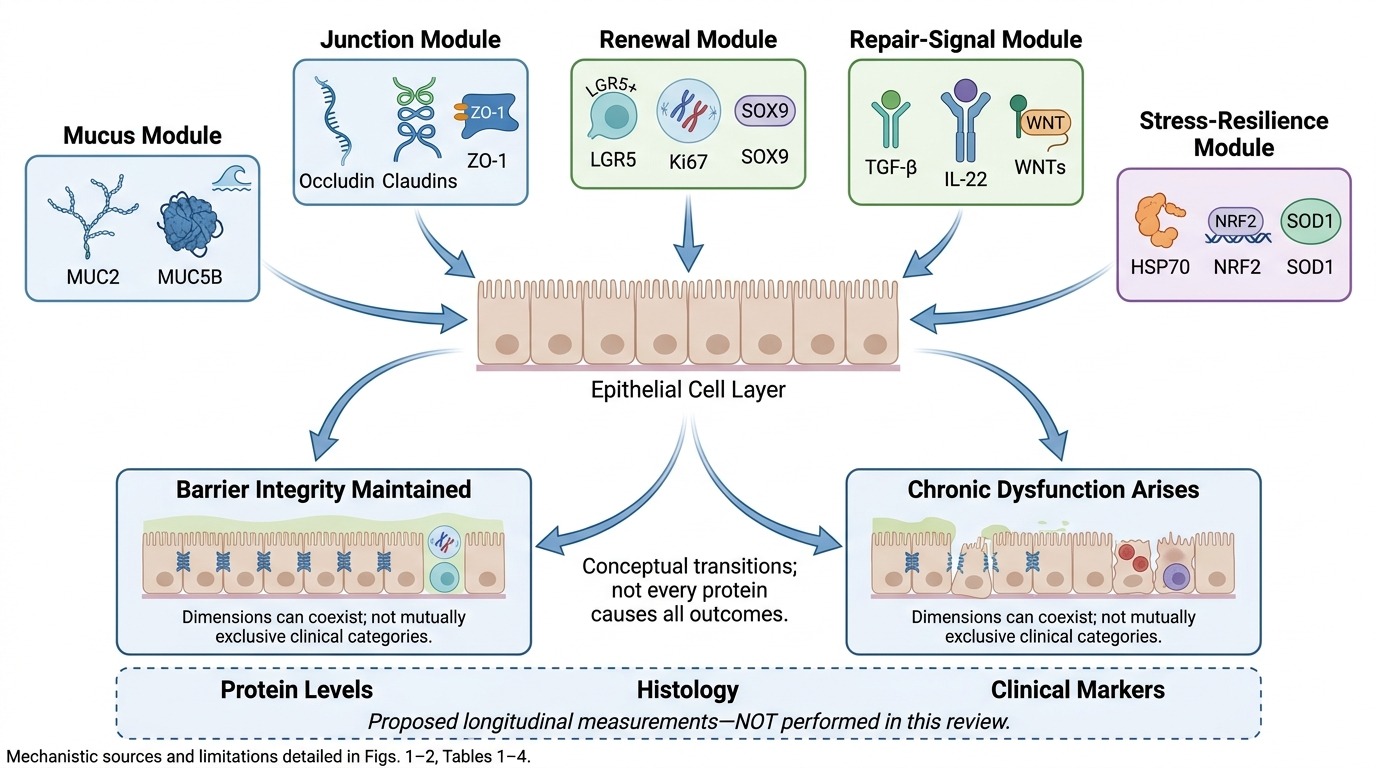
Epithelial recovery in inflammatory bowel disease (IBD) requires coordinated restoration of mucus, junctional regulation, secretory differentiation, stem-cell renewal and resistance to cellular stress. This critical narrative review examines evidence-supported protein networks spanning epithelial, immune and stromal compartments, with MTG16 positioned within a broader differentiation program. MUC2, TFF3, AGR2 and ZG16 support distinct aspects of mucosal defense; CLDN2, occludin, ZO-1 and long myosin light-chain kinase regulate different dimensions of permeability and repair. Stromal WNT/R-spondin support, ASCL2-dependent dedifferentiation and YAP/TAZ-associated reprogramming replenish damaged epithelium. XBP1, ATG16L1, caspase-8 and GPX4 connect secretory competence and stress resilience to inflammatory susceptibility. IL-22, IL-10, interferon-γ, TNF and amphiregulin have effects determined by cell compartment, cytokine combinations and exposure duration. The same broad repair environment can sustain inflammation, fibrosis or tumor-promoting states. Recent epithelial-memory studies further distinguish transient regeneration from persistent chromatin priming. The central unresolved question is which persistent protein activities, measured during well-documented remission, cause functional deficits and contribute to subsequent disease recurrence. We propose paired protein, chromatin and functional measurements with temporally controlled perturbation and longitudinal clinical validation. The resulting framework connects protein mechanisms to measurable recovery endpoints while separating established experimental findings from proposed analyses.
Keywords:
inflammatory bowel disease
; epithelial proteins
; mucus
; junctions
; regeneration
; inflammatory memory
; remission
Copyright: This open access article is published under a Creative Commons CC BY 4.0 license, which permit the free download, distribution, and reuse, provided that the author and preprint are cited in any reuse.