
Submitted:
21 September 2026
Posted:
22 September 2026
You are already at the latest version
Abstract
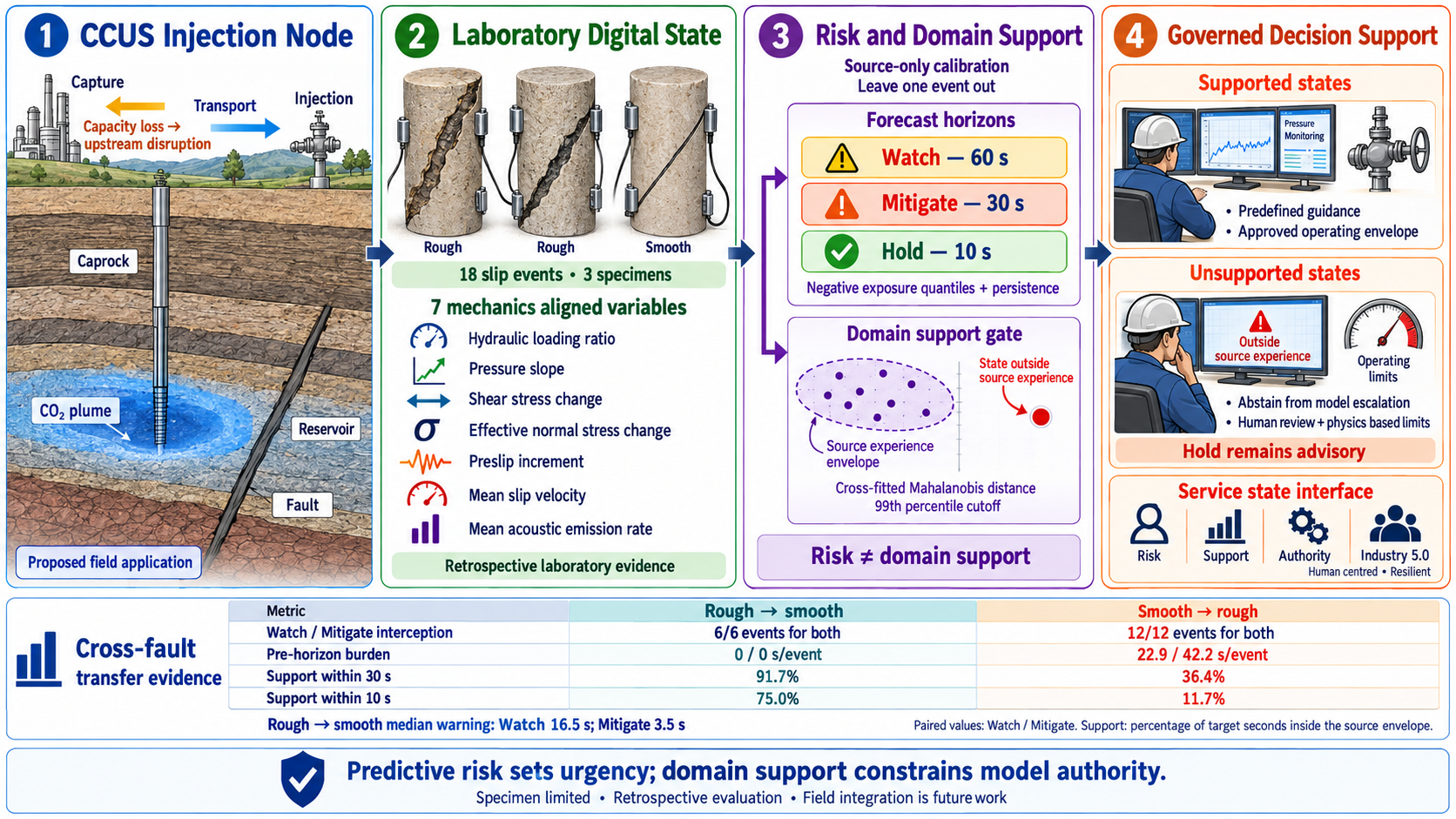
Carbon capture, utilization, and storage (CCUS) supply chains depend on injection nodes whose loss of capacity can propagate upstream as curtailment and network disruption. This design science study develops a digital twin ready predictive risk artifact that converts subsurface measurements into governed states rather than treating model probability as automatic authority. Eighteen slip events from two rough and one smooth fault were represented by seven mechanics aligned variables. Source domain leave one event out probabilities were mapped to Watch (60 s), Mitigate (30 s), and Hold (10 s) states using source calibrated negative exposure quantiles and persistence rules. A cross fitted Mahalanobis support gate identified states outside source experience. Rough to smooth Watch and Mitigate policies intercepted all six events with median warnings of 16.5 and 3.5 s and no pre horizon intervention burden. Smooth to rough policies also intercepted all twelve events but incurred 22.9 and 42.2 s/event of burden. At the 99th percentile support cutoff, support eligible coverage within 30 s was 91.7% versus 36.4% in reverse, and within 10 s it was 75.0% versus 11.7%. These specimen limited results support an Industry 5.0 architecture that separates predictive risk, domain validity, human authority, and physics based fallback.
Keywords:
digital twin
; predictive risk management
; Industry 5.0
; CCUS supply chain
; subsurface injection
; domain shift
; human in the loop
; fault reactivation
Copyright: This open access article is published under a Creative Commons CC BY 4.0 license, which permit the free download, distribution, and reuse, provided that the author and preprint are cited in any reuse.