
Submitted:
22 September 2026
Posted:
22 September 2026
You are already at the latest version
Abstract
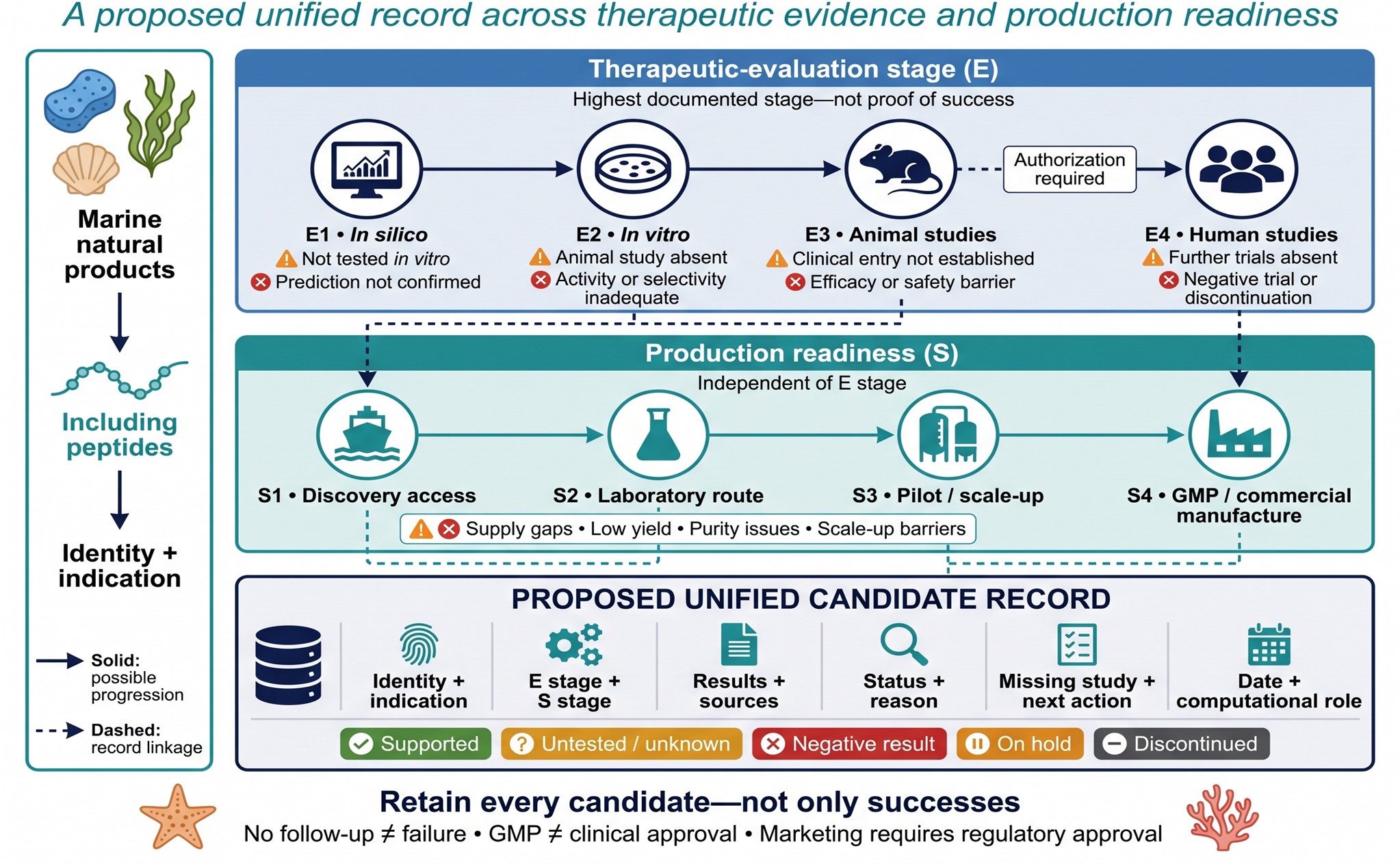
Marine invertebrates and their microbial partners provide distinctive chemical scaffolds, but computational prioritization alone can overstate translational progress when experimental support and material supply remain limited. This critical narrative review proposes a linked-record framework for evaluating exact entity-indication pairs on two independent axes: therapeutic-evaluation stage (E1, in silico, to E4, human intervention) and production readiness (S1, discovery access, to S4, GMP or commercial manufacture). E records the highest stage documented in the reviewed sources, not evidence strength or therapeutic success. Computational contribution, evidence direction, study quality, provenance, and scenario-specific supply adequacy remain separate attributes; E and S are not combined into a composite score. Contrasting lineages involving halichondrin B and eribulin, (+)-aeroplysinin-1, a sea-star steroid, acanthomanzamine C, cynthichlorine, gukulenin A, and meridianin mixtures illustrate how uncertain chronology, test-article mismatch, incomplete validation, and poorly characterized production routes affect interpretation. A worked mass balance distinguishes physical access from the amount required for a defined experiment. Supply-by-design therefore integrates identity, route feasibility, demand, ecological constraints, and access obligations at nomination. The framework is preliminary and requires independent reliability and prospective utility testing.
Keywords:
marine natural products
; marine invertebrates
; machine learning
; virtual screening
; molecular docking
; therapeutic-evaluation stage
; production readiness
; sustainable supply
; bioprospecting
Copyright: This open access article is published under a Creative Commons CC BY 4.0 license, which permit the free download, distribution, and reuse, provided that the author and preprint are cited in any reuse.