Preprint
Article

This version is not peer-reviewed.

Freeze-Dried Porous Composites Based on Sodium Alginate and Powders of Calcium Salts Synthesized from Mixed-Anionic Solutions Prepared from (NH4)2CO3 and (NH4)2H2P2O7 Taken in Different Proportions

A peer-reviewed article of this preprint also exists.

Submitted:

19 September 2026

Posted:

21 September 2026

You are already at the latest version

Abstract

Freeze-dried porous (0.05-0.06 g/cm3) composite materials were prepared from homogeneous molding compositions containing distilled water (95 wt. %), fine inorganic powders of calcium salts (2.5 wt. %) and sodium alginate (2.5 wt. %). Aqueous solution of calcium chloride (CaCl2) and aqueous mixed-anionic solution prepared by mixing solutions of (NH4)2CO3 and (NH4)2H2P2O7 taken in different proportions were used for syntheses of fine inorganic powders. Molar ratios (NH4)2Н2P2O7)/((NH4)2CO3+(NH4)2Н2P2O7) of salts used for mixed-anionic solutions preparation were established as 0 (reference powder), 0.02, 0.04, 0.08 and 0.16. Quantities of aqueous solutions of calcium chloride (CaCl2) was taken to provide molar ratio CaCl2/((NH4)2CO3+(NH4)2Н2P2O7) equal 1.00 (reference powder), 1.02, 1.04, 1.08 and 1.16. Phase composition of synthesized inorganic powders included calcium carbonate (CaCO3) (mostly vaterite) and quasi-amorphous phase of hydrated calcium pyrophosphate (Ca2P2O7 xH2O). All synthesized powders contained adsorbed and occluded salts presented in the mother liquor after synthesis completed before separation of precipitate. Mother liquors were aqueous solutions of ammonium chloride (NH4Cl) (all syntheses) and calcium chloride (CaCl2) (syntheses from mixed-anionic solutions). As components of inorganic powders used as fillers in composite materials ammonium chloride (NH4Cl) and calcium chloride (CaCl2) provoked a partial cross-linking of sodium alginate in the stages of preparation of molding compositions, composite sample molding, freezing and freeze drying. All freeze-dried porous composite materials demonstrated high water absorption capacity 4700-9300%. The most pronounced cross-linked effect was observed for alginate matrixes loaded with powders synthesized at molar ratio CaCl2/((NH4)2CO3+(NH4)2Н2P2O7) equal 1.04 and 1.08 demonstrating lowest water absorption and dry mass-loss after dipping in distilled water for 12 hours. Prepared freeze-dried porous composite materials with alginate matrix and calcium carbonate and/or hydrated calcium pyrophosphate powders as a filler can be recommended for subsequent testing as extracellular matrix for soft/hard tissue repair, as wound dressings or bone defects fillers.

Keywords: 
;  ;  ;  ;  ;  ;  ;  ;  ;  ;  ;  

1. Introduction

Modern medicine actualizes assisted tissue regenerative healing as important method of tissue defect repair [1,2]. Such healing is usually aided by artificial shape/place-holder material (scaffolds) placed inside tissue defect or wound to facilitate proper tissue regeneration while also trying to prevent long-term damage caused by tissue dislocations [3]. Placed inside tissue defect or wound, such scaffolds are expected to do two contradicting things at the same time: keep intact functionality of replaced tissue (e.g. hold the load for hard/bone tissue scaffolds or internal tissue protection for wound dressings) and get bioresorbed at a steady pace to be fully replaced by natural body tissue over the course of natural tissue regeneration [4,5].
Alginate (general term for alginic acid salts, primarily sodium (soluble, widely used commercial product) and calcium (crosslinked)) is a descent choice for extracellular matrices (ECM’s) [6,7,8] creation. Being natural vegetative polysaccharide of marine origin [9] it causes lowest inflammation degree and does not provoke immune response during bioresorption [10,11]. Alginate based materials are widely used in regenerative medicine for bone tissue engineering [12], wound healing [13] and drug delivery systems [14,15]. As matrix alginate is frequently used for composite materials creation [16].
As a polyelectrolyte, alginic acid sodium salt is water-soluble and can be crosslinking with multivalent cations [17,18]. Calcium chloride (CaCl2) is the most frequently used salt in form of aqueous or alcohol solutions as an external crosslinking agent [19]. Biocompatible low-soluble salts such as calcium carbonate (CaCO3) [20,21], calcium sulphate (CaSO4) [22,23] or calcium hydrogen phosphate (CaHPO4) [24,25] can be used both as fillers and as internal cross-linking agents, being dispersed inside alginate solution [26]. Compared to conventional alginate external crosslinking with CaCl2 aqueous or alcohol solution, internal crosslinking process provided by biocompatible calcium salts filler dissolution does not depend on item/mold volume and happens much more uniformly with crosslinker source being evenly dispersed within molding composition.
Different fine inorganic powders are used as fillers of composite materials with alginate matrix. Powders of calcium phosphates [27,28,29] and calcium carbonates [30,31] are used for creation of composites with alginate matrix to be used for bone defect treatment [32,33,34]. Presence of both calcium carbonates and calcium phosphates in composite with alginate matrix gives opportunity of regulation both resorption/regeneration properties and the internal cross-linking process.
Simple mechanical mixture might not be the most optimal way to combine calcium carbonates and calcium phosphates due to possibility of particle size difference making powder mixture non-uniform whether or not powders are mixed inside alginate solution. A better method might be mixed-anionic synthesis which allows simultaneous precipitation of several different salts as a fine powder mixture. Fine inorganic powders of calcium carbonates or calcium phosphates for creation of composite materials with polymer/polysaccharide/alginate matrix have to be specially prepared using bottom-up methods. The most convenient method of fine powders preparation is precipitation from solutions. Synthesis from mixed-anionic solutions gives opportunity to prepare active nano-sized powders with high phase homogeneity [35], to provide opportunity of pH regulation in reaction zone [36] and to create conditions for precipitated particles crystallinity tuning [37]. For example, precipitation from mixed-anionic solutions prepared from sodium hydrogen carbonate (NaHCO3) and sodium pyrophosphate (Na4P2O7) containing both CO32- and P2O74- provided unique conditions for preparation of amorphous calcium carbonate (CaCO3) [37]. Presence of sodium nitrate (NaNO3) as reaction by-product in this powder of amorphous calcium carbonate made necessary the stage of precipitate washing.
Inspired by articles mentioned above [35,36,37], present research focuses on mixed-anionic synthesis using calcium chloride (CaCl2) as calcium source and ammonium di-hydro-pyrophosphate ((NH4)2Н2P2O7) and ammonium carbonate ((NH4)2CO3) as pyrophosphate and carbonate anion sources respectively for mixed-anionic solutions preparation. Chosen ion system thus eliminates presence of undesired ions (for example, nitrate and sodium) in reaction zone and undesired substances as reaction by-product in synthesized powders along with requirement for precipitate washing stage. Taking into account interaction of calcium chloride (CaCl2) ammonium carbonate ((NH4)2CO3) and ammonium di-hydro-pyrophosphate ((NH4)2Н2P2O7) expectation of calcium carbonates (CaCO3) of different modifications (even including amorphous) and hydrated calcium pyrophosphate (Ca2P2O7 xH2O) formation is under consideration.
Previous investigation [38] showed that preservation of reaction by-products in the powders of calcium carbonate intended for preparation of composites with alginate matrix can be a significant factor influencing properties of molding compositions and possibility of internal cross-linking. Using calcium chloride (CaCl2) and soluble ammonium salts can provide formation of ammonium chloride (NH4Cl) as reaction by-product. At the stage of molding composition preparation being dissolved ammonium chloride (NH4Cl) interacts with calcium carbonate (CaCO3) with calcium chloride formation (CaCl2) [39] and thus induces alginate crosslinking.
Monolithic alginate hydrogel itself is not optimal to be used as an ECM due to lack of cell permeability, necessary for faster bioresorbtion and tissue regeneration. Pores can be formed by either foaming, 3D printing, electrospinning, or freeze-drying of alginate solution [40]. Freeze drying (lyophilization) is one of convenient method for preparation of porous composites materials based on polysaccharides [41,42,43]. Freeze-drying has distinct advantage of forming a thorough network of interconnected pores, further promoting bodily liquid and cell permeability. Both calcium salts internal crosslinking and freeze-drying simultaneously can be applied to molding compositions based on alginate solution to produce crosslinked porous polymer material.
The aim of this investigation was to prepare porous composite materials with alginate matrix and inorganic powders (calcium carbonate and/or hydrated calcium pyrophosphate) containing reaction by-product as fillers using lyophilization of molding compositions. The main point of this investigation was to find correlations between properties of synthesized powders and their influence on properties of porous composite materials with alginate matrix. As a main factors influencing the powder properties were established molar ratios (NH4)2Н2P2O7)/((NH4)2CO3+(NH4)2Н2P2O7) for mixed-anionic aqueous solutions and molar ratios CaCl2/(NH4)2CO3=1 and CaCl2/(NH4)2Н2P2O7=2 for aqueous solutions of CaCl2 providing formation of calcium carbonate (CaCO3) and hydrated calcium pyrophosphate (Ca2P2O7 xH2O) respectively as expected result of the syntheses.

2. Materials and Methods

2.1. Preparation of Aqueous Solution of Pyrophosphoric Acid (H4P2O7)

Aqueous solution of pyrophosphoric acid (H4P2O7) was prepared via ion exchange from aqueous solution of sodium pyrophosphate (Na4P2O7) using cationite KU-2х8 (styrene and divinylbenzene copolymer (8%), GOST 20298-74, manufactured by LLC PA «TOKEM», Kemerovo, Russia) in H+ form as ion-exchange material.
Sodium pyrophosphate decahydrate (Na4P2O7∙10H2O) (CAS No. 13472-36-1 analytical pure grade, Rushim, Moscow, Russia) was used for preparation of 320 ml of 0.4 M aqueous solution of sodium pyrophosphate (Na4P2O7).
Prepared hot (60 oC) aqueous solution of sodium pyrophosphate (Na4P2O7) was passed through the column containing cationite resin in H+ form. The processes occurring during the synthesis of pyrophosphoric acid (H4P2O7) can be represented as the following ion exchange reaction (Equation (1)):
Na4P2O7 + 4HOOC-R(H+ resin) → H4P2O7 + 4NaOOC-R
180 ml of pyrophosphoric acid (H4P2O7) with pH=1 and concentration 0.4 M was prepared.

2.2. Preparation of Aqueous Mixed-Anionic Solutions from Aqueous Solutions of Ammonium Di-Hydro-pyrophosphate ((NH4)2Н2P2O7) and Ammonium Carbonate ((NH4)2CO3)

Concentrated aqueous ammonia solution NH4OH (CAS No. 1336-21-6, analytical pure grade, Rushim, Moscow, Russia) was added to the fresh aqueous solution of pyrophosphoric acid to change pH of solution to 4 and to provide preparation of aqueous solution of ammonium di-hydro-pyrophosphate ((NH4)2Н2P2O7) according to Equation (2) [44,45].
H4P2O7 + 2NH4OH → (NH4)2Н2P2O7 + 2H2O
Then aqueous solution of ammonium di-hydro-pyrophosphate ((NH4)2Н2P2O7) was diluted to prepare 0.2M aqueous solution of ammonium di-hydro-pyrophosphate (NH4)2Н2P2O7.
193.6 g of ammonium carbonate (NH4)2CO3 (CAS No. 506-87-6, analytical pure grade, Rushim, Moscow, Russia) were used for preparation of 2 l of 0.3 M aqueous solution.
Molar ratios of ammonium di-hydro-pyrophosphate ((NH4)2Н2P2O7) and ammonium carbonate (NH4)2CO3 in mixed-anionic solutions is presented in Table 1.
Volume proportions of aqueous solutions with preset concentrations were mixed to provide molar content 0 (reference synthesis), 2, 4, 8 and 16 mol % of ammonium di-hydro-pyrophosphate ((NH4)2Н2P2O7) in the mixture of salts ((NH4)2CO3+ (NH4)2Н2P2O7) present in mixed-anionic solutions.
Calculated volumes of 0.2M aqueous solution of ammonium di-hydro-pyrophosphate ((NH4)2Н2P2O7) was added to the calculated volumes of 0.3M aqueous solution of ammonium carbonate (NH4)2CO3 (Table 2). Aqueous solutions of ammonium di-hydro-pyrophosphate (NH4)2Н2P2O7 and ammonium carbonate (NH4)2CO3 were mixed together in a beaker with magnetic stirrer during 5 min.

2.3. Synthesis of Powders from Mixed-Anionic Solutions

Calcium chloride CaCl2 (CAS No. 10043-52-4, analytical pure grade, Rushim, Moscow, Russia) were used for preparation of 0.3 M aqueous solutions.
Prepared aqueous solution of ammonium carbonate ((NH4)2CO3) (FR-00) and aqueous mixed-anionic solutions (FR-02, FR-04, FR-08, FR-16) were added to the calculated volumes of 0.3 M aqueous solutions of calcium chloride CaCl2 (Table 2) causing as expected simultaneous precipitation of calcium salts, i.e. CaCO3 and Ca2P2O7·хH2O.
Calculation of volumes of aqueous solutions of calcium chloride CaCl2 for syntheses from the mixed-anionic solutions was done taking into account that the molar ratio for CaCO3 (Ca/CO3=1) for the pair CaCl2 and (NH4)2CO3, and the molar ratio for Ca2P2O7·xH2O (Ca/P=1 or Ca/Н2P2O7=2) for pair CaCl2 and (NН4)2Н2P2O7.
The syntheses of the powders were carried out in glass with a volume of 1 l at magnetic stirrer. Suspensions of precipitates were keeping under constant stirring and pH control (pH Meter EXPERT, LLC «Econix Expert», Moscow, Russia) during 15 min after addition of mixed-anionic aqueous solutions with the content of (NН4)2Н2P2O7 varying from 0 to 16 mol % to the aqueous solutions of CaCl2. Powder labels include the figures reflected molar content of (NН4)2Н2P2O7. Labeling used for synthesized powders under investigation, volumes and concentrations of solutions used for powders preparation are presented in Table 2.
Prepared precipitates were separated from the mother liquors by vacuum filtration using a Buchner funnel and a Bunsen flask, placed in the plastic trays, evenly distributed in a thin layer and left to dry for 1 week at room temperature. The powder preparation protocol excluded the stage of by-product removing via powder washing. Then after drying powders were collected, crushed in an agate mortar and sieved through a polyester sieve with a mesh size of 200 microns. The scheme of powders synthesis is presented in Figure 1.

2.4. Thermal Treatment of Synthesized Powders

To clarify the composition of synthesized powders they were heat treated at different temperatures in the interval 200-600 oC (FR-00, FR-02, FR-04) and in the interval 200-1000 oC (FR-08, FR-16) with heating rate 5 oC/min and holding time at the selected temperature 2 hours.

2.5. Preparation of Molding Compositions, Containing Synthesized Powders and Aqueous Solution of Sodium Alginate

Sodium alginate E401 (Qingdao Nanshan Yuanquan Seaweed Co., Ltd., Qingdao, China) and powders synthesized from the mixed-anionic aqueous solutions and aqueous solutions of CaCl2 were used for preparation of molding compositions. Components of molding compositions are presented in Table 3.
2.5 g was of each synthesized powder (FR-00, FR-02, FR-04, FR-08, FR-16) were placed in 95 ml of distilled water in glass with a volume of 100 ml at magnetic stirrer. Then to the resulting suspensions of synthesized powders in water 2.5 g of sodium alginate was added. The mixtures were stirred with a spatula for 60 minutes until a uniform viscous molding compositions (Alg_FR-00, Alg_FR-02, Alg_FR-04, Alg_FR-08, Alg_FR-16) were obtained without visible agglomerates.

2.6. Porous Freeze-Dried Composites Preparation

The resulting molding compositions (4.5-6.5 g) was poured/placed into plastic Petri dishes with diameter 34.2 mm. The samples were frozen at -25 ° C. The frozen samples were then freeze dried (lyophilized) in a vacuum cryodryer for 48 hours for preparation of porous freeze-dried composites (Cryo_Alg_FR-00, Cryo_Alg_FR-02, Cryo_Alg_FR-04, Cryo_Alg_FR-08, Cryo_Alg_FR-16). The laboratory freeze dryer BIOBASE BK-FG10 S (Jinan Biobase Medical Co., Ltd., Jinan, China), providing vacuum degree < 10 Pa with cold trap temperature −60 ◦C, was used for drying of preemptively frozen at −25 ◦C samples.

2.7. Methods of Analysis

The bulk density of the powders was defined as the ratio of the weight of the powder to the volume occupied. For this purpose, a fixed volume (1 cm3) volumetric tube was filled with powder by free-filling and the weight of this powder portion was determined on a Shimadzu AUY 120 analytical balance (Shimadzu, Kyoto, Japan). Thus, three parallel measurements were made and the bulk density of the sample was calculated. The results were presented as arithmetic average.
The phase composition of synthesized powders and composites was studied by X-ray powder diffraction (XRD) analysis using CuKa radiation (λ = 1.5418 Å, step 2θ – 0.02°) using Rigaku D/Max-2500 diffractometers (Rigaku Corporation, Tokyo, Japan) in the angle range 2θ = 2...70° or Tongda TD-3700 (Dandong Tongda Science & Technology Co., Ltd., Dandong, China) in the angle range 2θ = 3...70°. The X-ray patterns were analyzed using the WinXPOW program and the ICDD PDF-2 (http://www.icdd.com/products/pdf2.htm, accessed on 20 August 2026) [46] databases and the Match! program. (https://www.crystalimpact.com/, accessed on 20 August 2026). The quantitative ratio of the target phases in the synthesized powders was determined using the Match!3 program, https://www.crystalimpact.com/.
FTIR-spectra of powders after synthesis and drying were recorded in the transmission mode in the wavenumbers range of 4000–400 cm-1 with a step of 4 cm-1 on a Perkin Elmer Frontier spectrometer (Perkin Elmer, Waltham, Massachusetts, USA). The survey was carried out with potassium bromide tablets (7 mm diameter) containing 1 mass% of the test sample. The tablets were prepared by carefully grinding KBr together with the sample, followed by pressing into tablets at a pressure of 50 bar.
Scanning electron microscopy (SEM) images of the synthesized powders were characterized using an EVO LS 15 microscope (Carl Zeiss, Jena, Germany) in secondary electron imaging mode (SE2 detector). The accelerating voltage of the electron gun was up to 20 kV. The images were obtained in secondary electrons at magnifications up to 1000× and 10000×. SEM images of the synthesized powders after heat treatment were studied using a scanning electron microscope with an auto emission source JEOL JSM-6000PLUS Neoscope II (JEOL Ltd., Tokyo, Japan). The accelerating voltage of the electron gun was up to 5 kV. The images were obtained in secondary electrons at magnifications up to 1000×. For the study, the samples were glued onto a copper substrate using carbon tape, and a layer of gold ~15 nm was sprayed. The survey was carried out in vacuum mode. The images were recorded in digitized form on a computer.
Textural characteristics of synthesized powders were determined based on the nitrogen adsorption isotherms measured at 77K using an IMC ProSurf-V 1220 analyzer (IMC-systems, Moscow, Russia). Before the measurements, the samples were activated at 150 ◦C and 5 × 10⁻² mmHg for 2 h to remove physically adsorbed solvent molecules. The specific surface area was calculated according to the Brunauer–Emmett–Teller (BET) method. Additionally, sample activation was performed in dynamic conditions upon heating at 150 ◦C in nitrogen flow for 2 h using Sorbi-MS analyzer (Meta, Novosibirsk, Russia), and the following nitrogen adsorption experiment confirmed the same value of the specific surface area.
Thermal analysis (TA) including thermogravimetry (TGA) of synthesized powders was performed using an NETZSCH STA 409 PC Luxx thermal analyzer (NETZSCH, Selb, Germany) during heating in air (10 °C/min, 40–1000 °C), the specimen mass being at least 10 mg. The gas-phase composition was monitored by a QMS 403C Aëolos quadrupole mass spectrometer (NETZSCH, Selb, Germany) coupled with a NETZSCH STA 409 PC Luxx thermal analyzer (NETZSCH, Selb, Germany). The mass spectra were registered for the m/z = 44 (CO2).
To calculate bulk density of molding compositions consisting of synthesized powders and aqueous solution of sodium alginate mass of 2 ml was weighed.
The viscosity of suspensions of synthesized powders in aqueous solution of sodium alginate in a rotary stationary (CSR) mode was studied using an Anton Paar MCR 302e modular rheometer (Anton Paar GmbH, Graz, Austria) in a plane-to-plane geometry with a diameter of 25 mm, a gap of 0.25 mm in the shear rate range from 1 to 100 s-1. The measurements were carried out at a room temperature of 23 °C.
Indirect investigation of properties of molding compositions consisting of synthesized powders and an aqueous solution of sodium alginate was done via drying at room temperature. For an indirect assessment of viscosity, we considered the spreading area of the same mass of molding compositions. 10.00 g of each molding compositions were dosed onto the flat surface of a glass Petri dish.
To estimate bulk density of porous freeze-dried hydrogels composites mass and dimensions were determined.
Photos of porous freeze-dried hydrogels composites were done using Digital microscope Levenhuk Discovery Artisan 512, (Levenhuk, Inc., headquarters, Fremont, California, USA; produced in China).
Hydrophilic properties, water absorption (swelling) and solubility of freeze dried porous composite materials (Cryo_Alg_FR-00, Cryo_Alg_FR-02, Cryo_Alg_FR-04, Cryo_Alg_FR-08, and Cryo_Alg_FR-16) were investigated by distilled water treatment. Samples of freeze dried porous composite materials were divided (cut) into small (~0.15-0.2 g) slices. 3 slices were taken for each type, weighted (mfreeze) and placed in 50 ml of distilled water for 12 h. Wet samples were then gently soaked on dry filtering paper to remove excess moisture and weighted (mt, t=0). Then to investigate the dependence of mass of all samples from drying duration at 60 oC they were periodically weighted up to the constant mass (mdry) reaching. Current swelling degree percentage (S, %) was calculated as current mass as comparison of dry mass measured after drying (mdry) and wet mass at drying start (mt, t=0) (Equation (3)).
S=mt/mdry·100%
Retain mass (R, %) of sample after drying up to the constant mass was calculated using Equation (4).
R= mdry /mfreeze·100%
The mass loss (L, %) of samples due to dissolution of soluble components of porous composite material was calculated using Equation (5).
L=(mfreeze-mdry)/mfreeze·100%,
In Equations (3)-(5):
mt – mass of sample in current time during wet sample drying, g
mdry - mass of sample dried at 60 oC up to constant mass reaching, g
mfreeze - mass of slice of freeze sample used for investigation, g (dry slice sample mass measured before water dipping,).
Calculated values for each trio of sample-slices were then approximated using arithmetical gross average, used to plot drying kinetics graph.

3. Results and Discussion

pH levels of the starting solutions of (NH4)2CO3 and mixed-anionic solutions after addition of solution of (NН4)2Н2P2O7 presented in Figure 1, a. Simultaneous presence of acidic ammonium di-hydro-pyrophosphate ((NН4)2Н2P2O7) and ammonium carbonate ((NH4)2CO3) creates opportunity for interaction between these components (Equations 6 and 7) [44,45]:
(NН4)2Н2P2O7 + 2(NH4)2CO3 → (NН4)4P2O7 + 2NH4HCO3
(NН4)2Н2P2O7 + (NH4)2CO3 → (NН4)4P2O7 + H2CO3
pH levels of mixed-anionic solutions were in the interval 8.5-8.9. According [44,45], this interval pH corresponds to (NН4)4P2O7 existence.
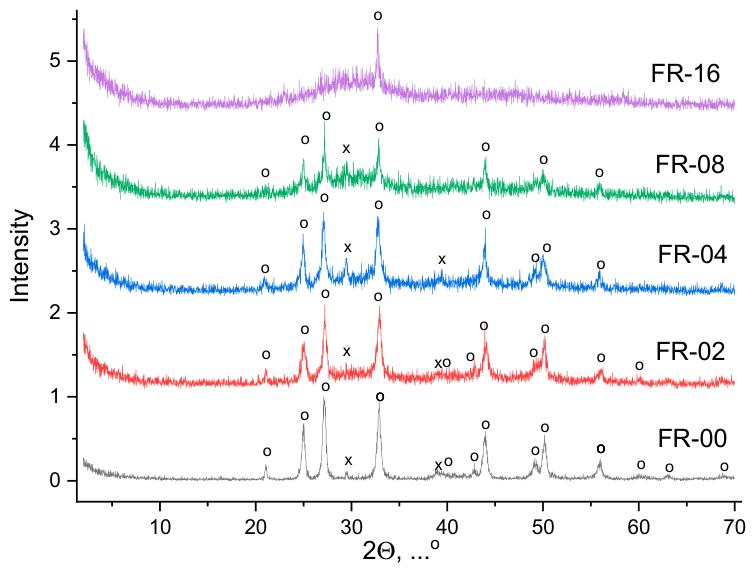
Kinetic curves of pH measurement of suspensions created as a result of starting solutions interaction, after addition of aqueous mixed-anionic solutions to the solutions of calcium chloride (CaCl2) are shown in Figure 1, b. pH levels for all suspensions during 15 min since addition of aqueous mixed-anionic solutions to the aqueous solutions of calcium chloride (CaCl2) up to the filtration were in the narrow interval 8.07 – 8.57. Never the less the bigger the content of ammonium di-hydro-pyrophosphate ((NН4)2Н2P2O7) in the mixed-anionic solution the lower pH level of suspensions was. Phase composition of prepared powders, synthesized from aqueous solutions of calcium chloride (CaCl2) and the mixed-anionic solutions prepared from ammonium carbonate ((NH4)2CO3) and ammonium di-hydro-pyrophosphate ((NН4)2Н2P2O7) is shown in Figure 2.
The phase composition of reference powder FR-00 included vaterite (the most intense peaks) and calcite. The content of the last was estimated using Match! as 4.9%. The precipitation of calcium carbonate (CaCO3) in form of vaterite or calcite took place due to the interaction of ammonium carbonate with calcium chloride (Equation 8).
(NH4)2CO3 + CaCl2 → CaCO3 + 2NH4Cl
XRD graph of powder FR-16 gives opportunity to conclude that this powder mainly consists of quasi-amorphous phase, and the only reflex (2Q=23.8) can be attributed to the vaterite. Increasing the content of ammonium di-hydro-pyrophosphate ((NН4)2Н2P2O7) in mixed-anionic solution and increasing content of pyrophosphate ions (P2O74-) in the reaction zone course the increasing of quasi-amorphous phase presence. The phase composition of powders FR-02, FR-04, FR-08 are between composition detected for FR-00 and FR-16 powders and include preferably vaterite, a little quantity of calcite and quasi-amorphous phase. This indicates a direct influence of pyrophosphate ions (P2O74-) on the crystallization process taking place in the reaction zone. The increase of pyrophosphate ions (P2O74-) fraction in mixed-anionic solutions leads to gradual amorphization of the synthesized powders. It is known that ammonium (NH41-)-ions presence helps the formation of metastable vaterite [47,48,49]. Also, it is known that presence of pyrophosphate ion (P2O74-) in reaction zone can help the formation of metastable amorphous calcium vaterite [37]. Formation of amorphous hydrated calcium pyrophosphate (Ca2P2O7 xH2O) was also possible. Due to possible presence of (NН4)4P2O7 (Equation 3) the following reaction can take place with formation of hydrated calcium pyrophosphate (Equation 9).
(NН4)4P2O7 + 2CaCl2 + xH2O → Ca2P2O7 xH2O + 4NН4Cl
We have to admit that ammonium carbonate ((NH4)2CO3) in this case may play a role of pH regulator. The possibility of reactions (Equation 4 and Equation 7) obviously can create the problems with the synthesis of calcium carbonate because the weak acid such as H2CO3 cannot displace a strong one from calcium chloride. And for this reason, calcium chloride (CaCl2) may stay in the composition of mother liquor additionally to the by-product (NН4Cl) of planed synthesis via exchange reactions.
So, based on XRD data for synthesized powders composition of quasi-amorphous phase is not clear and it can be taken as multiphase.
Taking into account properties of H2CO3 we can assume that this weak acid can provide formation of H2O and CO2 with possibility to escape from reaction zone (Equation 10).
H2CO3 → CO2 + 2H2O
Reaction (Equation 7) reflects formation of metastable H2CO3. This transformation can be a reason of loss of carbonate-ion as a possible participant of CaCO3 formation in the syntheses of powders FR-02, FR-04, FR-08, FR-16 and can lower the content of calcium carbonate in the composition of synthesized powder in comparison with expected one. Never the less gas evolution from the reaction zone was not noticed during syntheses implementation probably due to low content of ammonium di-hydro-pyrophosphate ((NН4)2Н2P2O7) in the mixed-anionic solutions and due to kinetic reasons. Moreover, interaction of calcium chloride (salt of the strong acid) with weak carbon acid presenting in the reaction zone is impossible. This fact can be taken as a reason of presence of notable quantity of calcium chloride (CaCl2) in the compositions of mother liquor solutions especially in cases of syntheses of powders FR-08, FR-16. Taking into account the absence of stage of washing in the powders’ preparation protocol, ammonium chloride (NH4Cl) (all powders) and calcium chloride (CaCl2) (powders FR-02, FR-04, FR-08, FR-16) can be in the synthesized powders due to adsorption of components from mother liquor and due to mother liquor occlusion [50].
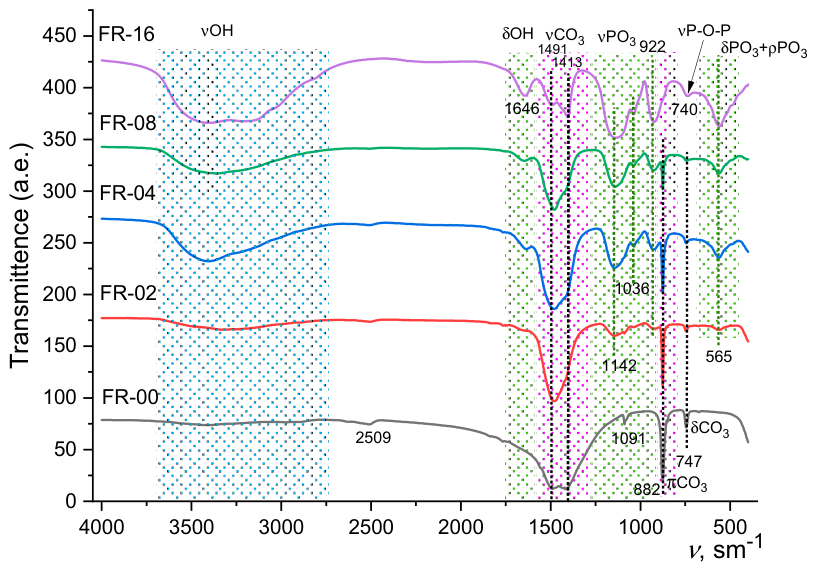
FTIR spectra of synthesized powders are presented in Figure 3. The FTIR spectroscopy data for powder FR-00 correspond to calcium carbonate according to data presented in the data bases [51] and articles published before [38,52,53]. Vibrations both of calcite and vaterite can be found in the FTIR spectra for powders FR-00, FR-02, FR-04, FR-08, FR-16. The major carbonate band constituted by a split peak at 1413–1491 cm−1 as additional confirmation of vaterite presence. Another bright carbonate band at 882 cm-1 present in FTIR spectra for powders FR-00, FR-02, FR-04, FR-08. This band losses its intensively with the increasing of ammonium di-hydro-pyrophosphate ((NН4)2Н2P2O7) content used for preparation of the mixed-anionic solution. Bands corresponding to hydrated calcium pyrophosphate tetrahydrate [54] or amorphous hydrated calcium pyrophosphate [55] at 1142, 1036, 922, 565 are in the FTIR spectra of powders FR-02, FR-04, FR-08, FR-16 and they became more noticeable with increasing of content of ammonium di-hydro-pyrophosphate ((NН4)2Н2P2O7) used for preparation of the mixed-anionic solution. A wide absorption band O-H groups in the region of 2750-3700 cm-1 (which indicates the presence of hydrated/absorbed water in the samples) can be obviously found for powders FR-04, FR-08, FR-16.
The most pronounced and intense bands of pyrophosphate groups are observed for the FR-16 powder which is directly related to the maximum content of the pyrophosphate ions (P2O74-) in the mixed-anionic solution prepared for synthesis of this powder.
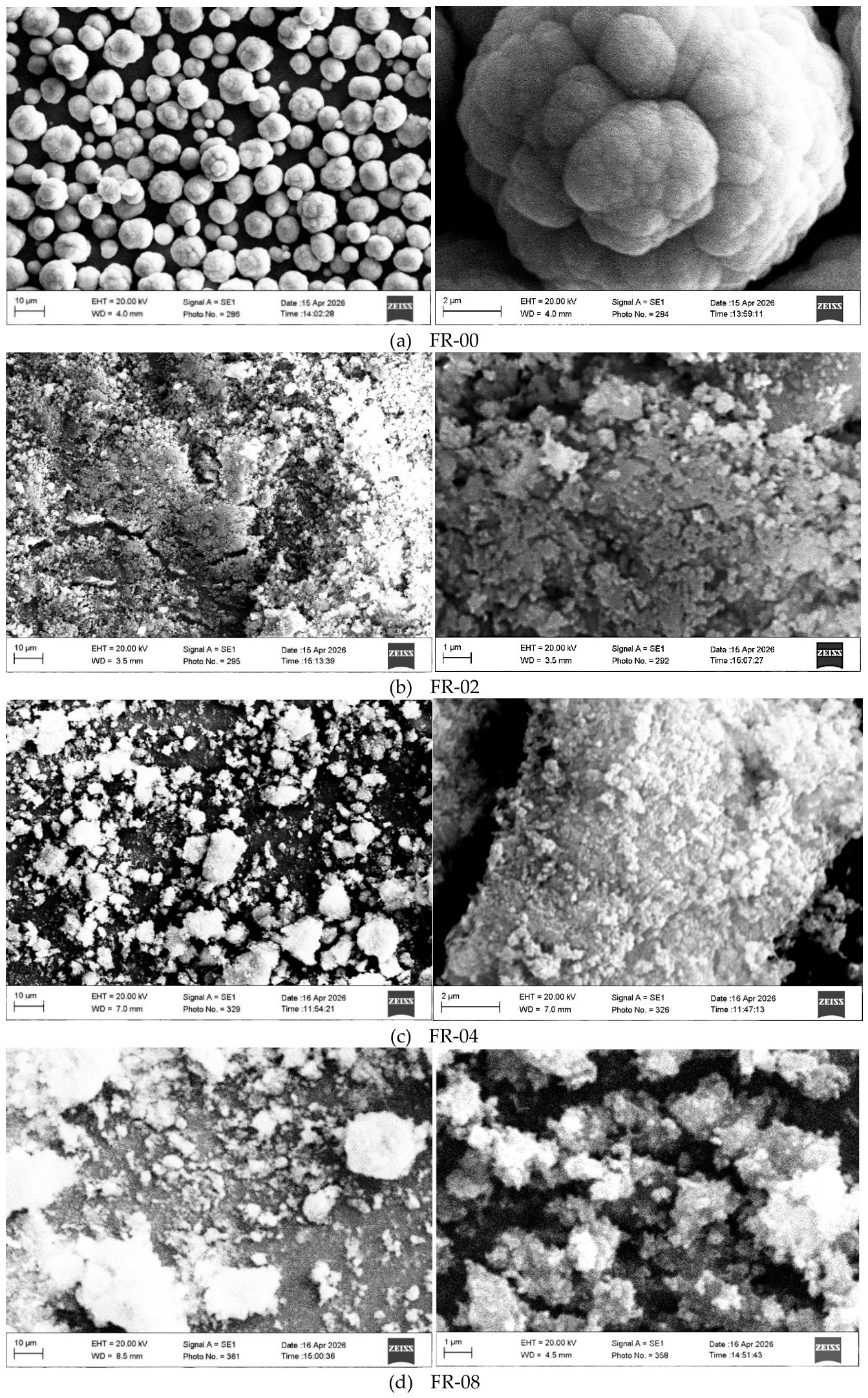
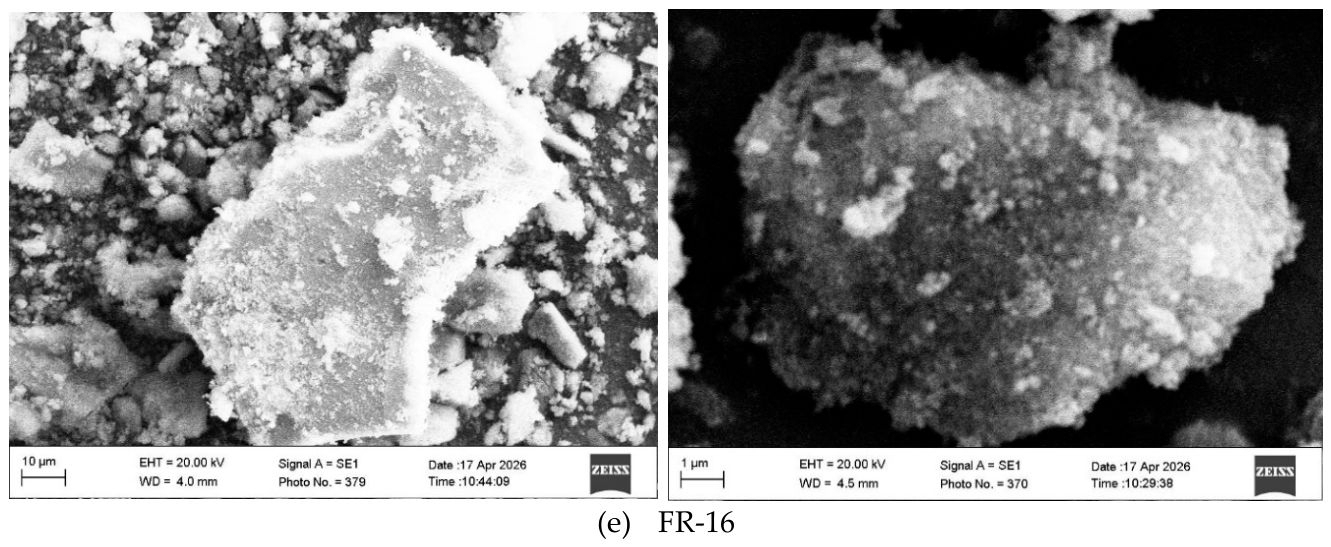
Micrographs of powders synthesized from aqueous mixed-anionic solutions prepared from different quantities of ammonium carbonate and ammonium di-hydro-pyrophosphate ((NН4)2Н2P2O7) and aqueous solution of calcium chloride CaCl2 are shown in Figure 4.
The FR-00 powder is characterized by fairly large (3-14 mm) spherical particles with a well-defined surface. This morphology is one of the typical for vaterite particles [56,57,58,59,60,61]. In powder FR-02 the destruction of large spherical particles and the formation of smaller (100-200 nm) particles are observed in spite of the practically identical phase composition according to XRD data (Figure 2) and bands places in the FTIR graph (Figure 3). Microstructure of powders FR-04, FR-08 and FR-16 looks similar to the microstructure of powder FR-02. But according to XRD data fine microstructures of powders FR-04, FR-08 and FR-16 probably present the particles not only vaterite (CaCO3) but also of amorphous phase of hydrated calcium pyrophosphate (Ca2P2O7 xH2O). Particles become less shaped, agglomerates (less 1 mm) of small particle are observed. This indicates an increase in the content of hydrated calcium pyrophosphate compounds and a decrease in the proportion of well-crystallized calcium carbonate. Microstructure of synthesized powders are consistent with XRD data showing an increase in the content amorphous phases.
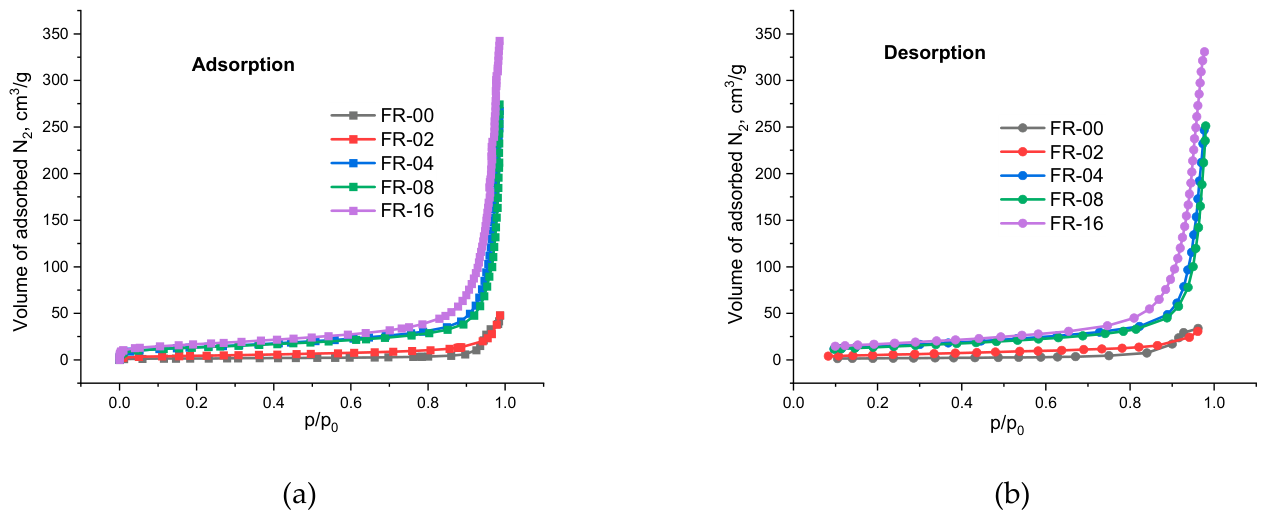
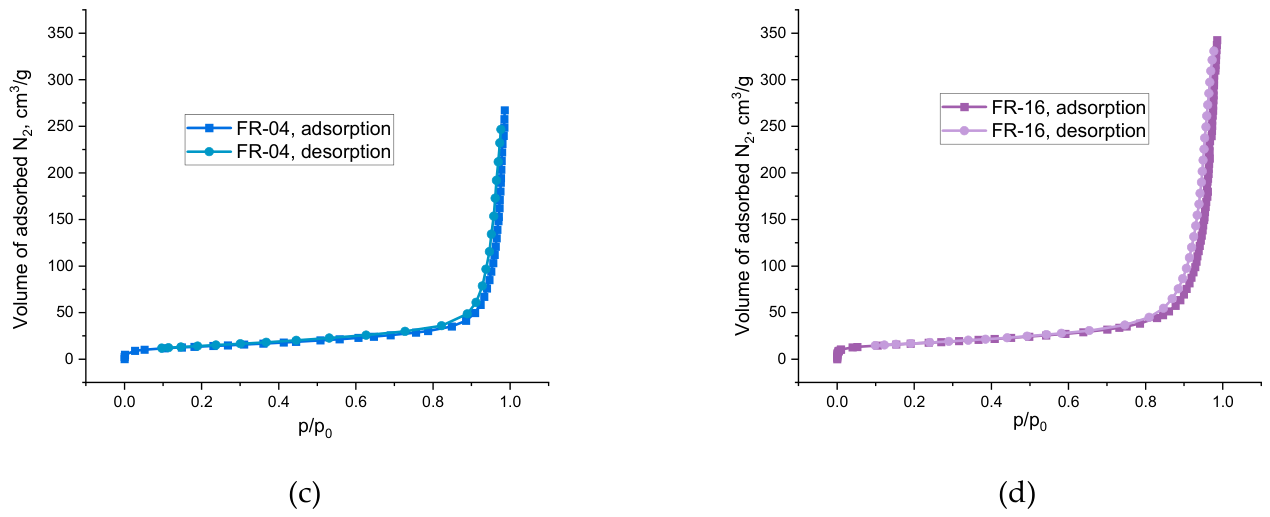
The obtained adsorption (Figure 5, a) and desorption isotherms (Figure 5, b) are Type-III (IUPAC classification [62]), corresponding to nonporous materials. Additionally, adsorption-desorption isotherms separately presented for powders FR-04 (Figure 5, c) and FR-16 (Figure 5, d) to demonstrate that adsorption and desorption isotherms for powders under investigation have identical character. It is noteworthy that maximum volume of adsorbed N2 increases in the row of powders from FR-00 (47 cm3/g) to the FR-16 (345 cm3/g).
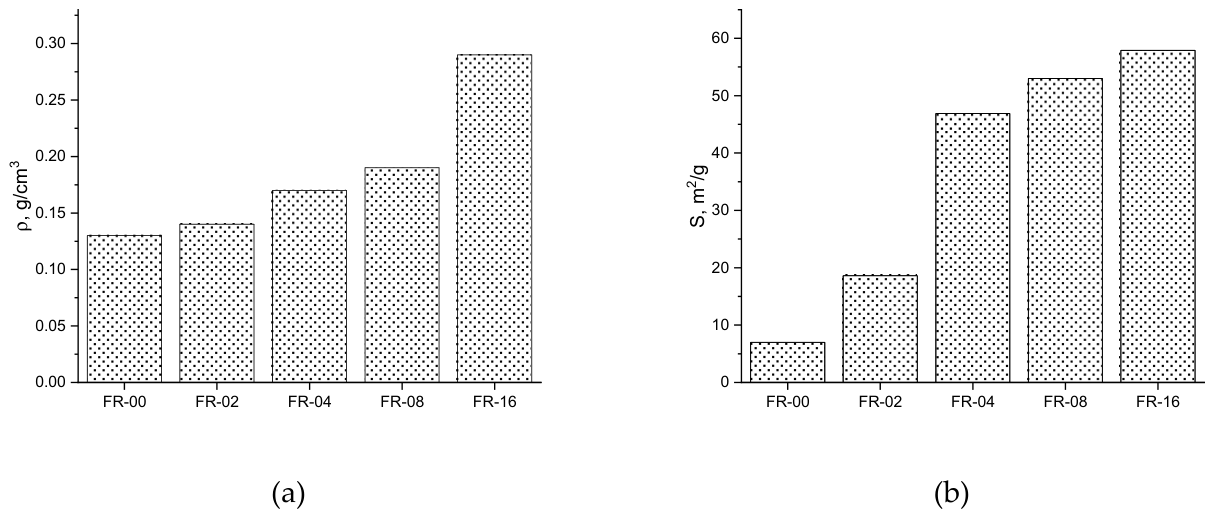
Apparent densities and specific surface areas of powders synthesized from aqueous mixed-anionic solutions prepared using different quantities of ammonium carbonate ((NH4)2CO3) and ammonium di-hydro-pyrophosphate ((NН4)2Н2P2O7) and aqueous solution of calcium chloride (CaCl2) are shown in Figure 6.
Apparent densities of the synthesized powders increase from 0.13 g/cm3 for FR-00 to 0.29 g/cm3 for FR-16. The specific surface areas of the synthesized powders calculated using the BET model, increases from 7 m2/g for FR-00 and 57 m2/g for FR-16.
Specific surface areas of the synthesized powders depend on the content of pyrophosphate ions in starting mixed-anionic solution. A significant increase in the specific surface area of synthesized FR-02 (19 m2/g) powder in comparison of the specific surface area of synthesized FR-00 (7 m2/g) powder might be due to particle growth disruption caused by forming amorphous hydrated calcium pyrophosphate acting both as growth inhibitors for vaterite crystals during synthesis and presumably as some sort of spacers between particles preventing agglomeration-induced surface area growth.
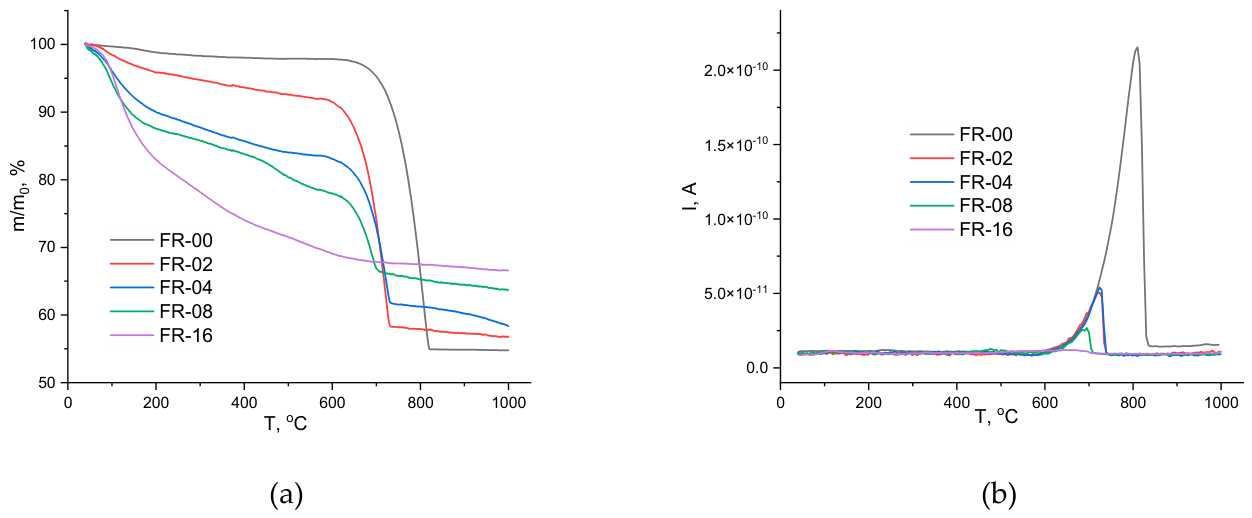
Mass-loss and ion current for m/z=44 (b) for powders synthesized from aqueous mixed-anionic solutions prepared from different quantities of ammonium carbonate ((NH4)2CO3) and ammonium di-hydro-pyrophosphate ((NН4)2Н2P2O7) and aqueous solution of calcium chloride (CaCl2) are shown in Figure 7.
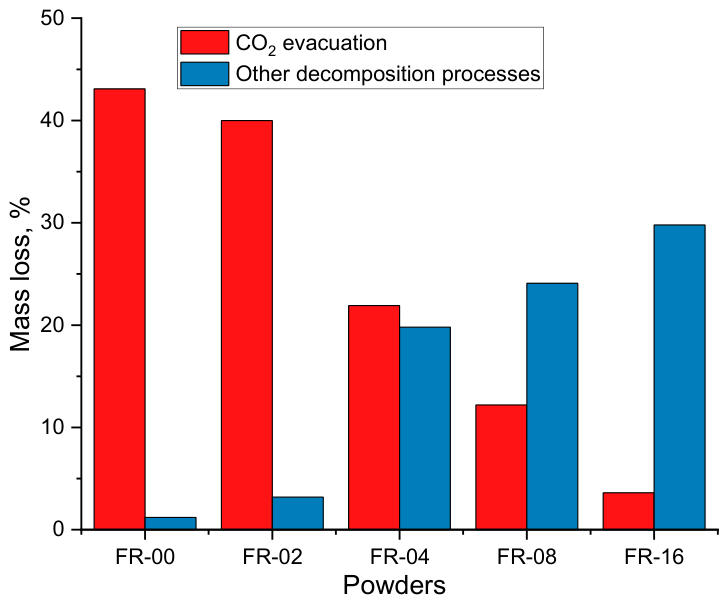
A decrease in weight is observed for all samples when heated but the pattern of weight loss differs depending on the composition of the powders. The total mass loss for powder FR-00 was the biggest (45.2%), and the total mass loss for powder FR-16 was the smallest (33.4%) (Figure 7 and Table 4). For samples with a high content of amorphous phases (presumably hydrated calcium pyrophosphate (Ca2P2O7 xH2O)), especially FR-08 and FR-16 mass loss begins earlier and occurs more smoothly. Temperature intervals of mass-loss taking place due to CO2 evacuation, including calcium carbonate decomposition (Equation 11, Table 4) as a reason were determined based on temperature dependences of ion current for m/z=44 (Figure 7, b).
CaCO3→CaO+CO2↑
The mass loss at temperatures lower than temperature of starting of calcium carbonate decomposition can be associated with (1) the removal of adsorbed water, (2) the dehydration of hydrated calcium pyrophosphate as it was also observed before (Equation 12) [63], (3) ammonium chloride decomposition (200-600 oC) (Equation 13) [64], and even with dehydration of hydrated calcium chloride (40-150 oC) (Equation 14) [65].
Ca2P2O7⋅xH2O→Ca2P2O7+xH2O↑
NH4Cl → NH3 + HCl
CaCl2⋅xH2O→ CaCl2 + xH2O
Due to presence of calcium pyrophosphate (Ca2P2O7) (Equation 12) and calcium carbonate (CaCO3) there is a possibility of reaction between these components at high temperatures with formation of, for example, tricalcium phosphate (Ca3(РO4)2) (Equation 15).
Ca2P2O7+CaCO3→Ca3(РO4)2+CO2↑
The contribution of various processes to the mass loss for different powders is shown in Figure 8.
Presence of HCl (Equation 13) in powders under investigation with phase composition containing calcium carbonate creates possibility of calcium chloride formation (Equation 16).
CaCO3 + 2HCl → CaCl2 + CO2↑+ H2O
According TGA data only FR-00 and FR-16 powders could reach constant mass at 823 oC and 954 oC, respectively within appointed temperature measuring interval (40-1000 oC). The mass of other powders continued their loss after small stop period from 763 oC (FR-02), 760 oC (FR-04) and 740 oC (FR-08). High temperature mass loss of these powders might be caused by presence of CaCl2 having melting point 768 oC [66] or 775 oC [67] or 772 [68] followed by its evacuation. The mass change due to presence of CaCl2 can also be attributed to the HCl liberation from the powder due to the high-temperature hydrolysis of CaCl2 (Equations 17 and 18) [69,70].
2CaCl2 +H2O = 2HCl + Ca2OCl2
Ca2OCl2 + H2O = 2HCl + 2CaO
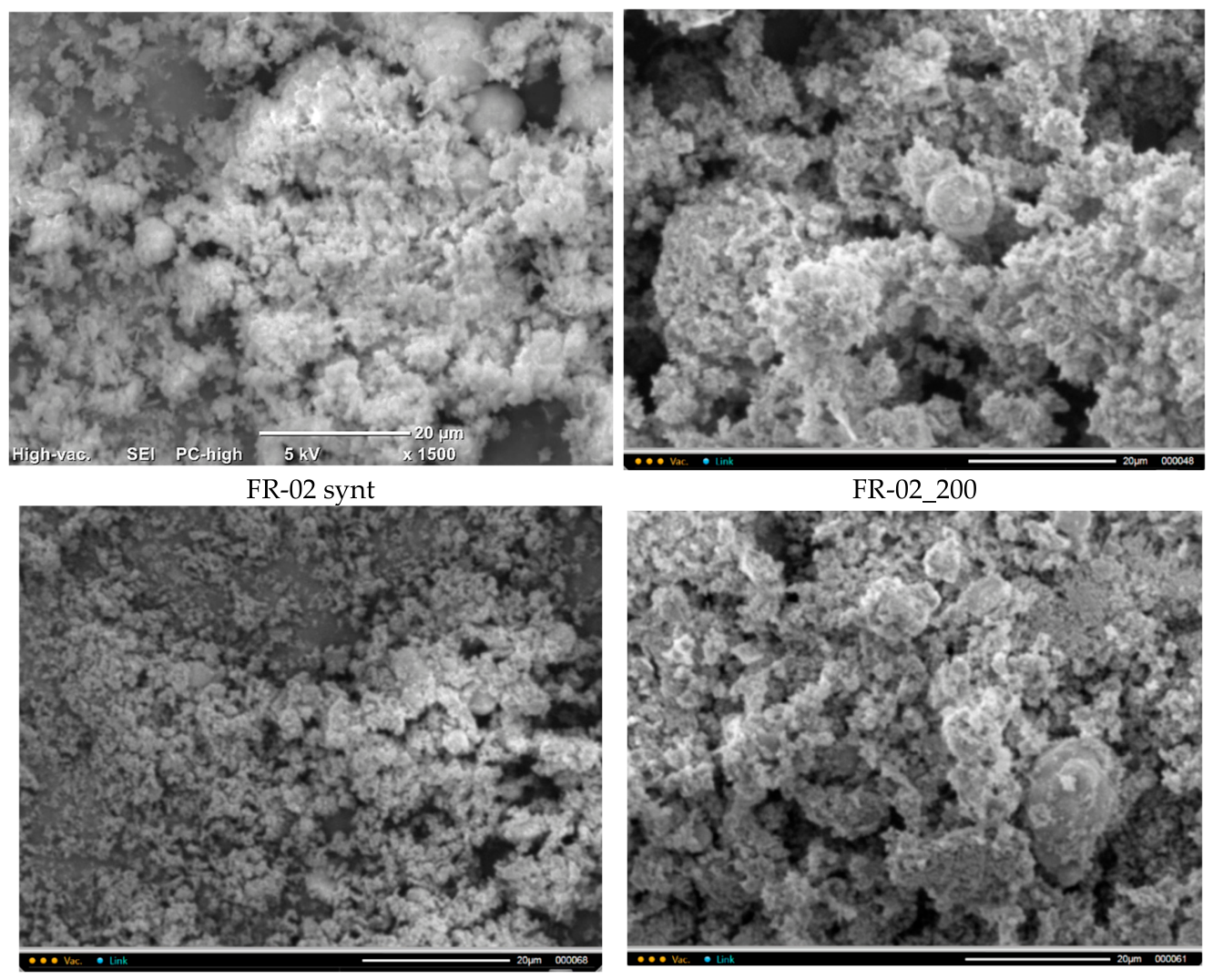
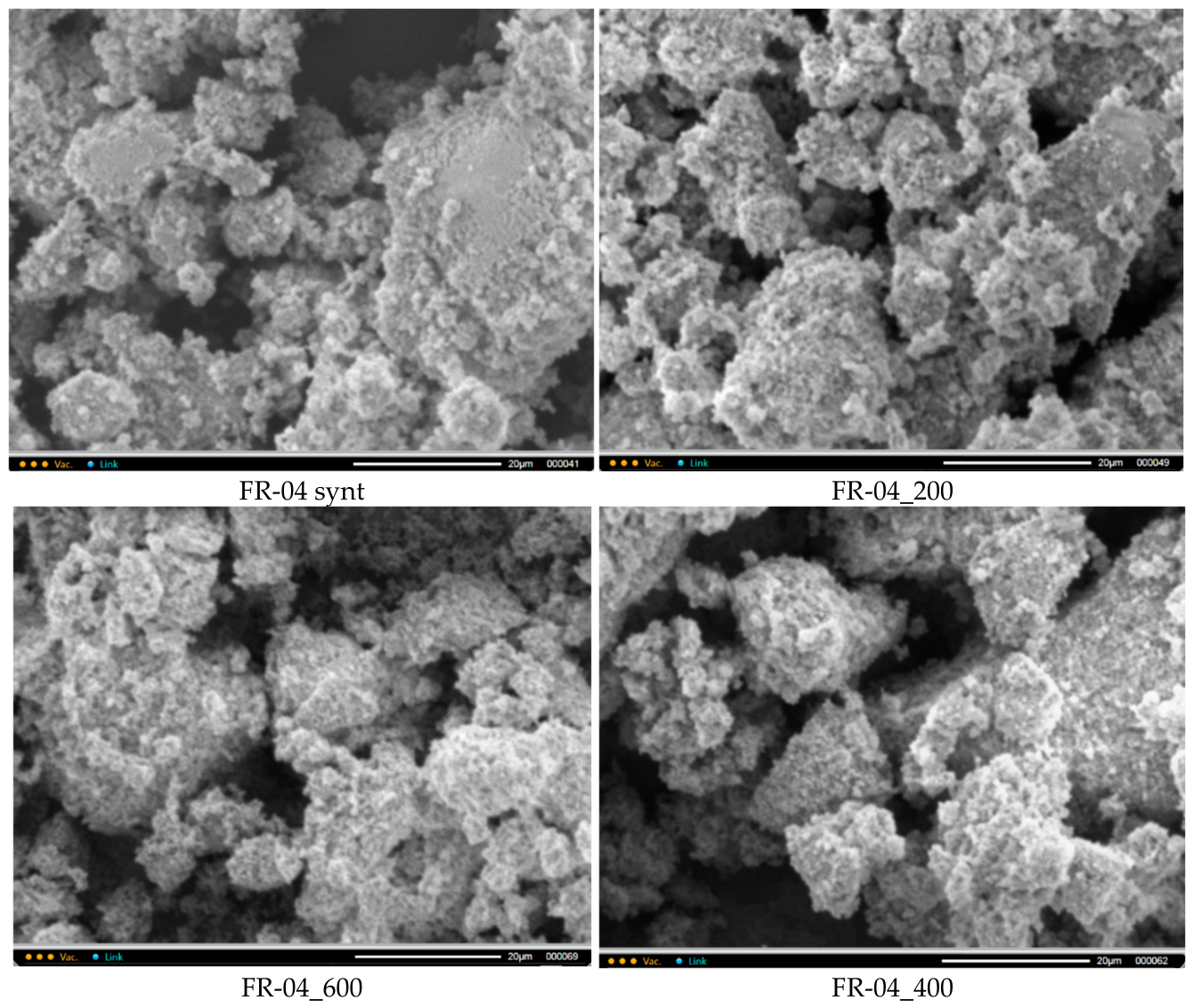
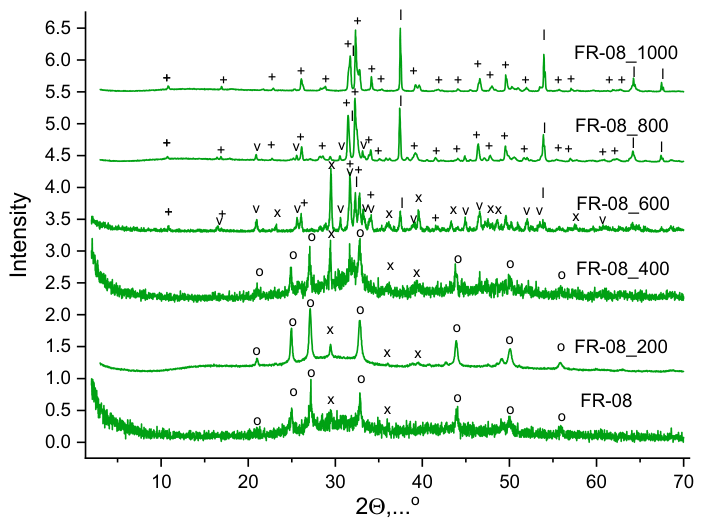
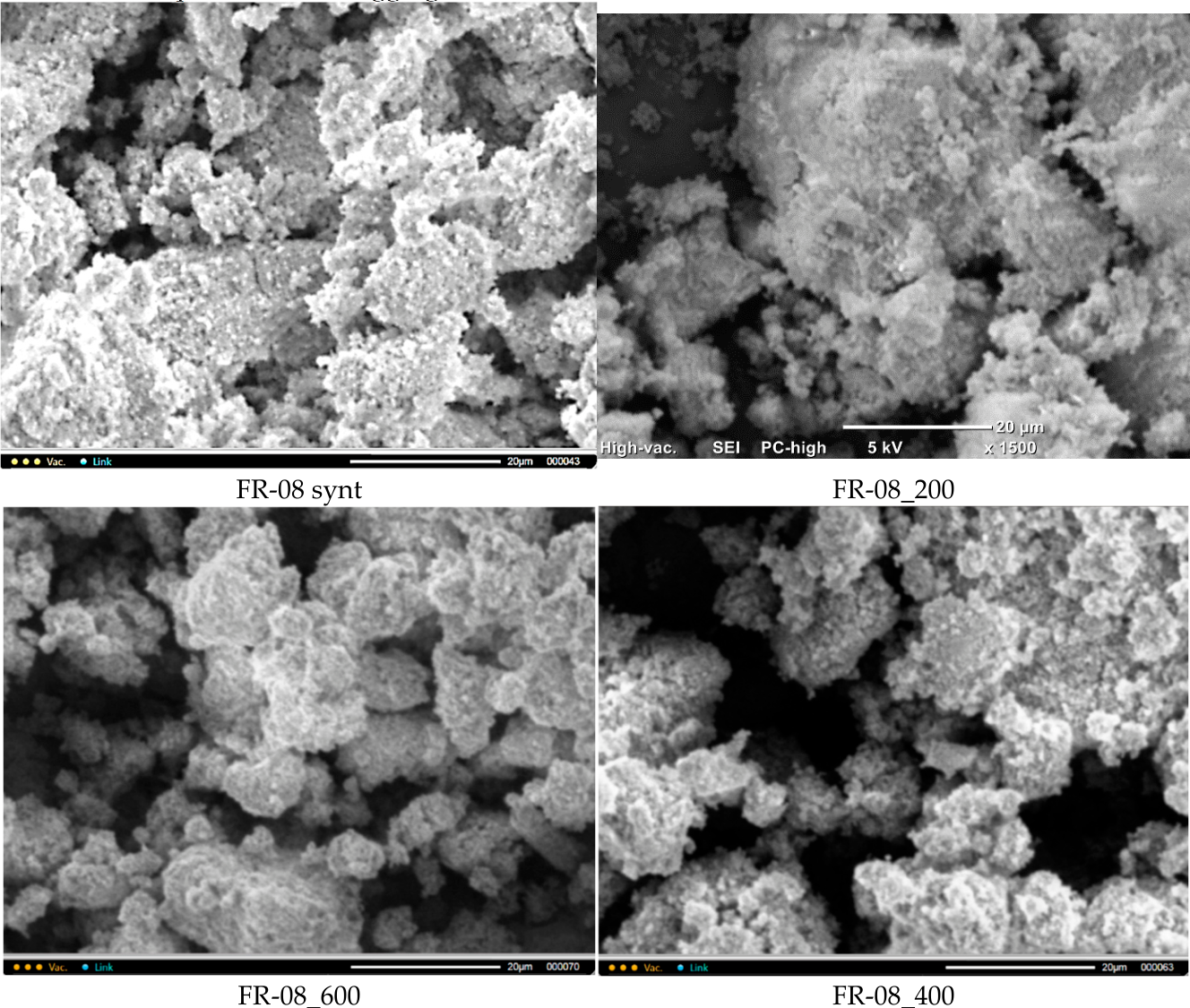
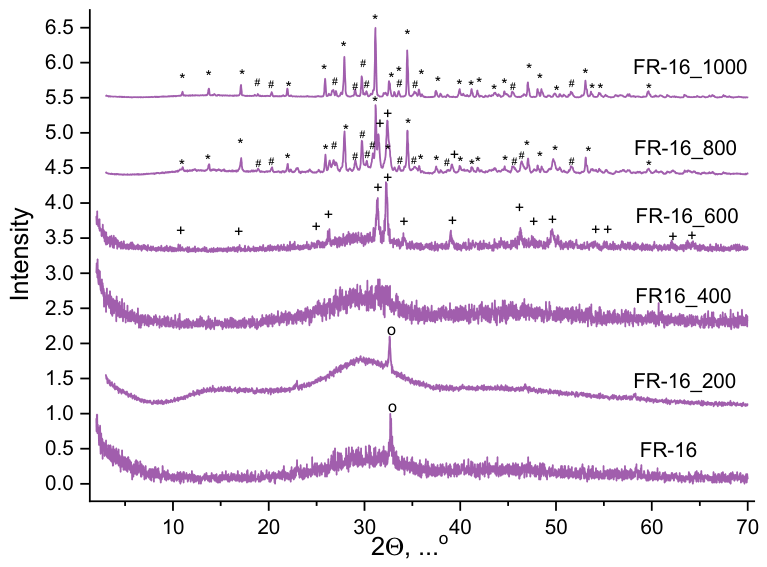
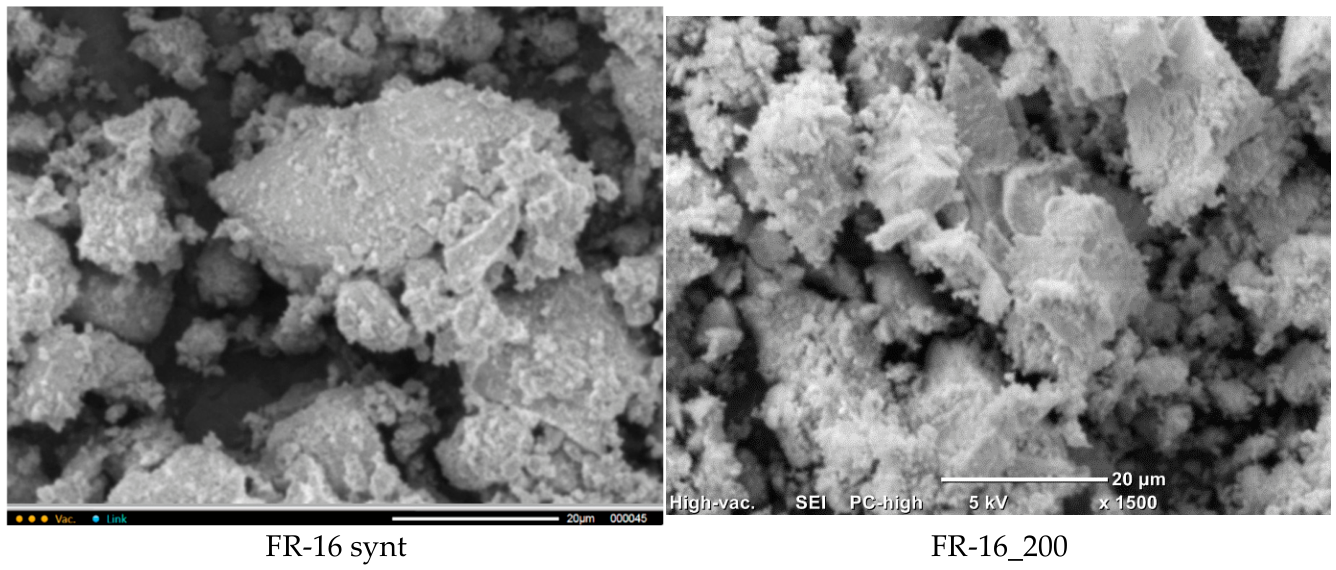
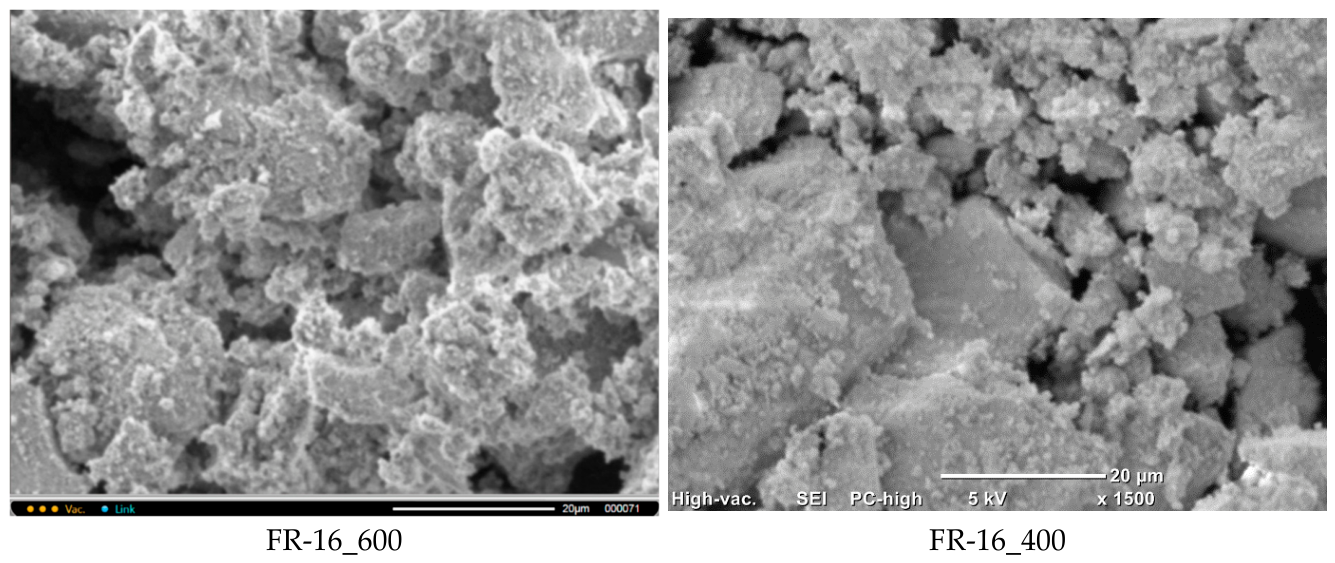
To clarify the nature of synthesized powders the heat treatment was carried out at the interval 200-600 oC for powders FR-00, FR-02, FR-04 (Figure 9, Figure 10, Figure 11, Figure 12, Figure 13 and Figure 14) and in the interval 200-1000 oC for powders FR-08 and FR-16 (Figure 15, Figure 16, Figure 17 and Figure 18).
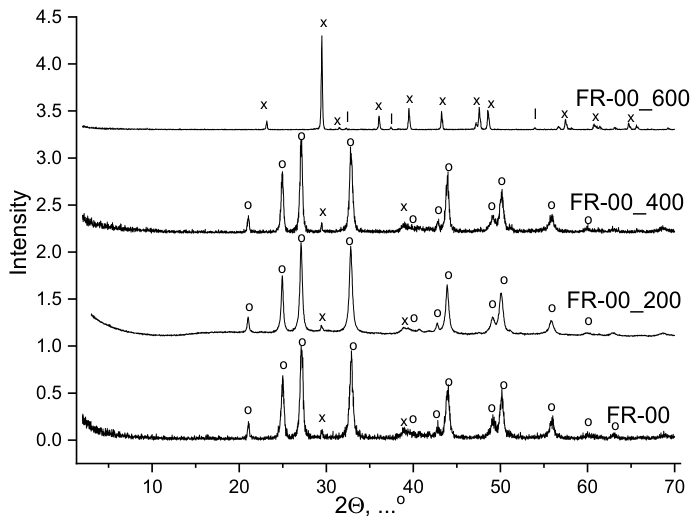
After heat treatment at 200 and 400 oC phase composition of powder FR-00 demonstrate no changes in comparison with powder after synthesis (Figure 9).
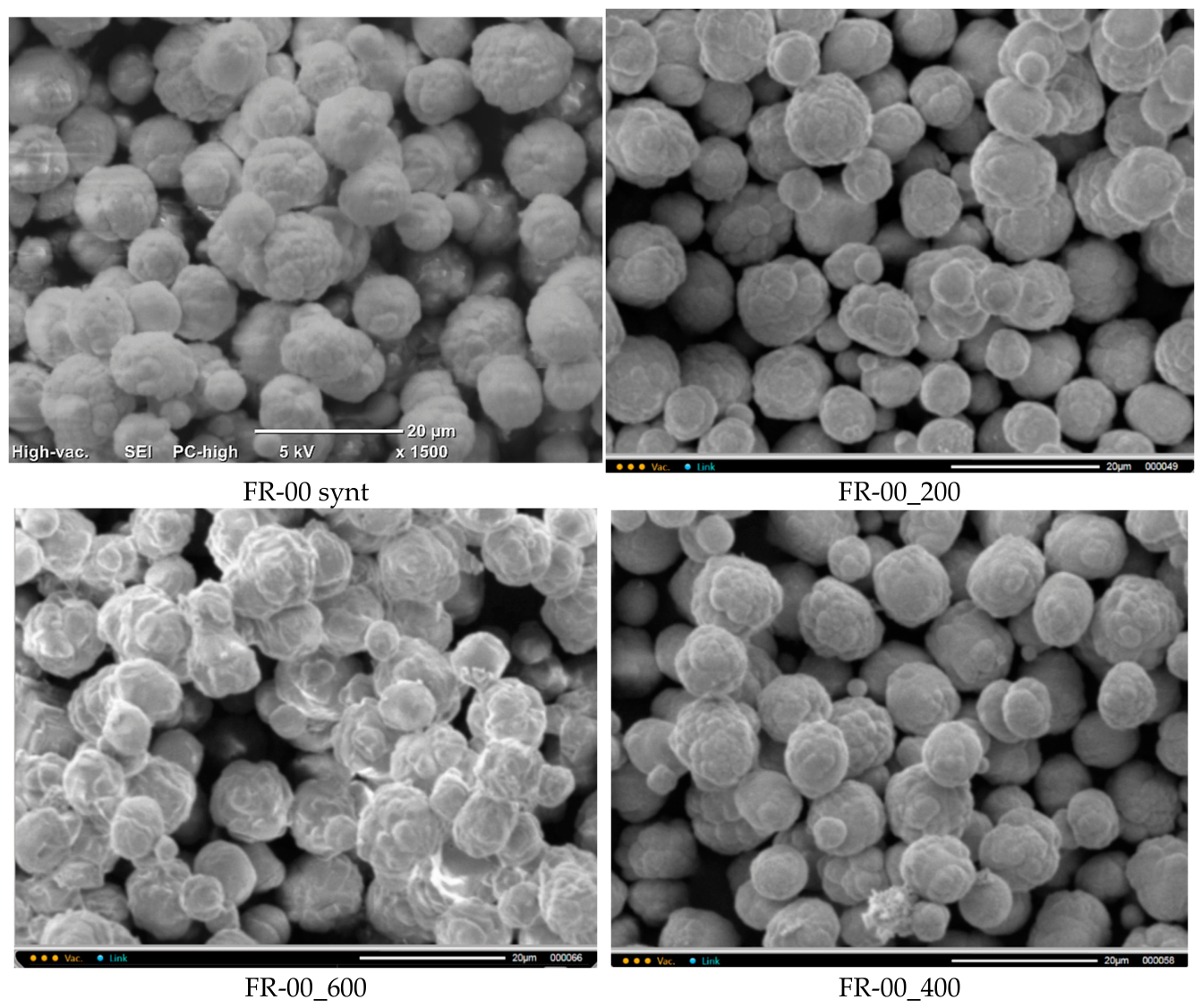
After heat treatment at 600 oC metastable vaterite changed to calcite and some reflexes of lime also appeared. Microstructure of powder FR-00 only after heat treatment at 600 oC demonstrate slight tendency to particle morphology changing.
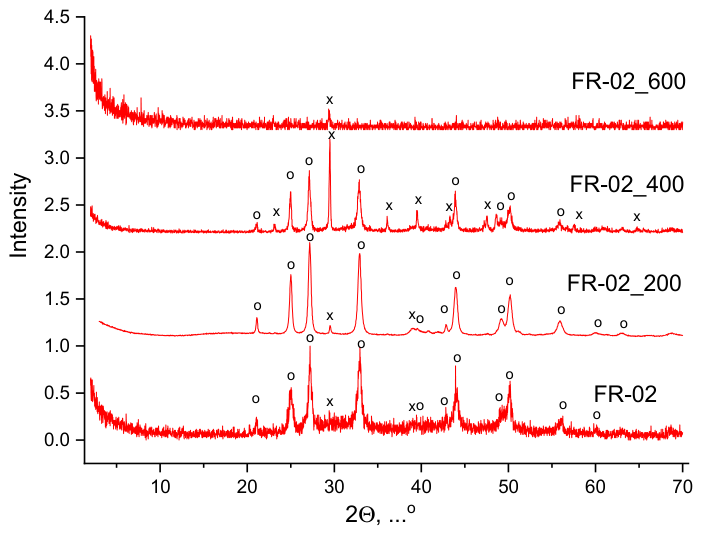
Phase composition of powder FR-02 after heat treatment at 200 slightly differs from phase composition of powder after synthesis with no presence of amorphous phase (Figure 11). After heat treatment at 400 oC presence of both modifications of calcium carbonate (calcite and vaterite) was obvious. After heat treatment at 600 oC powder consisted of quasi-amorphous phase and the only reflex belonging calcite could be seen. Microstructure of powder FR-02 after heat treatment at 600 oC (Figure 12) was more uniform then after synthesis and heat treatment at lower temperatures and consisted of particles with size less than 1 mm and slight tendency to particle morphology changing.
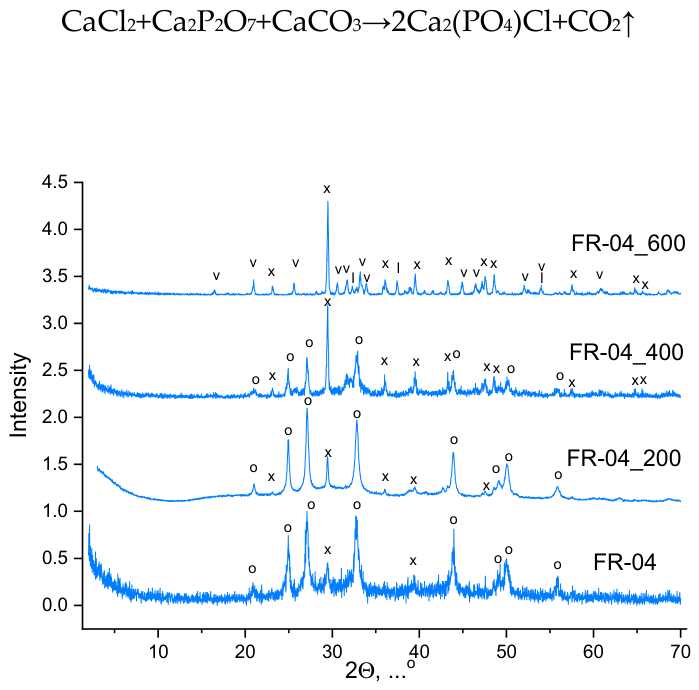
Phase composition of powder FR-04 after heat treatment at 200 and 400 oC consisted of both calcite and vaterite (Figure 13). Phase composition of powder FR-04 after heat treatment at 600 oC additionally included chlorspodiosite (Ca2(PO4)Cl) and lime (CaO). Formation of chlorspodiosite (Ca2(PO4)Cl) can be due to interaction of products of thermal conversion of components presenting in the powder FR-04, i.e. calcium chloride (CaCl2), calcium pyrophosphate (Ca2P2O7) and calcium carbonate (CaCO3) (Equation 19). Possibility of chlorspodiosite (Ca2(PO4)Cl) formation from amorphous calcium phosphate and calcium chloride during heating was reported earlier [71]. Presence of chlorspodiosite (Ca2(PO4)Cl) in the powder FR_600 indirectly confirms presence of calcium chloride in powder FR-04, loss of (NH4)2CO3 as a precursor of CaCO3 and the role of (NH4)2CO3 as pH-regulator in reaction zone at the stage of mix-anionic solution preparation due to interaction of ions presented in solutions. Additionally, formation of chlorspodiosite (Ca2(PO4)Cl) (Equation 19) can be treated as an additional reason of the CO2 release during heating when interpreting the TGA/MS (m/z=44) data along with the previously mentioned reactions (Equations 15 and 16).
CaCl2+Ca2P2O7+CaCO3→2Ca2(РO4)Cl+CO2↑
Micrographs of FR-04 powders after heat treatment at 200, 400 and 600 oC demonstrate less difference from powder after synthesis (Figure 14). If formation of submicron particles after synthesis was due to nonequilibrium conditions used for powder synthesis submicron dimensions of particles after heat treatment was due to mutual reactions (dehydration, decomposition, new mineral formation) taking place preventing particles growth.
Phase composition of powder FR-08 after heat treatment at 200 and 400 oC included both calcite and vaterite (Figure 15).
Additionally, a noticeable amount of quasi amorphous phase can be seen in phase composition of powder FR-08 after heat treatment at 400 oC. After heat treatment at 600 oC. there are reflexes of calcite, lime, chlorspodiosite (Ca2(PO4)Cl) and chlorapatite (Ca10(PO4)6Cl2) in the diffractogram. After heat treatment at 800 oC there are reflexes of lime (CaO), chlorspodiosite (Ca2(PO4)Cl) and chlorapatite (Ca10(PO4)6Cl2) in the diffractogram. And after heat treatment at 1000 oC phase composition of the powder included only lime (CaO) and chlorapatite (Ca10(PO4)6Cl2). Formation of chlorapatite (Ca10(PO4)6Cl2) (Equations 20) can be due to interaction of products of thermal conversion of components of synthesized powder i.e. CaO (from CaCO3 and from CaCl2 via Ca2OCl2) and Ca2P2O7 (from Ca2P2O7⋅xH2O) and chlorspodiosite (Ca2(PO4)Cl) which formed at lower temperatures.
2Ca2(РO4)Cl+2Ca2P2O7 + 2CaO → Ca10(PO4)6Cl2
Micrographs of FR-08 powders after heat treatment at 200, 400 and 600 oC also as a powders FR-04 after heat treatment demonstrate less difference from powder after synthesis (Figure 16). The dimensions of particles in the aggregates are less than 1 mm.
Diffractogram of powder FR-16 after heat treatment at 200 oC slightly differs from diffractogram of powder after synthesis (Figure 17). Reflex of vaterite and quasi amorphous phase can be seen. After heat treatment at 400 oC phase composition of powder FR-16 (FR-16_400) includes quasi amorphous phase. Phase composition of powder FR-16 after heat treatment at 600 oC included chlorapatite (Ca10(PO4)6Cl2) and quasi amorphous phase. Phase composition of powder FR-16 after heat treatment at 800 oC included chlorapatite (Ca10(PO4)6Cl2), b-tricalcium phosphate (b-Ca3(PO4)2) and b-calcium pyrophosphate (b-Ca2P2O7). Phase composition of powder FR-16 after heat treatment at 1000 oC included b-tricalcium phosphate (b-Ca3(PO4)2) and b-calcium pyrophosphate (b-Ca2P2O7).
Formation of chlorapatite (Ca10(PO4)6Cl2) confirms presence of CaCl2 in the synthesized powder FR-16. Heat treatment of this powder at 800 oC and 1000 oC which are higher than melting point of CaCl2 leaded to the higher content of calcium phosphates not containing Cl. Presence of b-calcium pyrophosphate (b-Ca2P2O7) indirectly confirmed hypothesis about amorphous hydrated calcium pyrophosphate as dominating phase in the synthesized FR-16 powder. Formation of b-tricalcium phosphate (b-Ca3(PO4)2) as it is known [72] can be a result of interaction of calcium pyrophosphate and calcium oxide (Equation 21).
Ca2P2O7 + 2CaO → Ca3(PO4)2
Micrographs of FR-16 powders after heat treatment at 200, 400 and 600 oC are shown at Figure 18.
Investigation of thermal evolution of phase composition confirmed the presence of calcium chloride CaCl2 (captured from mother liquor) in synthesized powders FR-04, FR-08, and FR-16. Relatively high content of CaCl2 and NH4Cl (captured from mother liquor) in FR-04, FR-08 and FR-16 powders caused formation of chlorspodiosite (Ca2(PO4)Cl) or even chlorapatite (Ca10(PO4)6Cl2) during thermal treatment. The lowest content of CaCl2 (captured from mother liquor) in the FR-02 powder was confirmed by no formation of Cl-containing phases during heating. And this was calcium chloride CaCl2 retained in mother liquors and then in powders. This calcium chloride CaCl2 was introduced for calcium carbonate synthesis but there was no enough ammonium carbonate to interact with. Ammonium chloride (NH4Cl) as a reaction by-product presented in all powders and also could provide additional formation of CaCl2 during heating.
Dried synthesized powders were then used to prepare molding compositions. Molding compositions densities were more-or-less the same, varying between 1.00-1.11 g/cm3 (Table 5).
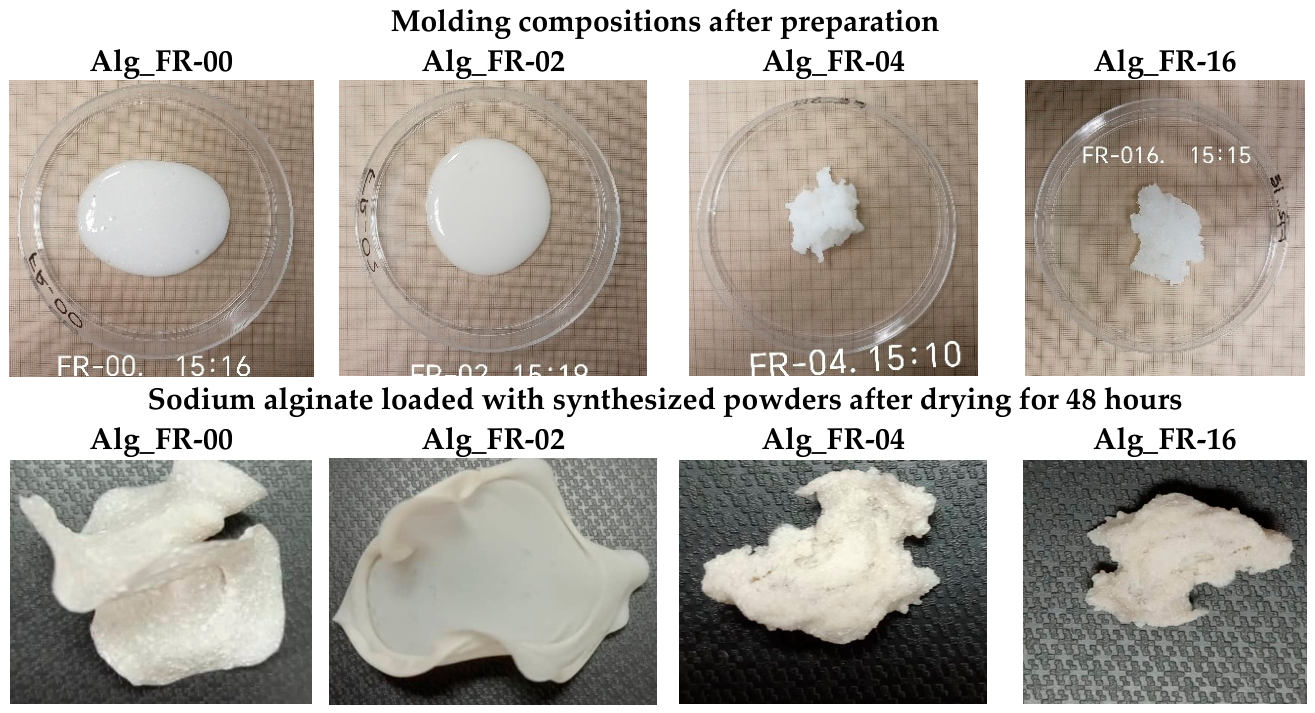
As an indirect comparative assessment of the rheological properties of the studied suspensions, the spreading area analysis method was applied (Figure 19). Ionic crosslinking of sodium alginate possibly taking place already at the stage of suspension preparation (Figure 19, upper raw). Suspensions Alg_FR-00 and Alg_FR-02 demonstrated ability to spread under the influence of gravity over the surface of Petri glass. The dimensions of spreading area of suspensions Alg_FR-00 and Alg_FR-02 under the influence of gravity on a horizontal surface were about the same (~30 cm2) but they were lower than thick lens-like flat puddles measured earlier (48-65 cm2) using the same preparation protocol for suspensions loaded with powders of CaCO3 with a predominance of calcite in the phase composition [38]. Molding compositions Alg_FR-04, Alg_FR-08, and Alg_FR-16 lose their ability to flow and form hydrogels. It’s possible to see consequence of cross-linking process both for molding compositions Alg_FR-04, Alg_FR-16 (Figure 19, upper row) and Alg_FR-08 (not shown) which all were similar.
It is worth noting that properties of molding compositions depend on chemical composition of powders used as fillers. All powders under investigation contain ammonium chloride (NH4Cl) as a reaction by-product. At the stage of molding compositions preparation this salt (ammonium chloride (NH4Cl)) dissolves, interacts with calcium carbonate and provoke CaCO3 dissolution via soluble calcium chloride CaCl2 formation (Equations 22 and 23) [38,39] which is a well-known and frequently used cross-linking agent as a highly soluble multivalent cation salt. We can take this process as providing source one (source I) of calcium chloride (CaCl2) in the molding composition.
NH4Cl → NH4+ + Cl−
2NH4+ + 2Cl− + CaCO3 → CaCl2 + (NH4)2CO3
Some powders (FR-02, FR-04, FR-08, and FR-16) under investigation contains additional CaCl2 captured from mother liquor. Synthesis conditions of mentioned above powders, mainly molar ratios of salts ((NH4)2Н2P2O7)/((NH4)2CO3+(NH4)2Н2P2O7)), used for preparation of mixed-anionic solutions can be viewed as cause for calcium chloride (CaCl2) presence in mother liquor and consequently in the synthesized powder. Thus, the higher the content of (P2O74-) ions in the reaction zone the higher concentration of CaCl2 in mother liquor after sediment formed and content of CaCl2 in the synthesized powders as shown above in the discussion of their properties. We can take this phenomenon as second source (source II) of calcium chloride (CaCl2) in the molding composition. But formation of low content of amorphous hydrated calcium pyrophosphate in the powder FR-02, provide low presence of CaCl2 (source II) due to diminished quantity of (NH4)2CO3 used for pH regulation in the reaction zone.
So, cross-linking process in the molding compositions Alg_FR-04, Alg_FR-08, and Alg_FR-16 could be caused by presence of calcium chloride from both source I and source II. Cross-linking in the molding compositions Alg_FR-00, Alg_FR-02 could be caused by presence calcium chloride preferably from source I.
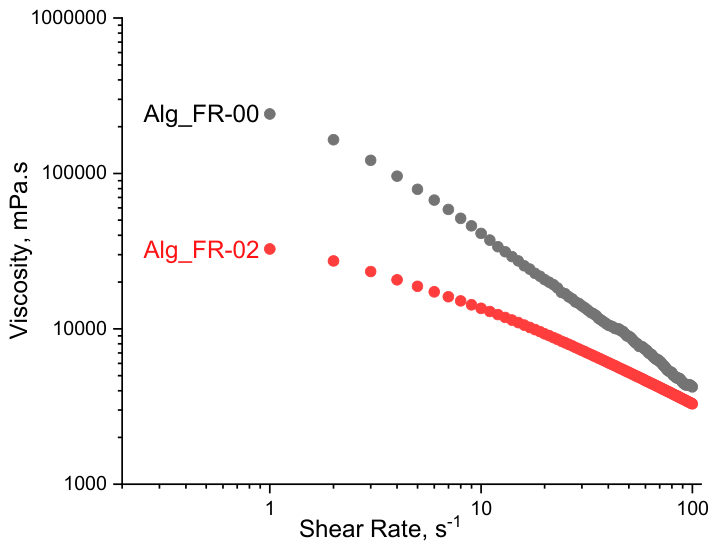
Rheological properties (dependence of viscosity from shear rate) were investigated for suspensions (molding compositions) Alg_FR-00 and Alg_FR-02 which demonstrated ability to flow. The curves shown in Figure 20 are typical of a structured pseudoplastic fluid. As the shear rate increases, the fluctuation network collapses, leading to a decrease in viscosity.
The lower initial viscosity of the Alg_FR-02 molding composition is due to differences in the morphology and size of the powder particles and the interfacial surface area (Figure 20). Alg_FR-02 molding composition shows the lowest viscosity values in the entire studied range of shear rates and Alg_FR-00 molding composition shows the biggest viscosity values (Figure 20). Suspensions (molding compositions) Alg_FR-00 and Alg_FR-02 loaded with powders with the same phase composition presented by vaterite CaCO3. They both contain adsorbed and occluded reaction by-product - ammonium chloride (NH4Cl) provoking formation of cross-linking agent calcium chloride (CaCl2). The difference in these powders’ properties can be found in the Figure 4 showing micrographs of synthesized powders and Figure 6, presenting specific surface areas. Powder FR-00 consisted of fairly large (3-14 mm) spherical particles with a well-defined surface and has the lowest specific surface areas (7 m2/g). Powder FR-02 consisted formation of smaller (100-200 nm) particles and has the bigger specific surface area (18 m2/g). The powder FR-00 with bigger specific surface area can absorb bigger quantity of by-product ammonium chloride (NH4Cl) presented in mother liquor. And the bigger quantity of ammonium chloride (NH4Cl) could provide formation of bigger quantity of calcium chloride (CaCl2) (source I) then in the molding composition. The impact of calcium chloride (CaCl2) from source II to the cross-linking process in the molding composition Alg_FR-02 is negligible due to lowest content in comparison with molding compositions Alg_FR-04, Alg_FR-08, and Alg_FR-16 based on powders synthesized from mixed-anionic solutions.
Sodium alginate macromolecules cross-linked with the water-soluble salt calcium chloride CaCl2 form a new phase, and their concentration in the dispersion medium decreases, leading to a decrease in viscosity. Since the Alg_FR-02 molding composition contains more calcium chloride as a cross-linking agent, the proportion of cross-linked alginate increases, resulting in a lower viscosity than molding composition Alg_FR-00 demonstrates.
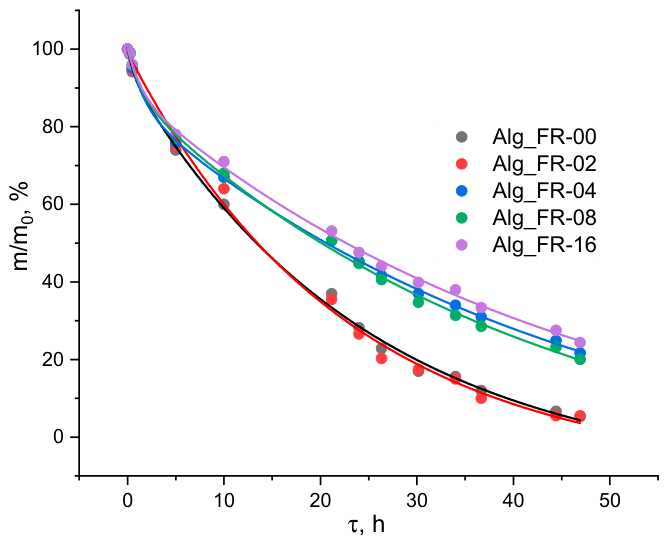
The dependences of molding compositions (Alg_FR-00, Alg_FR-02, Alg_FR-04, Alg_FR-08, and Alg_FR-16) mass from the drying process duration at room temperature are shown in Figure 21. As a result of the drying suspensions puddles (Alg_FR-00, Alg_FR-02) and globes (Alg_FR-04, Alg_FR-16) (Figure 19, upper raw) converted into deformed pieces of composites with alginate matrix and synthesized powders used as a filler (Figure 19, lower row). Retained masses after drying during 48 h for Alg_FR-00, Alg_FR-02 (~6%) were closer to content of sum of sodium alginate (2.5%) and powder-filler (2.5%) used for molding compositions preparation than those for Alg_FR-04, Alg_FR-08, and Alg_FR-16 (20-24%). It is possible to admit that the last sample have higher ability to keep water or water solutions. This ability of these samples to save humidity first of all can be due to presence of crosslinked alginate and then due to the bigger specific areas 46, 53, 58 m2/g for the powders FR-04, FR-08, and FR-16 respectively (Figure 6, b).
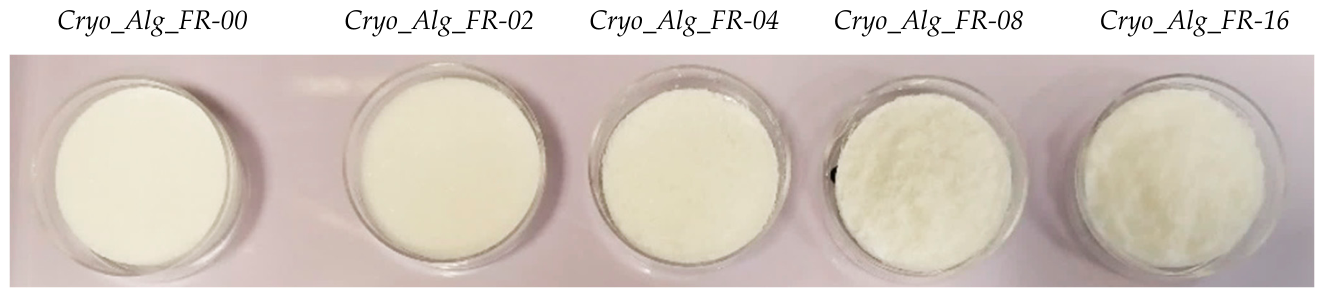
Camera photos of freeze-dried hydrogels porous composite materials are presented in Figure 22. The surfaces of samples Cryo_Alg_FR-08 and Cryo_Alg_FR-16 are not smooth enough probably due to the consistence of partially cross-linked molding compositions used for molding. Linear shrinkages (diameter) of samples were in the interval 5.1-7.3% after freeze drying relatively to the diameter of plastic Petri dish used for molding, and densities were in the interval 0.05-0.06 g/cm3 (Table 6). After freeze drying for all samples retain mass was in interval 4.3-5.0%. Samples Cryo_Alg_FR-02 and Cryo_Alg_FR-04 had lower mass loss and retain mass was close to the sum of mass content of alginate and powder used for molding compositions preparation.
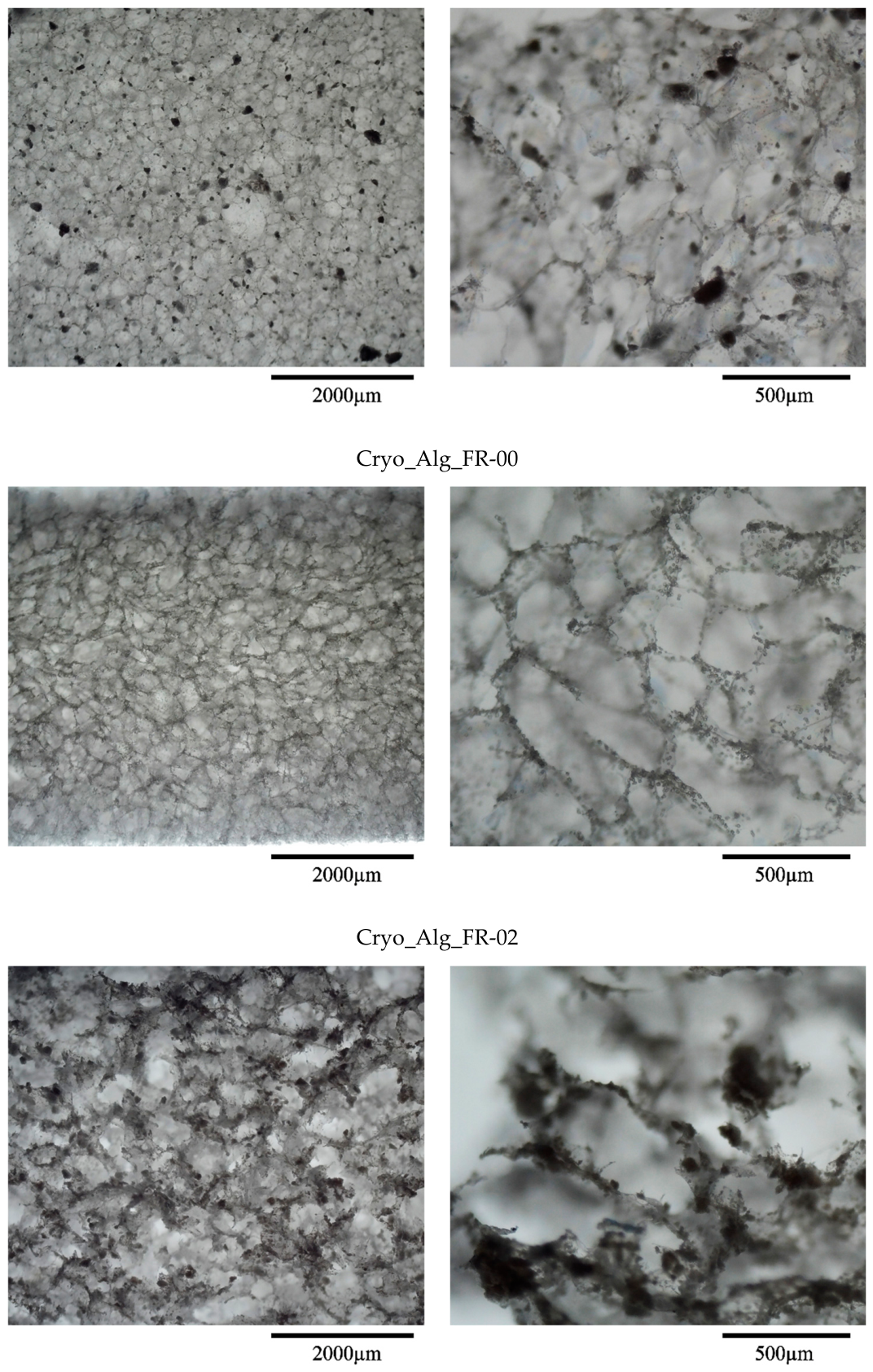
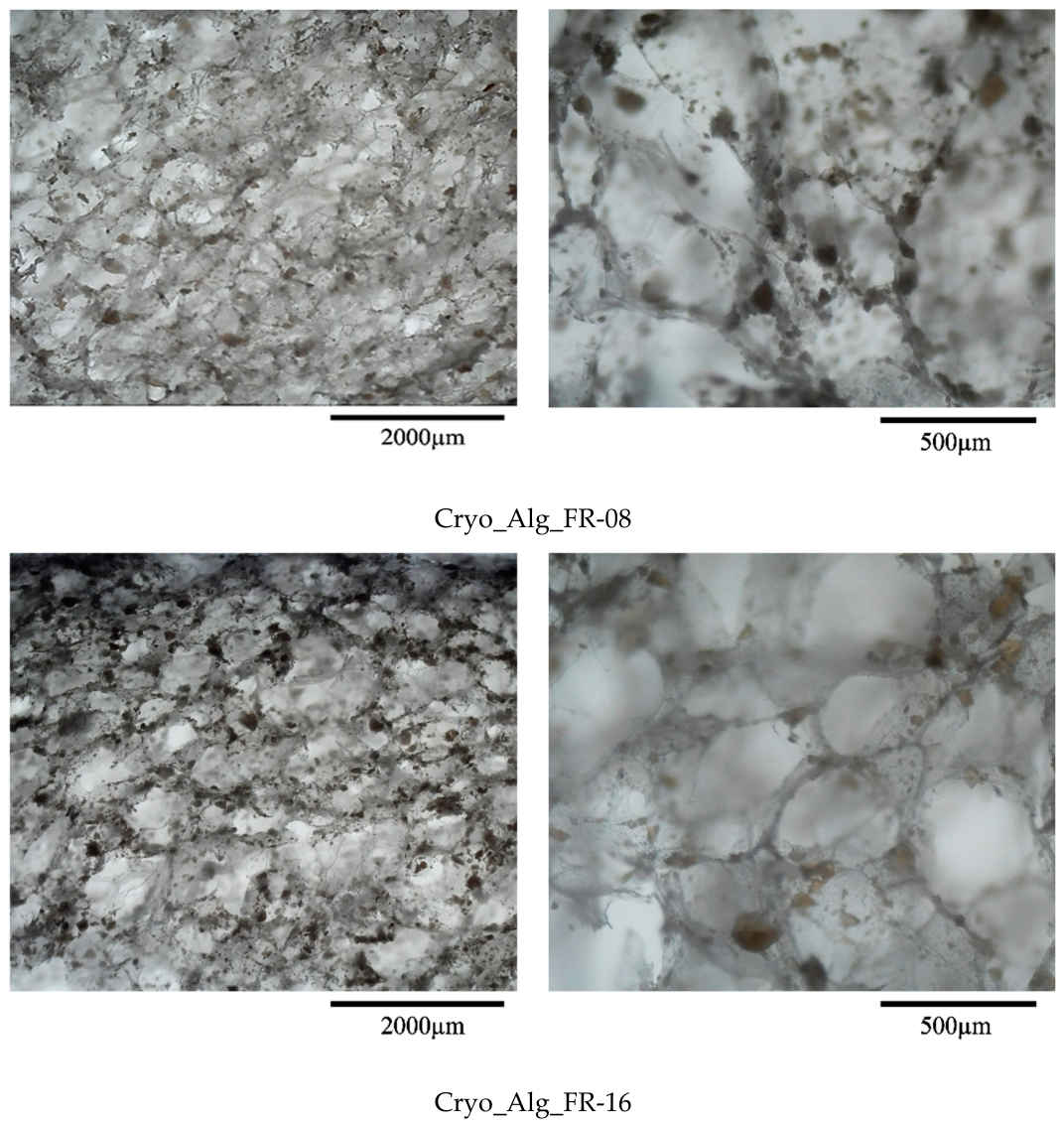
The microstructure of samples of porous freeze-dried composite materials was examined by optical microscopy (Figure 23). The obtained images clearly show a developed porous structure formed during the sublimation of ice crystals. The cryo drying method allowed the successful formation of three-dimensional matrices with a developed interconnected pore system over the entire range of filler concentrations.
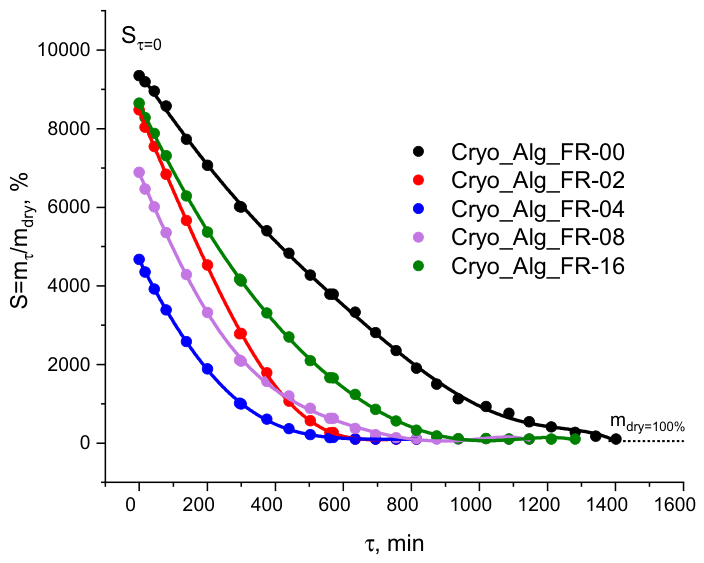
Slices of freeze-dried composites demonstrated their high degree of swelling after dipping in the distilled water for 12 h. Samples Cryo_Alg_FR-00, Cryo_Alg_FR-02 and Cryo_Alg_FR-16 demonstrated higher swelling capacity - 9300-8500%. Samples Cryo_Alg_FR-04 and Cryo_Alg_FR-08 demonstrated lower swelling capacity 4700 and 6900% respectively. Degree of swelling of samples under investigation correlates with their mass loss during dipping in the distilled water. Lower swelling capacity and lower mass loss can be caused by cross-linked reaction during freeze-dried porous composites preparation both in the stage of preparation of molding compositions and in the stage of freeze-drying. In the sample Cryo_Alg_FR-00 cross-linking agent (CaCl2) can be created only as a result of interaction of CaCO3 and NH4Cl in the stages of suspension preparation and in the stage of freeze-drying. In the sample Cryo_Alg_FR-16 cross-linking agent (CaCl2) was introduced preferably as a component of synthesized powder. In the samples Cryo_Alg_FR-02, Cryo_Alg_FR-04, Cryo_Alg_FR-08 cross-linking agent (CaCl2) probably can have two ways of origin. And for sample Cryo_Alg_FR-04 action or quantity of cross-linking agent (CaCl2) showed the highest result.
Figure 24 shows the degree of swelling and the change in the mass of swollen gels during the drying process (the parameter characterizes the water-holding capacity of porous composite materials (Cryo_Alg_FR-00, Cryo_Alg_FR-02, Cryo_Alg_FR-04, Cryo_Alg_FR-08, and Cryo_Alg_FR-16) with alginate matrix and synthesized powders as fillers after dipping in the water. As seen in Figure 24 and Table 7, drying rate inversely correlates with swelling degree and mass-loss, with Cryo_Alg_FR-04 being prime example – absorbing least water amounts, drying quicker than other samples and retaining most dry mass. These 3 factors can be pieced together as alginate cross-linking degree dependence. With denser crosslinking, alginate macromolecule nets have lesser flexibility in terms of pore forming to incorporate water – reducing hydrogel water absorption capacity and at the same time reducing solubility.
The results of experiments on the degree of moisture absorption revealed an ambiguous effect of the composition powder used as a filler i.e. content of calcium hydrated pyrophosphate, calcium carbonate and salts adsorbed or occluded from mother liquor on the rheological and gel-forming properties of the molding compositions and properties of freeze-dried porous composites. The maximum degree of swelling (9300%) and mass-loss (59.9%) were recorded for sample Cryo_Alg_FR-00 with filler powder clearly lacking enough adsorbed soluble reaction byproducts to facilitate thorough polymer cross-linking via CaCO3 dissolution. At the same time. minimum values (4700% and 26.4% respectively) were observed in sample Cryo_Alg_FR-04 which indicated significant gelation process improvement for a powder containing both calcium hydrated pyrophosphate, calcium carbonate and adsorbed salts such as CaCl2 and NH4Cl.
The results obtained demonstrate that varying the anionic composition of precursor powders is an effective tool for controlling the technological characteristics of composite materials. in particular the gel time and plasticity of suspensions. which is important for their subsequent formation and clinical use.

5. Conclusions

Porous composite materials were prepared from homogeneous molding composition which consisted of water solution of sodium alginate and fine inorganic powders used as filler. Aqueous solution of calcium chloride (CaCl2) and aqueous mixed-anionic solution prepared by mixing solutions of (NH4)2CO3 and (NH4)2H2P2O7 taken in different proportions were used for syntheses of fine inorganic powders. Molar ratios (NH4)2Н2P2O7)/((NH4)2CO3+(NH4)2Н2P2O7) were established as 0 (reference powder), 0.02, 0.04, 0.08 and 0.16. Quantity of aqueous solution of calcium chloride was taken to provide molar ratio CaCl2/((NH4)2CO3+(NH4)2Н2P2O7) equal 1.00 (reference powder), 1.02, 1.04, 1.08 and 1.16. Phase composition of inorganic powders included calcium carbonate (mostly vaterite) and quasi-amorphous phase of hydrated calcium pyrophosphate. All synthesized powders contained adsorbed and occluded salts presented in the mother liquor after reaction completed before separation of precipitate. The higher was the molar ratio (NH4)2Н2P2O7/((NH4)2CO3+(NH4)2Н2P2O7) of salts used for preparation of mixed-anionic solutions the lower was the content of calcium carbonate (preferably vaterite), the higher was the content of amorphous phase according XRD and MS data. At the stage of mixed-anionic solutions preparation interaction of ammonium carbonate ((NH4)2CO3) and di-hydro-ammonium pyrophosphate ((NH4)2Н2P2O7) formation of H2CO3 was possible. pH level of mixed-anionic solutions prepared from (NH4)2CO3 and (NH4)2Н2P2O7) confirmed transformation of planed simultaneous presence of CO32- and Н2P2O72- anions to the mixture CO32- and P2O74- anions. This fact confirmed the property of aqueous solution of ammonium carbonate ((NH4)2CO3) as buffer or pH regulator. For this reason, it turned out that calcium chloride (CaCl2) in reaction zone in cases of synthesis from mixed-anionic solutions was in excess without the possibility of forming calcium carbonate (CaCO3). The presence of calcium chloride (CaCl2) was confirmed via investigation of thermal evolution of phase composition of powders synthesized at molar ratios (NH4)2Н2P2O7)/((NH4)2CO3+(NH4)2Н2P2O7) established as 0.04, 0.08 and 0.16. Phase composition of these powders after heat treatment at 600-800 oC included chlorspodiosite Ca2(PO4)Cl and/or chlorapatite Ca10(PO4)6Cl2. Properties of molding compositions containing the water solution of sodium alginate with the same concentration and the same mass ratio of “inorganic powder/sodium alginate” showed dependence from properties of synthesized powders i.e. powder microstructure, specific surface area, phase composition, presence and composition of soluble salts captured from mother liquor. These soluble salts in the composition of synthesized inorganic powders at the stages of (1) molding compositions preparation, (2) freezing and (3) lyophilization provided forming and presence of calcium chloride (CaCl2) as a cross-linking agent influencing both rheological properties of molding compositions and properties of freeze-dried porous composites including swelling degree and solubility. It was revealed that introduction of cross-linking agent (calcium chloride (CaCl2)) for sodium alginate as a component of powder, used as a filler, can be occurred via two ways: (1) interaction of ammonium chloride (NH4Cl) (reaction by-product) with calcium carbonate (CaCO3) (source I) and (2) via direct inclusion of calcium chloride (CaCl2) taken in excess in composition of synthesized powder (source II). All freeze-dried porous composite materials demonstrated high water absorption capacity 4700-9300%. The most pronounced cross-linked effect was observed for alginate matrixes loaded with powders synthesized at molar ratio CaCl2/((NH4)2CO3+(NH4)2Н2P2O7) equal 1.04 and 1.08 demonstrating lowest water absorption and dry mass-loss after dipping in distilled water for 12 hours. Prepared freeze-dried porous composite materials with alginate matrix and calcium carbonate and/or hydrated calcium pyrophosphate powders as a filler can be recommend for subsequent testing as extracellular matrix for soft/hard tissue repair, as wound dressings or bone defects filler.

Author Contributions

Conceptualization, M.M.A., T.V.S., N.R.K.; methodology, M.M.A., T.V.S., O.T.G., N.R.K.; investigation, M.M.A., T.V.S., O.T.G., F.F.N., T.B.S., V.B.P., A.M.M., N.M.N., D.M.T., O.V.B., T.V.F., E.A.K., G.M.T., Y.Y.F., N.A.S., N.R.K.; resources, O.T.G., T.B.S., V.B.P., D.M.T., O.V.B.; E.A.K., G.M.T.; writing—original draft preparation, M.M.A., T.V.S., F.F.N.; writing—review and editing, M.M.A., T.V.S., N.A.S., N.R.K.; visualization, M.M.A., F.F.N., T.V.S., O.T.G., T.B.S., V.B.P., A.M.M., N.M.N., O.V.B., E.A.K.; supervision, T.V.S., N.R.K.; project administration, T.V.S., N.R.K.; funding acquisition, T.V.S., T.B.S., V.B.P., D.M.T. All authors have read and agreed to the published version of the manuscript.

Funding

This work was carried out with the support of the State assignment of the Lomonosov Moscow State University: AAAA-A21-121011590082-2.

Data Availability Statement

All research data presented in the article.

Acknowledgments

This research was carried out using the equipment of the MSU Shared Research Equipment Center “Technologies for obtaining new nanostructured materials and their complex study” and was purchased by MSU within the framework of the Equipment Renovation Program (National Project “Science”) and within the framework of the MSU Program of Development.

Conflicts of Interest

The authors declare no conflicts of interest.

References

  1. Fani, N.; Moradi, M.; Zavari, R.; Parvizpour, F.; Soltani, A.; Arabpour, Z.; Jafarian, A. Current advances in wound healing and regenerative medicine. Stem Cell Res. Ther. 2024, 19(3), 277–291. [Google Scholar] [CrossRef] [PubMed]
  2. Xue, N.; Ding, X.; Huang, R.; Jiang, R.; Huang, H.; Pan, X.; Min, W.; Chen, J.; Duan, J.-A.; Liu, P.; et al. Bone Tissue Engineering in the Treatment of Bone Defects. Pharmaceuticals 2022, 15, 879. [Google Scholar] [CrossRef] [PubMed]
  3. Prete, S.; Dattilo, M.; Patitucci, F.; Pezzi, G.; Parisi, O.I.; Puoci, F. Natural and Synthetic Polymeric Biomaterials for Application in Wound Management. J. Funct. Biomater. 2023, 14, 455. [Google Scholar] [CrossRef] [PubMed]
  4. Malzoni, C.M.D.A.; Oliveira, J.A.; Soares, L.F.F.; Chimirri, M.C.; Almeida, D.A.D.F.; Pigossi, S.C.; Marcantonio, E. Three-dimensional printed bioresorbable scaffold for maxillofacial bone reconstruction: A Scoping Review. Braz. Dent. J. 2024, 35, e24-6112. [Google Scholar] [CrossRef] [PubMed]
  5. Lee, H.-M.; Ryu, H. Bioresorbable Materials for Wound Management. Biomimetics 2025, 10, 108. [Google Scholar] [CrossRef] [PubMed]
  6. Bandzerewicz, A.; Gadomska-Gajadhur, A. Into the Tissues: Extracellular Matrix and Its Artificial Substitutes: Cell Signalling Mechanisms. Cells 2022, 11, 914. [Google Scholar] [CrossRef] [PubMed]
  7. Dzobo, K.; Dandara, C. The Extracellular Matrix: Its Composition, Function, Remodeling, and Role in Tumorigenesis. Biomimetics 2023, 8, 146. [Google Scholar] [CrossRef] [PubMed]
  8. Rowley, J.A.; Madlambayan, G.; Mooney, D.J. Alginate hydrogels as synthetic extracellular matrix materials. Biomaterials 1999, 20(1), 45–53. [Google Scholar] [CrossRef] [PubMed]
  9. Augst, A.D.; Kong, H.J.; Mooney, D.J. Alginate hydrogels as biomaterials. Macromol. Biosci. 2006, 6(10), 663–673. [Google Scholar] [CrossRef] [PubMed]
  10. Elango, J.; Zamora-Ledezma, C.; Maté-Sánchez de Val, J.E. Natural vs Synthetic Polymers: How Do They Communicate with Cells for Skin Regeneration—A Review. J. Compos. Sci. 2023, 7, 385. [Google Scholar] [CrossRef]
  11. Lee, K.Y.; Mooney, D.J. Alginate: properties and biomedical applications. Prog. Polym. Sci. 2012, 37(1), 106–126. [Google Scholar] [CrossRef] [PubMed]
  12. Venkatesan, J.; Bhatnagar, I.; Manivasagan, P.; Kang, K.H.; Kim, S.K. Alginate composites for bone tissue engineering: A review. Int. J. Biol. Macromol. 2015, 72, 269–281. [Google Scholar] [CrossRef] [PubMed]
  13. Varaprasad, K.; Jayaramudu, T.; Kanikireddy, V.; Toro, C.; Sadiku, E.R. Alginate-based composite materials for wound dressing application: A mini review. Carbohydr. Polym. 2020, 236, 116025. [Google Scholar] [CrossRef] [PubMed]
  14. Hasnain, M.S.; Nayak, A.K. Alginate-inorganic composite particles as sustained drug delivery matrices. In Applications of Nanocomposite materials in drug delivery; Inamuddin, Asiri, Abdullah M., Mohammad, Ali, Eds.; Woodhead Publishing, 2018; pp. 39–74. [Google Scholar] [CrossRef]
  15. Tiwari, A.; Jain, A.; Verma, A.; Panda, P.K.; Jain, S.K. Alginate-based composites in drug delivery applications. In Alginates, 1st ed.; Hasnain, Md Saquib, Nayak, Amit Kumar, Eds.; Apple Academic Press: New York, USA, 2019; pp. 457–482. [Google Scholar] [CrossRef]
  16. Bibi, A.; Rehman, S.U.; Yaseen, A. Alginate-nanoparticles composites: kinds, reactions and applications. Mater. Res. Express 2019, 6(9), 092001. [Google Scholar] [CrossRef]
  17. Ručigaj, A.; Golobič, J.; Kopač, T. The role of multivalent cations in determining the cross-linking affinity of alginate hydrogels: A combined experimental and modeling study. Chem. Eng. J. Adv. 2024, 20, 100678. [Google Scholar] [CrossRef]
  18. Makarova, A.O.; Derkach, S.R.; Khair, T.; Kazantseva, M.A.; Zuev, Y.F.; Zueva, O.S. Ion-Induced Polysaccharide Gelation: Peculiarities of Alginate Egg-Box Association with Different Divalent Cations. Polymers 2023, 15, 1243. [Google Scholar] [CrossRef] [PubMed]
  19. Wurm, F.; Rietzler, B.; Pham, T.; Bechtold, T. Multivalent Ions as Reactive Crosslinkers for Biopolymers—A Review. Molecules 2020, 25, 1840. [Google Scholar] [CrossRef] [PubMed]
  20. Sergeeva, A.; Vikulina, A.S.; Volodkin, D. Porous Alginate Scaffolds Assembled Using Vaterite CaCO3 Crystals. Micromachines 2019, 10, 357. [Google Scholar] [CrossRef] [PubMed]
  21. Mosievich, D.V.; Balabushevich, N.G.; Mishin, P.I.; Filatova, L.Y.; Murina, M.A.; Pobeguts, O.V.; Galyamina, M.A.; Obraztsova, E.A.; Grigorieva, D.V.; Gorudko, I.V.; et al. Vaterite/Fucoidan Hybrid Microparticles: Fabrication, Loading of Lactoferrin, Structural Characteristics and Functional Properties. Mar. Drugs 2025, 23, 428. [Google Scholar] [CrossRef] [PubMed]
  22. Jung, S.W.; Byun, J.H.; Oh, S.H.; Kim, T.H.; Park, J.S.; Rho, G.J.; Lee, J.H. Multivalent ion-based in situ gelling polysaccharide hydrogel as an injectable bone graft. Carbohydr. Polym. 2018, 180, 216–225. [Google Scholar] [CrossRef] [PubMed]
  23. Kuo, C.K.; Ma, P.X. Ionically crosslinked alginate hydrogels as scaffolds for tissue engineering: Part 1. Structure, gelation rate and mechanical properties. Biomaterials 2001, 22(6), 511–521. [Google Scholar] [CrossRef] [PubMed]
  24. Jost, V.; Reinelt, M. Effect of Ca2+ induced crosslinking on the mechanical and barrier properties of cast alginate films. J. Appl. Polym. Sci. 2018, 135(5), 45754. [Google Scholar] [CrossRef]
  25. Estevez, A.T.; Abdallah, Y.K. Biomimetic Approach for Enhanced Mechanical Properties and Stability of Self-Mineralized Calcium Phosphate Dibasic–Sodium Alginate–Gelatine Hydrogel as Bone Replacement and Structural Building Material. Processes 2024, 12, 944. [Google Scholar] [CrossRef]
  26. Chan, L.W.; Lee, H.Y.; Heng, P.W. Mechanisms of external and internal gelation and their impact on the functions of alginate as a coat and delivery system. Carbohydr. Polym. 2006, 63(2), 176–187. [Google Scholar] [CrossRef]
  27. Sikkema, R.; Keohan, B.; Zhitomirsky, I. Alginic Acid Polymer-Hydroxyapatite Composites for Bone Tissue Engineering. Polymers 2021, 13, 3070. [Google Scholar] [CrossRef] [PubMed]
  28. Sukhodub, L.F.; Sukhodub, L.B.; Litsis, O.; Prylutskyy, Y. Synthesis and characterization of hydroxyapatite-alginate nanostructured composites for the controlled drug release. Mater. Chem. Phys. 2018, 217, 228–234. [Google Scholar] [CrossRef]
  29. Furko, M.; Balázsi, K.; Balázsi, C. Calcium Phosphate Loaded Biopolymer Composites—A Comprehensive Review on the Most Recent Progress and Promising Trends. Coatings 2023, 13, 360. [Google Scholar] [CrossRef]
  30. Merle, M.; Lagarrigue, P.; Wang, S.; Duployer, B.; Tenailleau, C.; Müller, W. E.; Soulié, J. Freeze-cast composites of alginate/pyrophosphate-stabilized amorphous calcium carbonate: from the nanoscale structuration to the macroscopic properties. ACS Biomater. Sci. Eng. 2025, 11(2), 1198–1211. [Google Scholar] [CrossRef] [PubMed]
  31. Mahmood, Z.; Amin, A.; Zafar, U.; Raza, M.A.; Hafeez, I.; Akram, A. Adsorption studies of cadmium ions on alginate–calcium carbonate composite beads. Appl. Water. Sci. 2017, 7(2), 915–921. [Google Scholar] [CrossRef]
  32. Alkaron, W.; Almansoori, A.; Balázsi, C.; Balázsi, K. A Critical Review of Natural and Synthetic Polymer-Based Biological Apatite Composites for Bone Tissue Engineering. J. Compos. Sci. 2024, 8, 523. [Google Scholar] [CrossRef]
  33. Hussin, M.S.F.; Mohd Serah, A.; Azlan, K.A.; Abdullah, H.Z.; Idris, M.I.; Ghazali, I.; Mohd Shariff, A.H.; Huda, N.; Zakaria, A.A. A Bibliometric Analysis of the Global Trend of Using Alginate, Gelatine, and Hydroxyapatite for Bone Tissue Regeneration Applications. Polymers 2021, 13, 647. [Google Scholar] [CrossRef] [PubMed]
  34. Chen, X.; Wu, T.; Bu, Y.; Yan, H.; Lin, Q. Fabrication and Biomedical Application of Alginate Composite Hydrogels in Bone Tissue Engineering: A Review. Int. J. Mol. Sci. 2024, 25, 7810. [Google Scholar] [CrossRef] [PubMed]
  35. Safronova, T.V.; Knot’ko, A.V.; Shatalova, T.B.; Evdokimov, P.V.; Putlyaev, V.I.; Kostin, M.S. Calcium Phosphate Ceramic Based on Powder Synthesized From a Mixed-Anionic Solution. Glass Ceram. 2016, 73, 25–31. [Google Scholar] [CrossRef]
  36. Safronova, T.V.; Le, H.M.N.; Shatalova, T.B.; Murashko, A.M.; Filippova, T.V.; Motorin, E.A.; Tsymbarenko, D.M.; Golubchikov, D.O.; Boytsova, O.V.; Knotko, A.V. Powders Synthesized from Calcium Chloride and Mixed-Anionic Solution Containing Orthophosphate and Carbonate Ions. Compounds 2025, 5, 41. [Google Scholar] [CrossRef]
  37. Merle, M.; Soulié, J.; Sassoye, C.; Roblin, P.; Rey, C.; Bonhomme, C.; Combes, C. Pyrophosphate-stabilised amorphous calcium carbonate for bone substitution: toward a doping-dependent cluster-based model. Cryst. Eng. Comm. 2022, 24(45), 8011–8026. [Google Scholar] [CrossRef]
  38. Akhmedov, M.M.; Safronova, T.V.; Pavlova, A.A.; Kibardina, O.A.; Shatalova, T.B.; Platonov, V.B.; Murashko, A.M.; Filippov, Y.Y.; Motorin, E.A.; Gavlina, O.T.; et al. Composite Materials Based on Sodium Alginate and Synthetic Powders of Calcium Carbonate. J. Compos. Sci. 2026, 10, 172. [Google Scholar] [CrossRef]
  39. Zhao, H.; Chen, J.; Liu, C.; Shen, W.; Cai, C.; Ren, Y. Solubility of calcium carbonate in ammonium chloride aqueous solution at T = (298.15, 323.15, and 348.15) K. J. Chem. Eng. Data 2015, 60, 3201–3208. [Google Scholar] [CrossRef]
  40. Sergeeva, A.; Vikulina, A.S.; Volodkin, D. Porous Alginate Scaffolds Assembled Using Vaterite CaCO3 Crystals. Micromachines 2019, 10, 357. [Google Scholar] [CrossRef] [PubMed]
  41. Zdiri, K.; Cayla, A.; Elamri, A.; Erard, A.; Salaun, F. Alginate-Based Bio-Composites and Their Potential Applications. J. Funct. Biomater. 2022, 13, 117. [Google Scholar] [CrossRef] [PubMed]
  42. Sahoo, R.; Swaroop Sanket, A.; Pattnaik, A.; Pany, S.; Pradhan, S.; Pati, S.; Haugen, H.J.; Puppi, D.; Samal, S. K. Designing of porous scaffolds for tissue engineering and regenerative medicine. J. Mater. Chem. B. 2026, 14(9), 2733–2773. [Google Scholar] [CrossRef] [PubMed]
  43. Zvukova, N.D.; Klimova, T.P.; Ivanov, R.V.; Ryabev, A.N.; Tsiskarashvili, A.V.; Lozinsky, V.I. Cryostructuring of Polymeric Systems. 52. Properties, Microstructure and an Example of a Potential Biomedical Use of the Wide-Pore Alginate Cryostructurates. Gels 2019, 5, 25. [Google Scholar] [CrossRef] [PubMed]
  44. Farr, T.D.; Fleming, J.D. System Ammonia-Pyrophosphoric Acid-Water at 0° and 25° C. J. Chem. Eng. Data 1965, 10(1), 20–21. [Google Scholar] [CrossRef]
  45. Williard, J.W.; Ray, D.J.; Kim, Y.K. Solubility in the system ammonia-orthophosphoric acid-pyrophosphoric acid-water at 35 and 50. degree. C. J. Chem. Eng. Data 1987, 32(1), 113–114. [Google Scholar] [CrossRef]
  46. ICDD. PDF-4+ 2010 (Database), edited by Dr. Soorya Kabekkodu, International Centre for Diffraction Data. Newtown Square. PA. USA. 2010. Available online: http://www.icdd.com/products/pdf2.htm (accessed on 20 August 2026).
  47. Hu, Q.; Zhang, J.; Teng, H.; Becker, U. Growth process and crystallographic properties of ammonia-induced vaterite. Am. Mineral. 2012, 97(8-9), 1437–1445. [Google Scholar] [CrossRef]
  48. Liendo, F.; Arduino, M.; Deorsola, F.A.; Bensaid, S. Nucleation and growth kinetics of CaCO3 crystals in the presence of foreign monovalent ions. J. Cryst. Growth 2022, 578, 126406. [Google Scholar] [CrossRef]
  49. Konopacka-Łyskawa, D.; Kościelska, B.; Karczewski, J.; Gołąbiewska, A. The influence of ammonia and selected amines on the characteristics of calcium carbonate precipitated from calcium chloride solutions via carbonation. Mater. Chem. Phys. 2017, 193, 13–18. [Google Scholar] [CrossRef]
  50. Safronova, T.V. Phase composition of ceramic based on calcium hydroxyapatite powders containing byproducts of the synthesis reaction. Glass Ceram. 2009, 66, 136–139. [Google Scholar] [CrossRef]
  51. Available online: https://webbook.nist.gov/cgi/cbook.cgi?ID=C471341&Units=SI&Mask=80#IR-Spec (accessed on 21 August 2026).
  52. Andersen, F.A.; Brečević, L.; Beuter, G.; Dell’AMico, D.B.; Calderazzo, F.; Bjerrum, N.J.; Underhill, A.E. Infrared Spectra of Amorphous and Crystalline Calcium Carbonate. Acta Chem. Scand. 1991, 45, 1018–1024. [Google Scholar] [CrossRef]
  53. Matei, C.; Berger, D.; Dumbrava, A.; Radu, M.D.; Gheorghe, E. Calcium carbonate as silver carrier in composite materials obtained in green seaweed extract with topical applications. J. Sol.-Gel Sci. Technol. 2020, 93((2).), 315–323. [Google Scholar] [CrossRef]
  54. Parekh, B.B.; Joshi, M.J. Growth and characterization of gel grown calcium pyrophosphate tetrahydrate crystals. Cryst. Res. Technol. J. Exp. Ind. Crystallogr. 2007, 42(2), 127–132. [Google Scholar] [CrossRef]
  55. Gras, P.; Rey, C.; Marsan, O.; Sarda, S.; Combes, C. Synthesis and characterisation of hydrated calcium pyrophosphate phases of biological interest. Eur. J. Inorg. Chem. 2013, (34), 5886–5895. [Google Scholar] [CrossRef]
  56. Hou, W.; Feng, Q. Morphology and formation mechanism of vaterite particles grown in glycine-containing aqueous solutions. Mater. Sci. Eng. C 2006, 26, 644–647. [Google Scholar] [CrossRef]
  57. Greer, H.F.; Liu, M.-H.; Mou, C.-Y.; Zhou, W. Dipole field driven morphology evolution in biomimetic vaterite. Cryst. Eng. Comm. 2016, 18, 1585–1599. [Google Scholar] [CrossRef]
  58. Dang, H.; Xu, Z.; Chen, Z.; Wu, W.; Feng, J.; Sun, Y.; Jin, F.; Li, J.; Ge, F. A Facile and Controllable Method to In Situ Synthesize Stable Hydrophobic Vaterite Particles. Cryst. Res. Technol. 2019, 54, 1800243. [Google Scholar] [CrossRef]
  59. Dupont, L.; Portemer, F.; the late Figlarz; M. Synthesis and study of a well crystallized CaCO3 vaterite showing a new habitus. J. Mater. Chem. 1997, 7(5), 797–800. [Google Scholar] [CrossRef]
  60. Svenskaya, Y.I.; Fattah, H.; Inozemtseva, O.A.; Ivanova, A.G.; Shtykov, S.N.; Gorin, D.A.; Parakhonskiy, B.V. Key parameters for size-and shape-controlled synthesis of vaterite particles. Cryst. Growth Des. 2018, 18(1), 331–337. [Google Scholar] [CrossRef]
  61. Weiss, C.A.; Torres-Cancel, K.; Moser, R.D.; Allison, P.G.; Gore, E.R.; Chandler, M.Q.; Malone, P.G. Influence of temperature on calcium carbonate polymorph formed from ammonium carbonate and calcium acetate. J. Nanotech. Smart. Mater. 2014, 1, 1–6. Available online: https://jscholarpublishers.com/articles/JNSM/Influence-of-temperature-on-calcium-carbonate-polymorph-formed-from-ammonium-carbonate-and-calcium-acetate.pdf.
  62. Sing, K.S. Reporting physisorption data for gas/solid systems with special reference to the determination of surface area and porosity (Recommendations 1984). Pure Appl. Chem. 1985, 57(4), 603–619. Available online: https://media.iupac.org/publications/pac/1985/pdf/5704x0603.pdf. [CrossRef]
  63. Safronova, T.V.; Kurbatova, S.A.; Shatalova, T.B.; Knotko, A.V.; Yevdokimov, P.V.; Putlyayev, V.I. Calcium Pyrophosphate Powder for Production of Bioceramics Synthesized from Pyrophosphoric Acid and Calcium Acetate. Inorg. Mater. Appl. Res. 2017, 8(1), 118–125. [Google Scholar] [CrossRef]
  64. Zelenková, G.; Slovák, V. Decomposition of ammonium salts by quantitative TG-MS. J. Therm. Anal. Calorim. 2022, 147, 15059–15068. [Google Scholar] [CrossRef]
  65. Karunadasa, S. Dehydration of Calcium Chloride as Examined by High-temperature X-ray Powder Diffraction. Int. Multidiscip. Res. J. (ISSN 2424-7073) 2019, 4, 37–43. Available online: https://imrjournal.info/wp-content/uploads/2020/06/Sujith-Karunadasa.pdf.
  66. Karunadasa, K.S.; Manoratne, C.H.; Pitawala, H.M.T.G.A.; Rajapakse, R.M.G. Relative stability of hydrated/anhydrous products of calcium chloride during complete dehydration as examined by high-temperature X-ray powder diffraction. J. Phys. Chem. Solids. 2018, 120, 167–172. [Google Scholar] [CrossRef]
  67. Neumann, B.V.; Kröger, C.; Jüttner, H. Die Systeme Erdalkalichlorid-Erdalkalioxyd und die Zersetzung der Erdalkalichloride durch Wasserdampf. Z. Für Elektrochem. Und Angew. Phys. Chem. (Zeitschr. Elektrochem.) 1935, 41, 725–36. [Google Scholar] [CrossRef]
  68. Claquesin, J.; Gibilaro, M.; Massot, L.; Lemoine, O.; Bourges, G.; Chamelot, P. Thermodynamic properties of CaCl2-CaF2-CaO system: phase diagram investigation. Mater. Sci. Appl. 2021, 12(04), 139–151. [Google Scholar] [CrossRef]
  69. Safronova, T.V.; Putlyaev, V.I.; Shekhirev, M.A.; Tretyakov, Y.; Kuznetsov, A.V.; Belyakov, A.V. Densification additives for hydroxyapatite ceramics. J. Eur. Ceram. Soc. 2009, 29(10), 1925–1932. [Google Scholar] [CrossRef]
  70. Olsen, E.; Hansen, M.; Nygård, H.S. Hydrolysis of molten CaCl2-CaF2 with additions of CaO. Aims Energy 2017, 5(6), 873. Available online: https://www.aimspress.com/fileOther/PDF/energy/energy-05-00873.pdf. [CrossRef]
  71. Kabasinskas, E.; Karoblis, D.; Griesiute, D.; Raudonyte-Svirbutaviciene, E.; Pazylbek, S.; Lemezis, R.; Klimavicius, V.; Kareiva, A.; Zarkov, A. Synthesis and morphological control of Ca5(PO4)3Cl and Ca2PO4Cl via the phase transformation of amorphous calcium phosphate in molten chlorides. Ceram. Int. 2024, 50(10), 16844–16851. [Google Scholar] [CrossRef]
  72. Wang, Y.; Gao, J.; Hu, J.; Zhang, Y. Solid reaction mechanism of CaHPO4·2H2O + CaCO3 with and without yttria. Rare Met. 2009, 28(1), 77–81. [Google Scholar] [CrossRef]
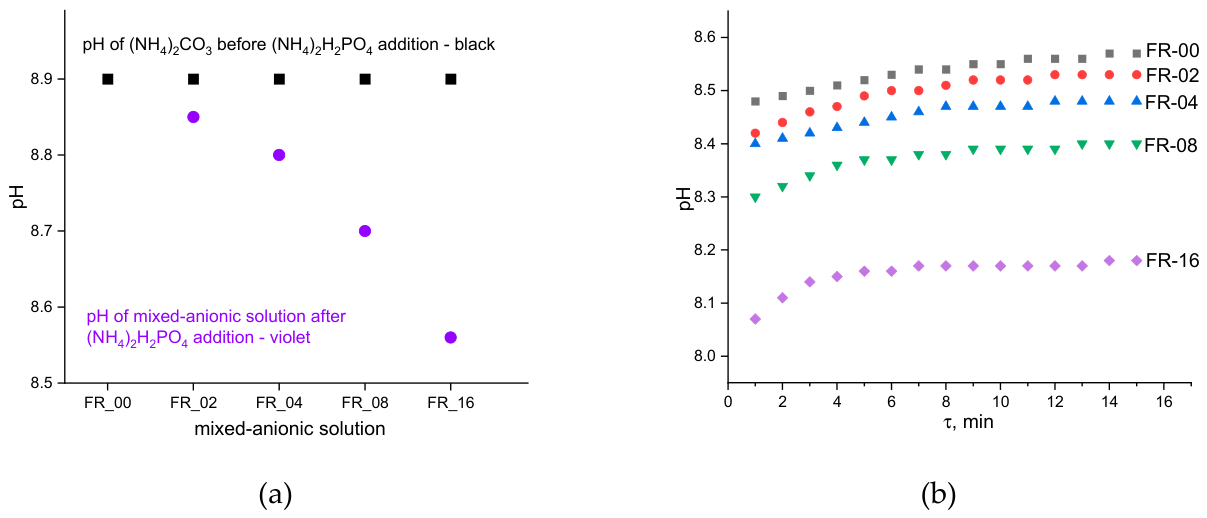
Figure 1. pH of mixed-anionic solutions (a) and kinetic curves of pH measurement of suspensions during synthesis (b).
Preprints 234146 g001
Figure 2. XRD data of powders after synthesis: o—vaterite (PDF No. 33-268; No. 96-900-7476); x—calcite (PDF No. 5-586; No. 96-900-0096).
Preprints 234146 g002
Figure 3. FTIR spectra for synthesized powders.
Preprints 234146 g003
Figure 4. Micrographs of powders synthesized from aqueous mixed-anionic solutions prepared from ammonium carbonate and ammonium di-hydro-pyrophosphate ((NН4)2Н2P2O7) taken in different proportions and aqueous solution of CaCl2: FR-00 (a), FR-02 (b), FR-04 (c), FR-08 (d), FR16 (e).
Preprints 234146 g004aPreprints 234146 g004b
Figure 5. Nitrogen adsorption (a) and desorption (b) isotherms at 77K for powders synthesized from aqueous mixed-anionic solutions prepared from different quantities of ammonium carbonate ((NH4)2CO3) and ammonium di-hydro-pyrophosphate ((NН4)2Н2P2O7) and aqueous solution of CaCl2. Nitrogen adsorption and desorption isotherms at 77K for powders FR-04 (c) and FR-16 (d).
Preprints 234146 g005aPreprints 234146 g005b
Figure 6. Apparent densities (a) and specific surface areas (b) of powders synthesized from aqueous mixed-anionic solutions prepared from different quantities of ammonium carbonate and ammonium di-hydro-pyrophosphate ((NН4)2Н2P2O7) and aqueous solution of CaCl2.
Preprints 234146 g006
Figure 7. Mass-loss (a) and ion current (I) for m/z=44 (b) for powders synthesized from aqueous mixed-anionic solutions prepared from different quantities of ammonium carbonate ((NH4)2CO3) and ammonium di-hydro-pyrophosphate ((NН4)2Н2P2O7) and aqueous solutions of calcium chloride (CaCl2).
Preprints 234146 g007
Figure 8. Comparison of mass-loss processes for different powders.
Preprints 234146 g008
Figure 9. XRD data of FR-00 powders after heat treatment at 200, 400 and 600 oC: o—vaterite (PDF No 33-268; No. 96-900-7476); x—calcite (PDF No 5-586; No 96-900-0096); l – lime CaO (PDF No 37-1497; No. 96-100-0045).
Preprints 234146 g009
Figure 10. Micrographs of FR-00 powders after heat treatment at 200, 400 and 600 oC.
Preprints 234146 g010
Figure 11. XRD data of FR-02 powders after heat treatment at 200, 400 and 600 oC: o—vaterite (PDF No 33-268; No. 96-900-7476); x—calcite (PDF No 5-586; No 96-900-0096).
Preprints 234146 g011
Figure 12. Micrographs of FR-02 powders after heat treatment at 200, 400 and 600 oC.
Preprints 234146 g012
Figure 13. XRD data of FR-04 powders after heat treatment at 200, 400 and 600 oC: o—vaterite (PDF No 33-268; No. 96-900-7476); x—calcite (PDF No 5-586; No 96-900-0096); l – lime CaO (PDF No 37-1497; No. 96-100-0045); v – chlorspodiosite Ca2(PO4)Cl (PDF No 72-10; No. 96-231-0395).
Preprints 234146 g013
Figure 14. Micrographs of FR-04 powders after heat treatment at 200, 400 and 600 oC.
Preprints 234146 g014
Figure 15. XRD data of synthesized powders FR-08 after heat treatment at 200, 400, 600, 800 and 1000 oC: o—vaterite (PDF No 33-268; No 96-900-7476); x—calcite (PDF No 5-586; No 96-900-0096); l – lime CaO (PDF No 37-1497; No 96-100-0045); v – chlorspodiosite Ca2(PO4)Cl (PDF No 72-10; No 96-231-0395); + - chlorapatite Ca10(PO4)6Cl2 (PDF No 73-1728; No 96-101-0917).
Preprints 234146 g015
Figure 16. Micrographs of FR-08 powders after heat treatment at 200, 400 and 600 oC.
Preprints 234146 g016
Figure 17. XRD data of FR-16 powders after heat treatment at 200, 400, 600, 800 and 1000 oC: o—vaterite (PDF No 33-268; No 96-900-7476); + - chlorapatite (Ca10(PO4)6Cl2) (PDF No 73-1728; No 96-101-0917); * - b-tricalcium phosphate b-Ca3(PO4)2 (PDF No; No); # - b-calcium pyrophosphate b-Ca2P2O7 (PDF No; No).
Preprints 234146 g017
Figure 18. Micrographs of FR-16 powders after heat treatment at 200, 400 and 600 oC.
Preprints 234146 g018aPreprints 234146 g018b
Figure 19. Indirect investigation of ability of molding compositions (m=10 g) consisting of synthesized powders and aqueous solution of sodium alginate to flow (upper line) and appearance of samples of sodium alginate loaded with synthesized powders after drying for 48 hours (lower row).
Preprints 234146 g019
Figure 20. Dependence of viscosity from the shear rate for the molding compositions Alg_FR-00 and Alg_FR-02.
Preprints 234146 g020
Figure 21. The mass–time dependence for molding compositions (Alg_FR-00, Alg_FR-02, Alg_FR-04, Alg_FR-08, and Alg_FR-16) consisting of synthesized powders and aqueous solution of sodium alginate during drying at room temperature.
Preprints 234146 g021
Figure 22. Camera photos of freeze-dried porous hydrogel composite materials (Cryo_Alg_FR-00, Cryo_Alg_FR-02, Cryo_Alg_FR-04, Cryo_Alg_FR-08, and Cryo_Alg_FR-16) with alginate matrix and synthesized powders as fillers.
Preprints 234146 g022
Figure 23. Microphotos of porous freeze-dried composite materials (Cryo_Alg_FR-00, Cryo_Alg_FR-02, Cryo_Alg_FR-04, Cryo_Alg_FR-08, and Cryo_Alg_FR-16) with alginate matrix and synthesized powders as fillers.
Preprints 234146 g023aPreprints 234146 g023b
Figure 24. Hydrophilic properties, swelling and mass change during drying of freeze dried porous composite materials (Cryo_Alg_FR-00, Cryo_Alg_FR-02, Cryo_Alg_FR-04, Cryo_Alg_FR-08, and Cryo_Alg_FR-16) with alginate matrix and synthesized powders as fillers after dipping in the water.
Preprints 234146 g024
Table 1. Molar ratios of salts used for mixed-anionic solutions preparation.
Labeling of mixed-anionic solutions (NH4)2Н2P2O7)/
((NH4)2CO3+(NH4)2Н2P2O7), mol %
(NH4)2CO3, mol (NН4)2Н2P2O7, mol ∑((NH4)2CO3 + (NН4)2Н2P2O7),
mol
FR-00 0 0.1500 0 0.1500
FR-02 2 0.1176 0.0024 0.1200
FR-04 4 0.1152 0.0048 0.1200
FR-08 8 0.1104 0.0096 0.1200
FR-16 16 0.1008 0.0192 0.1200
Table 2. Volumes and concentrations of staring aqueous solutions used for powders’ synthesis.
Labeling
of
powders
Molar ratio CaCl2/((NH4)2CO3+(NH4)2Н2P2O7) Starting solutions
Mixed-anionic solutions CaCl2
(NH4)2CO3 (NН4)2Н2P2O7
C, mol/l V, ml C, mol/l V,
ml
C, mol/l V1
for reaction with (NH4)2CO3, ml
V2
for reaction with (NH4)2Н2P2O7, ml
∑(V1+V2), ml
FR-00 1.00 0.3 500 0.2 0 0.3 500 0 500
FR-02 1.02 0.3 392 0.2 12 0.3 392 16 408
FR-04 1.04 0.3 384 0.2 24 0.3 384 32 416
FR-08 1.08 0.3 368 0.2 48 0.3 368 64 432
FR-16 1.16 0.3 336 0.2 96 0.3 336 128 464
Table 3. Components of Molding Compositions.
Substances in molding compositions Mass of substances, g Mass fraction, %
Distilled water 95 95
Synthesized powder 2.5 2.5
Sodium alginate (powder) 2.5 2.5
Table 4. Analysis of mass-loss of the synthesized powders.
Labeling of powders Retained mass, % Total mass loss, % Interval for CO2
evacuation, oC
Interval of
mass-loss due to CO2 evacuation, %
Mass-loss
due to CO2
evacuation, %
Mass-loss due to
dehydration and/or
by-products
decomposition, %
FR-00 54.8 45.2 589.9-841.0 97.9-54.8 43.1 1.2
FR-02 56.8 43.2 585.9-751.7 92.1-52.1 40.0 3.2
FR-04 58.3 41.7 570.6-745.5 83.5-61.6 21.9 19.8
FR-08 63.7 36.3 567.6-712.9 78.4-66.2 12.2 24.1
FR-16 66.6 33.4 495.3-707.7 71.6-68.0 3.6 29.8
Table 5. Density of molding compositions after addition of sodium alginate to the suspension of powders in water and homogenization.
Labeling of molding compositions Density of molding compositions, g/cm3
Alg_FR-00 1.11
Alg_FR-02 1.06
Alg_FR-04 1.00
Alg_FR-08 1.04
Alg_FR-16 1.03
Table 6. Mass-loss, linear shrinkage and density of samples after freeze drying.
Sample Mass-loss, % Retain mass, % D/D0, % Liner shrinkage, % Density, g/cm3
Cryo_Alg_FR-00 95.6 4,4 94.4 5.6 0.05
Cryo_Alg_FR-02 95.1 4,9 94.9 5.1 0.05
Cryo_Alg_FR-04 95.0 5.0 93.2 6.8 0.06
Cryo_Alg_FR-08 95.5 4.5 92.7 7.3 0.05
Cryo_Alg_FR-16 95.7 4.3 93.8 6.2 0.05
Table 7. Swelling degree (S), mass-loss during dipping in water (L), and retain mass (R) of freeze dried porous composite materials after dipping in water.
Sample S (t=0), % Mass-loss (L), % Retain mass (R), %
Cryo_Alg_FR-00 9300 59.9 40.1
Cryo_Alg_FR-02 8500 53.8 46.2
Cryo_Alg_FR-04 4700 26.4 73.6
Cryo_Alg_FR-08 6900 27.1 72.9
Cryo_Alg_FR-16 8600 43.9 56.1
Disclaimer/Publisher’s Note: The statements, opinions and data contained in all publications are solely those of the individual author(s) and contributor(s) and not of MDPI and/or the editor(s). MDPI and/or the editor(s) disclaim responsibility for any injury to people or property resulting from any ideas, methods, instructions or products referred to in the content.
Copyright: This open access article is published under a Creative Commons CC BY 4.0 license, which permit the free download, distribution, and reuse, provided that the author and preprint are cited in any reuse.