

Submitted:
19 September 2026
Posted:
20 September 2026
You are already at the latest version
Abstract
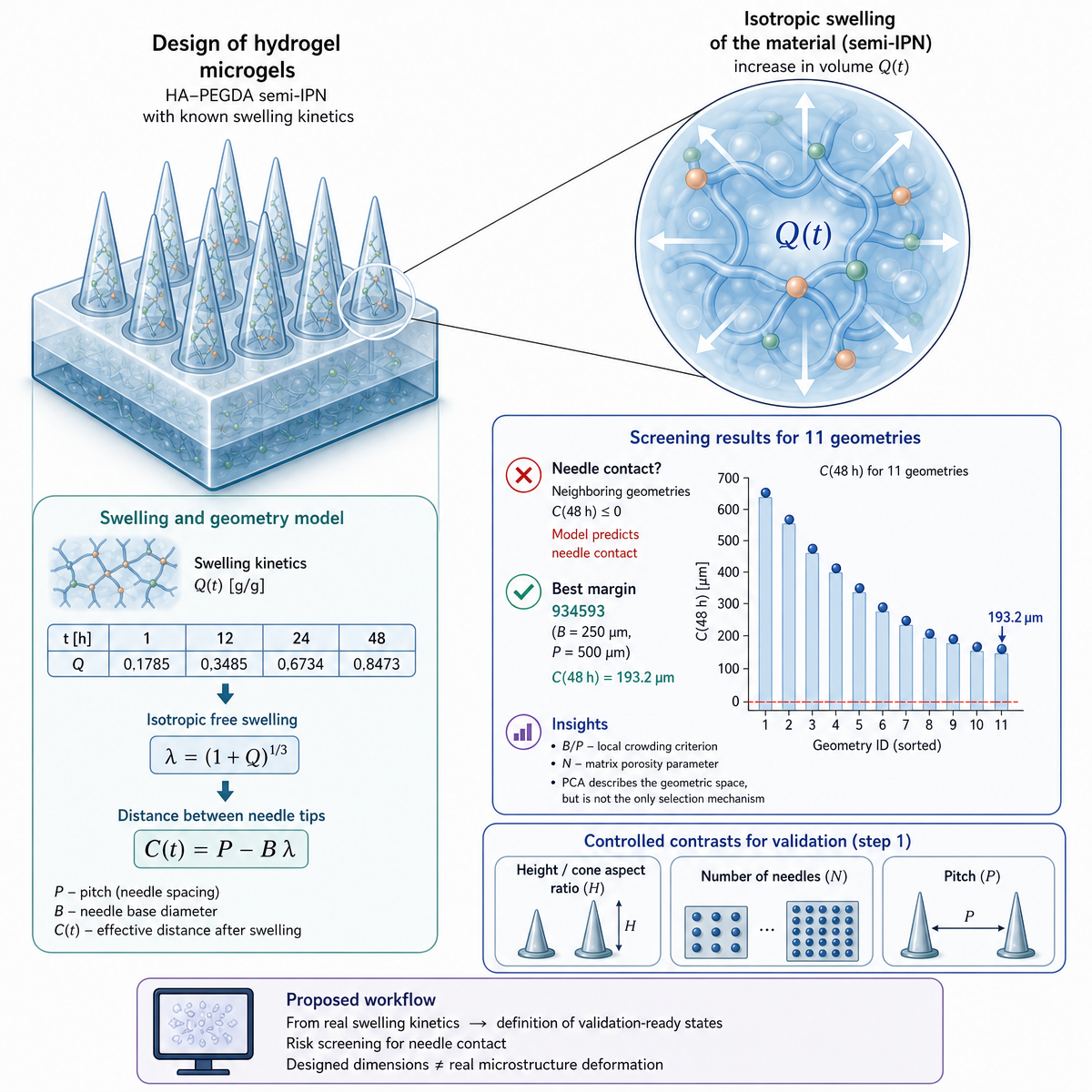
Hydrogel-forming microneedle design requires simultaneous consideration of material swelling and microstructure geometry. This study proposes a model-assisted frame-work for preselecting commercial microneedle templates for a hyaluronic acid (HA)–poly(ethylene glycol) diacrylate (PEGDA) semi-interpenetrating polymer network (semi-IPN) hydrogel with experimentally determined swelling kinetics. The gravimet-ric swelling ratio (Q) increased from 0.1785 at 1 h to 0.3485, 0.6734, and 0.8473 g/g at 12, 24, and 48 h, respectively. These data defined the material-response domain and were additionally used in an exploratory isotropic free-swelling scenario to calculate the swelling-adjusted inter-needle clearance, C(t)=P−B(1+Q)^(1/3), where P is pitch and B is needle base width. None of the 11 analyzed geometries reached the theoretical contact condition C≤0 at 48 h; the smallest clearance was obtained for template 934593 (193.2 µm). Geometry preselection therefore combined local crowding, needle number, and aspect ratio rather than relying solely on principal component analysis. Controlled template contrasts were identified to independently examine height/slenderness, nee-dle number, and pitch. The proposed framework integrates experimentally measured swelling with geometry-based screening to reduce the initial experimental design space while retaining physically informative boundary conditions for subsequent mi-croneedle fabrication and validation.
Keywords:
hydrogel-forming microneedles
; hyaluronic acid
; PEGDA
; semi-interpenetrating polymer network
; swelling
; microneedle geometry
; inter-needle clearance
; design space
1. Introduction
Microneedles are microstructures designed to controllably overcome the stratum corneum barrier and are used for transdermal delivery of active substances and vaccines, as well as for minimally invasive interstitial-fluid sampling and diagnostics [1,2,3,4]. Their performance depends on the interaction between material properties and geometry; height, base width, needle number, slenderness, and tip geometry affect penetration conditions, stresses, and sensations during application [5,6]. For hydrogel materials, the time-dependent response to hydration constitutes an additional design variable.
Swelling of hydrogel-forming microneedles is functionally important because it enables interstitial-fluid uptake and mass transport, while it may also alter the dimensions and mechanical properties of the hydrated structure [7,8,9,10,11,12]. However, a gravimetrically determined swelling ratio of a bulk specimen is not a direct measure of microneedle dimensional change. A microstructure has a different surface-area-to-volume ratio and may be mechanically constrained during skin contact. Material and geometry data should therefore remain conceptually distinct until experimental validation of actual microneedles.
A further practical design challenge is the number of possible experiments. Current studies on hydrogel-forming microneedles emphasize rational integration of matrix composition, geometry, fabrication parameters, and subsequent mechanical and functional validation [13,14,15,16,17,18]. When multiple geometries are available, exhaustive validation of every geometry at every material state can be costly and time-consuming. This is particularly relevant when the hydrogel composition has already been fixed and its material response has previously been characterized. In such cases, existing material data can be used before microneedle fabrication to rationally narrow the experimental design space.
In this study, a hydrogel prepared from two commercial hyaluronic-acid-containing formulations, NCTF® 135 HA and PROFHILO®, mixed at a 1:1 (v/v) ratio and supplemented with PEGDA 575 and a photoinitiator, was analyzed. Literature data support the use of HA in PEG/PEGDA-based semi-interpenetrating networks and the distinction between physical entrapment of HA and its covalent incorporation into a network [19,20,21,22]. Comparative characteristics of the commercial NCTF® 135 HA and PROFHILO® formulations have also been reported [23]. In the absence of evidence that HA was functionalized with polymerizable groups, the material is described here as an hyaluronic acid (HA)–poly(ethylene glycol) diacrylate (PEGDA) semi-interpenetrating polymer network (semi-IPN): PEGDA forms the covalently crosslinked phase, whereas HA-containing components remain physically incorporated within the network.
The novelty of the proposed approach lies in the use of two complementary but independent design domains. The first is the experimentally measured swelling kinetics Q(t), which defines the actual material-response domain of the investigated hydrogel. The second is the geometry design domain described by microneedle height (H), base width (B), pitch (P), and needle number (N) for the available templates. Swelling is not used to calculate the “best” template or to predict actual microneedle dimensions. Instead, it defines the range of material states over which each selected geometry should be validated. The geometry analysis is then used to select a minimal set of templates capable of testing the effect of geometry across this experimentally observed material-response range.
An additional role for the swelling data can be obtained by combining Q(t) with nominal base width B and pitch P. If isotropic free swelling is assumed solely as a sensitivity scenario, the linear expansion factor can be expressed as λ=(1+Q)^(1/3). This enables definition of the theoretical clearance between adjacent microneedles as C(t)=P−Bλ. C(t)≤0 would indicate contact under this simplified scenario, whereas positive C(t) represents a geometric separation margin. This parameter is not intended to predict actual microneedle swelling; rather, it serves as a physically interpretable geometry-screening criterion prior to fabrication.
The objectives of this study were therefore to: (i) define the experimental material-response domain from Q(t); (ii) characterize the space of 11 commercial geometries using H, B, P, and N; (iii) calculate exploratory swelling-adjusted clearance C(t) as a local-crowding criterion; (iv) distinguish local B/P crowding from needle number N and slenderness H/B; (v) use principal component analysis (PCA) as an auxiliary description of the global geometry space; and (vi) propose a minimal set of controlled contrasts for initial experimental validation.
2. Materials and Methods
2.1. Hydrogel Formulation and Data Source
The analyzed hydrogel was prepared from 5 mL NCTF® 135 HA and 5 mL PROFHILO® (1:1 v/v). To the 10 mL HA-containing phase, 2 mL PEGDA 575 and 50 µL 2-hydroxy-2-methylpropiophenone as photoinitiator were added. The formulation and swelling data used in the analysis originate from Kędzierska et al., Molecules, manuscript molecules-4374882 (in press) [24]. They are not presented here as new experimental results.
The material was defined as an HA–PEGDA semi-IPN hydrogel. This term denotes a covalently crosslinked PEGDA phase containing physically entrapped HA-containing components and does not imply demonstrated covalent crosslinking of HA by PEGDA.
2.2. Swelling in Water
Three specimens (n=3) were monitored longitudinally. Each specimen was weighed before the experiment and after 1, 12, 24, and 48 h of incubation in water. The swelling ratio was calculated as:
where m₀ is the initial mass and m(t) is the mass at time t. Given n=3 and repeated measurements on the same specimens, descriptive statistics were used.
Q(t) = [m(t) − m₀] / m₀

Table 1.
Swelling of the HA–PEGDA semi-IPN hydrogel in water. Experimental data source: Kędzierska et al., Molecules, manuscript molecules-4374882 (in press) [24].
Table 1.
Swelling of the HA–PEGDA semi-IPN hydrogel in water. Experimental data source: Kędzierska et al., Molecules, manuscript molecules-4374882 (in press) [24].
| Time | Sample 1 | Sample 2 | Sample 3 | Q mean ± SD | Swelling (%) | CV (%) |
| 1 h | 0.17419 | 0.18364 | 0.17772 | 0.17851 ± 0.00477 | 17.85 | 2.67 |
| 12 h | 0.34398 | 0.35415 | 0.34731 | 0.34848 ± 0.00518 | 34.85 | 1.49 |
| 24 h | 0.68734 | 0.67645 | 0.65645 | 0.67341 ± 0.01567 | 67.34 | 2.33 |
| 48 h | 0.84524 | 0.85009 | 0.84668 | 0.84734 ± 0.00249 | 84.73 | 0.29 |
2.3. Microneedle Geometry Space
Nominal parameters of 11 pyramidal NanoFabTx™ templates were obtained from the Merck/Sigma-Aldrich manufacturer selection guide [25]. The primary variables were H, B, P, and N. aspect ratio (AR)=H/B, V_needle=B²H/3, and V_array=N·V_needle were also calculated, but these derived parameters were not included in PCA.
Table 2.
Commercial microneedle template geometries included in the analysis.
| Template | N | H (µm) | B (µm) | P (µm) | AR | D_G |
| 934445 | 100 | 300 | 100 | 500 | 3.000 | 0.000 |
| 934453 | 100 | 400 | 150 | 500 | 2.667 | 0.148 |
| 934461 | 100 | 500 | 150 | 500 | 3.333 | 0.193 |
| 934488 | 100 | 500 | 200 | 500 | 2.500 | 0.295 |
| 934496 | 100 | 600 | 200 | 500 | 3.000 | 0.341 |
| 934518 | 225 | 600 | 200 | 500 | 3.000 | 0.159 |
| 934577 | 100 | 700 | 200 | 500 | 3.500 | 0.387 |
| 934585 | 100 | 800 | 200 | 500 | 4.000 | 0.432 |
| 934593 | 36 | 800 | 250 | 500 | 3.200 | 0.628 |
| 934607 | 36 | 1000 | 250 | 1000 | 4.000 | 0.859 |
| 934615 | 36 | 1000 | 250 | 1500 | 4.000 | 1.000 |
2.4. PCA i Deskryptor Geometries
H, B, P, and N were standardized as z-scores. the first principal component (PC1) was oriented so that greater H, B, and P and lower N corresponded to positive values:
PC1 = 0.565 z_H + 0.520 z_B + 0.491 z_P − 0.412 z_N
The normalized geometry-scale descriptor (D_G) was calculated as D_G=(PC1−PC1,min)/(PC1,max−PC1,min) was defined. D_G is solely a descriptive coordinate within the analyzed dataset and is not a compatibility or manufacturability index.
2.5. Material–Geometry Mapping
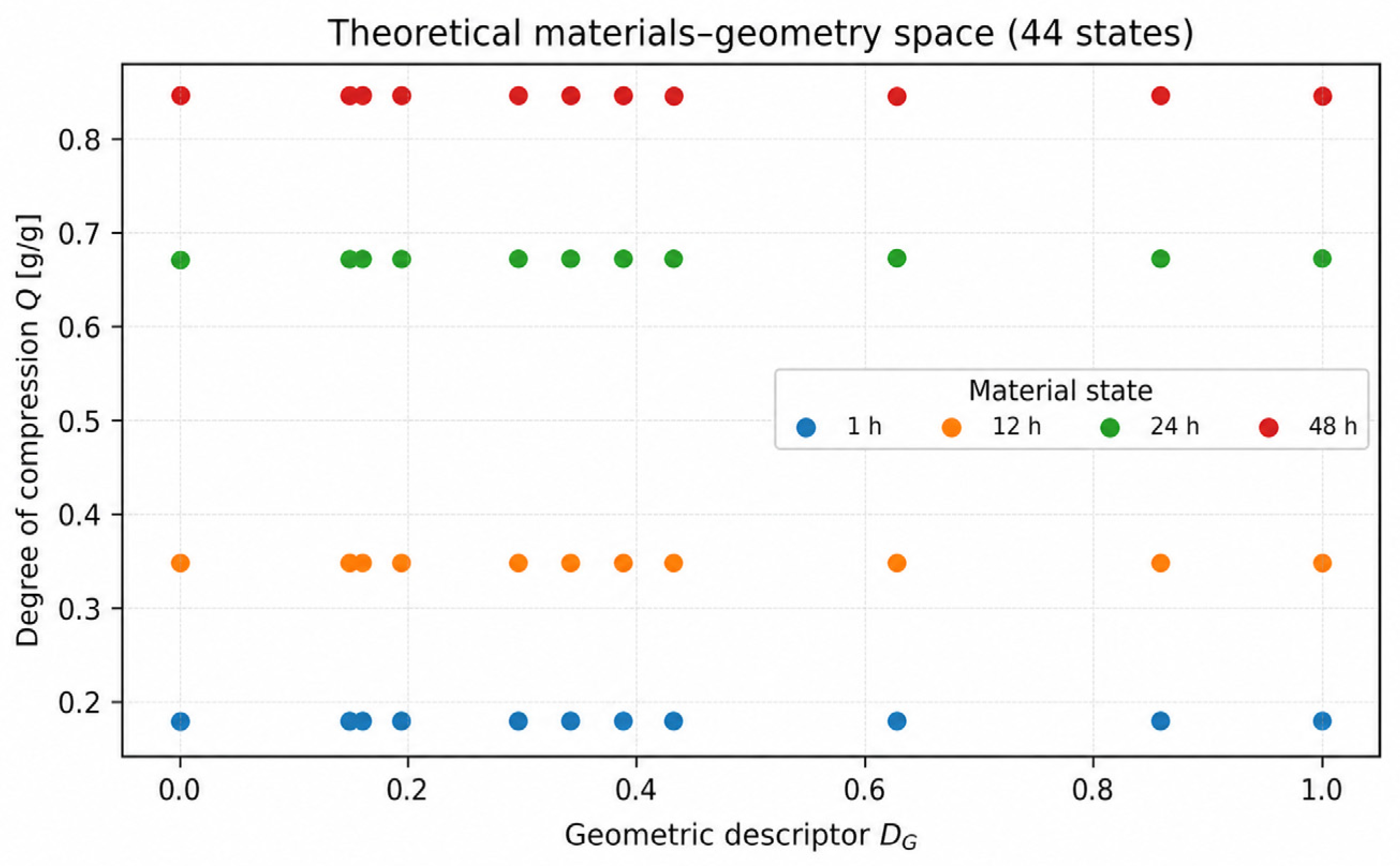
The four experimental Q(t) values were treated as four levels of the material-response domain, whereas the 11 nominal templates constituted the geometry design domain. Their Cartesian product defines 44 candidate material–geometry states. These are design-space points, not 44 independent experiments. The model does not assume functions Q→H, Q→B, or Q→D_G. Q(t) defines the experimentally observed range of hydrogel states that should be covered when validating each geometry selected from the geometry-space analysis.
2.6. Swelling-Adjusted Inter-Needle Clearance
In the exploratory isotropic free-swelling scenario, λ(t)=(1+Q(t))^(1/3) was assumed. Nominal base width was transformed to B_proxy(t)=B·λ(t), and the theoretical clearance between adjacent bases was defined as C(t)=P−B_proxy(t). A dimensionless relative separation margin was additionally defined as relative clearance [C_R(t)]=C(t)/P. The condition C(t)≤0 was treated as a theoretical indication of contact in this scenario. These calculations constitute geometric screening only: they do not account for anisotropy, mechanical constraints, actual microneedle swelling kinetics, shape change, or skin interactions. Needle number N was not included in C(t), because N describes array-level density, whereas C(t) is a local neighborhood parameter.
Preselection was performed hierarchically. First, Q(t), B, and P were used to calculate C(t) and identify geometries with the smallest separation margin. Second, N was considered as an independent measure of array-level density and H/B as a measure of slenderness. Third, controlled pairs or series were selected in which as many parameters as possible remained constant. This strategy enables the effects of height/slenderness to be distinguished from those of needle number and pitch. D_G and PCA were treated as descriptors of the global geometry space rather than as performance rankings.
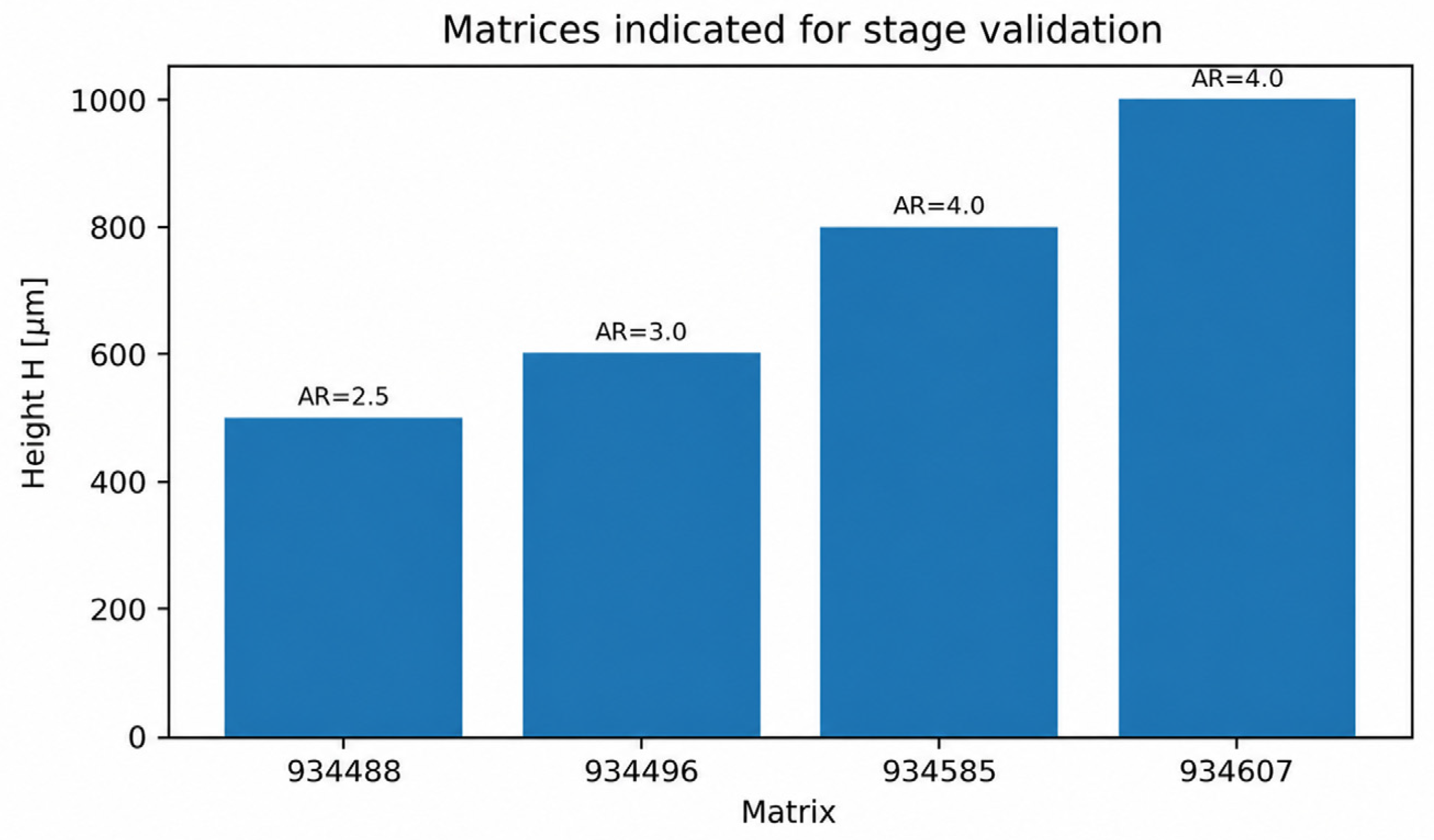
The primary controlled series comprised templates 934488, 934496, and 934585. All have B=200 µm, P=500 µm, and N=100, whereas H is 500, 600, and 800 µm and AR is 2.5, 3.0, and 4.0, respectively. Template 934496 was designated as the reference variant, 934488 as the lower and less slender variant, and 934585 as the taller and more slender variant. Template 934607 (H=1000 µm, B=250 µm, P=1000 µm, N=36) was retained as an optional second-stage boundary variant.
2.8. Model-Derived Validation Plan
Each of the three primary geometries should be fabricated using the same formulation and identical processing conditions. Before hydration, actual geometry, replication fidelity, axial-load behavior, and penetration capability should be determined. Each geometry should then be evaluated after 1, 12, 24, and 48 h, yielding a 3×4=12-state validation matrix. The objective is not to assume that bulk Q(t) equals microneedle swelling, but to directly determine how the same material response is expressed after the hydrogel is shaped into different geometries.
3. Results
3.1. Swelling Kinetics
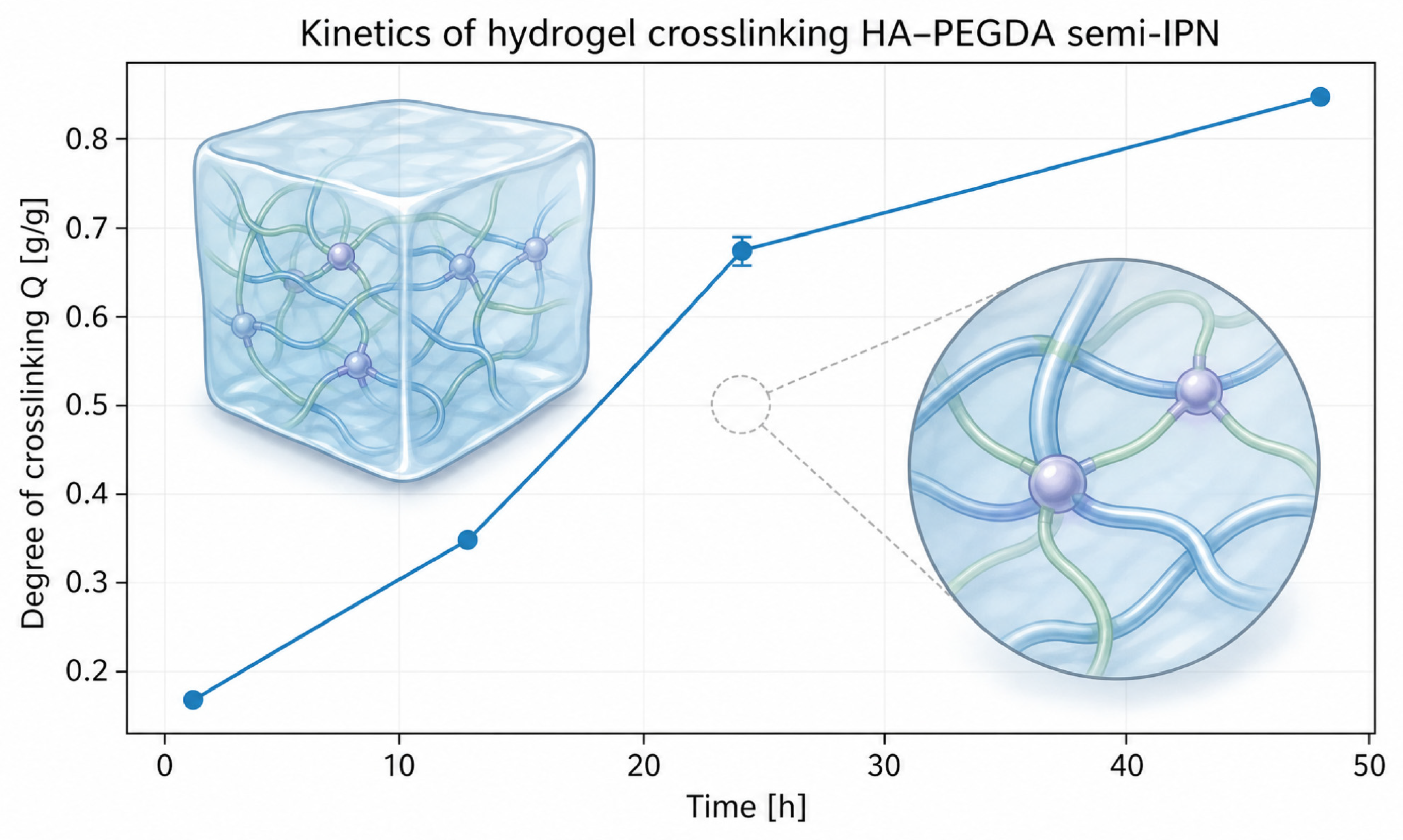
Q increased from 0.1785 ± 0.0048 g/g after 1 h to 0.3485 ± 0.0052 after 12 h, 0.6734 ± 0.0157 after 24 h, and 0.8473 ± 0.0025 g/g after 48 h. These values corresponded to mass increases of 17.85%, 34.85%, 67.34%, and 84.73%, respectively. The largest absolute increase in mean Q occurred between 12 and 24 h (ΔQ=0.3249 g/g), whereas ΔQ values for 1–12 h and 24–48 h were 0.1700 and 0.1739 g/g, respectively. Because Q continued to increase between 24 and 48 h, the data do not demonstrate attainment of equilibrium by 48 h. The coefficients of variation (CVs) were 2.67%, 1.49%, 2.33%, and 0.29%, respectively. In the model, these results define the experimentally observed material-response range, from early hydration to the highest measured state, with a particularly dynamic 12–24 h interval.
Figure 1.
Experimental water-swelling trajectory of the HA–PEGDA semi-IPN hydrogel; points represent mean ± standard deviation (SD) (n = 3).
Figure 1.
Experimental water-swelling trajectory of the HA–PEGDA semi-IPN hydrogel; points represent mean ± standard deviation (SD) (n = 3).
3.2. Geometry Variability
The analyzed ranges were H=300–1000 µm, B=100–250 µm, P=500–1500 µm, N=36–225, and AR=2.5–4.0. Thus, the available design space contains variants that differ simultaneously in several features, complicating interpretation of an exhaustive experiment involving all templates.
3.3. PCA
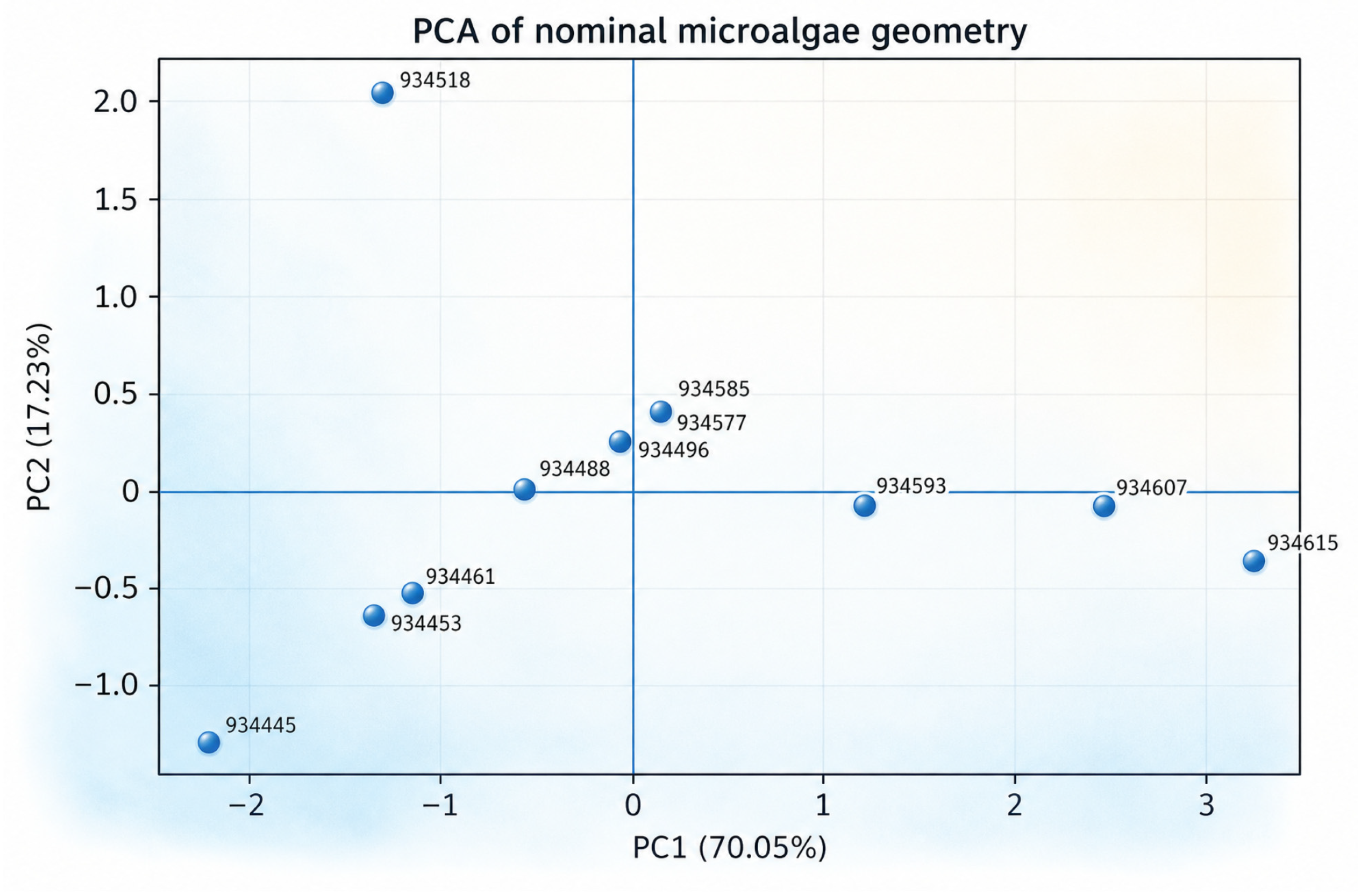
PC1 explained 70.05% and PC2 17.23% of the variance; together, the first two components accounted for 87.28% of geometric variability. PCA confirmed the multidimensional character of the dataset but was not treated as a predictive model.
Figure 2.
Distribution of the 11 nominal microneedle geometries in the space of the first two principal components.
Figure 2.
Distribution of the 11 nominal microneedle geometries in the space of the first two principal components.
3.4. Template Selection Based on Geometry and Swelling
Combining C(t), B/P, N, and H/B changes the role of preselection. Templates 934488–934496–934585 retain B=200 µm, P=500 µm, and N=100 while varying H=500–600–800 µm and AR=2.5–3.0–4.0; they therefore form a controlled series for assessing the effect of height/slenderness. The pair 934496–934518 retains H=600 µm, B=200 µm, and P=500 µm but differs only in N=100 versus 225, thereby isolating the effect of needle number. The pair 934607–934615 retains H=1000 µm, B=250 µm, and N=36 but differs in P=1000 versus 1500 µm, thereby isolating the effect of pitch. Template 934593 (H=800 µm, B=250 µm, P=500 µm, N=36) exhibits the smallest theoretical clearance and may serve as a crowding-boundary variant. Such controlled contrasts are more informative than selecting templates solely on the basis of distance in PCA space.
Figure 3.
Theoretical material–geometry design space generated from four experimental swelling states and 11 nominal geometries. The points represent 44 design states, not 44 independent experiments.
Figure 3.
Theoretical material–geometry design space generated from four experimental swelling states and 11 nominal geometries. The points represent 44 design states, not 44 independent experiments.
This section may be divided by subheadings. It should provide a concise and precise description of the experimental results, their interpretation, as well as the experimental conclusions that can be drawn.
The role of swelling in down-selection is therefore twofold. First, Q(t) defines four validation states (1, 12, 24, and 48 h), with the 12–24 h interval being particularly informative. Second, in the exploratory scenario, Q(t) together with B and P identifies geometries with the smallest separation margin and therefore those that should be treated as boundary variants. Because none of the 11 geometries reaches C≤0, clearance alone does not justify excluding any template because of predicted contact. It does, however, provide a physically interpretable basis for prioritizing local-crowding conditions and deciding which controlled contrasts should be tested first.
Figure 4.
Role of swelling data in experimental-space reduction. Gray points represent the full space of 11 geometries × 4 experimental Q(t) states = 44 candidate states. Highlighted columns correspond to the three geometries selected for the first stage; each is validated over the entire measured material-response range, yielding 12 targeted states.
Figure 4.
Role of swelling data in experimental-space reduction. Gray points represent the full space of 11 geometries × 4 experimental Q(t) states = 44 candidate states. Highlighted columns correspond to the three geometries selected for the first stage; each is validated over the entire measured material-response range, yielding 12 targeted states.
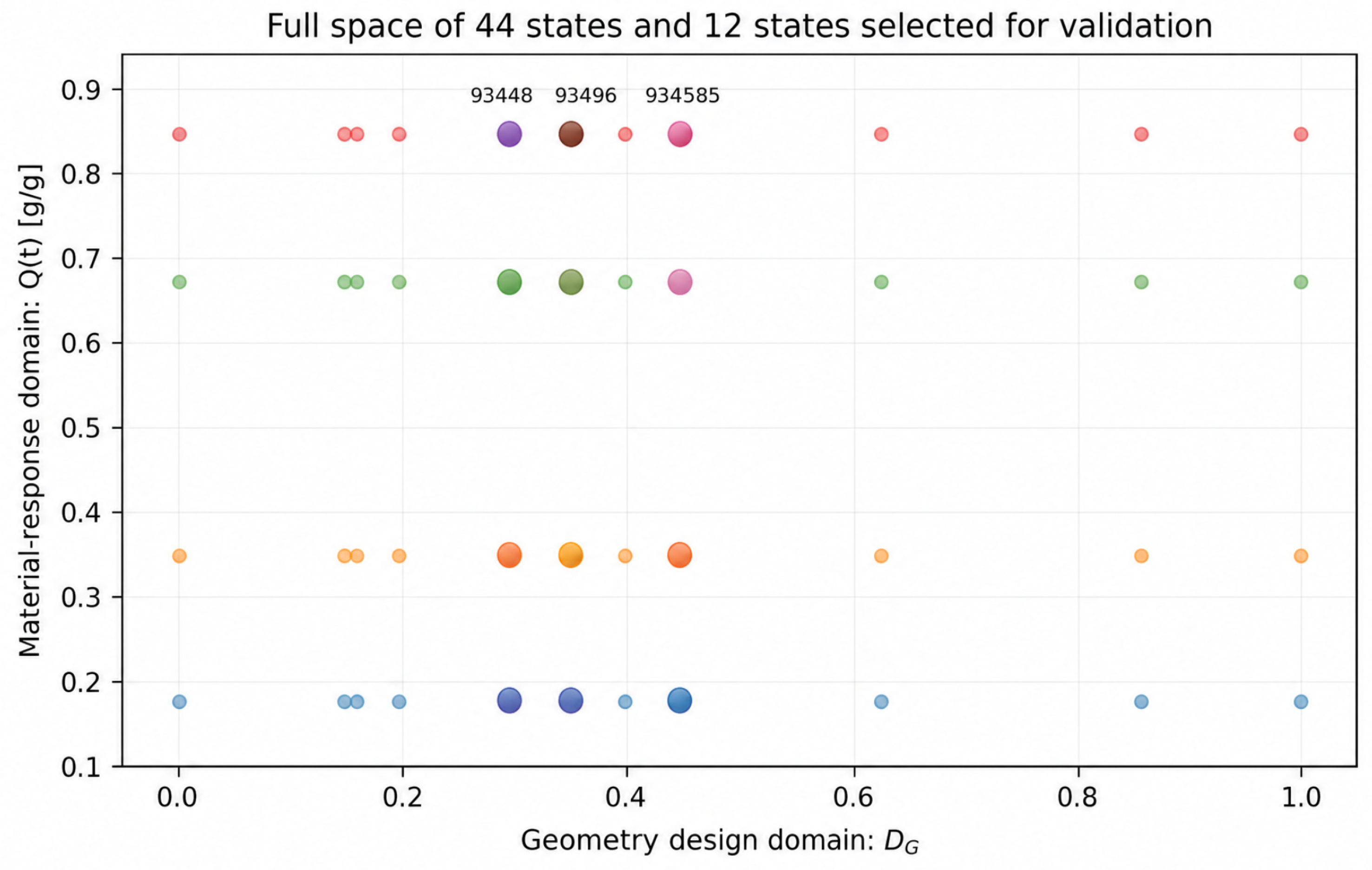
Figure 5.
Templates identified for staged validation. The first three constitute the primary controlled series; 934607 is an optional second-stage boundary variant.
Figure 5.
Templates identified for staged validation. The first three constitute the primary controlled series; 934607 is an optional second-stage boundary variant.
3.5. Reduction in Experimental Variants
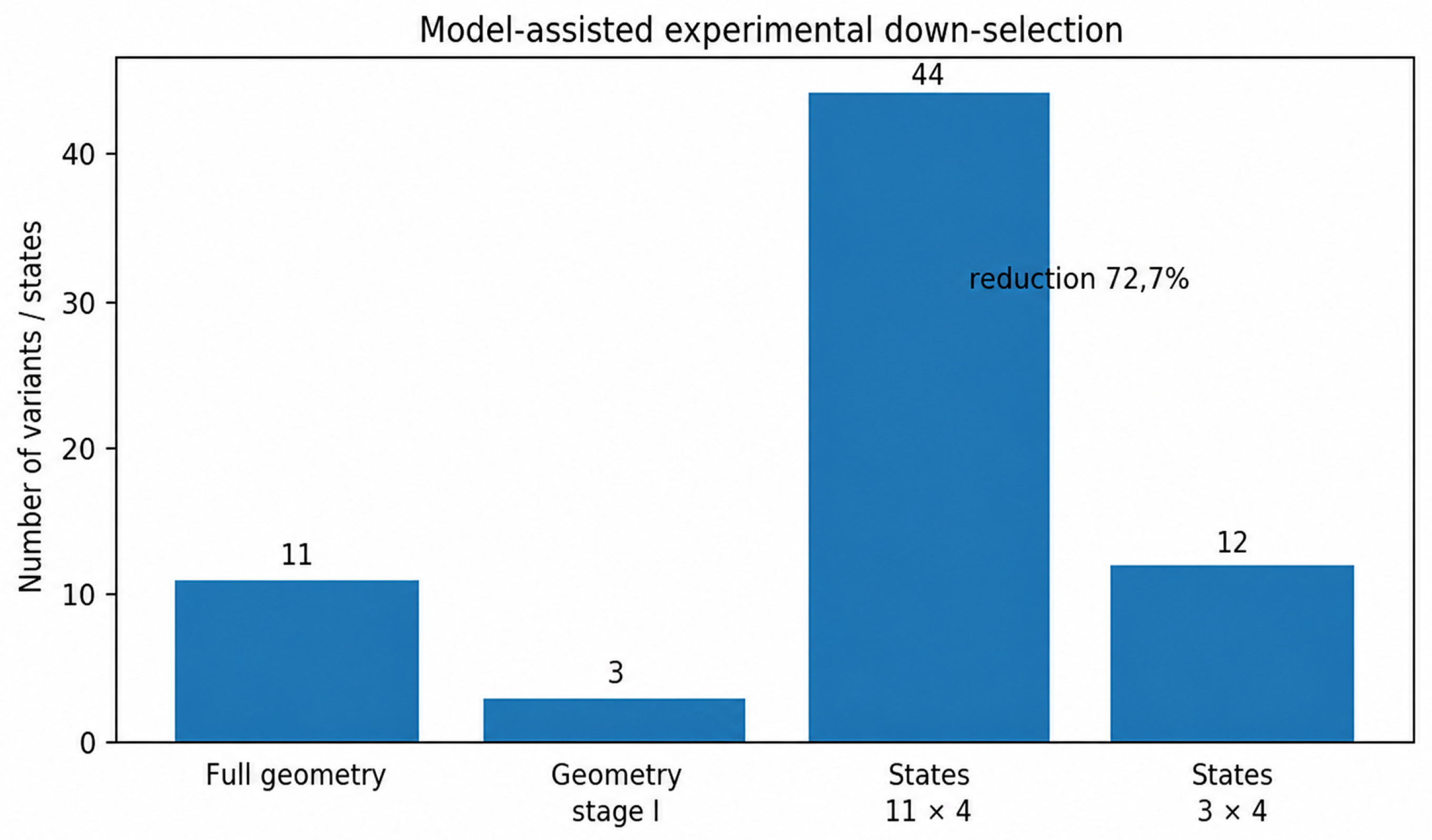
Exhaustive evaluation of all 11 geometries would require fabrication of 11 primary microneedle variants. The model reduces the first stage to three geometries, corresponding to a 72.7% reduction in the number of fabricated variants. Including four hydration states, the complete 11×4 design space comprises 44 combinations, whereas targeted validation of 3×4 comprises 12 combinations, also a 72.7% reduction. This reduction does not arise from arbitrary exclusion of templates but from selecting a controlled subset with high information value for a hydrogel with a known material response.
Figure 6.
Model-assisted experimental down-selection. The known hydrogel composition and experimental swelling trajectory are used to reduce the first stage from 11 to 3 geometries and from 44 to 12 geometry × time combinations (72.7% reduction).
Figure 6.
Model-assisted experimental down-selection. The known hydrogel composition and experimental swelling trajectory are used to reduce the first stage from 11 to 3 geometries and from 44 to 12 geometry × time combinations (72.7% reduction).
The complete 44-state matrix should not be interpreted as a requirement to experimentally fabricate and characterize all 44 combinations. Its primary function is to create a structured design space from which a smaller, information-rich subset can be selected. Because the hydrogel composition is fixed and its swelling trajectory has already been experimentally characterized, formulation screening need not be repeated. The design problem is therefore shifted from composition screening toward selection of geometries that provide the greatest comparative information with the fewest fabrication runs.
Table 3.
Templates identified by the model for staged experimental validation.
| Stage | Template | H | B | P | N | AR | Role in validation |
| I | 934488 | 500 | 200 | 500 | 100 | 2.5 | Lower-height / lower-slenderness variant |
| I | 934496 | 600 | 200 | 500 | 100 | 3.0 | Reference variant |
| I | 934585 | 800 | 200 | 500 | 100 | 4.0 | Higher-height / higher-slenderness variant |
| II | 934607 | 1000 | 250 | 1000 | 36 | 4.0 | Optional boundary variant |
On this basis, templates 934488, 934496, and 934585 were selected for the first validation stage. They retain B=200 µm, P=500 µm, and N=100, while H increases from 500 through 600 to 800 µm and AR from 2.5 through 3.0 to 4.0. This design is more informative than selecting distant PCA points that differ simultaneously in several parameters. Template 934496 was designated as the reference geometry, whereas 934607 was retained as a second-stage boundary variant.
4. Discussion
The principal result of this study is that experimentally measured swelling is assigned a direct but methodologically constrained role in geometry preselection. Q(t) defines the material-response domain and, when combined with B and P, also enables calculation of swelling-adjusted clearance as a theoretical test of local crowding. No inter-needle contact was indicated within the analyzed Q range. This negative result is itself informative: no template should be excluded solely because contact is predicted by this simplified model. Differences in C(t), however, identify geometries with smaller and larger separation margins, while N and H/B enable construction of controlled experimental contrasts.
The known Q(t) trajectory is important not because it enables calculation of microneedle geometry, but because it identifies the material states that the experiment must cover. Mass increased by 17.85% after 1 h and by 84.73% after 48 h, with the largest change occurring between 12 and 24 h. Validation limited to the initial and final states could therefore miss the interval of greatest observed dynamics. The 1, 12, 24, and 48 h points constitute four experimentally justified levels of the material-response domain [7,8,9,10,11,12,24].
It should be emphasized that B_proxy and C(t) are not predictions of the actual dimensions of hydrated microneedles. The transformation λ=(1+Q)^(1/3) assumes isotropic free swelling and neglects, among other factors, density differences, network constraints, microstructure geometry, skin contact, and possible anisotropy. Accordingly, C(t) serves as a screening parameter for prioritizing validation rather than replacing measurements of actual inter-needle distances, dimensions, structural integrity, and mechanical performance.
The 934488–934496–934585 series is particularly useful because B, P, and N remain constant. Compared with selecting three unrelated points with different D_G values, this design provides a more interpretable experiment: increasing H from 500 to 600 and 800 µm systematically changes AR from 2.5 to 3.0 and 4.0 while the other primary parameters remain unchanged. This allows assessment of whether hydration-related effects depend on structural height and slenderness without simultaneously confounding pitch or needle number. The importance of geometry for microneedle penetration and mechanical response is supported by previous studies [5,6,14,17,18].
Template 934496 was designated as the reference variant because it occupies an intermediate position in the controlled series and has AR=3.0. This does not imply that it is predicted to be optimal. Only measurements on actual microneedles can confirm replication fidelity, mechanical stability, and penetration. Template 934488 provides a lower-slenderness comparator, whereas 934585 enables evaluation of a more demanding geometry with the same base width and array organization.
Template 934607 was deliberately assigned to the second stage. It has a height of 1000 µm, a larger base, greater pitch, and fewer needles and therefore changes several parameters simultaneously. Including it in the initial experiment would complicate attribution of observed differences. After feasibility of the primary series is confirmed, it may serve as a stress-test geometry for probing the limits of the formulation in a more extreme region of the design space.
The proposed reduction from 11 to 3 templates in the first stage and from 44 to 12 combinations after accounting for swelling time has practical significance. It reduces material consumption, the number of fabrication processes, measurement time, and the number of replicates required for complete validation. Importantly, this efficiency is not achieved by discarding the broader design space: all 11 geometries remain represented in the theoretical analysis, while a controlled subset is advanced to experiment.
This approach may be generalized to other hydrogels provided that the formulation is first defined and reliable material characterization, such as swelling, rheology, or mechanical properties, is available. For a new composition, the model should be rerun because changes in polymer concentration, crosslink density, or formulation components may alter the rational geometry range. The framework is therefore formulation-specific rather than a universal geometry ranking. The need to jointly consider hydrogel chemistry, geometry, and functional characterization is also emphasized in recent HFMN reviews [9,10,11,12,13].
The study is limited by the use of one formulation and three swelling specimens. Rheology, modulus, fracture force, degradation, and actual microneedle swelling were not measured. The commercial NCTF® 135 HA and PROFHILO® formulations contain additional formulation components; therefore, the observed response cannot be attributed to HA alone. The model should be validated by fabricating the selected geometries and comparing their behavior before and after hydration.
Ultimately, the approach can be implemented sequentially: defined hydrogel composition → material characterization → geometry-space analysis → selection of a reduced number of variants → experimental validation → model update. In such a workflow, each new experiment increases material-specific knowledge and may further reduce the number of subsequent experiments.
5. Conclusions
The developed framework uses experimentally measured swelling at two decision stages. First, Q(t) defines four real material states requiring validation. Second, under the exploratory isotropic scenario, Q(t), B, and P define the swelling-adjusted clearance C(t), which provides a local separation-margin estimate. After 48 h, none of the 11 geometries reached theoretical contact; the smallest C was obtained for 934593 (193.2 µm), identifying it as a useful boundary variant rather than a geometry to be automatically excluded. N and H/B are then used to select controlled contrasts: 934488–934496–934585 for height/slenderness, 934496–934518 for needle number, and 934607–934615 for pitch. PCA remains an auxiliary description of the global geometry space. This workflow provides a physically interpretable basis for limiting the number of templates fabricated at the outset while preserving the need for experimental confirmation of actual microneedle swelling and mechanics.
Author Contributions
Conceptualization, M.K., and B.T.; methodology, M.K and B.T ; validation, M.K and B.T ; formal analysis, M.K and B.T ; investigation, M.K and B.T ;.; resources, M.K and P.P.; data curation, M.B and B.T..; writing—original draft preparation, M.K., and BT.; writing—review and editing, M.K. and B.T..; visualization, B.T.; supervision, M.K., B.T. and P.P.; project administration, M.K., B.T. and P.P.; funding acquisition, M.K., B.T. and P.P. All authors have read and agreed to the pub-lished version of the manuscript.
Funding
Manuscript preparation was supported during Harvard Medical School’s Polish Clinical Scholars Research Training Program, organised by the Agencja Badan Medycznych (ABM, English: Medi-cal Research Agency, Warsaw, Poland).
Institutional Review Board Statement
Not applicable.
Informed Consent Statement
Not applicable.
Data Availability Statement
The experimental swelling data analyzed in this study were obtained from Kędzierska et al. (Molecules, manuscript molecules-4374882, in press).
Acknowledgments
The research work was carried out within the SMART-MAT Functional Materials Science Club (section Smart-Mat) at the Faculty of Materials Engineering and Physics of the Cracow University of Technology.
Abbreviations
The following abbreviations are used in this manuscript:
| AR | Aspect ratio (H/B) |
| B | Microneedle base width |
| C(t) | Swelling-adjusted inter-needle clearance at time t |
| C_R(t) | Relative swelling-adjusted inter-needle clearance at time t |
| CV | Coefficient of variation |
| D_G | Normalized geometry-scale descriptor |
| H | Microneedle height |
| HA | Hyaluronic acid |
| N | Number of microneedles in the array |
| P | Microneedle pitch |
| PCA | Principal component analysis |
| PC1 | First principal component |
| PC2 | Second principal component |
| PEGDA | Poly(ethylene glycol) diacrylate |
| Q(t) | Swelling ratio at time t |
| SD | Standard deviation |
| semi-IPN | Semi-interpenetrating polymer network |
| CV | Coefficient of variation |
References
- Henry, S.; McAllister, D.V.; Allen, M.G.; Prausnitz, M.R. Microfabricated Microneedles: A Novel Approach to Transdermal Drug Delivery. J. Pharm. Sci. 1998, 87, 922–925. [CrossRef]
- Prausnitz, M.R. Microneedles for Transdermal Drug Delivery. Adv. Drug Deliv. Rev. 2004, 56, 581–587. [CrossRef]
- Kim, Y.-C.; Park, J.-H.; Prausnitz, M.R. Microneedles for Drug and Vaccine Delivery. Adv. Drug Deliv. Rev. 2012, 64, 1547–1568. [CrossRef]
- Larrañeta, E.; Lutton, R.E.M.; Woolfson, A.D.; Donnelly, R.F. Microneedle Arrays as Transdermal and Intradermal Drug Delivery Systems: Materials Science, Manufacture and Commercial Development. Mater. Sci. Eng. R Rep. 2016, 104, 1–32. [CrossRef]
- Davis, S.P.; Landis, B.J.; Adams, Z.H.; Allen, M.G.; Prausnitz, M.R. Insertion of Microneedles into Skin: Measurement and Prediction of Insertion Force and Needle Fracture Force. J. Biomech. 2004, 37, 1155–1163. [CrossRef]
- Gill, H.S.; Denson, D.D.; Burris, B.A.; Prausnitz, M.R. Effect of Microneedle Design on Pain in Human Volunteers. Clin. J. Pain 2008, 24, 585–594. [CrossRef]
- Donnelly, R.F.; Singh, T.R.R.; Garland, M.J.; et al. Hydrogel-Forming Microneedle Arrays for Enhanced Transdermal Drug Delivery. Adv. Funct. Mater. 2012, 22, 4879–4890. [CrossRef]
- Donnelly, R.F.; Mooney, K.; McCrudden, M.T.C.; et al. Hydrogel-Forming Microneedles Increase in Volume During Swelling in Skin, but Skin Barrier Function Recovery Is Unaffected. J. Pharm. Sci. 2014, 103, 1478–1486. [CrossRef]
- Turner, J.G.; White, L.R.; Estrela, P.; Leese, H.S. Hydrogel-Forming Microneedles: Current Advancements and Future Trends. Macromol. Biosci. 2021, 21, 2000307. [CrossRef]
- Shriky, B.; Babenko, M.; Whiteside, B.R. Dissolving and Swelling Hydrogel-Based Microneedles: An Overview of Their Materials, Fabrication, Characterization Methods, and Challenges. Gels 2023, 9, 806. [CrossRef]
- Aroche, A.F.; Nissan, H.E.; Daniele, M.A. Hydrogel-Forming Microneedles and Applications in Interstitial Fluid Diagnostic Devices. Adv. Healthc. Mater. 2025, 14, e2401782. [CrossRef]
- Zhang, Y.; Li, H.; Li, G.; Chen, Y.; Zeng, Y. Hydrogel-Forming Microneedles for the Treatment of Skin Diseases. Mater. Today Bio 2025, 35, 102448. [CrossRef]
- Moreira, L.M.C.C.; Amaral, M.K.O.; Chaves, L.L.; Soares, M.F.L.R.; Soares-Sobrinho, J.L. Beyond the Skin Barrier: From Rational Design to Translational and Market Perspectives of Hydrogel-Forming Microneedles. Int. J. Pharm. 2026, 697, 126818. [CrossRef]
- Tunçel, E.; Tort, S.; Han, S.; Yücel, Ç.; Tırnaksız, F. Development and Optimization of Hydrogel-Forming Microneedles Fabricated with 3D-Printed Molds for Enhanced Dermal Diclofenac Sodium Delivery: A Comprehensive In Vitro, Ex Vivo, and In Vivo Study. Drug Deliv. Transl. Res. 2025, 15, 2116–2145. [CrossRef]
- Leanpolchareanchai, J.; Nuchtavorn, N. Response Surface Methodology for Optimization of Hydrogel-Forming Microneedles as Rapid and Efficient Transdermal Microsampling Tools. Gels 2023, 9, 306. [CrossRef]
- Chen, Z.; Hu, X.; Lin, Z.; et al. Layered GelMA/PEGDA Hydrogel Microneedle Patch as an Intradermal Delivery System for Hypertrophic Scar Treatment. ACS Appl. Mater. Interfaces 2023, 15, 43309–43320. [CrossRef]
- Yolai, N.; Shu, W.; O’Cearbhaill, E.D.; Modchang, C.; Ní Annaidh, A. Finite Element Analysis of Polymeric Microneedle Insertion into Skin. Mater. Des. 2025, 259, 114936. [CrossRef]
- Amini Baghbadorani, M.; Zargar, M.; Shafieian, A.; Tolouei-Rad, M. Dynamic Mechanical Insertion Analysis of Gelatin Methacryloyl Microneedles under Realistic Insertion Conditions. J. Mech. Behav. Biomed. Mater. 2026, 177, 107357. [CrossRef]
- Kutty, J.K.; Cho, E.; Lee, J.S.; Vyavahare, N.R.; Webb, K. The Effect of Hyaluronic Acid Incorporation on Fibroblast Spreading and Proliferation within PEG-Diacrylate Based Semi-Interpenetrating Networks. Biomaterials 2007, 28, 4928–4938. [CrossRef]
- Skaalure, S.C.; Dimson, S.O.; Pennington, A.M.; Bryant, S.J. Semi-Interpenetrating Networks of Hyaluronic Acid in Degradable PEG Hydrogels for Cartilage Tissue Engineering. Acta Biomater. 2014, 10, 3409–3420. [CrossRef]
- Madaghiele, M.; Marotta, F.; Demitri, C.; Montagna, F.; Maffezzoli, A.; Sannino, A. Development of Semi- and Grafted Interpenetrating Polymer Networks Based on Poly(Ethylene Glycol) Diacrylate and Collagen. J. Appl. Biomater. Funct. Mater. 2014, 12, 183–192. [CrossRef]
- Lis, K.; Szechyńska, J.; Träger, D.; et al. Hybrid Polymer–Inorganic Materials with Hyaluronic Acid as Controlled Antibiotic Release Systems. Materials 2024, 17, 58. [CrossRef]
- Abuyousif, H.S.; Porcello, A.; Cerrano, M.; Marques, C.; Scaletta, C.; Lourenço, K.; Abdel-Sayed, P.; Chemali, M.; Raffoul, W.; Hirt-Burri, N.; et al. In Vitro Evaluation and Clinical Effects of a Regenerative Complex with Non-Cross-Linked Hyaluronic Acid and a High-Molecular-Weight Polynucleotide for Periorbital Treatment. Polymers 2025, 17, 638. [CrossRef]
- Kędzierska, M.; et al. Molecules 2026, in press, manuscript molecules-4374882.
- Merck/Sigma-Aldrich. NanoFabTx™ Drug Delivery Selection Guide. Nominal Parameters of Commercial Microneedle Templates. Available online: https://www.sigmaaldrich.com/US/en/technical-documents/technical-article/materials-science-and-engineering/drug-delivery/nanofabtx-drug-delivery-selection-guide (accessed on 7 September 2026).
Disclaimer/Publisher’s Note: The statements, opinions and data contained in all publications are solely those of the individual author(s) and contributor(s) and not of MDPI and/or the editor(s). MDPI and/or the editor(s) disclaim responsibility for any injury to people or property resulting from any ideas, methods, instructions or products referred to in the content. |
© 2026 by the authors. Licensee MDPI, Basel, Switzerland. This article is an open access article distributed under the terms and conditions of the Creative Commons Attribution (CC BY) license (http://creativecommons.org/licenses/by/4.0/).
Copyright: This open access article is published under a Creative Commons CC BY 4.0 license, which permit the free download, distribution, and reuse, provided that the author and preprint are cited in any reuse.