

Submitted:
17 September 2026
Posted:
20 September 2026
You are already at the latest version
Abstract
This study proposes the concept of Co-exploration as a diversification strategy that enables oil and gas (O&G) companies to leverage their geoscientific capabilities to jointly assess multiple resources, such as geothermal energy, natural hydrogen, lithium in brines, geological storage, and deep-sea mining. Those resources share a reliance on traditional upstream capabilities, including geological mapping, geophysical data acquisition and interpretation, reservoir characterization, modeling techniques, risk analysis, drilling, operations in remote environments, and the management of complex projects. A compatibility matrix was developed to summarize how well these alternatives fit a Co-exploration strategy. Alternatives such as CCS and CO2-EOR stand out for their technical and operational synergies with O&G upstream operations; however, they rely on tax incentives and an immature carbon market. Conversely, geothermal energy (EGS) and lithium production from brines represent more balanced alternatives for a Co-exploration strategy, combining geoscientific synergies, environmental and climate compatibility. Natural hydrogen offers strong strategic alignment but faces low technological maturity and market uncertainties. Finally, deep-sea mining emerges as the least viable alternative, despite its strategic appeal regarding the supply of critical elements. However, applying legacy O&G methods and tools is not straightforward. Alternative projects can differ from O&G projects in investment scale, time horizons, and risk-return profiles. There are also challenges associated with permitting, resource ownership, environmental and monitoring requirements, long-term liabilities, and social acceptance.
Keywords:
co-exploration
; energy transition
; upstream
; alternative resources
; geothermal energy
; natural hydrogen
; geosciences
; portfolio diversification
; risk management
1. INTRODUCTION
The transition to a low-emission energy system, driven by the urgency to mitigate climate change and achieve net zero emissions targets, poses unprecedented challenges to the oil and gas (O&G) industry, particularly to its Exploration and Production (E&P) segment [1]. Traditionally, O&G Exploration operates under a risk framework dominated by geological uncertainties, price volatility, and technical-operational challenges [2]. However, the dynamics of the energy transition introduce new layers of complexity and systemic uncertainty: risks, previously concentrated on technical and market factors, are increasingly shaped by the evolution of climate policies, investor expectations, social pressure, decarbonization imperatives, and volatility in long-term demand estimates.
Capital intensity, long investment cycles, and carbon exposure make exploratory projects especially vulnerable to unpredictable future scenarios. Figure 1 illustrates the volatility and dispersion of global oil demand projections developed by the Organization of the Petroleum Exporting Countries (OPEC) and the International Energy Agency (IEA) between 2015 and 2025, evidencing both intertemporal variability and divergences between institutional views. The consequence is an expansion of the decision-making uncertainty space, with direct impacts on exploration portfolio design, risk appetite, investment horizons, and the need for strategic options that offer flexibility and resilience.
Faced with this landscape, O&G companies have sought responses through different strategies that include: increased efficiency and reduction of operational greenhouse gas (GHG) emissions [25,26]; portfolio reconfiguration prioritizing assets with lower breakeven points, shorter investment cycles, and lower carbon intensity [27–29]; and expansion into low-carbon businesses through the development of capabilities in renewable energy, CO₂ capture and storage, biofuels, and hydrogen production by electrolysis [30–32].
However, these diversification alternatives present significant limitations. Most transition strategies adopted by O&G companies tend to move away from the technical-organizational core of E&P, requiring new capabilities, creation of distinct value chains, and risk-return profiles that do not align with the consolidated geological exploration competencies [33]. Additionally, such strategies frequently position exploration as an activity to be gradually reduced, relegating the upstream segment to a rearguard role in the transition process [27,30,34–36].
This strategic movement, although apparently aligned with climate imperatives, may be premature and even counterproductive. Even under scenarios of accelerated energy transition, traditional O&G exploratory activity will remain necessary in the short and medium term, given the imperatives of energy security, the natural decline of producing fields, geopolitical volatility, and the need for selective replacement of low-cost, low-risk reserves [37,38]. Moreover, premature abandonment of Exploration may compromise not only companies’ operational resilience, but also decades of investment in developing geoscientific competencies, data assets, and exploratory infrastructure.
Conceptual Gap and Study Motivation
The literature on energy transition strategies in the O&G industry focuses predominantly on two poles: (i) optimization and decarbonization of the fossil fuel core business [25,26]; and (ii) radical diversification into low-carbon sectors dissociated from upstream operations, such as wind and solar renewables [30–32]. However, a conceptual and strategic gap exists once little is discussed about how consolidated Exploration competencies and assets can be reoriented and expanded to assess and develop alternative subsurface resources, creating strategic optionality without abandoning the technical core of E&P.
Indeed, the geoscientific competencies accumulated by the O&G industry, including capabilities in acquisition and interpretation of seismic and geophysical data, reservoir modeling, deep-well drilling, geological risk management, and operation in complex environments, are directly transferable to the exploration of a variety of subsurface resources beyond hydrocarbons, such as geothermal energy, natural hydrogen, lithium in brines, submarine mining, and geological storage [33,39,40]. This transferability opens the possibility of an integrated diversification strategy that does not require creating new value chains from scratch, but instead leverages existing technical-operational synergies and infrastructure to expand the range of opportunities to monetize geological knowledge.
Despite this potential synergy, the literature lacks conceptual frameworks structuring how this integration can be implemented systematically. Concepts such as super basin [41,42] and super resource basin [43,44] address integrated exploration of multiple resources, but focus exclusively on mature basins and do not explicitly address the logic of energy transition risk mitigation. To date, no conceptual framework has articulated multi-resource exploration strategies from the inception of exploratory portfolios, explicitly addressing economic resilience and vulnerability reduction under adverse demand, price, and regulatory scenarios.
Study Objectives and Contributions
To fill this scientific gap, this study proposes Co-exploration as an exploratory strategy whereby conventional O&G exploration activities and datasets are leveraged and expanded to encompass the joint assessment of alternative subsurface resources that may be developed independently or synergistically with O&G projects. Unlike common diversification strategies that move away from E&P, Co-exploration proposes an integrated logic of geoscientific knowledge generation and portfolio construction, in which a common exploratory effort seeks to reduce aggregate risk, increase resilience, and decrease the risk of extreme losses associated with structural market changes.
The economic-strategic principle of Co-exploration is the creation of alternative routes for monetizing geological knowledge, reducing exclusive dependence on O&G exploratory success and the future value of hydrocarbons. Among the alternative resources considered in this analysis are geothermal energy (especially Enhanced Geothermal Systems, EGS), natural hydrogen, lithium in brines, submarine mining, geological storage, and other opportunities associated with underground reservoirs and geological formations with economic potential.
This study makes two primary contributions. First, it provides a theoretical-conceptual framework that repositions Exploration centrally within energy transition strategies. Second, it delivers a practical compatibility matrix for comparative assessment of alternative resources:
- Theoretical-conceptual contribution: Proposes Co-exploration as a strategic framework that repositions Exploration at the center (rather than in the rearguard) of an energy transition response strategy, valuing and expanding (instead of abandoning) upstream competencies.
- Methodological-practical contribution: Develops and presents a compatibility matrix as a comparative assessment tool for alternative resources, considering criteria of technical-operational synergy, technological maturity, strategic suitability, and environmental and climate aspects. The matrix offers O&G companies and producing countries an instrument for prioritization and selection of diversification pathways aligned with their specific competencies and contexts.
2. RISKS AND UNCERTAINTIES IN O&G EXPLORATION: ENERGY TRANSITION CONTEXT
Oil and gas Exploration has traditionally operated under a risk framework dominated by geological uncertainties, price volatility, and project execution challenges [2]. However, the global energy transition introduces new layers of complexity and systemic risk that extend beyond traditional technical and market factors. This section synthesizes the main risks and uncertainties currently conditioning exploratory decisions and analyzes the limitations of response strategies adopted by O&G companies.
2.1. Systemic Risks of Energy Transition
The literature identifies at least five main categories of risks associated with energy transition that directly affect the economic viability of exploratory projects: (i) market risks; (ii) regulatory and political risks; (iii) technological disruption risks; (iv) financial and investment risks; and (v) reputational and social license risks. Although presented separately, these risks are interconnected and mutually reinforcing, amplifying the complexity of risk assessment processes [45].
Market risks refer to uncertainties regarding peak oil demand and price volatility, which challenge the viability of projects with life cycles spanning decades. Although oil demand has historically shown continuous growth [46], long-term prospects have become highly uncertain due to climate policies, transportation electrification, and changes in consumption patterns. IEA projections suggest that the demand peak may occur by 2030 [15], while OPEC scenarios point to continued growth until mid-century. This dispersion of projections (Figure 1) expands the decision-making uncertainty space. Moreover, the risk of stranded assets, when assets become economically unviable before the end of their useful life, discourages long-term investments, especially in frontier areas [47–50].
Regulatory and political risks emerge from increasingly restrictive climate policies. Carbon pricing mechanisms (taxes and emissions trading systems, ETS) are proliferating globally, increasing operational costs and threatening the economics of marginal or carbon-intensive projects [51]. Additionally, exploration moratoria, license restrictions, elimination of subsidies, and fossil fuel phase-out policies can prevent access to new reserves and render planned projects unviable [52–54].
Technological disruption risks stem from the accelerated advancement of renewable energy, fleet electrification, electric vehicles, and energy efficiency gains, which have the potential to structurally reduce oil demand and lead to a prolonged period of low prices [55,56]. This dynamic may compromise the value of hydrocarbon discoveries, reduce the attractiveness of new investments, and accelerate the obsolescence of upstream assets [15,57–59]. Moreover, the development and adoption of energy transition technologies tend to accelerate as escalating geopolitical tensions and consequent oil price volatility expose vulnerabilities of consuming countries, which, in turn, seek to reduce fossil fuel dependence, ensure energy security, and avoid inflationary shocks [60]. International relations are thus profoundly influenced by energy resource distribution and associated technologies, meaning that significant energy technology transitions imply geopolitical shifts [61]. Growing competition for technological leadership in renewable energy sectors further amplifies uncertainties regarding transition pace [62–64]. For O&G companies, especially those with significant exposure to long-cycle exploration projects, this context calls for strategic reconfiguration.
Financial and investment risks are associated with the concept of unburnable carbon, once the potential emissions from global fossil fuel reserves far exceed the carbon budget compatible with climate targets [65,66]. This implies that a significant portion of reserves would have no realizable value in accelerated transition scenarios, raising the risk of accounting impairments and a carbon bubble [47,67]. Evidence indicates that, following the Paris Agreement, financial institutions began pricing these risks into sector lending, charging higher spreads and offering shorter terms [68], which increases the cost of capital and restricts access to financing.
Reputational and social license risks arise from increasing scrutiny by investors, regulators, and civil society. The rise of climate litigation, activist shareholder pressure, and public opposition to new exploration projects can compromise permitting, lead to delays and cancellations, and generate significant financial and operational costs [69–71]. Additionally, O&G companies face difficulties attracting new professionals, especially geoscientists, due to the perception that the sector is not aligned with the energy future [39,72–74].
2.2. Company Strategies: Limitations and Gaps
Faced with this expanded spectrum of risks, O&G companies have adopted diversification strategies that vary in degree of structural transformation. Historically, diversification has always been a central tool to mitigate risks and restore profitability in the face of economic shocks and structural changes [27]. However, current responses present significant limitations.
Incremental strategies focus on optimizing internal processes, such as reduction of operational emissions (Scopes 1 and 2), electrification, flaring elimination, methane leak control, and adoption of carbon capture and storage (CCS) technologies in line with the announced pledges of the net-zero emissions target [1,75]. Although important, these measures cover less than 20% of total O&G chain emissions, while the majority occurs in final combustion by consumers (Scope 3), and require high investments without necessarily ensuring resilience against declining demand scenarios [26,38].
Portfolio reconfiguration strategies prioritize assets with rapid return, short cycles, lower breakeven costs, and lower carbon intensity, while adopting greater financial discipline focused on shareholder returns [28–30,76]. This approach, however, limits investments in exploratory frontiers and keeps E&P spending below historical standards [37,77], compromising organic reserve replacement and increasing dependence on mergers and acquisitions (M&A) [78,79].
Radical diversification strategies involve profound structural transformations and massive investments in renewable energy (wind, solar), biofuels, green hydrogen, and other low-carbon technologies, with repositioning as "energy companies" [27,30,31,76]. European majors (Shell, BP, TotalEnergies, Eni) aggressively adopted this strategy between 2015 and 2022, with rebranding and announcements of ending exploratory expansion in new areas [35,80,81]. However, these strategies move away from the technical-organizational core of E&P, require creation of new value chains and risk-return profiles that do not align with consolidated Exploration competencies [33]. Significantly, from 2022 onward, a retreat from these strategies has been observed, with revisions of climate targets and resumption of O&G investments by European majors, evidencing that premature abandonment of core business may be counterproductive [82–84].
Table 1 synthesizes the identified risks, their impacts on exploratory decision-making, and strategic movements adopted by companies.
2.3. The Need for an Alternative Strategy
The oscillations in company strategies, ranging from optimism about renewables to recent retreats, evidence the challenge of balancing: (i) reserve replacement and cash generation in the short and medium term; (ii) operational competitiveness; and (iii) mitigation of long-term vulnerabilities in a transforming energy system [37,85],
The resilience of the upstream sector will depend not only on adaptation to carbon constraints, but also on a reassessment of the role of Exploration itself. Rather than abandoning subsurface investigation, a movement that has proven premature [84,86] and may compromise the replacement of still-needed reserves [37,38], this study proposes expanding the scope of Exploration through a strategic shift toward Co-exploration of alternatives. This approach consists of integrated pursuit of resources beyond hydrocarbons, leveraging geoscientific competencies, data infrastructure, and consolidated technical workflows to diversify exploratory portfolios without abandoning the technical-organizational core of E&P. The next section presents and characterizes this strategy in depth.
3. CO-EXPLORATION AND ALTERNATIVE SUBSURFACE RESOURCES
3.1. Definition and Rationale for Co-exploration
The significant reduction in upstream spending and, particularly, in Exploration investments over the past decade, resulting in levels well below historical standards and a continuing decline in the number of wildcat wells [77], reflects several factors: lower risk appetite, increased shareholder returns, focus on capital discipline (mainly by International Oil Companies, IOCs), structural sector changes, and a trend of low oil prices [37,87]. In this scenario, the relevance of Exploration in the strategy of various O&G companies appears to be diminishing, evidenced by reductions in exploration teams and the growing reliance on mergers and acquisitions (M&A) rather than organic reserve replacement [35,78,79].
Precursor concepts: super basin and super resource basin
An alternative strategy, proposed by the AAPG (American Association of Petroleum Geologists), claims greater upstream protagonism to revitalize the O&G industry, leveraging transformative technologies developed or improved between 2000 and 2015: horizontal drilling, hydraulic fracturing, advanced seismic imaging, and petroleum systems knowledge [41,42]. This approach introduces the concepts of super basin, mature basins with large recoverable volumes, multiple petroleum systems, data abundance, and established infrastructure, and super basin thinking, treatment of sedimentary basins as integrated economic ecosystems, focusing on revisiting plays, revitalizing mature basins, and promoting economies of scale [41,88].
In the energy transition context, this concept evolved into super resource basin or energy super basin, which seeks to transform provinces previously focused exclusively on hydrocarbons into low-carbon energy hubs, repositioning the role of geosciences beyond fossil fuels [89,90]. Considering favorable geology, existing infrastructure, and vast data legacy, super-basins are treated as multifunctional sedimentary systems in which hydrocarbon extraction enables transition to a sustainable and diversified energy system [89].
However, the strategy centered on super-basins is limited to a restricted group of mature basins and tends to focus on leveraging and extending the use of existing assets, such as depleted fields and associated infrastructure, for development of low-carbon technologies such as wind, geothermal, and CCS [89].
Definition of Co-exploration
This work proposes an adaptation and expansion of this strategy. Without limitation to mature basins and assigning Exploration a vanguard role, it introduces the concept of Co-exploration: a deliberate exploratory strategy in which, from initial campaign planning and conception, various resources beyond hydrocarbons are sought, aiming to capture technical and economic synergies. Although anchored in hydrocarbon exploration, the Co-exploration campaign is defined by a broader and more diversified scope, whose subordinate targets correspond to subsurface-associated resources and services, whose prospection is closely related to geosciences and O&G upstream.
Among the potential alternative resources to be co-explored, generally associated with a low-carbon economy, the following can be cited: geological storage of CO₂, methane, H₂, or thermal energy; occurrences of natural H₂ and associated elements (He); utilization of geothermal energy; and recovery of critical and strategic metals from brines or submarine deposits (crusts and nodules).
Strategic principles
The objective of the Co-exploration strategy is to promote diversification related to O&G sector capabilities and enable the construction of an options portfolio from a common base of knowledge and expertise in operations and logistics, to reduce uncertainties and increase expected value through the possibility of aggregating multiple revenue streams. Unlike the super basin thinking strategy, which focuses on mature basins to optimize O&G gains (albeit integrated with low-carbon businesses), Co-exploration is proposed as an integrated exploratory diversification strategy, explicitly oriented to reduce long-term risks and expand value pathways by combining O&G with alternative resources from the same architecture of data, decisions, and projects.
The proposed Co-exploration strategy requires more than mere coexistence of opportunities; it demands integration of the decision-making process from play conception onward, including area selection criteria, multiphysics and geochemical data acquisition, wildcat well design, and leveraging core business competencies and routines to evaluate and test multiple adjacent value chains. This represents, therefore, an adjacent diversification and growth strategy that uses existing assets and capabilities to expand operational boundaries, protecting and strengthening current operations while expanding frontiers and testing opportunities supported by already-mastered capabilities, tending to reduce implementation risks [91–93].
The implementation of Co-exploration, being a comprehensive adaptation strategy, should involve changes in investments, operations, R&D and, ideally, coalition between E&P companies and regulatory agencies [33].
Strategic value
The Co-exploration strategy has the potential to redefine the geoscientist's role as an integrator of low-carbon solutions and recover the relevance of the upstream segment, especially Exploration, considering energy transition advances [39,40]. Maintaining Exploration relevance is fundamental because, even under accelerated energy transition, traditional O&G exploratory activity will remain necessary in the short and medium term, given energy security imperatives, natural field decline, geopolitical volatility, and pressure for selective replacement of low-cost, low-risk reserves [38].
For O&G companies, Co-exploration seeks to ensure economic resilience and geopolitical relevance. The strategy allows diversification and integration of the portfolio with resources that increase asset sustainability under stricter regulations and offer business model extension [33].
For producing countries whose economies depend on oil revenues, Co-exploration can promote economic diversification and energy sovereignty [94]. The strategy favors using O&G revenues to finance new sectors and value chains (critical minerals, renewable energies) [95,96]. Potential substitution of domestic hydrocarbon consumption by renewable sources can free larger volumes for export, increasing revenues in the short term. Meanwhile, fossil fuel production integrated with low-carbon solutions, leveraging assets and sharing infrastructure, can decrease emission intensity, extend asset life, and reduce stranded asset and carbon bubble risks [97].
Pioneer example: Ordos Basin (China)
It is worth mentioning the Ordos Basin in China as a practical and pioneering example of a hybrid development model of integrated multi-resource exploration that bears similarities to the proposed Co-exploration strategy, although with a scope still limited to mature basins [43,44,98,99]. Characterized as a super resource basin or energy super basin, the vast intracratonic sedimentary Ordos Basin hosts systems where conventional and unconventional hydrocarbons coexist with strategic mineral deposits (sandstone-type uranium, lithium and germanium in coal), allowing infrastructure and geoscientific knowledge from the O&G industry to be transferred for coordinated extraction of these resources [43,99]. Additionally, there is integration of renewable energy production on the surface (high solar and wind potential), use of the subsurface for geothermal energy recovery, and CO₂ storage from local industries in depleted reservoirs and saline aquifers [99].
Driven by China's National Energy Administration (NEA) "Action Plan to Accelerate the Integrated Development of Oil and Gas Exploration and New Energies (2023–2025)," the approach aims to transform the Ordos Basin into a low-carbon energy hub with synergistic exploration of multiple resources [98,100,101].
Table 2 synthesizes the exploratory approaches discussed, evidencing the progression of concepts from prospection focused on individual hydrocarbon plays to integrated exploration of multiple subsurface resources. The comparison highlights how the Co-exploration strategy differentiates itself by explicitly prioritizing portfolio diversification and integration of alternative resources from the conception of the exploratory project, in response to energy transition risks and uncertainties.
3.2. Alternative Resources Integrable with Exploration
This section presents five categories of alternative subsurface resources that can be identified, characterized, and developed jointly with traditional O&G exploration. The analysis consolidates the essential characteristics of each resource, demonstrating how technical-operational synergies, accumulated geological data, existing infrastructure, and O&G industry competencies can be leveraged to mitigate risks and create new value sources in an energy transition context.
3.2.1. Geothermal Energy: Expanding the Geographic Base of Thermal Energy
Geothermal energy corresponds to the utilization of heat from Earth's interior, originating from residual heat from the planetary accretion process and continuous decay of natural radioactive isotopes [102]. The temperature differential between surface and core promotes a continuous thermal energy flow of approximately 45 terawatts to the surface, driving tectonic dynamics in Earth's crust. Geothermal systems exploit the thermal gradient in the crust, whose temperature increases on average 25–30 °C per kilometer of depth, for direct use in heating and cooling, electricity generation, or energy storage [103].
Conventional geothermal systems, dependent on naturally present hydrothermal fluids and permeable rocks, concentrate geographically in regions with higher geothermal gradients, generally associated with plate boundaries, active volcanic regions, or crustal extension areas. Despite being a mature technology used for over a century, conventional geothermal remains geographically restricted and its global potential largely unexplored [104]. For depths below 5000 m, global technical potential is on the order of 42 TW of capacity over 20 years; between 5000 and 8000 m, this potential exceeds 550 TW, reflecting the wide availability of high-temperature resources across much of the globe [105].
Recent approaches seek to overcome geographic restrictions through technologies that do not depend on hydrothermal resources or natural rock permeability. Enhanced Geothermal Systems (EGS) enable thermal energy recovery from low-permeability geological formations through fracture creation or intensification by hydraulic, thermal, or chemical stimulation [106,107]. Developed since the 1970s as Hot Dry Rock (HDR) System, EGS involves drilling wells to zones of interest, typically crystalline rocks at 4–5 km depth, followed by stimulation to increase permeability and fracture connectivity, enabling working fluid circulation (usually water) between injection and production wells [108]. Heated fluid returns to the surface for direct thermal use or electricity conversion via a steam turbine or Organic Rankine Cycle (ORC) at low temperatures [109,110]. EGS technologies are in an advanced pilot phase, with the first commercial projects already under execution, delivering significant performance improvements and reductions in drilling time and costs through the successful adaptation of oil and gas techniques [111].
Advanced Geothermal Systems (AGS), or Closed-Loop Geothermal Systems (CLGS), use sealed wells and a working fluid that circulates without direct contact with rock, transferring heat by conduction through wellbore walls. Although presenting lower heat transfer efficiency, they minimize risks of aquifer contamination, fluid losses, and induced seismicity. A promising variant is the CO₂-Plume Geothermal (CPG) system, which uses supercritical CO₂ as working fluid injected into a permeable reservoir underlying a sealing layer. Once heated, part of the CO₂ returns to the surface providing thermal energy and, after cycling, is reinjected, being permanently stored—integrating geothermal generation with carbon sequestration [112].
Geothermal energy presents the highest technical-operational overlap with O&G upstream. Competencies in deep-well drilling, reservoir characterization under high-pressure, high-temperature (HPHT) conditions, seismic data interpretation, fluid flow modeling in porous media, reservoir stimulation via hydraulic fracturing, and complex project management are directly transferable [113]. Sedimentary basins already mapped for petroleum can be repurposed for identifying potential geothermal reservoirs, reducing marginal costs and exploratory uncertainties [114]. Recent adaptation of O&G industry strategies for EGS well drilling has promoted significant time and cost reductions, while infrastructure sharing and logistical integration have potential to reduce technical and financial risks [106,115]. Mature or abandoned O&G wells can be converted for geothermal utilization, postponing decommissioning, while offshore platforms and pipelines can be adapted for thermal fluid transport [103,116,117]. Geothermal energy cogeneration can contribute to increased energy efficiency and reduced emissions associated with O&G production, while revenue stream diversification can attenuate exposure to oil price fluctuations and reduce stranded asset risk [118,119].
EGS can also be applied to associated lithium extraction from hypersaline fluids of stimulated geothermal sources [120]. In western Germany, pilot plants in the Upper Rhine Valley produce between 1000 and 1500 tons/y of lithium carbonate equivalent [121,122]. Over the past decade, the emergence of companies and startups seeking to exploit geothermal potential through innovative techniques has been observed, with investments from energy-intensive sectors and O&G companies. Traditional service providers such as SLB, Baker Hughes, and Halliburton already offer specific drilling, stimulation, and monitoring solutions for unconventional geothermal projects [103,105]. Despite advantages over conventional systems, EGS still faces technical and economic challenges before achieving commercial scale, including induced seismicity control, ensuring aquifer non-contamination, water resource management, maintaining long-term productivity, material durability in HPHT conditions, and high drilling and stimulation costs at great depths [123,124].
3.2.2. Lithium in Brines: Transforming Produced Waters into Strategic Resource
Geological brines are hypersaline waters circulating or accumulating in Earth's crust, frequently enriched in divalent cations, sulfates, and trace metals. Growing lithium demand, which more than doubled between 2021 and 2024 due to lithium-ion battery production for electric vehicles and stationary storage systems, drives interest in alternative extraction sources [125]. Although spodumene deposits in hard rocks dominate current global production, lithium-enriched brines represent approximately 75% of globally identified reserves, concentrated in the Central Andes zone (Argentina, Bolivia, Chile), where traditional exploitation depends on solar evaporation in salars, a slow process (12–24 months) with high water consumption and significant environmental impacts [126].
Emerging technologies such as Direct Lithium Extraction (DLE), based on selective adsorption, ion-exchange, or membrane separation processes, enable the rapid and continuous recovery of lithium from brines, eliminating the need for solar evaporation and improving the economic viability of resources previously considered marginal [127]. In this context, three geological settings stand out as having significant potential for integration with the oil and gas (O&G) industry: deep saline aquifers in sedimentary basins; brines associated with geothermal systems; and produced waters from O&G fields, previously treated as environmental liability [128,129] .
Produced waters from oilfields constitute a particularly relevant opportunity for the O&G industry. Such interest stems from large volume and continuous flow of already co-produced brines, which come to represent exploitable potential [128]. In Brazil, lithium occurrences in produced waters have been recorded in offshore fields in Northeast and Southeast regions, with concentrations between 60 and 200 mg/L and values above 300 mg/L in pre-salt fields of Santos Basin [130–133]. In the Salton Sea (California), with historical records up to 983 mg/L, plans exist for the first commercial-scale plant using DLE in the USA [134]. Annual brine production associated with geothermal energy generation in the region is estimated to potentially generate up to 127 thousand tons of lithium carbonate equivalent per year, with total potential resource up to 18 million tons [135].
Lithium brine exploration in sedimentary basins can directly benefit from O&G industry experience in using geophysical prospection methods, petrophysical and geochemical analyses, and reservoir characterization, fundamental for adequate brine recovery and reinjection. Utilization of data such as well logs, cores, and geochemical analyses of produced waters, combined with the possibility of sharing production and fluid treatment infrastructure, constitutes a competitive advantage with consequent cost and development timeline reduction [127]. Co-production with lithium recovery units integrated into O&G production operations can transform the waste stream into a strategic resource. From a circular economy perspective, brines offer potential for simultaneous extraction of other minerals of economic interest such as borates, magnesium, potassium, and sodium salts [136]. Synergy can be expanded with technological and strategic integration with carbon capture and storage (CCS) projects, since deep saline systems constitute potential geological CO₂ reservoirs and, if lithium-enriched, targets for critical metal extraction [136,137].
Regulatory frameworks such as the Inflation Reduction Act (IRA) in the USA and the European Union's Critical Raw Materials Regulation, which promoted domestic critical mineral production through tax credits for extraction and processing, favor project financial viability [138,139]. However, expansion depends on scale validation and DLE technology maturation, overcoming challenges in managing brine chemical complexity, and strategic incentives capable of reducing dependence on China-dominated supply chains through subsidies, tax credits, and price stabilization mechanisms to mitigate market volatility [125,138,140]. Although considered more environmentally sustainable than traditional mining, lithium extraction from brines presents relevant limitations, including significant freshwater consumption (critical in regions of high water stress), generation of large volumes of solid waste, induced seismicity risk associated with extraction and reinjection of large fluid volumes, presence of potentially toxic elements in brines, and high energy intensity of separation and chemical conversion processes, which may compromise lithium climate benefits if energy used is not from renewable sources [125,128,135,140].
3.2.3. Submarine Mining: Opportunities and Risks on the Seafloor
Growing demand for critical minerals for batteries, wind turbines, electric motors, and electrical distribution infrastructure, combined with concerns about geographic supply concentration and its geopolitical consequences, directs the mineral exploratory frontier to deep marine environments [125]. Submarine mining targets production of cobalt, copper, nickel, manganese, and rare earth elements in high-grade deposits located on the seafloor at depths exceeding 200 m, found in three main deposit types: polymetallic nodules, cobalt-rich crusts, and massive polymetallic sulfides [141].
Polymetallic nodules are rounded concretions formed on abyssal plains (3500–6500 m), with concentric structure of manganese and iron oxides precipitated around nucleating fragments, presenting slow growth rates (1–8 mm/million years) under very stable environmental conditions [141,142]. Formation can occur through hydrogenetic precipitation (directly from seawater) or diagenetic (from sediment pore water), directly influencing chemical composition: hydrogenetic nodules (Mn/Fe <4) are richer in cobalt and rare earth elements, while diagenetic (Mn/Fe 5 to 800) are enriched in nickel and copper [143]. The Clarion-Clipperton Zone (CCZ, North Equatorial Pacific) is the largest and most promising area, with estimates exceeding 500 million tons of dry nodules and significant grades of Mn, Ni, Cu, Co, Mo, and REE, containing 19 of 31 contracts granted by the International Seabed Authority (ISA) [144,145]. Other relevant occurrences include Cook Islands Exclusive Economic Zone (58 kg/m², high Co 0.41%, Ni 0.38%, REE+Y 0.167% grades) [146,147], Central Indian Ocean Basin (~380 Mt) [148], and Peru Basin [149,150].
The offshore O&G industry presents relevant technical-operational synergies for submarine mining, including seismic exploration and remote sensing technologies, deepwater and ultra-deepwater operations, ROVs and subsea systems, experience in offshore logistics and environmental management of marine operations, and the possibility of repurposing decommissioned offshore production infrastructure. Operational integration can reduce costs and risks by promoting a coordinated approach for exploration of diverse resources in deep marine environments. Beyond economic aspects, interest in submarine mining has strategic and geopolitical bias, whether through importance of commanding critical mineral supply chains for technologies essential to energy transition, defense, and electronics [61,62,94], or as a form of maritime sovereignty reinforcement, with mapping and exploration in exclusive economic zones potentially subsidizing territorial expansion claims [151–154].
Despite the strategic potential of marine mineral deposits, which frequently present grades and volumes superior to known terrestrial reserves [155], significant associated environmental risks exist. Studies observe that biodiversity in deep areas is still poorly known and mining activity would inevitably disturb seafloor habitat [156–158]. Nodule and crust removal may destroy ecosystems formed over thousands of years, while during extraction, ore elevation, and tailings treatment there is potential for sediment dispersion and release of heavy metals and toxic substances that can contaminate water column, cause damage to filter-feeding species, and affect food chains [149,159]. Noise and vibrations can impact sensitive marine species such as cetaceans and deep-water fauna [158]. Undefined international standards, scientific uncertainties about actual impacts, negative public perception, and non-governmental organization pressure can generate reputational costs to companies and governments advancing pioneer projects [160–163]. Very high operational costs, absence of commercial projects for benchmark, and still-incipient technological maturity constitute additional economic barriers [164].
3.2.4. Natural Hydrogen and Helium: Subsurface Gases with Strategic Potential
Natural Hydrogen
Natural hydrogen, also termed geological, native, or "white" hydrogen, consists of H₂ gas found naturally in its molecular form in the subsurface. Although occurrences have been known for over a century, they were historically treated as a mineralogical curiosity or contaminant in O&G reservoirs. In the energy transition context, low-carbon hydrogen is considered a bet for decarbonizing hard-to-abate industrial sectors and transportation [165]. The IEA considers hydrogen an important energy vector in all its scenarios to 2050, especially in Announced Pledges and Net Zero Emissions by 2050 scenarios [166]. However, projections are restricted to synthetic hydrogen obtained primarily by electrolysis, dependent on primary energy sources. Due to this dependence, hydrogen's role in the energy transition is controversial [167,168].
Over the past decade, growing scientific and economic interest in natural H₂ occurrences has been observed, including their understanding and search for potential flows or reserves that can be exploited as a carbon-free energy source [169,170]. Previously considered rare, the possibility of significant natural hydrogen accumulations was reassessed in the last 10 years, driving interest in geological-origin gas due to its potential as a renewable energy source whose combustion is free of CO₂ emissions. Continuously produced inside Earth, natural hydrogen is commonly observed in diffusive surface exhalations and subsurface interceptions by mineral drilling or hydrocarbon wells. Being a colorless, odorless, and non-toxic gas, although highly flammable, its detection and verification are difficult and, as specific analyses are not usual, occurrences tend to be ignored [171]. There is a reasonable set of observations, with H₂ contents exceeding 10%, pointing to occurrences in a wide variety of geological environments and broad geographic distribution, suggesting a diversity of generation mechanisms [172]. Hydrogen analyses are not routinely performed in wells and boreholes; therefore, occurrences are often identified by chance ("serendipity"), belatedly, tending to be underestimated. In the Khibiny Massif (Russia), despite recent studies revealing H₂-rich gases present in all studied mines, the first occurrence was only discovered after more than 20 years of research work in the region [173].
Serpentinization processes (reaction of ultramafic rocks with water in the presence of Fe²⁺) and deep degassing are considered the main mechanisms in terms of volumes generated, with radiolysis and iron reduction/sulfur oxidation processes contributing significantly in smaller proportions. Relevant occurrences include Mount Chimera (Turkey, "eternal fires" since antiquity, 17–22 t/year of H₂), Philippines (44% concentration), Mali (98% purity, 1500 m³/day, only case of commercial production to date) [172,174,175]. Recent studies detected emanations in cratonic regions in South Africa, Australia, Brazil, USA, Finland, and Russia, frequently associated with "fairy circles" recognizable by satellite. In the São Francisco Craton (Bahia, Brazil), emissions were recorded with flows between 7000 and 178,000 m³/day [176]. In Bulqizë (Albania), release at high concentrations (up to 84%) was identified in a chromite mine, with estimated flows of 11 t/year in the fault zone and total potential between 5000 and 50,000 tons [177].
Natural hydrogen exploration presents synergies with O&G through adaptation of petroleum systems model (generation, migration, accumulation, seal), regional seismic, geochemical, gravimetric, and well data supporting assessment of generating and accumulating systems, drilling and well-testing capacity, knowledge of gas migration and seals, and possibility of co-production with hydrocarbons [178]. Considering modest expectations and smaller accumulations, natural hydrogen may play an important role when used for local electricity generation through combustion or fuel cells (more efficient solution). As H₂ production could be controlled, such electricity generation could be integrated with intermittent sources (solar and wind) for stable and predictable energy supply, complementing other hydrogen production forms (green, blue), diversifying the energy mix and, due to low cost, helping develop necessary infrastructure for the hydrogen chain. Beyond energy purposes, it could be used in ammonia and fertilizer production with lower emissions. Throughout human civilization energy evolution, the succession of main fuels, from firewood to coal, through oil to natural gas, inadvertently followed toward a lower carbon/hydrogen ratio [179,180]. In this context, hydrogen can be understood as the limit of this trend and, considering similarities with hydrocarbon occurrences and prospection, a potential alternative resource to be explored by O&G companies.
Challenges include uncertainty about economically recoverable volumes, lack of consolidated models for H₂ generation and accumulation systems, low energy density (requires large volumes), need for storage and transport infrastructure, safety risks (flammability), very low technological maturity, only one small-scale commercial project worldwide, nonexistent market, and potential competition with green/blue H₂.
Helium
A noble gas essential for medical applications (magnetic resonance imaging), scientific (cryogenics), aerospace, and industrial uses, helium is a non-renewable resource on human timescales, generated by radioactive decay of uranium and thorium in crustal rocks, with accumulations in reservoirs associated with nitrogen-rich natural gas. Helium exploration and production demonstrates significant synergies with the O&G sector, as the primary helium provinces geographically coincide with petroleum-producing regions, enabling the application of analogous exploration workflows, the use of similar structures and seals for entrapment, and the leveraging of existing infrastructure, with helium being historically discovered as a by-product of natural gas in O&G operations [181]. It faces challenges such as very low concentrations in most reservoirs (<0.3 mol%), high separation and purification costs, restricted and geographically concentrated market (USA, Qatar, Algeria), price volatility, and risk of strategic reserve depletion [182,183].
3.2.5. Geological Storage: Carbon Capture and Storage as Natural Upstream Extension
Geological storage consists of fluid injection into deep subsurface rock formations for permanent isolation or temporary storage [184]. Practices established for decades include natural gas storage in depleted reservoirs and salt caverns to balance seasonal supply/demand fluctuations, and disposal of industrial liquid wastes and produced waters in saline formations [185]. Emerging possibilities include underground compressed air and hydrogen storage, converting surplus renewable-generated electricity into potential or chemical energy, acting as batteries of different scales for intermittency reduction and promoting greater energy security [186,187].
Among substances storable in the subsurface, carbon dioxide (CO₂) attracts greatest interest, concentrating most research efforts and resources. This stems from CO₂ being the main anthropogenic greenhouse gas (GHG); therefore, its permanent confinement is an important tool in carbon management to mitigate climate change. Additionally, CO₂ injection into O&G reservoirs has been a common practice since the 1970s to increase the recovery factor. Carbon Capture and Storage (CCS) technology aims to reduce carbon dioxide emissions from various industrial processes, especially in hard-to-abate sectors such as heavy industry and energy generation, fundamentally consisting of three stages: capture (CO₂ separation from residual gases emitted by industrial processes or fossil fuel combustion), transport (compression and transport via pipelines or ships) [185,188], and storage (supercritical CO₂ injection into geological formations at depths exceeding 800 m) [189,190].
As an alternative to capture of residual gases from fixed sources, Direct Air Capture (DAC) technology extracts CO₂ directly from the atmosphere using chemical sorbents or physical processes [191]. When combined with geological storage, DAC offers a pathway for net negative emissions. Significant advantages include the possibility of positioning directly at the storage or use site, eliminating the need for complex transport infrastructure, and stability of atmospheric CO₂ concentration over time [192]. Conversely, it faces significant limitations such as intense energy demand associated with the inefficient capture process (extremely low atmospheric concentration and negative Gibbs free energy of formation) and high operational and capital costs, hindering large-scale implementation [193].
Storage types include deep saline aquifers (greatest global storage potential), depleted O&G reservoirs (utilization of mature fields with detailed characterization and existing infrastructure), Enhanced Oil Recovery (EOR) with CO₂ (injection for additional oil recovery with partial storage), and basaltic formations (permanent CO₂ mineralization). CCS technology is applicable in various sectors: fossil-based baseload electricity generation, industrial processes in hard-to-abate sectors (cement, steel, petrochemicals where emissions are inherent to processes) [194], low-carbon hydrogen production, and association with bioenergy (BECCS), enabling negative emissions by combining renewable biomass energy with non-fossil CO₂ capture.
The sector with the deepest relationship with CCS technology is the O&G industry, which has developed over more than a century advanced tools and methods — seismic surveys, drilling technologies, petrophysical logs, and reservoir modeling — directly transferable to CCS [195]. Given accumulated geoscientific data, potential infrastructure sharing, and urgent need for energy sector decarbonization, the O&G segment has become the largest driver of CCS projects worldwide [196]. Synergies are the highest among all alternative resources, including competencies in reservoir and seal rock characterization, flow modeling in porous media, injection well drilling and completion capacity, transport infrastructure (pipelines) and monitoring (4D seismic), and repurposing of depleted assets.
Challenges include high costs of capture, transport, and injection; need for robust regulatory framework (long-term liability, pore space ownership); social acceptance (perception of leakage risk, induced seismicity); economic viability strongly dependent on carbon pricing (taxes, credit markets); competition for pore space with other alternatives (hydrogen, compressed air); and significant project delays and cancellations (more than 206 projects with delays and over 100 cancelled between 2005–2024) [197–199].
Therefore, this section demonstrated the diversity of strategic integration opportunities with O&G Exploration, each resource presenting a distinct profile of synergies, technological maturity, challenges, and potential contribution to exploratory portfolio resilience in the energy transition context, supporting the construction of the Compatibility Matrix presented in the following section.
4. Compatibility Matrix: Strategic Assessment Tool
Diversification of the exploratory portfolio through Co-exploration requires clear criteria to identify which alternative resources present greater adherence to the strategy, considering not only technical-operational aspects but also strategic, market, environmental, and regulatory factors. The Compatibility Matrix (Table 3) represents a qualitative analytical exercise that synthesizes the suitability of eight alternative resources according to eleven structured assessment criteria, offering a comparative view to support strategic decisions for resource prioritization and integration. The supplementary material provides a comprehensive description of these criteria, including rating scales and the specific aspects considered by the authors in evaluating the suitability of each alternative resource.
Assessment Criteria
The matrix uses eleven criteria, each assessed on a scale from 1 (very low) to 5 (very high), as described below, with equal weights applied to all criteria in the evaluation process:
- Geological Synergy (O&G Exploration): Degree of overlap between geological concepts, formation processes, geotectonic contexts, and exploratory models relevant to O&G and the alternative resource. High synergy enables direct transfer of geoscientific knowledge.
- Utilization of O&G Data: Potential for direct reuse of legacy geological and geophysical data (seismic, well logs, modeling) or data to be acquired, minimizing the need for dedicated campaigns and reducing entry costs.
- Technical and Operational Synergy: Compatibility between methods, technologies, and operational processes (drilling, completion, stimulation, reservoir monitoring, fluid management) between O&G and the alternative resource.
- Potential for Infrastructure & Logistics Sharing: Viability of repurposing existing physical assets (platforms, pipelines, operational bases, processing systems) and logistics (transport, supplies, workforce).
- Technological Maturity: Development stage of technologies necessary for exploration, development, and commercial production (TRL—Technology Readiness Level scale), determining execution risks and cost predictability.
- Market Expectations (maturity and demand): Existence, maturity, and growth projections of markets, including pricing mechanisms, supply/demand structure, and revenue predictability.
- Capital Intensity: Relative volume of required investments (CAPEX) and operational costs (OPEX). Note: Inverted scale; the lower the capital intensity, the higher the score.
- Risk Reduction Potential: Capacity of the alternative resource to act as a hedge against energy transition risks (O&G price volatility, regulatory changes, climate constraints), diversifying value sources.
- Strategic Alignment: Suitability of the alternative resource to long-term corporate objectives (decarbonization, energy transition, portfolio diversification, maintenance of operational and geopolitical relevance).
- Political and Regulatory Support: Existence of favorable regulatory frameworks, incentive policies (tax credits, subsidies, carbon pricing), government programs, and institutional acceptance.
- Environmental, Climate, and Social Suitability: Contribution to climate objectives (emissions reduction, alignment with Net Zero), relatively controlled environmental impacts, and social acceptance (social license to operate).

Table 1.
Compatibility matrix, scale from 1 (very low) to 5 (very high). * Inverted scale.
| Alternative resources | Geo Synergy | GG Data Use | Tech/Oper. Synergy | Infra & Logistics | Tech Maturity | Market Expectations | Capital Intensity* | Risk Reduction | Strategic Fit | Pol. & Reg. Support | ESG Suitability | Total Score |
|---|---|---|---|---|---|---|---|---|---|---|---|---|
| Geothermal (EGS) | 5 | 5 | 4 | 4 | 4 | 4 | 2 | 4 | 5 | 5 | 4 | 46 |
| Lithum (brines) | 4 | 5 | 4 | 4 | 4 | 5 | 4 | 4 | 4 | 3 | 4 | 45 |
| CO2-EOR | 5 | 5 | 5 | 5 | 5 | 4 | 3 | 3 | 4 | 3 | 2 | 44 |
| CO2 Storage (CCS) | 5 | 5 | 5 | 5 | 4 | 3 | 2 | 3 | 5 | 4 | 4 | 45 |
| H2 storage | 4 | 4 | 3 | 4 | 4 | 2 | 3 | 3 | 4 | 3 | 5 | 39 |
| Submarine minig | 1 | 2 | 4 | 2 | 2 | 5 | 1 | 4 | 2 | 1 | 1 | 25 |
| Natural H2 | 3 | 3 | 4 | 1 | 2 | 2 | 3 | 5 | 5 | 3 | 5 | 36 |
| Helium | 4 | 3 | 4 | 3 | 4 | 4 | 3 | 3 | 3 | 3 | 3 | 37 |
Comparative Analysis of Alternative Resources
The matrix reveals three distinct strategic suitability profiles:
High-compatibility resources (≥ 44 points):
- Geothermal energy (EGS) and Lithium (brines) emerge as the most balanced alternatives, combining strong technical-operational and geological synergies, high utilization of G&G data, long-term strategic alignment, and environmental-climate suitability. Both offer robust diversification pathways with moderate technological risk profiles and expanding markets.
- CO₂-EOR and CO₂ storage (CCS) present the highest technical-operational synergies and infrastructure repurposing capacity, in addition to consolidated technological maturity. However, they offer lower diversification potential (CCS depends on carbon markets still under consolidation; EOR maintains dependence on oil prices) and face criticism regarding long-term environmental-climate suitability, although they play a relevant role in the transition.
Intermediate-compatibility resources (36–39 points):
- H₂ storage presents moderate technical synergies and high environmental suitability but faces still-incipient markets and technological uncertainties related to hydrogen reactivity in the subsurface.
- Helium and natural H₂ have distinct profiles: helium presents a mature market and high-value strategic niches but limited volumes and restricted geographical opportunities; natural hydrogen, despite high strategic potential and risk reduction capacity, suffers from very low technological maturity and market uncertainty.
Low-compatibility resource (≤ 25 points):
- Submarine mining constitutes, in this analysis, the most fragile alternative, with minimal geological synergies, poorly understood environmental impacts, absence of a consolidated regulatory framework, extremely high capital intensity, and significant social/scientific opposition. Despite growing demand for critical minerals, entry barriers are prohibitive in the short and medium-term horizons.
Limitations and Strategic Considerations
The Compatibility Matrix offers a qualitative assessment based on general criteria and does not replace detailed technical-economic analyses specific to each geographical, regulatory, and operational context. Some important limitations include:
- Geographic and contextual bias: The suitability of each resource varies significantly across sedimentary basins, tectonic regimes, national regulatory frameworks, and existing infrastructure. The matrix does not capture these specificities.
- Spatial trade-offs: The best geological occurrences of alternative resources (e.g., high-gradient geothermal, lithium-rich brines, natural H₂) do not necessarily coincide with the best O&G plays. Co-exploration strategies guided exclusively by O&G criteria may test alternative resources under suboptimal conditions, distorting viability assessments.
- Regulatory and fiscal asymmetry: Historically, the O&G sector benefits from special tax and customs regimes (e.g., REPETRO, special customs regime for E&P activities in Brazil) that do not apply to alternative resources, even when sharing technologies and logistics. This asymmetry creates internal competitiveness distortions in corporate capital allocation decisions.
- Internal capital competition: Alternative resources compete with O&G projects for capital, human resources, and operational priority in an environment that favors mature metrics, consolidated historical returns, and established markets of the incumbent segment.
- Need for strategic complementarity: Integrated Co-exploration should ideally be complemented, or succeeded, by a portfolio diversification strategy that tests alternative resources in areas that are geologically most favorable to them, maximizing the potential of each resource after the initial learning and experimentation phase.
The Compatibility Matrix, therefore, functions as an initial strategic screening tool, guiding the prioritization of alternative resources for exploratory integration. Moreover, it can be adapted and customized according to the organization’s criteria, allowing the assignment of different weights to the evaluated factors in line with their specific characteristics, organizational strategies, and business objectives, thus becoming a flexible instrument aligned with the particular needs of each context. However, it must be complemented and followed by in-depth technical-economic feasibility analyses, operational synergy modeling, specific risk assessment, and alignment with long-term corporate and national objectives.
5. DISCUSSION
5.1. Theoretical Contributions and Strategic Implications
This study proposed the concept of Co-exploration as a diversification and integration strategy for the O&G Exploration and Production segment in the energy transition context. The central contribution lies in constructing a conceptual framework that expands the traditional scope of hydrocarbon Exploration to include joint prospection and development of alternative subsurface resources leveraging technical-operational synergies, legacy geological and geophysical data, existing infrastructure, and accumulated O&G industry competencies.
Co-exploration distinguishes itself from related concepts such as super basin (AAPG), super resource basin, and simple diversification or retrofit strategies by proposing exploratory integration from project conception, not merely as revisiting or subsequent utilization of mature assets. While the super basin concept focuses on hydrocarbon maximization in mature basins, and super resource basin suggests coexistence of multiple energy resources in low-carbon hubs, Co-exploration expands geographically to include frontier basins and emerging areas, and temporally by proposing integrated decisions and optionality from initial exploration phases.
Traditionally, O&G Exploration operates under a risk framework dominated by geological uncertainties, commodity price volatility, and project execution challenges. However, the acceleration of the energy transition introduces new layers of complexity: market risks (demand peak, long-term projection volatility), regulatory risks (carbon pricing, licensing constraints, supply limitation initiatives), financial risks (ESG fund divestment, restricted capital access), technological risks (disruption by electrification and renewables), and reputational and legal risks (climate litigation, stakeholder pressure). This study systematized these risks into five main groups, demonstrating how they intersect and amplify decision uncertainties in the upstream segment.
Facing this scenario of expanded and interdependent risks, Co-exploration offers an alternative combining risk mitigation, strategic optionality creation, and preservation of geoscientific competencies. By proposing integrated exploration of alternative resources with potential to generate value uncorrelated to hydrocarbon markets, the strategy seeks to: (1) diversify revenue sources, reducing exclusive dependence on oil and gas prices; (2) increase portfolio flexibility, incorporating real options logic; (3) reduce marginal exploration costs, leveraging legacy data and existing infrastructure; (4) mitigate stranded asset risks; and (5) preserve Exploration relevance, repositioning geoscientists as subsurface solution integrators.
The Compatibility Matrix (Table 3) offers an analytical tool for qualitative assessment of alternative resources according to eleven structured criteria. The matrix reveals that geothermal energy (EGS) and lithium in brines present the most balanced profiles for strategic integration, combining strong technical-operational synergies, expanding markets, and alignment with decarbonization objectives. Conversely, CO₂-EOR and CO₂ storage (CCS) offer the highest immediate technical synergies but lower diversification potential, while submarine mining faces prohibitive entry barriers. Natural hydrogen and helium present long-term opportunity profiles with high strategic potential but are limited by technological and market uncertainties.
Co-exploration also has implications for producing countries dependent on oil revenues. The strategy can support economic diversification efforts, leveraging infrastructure, skilled workforce, and accumulated geological knowledge to expand economic uses of the subsurface. Governments can stimulate Co-exploration through policies such as regulatory agency integration for coordinated licensing, inclusion of alternative exploratory efforts in minimum work programs, prioritization of low-carbon projects in mandatory R&D investments, attribution of points for alternative resource prospection in block auctions, and fiscal and credit incentive policies.
5.2. Limitations and Strategic Challenges
Despite potential advantages, the Co-exploration strategy faces significant structural and operational limitations:
Spatial trade-offs (geographic bias): Co-exploration guided exclusively by optimal O&G criteria tends to test alternative resources under suboptimal conditions, since the best geological occurrences of geothermal energy, natural hydrogen, lithium in brines, or geological storage do not necessarily coincide with the best hydrocarbon plays. This bias may distort viability assessments of alternative resources.
Regulatory and fiscal asymmetry: Historically, the O&G sector benefits from special tax and customs regimes that do not apply to alternative resources, even when sharing technologies, equipment, and logistics. This asymmetry creates internal competitiveness distortions in corporate capital allocation decisions.
Internal capital competition: Alternative resources compete with O&G projects for capital, human resources, and operational priority in an environment strongly favorable to the incumbent segment, which has mature assessment metrics, consolidated infrastructure, established markets, and high return expectations. Emerging alternatives tend to present lower return expectations, longer payback, and dependence on long-term contracts, government incentives, and construction of specific supply chains, elevating risk perception.
Greater operational complexity: Integration of multiple resources introduces new sources of technical uncertainty, requires coordination between operational, environmental, legal-regulatory, and commercial areas, and demands professional requalification and development of new competencies through partnerships with academia, other O&G companies, and technology, utilities, and chemical/mineral industry sectors.
Synergy materialization uncertainty: Potential advantages of Co-exploration depend on effective materialization of assumed synergies (infrastructure sharing, data reuse, marginal cost reduction). If these synergies do not materialize as expected, integration costs may exceed benefits.
Upside renunciation: The Co-exploration strategy implies renouncing part of maximum return in scenarios very favorable to O&G, trading upside potential for long-term robustness and resilience.
6. CONCLUSION AND FUTURE RESEARCH AGENDA
This study systematized the concept of Co-exploration as a strategic response to the challenges and uncertainties imposed by the energy transition on the O&G Exploration and Production segment. The conceptual framework developed demonstrates how technical-operational synergies, accumulated geoscientific competencies, legacy data, and existing infrastructure can be leveraged to diversify exploratory portfolios beyond hydrocarbons, creating strategic optionality and enhancing long-term resilience.
The analysis of five categories of alternative subsurface resources — geothermal energy (EGS), lithium in brines, submarine mining, natural hydrogen/helium, and geological CO₂ storage —revealed distinct integration potential profiles with O&G Exploration. The Compatibility Matrix developed offers practical guidance for prioritizing resources according to geological synergy, data utilization, technical-operational compatibility, infrastructure sharing, technological maturity, market expectations, capital intensity, risk reduction potential, strategic alignment, political-regulatory support, and environmental-climate-social suitability.
Key findings indicate that geothermal energy and lithium in brines present the most balanced profiles for immediate strategic integration, combining high technical synergies with expanding markets and alignment with decarbonization objectives. CO₂ storage (CCS) offers the highest operational synergies with O&G but lower diversification potential. Natural hydrogen represents a long-term strategic opportunity with high potential but limited by technological and market uncertainties. Submarine mining, despite strategic appeal, faces prohibitive environmental, regulatory, and economic barriers in the short and medium term.
The Co-exploration strategy also presents important implications for producing countries dependent on oil revenues, offering a pathway for economic diversification that leverages existing infrastructure and skilled workforce. However, the strategy's effectiveness depends on overcoming significant challenges, including spatial trade-offs (suboptimal resource testing), regulatory and fiscal asymmetries, internal capital competition, operational complexity, and synergy materialization uncertainty.
Future Research Directions
The conceptual framework proposed opens multiple avenues for future research:
Conceptual refinement and operationalization: Elaborating more precise definitions distinguishing Co-exploration from related concepts, developing specific metrics and indicators for synergies and flexibility, and constructing Co-exploration typologies for different contexts.
Business models for co-development: Comparing different organizational structures (internal development, joint ventures, venture capital, partnerships, hub models) and their suitability for different alternative resources, analyzing how each arrangement distributes resources, risks, and competencies.
Quantitative modeling and multi-resource portfolio analysis: Developing stochastic models (Monte Carlo simulation, real options) to compare economic viability and risk profiles of traditional versus integrated projects. Extending analysis to multi-resource portfolio optimization models incorporating multiple alternatives simultaneously, evaluating trade-offs among expected return, adjusted risk, capital constraints, ESG criteria, and decarbonization targets. Investigating temporal dynamics of capital allocation over multi-decade cycles, incorporating learning, strategy adjustments, and strategic optionality under deep uncertainty.
Spatial and geographic analysis: Developing explicit spatial analyses of Co-exploration potential in specific basins, mapping multi-resource occurrences and evaluating spatial trade-offs between optimal areas for O&G versus alternative resources.
Risk and deep uncertainty analysis: Modeling deep uncertainties using robust decision-making approaches, analyzing qualitative energy transition scenarios, and investigating correlations and interdependencies between different risk categories.
Public policy and regulatory assessment: Evaluating the effectiveness of policy instruments to stimulate Co-exploration, conducting international comparative analyses of regulatory frameworks, and investigating institutional arrangements for multi-agency coordination.
Empirical validation: Conducting detailed case studies of existing integrated resource exploration projects, interviews with industry professionals and policymakers, and econometric analyses of company performance comparing diversification strategies.
Socio-environmental dimensions: Investigating and comparing socio-environmental impacts between traditional and integrated projects, analyzing stakeholder perceptions and social acceptance, and developing integrated sustainability metrics aligned with UN Sustainable Development Goals.
These research extensions would transform Co-exploration from a conceptual proposition into an operational tool for strategic planning and capital allocation, supporting E&P companies and producing countries in navigating the complexities of the energy transition while maintaining energy security and creating long-term value. The strategy's success depends on coordinated efforts from industry, governments, academia, and civil society to develop the necessary technical, institutional, regulatory, fiscal, and market conditions for viable and sustainable implementation.
Abbreviations
The following abbreviations are used in this manuscript:
| Abbreviation | Full Term |
| AAPG | American Association of Petroleum Geologists |
| AGS | Advanced Geothermal Systems |
| CAPEX | Capital Expenditure |
| CCS | Carbon Capture and Storage |
| CCUS | Carbon Capture, Utilization, and Storage |
| CLGS | Closed-Loop Geothermal Systems |
| CO₂ | Carbon Dioxide |
| DLE | Direct Lithium Extraction |
| E&P | Exploration and Production |
| EGS | Enhanced Geothermal Systems |
| EOR | Enhanced Oil Recovery |
| ESG | Environmental, Social, and Governance |
| ETS | Emissions Trading System |
| G&G | Geological and Geophysical |
| H₂ | Hydrogen |
| He | Helium |
| HPHT | High-Pressure, High-Temperature |
| IEA | International Energy Agency |
| IOCs | International Oil Companies |
| ISA | International Seabed Authority |
| M&A | Mergers and Acquisitions |
| NEA | National Energy Administration (China) |
| O&G | Oil and Gas |
| OPEC | Organization of the Petroleum Exporting Countries |
| OPEX | Operational Expenditure |
| R&D | Research and Development |
| REPETRO | Special Customs Regime for Export and Import of Goods Intended for Exploration and Production Activities (Brazil) |
| ROVs | Remotely Operated Vehicles |
| TRL | Technology Readiness Level |
| UN | United Nations |
Statements & Declarations
Author Contributions
The study conception and design, material preparation, data collection, and analysis were performed by Rômulo Matos. The first draft of the manuscript was written by Rômulo Matos under the guidance and supervision of Alexandre Szklo. Co-author Alexandre Szklo provided critical revisions and constructive comments on subsequent versions of the manuscript. All authors have read and approved the final manuscript. Conceptualization, R.A.M; Methodology, R.A.M; Investigation, R.A.M; Data Curation, R.A.M; Formal Analysis, R.A.M; Writing – Original Draft Preparation, R.A.M; Supervision, A.S; Validation, A.S.; Writing – Review & Editing, A.S.. All authors have read and agreed to the published version of the manuscript.
Funding
This research did not receive any specific grant from funding agencies in the public, commercial, or not-for-profit sectors.
Ethics Approval and Consent to Participate
Not applicable.
Ethics Approval and Consent to Participate
Not applicable.
Consent for Publication
Not applicable.
Competing Interests
The research was conducted independently and the views expressed in this manuscript are solely those of the authors. However, Rômulo de Araújo Matos, the primary author of this paper, is currently employed by Petróleo Brasileiro S.A. (Petrobras), which operates in the O&G industry. The company had no role in the study design, data collection, analysis, or manuscript preparation.
References
- IEA. The Oil and Gas Industry in Net Zero Transitions. Paris, 2023. Available online: https://www.iea.org/reports/the-oil-and-gas-industry-in-net-zero-transitions (accessed on 25.12.09).
- Suslick, S. B.; Schiozer, D.; Rodriguez, M. R. Uncertainty and Risk Analysis in Petroleum Exploration and Production. Terrae 2009, 6, 30–41. [Google Scholar]
- OPEC. World Oil Outlook; Vienna, 2015. [Google Scholar]
- OPEC. World Oil Outlook; Vienna, 2016. [Google Scholar]
- OPEC. World Oil Outlook 2040; Vienna, 2017. [Google Scholar]
- OPEC. World Oil Outlook 2040; Vienna, 2018. [Google Scholar]
- OPEC. World Oil Outlook 2040; Vienna, 2019. [Google Scholar]
- OPEC. World Oil Outlook 2045; Vienna, 2020. [Google Scholar]
- OPEC. World Oil Outlook 2045; Vienna, 2021. [Google Scholar]
- OPEC. World Oil Outlook 2045; Vienna, 2022. [Google Scholar]
- OPEC. World Oil Outlook 2045; Vienna, 2023. [Google Scholar]
- OPEC. World Oil Outlook 2050; VIenna, 2024. [Google Scholar]
- OPEC. World Oil Outlook 2050; VIenna, 2025. [Google Scholar]
- IEA. World Energy Outlook 2023. Paris, 2023. Available online: www.iea.org/terms (accessed on 24.05.31).
- IEA. World Energy Outlook 2024. Paris. 2024. Available online: https://www.iea.org/reports/world-energy-outlook-2024?language=pt (accessed on 24.11.26).
- IEA. World Energy Outlook 2025. Paris. 2025. Available online: https://www.iea.org/reports/world-energy-outlook-2025 (accessed on 25.11.14).
- IEA. World Energy Outlook 2015. Paris. 2015. Available online: https://www.iea.org/reports/world-energy-outlook-2015 (accessed on 25.11.08).
- IEA. World Energy Outlook 2016. Paris. 2016. Available online: https://www.iea.org/reports/world-energy-outlook-2016 (accessed on 25.10.18).
- IEA. World Energy Outlook 2017. Paris. 2017. Available online: https://www.iea.org/reports/world-energy-outlook-2017 (accessed on 25.10.18).
- IEA. World Energy Outlook 2018. Paris. 2018. Available online: https://www.iea.org/reports/world-energy-outlook-2018 (accessed on 25.10.18).
- IEA. World Energy Outlook 2019. Paris. 2019. Available online: https://www.iea.org/reports/world-energy-outlook-2019 (accessed on 25.10.18).
- IEA. World Energy Outlook 2020. Paris, 2020. Available online: https://www.iea.org/reports/world-energy-outlook-2020 (accessed on 25.10.18).
- IEA. World Energy Outlook 2021. Paris. 2021. Available online: https://www.iea.org/reports/world-energy-outlook-2021 (accessed on 25.10.18).
- IEA. World Energy Outlook 2022. Paris. 2022. Available online: https://www.iea.org/reports/world-energy-outlook-2022 (accessed on 25.10.18).
- Jarboui, S.; Alofaysan, H. Global Energy Transition and the Efficiency of the Largest Oil and Gas Companies. Energies 2024, 17(10), 2271. [Google Scholar] [CrossRef]
- Cunha, B.; Schaeffer, R.; Szklo, A. O passado, o presente e o futuro da indústria de O&G frente à crise climática. Ensaio Energético. Available online: https://ensaioenergetico.com.br/o-passado-o-presente-e-o-futuro-da-industria-de-og-frente-a-crise-climatica (accessed on 26.01.17).
- Cherepovitsyn, A.; Kazanin, A.; Rutenko, E. Strategic Priorities for Green Diversification of Oil and Gas Companies. Energies 2023, 16(13), 4985. [Google Scholar] [CrossRef]
- IEA. The Oil and Gas Industry in Energy Transitions; Paris, 2020. [Google Scholar]
- IEA. World Energy Investment 2023; Paris, 2023. [Google Scholar]
- Halttunen, K.; Slade, R.; Staffell, I. Diversify or die: Strategy options for oil majors in the sustainable energy transition. Energy Res. Soc. Sci. 2023, 104, 103253. [Google Scholar] [CrossRef]
- Pickl, M. J. The renewable energy strategies of oil majors – From oil to energy? Energy Strategy Rev. 2019, 26, 100370. [Google Scholar] [CrossRef]
- Oberling, D. F.; Obermaier, M.; Szklo, A.; La Rovere, E. L. Investments of oil majors in liquid biofuels: The role of diversification, integration and technological lock-ins. Biomass Bioenergy 2012, 46, 270–281. [Google Scholar] [CrossRef]
- Fattouh, B.; Poudineh, R.; West, R. The rise of renewables and energy transition: what adaptation strategy exists for oil companies and oil-exporting countries? Energy Transit. 2019, 3(1–2), 45–58. [Google Scholar] [CrossRef]
- Asmelash, E.; Gorini, R. International Oil Companies and the Energy Transition; Abu Dhabi, 2021. [Google Scholar]
- Bousso, R. BP’s oil exploration team swept aside in climate revolution. In Reuters; Londres, 24 January 2021; Available online: https://www.reuters.com/article/business/bps-oil-exploration-team-swept-aside-in-climate-revolution-idUSKBN29U00B/#:~:text=Other%20oil%20veterans%20have%20also,in%20the%20exploration%20division%20said (accessed on 26.01.25).
- Fattouh, B.; Poudineh, R.; West, R. Energy Transition, Uncertainty, and the Implications of Change in the Risk Preferences of Fossil Fuels Investor. In Oxford Energy Insight; The Oxford Institute for Energy Studies: Oxford, January 2019. [Google Scholar]
- IEA. The Implications of Oil and Gas Field Decline Rates. Paris, 2025. Available online: https://www.iea.org/reports/the-implications-of-oil-and-gas-field-decline-rates (accessed on 26.02.05).
- Draeger, R.; Cunha, B. S. L.; Müller-Casseres, E.; Rochedo, P. R. R.; Szklo, A.; Schaeffer, R. Stranded crude oil resources and just transition: Why do crude oil quality, climate ambitions and land-use emissions matter. Energy 2022, 255, 124451. [Google Scholar] [CrossRef]
- Kombrink, H. Maybe the energy sector does not need so many new geoscientists after all? GEOExPro. Heggedal May 19. 2025. Available online: https://geoexpro.com/maybe-the-energy-sector-does-not-need-all-these-new-geoscientists-after-all/ (accessed on 26.01.28).
- Underhill, J. Geoscientists for the Energy Transition. GEOExPro. 18 July 2021. Available online: https://geoexpro.com/geoscientists-for-the-energy-transition/ (accessed on 26.01.28).
- Sternbach, C. A. Super basin thinking: Methods to explore and revitalize the world’s greatest petroleum basins. AAPG Bull. 2020, 104(12), 2463–2506. [Google Scholar] [CrossRef]
- Sternbach, C. A. AAPG Bulletin Super Basin Initiative. AAPG Bull. 2018, 102(03), vii–viii. [Google Scholar] [CrossRef]
- JIA, A.; CHEN, F.; FENG, N.; MENG, D.; ZHENG, S. Model construction and implementation of Ordos Energy Super Basin, NW China. Pet. Explor. Dev. 2024, 51(6), 1628–1640. [Google Scholar] [CrossRef]
- Zou, C.; Li, S.; Yang, Z. Rethinking the Ordos world-class super energy basin. J. Nat. Gas. Geosci. 2026. [Google Scholar] [CrossRef]
- Hoffart, F. M.; D’Orazio, P.; Holz, F.; Kemfert, C. Exploring the interdependence of climate, finance, energy, and geopolitics: A conceptual framework for systemic risks amidst multiple crises. Appl. Energy 2024, 361, 122885. [Google Scholar] [CrossRef]
- IEA. World oil supply and demand; IEA: Paris, 2021; Available online: https://www.iea.org/data-and-statistics/charts/world-oil-supply-and-demand-1971-2020 (accessed on 26.01.21).
- Tracker, Carbon. Unburnable Carbon 2013 Wasted Cap. Stranded Assets 2013. [CrossRef] [PubMed]
- Bos, K.; Gupta, J. Stranded assets and stranded resources: Implications for climate change mitigation and global sustainable development. Energy Res. Soc. Sci. 2019, 56, 101215. [Google Scholar] [CrossRef]
- Paletta, J.; Cunha, B. S.; Draeger, R.; Schaeffer, R.; Szklo, A. Stranded assets and compensation in oil and gas upstream projects: Conceptual and practical issues. Energy Clim. Change 2025, 6, 100178. [Google Scholar] [CrossRef]
- Curtin, J.; McInerney, C.; Ó Gallachóir, B.; Hickey, C.; Deane, P.; Deeney, P. Quantifying stranding risk for fossil fuel assets and implications for renewable energy investment: A review of the literature. Renew. Sustain. Energy Rev. 2019, 116, 109402. [Google Scholar] [CrossRef]
- World Bank. State and Trends of Carbon Pricing 2026; World Bank: Washington, DC, 2026. [Google Scholar] [CrossRef]
- Sovacool, B. K. Reviewing, Reforming, and Rethinking Global Energy Subsidies: Towards a Political Economy Research Agenda. Ecol. Econ. 2017, 135, 150–163. [Google Scholar] [CrossRef]
- Lazarus, M.; van Asselt, H. Fossil fuel supply and climate policy: exploring the road less taken. Clim. Change 2018, 150(1–2), 1–13. [Google Scholar] [CrossRef]
- SEI; Climate Analytics; E3G; IISD; UNEP. The Production Gap: Phasing down or Phasing up? Top Fossil Fuel Producers Plan Even More Extraction despite Climate Promises 2023. [CrossRef]
- Liu, Y.; Chen, H.; Jiang, L.; Li, T.; Guo, J.; Wei, T.; et al. Environmental and health impacts of banning passenger cars with internal combustion engines: A case study of Leeds, UK. Transp. Res. Part D. Transp. Environ. 2024, 134, 104343. [Google Scholar] [CrossRef]
- Morfeldt, J.; Davidsson Kurland, S.; Johansson, D. J. A. Carbon footprint impacts of banning cars with internal combustion engines. Transp. Res. Part D. Transp. Environ. 2021, 95, 102807. [Google Scholar] [CrossRef]
- Green, F.; Denniss, R. Cutting with both arms of the scissors: the economic and political case for restrictive supply-side climate policies. Clim. Change 2018, 150(1–2), 73–87. [Google Scholar] [CrossRef]
- IRENA. World Energy Transitions Outlook 2023 : 1.5°C Pathway; International Renewable Energy Agency IRENA, 2023. [Google Scholar]
- IRENA. Renewable Power Generation Costs in 2024. Abu Dhabi, 2025. Available online: https://www.irena.org/-/media/Files/IRENA/Agency/Publication/2025/Jul/IRENA_TEC_RPGC_in_2024_2025.pdf (accessed on 25.08.10).
- IISD. Progressing the Transition Away From Fossil Fuels - A Guide for Policy-Makers Working on TAFF Readmaods and Plans; Winnipeg, 2026. [Google Scholar]
- Hafner, M.; Tagliapietra, S. (Eds.) The Geopolitics of the Global Energy Transition; Springer International Publishing: Cham, 2020; Vol. 73. [Google Scholar] [CrossRef]
- Scholten, D.; Bazilian, M.; Overland, I.; Westphal, K. The geopolitics of renewables: New board, new game. Energy Policy 2020, 138, 111059. [Google Scholar] [CrossRef]
- You, X. China leads research in 90% of crucial technologies — a dramatic shift this century. Nature 2026, 649(8095), 13–14. [Google Scholar] [CrossRef] [PubMed]
- IEA. Energy Technology Perspectives 2024. Paris, 2024. Available online: https://www.iea.org/reports/energy-technology-perspectives-2024 (accessed on 24.08.20).
- McGlade, C.; Ekins, P. The geographical distribution of fossil fuels unused when limiting global warming to 2 °C. Nature 2015, 517(7533), 187–190. [Google Scholar] [CrossRef] [PubMed]
- Welsby, D.; Price, J.; Pye, S.; Ekins, P. Unextractable fossil fuels in a 1.5 °C world. Nature 2021, 597(7875), 230–234. [Google Scholar] [CrossRef] [PubMed]
- Comerford, D.; Spiganti, A. The Carbon Bubble: climate policy in a fire-sale model of deleveraging. Scand. J. Econ. 2023, 125(3), 655–687. [Google Scholar] [CrossRef]
- Delis, M. D.; de Greiff, K.; Iosifidi, M.; Ongena, S. Being stranded with fossil fuel reserves? Climate policy risk and the pricing of bank loans. Financ. Mark. Inst. Instrum. 2024, 33(3), 239–265. [Google Scholar] [CrossRef]
- Diantini, A.; Pappalardo, S. E.; Powers, T. E.; Codato, D.; Fera, G. Della; Heredia-R, M.; et al. Is this a Real Choice? Critical Exploration of the Social License to Operate in the Oil Extraction Context of the Ecuadorian Amazon. Sustainability 2020, 12(20), 8416. [Google Scholar] [CrossRef]
- Paletta, J.; Callegari, C.; Oliveira Fiorini, A. C.; Dias, F. G.; Freitas Junior, A.; de Barros, P. H. B. The Amazon’s new oil frontier is a biodiversity bomb in the making. Nat. Ecol. Evol. 2025. [Google Scholar] [CrossRef] [PubMed]
- Setzer, J.; Higham, C. Global Trends in Climate Change Litigation: 2025 Snapshot; Londres, 2025. [Google Scholar]
- Mosher, S.; Ryan, J.; Keane, C. Vision and Change in the Geosciences Shaping the Future of Graduate Geoscience Education; 2023. [Google Scholar]
- VU. Proposed plan for the reorganisation of the Department of Earth Sciences. Vrije Universiteit Amsterdam. Available online: https://vu.nl/en/news/2025/proposed-plan-for-the-reorganisation-of-the-department-of-earth-sciences (accessed on 26.02.01).
- IEA. World Energy Employment 2023; Paris, 2023. [Google Scholar]
- World Economic Forum. Oil and Gas Industry Net-Zero Tracker. 2024. Available online: https://reports.weforum.org/docs/WEF_Net_Zero_Industry_Tracker_2024_Oil_and_Gas.pdf (accessed on 26.01.17).
- Telegina, E. A.; Chapaikin, D. A. Directions of the Energy Transition in the Policy of Global Oil and Gas Companies. Stud. Russ. Econ. Dev. 2022, 33(5), 555–560. [Google Scholar] [CrossRef]
- Wen, Z.; Wang, J.; Wang, Z.; He, Z.; Song, C.; Chen, R.; et al. Analysis of the current status of global oil, gas, and associated resources exploration in 2023. Pet. Explor. Dev. 2024, 51(6), 1465–1479. [Google Scholar] [CrossRef]
- Jao, N. US oil, gas M&A activity jumped 57% last year amid industry consolidation. In Reuters; Londres, 20 August 2024; Available online: https://www.reuters.com/markets/commodities/us-oil-gas-ma-activity-jumped-57-last-year-amid-industry-consolidation-2024-08-20 (accessed on 26.01.25).
- Jelinek, P.; Kirsch, D. US Oil and Gas Reserves, Production and ESG Benchmarking Study. 2025. Available online: https://www.ey.com/content/dam/ey-unified-site/ey-com/en-us/industries/oil-gas/documents/ey-us-oil-and-gas-reserves-production-esg-study-2025-final.pdf (accessed on 26.01.25).
- TotalEnergies. Total is Transforming and Becoming TotalEnergies. Available online: https://totalenergies.com/media/news/press-releases/total-transforming-and-becoming-totalenergies (accessed on 26.01.18).
- Equinor. Statoil to change name to Equinor. Available online: https://www.equinor.com/news/archive/15mar2018-statoil (accessed on 26.01.18).
- Bousso, R. European oil giants step back from renewables path. In Reuters; Londres, 18 November 2024; Available online: https://www.reuters.com/business/energy/european-oil-giants-step-back-renewables-path-2024-11-18/ (accessed on 26.01.18).
- Gardes-Landolfini, C. Energy Transition and Geoeconomic Fragmentation. Staff Clim. Notes 2023, 2023(003), 1. [Google Scholar] [CrossRef]
- BP. Growing upstream. February 2025. Available online: https://www.bp.com/content/dam/bp/business-sites/en/global/corporate/pdfs/investors/bp-cmd-2025-oil-and-gas-presentation-slides.pdf (accessed on 26.01.18).
- Holtmeier, L. COMMODITIES 2026: Industry calls for more oil, but capex spending sees muted growth. S&P Global. Available online: https://www.spglobal.com/energy/en/news-research/latest-news/crude-oil/123125-commodities-2026-industry-calls-for-more-oil-but-capex-spending-sees-muted-growth (accessed on 26.01.18).
- Bousso, R. Exclusive: BP abandons goal to cut oil output, resets strategy. In Reuters; Londres, 7 October 2024; Available online: https://www.reuters.com/business/energy/bp-drops-oil-output-target-strategy-reset-sources-say-2024-10-07/ (accessed on 26.01.18).
- S; P Global. Global Integrated Oil Companies, Exploration trends and company strategy review. In S&P Global Commodity Insights; April 2025. [Google Scholar]
- Fryklund, B.; Stark, P. Super basins—New paradigm for oil and gas supply. AAPG Bull. 2020, 104(12), 2507–2519. [Google Scholar] [CrossRef]
- Underhill, J. R.; de Jonge-Anderson, I.; Hollinsworth, A. D.; Fyfe, L. C. Use of exploration methods to repurpose and extend the life of a super basin as a carbon storage hub for the energy transition. AAPG Bull. 2023, 107(8), 1419–1474. [Google Scholar] [CrossRef]
- Egorov, V.; Abriel, W.; Amoyedo, S.; Ball, P.; Bannister, K.; Dunlap, D.; et al. Introduction to the special section: Energy diversification — Natural resources beyond fossil fuels. Interpretation 2025, 13(2), SAi–SAii. [Google Scholar] [CrossRef]
- Banholzer, M.; Doherty, R.; Herring, D.; Liu, A.; Sparre, E.; Suontausta, T. How to reignite growth through adjacencies. McKinsey & Company. Available online: https://www.mckinsey.com.br/capabilities/strategy-and-corporate-finance/our-insights/how-to-reignite-growth-through-adjacencies (accessed on 25.09.14).
- Vincent, M. Using an Adjacent Growth Strategy during Turbulent Times. Deloitte -- Perspective. Available online: https://www.deloitte.com/za/en/services/consulting/perspectives/using-an-adjacent-growth-strategy-during-turbulent-times.html (accessed on 25.09.07).
- Allen, J.; Zook, C. When Your Business Needs a Second Growth Engine. Harvard Business Review. Available online: https://hbr.org/2022/05/when-your-business-needs-a-second-growth-engine (accessed on 25.08.24).
- IRENA. A New World: The Geopolitics of the Energy Transformation; IRENA: Abu Dhabi, 2019. [Google Scholar]
- Mackenzie, Wood. How can the Super Region enable the Energy Transition? Future Mineral Forum: Riyadh, 2024. [Google Scholar]
- Van de Graaf, T.; Verbruggen, A. The oil endgame: Strategies of oil exporters in a carbon-constrained world. Environ. Sci. Policy 2015, 54, 456–462. [Google Scholar] [CrossRef]
- Van de Graaf, T. Battling for a Shrinking Market: Oil Producers, the Renewables Revolution, and the Risk of Stranded Assets. In The Geopolitics of Renewables; Scholten, D., Ed.; Springer: Cham, 2018; Vol. 61, pp. 97–121. [Google Scholar] [CrossRef]
- ZOU, C.; LI, S.; XIONG, B.; CHEN, Y.; ZHANG, G.; XIE, X.; et al. Connotation, pathway and significance of carbon neutrality “super energy system”: A case study of the Ordos Basin, NW China. Pet. Explor. Dev. 2024, 51(4), 1066–1082. [Google Scholar] [CrossRef]
- Ju, Y.; Hou, X.; Zou, C.; Yang, Z.; Wei, Q.; Lyu, Q.; et al. Conventional-unconventional energy and mineral resources coexisting systems of cratonic basins in China. Renew. Sustain. Energy Rev. 2026, 226, 116423. [Google Scholar] [CrossRef]
- Zhang, Z.; Nie, S.; Downs, E. Inside China’s 2023 Natural Gas Development Report. Center on Global Energy Policy at Columbia SIPA. Available online: https://www.energypolicy.columbia.edu/inside-chinas-2023-natural-gas-development-report/ (accessed on 26.01.21).
- National Energy Administration. Action Plan for Accelerating the Integrated Development of Oil and Natural Gas Exploration and Development with the New Energy (2023-2025)” (加快油气勘探开发与新能源融合发展行动方案 [2023-2025]). China National Energy Administration. Available online: http://zfxxgk.nea.gov.cn/2023-02/27/c_1310704758.htm (accessed on 26.01.21).
- Lay, T.; Hernlund, J.; Buffett, B. A. Core–mantle boundary heat flow. Nat. Geosci. 2008, 1(1), 25–32. [Google Scholar] [CrossRef]
- Souza, P. H. G.; Szklo, A. Offshore Geothermal Energy Perspectives: Hotspots and Challenges. Resources 2025, 14(7), 103. [Google Scholar] [CrossRef]
- Nkinyam, C. M.; Ujah, C. O.; Asadu, C. O.; Kallon, D. V. V. Exploring geothermal energy as a sustainable source of energy: A systemic review. Unconv. Resour. 2025, 6, 100149. [Google Scholar] [CrossRef]
- IEA. The Future of Geothermal Energy. Paris, 2024. Available online: https://www.iea.org/reports/the-future-of-geothermal-energy (accessed on 26.01.28).
- Horne, R.; Genter, A.; McClure, M.; Ellsworth, W.; Norbeck, J.; Schill, E. Enhanced geothermal systems for clean firm energy generation. Nat. Rev. Clean Technol. 2025, 1(2), 148–160. [Google Scholar] [CrossRef]
- Olasolo, P.; Juárez, M. C.; Morales, M. P.; D´Amico, S.; Liarte, I. A. Enhanced geothermal systems (EGS): A review. Renew. Sustain. Energy Rev. 2016, 56, 133–144. [Google Scholar] [CrossRef]
- Huenges, E. Enhanced geothermal systems: Review and status of research and development. In Geothermal Power Generation; Elsevier, 2016; pp. 743–761. [Google Scholar] [CrossRef]
- Wieland, C.; Schifflechner, C.; Dawo, F.; Astolfi, M. The organic Rankine cycle power systems market: Recent developments and future perspectives. Appl. Therm. Eng. 2023, 224, 119980. [Google Scholar] [CrossRef]
- Imran, M.; Usman, M.; Park, B.-S.; Yang, Y. Comparative assessment of Organic Rankine Cycle integration for low temperature geothermal heat source applications. Energy 2016, 102, 473–490. [Google Scholar] [CrossRef]
- El-Sadi, K.; Gierke, B.; Howard, E.; Gradll, C. Review Of Drilling Performance In A Horizontal EGS Development. In 49th Workshop on Geothermal Reservoir Engineering; Stanford University: Stanford, 2024. [Google Scholar]
- Randolph, J. B.; Saar, M. O. Combining geothermal energy capture with geologic carbon dioxide sequestration. Geophys. Res. Lett. 2011, 38(10), n/a–n/a. [Google Scholar] [CrossRef]
- Domra Kana, J.; Djongyang, N.; Raïdandi, Danwe; Njandjock Nouck, P.; Dadjé, Abdouramani. A review of geophysical methods for geothermal exploration. Renew. Sustain. Energy Rev. 2015, 44, 87–95. [Google Scholar] [CrossRef]
- Abdel Zaher, M.; El Nuby, M.; Ghamry, E.; Mansour, K.; Saadi, N. M.; Atef, H. Geothermal studies in oilfield districts of Eastern Margin of the Gulf of Suez, Egypt. NRIAG J. Astron. Geophys. 2014, 3(1), 62–69. [Google Scholar] [CrossRef]
- Samuel, A.; Richard, W. M.; Rivas, E.; Atalay, S.; Moore, J.; Self, J.; et al. Improvement in Rate of Penetration in FORGE Drilling Through Real Time MSE Analysis and Improved PDC Technology. 47 th Workshop on Geothermal Reservoir Engineering, 47 th Workshop on Geothermal Reservoir Engineering. Stanford, 2022. [Google Scholar]
- Rashid, F.; Singh, D. N. Energy transitioning journey of decommissioning oil and gas wells: A geothermal perspective. Mar. Pet. Geol. 2024, 164, 106848. [Google Scholar] [CrossRef]
- Soldo, E.; Alimonti, C.; Scrocca, D. Geothermal Repurposing of Depleted Oil and Gas Wells in Italy. In The First World Energies Forum-Current and Future Energy Issues; The First World Energies Forum—Current and Future Energy Issues: Basel, 2020. [Google Scholar] [CrossRef]
- Aslani, A.; Ng, V.; Mueller, L. Co-producing Geothermal Power from Oil and Gas Operations: A Case Study from Alberta, Canada. In 50th Workshop on Geothermal Reservoir Engineering; 50th Workshop on Geothermal Reservoir Engineering: Stanford, 2025. [Google Scholar]
- M. Nick, H.; Ziabakhsh-Ganji, Z.; Khoshnevis, N.; Bruhn, D. F. Combined use of geothermal energy and oil or gas production. Proceedings World Geothermal Congress 2020, Proceedings World Geothermal Congress 2020: Reykjavik. 2020. [Google Scholar]
- Chandrasekharam, D.; Şener, M. F.; Recepoğlu, Y. K.; Isık, T.; Demir, M. M.; Baba, A. Lithium: An energy transition element, its role in the future energy demand and carbon emissions mitigation strategy. Geothermics 2024, 119, 102959. [Google Scholar] [CrossRef]
- Sanjuan, B.; Gourcerol, B.; Millot, R.; Rettenmaier, D.; Jeandel, E.; Rombaut, A. Lithium-rich geothermal brines in Europe: An up-date about geochemical characteristics and implications for potential Li resources. Geothermics 2022, 101, 102385. [Google Scholar] [CrossRef]
- Mouchot, J.; Pralle, N.; Girard, B.; Brand, S. Do Look Down! Sourcing Critical Material Lithium and Renewable Energy with Minimal Environmental Impact in Europe. In The Fourth EAGE Global Energy Transition Conference and Exhibition; The 4th Global Energy Transition Conference and Exhibition - European Association of Geoscientists & Engineers, 2023; pp. 1–5. [Google Scholar] [CrossRef]
- Douglas, J.; Aochi, H. Using Estimated Risk to Develop Stimulation Strategies for Enhanced Geothermal Systems. Pure Appl. Geophys. 2014, 171(8), 1847–1858. [Google Scholar] [CrossRef]
- Boretti, A. Enhanced geothermal systems: Potential, challenges, and a realistic path to integration in a sustainable energy future. Next Energy 2025, 8, 100332. [Google Scholar] [CrossRef]
- IEA. Global Critical Minerals Outlook 2025. Paris, 2025; Paris. Available online: https://www.iea.org/reports/global-critical-minerals-outlook-2025 (accessed on 25.08.08).
- Kirshen, A. B.; Moran, B. J.; Munk, L. A.; Russo, A. A.; McKnight, S. V.; Jenckes, J.; et al. Freshwater inflows to closed basins of the Andean plateau in Chile, Argentina, and Bolivia. Commun. Earth Environ. 2025, 6(1), 177. [Google Scholar] [CrossRef]
- Liu, Q.; Yang, P.; Tu, W.; Sun, H.; Li, S.; Zhang, Y. Lithium recovery from oil and gas produced water: Opportunities, challenges, and future outlook. J. Water Process Eng. 2023, 55, 104148. [Google Scholar] [CrossRef]
- Ann Munk, L.; Boutt, D.; Butler, K.; Russo, A.; Jenckes, J.; Moran, B.; et al. Lithium Brines: Origin, Characteristics, and Global Distribution. Econ. Geol. 2025, 120(3), 575–597. [Google Scholar] [CrossRef]
- Butler, K. L.; Munk, L. A.; Boutt, D. F.; Morris, N.; Kennedy, J.; Saha, P.; et al. The Origin and Enrichment of Sedimentary Basin Lithium Brines: A Case Study From the Upper Devonian Leduc Formation, Alberta Basin, Canada. Econ. Geol. 2025, 120(3), 649–662. [Google Scholar] [CrossRef]
- Lima, N. M.; Silva, H. Q. V.; Tommasini, D.; Oliveira, M. C. K.; Silva, V. G.; Ramnani, C. W.; et al. Lithium occurrences in deep brines from the Brazilian Atlantic Margin. In Goldschmidt; Goldschmidt 2025 - European Association of Geochemistry: Praga, 2025. [Google Scholar]
- Gorla, F. F. L.; Nogueira, J. D. de L.; dos Santos, S. B.; Fontes, R. A.; Sacorague, L. A.; Henrique, A.; et al. Investigating formation water variability in the Búzios oilfield (Santos Basin) using cluster analysis and hydrogeochemical modeling. Geoenergy Sci. Eng. 2025, 244, 213468. [Google Scholar] [CrossRef]
- Ramnani, C. W.; Oliveira, M. C. K.; Vazquez, J. C.; Novaes, A. M. D. A.; Escalfoni, R.; Chinelatto, L. S.; et al. Lithium in the Pre-Salt Santos Basin: From Clayey Rocks to Produced Water. In International Meeting for Applied Geoscience & Energy Image; AAPG: Houston, Texas, 2026. [Google Scholar]
- Meirelles, M.; Jahnert, R.; Lupinacci, W.; Freire, F. Potential for lithium exploration in formation waters of the Itapema Formation at Búzios Field, Santos Basin. AAPG International Conference & Exhibition, ICE, 2025; AAPG: Rio de Janiero. [Google Scholar]
- Permitting Council. Hell’s Kitchen Critical Minerals & Power. Available online: https://www.permits.performance.gov/permitting-project/fast-41-covered-projects/hells-kitchen-critical-minerals-power (accessed on 26.01.21).
- Dobson, P.; Araya, N.; Brounce, M.; Busse, M.; Camarillo, M.; English, L.; et al. Characterizing the Geothermal Lithium Resource at the Salton Sea; E-Scholarship Repository: Berkeley, CA (United States), 2023. [Google Scholar] [CrossRef]
- Buscheck, T. A.; White, J. A.; Carroll, S. A.; Bielicki, J. M.; Aines, R. D. Managing geologic CO2 storage with pre-injection brine production: a strategy evaluated with a model of CO2 injection at Snøhvit. Energy Environ. Sci. 2016, 9(4), 1504–1512. [Google Scholar] [CrossRef]
- Buscheck, T. A.; Bielicki, J. M.; White, J. A.; Sun, Y.; Hao, Y.; Bourcier, W. L.; et al. Pre-injection brine production in CO2 storage reservoirs: An approach to augment the development, operation, and performance of CCS while generating water. Int. J. Greenh. Gas. Control 2016, 54, 499–512. [Google Scholar] [CrossRef]
- Mehdi, A.; Moerenhout, T. The IRA and the US Battery Supply Chain: One Year On. Center on Global Energy Policy at Columbia University, School of International and Public Affairs. Available online: https://www.energypolicy.columbia.edu/publications/the-ira-and-the-us-battery-supply-chain-one-year-on/ (accessed on 25.09.06).
- Conselho da União Europeia. Autonomia estratégica: Conselho dá a sua aprovação final ao Regulamento Matérias-Primas Críticas. Conselho Europeu. Available online: https://www.consilium.europa.eu/pt/press/press-releases/2024/03/18/strategic-autonomy-council-gives-its-final-approval-on-the-critical-raw-materials-act/ (accessed on 25.09.06).
- Warren, I. Techno-Economic Analysis of Lithium Extraction from Geothermal Brines; Golden, CO, 2021. Available online: https://www.nrel.gov/docs/fy21osti/799178.pdf (accessed on 26.03.16).
- Miller, K. A.; Thompson, K. F.; Johnston, P.; Santillo, D. An Overview of Seabed Mining Including the Current State of Development, Environmental Impacts, and Knowledge Gaps. Front. Mar. Sci. 2018, 4. [Google Scholar] [CrossRef]
- Ren, X.; Li, H.; Yan, S.; Li, H.; Shi, X. Hydrogenetic and Diagenetic Controls on the Specific Surface Area of Polymetallic Nodules in Deep Ocean Basins. Minerals 2023, 13(11), 1431. [Google Scholar] [CrossRef]
- Wegorzewski, A. V.; Grangeon, S.; Webb, S. M.; Heller, C.; Kuhn, T. Mineralogical transformations in polymetallic nodules and the change of Ni, Cu and Co crystal-chemistry upon burial in sediments. Geochim. Et. Cosmochim. Acta 2020, 282, 19–37. [Google Scholar] [CrossRef]
- Kuhn, T.; Rühlemann, C. Exploration of Polymetallic Nodules and Resource Assessment: A Case Study from the German Contract Area in the Clarion-Clipperton Zone of the Tropical Northeast Pacific. Minerals 2021, 11(6), 618. [Google Scholar] [CrossRef]
- ISA. Exploration Contracts. International Seabed Authority. Available online: https://www.isa.org.jm/exploration-contracts/ (accessed on 25.09.05).
- Hein, J. R.; Spinardi, F.; Okamoto, N.; Mizell, K.; Thorburn, D.; Tawake, A. Critical metals in manganese nodules from the Cook Islands EEZ, abundances and distributions. Ore Geol. Rev. 2015, 68, 97–116. [Google Scholar] [CrossRef]
- Petterson, M. G.; Tawake, A. The Cook Islands (South Pacific) experience in governance of seabed manganese nodule mining. Ocean Coast. Manag. 2019, 167, 271–287. [Google Scholar] [CrossRef]
- Ministry of Earth Science. India’s Exclusive Rights to Explore Polymetallic Nodules from Central Indian Ocean Seabed Basin Extended by Five Years. Ministry of Earth Science, Bureau Government of India. Available online: https://www.pib.gov.in/newsite/PrintRelease.aspx?relid=170138 (accessed on 25.09.15).
- Molari, M.; Janssen, F.; Vonnahme, T. R.; Wenzhöfer, F.; Boetius, A. The contribution of microbial communities in polymetallic nodules to the diversity of the deep-sea microbiome of the Peru Basin (4130–4198 m depth). Biogeosciences 2020, 17(12), 3203–3222. [Google Scholar] [CrossRef]
- Reyss, J. L.; Lemaitre, N.; Ku, T. L.; Marchig, V.; Southon, J. R.; Nelson, D. E.; et al. Growth of a manganese nodule from Peru Basin: A radiochemical anatomy. Geochim. Et. Cosmochim. Acta 1985, 49(11), 2401–2408. [Google Scholar] [CrossRef]
- Zoghbi, E. Deep-Sea Mining and Ocean Governance at a Crossroads. In Policy Center for the New South; Mohammed VI Polytechnic University.
- Tilot, V. C.; Guilloux, B.; Willaert, K.; Mulalap, C. Y.; Bambridge, T.; D’Arcy, P.; et al. The Concept of Oceanian Sovereignty in the Context of Deep Sea Mining in the Pacific Region. Front. Mar. Sci. 2021, 8. [Google Scholar] [CrossRef]
- CIRM. Após atuação do MRE e da Marinha, ONU reconhece expansão do território marítimo brasileiro. Comissão Interministerial para Recursos do Mar. Available online: https://www.marinha.mil.br/secirm/pt-br/leplac/noticias/onu-reconhece-expansao-maritimo-brasileiro (accessed on 26.01.30).
- Pereira da Silva, A. Brazil advances over the Area: The inclusion of the Rio Grande Rise within the Brazilian outer continental shelf and its consequences for other states and for the common heritage of mankind. Mar. Policy 2021, 125, 104399. [Google Scholar] [CrossRef]
- Hein, J. R.; Mizell, K.; Koschinsky, A.; Conrad, T. A. Deep-ocean mineral deposits as a source of critical metals for high- and green-technology applications: Comparison with land-based resources. Ore Geol. Rev. 2013, 51, 1–14. [Google Scholar] [CrossRef]
- Levin, L. A.; Amon, D. J.; Lily, H. Challenges to the sustainability of deep-seabed mining. Nat. Sustain. 2020, 3(10), 784–794. [Google Scholar] [CrossRef]
- Guo, X.; Fan, N.; Liu, Y.; Liu, X.; Wang, Z.; Xie, X.; et al. Deep seabed mining: Frontiers in engineering geology and environment. Int. J. Coal Sci. Technol. 2023, 10(1), 23. [Google Scholar] [CrossRef]
- Williams, R.; Erbe, C.; Duncan, A.; Nielsen, K.; Washburn, T.; Smith, C. Noise from deep-sea mining may span vast ocean areas. Science 2022, 377(6602), 157–158. [Google Scholar] [CrossRef] [PubMed]
- Weaver, P. P. E.; Billett, D. Environmental Impacts of Nodule, Crust and Sulphide Mining: An Overview. In Environmental Issues of Deep-Sea Mining; Springer International Publishing: Cham, 2019; pp. 27–62. [Google Scholar] [CrossRef]
- Morton, K.; Dolsak, N.; Prakash, A. Comparing support for deep-sea mining among the mass public and environmental non-governmental organizations. Environ. Res. Lett. 2025, 20(11), 114065. [Google Scholar] [CrossRef]
- Jaeckel, A.; Harden-Davies, H.; Amon, D. J.; van der Grient, J.; Hanich, Q.; van Leeuwen, J.; et al. Deep seabed mining lacks social legitimacy. npj Ocean Sustain. 2023, 2(1), 1. [Google Scholar] [CrossRef]
- Smith, C. R.; Tunnicliffe, V.; Colaço, A.; Drazen, J. C.; Gollner, S.; Levin, L. A.; et al. Deep-Sea Misconceptions Cause Underestimation of Seabed-Mining Impacts. Trends Ecol. Evol. 2020, 35(10), 853–857. [Google Scholar] [CrossRef] [PubMed]
- Koschinsky, A.; Heinrich, L.; Boehnke, K.; Cohrs, J. C.; Markus, T.; Shani, M.; et al. Deep-sea mining: Interdisciplinary research on potential environmental, legal, economic, and societal implications. Integr. Environ. Assess. Manag. 2018, 14(6), 672–691. [Google Scholar] [CrossRef] [PubMed]
- Tjåland, E.; Ellefmo, S. L.; Aasly, K.; Gjersvik, T. B.; Fichler, C. Oil and Gas Technologies as Key Elements for a Viable Deep Sea Mining Industry. 2022; Volume 10. [Google Scholar] [CrossRef]
- IEA. Global Hydrogen Review 2025. Paris. 2025. Available online: https://www.iea.org/reports/global-hydrogen-review-2025 (accessed on 25.12.08).
- IEA, I. E. A. Net Zero Roadmap: A Global Pathway to Keep the 1.5 °C Goal in Reach - 2023 Update. 2023. Available online: www.iea.org/t&c/ (accessed on 24.05.31).
- Sadeq, A. M.; Homod, R. Z.; Hussein, A. K.; Togun, H.; Mahmoodi, A.; Isleem, H. F.; et al. Hydrogen energy systems: Technologies, trends, and future prospects. Sci. Total Environ. 2024, 939, 173622. [Google Scholar] [CrossRef] [PubMed]
- Odenweller, A.; Ueckerdt, F. The green hydrogen ambition and implementation gap. Nat. Energy 2025, 10(1), 110–123. [Google Scholar] [CrossRef]
- Singh, C. H. The Emergence of Natural Hydrogen: Genesis and Current Perspectives. Sci. Contrib. Oil Gas. 2025, 48, 91–112. [Google Scholar] [CrossRef]
- Han, S.; Huang, J.; Prinzhofer, A.; Wang, C. Advances in global natural hydrogen research and exploration. Adv. Geo-Energy Res. 2025, 15(2), 91–94. [Google Scholar] [CrossRef]
- Knez, D.; Zamani, O. A. M. Up-to-Date Status of Geoscience in the Field of Natural Hydrogen with Consideration of Petroleum Issues. Energies 2023, 16(18), 6580. [Google Scholar] [CrossRef]
- Zgonnik, V. The occurrence and geoscience of natural hydrogen: A comprehensive review. In Earth-Science Reviews; Elsevier B.V, 1 April 2020. [Google Scholar] [CrossRef]
- Nivin, V. A. Occurrence forms, composition, distribution, origin and potential hazard of natural hydrogen–hydrocarbon gases in ore deposits of the Khibiny and Lovozero massifs: A review. In Minerals; MDPI AG, 1 September 2019. [Google Scholar] [CrossRef]
- Etiope, G.; Schoell, M.; Hosgörmez, H. Abiotic methane flux from the Chimaera seep and Tekirova ophiolites (Turkey): Understanding gas exhalation from low temperature serpentinization and implications for Mars. Earth Planet. Sci. Lett. 2011, 310(1–2), 96–104. [Google Scholar] [CrossRef]
- Maiga, O.; Deville, E.; Laval, J.; Prinzhofer, A.; Diallo, A. B. Characterization of the spontaneously recharging natural hydrogen reservoirs of Bourakebougou in Mali. Sci. Rep. 2023, 13(1), 11876. [Google Scholar] [CrossRef] [PubMed]
- Prinzhofer, A.; Moretti, I.; Françolin, J.; Pacheco, C.; D’Agostino, A.; Werly, J.; et al. Natural hydrogen continuous emission from sedimentary basins: The example of a Brazilian H2-emitting structure. Int. J. Hydrogen Energy 2019, 44(12), 5676–5685. [Google Scholar] [CrossRef]
- Truche, L.; Donzé, F. V.; Goskolli, E.; Muceku, B.; Loisy, C.; Monnin, C.; et al. A deep reservoir for hydrogen drives intense degassing in the Bulqizë ophiolite. Science 2024, 383(6683), 618–621. [Google Scholar] [CrossRef] [PubMed]
- Tari, G. C. Natural hydrogen exploration: some similarities and differences with oil and gas exploration. In Natural Hydrogen Systems; De Gruyter, 2025; pp. 75–104. [Google Scholar] [CrossRef]
- Nakićenović, N. Freeing Energy from Carbon. Daedalus 1996, 125(3), 95–112. [Google Scholar]
- MARCHETTI, C. When will hydrogen come? Int. J. Hydrogen Energy 1985, 10(4), 215–219. [Google Scholar] [CrossRef]
- Danabalan, D.; Gluyas, J. G.; Macpherson, C. G.; Abraham-James, T. H.; Bluett, J. J.; Barry, P. H.; et al. The principles of helium exploration. Pet. Geosci. 2022, 28(2). [Google Scholar] [CrossRef]
- Halford, D. T.; Karolytė, R.; Andreason, M. W.; Cathey, B.; Cathey, M.; Dellenbach, J. T.; et al. Probabilistic Determination of the Role of Faults and Intrusions in Helium-Rich Gas Fields Formation. Geochem. Geophys. Geosystems 2024, 25(6). [Google Scholar] [CrossRef]
- Flude, S.; Warr, O.; Magalhães, N.; Bordmann, V.; Fleury, J.-M.; Reis, H.; et al. Generation, migration and accumulation of natural hydrogen and helium in the intracratonic São Francisco Basin, eastern Brazil: implications for the understanding and exploration of natural H 2 systems. Geoenergy 2025, 3(1). [Google Scholar] [CrossRef]
- Albertz, M.; Stewart, S. A.; Goteti, R. Perspectives on geologic carbon storage. Front. Energy Res. 2023, 10. [Google Scholar] [CrossRef]
- IPCC. Underground Geological Storage. In IPCC Special Report on Carbon Dioxide Capture and Storage; Metz, B., Davidson, O., de Coninck, H. C., Loos, M., Mayer, L. A., Eds.; Cambridge University Press: Cambridge, 2005. [Google Scholar]
- Ji, W.; Wan, J.; Li, J.; Chen, S.; Ma, H.; Yu, H. Integration of large-scale underground energy storage technologies and renewable energy sources. Adv. Geo-Energy Res. 2024, 14(2), 81–85. [Google Scholar] [CrossRef]
- Amiri, B.; Andersen, P. Ø.; Ghaedi, M.; Luo, X. Investigation of synergy between extended oil recovery and hydrogen storage in a producing field using the Norne reservoir model. Gas. Sci. Eng. 2025, 143, 205729. [Google Scholar] [CrossRef]
- Nogueira, T.; Rochedo, P. R. R.; Szklo, A. Evaluation of offshore CO2 transport alternatives in Brazil. Int. J. Greenh. Gas. Control 2022, 116, 103629. [Google Scholar] [CrossRef]
- Bashir, A.; Ali, M.; Patil, S.; Aljawad, M. S.; Mahmoud, M.; Al-Shehri, D.; et al. Comprehensive review of CO2 geological storage: Exploring principles, mechanisms, and prospects. Earth-Sci. Rev. 2024, 249, 104672. [Google Scholar] [CrossRef]
- Bandilla, K. W. Carbon Capture and Storage. In Future Energy; Elsevier, 2020; pp. 669–692. [Google Scholar] [CrossRef]
- Sodiq, A.; Abdullatif, Y.; Aissa, B.; Ostovar, A.; Nassar, N.; El-Naas, M.; et al. A review on progress made in direct air capture of CO2. Environ. Technol. Innov. 2023, 29, 102991. [Google Scholar] [CrossRef]
- Meehan, D. N. Risks and Challenges in CO2 Capture, Use, Transportation, and Storage. Sustainability 2025, 17(17), 7871. [Google Scholar] [CrossRef]
- Erans, M.; Sanz-Pérez, E. S.; Hanak, D. P.; Clulow, Z.; Reiner, D. M.; Mutch, G. A. Direct air capture: process technology, techno-economic and socio-political challenges. Energy Environ. Sci. 2022, 15(4), 1360–1405. [Google Scholar] [CrossRef]
- Gailani, A.; Cooper, S.; Allen, S.; Pimm, A.; Taylor, P.; Gross, R. Assessing the potential of decarbonization options for industrial sectors. Joule 2024, 8(3), 576–603. [Google Scholar] [CrossRef]
- Ringrose, P.; Andrews, J.; Zweigel, P.; Furre, A.-K.; Hern, B.; Nazarian, B. Why CCS is Not Like Reverse Gas Engineering. First Break 2022, 40(10), 85–91. [Google Scholar] [CrossRef]
- IEA. CCUS Projects Database. CCUS Projects Database. 15 March 2024. Available online: https://www.iea.org/data-and-statistics/data-product/ccus-projects-database (accessed on 25.01.10).
- Rystad. Rystad Energy UCube. 2024. [Google Scholar] [CrossRef]
- Reid, Andrew. The Runaway Cost of UK Carbon Capture and Storage Subsidies; Valley City, OH, 2025. [Google Scholar]
- IEA. Policy and financing momentum sustain CCUS progress despite setbacks; International Energy Agency: Paris, 27 March 2026; Available online: https://www.iea.org/commentaries/policy-and-financing-momentum-sustain-ccus-progress-despite-setbacks (accessed on 26.09.11).
Figure 1.
- Global oil demand projections produced by OPEC and the IEA over the past ten years, highlighting the volatility of estimates, the divergences between the two institutions’ perspectives, and the sensitivity of projections and scenarios to changes in market conditions. Authors’ own elaboration based on data from OPEC [3,4,5,6,7,8,9,10,11,12,13] and the IEA [14,15,16,17,18,19,20,21,22,23,24].
Figure 1.
- Global oil demand projections produced by OPEC and the IEA over the past ten years, highlighting the volatility of estimates, the divergences between the two institutions’ perspectives, and the sensitivity of projections and scenarios to changes in market conditions. Authors’ own elaboration based on data from OPEC [3,4,5,6,7,8,9,10,11,12,13] and the IEA [14,15,16,17,18,19,20,21,22,23,24].
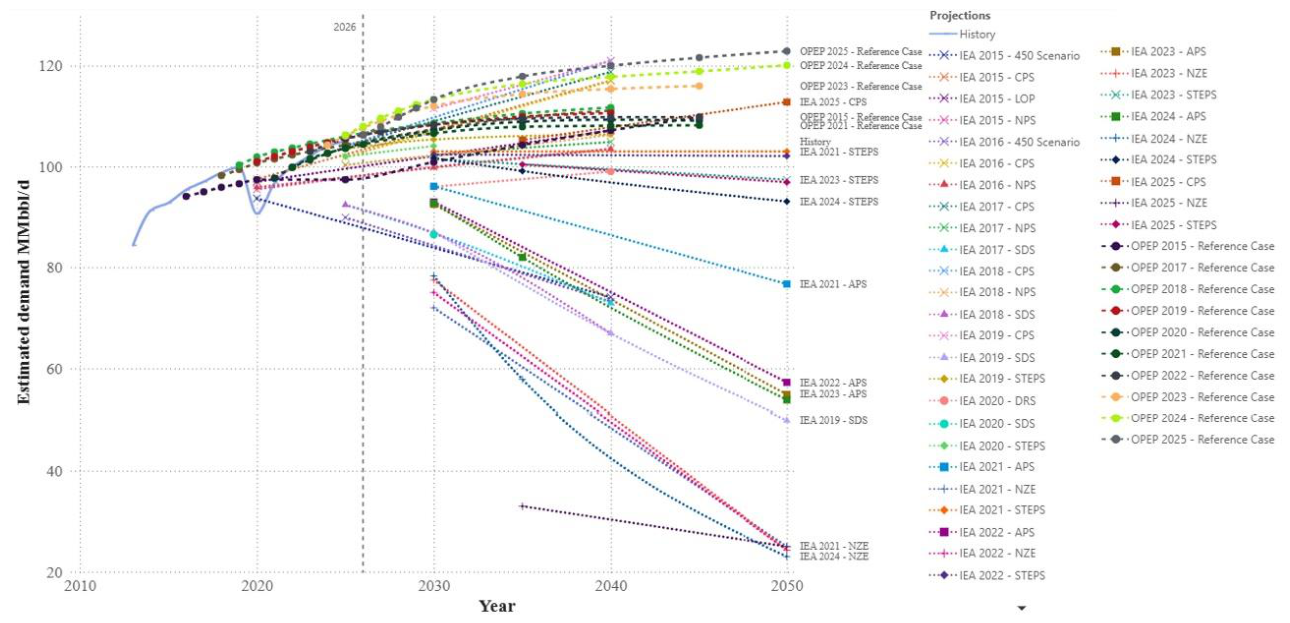
Table 1.
Synthesis of risks, uncertainties, and strategic movements of O&G companies.
| Risk Type | Threats and uncertainties impacting Exploration decision-making | Company Strategic Movements |
|---|---|---|
| 1. Market Risks | Uncertainties regarding peak demand and price volatility challenge the viability of projects with decades-long life cycles. The threat of stranded assets discourages long-term investments. | Portfolio review focusing on rapid-return and short-cycle assets; reassessment of strategies in frontier areas or areas without infrastructure. |
| 2. Regulatory and Political Risks | Carbon pricing mechanisms (taxes and ETS) and elimination of subsidies threaten operational margins and the economics of marginal or carbon-intensive projects. Moratoria and license restrictions can prevent access to new reserves. | Pursuit of energy efficiency, emissions reduction in E&P (Scopes 1 and 2), and adoption of CCS (Carbon Capture and Storage) technologies. |
| 3. Technological Disruption Risks | The advancement of renewables, biofuels, electrification, EVs, and energy efficiency has the potential to reduce oil demand and lead to a prolonged period of low prices and accelerated obsolescence of upstream assets. | Diversification beyond core business, investments in renewables, H2 and biofuels; repositioning as energy companies. |
| 4. Financial and Investment Risks | The possibility of a carbon bubble and devaluation of reserves (unburnable carbon) increases the cost of capital and restricts access to bank financing. | Greater financial discipline, prioritization of shareholder returns, and debt reduction at the expense of exploratory cost expansion. |
| 5. Reputational and Social License Risks | The increase in climate litigation, activist shareholder pressure, and difficulty attracting talent (geoscientists). Resistance to social acceptance can delay or cancel projects. | Greater transparency of decarbonization targets (Net Zero) and climate governance; adoption of brands and names seeking identification with sustainability. |
Note: ETS = Emissions Trading System; CCS = Carbon Capture and Storage; EVs = Electric Vehicles; H2 = Hydrogen.
Table 2.
Synthesis of exploratory concepts.
| Concept | Super Basin (AAPG) | Super Resource Basin | Co-exploration |
|---|---|---|---|
| Scope | Mature basins | Mature basins | All basins + frontiers |
| Timing | Revisit/retrofit | Subsequent coexistence | Integration from conception |
| Focus | Maximize O&G | Low-carbon hub | Diversification + resilience |
| Exploration Role | Final optimization | Coordinated transition | Strategic vanguard |
| Decision | Isolated by resource | Isolated by resource | Integrated multi-resource |
Disclaimer/Publisher’s Note: The statements, opinions and data contained in all publications are solely those of the individual author(s) and contributor(s) and not of MDPI and/or the editor(s). MDPI and/or the editor(s) disclaim responsibility for any injury to people or property resulting from any ideas, methods, instructions or products referred to in the content. |
© 2026 by the authors. Licensee MDPI, Basel, Switzerland. This article is an open access article distributed under the terms and conditions of the Creative Commons Attribution (CC BY) license (http://creativecommons.org/licenses/by/4.0/).
Copyright: This open access article is published under a Creative Commons CC BY 4.0 license, which permit the free download, distribution, and reuse, provided that the author and preprint are cited in any reuse.