

Submitted:
17 September 2026
Posted:
20 September 2026
You are already at the latest version
Abstract
The long-term decline in the population abundance of the European brown hare (Lepus europaeus Pall. 1778), observed since the 1970s, is primarily attributed to environmental and anthropogenic factors, but the contribution of infectious diseases to this species' population dynamics remains poorly understood. Among wildlife pathogens, lagoviruses attract particular attention because of their epidemiological and ecological significance and their changing host range. This study evaluated the population indicators of the European brown hare and serological evidence of its exposure to EBHSV and RHDV2 across five regions of Poland. The research was conducted in areas where local population densities still permit game management. A total of 109 hares harvested from five regions of eastern Poland were examined. Analysis of population indicators showed that hares from all studied regions had comparable physical condition, assessed by body weight. Significant differences in this trait were found only between juveniles and adults. Indicators related to population growth dynamics and future development suggest that, although their values are low, they still determine the reproductive capacity and annual recruitment of individual populations; however, these values decreased noticeably compared with previous years and other study areas in Poland. Serological tests revealed EBHSV-specific antibodies in hares from all five studied regions, which are characterised by stable population densities. This indicates a widespread exposure of the studied populations to this virus. The high percentage of sero-positive individuals confirms that contact with EBHSV was neither incidental nor restricted to a single location, but was detected across all investigated habitats. The presence of antibodies indicates exposure to the virus and the development of a specific humoral response, but it does not determine current infection status. A particularly important finding was the detection of antibodies reactive against RHDV2 in free-ranging brown hares. This result provides seroepidemiological evidence of exposure to RHDV2 and serves as a significant epidemiological signal that RHDV2 should be included in lagovirus surveillance in brown hares. This is especially relevant for hares in the vicinity of small, open-system rabbit farms. This finding highlights an important and hitherto insufficiently recognised element of epizootic pressure, whose significance for the stability and long-term population dynamics of the European brown hare requires special attention and further research. The results indicate that lagovirus exposure is a significant component of the diverse epidemiological background in which European brown hare populations function, even in areas with densities permitting game management. These findings emphasise the importance of integrated monitoring of hare populations, combining traditional population indicators with serological surveillance of lagoviruses. This approach can improve understanding of virus–host system dynamics, identify changes in the epizootic situation, and assess the potential significance of lagovirus infections for the long-term population dynamics of the European brown hare.
Keywords:
Lepus europaeus
; population indicator
; animal viruses
; European Brown Hare Syndrome (EBHSV)
; Rabbit Haemorrhagic Disease Virus 2 (RHDV2)
; host-pathogen interaction
; seroprevalence
1. Introduction
The European hare, or brown hare (Lepus europaeus), is one of the most characteristic representatives of the order of lagomorphs and was, until recently, widespread throughout Europe, including Poland. This species plays a significant role in the functioning of agricultural and open ecosystems, forming an important part of food webs and serving as an indicator of environmental condition. However, since the late 1960s, a downward trend in the population of this species has been observed in most European countries [1,2,3,4,5]. This trend has also affected Poland, where local population densities are currently lower than the annual harvest levels recorded in the 1960s and 1970s [6,7,8,9]. Nevertheless, population densities remain sufficiently high in some areas to permit sustainable annual harvesting through regulated hunting [10,11,12]. It is worth noting that hunting in areas with high population densities does not directly affect population growth dynamics, as it is compensatory, removing only the surplus and thus reducing population density in line with the decline in resource availability before winter [13].
Although it is not possible to point to the specific causes of such a dramatic decline in the hare population, the main factors cited are the intensification of agriculture, which, combined with the widespread use of plant protection products and climate change, has simplified agro-community structures and, consequently, led to the loss of habitats for this species [1,14]. This was confirmed by a study conducted in Austria, which showed a significant increase in hare survival rates depending on the proportion of fallow land compared with cultivated land [15]. In turn, climatic factors contribute to population decline, particularly among juvenile individuals, for whom the mortality rate in the first month of life was approximately 18% [16]. Predator pressure, mainly posed by foxes, also plays a significant role; this is linked to the oral vaccination programmes for wild foxes that have been carried out in many European countries since the 1970s as part of rabies control efforts [17,18,19,20,21,22,23].
Diseases with different aetiologies are another factor that substantially reduces hare populations. Until recently, coccidiosis and other parasitic diseases were considered the most significant [24,25,26,27]. However, in the 1980s, a new clinical entity was diagnosed and described as the European brown hare syndrome (EBHS). The disease was first diagnosed in 1980 in Scandinavia, although evidence suggests it may have existed earlier [28]. Originally, it was thought to be a toxic-metabolic syndrome. However, because the disease spread rapidly throughout Europe and contributed to the decimation of the hare population, research has shown that it is of viral origin [29]. In the mid-1990s, following the rapid spread of the highly lethal and contagious EBHS virus (GII.1) throughout many European countries, a dramatic decline in wild hare populations was recorded [30,31,32,33,34,35,36,37]. Furthermore, in the 1980s, a similar severe viral disease in rabbits (RHD) was diagnosed, caused by a different but closely related virus from the Caliciviridae family, genus Lagovirus, known as RHDV (GI.1). The two lagoviruses share numerous clinical, pathological and epizootic similarities [38,39]. The structural and evolutionary similarities between the viruses described are confirmed by cross-reactive immune responses [40]. In Poland, the first EBHSV isolate was detected in hares in 1992 [41,42]. During the same period, the presence of the virus was also confirmed in other studies conducted in western Poland. These studies also confirmed, for the first time, the presence of anti-RHDV antibodies in 3% of native hares [43]. In the early 2000s, outbreaks of EBHS were reported in Poland among hares kept in captivity, and genetic analyses revealed a close relationship between Polish and European strains of EBHSV [44]. In 2010, a new type of rabbit haemorrhagic disease virus, RHDV2 (GI.2), which causes the death of vaccinated rabbits and juvenile rabbits under one month of age, was detected in France [45,46]. RHDV2 strains (also referred to as RHDVb) were also isolated in 2011 in Spain [47]. The study showed that disease caused by this virus differs in duration, mortality rates and the higher prevalence of the subacute form, as well as partial cross-protection between RHDV and RHDV2. RHDV2, which affects both farmed and wild rabbits, is currently detected almost worldwide and can cause a disease resembling EBHS in various hare species. It has also been reported in species other than lagomorphs [48,49,50,51,52]. Another study covering two regions of Poland, conducted between 2020 and 2021, detected no RHDV2 in the 113 hares tested [53].
The aim of the study was to assess population indicators of the European brown hare (Lepus europaeus) and searching for the presence of EBHSV and RHDV2 viruses in hares inhabiting selected regions of Poland where population densities permit sustainable game management. The prevalence of both pathogenic lagoviruses was evaluated through serological investigation, using highly specific ELISA tests for EBHSV and RHDV2 antibodies. The presented study integrates population and serological data to characterize the epidemiological background of lagovirus exposure and to assess its potential significance for virus–host interactions and population dynamics.
2. Materials and Methods
2.1. Animals
The study was conducted on a sample of 109 hares harvested in five regions of eastern Poland (Figure 1). As the biological material for the study was collected from dead hares obtained in accordance with Polish hunting legislation, no approval from the local ethics committee was required to carry out the study. The hares were harvested during the 2022/23 hunting season. Immediately after harvesting, body mass was measured using a portable KERN HCB20K10 scale (Germany). The hares’ age was determined by initially categorising them into juveniles or adults based on body mass [54], and then refined using the method proposed by Stroh. This method classifies individuals as juveniles or adults based on the presence or absence of cartilaginous swelling on the forelimb [55]. This enabled distinguishing between juveniles (up to 1 year old) and adults (over 1 year old). In turn, sex was determined on the basis of the presence of secondary sexual characteristics [7]. Blood samples were collected in the field directly from harvested hares for analysis.
2.2. Population Indicators
To describe population growth dynamics, the coefficient of reproduction, reproductive index/success rate, coefficient of population increase and population increase were used [3].
Coefficient of reproduction:
Reproductive index/success rate:
Coefficient of population increase:
Population increase:
Where:
Njuv - number of juveniles
Nad - number of adults
Nadf - number of adult females
%juv - percentage of juveniles
Furthermore, the sex and age structure of hares in each research area was calculated.
2.3. Serological Methods
Antibodies against EBHSV and RHDV2 in hare blood serum samples were detected using two ELISA kits for EBHSV and RHDV2 serology, commercially available from the Istituto Zooprofilattico Sperimentale della Lombardia e dell’Emilia (IZSLER) in Brescia, Italy (IZSLER product codes: 72574 and 78751). The tests were carried out in accordance with the manufacturer’s instructions. Each ELISA kit contains appropriate negative and positive control sera, viral antigen and specific monoclonal antibodies conjugated to horseradish peroxidase, enabling highly sensitive detection of antibodies against EBHSV and RHDV2. The serum titre corresponds to the dilution of the test serum that inhibits the absorbance (492 nm) of the negative control serum by 50%.
2.4. Statistical Analysis
In the database, variables relating to serological status (the presence of antibodies against EBHS and RHDV2) were encoded in a binary system as dichotomous variables (‘0’ – negative result – no antibodies or a titre below 10; ‘1’ – positive result/presence of antibodies with a titre of 10 or higher), while antibody titres were entered as continuous values.
The normality of the distribution of the continuous variables analysed was verified using the Shapiro-Wilk test. The homogeneity of variances in the groups being compared was assessed using Levene’s test. To assess the significance of differences between two independent groups for normally distributed variables, the t-test for independent samples was employed. When analysing antibody titres, the non-parametric Mann-Whitney U test was used because the assumptions of normality were not met. An analysis of the prevalence of antibodies (seroprevalence) by gender and age was carried out using Fisher’s exact two-sided test and the chi-squared test of independence. Differences in seroprevalence and antibody titres between the individual geographical regions (REGs 1–5) were assessed using the Kruskal-Wallis test.
A multifactorial assessment of the determinants of seroprevalence was carried out using generalised mixed-effects models of analysis of covariance (Mixed ANCOVA). In these models, the region of origin (REG) was included as a random effect; sex, age and (in the model for RHDV2) EBHS serological status were included as fixed effects, while the individual’s body mass was included as a covariate.
All statistical calculations and graphical visualisations were performed using Statistica 13.1 software with a standard significance level of α = 0.05.
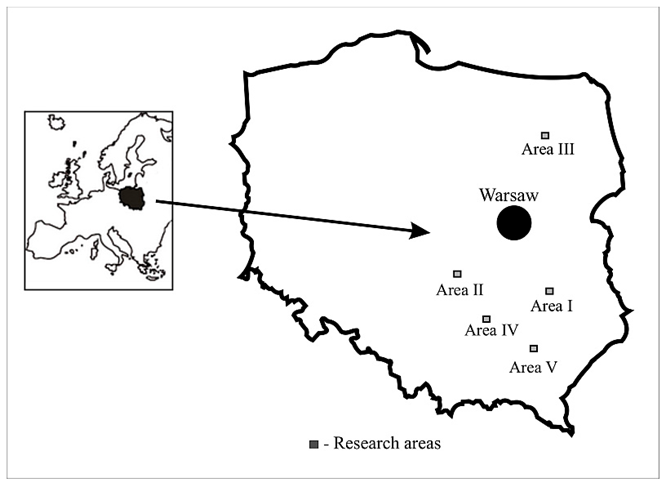 |
| Map 1. Spatial distribution of the research areas. |
3. Results
3.1. Structure of the Populations Under Assessment
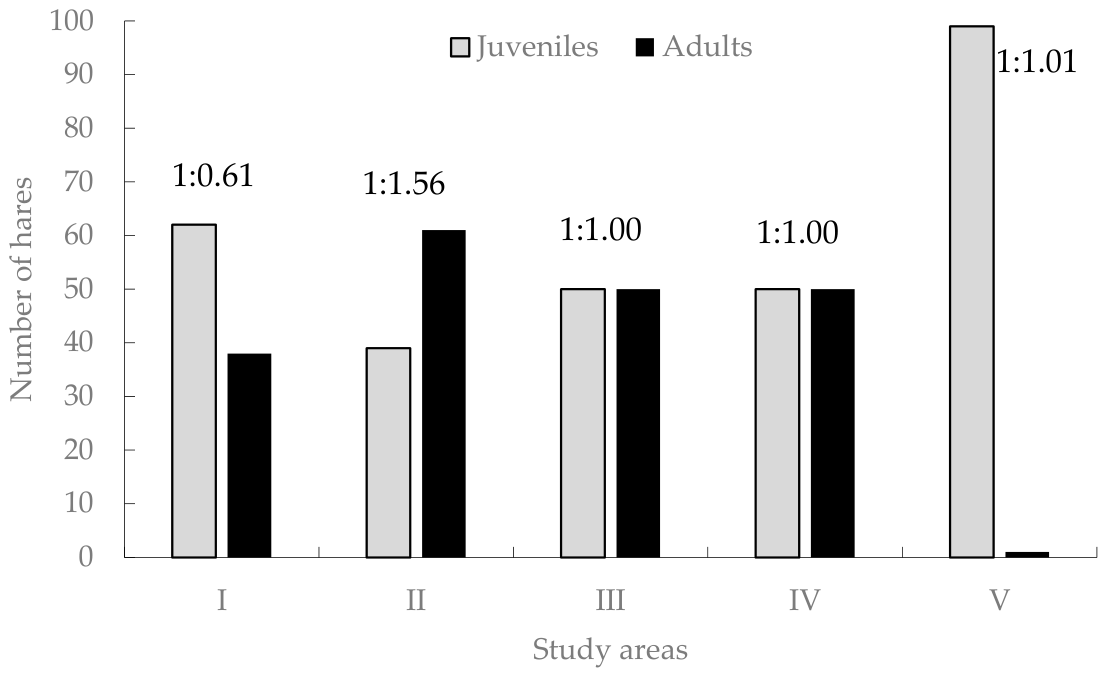
The body mass of both juvenile and adult hares showed little variation between the areas from which the animals originated (Table 1). The comparative analysis showed no statistically significant differences in body mass between males (4.09 kg) and females (4.11 kg) (t-test=-0.381; p=0.704; Levene’s test: p=0.538), which indicates the absence of sexual dimorphism in this respect in the sample under analysis. However, body mass was found to be strongly and highly statistically significantly correlated with the age of the individuals (t= -10.212; p<0.001; Levene’s test: p=0.252). Adult hares (A) were, on average, over 0.5 kg heavier (4.40 kg) than juveniles (J) (3.88 kg). Overall, the study population showed a higher proportion of females (56%) than males (44%), and juveniles (57.8%) were more common than adult hares aged over one year (42.2%) (Figure 1 and Figure 2). However, the percentage share of the above-mentioned categories (age/sex) in individual groups of animals deviated from the average values, as was the case in Area III, where adult hares accounted for 100%, and in Area V, where juvenile hares accounted for 95.6% of the animals.
Figure 1.
Hare sex structure in research areas (expressed as a ratio of males to females).
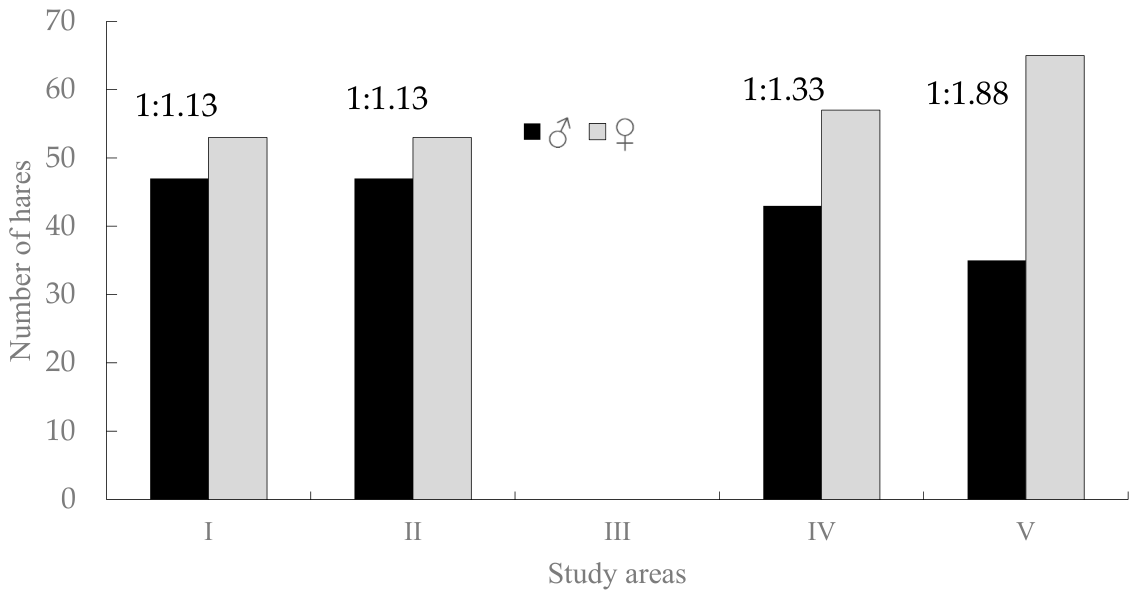
Figure 2.
Hare age structure in research areas (expressed as a ratio of juveniles to adults).
An analysis of population indicators revealed substantial variation in the parameters assessed across the individual research areas (Table 1). Nevertheless, the coefficient of population growth was positive in all areas, and its values indicate that these populations are growing at a moderate rate. The values of the coefficient of reproduction are rather concerning, as it fluctuated around 1.0 (except for Area V), indicating a decline in the condition of individual populations in terms of their potential for further growth. However, the small sample sizes do not allow any clear conclusions to be drawn in this regard.
3.2. EBHS Seroprevalence
The overall seroprevalence of antibodies against the EBHS virus (GII.1) in 109 wild hares from five different geographical regions of Poland, collected between November and the end of December 2022, was estimated at 78.9% (Table 2). The antibody titres recorded by the EBHS ELISA test in 86 hares fell within the low (10-40) or medium (40-≤160) ranges. No antibodies against EBHS were detected in 23 animals (21.1%). Within individual sample batches, the proportion of seropositive hares ranged from 72.3 to 87.0%. The overall percentage of EBHS-seropositive hares was higher in females than in males, averaging 47.7% compared with 31.2%. In individual batches, the proportion of females with EBHS antibodies among all positive individuals in the group ranged from 55.9 to 70%, while for males, it ranged from 30.0 to 45.5%. Considering the animals’ age, the proportion of EBHS-seropositive hares was higher among juveniles than among adults, at 44% and 34.9%, respectively.
An overall assessment of the entire study sample showed that, by sex, the prevalence of EBHS infections was 85.2% (52/61) among females and 70.8% (34/48) among males. Although a higher seroprevalence was observed in females, this difference did not reach the threshold for statistical significance, showing only a weak trend (two-tailed exact Fisher’s test, p=0.097; chi-squared test=3.35, p=0.067). An analysis of antibody titres using the Mann-Whitney U test showed no statistically significant differences between males and females (U=1335.0; Z=0.78; p=0.413).
Meanwhile, analysis by sex group showed that seroprevalence of EBHS among juvenile individuals (J) was 81.0% (51/63), while among adults (A), it was 76.1% (35/46). An analysis of the effect of age on seroprevalence revealed no statistically significant differences between juvenile and adult individuals (two-tailed exact Fisher’s test, p=0.482; chi-squared test=0.66, p=0.417). A comparison of antibody titres between juvenile and adult hares, carried out using the Mann-Whitney U test, also revealed no statistically significant differences (U=1391.0; Z=-0.37; p=0.712). It follows that the age of the hares (J vs A) had no effect on either the presence of the virus (seroprevalence) alone or the strength of the serological response (antibody titres).
An analysis of infection prevalence according to the animals’ area of origin showed no significant geographical differences in the seroprevalence of the EBHS virus. With regard to EBHS, the proportion of seropositive individuals across the individual areas was similar (chi-square test = 2.87; p = 0.580). A comparison of antibody titres across research areas, conducted using the Kruskal-Wallis test, revealed no statistically significant differences (H=0.94; p=0.918). The level of the immune response in hares was similar and independent of the source location.
A comparative analysis of hare body mass by EBHS serostatus showed that EBHS-seropositive individuals (N=86) had a significantly higher mean body mass (4.15 kg) than EBHS-seronegative individuals (N=23; 3.91 kg). This difference, as determined by a t-test for independent samples, was statistically significant (t=2.875; p=0.0049). The higher average body mass of seropositive individuals (4.15 kg) compared with seronegative ones (3.91 kg) reflects the relationship between a hare’s biological maturity and the duration of its exposure to the pathogen (Figure 3). Body mass is a precise indicator of age and level of physical development in individuals, which means that heavier hares spend more time in the wild and are more likely to be exposed to the EBHS virus, a factor associated with the development of a humoral immune response. Greater body mass may also indicate good overall body condition in animals that have successfully survived infection and developed long-lasting population immunity.
3.3. RHDV2 Seroprevalence
Antibodies against RHDV2 (GI.2) were detected in 11 hare serum samples from all batches, collected in 5 research areas. The average RHDV2 seroprevalence was 10.1%. The ELISA titres for RHDV2 ranged from 20 in 7 samples, through 40 in 1 sample, to 80 (the maximum value) in 3 samples (Table 3). Nine of the eleven hares that tested positive in the EBHS ELISA (HRP conjugated with specific monoclonal antibodies) showed higher titres than those obtained in the RHDV2 serology ELISA (Figure 4). In contrast, the antibody titres in the ELISA test for RHDV2 were higher in two of the eleven hares than in the EBHS serological test. In two hares examined, the titre of antibodies against RHDV2 was 80, and these were the only hares in this group that, according to the interpretation by Velarde et al. [56], also applied in other studies [57], had Rt values in the RHDV2/EBHS ELISA tests of 8 and 4, respectively, which indirectly suggests that these hares had a more recent or primary exposure to the RHDV2 antigen.
No significant differences in RHDV2 seroprevalence were found between females (11.5%, 7/61) and males (8.3%, 4/48) (two-tailed exact Fisher’s test, p=0.752; chi-squared test=0.29, p=0.589). This was confirmed by an analysis of antibody titres using the Mann-Whitney U test, which revealed no statistically significant differences between males and females (U=420.0, Z=-0.27, p=0.611). An analysis of the effect of age on seroprevalence also revealed no statistically significant differences between juvenile and adult individuals (two-tailed exact Fisher’s test, p=0.522; chi-squared test=0.76, p=0.382). This was confirmed by the Mann-Whitney U test, which also failed to reveal any statistically significant differences (U=1383.0, Z=-0.77, p=0.442). It follows that the age of the hares (J vs A) had no effect on either the presence of the virus (seroprevalence) alone or the strength of the serological response (antibody titres). Moreover, an analysis of infection prevalence by animals’ area of origin did not reveal any significant geographical differences in seroprevalence. The region of origin did not significantly affect antibody detection frequency (chi-square test=4.09; p=0.394). A comparison of antibody titres between the areas under study, carried out using the Kruskal-Wallis test, revealed no statistically significant differences (H=4.04; p=0.400). Therefore, the extent of the immune response in hares was similar regardless of the place from which they were sourced. A similar comparative analysis of hare body mass by RHDV2 serostatus (Figure 5) revealed no statistically significant differences between seronegative (4.10 kg) and seropositive (4.09 kg) individuals (t=0.091, p=0.927). This suggests that, unlike EBHS, body mass is not associated with RHDV2 serological status, confirming the incidental nature of the animals’ exposure to this virus, independent of their biological age.
In order to identify the factors affecting the presence of EBHS antibodies, a generalised mixed-effects model (ANCOVA) was used, in which the region of origin was included as a random effect, sex and age as fixed effects, and the individual’s body mass as a covariate. The only factor showing a statistically significant effect on the presence of EBHS antibodies was body mass (p=0.0061). Neither age (p=0.1208) nor the random effect of the area (p=0.2174) showed a significant effect on the serological status of hares, while sex showed a weak trend towards significance (p=0.0777), with a higher seroprevalence recorded in females. In turn, an analysis of factors affecting the presence of RHDV2 antibodies, considering EBHS serological status, showed that the only statistically significant predictor of the presence of RHDV2 antibodies was EBHS serological status (p=0.0366). Hares with antibodies against EBHS exhibited a significantly higher prevalence of antibodies against RHDV2. The other variables analysed, including age (p=0.1609), sex (p=0.5661), body mass (p=0.9241) and the random effect of the sampling area (p=0.7072), did not have a significant effect on RHDV2 seropositivity.
Given that EBHS is the dominant serotype in the population (78.9%), individuals seropositive for RHDV2 are almost exclusively derived from a group of hares that already possess antibodies against EBHS. This correlation strongly supports the hypothesis of cross-reactivity between the antigens of the two viruses (owing to their close taxonomic relationship within the Caliciviridae family) or points to an overlap in transmission routes and the presence of common environmental vectors that transmit both pathogens.
4. Discussion
The dramatic decline of the hare population in Poland since the 1970s is a long-standing phenomenon [58,59] that is worsening given the current ecological and population situation [11,60,61]. This situation is not an isolated one and reflects a much wider phenomenon occurring throughout Europe. This unfavourable development resulted from a number of factors: environmental factors (the use of chemicals on fields, changes in crop structure), factors linked to the urbanisation of rural areas (a reduction in arable land, changes in crop structure), and the occurrence of parasitic and infectious diseases [2]. Among the latter, the European brown hare syndrome (EBHSV), a fatal viral disease caused by the lagovirus EBHSV (GII.1), deserves mention first and foremost. A significant contribution of EBHS to the decline in hare populations has been observed since the 1980s, initially on the Scandinavian Peninsula, and later in most European countries [14,28]. In Poland, the impact of EBHSV on the hare population has been particularly pronounced since the mid-1990s [41].
The results from the present study regarding population indicators confirm earlier findings from studies conducted in four regions of south-eastern Poland, namely that body mass is determined solely by age, while the region of origin plays a lesser role. In terms of sex structure, females also predominated. However, the present study showed a balanced age distribution, with a slight predominance of juvenile individuals. As previously noted, key parameters related to reproduction and long-term population persistence indicate that, despite population densities that permit hunting, these populations are on the verge of being unable to continue functioning optimally [61]. These findings also confirm data from other studies in south-eastern Poland regarding body mass, but do not confirm the data on age structure [60]. In turn, a nationwide study conducted in 2009 also revealed differences in body mass only by age group, with females clearly predominating within each population. The average body mass was similar to the current figure reported by Misiorowska et al. [11]. Similar results regarding body mass were obtained in Hungary, with a slight advantage for juvenile hares over adults [5]. A Slovak study conducted in 2011–2012 in the Nitra region revealed a similar proportion of males and females in the population, although differences were observed in age groups and between study seasons [4]. At present, the body mass of hares in Poland is also similar to that in the Central Pomerania region [6], and significantly higher than that reported for the Greater Poland region [62] and north-eastern Croatia [3]. The results of a study into the body mass of continental and island hares in Sweden showed that hares living on the mainland had a higher body mass. There were no significant differences between the sex groups, while differences were found between juvenile and adult hares [63]. Body mass can also be correlated with climatic conditions. A study comparing adult female hares from Belgium (temperate oceanic climate) and Lower Austria (temperate continental climate) showed that the animals from Belgium had a higher body mass (4.3 kg) than those from Austria (3.4 kg) [64]. At present, the rates of reproductive dynamics and thus of population growth, although for the most part remaining at a level that enables continued slow population growth, are lower than those recorded in previous years in Poland, Croatia and Hungary [3,5,61].
In recent years, type 2 rabbit haemorrhagic disease (RHD) has been identified as a potential threat to the hare population. RHDV2 (GI.2) is a pathogenic lagovirus that is fatal to rabbits. This virus first appeared in France in late 2010, whereas in Poland, it has been present since 2016. The many distinctive features characterising RHDV2 include its ability to overcome immunity in rabbits vaccinated against RHDV (GI.1), the mortality of juvenile rabbits under two months of age and, most importantly, its ability to infect hares and cause a disease similar to EBHS [45,46]. As has been repeatedly demonstrated, RHDV2 is capable of overcoming species barriers and occasionally infecting hares [48,49,56,65,66,67]. Although no such cases have yet been diagnosed in Poland’s native population of brown hares, it seems obvious that domestic rabbits, particularly those from traditional open-range systems kept in rural areas, are the likely source of RHDV2 transmission to hares.
The opportunity to obtain blood samples from hunted hares for serological testing enabled assessment of their serological status regarding EBHS. The authors’ previous study, which was limited to two hunting areas in eastern and central Poland, revealed a high proportion of EBHS-seropositive hares in those areas. The present study, conducted on a sample of 109 hares, was expanded to include samples from new hunting areas, previously unexplored in this respect, and located along the eastern border of Poland and in the southern and central parts of the country (Figure 1). The results of EBHS antibody tests showed a high seroprevalence of the virus (78.9%) across all areas analysed. In a habitat located in the hunting area that was examined again after more than a year (Area I), the proportion of hares seropositive for EBHSV (72.3%) was similar to the level (75–90%) noted in the previous study [53]. Similar to the previous study, the overall proportion of EBHS-seropositive hares was higher in females than in males (47.7% vs 31.2%). However, with regard to age, a high proportion of seropositive hares was found in both juveniles (81.0%) and adults (76.1%), although these differences were not statistically significant. The persistence of such a high seroprevalence even among juvenile individuals demonstrates widespread exposure of hares to the EBHS virus in the environment, indicating constant infectious pressure from the virus, regardless of the animals’ age.
The high proportion of EBHS-seropositive hares, which is comparable to the results of a previous study [53] and to data recorded in recent years in Italy [57], can be interpreted as a state of population immunity following natural infection, due to the presence of the EBHS virus in the habitats under analysis. Generally low EBHS antibody titres (10-40), with a maximum of 160 (in only 4 hares), indicate that exposure to the virus occurred some time ago.
The positive RHDV2 serology result found in 11 hares (10% of the total) previously diagnosed as EBHS-positive (Figure 3) may indicate exposure to both pathogenic lagoviruses. An analysis of EBHSV antibody titres reveals that, in 9 cases, these titres were higher than those for RHDV2. In 6 serum samples, the ratio of EBHS titre to RHDV2 (Rt ratio according to Velarde [56] ranged from 2 to 8, while in one sample, it was 1. However, in this case, exposure of the hares to RHDV2 cannot be ruled out, as the data may also result from a cross-reaction due to antigenic similarity, as noted by Estruch et al. [57].
A completely different serological response was observed for two hares from a habitat near Dąbrowa Tarnowska (Area V). In these cases, the RHDV2 antibody titre (80) was 8 times and 4 times higher than the EBHSV antibody titre, respectively, indicating direct exposure to RHDV2. The presence of RHDV2 in this area is not unexpected. RHDV2 has been identified there on several occasions between 2018 and 2020 [68] and most recently in 2025 (unpublished data). The presence of RHDV2 in this area has been confirmed using virological and molecular methods, and its genetic profile places it in the GI.3/GI.2 group. Moreover, the RHD outbreaks caused by RHDV2, recently detected for the first time in eastern Slovakia, have confirmed an epizootic situation in this European area, linked to the active circulation of GI.2 strains in the immediate vicinity of southeastern Poland [69].
Whether the positive serological reaction to RHDV2 was associated with EBHS seroconversion and resulted from the antigenic similarity and capsid structure shared by the lagoviruses EBHSV and RHDV2 remains difficult to determine conclusively. The authors of the present study found that high EBHS antibody titres did not always correlate with RHDV seroconversion. For example, in one of the hares from Area I with a relatively high EBHS antibody titre (160), no presence of RHDV2 antibodies was detected. However, cases with significantly higher RHDV2 antibody titres than EBHS (e.g., reported in Area V) indicate real, direct exposure to this pathogen. These findings suggest that the serological presence of antibodies to both viruses has complex underlying causes, arising from both antigenic similarity and potential cross-reactions, as well as from the local presence of RHDV2 in the hare population.
5. Conclusions
The analysis of hare population indicators across five regions of Poland revealed no significant differences in body weight among the studied areas. Moreover, these values did not differ from those recorded in previous years or from data reported in other European countries. In turn, data on sex and age structure across all studied areas showed that, along with a decline in population abundance, population indicators of reproductive capacity also decreased, directly limiting development prospects in subsequent years.
Serological tests provided evidence of free-ranging hare exposure to lagoviruses in the analysed regions. The serological tests revealed EBHSV-specific antibodies in hares from all five studied regions, which are characterised by stable population densities and are located in eastern, central, and southern Poland. These results indicate widespread exposure to EBHSV and confirm that this virus is a significant component of the epidemiological situation in the studied European brown hare populations. Based on these results, the high percentage of EBHSV-seropositive hares, regardless of study area, may indicate the development of herd immunity, providing a certain level of protection against infection while supporting the annual renewal of the hare population. Although the estimated population growth rates were positive, the low reproduction coefficient (fluctuating up to 1.0), combined with the widespread and persistent occurrence of EBHSV, serves as a serious warning signal. Under intensive epizootic pressure, such low reproductive potential does not provide the population with a safe survival margin. In the long term, this situation may reduce reproductive capacity. Consequently, population density may further decline and local populations may lose stability, even in areas where densities currently remain at a level permitting hunting.
Detecting antibodies reactive against RHDV2 in free-ranging hares is an important epidemiological observation, indicating prior exposure to the virus. This result is particularly significant in areas where RHDV2 occurs in rabbit populations, especially near small farms operating under an open system, where contact between wild and captive leporids may increase exposure. The presence of RHDV2-reactive antibodies in wild hares therefore indicates an additional epidemiological factor whose potential significance for the health and population dynamics of this species remains unrecognised. Determining whether exposure to RHDV2 is sporadic or more widespread in European brown hare populations, and defining its potential consequences, requires further monitoring and research in selected areas.
In summary, combining the assessment of population indicators with serological surveillance provided a broader perspective on lagovirus–host interactions in European brown hare populations. Although the results do not yet allow an unambiguous determination of the relationship between exposure to EBHSV and RHDV2 and population indicators, the study provides valuable epidemiological data from free-ranging hares representing five geographically distinct regions of Poland. Serological evidence, reflecting widespread exposure of hares to EBHSV, along with the detection of RHDV2-reactive antibodies — highlight the importance of lagoviruses as a valuable element of the epidemiological landscape within the studied populations. Further long-term studies combining monitoring of population indicators with serological surveillance, molecular diagnostics, and genomic characterisation of lagoviruses are essential to determine the significance of exposure to and infection with these viruses for the health, stability, and future population dynamics of Lepus europaeus.
Supplementary Materials
The following supporting information can be downloaded at the website of this paper posted on Preprints.org.
Author Contributions
Conceptualization: M.F., A.F. and P.C.; methodology: M.F., B.H.-S. and A.F.; validation: P.C., B.H.-S. and A.F.; formal analysis: P.C., M.F. and A.F.; investigation: M.F., P.C., K.Ł. and A.F.; resources: M.F., K.Ł. and A.F.; data curation: M.F., P.C. and K.Ł.; writing—original draft preparation: M.F., K.Ł. and N.B.; writing—review and editing: P.C., B.H.-S. and A.F.; visualization: K.Ł. and N.B.; supervision: P.C., B.H.-S. and A.F.; project administration: M.F. and A.F.; funding acquisition: M.F. and A.F. All authors have read and agreed to the published version of the manuscript.
Funding
This research received no external funding.
Institutional Review Board Statement
The study material included hares culled during legal hunting by Polish hunters in the 2022/2023 hunting season, in accordance with the Polish Hunting Law and relevant regulations. During the hunt, the dead hares were weighed and their eyeballs were dissected for laboratory analyses. Since the entire study and sampling were performed on animals legally harvested during standard hunting seasons and not specifically for the purpose of this experiment, such research did not require the approval of the Ethics Committee.
Informed Consent Statement
Not applicable.
Data Availability Statement
The data presented in this study are available on request from the corresponding author.
Conflicts of Interest
The authors declare no conflicts of interest.
References
- Smith, R.K.; Jennings, N.V.; Harris, S. A quantitative analysis of the abundance and demography of European hare Lepus europaeus in relation to habitat type, intensity of agriculture and climate. Mamm. Rev. 2005, 35, 1–24. [Google Scholar] [CrossRef]
- Schmidt, N.M.; Asferg, T.; Forchhammer, M.C. Long-term patterns in European brown hare population dynamics in Denmark: effects of agriculture, predation and climate. BMC Ecol. 2004, 4, 1–7. [Google Scholar] [CrossRef] [PubMed]
- Pintur, K.; Popović, N.; Alegro, A.; Severin, K.; Slavica, A.; Kolić, E. Selected indicators of brown hare (Lepus europaeus Pallas, 1778) population dynamics in northwestern Croatia. Vet. Arh. 2006, 76, 199–209. [Google Scholar]
- Méres, J.; Ostrihoň, M.; Slamečka, M.; Kaštier, J. Population structure of brown hare (Lepus europaeus): a case study in selected areas of Nitra region. Acta Fac. For. Zvolen 2013, 1, 43–58. [Google Scholar]
- Farkas, P.; Kusza, S.; Majzinger, I. Analysis of some population parameters of the brown hare (Lepus europaeus Pallas, 1758) in two hunting areas on the Hungarian great plain. Lucr. Științ. Manag. Agric. 2016, 18, 71–74. [Google Scholar]
- Mysłek, P.; Kalasińska, E.; Bartyzel, B. Size of the brown hare (Lepus europaeus Pallas 1778) living in Central Pomerania in Poland. Zool. Pol. 2004, 49, 237–244. [Google Scholar]
- Pielowski; Zając, Z. Monografia przyrodniczo−łowiecka; PWRiL: Warszawa, Polska, 1979. [Google Scholar]
- Misiorowska, M.; Wasilewski, M. Survival and causes of death among released brown hares (Lepus europaeus Pallas, 1778) in Central Poland. Acta Theriol. 2012, 57, 305–312. [Google Scholar] [CrossRef] [PubMed]
- Flis, M. Variability of density and habitat preferences of brown hare in hunting district located in the Lublin Upland. Sylwan 2016, 160, 829–836. [Google Scholar] [CrossRef]
- Dziedzic, R.; Kamieniarz, R.; Majer-Dziedzic, B.; Wójcik, M.; Beeger, S.; Flis, M.; Olszak, K.; Żontała, M. Przyczyny spadku populacji zająca szaraka w Polsce; Wyd. Ministerstwo Środowiska. Fundacja Ekonomistów Środowiska i Zasobów Naturalnych: Warszawa, Polska, 2002; pp. 7–48. [Google Scholar]
- Misiorowska, M.; Ludwisiak, Ł.; Nasiadka, P. Population parameters of brown hare (Lepus europaeus L.) in regions of the species highest density in Poland. Sylwan 2014, 158, 901–910. [Google Scholar] [CrossRef]
- Flis, M.; Rataj, B. Characteristics of population indicators of brown hare (Lepus europaeus Pall.) obtained during group hunting in the region with the highest density in western part of the Lublin Region in Poland. Appl. Ecol. Environ. Res. 2019, 17, 13701–13711. [Google Scholar] [CrossRef]
- Olesen, C.R.; Asferg, T. Assessing potential causes for the population decline of European brown hare in the agricultural landscape of Europe – a review of the current knowledge; NERI Technical Report No. 600; National Environmental Research Institute: Ministry of the Environment: Denmark, 2006; pp. 5–31. [Google Scholar]
- Edwards, P.J.; Fletcher, M.R.; Berny, P. Review of the factors affecting the decline of the European brown hare, Lepus europaeus (Pallas, 1778) and the use of wildlife incident data to evaluate the significance of paraquat. Agric. Ecosyst. Environ. 2000, 79, 95–103. [Google Scholar] [CrossRef]
- Schai-Braun, S.C.; Reichlin, T.S.; Ruf, T.; Klansek, E.; Tataruch, F.; Arnold, W.; Hackländer, K. The European hare (Lepus europaeus): A picky herbivore searching for plant parts rich in fat. PLoS ONE 2015, 10, e0134278. [Google Scholar] [CrossRef] [PubMed]
- Karp, D.; Gehr, B. Bad hare day: very low survival rate in brow hare leverets. Wildl. Biol. 2020, 2020, 1–8. [Google Scholar] [CrossRef]
- Goszczyński, J.; Wasilewski, M. Predation of foxes on a hare population in central Poland. Acta Theriol. 1992, 37, 329–338. [Google Scholar] [CrossRef]
- Panek, M.; Kamieniarz, R.; Bresiński, W. The effect of experimental removal of red foxes Vulpes vulpes on spring density of brown hares Lepus europaeus in western Poland. Acta Theriol. 2006, 51, 187–193. [Google Scholar] [CrossRef]
- Panek, M. Long-term changes in the feeding pattern of red foxes Vulpes vulpes and their predation on brown hares Lepus europaeus in western Poland. Eur. J. Wildl. Res. 2013, 59, 581–586. [Google Scholar] [CrossRef]
- Demirbas, Y. Density of European hare and red fox in different habitats of Kirikkale Province (Central Anatolia), with a low level in hare number and an expected correlation in spring. Acta Zool. Bulg. 2015, 67, 515–520. [Google Scholar]
- Hušek, J.; Panek, M.; Tryjanowski, P. Predation risk drives habitat-specific sex ratio in a monomorphic species, the brown hare (Lepus europaeus). Ethology 2015, 121, 593–600. [Google Scholar] [CrossRef]
- Flis, M. Preventive vaccination of foxes against rabies-economic and environmental aspect. Econ. Environ. 2018, 1, 220–230. [Google Scholar]
- Ponjiger, I.; Ristić, Z.; Marković, V.; Matejević, M.; Kovačević, M. The dynamics of red fox (Vulpes vulpes) and brown hare (Lepus europaeus) population in the Vojvodina region (Serbia) in relation to rabies vaccination. Vet. Arh. 2020, 89, 839–850. [Google Scholar] [CrossRef]
- Pikula, J.; Beklova, M.; Holesovska, Z.; Treml, F. Ecology of European brown hare and distribution of natural foci of tularemia in the Czech Republic. Acta Vet. Brno 2004, 73, 267–273. [Google Scholar] [CrossRef]
- Dubinský, P.; Vasilková, Z.; Hurníková, Z.; Miterpáková, M.; Slamečka, J.; Jurčík, R. Parasitic infections of the European brown hare (Lepus europaeus Pallas, 1778) in south-western Slovakia. Helminthologia 2010, 47, 219–225. [Google Scholar] [CrossRef]
- Chroust, K.; Vodnansky, M.; Pikula, J. Parasite load of European brown hares in Austria and Czech Republic. Vet. Med. 2012, 57, 551–558. [Google Scholar] [CrossRef]
- Kornaś, S.; Wierzbowska, I.; Wajdzik, M.; Kowal, J.; Basiaga, M.; Nosal, P. Endoparasites of European Brown Hare (Lepus europaeus) from Southern Poland based on necropsy. Ann. Anim. Sci. 2014, 14, 297–306. [Google Scholar] [CrossRef]
- Gavier-Widén, D.; Mörner, T. Epidemiology and diagnosis of the European brown hare syndrome in Scandinavian countries: A review. Rev. Sci. Tech. 1991, 10, 453–458. [Google Scholar] [CrossRef] [PubMed]
- Lavazza, A.; Vecchi, G. Osservazione su alcuni episodi di mortalità nelle lepri. Evidenziazione al microscopio elettronico di una particella virale. Nota preliminare. Selez. Vet. 1989, 30, 461–467. [Google Scholar]
- Cancellotti, F.M.; Renzi, M. Epidemiology and current situation of viral haemorrhagic disease of rabbits and the European brown hare syndrome in Italy. Rev. Sci. Tech. 1991, 10, 409–422. [Google Scholar] [CrossRef] [PubMed]
- Scicluna, M.T.; Lavazza, A.; Capucci, L. European brown hare syndrome in northern Italy: Results of a virological and serological survey. Rev. Sci. Tech. 1994, 13, 893–904. [Google Scholar] [CrossRef]
- Nauwynck, H.; Callebaut, P.; Peeters, J.; Ducatelle, R.; Uyttebroek, E. Susceptibility of hares and rabbits to a Belgian isolate of European brown hare syndrome virus. J. Wildl. Dis. 1993, 29, 203–208. [Google Scholar] [CrossRef] [PubMed]
- Syrjälä, P.; Nylund, M.; Heinikainen, S. European brown hare syndrome in free-living mountain hares (Lepus timidus) and European brown hares (Lepus europaeus) in Finland 1990–2002. J. Wildl. Dis. 2005, 41, 42–47. [Google Scholar] [CrossRef] [PubMed]
- Frölich, K.; Haerer, G.; Bacciarini, L.; Janovsky, M.; Rudolph, M.; Giacometti, M. European brown hare syndrome in free-ranging European brown and mountains hares from Switzerland. J. Wildl. Dis. 2001, 37, 803–807. [Google Scholar] [CrossRef] [PubMed]
- Frölich, K.; Wisser, J.; Schmüser, H.; Fehlberg, U.; Neubauer, H.; Grunow, R.; Nikolaou, K.; Priemer, J.; Thiede, S.; Streich, W.J.; Speck, S. Epizootiologic and ecologic investigations of European brown hares (Lepus europaeus) in selected populations from Schleswig-Holstein, Germany. J. Wildl. Dis. 2003, 39, 751–761. [Google Scholar] [CrossRef] [PubMed]
- Le Gall-Reculé, G.; Zwingelstein, F.; Laurent, S.; Portejoie, Y.; Rasschaert, D. Molecular epidemiology of European brown hare syndrome virus in France between 1989 and 2003. Arch. Virol. 2006, 151, 1713–1721. [Google Scholar] [CrossRef] [PubMed]
- Chasey, D.; Duff, P. European brown hare syndrome and associated virus particles in the UK. Vet. Rec. 1990, 126, 623–624. [Google Scholar] [PubMed]
- Abrantes, J.; Van der Loo, W.; Le Pendu, J.; Esteves, P.J. Rabbit haemorrhagic disease (RHD) and rabbit haemorrhagic disease virus (RHDV): A review. Vet. Res. 2012, 43, 12. [Google Scholar] [CrossRef] [PubMed]
- Le Pendu, J.; Abrantes, J.; Bertagnoli, S.; Guitton, J.S.; Le Gall-Reculé, G.; Lopes, A.M.; Marchandeau, S.; Alda, F.; Almeida, T.; Celio, A.P.; Bárcena, J.; Burmakina, G.; Blanco, E.; Calvete, C.; Cavadini, P.; Cooke, B.; Dalton, K.; Delibes Mateos, M.; Deptuła, W.; Eden, J.S.; Wang, F.; Ferreira, C.C.; Ferreira, P.; Foronda, P.; Gancalves, D.; Gavier-Widén, D.; Hall, R.; Hukowska-Szematowicz, B.; Kerr, P.; Kavaliski, J.; Lavazza, A.; Mahar, J.; Mologolovkin, A.; Marques, R.M.; Marques, S.; Martino-Alonsa, A.; Monterroso, P.; Moreno, S.; Mutze, G.; Neimanis, A.; Niedźwiedzka-Rystwej, P.; Peacock, D.; Parra, F.; Rocchi, M.; Rouco, C.; Ruvoën-Clouet, N.; Silva, E.; Silvério, D.; Strive, T.; Thompson, G.; Tokarz-Deptula, B.; Esteves, P. Proposal for a unified classification system and nomenclature of lagoviruses. J. Gen. Virol. 2017, 98, 1658–1666. [Google Scholar] [CrossRef] [PubMed]
- Majer-Dziedzic, B.; Buczek, J.; Dziedzic, R.; Ziętek, J. Viral hemorrhage disease in hares (European Brown Hare Syndrome) in breeding farms - prophylactic measures. Med. Weter. 2006, 62, 807–810. [Google Scholar]
- Chrobocińska, M.; Górski, J. Prevalence of infection with EBHS (European Brown Hare Syndrome) virus in hares in Poland. Bull. Vet. Inst. Pulawy 1995, 39, 17–21. [Google Scholar]
- Chrobocińska, M. Analysis of the fragment of capsid protein gene sequences of Polish strains of European brown hare syndrome virus. Bull. Vet. Inst. Pulawy 2002, 46, 213–222. [Google Scholar]
- Frölich, K.; Meyer, H.; Pielowski, Z.; Ronsholt, L.; von Seck-Lanzendorf, S.; Stolte, M. European brown hare syndrome in free-ranging hares in Poland. J. Wildl. Dis. 1996, 32, 280–285. [Google Scholar] [CrossRef] [PubMed]
- Kwit, E.; Chrobocińska, M.; Grądzki, Z.; Jarosz, Ł.; Majer-Dziedzic, B.; Bigoraj, E. The genetic analysis of new Polish strains of European brown hare syndrome virus. Pol. J. Vet. Sci. 2014, 17, 353–355. [Google Scholar] [CrossRef] [PubMed]
- Le Gall-Reculé, G.; Lavazza, A.; Marchandeau, S.; Bertagnoli, S.; Zwingelstein, F.; Cavadini, P.; Martinelli, N.; Lombardzi, G.M.; Guérin, J.; Leaitre, E.; Decors, A.; Boucher, S.; Le Normand, B.; Capucci, L. Emergence of a new lagovirus related to Rabbit Haemorrhagic Disease Virus. Vet. Res. 2013, 44, 81. [Google Scholar] [CrossRef] [PubMed]
- Le Gall-Reculé, G.; Zwingelstein, F.; Boucher, S.; Le Normand, B.; Plassiart, G.; Portejoie, Y.; Decors, A.; Bertagnoli, S.; Guérin, J.; Marchandeau, S. Detection of a new variant of rabbit haemorrhagic disease virus in France. Vet. Rec. 2011, 168, 137–138. [Google Scholar] [CrossRef] [PubMed]
- Dalton, K.P.; Nicieza, I.; Balseiro, A.; Muguerza, M.A.; Rosell, J.M.; Casais, R.; Alvarez, A.L.; Parra, F. Variant rabbit hemorrhagic disease virus in young rabbits, Spain. Emerg. Infect. Dis. 2012, 18, 2009–2012. [Google Scholar] [CrossRef] [PubMed]
- Puggioni, G.; Cavadini, P.; Maestrale, C.; Scivoli, R.; Botti, G.; Ligios, C.; Le Gall-Reculé, G.; Lavazza, A.; Capucci, L. The new French 2010 variant of the rabbit of the hemorrhagic disease virus causes an RHD-like disease in the Sardinian Cape hare (Lepus capensis mediterraneus). Vet. Res. 2013, 44, 96. [Google Scholar] [CrossRef] [PubMed]
- Camarda, A.; Pugliese, N.; Cavadini, P.; Circella, E.; Capucci, L.; Caroli, A.; Legretto, M.; Mallia, E.; Lavazza, A. Detection of the new emerging rabbit haemorrhagic disease type 2 virus (RHDV2) in Sicily from rabbit (Oryctolagus cuniculus) and Italian hare (Lepus corsicanus). Res. Vet. Sci. 2014, 97, 642–645. [Google Scholar] [CrossRef] [PubMed]
- Lopes, A.M.; Marques, S.; Silva, E.; Magalhães, M.J.; Pinheiro, A.; Alves, P.C.; Le Pendu, J.; Esteves, P.J.; Thompson, G.; Abrantes, J. Detection of RHDV strains in the Iberian hare (Lepus granatensis): Earliest evidence of rabbit lagovirus cross-species infection. Vet. Res. 2014, 45, 94–101. [Google Scholar] [CrossRef] [PubMed]
- Calvete, C.; Mendoza, M.; Sarto, M.P.; De Bagüés, M.P.J.; Luján, L.; Molín, J.; Calvo, A.J.; Monroy, F.; Calvo, J.H. Detection of Rabbit Hemorrhagic Disease Virus GI.2/RHDV2/b in the Mediterranean Pine Vole (Microtus duodecimcostatus) and White-Toothed Shrew (Crocidura russula). J. Wildl. Dis. 2019, 55, 467–472. [Google Scholar] [CrossRef] [PubMed]
- Asin, J.; Calvete, C.; Uzal, F.A.; Crossley, B.M.; Dias Duarte, M.; Henderson, E.E.; Abade dos Santos, F. Rabbit hemorrhagic disease virus 2, 2010-2023; a review of global detection and affected species. J. Vet. Diagn. Invest. 2024, 36, 617–637. [Google Scholar] [CrossRef] [PubMed]
- Fitzner, A.; Niedbalski, W.; Kęsy, A.; Rataj, B.; Flis, M. European Brown Hare Syndrome in Poland: Current epidemiological situation. Viruses 2022, 14, 2423. [Google Scholar] [CrossRef] [PubMed]
- Flis, M.; Czyżowski, P.; Beeger, S.; Rataj, B.; Karpiński, M. Logistic regression model for determination of the age of brown hare (Lepus europaeus Pall.) based on body weight. Animals 2022, 12, 529. [Google Scholar] [CrossRef] [PubMed]
- Stroh, G. Zwei sichere Altersmerkmale beim Hasen. Berl. Tierärztl. Wochenschr. 1931, 47, 180–181. [Google Scholar]
- Velarde, R.; Cavadini, P.; Neimanis, A.; Cabezón, O.; Chiari, M.; Gaffuri, A.; Lavín, S.; Grilli, G.; Gavier-Widén, D.; Lavazza, A.; Capucci, L. Spillover events of infection of brown hares (Lepus europaeus) with rabbit haemorrhagic disease Type 2 Virus (RHDV2) caused sporadic aases of an European Brown Hare Syndrome-Like disease in Italy and Spain. Transbound. Emerg. Dis. 2017, 64, 1750–1761. [Google Scholar] [CrossRef] [PubMed]
- Estruch, J.; Cavadini, P.; Lavazza, A.; Capucci, L.; Abrantes, J.; Lops, A.M.; Almeida, T.; Neimanis, A.; Lavin, S.; Rouco, C.; Serrano, E.; Velarde, R. Pathological and serological insights into Lagovirus diseases dynamics in the European brown hare (Lepus europaeus): a nine-year longitudinal study. Vet. Microbiol. 2025, 304, 110478. [Google Scholar] [CrossRef] [PubMed]
- Panek, M. Current situation of hares and partridges and the management of their populations. In Anim. Popul. Manag.; Polski Związek Łowiecki: Warsaw, Poland, 2016; pp. 99–109. Available online: www.czempin.pzlow.pl (accessed on 1 June 2022).
- Panek, M. Habitat factors associated with the decline in brown hare abundance in Poland in the beginning of the 21st century. Ecol. Indic. 2018, 85, 915–920. [Google Scholar] [CrossRef]
- Flis, M. Diversity of age, gender, and body mass of hares living in low density in the Lublin Upland. Sylwan 2015, 159, 579–585. [Google Scholar] [CrossRef]
- Flis, M.; Czyżowski, P.; Beeger, S.; Piórkowski, J.; Karpiński, M. Density of the brown hare (Lepus europaeus Pall.) and selected population indicators. Anim. Sci. Genet. 2023, 19, 73–86. [Google Scholar] [CrossRef]
- Takacs, V.; Zduniak, P.; Panek, M.; Tryjanowski, P. Does handling reduce the winter body mass of the European hare? Cent. Eur. J. Biol. 2009, 4, 427–433. [Google Scholar] [CrossRef]
- Thulin, C.G.; Malmsten, J.; Laurila, A. Differences in body mass, health status and genetic variation between insular and mainland brown hares (Lepus europaeus) in Sweden. Eur. J. Wildl. Res. 2012, 58, 897–907. [Google Scholar] [CrossRef]
- Hackländer, K.; Zeitlhofer, C.; Ceulemans, T.; Suchentrunk, F. Continentality affects body condition and size but not yearly reproductive output in female European hares (Lepus europaeus). Mamm. Biol. 2011, 76, 662–664. [Google Scholar] [CrossRef]
- Le Gall-Reculé, G.; Lemaitre, E.; Bertagnoli, S.; Hubert, C.; Top, S.; Decors, A.; Marchandeau, S.; Guitton, J.S. Large-scale lagovirus disease outbreaks in European brown hares (Lepus europaeus) in France caused by RHDV2 strains spatially shared with rabbits (Oryctolagus cuniculus). Vet. Res. 2017, 48, 70. [Google Scholar] [CrossRef] [PubMed]
- Hall, R.N.; Peacock, D.E.; Kovaliski, J.; Mahar, J.E.; Mourant, R.; Piper, M.; Strive, T. Detection of RHDV2 in European brown hares (Lepus europaeus) in Australia. Vet. Rec. 2017, 180, 121. [Google Scholar] [CrossRef] [PubMed]
- Neimanis, A.S.; Ahola, H.; Pettersson, U.L.; Lopes, A.M.; Abrantes, J.; Zohari, S.; Esteves, P.J.; Gavier-Widén, D. Overcoming species barriers: An outbreak of Lagovirus europaeus GI.2/RHDV2 in an isolated population of mountain hares (Lepus timidus). BMC Vet. Res. 2018, 14, 367. [Google Scholar] [CrossRef] [PubMed]
- Fitzner, A.; Niedbalski, W.; Hukowska-Szematowicz, B. Simultaneous occurence of field epidemics of Rabbit hemorrhagic disease (RHD) in Poland due to the co-presence of Lagovirus europaeus GI.1 (RHDV)/ GI.1a (RHDVa) and GI.2 (RHDV2) genotypes. Viruses 2025, 17, 1305. [Google Scholar] [CrossRef] [PubMed]
- Zakutna, L.; Najt, D.; Lany, P.; Rosenbergova, K.; Zigo, F.; Simek, V. First detection of RHDV2 in Oryctolagus cuniculus in eastern Slovakia. Biologia 2026, 81, 176. [Google Scholar] [CrossRef]
Figure 3.
Body mass of hares according to their EBHSV serological status (0: seronegative, 1: seropositive). The small squares denote mean values, the boxes represent mean ± SE, and the whiskers denote mean ± 1.96SE.
Figure 3.
Body mass of hares according to their EBHSV serological status (0: seronegative, 1: seropositive). The small squares denote mean values, the boxes represent mean ± SE, and the whiskers denote mean ± 1.96SE.
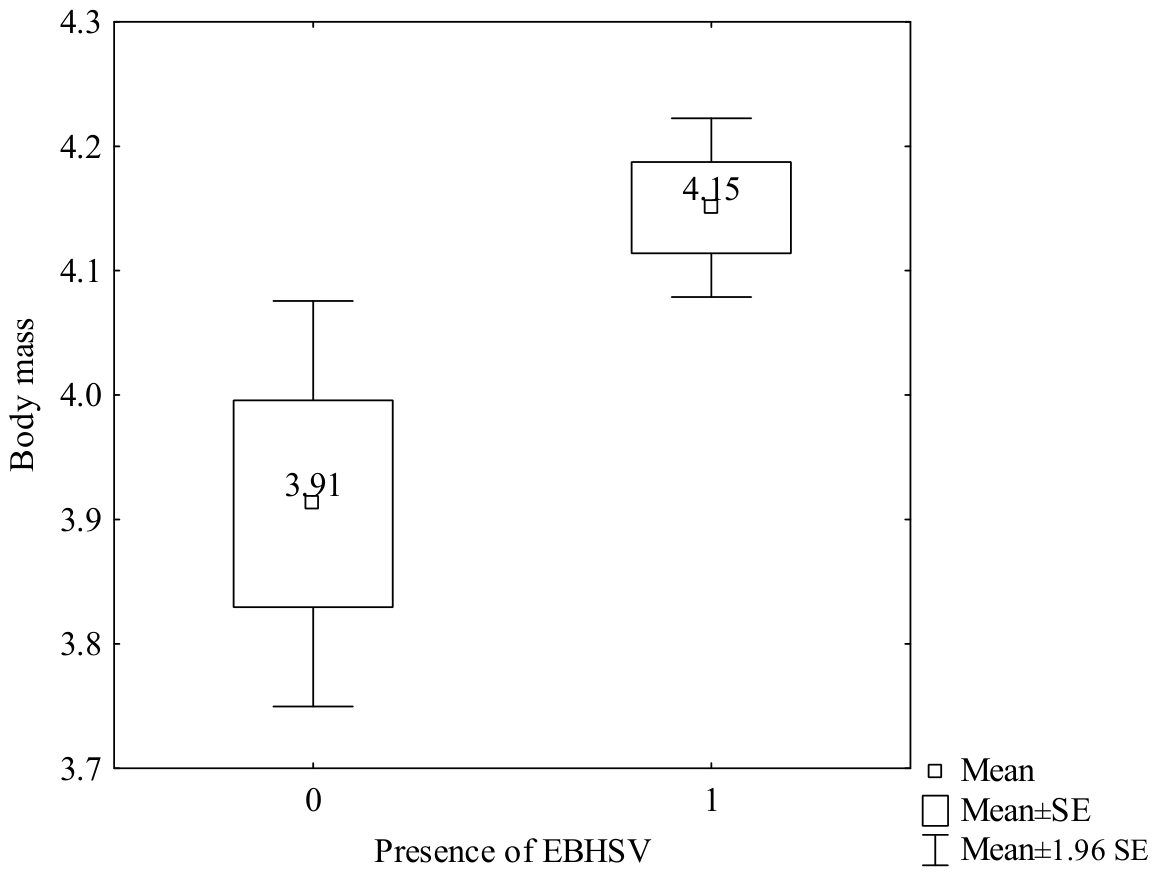
Figure 4.
Serological test results for EBHS and RHDV2 antibodies using ELISA (titres in individual hares across research areas; the horizontal line indicates the cut-off threshold of 160).
Figure 4.
Serological test results for EBHS and RHDV2 antibodies using ELISA (titres in individual hares across research areas; the horizontal line indicates the cut-off threshold of 160).
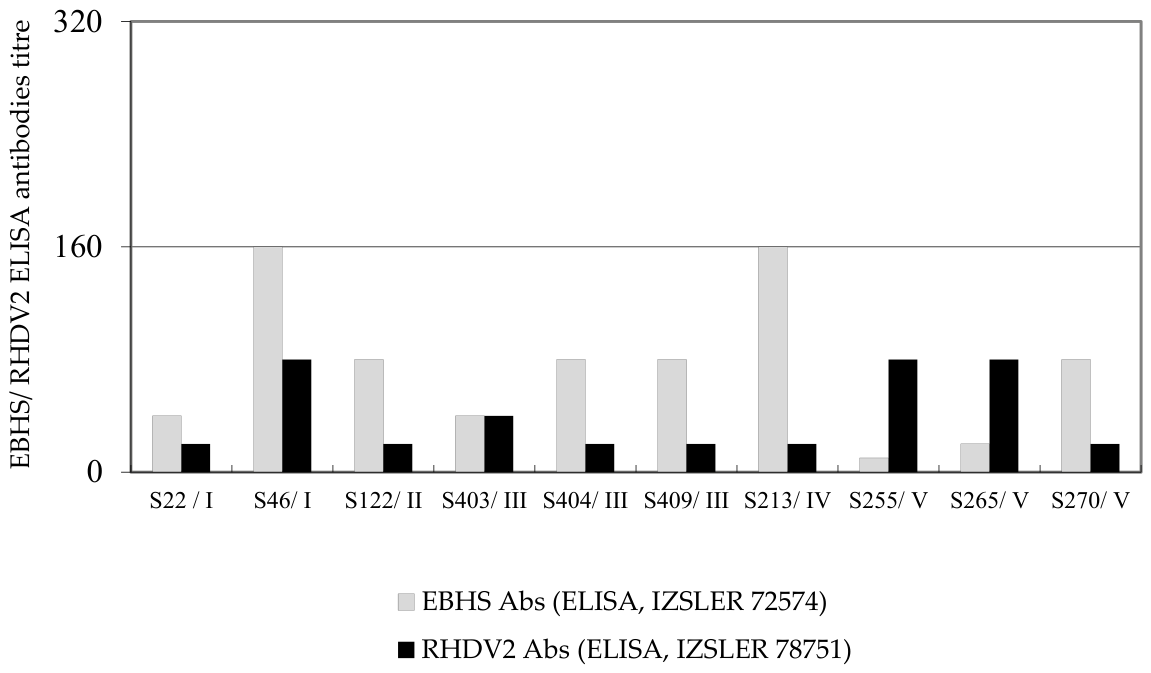
Figure 5.
Body mass of hares according to their RHDV2 serological status (0: seronegative, 1: seropositive). The small squares denote mean values, the boxes represent mean ± SE, and the whiskers denote mean ± 1.96SE.
Figure 5.
Body mass of hares according to their RHDV2 serological status (0: seronegative, 1: seropositive). The small squares denote mean values, the boxes represent mean ± SE, and the whiskers denote mean ± 1.96SE.
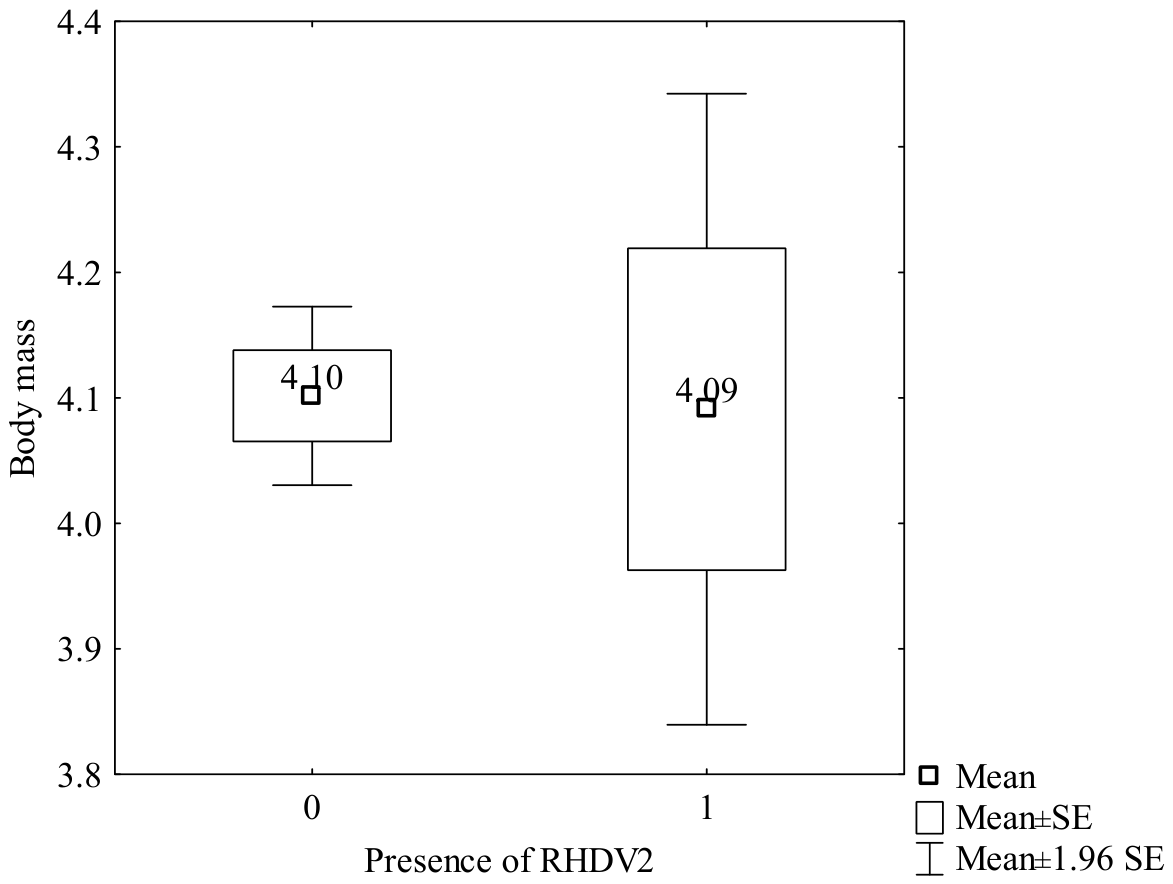

Table 1.
Hare population indicators in the research areas.
| Research area | N | Body mass (kg) |
Wr Coefficient of reproduction |
Wsr Reproductive index/success rate |
Wpp Coefficient of population increase |
Wp Coefficient of population growth |
|
| Juvenile | Adult | ||||||
| I | 47 | 3.94 | 4.48 | 1.62 | 3.23 | 1.84 | 85.00 |
| II | 13 | 3.96 | 4.55 | 0.63 | 1.25 | 1.58 | 59.00 |
| III* | 12 | - | 4.18 | - | - | - | - |
| IV | 14 | 3.73 | 4.36 | 1.00 | 1.17 | 1.40 | 40.00 |
| V | 23 | 3.84 | 4.70 | 22.00 | 22.00 | 16.10 | 1650.00 |
* all the harvested hares are adult individuals.
Table 2.
Prevalence of antibodies to EBHSV in brown hares (Lepus europaeus) in the south, south-eastern, eastern and central regions of Poland from November to December 2022 (EBHS ELISA serological).
Table 2.
Prevalence of antibodies to EBHSV in brown hares (Lepus europaeus) in the south, south-eastern, eastern and central regions of Poland from November to December 2022 (EBHS ELISA serological).
|
Region of origin |
No of tested hares |
Positive | Negative | ||||||||
| No |
Percentage1 |
Anti-EBHSV antibody titre distribution2 titre (Pab ELISA / Mab ELISA) |
No |
Percentage1 % |
|||||||
| >10 - 40 | >40 - 160 | > 160 - 640 | < 10 | ||||||||
| No | % | No | % | No | % | No | % | ||||
| I | 47 | 34 | 72.3 | 17 | 50.0 | 17 | 50.0 | 0 | 0 | 13 | 27.7 |
| II | 13 | 11 | 84.6 | 5 | 45.5 | 6 | 54.5 | 0 | 0 | 2 | 15.4 |
| III | 12 | 9 | 75.0 | 3 | 33.3 | 6 | 66.7 | 0 | 0 | 3 | 25.0 |
| IV | 14 | 12 | 85.7 | 5 | 41.7 | 9 | 58.3 | 0 | 0 | 2 | 14.3 |
| V | 23 | 20 | 87.0 | 8 | 40.0 | 12 | 60.0 | 0 | 0 | 3 | 13.0 |
| Total | 109 | 86 | 78.9% | 38 | 44.2% | 48 | 55.8% | 0 | 0.0% | 23 | 21.1% |
1 percentage of positive/negative in relation to the total number of hares tested 2 percentage of positive sera with the specified titre in relation to the total number of positives.
Table 3.
Prevalence of antibodies to RHDV2 in brown hares (Lepus europaeus) in the south, south-eastern, eastern and central regions of Poland from November to December 2022.
Table 3.
Prevalence of antibodies to RHDV2 in brown hares (Lepus europaeus) in the south, south-eastern, eastern and central regions of Poland from November to December 2022.
|
Region of origin |
No of tested hares |
Positive | Negative | ||||||||
| No |
Percentage1 |
Anti-EBHSV antibody titre distribution2 titre (Pab ELISA / Mab ELISA) |
No |
Percentage1 % |
|||||||
| >10 - 40 | >40 - 160 | > 160 - 640 | < 10 | ||||||||
| No | % | No | % | No | % | No | % | ||||
| I | 47 | 3 | 6.4 | 2 | 66.7 | 1 | 33.3 | 0 | 0 | 44 | 93.6 |
| II | 13 | 1 | 7.7 | 1 | 100 | 0 | 0 | 0 | 0 | 12 | 92.3 |
| III | 12 | 3 | 25 | 3 | 100 | 0 | 0 | 0 | 0 | 9 | 75.0 |
| IV | 14 | 1 | 7.1 | 1 | 100 | 0 | 0 | 0 | 0 | 13 | 92.9 |
| V | 23 | 3 | 13.0 | 1 | 33.3 | 2 | 66.7 | 0 | 0 | 20 | 87.0 |
| Total | 109 | 11 | 10.1% | 8 | 72.7% | 3 | 27.3% | 0 | 0 | 98 | 89.9% |
1 percentage of positive/negative in relation to the total number of hares tested 2 percentage of positive sera with the specified titre in relation to the total number of positives.
Disclaimer/Publisher’s Note: The statements, opinions and data contained in all publications are solely those of the individual author(s) and contributor(s) and not of MDPI and/or the editor(s). MDPI and/or the editor(s) disclaim responsibility for any injury to people or property resulting from any ideas, methods, instructions or products referred to in the content. |
© 2026 by the authors. Licensee MDPI, Basel, Switzerland. This article is an open access article distributed under the terms and conditions of the Creative Commons Attribution (CC BY) license (http://creativecommons.org/licenses/by/4.0/).
Copyright: This open access article is published under a Creative Commons CC BY 4.0 license, which permit the free download, distribution, and reuse, provided that the author and preprint are cited in any reuse.