
Submitted:
17 September 2026
Posted:
18 September 2026
You are already at the latest version
Abstract
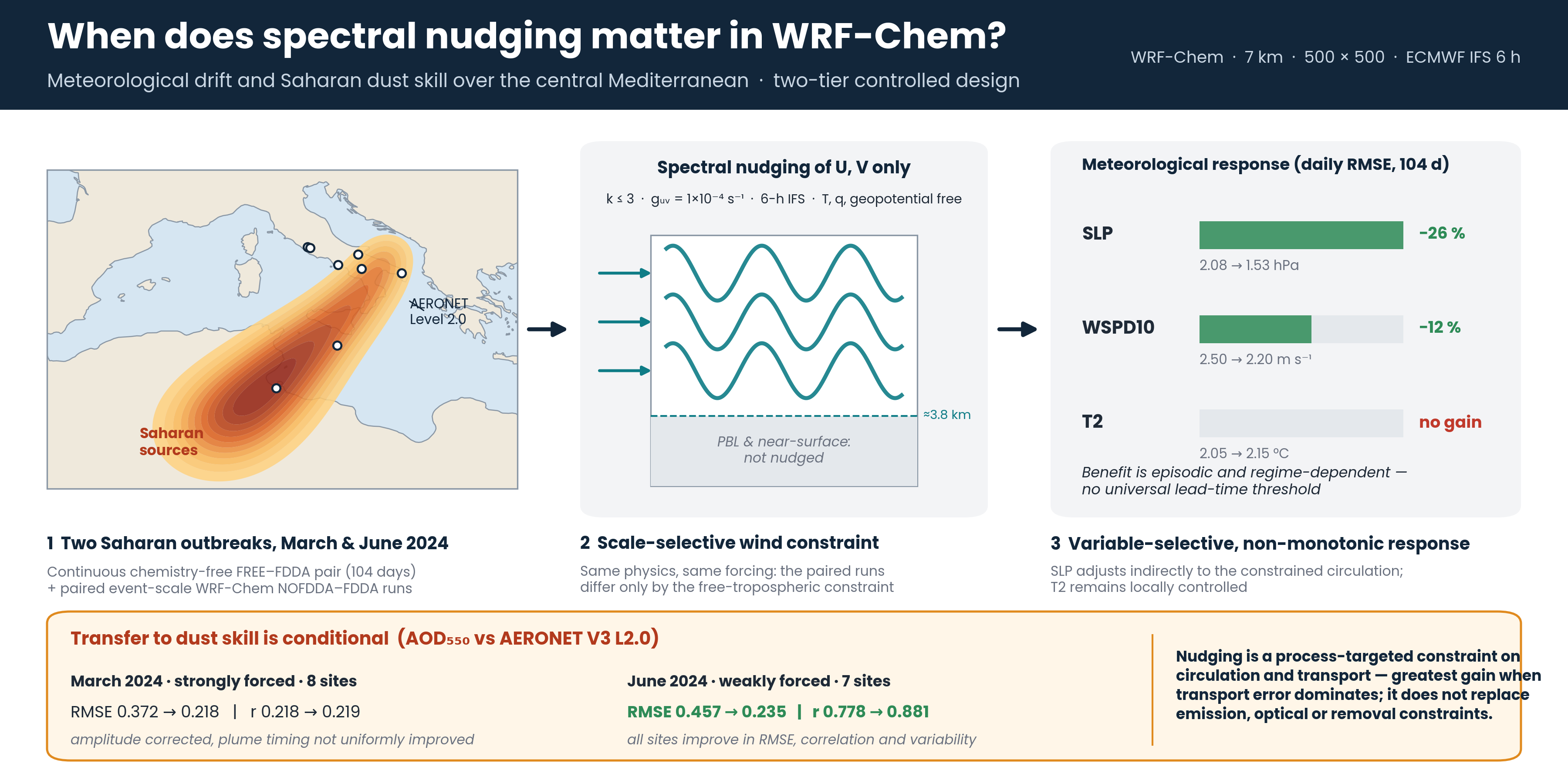
Regional WRF-Chem dust simulations may require continuous integrations when state continuity is scientifically important, yet extended limited-area runs can depart dynamically from the driving analysis. We use a two-tier controlled design that separates dynamical attribution from aerosol transport response: a continuous chemistry-free FREE-FDDA pair spanning 104 days (15 March-27 June 2024) isolates the meteorological response to spectral nudging of the horizontal wind, and paired event-scale WRF-Chem simulations of two Saharan outbreaks test whether that response propagates into dust prediction skill. The meteorological response is variable-selective and strongly non-monotonic. Sea-level pressure improves most (mean daily RMSE 2.08 to 1.53 hPa) as an indirect response of the mass field, 10 m wind speed improves coherently but less (2.50 to 2.20 m s-1), and 2 m temperature does not improve (2.05 to 2.15 °C); the benefit recurs episodically as synoptic regimes evolve rather than following a universal lead-time threshold. Aerosol transport, evaluated against AERONET Version 3 Level 2.0 AOD550 with Level 1.0 as a coverage-sensitivity check, is conditional. In the weakly forced June case all seven sites improve simultaneously in RMSE, correlation and variability amplitude (station-mean RMSE 0.457 to 0.235; correlation 0.778 to 0.881). In March, RMSE decreases at all eight sites but mean correlation is unchanged, indicating amplitude correction without uniform improvement of plume timing. Spectral nudging therefore acts as a process-targeted constraint on circulation and transport consistency whose aerosol benefit is greatest when transport error dominates; it does not replace constraints on dust emission, optical properties or removal.
Keywords:
WRF-Chem
; spectral nudging
; Saharan dust
; aerosol optical depth
; extreme event
Copyright: This open access article is published under a Creative Commons CC BY 4.0 license, which permit the free download, distribution, and reuse, provided that the author and preprint are cited in any reuse.