

Submitted:
28 August 2026
Posted:
18 September 2026
You are already at the latest version
Abstract
Large-language models (LLMs) are rapidly becoming part of human culture, reshaping how information is produced, transmitted, and used. Here we propose that their diffusion can be understood through a viral analogy, with LLM use spreading through populations, becoming embedded in cognitive and cultural practices. We model transitions among uncoupled, coupled, and persistently dependent users, and show that the interplay between social transmission, recovery, and collective reinforcement can generate tipping points and technological lock-in. A central consequence is the possibility of runaway dynamics: once a critical threshold is crossed, small increases in adoption can trigger rapid population-level shifts toward persistent dependence, with abrupt losses in cognitive competence. The same framework, however, identifies conditions for cognitive immunization, based on reducing transmission and facilitating reversibility. Our results highlight how LLM adoption may involve nonlinear collective transitions with important consequences for cognitive autonomy.
Keywords:
large-language models
; language
; cognitive offloading
; extended mind
; memes
; automation bias
; dependency
; cognition
1. Introduction
The emergence of human language is widely regarded as a major evolutionary transition [1]. While it shares key features with genetic transmission [2], language established a new system of inheritance and collective memory. It allows information to accumulate, be passed on, and recombine over generations, thus supporting cumulative culture [3,4]. In this sense, languages can be viewed as population-level cultural systems with partially autonomous dynamics: they diversify, compete, hybridize, spread, and sometimes become extinct, showing patterns reminiscent of species embedded in ecological communities [5]. Their persistence depends largely on social learning, through which individuals acquire words, grammatical constructions, meanings, and communicative conventions by observing and interacting with others, especially during childhood [6]. Because linguistic structures propagate by entering developing minds, relying on their exceptional plasticity, and recruiting their speakers as new vectors of transmission, language has sometimes been described as a viral entity [7,8].
The metaphor acquired a concrete technological counterpart with the emergence of computer viruses: self-propagating informational structures capable of entering a host system, modifying its operation, and recruiting it for further transmission [9]. In parallel, theories of cultural evolution formalized the idea that socially transmitted information can exhibit variation, differential persistence, and inheritance, whether framed through gene-culture coevolution [10,11,12] or through the concept of memes [13,14,15]. Together, these traditions point towards a broader class of entities, the “viruses of the mind” [16,17] whose evolution depends not on a particular material substrate, but on their capacity to reproduce and persist across biological, cognitive, or computational hosts.
In language, what propagates virally are patterns—from words to ideas—that reproduce through imitation, mutate through use, and persist through brains, media, institutions, and technologies. This points to cognition as distributed across minds and external structures—the extended mind [18]—which do not merely store information but also reshape cognitive tasks [19,20]. Such artifacts can be complementary, strengthening capacities beyond their immediate use, or competitive, improving performance while potentially weakening the underlying skill [21,22,23]. Language itself is a two-sided cognitive technology: it externalizes, stabilizes, and recombines thought [24], while linguistic categories and narratives reshape perception and reasoning [25,26,27,28]. Through cultural transmission, language is also adapted to the cognitive and communicative demands of its users [29,30,31], so that its propagation both extends cognition and transforms the minds that depend on it.
This reciprocal transformation also characterizes communication technologies. The Internet and instant messaging blurred distinctions between speech and writing [32,33], while mobile phones and smartphones encouraged abbreviated, compressed forms of expression that largely reflect linguistic flexibility rather than declining literacy [34,35,36]. Social media further reorganized the structure and social selection of communication [37,38], integrating text, hyperlinks, multimodal expression, and algorithmically selected content [39,40]. Such technologies do not merely transmit language: their affordances reshape how it is produced, circulated, interpreted, and selected.
LLMs represent a further transition. Unlike previous media, they do not merely constrain the form or circulation of human expression but actively participate in its production, reformulation, and evaluation. The relevant question, therefore, is not simply whether LLMs alter language use, but whether they reorganize the coupled system formed by language, cognition, and technology. This comparison may help identify which cognitive capacities these systems amplify, which they displace, and under what conditions sustained reliance may produce cognitive reorganization or erosion. In this respect, LLMs extend a feature shared, to varying degrees, by earlier information technologies: cognitive offloading, understood as the delegation of cognitive operations to external tools and representations.
Two technological precursors bridge natural language and the LLM era: computer viruses (CVs) [41,42,43] and programming languages (PLs) [44]. CVs reproduced key features of biological viruses: compact informational structures that exploit host machinery and evolve to evade detection. Their emergence triggered an arms race with antivirus software [45], influenced artificial life [46] and network science [47,48,49], and fostered modern cybersecurity and computer immunology [50,51]. PLs spread across computers, institutions, and communities [52,53], becoming an operational substrate of the digital revolution and, alongside neural networks, paving the way for artificial intelligence [54]. Both depend on technological hosts and reshape their environments. LLMs combine aspects of each: like PLs, they provide a new human–machine interface; like CVs, they propagate through users and digital ecosystems. Yet their capacity for cognitive offloading is unprecedented [55].
Here, we address our previous question by treating LLMs as engines of cognitive and social change whose rapid diffusion is transforming human capacities. We first compare LLMs with infectious agents and then develop an explicit population model of their propagation, drawing on mathematical approaches from epidemiology [56] that have also been applied to technological adoption [57,58]. The model describes transitions among host-coupling states, which we link to an illustrative measure of cognitive competence to distinguish the consequences of different coupling regimes from the underlying bifurcation structure and explore potential interventions. It does not identify any single entity as the viral analogue: LLM ecosystems contain culturally transmitted practices and content alongside technologically evolving model lineages, and these need not coincide. Instead, the analogy concerns a broader feedback loop in which persistent technological lineages are instantiated in external machinery, modify their human host environment, and thereby influence their own propagation. This homology is already partly present in conventional and adaptive software [59,60,61,62], but LLMs deepen it by becoming integrated into cognitive processing itself.
The viral analogy does not imply that LLM-human interactions are intrinsically parasitic. Biological viruses range from pathogens to mutualists and evolutionary partners [63,64,65,66,67], and the effects of LLMs likewise depend on how they are used. They can enhance exploration, access to expertise, and productivity [68,69], but can also promote cognitive offloading, dependence, and loss of competence [70], while individual benefits may not scale to the population level [71]. The analogy is therefore useful because LLM use can generate persistence and transmission loops, both through culturally propagating patterns of use and through model lineages sustained and modified by technological and economic feedbacks. The model below focuses on one part of this ecology: transitions among human states of cognitive coupling.
2. Population Dynamics of LLM-Mediated Cognitive Coupling
Classical epidemic models describe the transmission of biological agents through transitions between host states [56]. A similar mathematical language has been used for technological diffusion, where adoption depends on exposure to previous users and social reinforcement [72,73], as well as in multicompartment models of drug [74,75,76] and social media [77,78,79] addictions. At the level modeled here, we do not represent the reproduction or evolution of the model/program lineage explicitly. Instead, we coarse-grain one epidemiological layer of the larger LLM ecology: transitions among human host/coupling states. We consider three population states (Figure 1a): uncoupled or weakly coupled individuals U, regular users C who retain cognitive autonomy, and dependent users D who persistently delegate cognitive operations to the model. Their dynamics are
with . Here, measures the effective spread of LLM practices through social and institutional exposure, the return from regular use to the uncoupled state, the transition from regular use to persistent dependency, and recovery from dependency. These rates coarse-grain heterogeneous individual processes into population-level transitions rather than representing single psychological mechanisms. The nonlinear term introduces a cooperative (Allee-like) mechanism [80]. The underlying assumption is that LLM-independent cognitive practice is socially reinforced and cultural expectations that reward independent reasoning become more effective when autonomous individuals are common. The quadratic dependence on U represents this positive frequency dependence, whereas the factor C restricts the restoring effect to individuals engaged with LLMs. Accordingly, the incidence term should be interpreted as an effective host-side social or institutional transmission pressure. As in biological compartment models, the fact that the state variables describe hosts does not imply that a host state is the pathogen. The equations model the epidemiology of coupling and therefore do not, by themselves, determine the identity of the viral analogue.
Mean-field approximations like the one we take here provide a valuable, analytically tractable baseline for identifying the mechanisms underlying collective behavior [81]. Here, individuals sample population-level frequencies, with connectivity absorbed into the effective rate . However, real social and technological networks are heterogeneous and correlated [82]: connectivity distributions can shift epidemic thresholds and immunization outcomes [47,83,84,85,86,87], while other network properties can further modify diffusion [88,89,90,91,92]. Communication topology could also shape collective behavior in LLM-agent networks (as they do in biological epidemics [93]), particularly when cognitive states reshape social ties (again, as for biological pathogens [94]). At larger scales, interconnected regions and institutions can generate invasion thresholds and topology-dependent patterns [95,96,97]. Our formulation therefore offers a useful reference for future network and spatial extensions.
The cooperative component at the population-level has strong precedents in social and ecological dynamics. The quadratic term, commonly used in evolutionary ecology models to introduce mutualisms [81,98,99] assumes that autonomous cognitive practices are frequency dependent: schools, workplaces, peer groups, and norms can make independent work easier to maintain when it remains common. Threshold models of collective behavior show theoretically that such frequency dependence naturally produces critical transitions in humans [100,101,102]. In particular, it has been shown that social conventions can undergo genuine tipping [103,104] when a minority of the group was sufficient to move a population from one convention to another.
Dependency is assumed to arise primarily through regular use, , rather than directly from U. These simplifications isolate the interaction between contagion-like technological adoption and collective protection of cognitive autonomy, allowing us to identify conditions for abrupt and potentially irreversible population-level transitions. Figure 1 connects these population states with different forms of human-LLM coupling. Uncoupled individuals remain embedded in a diversified cognitive ecology, while making little or no use of LLMs (Figure 1b). Regular users incorporate LLMs while retaining substantial independent cognitive activity (Figure 1c), whereas in the dependent state the LLM becomes the dominant interface for performing tasks and accessing information (Figure 1d).
Transitions among these regimes can result from social exposure, institutional adoption, repeated reliance on generated outputs, abandonment of the technology, or progressive cognitive offloading. Cognitive offloading is itself a normal and often adaptive component of human cognition [55,105,106]. Reading and writing provide a paradigmatic example: literacy recruits and reorganizes preexisting neural circuits [107], while external symbolic structures extend memory and enable new forms of reasoning. Crucially, however, external support can either generate new internal competence or substitutes for it.
Recent work on LLM-assisted writing suggests that increased externally supported performance can be accompanied by reduced cognitive engagement, recall, or sense of authorship [108]. It is therefore useful to distinguish between scaffolding and substitution. Scaffolding reduces immediate cognitive demands while preserving or increasing the user’s subsequent capacity to perform the task; substitution removes the need to perform the underlying cognitive operation. Following [21], these correspond broadly to complementary and competitive cognitive artifacts. An LLM may thus operate as a tutor whose arguments are reconstructed, challenged, and verified, or as a substitute that performs synthesis, evaluation, and composition on behalf of the user. The relevant distinction is therefore not simply between using and avoiding LLMs, but between forms of coupling and, ultimately, what cognitive capacities remain when the tool is withdrawn. The transition provides a minimal representation of this shift from complementary use toward persistent substitutive dependency.
The model displays qualitatively distinct long-term regimes of LLM use. Using , the dynamics can be written as a two-dimensional system
where . An equilibrium (fixed point) is the fully uncoupled state , corresponding to a population in which LLM-mediated cognitive coupling is absent. The other points satisfy and , giving
where are the two roots defined as:
The two branches exist when . The uncoupled equilibrium remains stable while
and loses stability at through a transcritical bifurcation. When , the saddle-node occurs before this loss of stability, producing the bistable interval
Within this interval, both the uncoupled and the coupled state coexist, separated by the unstable branch (dashed lines in Figure 2). Consequently, increasing from the uncoupled state leaves the population near until is reached, whereas decreasing from the coupled state does not restore the uncoupled regime until is crossed. The difference between these thresholds,
defines the width of the hysteretic region and provides a simple mechanism for technological lock-in.
These transitions are illustrated in Figure 2. Figure 2a shows the equilibrium uncoupled fraction as is varied: a stable coupled branch and a saddle emerge at , while the uncoupled state loses stability only at . The corresponding regular-use and dependent fractions are shown in Figure 2b and follow directly from Eq. (6). Figure 2c summarizes the bifurcation structure in the plane. Genuine bistability occurs only for and between the saddle-node boundary and the transcritical boundary . For , the formal saddle-node lies outside the physical simplex and the transition is instead continuous, occurring through a forward transcritical bifurcation. At , the two thresholds coincide at , marking the boundary between continuous adoption and history-dependent discontinuous transitions.
3. Cognitive Competence Across the Transition
The population-level transition can have consequences for human competence, but their sign is not fixed by the bifurcation itself. To illustrate one possible consequence, we assign each state a relative cognitive competence, , , and , and define the average
Here should be narrowly interpreted as cognitive competence (CC): the capacity available to the human when external support is removed, rather than the total capability of the coupled human-AI system. To illustrate a substitutive-use regime, we use , , and , corresponding to progressively greater loss of cognitive competence with increasing dependence. This ordering is an illustrative modelling assumption, not a general claim about LLM use. In scaffolded or augmentative regimes, coupling could leave subsequent CC unchanged or even increase it.
Using the previous attractor states, the average cognitive competence becomes (see SM for a full derivation)
where
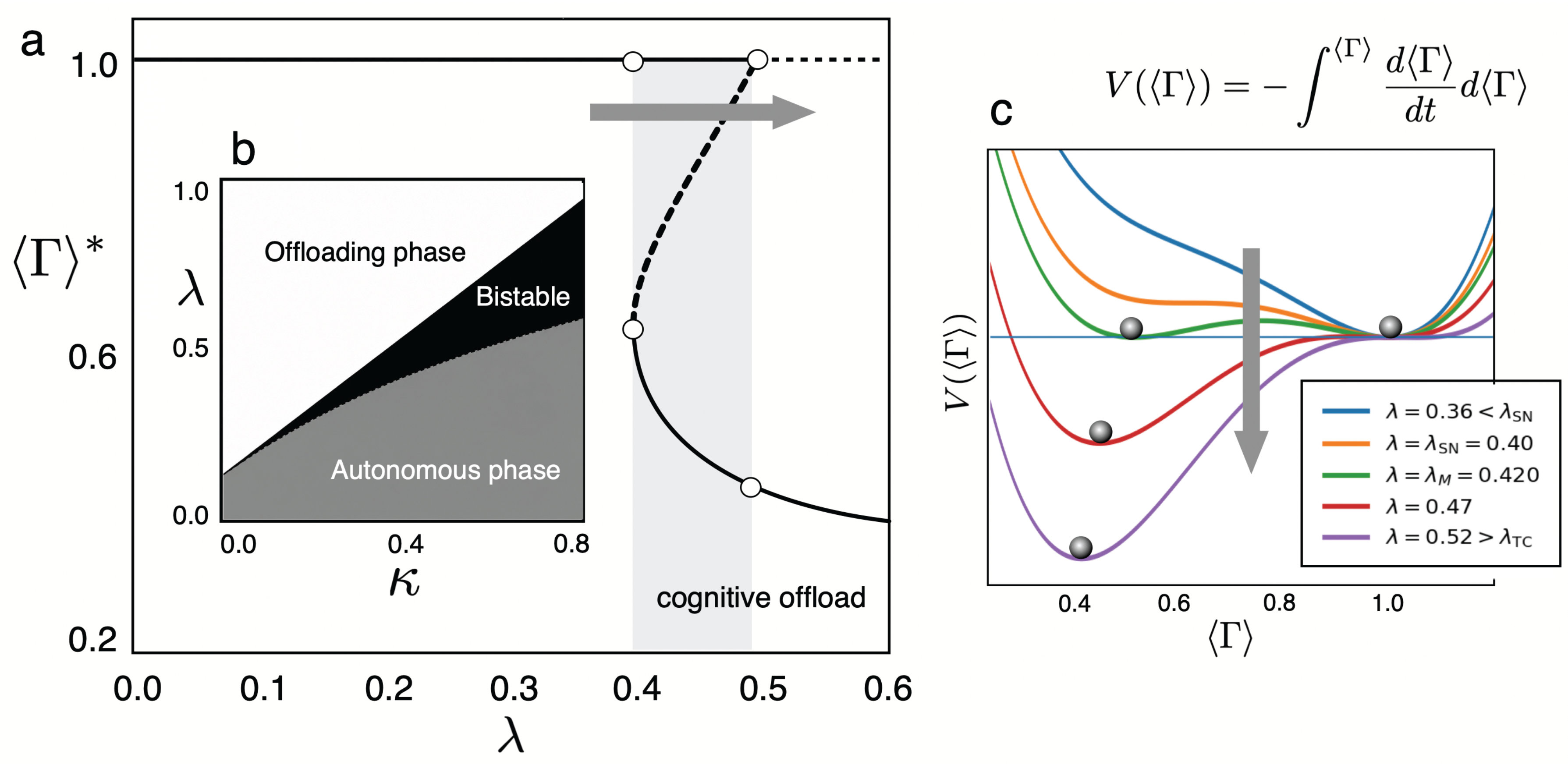
is the mean effective CC of the coupled population. Thus, is an increasing function of and inherits exactly the same saddle-node, bistable, and hysteretic structure as the population dynamics (Figure 3a-b). In particular, when , increasing leaves the system on the fully uncoupled state, , until . At this point the autonomous attractor loses stability and the population moves to the coupled branch, for which at the transition. The corresponding drop in RUC is therefore
Conversely, when is decreased from the coupled regime, recovery does not occur at the same point. The system remains on the low-RUC branch until the saddle-node is reached, where . The subsequent return to the autonomous state produces a CC increase
cognitive competence therefore displays the same hysteresis as LLM adoption: gradual changes in transmission pressure can generate an abrupt loss of autonomous capacity, while reversing that loss requires a larger reduction in .
The bifurcation structure itself is independent of this particular choice of ; the values used here illustrate the consequences of a regime in which increasing dependence is associated with reduced CC. For the parameters used in Figure 2, we obtain . As increases through (gray arrows), the equilibrium CC consequently falls from 1 to approximately . In the reverse trajectory, the coupled state persists to , where , before recovering to unity. The bifurcation therefore converts a smooth change in the pressure to adopt LLM-mediated cognition into a discontinuous and history-dependent change in population-level cognitive competence. Notice also that and do not alter the positions of the two tipping points in this minimal model, but they determine g and hence the cognitive cost associated with occupying the coupled state. Importantly, the presence of this sharp transition has a key implication: crossing the bifurcation changes the attractor structure and can therefore produce an abrupt change in the equilibrium population state under quasistatic parameter variation. The minimal model does not, however, determine how rapidly the transition unfolds in real time.
An alternative visualization of this transition is provided by the effective potential associated with the dynamics of . Under the one-dimensional reduction described in the SM, the coupled fractions C and D rapidly relax to their quasi-equilibrium ratio. The resulting dynamics can be written as a gradient system,
where the potential V is obtained from:
is a quartic function with two wells (see SM). This representation preserves the equilibrium states and bifurcation thresholds of the population model: minima of V correspond to stable population states, whereas the intervening maximum represents the unstable branch separating their basins of attraction.
The evolution of this landscape as increases is shown in Figure 3c. The dynamics can be pictured as a marble moving over the landscape until it settles in a valley. For low values of , the only valley lies at high , corresponding to strong cognitive autonomy. At , a second valley appears at lower , representing a state dominated by cognitive offloading. Within the bistable interval, , either state can persist, depending on the system’s history and on which side of the intervening barrier it lies. As increases, the low- valley becomes progressively deeper. At (the so called Maxwell point) for the parameters used here, the two valleys have equal depth; beyond it, the offloading state becomes increasingly favored. Nevertheless, the marble may remain trapped in the high-autonomy valley until this valley disappears at . It then rolls abruptly toward the low- minimum, producing a runaway transition: greater reliance on LLMs promotes further cognitive offloading, which in turn reinforces that reliance. In contrast, recovery of autonomy requires crossing the barrier or reducing sufficiently so that the offloading valley disappears at . The landscape thus provides an intuitive picture of tipping, runaway change, and hysteresis between autonomous and cognitively offloaded states.

Table 1.
Qualitative effects of cognitive immunization strategies. The parameters , , and modify the bifurcation structure, with and . For , these thresholds delimit the bistable regime. By contrast, and do not move the tipping points in this minimal model, but determine the partition between regular and dependent users and therefore the cognitive competence .
| Intervention | Main mathematical effect | Effect on tipping and cognitive state |
|---|---|---|
| Reduce propagation of substitutive/dependency-producing coupling | Decreases by limiting automatic adoption and social or institutional amplification of LLM use. | Direct. Prevents invasion for ; after lock-in, recovery requires . |
| Preserve autonomous alternatives and routes back to unaided cognition | Increases , the rate at which regular users return to uncoupled or weakly coupled cognition. | Raises both thresholds and reduces hysteresis. Bistability disappears for . |
| Strengthen collective autonomy | Increases , the strength of nonlinear collective reinforcement of autonomous cognition. | Raises resistance to invasion, but for also widens the hysteretic interval. |
| Favor recovery over collective lock-in | Increases the ratio , strengthening individual routes back to autonomous cognition relative to collective reinforcement. | Moves the system toward , where the saddle-node and transcritical thresholds merge and the transition becomes continuous. |
| Prevent progression to dependency | Decreases , reducing transitions from regular use C to persistent dependency D. | No direct effect on or . Reduces and increases . |
| Promote recovery from dependency | Increases , shifting users from persistent dependency D back to regular use C. | No direct effect on the bifurcation thresholds. Reduces dependency and raises at fixed . |
4. Cognitive Immunization and Intervention Strategies
The bifurcation structure provides a natural framework for considering "cognitive immunization," understood here not as preventing contact with LLMs, but as preserving resistance to harmful substitutive or dependency-producing coupling while allowing beneficial forms of human-AI integration. A first important result is the asymmetry between prevention and reversal. If the population is initially close to the uncoupled state , invasion is prevented provided
Once the system has moved to the coupled attractor, however, restoring below is insufficient whenever the system lies inside the bistable regime. The coupled state persists until
Thus, after the tipping point has been crossed, reversal requires a larger reduction in transmission pressure than would have been required to prevent the transition in the first place. This prevention-reversal asymmetry is the direct dynamical consequence of hysteresis and provides a simple mechanism for technological lock-in.
Among the parameters controlling the bifurcation structure, has a particularly clear protective role. Increasing , the rate at which regular users return to uncoupled or weakly coupled cognition, raises the invasion threshold while simultaneously moving the system toward the boundary . At this boundary the physically accessible saddle-node disappears; for , bistability is lost and the transition becomes continuous. Interventions that make autonomous cognition an accessible and recurrent state-for example, through protected unaided tasks, deliberate periods of disengagement, maintenance of non-LLM skills, or attractive non-LLM alternatives-can therefore modify not only the position of the tipping point but the qualitative form of the transition itself.
The effect of is more subtle. Increasing strengthens the collective reinforcement of autonomous cognition and raises , making invasion more difficult when the population is predominantly uncoupled. At the same time, for , it also increases the separation between the two thresholds,
thereby enlarging the hysteretic region. Strong collective protection can therefore stabilize autonomy while U is high, but may also increase path dependence once the autonomous fraction has been substantially depleted. The relevant intervention is consequently not simply to maximize , but to reinforce collective autonomy together with sufficiently strong return processes so that protection does not come at the cost of a broad hysteretic regime.
The parameters and play a different role. They do not shift or , but control the composition of the coupled population. At equilibrium, we have
so decreasing or increasing reduces the fraction of users in the dependent state without necessarily reducing overall LLM adoption. These parameters therefore describe a second class of interventions aimed not at preventing coupling itself, but at limiting its transition toward persistent cognitive substitution. Examples include metacognitive training, verification requirements, periodic unaided practice, task designs that preserve active reasoning, and mechanisms that facilitate recovery from dependency.
The model thus distinguishes two complementary intervention levels. Changes in , , and reshape the population-level tipping landscape and determine whether bistability and hysteresis are possible, whereas changes in and primarily determine the cognitive burden associated with the coupled state. In this sense, immunization can act either by preventing a collective transition or by reducing the probability that ordinary LLM use develops into persistent dependency.
Thus immunization (as defined here) need not imply low overall LLM use. It can instead consist of shaping the coupling so that high adoption remains compatible with verification, active reasoning, autonomous alternatives, and recovery from substitutive dependence.
5. Discussion
In 1960, Joseph Licklider anticipated a future in which the relation between humans and computers would move beyond simple tool use [109]:
"Man-computer symbiosis is probably not the ultimate paradigm for complex technological systems. It seems entirely possible that, in due course, electronic or chemical machines will outdo the human brain in most of the functions we now consider exclusively within its province."
More than six decades later, LLMs made this quote especially concrete. Their importance lies not only in what they can do, but in the new forms of coupling they create between human and artificial cognition. At one extreme, AI could become an "exocortex": an external extension of cognition capable of searching large bodies of knowledge while leaving interpretation and high-level judgment to the human researcher [110]. Such systems could greatly accelerate the accumulation and transmission of cultural and scientific knowledge. More generally, humans have always externalized parts of cognition into language, writing, institutions, and technology. This externalization has been the engine of rapid and accelerated change driven by culture [111,112]. AI represents a new step in this process, one in which external cognitive machinery becomes increasingly active and agent-like [113]. As suggested in previous studies, this might be a new class of synthetic evolutionary transition [114,115,116,117].
Our model suggests that the consequences of this transition cannot be understood from individual LLM use alone. Two social processes interact. First, new ways of using LLMs spread because people learn from other people, because workplaces and schools adopt them, and because successful practices are copied. In this sense, adoption has a contagion-like component. Second, autonomous cognition is itself socially sustained. Education and institutions do more than transmit information: they create environments in which reading, writing, reasoning, verification, and independent problem solving are repeatedly practiced and rewarded. When these practices are common, they reinforce each other.
The interaction between these two processes creates the central feedback in our model. As cognitive delegation becomes more widespread, the social environment that supports autonomous reasoning can weaken; as that environment weakens, delegation becomes still easier and more attractive. Therefore, a gradual increase in LLM adoption can produce a disproportionate collective response. Beyond a critical point, the loss of autonomy becomes self-reinforcing and the population can move rapidly toward a state of much stronger cognitive offloading and lower cognitive competence. The important result is not that such a runaway must occur, but that it can occur under plausible forms of social learning and cooperative reinforcement. Moreover, once such a state has become established, simply returning conditions to where they were before the transition may not be sufficient to restore the previous state. Prevention can therefore be considerably easier than reversal.
This possibility should not obscure the substantial benefits of LLMs. The distinction is not between using and not using AI, but between forms of coupling that extend human competence and those that replace the cognitive operations through which competence is maintained. The evidence already points to both possibilities. Recent experiments also show that the direction of these effects strongly depends on the architecture of the human-AI coupling. In a randomized study, a guided "think first, ChatGPT later" protocol produced higher subsequent independent creativity than unrestricted use of the ChatGPTa condition only for humans [118]. Moreover, generative AI can increase productivity and provide powerful cognitive assistance, but knowledge workers also report a reduced effort to think critically when confidence in AI is high [119]. In education, unrestricted access to generative AI can improve performance while the tool is available, yet reduce subsequent unaided performance, while pedagogically constrained AI can substantially mitigate this effect [120,121]. Related results indicate poorer comprehension or retention when students rely on LLMs without engaging in complementary cognitive activities such as note-taking [122]. In programming, novice users can also struggle to understand and critically evaluate AI-generated code, creating conditions for automation bias and superficial competence [123].
These findings reinforce the distinction between AI as scaffolding and AI as substitution. This distinction also changes how we should think about "cognitive immunization." At the population level, immunization does not mean preventing contact with AI. It means preserving the practices and institutions that keep human cognition active: unaided problem solving, verification, critical discussion, periods of deliberate disengagement, maintenance of non-AI skills, and educational designs in which the model supports rather than completes the cognitive task. However, once persistent dependency has developed, the problem can no longer be addressed by educational design alone. Emerging work on problematic LLM use points to psychological and behavioral mechanisms related to loss of control, emotional regulation, cognitive biases, and habitual reliance, suggesting that behavioral self-regulation and, in more severe cases, psychological interventions such as cognitive-behavioral therapy may become relevant [124]. Thus, the analogy with immunization extends naturally from prevention at the cultural and institutional level to recovery at the individual level.
Several extensions could bring this minimal model closer to the complexity of real human-LLM interactions. These include replacing the population-level description with heterogeneous interacting agents [22], allowing cognitive autonomy to vary continuously rather than dividing users into sharply separated classes, and introducing feedbacks through which cognitive change modifies subsequent adoption and dependence. Such a formulation would also soften the boundaries between humans, LLMs, and increasingly hybrid human-machine systems [125], which may occupy a broad continuum of cognitive organizations rather than discrete categories. More generally, if agents themselves can be understood as persistent patterns of information and activity distributed on biological, artificial, or hybrid substrates [113,126,127], the relevant evolving entities may not always be conventional individuals. What spreads could instead be patterns of cognitive organization, including perspectives that shape how agents represent the world, themselves, and possible actions. LLMs would then be more than passive tools for cognitive offloading: by participating in these distributed patterns, they could progressively reshape the cognitive structures through which users interpret and act on the world. From this perspective, the "cognitive virus" is a persistent technological lineage embedded in a larger ecology of cultural replicators, human host states, institutions, and technical infrastructure.
A further limitation is that human behavior is not yet explicitly coupled to the spreading process. Such feedbacks can qualitatively reshape epidemic thresholds [128,129,130,131,132], and can even generate higher-order critical phenomena [133,134,135]. A useful conceptual framework for extending this picture is provided by the emerging field of Diverse Intelligence, which treats intelligence and agency not as properties restricted to brains or particular biological substrates, but as graded capacities of systems operating across multiple spatial, temporal, and organizational scales [136,137]. In particular, this perspective emphasizes the ability of biological, artificial, and hybrid agents [125] to navigate problem spaces and maintain goal-directed organization, providing a natural language to describe coupled human-AI systems in which boundaries and degrees of agency may themselves change over time. In addition, multilayer-network theory offers a formal framework for representing the interacting behavioral, technological, and social processes through which such feedbacks propagate [138,139]. Together, these approaches suggest a systematic route beyond the present mean-field description.
Future models could therefore treat autonomy, dependence, and agency as continuous and coevolving properties of distributed human-machine patterns, rather than as fixed compartments, and ask under what conditions transient interactions become self-maintaining forms of cognitive organization.
Supplementary Materials
The following supporting information can be downloaded at the website of this paper posted on Preprints.org.
Acknowledgments
R.S. has been supported by an AGAUR 2021 SGR 0075 grant, a AEI-PID2023-152129NB-I00 grant, and the Santa Fe Institute. S.F.E. has been supported by grants PID2025-169610NB-I00 funded by MCIU/AEI/10.13039/501100011033 and by “ERDF a way of making Europe”, CIPROM/2022/59 funded by Generalitat Valenciana, and the Santa Fe Institute. L.F.S. has been supported by the Occident Foundation (grant FJSCNB-2022-12-B) and by the Spanish State Research Agency, AEI, through grant PID2023-153225NA-I00 funded by MICIU/AEI/10.13039/501100011033 and ERDF, EU. L.F.S. conducted this research while visiting the Okinawa Institute of Science and Technology (OIST) through the Theoretical Sciences Visiting Program (TSVP).
References
- Szathmáry, E.; Smith, J.M. The major evolutionary transitions. Nature 1995, 374, 227–232. [Google Scholar] [CrossRef] [PubMed]
- Nowak, M.A.; Krakauer, D.C. The evolution of language. Proc. Natl. Acad. Sci. 1999, 96, 8028–8033. [Google Scholar] [CrossRef] [PubMed]
- Tomasello, M. The Cultural Origins of Human Cognition; Harvard University Press: Cambridge, MA, USA, 1999. [Google Scholar]
- Boyd, R.; Richerson, P.J. Culture and the Evolutionary Process; University of Chicago Press: Chicago, IL, USA, 1985. [Google Scholar]
- Solé, R.V.; Corominas-Murtra, B.; Fortuny, J. Diversity, competition, extinction: the ecophysics of language change. J. R. Soc. Interface 2010, 7, 1647–1664. [Google Scholar] [CrossRef] [PubMed]
- Tomasello, M. Constructing a Language: A Usage-Based Theory of Language Acquisition; Harvard University Press: Cambridge, MA, USA, 2003. [Google Scholar]
- Burroughs, W.S. The Electronic Revolution; Expanded Media Editions, 1970. [Google Scholar]
- Aoki, K. Introduction: Language Is a Virus. Univ. Miami Law Rev. 1999, 53, 961. [Google Scholar]
- Cohen, F. Computer viruses. Comput. Secur. 1987, 6, 22–35. [Google Scholar] [CrossRef]
- Feldman, M.W.; Laland, K.N. Gene-culture coevolutionary theory. Trends Ecol. Evol. 1996, 11, 453–457. [Google Scholar] [CrossRef] [PubMed]
- Gintis, H. Gene–culture coevolution and the nature of human sociality. Philos. Trans. R. Soc. B Biol. Sci. 2011, 366, 878–888. [Google Scholar] [CrossRef] [PubMed]
- Whitehead, H.; Laland, K.N.; Rendell, L.; Thorogood, R.; Whiten, A. The reach of gene–culture coevolution in animals. Nat. Commun. 2019, 10, 2405. [Google Scholar] [CrossRef] [PubMed]
- Dawkins, R. The Selfish Gene; Oxford University Press: Oxford, UK, 1976. [Google Scholar]
- Blackmore, S. The Meme Machine; Oxford University Press: Oxford, UK, 2000. [Google Scholar]
- Dennett, D.C. From Bacteria to Bach and Back: The Evolution of Minds; W. W. Norton & Company: New York, NY, USA, 2017. [Google Scholar]
- Dawkins, R. Viruses of the Mind. In Dennett and His Critics: Demystifying Mind; Dahlbom, B., Ed.; Blackwell: Oxford, UK, 1993; pp. 13–27. [Google Scholar]
- Brodie, R. Virus of the Mind: The New Science of the Meme; Hay House: Carlsbad, CA, USA, 2009. [Google Scholar]
- Clark, A.; Chalmers, D. The Extended Mind. Analysis 1998, 58, 7–19. [Google Scholar] [CrossRef]
- Norman, D.A. Cognitive Artifacts. In Designing Interaction: Psychology at the Human-Computer Interface; Carroll, J.M., Ed.; Cambridge University Press: Cambridge, UK, 1991; pp. 17–38. [Google Scholar]
- Hutchins, E. How a Cockpit Remembers Its Speeds. Cogn. Sci. 1995, 19, 265–288. [Google Scholar] [CrossRef] [PubMed]
- Krakauer, D.C. Will AI Harm Us? Better to Ask How We’ll Reckon With Our Hybrid Nature. In Nautilus; 2016. [Google Scholar]
- Krakauer, D.C. Competitive and Complementary Tools. 2026, 2607.18460. [Google Scholar]
- Fasoli, M. Substitutive, Complementary and Constitutive Cognitive Artifacts: Developing an Interactionist Approach. Rev. Philos. Psychol. 2018, 9, 671–687. [Google Scholar] [CrossRef]
- Clark, A. Magic Words: How Language Augments Human Computation. In Language and Thought: Interdisciplinary Themes; Carruthers, P., Boucher, J., Eds.; Cambridge University Press: Cambridge, UK, 1998; pp. 162–183. [Google Scholar] [CrossRef]
- Winawer, J.; Witthoft, N.; Frank, M.C.; Wu, L.; Wade, A.R.; Boroditsky, L. Russian blues reveal effects of language on color discrimination. Proc. Natl. Acad. Sci. 2007, 104, 7780–7785. [Google Scholar] [CrossRef] [PubMed]
- Lupyan, G.; Ward, E.J. Language can boost otherwise unseen objects into visual awareness. Proc. Natl. Acad. Sci. 2013, 110, 14196–14201. [Google Scholar] [CrossRef] [PubMed]
- Fausey, C.M.; Long, B.L.; Inamori, A.; Boroditsky, L. Constructing agency: the role of language. Front. Psychol. 2010, 1, 162. [Google Scholar] [CrossRef] [PubMed]
- Thibodeau, P.H.; Boroditsky, L. Metaphors We Think With: The Role of Metaphor in Reasoning. PLoS ONE 2011, 6, e16782. [Google Scholar] [CrossRef] [PubMed]
- Kirby, S.; Cornish, H.; Smith, K. Cumulative cultural evolution in the laboratory: An experimental approach to the origins of structure in human language. Proc. Natl. Acad. Sci. 2008, 105, 10681–10686. [Google Scholar] [CrossRef] [PubMed]
- Christiansen, M.H.; Chater, N. Creating Language: Integrating Evolution, Acquisition, and Processing; MIT Press: Cambridge, MA, USA, 2016. [Google Scholar]
- Gelman, S.A.; Roberts, S.O. How language shapes the cultural inheritance of categories. Proc. Natl. Acad. Sci. 2017, 114, 7900–7907. [Google Scholar] [CrossRef] [PubMed]
- Crystal, D. Language and the Internet, 2 ed.; Cambridge University Press: Cambridge, UK, 2006. [Google Scholar]
- Baron, N.S. Always On: Language in an Online and Mobile World; Oxford University Press: Oxford, UK, 2008. [Google Scholar]
- Ling, R.; Baron, N.S. Text Messaging and IM. J. Lang. Soc. Psychol. 2007, 26, 291–298. [Google Scholar] [CrossRef]
- Lyddy, F.; Farina, F.; Hanney, J.; Farrell, L.; Kelly O’Neill, N. An Analysis of Language in University Students’ Text Messages. J. Comput.-Mediat. Commun. 2014, 19, 546–561. [Google Scholar] [CrossRef]
- Ruiz-Trillo, I.; Casacuberta, E.; Brown, N.H.; Solé, R. A smartphone analogy to explore the origin of animals. EMBO J. 2026, 45, 1865–1877. [Google Scholar] [CrossRef] [PubMed]
- boyd, d. Social Network Sites as Networked Publics: Affordances, Dynamics, and Implications. In A Networked Self: Identity, Community, and Culture on Social Network Sites; Papacharissi, Z., Ed.; Routledge: New York, NY, USA, 2010; pp. 39–58. [Google Scholar]
- Androutsopoulos, J. Languaging when contexts collapse: Audience design in social networking. Discourse Context Media 2014, 4-5, 62–73. [Google Scholar] [CrossRef]
- Kress, G. Multimodality: A Social Semiotic Approach to Contemporary Communication; Routledge: London, UK, 2010. [Google Scholar]
- Zappavigna, M. The Discourse of Twitter and Social Media: How We Use Language to Create Affiliation on the Web; Continuum: London, UK, 2012. [Google Scholar]
- Cohen, F. Computational aspects of computer viruses. Comput. Secur. 1989, 8, 297–298. [Google Scholar] [CrossRef]
- Cass, S. MEMS in space. IEEE Spectr. 2001, 38, 56–61. [Google Scholar] [CrossRef]
- Parikka, J. Digital Contagions: A Media Archaeology of Computer Viruses; Peter Lang: New York, NY, USA, 2007. [Google Scholar]
- Sammet, J.E. Programming languages. Commun. ACM 1972, 15, 601–610. [Google Scholar] [CrossRef]
- Nachenberg, C. Computer virus-antivirus coevolution. Commun. ACM 1997, 40, 46–51. [Google Scholar] [CrossRef]
- Spafford, E.H. Computer Viruses as Artificial Life. Artif. Life 1994, 1, 249–265. [Google Scholar] [CrossRef]
- Pastor-Satorras, R.; Vespignani, A. Epidemic Spreading in Scale-Free Networks. Phys. Rev. Lett. 2001, 86, 3200–3203. [Google Scholar] [CrossRef] [PubMed]
- Lloyd, A.L.; May, R.M. How Viruses Spread Among Computers and People. Science 2001, 292, 1316–1317. [Google Scholar] [CrossRef] [PubMed]
- Keeling, M.J.; Eames, K.T. Networks and epidemic models. J. R. Soc. Interface 2005, 2, 295–307. [Google Scholar] [CrossRef] [PubMed]
- Forrest, S.; Hofmeyr, S.A.; Somayaji, A. Computer immunology. Commun. ACM 1997, 40, 88–96. [Google Scholar] [CrossRef]
- Dasgupta, D.; Niño, L.F. Immunological Computation: Theory and Applications; CRC Press: Boca Raton, FL, USA, 2008. [Google Scholar]
- Valverde, S.; Solé, R.V. Punctuated equilibrium in the large-scale evolution of programming languages. J. R. Soc. Interface 2015, 12, 20150249. [Google Scholar] [CrossRef] [PubMed]
- Valverde, S.; Solé, R.V. A Cultural Diffusion Model for the Rise and Fall of Programming Languages. Hum. Biol. 2015, 87, 224. [Google Scholar] [CrossRef] [PubMed]
- Hey, A.J.G.; Pápay, G. The Computing Universe: A Journey Through a Revolution; Cambridge University Press: New York, NY, USA, 2015. [Google Scholar]
- Gerlich, M. AI Tools in Society: Impacts on Cognitive Offloading and the Future of Critical Thinking. Societies 2025, 15, 6. [Google Scholar] [CrossRef]
- Anderson, R.M.; May, R.M. Infectious Diseases of Humans: Dynamics and Control; Oxford University Press: Oxford, UK, 1991. [Google Scholar]
- Karshenas, M.; Stoneman, P.L. Rank, Stock, Order, and Epidemic Effects in the Diffusion of New Process Technologies: An Empirical Model. RAND J. Econ. 1993, 24, 503. [Google Scholar] [CrossRef] [PubMed]
- Dahlke, J.; Beck, M.; Kinne, J.; Lenz, D.; Dehghan, R.; Wörter, M.; Ebersberger, B. Epidemic effects in the diffusion of emerging digital technologies: evidence from artificial intelligence adoption. Res. Policy 2024, 53, 104917. [Google Scholar] [CrossRef]
- Lehman, M. Program evolution. Inf. Process. Manag. 1984, 20, 19–36. [Google Scholar] [CrossRef]
- Lehman, M. Feedback in the software evolution process. Inf. Softw. Technol. 1996, 38, 681–686. [Google Scholar] [CrossRef]
- Fitzgerald, B.; Stol, K.J. Continuous software engineering: A roadmap and agenda. J. Syst. Softw. 2017, 123, 176–189. [Google Scholar] [CrossRef]
- Ros, R.; Bjarnason, E.; Runeson, P. A theory of factors affecting continuous experimentation (FACE). Empir. Softw. Eng. 2024, 29, 21. [Google Scholar] [CrossRef]
- Márquez, L.M.; Redman, R.S.; Rodriguez, R.J.; Roossinck, M.J. A Virus in a Fungus in a Plant: Three-Way Symbiosis Required for Thermal Tolerance. Science 2007, 315, 513–515. [Google Scholar] [CrossRef] [PubMed]
- Ryan, F. Virolution; Collins: London, UK, 2009. [Google Scholar]
- Roossinck, M.J. The good viruses: viral mutualistic symbioses. Nat. Rev. Microbiol. 2011, 9, 99–108. [Google Scholar] [CrossRef] [PubMed]
- Barr, J.J.; Auro, R.; Furlan, M.; Whiteson, K.L.; Erb, M.L.; Pogliano, J.; Stotland, A.; Wolkowicz, R.; Cutting, A.S.; Doran, K.S.; et al. Bacteriophage adhering to mucus provide a non–host-derived immunity. Proc. Natl. Acad. Sci. 2013, 110, 10771–10776. [Google Scholar] [CrossRef] [PubMed]
- Roossinck, M.J.; Bazán, E.R. Symbiosis: Viruses as Intimate Partners. Annu. Rev. Virol. 2017, 4, 123–139. [Google Scholar] [CrossRef] [PubMed]
- Noy, S.; Zhang, W. Experimental evidence on the productivity effects of generative artificial intelligence. Science 2023, 381, 187–192. [Google Scholar] [CrossRef] [PubMed]
- Brynjolfsson, E.; Li, D.; Raymond, L. Generative AI at Work. Q. J. Econ. 2025, 140, 889–942. [Google Scholar] [CrossRef]
- Risko, E.F.; Gilbert, S.J. Cognitive Offloading. Trends Cogn. Sci. 2016, 20, 676–688. [Google Scholar] [CrossRef] [PubMed]
- Doshi, A.R.; Hauser, O.P. Generative AI enhances individual creativity but reduces the collective diversity of novel content. Sci. Adv. 2024, 10, eadn5290. [Google Scholar] [CrossRef] [PubMed]
- Bass, F.M. A New Product Growth for Model Consumer Durables. Manag. Sci. 1969, 15, 215–227. [Google Scholar] [CrossRef]
- Karshenas, M.; Stoneman, P.L. Rank, Stock, Order, and Epidemic Effects in the Diffusion of New Process Technologies: An Empirical Model. RAND J. Econ. 1993, 24, 503. [Google Scholar] [CrossRef] [PubMed]
- White, E.; Comiskey, C. Heroin epidemics, treatment and ODE modelling. Math. Biosci. 2007, 208, 312–324. [Google Scholar] [CrossRef] [PubMed]
- Battista, N.A.; Pearcy, L.B.; Strickland, W.C. Modeling the Prescription Opioid Epidemic. Bull. Math. Biol. 2019, 81, 2258–2289. [Google Scholar] [CrossRef] [PubMed]
- Ende, M.W.; Epskamp, S.; Lees, M.H.; Maas, H.L.; Wiers, R.W.; Sloot, P.M. A review of mathematical modeling of addiction regarding both (neuro-) psychological processes and the social contagion perspectives. Addctv. Behav. 2022, 127, 107201. [Google Scholar] [CrossRef] [PubMed]
- Chou, C.; Condron, L.; Belland, J.C. A Review of the Research on Internet Addiction. Educ. Psychol. Rev. 2005, 17, 363–388. [Google Scholar] [CrossRef]
- Kuss, D.; Griffiths, M.; Karila, L.; Billieux, J. Internet Addiction: A Systematic Review of Epidemiological Research for the Last Decade. Curr. Pharm. Des. 2014, 20, 4026–4052. [Google Scholar] [CrossRef] [PubMed]
- Alemneh, H.T.; Alemu, N.Y. Mathematical modeling with optimal control analysis of social media addiction. Infect. Dis. Model. 2021, 6, 405–419. [Google Scholar] [CrossRef] [PubMed]
- Courchamp, F.; Berec, L.; Gascoigne, J. Allee Effects in Ecology and Conservation; Oxford University Press: Oxford, UK, 2008. [Google Scholar]
- Solé, R.V. Phase Transitions; Princeton University Press: Princeton, NJ, USA, 2011. [Google Scholar]
- De Domenico, M. Decoding the architecture of living systems. Rep. Prog. Phys. 2026, 89, 014601. [Google Scholar] [CrossRef] [PubMed]
- Newman, M.E.J. Spread of epidemic disease on networks. Phys. Rev. E 2002, 66, 016128. [Google Scholar] [CrossRef] [PubMed]
- Pastor-Satorras, R.; Castellano, C.; Mieghem, P.V.; Vespignani, A. Epidemic processes in complex networks. Rev. Mod. Phys. 2015, 87, 925–979. [Google Scholar] [CrossRef]
- May, R.M.; Lloyd, A.L. Infection dynamics on scale-free networks. Phys. Rev. E 2001, 64, 066112. [Google Scholar] [CrossRef] [PubMed]
- Pastor-Satorras, R.; Vespignani, A. Immunization of complex networks. Phys. Rev. E 2002, 65, 036104. [Google Scholar] [CrossRef] [PubMed]
- Cohen, R.; Havlin, S.; Ben-Avraham, D. Efficient Immunization Strategies for Computer Networks and Populations. Phys. Rev. Lett. 2003, 91, 247901. [Google Scholar] [CrossRef] [PubMed]
- Boguñá, M.; Pastor-Satorras, R. Epidemic spreading in correlated complex networks. Phys. Rev. E 2002, 66, 047104. [Google Scholar] [CrossRef] [PubMed]
- Newman, M.E.J. Assortative Mixing in Networks. Phys. Rev. Lett. 2002, 89, 208701. [Google Scholar] [CrossRef] [PubMed]
- Newman, M.E.J. Properties of highly clustered networks. Phys. Rev. E 2003, 68, 026121. [Google Scholar] [CrossRef] [PubMed]
- Miller, J.C. Spread of infectious disease through clustered populations. J. R. Soc. Interface 2009, 6, 1121–1134. [Google Scholar] [CrossRef] [PubMed]
- Salathé, M.; Jones, J.H. Dynamics and Control of Diseases in Networks with Community Structure. PLoS Comput. Biol. 2010, 6, e1000736. [Google Scholar] [CrossRef] [PubMed]
- Zomer, N.; De Domenico, M. Unraveling the emergence of collective behavior in networks of cognitive agents. npj Artif. Intell. 2026, 2, 36. [Google Scholar] [CrossRef]
- Gross, T.; D’Lima, C.J.D.; Blasius, B. Epidemic Dynamics on an Adaptive Network. Phys. Rev. Lett. 2006, 96, 208701. [Google Scholar] [CrossRef] [PubMed]
- Colizza, V.; Vespignani, A. Invasion Threshold in Heterogeneous Metapopulation Networks. Phys. Rev. Lett. 2007, 99, 148701. [Google Scholar] [CrossRef] [PubMed]
- Brechtel, A.; Gramlich, P.; Ritterskamp, D.; Drossel, B.; Gross, T. Master stability functions reveal diffusion-driven pattern formation in networks. Phys. Rev. E 2018, 97, 032307. [Google Scholar] [CrossRef] [PubMed]
- Nauta, J.; De Domenico, M. Topological conditions drive stability in meta-ecosystems. Phys. Rev. Res. 2024, 6, 043055. [Google Scholar] [CrossRef]
- Kéfi, S.; Rietkerk, M.; Baalen, M.v.; Loreau, M. Local facilitation, bistability and transitions in arid ecosystems. Theor. Popul. Biol. 2007, 71, 367–379. [Google Scholar] [CrossRef] [PubMed]
- Scheffer, M.; Bascompte, J.; Brock, W.A.; Brovkin, V.; Carpenter, S.R.; Dakos, V.; Held, H.; Nes, E.H.v.; Rietkerk, M.; Sugihara, G. Early-warning signals for critical transitions. Nature 2009, 461, 53–59. [Google Scholar] [CrossRef] [PubMed]
- Granovetter, M. Threshold Models of Collective Behavior. Am. J. Sociol. 1978, 83, 1420–1443. [Google Scholar] [CrossRef] [PubMed]
- Ball, P. Critical Mass: How One Thing Leads to Another; William Heinemann: London, UK, 2004. [Google Scholar]
- Castellano, C.; Fortunato, S.; Loreto, V. Statistical physics of social dynamics. Rev. Mod. Phys. 2009, 81, 591–646. [Google Scholar] [CrossRef]
- Centola, D.; Becker, J.; Brackbill, D.; Baronchelli, A. Experimental evidence for tipping points in social convention. Science 2018, 360, 1116–1119. [Google Scholar] [CrossRef] [PubMed]
- Ashery, A.F.; Aiello, L.M.; Baronchelli, A. Emergent social conventions and collective bias in LLM populations. Sci. Adv. 2025, 11, eadu9368. [Google Scholar] [CrossRef] [PubMed]
- Risko, E.F.; Gilbert, S.J. Cognitive Offloading. Trends Cogn. Sci. 2016, 20, 676–688. [Google Scholar] [CrossRef] [PubMed]
- Jose, B.; Cherian, J.; Verghis, A.M.; Varghise, S.M.; S, M.; Joseph, S. The cognitive paradox of AI in education: between enhancement and erosion. Front. Psychol. 2025, 16, 1550621. [Google Scholar] [CrossRef] [PubMed]
- Dehaene, S.; Cohen, L.; Morais, J.; Kolinsky, R. Illiterate to literate: behavioural and cerebral changes induced by reading acquisition. Nat. Rev. Neurosci. 2015, 16, 234–244. [Google Scholar] [CrossRef] [PubMed]
- Kosmyna, N.; Hauptmann, E.; Yuan, Y.T.; Situ, J.; Liao, X.H.; Beresnitzky, A.V.; Braunstein, I.; Maes, P. Your Brain on ChatGPT: Accumulation of Cognitive Debt when Using an AI Assistant for Essay Writing Task. 2025, 2506.08872. [Google Scholar]
- Licklider, J.C.R. Man-Computer Symbiosis. IRE Trans. Hum. Factors Electron. 1960, HFE-1, 4–11. [Google Scholar] [CrossRef]
- Yager, K.G. Towards a science exocortex. Digit. Discov. 2024, 3, 1933–1957. [Google Scholar] [CrossRef]
- Muthukrishna, M.; Doebeli, M.; Chudek, M.; Henrich, J. The Cultural Brain Hypothesis: How culture drives brain expansion, sociality, and life history. PLoS Comput. Biol. 2018, 14, e1006504. [Google Scholar] [CrossRef] [PubMed]
- Perreault, C. Cultural evolution accelerated human range expansion by more than two orders of magnitude. Proc. Natl. Acad. Sci. 2026, 123, e2523038123. [Google Scholar] [CrossRef] [PubMed]
- Ruffini, G.; Castaldo, F. Pattern, Persist! Algorithmic Information Conservation and the Thermodynamics of Agency, 2026. Preprints.org version 2. [CrossRef]
- Solé, R. Synthetic transitions: towards a new synthesis. Philos. Trans. R. Soc. B Biol. Sci. 2016, 371, 20150438. [Google Scholar] [CrossRef] [PubMed]
- Rainey, P.B. Major evolutionary transitions in individuality between humans and AI. Philos. Trans. R. Soc. B Biol. Sci. 2023, 378, 20210408. [Google Scholar] [CrossRef] [PubMed]
- Rainey, P.B.; Hochberg, M.E. Could humans and AI become a new evolutionary individual? Proc. Natl. Acad. Sci. 2025, 122, e2509122122. [Google Scholar] [CrossRef] [PubMed]
- Müller, V.; Steels, L.; Szathmáry, E. Evolvable AI: Threats of a new major transition in evolution. Proc. Natl. Acad. Sci. 2026, 123, e2527700123. [Google Scholar] [CrossRef] [PubMed]
- Wong, S.S.H.; Qiu, S.X. Think First, ChatGPT Later: Guiding Human–AI Collaboration for Learning Gains in Independent Human Creativity. Educ. Psychol. Rev. 2026, 38, 45. [Google Scholar] [CrossRef]
- Lee, H.P.H.; Sarkar, A.; Tankelevitch, L.; Drosos, I.; Rintel, S.; Banks, R.; Wilson, N. The Impact of Generative AI on Critical Thinking: Self-Reported Reductions in Cognitive Effort and Confidence Effects From a Survey of Knowledge Workers. In Proceedings of the Proceedings of the 2025 CHI Conference on Human Factors in Computing Systems; 2025; pp. 1–22. [Google Scholar] [CrossRef]
- Bastani, H.; Bastani, O.; Sungu, A.; Ge, H.; Kabakcı, Ö.; Mariman, R. Generative AI without guardrails can harm learning: Evidence from high school mathematics. Proc. Natl. Acad. Sci. 2025, 122, e2422633122. [Google Scholar] [CrossRef] [PubMed]
- Huettig, F.; Christiansen, M.H. Can Large Language Models Counter the Recent Decline in Literacy Levels? An Important Role for Cognitive Science. Cogn. Sci. 2024, 48, e13487. [Google Scholar] [CrossRef] [PubMed]
- Kreijkes, P.; Kewenig, V.; Kuvalja, M.; Lee, M.; Hofman, J.M.; Vitello, S.; Sellen, A.; Rintel, S.; Goldstein, D.G.; Rothschild, D.; et al. Effects of LLM use and note-taking on reading comprehension and memory: A randomised experiment in secondary schools. Comput. Educ. 2026, 243, 105514. [Google Scholar] [CrossRef]
- Zi, Y.; Li, L.; Guha, A.; Anderson, C.; Feldman, M.Q. I Would Have Written My Code Differently’: Beginners Struggle to Understand LLM-Generated Code. In Proceedings of the Proceedings of the 33rd ACM International Conference on the Foundations of Software Engineering, 2025; pp. 1479–1488. [Google Scholar] [CrossRef]
- Liao, H.Y.; Ko, C.H.; Yen, C.F. Problematic ChatGPT use: Manifestations, etiologies, and evaluation. Biomed. J. 2026, 49, 100998. [Google Scholar] [CrossRef] [PubMed]
- Solé, R.; Seoane, L.F.; Pla-Mauri, J.; Bennett, M.T.; Hochberg, M.E.; Levin, M. Cognition spaces: natural, artificial, and hybrid. 2026, 2601.12837. [Google Scholar]
- Levin, M. Technological Approach to Mind Everywhere: An Experimentally-Grounded Framework for Understanding Diverse Bodies and Minds. Front. Syst. Neurosci. 2022, 16, 768201. [Google Scholar] [CrossRef] [PubMed]
- Fields, C.; Levin, M. Thoughts and thinkers: On the complementarity between objects and processes. Phys. Life Rev. 2025, 52, 256–273. [Google Scholar] [CrossRef] [PubMed]
- Fenichel, E.P.; Castillo-Chavez, C.; Ceddia, M.G.; Chowell, G.; Parra, P.A.G.; Hickling, G.J.; Holloway, G.; Horan, R.; Morin, B.; Perrings, C.; et al. Adaptive human behavior in epidemiological models. Proc. Natl. Acad. Sci. 2011, 108, 6306–6311. [Google Scholar] [CrossRef] [PubMed]
- Bootsma, M.C.J.; Ferguson, N.M. The effect of public health measures on the 1918 influenza pandemic in U.S. cities. Proc. Natl. Acad. Sci. 2007, 104, 7588–7593. [Google Scholar] [CrossRef] [PubMed]
- Funk, S.; Salathé, M.; Jansen, V.A.A. Modelling the influence of human behaviour on the spread of infectious diseases: a review. J. R. Soc. Interface 2010, 7, 1247–1256. [Google Scholar] [CrossRef] [PubMed]
- Funk, S.; Gilad, E.; Watkins, C.; Jansen, V.A.A. The spread of awareness and its impact on epidemic outbreaks. Proc. Natl. Acad. Sci. 2009, 106, 6872–6877. [Google Scholar] [CrossRef] [PubMed]
- Bosetti, P.; Poletti, P.; Stella, M.; Lepri, B.; Merler, S.; De Domenico, M. Heterogeneity in social and epidemiological factors determines the risk of measles outbreaks. Proc. Natl. Acad. Sci. 2020, 117, 30118–30125. [Google Scholar] [CrossRef] [PubMed]
- Granell, C.; Gómez, S.; Arenas, A. Dynamical Interplay between Awareness and Epidemic Spreading in Multiplex Networks. Phys. Rev. Lett. 2013, 111, 128701. [Google Scholar] [CrossRef] [PubMed]
- Lima, A.; De Domenico, M.; Pejovic, V.; Musolesi, M. Disease Containment Strategies based on Mobility and Information Dissemination. Sci. Rep. 2015, 5, 10650. [Google Scholar] [CrossRef] [PubMed]
- Maniscalco, D.; Bertola, T.; d’Andrea, V.; De Domenico, M. Critical behavior of epidemics depending on the interplay between temporal scales and human behavior. Chaos Solitons Fractals 2025, 198, 116501. [Google Scholar] [CrossRef]
- Chis-Ciure, R.; Levin, M. Cognition all the way down 2.0: neuroscience beyond neurons in the diverse intelligence era. Synthese 2025, 206, 257. [Google Scholar] [CrossRef]
- Levin, M. Artificial Intelligences: A Bridge Toward Diverse Intelligence and Humanity’s Future. Adv. Intell. Syst. 2025, 7, 2401034. [Google Scholar] [CrossRef]
- De Domenico, M.; Granell, C.; Porter, M.A.; Arenas, A. The physics of spreading processes in multilayer networks. Nat. Phys. 2016, 12, 901–906. [Google Scholar] [CrossRef]
- De Domenico, M. More is different in real-world multilayer networks. Nat. Phys. 2023, 19, 1247–1262. [Google Scholar] [CrossRef]
Figure 1.
Population-level host-state model within an LLM propagation ecology. (a) Individuals move among three states: uncoupled or weakly coupled users U; autonomous coupled users C, who use LLMs while retaining reading, writing, reasoning, verification, and access to alternative information sources; and persistently dependent users D, for whom LLM-mediated cognitive operations have become strongly substitutive. Exposure to socially, institutionally, or platform-mediated LLM practices drives the transition at rate , whereas abandonment returns users to the uncoupled state at rate . Regular use develops into dependency at rate , while training, verification practices, or deliberate cognitive friction restore autonomous use at rate . (b) In the uncoupled state, cognition is distributed across the brain and a heterogeneous external information environment, including books, writing, computers, Wikipedia, and the Internet. (c) In the coupled but autonomous state, the LLM becomes an additional component of this cognitive ecology, while other information sources and independent cognitive operations are retained. (d) In the dependent state, interaction with the LLM becomes dominant, progressively replacing alternative cognitive supports and concentrating cognitive activity within a single human-machine coupling. The model therefore describes transitions among human host/coupling states associated with LLM use. It represents one population-level layer of the broader viral ecology and does not by itself model reproduction of the model/program lineage.
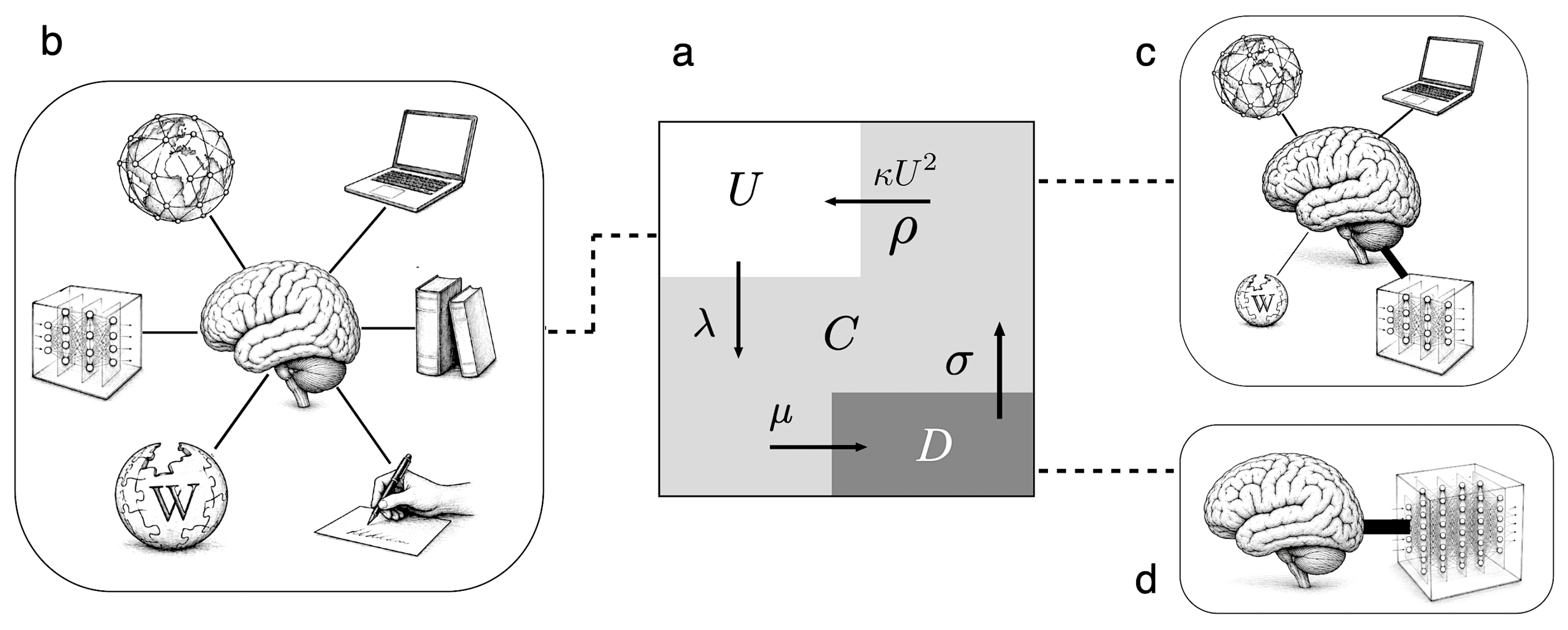
Figure 2.
Bifurcation structure of the LLM propagation model. Top: equilibrium fraction of uncoupled individuals, , as a function of the transmission parameter . For , the system is bistable: the fully uncoupled state and a coupled state are both stable and are separated by an unstable branch (dashed). Increasing drives an abrupt transition to the coupled regime at the transcritical threshold , whereas recovery occurs only after is reduced below the saddle-node threshold , generating hysteresis and technological lock-in. Bottom: corresponding equilibrium fractions of regular users, (red), and dependent users, (blue). Solid curves denote stable equilibria and dashed curves unstable branches. Beyond the tipping point, the sharp decrease in is accompanied by a rapid increase in both regular LLM use and persistent cognitive dependency, representing population-level cognitive offloading. Parameters used: .
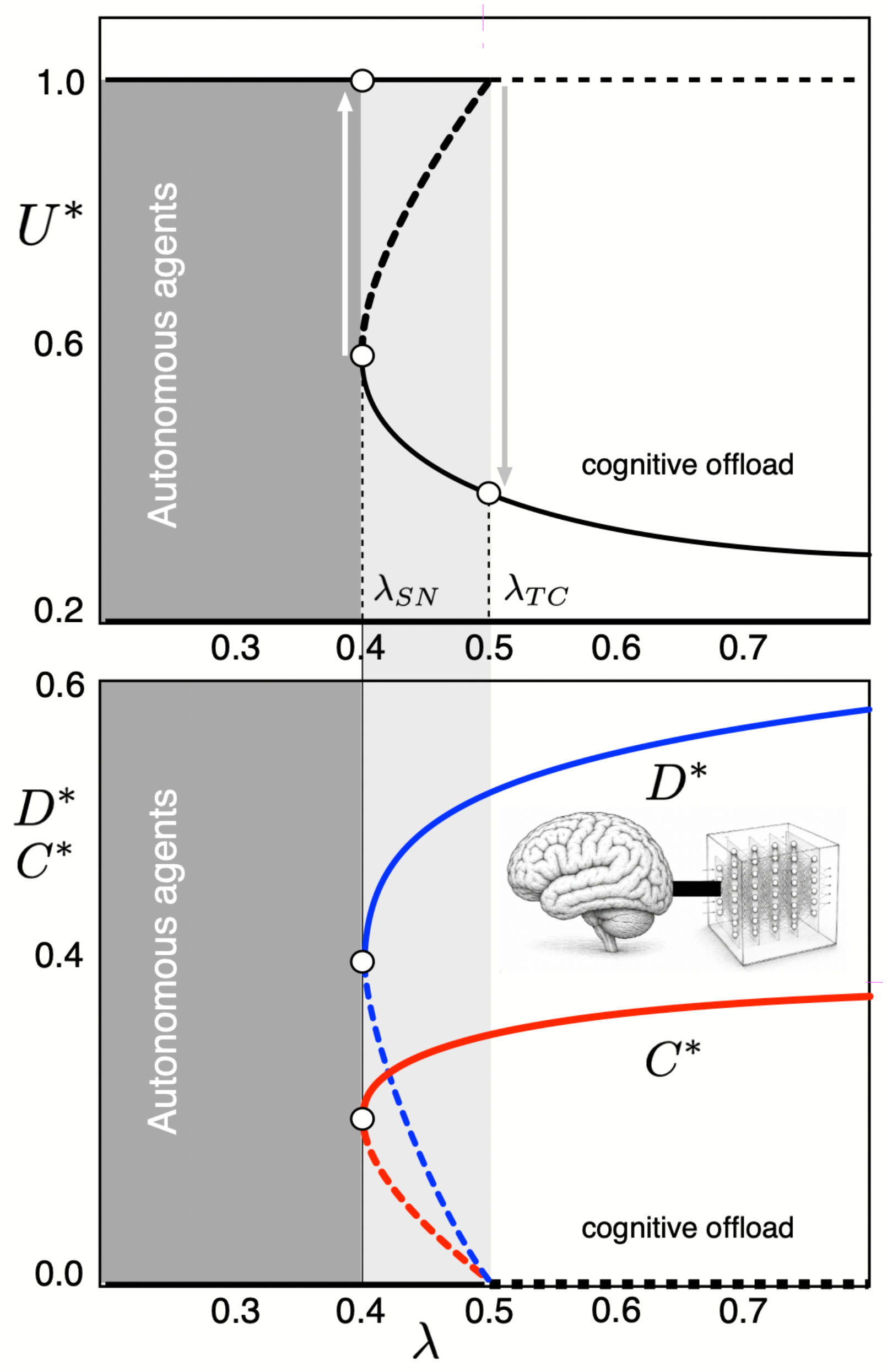
Figure 3.
Cognitive offloading bifurcation, phase structure, and effective potential of the LLM propagation model. (a) Equilibrium average cognitive competence as a function of the transmission parameter . The fully autonomous state remains stable up to the transcritical threshold , whereas a stable offloading branch and an unstable branch appear at the saddle-node threshold . The shaded interval marks the bistable region, where autonomous and offloaded states coexist, implying hysteresis and path dependence. (b) Phase diagram in the plane. The lower boundary, , and the upper boundary, , delimit the bistable domain (black); below it the autonomous phase dominates (gray), whereas above it only the offloading phase is stable (white). (c) Effective potential for representative values of , following the gray arrow in (a) that crosses the bistable domain. The potential landscape shows how the single autonomous minimum is replaced by two competing minima in the bistable regime and finally by a single offloading minimum above . At (the so called Maxwell point), the two minima have equal depth. Same parameters as in Figure 2, with , , and
Disclaimer/Publisher’s Note: The statements, opinions and data contained in all publications are solely those of the individual author(s) and contributor(s) and not of MDPI and/or the editor(s). MDPI and/or the editor(s) disclaim responsibility for any injury to people or property resulting from any ideas, methods, instructions or products referred to in the content. |
© 2026 by the authors. Licensee MDPI, Basel, Switzerland. This article is an open access article distributed under the terms and conditions of the Creative Commons Attribution (CC BY) license (http://creativecommons.org/licenses/by/4.0/).
Copyright: This open access article is published under a Creative Commons CC BY 4.0 license, which permit the free download, distribution, and reuse, provided that the author and preprint are cited in any reuse.