

Submitted:
17 September 2026
Posted:
17 September 2026
You are already at the latest version
Abstract
The restructuring of industrial cities follows various paths depending on local conditions and choices. A novel idea of a local industrial restructuring is to link the industrial park development with the circular economy. The park formations that are based on local government initiatives combine public and private interests, which poses a governance challenge, as they must generate both public value and profits for businesses. In this article, we will focus on the city government’s role and relations with key stakeholders in the building of the green growth coalition around recycling industrial district. Our research is based on single case study methodology. The case is the largest recycling industrial district in Japan, the Kitakyushu Eco-Town. Our interest is in the role of city government as a key player of the green growth coalition. The results show that the city government can effectively build a growth coalition that eventually contributes to the green restructuring. Building a green growth machine is, however, contingent, i.e. the success of the coalition is conditioned by local leadership and endogenous factors as well as their connections with exogenous factors from national governments to global economic and technology trends.
Keywords:
circular economy
; recycling
; industrial district
; eco-industrial park
; eco-town
; growth machine
; green growth
; green restructuring
; governance
; Kitakyushu
; Japan
1. Introduction
The decline of industrial cities in the post-war decades together with increased environmental concerns put pressure on local players to seek balance between economic and environmental goals in their urge to promote economic development and community well-being. Such pressures acted as a catalyst for ecological modernization [1,2] and green restructuring [3], which presented green economy as an attractive option with a genuine potential for exploiting niche markets and reorganizing local and regional economies to improve competitiveness and create jobs [4]. Such a development sparked interest in the idea of green industrial city [5,6,7] and, as its local spatial instance, of eco-industrial park [8,9,10,11] as a new type of industrial district [12,13,14]. The overarching goal of such a park is to generate economic growth and create employment opportunities by attracting investment and supporting R&D activities while at the same time promoting sustainable development [15,16].
There are various groups of local players that have an interest in driving – and at times opposing – such green economic transformation, including manufacturers, business associations, local decision-makers, investors, environmental movements, and inhabitants. In an ideal case, environmental and business interests are balanced in this multi-actor setting through private interactions and democratic governance. A mature approach that addresses such issues is green urban growth machine theorization. It is based on growth machine thesis that emerged in the USA in the 1970s and the following decade, reflecting the peculiarities of urban development under capitalism. As this and similar critical approaches to the political economy of the greening of urban development have traditionally revolved around private landownership and local business interests, the role of local governance institutions has remained insufficiently researched [17,18]. This is evident also in the context of eco-industrial park development [19,20]. Our research is meant to fill this gap by enriching both theoretical and empirical views on institutional growth coalition building with special reference to the role of local government. Building on previous discussion, this article aims to answer the following question: What characterizes the city government’s role and relations with key stakeholders in the building of the green growth coalition around recycling industrial district in the context of a mature developmental state?
We will address the above question by emphasizing institutional environment within which local growth coalitions emerge. Our discussion reflects the interplay of city government and its coalition partners in determining the balance between economic growth and sustainability, which is crystallized in environmentally oriented industrial policy (e.g. [21,22]). This will allow us to build a novel institutionally oriented view of the emergence and functioning of green urban growth coalition.
Due to conceptually and empirically challenging nature of our research problem, we rely on case study methodology. Our case is Eco-Town project of the city of Kitakyushu, which played a pivotal role in establishing the largest cluster of recycling industries in Japan.
This article next establishes the theoretical foundations of the green growth machine. It then outlines the case selection and methodological underpinnings before analyzing the building of green growth coalition around the recycling industrial district known as Kitakyushu Eco-Town. Lastly, dedicated discussion of the findings and concluding remarks synthesize the final insights.
2. The Emergence of a Green Urban Growth Machine
The emergence of eco-industrial parks stems from the local aspiration to generate economic growth or at least decelerate the contractionary spiral of the local economy. Such a view is postulated in growth machine thesis, which describes the contradictions of the local economic development in the context of capitalism [23,24]. It emerged from both the Chicago school of urban sociology and from the social science field of community power studies, which were fused with selected aspects of urban political economy [25]. It is a meso-level theorization that has a loose connection with urban regime theory [26], institutional analysis of urban development [27], critical urban governance research [28], and the idea of urban entrepreneurship [29], which all share a critical view of neoliberal urbanism as their common denominator [30].
2.1. The Foundational Tenets of the Growth Machine Theory
Growth machine thesis argues that the shared interests of parochial elite are primary promoters of the local growth agenda, making the city a locus of capital accumulation [23,25,30,31,32]. Growth machine thesis assumes that place entrepreneurs and their associates seek legitimation of their local development efforts by claiming that growth benefits us all. This is called value-free development, which emphasizes that the land use issues should be left to free market logic, that is, to a price mechanism that determines the relationship between demand and supply of land [24]. This view reflects the situation particularly in American cities, in which private ownership has had a significant impact on urban development. The twist is that property owners and developers try to use local policy-making apparatus to maximize returns on their investments [30,32].
Regarding agency, the growth machine thesis marks a rebirth of the interest in local elite’s role in reshaping urban development, which connects it to urban entrepreneurialism [29]. Its paradigmatic setting is built on an antagonism between place entrepreneurs and urban dwellers. In this setting the place entrepreneurs or urban rentiers form a growth coalition that attempts to intensify the exchange value of urban places. Urban entrepreneurialism revives interest in local government as a growth coalition player. This aligns with the growing tendency of local governments to adopt a market-driven approach to attracting investments and fostering economic growth [29].
2.2. Greening the Urban Growth Machine
In a rapidly changing world, cities—as democratic, self-governing entities—have shown interest in seeking potential growth within new economic, technological, social, cultural, and political trends, many of which are contradictory in nature. One among them is green economy agenda, within which circular economy (CE) has become one of the most widely discussed vis-à-vis urban economic development due to its natural connection with urban metabolism [33,34,35]. Such an agenda eventually became incorporated into the economic development strategies of many progressive and innovative cities throughout the developed world [36], as seen in the gradual emergence of urban environmental regimes, which are growth-oriented and spatially selective, and rely on consensual mainstreaming in urban politics [4]. While such a development has been typical in Anglo-American and European liberal democracies [31,37], it has emerged also in developed countries in Asia, most notably in developmental and post-developmental states in East Asia [38].
Even if economic environment has changed dramatically during the last few decades and occasionally some businesses benefit even anti-growth orientation [39], local land and property owners continue to attract global value flows to localities and, as a part of it, promoting the intensification of the use of privately owned land, buildings, and infrastructures [23,24]. This creates a complex dynamic between pro-growth and anti-growth forces, both being transnationally oriented or “cognitively globalized” to a degree, yet at the same time seeking to leverage local government to advance their local interests. Anti-growth groups assume as a rule that uncontrolled pro-growth agenda tends to worsen the living conditions of local residents, including the impacts of environmental degradation, and potentially decrease the use value of land [24]. A high-profile group among such opposition forces is environmental movement [40], which has a stake in local economic development policy (cf. [41,42,43,44]).
While the relationship between the growth coalition and environmental movement can be conflictual, that is not always the case, as oftentimes such coalitions themselves reflect or adopt innovative environmental policies [19]. This has become clear in contemporary academic discourse on the greening of urban growth machine, which has brought up such issues as the building of green growth coalition [36,45], green investments and gentrification [46,47,48,49], challenges to ecological modernization [50], flexibility of green growth agenda [19], and inter-industry tensions in industrial policy [51]. These imply that various aspects of environmentalism are malleable and can be used instrumentally for competitive advantage, strategic maneuver, or economic gain. Designing and implementing an environmentally friendly local growth agenda can be either a smooth or a contentious process, depending on local conditions, stakeholder relationships, local leadership, and institutional capacity [36,52,53].
In local economic development, all the key urban functions —investment, production, distribution, and consumption— are integrated in a decentralized fashion, involving a wide range of different actors [54,55]. This applies to greening of such a development too [20,35,56]. The multi-dimensionality of the building of a growth machine urges us to take broadening views of green growth [20,57,58,59]. A notable feature of this setting is the role of public actors, most notably that of local government as a key local player, which may assume different roles [60,61]. The role of public actors is context-sensitive, determined by history, ideological underpinnings, political culture, and administrative tradition (e.g. [62]). All such elements form a complex setting that is conditioned by local and external factors and affect the roles and relations of local actors that play a critical part in building or opposing the green growth coalition and eventually in shaping urban economic restructuring.
3. Methodology
3.1. Case Study Methodology
The structural and relational aspects of eco-industrial parks vary across individual cases, making it challenging to develop a robust research design. In order to clarify the given setting, our discussion revolves around three major components: industrial park as an organized entity; city government as a pivotal actor vis-à-vis local stakeholder landscape; and local and national policies for green industrial restructuring as the overarching policy framework. Our aim is to provide a detailed picture of a complex phenomenon and to build a theoretically grounded analysis using context-sensitive data. A research strategy that is particularly suitable for such a purpose is the single case study.
Rather than statistical generalizations, we seek so called analytical generalizations of specific aspects of green growth machine development in the given context. Taking a deeper view of the phenomena, we can understand and contextualize the relationships and modes of action within aspirational coalition formation (see e.g. [63]). Such a research setting creates a precondition for finetuning growth machine theory and identifying critical aspects of the localization of green industrial restructuring [64,65,66].
3.2. Case Selection
When reviewing the variations of eco-industrial parks as manifestations of green growth machine, it became clear that there are almost as many exceptions as there are cases, implying that each park has its specific conditions and characteristic features. Yet, they also share many similar features from the mission to certain aspects of organizational structures and stakeholder relations. We sought a case in which the public-sector interests are clearly pronounced, including both park development and its integration into local public policies. This emphasis relates to our interest in those societal contexts in which local government’s active involvement as integrator of industrial and green policies shapes the building of a growth coalition. After searching for suitable cases from different societal contexts, the case of Eco-Town program in Japan attracted our attention as an example of a local instance of a mature East Asian developmental or post-developmental state [67,68,69,70,71,72,73]. The Kitakyushu Eco-Town project in Kyushu Island is in its own class in terms of reputation and scale [74,75,76,77,78,79]. We ended up drilling deeper into this project, which illustrates the use of recycling industrial parks as an industrial spearhead project around which the city government attempts to build a green growth coalition (on the principles of case selection, see [80]). The recycling industry is one of the characteristic features of Japan’s EIP policy, as pointed out by Putra and others [81] in their bibliometric analysis of EIP projects in East Asia.
Kitakyushu Eco-Town is a recycling industrial park, which is a special form of eco-industrial park [82,83]. It is worth remembering that in the given context the term ‘Eco-Town’ does not refer to a multi-dimensional sustainable community but a large-scale industrial district (cf. [84]). The name ‘Eco-Town’ comes from the Japanese Eco-Town program. Kitakyushu Eco-Town continued its operation under this name after the termination of the national program. The city of Kitakyushu became one of the most well-known green cities in East Asia with a range of sustainability-oriented policy programs and measures highlighted in a Sustainable Development Goal (SDG) vision of the city that aims at inclusive green growth [D1]. This framework covers practically all policy areas, including the promotion of economic development, the essence of which has been characterized as “SDG-focused local industrial policy” [85].
3.3. Data Collection and Analysis
The primary qualitative data for our empirical analysis were collected through interviews (Appendix 1). We also reviewed a few relevant policy reports and promotional materials (Appendix 2). Furthermore, two field trips were organized to various destinations in the city of Kitakyushu, the selected recycling plants in Eco-Town being the primary destinations of these visits (see Appendix 3). Lastly, regarding secondary material, several case studies on Kitakyushu Eco-Town were utilized in both theoretical framework and discussion (e.g. [74,78]).
This article relies on qualitative single case study methodology with a strong theoretical underpinning. The core feature of analysis is exemplification [86] that is guided by growth machine theorization [23,24,25,31] and a scholarly discussion about green growth machines [19,20,51].
The primary qualitative data for our empirical analysis were collected through expert interviews with the representatives of the city of Kitakyushu, Eco-Town Center, and Kitakyushu Urban Center in Kitakyushu in 2023 and 2025 (see Appendix 1). The interviews were thematically structured and addressed the management and governance of Eco-Town project. The structure of our interview was based on the following themes: (a) The management of Eco-Town; (b) The most important stakeholder groups; (c) Policy instruments and their utilization; (d) Interests and tensions; (e) green growth agenda in economic restructuring; and (f) Green urban growth machine in Kitakyushu. We were particularly interested in finding out how the aspects of growth machine thinking were expressed in the interview data, which built on dialectic relationship with particularities of the case and its institutional, economic, and societal contexts. The data analysis was based on deductive coding of qualitative data with predefined set of codes, which built a connection with green growth machine theorizing [87]. After narrowing down the categories, the four anchor categories were used in reflexive thematic analysis [88]: drivers/rationale; local government; stakeholders; and green growth, which form the main themes of the empirical analysis.
Organizations produce documentary materials, which represent their self-understanding as well as the social realities they relate to [89,90]. We reviewed thematically selected policy and promotional documents in order to distill aspects that highlight relational issues associated with the building, functioning, and challenges of green urban growth coalition organized around Kitakyushu Eco-Town project (cf. [74]). The use of documents aligns with the idiosyncratic in-depth case study methodology. Due to the promotional nature of many documents, they were given supplementary role vis-à-vis expert interviews and were utilized selectively relying on descriptive policy document analysis [91,92]. They are referred to in the text by the codes [D1]–[D8].
Finally, we utilized previously published case studies on Kitakyushu Eco-Town as a supplementary material in describing our case, deepening the analysis, and evaluating our findings. Their main role was to sophisticate data analysis and validate our interpretations [74,75,76,77,78,79,85,93,94,95,96,97].
4. Findings
In this section we will discuss the rationale, local governance, green growth agenda, and stakeholder relations of the green urban growth coalition built around the Kitakyushu Eco-Town, Japan.
4.1. Kitakyushu Eco-Town Project: Rationale, Drivers, and Key Actors
The historical background of Kitakyushu’s industrial restructuring is the role of the city as one of the largest heavy industrial complexes in Japan. This development accelerated during the economic growth period from the mid-1950s until the oil crises of the 1970s. An unintended consequence of this development was that by the 1950s the city became extremely polluted [93]. The unsustainability of Kitakyushu’s development brought about counterforces that could be ignored neither by the industrial leaders nor the city government. It put pressure not only on reducing air and water pollution but also on industrial restructuring [79,98].
A change agent who turned these pressures into visionary industrial policy was Mayor Koichi Sueyoshi [76]. He served as the mayor of the city from 1987 until 2007. He took decisive steps towards bringing local stakeholders together to plan and implement economic development in which environmental concerns were given a major role (Interview 7). This collaborative work with key stakeholders was organized by setting up several committees since 1989 [75,76,78]. Collaboration with large corporations – especially with Nippon Steel Corporation (NSC) – was essential at that time, as they had reclaimed land in Hibikinada area in Wakamatsu ward. The area owned primarily by NSC had become underutilized due to industrial decline, while the planned recycling-oriented industrial district had high spatial requirements. In the 1990s, the city government purchased 3/4 of the Hibikinada area in order to lease plots to recycling firms [75,78]. In this process other key stakeholders included Toshiba, Mitsui, the Harbor Bureau, technology experts, and a few civic organizations [78]. This work was continued by another long-serving mayor, Kenji Kitahashi, who led the city government from 2007 until 2023. The focus of these mayors was on economic development while promoting simultaneously progressive environmental initiatives. The next mayor was Kazuhisa Takeuchi, who continued forward-looking leadership of his predecessors.
With a then novel green industrial transition in mind, the city government approached relevant ministries on this issue. Soon the Ministry of the Environment (MoE) and the Ministry of Economy, Trade and Industry (METI) set up a national Eco-Town program. The initial objective of the program was to extend the operational lifespan of existing landfill sites in different parts of Japan while at the same time revitalizing and stimulating local industries. In all, 26 Eco-Towns were established within the national program, which lasted from 1997 until 2006 [36,83]. Kitakyushu became the first city to be accepted in the program in 1997. Irvine and Bai [76] argued that funding from national sources was essential to the Eco-Town project in its early years. It is worth emphasizing that the development of the national regulatory framework was of vital importance too, for the Basic Law for Establishing the Recycling-based Society came into force in January 2001 accompanied by several special recycling laws enacted in the early 2000s. This gave an extra push to the creation of recycling market (Interview 7; 5).
Kitakyushu City had skilled human resources and an industrial base, as well as a network of residents, businesses, and the local government, so efforts to turn the Hibikinada area into an environmentally friendly city began with a unified collaborative system. (Interview 1)
Hibikinada became a large industrial area promoted within the national Eco-Town policy framework. It benefited from the industrial heritage and related technological advances in the city as well as the nearby port. Unlike many other early eco-industrial districts, Kitakyushu Eco-Town was not based on the idea of industrial symbiosis as such but focused at the outset on recycling as its industrial profile, which matched well with the rising CE agenda.
The Eco-Town project is a policy that aims at achieving zero emissions by turning all waste into raw materials for other industries. … City’s policy is to attract recycling companies, and they will give priority to such businesses. (Interview 2)
Thus, the major preconditions for the establishment of Kitakyushu Eco-Town were location, availability of land, institutional support, and business-friendly city government.
Land availability at a reasonable price is a big motivation to start up the recycling business here in Kitakyushu, with considerable support from the Kitakyushu city government, including administrative procedures and R&D funding. (Interview 7)
4.2. City Government as Growth Coalition Builder
Even if Kitakyushu is an industrial city par excellence, which suggests that industrial corporations are likely to be among the most influential growth machine players, city government was actually the most active actor in the coalition that was built around Eco-Town project. The city of Kitakyushu developed into a progressive pioneer in green restructuring. Its flagship initiative was Eco-Town project, which received both national and international recognition.
One of Kitakyushu’s strengths is its ability to form policies under local government leadership. (Interview 1)
The city government was instrumental in developing the Hibikinada area and attracting recycling businesses there. The factual managerial role is currently played by Circular Economy Promotion Division of the Environment Bureau of the city government. It focuses on supporting business and technological development related to Eco-Town area, such as providing experimentation facilities, granting subsidies for R&D, promoting industry-academia collaboration, facilitating business-to-business collaboration, and supporting startup companies (Interview 2). There is, however, neither any appointed CEO managing the park operations nor direct involvement in the businesses operating in the park. The city government coordinates the park development and gives guidance whenever seen appropriate or requested by companies (Interview 2). The city operates like a one-stop-shop or a liaison office but in a less bureaucratic manner than what is common in Japanese local government (Interview 1).
City Hall tends to act as an intermediary, provide cooperation, and provide subsidies. (Interview 3)
For promotional and educational purposes, it set up Eco-Town Center in 2001 as a visitor hub of the area with permanent exhibition, classrooms, and staff, which implies that industrial tourism was part of the Eco-Town project from the beginning (Interview 4).
4.3. Stakeholder Interests in the Local Governance Setting
The city of Kitakyushu has an enabling orientation in governing the Eco-Town area (Interview 1). Even if the city government is a primus inter pares in local governance, its role is primarily collaborative, enabling, and persuasive.
Eco-Town is a collaborative enterprise in the sense that the city government emphasized at the outset responsiveness towards civil society and also collaboration with the academia and businesses ([99]; see also [100]). A characteristic feature of Eco-Town coalition building is its inherent multi-sector and multi-scalar nature, with an exceptionally strong international dimension (cf. [76,78]).
Eco-Town project is resourced collaboratively by public and private landowners, private corporations, and city and national governments. The management of the area is rather decentralized. For example, there is no excessive preferential treatment of Eco-Town companies (Interview 3). The city government keeps the managerial issues of recycling business at arm’s length. It becomes active only when businesses need connections, advice, or support to technological development (Interview 1; 6; 7).
Citizen participation in local environmental issues began long before the Eco-Town project. Initially, urban residents engaged in protest against pollution in the city, but over time their role changed as the situation improved and the city government began to implement progressive environmental policy. The city government was keen to organize awareness campaigns and facilitate education as a precondition for structural change [D2], while as a practical solution it introduced an advanced household waste separation system, which created a material connection between local residents’ lifestyles and industrial-scale recycling [95].
Kitakyushu is a pioneering city that gets residents to sort their waste at the source—the most challenging yet crucial stage for recycling. --- Waste categories requiring sorting include, for example, glass, PET bottles, plastics, light bulbs, and so on. The city collects these pre-sorted materials and delivers them directly to recycling companies. (Interview 7)
Currently, the main activity is to strengthen environmental awareness among school children and local residents, including organized visits to Eco-Town Center, which contributes directly to recycling efforts (Interview 2; 4). This builds gradually loose symbiotic relationships between industries, retailers, and urban dwellers.
4.4. Aspiring Green Growth
Kitakyushu has transformed from a heavily polluted industrial city into an internationally recognized green growth city [36]. It has focused on developing and exporting its expertise in environmental technologies, recycling systems, and other CE solutions. It has shown genuine interest in integrating environmental and industrial policies.
Eco-Town project channels green growth ideas through recycling industries, which has a special nature in terms of profit generation and job creation. Even if the area was not designed as a symbiotic eco-industrial park as such, the idea of industrial and urban symbiosis has been part of the philosophy that inspired the development of the area.
I cannot really say that Eco-Town has succeeded in achieving industrial symbiosis. … we changed the Eco-Town concept into recycling industry complex. (Interview 7)
Eco-Town’s direct impact on job creation is relatively modest.
The impact of Eco-Town’s job creation is relatively small. … recycling industry is a challenging industry to run, and it is difficult to create many jobs compared with arterial industries, such as automobiles and steel. (Interview 2)
Green growth requires innovations, incentives, and investments, and it may be that Kitakyushu does not generate such activities as it did a few decades ago. It has reached the point at which it has got most of the benefits from the recycling market and businesses during the early years of the launch of the national Eco-Town program. While some niche markets are assumed to expand in the future, as with the case of recycling waste solar panels (visit to Shinryo Corporation, see Appendix 3), time seems to be ripe for new initiatives, as seen in the city government’s proactive promotion of wind energy production through the Kitakyushu Hibikinada Offshore Wind Farm project (Interview 5) and increased interest in supporting supply and utilization of hydrogen as a part of its strive for low-carbon economy [D3-D6].
But such situation has sustained for past 25 years, so private sector cannot really invest into updating this industrial sector further. If another policy comes in to support recycled materials, higher value in the market, then private sector is ready to invest into them. (Interview 7)
5. Discussion
Kitakyushu Eco-Town represents a case of a city government-led green urban growth machine in the context of a mature developmental state. It is an outcome of an institutionally embedded green urban growth coalition, in which a national government played an enabling role through policy programs and legislation. Local government assumed a role as an institutional entrepreneur, which compensated for the lack of private capital by extracting public funding from local and national sources to support the creation of the branded cluster of recycling plants. This actually reveals how Kitakyushu as an old company town was able to utilize its legacy in terms of land, expertise, and capital while transforming towards recycling industry as a part of the greening of the local economy. Lee and Sonnenfeld [96] emphasize that “Kitakyushu Eco-Town thus illustrates how corporate motivations and resource strategies, aligned with local initiatives, can enable city-level industrial symbiosis,” from which they derive an idea that local government has co-created recycling industry in collaboration with corporate stakeholders. However, it is evident that symbiotic relationships within the industrial sector are still in their infancy—and even more so when considering the broader range of urban actors involved in urban symbiosis.
A critical task taken care of by city government is stakeholder engagement [78,101]. While collaborative relationship of the city of Kitakyushu and NSC as the most powerful industrial player in the area was intensive in the early years of industrial district development, stakeholder group widened soon after the city government had purchased large part of the land in Hibikinada area. City government was able to bridge the public-private divide and intensify its collaboration with SMEs ([99]; cf. [94]). It is worth emphasizing that the active involvement of civil society has served to balance the agenda, a prerequisite for achieving optimal results in the pursuit of a high quality of life and sustainable lifestyle (cf. [101]). The environmental movement had a notable local influence in the post-War decades, which were reflected in voluntary improvements by industries and anti-pollution agreements between city government and industrial companies [74,78]. Progressive environmental policies became filtered through local politico-administrative machinery the way that effectively created alternative strategy to a one-dimensional growth machine logic (cf. [102]). The city government obviously succeeded in translating grassroots environmental activism into green industrial policy, as pointed out by Low [99]. Our results also align with the findings of Irvine and Bai [76], who emphasize the importance of vertical and horizontal linkages behind the success of the development of Kitakyushu Eco-Town.
It seems that the more distant the rationale of growth coalition is from instrumental profit maximization ethos of land and property owners and recycling businesses, the more delocalized and potentially politicized its agenda becomes, which implies a wider leeway in terms of industrial policy. When the local government becomes a key player in industrial development, it creates a “development proposal” to private enterprises, which predominantly revolves around industrial land, R&D subsidies, and the brand of the industrial district or cluster. In this way local government as an urban entrepreneur lays its cards on the table while giving the final say to private stakeholders. This is the essence of institutionally embedded green growth machine. Even if profit motive is at the core of the involvement of private firms as members of the growth coalition, the city government’s open commitment to the development of an area together with public land ownership seems to balance the relational aspects of the growth machine. Moreover, the role of local government seems to be changing during the life cycle of the park, for in the inception phase of Eco-Town project its role as a policymaker and a financier was critical, whereas after reaching a certain level of maturity, its role developed towards facilitator and supporter, which hints that the relationality in the governance of the park is dynamic, i.e. it develops gradually from external towards internal focus (cf. [61]).
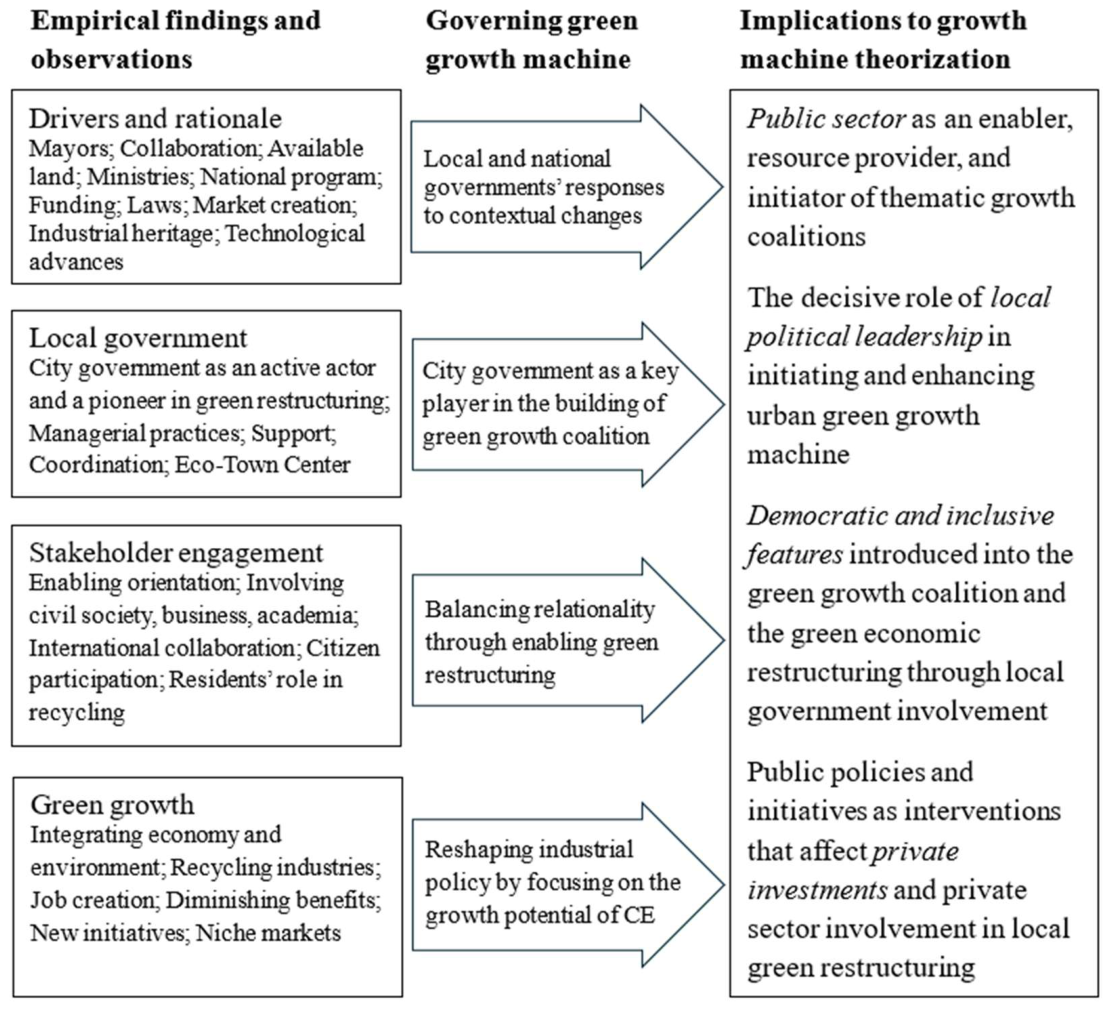
Our results give insights into refining some aspects of green growth machine discourse. First, the role of public sector must be given a due role especially in developed country contexts. Second, as a continuation of the first point, the role of local government as an agenda-setter should not be underestimated. Third, the successful implementation of novel industrial policies depends essentially on stakeholder engagement regarding business community, urban community, and a wider societal context. Lastly, green growth machine is a manifestation of environmentally justified industrial policy intervention, which necessitates a balance between business and environmental interests. Theoretical implications of our findings for growth machine theory are highlighted in Figure 1.
The spatial and economic organization of local industrial development affects the growth machine dynamic. Namely, the case of Eco-Town implies that industrial districts constitute a special kind of environment in terms of spatial, social, institutional, and industrial development. For example, there was no notable green gentrification in Eco-Town and surrounding areas due to the availability of reclaimed land. As regards local industries, the Eco-Town as a greenfield development is largely separated from the traditional industry clusters of the city. Recycling industry cluster is actually a narrow slice of the entire industrial base of the city (cf. [51]). In the same vein, Eco-Town-driven industrial symbiosis as a part of a wider circular urban-regional ecosystem rests on the standalone commercial recycling firms with small-scale inter-industry raw material exchanges and a few waste-to-energy ventures [96,103]. Kitakyushu Eco-Town model is rather different when compared with, let’s say, Kawasaki Eco-Town, which as a brownfield development anchored its activities in the cluster of established heavy industries [99,104,105].
The city government of Kitakyushu has consistently been striving for economic growth, but not at the expense of the environment (cf. [19,46,49,50]). The aim was the transition to a circular economy, spearheaded by Eco-Town as a recycling industry hub. Economically, the appeal of Eco-Town may have slightly diminished due to the heavy reliance on labor in recycling processes, uncertainties regarding the streams of recyclables, and narrow profit margins. These factors keep business interests modest within the green urban growth machine, which poses a challenge to the resilience of the green growth coalition (e.g. [79,96]). This situation urges the renewal of growth agenda that is able to attract diverse businesses and expand into international markets. In Kitakyushu, the focus started to change in the latter half of the 2000s, due to the commitment to local low-carbon development and the pursuit of becoming a zero-emission city—a goal officially announced by the city government in the early 2020s. While recycling exhibits growth prospects in areas like clean-tech sector, including solar panels and lithium-ion batteries, Kitakyushu’s current green growth strategy is oriented towards reducing carbon dioxide emissions from energy production, developing energy storage systems, and aspiring to become a hub of wind power industries. This indicates a thematic shift in Kitakyushu’s green growth machine [D7-D8].
6. Conclusion
The Eco-Town project of the city of Kitakyushu is one of the most prominent cases of local economic restructuring in Japan built upon the idea of circular economy. The city government set up a recycling industrial park, which became a significant player at different territorial scales. Even if it was based on local government initiative, it is governed in a collaborative and enabling fashion. This is instrumental to securing the balanced view of public, private, and civic interests in the development of recycling industrial complex.
Our results show that the role of local government in the formation of green urban growth machines can be decisive, which urges the reconsideration of the premises of growth machine thesis, especially regarding the local growth coalitions in the mature developmental states. In the case of Kitakyushu Eco-Town, the local government operates in a persuasive manner, which gives the private actors considerable leeway in their involvement.
Our case shows that the decisive actions of the city government have potential to foster green restructuring. Moreover, such an impact seems to be amplified if national government provides support for locally initiated and embedded policies and actions. At the same time, it seems that building a green growth machine is highly contingent, which implies that the success of green growth coalition is conditioned by local leadership and locally determined factors as well as their connections with exogenous factors from national governments to global economic and technology trends.
The limitations of this study relate to the reliance of single case study methodology, which is used to highlight the special nature of the context in which local government may have a significant role in building a green growth coalition. While the case of Japan serves our purposes well, it is applicable primarily to a mature developmental state context. This reveals the need for future research regarding the role of public sector organizations in the building and functioning of green growth coalitions in different contexts. Furthermore, there is need for research on various ways of harmonizing different interests and institutional logics while simultaneously guaranteeing that public interest is sufficiently taken into account in the growth-oriented industrial and urban development policies.
Author Contributions
Conceptualization, A.-V.A., P.V. and H.M; methodology, A.-V.A., P.V. and H.M.; software, A.-V.A.; validation, A.-V.A., P.V. and H.M; formal analysis, A.-V.A., P.V. and H.M.; investigation, H.M., A.-V.A. and P.V.; resources, P.V., A.-V.A. and H.M.; data curation, A.-V.A., P.V. and H.M.; writing—original draft preparation, A-V.A.; writing—review and editing, A.-V.A.; visualization, A.-V.A.; supervision, A.-V.A..; project administration, A.-V.A. and P.V.; funding acquisition, P.V. and A.-V.A. All authors have read and agreed to the published version of the manuscript.
Funding
This research is an outcome of the project “Governing Transition to a Circular City: Engaging public and private stakeholders in the circular economy” of the VATACO consortium funded by the Critical Materials in Circular Economy of Cities (Romulus) 2022–2025 program of the Research Council of Finland. Funding was granted by The Research Council of Finland on 9 November 2021. Funding numbers of Consortium members are 347136 and 357561.
Institutional Review Board Statement
The study was conduct following the guidelines of the Research Council of Finland and the ethical principles followed by Tampere University. The Research Council of Finland requires that all research funded by it is carried out following the guidelines of the Finnish National Board on Research Integrity. On RI Guidelines, see https://tenk.fi/sites/default/files/2023-05/RI_Guidelines_2023.pdf (accessed on 11 September 2023).
Informed Consent Statement
Informed consent was obtained from all subjects involved in the study.
Data Availability Statement
Details of data are described in methodology section and in Appendix A, Appendix B and Appendix C. Interview data is stored by Tampere University according to the data management plan of the VATACO Consortium, which follow the instructions of The Research Council of Finland.
Acknowledgments
We would like to thank Tampere University and Ritsumeikan University as well as the Research Council of Finland for supporting our research. Special thanks to the MDPI team for their assistance in publishing this article.
Conflicts of Interest
The authors declare no conflicts of interest.
Abbreviations
The following abbreviations are used in this manuscript:
| CE | Circular economy |
| CEO | Chief executive officer |
| EIP | Eco-industrial park |
| METI | Ministry of Economy, Trade and Industry |
| MoE | Ministry of the Environment |
| R&D | Research and development |
| SDG | Sustainable development goal |
| SME | Small and medium-sized enterprise |
Appendix A Interviews
Interview 1. Chief of Environmental Technology Development, Green Growth Promotion Department, Environment Bureau, Environmental Innovation Support Division, City of Kitakyushu, Japan (Interviewed by H.M., A.-V.A. and P.V. on 31 October 2024 in the City Hall of the City of Kitakyushu, Japan).
Interview 2. Manager, Circular Economy Promotion Division, Environment Bureau, City of Kitakyushu, Japan. (Interviewed by H.M., A.-V.A. and P.V. on 19 June 2025 at Eco-Town Center, Kitakyushu).
Interview 3. Employee, Eco-Town Center, Kitakyushu, Japan. (Interviewed by A.-V.A., P.V. and H.M. on 19 June 2025 at Eco-Town Center, Kitakyushu, Japan).
Interview 4. Representative Director, Eco-Town Center, City of Kitakyushu, Japan (Interviewed informally during Eco-Town Center visit by H.M., A.-V.A. and P.V. on 20 June 2025 at Eco-Town Center, Kitakyushu, Japan).
Interview 5. Policy Researcher, Kitakyushu Urban Center (KUC), The Institute for Global Environmental Strategies (IGES), Kitakyushu, Japan. (Interviewed by P.V. and A.-V.A. on 1 November 2024 at KUC, Kitakyushu, Japan).
Interview 6. Director of general affairs, Kitakyushu Urban Center (KUC). (Interviewed by P.V. and A.-V.A. on 1 November 2024 at KUC, Kitakyushu, Japan).
Interview 7. Program Director, Kitakyushu Urban Center (KUC). (Interviewed by A.-V.A. and P.V. on 1 November 2024 at KUC, Kitakyushu, and on 18 June 2025 at KUC, Kitakyushu, Japan).
Appendix B Policy and Promotional Documents
[D1] OECD (2021). A Territorial Approach to the Sustainable Development Goals in Kitakyushu, Japan. OECD Regional Development Papers. Retrieved October 10, 2025, from https://www.oecd.org/content/dam/oecd/en/publications/reports/2021/06/a-territorial-approach-to-the-sustainable-development-goals-in-kitakyushu-japan_aa1def64/12db268f-en.pdf
[D2] Kitakyushu City (2018). The Kitakyushu City Basic Environmental Plan. Retrieved September 4, 2026, from https://www.city.kitakyushu.lg.jp/files/000823011.pdf
[D3] Sono, Junichi (2018) Eco Model City, Kitakyushu. Kitakyushu Asian Center for Low Carbon Society. City of Kitakyushu. 5 Green Industry Conference for Sustainable Development. 3-5 October 2018, Bangkok, Thailand.
[D4] Kitakyushu City (2018). The Sustainable Development Goals Report - Fostering a trusted Green Growth City with true wealth and prosperity, contributing to the world - 2018. City of Kitakyushu and IGES. https://www.local2030.org/pdf/vlr/kitakyushu-sdg-report-en-2018.pdf
[D5] Kitakyushu City (2023a). Kitakyushu City Newsletter, Issue 1, January 2023. Retrieved October 10, 2025, from https://www.city.kitakyushu.lg.jp/files/001121980.pdf
[D6] Kitakyushu City (2023b). Kitakyushu City Newsletter, Issue 2, August 2023. Retrieved October 10, 2025, from https://www.city.kitakyushu.lg.jp/files/001121981.pdf
[D7] Kitakyushu City (2021). The 2nd Kitakyushu City Fundamental Plan for Establishing a Sound Material-Cycle Society - Summary Overview. City of Kitakyushu, August 2021. Retrieved September 4, 2026, from https://www.city.kitakyushu.lg.jp/files/000961215.pdf
[D8] Kitakyushu City (2022). Kitakyushu City Green Growth Strategy [北九州市グリーン成長戦略] —Promoting Energy Decarbonization and Innovation to Realize a Zero-Carbon City—. In Japanese. Kitakyushu City, February 2022. Retrieved September 4, 2026, from https://www.city.kitakyushu.lg.jp/files/000967655.pdf
Appendix C Field Trips
Kitakyushu Eco-Town Center, 31 October 2024, H.M., A.-V.A., and P.V.
Kitakyushu Eco-Town Center, 19-20 June 2025, H.M., A.-V.A., and P.V.
Shinryo solar panel circular unit, a subsidiary of Mitsubishi Chemical Engineering Corporation. The visit was hosted by Daisuke Moriya, Director of the Planning Department. Kitakyushu Eco-Town, 31 October 2024, H.M., A.-V.A., and P.V.
Automobile Recycling Facility, Operated by West Japan Auto Recycling Co., introduced by Akihiro Tarutoko, Kitakyushu Eco-Town, 19 June 2025, H.M., A.-V.A., and P.V.
OA Equipment Recycling Facility, Shinryo Corporation, introduced by Akihiro Tarutoko, Kitakyushu Eco-Town, 19 June 2025, H.M., A.-V.A., and P.V.
Aluminum and steel Can Recycling Facility, KARS Company, Ltd., Kitakyushu Eco-Town, 20 June 2025, H.M., A.-V.A., and P.V.
Hibikinada Offshore Wind Farm, Kitakyushu, Japan, 20 June 2025, H.M. and A.-V.A.
Kitakyushu Eco House, 2-2-6 Higashida, Yahata-higashi, Kitakyushu City, 1 Nov 2024, A.-V.A. and P.V.
Takamiya Environment Museum, Kitakyushu City, 1 Nov 2024, A.-V.A. and P.V.
References
- Gibbs, D. Ecological Modernization. In International Encyclopedia of Geography: People, the Earth, Environment and Technology; Richardson, D., Castree, N., Goodchild, M.F., Kobayashi, A., Liu, W., Marston, R.A., Eds.; John Wiley & Sons: Hoboken, NJ, USA, 2017; pp. 1–13. [Google Scholar] [CrossRef]
- Nielsen, E.S. Smart Growth Machines: The Ecological Modernization of Urban Political Economy. In From Sustainable to Resilient Cities: Global Concerns and Urban Efforts; Research in Urban Sociology; Holt, W.G., Ed.; Emerald: Bingley, UK, 2014; Vol. 14, pp. 169–190. [Google Scholar] [CrossRef]
- Jakobsen, S.-E.; Uyarra, E.; Njøs, R.; Fløysand, A. Policy action for green restructuring in specialized industrial regions. Eur. Urban Reg. Stud. 2022, 29(3), 312–331. [Google Scholar] [CrossRef]
- Rosol, M.; Béal, V.; Mössner, S. Greenest cities? The (post-)politics of new urban environmental regimes. Environ. Plan. A Econ. Space 2017, 49(8), 1710–1718. [Google Scholar] [CrossRef]
- Grillitsch, M.; Hansen, T. Green industry development in different types of regions. Eur. Plan. Stud. 2019, 27(11), 2163–2183. [Google Scholar] [CrossRef]
- Zhang, Y.; Lu, J. Green industrial cities. In China’s Eco-city Construction; Research Series on the Chinese Dream and China’s Development Path; Li, J., Yang, T., Eds.; Springer: Berlin and Heidelberg, Germany, 2016. [Google Scholar] [CrossRef]
- Froy, F.; Heroy, S.; Uyarra, E.; O’Clery, N. What drives the creation of green jobs, products and technologies in cities and regions? Insights from recent research on green industrial transitions. Local Econ. 2022, 37(7), 584–601. [Google Scholar] [CrossRef]
- Gibbs, D.; Deutz, P. Implementing industrial ecology? Planning for eco-industrial parks in the USA. Geoforum 2005, 36(4), 452–464. [Google Scholar] [CrossRef]
- Gibbs, D.; Deutz, P. Reflections on implementing industrial ecology through eco-industrial park development. J. Clean. Prod. 2007, 15(17), 1683–1695. [Google Scholar] [CrossRef]
- Rodrik, D. Green industrial policy. Oxf. Rev. Econ. Policy 2014, 30(3), 469–491. [Google Scholar] [CrossRef]
- Perrucci, D.V.; Aktaş, C.B.; Sorentino, J.; Akanbi, H.; Curabba, J. A review of international eco-industrial parks for implementation success in the United States. City Environ. Interact. 2022, 16, 100086. [Google Scholar] [CrossRef]
- Marshall, A. Principles of Economics; Macmillan: London, UK, 1922. [Google Scholar]
- Becattini, G. Industrial Sectors and Industrial Districts: Tools for Industrial Analysis. Eur. Plan. Stud. 2002, 10(4), 483–493. [Google Scholar] [CrossRef]
- Saggese, S. Governance of Industrial Districts: Bibliometric and Cluster Analyses. Int. J. Bus. Manag. 2016, 11(9), 36–50. [Google Scholar] [CrossRef]
- Aggeri, F. Industrial eco-parks as drivers of the circular economy. Field Actions Sci. Rep. 2021, Special Issue 23, 60–61. Available online: http://journals.openedition.org/factsreports/6642 (accessed on 3 November 2022).
- Mitrovic, A.; Vuruna, M.; Mutavčić, V. The critical role of industrial eco-parks in preserving the environment of the Western Balkans. In New Trends in Engineering Research 2024;Lecture Notes in Networks and Systems; Mitrovic, N., Mladenovic, G., Mitrovic, A., Eds.; Springer: Cham, Switzerland, 2024; Vol. 1216. [Google Scholar] [CrossRef]
- Dai, Y.; Day, S.; Masi, D.; Gölgeci, I. A synthesised framework of eco-industrial park transformation and stakeholder interaction. Bus. Strategy Environ. 2022, 31(7), 3122–3151. [Google Scholar] [CrossRef]
- Nylén, E.J.; Anttiroiko, A.-V.; Tiensuu, A. The role of eco-industrial parks in promoting regional circular economy: A stakeholder perspective. Circ. Econ. Sustain. 2024, 5, 1245–1267. [Google Scholar] [CrossRef]
- Jocoy, C.L. Green growth machines? Competing discourses of urban development in Playa Vista, California. Urban Geogr. 2017, 39(3), 388–412. [Google Scholar] [CrossRef]
- DuPuis, E.M.; Greenberg, M. The right to the resilient city: Progressive politics and the green growth machine in New York City. J. Environ. Stud. Sci. 2019, 9, 352–363. [Google Scholar] [CrossRef]
- Wu, M.; Salzman, J. The next generation of trade and environment conflicts: The rise of green industrial policy. Northwest. Univ. Law Rev. 2014, 108(2), 401–474. Available online: https://scholarship.law.duke.edu/faculty_scholarship/3320 (accessed on 7 September 2026).
- Wang, N.; Guo, J.; Zhang, X.; Zhang, J.; Li, Z.; Meng, F.; Zhang, B.; Ren, X. The circular economy transformation in industrial parks: Theoretical reframing of the resource and environment matrix. Resour. Conserv. Recycl. 2021, 167, 105251. [Google Scholar] [CrossRef]
- Molotch, H. The city as a growth machine: Toward a political economy of place. Am. J. Sociol. 1976, 82(2), 309–332. [Google Scholar] [CrossRef]
- Logan, J.; Molotch, H. Urban Fortunes: The Political Economy of Place; University of California Press: Los Angeles, USA, 1987. [Google Scholar]
- Molotch, H. Urban growth machine. In Oxford Bibliographies in Sociology, online ed.; Spillman, L., Ed.; Oxford Academic: New York, USA, 2021. [Google Scholar] [CrossRef]
- Stone, C. Regime Politics: Governing Atlanta, 1946–1988; University Press of Kansas: Lawrence, USA, 1989. [Google Scholar]
- Raco, M. Competition, collaboration and the new industrial districts: Examining the institutional turn in local economic development. Urban Stud. 1999, 36(5–6), 951–968. [Google Scholar] [CrossRef]
- MacLeod, G.; Goodwin, M. Space, scale and state strategy: Rethinking urban and regional governance. Prog. Hum. Geogr. 1999, 23(4), 503–527. [Google Scholar] [CrossRef]
- Harvey, D. From managerialism to entrepreneurialism: The transformation in urban governance in late capitalism. Geogr. Ann. Ser. B Hum. Geogr. 1989, 71(1), 3–17. [Google Scholar] [CrossRef]
- Farahani, A. Urban growth machine. In The Wiley-Blackwell Encyclopedia of Social Theory; Turner, B.S., Ed.; Wiley-Blackwell: Hoboken, NJ, USA, 2017. [Google Scholar] [CrossRef]
- Molotch, H. The political economy of growth machines. J. Urban Aff. 1993, 15(1), 29–53. [Google Scholar] [CrossRef]
- Rodgers, S. Urban growth machine. In International Encyclopedia of Human Geography; Kitchin, R., Thrift, N., Eds.; Elsevier: Oxford, UK, 2009; pp. 40–45. [Google Scholar] [CrossRef]
- Kirchherr, J.; Yang, N.-H.N.; Schulze-Spüntrup, F.; Heerink, M.J.; Hartley, K. Conceptualizing the circular economy (revisited): An analysis of 221 definitions. Resour. Conserv. Recycl. 2023, 194, 107001. [Google Scholar] [CrossRef]
- Nuur, C. In perspective: Rejuvenating local economies through locally embedded circular economy systems. Local Econ. J. Local Econ. Policy Unit. 2026, 40(1), 19–29. [Google Scholar] [CrossRef]
- Lin, B.C. Sustainable growth: A circular economy perspective. J. Econ. Issues 2020, 54(2), 465–471. [Google Scholar] [CrossRef]
- OECD. Green Growth in Cities; OECD Green Growth Studies; OECD Publishing: Paris, France, 2013. [Google Scholar] [CrossRef]
- Harding, A. Urban regimes and growth machines: Toward a cross-national research agenda. Urban Aff. Q. 1994, 29(3), 356–382. [Google Scholar] [CrossRef]
- Stubbs, R. The origins of East Asia’s developmental states and the pressures for change. In Asia after the Developmental State: Disembedding Autonomy; Carroll, T., Jarvis, D.S.L., Eds.; Cambridge University Press: Cambridge, UK, 2017; pp. 51–71. [Google Scholar] [CrossRef]
- Törnberg, P. The City as an Anti-Growth Machine. Antipode 2026, 58(2), e70145. [Google Scholar] [CrossRef]
- Mihaylov, N.L.; Perkins, D.D. Local environmental grassroots activism: contributions from environmental psychology, sociology and politics. Behav. Sci. 2015, 5(1), 121–153. [Google Scholar] [CrossRef]
- Matlock, A.S.; Lipsman, J.E. Mitigating environmental harm in urban planning: an ecological perspective. J. Environ. Plan. Manag. 2020, 63(3), 568–584. [Google Scholar] [CrossRef]
- Zuniga-Teran, A.A.; Gerlak, A.K.; Elder, A.D.; Tam, A. The unjust distribution of urban green infrastructure is just the tip of the iceberg: A systematic review of place-based studies. Environ. Sci. Policy 2021, 126, 234–245. [Google Scholar] [CrossRef]
- Haarstad, H.; Hofstad, H.; Vedeld, T.; Smas, L.; Braathen, E.; Millstein, M. Democratic limitations of urban climate governance: proactive and reactive citizen action in four Scandinavian cities. Urban Geogr. 2025, 46(3), 680–698. [Google Scholar] [CrossRef]
- Haarstad, H.; Yazar, M. Urban sustainability: a spatial justice critique. Territ. Politics Gov. 2026, 14(6), 1037–1051. [Google Scholar] [CrossRef]
- Mboumoua, I. Revisiting the growth coalition concept to analyse the success of the Crossrail London megaproject. Eur. Plan. Stud. 2017, 25(2), 314–331. [Google Scholar] [CrossRef]
- Rigolon, A.; Collins, T. The green gentrification cycle. Urban Stud. 2023, 60(4), 770–785. [Google Scholar] [CrossRef]
- Rigolon, A.; Stuhlmacher, M.; Christensen, J.; Collins, T.W.; Kim, J. Different pathways to greening in gentrifying communities: Power, transformative projects, and the green gentrification cycle. Cities 2025, 166, 106268. [Google Scholar] [CrossRef]
- Mullenbach, L.E.; Mowen, A.J.; Brasier, K.J. Urban parks, the growth machine, and the media: An analysis of press coverage of the High Line, Klyde Warren Park, and the Rail Park. Environ. Sociol. 2021, 7(4), 407–420. [Google Scholar] [CrossRef]
- Reibel, M.; Rigolon, A.; Rocha, A. Follow the money: Do gentrifying and at-risk neighborhoods attract more park spending? J. Urban Aff. 2021, 45(5), 923–941. [Google Scholar] [CrossRef]
- Scanu, E.; Cloutier, G.; Trudelle, C. Contesting the greening of the urban growth machine: Ecological modernization and the promethean counter-discourse. Environ. Plan. E Nat. Space 2021, 4(4), 1369–1388. [Google Scholar] [CrossRef]
- Dilworth, R.; Stokes, R. Green growth machines, LEED ratings and value free development: The case of the Philadelphia property tax abatement. J. Urban. 2012, 6(1), 37–51. [Google Scholar] [CrossRef]
- Evans, B.; Joas, M.; Sundback, S.; Theobald, K. Governing local sustainability. J. Environ. Plan. Manag. 2006, 49(6), 849–867. [Google Scholar] [CrossRef]
- Hermelin, B.; Andersson, I. How green growth is adopted by local policy – a comparative study of ten second-rank cities in Sweden. Scott. Geogr. J. 2018, 134(3–4), 184–202. [Google Scholar] [CrossRef]
- Clark, J.; Harrison, J.; Miguelez, E. Connecting cities, revitalizing regions: the centrality of cities to regional development. Reg. Stud. 2018, 52(8), 1025–1028. [Google Scholar] [CrossRef]
- Radivojević, V.; Rađenović, T.; Dimovski, J. The role of circular economy in driving economic growth: Evidence from EU countries. SAGE Open 2024, 14(4). [Google Scholar] [CrossRef]
- Tufail, M.; Song, L.; Khan, Z. Green finance and green growth nexus: Evaluating the role of globalization and human capital. J. Appl. Econ. 2024, 27(1), 2309437. [Google Scholar] [CrossRef]
- Sax, D.L.; Nesbitt, L.; Quinton, J. Improvement, not displacement: A framework for urban green gentrification research and practice. Environ. Sci. Policy 2022, 137, 373–383. [Google Scholar] [CrossRef]
- Aslam, A.; Ghouse, G. Targeting the new sustainable inclusive green growth: A review. Clean. Responsible Consum. 2023, 11, 100140. [Google Scholar] [CrossRef]
- Schultz, F.C.; Pies, I. The circular economy growth machine: A critical perspective on ‘post-growth’ and ‘pro-growth’ circularity approaches. J. Ind. Ecol. 2024, 28(1), 17–24. [Google Scholar] [CrossRef]
- Uusikartano, J.; Väyrynen, H.; Aarikka-Stenroos, L. Public agency in changing industrial circular economy ecosystems: Roles, modes and structures. Sustainability 2020, 12(23), 10015. [Google Scholar] [CrossRef]
- Uusikartano, J.; Väyrynen, H.; Aarikka-Stenroos, L. Public actors and their diverse roles in eco-industrial parks: A multiple-case study. J. Clean. Prod. 2021, 296, 126463. [Google Scholar] [CrossRef]
- Torfing, J.; Andersen, L.B.; Greve, C.; Klausen, K.K. Public Governance Paradigms: Competing and Co-Existing; Edward Elgar Publishing: Cheltenham, UK, 2020. [Google Scholar] [CrossRef]
- Flyvbjerg, B. Five misunderstandings about case-study research. Qual. Inq. 2006, 12(2), 219–245. [Google Scholar] [CrossRef]
- Yin, R.K. Case Study Research: Design and Methods, 5th ed.; Sage: Los Angeles, USA, 2014. [Google Scholar]
- Eisenhardt, K.M.; Graebner, M.E. Theory building from cases: Opportunities and challenges. Acad. Manag. J. 2007, 50, 25–32. [Google Scholar] [CrossRef]
- Ridder, H.-G. The theory contribution of case study research designs. Bus. Res. 2017, 10, 281–305. [Google Scholar] [CrossRef]
- Chen, X.; Fujita, T.; Ohnishi, S.; Fujii, M.; Geng, Y. The Impact of Scale, Recycling Boundary, and Type of Waste on Symbiosis and Recycling. J. Ind. Ecol. 2012, 16, 129–141. [Google Scholar] [CrossRef]
- Park, B.-G.; Hill, R.C.; Saito, A. (Eds.) Locating Neoliberalism in East Asia: Neoliberalizing Spaces in Developmental States; Wiley-Blackwell: Chichester, UK, 2012. [Google Scholar]
- Pirie, I. Korea and Taiwan: The crisis of investment-led growth and the end of the developmental state. J. Contemp. Asia 2017, 48(1), 133–158. [Google Scholar] [CrossRef]
- Garvizu, N. The Japanese developmental state: The case of Cool Japan. Electron. J. Contemp. Jpn. Stud. 2019, 19(3), 10. Available online: https://www.japanesestudies.org.uk/ejcjs/vol19/iss3/garvizu.html (accessed on 3 October 2025).
- Chu, Y.-W. (Ed.) The Asian Developmental State: Reexaminations and New Departures; Palgrave Macmillan: New York, USA, 2016. [Google Scholar] [CrossRef]
- Maslow, S. Knowledge Regimes in Post-Developmental States: Assessing the Role of Think Tanks in Japan’s Policymaking Process. Pac. Aff. 2018, 91(1), 95–117. [Google Scholar] [CrossRef]
- Schaede, U. From developmental state to the ‘New Japan’: the strategic inflection point in Japanese business. Asia Pac. Bus. Rev. 2012, 18(2), 167–185. [Google Scholar] [CrossRef]
- Shiroyama, H.; Kajiki, S. Case Study of Eco-town Project in Kitakyushu: Tension Among Incumbents and the Transition from Industrial City to Green City. In Governance of Urban Sustainability Transitions. Theory and Practice of Urban Sustainability Transitions; Loorbach, D., Wittmayer, J., Shiroyama, H., Fujino, J., Mizuguchi, S., Eds.; Springer: Tokyo, Japan, 2016; pp. 113–132. [Google Scholar] [CrossRef]
- Kubota, T. Contribution to the Kitakyushu Eco-Town Project by Yawata Works, Nippon Steel Corporation. Nippon Steel Technical Report 86. 2002. Available online: https://www.nipponsteel.com/en/tech/report/nsc/pdf/8606.pdf (accessed on 23 September 2025).
- Irvine, S.; Bai, X. Positive inertia and proactive influencing towards sustainability: Systems analysis of a frontrunner city. Urban Transform. 2019, 1(1), 1. [Google Scholar] [CrossRef]
- Feldman, M.P. Constructing jurisdictional advantage in a mature economy: The case of Kitakyushu, Japan. In Growing Industrial Clusters in Asia: Serendipity and Science; Yusuf, S., Nabeshima, K., Yamashita, S., Eds.; World Bank: Washington, DC, USA, 2008; pp. 220–244. [Google Scholar]
- Yin, G. The strategy of ‘scale’ in policy-making process: A case study of Eco-Town Project, Kitakyushu City. Geogr. Rev. Jpn. Ser. B 2014, 87(1), 15–26. [Google Scholar] [CrossRef]
- Ortiz-Moya, F. Green growth strategies in a shrinking city: Tackling urban revitalization through environmental justice in Kitakyushu City, Japan. J. Urban Aff. 2018, 42(3), 312–332. [Google Scholar] [CrossRef]
- Gerring, J. Case selection for case-study analysis: Qualitative and quantitative techniques. In The Oxford Handbook of Political Methodology; Box-Steffensmeier, J.M., Brady, H.E., Collier, D., Eds.; Oxford University Press: Oxford, UK, 2009. [Google Scholar] [CrossRef]
- Putra, A.S.; Dong, L.; Park, Y.; Park, H.-S. Characterization of national eco-industrial park projects in China, Korea, and Japan: Bibliometric analysis and systematic literature review. J. Ind. Ecol. 2025, 29, 96–112. [Google Scholar] [CrossRef]
- Sato, M.; Ushiro, Y.; Matsunga, H. Categorisation of Eco-Town Projects in Japan. Paper presented at the International Symposium on Green Technology for Resources and Materials Recycling, Seoul, Korea, 24-27 November 2004. [Google Scholar]
- van Berkel, R.; Fujita, T.; Hashimoto, S.; Geng, Y. Industrial and urban symbiosis in Japan: Analysis of the Eco-Town program 1997–2006. J. Environ. Manag. 2009, 90(3), 1544–1556. [Google Scholar] [CrossRef]
- Bayülken, B. Toward a theory of successful eco-town development. Doctoral dissertation, Erasmus University Rotterdam, Rotterdam, 28 April 2016. Available online: http://hdl.handle.net/1765/80098 (accessed on 10 October 2025).
- Kitagawa, F. Smart cities as “mission-oriented” innovation and entrepreneurial ecosystems—insights from 20 years of experiments in Japan. Camb. J. Reg. Econ. Soc. 2025, 18, 481–494. [Google Scholar] [CrossRef]
- Morgan, M.S. Exemplification and the use-values of cases and case studies. Stud. Hist. Philos. Sci. Part A 2019, 78, 5–13. [Google Scholar] [CrossRef]
- Fife, S.T.; Gossner, J.D. Deductive qualitative analysis: Evaluating, expanding, and refining theory. Int. J. Qual. Methods 2024, 23. [Google Scholar] [CrossRef]
- Braun, V.; Clarke, V. One size fits all? What counts as quality practice in (reflexive) thematic analysis? Qual. Res. Psychol. 2021, 18(3), 328–352. [Google Scholar] [CrossRef]
- Atkinson, P.; Coffey, A. Analysing documentary realities. In Qualitative Research, 3rd ed.; Silverman, D., Ed.; Sage: London, UK, 2011; pp. 77–92. [Google Scholar]
- Prior, L. Using documents in social research. In Qualitative Research, 3rd ed.; Silverman, D., Ed.; Sage: London, UK, 2011; pp. 93–110. [Google Scholar]
- Morgan, H. Conducting a qualitative document analysis. Qual. Rep. 2022, 27(1), 64–77. [Google Scholar] [CrossRef]
- Einbinder, S. Policy analysis. In The Handbook of Social Work Research Methods, 2nd ed.; Thyer, B., Ed.; Sage: London, UK, 2010; pp. 527–546. [Google Scholar] [CrossRef]
- Sueyoshi, K. From sea of death to international environmental leadership: The case of Kitakyushu City. Mar. Policy 1994, 18(2), 195–198. [Google Scholar] [CrossRef]
- Nabeshima, K.; Yamashita, S. Kitakyushu: Desperately seeking clusters. In Growing Industrial Clusters in Asia: Serendipity and Science; Yusuf, S., Nabeshima, K., Yamashita, S., Eds.; World Bank: Washington, D.C., USA, 2008; pp. 245–270. [Google Scholar]
- Herrador, M.; de Jong, W.; Nasu, K.; Granrath, L. The rising phenomenon of circular cities in Japan. Case studies of Kamikatsu, Osaki and Kitakyushu. Sci. Total Environ. 2023, 894, 165052. [Google Scholar] [CrossRef]
- Lee, K.; Sonnenfeld, D.A. Corporate Engagement and Urban Industrial Symbiosis: Lessons from Kitakyushu Eco-Town, Japan. Case Stud. Environ. 2025, 9(1), 2650201. [Google Scholar] [CrossRef]
- Zhang, Y.; Gao, W.; Zhang, N.; Tan, W. Land-Use Restructuring in Quasi-Industrial Districts Under Deindustrialization: Evidence from Kitakyushu, Japan. Urban Sci. 2026, 10(6), 333. [Google Scholar] [CrossRef]
- Yada, T. The depression and restructuring of Kitakyushu’s economy. Keizaigaku Kenkyu 1989, 55(1/2), 21–28. [Google Scholar] [CrossRef]
- Low, M. Eco-Cities in Japan: Past and Future. J. Urban Technol. 2013, 20(1), 7–22. [Google Scholar] [CrossRef]
- van Bueren, B.J.A.; Leenders, M.A.A.M.; Argus, K.; Lim, W.M.; Iyer-Raniga, U.; Sabani, A. Integrating sustainability into helix models for eco-innovation: The eco-5HM. Technovation 2025, 143, 103211. [Google Scholar] [CrossRef]
- Premakumara, D.G.J.; Yoshimura, T.; Clatterbuck, A. Local Governance and Environmental Sustainability in Minamata City: Beyond Deadlock and Conflict to Multi-Stakeholder Collaboration. In Proceedings of the 11th International Congress on Planning for Sustainable Cities, APSA, Tokyo, Japan, 19-22 September 2011; pp. 1063–1074. Available online: https://www.iges.or.jp/en/publication_documents/pub/discussionpaper/en/2606/E-3-6.pdf (accessed on 22 August 2026).
- Berglund, L.; Butler, S. Community benefits agreements and growth coalitions: leveraging the growth machine thesis for alternative organizing strategies. Urban Geogr. 2023, 44(6), 1250–1258. [Google Scholar] [CrossRef]
- Srinivas, H. Environmentally-Sensitive Industrial Development: Policy Lessons Learnt from Ecotowns in Japan. GDRC Research Output - Case Study Series E-138; Global Development Research Center: Kobe, Japan, 2026; Available online: https://www.gdrc.org/sustbiz/ecotown/index.html (accessed on 4 September 2026).
- Choy, Y.K.; Onuma, A.; He, Y.; Ern, L.K. Ecological Economics in Practice: Kawasaki’s Low-Entropy Urban Transition Through Industrial Symbiosis and Thermodynamic Governance. J. Sustain. 2025, 1(2), 1–45. [Google Scholar] [CrossRef]
- van Berkel, R.; Fujita, T.; Hashimoto, S.; Fujii, M. Quantitative Assessment of Urban and Industrial Symbiosis in Kawasaki, Japan. Environ. Sci. Technol. 2009, 43(5), 1271–1281. [Google Scholar] [CrossRef]
Figure 1.
Theorizing the governance of green urban growth coalition.
Disclaimer/Publisher’s Note: The statements, opinions and data contained in all publications are solely those of the individual author(s) and contributor(s) and not of MDPI and/or the editor(s). MDPI and/or the editor(s) disclaim responsibility for any injury to people or property resulting from any ideas, methods, instructions or products referred to in the content. |
© 2026 by the authors. Licensee MDPI, Basel, Switzerland. This article is an open access article distributed under the terms and conditions of the Creative Commons Attribution (CC BY) license.
Copyright: This open access article is published under a Creative Commons CC BY 4.0 license, which permit the free download, distribution, and reuse, provided that the author and preprint are cited in any reuse.