

Submitted:
15 September 2026
Posted:
17 September 2026
You are already at the latest version
Abstract
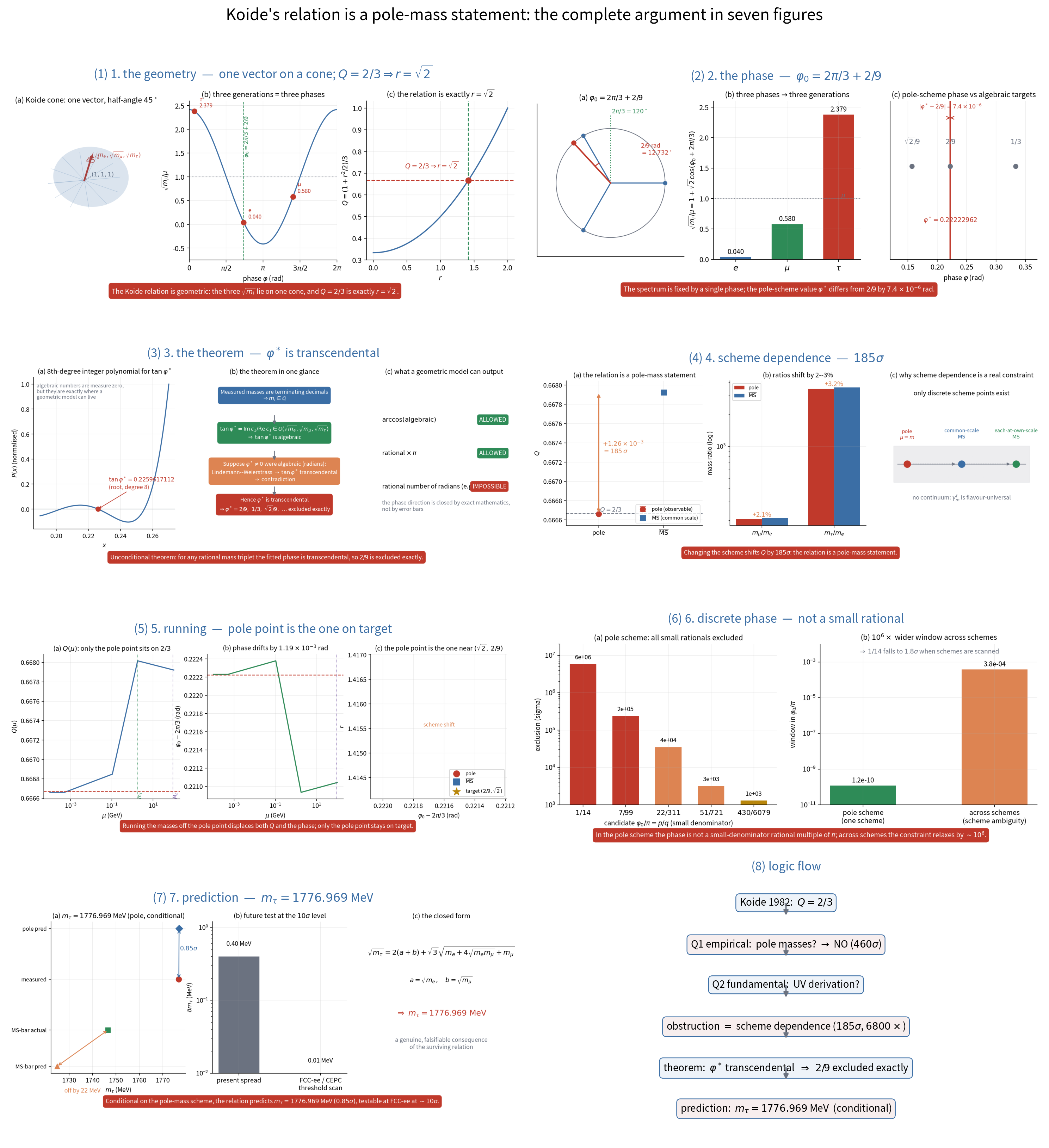
We separate two questions. (Q1, empirical) Do the pole masses satisfy the Koide relation in the polar form \(\sqrt{m_i}=\mu(1+\sqrt2\cos(\varphi_0+2\pi i/3))\) with \(\varphi_0=2\pi/3+2/9\)? No: the same-scheme comparison of \(m_\mu/m_e\) gives 206.77032 vs. 206.7682830(44), i.e. \(\approx460\sigma\), with no theoretical error. (Q2, fundamental) Can a UV theory derive it? The obstruction is scheme dependence and it is large: the common-scale MS ratios differ from the pole ratios by 2.1% (\(m_\mu/m_e\)) and 3.2% (\(m_\tau/m_e\)), moving Q by \( +1.26\times10^{-3}=185\sigma \) and \( \varphi_0 \) by \( -1.19\times10^{-3} \) rad. As the charged-lepton mass anomalous dimension is flavour-universal, there is no continuous scheme dial: only the pole point and the (common-scale) MS point. Hence any UV derivation must explain why the relation holds for pole masses, and no exact \(\varphi_0\) claim is scheme-invariant (\(\Delta\varphi_0=6800\times|\varphi^*-2/9|\)). We also prove an unconditional theorem: for any rational mass triplet, the fitted phase \(\varphi^*\) is a transcendental number of radians — so \(\varphi^*=2/9\), \(1/3\), \(\sqrt2/9\), or any nonzero algebraic radian, is exactly excluded, independently of errors and schemes. Finally the conditional pole-scheme prediction \(m_\tau=1776.969\) MeV (\( 0.85\sigma \)).
Keywords:
Koide relation
; charged-lepton masses
; pole masses
; renormalization scheme
; transcendental number theory
Copyright: This open access article is published under a Creative Commons CC BY 4.0 license, which permit the free download, distribution, and reuse, provided that the author and preprint are cited in any reuse.