

Submitted:
16 September 2026
Posted:
17 September 2026
You are already at the latest version
Abstract
Behavior change is frequently initiated but less reliably maintained. Individuals may establish meaningful intentions and begin acting toward desired outcomes, yet discontinue new patterns when initial motivation decreases, competing goals emerge, resources become constrained, or personal and environmental conditions change. Existing theories provide well-developed explanations for particular components of this process, including goal selection, motivational quality, attentional control, self-monitoring, habit formation, environmental opportunity, and social support. However, these mechanisms are often examined within separate theoretical traditions. This conceptual article introduces the Time to Live (TTL) Model, an integrated self-regulation framework for understanding sustainable behavior change through five interdependent regulatory conditions: clarity, energy, focus, awareness, and support. Clarity concerns meaningful direction and alignment between behavior, goals, and personally relevant values. Energy refers to the psychological and physical capacity available for continued goal-directed action. Focus concerns the allocation and protection of attention in the presence of competing demands. Awareness enables monitoring of behavior, progress, internal states, and changing circumstances, allowing adaptive correction. Support encompasses interpersonal, environmental, and structural resources that facilitate continued action. The TTL Model proposes that sustainable behavior change depends not solely on initial motivation, intention strength, or willpower, but on the coordinated functioning of these five conditions over time. Its distinctive theoretical contribution is configurational: a substantial deficit in one component may become a regulatory bottleneck, destabilizing behavior maintenance even when other components remain relatively strong. The model further conceptualizes lapses not as definitive failures but as regulatory information that can activate monitoring, adaptation, and behavioral recovery. Drawing on research in self-regulation, goal-setting, self-concordance, subjective vitality, attentional control, implementation intentions, progress monitoring, habit formation, psychological flexibility, goal adjustment, and social support, the article develops testable propositions and outlines a program for empirical validation.
Keywords:
self-regulation
; behavior change
; behavior maintenance
; goal pursuit
; motivation
; attention
; psychological flexibility
; social support
; sustainable behavior change
1. Introduction
Human behavior is characterized by a recurrent paradox: people are often capable of beginning change but considerably less successful at maintaining it. New exercise routines, professional goals, learning programs, productivity systems, dietary changes, and personal-development practices can initially be accompanied by high commitment and optimism. Yet after days, weeks, or months, many new patterns weaken or disappear.
This distinction between initiating and maintaining behavior has important theoretical implications. Rothman (2000) argued that the psychological processes associated with initiating a behavioral change may differ from those responsible for maintaining it. Later theoretical work similarly emphasized that behavior maintenance should be understood not as a static endpoint but as an ongoing regulatory process. A systematic review by Kwasnicka et al. (2016) identified five broad theoretical themes associated with maintenance: sustained motives, self-regulation, psychological and physical resources, habit, and environmental and social influences.
The maintenance problem therefore extends beyond motivation. A person may genuinely value an outcome and intend to pursue it, yet lack the current capacity necessary to act consistently. Another person may have sufficient capacity but struggle to protect attention from competing demands. A third may follow a strategy diligently but fail to recognize that circumstances have changed and that the strategy itself requires modification. Still another individual may possess strong personal motivation and regulatory skills but function in an environment that repeatedly undermines the desired behavior.
Self-regulation research already provides important accounts of many of these processes. Control theory conceptualizes self-regulation as a feedback system in which current states are compared with desired standards and discrepancies stimulate regulatory responses (Carver & Scheier, 1982). Goal-setting theory demonstrates how goals organize and direct effort (Locke & Latham, 2002). Self-determination theory and the self-concordance model emphasize the importance of autonomous, personally meaningful motivation (Ryan & Deci, 2000; Sheldon & Elliot, 1999). Implementation intentions help translate goals into action (Gollwitzer, 1999; Gollwitzer & Sheeran, 2006), while self-monitoring facilitates progress toward desired outcomes (Harkin et al., 2016). Habit research explains how repeated context-behavior associations can gradually reduce dependence on deliberate control (Lally et al., 2010; Wood & Rünger, 2016).
Yet this richness also creates fragmentation. Different theories illuminate different stages or mechanisms of goal pursuit, and no single framework needs to encompass every determinant of human behavior. At the same time, the individual attempting to sustain change encounters these influences simultaneously rather than as separate theoretical categories.
The present article introduces the Time to Live Model, an integrative self-regulation framework designed around this maintenance problem. The model identifies five regulatory conditions — clarity, energy, focus, awareness, and support — that may jointly influence whether desired behavior is maintained, adaptively modified, recovered following disruption, or abandoned.
The proposed contribution is not the claim that these five psychological phenomena are individually new. Each overlaps with established constructs. Rather, the model makes four more specific theoretical contributions. First, it organizes several well-established determinants into a person-centered regulatory architecture that distinguishes meaningful direction, available capacity, attentional allocation, monitoring and adjustment, and social/environmental scaffolding. Second, it conceptualizes maintenance dynamically. Sustainable behavior is not defined as uninterrupted adherence but as the capacity to continue, adjust, or recover while remaining connected to a meaningful direction. Third, the model advances a configurational or weakest-link prediction: average regulatory strength may not fully capture system functioning because a sufficiently severe deficit in one component can constrain the entire system. Fourth, TTL provides a basis for component-matched intervention. Rather than responding to all behavioral difficulty by increasing motivation, an intervention can identify whether the primary constraint concerns clarity, capacity, attention, monitoring, or support.
The remainder of this article develops the theoretical foundation of this framework, specifies its components and mechanisms, compares it with established approaches, formulates testable propositions, and presents an empirical validation agenda.
2. Behavior Maintenance as a Dynamic Regulatory Problem
Behavior maintenance is sometimes described as the continuation of a newly adopted behavior after an initial change. For the present framework, this definition is too narrow.
The TTL Model defines sustainable behavior change as the continued enactment, adaptive modification, or timely restoration of behavior consistent with a personally meaningful direction across time and changing circumstances.
This definition contains three elements. The first is continuation. Desired behavior must persist sufficiently over time to become consequential rather than remaining a short-lived episode. The second is adaptation. Maintaining a meaningful direction does not necessarily require maintaining precisely the same method. Goals, contexts, constraints, and opportunities change. The third is recovery. Temporary lapses are expected in many long-term behavioral processes. Maintenance therefore concerns not only avoiding disruption but also the ability to restart or recalibrate after disruption occurs.
This perspective is compatible with evidence showing that behavioral maintenance involves multiple interacting influences. Kwasnicka et al. (2016) identified motives, active self-regulation, resources, habits, and environmental/social influences as recurring theoretical themes. Their synthesis emphasizes that the need for deliberate self-regulation may itself change as new behaviors become established and contextual cues or competing responses change.
Research on dynamic self-regulation reaches a related conclusion. Neal, Ballard, and Vancouver (2017) describe self-regulation as an ongoing process in which people must manage competing goals, allocate limited time and effort, decide which goals receive priority, and adjust pursuit in response to changing conditions. Multiple-goal research further demonstrates that real-world behavior rarely occurs in isolation: focal goals coexist within larger networks of competing or facilitating goals (Kung & Scholer, 2021).
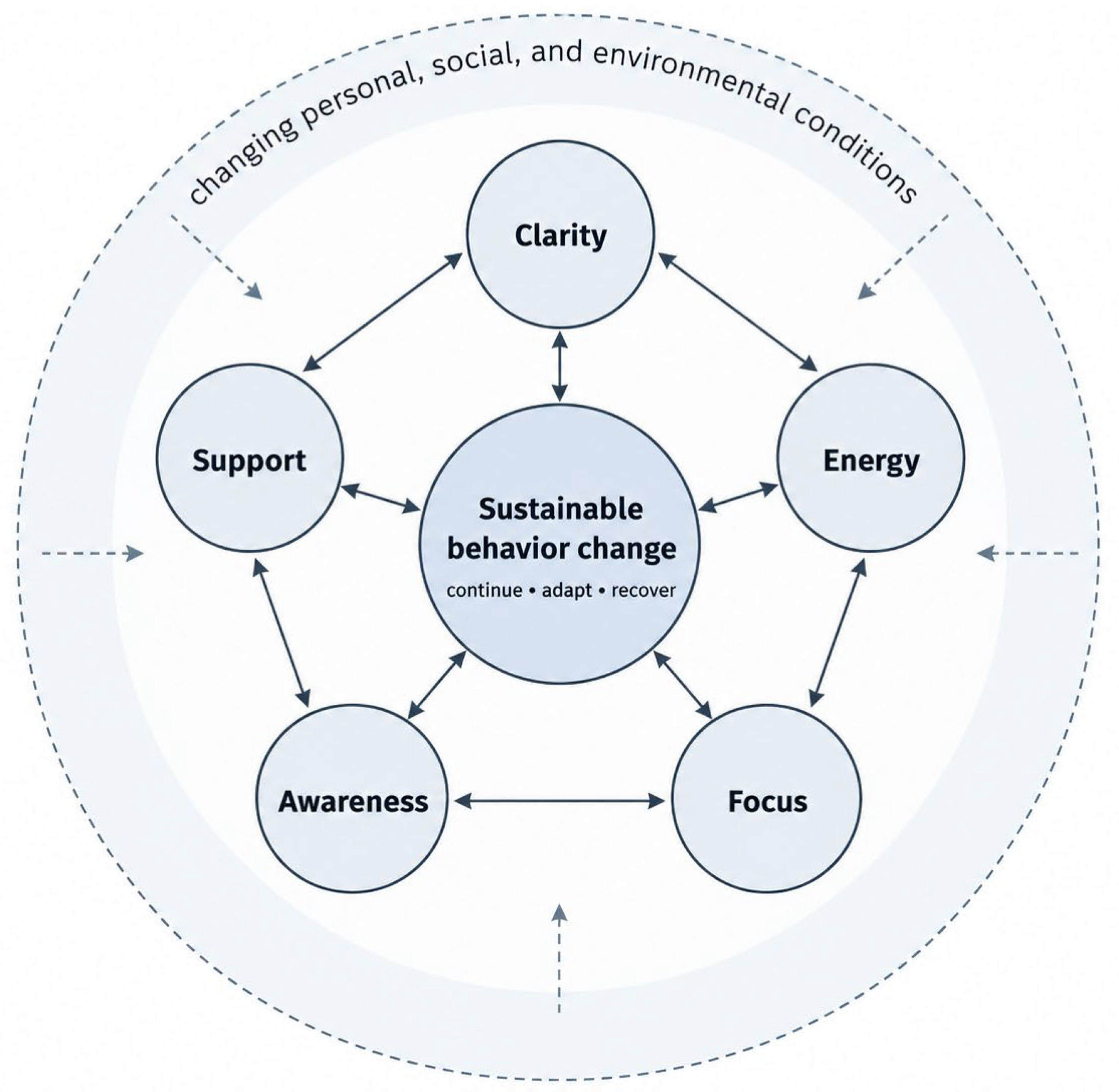
Figure 1.
Architecture of the Time to Live Model.
This is especially relevant for behavior maintenance. An intervention may increase one behavior successfully in a controlled setting while everyday life continues to impose occupational obligations, family demands, fatigue, distractions, financial limitations, and alternative goals.
The TTL Model consequently treats maintenance as an open regulatory system operating within changing conditions, rather than as an endpoint reached when sufficient motivation has been generated.
3. Components of the Time to Live Model
3.1. Clarity: Meaningful Direction
Clarity is defined as the degree to which individuals understand what they are attempting to change, why the change matters, and how the desired direction relates to personally meaningful values, needs, and longer-term goals. This definition intentionally goes beyond conventional goal specificity.
Goal-setting theory has established the importance of clear goals and standards for directing behavior and effort (Locke & Latham, 2002). Yet a goal can be highly specific without being deeply endorsed by the person pursuing it. For example, a target may be measurable and time-bound while reflecting external expectations rather than an individual’s own priorities.
The self-concordance model provides particularly important support for this distinction. Sheldon and Elliot (1999) found that goals aligned with individuals’ developing interests and core values were associated with more sustained effort and higher attainment. Self-determination theory similarly distinguishes autonomous motivation from controlled forms of motivation and emphasizes that the quality of motivation matters for persistence and psychological functioning (Ryan & Deci, 2000).
More recent value-based accounts of self-control reinforce this principle by suggesting that goal-consistent action can be understood as competition among options with different subjective values rather than as a simple battle between willpower and temptation. From such a perspective, maintaining behavior requires the focal action to retain sufficient subjective importance relative to alternatives (Berkman et al., 2017).
Within TTL, clarity therefore serves three functions. First, it establishes direction: the individual knows which outcome or life direction is being pursued. Second, it establishes meaning: the person understands why that direction matters personally. Third, it facilitates prioritization: when alternative goals and demands compete, clarity provides a criterion for deciding which actions deserve attention.
The construct should therefore not be operationalized as a synonym for certainty or decisiveness. High clarity does not imply certainty that a particular strategy will succeed. It instead refers to sufficient understanding of the desired direction and its subjective significance.
Proposition 1.
Greater clarity will positively predict persistence in goal-directed behavior, partly through greater value congruence and sustained goal commitment.
Proposition 2.
Clarity will improve prioritization under conditions of goal competition by increasing the relative salience of goal-consistent actions.
3.2. Energy: Available Capacity for Action
The term energy can become conceptually vague unless defined carefully. Within TTL, energy does not refer to an unspecified internal force, nor does the model assume that self-control depends on a fixed consumable psychological resource.
Instead, energy is defined as the currently available psychological and physical capacity to initiate and sustain goal-directed action. This includes subjective vitality, fatigue, sleep-related functioning, perceived capacity, and other states that influence the feasibility and experienced effort of action.
Ryan and Frederick (1997) conceptualized subjective vitality as the experience of possessing energy available to the self. Across their studies, vitality was associated with psychological and somatic functioning and self-motivation.
Research on sleep also supports the broader proposition that regulatory capacity fluctuates. Sleep quality and duration influence attention, inhibitory control, and everyday functioning, making them relevant contextual indicators of available capacity.
At the same time, contemporary self-control research cautions against simplistic resource-depletion metaphors. TTL does not require the assumption that every act of self-control literally exhausts a finite store of psychological energy. Rather, it proposes the more modest claim that people differ across time in their functional readiness and perceived capacity for effortful action.
Energy also interacts with the remaining TTL components. Low capacity may increase distractibility, reduce monitoring, weaken persistence after setbacks, and increase dependence on environmental support. Conversely, supportive conditions, adequate recovery, and reduced competing demands may preserve capacity.
Proposition 3.
Greater available capacity will positively predict behavioral consistency over time.
Proposition 4.
Energy will moderate the relationship between clarity and behavioral enactment, such that meaningful goals will translate less reliably into repeated action during periods of persistently low capacity.
3.3. Focus: Protecting Goal-Relevant Attention
Focus is defined as the ability to allocate and maintain attention in accordance with a current priority while limiting unnecessary interference from competing stimuli, thoughts, tasks, and goals.
Goal pursuit is inevitably selective. At any given moment, multiple potential actions compete for attention. Modern environments intensify this competition through notifications, media, communication demands, and rapid task switching.
Diehl, Semegon, and Schwarzer (2006) conceptualized attention control as a component of dispositional self-regulation and described it in terms of maintaining attention toward a task while managing internal and external distraction.
Goal-shielding research provides another relevant mechanism. Shah, Friedman, and Kruglanski (2002) demonstrated that commitment to a focal goal can inhibit the accessibility of alternative goals, thereby protecting ongoing goal pursuit.
Implementation intentions provide a complementary route. Rather than demanding continuous conscious control, an individual can prospectively link a relevant cue with a predetermined response — an if–then plan. Gollwitzer and Sheeran’s (2006) meta-analysis found a substantial aggregate effect of implementation intentions on goal attainment.
Focus in TTL therefore encompasses both direct attentional control and strategies that reduce attentional burden. Environmental design, reminders, routines, protected work intervals, prioritization, and implementation intentions may all help prevent the focal behavior from being repeatedly displaced by immediate alternatives.
Focus should be distinguished from clarity. A person may know exactly what matters yet fail to allocate attention accordingly. Clarity selects the direction; focus protects the moment-to-moment allocation of attention toward that direction.
Proposition 5.
Greater goal-relevant attentional control will predict greater behavioral consistency under conditions of competing demands.
Proposition 6.
The positive association between clarity and behavior will be stronger when individuals successfully protect attention from competing goals and distractions.
3.4. Awareness: Monitoring and Adaptive Regulation
Awareness is defined as the capacity to observe one’s behavior, progress, internal condition, and relevant environmental changes and to use that information to regulate subsequent action.
Awareness is not identical to mindfulness, although mindful attention may support it. Nor is awareness equivalent to focus. Focus is primarily allocative: What am I attending to? Awareness is primarily metaregulatory: What is happening in the system, and does something need to change?
Control theory provides a foundational explanation for this function. Self-regulation depends on comparison between the current state and a reference state. Without information regarding discrepancies, adaptive correction becomes difficult (Carver & Scheier, 1982).
Progress-monitoring research provides strong experimental evidence. Harkin et al. (2016) synthesized 138 studies and found that interventions designed to increase progress monitoring increased both monitoring and goal attainment; the effect of monitoring interventions on attainment was mediated by increased monitoring behavior.
Awareness also includes sensitivity to changes in the appropriateness of the goal or strategy itself. Persistence is not universally adaptive. When goals become unattainable, excessively costly, or no longer personally relevant, disengagement, reengagement, or adjustment may be preferable to rigid persistence. Research by Wrosch and colleagues has demonstrated the relevance of adaptive goal disengagement and reengagement, while meta-analytic work has further supported the importance of goal-adjustment capacities (Barlow & Wrosch, 2020; Wrosch et al., 2003).
Psychological flexibility similarly emphasizes the capacity to adapt behavior to changing situational demands while remaining responsive to meaningful aims and values (Kashdan & Rottenberg, 2010).
This distinction is crucial for TTL because sustainable change should not mean endlessly repeating an obsolete method.
Proposition 7.
Greater regulatory awareness will predict behavior maintenance through more timely detection of deviations and implementation of corrective responses.
Proposition 8.
Under changing conditions, awareness will predict adaptive modification of goals or strategies rather than either premature abandonment or rigid persistence.
3.5. Support: Interpersonal and Environmental Scaffolding
Support is defined as interpersonal, environmental, and structural conditions that increase the feasibility, stability, or recovery of goal-directed behavior. This is deliberately broader than emotional support.
Interpersonal support may include encouragement, responsiveness, information, accountability, mentoring, or practical assistance. Environmental support may include reminders, prompts, accessible resources, physical arrangements, digital tools, routines, or reduced barriers.
Social-support research has long demonstrated that interpersonal resources may operate through both direct and buffering processes (Cohen & Wills, 1985). More specifically for goal pursuit, Vowels and Carnelley (2022) reported an overall positive association between partner support and goal outcomes, with responsive and practical forms of support showing beneficial associations.
The inclusion of the environment connects TTL with broader behavior-change models. In COM-B, behavior depends on interacting conditions of capability, opportunity, and motivation. Physical and social opportunity explicitly acknowledge that behavior cannot be explained solely through processes occurring inside the individual (Michie et al., 2011).
Behavior-change intervention research similarly identifies techniques involving social support, environmental restructuring, prompts and cues, self-monitoring, and problem solving. The Behavior Change Technique Taxonomy formalizes many such strategies as distinct intervention components rather than treating motivation as the sole target of behavioral intervention (Michie et al., 2013).
Support therefore functions as regulatory scaffolding. It changes the effort required to maintain behavior rather than merely making an individual feel emotionally supported.
Proposition 9.
Greater supportive scaffolding will positively predict behavioral maintenance.
Proposition 10.
Support will buffer the negative effects of temporary reductions in individual regulatory capacity on behavior maintenance.

Table 1.
Components of the Time to Live Model.
| TTL component | Scientific definition | Primary regulatory function | Related established constructs | Candidate indicators |
| Clarity | Understanding the desired direction of change, its personal meaning, and its relationship to values and goals | Direction and prioritization | Goal setting; self-concordance; autonomous motivation; value-based choice | Goal-value congruence; perceived purpose; directional certainty |
| Energy | Current psychological and physical capacity available for goal-directed action | Capacity for enactment | Subjective vitality; fatigue; sleep-related functioning; effort | Vitality; fatigue; sleep adequacy; perceived available capacity |
| Focus | Allocation and protection of attention toward goal-relevant action despite competing stimuli and goals | Goal shielding and attentional selection | Attention control; goal shielding; implementation intentions | Distractibility; sustained attention; protected goal time |
| Awareness | Monitoring behavior, progress, internal state, and context and using feedback to regulate subsequent action | Feedback and adaptation | Self-monitoring; control theory; psychological flexibility; goal adjustment | Progress tracking; discrepancy detection; strategy adjustment |
| Support | Interpersonal, environmental, and structural resources facilitating goal-consistent behavior | Regulatory scaffolding | Social support; autonomy support; environmental opportunity; prompts/cues | Responsive support; accountability; prompts; access; environmental facilitation |
Note. TTL = Time to Live.
4. From Components to an Integrated System
The central claim of TTL is stronger than the proposition that clarity, capacity, attention, monitoring, and support each correlate with behavior. The model proposes that they constitute an interdependent regulatory system.
Consider an individual attempting to maintain regular exercise. If clarity is low, she may possess adequate time and energy but fail to prioritize exercise relative to competing demands because its personal importance is unclear. If energy is low, she may strongly value exercise and schedule it effectively but repeatedly lack sufficient functional capacity to follow through. If focus is low, available time may be absorbed by competing tasks despite strong motivation and physical readiness. If awareness is low, she may fail to recognize a gradually deteriorating pattern until several weeks have passed. If support is low, every session may require greater individual effort because the environment contains friction rather than cues, social reinforcement, or structural facilitation.
These examples illustrate why a single determinant may provide an incomplete explanation. At the same time, the components are not fully independent. Their effects may be reciprocal. Clarity can support focus by increasing the subjective priority of a goal. Focus can preserve energy by reducing unnecessary task switching. Awareness can reveal chronic depletion before it generates disengagement. Support can preserve both attention and capacity by reducing logistical and emotional burden. Behavioral progress can reinforce clarity by strengthening the perceived meaningfulness of continued action.
TTL therefore proposes a dynamic process rather than a static five-variable checklist.
M(t + 1) = f[C(t), E(t), F(t), A(t), S(t), X(t), interactions]
In this conceptual notation, M represents maintenance of goal-consistent behavior; C, clarity; E, energy; F, focus; A, awareness; S, support; and X, relevant personal and environmental context. The notation is not intended as a fixed structural equation, and the model does not assume equal component weights across behaviors or populations.
4.1. The Regulation Cycle
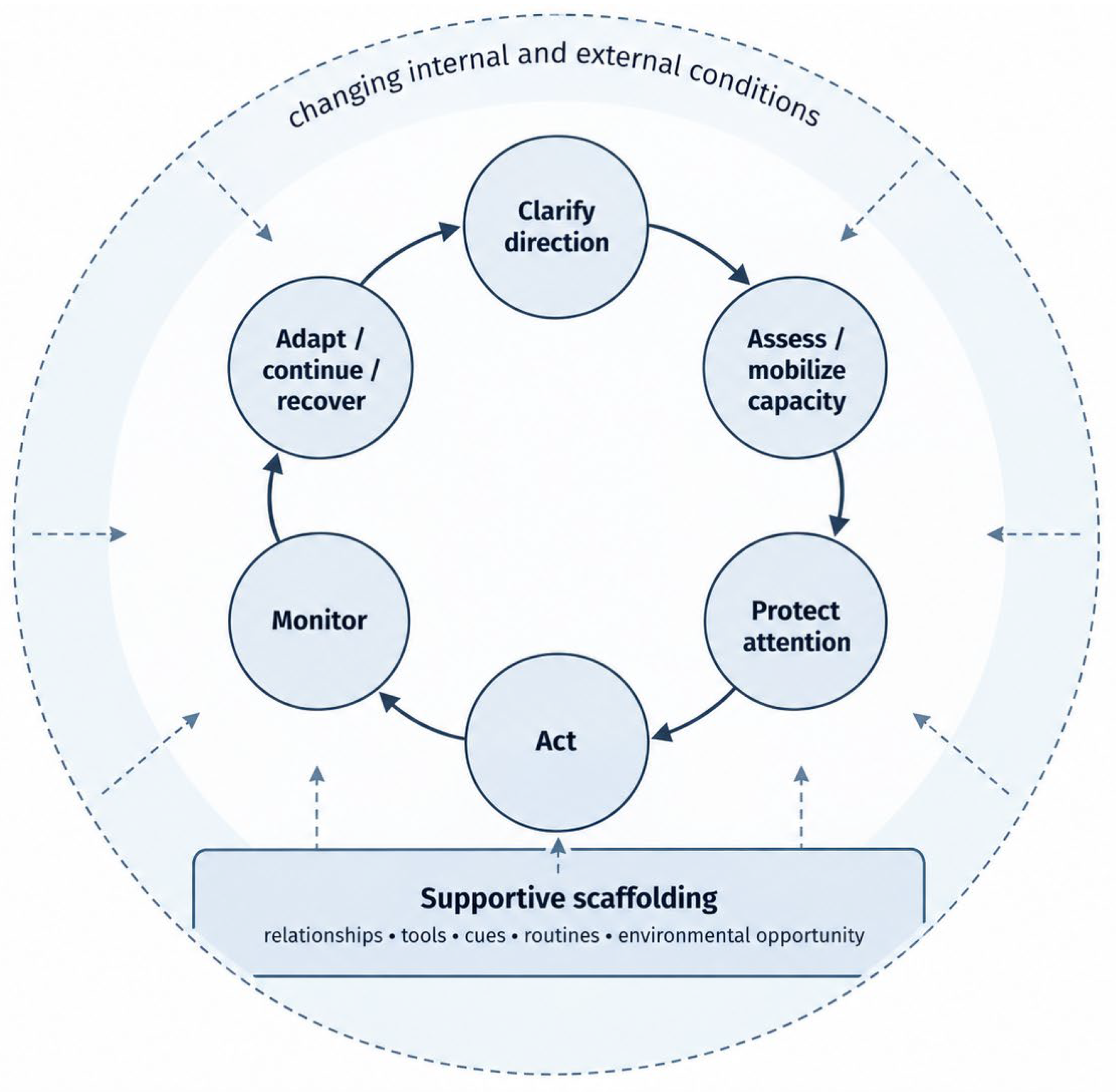
The TTL system can also be represented temporally. Clarity identifies the meaningful direction. Energy determines whether sufficient capacity is currently available. Focus allocates attention toward the relevant action. Behavior generates consequences and new information. Awareness detects progress, barriers, changes in capacity, and shifts in context. The individual then continues, adapts, pauses, or recommits. Support influences every phase by altering the difficulty and stability of regulation.
This creates a recurrent cycle rather than a one-time sequence.
Figure 2.
Dynamic Regulatory Cycle of the Time to Live Model.
5. The Bottleneck Hypothesis
The most distinctive theoretical proposition of TTL concerns configuration. Many predictive approaches treat determinants additively. Under a purely additive model, high functioning in one domain can statistically compensate for low functioning in another. TTL proposes that this assumption may be incomplete.
For some behaviors and under some conditions, a sufficiently weak component may constrain the entire regulatory system. In other words, sustainable change may demonstrate bottleneck dynamics.
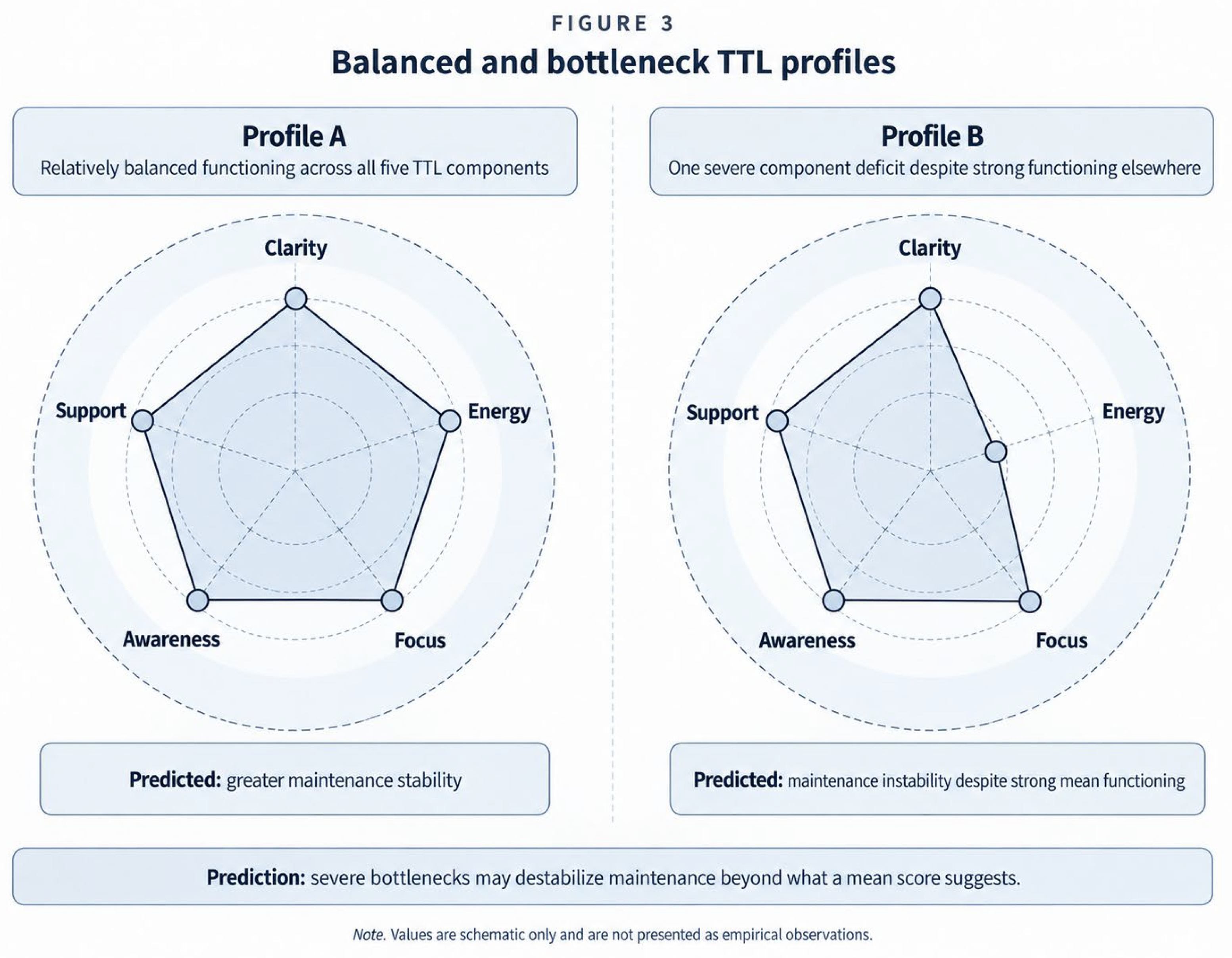
Imagine two individuals whose mean TTL functioning is identical. Individual A reports moderately high functioning across all five components. Individual B reports extremely high clarity, focus, awareness, and support but extremely low energy. An additive score could classify both individuals as equally prepared for maintenance. Yet if available capacity represents a necessary constraint on enactment, Individual B may exhibit considerably less stable behavior.
A similar pattern could arise with other components. Extremely low clarity may prevent meaningful prioritization regardless of available capacity. Extremely weak focus may prevent action from receiving sufficient attentional priority. Extremely weak awareness may allow small deviations to accumulate. Extremely hostile or restrictive environments may block enactment regardless of strong personal regulation.
The conceptual model therefore develops the weakest-link intuition into a falsifiable proposition.
Proposition 11—Bottleneck Proposition.
The lowest-functioning TTL component will predict unique variance in behavior maintenance beyond both initial motivation and the mean level of TTL functioning.
Proposition 12—Constraint Amplification Proposition.
Bottleneck effects will become stronger as the difficulty, duration, or environmental demands of the target behavior increase.
Figure 3.
Balanced and Bottleneck Regulatory Profiles.
6. Lapses, Recovery, and Adaptive Persistence
A model of sustainable change should explain not only persistence but also what occurs when persistence is disrupted.
Traditional everyday interpretations frequently treat a lapse as evidence that motivation has disappeared or that the behavior-change attempt has failed. TTL instead treats lapses as diagnostic events. A lapse may contain information about the system. Repeated missed exercise sessions may indicate reduced energy. Repeated distraction may reveal insufficient attentional protection. Loss of interest may reveal declining clarity or goal-value alignment. Repeated failure after changes in life circumstances may indicate that the strategy has not been adapted. A socially unsupportive environment may create new barriers that were absent during initiation.
Awareness therefore becomes particularly important after disruption because it determines whether the individual interprets a lapse as information and responds adaptively or simply disengages.
Research on action crises provides a useful parallel. When difficulties and setbacks accumulate, individuals can enter a phase characterized by conflict over whether continued pursuit remains worthwhile (Brandstätter & Schüler, 2013; Brandstätter et al., 2013).
Goal-adjustment research further demonstrates that successful self-regulation cannot always be reduced to greater persistence. Under some circumstances, adapting, reducing, replacing, or relinquishing a goal can be more functional than continuing unchanged (Barlow & Wrosch, 2020; Wrosch et al., 2003).
TTL consequently distinguishes adaptive persistence from rigid persistence. Adaptive persistence means continued commitment to meaningful direction combined with willingness to modify the behavioral route when evidence indicates that modification is required.
Proposition 13.
Following a lapse, greater awareness will predict faster restoration or adaptive modification of goal-consistent behavior.
Proposition 14.
The effect of awareness on recovery will be stronger when sufficient clarity remains regarding the higher-order value or direction underlying the original behavior.
7. Theoretical Positioning of the TTL Model
The usefulness of a new conceptual model depends substantially on whether it contributes something beyond relabeling existing theory. TTL is not intended to replace control theory, self-determination theory, COM-B, the Health Action Process Approach (HAPA), goal-setting theory, implementation intentions, or maintenance models. Rather, its contribution lies in integration and diagnostic granularity.
Control Theory
Control theory provides one of the strongest foundations for the awareness component because it conceptualizes regulation through feedback and discrepancy reduction (Carver & Scheier, 1982). TTL differs by explicitly separating the information-processing function of monitoring from four other conditions that may determine whether corrective behavior is feasible. A person can accurately perceive a discrepancy yet remain unable to correct it because capacity, attention, meaning, or environmental support is insufficient.
Goal-Setting Theory
Goal-setting theory provides extensive evidence concerning how goals influence task performance, direction, effort, persistence, and strategy (Locke & Latham, 2002). TTL gives greater emphasis to the conditions required after a goal has already been selected, particularly maintenance across fluctuating states and contexts.
Self-Determination Theory and Self-Concordance
These theories provide the strongest foundation for TTL clarity. Autonomous and self-concordant goals tend to generate qualitatively different forms of engagement than externally imposed or poorly internalized goals. TTL embeds this motivational issue within a broader regulatory system rather than treating motivational quality as sufficient by itself.
Implementation Intentions
Implementation intentions provide a highly specific mechanism for facilitating action and protecting intentions from predictable barriers. TTL does not compete with this mechanism. An implementation intention can be treated as one potential intervention strategy primarily affecting focus and, in some cases, support through environmental cueing.
Health Action Process Approach
HAPA distinguishes motivational processes leading to intention from volitional processes supporting enactment and maintenance. Planning, action control, and maintenance or recovery self-efficacy are particularly relevant after intentions are formed (Schwarzer, 2008). TTL shares the emphasis on postintentional regulation but organizes maintenance determinants differently, around five simultaneously functioning conditions rather than a stage-based sequence.
COM-B
COM-B provides an elegant high-level account in which behavior is generated by capability, opportunity, and motivation (Michie et al., 2011). TTL can be understood as operating at a more granular self-regulatory level. Energy partly overlaps with capability; support partly overlaps with opportunity; and clarity contributes to motivational direction. However, focus and awareness separate attentional allocation and metaregulation as distinct problems that are particularly salient during long-term goal pursuit.
Behavior Maintenance Models
Kwasnicka et al.’s (2016) theoretical synthesis is the closest broad conceptual neighbor of TTL. It identifies maintenance motives, self-regulation, resources, habits, and environmental/social factors. The difference is primarily organizational. TTL asks not which theoretical mechanisms have been proposed to explain maintenance, but which regulatory conditions must remain sufficiently functional for an individual to continue, adapt, or recover meaningful behavior. This difference enables the model to generate a specific configurational prediction — the bottleneck proposition — and a corresponding intervention logic.
Table 2.
Theoretical Positioning of the Time to Live Model.
| Framework | Primary theoretical focus | Major contribution | Relationship to TTL |
| Control Theory | Feedback and discrepancy reduction | Explains monitoring and corrective regulation | Primary theoretical foundation for Awareness |
| Goal-Setting Theory | Goal characteristics and performance | Explains direction, effort, persistence | Supports Clarity; TTL extends emphasis to maintenance conditions |
| Self-Determination Theory | Autonomous vs. controlled motivation | Explains motivational quality | Supports value-related dimension of Clarity |
| Self-Concordance Model | Alignment between goals and core values/interests | Predicts sustained effort and attainment | Direct foundation for Clarity |
| Implementation Intentions | Translation of intentions into action | Specifies cue-response planning | Potential strategy supporting Focus |
| HAPA | Motivational and volitional phases of behavior | Distinguishes intention formation from action and maintenance | Shares postintentional focus; TTL uses component architecture |
| COM-B | Capability, opportunity, motivation | High-level behavioral system | TTL provides more granular self-regulatory categories |
| Behavior Maintenance Synthesis | Motives, regulation, resources, habit, context | Integrates maintenance theories | Closest broad conceptual foundation; TTL adds component configuration and bottleneck prediction |
| Goal Adjustment Models | Persistence, disengagement, reengagement, flexibility | Explains adaptive change when pursuit becomes difficult | Supports adaptive function of Awareness |
| TTL Model | Coordination of direction, capacity, attention, monitoring, and scaffolding | Configurational account of sustainable regulation | Predicts balanced vs. bottleneck functioning and component-matched intervention |
Note. HAPA = Health Action Process Approach; TTL = Time to Live.
8. Habit and the Changing Need for Active Regulation
Habit deserves special consideration because it is not represented as one of the five TTL components. This is intentional.
Habits emerge when behaviors become associated with recurring contexts, increasing the likelihood that they will be activated with less deliberate decision-making. Lally et al. (2010) demonstrated that automaticity can develop gradually through repeated performance in stable contexts, while Wood and Rünger (2016) reviewed the cognitive, motivational, and contextual mechanisms of habitual behavior.
In TTL, habit is conceptualized primarily as a change in the regulatory demands placed on the system, rather than as a sixth parallel component. As automaticity increases, maintaining a behavior may require less moment-to-moment focus and less deliberate decision-making. Supportive cues embedded in the environment may increasingly trigger behavior automatically.
However, habits remain context sensitive. Major contextual changes can weaken established cue-response relationships and increase the renewed need for deliberate regulation.
Proposition 15.
As behavioral automaticity increases, the immediate relationship between focus and behavioral enactment will decrease under stable conditions.
Proposition 16.
Following major contextual disruption, the contribution of active TTL regulation will increase until the behavior is stabilized within the new context.
9. Empirical Operationalization
At present, the TTL Model should be treated as a conceptual framework, not as a validated psychological measurement model. The next research task is therefore not to assume that five empirical factors already exist but to test whether the proposed distinctions can be reliably operationalized.
A preliminary Time to Live Self-Regulation Inventory (TTL-SRI) could begin with approximately 30–40 candidate items, with six to eight items representing each theoretical component. Items should be behavior-specific whenever possible and should undergo expert review, cognitive interviewing, pilot testing, item-reduction analysis, and independent replication before a formal TTL scale is claimed.
Illustrative candidate items include the following: Clarity — ‘I can clearly explain why maintaining this behavior matters to me’; ‘This behavior reflects something I personally value’; ‘I understand how this behavior fits into the life I want to build.’ Energy — ‘I usually have enough psychological and physical capacity to carry out this behavior’; ‘Fatigue regularly prevents me from doing what I planned’ (reverse scored); ‘When it is time to act, I generally have enough capacity to begin.’ Focus — ‘I protect time and attention for this behavior’; ‘Other tasks repeatedly pull my attention away from this goal’ (reverse scored); ‘I can keep this behavior prioritized when competing demands appear.’ Awareness — ‘I regularly notice whether I am moving toward or away from this goal’; ‘When my strategy stops working, I recognize that I need to adjust it’; ‘I notice changes in my own condition that affect my ability to continue.’ Support — ‘My environment makes this behavior reasonably easy to carry out’; ‘I have people, tools, or systems that help me stay on track’; ‘When difficulties arise, I have access to useful support.’
10. Proposed Validation Program
Study 1: Content and Construct Development
A multidisciplinary expert panel in self-regulation, motivational psychology, behavioral science, psychometrics, and applied behavior change should independently assess the proposed items. The primary goals would be content validity, construct coverage, conceptual redundancy, clarity of wording, and distinction between TTL components. Particular attention should be paid to Focus versus Awareness and Clarity versus general motivation, because conceptual overlap is plausible.
Study 2: Exploratory Factor Analysis
A large heterogeneous sample could identify a meaningful personal behavior that participants wish to sustain. The initial 30–40 item pool could then undergo exploratory factor analysis. The relevant question would be whether the data support a correlated five-factor structure, a smaller number of factors, a hierarchical structure, or a bifactor solution containing broader self-regulatory functioning plus specific components. The analysis should therefore be theory-informed but not force the expected model when the data do not support it.
Study 3: Confirmatory Validation
A second independent sample should be used for confirmatory factor analysis. Model fit should be compared across plausible structures. Internal reliability should preferably be evaluated using coefficient omega in addition to conventional alpha estimates. Convergent validity could be examined using established measures of self-concordance or autonomous motivation, subjective vitality or fatigue, attention control, self-monitoring, psychological flexibility, and perceived social support. Discriminant validity would require demonstrating that the five TTL components are related but not empirically interchangeable.
Study 4: Longitudinal Predictive Validity
The critical test should be prospective. Participants could choose one repeated behavior — exercise, writing, learning, meditation, dietary behavior, or another goal-directed routine — and be followed for approximately 8–12 weeks. Baseline measures should include initial intention, goal commitment, self-efficacy, TTL components, and relevant demographic and contextual variables. Behavior should then be recorded repeatedly through logs, digital traces where feasible, or ecological momentary assessment. Primary dependent variables should include behavioral adherence, duration before first meaningful lapse, number of lapses, time to recovery after lapse, and overall behavioral stability. TTL would demonstrate incremental validity if its components or configurations predicted maintenance after controlling for initial intention, self-efficacy, and goal commitment.
Study 5: Testing the Bottleneck Hypothesis
The bottleneck hypothesis should be tested explicitly rather than inferred from ordinary regression coefficients. At minimum, three competing predictors should be compared: mean TTL score, lowest TTL component, and component interactions or configurational models. The critical test is whether the lowest component or interaction structure predicts meaningful incremental variance beyond average regulatory functioning. More advanced analysis could use polynomial regression, response-surface analysis, latent profile analysis, or machine-learning approaches to investigate whether particular component configurations predict distinct maintenance trajectories.
Table 3.
Testable Propositions and Suggested Empirical Tests.
| Proposition | Central prediction | Candidate test |
| P1 | Clarity predicts persistence through value congruence and commitment | Longitudinal mediation |
| P2 | Clarity facilitates prioritization under goal competition | Experimental competing-goal paradigm |
| P3 | Greater Energy predicts consistency | Repeated capacity and behavior assessment |
| P4 | Energy moderates Clarity → behavior translation | Multilevel interaction model |
| P5 | Focus predicts consistency under competing demands | Daily diary / ecological momentary assessment |
| P6 | Focus strengthens Clarity → behavior relation | Moderated longitudinal model |
| P7 | Awareness predicts timely corrective behavior | Progress tracking and behavioral deviation |
| P8 | Awareness facilitates adaptive rather than rigid persistence | Changing-constraint experiment |
| P9 | Support predicts maintenance | Prospective regression |
| P10 | Support buffers temporary low capacity | Multilevel interaction |
| P11 | Lowest TTL component predicts maintenance beyond mean TTL score | Incremental validity comparison |
| P12 | Bottleneck effects increase as behavioral demands increase | Moderated bottleneck analysis |
| P13 | Awareness predicts faster recovery after lapse | Survival / time-to-recovery models |
| P14 | Clarity strengthens awareness-driven recovery | Interaction analysis |
| P15 | Habit reduces dependence on active focus in stable contexts | Moderated longitudinal analysis |
| P16 | Context disruption increases dependence on active TTL regulation | Natural experiment / longitudinal transition |
| P17 | Component-matched interventions outperform equally intensive non-matched interventions | Randomized controlled component-matching experiment |
Note. EMA = ecological momentary assessment; TTL = Time to Live.
11. Component-Matched Intervention
If the TTL framework receives empirical support, its primary applied advantage may be diagnostic. When a person fails to maintain behavior, common responses often attempt to increase effort or motivation regardless of the source of the difficulty. TTL instead asks which regulatory condition is currently constraining the behavior.
A clarity deficit could be addressed through values clarification, reconsideration of higher-order goals, or selection of a more self-concordant target. An energy deficit might require workload modification, sleep or recovery intervention, reduction of competing demands, or adjustment in the scale of the target behavior. A focus deficit might be addressed through environmental restructuring, implementation intentions, protected time, distraction reduction, or simpler action cues. An awareness deficit might require behavioral tracking, scheduled review, feedback, reflective practices, or explicit decision points for strategy adjustment. A support deficit might require accountability systems, social support, mentoring, practical assistance, environmental redesign, or increased access to relevant tools.
Importantly, this is not meant to imply that every failure has only one cause. Multiple components may simultaneously require intervention. The practical question is whether treatment of the dominant bottleneck produces greater improvement than a generic intervention applied equally to all individuals.
Proposition 17.
Interventions matched to an individual’s lowest-functioning TTL component will produce greater maintenance than equally intensive non-matched self-regulation interventions.
12. Boundary Conditions
TTL is not intended to provide a complete theory of all human behavior. Several boundary conditions should be made explicit.
First, the framework is primarily designed for intentional or partially intentional behavior change. It may be less useful for behavior dominated by severe external coercion, acute psychiatric processes, neurocognitive impairment, or physiological dependence, where other mechanisms may dominate.
Second, TTL should not be interpreted as a purely individualistic model. Structural conditions matter. Poverty, discrimination, unsafe environments, restrictive workplaces, inadequate access to health care, caregiving responsibilities, disability, and legal or organizational constraints may limit behavioral opportunity regardless of personal regulatory strength. Support partly incorporates environmental opportunity, but no amount of individual self-regulation should be assumed to eliminate hard structural constraints.
Third, different behaviors are likely to place different demands on components. A short daily learning routine may be highly sensitive to focus and environmental cueing. Endurance exercise may place greater demands on physical capacity. A long professional transition may depend strongly on clarity and adaptive monitoring.
Fourth, component importance may change over time. New behaviors may initially require considerable focus and awareness, whereas well-established habits may require less active attention until context changes.
Finally, some compensation among components is almost certainly possible. Strong support may compensate partially for low focus by creating reliable cues. High clarity may sustain effort during temporary reductions in vitality. Strong awareness may allow an individual to redesign a system before capacity deteriorates further. The bottleneck proposition therefore does not require perfect non-compensability. It predicts that compensation has limits, particularly when a component becomes severely constrained.
13. Discussion
The central purpose of the Time to Live Model is to explain why meaningful intentions do not always produce sustainable patterns of behavior.
Existing behavioral science offers substantial knowledge about this problem. Goal-setting research explains the effects of goals and performance standards. Self-determination and self-concordance research explain differences in motivational quality. Implementation intentions explain important mechanisms for translating intentions into action. Progress-monitoring research demonstrates the importance of feedback. Habit research explains how repetition in stable contexts can increase automaticity. Social and environmental models demonstrate that behavior cannot be understood independently of context.
TTL does not dispute these frameworks. Its purpose is to reorganize a portion of this knowledge around a different unit of analysis: the functioning of the person’s regulatory system during sustained goal pursuit.
The model therefore asks five distinct questions: whether the individual has sufficient clarity regarding what direction matters and why; whether sufficient psychological and physical capacity is available; whether attention is adequately protected; whether progress and changing conditions are being monitored; and whether interpersonal and environmental conditions facilitate rather than unnecessarily obstruct continued action.
The theoretical advantage of these distinctions is that they separate problems that are frequently collapsed into motivation. A person can be motivated but exhausted. A person can be energized but directionless. A person can possess both direction and capacity while remaining chronically distracted. A person can sustain focused behavior while failing to notice that the behavior no longer serves its original purpose. A person can function well individually while facing an environment that continually undermines enactment.
These distinctions have implications both for prediction and intervention. The bottleneck hypothesis provides the strongest test of whether TTL adds explanatory value beyond a convenient classification system. If the five components merely behave as correlated indicators of a common self-regulation factor, then a mean score may explain most of the predictive variance. In contrast, if severely weak components systematically constrain maintenance, configurational analysis should outperform purely additive scoring.
The recovery propositions provide a second potential contribution. Behavior maintenance research can become overly focused on uninterrupted adherence. Yet in real life, disruption is common. Family events, illness, workload shifts, travel, emotional stress, and changing priorities can interrupt even deeply established routines.
From a TTL perspective, sustainability should therefore be measured not only through the absence of lapses but through the quality of recovery: how quickly the person notices the deviation, whether they understand why it occurred, whether the behavior, strategy, or goal itself requires modification, whether sufficient capacity and support can be mobilized to restart, and whether disruption is interpreted as information rather than as definitive personal failure.
This perspective moves the construct from ‘maintenance equals never stopping’ toward a more dynamic understanding of regulation.
14. Limitations and Future Research
The current framework has several important limitations. The first is empirical. The five-component structure has not yet been validated psychometrically or prospectively. The present article therefore proposes constructs and relationships rather than reports established factors.
Second, conceptual overlap is unavoidable. Clarity overlaps with constructs from self-concordance, autonomous motivation, goal commitment, and purpose. Energy overlaps with subjective vitality, fatigue, perceived capacity, and aspects of physical functioning. Focus overlaps with attention regulation, goal shielding, and planning. Awareness overlaps with self-monitoring, metacognition, feedback regulation, and psychological flexibility. Support overlaps with perceived social support, environmental opportunity, accountability, and behavior-change techniques.
This overlap should not be hidden. It is central to the model’s status as an integrative framework. Its novelty must therefore be evaluated through the usefulness of its organization, the validity of its distinctions, its configurational predictions, and the effectiveness of component-matched intervention — not through claims that the underlying psychological phenomena are unprecedented.
Third, the term energy will require especially careful validation. Researchers should determine whether it is best modeled as one factor, as a higher-order combination of vitality and fatigue-related variables, or as a practical label for multiple state-level capacity indicators.
Fourth, the model may operate differently across cultures, socioeconomic circumstances, age groups, and behavioral domains. Cross-cultural validation will therefore be necessary before broad universality is claimed.
Fifth, much of the initial model is intentionally person-centered. Future versions should develop the environmental layer more systematically, particularly where structural constraints cannot reasonably be reduced to perceived support.
Finally, causal direction will require experimental research. Correlational evidence that TTL components predict behavioral maintenance would be informative but insufficient to establish whether manipulating the proposed bottlenecks improves outcomes.
15. Conclusion
Beginning change and sustaining change are not the same regulatory task.
People may possess sincere intentions, clearly defined goals, and substantial initial motivation while still struggling to maintain new behavior as capacity fluctuates, attention is redirected, life circumstances change, setbacks accumulate, or environmental support weakens.
The Time to Live Model proposes that sustainable behavior change depends on five interdependent conditions: clarity provides meaningful direction; energy provides available capacity; focus protects goal-relevant attention; awareness enables monitoring and adaptive correction; and support provides interpersonal and environmental scaffolding.
The model’s central claim is systemic rather than motivational. Sustainable change may depend not only on how strongly an individual wants an outcome, but on whether the broader regulatory architecture is sufficiently functional to support continued movement toward it.
A particularly important prediction is that substantial weakness in one component may become a regulatory bottleneck. If supported empirically, this would imply that behavioral interventions should move beyond universal attempts to increase motivation and instead identify the specific condition currently constraining maintenance.
TTL also proposes a broader understanding of sustainability. A sustainable behavioral system is not one in which disruption never occurs. It is one capable of detecting disruption, responding adaptively, and restoring meaningful direction without requiring the individual to begin psychologically from zero after every lapse.
Future research should therefore test not only whether the five TTL components can be measured reliably, but whether their configuration predicts longitudinal maintenance, whether weakest-link effects occur, whether the system changes as habits develop, and whether interventions targeted to the dominant bottleneck improve long-term outcomes.
The resulting empirical question is straightforward: Is sustainable behavior change better predicted by motivation alone, by the overall strength of self-regulation, or by the functioning and configuration of the regulatory system that supports continued action? The Time to Live Model offers a framework for testing that question.
Data Availability
Not applicable. This article is conceptual and does not report analysis of an empirical dataset.
Ethics Approval
Not applicable. No human participants or identifiable personal data are reported in this conceptual article.
References
- Bandura, A. Self-efficacy mechanism in human agency. Am. Psychol. 1982, 37(2), 122–147. [Google Scholar] [CrossRef]
- Barlow, M. A.; Wrosch, C. Goal adjustment capacities and quality of life: A meta-analytic review. J. Personal. 2020, 88(2), 307–323. [Google Scholar] [CrossRef] [PubMed]
- Berkman, E. T.; Hutcherson, C. A.; Livingston, J. L.; Kahn, L. E.; Inzlicht, M. Self-control as value-based choice. Curr. Dir. Psychol. Sci. 2017, 26(5), 422–428. [Google Scholar] [CrossRef] [PubMed]
- Brandstätter, V.; Herrmann, M.; Schüler, J. The struggle of giving up personal goals: Affective, physiological, and cognitive consequences of an action crisis. Personal. Soc. Psychol. Bull. 2013, 39(12), 1668–1682. [Google Scholar] [CrossRef] [PubMed]
- Brandstätter, V.; Schüler, J. Action crisis and cost-benefit thinking: A cognitive analysis of a goal-disengagement phase. J. Exp. Soc. Psychol. 2013, 49(3), 543–553. [Google Scholar] [CrossRef]
- Carver, C. S.; Scheier, M. F. Control theory: A useful conceptual framework for personality-social, clinical, and health psychology. Psychol. Bull. 1982, 92(1), 111–135. [Google Scholar] [CrossRef]
- Cohen, S.; Wills, T. A. Stress, social support, and the buffering hypothesis. Psychol. Bull. 1985, 98(2), 310–357. [Google Scholar] [CrossRef]
- Diehl, M.; Semegon, A. B.; Schwarzer, R. Assessing attention control in goal pursuit: A component of dispositional self-regulation. J. Personal. Assess. 2006, 86(3), 306–317. [Google Scholar] [CrossRef] [PubMed]
- Gollwitzer, P. M. Implementation intentions: Strong effects of simple plans. Am. Psychol. 1999, 54(7), 493–503. [Google Scholar] [CrossRef]
- Gollwitzer, P. M.; Sheeran, P. Implementation intentions and goal achievement: A meta-analysis of effects and processes. Adv. Exp. Soc. Psychol. 2006, 38, 69–119. [Google Scholar] [CrossRef]
- Harkin, B.; Webb, T. L.; Chang, B. P. I.; Prestwich, A.; Conner, M.; Kellar, I.; Benn, Y.; Sheeran, P. Does monitoring goal progress promote goal attainment? A meta-analysis of the experimental evidence. Psychol. Bull. 2016, 142(2), 198–229. [Google Scholar] [CrossRef] [PubMed]
- Hennessy, E. A.; Johnson, B. T.; Acabchuk, R. L.; McCloskey, K.; Stewart-James, J. Self-regulation mechanisms in health behavior change: A systematic meta-review of meta-analyses, 2006–2017. Health Psychol. Rev. 2020, 14(1), 6–42. [Google Scholar] [CrossRef] [PubMed]
- Kashdan, T. B.; Rottenberg, J. Psychological flexibility as a fundamental aspect of health. Clin. Psychol. Rev. 2010, 30(7), 865–878. [Google Scholar] [CrossRef] [PubMed]
- Kung, F. Y. H.; Scholer, A. A. Moving beyond two goals: An integrative review and framework for the study of multiple goals. Personal. Soc. Psychol. Rev. 2021, 25(2), 130–158. [Google Scholar] [CrossRef] [PubMed]
- Kurzban, R.; Duckworth, A.; Kable, J. W.; Myers, J. An opportunity cost model of subjective effort and task performance. Behav. Brain Sci. 2013, 36(6), 661–679. [Google Scholar] [CrossRef] [PubMed]
- Kwasnicka, D.; Dombrowski, S. U.; White, M.; Sniehotta, F. Theoretical explanations for maintenance of behaviour change: A systematic review of behaviour theories. Health Psychol. Rev. 2016, 10(3), 277–296. [Google Scholar] [CrossRef] [PubMed]
- Lally, P.; van Jaarsveld, C. H. M.; Potts, H. W. W.; Wardle, J. How are habits formed: Modelling habit formation in the real world. Eur. J. Soc. Psychol. 2010, 40(6), 998–1009. [Google Scholar] [CrossRef]
- Locke, E. A.; Latham, G. P. Building a practically useful theory of goal setting and task motivation: A 35-year odyssey. Am. Psychol. 2002, 57(9), 705–717. [Google Scholar] [CrossRef] [PubMed]
- Michie, S.; Richardson, M.; Johnston, M.; Abraham, C.; Francis, J.; Hardeman, W.; Eccles, M. P.; Cane, J.; Wood, C. E. The Behavior Change Technique Taxonomy (v1) of 93 hierarchically clustered techniques: Building an international consensus for the reporting of behavior change interventions. Ann. Behav. Med. 2013, 46(1), 81–95. [Google Scholar] [CrossRef] [PubMed]
- Michie, S.; van Stralen, M. M.; West, R. The behaviour change wheel: A new method for characterising and designing behaviour change interventions. Implement. Sci. 2011, 6, 42. [Google Scholar] [CrossRef] [PubMed]
- Neal, A.; Ballard, T.; Vancouver, J. B. Dynamic self-regulation and multiple-goal pursuit. Annu. Rev. Organ. Psychol. Organ. Behav. 2017, 4, 401–423. [Google Scholar] [CrossRef]
- Rothman, A. J. Toward a theory-based analysis of behavioral maintenance. Health Psychol. 2000, 19 (Suppl. 1), 64–69. [Google Scholar] [CrossRef] [PubMed]
- Ryan, R. M.; Deci, E. L. Self-determination theory and the facilitation of intrinsic motivation, social development, and well-being. Am. Psychol. 2000, 55(1), 68–78. [Google Scholar] [CrossRef] [PubMed]
- Ryan, R. M.; Frederick, C. On energy, personality, and health: Subjective vitality as a dynamic reflection of well-being. J. Personal. 1997, 65(3), 529–565. [Google Scholar] [CrossRef] [PubMed]
- Schwarzer, R. Modeling health behavior change: How to predict and modify the adoption and maintenance of health behaviors. Appl. Psychol. 2008, 57(1), 1–29. [Google Scholar] [CrossRef]
- Shah, J. Y.; Friedman, R.; Kruglanski, A. W. Forgetting all else: On the antecedents and consequences of goal shielding. J. Personal. Soc. Psychol. 2002, 83(6), 1261–1280. [Google Scholar] [CrossRef]
- Sheldon, K. M.; Elliot, A. J. Goal striving, need satisfaction, and longitudinal well-being: The self-concordance model. J. Personal. Soc. Psychol. 1999, 76(3), 482–497. [Google Scholar] [CrossRef] [PubMed]
- Vowels, L. M.; Carnelley, K. B. Partner support and goal outcomes: A multilevel meta-analysis and a methodological critique. Eur. J. Soc. Psychol. 2022, 52(4), 679–694. [Google Scholar] [CrossRef]
- Wood, W.; Rünger, D. Psychology of habit. Annu. Rev. Psychol. 2016, 67, 289–314. [Google Scholar] [CrossRef] [PubMed]
- Wrosch, C.; Scheier, M. F.; Miller, G. E.; Schulz, R.; Carver, C. S. Adaptive self-regulation of unattainable goals: Goal disengagement, goal reengagement, and subjective well-being. Personal. Soc. Psychol. Bull. 2003, 29(12), 1494–1508. [Google Scholar] [CrossRef] [PubMed]
Disclaimer/Publisher’s Note: The statements, opinions and data contained in all publications are solely those of the individual author(s) and contributor(s) and not of MDPI and/or the editor(s). MDPI and/or the editor(s) disclaim responsibility for any injury to people or property resulting from any ideas, methods, instructions or products referred to in the content. |
© 2026 by the authors. Licensee MDPI, Basel, Switzerland. This article is an open access article distributed under the terms and conditions of the Creative Commons Attribution (CC BY) license (http://creativecommons.org/licenses/by/4.0/).
Copyright: This open access article is published under a Creative Commons CC BY 4.0 license, which permit the free download, distribution, and reuse, provided that the author and preprint are cited in any reuse.