

Submitted:
16 September 2026
Posted:
17 September 2026
You are already at the latest version
Abstract
Goal setting is central to human self-regulation, yet technically well-specified goals do not necessarily produce sustained goal pursuit. The widely used SMART heuristic offers a practical structure for formulating objectives, but its principal emphasis is on properties of the stated goal rather than on the broader fit among the goal, the person pursuing it, available resources, and changing circumstances. This conceptual article introduces STELLAR, a seven-component framework for designing goals that are not only sufficiently structured and clearly targeted but also personally coherent, resource-compatible, manageable, adaptable, and feasible. STELLAR comprises Structured, Targeted, Energizing, Logical, Light, Adaptive, and Realistic dimensions. Structured and Targeted provide route coherence and evaluable direction; Energizing concerns compatibility between pursuit demands and sustainable resources; Logical captures coherence with personal values, needs, identity, and life direction; Light concerns manageable proximal action; Adaptive enables revision of strategies or pathways as circumstances change; and Realistic addresses feasibility relative to the individual’s current starting position and constraints. The framework integrates goal-setting theory, goal-systems research, self-concordance, self-determination theory, self-efficacy, implementation intentions, subgoal research, progress monitoring, resource allocation, and adaptive goal regulation. Seventeen testable propositions are developed, including a component-matched goal-redesign proposition. The article positions STELLAR as an extension of goal specification toward multidimensional goal-pursuit design and outlines a program for psychometric, longitudinal, experimental, comparative, and intervention-based validation.
Keywords:
goal setting
; goal pursuit
; STELLAR Framework
; SMART goals
; self-regulation
; self-concordance
; autonomous motivation
; goal adjustment
1. Introduction
Goals occupy a central position in theories of human motivation and self-regulation. They organize behavior around desired future states, direct attention, influence effort, support persistence, and provide standards against which progress can be evaluated. A large body of research, particularly within goal-setting theory, demonstrates that goal characteristics can materially affect performance and behavioral regulation (Locke & Latham, 2002, 2006). More broadly, psychological research conceptualizes goals not merely as verbal statements of intention but as internal representations of desired states embedded within dynamic cognitive, motivational, and behavioral systems (Austin & Vancouver, 1996).
Yet the existence of a goal—even a clearly stated one—does not ensure successful pursuit. Meta-analytic evidence on the intention-behavior relation demonstrates that experimentally induced changes in intention produce smaller changes in actual behavior, illustrating the gap between wanting or intending to act and consistently doing so (Webb & Sheeran, 2006). Implementation-intention research similarly shows that people often require additional regulatory strategies concerning when, where, and how action will occur after a goal intention has already been formed (Gollwitzer, 1999; Gollwitzer & Sheeran, 2006).
This distinction is particularly relevant to one of the most familiar practical approaches to goal formulation: the SMART heuristic. Doran (1981) originally introduced SMART within management practice as a method for writing objectives, using the terms Specific, Measurable, Assignable, Realistic, and Time-related. Over subsequent decades, numerous variants of the acronym have emerged, including formulations using Achievable, Attainable, Relevant, and Time-bound. SMART has become highly influential because of its simplicity and intuitive usefulness, but it was developed as a managerial heuristic rather than as a formal psychological theory of goal pursuit.
Recent scholarship has therefore cautioned against treating SMART as a comprehensive scientific account of effective goal setting. Swann et al. (2023), for example, noted inconsistent definitions, limited theoretical grounding, and incomplete representation of theoretically relevant goal characteristics in applications of SMART to physical activity. Contemporary reviews of applied goal-setting practice likewise emphasize that effective goal setting involves not only what goal is selected but why it matters and how it will be pursued (Bird et al., 2024). These critiques do not imply that specificity, measurement, feasibility, or temporal structure are irrelevant. Rather, they suggest that goal specification and goal regulation are not identical problems.
The present article introduces the STELLAR Framework, a seven-component model intended to broaden the design of personal goals beyond technical specification alone. STELLAR asks whether a goal is Structured, Targeted, Energizing, Logical, Light, Adaptive, and Realistic. The framework emerged from the observation that a goal may be precisely formulated while still failing to fit the person who must pursue it. It therefore distinguishes a technically well-defined goal from one that is connected to personal values, available resources, manageable action, a credible starting point, and the capacity to adapt as circumstances change.
The contribution proposed here is not that each underlying psychological phenomenon is individually novel. Goal systems, specificity, autonomous motivation, resource allocation, self-efficacy, proximal subgoals, planning, and adaptive regulation all have established scientific literatures. Instead, STELLAR offers an integrative goal-design architecture that brings these concerns together at the point of goal formulation.
Four contributions are proposed. First, STELLAR distinguishes technical goal specification from person-goal fit. Second, it treats feasibility as multidimensional: a goal may be theoretically attainable but poorly matched to resources that can be sustained during pursuit. Third, STELLAR incorporates adaptability into goal design before disruption occurs rather than treating adjustment as evidence that the original goal has failed. Fourth, the framework generates empirically testable predictions concerning whether multidimensional goal design predicts commitment, initiation, persistence, adjustment, and attainment beyond conventional goal specification.
The article develops each component, maps STELLAR onto established theory, specifies mechanisms and testable propositions, and outlines a program for empirical validation.
2. From Goal Specification to Goal Pursuit
The distinction between a goal statement and the broader goal-pursuit process is fundamental. Goal-setting theory has repeatedly shown that specific and challenging goals can improve performance under appropriate conditions. However, goal effects depend on moderators including commitment, ability, feedback, task complexity, and situational constraints, and operate through mechanisms such as directing attention, mobilizing effort, prolonging effort, and stimulating strategy development (Locke & Latham, 2002). Meta-analytic work further identifies goal commitment as a critical construct in understanding when assigned or self-set goals affect performance (Klein et al., 1999).
Research also demonstrates that goals differ in ways other than specificity. Their content, hierarchical position, relationship to other goals, motivational origin, temporal distance, and perceived attainability can alter how they function. Austin and Vancouver (1996) emphasized the structural and dynamic properties of goal systems, while Kruglanski et al. (2002) formalized how goals and means can form interconnected cognitive systems. Multiple-goal research further demonstrates that individuals continuously allocate limited time and resources among competing priorities (Kung & Scholer, 2021; Neal et al., 2017).
The practical implication is that a goal can be well specified yet poorly designed for sustained pursuit. Consider a person who formulates the objective: ‘I will complete a professional certification within six months by studying for two hours every weekday.’ The objective is clear, measurable, and temporally defined. Yet several scientifically relevant questions remain unanswered: Does the certification reflect something the individual genuinely values? Does it fit with other important goals? Can the person sustain ten hours of additional study each week given current work and caregiving responsibilities? What happens during weeks when the original study schedule becomes impossible? Is the six-month outcome appropriately demanding given the person’s current competence? Can the goal be divided into sufficiently manageable proximal steps?
The STELLAR Framework is intended to make these questions part of the goal-design process itself.
3. SMART as a Goal-Formulation Heuristic
SMART should not be treated as a single invariant scientific construct. The acronym has changed considerably since Doran’s original formulation, and different fields employ different definitions. This variability argues against overly rigid comparisons between SMART and another model.
The appropriate claim is narrower. SMART is useful as a goal-specification heuristic, particularly where it encourages individuals to replace vague aspirations with objectives that can be recognized and evaluated. A statement such as ‘I want to improve my career’ provides less behavioral guidance than a more clearly articulated target.
However, common SMART formulations do not explicitly constitute a comprehensive model of personal value congruence, autonomous motivation, goal hierarchy and conflict, sustainable resource allocation, behavioral implementation, adaptation under changing circumstances, or optimal disengagement from no-longer-appropriate strategies. Recent critique in physical-activity research has likewise emphasized that SMART should not be conflated with the much larger empirical literature of formal goal-setting theory (Swann et al., 2023).
STELLAR therefore does not propose that SMART should be discarded. It asks a broader question. SMART primarily helps ask how a goal can be stated clearly enough to guide and evaluate action. STELLAR additionally asks whether this is a goal that this person can meaningfully, sustainably, and adaptively pursue. This distinction forms the conceptual starting point of the framework.
4. The STELLAR Framework
The seven STELLAR components are Structured, Targeted, Energizing, Logical, Light, Adaptive, and Realistic. Structured goals are embedded in a broader system and route; Targeted goals are sufficiently clear to identify progress and attainment; Energizing goals are compatible with required resources; Logical goals cohere with personal values and broader life direction; Light goals are translated into manageable steps; Adaptive goals permit adjustment when circumstances change; and Realistic goals are grounded in the individual’s actual starting conditions. Figure 1 summarizes this architecture, and Table 1 provides the scientific definitions and proposed functions of the seven dimensions.
4.1. Structured: Embedding a Goal in an Action System
Structured refers to the extent to which a goal is embedded within an intelligible system linking the desired outcome to intermediate objectives, strategies, and actions. A goal is therefore not considered structured merely because its final outcome is clearly stated.
Goal-systems research suggests that goals operate within networks connecting higher-order ends with subordinate means, and that a single means may support one goal while conflicting with another (Kruglanski et al., 2002). Multiple-goal research similarly demonstrates that self-regulation requires selection, prioritization, and allocation of limited resources among competing demands (Kung & Scholer, 2021; Neal et al., 2017).
Structure provides an answer to the question: How does the desired end state connect to an actionable route? The distinction is relevant because distant goals can provide direction while offering limited information regarding immediate action. Within STELLAR, structure can include the relationship between a focal goal and higher-order goals, intermediate milestones, potential means of pursuit, sequencing of actions, and recognition of competing goals.
A structured goal does not require that every step be determined in advance. Excessive rigidity would contradict the Adaptive component. Structure instead means that there is a coherent route without requiring a fixed route.
Proposition 1.
Goals with greater perceived structural coherence will be associated with stronger action initiation and greater progress than equally valued goals represented only as distal desired outcomes.
Proposition 2.
Structural coherence will partially mediate the relationship between goal importance and consistent goal-directed action by reducing uncertainty about what to do next.
4.2. Targeted: Defining Direction and Standards of Progress
Targeted refers to the extent to which the intended outcome and relevant indicators of progress are sufficiently specified for the individual to recognize movement toward or attainment of the goal. This component overlaps most directly with established goal-setting principles and with the familiar strength of SMART.
Goal-setting theory demonstrates that goal specificity can provide direction and clear standards, although effective design also depends on goal type, task characteristics, challenge, commitment, and feedback (Locke & Latham, 2002, 2006). In complex or novel tasks, learning or process goals may sometimes be more appropriate than narrowly specified performance targets.
Recent evidence illustrates why specificity should not be treated as universally superior in isolation. In a systematic review and meta-analysis of goal setting in sport, Williamson et al. (2024) found that process goals showed the largest performance effects among the goal types examined and found no significant performance difference between specific and nonspecific goal categories within the included studies. Such findings are domain-specific, but they reinforce the need to distinguish useful targeting from mechanical specificity.
STELLAR therefore deliberately uses Targeted rather than defining this component simply as specific. A goal should be sufficiently precise to orient regulation, but the correct form and level of specificity depend on the type of goal. Targeted goals also facilitate monitoring: experimental meta-analysis shows that increasing progress monitoring can improve goal attainment (Harkin et al., 2016).
Proposition 3.
Greater target clarity will facilitate goal progress through improved monitoring and reduced ambiguity concerning successful performance.
Proposition 4.
The optimal degree and form of target specificity will depend on goal type and task complexity rather than increasing goal effectiveness monotonically.
4.3. Energizing: Resource Compatibility During Goal Pursuit
The label Energizing requires precise definition because it could otherwise be interpreted as simple excitement or enthusiasm. Within STELLAR, Energizing refers to the compatibility between the demands of goal pursuit and the psychological, physical, temporal, attentional, social, and material resources that the individual can reasonably mobilize over time.
This construct therefore concerns resource sustainability, not merely intrinsic motivation. Research on subjective vitality provides one relevant psychological foundation. Ryan and Frederick (1997) described subjective vitality as the felt experience of energy available to the self and demonstrated associations with psychological and somatic functioning as well as self-motivation.
Resource compatibility also matters because people rarely pursue a single goal in isolation. Time and attention invested in one goal are unavailable for others, and multiple-goal regulation necessarily involves trade-offs (Kung & Scholer, 2021; Neal et al., 2017). A goal may therefore be desirable and theoretically achievable while being resource-incompatible in its present form.
For example, a parent working full-time may be capable of completing an advanced degree, yet a goal requiring four uninterrupted hours of study every evening may be poorly matched to present resources. The problem is not necessarily the educational goal itself; the pursuit architecture may be unsustainable.
This distinction is important because STELLAR separates Energizing from Realistic. Energizing asks whether the demands of pursuing the goal can be supported over time. Realistic asks whether the desired target is feasible from the person’s current starting position.
Proposition 5.
Greater resource compatibility will predict stronger persistence and lower rates of goal interruption, controlling for goal importance and initial commitment.
Proposition 6.
Resource incompatibility will weaken the relationship between goal commitment and sustained goal-directed behavior.
4.4. Logical: Goal-Value and Goal-Identity Coherence
Within STELLAR, Logical does not refer to formal logical reasoning. It refers to the perceived coherence of a goal with an individual’s values, needs, identity, and broader life direction.
This component is strongly grounded in research on self-concordance and self-determination. Sheldon and Elliot (1999) defined self-concordant goals as goals consistent with a person’s developing interests and core values. Across longitudinal studies, greater self-concordance predicted more sustained effort and greater goal attainment. Self-determination theory similarly distinguishes autonomous forms of motivation from controlled forms of regulation and emphasizes the consequences of personal endorsement for persistence and well-being (Ryan & Deci, 2000).
A goal may therefore be perfectly clear and objectively feasible yet psychologically weak because it represents a ‘should’ rather than a personally endorsed direction. This does not imply that all meaningful goals must be inherently enjoyable. Many valued goals involve effort, discomfort, and delayed reward. Logical alignment concerns whether the individual can endorse the reason for pursuing the goal.
The empirical relevance of combining motivational alignment with planning has already been demonstrated. Koestner et al. (2002) found that self-concordance and implementation intentions both contributed to progress toward personal goals, supporting the idea that meaningful goal choice and effective execution solve different regulatory problems. More broadly, meta-analytic evidence indicates that intrinsic motivation and extrinsic incentives can make distinct contributions to performance depending on the performance criterion and context (Cerasoli et al., 2014).
Proposition 7.
Greater Logical alignment will predict stronger sustained commitment through greater autonomous motivation and self-concordance.
Proposition 8.
Goal-value coherence and action planning will make independent contributions to goal progress, such that neither meaningfulness nor implementation structure alone will fully substitute for the other.
4.5. Light: Designing Manageable Entry Into Action
Light refers to the extent to which the pursuit architecture reduces unnecessary perceived burden by converting large or distant goals into manageable units of action. Light does not mean that goals should always be easy.
This distinction is necessary because goal-setting theory has repeatedly demonstrated advantages of appropriately challenging goals under suitable conditions. A framework that simply advised individuals to reduce challenge would therefore conflict with substantial evidence. Rather, STELLAR proposes that a goal can remain ambitious while its next actionable unit remains manageable.
Research on proximal goals supports part of this logic. Bandura and Schunk (1981) found that proximal subgoals enhanced self-directed learning, perceived self-efficacy, and intrinsic interest relative to distal goals in their experimental context. However, subgoals do not exert universally positive effects. Huang et al. (2017) showed that their motivational function can change across the course of pursuit: subgoals may strengthen perceived attainability earlier in pursuit, whereas attention to the overarching goal can become more motivating closer to completion.
Light should therefore not be interpreted as a mechanical rule to divide every objective indefinitely. Its proposed function is to reduce entry friction, perceived overwhelm, and ambiguity concerning the next action while preserving connection to the higher-order goal. Implementation intentions provide a complementary mechanism by prospectively specifying when, where, and how an action will occur (Gollwitzer, 1999; Gollwitzer & Sheeran, 2006).
Proposition 9.
Greater perceived action manageability will increase the probability of goal initiation, particularly for psychologically or behaviorally demanding goals.
Proposition 10.
Proximal action structure will be particularly beneficial during early goal pursuit, whereas continued fragmentation into subgoals may become less beneficial as individuals approach goal completion.
4.6. Adaptive: Preserving Direction While Changing the Route
Adaptive refers to the extent to which the goal architecture permits revision of methods, intermediate targets, timelines, or—in appropriate circumstances—the goal itself in response to meaningful changes in information or circumstances.
This component rejects the assumption that persistence always means repetition of the original plan. Brandstätter and Bernecker (2022) emphasize that both persistence and timely disengagement can represent successful self-regulation depending on circumstances. Wrosch et al. (2003) likewise demonstrated the psychological relevance of disengaging from unattainable goals and reengaging with alternatives, while Barlow et al. (2020) synthesized evidence connecting goal-adjustment capacities with quality-of-life outcomes.
Recent meta-analytic work further underscores the multidimensional nature of goal adjustment. Riddell et al. (2026) integrated evidence across goal disengagement, reengagement, and goal-striving flexibility and concluded that these processes have distinct antecedents and outcomes. This supports treating adaptability as more than simple persistence or abandonment.
Adaptive therefore has at least three levels: strategy adaptation, in which the goal remains stable but the method changes; parameter adaptation, in which timing, scale, or intermediate milestones change; and goal adaptation, in which the goal itself is revised or relinquished when its assumptions no longer hold. STELLAR’s emphasis is not that goals should be unstable. Rather, commitment to meaningful direction should be distinguished from attachment to one implementation path.
Proposition 11.
Adaptive goal architecture will predict stronger sustained pursuit under changing conditions than rigid goal architecture with equivalent initial commitment.
Proposition 12.
Goals with greater adaptive capacity will be more likely to undergo strategy modification before full goal disengagement occurs..
4.7. Realistic: Feasibility Relative to the Starting Position
Realistic refers to the perceived credibility of a pathway to goal attainment given the individual’s present starting position, capabilities, constraints, and available developmental pathway. This component should not be confused with setting only conservative goals.
Goal-setting theory generally supports challenging goals when individuals possess sufficient ability, commitment, feedback, and opportunity (Locke & Latham, 2002). The scientific issue is therefore not whether a goal is ambitious but whether the level and route are credible enough to sustain effective regulation.
Self-efficacy research provides a relevant theoretical basis. Perceived self-efficacy influences action, persistence, and responses to difficulty, although self-efficacy itself should not be treated as identical to objective feasibility (Bandura, 1982). Realistic therefore incorporates a comparison among the desired end state, the current starting state, the available time horizon, and plausible pathways for developing missing capabilities.
A novice runner may realistically pursue a marathon as a long-term objective without being ready to run one immediately. A person without a required qualification may realistically pursue a profession if the goal architecture incorporates the intermediate educational requirements. Realistic constrains the distance between aspiration and credible pathway, not the magnitude of aspiration itself.
Proposition 13.
Perceived goal feasibility will exhibit a positive relationship with commitment and initiation when controlling for goal value.
Proposition 14.
Goals that are highly valued but perceived as lacking a credible pathway will produce weaker sustained pursuit than equally valued goals for which a plausible developmental route is identifiable.
5. STELLAR as an Integrated Goal-Design Architecture
The seven components are analytically separable but are not proposed to function independently. A Structured goal without a clear Target may produce elaborate planning with no defined criterion for success. A Targeted and Structured goal may nevertheless produce weak commitment if Logical alignment is absent. A personally meaningful goal may remain inactive if it is not Light enough to generate an accessible next step. An ambitious objective may appear inspiring but produce repeated failure when Realistic feasibility is absent. A feasible goal may still collapse when its pursuit demands exceed available resources, indicating low Energizing compatibility. And a well-designed goal may become dysfunctional when circumstances change if the architecture is insufficiently Adaptive.
STELLAR therefore proposes that goal quality is multidimensional. A simplified representation can be expressed conceptually as SGP = f(S, T, E, Lg, Lt, A, R, interactions, context), where SGP denotes sustainable goal pursuit; S, Structured; T, Targeted; E, Energizing; Lg, Logical; Lt, Light; A, Adaptive; and R, Realistic. The notation is conceptual rather than a proposed structural equation.
The model does not initially assume that all seven components form equally weighted reflective factors. Some STELLAR dimensions may function more like formative properties of goal design than manifestations of a single latent psychological trait. This distinction should become an explicit subject of empirical research rather than being determined by acronym structure alone.
6. Four Regulatory Problems Addressed by STELLAR
Although STELLAR contains seven components, its scientific rationale can be organized around four broader regulatory problems. Direction is addressed primarily by Structured and Targeted: What am I trying to accomplish, and how is the outcome connected to an actionable route? Person-goal fit is addressed primarily by Logical, Energizing, and Realistic: Does this goal fit what matters to me, the resources I can sustain, and the reality from which I am beginning? Enactability is addressed by Light: Can the goal be translated into sufficiently manageable actions to cross the intention-behavior gap? Adaptability is addressed by Adaptive: Can pursuit survive changing conditions without requiring either rigid persistence or premature abandonment?
These categories are conceptual groupings rather than proposed higher-order empirical factors. Their purpose is to clarify why seven separate questions may be useful and to locate STELLAR within broader self-regulatory problems. Figure 2 depicts the proposed upstream role of STELLAR in goal design and its relationship with downstream pursuit processes.
7. Values Alignment and the Quality of Motivation
One of STELLAR’s central claims is that a goal’s psychological quality cannot be inferred solely from the precision of its wording. Two individuals can pursue identical objective targets for entirely different reasons. One may pursue a professional qualification because the work is connected to meaningful long-term aspirations. Another may pursue the same qualification primarily because of family expectations, perceived social status, or fear of disappointing others. The target is technically identical; the motivational architecture is not.
This distinction has strong theoretical precedent. Self-concordance predicts sustained effort partly because goals reflect personal interests and core values, while self-determination theory differentiates autonomous and controlled regulation (Ryan & Deci, 2000; Sheldon & Elliot, 1999). A large meta-analysis across work, education, and physical domains likewise shows that intrinsic motivation and extrinsic incentives relate to performance in distinguishable ways (Cerasoli et al., 2014).
STELLAR places this consideration directly inside goal formulation through Logical. This does not imply that externally initiated goals are necessarily ineffective. Individuals can internalize goals initially introduced by employers, families, institutions, or health professionals. The relevant question becomes whether the person ultimately experiences a meaningful reason for pursuing them. Thus, Logical alignment may be one mechanism connecting goal formulation to longer-term commitment.
8. Resource Compatibility and Sustainable Pursuit
A second contribution of STELLAR is the separation of goal attainability from pursuit sustainability. The questions ‘Could this individual eventually attain the target?’ and ‘Can this individual currently sustain the pathway being proposed?’ are not equivalent.
A person may be capable of writing a book within one year while being unable to sustainably write four hours every day. A student may realistically be capable of obtaining a professional qualification while lacking the financial resources to follow a particular educational route. A person may have the physical capacity to train for a sporting event but not simultaneously sustain the proposed program, current occupational workload, inadequate sleep, and caregiving demands.
STELLAR separates these problems through Realistic and Energizing. Realistic addresses destination feasibility; Energizing addresses pathway sustainability. This distinction may be empirically valuable because common goal-assessment systems can collapse both questions into generalized achievability.
Proposition 15.
Measures of Energizing and Realistic will demonstrate discriminant and incremental validity: perceived resource compatibility will explain variance in sustained pursuit beyond perceived attainability, and perceived attainability will explain variance beyond resource compatibility.
9. Goal Design and the Intention-Behavior Gap
The existence of strong intentions does not guarantee equivalent behavioral change. Experimental meta-analysis demonstrates that substantial changes in intention produce smaller changes in actual behavior (Webb & Sheeran, 2006). This gap motivates the STELLAR emphasis on Structured and Light design.
A person may form the intention ‘I will become physically active.’ Targeted reformulation can clarify the desired behavior. Structure can link the target to a route. Light can make the next action sufficiently manageable. Implementation intentions can further specify the context in which action will occur. These components should not be collapsed. A goal can be Targeted but lack an actionable route; a route can be Structured but contain actions that feel prohibitively burdensome; and a manageable step can exist without being tied to a sufficiently important higher-order goal.
The framework therefore predicts that goal design and action planning complement one another, consistent with findings that self-concordance and implementation intentions make distinguishable contributions to personal-goal progress (Koestner et al., 2002).
10. Adaptability Versus Goal Drift
A potential criticism of adaptive goal design is that flexibility could weaken commitment. If every obstacle justifies changing the target, adaptation may become a rationalization for inconsistency. STELLAR therefore distinguishes adaptability from arbitrariness.
Adaptive revision should be triggered by relevant information: a change in resources, new constraints, new evidence regarding feasibility, changes in higher-order values, persistent failure of the selected strategy, or emergence of a superior pathway. Structured, Targeted, and Logical dimensions provide the anchor against which adaptation can be assessed.
In other words, Adaptive tells the individual that the route can change, while Logical and Structured help determine what should remain stable. This creates a dynamic tension between persistence and adjustment. Contemporary reviews and meta-analytic evidence increasingly recognize that successful regulation includes both continued pursuit and appropriate modification, disengagement, or reengagement when circumstances warrant it (Brandstätter & Bernecker, 2022; Riddell et al., 2026).
Proposition 16.
Adaptive goal revision will be most beneficial when higher-order goal meaning remains clear; flexibility without such anchoring will be more strongly associated with goal drift or disengagement.
11. STELLAR and SMART: Extension Rather Than Replacement
A useful comparison between SMART and STELLAR should avoid creating a false competition. SMART and STELLAR operate at partially different levels. SMART is most naturally understood as a compact specification heuristic; STELLAR is proposed as a multidimensional goal-design framework.
SMART can therefore be nested within STELLAR rather than rejected by it. Specificity and measurability overlap substantially with Targeted. Elements of achievability or realism overlap partly with Realistic. Time boundaries may be incorporated within Targeted and Structured. What STELLAR makes more explicit are goal hierarchy, personal value alignment, resource sustainability, action manageability, and adaptation.
This distinction is consistent with recent scholarship warning that SMART should not be treated as synonymous with formal goal-setting theory and noting substantial variability in the acronym’s interpretation (Swann et al., 2023). Figure 3 represents these approaches as different levels of conceptual scope rather than as evidence that one has already been shown empirically superior.

Table 2.
Conceptual Comparison of SMART and STELLAR.
| Dimension | Common emphasis in SMART formulations | STELLAR treatment |
| Clear outcome | Explicit | Targeted |
| Progress criterion | Explicit through measurable targets | Targeted |
| Temporal organization | Commonly explicit | Targeted / Structured |
| Feasibility | Commonly represented as achievable or realistic | Realistic, explicitly distinguished from resource sustainability |
| Goal hierarchy and route | Not necessarily explicit | Structured |
| Values and personal endorsement | Not core to most formulations | Logical |
| Sustainable resource fit | Not clearly separated from achievability | Energizing |
| Manageable proximal action | Not necessarily explicit | Light |
| Adaptation to changing conditions | Not typically a core criterion | Adaptive |
| Goal-pursuit orientation | Primarily specification-oriented | Integrates specification with person-goal fit and pursuit architecture |
Note. SMART has numerous variants. The table represents common contemporary formulations rather than a single universal definition and does not imply established empirical superiority of STELLAR.
12. Testable Propositions
The theoretical value of STELLAR ultimately depends on whether its propositions survive empirical testing. The seventeen propositions developed in this article are summarized in Table 3. The final proposition extends the framework’s diagnostic logic into an intervention prediction: if a meaningful deficit in one STELLAR dimension is identified, redesign targeted to that deficit should outperform an equally intensive but non-matched refinement strategy.
13. Empirical Operationalization
STELLAR should presently be regarded as a conceptual framework, not as a validated seven-factor psychometric instrument. The acronym itself does not establish that seven statistically distinguishable latent variables exist. The appropriate next step is empirical construct development.
A preliminary STELLAR Goal Design Inventory (STELLAR-GDI) could initially contain approximately 35-49 candidate items, with five to seven items representing each theoretical component. Items should refer to a specific focal goal rather than to generalized personality.
Illustrative Structured items might include: ‘I have a clear route connecting this goal to the actions required to pursue it’; ‘I know what the next major stages of this goal are’; and ‘I understand how this goal fits with my other important goals.’ Targeted items might include: ‘I can clearly identify what successful progress toward this goal would look like’; ‘I know how I will recognize whether I am moving in the right direction’; and ‘The intended outcome of this goal is sufficiently clear.’
Illustrative Energizing items might include: ‘The resources required by this goal are compatible with my current life’; ‘I can sustain the time and attention this goal requires’; and ‘This goal currently demands more resources than I can realistically maintain’ (reverse scored). Logical items might include: ‘This goal reflects something I personally value’; ‘I would still want this goal even if other people did not expect it from me’; and ‘This goal fits the kind of life I want to build.’
Illustrative Light items might include: ‘I can identify a manageable next step toward this goal’; ‘The goal has been divided into steps that make it possible to begin’; and ‘Thinking about the whole goal makes it difficult to know where to start’ (reverse scored). Adaptive items might include: ‘I know how I could modify my approach if circumstances changed’; ‘I can change the route without automatically abandoning what matters about the goal’; and ‘My plan allows for adjustment when new information appears.’ Realistic items might include: ‘There is a credible pathway from my present situation to this goal’; ‘The goal takes my current skills and constraints into account’; and ‘I can identify the capabilities I would need to develop in order to reach this goal.’
These examples are candidate items only. They should undergo expert review, cognitive interviewing, pilot testing, item reduction, model comparison, and independent replication before a formal instrument is claimed.
14. Proposed Validation Program
Study 1: Content Validity and Construct Clarification
An expert panel drawn from motivation science, self-regulation, psychometrics, organizational psychology, health psychology, and behavioral science should evaluate the seven proposed constructs. Experts should assess conceptual clarity, theoretical relevance, overlap between components, missing dimensions, item-construct fit, and whether any labels introduce unintended meanings. Special attention should be paid to Energizing versus Realistic, Structured versus Light, and Logical versus general goal importance. The label Logical should also be evaluated because its everyday meaning is broader than the specific construct of value and identity coherence proposed here.
Study 2: Psychometric Structure
A heterogeneous sample should identify one personally meaningful goal expected to require pursuit for at least several weeks and complete the preliminary STELLAR-GDI. Analyses should compare multiple possibilities rather than assuming a seven-factor model in advance: a correlated seven-component model, fewer empirically distinguishable dimensions, higher-order models, formative or composite measurement, and multidimensional profile approaches. Because STELLAR is a goal-design framework, some dimensions may be causal ingredients rather than interchangeable indicators of one underlying construct. Conventional reflective factor modeling should therefore not automatically determine theoretical validity.
Study 3: Convergent and Discriminant Validity
A second sample should compare STELLAR components with validated measures of goal commitment, self-concordance, autonomous motivation, subjective vitality, self-efficacy, implementation planning, perceived attainability, progress monitoring, and goal-adjustment capacities. Expected convergence should be theoretically selective. Logical should correlate with self-concordance; Realistic with perceived attainability and self-efficacy; Energizing with resource compatibility and vitality-related indicators while remaining distinguishable from Realistic; Light with perceived action manageability and proximal planning; and Adaptive with goal-adjustment capacity while remaining distinguishable from low commitment.
Study 4: Longitudinal Predictive Validity
Participants should select a personal goal requiring approximately 8-12 weeks of pursuit. At baseline, researchers should measure goal importance, goal commitment, self-efficacy, autonomous motivation, conventional SMART characteristics, and the seven STELLAR dimensions. Repeated measures should assess behavioral action, goal progress, perceived difficulty, temporary disengagement, strategy modification, and final attainment. The key test is incremental validity: do STELLAR dimensions predict meaningful variance in goal progress after controlling for conventional predictors such as commitment, self-efficacy, initial intention, and goal specificity?
Study 5: SMART Versus STELLAR Goal-Design Experiment
Participants could be randomly assigned to a control condition in which they formulate a goal without a formal framework, a SMART condition using a standardized protocol, or a STELLAR condition using the seven-component protocol. Researchers should not assume in advance that STELLAR will outperform SMART. Immediate outcomes could include goal clarity, autonomous motivation, perceived attainability, resource compatibility, action readiness, and commitment. Participants could then be followed longitudinally to assess initiation, persistence, goal progress, adaptation, and attainment. Mediation analyses could test whether any downstream advantages arise through value alignment, manageability, resource compatibility, or adaptability.
Study 6: Component Ablation
A particularly rigorous test would examine whether every STELLAR component adds value. Participants could receive goal-design protocols systematically omitting particular components, such as STELLAR without Logical, without Energizing, or without Adaptive, compared with the full framework. A component-ablation design would help determine whether individual elements contribute unique predictive or intervention value or whether a more parsimonious framework performs equally well. Successful validation should be allowed to simplify the original framework if evidence indicates redundancy.
Study 7: Component-Matched Goal Redesign
A final intervention study should directly test Proposition 17. Participants would first formulate a focal goal and complete the STELLAR assessment. A preregistered matching rule would identify a clearly deficient dimension or the dimension most likely to constrain pursuit. Participants would then be randomized either to a redesign intervention specifically targeting that dimension or to an equally intensive non-matched goal-design intervention. Subsequent initiation, progress, persistence, and adaptation would be compared across conditions. To avoid circular conclusions, the matching rule, thresholds, primary outcomes, and analysis plan should be specified before data collection. Evidence that matched redesign outperforms non-matched redesign would provide a stronger test of STELLAR’s practical diagnostic value than simple correlations with overall scores.
15. Practical Implications
If supported empirically, STELLAR could provide a practical diagnostic tool for identifying problems before intensive pursuit begins. Rather than asking only whether a goal is clear and measurable, an individual, coach, educator, manager, clinician, or behavioral intervention designer could examine seven dimensions.
A low Structured score would suggest that the endpoint exists without an adequate route. A low Targeted score would suggest ambiguity concerning the outcome or progress. A low Energizing score would identify mismatch between goal demands and sustainable resources. A low Logical score would suggest weak personal endorsement. A low Light score would identify excessive action burden or difficulty identifying the next step. A low Adaptive score would reveal excessive rigidity. A low Realistic score would identify an insufficiently credible pathway from the present starting point.
This diagnostic logic supports goal redesign rather than premature judgment of an individual’s discipline or motivation. Failure to act on a valued goal might not mean that the person does not want it sufficiently; the goal may be structured at a scale that exceeds current resources or may lack a manageable next step.
The applied value of a diagnostic framework should itself be testable. If STELLAR dimensions capture distinct constraints, a redesign intervention should be most useful when it addresses the dimension that is genuinely limiting pursuit rather than applying the same refinement strategy to every goal.
Proposition 17.
Goal redesign interventions matched to a diagnosed STELLAR deficit will produce greater subsequent goal progress and persistence than equally intensive non-matched goal-design interventions.
16. Boundary Conditions
STELLAR is not intended to provide a universal prescription for all forms of goal-directed behavior. First, the framework is most directly relevant to personally or jointly formulated goals involving some degree of individual agency. Where behavior is externally mandated and the person has little discretion regarding the target or pathway, several STELLAR dimensions may be constrained.
Second, different goal domains may require different component weights. For a short routine task, Logical alignment may matter less than in a multi-year career decision. For complex skill acquisition, Structured and Light design may be especially important. For highly unstable environments, Adaptive may become central.
Third, not every goal should necessarily maximize all seven dimensions. Highly exploratory goals may initially remain relatively untargeted. Creative processes may benefit from flexibility concerning exact outcomes. Emergency situations may require action before extensive values clarification is possible.
Fourth, external constraints cannot be solved through goal design alone. A goal may be meaningful, structured, and psychologically appropriate while remaining blocked by financial, institutional, legal, social, or physical barriers.
Fifth, adaptability can become maladaptive if it licenses continual abandonment of difficult actions. Empirical work will therefore need to distinguish adaptive revision from avoidance.
Finally, the STELLAR acronym itself should not be protected from scientific revision. If empirical evidence indicates that two components are redundant, that additional dimensions are necessary, or that particular labels are misleading, theory development should follow evidence rather than preserving mnemonic symmetry.
17. Discussion
The central argument of this article is that the quality of goal design cannot be reduced to the technical properties of a goal statement. Goal pursuit requires more than identifying a specific future outcome. People must integrate the goal with other priorities, endorse its meaning, estimate its demands, identify an actionable route, manage the psychological distance between present action and distal achievement, and revise their plans when reality changes.
Extensive research already illuminates each of these processes. Goal-setting theory explains direction, effort, persistence, and strategy. Goal-systems research explains relations among higher-order ends, means, and competing goals. Self-concordance and self-determination theory explain why personally endorsed goals can produce different patterns of effort and well-being. Implementation-intention research demonstrates that goal intentions alone are frequently insufficient for effective action. Research on proximal goals and subgoals explains how large goals can be translated into psychologically useful intermediate structures. Goal-adjustment research demonstrates why successful self-regulation sometimes requires changing course rather than persisting indefinitely.
The proposed contribution of STELLAR is to bring these concerns together at the moment when a goal is designed. The framework asks whether the goal is embedded in a coherent route; whether progress and attainment can be recognized; whether its resource demands can be sustained; whether it reflects a personally meaningful direction; whether it can be translated into manageable action; whether pursuit can adapt when conditions change; and whether there is a credible pathway from the current starting position.
These questions change the practical meaning of goal quality. A goal is no longer regarded as effective merely because its verbal description satisfies a checklist. Instead, goal quality becomes a function of the relationship among the target, the person, the route, the resources, and the context in which pursuit will unfold.
This person-centered perspective also provides a potential explanation for why technically similar goals can produce different outcomes. Two individuals can pursue the same objective under different motivational, resource, and contextual conditions. Likewise, the same individual can formulate the same nominal goal at two different periods of life and experience different pursuit dynamics. STELLAR therefore conceptualizes goal design as relational rather than purely objective.
The framework also clarifies why ‘Beyond SMART’ should not be interpreted as ‘Against SMART.’ Specific, measurable, or otherwise clearly specified goals may remain valuable. STELLAR’s argument is that specification does not answer every scientifically relevant question. The strongest future evidence for STELLAR would not necessarily show that SMART performs poorly. A more informative result would demonstrate that SMART-style specification explains one portion of successful goal pursuit while additional STELLAR dimensions explain incremental variance through different mechanisms.
For example, Targeted may predict monitoring; Logical may predict autonomous commitment; Light may predict initiation; Energizing may predict persistence; Adaptive may predict adjustment under disruption; and Realistic may predict credible attainability. Such differentiated effects would provide stronger theoretical support than merely demonstrating that a seven-component checklist correlates with attainment. The component-matched intervention proposition raises an even stronger standard: STELLAR would have practical diagnostic value if identifying and correcting a specific deficit improves subsequent pursuit more than non-matched goal refinement.
18. Limitations and Future Research
The current STELLAR framework is conceptual and has not yet undergone formal empirical validation. This limitation should remain explicit. First, it is not yet known whether the seven proposed dimensions are psychometrically separable. Several forms of overlap are plausible: Structured and Light both concern translation of distal aims into action; Energizing and Realistic both involve feasibility; Logical may overlap substantially with self-concordance; and Targeted may overlap with conventional goal specificity. Such overlap does not necessarily invalidate the framework, but empirical work must determine whether the distinctions add explanatory value.
Second, the seven components were organized partly to produce a practically usable framework. Mnemonic usability is not equivalent to construct validity. Research should therefore test alternative models and should not force empirical data into the seven-letter structure.
Third, causal direction remains unresolved. People who are already succeeding may retrospectively perceive their goals as clearer, more logical, realistic, manageable, or resource-compatible. Longitudinal and experimental research is required.
Fourth, the model currently emphasizes the quality of the focal goal more than the broader network of competing goals. Future work should examine whether STELLAR improves allocation across multiple simultaneous goals rather than merely pursuit of one isolated target.
Fifth, goal content matters. A well-designed goal can be ethically problematic or harmful to others. STELLAR evaluates the regulatory quality of a goal and its fit with the person; it does not constitute a moral framework for judging whether the goal itself should be pursued.
Sixth, successful regulation includes disengagement. An empirical STELLAR framework should therefore avoid defining every instance of goal abandonment as failure. The emerging goal-adjustment literature provides a particularly important basis for defining when flexible revision, disengagement, or reengagement is adaptive (Riddell et al., 2026).
Finally, cross-cultural validation will be necessary. The relative importance of personal autonomy, value congruence, family expectations, resource assessment, and individual goal ownership may differ meaningfully across cultural contexts.
19. Conclusion
Goal setting is not merely the act of choosing a destination. It is also the design of a relationship between a desired future state and the person expected to pursue it.
The STELLAR Framework proposes seven dimensions of that relationship. Structured goals provide an intelligible route. Targeted goals provide sufficiently clear standards of direction and progress. Energizing goals fit the resources that can be sustained during pursuit. Logical goals cohere with personally meaningful values and life direction. Light goals translate ambition into manageable action. Adaptive goals permit the route to change when circumstances change. Realistic goals connect aspiration with a credible pathway from the present starting point.
The framework therefore extends goal formulation from the predominantly technical question ‘Is the goal clearly stated?’ to the broader regulatory question ‘Is this goal designed in a way that this person can meaningfully, feasibly, and adaptively pursue?’
The scientific value of STELLAR will depend on empirical testing. Future research should determine whether its dimensions can be measured reliably, whether they demonstrate discriminant and incremental validity, whether STELLAR-designed goals produce stronger initiation and sustained pursuit than alternative goal-formulation approaches, which components are responsible for any observed effects, and whether component-matched redesign improves outcomes beyond generic refinement.
A particularly informative test will be whether technically similar goals produce different trajectories when they differ in personal alignment, resource compatibility, action manageability, and adaptability. If supported, STELLAR could contribute to a shift from goal specification toward goal-pursuit design.
Funding
To be completed before submission.
Conflicts of Interest
To be completed before submission.
Data Availability
Not applicable. This article is conceptual and does not report analysis of an empirical dataset.
Ethics Approval
Not applicable. No human participants or identifiable personal data are reported in this conceptual article.
References
- Austin, J. T.; Vancouver, J. B. Goal constructs in psychology: Structure, process, and content. Psychological Bulletin 1996, 120(3), 338–375. [Google Scholar] [CrossRef]
- Bandura, A. Self-efficacy mechanism in human agency. American Psychologist 1982, 37(2), 122–147. [Google Scholar] [CrossRef]
- Bandura, A.; Schunk, D. H. Cultivating competence, self-efficacy, and intrinsic interest through proximal self-motivation. Journal of Personality and Social Psychology 1981, 41(3), 586–598. [Google Scholar] [CrossRef]
- Barlow, M. A.; Wrosch, C.; McGrath, J. J. Goal adjustment capacities and quality of life: A meta-analytic review. Journal of Personality 2020, 88(2), 307–323. [Google Scholar] [CrossRef]
- Bird, M. D.; Swann, C.; Jackman, P. C. The what, why, and how of goal setting: A review of the goal-setting process in applied sport psychology practice. Journal of Applied Sport Psychology 2024, 36(1), 75–97. [Google Scholar] [CrossRef]
- Brandstätter, V.; Bernecker, K. Persistence and disengagement in personal goal pursuit. Annual Review of Psychology 2022, 73, 271–299. [Google Scholar] [CrossRef]
- Cerasoli, C. P.; Nicklin, J. M.; Ford, M. T. Intrinsic motivation and extrinsic incentives jointly predict performance: A 40-year meta-analysis. Psychological Bulletin 2014, 140(4), 980–1008. [Google Scholar] [CrossRef]
- Doran, G. T. There’s a S.M.A.R.T. way to write management’s goals and objectives. Management Review 1981, 70(11), 35–36. [Google Scholar]
- Gollwitzer, P. M. Implementation intentions: Strong effects of simple plans. American Psychologist 1999, 54(7), 493–503. [Google Scholar] [CrossRef]
- Gollwitzer, P. M.; Sheeran, P. Implementation intentions and goal achievement: A meta-analysis of effects and processes. Advances in Experimental Social Psychology 2006, 38, 69–119. [Google Scholar] [CrossRef]
- Harkin, B.; Webb, T. L.; Chang, B. P. I.; Prestwich, A.; Conner, M.; Kellar, I.; Benn, Y.; Sheeran, P. Does monitoring goal progress promote goal attainment? A meta-analysis of the experimental evidence. Psychological Bulletin 2016, 142(2), 198–229. [Google Scholar] [CrossRef]
- Huang, S.-C.; Jin, L.; Zhang, Y. Step by step: Sub-goals as a source of motivation. Organizational Behavior and Human Decision Processes 2017, 141, 1–15. [Google Scholar] [CrossRef]
- Klein, H. J.; Wesson, M. J.; Hollenbeck, J. R.; Alge, B. J. Goal commitment and the goal-setting process: Conceptual clarification and empirical synthesis. Journal of Applied Psychology 1999, 84(6), 885–896. [Google Scholar] [CrossRef]
- Koestner, R.; Lekes, N.; Powers, T. A.; Chicoine, E. Attaining personal goals: Self-concordance plus implementation intentions equals success. Journal of Personality and Social Psychology 2002, 83(1), 231–244. [Google Scholar] [CrossRef]
- Kruglanski, A. W.; Shah, J. Y.; Fishbach, A.; Friedman, R.; Chun, W. Y.; Sleeth-Keppler, D. A theory of goal systems. Advances in Experimental Social Psychology 2002, 34, 331–378. [Google Scholar] [CrossRef]
- Kung, F. Y. H.; Scholer, A. A. Moving beyond two goals: An integrative review and framework for the study of multiple goals. Personality and Social Psychology Review 2021, 25(2), 130–158. [Google Scholar] [CrossRef]
- Locke, E. A.; Latham, G. P. Building a practically useful theory of goal setting and task motivation: A 35-year odyssey. American Psychologist 2002, 57(9), 705–717. [Google Scholar] [CrossRef]
- Locke, E. A.; Latham, G. P. New directions in goal-setting theory. Current Directions in Psychological Science 2006, 15(5), 265–268. [Google Scholar] [CrossRef]
- Neal, A.; Ballard, T.; Vancouver, J. B. Dynamic self-regulation and multiple-goal pursuit. Annual Review of Organizational Psychology and Organizational Behavior 2017, 4, 401–423. [Google Scholar] [CrossRef]
- Riddell, H.; Sedikides, C.; Sivaramakrishnan, H.; Wan, P.; Maltagliati, S.; Jackson, B.; Thøgersen-Ntoumani, C.; Gucciardi, D. F.; Ntoumanis, N. A meta-analytic review and conceptual model of the antecedents and outcomes of goal adjustment in response to striving difficulties. Nature Human Behaviour 2026, 10, 317–332. [Google Scholar] [CrossRef]
- Ryan, R. M.; Deci, E. L. Self-determination theory and the facilitation of intrinsic motivation, social development, and well-being. American Psychologist 2000, 55(1), 68–78. [Google Scholar] [CrossRef]
- Ryan, R. M.; Frederick, C. On energy, personality, and health: Subjective vitality as a dynamic reflection of well-being. Journal of Personality 1997, 65(3), 529–565. [Google Scholar] [CrossRef]
- Sheldon, K. M.; Elliot, A. J. Goal striving, need satisfaction, and longitudinal well-being: The self-concordance model. Journal of Personality and Social Psychology 1999, 76(3), 482–497. [Google Scholar] [CrossRef]
- Swann, C.; Jackman, P. C.; Lawrence, A.; Hawkins, R. M.; Goddard, S. G.; Williamson, O.; Schweickle, M. J.; Vella, S. A.; Rosenbaum, S.; Ekkekakis, P. The (over)use of SMART goals for physical activity promotion: A narrative review and critique. Health Psychology Review 2023, 17(2), 211–226. [Google Scholar] [CrossRef]
- Webb, T. L.; Sheeran, P. Does changing behavioral intentions engender behavior change? A meta-analysis of the experimental evidence. Psychological Bulletin 2006, 132(2), 249–268. [Google Scholar] [CrossRef]
- Williamson, O.; Swann, C.; Bennett, K. J. M.; Bird, M. D.; Goddard, S. G.; Schweickle, M. J.; Jackman, P. C. The performance and psychological effects of goal setting in sport: A systematic review and meta-analysis. International Review of Sport and Exercise Psychology 2024, 17(2), 1050–1078. [Google Scholar] [CrossRef]
- Wrosch, C.; Scheier, M. F.; Miller, G. E.; Schulz, R.; Carver, C. S. Adaptive self-regulation of unattainable goals: Goal disengagement, goal reengagement, and subjective well-being. Personality and Social Psychology Bulletin 2003, 29(12), 1494–1508. [Google Scholar] [CrossRef]
Figure 1.
The STELLAR Goal Architecture.
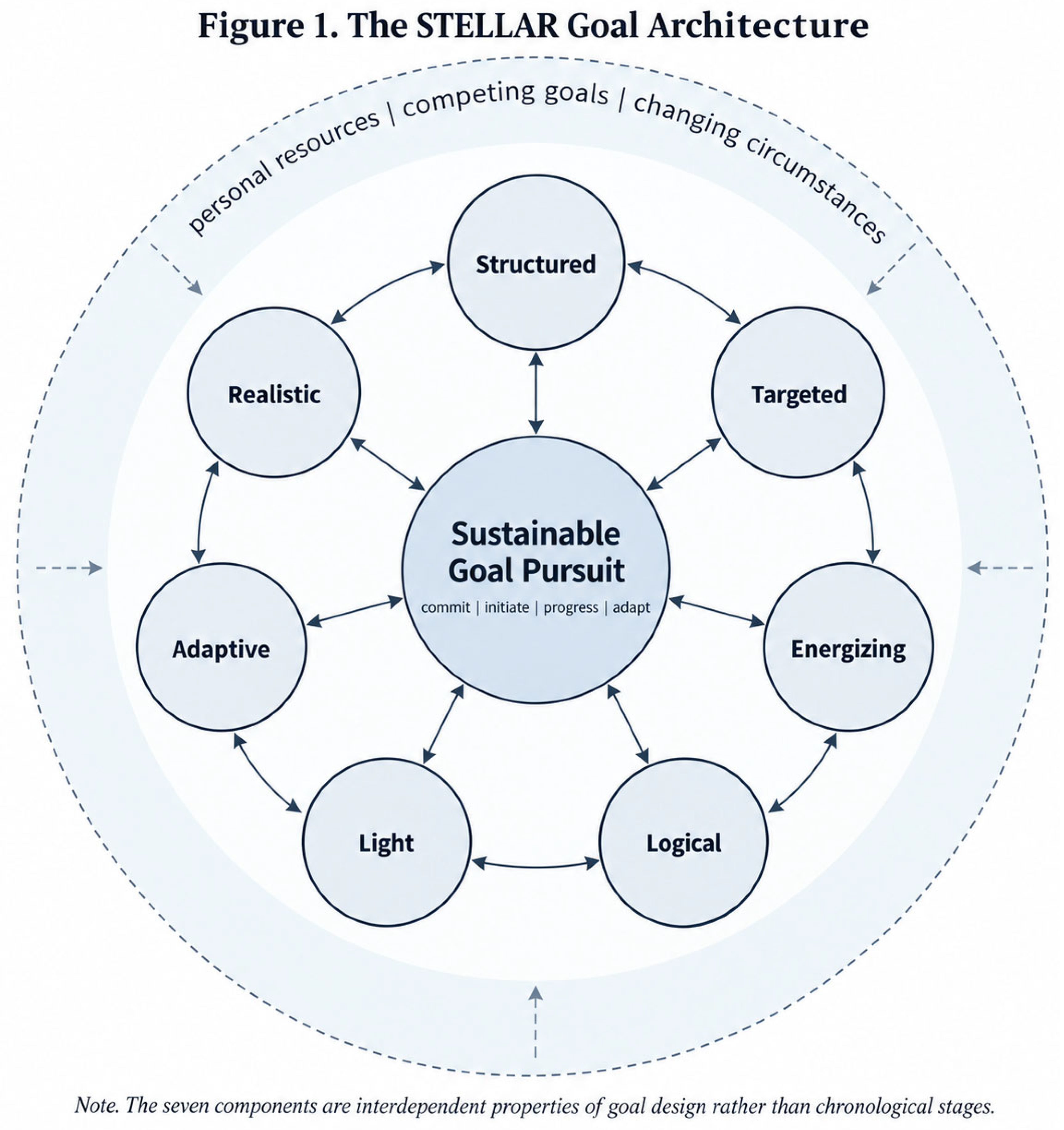
Figure 2.
From Goal Design to Sustainable Goal Pursuit.
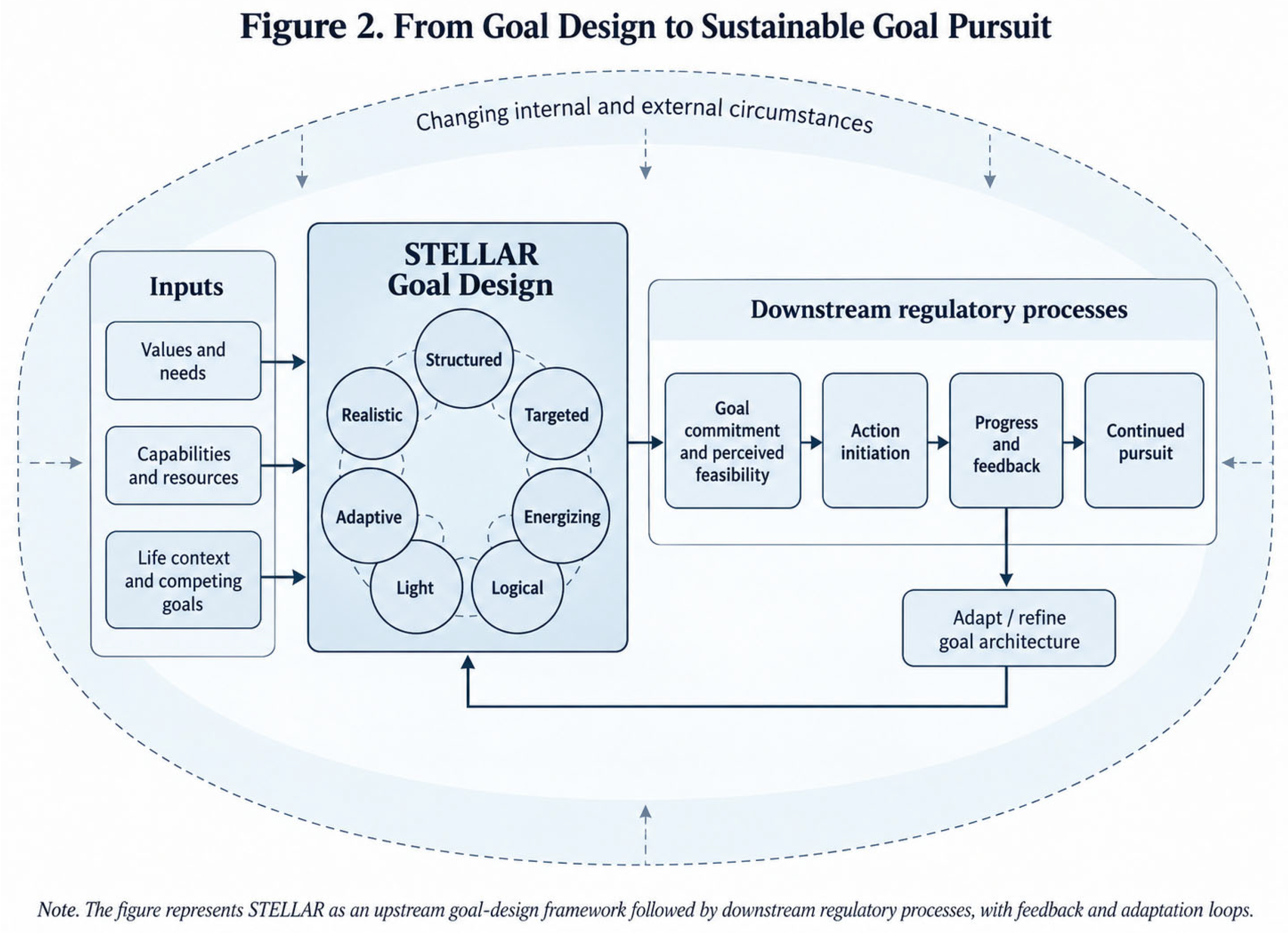
Figure 3.
SMART and STELLAR as Different Levels of Goal Design.
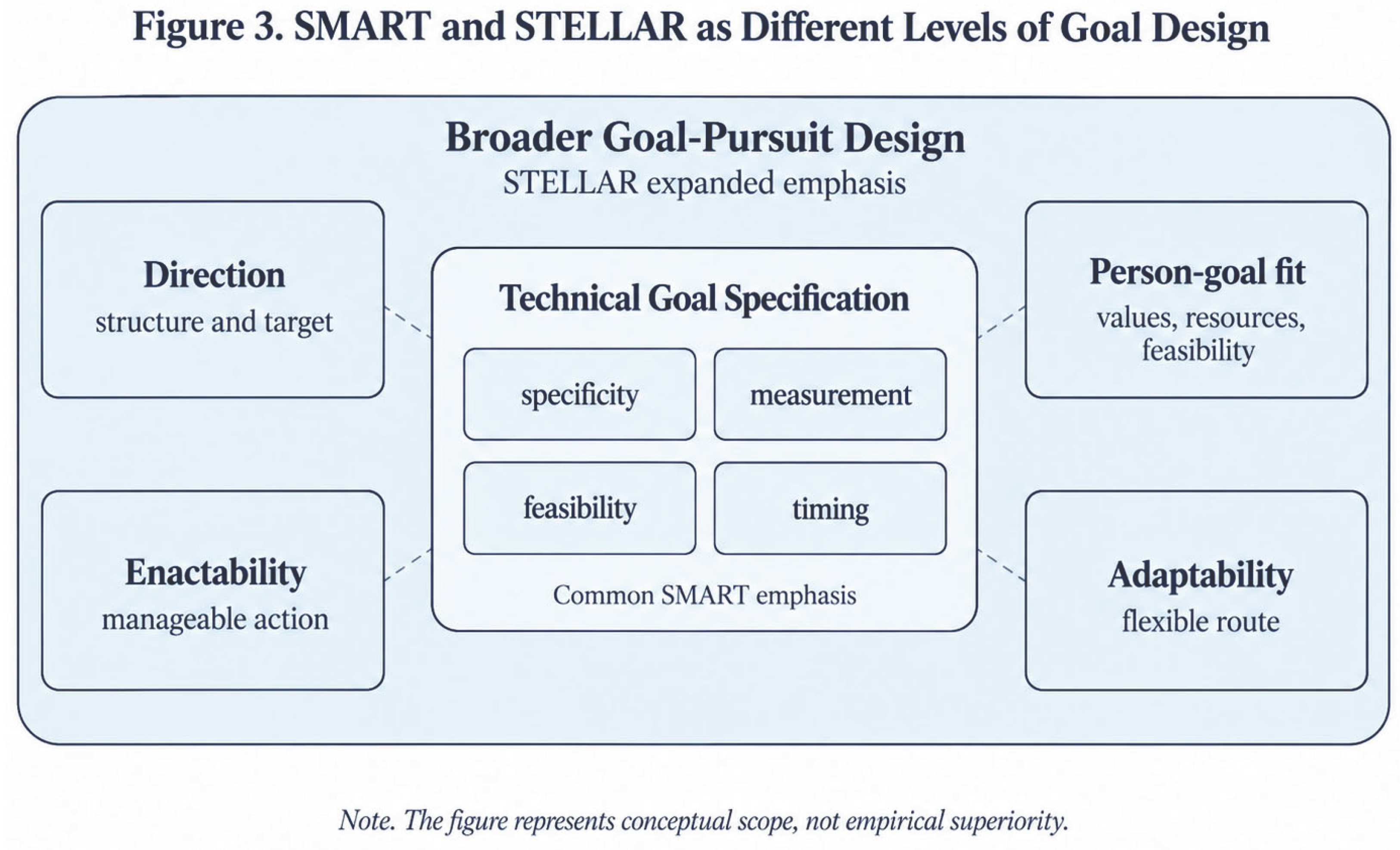
Table 1.
Definitions and Proposed Functions of the STELLAR Components.
| Component | Scientific definition | Primary function | Related research traditions |
| Structured | Degree to which a goal is embedded in a coherent route linking higher-order aims, intermediate objectives, and actionable means | Action organization | Goal systems; multiple-goal regulation; planning |
| Targeted | Degree to which desired outcomes and indicators of progress are sufficiently clear to guide evaluation | Direction and monitoring | Goal-setting theory; progress monitoring |
| Energizing | Compatibility between goal demands and available psychological, physical, temporal, attentional, social, and material resources | Resource sustainability | Subjective vitality; resource allocation; multiple-goal pursuit |
| Logical | Coherence between a goal and the individual’s values, needs, identity, and broader life direction | Motivational internalization | Self-concordance; self-determination theory |
| Light | Degree to which a goal is translated into manageable proximal actions without eliminating meaningful challenge | Action accessibility | Proximal subgoals; implementation intentions |
| Adaptive | Capacity of the pursuit architecture to change in response to new information or circumstances | Flexible persistence | Goal adjustment; disengagement/reengagement; goal-striving flexibility |
| Realistic | Feasibility of the goal relative to current capabilities, constraints, starting position, and plausible developmental pathways | Credible attainability | Self-efficacy; expectancy; goal difficulty |
Note. STELLAR = Structured, Targeted, Energizing, Logical, Light, Adaptive, and Realistic.
Table 3.
STELLAR Propositions and Candidate Empirical Tests.
| Proposition | Central prediction | Candidate test |
| P1 | Structural coherence predicts initiation and progress | Prospective goal-pursuit study |
| P2 | Structure mediates importance -> action partly through reduced next-step uncertainty | Longitudinal mediation |
| P3 | Target clarity improves progress through monitoring | Longitudinal mediation / experiment |
| P4 | Optimal target specificity varies by task and goal type | Goal-type x specificity experiment |
| P5 | Resource compatibility predicts persistence | Longitudinal regression |
| P6 | Resource incompatibility weakens commitment -> behavior translation | Moderated longitudinal model |
| P7 | Logical alignment predicts commitment through autonomous motivation | Mediation analysis |
| P8 | Values alignment and planning make independent contributions to progress | Factorial experiment |
| P9 | Manageable proximal action increases initiation | Randomized action-design study |
| P10 | Benefits of subgoals vary across phases of pursuit | Repeated-measures experiment |
| P11 | Adaptive architecture improves persistence under changing circumstances | Experimental disruption paradigm |
| P12 | Adaptability promotes strategy change before disengagement | Longitudinal event analysis |
| P13 | Feasibility predicts commitment and initiation | Prospective structural model |
| P14 | Valued goals without credible pathways show weaker sustained pursuit | Longitudinal comparison |
| P15 | Energizing and Realistic demonstrate distinct incremental validity | CFA / composite validation + incremental regression |
| P16 | Adaptation is most functional when higher-order meaning remains clear | Moderated longitudinal analysis |
Note. CFA = confirmatory factor analysis. The measurement model should not be assumed to be reflective; formative or composite specifications should also be evaluated.
Disclaimer/Publisher’s Note: The statements, opinions and data contained in all publications are solely those of the individual author(s) and contributor(s) and not of MDPI and/or the editor(s). MDPI and/or the editor(s) disclaim responsibility for any injury to people or property resulting from any ideas, methods, instructions or products referred to in the content. |
© 2026 by the authors. Licensee MDPI, Basel, Switzerland. This article is an open access article distributed under the terms and conditions of the Creative Commons Attribution (CC BY) license (http://creativecommons.org/licenses/by/4.0/).
Copyright: This open access article is published under a Creative Commons CC BY 4.0 license, which permit the free download, distribution, and reuse, provided that the author and preprint are cited in any reuse.