
Submitted:
15 September 2026
Posted:
17 September 2026
You are already at the latest version
Abstract
During the last thirty years, the compelling experimental evidences for oscillations of solar, reactor, atmospheric and accelerator neutrinos imply the existence of 3-neutrino mixing.Since in the Standard Model neutrinos are massless, the mechanism of generation of these small masses is unknown and different according to their nature: Dirac or Majorana? Neutrino oscillations experiments cannot give the answer. In the same way as the mixing of quarks is parametrized by the Cabibbo Kobayashi Maskawa quark mixing matrix - which is a unitary matrix that contains information on the strength of the flavour-changing weak interaction - , neutrino mixing can be parameterized by a 3x3 leptonic mixing matrix,called the Pontecorvo Maki Nakagawa Sakata matrix (PMNS matrix). Neutrino oscillation experiments have improved and stabilised the precision on the measurements of three mixing angles and one CP violating phase, constraining strongly unitarity violation of PMNS matrix. If neutrinos are of Majorana type there are 2 additionnal phases that cannot be accessed by oscillation experiments. In this work, we will use the most recent Nu-Fit of the PMNS parameters at 3σ in normal and inverted neutrino masses hierarchies.We will first discuss the constraints on the sum of neutrino masses and mass hierarchies taking also into account cosmological bounds and KATRIN and DESI experiments. Neutrinoless double beta decay (hereafter denoted 0νββ decay) constrains the effective Majorana mass |mee|.Within its experimental limits we will study the sensitivity to the 2 additionnal Majorana phases α and β. We will show that only one phase - α - can be extracted from data. We finally discuss the possibility that neutrino antineutrino oscillations involving muons could be complementary to 0νββ decay to help in finding the nature of neutrinos.
Keywords:
neutrinos
; Majorana
; Dirac
1. Introduction
The possibility that neutrinos oscillate has been predicted in 1957 by Bruno Pontecorvo [1] in a two component model involving one neutrino and one antineutrino. In a paper published in 1962 [2] , Maki, Nakagawa, and Sakata conjectured that the observed neutrino is actually a superposition of several states with different mass eigenvalues. They then developed an initial version of the PMNS matrix describing the two known flavors. The PMNS version with 3 flavours explains well quantitatively the observed neutrino oscillations [3]. The experimental observation of solar [4] neutrino oscillations is sensitive to the mixing angle and the squared masses difference between the two neutrino mass eigenstates 1 and 2. Atmospheric [5] neutrinos measure the mixing angle and the squared masses difference between the two neutrino mass eigenstates 2 and 3. Neutrino sources from reactor [6] and accelerator [7,8,9] are sensitive to the mixing angle and the CP violating phase . Most PMNS parameters are fixed within less than . The mass hierarchy (NH with mass eigenstate lightest or IH with mass eigenstate lightest) remains an open question.
Nevertheless, for NH, CP conservation is favored. But maximal CP violation is favoured for IH. There is no clear preference for octant.
Recent cosmological constraints on the sum of neutrino masses () already disfavor the inverted mass hierarchy and allow very little parameter space even for normal hierarchy [10]. This DESI result is based on a combination of their data sets on Baryon Acoustic Oscillations (BAO) [11] together with the Planck CMB 2018 data [12] and the lensing data from ACT [13]. In April 2024, the DESI collaboration [10] presented the most stringent bound on the sum of neutrino masses: .
In [14] these constraints have been critically assessed investigating their robustness against different statistical methods and relaxing cosmological assumptions. The cosmological neutrino mass constraints are substantially relaxed if the background dynamics are allowed to deviate from flat CDM.
The KATRIN experiment performs precision spectroscopy of the tritium -decay close to the kinematic endpoint. On the basis of the first five measurement campaigns, the experiment derived an upper limit on the effective electron neutrino mass of eV [ CL] [15].
Lower bounds derived from the neutrino oscillations give [16]: in NH and in IH.
In this work, we will first use the Nu- Fit parameters extracted from neutrino oscillations [16] and the cosmological bounds to deduct the allowed space for as a function of the lightest neutrino mass in the normal mass ordering and in the inverted ordering .
In the next sections we will assume that neutrinos are of Majorana type. We will study in section 2 the sensitivity to the Majorana phases of the effective electron neutrino mass measured in decay experiments . Section 3 is devoted to the sensitivity of muon neutrino antineutrino oscillations experiments to Majorana phases. Conclusions are given in section 4.
2. Status on Neutrino Masses from Oscillation and Cosmological Data
2.1. Parametrisation of the PMNS Mixing Matrix
The PMNS matrix U for Dirac neutrinos relates neutrino flavor eigenstates to mass eigenstates:
U can be parametrized as:
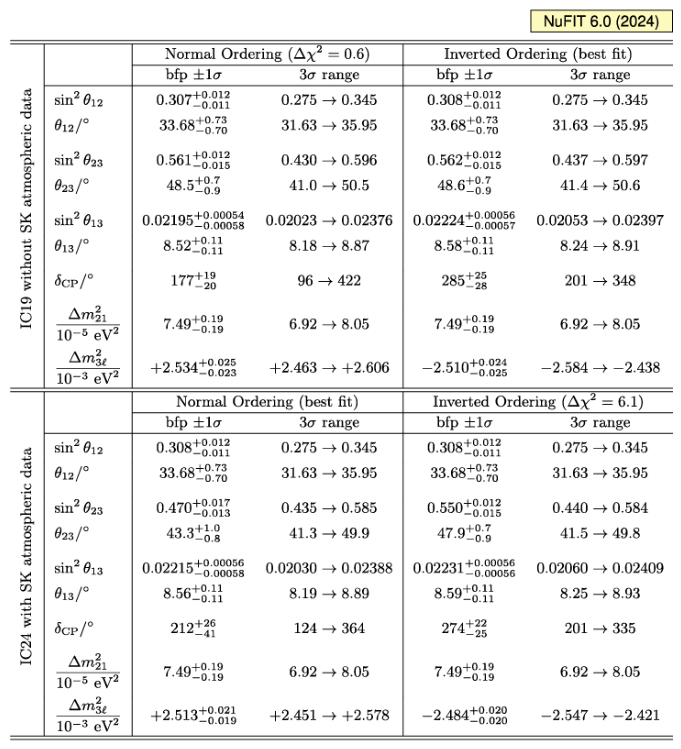
For the parameters , and (the mixing angles) and the only phase measurable in neutrino oscillations experiments we will take the latest data from [16] shown in the table Nu-FiT 6.0 (2024) below. More precisely, for our analysis we will take IC24 with SK atmospheric data (best fit ).
2.2. Unitarity of PMNS Matrix from Neutrino Oscillations
The unitarity of PMNS matrix has been reviewed in [17]. The absolute values of the PMNS matrix elements are respectively for normal hierarchy (NH) and inverted hierarchy (IH):
and:
Figure 1.
Neutrino oscillation parameters from NuFIT 6.0 (2024).
Therefore unitarity in the lepton sector is experimentally confirmed from 2024 data up to .
2.3. Allowed Regions from Neutrino Oscillations and Cosmology
In the NH mass hierarchy:
In the IH mass hierarchy:
The sum of neutrino masses is plotted in Figure 2 as a function of the lightest neutrino mass. In Figure 3 we include cosmological bounds which give upper limits on .
The CDM model excludes masses of the lightest neutrino greater than in the IH scenario and masses greater than in the NH scenario. This leaves very small room for the inverted hierarchy. Extended cosmological models release the upper bound allowing masses of the lightest neutrino up to in both scenari. We have to be cautious with the standard cosmological model CDM: the Hubble constant tension and the baryon acoustic oscillation (BAO) measurements from DESI favor a dark energy which may not be a cosmological constant but rather a rapidly evolving component that is weakening with time. Since there is less and less consensus on the validity of the CDM model we will be conservative, keeping as upper limit on .
3. Neutrinoless Double Beta Decay
3.1. Mixing Matrix for Majorana Neutrinos
If neutrinos are Majorana the leptonic mass matrix is the product of the PMNS matrix with:
Without loss of generality we can consider two additionnal phases and .
The Majorana mixing matrix reads:
3.2. Effective Majorana Mass
Neutrinoless double beta decay is a rare nuclear transition where a nucleus undergoes 2 beta decays emitting 2 electrons but no antineutrino.Due to the Majorana nature of neutrino the antineutrino emitted during one beta decay is reabsorbed during the second decay. There is a variety of experiments [18] using different even nuclear isotopes and different detection technics (for a recent review see [19]). The signal is a peak in the summed energy spectrum of the final state electrons, which up to now has not be observed. The measured quantity is the half-life of the decay rate which depends on the effective Majorana mass and nuclear matrix elements. The experimental bounds on are [16]: eV for NH and eV for IH.
The effective Majorana mass is defined as:
Its value is:
3.3. Sensitivity to Majorana Phases
We will first test the sensitivity of to the phases and .This is done for NH et IH keeping in the experimental limits given above.
Since is very small, if we neglect the terms proportionnal to , we can extract :
3.4. Sensitivity to the Dirac CP Violating Phase
4. Effective Majorana Mass Involving Muon Neutrinos
The 3D mapping of the six effective Majorana masses (where and are the flavor indices) has been studied in [20]. Since we have previously shown that a measurement of in neutrinoless double beta decay experiments does not allow us to determine the two Majorana CP phases, we propose to probe the dependence of on the two Majorana phases and with oscillations , a possible lepton-number-violating process. We are aware of the difficulty of measuring this effective Majorana mass defined below.
Its value is:
We can simplifiy this expression by removing the terms proportional to .We have checked that this simplification does not affect the results.
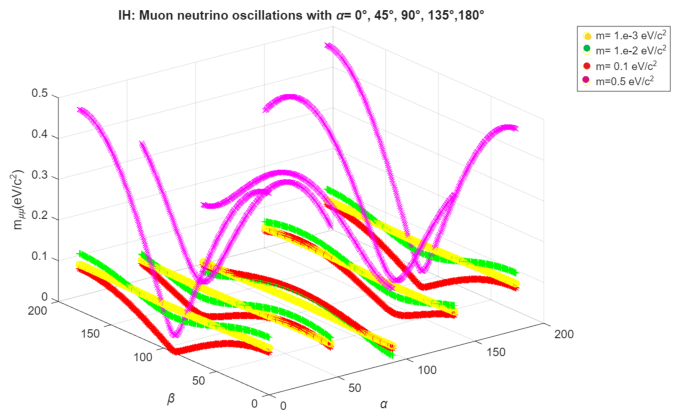
The following four figures show that is sensitive to both Majorana phases. We have taken 4 masses for the lightest neutrino : .
We have rescaled by a factor of 5 the values of for and .
The shapes of the curves are similar whatever the mass of the lightest neutrino but for masses greater than eV the variation of the effective Majorana mass with the Majorana phases is more significant and pronounced and can reach a factor of 10 between the minimal and maximal values.
Figure 10.
Effective Majorana mass as a function of the Majorana phase for 4 masses of the lightest neutrino and 5 values of the Majorana phase in the NH mass ordering.
Figure 10.
Effective Majorana mass as a function of the Majorana phase for 4 masses of the lightest neutrino and 5 values of the Majorana phase in the NH mass ordering.
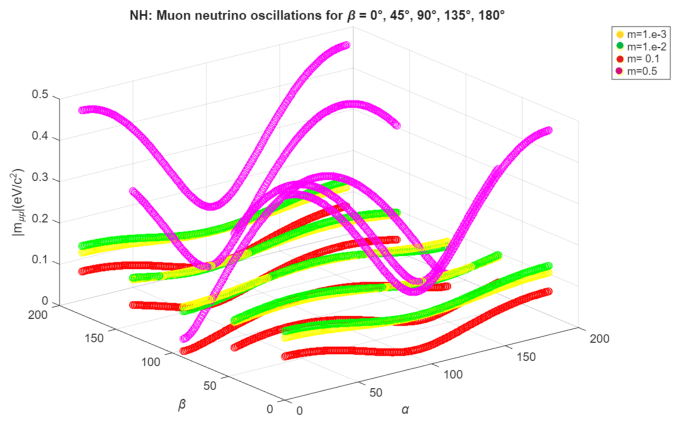
Figure 11.
Effective Majorana mass as a function of the Majorana phase for 4 masses of the lightest neutrino and 5 values of the Majorana phase in the NH mass ordering.
Figure 11.
Effective Majorana mass as a function of the Majorana phase for 4 masses of the lightest neutrino and 5 values of the Majorana phase in the NH mass ordering.
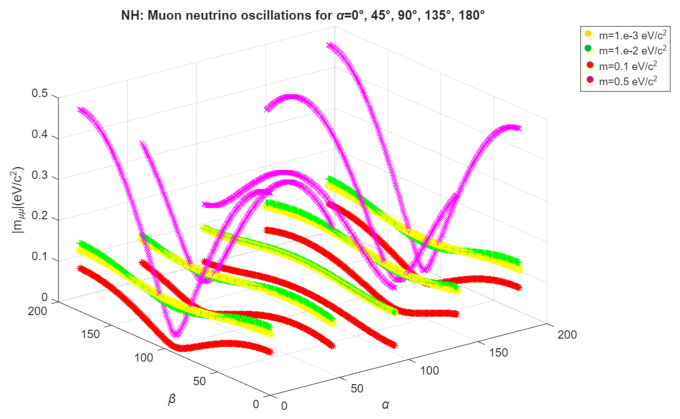
Figure 12.
Effective Majorana mass as a function of the Majorana phase for 4 masses of the lightest neutrino and 5 values of the Majorana phase in the IH mass ordering.
Figure 12.
Effective Majorana mass as a function of the Majorana phase for 4 masses of the lightest neutrino and 5 values of the Majorana phase in the IH mass ordering.
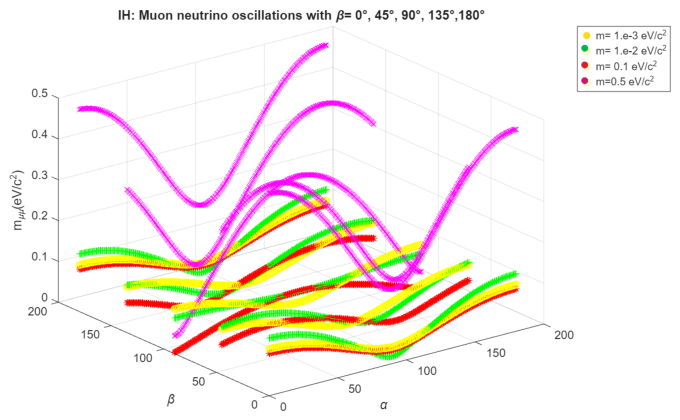
Figure 13.
Effective Majorana mass as a function of the Majorana phase for 4 masses of the lightest neutrino and 5 values of the Majorana phase in the IH mass ordering.
Figure 13.
Effective Majorana mass as a function of the Majorana phase for 4 masses of the lightest neutrino and 5 values of the Majorana phase in the IH mass ordering.
5. Conclusions
The phenomenology of neutrino oscillations can be fully described in terms of the PMNS mixing matrix. Solar, atmospheric, reactor and accelerator neutrino (or antineutrino) oscillation experiments have allowed to extract within a few % the values of the 3 mixing angles and the magnitude of the two squared mass differences. Nevertheless our present knowledge on the sign of and the value of the CP violating phase remains rather poor. The up to date analysis of neutrino oscillations data don’t establish first signs of non unitarity of the PMNS mixing matrix.
Oscillation measurements cannot access the nature of massive neutrinos: Dirac or Majorana? If we assume that each massive neutrino is a Majorana fermion we have to add two Majorana CP-violating phases. They can be determined or constrained by lepton-number-violating processes. Neutrinoless double-beta decay is a good candidate to probe the Majorana nature of neutrinos . We have shown that present experimental limits on the effective electron Majorana mass constrain only the phase . The second Majorana phase cannot be accessed by measurement of because terms involving are proportional to the mixing angle which is close to 0. We suggest to investigate muon neutrino experiments which could measure the effective muon Majorana mass , we have shown sensitive to both Majorana phases.
Acknowledgments
I thank Christian Marinoni and Federico Piazza for discussions on cosmological models. I thank Marc Knecht for help in several stages of this work.
References
- Pontecorvo, B. Inverse β-Processes and Lepton Charge Nonconservation. Sov. Phys. JETP. 1958, 6, 429. [Google Scholar]
- Nakagawa, Maki Z.; M. Sakata, S. Remarks on the Unified Model of Elementary Particles. Prog. Theor. Phys. 1962, 28, 870. [Google Scholar] [CrossRef]
- For a recent review, see e.g. Gonzalez-Garcia M.C. Yokoyama M. Neutrino Masses, Mixing, and Oscillations. Phys. Rev. D. ( 2024), 110, 033003 ; Gonzalez-Garcia C. Global analysis of neutrino oscillations. In Proceedings of the Neutrino ’26 Conference (to appear); 2026.
- [ Homestake collaboration] Cleveland B. T. et al. Measurement of the solar electron neutrino flux with the Homestake chlorine detector. Astrophys. J., (1998),496 (1), 505;[SNO Collaboration] Ahmad Q.R. et al. Direct Evidence for Neutrino Flavor Transformation from Neutral-Current Interactions in the Sudbury Neutrino Observatory. Phys. Rev. Lett., (2002), 89 , 011301; [SAGE Collaboration] Abdurashitov J.N. et al Measurement of the solar neutrino capture rate with gallium metal. III: Results for the 2002–2007 data-taking period Phys.Rev.C. (2009), 80, 015807; Kaether F. Hampel W. Heusser G. Kiko J. Kirsten T. Reanalysis of the GALLEX solar neutrino flux and source experiments, Phys. Lett. (2010) 685 (1), 47 ; [KAMIation] Totsuk Y. et al. Recent results on solar neutrinos from Kamiokande. Nucl. Phys. B. (1991), 19, 69; [BOREXINO Collaboration] Basilico D. et al. Final results of Borexino on CNO solar neutrinos Phys. Rev. D. (2023), 108 , 102005 ;[KamLAND Collaboration] Eguchi1 K. et al. First Results from KamLAND: Evidence for Reactor Antineutrino Disappearance. Phys. Rev. D 2023, 108, 102005.
- [IceCube Collaboration] Kuwabara1 T. et al. Systematics for Atmospheric Neutrinos in IceCube. JPS Conf. Proc. (2016), 12, 010014 ; [MINOS Collaboration] Adamson P. et al. Measurement of Neutrino and Antineutrino Oscillations Using Beam and Atmospheric Data in MINOS. Phys. Rev. Lett. (2013), 110, 251801; [Super-Kamiokande collaboration] Fukuda Y. Hayakawa T. Ichihara E. Inoue K. Ishihara K. Ishino H. et al. Evidence for oscillation of atmospheric neutrinos. Phys. Rev. Lett. 1998, 81, 1562.
- Bemporad, C. Gratta G. Vogel P. Rev.Mod. Phys. (2002), 74 , 297; [KAMLAND Collaboration] Abe S. et al. Precision Measurement of Neutrino Oscillation Parameters with KamLAND. Phys. Rev. Lett. (2008), 100, 221803 and Phys. Rev. Lett. (2008), 101, 119904 and Phys. Rev. Lett. (2008), 101, 259901 ;[Daya Bay Collaboration.] An FP. et al. Observation of electron antineutrino disappearance at Daya Bay Phys. Rev. Lett. (2012), 108, 171803 and Adley D. et al. Measurement of the electron antineutrino oscillation with 1958 days of operation at Daya Bay Phys. Rev. Lett. (2018), 121, 241805 ; [Double CHOOZ Collaboration] de Kerret H. et al. Double Chooz θ13 measurement via total neutron capture detection. Nat. Phys. (2020), 16, 558; [Reno Collaboration] Shin CD. Measurement of θ13 using RENO reactor neutrino events with neutron capture on hydrogen. J. Phys.: Conf. Ser. (2017), 888, 012138 and Shin CD. et al. Recent Results from RENO. PoS ICHEP2020 2021, 177.
- [OPERA Collaboration] KOMATSU M. et al. Latest results on νμ→ντ oscillations from the OPERA experiment. Nucl. Part. Phys. Proc. (2016), 273, 1865; [The NOva Collaboration and the T2K Collaboration.] Joint neutrino oscillation analysis from the T2K and NOvA experiments. Nature 2025, 646, 818. [PubMed]
- LSND Collaboration; Aguilar, A.; et al. Evidence for neutrino oscillations from the observation of νe appearance in a νμ beam. Phys. Rev. D. 2001, 64, 112007. [Google Scholar] [CrossRef]
- [MiniBooNE Collaboration] Aguilar Arevalo A.A et al. Event excess in the MiniBooNE search for νμ¯→νe¯ oscillations. Phys. Rev. Lett. (2010), 105, 181801; Abratenko P. et al. Search for light sterile neutrinos with two neutrino beams at MicroBooNE. Nature 2025, 648, 64. [PubMed]
- DESI Collaboration; Adame, A. G.; et al. DESI 2024 VI: Cosmological Constraints from the Measurements of Baryon Acoustic Oscillations. J. Cosmol. Astropart. Phys. 2025, 02, 021. [Google Scholar] [CrossRef]
- DESI Collaboration; Adame, A. G.; et al. DESI 2024 III: Baryon Acoustic Oscillations from Galaxies and Quasars. J. Cosmol. Astropart. Phys. 2025, 04, 012. [Google Scholar] [CrossRef]
- [Planck Collaboration] Aghanim N. et al. Planck 2018 results VI. Cosmological parameters. Astron. Astrophys., (2020), 641, A6 ; Planck 2018 results. I. Overview and the cosmological legacy of Planck. Astron. Astrophys. 2020, 641, A1.
- [ACT Colllaboration] Madhavacheril M. S. et al. DR6 Gravitational Lensing Map and Cosmological Parameters. Astrophys. J., (2024), 962 , 113; Qu FJ. et al. A Measurement of the DR6 CMB Lensing Power Spectrum and Its Implications for Structure Growth. Astrophys. J. 2024, 962, 112.
- Naredo-Tuero D. Escudero M. Fernandez-Martinez E. Marcano X. and Poulin V.Critical look at the cosmological neutrino mass bound. Phys. Rev. D., (2024), 110, 123537; Allalia I.J. and Notarib A. Neutrino mass bounds from DESI 2024 are relaxed by Planck PR4 and cosmological supernovae. J. Cosmol. Astropart. Phys. (2024), 12, 020; Choudhury S. R. and Choubey S. Updated Bounds on Sum of Neutrino Masses in Various Cosmological Scenarios. J. Cosmol. Astropart. Phys. 2018, 09(020), 017.
- Aker, M. Aker M. et al. Direct neutrino-mass measurement based on 259 days of KATRIN data. Science, ( 2025), 388, 180; Shao H. et al. Cosmological limits on the neutrino mass sum for beyond-ΛCDM models. Phys. Rev. D. 2025, 111, 083535. [Google Scholar]
- Esteban I. Gonzalez-Garcia M.C. Maltoni M. Martinez-Soler I. Pinheiro J. P. Schwetz T. and Zhou A. NuFit-6.0: updated global analysis of three-flavor neutrino oscillations. J. High. Energy. Phys. ((2024), 12, 216; Navas S. et al. Particle Data Group. Phys. Rev. D. 2024, 110, 030001.
- Chiappetta, P. Unitarity of the Leptonic Mass Matrix. Open. Access. J. Phys. Sci. 2025, 1. [Google Scholar]
- [neXO Collaboration] Adhikari G. et al. nEXO: neutrinoless double beta decay search beyond 1028 year half-life sensitivity. J. Phys. G, (2022), 49, 015104; [LEGEND Collaboration] Acharya H. et al. First Results on the Search for Lepton Number Violating Neutrinoless Double β Decay with the LEGEND-200 Experiment. Phys. Rev. Lett. (2026), 136, 022701; [KamLAND-Zen Collaboration] Abe S. et al. Search for Majorana Neutrinos with the Complete KamLAND-Zen Dataset, Phys. Rev. Lett. (2025), 135, 262501; [CUPID Collaboration] Azzolini O. et al. Final Result on the Neutrinoless Double Beta Decay of 32Se with CUPID-0. Phys. Rev. Lett. (2022), 129, 111801; [CUORE Collaboration] Artusa D. R. et al.New direct limit on neutrinoless double beta decay half-life of 130Te with CUORE. Phys. Rev. Lett. 2022, 129, 222501. [PubMed]
- Giuliani A. The Quest for Neutrinoless Double Beta Decay: Progress and Prospects. Physics and the Cosmos. (2026), 1(1), 6; Agostini M. et al. Toward the Discovery of Matter Creation with Neutrinoless ββ Decay. Rev. Mod. Phys. 2023, 95, 025002.
- Hu, C.; Xing, Z. 3D mapping of the effective Majorana neutrino masses with neutrino oscillation data. Nucl. Phys. B. 2021, 571, 115521. [Google Scholar]
Figure 2.
Allowed ranges on the sum of neutrino masses as a function of the lightest neutrino mass m for NH (dashed line) and IH (full line) mass hierarchies extracted from oscillation data.
Figure 2.
Allowed ranges on the sum of neutrino masses as a function of the lightest neutrino mass m for NH (dashed line) and IH (full line) mass hierarchies extracted from oscillation data.
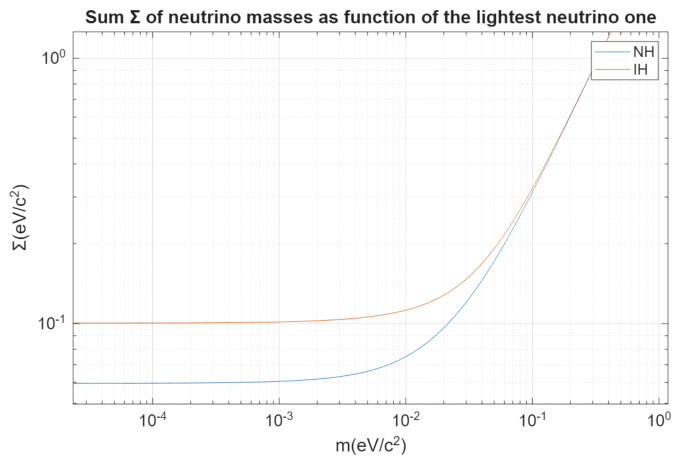
Figure 3.
Upper limits on the sum of neutrino masses as a function of the lightest neutrino mass m in the CDM model and an extended cosmological model inscluding CMB Planck data and BAO measurements.
Figure 3.
Upper limits on the sum of neutrino masses as a function of the lightest neutrino mass m in the CDM model and an extended cosmological model inscluding CMB Planck data and BAO measurements.
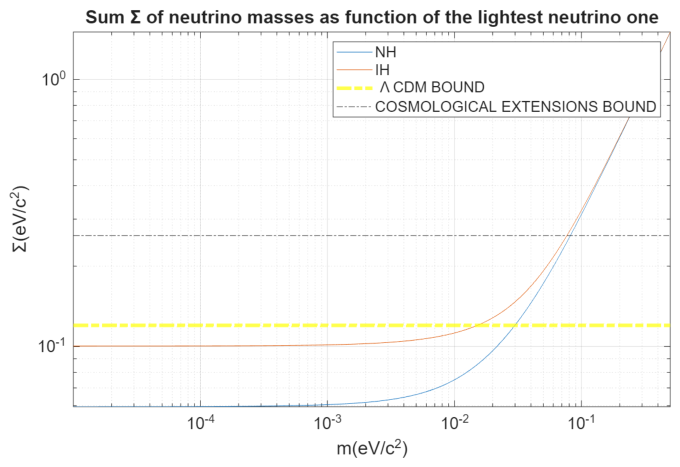
Figure 4.
Allowed values of the Majorana phase as a function of the lightest neutrino mass m and within the experimental bounds in the NH mass ordering.
Figure 4.
Allowed values of the Majorana phase as a function of the lightest neutrino mass m and within the experimental bounds in the NH mass ordering.
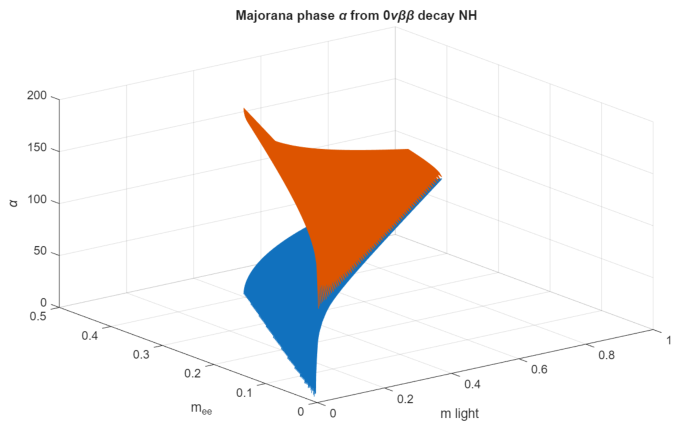
Figure 5.
Allowed values of the Majorana phase as a function of the lightest neutrino mass m and within the experimental bounds in the IH mass ordering.
Figure 5.
Allowed values of the Majorana phase as a function of the lightest neutrino mass m and within the experimental bounds in the IH mass ordering.
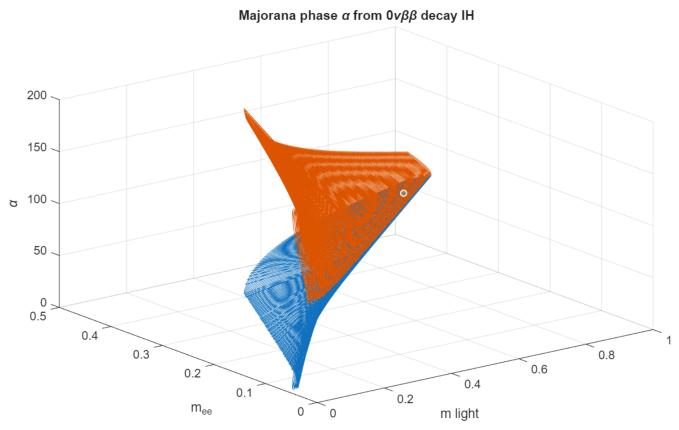
Figure 6.
Effective Majorana mass as a function of the Majorana phase for 5 masses of the lightest neutrino m and 5 angles of the Majorana phase in the NH mass ordering.
Figure 6.
Effective Majorana mass as a function of the Majorana phase for 5 masses of the lightest neutrino m and 5 angles of the Majorana phase in the NH mass ordering.
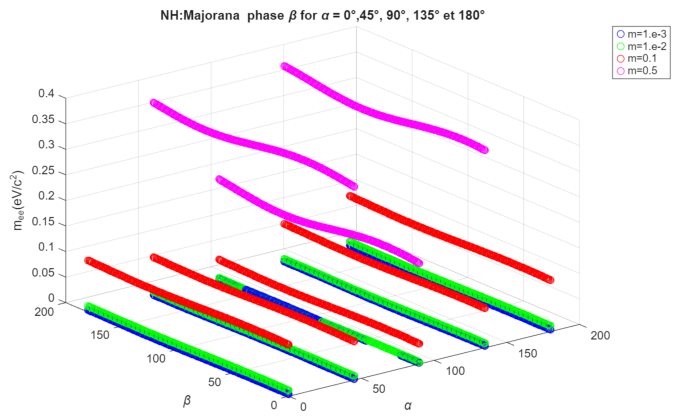
Figure 7.
Effective Majorana mass as a function of the Majorana phase for 5 masses of the lightest neutrino m and 5 angles of the Majorana phase in the IH mass ordering.
Figure 7.
Effective Majorana mass as a function of the Majorana phase for 5 masses of the lightest neutrino m and 5 angles of the Majorana phase in the IH mass ordering.
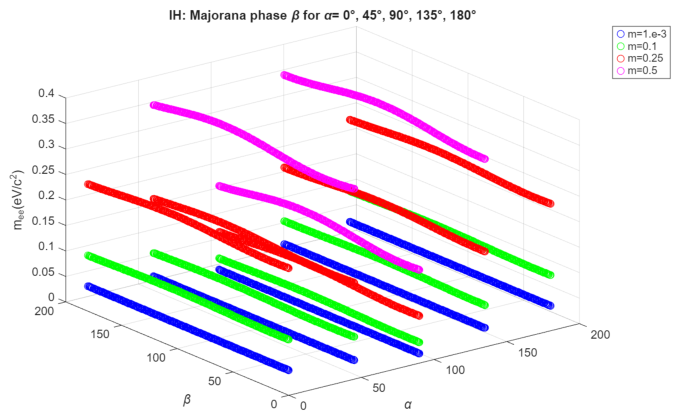
Figure 8.
Effective Majorana mass as a function of the electron neutrino mass within CP violating phase allowed values in the NH mass ordering.
Figure 8.
Effective Majorana mass as a function of the electron neutrino mass within CP violating phase allowed values in the NH mass ordering.
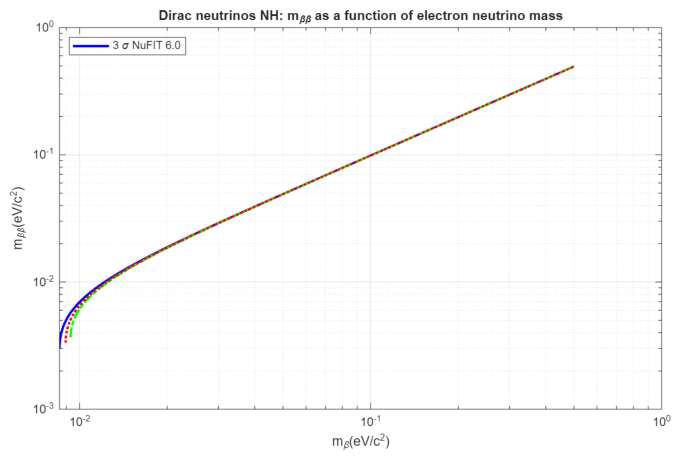
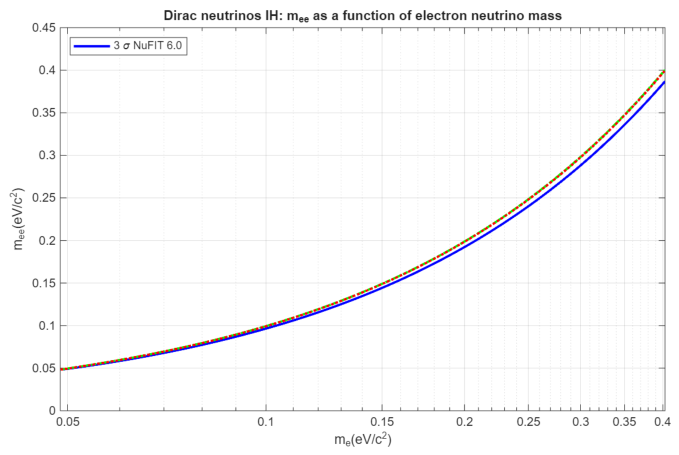
Figure 9.
Effective Majorana mass as a function of the electron neutrino mass within CP violating phase allowed values in the IH mass ordering.
Figure 9.
Effective Majorana mass as a function of the electron neutrino mass within CP violating phase allowed values in the IH mass ordering.
Disclaimer/Publisher’s Note: The statements, opinions and data contained in all publications are solely those of the individual author(s) and contributor(s) and not of MDPI and/or the editor(s). MDPI and/or the editor(s) disclaim responsibility for any injury to people or property resulting from any ideas, methods, instructions or products referred to in the content. |
© 2026 by the authors. Licensee MDPI, Basel, Switzerland. This article is an open access article distributed under the terms and conditions of the Creative Commons Attribution (CC BY) license (http://creativecommons.org/licenses/by/4.0/).
Copyright: This open access article is published under a Creative Commons CC BY 4.0 license, which permit the free download, distribution, and reuse, provided that the author and preprint are cited in any reuse.