

Submitted:
09 September 2026
Posted:
17 September 2026
You are already at the latest version
Abstract
Research on societal resilience and national security has increasingly focused on the factors that determine citizens’ readiness to defend the state; however, the interrelationships among individual financial resilience, institutional trust, and motivation for civil defense remain under-explored. The aim of this article is to empirically assess the direct and indirect effects of individual financial resilience on citizens’ willingness to defend the state, and to compare the structure of these relationships in Estonia and Lithuania, while accounting for the moderating effects of income and ethnicity. The study employed a quantitative comparative research method, and moderated mediation was applied to assess to hypothesis. The results showed that in both countries, individual financial resilience significantly increases institutional trust and citizens’ willingness to defend the state, and that institutional trust significantly mediates this relationship. In Estonia, a significant moderating effect of income and ethnic affiliation was found, whereas in Lithuania, the influence of these factors was not confirmed. The results indicate that financial resilience and institutional trust are important prerequisites for public willingness to defend the country, but their interaction depends on the national context. This study contributes to research on societal resilience and national security by highlighting the importance of economic and institutional factors in shaping citizens’ willingness to contribute to national defense.
Keywords:
individual financial resilience
; institutional trust
; national defense willingness
; Baltic states
1. Introduction
Individual financial resilience is understood not merely as the level of income or the amount of savings, but as an individual’s broader ability to withstand financial shocks, adapt to adverse economic circumstances, and mobilize the necessary resources [1,2,3,4]. Salignac et al. [5] define financial resilience as a multidimensional construct encompassing economic resources, financial knowledge and behavior, access to appropriate financial products and services, and social capital. Therefore, it can be argued that greater financial resilience is associated with better ability to cope with financial shocks and a lower risk of experiencing financial difficulties [6]. Brüggen et al. [7] expand on the concept of financial resilience, emphasizing that one’s financial situation must be assessed not only through objective indicators but also through an individual’s ability to meet current and future financial obligations and to feel secure about their financial future. Liu et al. [4] supplement this concept by arguing that financial resilience is linked not only to income or savings but also to broader psychological, social, and situational factors. These insights allow us to view financial resilience not merely as an economic factor but also as a factor in social security, reducing financial stress and strengthening an individual’s ability to function under conditions of uncertainty, since individuals who are able to meet their current and future financial needs feel more confident about their financial future [8] (p.4). This is confirmed by Kempson et al. [9], who note that financial security strengthens an individual’s sense of control and ability to plan for the future, thereby creating the conditions for more active long-term decision-making. Näsman et al. [10] found that socioeconomic resources, including income, education, and health status, are positively associated with various forms of civic engagement. The authors note that socioeconomic resources provide the means and capabilities necessary for civic engagement, and that higher income levels increase the likelihood of participating in volunteer, political, and associational activities [10]. Therefore, financial stability can be considered one of the factors that create more favorable conditions for more active civic and community participation. Conversely, financial vulnerability—manifested through material deprivation and constant anxiety about basic expenses—correlates directly with increased stress and social exclusion, which limits citizens’ motivation and resources to participate in collective actions [11,12,13]. Therefore, it can be argued that individual financial resilience, as part of economic resilience, can be considered an important context in which citizens’ trust in state institutions and their attitudes toward national defense are formed. Institutional resilience can be understood as the ability of public institutions to maintain the continuity of their core functions [14], adapt to shocks [15], provide high-quality services, and uphold public welfare under conditions of crisis or uncertainty [16]. Profiroiu and Nastacă [17] define institutional resilience in public administration as the ability of institutions to strengthen their preparedness for future shocks, adapt to unforeseen situations, ensure the continuity of high-quality services, and maintain communication with citizens. From the citizens’ perspective, institutional resilience can be understood as a subjective assessment of the reliability and effectiveness of institutions: citizens’ belief that state institutions are capable of acting consistently, providing necessary public services, preparing for crises, and addressing issues of importance to society. This interpretation aligns with the OECD’s [18] concept of trust in public institutions, according to which trust reflects citizens’ expectations that institutions will act reliably, responsibly, and honestly, and will be able to reduce social, economic, and political uncertainty. From the citizens’ perspective, this resilience is most often manifested through institutional trust, which describes citizens’ belief that the institutional system is capable of producing the outcomes desired by society [19]. Therefore, institutional trust can be considered as a subjective dimension of institutional resilience; that is, the more citizens perceive institutions as effective, impartial, competent, and capable of acting in the public interest, the stronger their perceived institutional resilience [20]. Rothstein and Stolle [21] supplement this interpretation by arguing that procedural justice in institutions influences citizens’ institutional trust, sense of security, and evaluations of public officials and other citizens. Therefore, the quality, impartiality, and fairness of institutions can be regarded as important prerequisites that strengthen social trust, which in turn creates more favorable conditions for collective action and societal resilience. Trust in state institutions is a fundamental element of the functioning of society, social cohesion and national security. Institutional trust reflects citizens’ belief that the system is functioning properly, including its rules, organizations and law enforcement mechanisms. Conversely, low trust directly correlates with a lower sense of individual security. When trust in state institutions is low, citizens tend to seek security in informal networks, such as kinship ties or even corrupt structures, which further weakens the foundations of the state [22]. Although the overall trend of trust in state institutions is decreasing in democratic countries, population survey data show that the level of institutional trust varies greatly across countries [23]. Generally, trust in state institutions is higher in higher-income countries than in lower-income countries [24]. Citizen engagement is also an important factor of trust in institutions. People who feel they have political power and can influence government decisions are more than three times more likely to trust institutions than those who feel powerless [25]. Trust in institutions also depends primarily on citizens’ perceived quality of governance, which includes both competence and values and ethical behavior. Perceived government reliability in the event of a natural disaster and the integrity of high-ranking officials are the strongest indicators of trust in institutions, followed by satisfaction with security and education services. Although party affiliation also has some influence, its impact is relatively small [26]. Institutional trust is influenced not only by political and social factors, but also by economic ones. The financial resilience of society is closely related to trust in institutions. Research data show that in all countries, feelings of financial insecurity correlate with lower trust in state institutions: just 35 percent respondents who are worried about their financial future trust the country's government, while among those who feel financially stable, this indicator is 17 percentage points higher [25]. Therefore, financial stability can be considered one of the prerequisites for a favorable assessment of institutions. This is most often linked to a subjective sense of financial security. Rohde [27] found that individuals experiencing economic insecurity tend to have lower levels of trust in various social institutions, while Schaub [28] found that sudden financial difficulties reduce political participation, particularly among low-income individuals, as they are associated with stress, a decline in psychological well-being, social isolation, alienation, and a diminished sense of political efficacy.
Institutional trust acts as a mediator between the individual and the state’s defense objectives. A study by Habibov et al. [19] shows that greater trust in state institutions increases citizens’ willingness to financially support the functions of the welfare state – that is, to pay higher taxes for social assistance, health care, and education. Although this study does not directly address national defense, it supports the broader assumption that citizens are more inclined to contribute to the state’s collective functions when they trust in the effectiveness and integrity of its institutions. In the context of national security, this logic can be linked to research on total defense, which shows that national defense relies on the engagement of the entire society, political trust, trust in the armed forces, national identity, and social cohesion [29,30,31]. Anderson et al. [32], in their analysis stated willingness to fight for their country, found that the relationship between individual income and this stated willingness to defend the country is not direct but depends on the level of income inequality in the country. In countries with high income inequality, wealthier respondents are less likely to indicate that they would be willing to defend their country compared to lower-income respondents, whereas in countries with low inequality, the differences between income groups are small. According to a survey conducted by the Gallup International Association in 45 countries at the end of 2023, covering about half of the world's population, 52% of adults worldwide say they would be willing to fight for their country if necessary, 33% would not fight, and 14% are not sure. There is a clear divide in the world between the South/East and the North/West in terms of attitudes towards being willing to fight for their country. In the European Union, 32% of citizens were willing to fight for their country if necessary, compared to 41% in the United States, while in West Asia, 77% and 73% in the Middle East. In Ukraine, 62% of citizens were willing to fight, compared to 32% in Russia [33]. A survey of the population of NATO countries revealed that Turkey and the Nordic countries, especially Sweden and Finland, were characterized by a strong willingness of citizens to fight. The case of Turkey is explained by the changing geopolitical context, and the Nordic countries by the desire to preserve their way of life and the threats posed by Russia. Of the Baltic countries, Lithuania, with 52 percent, entered the top ten NATO countries whose citizens expressed the strongest willingness to defend their country, but Estonia and Latvia took lower places – 45 and 37 percent, respectively. In both cases, this was influenced by the opinion of the Russian-speaking population, which reduced the average country's willingness to fight [34]. Onderco et al. [35] distinguish the main motives that determine citizens' willingness to defend the country, including the geopolitical environment, values, compulsory military service and demographic factors (gender, age). Regional conflicts change citizens' attitudes towards war. When military operations take place in the neighborhood, people more often begin to perceive war as inevitable, and therefore are more likely to get involved in the defense of the country if necessary. The study participants indicate that they are ready to defend fundamental values – democracy, freedom and an open society. A positive correlation was also observed between compulsory military service and a greater willingness of citizens to defend the country. Women are more likely to hesitate about direct participation in combat operations, but are ready to contribute to defense in other forms, such as assistance. Although older people sometimes doubt their physical capabilities, their willingness to defend the country often remains high due to previous military experience or differences in generational attitudes.
Studies in the Baltic states suggest that the relationship between economic well-being and willingness to defend the country is not straightforward. It is argued that citizens’ willingness to defend their country is linked to trust in institutions, national identity, trust in the armed forces, and the broader social and political context [30,34,36,37,38]. Ramonaitė et al. [30] argue that studies in the Baltic states show that higher income, higher education, and greater trust in political institutions are associated with a stronger willingness to defend the country. Therefore, reliably functioning institutions can be understood as a channel through which individual financial security and trust in the state’s ability to act translate into broader social resilience and civic readiness to support the state in crisis and defense situations. Rostoks and Mieriņa [31], in their analysis of the Latvian case, revealed that trust in NATO’s security guarantees significantly strengthens the population’s willingness to defend the country, reduces the tendency to flee the country in the event of military aggression, and increases support for strengthening the state’s defense capabilities. The authors emphasize that citizens are willing to shoulder the collective burden only when they trust in the integrity and effectiveness of state institutions. This echoes the importance of social trust, civic engagement, and community cohesion—as highlighted in studies on societal resilience—in strengthening a nation’s resilience to crises [29]. Therefore, it can be argued that individual financial resilience, by contributing to a greater sense of security and social stability, can indirectly strengthen societal resilience and willingness to contribute to ensuring national security.
Although it is recognized in the academic literature that financial resilience is linked to institutional trust, and that institutional trust is linked to citizens’ willingness to contribute to the state’s collective functions, it remains unclear how individual financial resilience—both directly and indirectly, through institutional trust—shapes citizens’ willingness to defend the state, and whether these relationships vary across different national contexts. In particular, there is a lack of comparative empirical studies revealing the significance of income and ethnicity for these relationships in the Baltic states. Therefore, the aim of this study is to address this issue.
2. Materials and Methods
2.1. Research Instrument and Hypotheses
The survey has been carried out to collect and analyse quantitative data from Estonia and Lithuania, comprising a total of 2,008 respondents (1,004 in each country). All statements relating to the main research constructs in the questionnaire were assessed using a uniform five-point Likert scale, with ratings ranging from 1 (‘strongly disagree’) to 5 (‘strongly agree’). The survey instrument was designed to cover three main scales for measuring latent variables, as well as a comprehensive set of socio-demographic indicators. These are connected but distinct layers of resilience: individual financial resilience helps people absorb shocks, institutional resilience helps organizations and governments keep operating, and preparedness to defend homeland depends on how well those personal and institutional capacities are coordinated into emergency, civil defense, and homeland security systems [39,41,42].
The first main research variable was individual financial resilience. It assesses an individual’s subjective ability to withstand financial shocks, manage economic uncertainty and ensure personal and family financial security [39,40,43]. Studies link [42,44] it to emergency savings, financial literacy, inclusion, employment, and coping capacity. Thus, 6 questionnaire statements were included to measure this construct. ‘I am satisfied with my current income’, ‘My current income allows me to buy food and other essentials without worrying too much about the cost’, ‘I do not face financial difficulties in paying utility bills, rent, bank loans, leasing payments and other obligations’, ‘I can set aside funds for leisure, travel, entertainment and self-improvement’, “My current income allows me to set aside part of it for savings” and “I can afford to help other people who ask for financial assistance”.
The second variable – institutional resilience and trust – measures citizens’ subjective assessment of the ability of state institutions to function effectively, transparently and reliably, and to ensure security in times of crisis [45,46]. Stronger capacity, collaboration, and planning improve continuity and response [47]. Five statements were used to assess this construct: ‘I feel safe living in my country’, ‘I hope that life in the country will improve in the future’, ‘My country’s government adequately informs the public about potential threats and security measures’, ‘I have confidence in the combat readiness of my country’s armed forces’ and ‘I have confidence in the armed forces’ ability to defend my country in the event of a threat’. The third, dependent variable of the study – readiness to defend the country – assesses citizens’ civic motivation, determination and practical actions to contribute to the defence of the state in the event of a military conflict or national crisis [48]. Preparedness in homeland security is repeatedly framed as a “whole-of-society” or distributed task involving civilians, agencies, infrastructure, and military/civilian coordination [49]. Meanwhile, the readiness to defend the country depends on both household stability and institutional capacity, not just military forces [50]. The construct is measured using three statements: ‘If my country were under threat, I would go to defend it in any way available to me’, ‘I already have an emergency kit ready in case I need to evacuate (documents, medicines, a torch, a first-aid kit, tinned food, etc.)’ and ‘My country should allocate more funds to defence, given the geopolitical situation’.
In addition to the main scales, the questionnaire included a comprehensive set of social, economic and demographic variables, of which two key indicators – income and ethnic affiliation – were identified in the research models as theoretically grounded moderating variables. The income indicator, measured as monthly net income per household member, was selected as a moderator in order to assess how objective economic status modifies the impact of subjective financial resilience on citizens’ behaviour and civic engagement. Households with more financial capacity are better able to prepare for and recover from emergencies, which supports societal readiness [4]. The theoretical assumption is based on the idea that a subjective sense of security may translate into defensive mobilisation to varying degrees across different income groups: lower-income individuals, even when demonstrating subjective financial resilience, may face material constraints, whilst in higher-income groups, financial stability affords greater freedom and resources for practical preparedness to defend the state. Ethnic affiliation, categorised as members of the titular nation and ethnic minorities, was selected as the second moderating factor due to the specific geopolitical and socio-cultural context of the Baltic states. In Estonia, media consumption and political preferences differ among Russian-speaking residents, and some have reported lower political.By including ethnic affiliation as a moderator, the aim is to analyse whether the impact of financial and institutional resilience on readiness to defend the country remains universal or varies depending on respondents’ ethnic and civic identities. The remaining socio-demographic variables – education, employment status, personal relationships or marital status, and place of residence – are used to analyse the distribution of sample according different features.
Before conducting the research, the following hypotheses were formulated. These were subsequently either confirmed or rejected based on the research findings.
H1: Individual financial resilience (X) has a positive effect on institutional resilience (M)
H2: Individual financial resilience (X) has a positive effect on an individual’s willingness to defend the country
H3: Institutional resilience mediates the relationship between individual financial resilience and willingness to defend the country
H4a: Income moderates the relationship between individual financial resilience (X) and institutional resilience (M)—individuals with lower incomes have a stronger influence of financial resilience on trust in institutions
H4b: Income moderates the relationship between institutional resilience (M) and willingness to defend the country (Y).
H5a: Ethnicity (Z) moderates the relationship between institutional resilience (M) and willingness to defend the country (Y)—institutional resilience increases the willingness to defend the country more strongly among the titular ethnic group.
H5b: Ethnicity moderates (Z) the overall indirect effect of individual financial resilience on willingness to defend the country (moderated mediation).
The research model is presented below (Figure 1).
2.2. Data and Sample
To facilitate a robust cross-national analysis, identical quantitative survey instruments were administered in Estonia and Lithuania. A representative population survey was conducted in October 2025. After the survey was completed, the distribution of respondents by gender, age group, and size of place of residence was compared with the distribution in the general population, and the data were weighted so that the demographic structure of the sample would match that of the general population. The combined research effort yielded a total valid sample of 2,008 respondents, split equally between Estonia (N=1,004) and Lithuania (N=1,004). Both national cohorts exhibit structural characteristics that closely mirror the socio-demographic profiles of their respective adult populations, ensuring high internal validity for cross-country comparison.
- Demographic Homogeneity and Variations
A key analytical strength of the research design is the high degree of demographic congruence between the two national samples, effectively minimizing confounding effects related to age and biological sex. The gender distribution displays an almost identical female-to-male ratio in both sub-samples: women comprise 53.5% (n=537) of the Estonian cohort and 53.6% (n=538) of the Lithuanian cohort, while men account for 46.5% (n=467) and 46.4% (n=466), respectively.
Furthermore, the age dynamics demonstrate remarkable statistical convergence. The mean age of the respondents is virtually identical across both nations, standing at 50.17 years in Estonia and 50.15 years in Lithuania. The median age reveals only minor variations, registered at 50.00 years in Estonia (Q1=36.00, Q3 =64.00) and 51.00 years in Lithuania (Q 1=36.00, Q3 =64.00). The domestic structures further emphasize this cross-national alignment. The average household size is 2.45 members in Estonia and 2.51 members in Lithuania, with two-person households constituting the absolute mode in both samples (Estonia: 35.8%; Lithuania: 37.0%).
The primary divergence in demographics lies in ethnic compositions, reflecting the distinct historical trajectories of the two Baltic states. The Estonian sample comprises 68.6% (n=689) ethnic Estonians and a substantial Russian-speaking minority of 26.6% (n=267). Conversely, the Lithuanian sample features a higher ethnic homogeneity with 91.2% (n=916) ethnic Lithuanians, while its largest historical minorities are Poles (4.6%, n=46) and Russians (2.1%, n=21).
- Socioeconomic Status and Labor Market Structures
The educational backgrounds within both cohorts reflect highly qualified but differently distributed systems. In Estonia, secondary (34.0%) and vocational training (27.2%) form the baseline, supplemented by a strong higher education presence (16.9% bachelor's and 9.4% master's/doctoral degrees). The Lithuanian sample displays a more fragmented distribution, where vocational education is the largest single category (30.1%), alongside significant shares of secondary (17.0%), advanced post-secondary (16.9%), and university-level degrees (13.5% bachelor's and 6.5% master's/doctoral degrees).
Labor force participation highlights distinct national structural differences. While specialized white-collar professionals and specialists form the largest single block in Estonia (30.2%), they are followed by pensioners (25.1%) and blue-collar laborers (15.5%). In Lithuania, the professional hierarchy is inverted: manual and blue-collar laborers represent the largest active group (29.8%), followed by specialists and white-collar professionals (25.9%), with retirees constituting an identical proportion to Estonia at 24.9%.
From a financial perspective, the reported average monthly net household income reflects the macroeconomic gap within the Baltic region. The mean net household income in Estonia was recorded at €1,878.11 (median = €1,700.00), equating to a per capita monthly net income of €873.71 (median = €750.00). In Lithuania, the mean net family income stands lower at €1,462.78 (median = €1,400.00), resulting in an average per capita income of €661.51 (median = €666.00). Both cohorts demonstrated standard identical sensitivities toward financial self-reporting, with missing data/refusals accounting for 23.4% of responses in Estonia and 25.9% in Lithuania.
- Spatial Distribution and Urbanization
Territorial representation shows distinct geographical clustering due to national administrative structures. In Estonia, regional distribution is heavily centralized around the Northern region (Põhja-Eesti), which encompasses 46.5% (n=467) of the sample. In contrast, Lithuania exhibits a more decentralized, policentric spatial pattern spread across its major administrative counties. Regarding urbanization levels, both countries share an identical proportion of rural residents, with exactly 31.5% of respondents in both Estonia (n=316) and Lithuania (n=317) residing in small villages or rural settlements under 2,000 inhabitants. However, the urban settlement patterns differ significantly. While Estonia exhibits a highly centralized metropolitan model where the capital city of Tallinn absorbs 37.5% (n=376) of the entire national sample, Lithuania displays a more distributed urban continuum. The capital city of Vilnius represents 20.3% (n=203) of the Lithuanian cohort, followed by a secondary urban tier including Kaunas (10.5%), Klaipėda (5.4%), Šiauliai (3.9%), and Panevėžys (3.1%).

Table 1.
Respondents’ characteristics.
| Variable / Socio-Demographic Category | Estonia Sample (N=1,004) | Lithuania Sample (N=1,004) | Comparative Alignment / Structural Note |
|---|---|---|---|
| Gender | Identical distribution | ||
| Female | 53.5% (n=537) | 53.6% (n=538) | Structural symmetry across both cohorts |
| Male | 46.5% (n=467) | 46.4% (n=466) | Balanced gender representation |
| Age Dynamics | Completely converged | ||
| Mean Age (Years) | 50.17 | 50.15 | Zero statistical age gap between samples |
| Median Age | 50.00 [36.00, 64.00] | 51.00 [36.00, 64.00] | Symmetrical age distribution |
| Ethnic Composition | Reflects national demographics | ||
| Dominant Ethnicity | 68.6% (n=689) Estonian | 91.2% (n=916) Lithuanian | Higher ethnic homogeneity in Lithuania |
| Russian Minority | 26.6% (n=267) | 2.1% (n=21) | Historical minority distribution |
| Polish Minority | — | 4.6% (n=46) | Present uniquely in the Lithuanian context |
| Other Nationalities | 4.8% (n=48) | 1.7% (n=17) | Small historical/migrant segments |
| Marital Status | Homogeneous marriage baselines | ||
| Married / Cohabiting | 53.3% (n=535) | 53.1% (n=534) | Primary household baseline |
| Single / Unmarried | 14.1% (n=142) | 13.9% (n=139) | Secondary demographic block |
| Divorced / Separated | 11.2% (n=112) | 10.9% (n=109) | Minor regional variation |
| Widowed | 10.3% (n=103) | 10.5% (n=105) | Aligns with the mature median age |
| Other / No Response | 1.1% (n=12) | 1.6% (n=17) | Marginal non-response |
| Educational Attainment | Highly qualified qualified labor | ||
| University Master’s / PhD | 9.4% (n=94) | 6.5% (n=65) | Strong presence of tertiary degrees |
| University Bachelor’s | 16.9% (n=170) | 13.5% (n=135) | Solid professional baseline |
| Non-university Higher (College) | — | 11.5% (n=115) | Unique professional tier in Lithuania |
| Vocational Training / Applied | 27.2% (n=273) | 30.1% (n=302) | Largest structural group in both nations |
| Secondary Education | 34.0% (n=341) | 17.0% (n=171) | Main educational variation |
| Advanced Post-secondary | — | 16.9% (n=170) | Differentiated secondary system track |
| Basic / Primary Education | 12.5% (n=126) | 4.2% (n=42) | Lower educational brackets |
| Occupational Status | Dynamic labor market structures | ||
| Specialists / White-collar | 30.2% (n=303) | 25.9% (n=260) | Dominant active professional segments |
| Laborers / Blue-collar | 15.5% (n=156) | 29.8% (n=300) | Inverted professional weight in LT |
| Pensioners / Retired | 25.1% (n=252) | 24.9% (n=250) | Identical post-working proportions |
| Self-employed / Business Owners | 6.2% (n=62) | 4.6% (n=46) | Entrepreneurial activity shares |
| Students | 4.9% (n=49) | 4.2% (n=42) | Youth population coverage |
| Unemployed | 3.5% (n=35) | 3.3% (n=33) | Matches natural baseline rates |
| Housewives / Homemakers | 2.9% (n=29) | 2.6% (n=26) | Marginal economic inactivity |
| Managers / Executives | 1.9% (n=19) | 1.9% (n=19) | Symmetrical corporate leadership |
| Household & Income Metrics | Symmetrical domestic setups | ||
| Mean Household Size | 2.45 members | 2.51 members | Symmetrical household dynamics |
| Dominant Household Type | 2 persons (35.8%) | 2 persons (37.0%) | Identical baseline household mode |
| Mean Net Family Income | €1,878.11 | €1,462.78 | Captures regional wage gap |
| Mean Per Capita Income | €873.71 | €661.51 | Real purchasing power disparity |
| Income Non-response Rate | 23.4% (n=235) | 25.9% (n=260) | Symmetrical sensitivity to financial data |
| Urbanization Continua | Perfect rural baseline matching | ||
| Rural / Villages (<2k inh.) | 31.5% (n=316) | 31.5% (n=317) | Perfect match across both cohorts |
| Capital City Concentration | Tallinn (37.5%) | Vilnius (20.3%) | Centralized (EE) vs. Policentric (LT) |
3. Empirical Results
The study conducted a comprehensive data analysis, starting with scale reliability, descriptive statistics, and correlations to gain insights into the main variables. Subsequently, a mediator analysis was used to explore the importance of institutional resilience for willingness to defend the country. Finally, a moderator analysis examined potential conditional relationships of sociodemographic factors. This section may be divided by subheadings. It should provide a concise and precise description of the experimental results, their interpretation, and the experimental conclusions that can be drawn.
3.1. Scale Reliability, Descriptive Statistics, and Correlations
Prior to conducting the inferential statistical analysis, the internal consistency and reliability of the latent constructs—Individual Financial Resilience (FINRS), Institutional Resilience (INSRS), and Willingness to Defend the Country (WD)—were evaluated using Cronbach’s alpha (α) coefficients for both Estonia and Lithuania (Table 2).
The FINRS scale demonstrated excellent internal consistency in both nations (Estonia α = 0.924; α = 0.881), indicating highly stable scale reliability. The INSRS construct exhibited good reliability, displaying higher internal consistency in Estonia (α = 0.875) than in Lithuania (α = 0.748). The WD construct revealed acceptable reliability in Lithuania (α = 0.726). In Estonia, the coefficient was lower (α = 0.626), which remains within the permissible limits for exploratory social science research and behavioral constructs, though it indicates a higher degree of item heterogeneity. Overall, the measurement scales demonstrated sufficient internal consistency to justify the aggregation of items for subsequent parametric analyses.
To examine the linear relationships between individual financial resilience, institutional trust, and national defense willingness, a correlation analysis was conducted. The bivariate correlation matrices for Estonia and Lithuania are presented in Table 3 and Table 4. The statistical output indicates positive, statistically highly significant relationships (p < 0.001) across all pairs of variables in both countries. In Estonia, a strong positive correlation was observed between INSRS and PD (r = 0.672), representing the most robust relationship in the sample. This implies that citizens who express higher confidence in state institutional resilience manifest a substantially stronger willingness to defend the nation. Moderate positive correlations were detected between FINRS and INSRS (r = 0.522), as well as between FINRS and WD (r = 0.428).
In Lithuania, the directional patterns mirror those found in Estonia, though the effect sizes are systematically lower. The strongest link was confirmed between INSRS and WD (r = 0.550), reinforcing the premise that institutional resilience is a primary correlate of defense willingness. FINRS demonstrated moderate positive correlations with both WD (r = 0.403) and INSRS (r = 0.388). Comparative analysis suggests that the interconnectedness of individual financial resilience, institutional trust, and civic defense motivation is more tightly integrated within the Estonian societal framework than in the Lithuanian context.
3.2. Moderated Mediation Conditional Process Analysis for Estonia
To test the hypothesized moderated mediation model, the PROCESS macro (v5.0, Model 58) by [51] was utilized with 5,000 bootstrap resamples. The model examined the indirect effect of individual financial resilience (X: FINRS) on willingness to defend the country (Y: WD) through institutional resilience (M: INSRS), while simultaneously testing the moderating role of individual income across all paths. The total sample size for this analysis was (N = 1,004). Individual financial resilience (FINRS) served as the primary predictor (X), willingness to defend the country (WD) as the outcome variable (Y), institutional resilience (INSRS) as the mediator (M), and income (D9) as the moderator (W). The results of the conditional process analysis are partitioned into two regression models (Table 5).
The first regression model (R2 = 0.317, p < 0.001) revealed that FINRS has a positive and statistically highly significant direct effect on INSRS (b = 0.8080, p < 0.001), thereby supporting H1. Additionally, the interaction term between FINRS and Income was statistically significant (b = -0.0365, t = -3.3818, p = 0.0007). Conditional effect analysis demonstrated that the positive impact of financial resilience on institutional trust is most pronounced among lower-income individuals (Effect = 0.7351, p < 0.001) and systematically decreases as income levels rise, dropping to 0.5162 (p < 0.001) at higher income percentiles. This provides robust empirical support for H4a. The second regression model (R2 = 0.461, p < 0.001) established that FINRS maintains significant positive direct effect on WD (b = 0.0968, p < 0.001), which validates H2. Furthermore, INSRS exerted a strong, positive direct effect on WD (b= 0.4041, p < 0.001). However, the interaction term between INSRS and Income (Int_2) was not statistically significant (b = -0.0007, t = -0.1214, p = 0.9034), indicating that income does not moderate the relationship between institutional resilience and defense willingness. Thus, H4b is rejected in the case of Estonia.
Regarding the mediation and conditional indirect effects, the bootstrapped 95% confidence intervals for the indirect effect of FINRS →INSRS→ WD did not cross zero across all specified income levels (Table 6), confirming that institutional resilience significantly mediates the relationship, which supports H3. Reflecting the moderation in the first stage, the indirect mechanism is conditional: the indirect effect of financial resilience on defense willingness via institutional trust is stronger for lower-income citizens (Effect = 0.2960, 95% CI [0.2469, 0.3484]) than for higher-income individuals (Effect = 0.2057, 95% CI [0.1670, 0.2469]).
3.3. Moderated Mediation Analysis for Ethnicity
To test hypotheses H5a and H5b, Hayes’ PROCESS macro (Model 14, 5000 bootstrap samples) was performed. Individual financial resilience (FINRS) was utilized as the independent variable (X), institutional resilience (INSRS) as the mediator (M), willingness to defend the country (WD) as the outcome variable (Y), and ethnicity (D4) as the moderator (W). The statistical findings are presented in Table 7.
The first stage of the mediation model confirmed that FINRS maintains a strong, positive direct impact on INSRS (b = 0.5617, p < 0.001). In the second stage predicting defense willingness (WD), the interaction term between institutional resilience and ethnicity (Int_1) was positive and statistically significant (b = 0.0450, t = 2.3061, p = 0.0213), accounting for an incremental increase in explained variance (Δ R² = 0.0029, F = 5.3179, p = 0.0213).
Conditional effect analysis revealed that while institutional resilience significantly enhances defense willingness across all groups, the magnitude of this effect is substantially stronger within the dominating ethnic group (Value = 3.00, Effect = 0.4729, p < 0.001) compared to the minority group (Value = 1.00, Effect = 0.3830, p < 0.001). This empirical evidence fully supports H5a.
Table 8.
Conditional indirect effects and index of moderated mediation.
| Ethnicity Group (Value) | Indirect Effect | Boot SE | Boot LLCI | Boot ULCI |
|---|---|---|---|---|
| Minority Group (1.00) | 0.2151 | 0.0156 | 0.1848 | 0.2453 |
| Titular Group (3.00) | 0.2656 | 0.0232 | 0.2207 | 0.3112 |
| Index of Moderated Mediation | 0.0253 | 0.0114 | 0.0031 | 0.0478 |
To evaluate the overall moderated mediation mechanism (H5b), the Index of Moderated Mediation was assessed. The bootstrap analysis yielded a significant positive index of 0.0253, with a 95% confidence interval that strictly excludes zero (95% Boot CI [0.0031, 0.0478]). This confirms that the indirect effect of individual financial resilience on willingness to defend the country via institutional trust is structurally conditioned by the respondent's ethnicity. Specifically, the total indirect mechanism is significantly more robust for individuals belonging to the titular ethnic group (Effect = 0.2656) than for ethnic minorities (Effect = 0.2151), thus supporting H5b.
3.4. Moderated Mediation Conditional Process Analysis for Lithuania
To ensure cross-national comparability, Hayes’ PROCESS macro (Model 59, 5000 bootstrap samples) was applied to the Lithuanian dataset using an identical structural configuration. Individual financial resilience (FINRS) served as the independent variable (X), institutional resilience (INSRS) as the mediator (M), willingness to defend the country (WD) as the outcome variable (Y), and income as the moderator (W). The statistical parameters for Lithuania are detailed in Table 9.
The first regression stage (R² = 0.140, p < 0.001) indicated that FINRS has a positive and statistically highly significant direct effect on INSRS (b = 0.3996, p < 0.001), providing empirical support for H1 in Lithuania. However, unlike the Estonian context, the interaction term between FINRS and Income was not statistically significant (b = 0.0000, p = 0.1890). This indicates that income levels do not moderate the relationship between individual financial resilience and institutional trust within the Lithuanian population, leading to the rejection of H4a for Lithuania.
The second regression stage (R² = 0.338, p < 0.001) revealed that FINRS maintains a robust, positive direct impact on PD (b = 0.1928, p < 0.001), supporting H2. Furthermore, INSRS demonstrated a strong, positive direct effect on national defense willingness (b = 0.3841, p < 0.001), corroborating the structural importance of institutional trust. The interaction term between INSRS and Income (Int_2) was statistically non-significant (b = 0.0000, p = 0.4089), indicating that income does not alter the link between institutional trust and defense willingness, thereby rejecting H4b for Lithuania.
In terms of mediation effects, the bootstrapped 95% confidence intervals for the indirect pathway (FINRS → INSRS → WD) remained entirely above zero across all identified income percentiles (Table 10), confirming that institutional resilience significantly mediates the relationship, which supports H3. Mirroring the non-significant interaction terms, the indirect mechanism is structurally stable and does not vary meaningfully across different income brackets, establishing a uniform indirect effect ranging between 0.1426 and 0.1644 (Table 10).
3.5. Moderated Mediation Analysis for Lithuania (Ethnicity Moderation)
To evaluate structural cross-national nuances, Hayes’ PROCESS macro (Model 14, 5000 bootstrap samples) was applied to the Lithuanian dataset. Individual financial resilience (FINRS) operated as the focal predictor (X), institutional resilience (INSRS) as the mediator (M), willingness to defend the country (WD) as the outcome variable (Y), and ethnicity (Ethnicity) as the moderator (W). Prior to the analysis, the product term components were mean-centered. The comprehensive regression parameters are structured in Table 11.
In the first stage, FINRS maintained a positive and highly significant direct association with INSRS (b = 0.4170, p < 0.001). In the second stage (Table 12) predicting defense willingness (WD), both FINRS (b = 0.1946, p < 0.001) and INSRS (b = 0.3852, p < 0.001) displayed powerful positive direct effects. However, the interaction term between institutional resilience and ethnicity (Int_1) was statistically non-significant (b = -0.0227, t = -1.2209, p = 0.2224), indicating that ethnicity does not moderate the path from institutional trust to national defense willingness. Hence, H5a is rejected for Lithuania.
The indirect pathway of FINRS → INSRS → WD was confirmed as significant, given that the bootstrapped 95% confidence intervals stayed entirely above zero (Effect = 0.1624, 95% CI [0.1205, 0.2078]). To evaluate the conditional indirect mechanism (H5b), the Index of Moderated Mediation was reviewed. The bootstrap results yielded a non-significant index of -0.0095, with the 95% confidence interval strictly overlapping zero (95% Boot CI [-0.0239, 0.0386]). This empirical output confirms that the indirect influence of Individual financial resilience on willingness to defend the country via institutional trust operates uniformly across the sample, leading to the rejection of H5b in Lithuania.
3.6. Comparison and Hypothesis Overview: Estonia vs. Lithuania
The cross-national empirical evidence uncovers profound structural differences in how individual financial resilience, institutional trust, and citizens' willingness to defend their country intersect within the two Baltic societies. While the foundational indirect mechanism holds universally true in both nations—confirming that individual financial resilience fosters institutional trust, which subsequently drives national defense willingness—the socio-demographic boundary conditions diverge radically. To provide a clear overview of the structural divergence between the two nations, Table 13 summarizes the empirical outcomes for all tested hypotheses.
As detailed in Table 13, defense willingness in Estonia is highly conditional, functioning as a socio-economically and ethnically stratified phenomenon. The confirmation of H4a, H5a, and H5b in the Estonian sample implies that both financial inequality (income) and ethnic background act as powerful filters. Lower-income Estonians heavily rely on individual financial stabilization to form trust in state structures, while the titular ethnic group displays a significantly tighter systemic integration where institutional resilience translates directly into a robust willingness to defend the country.
Conversely, in Lithuania, the complete rejection of all interaction terms (H4a, H4b, H5a, H5b) reveals a highly homogenous and institutionally resilient consensus. Neither income brackets nor ethnic minority status structurally distort how financial resilience or institutional trust convert into national defense motivation. The Lithuanian population operates uniformly across demographic cleavages, where civic duty and state allegiance appear decentralized from socio-economic status or ethnic divisions. Furthermore, the higher direct effect of financial resilience on defense willingness in Lithuania (b = 0.195 vs. b = 0.097 in Estonia) suggests that Lithuanian citizens anchor their defense motivation more intrinsically within personal autonomy, whereas Estonian citizens rely fundamentally on the perceived integrity of state institutions. These findings provide critical policy insights, suggesting that while Estonia must prioritize targeted social cohesion and minority inclusion to optimize national defense, Lithuania’s strategic focus should remain on amplifying baseline institutional performance across a universally receptive populace.
4. Discussion
The findings of the study confirmed the theoretical assumption that individual financial resilience is an important factor shaping citizens’ trust in government institutions. In both Estonia and Lithuania, a statistically significant positive effect of individual financial resilience on institutional trust was found. These results are consistent with Rohde’s [27] findings that greater financial security increases trust in institutions, as well as with OECD [25] data showing that financially more secure residents have greater trust in government institutions. The results are also consistent with the view of Habibov et al. [19], and Van der Meer and Hakhverdian [20] that institutional trust reflects citizens’ perceptions of the state’s ability to act effectively and reliably. The study also confirmed the theoretical proposition that individual financial resilience directly increases citizens’ willingness to defend their country. This result aligns with the assertion by Kempson et al. [9] that financial security strengthens an individual’s sense of control and ability to plan for the future, as well as with the conclusions of Näsman et al. [10] that greater socioeconomic resources encourage more active civic participation. The results also complement the concept of financial resilience proposed by Liu et al. [4] and Brüggen et al. [7], according to which financial security creates the conditions for more active engagement in public life. In both countries, a significant effect of institutional trust on citizens’ willingness to defend the state was found, and institutional trust acted as a mediator between financial resilience and the willingness to defend the country. These results are fully consistent with the theoretical assumption by Habibov et al. [19] that trust in institutions promotes citizens’ willingness to contribute to the collective functions performed by the state. They also align with the studies by Bērziņa and Zupa [29], Ramonaitė et al. [30], and Rostoks and Mieriņa [31], which emphasize that the foundation of total defense lies in institutional trust, social cohesion, and citizen engagement. The study’s results only partially confirmed the theoretical assumptions regarding the significance of income. In Estonia, it was found that for residents with lower incomes, the impact of financial resilience on institutional trust is stronger, therefore, these results are consistent with Schaub’s [28] conclusions that economic hardships most strongly affect political trust among lower-income groups, as well as Rohde’s [27] assertion regarding the impact of economic insecurity on institutional trust. However, in Lithuania, income did not strengthen this relationship; therefore, this theoretical assumption was not confirmed in the case of Lithuania. The study refuted the theoretical assumption that income strengthens the effect of institutional trust on the willingness to defend the country. In neither Lithuania nor Estonia did income level have a statistically significant effect on this relationship. These results partly contradict the assertion by Ramonaitė et al. [30] that higher income is associated with a stronger willingness to defend the state. On the other hand, they are more consistent with the findings of Anderson et al. [32], who concluded that the effect of income on citizens’ willingness to defend the state is not direct but depends on the broader social and economic context of the country. The results from Estonia confirmed the theoretical assumptions regarding the significance of ethnic affiliation. It was found that the effect of institutional trust on the willingness to defend the country, as well as the indirect effect of financial resilience via institutional trust, was stronger among members of the titular ethnic group. This is consistent with Andžāns’ [52] conclusions that the attitudes of russian-speaking residents in the Baltic states reduce overall readiness to defend the state and aligns with the works of Rostoks and Mieriņa [31] and Bērziņa and Zupa [29], which emphasize the importance of social trust and national identity for societal resilience. Meanwhile, the results for Lithuania did not confirm these theoretical assumptions. Ethnic affiliation had no significant effect on either the relationship between institutional trust and the willingness to defend the country or on the indirect effect of financial resilience. This suggests that, in Lithuanian society, citizens’ willingness to defend the state is determined more by common mechanisms of financial resilience and institutional trust than by ethnic differences. Therefore, these results partially refute the theoretical assumptions formulated on the basis of the studies by Andžāns (2026), Rostoks and Mieriņa [31], and Bērziņa and Zupa [29]. In summary, the results of the study show that individual financial resilience and trust in institutions are important factors influencing citizens’ willingness to defend the state. This leads to the conclusion that national security policy should encompass not only the strengthening of military capabilities in Estonia and Lithuania, but also social and economic policy measures that increase societal resilience. The study also raised new questions that should be explored in future research. First, it would be advisable to expand the geographic scope of comparative studies to include more European Union and NATO member states. This would make it possible to determine whether the relationships identified in this study are specific to the Baltic states or whether they are also present in other countries that differ in terms of economic development, income inequality, security situation, or ethnic composition of the population. Second, future studies would benefit from using longitudinal data, which would allow for an assessment of how the relationships between financial resilience, trust in institutions, and citizens’ willingness to defend the state change over time. Third, it is recommended to broaden the range of factors under consideration by incorporating additional variables into the model that, based on previous studies, may have a significant influence on citizens’ willingness to defend the state.
5. Conclusions
The study revealed that in both Lithuania and Estonia, individual financial resilience is a significant factor associated with greater institutional trust and a stronger willingness among citizens to defend the state. This suggests that individual financial resilience can be considered a key prerequisite for societal resilience and national security. It was found that trust in institutions in both Estonia and Lithuania acts as a mediator between individual financial resilience and citizens’ willingness to defend the state. This finding suggests that individual financial resilience enhances civic motivation not only directly but also by strengthening citizens’ confidence in the ability of state institutions to effectively carry out their functions. A comparative analysis of the research results shows that the interaction between financial resilience, institutional trust, and civil defense motivation is more differentiated in Estonia than in Lithuania. In Estonia, a significant moderating effect of income and ethnic affiliation was identified, whereas in Lithuania the influence of these factors was not confirmed; therefore, it can be concluded that the relationships under analysis depend on the specific national and social context. The results of the study show that the significance of individual financial resilience for citizens’ willingness to defend the state cannot be explained solely by economic resources. This construct encompasses broader social and psychological mechanisms that, by acting through institutional trust, contribute to society’s willingness to support national defense. The findings contribute to the field of research on societal resilience and total defense, broadening our understanding of the significance of financial resilience as one of the factors shaping citizens’ trust in the state and their willingness to contribute to its defense.
Author Contributions
Conceptualization, G.D., D.P., and A. Š.; methodology, G.D.,D. P., and A. Š.; software, A. Š.; validation, A. Š. and G.D; formal analysis, G.D., D. P.; and A.Š.; investigation, G.D., D.P. and A. Š.; resources, G.D. and D. P.; data curation, A. Š.; writing—original draft preparation, G.D., D.P. and A. Š.; writing—review and editing, G. D., D. P., and A. Š.; visualization, A. Š., and D. P; supervision, G .D. All authors have read and agreed to the published version of the manuscript.
Funding
This research received no external funding.
Institutional Review Board Statement
The study was conducted in accordance with the Declaration of Helsinki, and approved by the Institutional Review Board of General Jonas Žemaitis Military Academy of Lithuania (order No. V-56 of 30 January, 2025). The article was prepared in accordance with the Research Supporting Studies.
Informed Consent Statement
The public opinion survey was conducted by “Baltic Survey Ltd”, which is corporate member of ESOMAR and conducts all projects including public opinion polls in strict adherence to ICC/ESOMAR International Code on Market and Social Research. Informed consent was obtained from all subjects involved in the study.
Data Availability Statement
The research uses data from the public opinion survey conducted by “Baltic Survey Ltd”.
Acknowledgments
During the preparation of this manuscript, the authors used DeepL Translator for text translation from Lithuanian to English, and ChatGPT for academic language editing and proof reading. The authors have reviewed and edited the output and take full responsibility for the content of this publication.
Conflicts of Interest
The authors declare no conflict of interest.
References
- Muir, K.; Hamilton, M.; Noone, J.H.; Marjolin, A.; Salignac, F.; Saunders, P. Exploring Financial Wellbeing in the Australian Context; Centre for Social Impact & Social Policy Research Centre – University of New South Wales Sydney, for Financial Literacy Australia: Sydney, 2017. [Google Scholar]
- Salignac, F.; Muir, K.; Wong, J. Are you really financially excluded if you choose not to be included? Insights from social exclusion, resilience and ecological systems. J. Soc. Policy 2016, 45(2), 269–286. [Google Scholar] [CrossRef]
- Liu, Z.; Chen, J.K. Financial resilience in China: Conceptual framework, risk and protective factors, and empirical evidence. J. Fam. Econ. Issues 2023, 45(4), 852–875. [Google Scholar] [CrossRef]
- Liu, Z.; Chen, J.-K.; Xiao, J.J. Financial resilience: A scoping review, conceptual synthesis and theoretical framework. Int. J. Bank. Mark. 2025, 43(7), 1541–1576. [Google Scholar] [CrossRef]
- Salignac, F.; Marjolin, A.; Reeve, R.; Muir, K. Conceptualizing and measuring financial resilience: A multidimensional framework. Soc. Indic. Res. 2019, 145(1), 17–38. [Google Scholar] [CrossRef]
- Carton, F.; Xiong, H.; McCarthy, J.B. Human-centred factors of decision-making for financial resilience. J. Decis. Syst. 2024, 33 (Suppl. 1), 311–321. [Google Scholar] [CrossRef]
- Brüggen, E.C.; Hogreve, J.; Holmlund, M.; Kabadayi, S.; Löfgren, M. Financial well-being: A conceptualization and research agenda. J. Bus. Res. 2017, 79, 228–237. [Google Scholar] [CrossRef]
- Netemeyer, R.G.; Warmath, D.; Fernandes, D.; Lynch, J.G., Jr. How am I doing? Perceived financial well-being, its potential antecedents, and its relation to overall well-being. J. Consum. Res. 2018, 45(1), 68–89. [Google Scholar] [CrossRef]
- Kempson, E.; Finney, A.; Poppe, C. Financial Well-Being: A Conceptual Model and Preliminary Analysis. In Consumption Research Norway (SIFO); Oslo and Akershus University College of Applied Sciences: Oslo, 2017. [Google Scholar]
- Näsman, M.; Torres, S.; Kelfve, S.; Lennartsson, C. Multidimensional civic engagement in later life in 32 European countries: The role of individual resources and welfare state context. Eur. J. Ageing 2025, 22(1), 2. [Google Scholar] [CrossRef]
- Lee, S. Subjective well-being and mental health during the pandemic outbreak: Exploring the role of institutional trust. Res. Aging 2022, 44(1), 10–21. [Google Scholar] [CrossRef] [PubMed]
- Ettman, C.K.; Thornburg, B.; Abdalla, S.M.; Meiselbach, M.K.; Galea, S. Financial assets and mental health over time. Sci. Rep. 2024, 14, 27370. [Google Scholar] [CrossRef] [PubMed]
- Justino, P.; Samarin, M. Trust in a Changing World: Social Cohesion and the Social Contract in Uncertain Times; WIDER Working Paper No. 34/25; United Nations University World Institute for Development Economics Research, 2025. [Google Scholar] [CrossRef]
- Capano, G.; Woo, J.J. Designing policy robustness: Outputs and processes. Policy Soc. 2018, 37(4), 422–440. [Google Scholar] [CrossRef]
- Duit, A. Resilience thinking: Lessons for public administration. Public Adm. 2016, 94(2), 364–380. [Google Scholar] [CrossRef]
- Boin, A.; Lodge, M. Designing resilient institutions for transboundary crisis management: A time for public administration. Public Adm. 2016, 94(2), 289–298. [Google Scholar] [CrossRef]
- Profiroiu, A.G.; Nastacă, C.-C. What strengthens resilience in public administration institutions? East. J. Eur. Stud. 2021, 12(Special Issue), 100–126. [Google Scholar] [CrossRef]
- OECD. Building Trust to Reinforce Democracy: Main Findings from the 2021 OECD Survey on Drivers of Trust in Public Institutions; OECD Publishing, 2022. [Google Scholar] [CrossRef]
- Habibov, N.; Cheung, A.; Auchynnikava, A. Does institutional trust increase willingness to pay more taxes to support the welfare state? Sociol. Spectr. 2018, 38(1), 51–68. [Google Scholar] [CrossRef]
- Van der Meer, T.W.G.; Hakhverdian, A. Political trust as the evaluation of process and performance: A cross-national study of 42 European countries. Political Stud. 2017, 65(1), 81–102. [Google Scholar] [CrossRef]
- Rothstein, B.; Stolle, D. The state and social capital: An institutional theory of generalized trust. Comp. Politics 2008, 40(4), 441–459. [Google Scholar] [CrossRef]
- Ergezer, A.U. Human security and trust in institutions in the Western Balkans: A potential for deepening regional cooperation. Regional Cooperation Council. 2025. Available online: https://www.rcc.int/docs/744/op-ed-by-rccs-deputy-secretary-general-arslan-umut-ergezer-on-human-security-and-trust-in-institutions-in-the-western-balkans (accessed on 28 August 2026).
- Valgarðsson, V.; Jennings, W.; Stoker, G.; Bunting, H.; Devine, D.; McKay, L.; Klassen, A. A crisis of political trust? Global trends in institutional trust from 1958 to 2019. Br. J. Political Sci. 2025, 55(15), 1–23. [Google Scholar] [CrossRef]
- United Nations. Trust in Public Institutions: Trends and Implications for Economic Security; United Nations, 2021; Available online: https://digitallibrary.un.org/record/3929155 (accessed on 28 August 2026).
- OECD. OECD Survey on Drivers of Trust in Public Institutions – 2024 Results: Building Trust in a Complex Policy Environment; OECD Publishing, 2024; Available online: https://www.oecd.org/en/publications/oecd-survey-on-drivers-of-trust-in-public-institutions-2024-results_9a20554b-en.html (accessed on 28 August 2026).
- Murtin, F.; Pipke, D.; Grimalda, G.; Bonnet, J.; Fleischer, L.; Gonzalez, S.; Siegerink, V.; Aassve, A.; Algan, Y.; Cetre, S.; Galizzi, M.; Hortala-Vallve, R.; Kim, S.; Lee, T.D.; Lonti, Z.; Masao, O.; Putterman, L.; Schmidt, U.; Smith, C. What explains trust in institutions? Multi-disciplinary evidence from an international survey. Eur. J. Political Res. 2026, 1–25. [Google Scholar] [CrossRef]
- Rohde, N. Economic insecurity, nativism, and the erosion of institutional trust. J. Econ. Behav. Organ. 2023, 212, 1017–1028. [Google Scholar] [CrossRef]
- Schaub, M. Acute financial hardship and voter turnout: Theory and evidence from the sequence of bank working days. Am. Political Sci. Rev. 2021, 115(4), 1258–1274. [Google Scholar] [CrossRef]
- Bērziņa, I.; Zupa, U. Factors affecting willingness to fight for a country in the Latvian and Russian-speaking communities in Latvia. Natl. Identities 2021, 23(3), 239–252. [Google Scholar] [CrossRef]
- Ramonaitė, A.; Šlekys, D.; Tylaitė, A. Living next to an aggressor: Willingness to defend one’s country in Lithuania, Latvia, and Taiwan. Politologija 2025, 120(4), 38–80. [Google Scholar] [CrossRef]
- Rostoks, T.; Mieriņa, I. NATO’s reassurance and the willingness to defend one’s country: Survey evidence from Latvia. Eur. Secur. 2025, 34(3), 386–406. [Google Scholar] [CrossRef]
- Anderson, C.J.; Getmansky, A.; Hirsch-Hoefler, S. Burden sharing: Income, inequality and willingness to fight. Br. J. Political Sci. 2020, 50(1), 363–379. [Google Scholar] [CrossRef]
- Gallup International Association. Fewer people are willing to fight for their country compared to ten years ago. 2024. Available online: https://www.gallup-international.com/survey-results-and-news/survey-result/fewer-people-are-willing-to-fight-for-their-country-compared-to-ten-years-ago (accessed on 28 August 2026).
- Andžāns, M.; Sprūds, A. Three-decade evolution of the willingness to defend one’s own country: The case of the Baltic States. Lith. Annu. Strateg. Rev. 2020, 18(1), 195–220. [Google Scholar] [CrossRef]
- Onderco, M.; Wagner, W.; Sorg, A. Who are willing to fight for their country, and why? Clingendael Spectator. 2024. Available online: https://spectator.clingendael.org/en/publication/who-are-willing-fight-for-their-country-and-why (accessed on 28 August 2026).
- Matonytė, I.; Morkevičius, V.; Lašas, A.; Jankauskaitė, V. The perception of threats to national welfare: The impact of social optimism, self-confidence, and of social and institutional trust. Politologija 2017, 85(1), 3–55. [Google Scholar] [CrossRef]
- Rutkauskas, V. Factors affecting willingness to fight for one’s own country: The case of Baltic States. Spec. Oper. J. 2018, 4(1), 48–62. [Google Scholar] [CrossRef]
- Sundberg, R.; Gustavsson, G. Defending the national identity: Exploring the links between a multidimensional national identity concept and the willingness to defend one’s country. Eur. Secur. 2026, 35(2), 233–253. [Google Scholar] [CrossRef]
- Kamble, P.A.; Mehta, A.; Rani, N. Building financial resilience: A systematic literature review and future research agenda. J. Econ. Surv. 2026, 40(2), 954–981. [Google Scholar] [CrossRef]
- Kamble, P.A.; Mehta, A.; Rani, N. Measuring multidimensional financial resilience: An ex-ante approach. Soc. Indic. Res. 2025, 176, 533–567. [Google Scholar] [CrossRef]
- dos Santos, V.M.; dos Santos Grecco, C.H.; de Carvalho, R.M.; et al. A fuzzy model to assess the resilience of Protection and Civil Defense Organizations. Qual. Quant. 2020, 54, 735–759. [Google Scholar] [CrossRef]
- Kahan, J.H. Resilience redux: Buzzword or basis for homeland security. Homeland Security Affairs.
- Hamid, F.S.; Loke, Y.J.; Chin, P.N. Determinants of financial resilience: Insights from an emerging economy. J. Soc. Econ. Dev. 2023, 25, 479–499. [Google Scholar] [CrossRef] [PubMed]
- Cong, Z.; Feng, G. Financial preparedness for emergencies: Age patterns and multilevel vulnerabilities. Res. Aging 2022, 44(3–4), 334–348. [Google Scholar] [CrossRef] [PubMed]
- Dimitrijevska-Markoski, T.; Nukpezah, J.A.; Azhar, A. Service delivery during crises: The effects of organizational capacity, collaboration, and public service motivation on organizational resilience. Public Adm. Q. 2024, 48(4), 210–227. [Google Scholar] [CrossRef]
- Andrew, S.A.; Jung, K.; Li, X. Grass-root organisations, intergovernmental collaboration, and emergency preparedness: An institutional collective action approach. Local Gov. Stud. 2015, 41(5), 673–694. [Google Scholar] [CrossRef]
- Chowdhury, E.K.; Pellegrino, A.; Dhar, S.S. Institutional drivers of public sector resilience: Governance capacity, fiscal investment, and demographic pressure in South Asia. Soc. Sci. Humanit. Open 2026, 14, 103192. [Google Scholar] [CrossRef]
- Bodas, M.; Peleg, K.; Stolero, N.; Adini, B. Understanding societal resilience—Cross-sectional study in eight countries. Front. Public Health 2022, 10, 883281. [Google Scholar] [CrossRef] [PubMed]
- Ruggiero, A.; Piotrowicz, W.; Lijo, J. Enhancing societal resilience through the whole-of-society approach to crisis preparedness: Complex adaptive systems perspective – The case of Finland. Int. J. Disaster Risk Reduct. 2024, 114, 104944. [Google Scholar] [CrossRef]
- Ramsay, J.; Renda-Tanali, I. Development of competency-based education standards for homeland security academic programs. J. Homel. Secur. Emerg. Manag. 2018, 15(3), 20180016. [Google Scholar] [CrossRef]
- Hayes, A. F. Counterfactual/potential outcomes “causal mediation analysis” with treatment by mediator interaction using PROCESS. Canadian Centre for research analysis and methods technical report. 2022; pp. 1–12. [Google Scholar]
- Andžāns, M. Would you fight for your country? The most and least willing among NATO allies. Foreign Policy Research Institute. 2026. Available online: https://www.fpri.org/article/2026/03/would-you-fight-for-your-country-the-most-and-least-willing-among-nato-allies/.
Figure 1.
Research model.
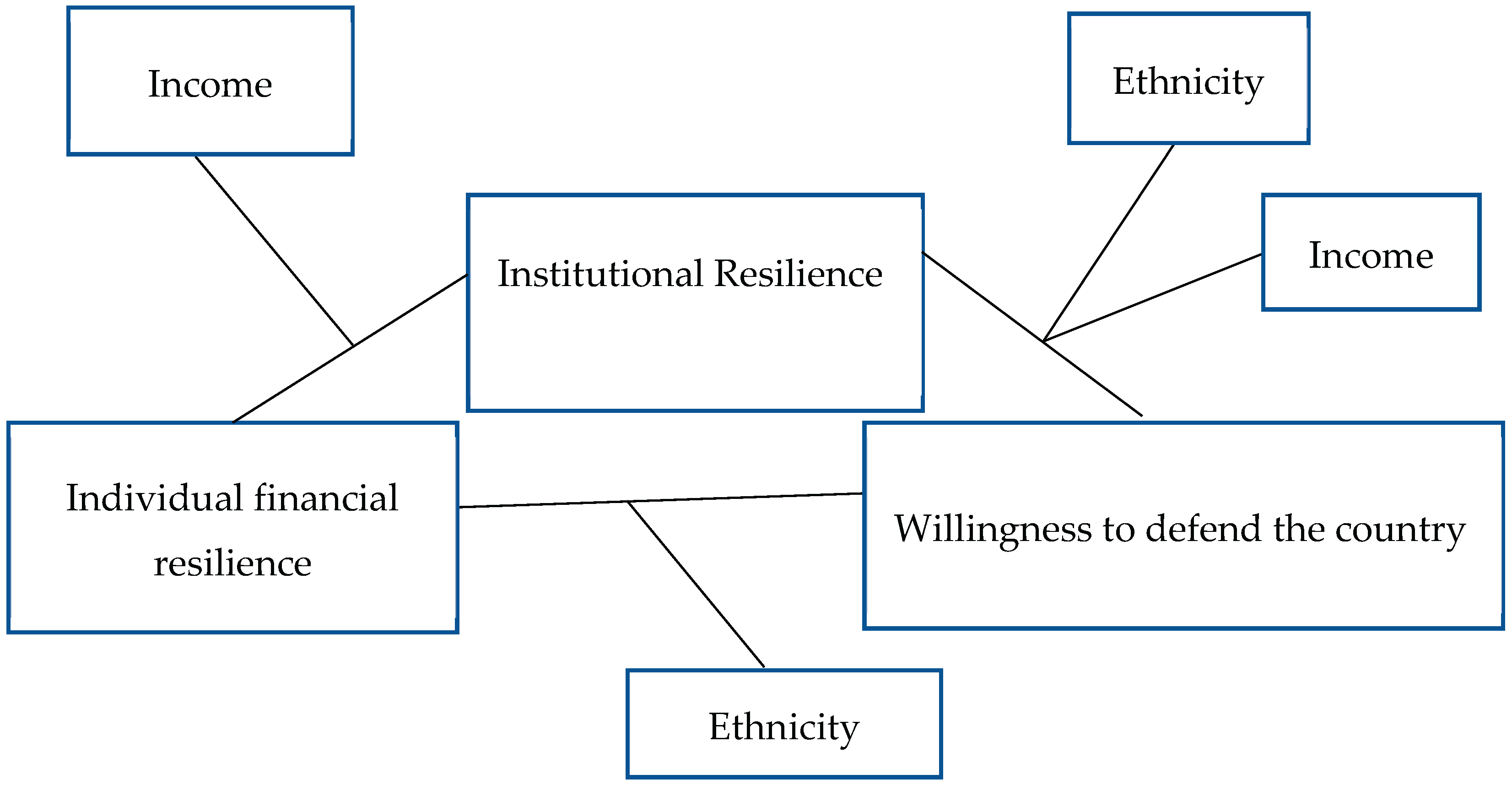
Table 2.
Cronbach’s alpha (α) coefficients for both Estonia and Lithuania.
| Reliability | Estonia | Lithuania |
|---|---|---|
| FINRS | 0.924 | 0.881 |
| INSRS | 0.875 | 0.748 |
| WD | 0.626 | 0.726 |
Table 3.
Bivariate correlation matrix for Estonia.
| FINRS | INSRS | PD | |
|---|---|---|---|
| FINRS | 1 | 0.522*** | 0.428*** |
| INSRS | 0.522*** | 1 | 0.672*** |
| PD | 0.428*** | 0.672*** | 1 |
Table 4.
Bivariate correlation matrix for Lithuania.
| FINRS | INSRS | PD | |
|---|---|---|---|
| FINRS | 1 | 0.388 *** | 0.403*** |
| INSRS | 0.388*** | 1 | 0.550*** |
| PD | 0.403*** | 0.550*** | 1 |
Table 5.
Conditional process analysis results for Estonia (PROCESS Model 58).
| Model and Variable | Coeff. (b) | se | t | p | 95% LLCI | 95% ULCI |
|---|---|---|---|---|---|---|
| Model 1: Outcome = INSRS (R2 = 0.317) | ||||||
| Constant | 1.2902 | 0.1611 | 8.0073 | < 0.001 | 0.9740 | 1.6064 |
| FINRS (X) | 0.8080 | 0.0645 | 12.5208 | < 0.001 | 0.6814 | 0.9346 |
| Income (W) | 0.0331 | 0.0297 | 1.1166 | 0.2644 | -0.0251 | 0.0914 |
| Interaction (FINRS xIncome) | -0.0365 | 0.0108 | -3.3818 | 0.0007 | -0.0576 | -0.0153 |
| Model 2: Outcome = PD (R2 = 0.461) | ||||||
| Constant | 1.1622 | 0.1031 | 11.2754 | < 0.001 | 0.9599 | 1.3645 |
| FINRS (X) | 0.0968 | 0.0207 | 4.6785 | < 0.001 | 0.0562 | 0.1374 |
| INSRS (M) | 0.4041 | 0.0331 | 12.2121 | < 0.001 | 0.3391 | 0.4690 |
| Income (W) | -0.0157 | 0.0188 | -0.8396 | 0.4014 | -0.0525 | 0.0211 |
| Interaction (INSRS x Income) | -0.0007 | 0.0058 | -0.1214 | 0.9034 | -0.0121 | 0.0107 |
Table 6.
Conditional indirect effects of FINRS on WD via INSRS.
| Income Value (Percentile) | Indirect Effect | Boot SE | Boot LLCI | Boot ULCI |
|---|---|---|---|---|
| 2.0000 (Low) | 0.2960 | 0.0257 | 0.2469 | 0.3484 |
| 4.0000 (Medium) | 0.2657 | 0.0177 | 0.2314 | 0.3011 |
| 8.0000 (High) | 0.2057 | 0.0204 | 0.1670 | 0.2469 |
Table 7.
Moderated mediation analysis results (PROCESS Model 14).
| Model and Variable | Coeff. (b) | se | t | p | 95% LLCI | 95% ULCI |
|---|---|---|---|---|---|---|
| Model 1: Outcome = INSRS (R² = 0.290) | ||||||
| Constant | 1.5984 | 0.0791 | 20.2118 | < 0.001 | 1.4432 | 1.7535 |
| FINRS (X) | 0.5617 | 0.0278 | 20.2356 | < 0.001 | 0.5072 | 0.6161 |
| Model 2: Outcome = WD (R² = 0.460) | ||||||
| Constant | 1.3145 | 0.1170 | 11.2350 | < 0.001 | 1.0849 | 1.5440 |
| FINRS (X) | 0.0777 | 0.0193 | 4.0221 | < 0.001 | 0.0398 | 0.1156 |
| INSRS (M) | 0.3380 | 0.0364 | 9.2961 | < 0.001 | 0.2667 | 0.4094 |
| Ethnicity (W) | -0.1191 | 0.0559 | -2.1322 | 0.0332 | -0.2287 | -0.0095 |
| Interaction (INSRS × Ethnicity) | 0.0450 | 0.0195 | 2.3061 | 0.0213 | 0.0067 | 0.0832 |
Table 9.
Conditional process analysis results for Lithuania (PROCESS Model 59) 58).
| Model and Variable | Coeff. (b) | se | t | p | 95% LLCI | 95% ULCI |
|---|---|---|---|---|---|---|
| Model 1: Outcome = INSRS (R² = 0.140) | ||||||
| Constant | 0.0087 | 0.0407 | 0.2148 | 0.8300 | -0.0711 | 0.0886 |
| FINRS (X) | 0.3996 | 0.0345 | 11.5969 | < 0.001 | 0.3320 | 0.4672 |
| Income (W) | 0.0001 | 0.0000 | 1.5130 | 0.1306 | 0.0000 | 0.0001 |
| Interaction (FINRS × Income) | 0.0000 | 0.0000 | -1.3144 | 0.1890 | -0.0001 | 0.0000 |
| Model 2: Outcome = PD (R² = 0.338) | ||||||
| Constant | 3.1385 | 0.0291 | 107.8958 | < 0.001 | 3.0814 | 3.1956 |
| FINRS (X) | 0.1928 | 0.0259 | 7.4421 | < 0.001 | 0.1419 | 0.2436 |
| INSRS (M) | 0.3841 | 0.0229 | 16.8025 | < 0.001 | 0.3392 | 0.4289 |
| Income (W) | 0.0000 | 0.0000 | 1.1388 | 0.2551 | 0.0000 | 0.0001 |
| Interaction (INSRS × Income) | 0.0000 | 0.0000 | 0.8261 | 0.4089 | -0.0000 | 0.0000 |
Table 10.
Conditional indirect effects for Lithuania.
| Income Level (Percentile) | Indirect Effect | Boot SE | Boot LLCI | Boot ULCI |
|---|---|---|---|---|
| Low (-1400.78) | 0.1644 | 0.0343 | 0.1003 | 0.2346 |
| Medium (-108.78) | 0.1544 | 0.0208 | 0.1148 | 0.1972 |
| High (1191.22) | 0.1426 | 0.0252 | 0.0967 | 0.1962 |
Table 11.
Moderated mediation analysis results for Lithuania (PROCESS Model 14).
| Model and Variable | Coeff. (b) | se | t | p | 95% LLCI | 95% ULCI |
|---|---|---|---|---|---|---|
| Model 1: Outcome = INSRS (R² = 0.138) | ||||||
| Constant | -1.1995 | 0.1031 | -11.6373 | < 0.001 | -1.4018 | -0.9972 |
| FINRS (X) | 0.4170 | 0.0330 | 12.6374 | < 0.001 | 0.3522 | 0.4817 |
| Model 2: Outcome = WD (R² = 0.337) | ||||||
| Constant | 2.5812 | 0.0794 | 32.5158 | < 0.001 | 2.4255 | 2.7370 |
| FINRS (X) | 0.1946 | 0.0257 | 7.5731 | < 0.001 | 0.1441 | 0.2450 |
| INSRS (M) | 0.3852 | 0.0228 | 16.8840 | < 0.001 | 0.3404 | 0.4300 |
| Ethnicity (W) | 0.0115 | 0.0400 | 0.2872 | 0.7741 | -0.0670 | 0.0900 |
| Interaction (INSRS × Ethnicity) | -0.0227 | 0.0186 | -1.2209 | 0.2224 | -0.0591 | 0.0138 |
Table 12.
Conditional indirect effects and index of moderated mediation for Lithuania.
| Ethnicity Value | Indirect Effect | Boot SE | Boot LLCI | Boot ULCI |
|---|---|---|---|---|
| Mean / Conditional (-0.1882) | 0.1624 | 0.0224 | 0.1205 | 0.2078 |
| Index of Moderated Mediation | -0.0095 | 0.0168 | -0.0239 | 0.0386 |
Table 13.
Comprehensive hypothesis testing outcomes and cross-national comparison.
| Hypothesis | Structural Pathway / Relationship | Estonia | Lithuania | Comparative Synthesis & Scientific Conclusion | |
|---|---|---|---|---|---|
| H1 | FINRS → INSRS |
Supported (b = 0.81, p < 0.001) |
Supported (b = 0.42, p < 0.001) |
Financial resilience drives institutional trust in both nations, but the effect size is twice as strong in Estonia. | |
| H2 | FINRS → WD |
Supported (b = 0.10, p < 0.001) |
Supported (b = 0.19, p < 0.001) |
The direct path from individual finances to defense willingness is stronger in Lithuania, suggesting more intrinsic motivation. | |
| H3 | FINRS → INSRS → WD (Mediation) |
Supported (95% CI > 0) |
Supported (95% CI > 0) |
Institutional resilience acts as a robust and universal psychological bridge in both Baltic societies. | |
| H4a | Income moderates FINRS → INSRS |
Supported (b = -0.04, p < 0.001) |
Rejected (b = 0.00, p = 0.189) |
Key Divergence: Financial stratification matters in Estonia (low-income relies more on financial stability for trust), but is uniform in Lithuania. | |
| H4b | Income moderates INSRS → WD |
Rejected (b = 0.00, p = 0.903) |
Rejected (b = 0.00, p = 0.409) |
Income brackets do not structurally alter how institutional trust translates into national defense willingness in either country. | |
| H5a | Ethnicity moderates INSRS → WD |
Supported (b = 0.05, p = 0.021) |
Rejected (b = -0.02, p = 0.222) |
Key Divergence: Institutional trust mobilizes the titular group significantly more in Estonia, whereas Lithuanian minorities behave uniformly. | |
| H5b | Ethnicity moderates overall indirect effect |
Supported (Index 95% CI > 0) |
Rejected (Index 95% CI crosses 0) |
The conditional indirect mechanism is strictly verified in Estonia, but completely absent in the homogenous Lithuanian context. | |
Note: FINRS = Individual Financial Resilience; INSRS = Institutional Resilience; WD = Willingness to Defend the Country.
Disclaimer/Publisher’s Note: The statements, opinions and data contained in all publications are solely those of the individual author(s) and contributor(s) and not of MDPI and/or the editor(s). MDPI and/or the editor(s) disclaim responsibility for any injury to people or property resulting from any ideas, methods, instructions or products referred to in the content. |
© 2026 by the authors. Licensee MDPI, Basel, Switzerland. This article is an open access article distributed under the terms and conditions of the Creative Commons Attribution (CC BY) license (http://creativecommons.org/licenses/by/4.0/).
Copyright: This open access article is published under a Creative Commons CC BY 4.0 license, which permit the free download, distribution, and reuse, provided that the author and preprint are cited in any reuse.