

Submitted:
15 September 2026
Posted:
16 September 2026
You are already at the latest version
Abstract
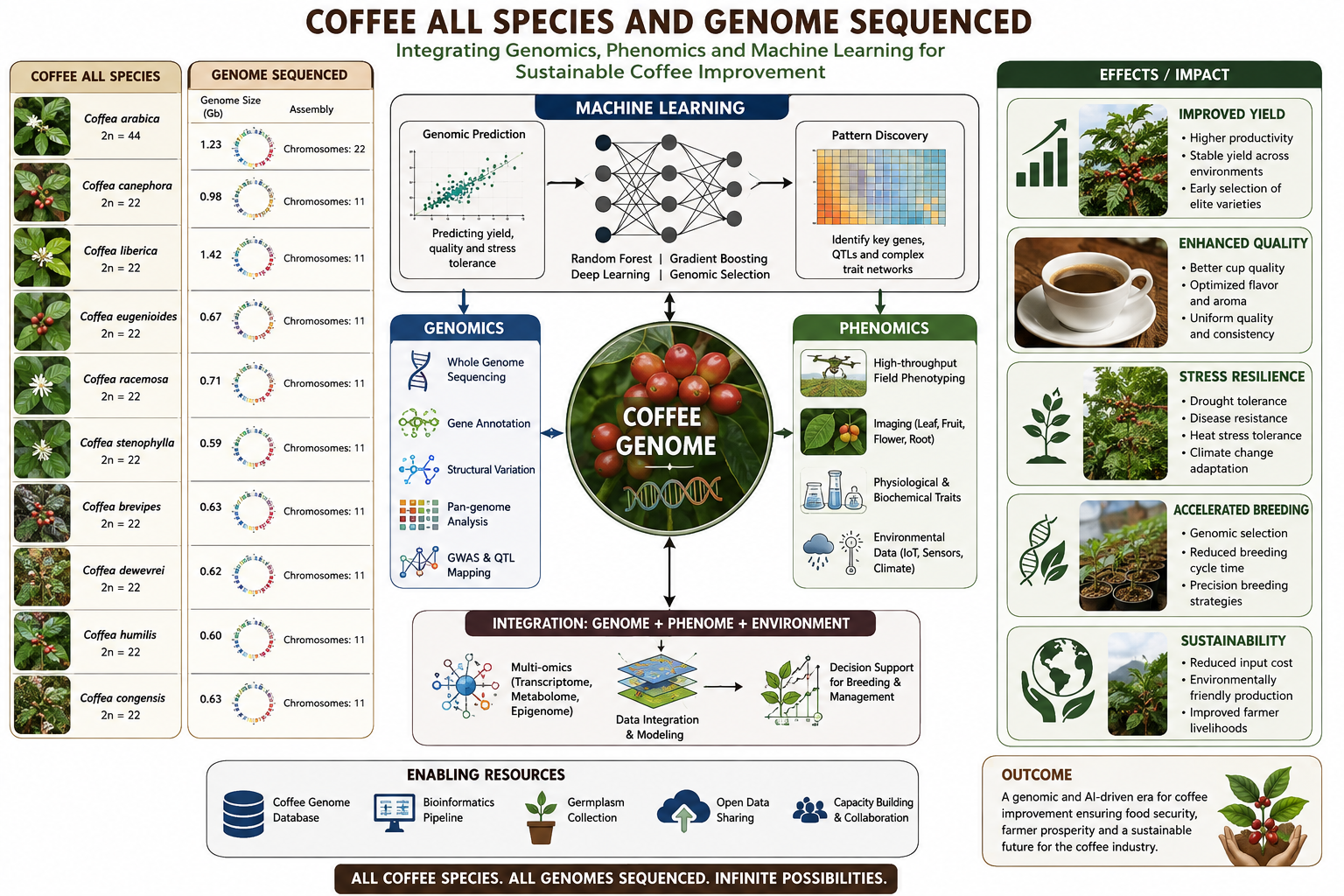
Coffee is one of the world's most economically and culturally important crops, with Coffea arabica accounting for approximately 60–70% of global coffee production and Coffea canephora (Robusta) comprising much of the remainder. Recent advances in coffee genomics have created new opportunities to improve productivity, cup quality, disease resistance, and climate resilience. These advances include the generation of high-quality reference genomes for Coffee arabica and its diploid progenitor species, reconstruction of the evolutionary and domestication history of arabica, application of genomic prediction and machine-learning approaches to yield and bean-quality traits, and the development of genomic strategies for breeding climate-resilient cultivars. Collectively, these studies demonstrate an increasingly integrated research landscape in which genomics, agronomy, molecular biology, phenomics, and data science are being applied to address major constraints on coffee production, including limited genetic diversity, disease susceptibility, and climate vulnerability. This article discusses how these complementary approaches may contribute to the development of coffee cultivars and provide a unified framework metavar for accessing combined genome annotations and high throughput search of annotations across haplotypes for improved agronomic performance with desirable sensory and processing characteristics.
Keywords:
coffee
; genomics
; genome sequencing
; machine learning
Copyright: This open access article is published under a Creative Commons CC BY 4.0 license, which permit the free download, distribution, and reuse, provided that the author and preprint are cited in any reuse.