
Submitted:
15 September 2026
Posted:
15 September 2026
You are already at the latest version
Abstract
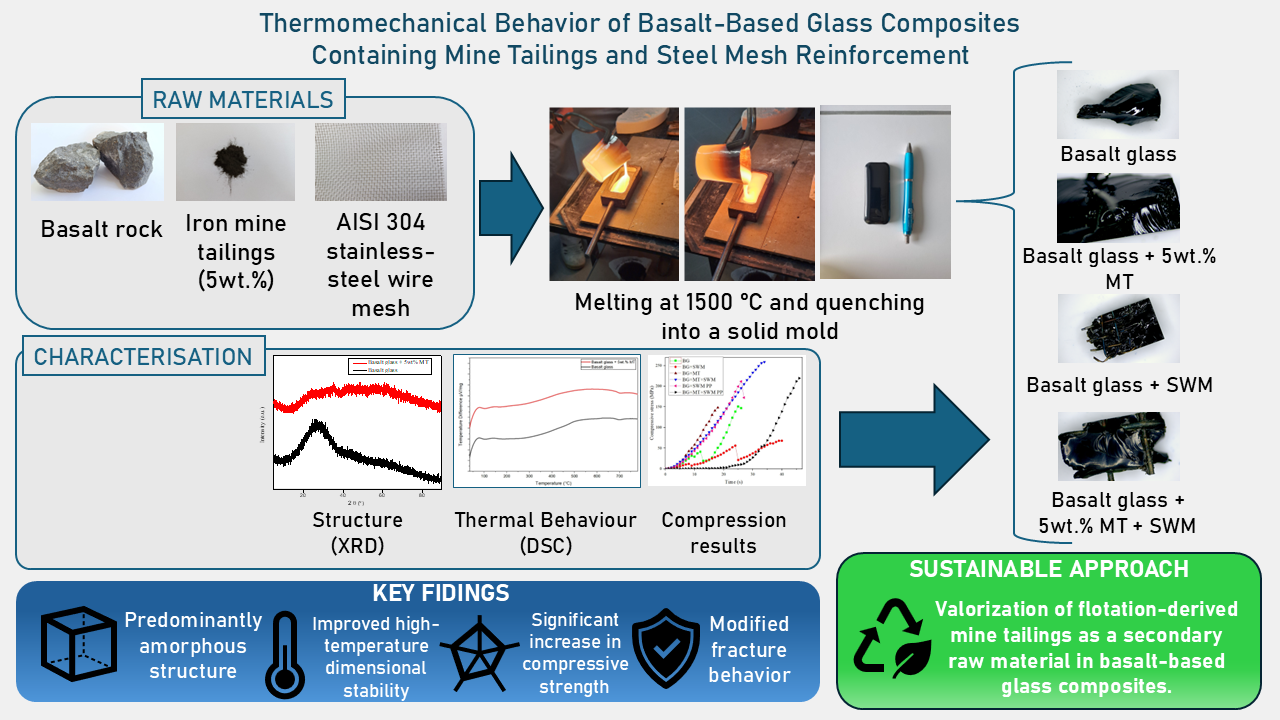
Basalt-based glass materials and composite variants were synthesized from basalt rock originating from the Vrelo deposit in Serbia using the melt-quenching method. In addition to the reference basalt glass, samples containing 5 wt.% iron mine tailings originating from flotation waste in the Bor mining district, Serbia, and commercially available AISI 304 stainless steel wire mesh were prepared to investigate the effects of secondary raw materials, reinforcement, and reinforcement orientation on thermal and mechanical behavior. The materials were characterized by energy-dispersive X-ray spectroscopy (EDS), X-ray diffraction (XRD), differential thermal analysis (DTA), differential scanning calorimetry (DSC), dilatometry, compressive strength testing, and stereomicroscopy. XRD confirmed the predominantly amorphous character of the synthesized glasses. DTA and DSC revealed broad intermediate-temperature thermal responses and a reproducible thermal event near 700 °C, while dilatometry demonstrated distinct differences in the high-temperature dimensional behavior of the investigated compositions. Compressive strength was strongly influenced by composition and steel mesh orientation, with the highest value of 258.6 MPa obtained for the composite containing 5 wt.% mine tailings and steel wire mesh. Stereomicroscopy revealed differences in crack propagation, fracture morphology, and fragment retention associated with mine tailings and steel reinforcement. These results demonstrate the potential of mine-tailings-modified and steel-reinforced basalt glasses as sustainable materials with tunable thermomechanical performance.
Keywords:
basalt glass
; melt-quenching
; mine tailings
; mechanical properties
; thermal properties
1. Introduction
Basalt-based glasses have attracted considerable attention due to their favorable combination of thermal stability, mechanical strength, chemical durability, and relatively low production cost [1,2]. Produced from naturally occurring volcanic rocks rich in silica, alumina, iron, calcium, and magnesium oxides, basalt glasses represent compositionally complex aluminosilicate systems with potential for use in demanding engineering environments [3]. Their resistance to corrosion, elevated temperatures, and wear has supported their consideration for industrial pipelines, protective linings, structural components, and waste-containment systems [4,5,6].
In addition to their macroscopic thermomechanical properties, the performance of basalt-derived glasses is closely related to their structural state and crystallization behavior [7]. Rapid cooling of a basalt melt can suppress long-range crystalline ordering and produce a predominantly amorphous material characterized by short-range structural order within the silicate network [7,8]. Subsequent thermal treatment may promote structural rearrangement, nucleation, and crystallization, depending on the chemical composition, thermal history, and processing conditions [9]. Consequently, X-ray diffraction and thermal analysis provide complementary information for evaluating the amorphous character of basalt-derived glasses and their tendency toward thermally induced structural transformation and crystallization [8,10].
The crystallization behavior of basalt glasses is particularly important because controlled nucleation and crystal growth provide a route for converting an initially glassy precursor into a glass-ceramic material [10]. Basalt-derived glass-ceramics have therefore been investigated extensively, with their final phase assemblage, microstructure, and properties strongly dependent on the parent-glass composition and applied heat-treatment conditions [7,9,10]. Previous studies have demonstrated that basaltic compositions can develop crystalline phases during controlled thermal treatment and that the resulting glass-ceramic microstructure can substantially influence mechanical and thermal properties [9,10,11]. Understanding the structural state and thermal response of the initial basalt glass is therefore important not only for its direct application as a glass, but also for assessing its potential as a precursor for subsequent glass-ceramic development.
The incorporation of secondary raw materials provides an additional means of modifying the composition and crystallization behavior of basalt-derived glass systems [2,12]. In particular, mine tailings contain oxide constituents that may become incorporated into the glass network during melting and can potentially affect structural ordering, thermal transformations, and the development of crystalline phases during subsequent heat treatment [5,13,14]. At the same time, their incorporation provides an opportunity for the valorization of industrial waste streams through their partial substitution for primary mineral resources [5,15]. The production of glasses and glass-ceramics from mining and metallurgical wastes has consequently received increasing attention as a route toward materials with reduced consumption of virgin raw materials and potentially useful engineering properties [12,15,16].
Beyond bulk glass and glass-ceramic components, basalt-derived compositions are also relevant to processing at smaller dimensions [6,17]. Basalt glasses are already established as precursors for continuous fibers, while the relationship between glass composition, thermal stability, and crystallization is particularly important during fiber processing because reduced dimensions and thermal history can influence structural evolution [9,18]. The possibility of processing suitable basalt-derived melts into microfibers or microspherical geometries may therefore provide an additional direction for future development, particularly where high surface area, controlled geometry, or reduced material dimensions are advantageous [6,18]. However, the feasibility of such processing depends strongly on melt viscosity, softening behavior, crystallization tendency, and compositional homogeneity and must therefore be evaluated for each specific basalt-derived system [9,18].
Basalt rock from the Vrelo deposit, Serbia, was used as the primary raw material. The basalt was melted at high temperature and rapidly quenched into molds to obtain a predominantly amorphous glass structure [1,19]. In addition to the reference basalt glass, composite samples containing 5 wt.% iron mine tailings derived from flotation waste produced during ore beneficiation in the Bor mining district (Serbia) and commercially purchased AISI 304 stainless-steel wire mesh with a wire diameter of 0.5 mm and a mesh opening size of 3 mm (purchased from Roda Steel, Belgrade, Serbia; product name: Prochrome steel wire mesh) reinforcement were prepared to investigate the influence of waste-derived additives and reinforcement on the thermal and mechanical behavior of the resulting glass composites.
The study focuses on the relationship between composition, structural order, thermal behavior, and mechanical response of the resulting basalt-derived materials. X-ray diffraction was used to evaluate the predominantly amorphous structure and short-range ordering of the synthesized glasses, while DTA and DSC were employed to examine thermal responses relevant to structural rearrangement and possible crystallization behavior [7,9,20]. Dilatometry was used to assess high-temperature dimensional stability, and compression testing combined with stereomicroscopic examination provided information on mechanical performance and fracture morphology. Particular attention was given to determining whether the incorporation of mine tailings alters the structural and thermal behavior of the basalt-derived glass and to assessing the combined effect of mine tailings and steel-mesh reinforcement on the resulting thermomechanical properties. In this context, the investigated materials are considered both as functional basalt-based glasses and as potential precursor systems for further controlled crystallization and development of basalt-derived glass-ceramic materials [10].
2. Materials and Methods
2.1. Raw Materials
Basalt rock obtained from the Vrelo deposit in Serbia was used as the primary raw material for glass production. Prior to melting, the basalt was crushed and mechanically ground to a particle size below 63 μm. Due to its aluminosilicate composition, basalt represents a suitable precursor for the production of glass materials with favorable thermal and mechanical properties [21,22,23,24].
Iron mine tailings originating from the Bor mining district in eastern Serbia were used as a secondary raw material. The tailings were incorporated into selected basalt batches at a concentration of 5 wt.% to evaluate their influence on the thermal and mechanical behavior of the resulting glass composites while simultaneously promoting the utilization of industrial waste materials [5,6,13].
2.2. Preparation of Basalt Glass and Composite Samples
Basalt glass and its composite variants were synthesized using the conventional melt-quenching technique [27,28,29]. The prepared basalt powder, with or without the addition of mine tailings, was melted in platinum crucibles at 1500 °C using a Classic 0718E elevator furnace. After complete melting and homogenization, the molten material was poured into preheated molds and rapidly cooled to obtain a glassy structure.
Six sample configurations were prepared: Basalt glass (BG); Basalt glass reinforced with steel wire mesh (BG+SWM); Basalt glass containing 5 wt.% mine tailings (BG+MT); Basalt glass containing 5 wt.% mine tailings reinforced with steel wire mesh (BG+MT+SWM); Basalt glass reinforced with steel wire mesh oriented perpendicular to the compression axis (BG+SWM PP); Basalt glass containing 5 wt.% mine tailings reinforced with steel wire mesh oriented perpendicular to the compression axis (BG+MT+SWM PP).
For reinforced samples, the steel wire mesh was positioned inside the mold before casting. Depending on the sample type, the mesh was oriented either parallel or perpendicular to the compression axis in order to evaluate the effect of reinforcement orientation on the mechanical performance of the composites.
Following quenching, all samples were annealed in a muffle furnace at 665 °C for 45 min to relieve residual thermal stresses generated during cooling. After annealing, the samples were cooled to room temperature and prepared for subsequent characterization.
2.3. Charasterisation methods
The elemental composition of the raw materials and synthesized samples was determined using a Tescan Mira3 FEG scanning electron microscope equipped with an energy-dispersive X-ray spectroscopy (EDS) detector. The elemental composition was expressed in atomic percent (at.%).
The structural characteristics of the synthesized basalt glass and basalt glass containing 5 wt.% mine tailings were investigated at room temperature by X-ray powder diffraction (XRPD) using an Ultima IV diffractometer (Rigaku, Tokyo, Japan) equipped with Cu Kα radiation. The measurements were performed at a generator voltage of 40 kV and a generator current of 40 mA. Diffraction patterns were recorded over a 2θ range of 5-90° 2θ in continuous scan mode, using a step size of 0.02° and a scan rate of 5°/min. The obtained diffraction patterns were evaluated to determine the amorphous or crystalline nature of the synthesized materials and to identify any detectable crystalline phases. Phase analysis was performed using PDXL2 software (version 2.0.3.0, Rigaku Corporation, Tokyo, Japan), with reference to diffraction patterns from the International Centre for Diffraction Data (ICDD) PDF-2 database, version 2012 [30,31].
Thermal characterization of the synthesized samples was performed using differential thermal analysis (DTA), differential scanning calorimetry (DSC), and dilatometry. DTA and DSC heat-flow measurements were carried out using an SDT Q600 simultaneous thermal analyzer. The reference basalt glass and basalt glass containing 5 wt.% mine tailings were heated from room temperature to 800 °C at a heating rate of 20 °C/min under a nitrogen atmosphere with a gas flow rate of 100 mL/min, using alumina crucibles. The obtained DTA and heat-flow curves were used to evaluate the thermal response of the investigated glasses and to identify characteristic low-temperature features, broad intermediate-temperature responses, and high-temperature thermal events occurring during heating.
Dilatometric measurements were performed using a NETZSCH DIL 402 SU dilatometer in standard expansion mode to evaluate the thermal expansion and high-temperature dimensional behavior of the reference basalt glass and basalt glass containing 5 wt.% mine tailings. The specimens were heated from 25 to 950 °C at a constant heating rate of 5 °C/min. During the measurements, nitrogen was supplied at a flow rate of 250.0 mL/min, while argon was supplied as the secondary purge and protective gas at a flow rate of 240.3 mL/min. The relative length change (ΔL/L₀), where L₀ represents the initial specimen length and ΔL the change in specimen length during heating, was recorded as a function of temperature. The resulting dilatometric curves were used to compare the thermal expansion behavior and high-temperature dimensional stability of the investigated glass compositions.
Mechanical properties were evaluated by compressive strength testing using an Instron Model 1185 universal testing machine equipped with a 10 kN load cell. The tests were performed under ambient laboratory conditions. Three specimens were tested for each composition. The samples were prepared in the form of rectangular prisms with dimensions satisfying b = 1.5a. For reinforced specimens, the steel wire mesh was oriented either parallel or perpendicular to the compression axis, as shown in Figure 1. The obtained stress–time curves were used to determine the maximum compressive strength and to assess the influence of mine tailings, steel wire mesh reinforcement, and reinforcement orientation on the mechanical behavior of the investigated materials.
Following compression testing, the fracture surfaces were examined by stereomicroscopy to evaluate fracture morphology, crack propagation characteristics, and the interaction between the basalt glass matrix and the steel wire mesh reinforcement.
3. Results
3.1. Chemical composition
The elemental composition of the raw materials and synthesized basalt-based glasses was investigated by energy-dispersive X-ray spectroscopy (EDS). The analysis was performed to characterize the principal elements present in the basalt precursor and mine tailings and to evaluate compositional changes following melting and the incorporation of 5 wt.% mine tailings. The obtained results are expressed in atomic percent (at.%) and are presented in Table 1, Table 2, Table 3 and Table 4. Since EDS provides localized elemental information from the analyzed region, the results are considered semi-quantitative and should primarily be used to evaluate compositional trends rather than absolute bulk composition.
3.1.1. Raw Materials
The elemental composition of the basalt rock used as the primary raw material is presented in Table 1. The basalt is predominantly composed of O and Si, accompanied by substantial amounts of Al, Mg, Ca, and Fe, together with smaller quantities of Na, K, and Ti [19,24]. This elemental distribution is consistent with the multicomponent aluminosilicate composition characteristic of natural basaltic materials. The relatively high Si and Al contents are consistent with the aluminosilicate-based composition of the precursor, while Ca, Mg, Fe, Na, and K represent additional constituents that may influence the melting behavior and thermal properties of the resulting glass [11,28,32].
The mine tailings exhibited a substantially different elemental composition from that of the basalt precursor (Table 2). Although O and Si remained major constituents, the most pronounced difference was the considerably higher Fe content, reaching 34 at.%, compared with 4.30 at.% in the basalt raw material. The tailings additionally contained Na, Mg, Al, K, Ca, and Ti, while minor amounts of S, W, and Pb were also detected. This complex elemental composition reflects the origin of the material as flotation waste generated during polymetallic ore beneficiation in the Bor mining district of eastern Serbia [5,6,13].
The substantial difference between the elemental compositions of the basalt precursor and mine tailings demonstrates that the latter represents a chemically distinct secondary raw material rather than simply an additional silicate component. In particular, its high Fe content and presence of minor metallic constituents may influence the thermal and mechanical behavior of the basalt-derived glass when incorporated into the melt.
In addition to basalt and mine tailings, commercially available AISI 304 stainless steel wire mesh was incorporated as reinforcement in selected composite samples. The steel mesh was introduced as a discrete reinforcing component and was therefore not included in the EDS comparison of the basalt-derived glass compositions.
3.1.2. Synthesized Glass Samples
The elemental composition of the synthesized reference basalt glass is presented in Table 3. The principal detected elements were O, Si, Mg, Al, Ca, and Fe, accompanied by smaller amounts of Na, K, and Ti. Comparison with the basalt precursor demonstrates that the same principal elements were retained following melting and cooling, indicating that the overall multicomponent aluminosilicate composition of the starting basalt was preserved during glass synthesis.
The reference basalt glass contained 24.74 at.% Si and 7.90 at.% Al, values very close to those measured in the basalt precursor (24.70 and 7.68 at.%, respectively). Similarly, only moderate differences were observed for Mg, Ca, Fe, Na, K, and Ti. These results indicate that the melt-quenching process did not produce major changes in the relative distribution of the principal detected elements within the analyzed regions. Together with the predominantly amorphous structure established by XRD, the EDS results are consistent with successful conversion of the basalt precursor into a multicomponent basalt-derived glass.
The basalt glass containing 5 wt.% mine tailings exhibited a modified elemental composition compared with the reference basalt glass (Table 4). The analyzed region contained O, Na, Mg, Al, Si, K, Ca, Ti, and Fe, confirming the retention of the principal elements characteristic of the basalt-derived system. Differences were observed in their relative atomic proportions, including lower measured concentrations of Si, Mg, Ca, and Fe and higher measured concentrations of O and Na compared with the reference basalt glass.
The compositional differences between the reference and mine-tailings-containing glasses are consistent with modification of the basalt-derived system following incorporation of the secondary raw material. However, because EDS probes a localized interaction volume rather than the complete bulk specimen, the measured atomic percentages may be affected by local compositional heterogeneity and the specific region selected for analysis. This consideration is particularly important for the measured oxygen concentration, which increased from 43.77 at.% in the reference basalt glass to 63.85 at.% in the sample containing 5 wt.% mine tailings. Quantification of light elements such as oxygen by EDS is associated with greater analytical uncertainty; therefore, this difference should not be interpreted independently as direct evidence of a specific change in glass-network connectivity [33].
Overall, the EDS results demonstrate that the basalt precursor, mine tailings, and synthesized glasses contain the expected major elements of a complex aluminosilicate-based system. The reference glass largely retained the principal elemental composition of the original basalt, while incorporation of 5 wt.% mine tailings resulted in measurable local compositional differences. When considered together with the XRD results, which demonstrate the predominantly amorphous character of both synthesized compositions, the EDS data indicate that mine tailings can be incorporated into the basalt-derived glass system without the formation of readily detectable crystalline phases under the applied processing conditions.
3.2. Structural Properties
The structural characteristics of the synthesized basalt glass and basalt glass containing 5 wt.% mine tailings were evaluated by X-ray diffraction (XRD), and the corresponding diffraction patterns are presented in Figure 2.
Both samples exhibit broad diffuse scattering rather than sharp and well-defined Bragg reflections, indicating the predominantly amorphous nature of the synthesized materials. The reference basalt glass displays a pronounced broad diffraction halo centered approximately within the 25–30° 2θ region, characteristic of the short-range structural ordering present in amorphous silicate networks. The absence of distinct crystalline reflections indicates that the applied melting and subsequent cooling procedure effectively suppressed extensive crystallization and resulted in the formation of a predominantly glassy material [7,10].
The addition of 5 wt.% mine tailings did not lead to the appearance of distinct crystalline reflections, and the BG+MT sample retained a predominantly amorphous diffraction pattern. Compared with the reference basalt glass, the BG+MT sample exhibits a somewhat broader and less-defined diffuse scattering contribution in the same general 2θ region. This difference suggests that the incorporation of mine-tailings-derived constituents may modify the short-range structural organization of the glass without promoting detectable long-range crystalline ordering [7,10]. However, because the XRD patterns remain dominated by broad amorphous scattering, the specific nature of these structural changes cannot be determined from XRD alone [7,10].
These XRD results provide an important basis for interpretation of the subsequent thermal analyses. Since both as-prepared materials are predominantly amorphous, the broad thermal responses observed by DTA and DSC can be discussed primarily in terms of thermally induced changes within an initially glassy structure. However, XRD of the as-prepared samples alone cannot determine whether crystallization occurs during subsequent heating; therefore, the high-temperature thermal event observed near 700 °C is discussed without assigning it unequivocally to a specific phase transformation.
3.3.. Thermal Properties
The thermal behavior of the obtained basalt glass and composite samples was investigated in order to evaluate their thermal stability and suitability for potential structural and high-temperature applications. Thermal analysis provides important information regarding the glass transition behavior, structural relaxation processes, crystallization tendency, and dimensional stability of the investigated materials [7,9,34]. The obtained results also enable evaluation of the influence of mine tailings and steel mesh reinforcement on the thermal response of the basalt-based glass system.
3.3.1. Differential Thermal Analysis (DTA) and Differential Scanning Calorimetry (DSC)
The thermal behavior of the reference basalt glass and the basalt glass containing 5 wt.% mine tailings was investigated by differential thermal analysis (DTA). The corresponding thermograms are presented in Figure 3 and Figure 4, respectively. Several weak low-temperature features, followed by a broad intermediate-temperature transition and a distinct high-temperature event, were identified for both compositions.
For the basalt glass, the initial rapid change in the DTA signal was followed by three relatively weak low-temperature features. A local maximum was observed at 77.4 °C (LT1), with a DTA signal of −0.779 µV mg⁻¹, followed by a shallow minimum at 103 °C (LT2; −0.804 µV mg⁻¹) and a second weak feature at 140.2 °C (LT3; −0.785 µV mg⁻¹). Owing to their relatively low temperatures and small amplitudes, these features are not considered evidence of major transformations within the basalt glass network [18,35,36]. They may instead be related to initial thermal equilibration, removal of weakly adsorbed species, or minor low-temperature relaxation processes. Their precise origin cannot be established from DTA alone.
A similar low-temperature response was observed for the basalt glass containing 5 wt.% mine tailings. The corresponding features occurred at 75.97 °C (LT1; −0.789 µV mg⁻¹), 101.4 °C (LT2; −0.810 µV mg⁻¹), and 142.5 °C (LT3; −0.778 µV mg⁻¹). The differences between the characteristic temperatures of the two compositions are small, amounting to only 1–2 °C. Therefore, the addition of 5 wt.% mine tailings does not appear to cause a substantial displacement of the low-temperature DTA features.
Following the low-temperature region, both materials exhibit a comparatively stable signal before entering a broad thermal transition region [35,36]. For the reference basalt glass, a gradual shift toward less negative DTA values becomes evident from approximately 250–300 °C, with the most pronounced change occurring between approximately 300 and 500 °C. The signal subsequently approaches a plateau at approximately 550–600 °C. Rather than producing a discrete peak, this process extends over a broad temperature interval, indicating a gradual thermally activated response of the glass structure [36,37].
The basalt glass containing 5 wt.% mine tailings exhibits a comparable but somewhat broader and smoother evolution. The DTA signal begins to change gradually above approximately 200–250 °C and continues toward a broad maximum at approximately 550–600 °C. This region is therefore designated in Figure 4 as the broad thermal transition region [18]. Considering the amorphous nature of the starting materials established by XRD, this broad response may be associated with progressive structural relaxation and rearrangement of the disordered aluminosilicate network during heating [35,36]. Structural relaxation is a well-established feature of silicate and basaltic glasses; however, the broad DTA response should not be interpreted as a specific phase transformation solely on the basis of the present thermal data.
At higher temperatures, both compositions exhibit another clearly distinguishable but relatively weak thermal feature. For the reference basalt glass, a shallow minimum occurs at about 698 °C (HT), whereas the corresponding event in the sample containing 5 wt.% mine tailings occurs at 699.79 °C (HT). The difference of less than 2 °C indicates that the addition of mine tailings has essentially no measurable influence on the position of this high-temperature event under the applied experimental conditions [18]. The similarity of the HT temperatures further suggests that the principal high-temperature response remains governed by the basalt glass matrix [9,38].
The origin of the HT event near 700 °C should nevertheless be interpreted cautiously. The XRD patterns of the as-prepared basalt glass and basalt glass containing 5 wt.% mine tailings exhibit broad diffuse scattering without distinct crystalline reflections, confirming the predominantly amorphous character of both starting materials. Consequently, the event observed at approximately 700 °C represents a thermally induced change occurring during reheating of an initially amorphous material [7,35,38]. Its temperature also corresponds closely to the region in which significant dimensional changes were observed by dilatometry, suggesting a possible relationship with the onset of high-temperature structural rearrangement, softening, and viscous deformation of the glass network. However, the present results do not allow this event to be unequivocally assigned to crystallization or another specific transformation. XRD analysis after heating through this temperature interval would be required to determine whether devitrification occurs.
Overall, the DTA results demonstrate that the addition of 5 wt.% mine tailings does not substantially shift the characteristic thermal features of the basalt glass, as LT1, LT2, LT3, and HT occur at nearly identical temperatures in both compositions. The primary influence of the mine-tailings addition is instead reflected in the shape and breadth of the intermediate-temperature response, with the modified glass exhibiting a smoother and broader thermal transition. Together with the predominantly amorphous XRD patterns, these observations indicate that the addition of 5 wt.% mine tailings modifies the thermal response of the basalt glass network without fundamentally altering its characteristic thermal behavior [18,35].
The DSC heat-flow curves of the reference basalt glass and the basalt glass containing 5 wt.% mine tailings are presented in Figure 5 and Figure 6, respectively. The DSC results generally support the thermal behavior observed by DTA, with both compositions exhibiting weak low-temperature features, broad intermediate-temperature responses, and a reproducible high-temperature thermal event near 700 °C. However, differences in the shape and breadth of the DSC curves indicate that the incorporation of mine tailings modifies the thermal response of the basalt glass matrix without substantially shifting the principal characteristic temperatures.
For the basalt glass, the initial rapid stabilization of the heat-flow signal is followed by a weak local maximum at 77.8 °C (LT1) and a shallow minimum at around 100 °C (LT2). These temperatures correspond closely to the low-temperature features identified by DTA at 77.4 and 103.0 °C, respectively. The close correspondence between the two thermal techniques indicates that these weak features are reproducible characteristics of the sample rather than isolated fluctuations in a single measurement. Nevertheless, because of their low temperatures and relatively small amplitudes, they should not be assigned to a major transformation of the glass network without additional evidence [20].
Following the low-temperature features, the reference basalt glass exhibits a broad thermal transition region extending approximately from 200 to 470 °C. Within this interval, the heat-flow signal decreases continuously rather than exhibiting a sharp, well-defined peak. This broad response is consistent with gradual thermally activated structural relaxation and rearrangement within the predominantly amorphous basalt glass network [20,36]. At the upper end of this region, a weak intermediate-temperature feature is observed at 493.3 °C (IT). The relatively small magnitude of this feature indicates that it represents a subtle change in the thermal response rather than an abrupt phase transformation.
At higher temperatures, the heat-flow signal continues to decrease until a pronounced minimum is reached at 701.5 °C (HT), after which a partial recovery of the signal is observed. This high-temperature event corresponds closely to the HT feature identified by DTA at 698 °C, with a difference of only about 3.5 °C between the two techniques. The occurrence of comparable thermal features in both DTA and DSC provides strong evidence that the response near 700 °C represents a genuine high-temperature thermal event in the basalt glass.
The DSC curve of the basalt glass containing 5 wt.% mine tailings exhibits a similar overall response but with several notable differences. The first two low-temperature features occur at 78.52 °C (LT1) and 97.39 °C (LT2), respectively, again closely corresponding to those observed for the reference basalt glass and to the DTA features of the mine-tailings-containing sample at 75.97 and 101.4 °C. An additional broad local maximum is observed at about 200 °C (LT3), after which the heat-flow signal enters an extended thermal transition region.
In contrast to the reference basalt glass, for which the broad transition is concentrated primarily between approximately 200 and 470 °C and is followed by a distinguishable intermediate event at 493.3 °C, the mine-tailings-containing sample exhibits a substantially broader and smoother thermal response extending from approximately 200 °C to the high-temperature region. The heat-flow signal decreases progressively throughout this interval without the clearly resolved intermediate feature observed for the reference glass. This difference suggests that the incorporation of 5 wt.% mine tailings broadens the distribution of thermally activated structural rearrangements within the glass network, resulting in a more gradual thermal response over a wider temperature interval [20,35,36].
A pronounced high-temperature minimum is observed at 703.8 °C (HT). This value is remarkably close to both the HT event of the reference basalt glass measured by DSC (701.5 °C) and the corresponding DTA event for the mine-tailings-containing glass (699.79 °C). The difference between the DSC HT temperatures of the two compositions is only approximately 2.3 °C, indicating that the addition of 5 wt.% mine tailings does not substantially shift the temperature of the principal high-temperature thermal event.
When considered together, the DTA and DSC measurements reveal a consistent thermal response for both investigated compositions. The low-temperature features occur within comparable temperature intervals in the two techniques, while the most pronounced agreement is observed for the high-temperature event near 700 °C. DTA identified this event at around 698 °C for the reference basalt glass and 699.79 °C for the mine-tailings-containing glass, whereas DSC placed the corresponding minima at 701.5 and 703.8 °C, respectively. Such agreement between independent thermal signals supports the presence of a reproducible thermally induced process in this temperature range.
The XRD patterns of the as-prepared materials demonstrate that both compositions are predominantly amorphous prior to thermal analysis. Therefore, the broad DTA and DSC responses can reasonably be associated with thermally activated changes occurring within an initially disordered glass network [20,36]. However, the absence of crystalline reflections in the initial XRD patterns does not demonstrate that the samples remain amorphous after heating. Consequently, the HT event near 700 °C cannot presently be assigned unequivocally to crystallization, glass softening, or another specific structural transformation [7,35,38,39]. This distinction is important because basalt glasses can undergo glass transition, structural relaxation, and subsequent crystallization during reheating, with the characteristic temperatures strongly dependent on composition and thermal history [7,20,35,37,39].
Overall, the combined DTA and DSC results indicate that the incorporation of 5 wt.% mine tailings primarily modifies the breadth and shape of the intermediate-temperature thermal response rather than substantially shifting the characteristic high-temperature behavior. Both materials exhibit a reproducible HT event close to 700 °C, whereas the mine-tailings-containing glass displays a broader and more continuous intermediate-temperature response. These observations suggest that the mine tailings influence the distribution of thermally activated structural rearrangements within the basalt glass matrix while preserving the principal thermal characteristics of the parent glass [36].
3.3.2. Thermal Expansion Behaviour
The thermal expansion behavior of the investigated basalt-based glasses was evaluated by dilatometric measurements in order to assess their dimensional stability and thermally induced deformation during heating. The relative length change (ΔL/L₀) was monitored as a function of temperature for the reference basalt glass and the basalt glass containing 5 wt.% mine tailings, as presented in Figure 7 and Figure 8.
The reference basalt glass exhibited a gradual and nearly linear increase in relative length change with increasing temperature over the majority of the investigated range. Up to approximately 700–720 °C, ΔL/L₀ increased continuously, indicating relatively stable thermal expansion of the glass. Within this temperature interval, the dimensional response is predominantly associated with thermal expansion of the predominantly amorphous basalt-derived structure [37,40].
At temperatures above 720 °C, a pronounced deviation from the preceding expansion behavior was observed. The relative length change decreased rapidly between approximately 730 and 760 °C, indicating substantial contraction and loss of dimensional stability. Such behavior is consistent with the onset of significant high-temperature softening and viscous deformation of the glass under the applied dilatometric conditions [36,40]. As the viscosity decreases with increasing temperature, the specimen becomes increasingly susceptible to deformation under the measuring force of the dilatometer, resulting in the pronounced reduction in measured length [36,40].
Importantly, this contraction should not be interpreted directly as the glass-transition temperature (Tg). The glass transition generally occurs before extensive viscous deformation becomes evident, whereas the rapid dimensional change observed here is more appropriately associated with high-temperature softening and deformation of the specimen [36,37,41]. Determination of a specific dilatometric Tg would require evaluation of the change in slope of the expansion curve using an appropriate extrapolation procedure [41].
In contrast, the basalt glass containing 5 wt.% mine tailings exhibited a more gradual and continuous increase in relative length change throughout the investigated temperature range. The ΔL/L₀ value increased progressively up to 0.008–0.0085 at temperatures approaching 900 °C, without the pronounced contraction observed for the reference basalt glass. This behavior indicates substantially greater dimensional stability of the mine-tailings-containing glass under the applied heating conditions.
The absence of rapid high-temperature contraction suggests that the incorporation of 5 wt.% mine tailings modifies the deformation behavior of the basalt-derived glass and delays the onset of pronounced dimensional instability. The compositional modification introduced by the mine tailings may influence the viscosity and thermally activated structural rearrangement of the glass at elevated temperatures [36]. However, the specific structural mechanism responsible for this behavior cannot be established from dilatometry alone.
Comparison of the two dilatometric curves therefore reveals a clear influence of mine-tailings incorporation on the high-temperature dimensional behavior of the basalt glass. While both compositions exhibit progressive thermal expansion during the initial and intermediate stages of heating, the reference basalt glass undergoes pronounced contraction above 720 °C, whereas the sample containing 5 wt.% mine tailings maintains a continuous positive dimensional response over the investigated temperature range.
These observations complement the DTA and DSC results. Both thermal-analysis techniques identified a reproducible high-temperature thermal event near 700 °C, occurring at approximately 698–700 °C by DTA and 701.5–703.8 °C by DSC. The subsequent pronounced dimensional instability of the reference basalt glass observed by dilatometry above 720 °C indicates that the thermal event detected near 700 °C precedes or accompanies the onset of substantial high-temperature structural rearrangement and deformation [36]. The mine-tailings-containing glass, however, does not exhibit the same rapid contraction despite displaying a comparable DTA/DSC event near 700 °C. This suggests that although the characteristic thermal event occurs at a similar temperature in both compositions, the subsequent high-temperature deformation behavior is strongly modified by the addition of 5 wt.% mine tailings.
Overall, the dilatometric results demonstrate that the incorporation of 5 wt.% mine tailings has a pronounced influence on the high-temperature dimensional response of the basalt-derived glass. The modified composition exhibits delayed dimensional instability and greater resistance to thermally induced deformation under the investigated conditions, while retaining the characteristic thermal behavior of the parent basalt glass observed by DTA and DSC.
3.4. Mechanical properties
The mechanical behavior of the obtained basalt glass and composite samples was evaluated by compressive strength testing in order to determine the influence of mine tailings and steel wire mesh reinforcement on the load-bearing capacity and fracture resistance of the investigated materials. Due to the inherently brittle nature of glass materials, the analysis of deformation and fracture mechanisms is essential for understanding the relationship between composition, microstructure, and mechanical performance [42,43].
3.4.1. Compressive strength
The mechanical behavior of the investigated basalt-based glasses and composite variants was evaluated by uniaxial compression testing. Three specimens were tested for each composition and reinforcement configuration. For comparison of the stress–time responses, the curve corresponding to the specimen with the median maximum compressive strength among the three independently tested specimens was selected as representative of each material. The resulting stress–time curves are presented in Figure 9, while the corresponding maximum compressive-strength values are summarized in Table 5.
The reference basalt glass exhibited a maximum compressive strength of 146.69 MPa. The stress increased progressively during loading until the maximum value was reached, followed by a rapid decrease associated with fracture of the glass specimen. This response is consistent with the predominantly brittle behavior expected for an amorphous silicate-based material, in which accumulated elastic deformation is followed by rapid crack propagation once the critical stress state is reached [10,42,43].
The incorporation of 5 wt.% mine tailings alone produced only a minor change in maximum compressive strength, increasing the measured value from 146.69 MPa for the reference basalt glass to 148.01 MPa. This corresponds to an increase of approximately 0.9%, indicating that the addition of mine tailings at the investigated concentration does not substantially alter the maximum compressive load-bearing capacity of the basalt glass in the absence of steel reinforcement. Nevertheless, differences in the shape of the stress–time response and the post-fracture morphology indicate that the mine tailings may influence crack development and fracture behavior even when the maximum strength remains essentially unchanged.
A substantially stronger effect was observed following the introduction of steel wire mesh, with the mechanical response depending strongly on the orientation of the reinforcement relative to the compression axis. The BG+SWM configuration exhibited a maximum compressive strength of only 67.88 MPa, corresponding to a reduction of 53.7% compared with the reference basalt glass. In contrast, when the steel wire mesh was positioned perpendicular to the compression axis (BG+SWM PP), the maximum compressive strength increased to 172.25 MPa, about 17.4% higher than that of the reference glass. These results demonstrate that the presence of steel wire mesh alone does not necessarily improve the compressive strength of the basalt glass and that its reinforcing efficiency is strongly dependent on orientation and configuration within the glass matrix [44,45].
The most pronounced improvement in mechanical performance was observed for the hybrid composites containing both 5 wt.% mine tailings and steel wire mesh. The BG+MT+SWM sample exhibited the highest compressive strength among all investigated configurations, reaching 258.64 MPa, corresponding to an increase of 76.3% relative to the reference basalt glass. The corresponding perpendicular configuration (BG+MT+SWM PP) reached 219.26 MPa, representing an increase of about 49.5% compared with the reference material. Both hybrid configurations therefore substantially exceeded the compressive strength of the unreinforced basalt glass and the glass containing mine tailings alone.
Interestingly, the influence of reinforcement orientation was different in the presence and absence of mine tailings. For basalt glass reinforced only with steel wire mesh, the perpendicular configuration exhibited considerably greater compressive strength than the alternative mesh orientation (172.25 versus 67.88 MPa). In contrast, for the hybrid material containing mine tailings, the BG+MT+SWM configuration exhibited a higher maximum compressive strength than the perpendicular configuration (258.64 versus 219.26 MPa). This behavior indicates that the mechanical response cannot be attributed solely to the presence or orientation of the steel reinforcement. Instead, the results suggest an interaction between the glass matrix composition, mine-tailings addition, steel wire mesh, and reinforcement orientation.
The stress–time curves further demonstrate differences in failure behavior among the investigated configurations. The unreinforced glasses generally exhibited relatively abrupt stress reductions following the maximum load, characteristic of brittle fracture [10,42]. In the steel-mesh-containing samples, multiple localized stress reductions were observed during loading, indicating progressive damage prior to complete loss of load-bearing capacity. These features may be associated with sequential cracking of the glass matrix and continued mechanical interaction with the embedded steel reinforcement [44,45,46,47]. However, the specific fracture mechanisms cannot be established from the stress–time curves alone and are therefore considered together with the stereomicroscopic observations of the post-compression fragments in the following section.
Overall, the compression results demonstrate that mine tailings alone have little influence on the maximum compressive strength, whereas the incorporation of steel wire mesh produces a strongly configuration-dependent mechanical response. The combination of mine tailings and steel wire mesh resulted in the highest compressive strengths, indicating that the mechanical behavior of the hybrid system arises from the combined influence of matrix composition and reinforcement arrangement. The pronounced differences between reinforcement orientations further demonstrate that reinforcement geometry and orientation represent critical parameters in controlling the compressive performance of the investigated basalt-glass composites.
3.4.2. Stereomicroscopic Analysis of Fracture Mechanisms
Following compressive strength testing, the fractured specimens were examined by stereomicroscopy to evaluate differences in fragmentation, crack propagation, fracture morphology, and the interaction between the basalt glass matrix and steel wire mesh reinforcement. Representative stereomicroscopic images of the investigated materials are presented in Figure 10, Figure 11, Figure 12 and Figure 13. The observed fracture characteristics provide additional insight into the mechanical responses obtained during compression testing.
The reference basalt glass exhibited fracture morphology characteristic of a brittle material. As shown in Figure 10, compression resulted in extensive fragmentation of the specimen, producing multiple angular fragments with sharp fracture edges and relatively smooth fracture surfaces. Numerous cracks propagated through the glass matrix, resulting in separation of the original specimen into individual fragments [42,48]. The absence of a secondary reinforcing phase allowed cracks to propagate through the glass without an apparent physical barrier capable of retaining the fractured regions. This morphology is consistent with the relatively abrupt loss of load-bearing capacity observed in the corresponding stress–time curve after the maximum compressive stress was reached [42].
The basalt glass containing 5 wt.% mine tailings also exhibited predominantly brittle fracture behavior, as shown in Figure 11. Angular fragments and multiple fracture surfaces remained clearly visible after compression testing, indicating that the incorporation of mine tailings did not fundamentally change the brittle nature of the basalt-derived glass. However, differences in fragment geometry and crack trajectories can be observed compared with the reference material, suggesting that the compositional modification introduced by the mine tailings influences local crack propagation within the glass matrix.
These morphological differences are particularly noteworthy when considered together with the compressive-strength results. The maximum compressive strength increased only slightly from 146.69 MPa for the reference basalt glass to 148.01 MPa for the sample containing 5 wt.% mine tailings, indicating that the addition of mine tailings alone did not substantially alter the maximum load-bearing capacity. The stereomicroscopic observations nevertheless suggest that the modified composition affects the manner in which fracture develops after the critical stress state is reached. Thus, mine-tailings incorporation appears to have a greater influence on fracture morphology than on the maximum compressive strength when no steel reinforcement is present.
A distinctly different post-fracture morphology was observed in the basalt glass specimens containing steel wire mesh reinforcement (Figure 12). Although extensive cracking of the glass matrix remained evident, numerous fractured glass regions remained associated with or physically retained by the steel mesh after compression testing. The mesh therefore maintained partial connectivity between fragments that would otherwise have separated completely following brittle fracture of the glass matrix [48,49,50].
Crack trajectories in the vicinity of the steel wires were more complex than those observed in the unreinforced basalt glass. In several regions, cracks appeared to change direction or propagate along the glass–steel interface rather than continuing along a single uninterrupted path through the matrix. These observations are consistent with crack deflection and bridging-type interactions associated with the presence of the reinforcing mesh [26,46,48,49,50]. However, because fracture toughness and crack-growth resistance were not measured directly, these mechanisms should be regarded as morphological interpretations rather than quantitative evidence of increased fracture toughness.
The stereomicroscopic observations also help explain why the presence of steel wire mesh did not result in a uniform increase in compressive strength. As demonstrated by the compression tests, the BG+SWM configuration exhibited a maximum compressive strength of 67.88 MPa, whereas the perpendicular reinforcement configuration reached 172.25 MPa. The substantial difference between these values indicates that the mechanical contribution of the steel mesh depends strongly on its orientation relative to the applied compressive load [46,48]. Although the mesh can retain fractured material and modify local crack trajectories, an unfavorable reinforcement configuration may introduce interfaces or local stress concentrations that promote premature matrix cracking [26]. Conversely, an appropriately oriented mesh may interact more effectively with propagating cracks and maintain greater structural connectivity during progressive damage [46].
The hybrid composite containing both 5 wt.% mine tailings and steel wire mesh exhibited the most complex fracture morphology among the investigated materials (Figure 13). Extensive cracking of the basalt-derived glass matrix was observed, while numerous fragments remained attached to or interconnected by the embedded steel mesh. Crack paths in the vicinity of the reinforcement exhibited changes in direction and branching, while the steel wires remained capable of retaining fractured regions after failure of the surrounding brittle matrix [49,50].
This morphology corresponds to the substantially higher compressive strengths measured for the hybrid composites. The BG+MT+SWM configuration reached the highest compressive strength of all investigated materials at 258.64 MPa, while the perpendicular configuration reached 219.26 MPa, compared with 146.69 MPa for the reference basalt glass and 148.01 MPa for the glass containing mine tailings alone. The large increase observed only when mine tailings and steel reinforcement were combined indicates that the mechanical response of the hybrid composite cannot be attributed solely to the presence of either component individually.
The stereomicroscopic observations provide morphological evidence consistent with increased crack-path complexity and improved retention of fractured material in the hybrid composites. The embedded steel mesh acts as a physical connection between separated regions of the brittle glass matrix, while crack deflection and branching around the reinforcement may contribute to a more progressive failure process [48,49,50]. Nevertheless, the present observations do not provide a direct quantitative measurement of fracture toughness or energy absorption, and these mechanisms should therefore be interpreted as possible explanations for the observed mechanical response rather than independently measured material properties.
Overall, the stereomicroscopic observations demonstrate a clear evolution in fracture morphology with the introduction of mine tailings and steel wire mesh reinforcement. The unreinforced basalt glass undergoes extensive brittle fragmentation, while the addition of mine tailings modifies the morphology of the resulting fragments without substantially changing the maximum compressive strength. The introduction of steel wire mesh produces a more complex fracture pattern and enables partial retention of fractured glass regions, although its effect on compressive strength is strongly dependent on reinforcement orientation. The combination of mine tailings and steel wire mesh produces both the highest measured compressive strengths and the most complex post-fracture morphology. When considered together with the compression results, these observations indicate that the mechanical behavior of the investigated composites is governed by the combined effects of matrix composition, reinforcement presence, and reinforcement orientation, rather than by the steel mesh or mine-tailings addition independently.
4. Potential Application
The combined thermal and mechanical behavior of the investigated basalt-based materials suggests potential for further development in applications where dimensional stability, compressive performance, and retention of fractured material are relevant [22,51]. The addition of 5 wt.% mine tailings improved the high-temperature dimensional stability of the basalt glass, while the hybrid composites containing mine tailings and steel wire mesh exhibited substantially higher compressive strengths and increased retention of fractured glass regions. However, the strong dependence of mechanical performance on reinforcement orientation indicates that steel mesh geometry and arrangement must be carefully considered when designing such composite systems.
From a sustainability perspective, the incorporation of flotation-derived mine tailings from the Bor mining district provides a potential route for partially replacing primary raw materials with an industrial secondary material. The valorization of mine tailings through glass and glass–ceramic production has been increasingly investigated as an approach to reducing waste disposal and primary raw-matserial consumption [12,15,16]. Beyond bulk applications, basalt-derived glasses may also be considered for processing into smaller-scale geometries such as microfibers, since basalt glasses are established precursor materials for fiber production and their crystallization behavior and thermal stability are important during fiber-forming processes [18,52]. The present results demonstrate the feasibility of incorporating 5 wt.% mine tailings into a predominantly amorphous basalt-derived glass while retaining useful thermomechanical characteristics. Nevertheless, further investigation of fracture toughness, flexural and tensile behavior, thermal cycling, chemical durability, glass–steel interfacial behavior, and long-term stability is required before specific engineering applications can be established.
5. Conclusion
Basalt-based glasses and composite variants containing 5 wt.% iron mine tailings and AISI 304 stainless steel wire mesh were successfully produced by the melt-quenching method. The combined structural, thermal, mechanical, and fracture-morphology analyses demonstrated that the incorporation of mine tailings and steel reinforcement modifies the thermomechanical behavior of the basalt-derived glass system, with the mechanical response being strongly dependent on reinforcement configuration and orientation.
XRD analysis confirmed the predominantly amorphous character of both the reference basalt glass and the glass containing 5 wt.% mine tailings, indicating that the incorporation of the secondary raw material did not result in the formation of readily detectable crystalline phases under the applied processing conditions. EDS analysis demonstrated that the synthesized materials retained the principal elements characteristic of the multicomponent aluminosilicate-based system, while measurable compositional differences were observed following the incorporation of mine tailings.
DTA and DSC measurements revealed broad thermally activated responses and a reproducible high-temperature thermal event near 700 °C for both investigated glass compositions. The close correspondence between the characteristic temperatures obtained by the two thermal-analysis techniques indicates that the addition of 5 wt.% mine tailings primarily modifies the breadth and shape of the intermediate-temperature thermal response without substantially shifting the principal high-temperature event. Dilatometric measurements revealed a more pronounced difference between the compositions: the reference basalt glass exhibited substantial contraction above 720 °C, whereas the mine-tailings-containing glass maintained a comparatively stable dimensional response to considerably higher temperatures. This indicates that mine-tailings incorporation significantly modifies the high-temperature deformation behavior of the basalt-derived glass.
The addition of 5 wt.% mine tailings alone produced only a minor change in compressive strength, from 146.69 MPa for the reference basalt glass to 148.01 MPa. In contrast, steel wire mesh reinforcement produced a strongly orientation-dependent response. The basalt glass reinforced with steel mesh exhibited compressive strengths ranging from 67.88 to 172.25 MPa, depending on reinforcement orientation. The highest mechanical performance was obtained for the hybrid composites containing both mine tailings and steel wire mesh, reaching 258.64 MPa in the most favorable configuration and 219.26 MPa in the perpendicular configuration. The maximum value therefore represents an increase of approximately 76% relative to the unreinforced reference basalt glass.
Stereomicroscopic examination of the fractured specimens demonstrated that the unreinforced glasses retained predominantly brittle fracture characteristics, whereas steel-mesh-containing samples exhibited increased crack-path complexity and retention of fractured glass regions by the reinforcement. These observations are consistent with crack deflection and bridging-type interactions between the glass matrix and embedded steel mesh, although further fracture-mechanics measurements are required to quantify their contribution.
Overall, the results demonstrate that mine-tailings incorporation and steel wire mesh reinforcement provide complementary routes for tailoring the thermal and mechanical behavior of melt-quenched basalt glass. Mine tailings had a particularly pronounced influence on high-temperature dimensional stability, while the combination of mine tailings and appropriately configured steel reinforcement produced the greatest improvement in compressive performance. In addition to these functional effects, the incorporation of flotation-derived mine tailings provides a potential pathway for the valorization of an industrial waste stream. Further investigation of reinforcement geometry, mine-tailings content, glass–steel interfacial behavior, fracture toughness, thermal cycling, and long-term durability is required to establish the suitability of these materials for specific engineering applications.
Author Contributions
Aleksa Luković, Jelena Maletaškić and Branko Matović; methodology, Panda Sabyasachi, Slađana Laketić, Željko Radovanović and Aleksa Luković; investigation, Aleksa Luković, Željko Radovanović, Ravi Kumar N. V.; data curation, Aleksa Luković; writing—original draft preparation, Aleksa Luković; writing—review and editing, Jelena Maletaškić and Branko Matović; visualization, Aleksa Luković; supervision, Danica Srećković-Batoćanin and Branko Matović.; project administration, Jelena Maletaškić. All authors have read and agreed to the published version of the manuscript.
Funding
This research was funded by the Ministry of Science, Technological Development and Innovation of the Republic of Serbia (Contract No: Vinča Institute of Nuclear Sciences: 451-03-33/2026-03/ 200017; Faculty of Technologssy and Metallurgy: 451-03-34/2026-03/200135; Faculty of Mining and Geology: 451-03-34/2026-03/200126; Innovation Center of the Faculty of Technology and Metallurgy: 451-03-33/2026-03/200287.
Data Availability Statement
The data presented in this study are available on request from the corresponding author.
Acknowledgments
The authors gratefully acknowledge Sabyasachi Panda for his valuable assistance with the dilatometric measurements.
Conflicts of Interest
The authors declare no conflicts of interest.
Abbreviations
The following abbreviations are used in this manuscript:
| BG | Basalt Glass |
| BG+SWM | Basalt glass reinforced with steel wire mesh |
| BG+MT | Basalt glass containing 5 wt.% mine tailings |
| BG+MT+SWM | Basalt glass containing 5 wt.% mine tailings reinforced with steel wire mesh |
| BG+SWM PP | Basalt glass reinforced with steel wire mesh oriented perpendicular to the compression axis |
| BG+MT+SWM PP | Basalt glass containing 5 wt.% mine tailings reinforced with steel wire mesh oriented perpendicular to the compression axis |
References
- Höland, W.; Beall, G.H. Glass-ceramic technology, 2nd ed; Wiley: Hoboken, N.J, 2012. [Google Scholar] [CrossRef]
- Khater, G.A.; Abdel-Motelib, A.; El Manawi, A.W.; Abu Safiah, M.O. Glass-ceramics materials from basaltic rocks and some industrial waste. J. Non-Cryst. Solids 2012, 358, 1128–1134. [Google Scholar] [CrossRef]
- Gill, R.; Fitton, G. Igneous Rocks and Processes: A Practical Guide; John Wiley & Sons, 2022. [Google Scholar]
- Čikara, D.; Todic, A.; Čikara-Anić, D. Possibilities of Production of Wear Resistant Construction Elements by Processing of Serbian Basalt. FME Trans. 2010, 38, 203–207. [Google Scholar]
- Cocic, M.; Logar, M.; Eric, S.; Tasic, V.; Devic, S.; Cocic, S.; Matovic, B. Application of the final flotation waste for obtaining the glass-ceramic materials. Sci. Sinter. 2017, 49, 431–443. [Google Scholar] [CrossRef]
- Marabini, A.M.; Plescia, P.; Maccari, D.; Burragato, F.; Pelino, M. New materials from industrial and mining wastes: glass-ceramics and glass- and rock-wool fibre. Int. J. Mineral. Process. 1998, 53, 121–134. [Google Scholar] [CrossRef]
- Yilmaz, S.; Özkan, O.T.; Günay, V. Crystallization kinetics of basalt glass. Ceram. Int. 1996, 22, 477–481. [Google Scholar] [CrossRef]
- Vogel, W. (Ed.) Glass Chemistry; Springer Berlin Heidelberg: Berlin, Heidelberg, 1994. [Google Scholar] [CrossRef]
- Huo, Y.; Qin, G.; Huo, J.; Zhang, X.; Guo, B.; Zhang, K.; Li, J.; Kang, M.; Zou, Y. Crystallization Kinetics of Modified Basalt Glass. Materials 2020, 13, 5043. [Google Scholar] [CrossRef]
- Klein, J.M.; Da Silva, K.M.S.; Titton, A.P.; Cruz, R.C.D.; Perottoni, C.A.; Zorzi, J.E. Microstructure and mechanical properties of a nucleant-free basaltic glass-ceramic. Mater. Sci. Technol. 2019, 35, 544–551. [Google Scholar] [CrossRef]
- Ercenk, E.; Guven, B.; Yilmaz, S. Crystallization kinetics of machinable glass ceramics produced from volcanic basalt rock. J. Non-Cryst. Solids 2018, 498, 262–271. [Google Scholar] [CrossRef]
- Cetin, S.; Marangoni, M.; Bernardo, E. Lightweight glass–ceramic tiles from the sintering of mining tailings. Ceram. Int. 2015, 41, 5294–5300. [Google Scholar] [CrossRef]
- Cocic, M.; Logar, M.; Matović, B.; Devic, S.; Volkov-Husović, T.; Cocic, S.; Tasic, V. Final Flotation Waste Kinetics of Sintering at Different Heating Regimes. Sci. Sinter. 2016, 48, 197–208. [Google Scholar] [CrossRef]
- Romero, M.; Ma, J.; Rincón. Surface and Bulk Crystallization of Glass-Ceramic in the Na2O-CaO-ZnO-PbO-Fe2O3-Al2O3-SiO2 System Derived from a Goethite Waste. J. Am. Ceram. Soc. 1999, 82, 1313–1317. [Google Scholar] [CrossRef]
- Kim, Y.; Park, H. A Value-Added Synthetic Process Utilizing Mining Wastes and Industrial Byproducts for Wear-Resistant Glass Ceramics. ACS Sustain. Chem. Eng. 2020, 8, 2196–2204. [Google Scholar] [CrossRef]
- Escobedo-Bretado, M.Á.; Ponce-Peña, P.; Poisot, M.; Rodríguez-Pulido, A.; Núñez-Ramírez, D.M.; Bretado-Aragón, L.A.; Lara, R.H.; Medina-Torres, L.; Quiñones-Jurado, Z.V.; Briones-Gallardo, R.; González-Lozano, M.A. Characterization and Property Evaluation of Glasses Made from Mine Tailings, Glass Waste, and Fluxes. Recycling 2025, 10, 39. [Google Scholar] [CrossRef]
- Deák, T.; Czigány, T. Chemical Composition and Mechanical Properties of Basalt and Glass Fibers: A Comparison. Text. Res. J. 2009, 79, 645–651. [Google Scholar] [CrossRef]
- Gutnikov, S.I.; Manylov, M.S.; Lazoryak, B.I. Crystallization and Thermal Stability of the P-Doped Basaltic Glass Fibers. Minerals 2019, 9, 615. [Google Scholar] [CrossRef]
- Cvetković, V.; Prelević, D.; Downes, H.; Jovanović, M.; Vaselli, O.; Pécskay, Z. Origin and geodynamic significance of Tertiary postcollisional basaltic magmatism in Serbia (central Balkan Peninsula). Lithos 2004, 73, 161–186. [Google Scholar] [CrossRef]
- Zheng, Q.; Zhang, Y.; Montazerian, M.; Gulbiten, O.; Mauro, J.C.; Zanotto, E.D.; Yue, Y. Understanding Glass through Differential Scanning Calorimetry. Chem. Rev. 2019, 119, 7848–7939. [Google Scholar] [CrossRef]
- Jensen, M.; Smedskjær, M.M.; Estrup, M.; Kristjansson, M.; Lönnroth, N.T.; Yue, Y. Hardness of basaltic glass-ceramics. Glass Technol.-Eur. J. Glass Sci. Technol. Part A 2009, 50, 189–195. [Google Scholar]
- Rincon, J.Ma.; Cáceres, J.; González-Oliver, C.J.; Russo, D.O.; Petkova, A.; Hristov, H. Thermal and Sintering Behaviour of Basalt Glasses and Natural Basalt Powders. J. Therm. Anal. Calorim. 1999, 56, 931–938. [Google Scholar] [CrossRef]
- Todic; Nedeljkovic, B.; Cikara, D.; Ristovic, I. Particulate basalt–polymer composites characteristics investigation. Mater. Des. 2011, 32, 1677–1683. [Google Scholar] [CrossRef]
- Pavkov, V.; Bakic, G.; Maksimovic, V.; Cvijovic-Alagic, I.; Prekajski-Ðordjevic, M.; Bucevac, D.; Matovic, B. High-density ceramics obtained by andesite basalt sintering. PAC 2022, 16, 143–152. [Google Scholar] [CrossRef]
- Speranzini, E.; Agnetti, S. Strengthening of glass beams with steel reinforced polymer (SRP). Compos. Part B Eng. 2014, 67, 280–289. [Google Scholar] [CrossRef]
- Kumar; Sharma, R.; S. Kumar, P. Verma, A review on machining performance of AISI 304 steel. Mater. Today Proc. 2022, 56, 2945–2951. [Google Scholar] [CrossRef]
- Shelby, J.E. Introduction to Glass Science and Technology, 3rd Edition; Royal Society of Chemistry, 2020. [Google Scholar]
- Babievskaya, I.Z.; Drobot, N.F.; Fomichev, S.V.; Krenev, V.A. Physicochemical modeling of basalt melt generation for petrurgy. Inorg. Mater. 2008, 44, 1334–1340. [Google Scholar] [CrossRef]
- Lima, L.F.D.; Zorzi, J.E.; Cruz, R.C.D. Basaltic glass-ceramic: A short review. Boletín De La. Soc. Española De Cerámica Y Vidr. 2022, 61, 2–12. [Google Scholar] [CrossRef]
- International Centre for Diffraction Data, PDF-4+ 2024, Release 2024, ICDD. Newtown Square, PA, USA, 2024.
- P. Version, 2.0. 3.0 Integrated X-ray Powder Diffraction Software; Rigaku Corporation: Tokyo, Japan, 2011; pp. 196–8666.
- Karamanov; Pisciella, P.; Cantalini, C.; Pelino, M. Influence of Fe3+/Fe2+ Ratio on the Crystallization of Iron-Rich Glasses Made with Industrial Wastes. J. Am. Ceram. Soc. 2000, 83, 3153–3157. [Google Scholar] [CrossRef]
- Kuisma-Kursula, P. Accuracy, precision and detection limits of SEM–WDS, SEM–EDS and PIXE in the multi-elemental analysis of medieval glass. X-Ray Spectrom. An. Int. J. 2000, 29, 111–118. [Google Scholar] [CrossRef]
- Lima, L.F.; Mantas, P.Q.; Segadães, A.M.; Cruz, R.C.D. Processing and characterization of sinter-crystallized basalt glass-ceramics. J. Non-Cryst. Solids 2020, 538, 120019. [Google Scholar] [CrossRef]
- Huo, Y.; Qin, G.; Huo, J.; Zhang, X.; Zhu, Y. Crystallization Kinetics of Basalt Glass-Ceramics Produced from Olivine Basalt Rock. Crystals 2022, 12, 899. [Google Scholar] [CrossRef]
- Webb, S. Silicate melts: Relaxation, rheology, and the glass transition. Rev. Geophys. 1997, 35, 191–218. [Google Scholar] [CrossRef]
- Ryan, M.P.; Sammis, C.G. The glass transition in basalt. J. Geophys. Res. Solid Earth 1981, 86, 9519–9535. [Google Scholar] [CrossRef]
- BURKHARD, D.J.M. Crystallization and Oxidation of Kilauea Basalt Glass: Processes during Reheating Experiments. J. Petrol. 2001, 42, 507–527. [Google Scholar] [CrossRef]
- Huo, Y.; Qin, G.; Huo, J.; Zhang, X.; Guo, B.; Zhang, K.; Li, J.; Kang, M.; Zou, Y. Crystallization Kinetics of Modified Basalt Glass. Materials 2020, 13, 5043. [Google Scholar] [CrossRef]
- Potuzak, M.; Dingwell, D.B. Temperature-dependent thermal expansivities of multicomponent natural melts between 993 and 1803 K. Chem. Geol. 2006, 229, 10–27. [Google Scholar] [CrossRef]
- Ding, L.; Qu, C.; Yang, Y.; Wilkinson, C.J.; Lee, K.-H.; DeCeanne, A.V.; Doss, K.; Mauro, J.C. Dilatometric fragility and prediction of the viscosity curve of glass-forming liquids. J. Am. Ceram. Soc. 2020, 103, 4248–4255. [Google Scholar] [CrossRef]
- Wang, E.Z.; Shrive, N.G. Brittle fracture in compression: Mechanisms, models and criteria. Eng. Fract. Mech. 1995, 52, 1107–1126. [Google Scholar] [CrossRef]
- Fu, Q.; Saiz, E.; Rahaman, M.N.; Tomsia, A.P. Toward Strong and Tough Glass and Ceramic Scaffolds for Bone Repair. Adv. Funct. Mater. 2013, 23, 5461–5476. [Google Scholar] [CrossRef]
- Taliercio, R. Coruzzi, Mechanical behaviour of brittle matrix composites: a homogenization approach. Int. J. Solids Struct. 1999, 36, 3591–3615. [Google Scholar] [CrossRef]
- Promis, G.; Bach, T.Q.; Gabor, A.; Hamelin, P. Failure behavior of E-glass fiber- and fabric-reinforced IPC composites under tension and compression loading. Mater. Struct. 2014, 47, 631–645. [Google Scholar] [CrossRef]
- Cai, H.; Faber, K.T.; Fuller, E.R., Jr. Crack Bridging by Inclined Fibers/Whiskers in Ceramic Composites. J. Am. Ceram. Soc. 1992, 75, 3111–3117. [Google Scholar] [CrossRef]
- Ranjbar, N.; Talebian, S.; Mehrali, M.; Kuenzel, C.; Cornelis Metselaar, H.S.; Jumaat, M.Z. Mechanisms of interfacial bond in steel and polypropylene fiber reinforced geopolymer composites. Compos. Sci. Technol. 2016, 122, 73–81. [Google Scholar] [CrossRef]
- Evans, A.G.; Zok, F.W. The physics and mechanics of fibre-reinforced brittle matrix composites. J. Mater. Sci. 1994, 29, 3857–3896. [Google Scholar] [CrossRef]
- Dassios, K.G.; Galiotis, C. Direct measurement of fiber bridging in notched glass-ceramic-matrix composites. J. Mater. Res. 2006, 21, 1150–1160. [Google Scholar] [CrossRef]
- Raab, D.; Pfeifer, K.; Hülsenberg, D.; Boccaccini, A.R. Mechanical properties of oxide-fiber reinforced glass matrix composites with BN or SnO2 interfaces. Mater. Sci. Eng. A 2006, 417, 341–347. [Google Scholar] [CrossRef]
- Lubas, M.; Zawada, A.; Jasinski, J.J.; Nowak, A. Experimental Study of Amphibolite–Basalt (SiO2-AlO3-CaO-Fe2O3) Glasses for Glass-Ceramic Materials Production. Materials 2023, 16, 6887. [Google Scholar] [CrossRef]
- Gutnikov, S.I.; Manylov, M.S.; Lazoryak, B.I. Crystallization and Thermal Stability of the P-Doped Basaltic Glass Fibers. Minerals 2019, 9, 615. [Google Scholar] [CrossRef]
Figure 1.
Schematic representation of the specimen geometry and steel wire mesh orientation used for compressive strength testing. The samples were prepared as rectangular prisms with dimensions satisfying b = 1.5a. The compression load was applied along the vertical axis. Steel wire mesh reinforcement was positioned either parallel (left) or perpendicular (right) to the compression axis to evaluate the influence of reinforcement orientation on the mechanical behavior of the basalt glass composites.
Figure 1.
Schematic representation of the specimen geometry and steel wire mesh orientation used for compressive strength testing. The samples were prepared as rectangular prisms with dimensions satisfying b = 1.5a. The compression load was applied along the vertical axis. Steel wire mesh reinforcement was positioned either parallel (left) or perpendicular (right) to the compression axis to evaluate the influence of reinforcement orientation on the mechanical behavior of the basalt glass composites.
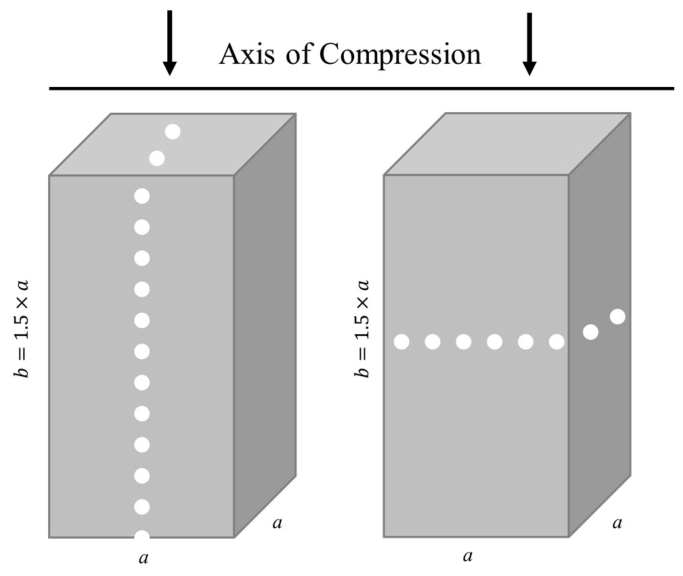
Figure 2.
X-ray diffraction (XRD) patterns of the reference basalt glass and basalt glass containing 5 wt.% mine tailings (MT), showing broad diffuse scattering characteristic of predominantly amorphous glass structures and the absence of distinct crystalline reflections.
Figure 2.
X-ray diffraction (XRD) patterns of the reference basalt glass and basalt glass containing 5 wt.% mine tailings (MT), showing broad diffuse scattering characteristic of predominantly amorphous glass structures and the absence of distinct crystalline reflections.
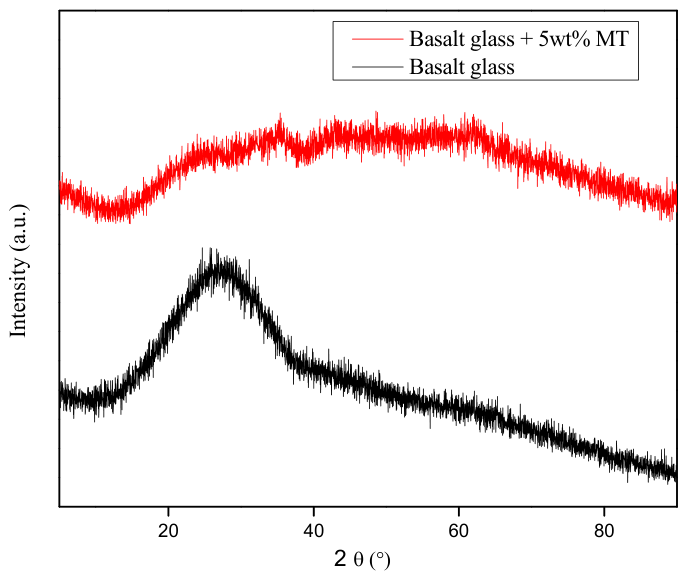
Figure 3.
DTA curve of the reference basalt glass, showing the identified low-temperature features (LT1–LT3), the broad thermal transition region, and the high-temperature thermal event (HT) near 700 °C.
Figure 3.
DTA curve of the reference basalt glass, showing the identified low-temperature features (LT1–LT3), the broad thermal transition region, and the high-temperature thermal event (HT) near 700 °C.
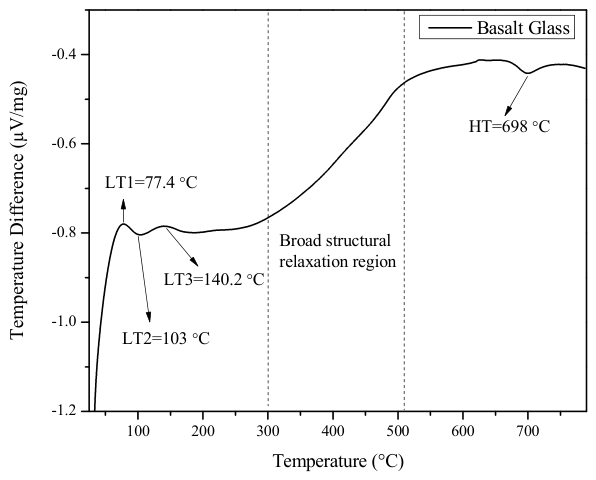
Figure 4.
DTA curve of basalt glass containing 5 wt.% mine tailings (MT), showing the identified low-temperature features (LT1–LT3), the broad thermal transition region, and the high-temperature thermal event (HT) near 700 °C.
Figure 4.
DTA curve of basalt glass containing 5 wt.% mine tailings (MT), showing the identified low-temperature features (LT1–LT3), the broad thermal transition region, and the high-temperature thermal event (HT) near 700 °C.
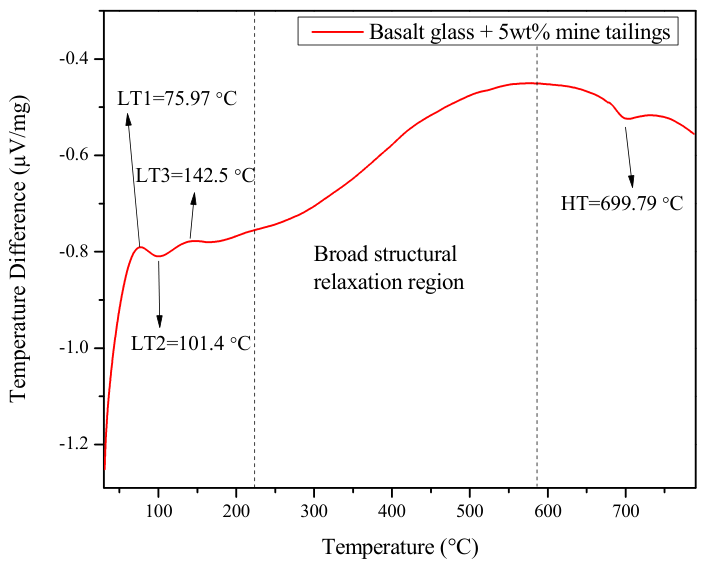
Figure 5.
DSC curve of the reference basalt glass, showing the identified low-temperature features (LT1 and LT2), the broad thermal transition region, the intermediate-temperature event (IT), and the high-temperature thermal event (HT) near 700 °C.
Figure 5.
DSC curve of the reference basalt glass, showing the identified low-temperature features (LT1 and LT2), the broad thermal transition region, the intermediate-temperature event (IT), and the high-temperature thermal event (HT) near 700 °C.
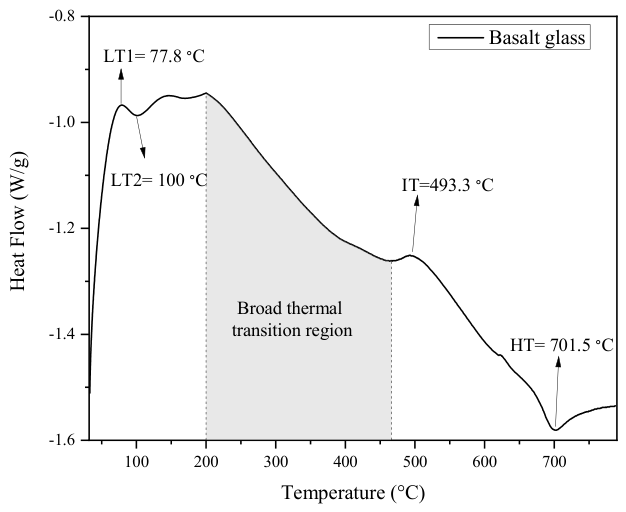
Figure 6.
DSC curve of basalt glass containing 5 wt.% mine tailings (MT), showing the identified low-temperature features (LT1–LT3), the broad thermal transition region, and the high-temperature thermal event (HT) near 700 °C.
Figure 6.
DSC curve of basalt glass containing 5 wt.% mine tailings (MT), showing the identified low-temperature features (LT1–LT3), the broad thermal transition region, and the high-temperature thermal event (HT) near 700 °C.
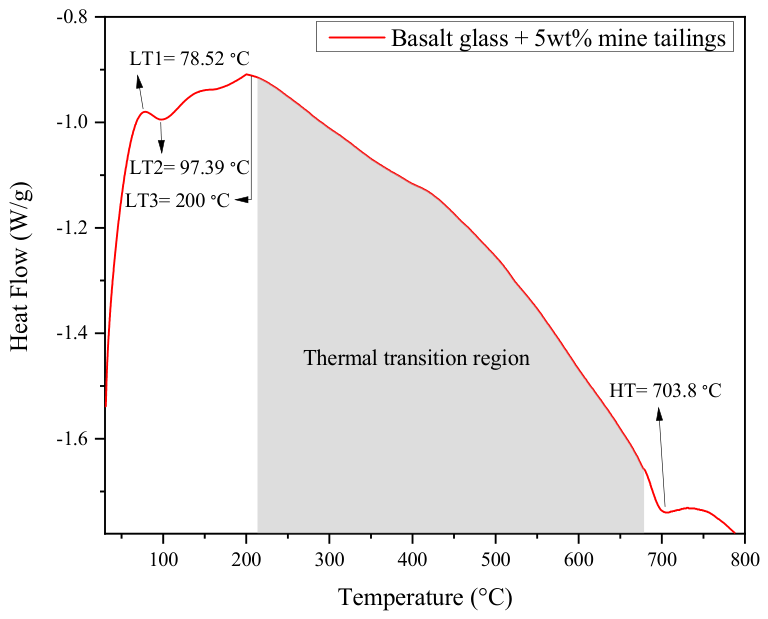
Figure 7.
Dilatometric curve of the basalt glass sample showing the relative length change (ΔL/L₀) during heating and the onset of softening at elevated temperatures.
Figure 7.
Dilatometric curve of the basalt glass sample showing the relative length change (ΔL/L₀) during heating and the onset of softening at elevated temperatures.
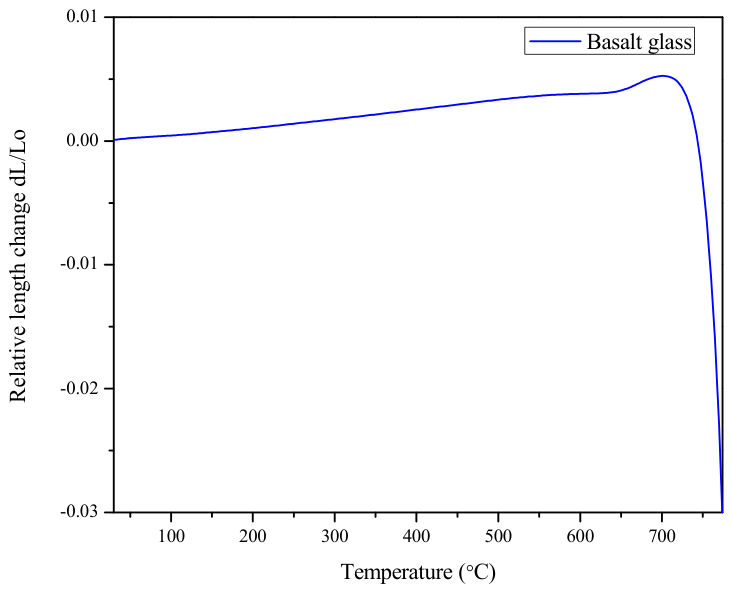
Figure 8.
Dilatometric curve of the basalt glass + 5 wt% Mine tailings sample showing the relative length change (ΔL/L0) during heating and the onset of softening at elevated temperatures.
Figure 8.
Dilatometric curve of the basalt glass + 5 wt% Mine tailings sample showing the relative length change (ΔL/L0) during heating and the onset of softening at elevated temperatures.
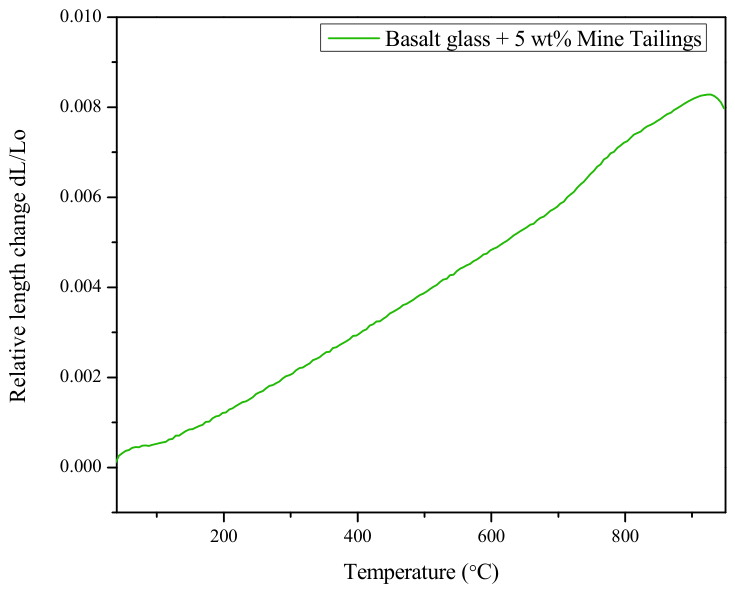
Figure 9.
Compressive stress–time curves of basalt glass and basalt-based composite samples obtained during compression testing. BG = basalt glass; BG+SWM = basalt glass reinforced with steel wire mesh; BG+MT = basalt glass containing 5 wt.% mine tailings; BG+MT+SWM = basalt glass containing 5 wt.% mine tailings reinforced with steel wire mesh; BG+SWM PP = basalt glass reinforced with steel wire mesh oriented perpendicular to the compression axis; BG+MT+SWM PP = basalt glass containing 5 wt.% mine tailings reinforced with steel wire mesh oriented perpendicular to the compression axis. The curves represent median maximum compressive strength among three independently tested specimens.
Figure 9.
Compressive stress–time curves of basalt glass and basalt-based composite samples obtained during compression testing. BG = basalt glass; BG+SWM = basalt glass reinforced with steel wire mesh; BG+MT = basalt glass containing 5 wt.% mine tailings; BG+MT+SWM = basalt glass containing 5 wt.% mine tailings reinforced with steel wire mesh; BG+SWM PP = basalt glass reinforced with steel wire mesh oriented perpendicular to the compression axis; BG+MT+SWM PP = basalt glass containing 5 wt.% mine tailings reinforced with steel wire mesh oriented perpendicular to the compression axis. The curves represent median maximum compressive strength among three independently tested specimens.
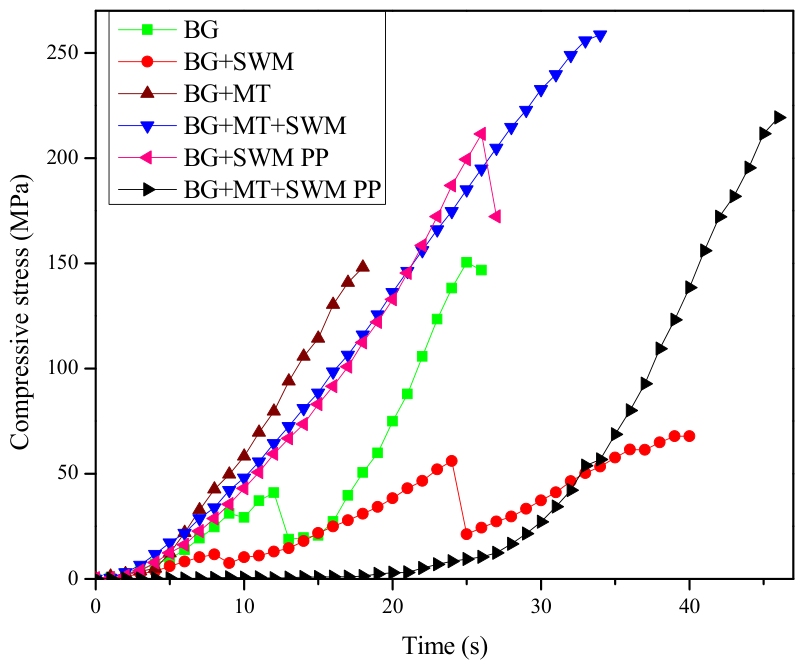
Figure 10.
Stereomicroscopic images of fragments of the reference basalt glass after compression testing, showing the characteristic brittle fracture morphology and fragmentation of the glass matrix. Scale bars: 2000 μm (a) and 5000 μm (b).
Figure 10.
Stereomicroscopic images of fragments of the reference basalt glass after compression testing, showing the characteristic brittle fracture morphology and fragmentation of the glass matrix. Scale bars: 2000 μm (a) and 5000 μm (b).
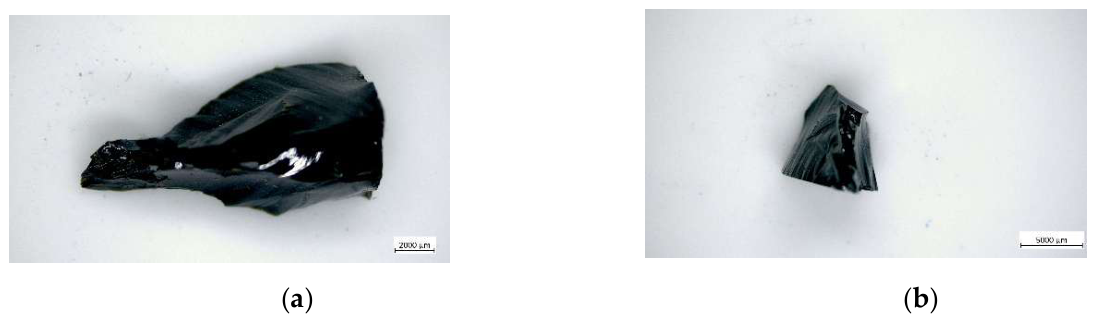
Figure 11.
Stereomicroscopic images of fragments of basalt glass containing 5 wt.% mine tailings after compression testing, showing brittle fragmentation and changes in fracture morphology compared with the reference basalt glass. Scale bars: 5000 μm (a) and 2000 μm (b).
Figure 11.
Stereomicroscopic images of fragments of basalt glass containing 5 wt.% mine tailings after compression testing, showing brittle fragmentation and changes in fracture morphology compared with the reference basalt glass. Scale bars: 5000 μm (a) and 2000 μm (b).
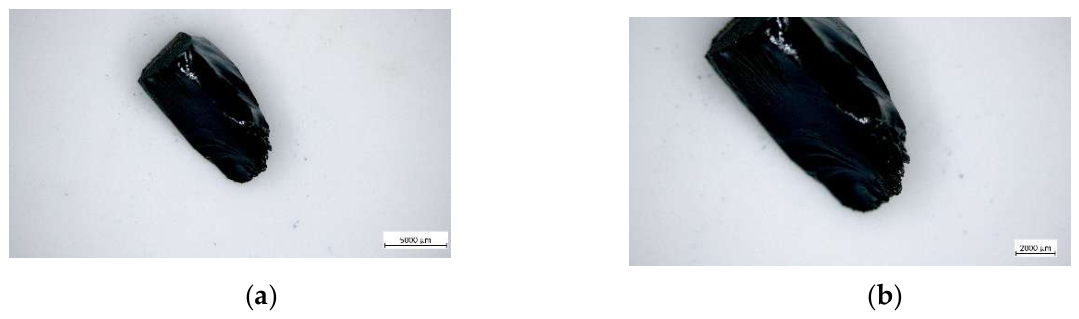
Figure 12.
Stereomicroscopic images of fragments of basalt glass reinforced with AISI 304 stainless steel wire mesh after compression testing, showing matrix fragmentation, interaction of cracks with the reinforcement, and retention of fractured glass regions by the steel mesh. Scale bars: 5000 μm (a), 2000 μm (b), and 1000 μm (c).
Figure 12.
Stereomicroscopic images of fragments of basalt glass reinforced with AISI 304 stainless steel wire mesh after compression testing, showing matrix fragmentation, interaction of cracks with the reinforcement, and retention of fractured glass regions by the steel mesh. Scale bars: 5000 μm (a), 2000 μm (b), and 1000 μm (c).
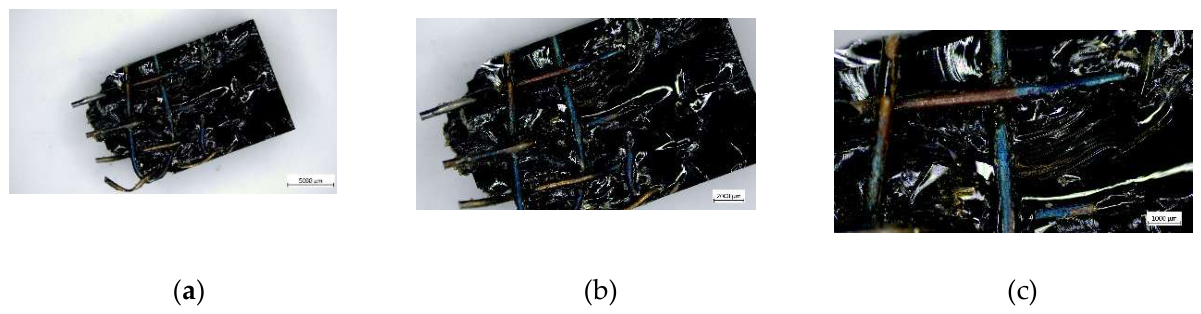
Figure 13.
Stereomicroscopic images of fragments of basalt glass containing 5 wt.% mine tailings and AISI 304 stainless steel wire mesh after compression testing, showing complex crack propagation, interaction between the glass matrix and reinforcement, and retention of fractured regions by the steel mesh. Scale bars: 2000 μm (a), 1000 μm (b and c), and 500 μm (d).
Figure 13.
Stereomicroscopic images of fragments of basalt glass containing 5 wt.% mine tailings and AISI 304 stainless steel wire mesh after compression testing, showing complex crack propagation, interaction between the glass matrix and reinforcement, and retention of fractured regions by the steel mesh. Scale bars: 2000 μm (a), 1000 μm (b and c), and 500 μm (d).
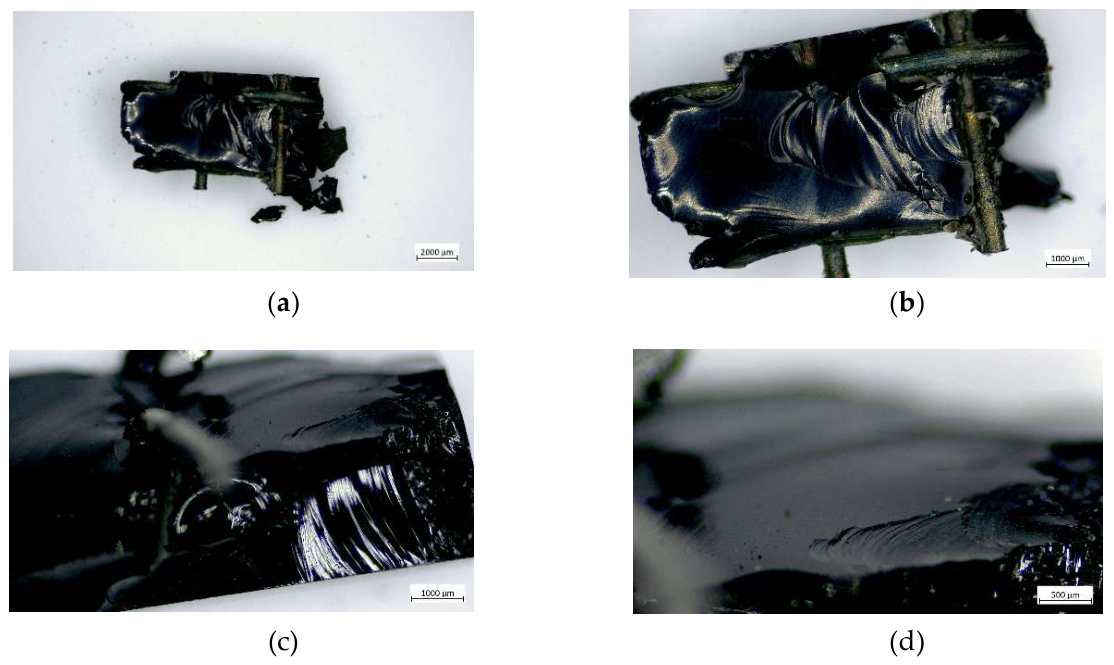

Table 1.
Elemental composition of basalt rock expressed in atomic percent (at.%) as determined by EDS.
Table 1.
Elemental composition of basalt rock expressed in atomic percent (at.%) as determined by EDS.
| O | Na | Mg | Al | Si | K | Ca | Ti | Fe | Total |
|---|---|---|---|---|---|---|---|---|---|
| 46.30 | 1.72 | 6.16 | 7.68 | 24.70 | 1.00 | 7.53 | 0.62 | 4.30 | 100 |
Table 2.
Elemental composition of mine tailings expressed in atomic percent (at.%) as determined by EDS.
Table 2.
Elemental composition of mine tailings expressed in atomic percent (at.%) as determined by EDS.
| O | Na | Mg | Al | Si | S | K | Ca | Ti | Fe | W | Pb | Total | |
|---|---|---|---|---|---|---|---|---|---|---|---|---|---|
| 38.86 | 0.73 | 2.36 | 3.49 | 15.01 | 0.19 | 2.41 | 1.13 | 1.09 | 34 | 0.51 | 0.23 | 100 | |
Table 3.
Elemental composition of basalt glass expressed in atomic percent (at.%) as determined by EDS.
Table 3.
Elemental composition of basalt glass expressed in atomic percent (at.%) as determined by EDS.
| O | Na | Mg | Al | Si | K | Ca | Ti | Fe | Total |
|---|---|---|---|---|---|---|---|---|---|
| 43.77 | 1.16 | 8.2 | 7.9 | 24.74 | 0.86 | 8.06 | 0.52 | 4.78 | 100 |
Table 4.
Elemental composition of basalt glass with 5wt% mine tailings expressed in atomic percent (at.%) as determined by EDS.
Table 4.
Elemental composition of basalt glass with 5wt% mine tailings expressed in atomic percent (at.%) as determined by EDS.
| O | Na | Mg | Al | Si | K | Ca | Ti | Fe | Total |
|---|---|---|---|---|---|---|---|---|---|
| 63.85 | 3.17 | 2.31 | 7.41 | 17.27 | 1.29 | 2.74 | 0.33 | 1.62 | 100 |
Table 5.
Maximum compressive strength (σ) of the investigated basalt glass and composite samples obtained from compression testing.
Table 5.
Maximum compressive strength (σ) of the investigated basalt glass and composite samples obtained from compression testing.
| Sample | σ(MPa) |
|---|---|
| Basalt glass | 146.69218 |
| Basalt glass + Steel wire mesh | 67.87815 |
| Basalt glass + Steel wire mesh PP | 172.24705 |
| Basalt glass + 5wt% Mine tailings | 148.00672 |
| Basalt glass + 5wt% Mine tailings + Steel wire mesh | 258.64112 |
| Basalt glass + 5wt% Mine tailings + Steel wire mesh PP | 219.25986 |
Disclaimer/Publisher’s Note: The statements, opinions and data contained in all publications are solely those of the individual author(s) and contributor(s) and not of MDPI and/or the editor(s). MDPI and/or the editor(s) disclaim responsibility for any injury to people or property resulting from any ideas, methods, instructions or products referred to in the content. |
© 2026 by the authors. Licensee MDPI, Basel, Switzerland. This article is an open access article distributed under the terms and conditions of the Creative Commons Attribution (CC BY) license (http://creativecommons.org/licenses/by/4.0/).
Copyright: This open access article is published under a Creative Commons CC BY 4.0 license, which permit the free download, distribution, and reuse, provided that the author and preprint are cited in any reuse.