

Submitted:
14 September 2026
Posted:
15 September 2026
You are already at the latest version
Abstract
Background/Objectives. Neurofibromatosis type 1 (NF1) is associated with neurocognitive difficulties and a high prevalence of sleep problems. However, the relationship between sleep and cognitive functioning in youth with NF1 remains poorly understood. This study examined associations between sleep characteristics and cognitive functioning in children with NF1.
Methods. Thirty-five children with NF1 (6-16 years) completed a comprehensive neuropsychological evaluation assessing attention, executive functioning, memory, and academic achievement. Parents completed measures of sleep, attention, and executive functioning. Primary sleep variables included PROMIS Sleep Disturbance, PROMIS Sleep-Related Impairment, and sleep duration. Correlational analyses, group comparisons, and exploratory hierarchical regressions were conducted.
Results. Forty percent of participants met criteria for clinically elevated sleep disturbance and sleep-related impairment. Greater sleep disturbance and sleep-related impairment were associated with higher levels of parent-reported attention and executive functioning difficulties. Sleep disturbance was also associated with poorer verbal memory. Children with clinically elevated sleep-related impairment demonstrated significantly greater attention and executive functioning difficulties than those without impairment. In exploratory regression analyses, sleep variables accounted for significant incremental variance in attention problems (ΔR² = .29), overall executive functioning (ΔR² = .31), working memory (ΔR² = .37), and performance-based memory outcomes (ΔR² = .32) beyond demographic and ADHD-related factors.
Conclusions. Sleep difficulties are common in children with NF1 and are associated with variability in attention, executive functioning, and memory. Sleep may represent a clinically meaningful and potentially modifiable contributor to neurocognitive outcomes in NF1, warranting routine assessment and further investigation as a therapeutic target.
Keywords:
neurofibromatosis type 1
; sleep disturbance
; sleep-related impairment
; neurocognition
; executive functioning
; attention
; memory
; pediatric neuropsychology
; ADHD
; neurodevelopment
1. Introduction
Neurofibromatosis type (NF1) is an autosomal dominant genetic disorder impacting approximately 1 in every 2,000-2,500 individuals and characterized by tumor predisposition, neurocutaneous manifestations, and elevated risk for neurodevelopmental difficulties [1]. Individuals with NF1 are at risk for broad cognitive deficits including mild to moderate reductions in general intelligence, attention, learning/memory, executive functioning, and verbal and nonverbal reasoning compared to the general population [2]. Similarly, NF1 is associated with increased rates of developmental diagnoses including Attention-Deficit/Hyperactivity Disorder (ADHD), learning disabilities, and autism spectrum disorder [3,4]. Animal research has supported the idea that these outcomes are related to neurobiological consequences of reduced neurofibromin causing overactivation of Ras-MAPK pathways and increased GABA release, thus impacting cortical development [5,6]. However, these mechanisms have yet to be fully understood and do not account for the high degree of neurocognitive heterogeneity observed in humans with NF1 [2].
A growing body of research suggests that sleep is a common and clinically significant concern in NF1 [7,8,9,10]. Although some studies have reported lower rates of formally diagnosed sleep disorders in NF1 than in the general population [8,11], symptom-based and objective assessments indicate meaningful differences in sleep quality and duration [12]. Compared with unaffected siblings or healthy controls, children with NF1 demonstrate greater difficulty falling and staying asleep, shorter sleep duration, reduced sleep efficiency, and more frequent nighttime awakenings [7,12,13]. Consistent with these findings, survey-based research found that about 60% of children and adolescents with NF1 met criteria for sleep disturbance and 43% demonstrated sleep-related impairment, with sleep difficulties particularly elevated among children with ADHD and learning problems [9].
Emerging evidence suggests that sleep disturbances may be associated with broader neurodevelopmental outcomes in NF1. In a recent cross-sectional study, Pride and colleagues [10] found that children with NF1 exhibited reduced overnight melatonin secretion, greater sleep irregularity, longer sleep latency, and shorter total sleep time compared with typically developing peers. These sleep disturbances were associated with poorer cognitive functioning, lower adaptive functioning, and increased behavioral difficulties. Preclinical studies similarly support the presence of sleep dysregulation in NF1, with animal models demonstrating abnormalities in sleep duration, continuity, timing, and circadian regulation [14,15]
Beyond NF1, sleep plays a critical role in neurodevelopment and cognitive functioning throughout childhood. Sleep is associated with memory consolidation, executive functioning, attention regulation, emotional functioning and adaptive outcomes [16]. Consequently, sleep disruption has emerged as an important contributor to neurobehavioral outcomes across a range of neurodevelopmental and genetic conditions [17]. Given the high prevalence of both sleep difficulties and neurocognitive challenges in NF1, sleep may represent a potentially modifiable factor contributing to variability in neurodevelopmental outcomes.
Despite evidence of both sleep problems [7,8,9,10] and cognitive challenges [2,4] in NF1, relatively little research has examined relationships between these domains. Existing evidence suggests that sleep disruption may be linked to cognitive vulnerability. Children with NF1 who have ADHD or lower IQ demonstrate higher rates of sleep disturbance [11], while infants with NF1 exhibit reduced sleep and greater settling difficulties prior to the emergence of measurable cognitive differences from controls [18]. Similarly, reduced sleep duration has been observed early in development in Nf1 drosophila models [19]. Together these findings raise the possibility that sleep disruption may contribute to downstream neurodevelopmental outcomes in NF1.
The aim of this study is to examine the relationships between sleep and neurocognitive functioning in a sample of children with NF1. Based on previous literature, we hypothesized that greater sleep disturbance and sleep-related impairment, as well as shorter weeknight sleep duration, would be associated with poorer cognitive functioning in youth with NF1. We further hypothesized that children meeting criteria for clinically significant sleep disturbance or impairment would demonstrate greater parent-reported and performance-based cognitive difficulties relative to those without sleep problems.
2. Materials and Methods
This was a prospective, cross-sectional study conducted as the second phase of a broader project examining sleep among youth with NF1. The current study represents the second phase of a larger program of research examining sleep and cognitive and emotional functioning in NF1. Phase 1 consisted of a large anonymous survey of caregivers that identified high rates of sleep disturbance and sleep-related impairment and showed associations between sleep difficulties, ADHD, and learning challenges in children with NF1 [9]. The current phase was designed to extend those findings through direct neuropsychological evaluation and detailed characterization of cognitive functioning. This study involved an in-person neuropsychological evaluation completed by the child and parent-completed questionnaires assessing their child’s cognitive functioning and sleep. Informed consent and child assent were obtained prior to participation, and all procedures were reviewed and approved by the Institutional Review Board (IRB) at our institution.
2.1. Participants
Thirty-six participants were enrolled in the study. Participants were recruited from a multidisciplinary NF clinic at a large metropolitan hospital. Children were eligible for participation if they had a confirmed diagnosis of NF1, were between 6 and 16 years old, and spoke English as their primary language. Exclusion criteria included intellectual functioning more than 2.5 standard deviations below average (IQ < 63), having a sensory impairment that would interfere with participation in a standard neurocognitive test battery (e.g. blindness, deafness, significant motor impairment), or having a history of traumatic head injury, progressive intracranial pathology, or neurological disorder or disease. Further, potential participants were excluded if they had started a new medication less than two weeks prior or were actively receiving treatment for a brain tumor.
2.2. Measures
Parent-Report Sleep Measures. Sleep problems were assessed via parent report using the Sleep Disturbance and Sleep-Related Impairment scales of the Patient Reported Outcomes Measurement System (PROMIS) [20] and the Child and Adolescent Sleep Checklist (CASC) [21].
The PROMIS Sleep Disturbance Parent Proxy form assesses disruptions to a child’s sleep (e.g., difficulties falling asleep, difficulties staying asleep, sleep quality) in the past 7 days, while the Sleep-Related Impairment Parent Proxy form assesses difficulties related to daytime sleepiness (e.g., disrupted activities, changes in mood). Raw scores are converted into T-scores, and T-scores > 60 are indicative of clinically elevated sleep disturbance or sleep-related impairment. The PROMIS measures were developed using classical test theory and item response theory methodology and have demonstrated good convergent validity. Prior research has also indicated good reliability of the PROMIS measures, with alphas ranging from α = .84-.95 [20,21].
The CASC consists of 24 items assessing a child’s general sleep characteristics (e.g. sleep duration) and the frequency of various sleep challenges [21]. For the current study, specific CASC items were examined to provide information about sleep duration, sleep latency, and nighttime awakenings.
Performance-Based Cognitive Measures. The Wechsler Intelligence Scale for Children, Fifth Edition is a widely used and psychometrically sound measure of core cognitive abilities (WISC-V) [23]. The Digit Span and Picture Span subtests were used as performance-based measures of auditory and visual working memory respectively. Scores on these subtests are converted to scaled scores using age-based normative data. The Working Memory Index (WMI), which is a composite of the two subtests, was also included in analyses. The Digits Forward sub score of the Digit Span test was used as a measure of simple attention span.
The NEPSY-Second Edition (NEPSY-II) is a battery of tests designed to measure key cognitive domains in children and adolescents including attention and executive functioning, language, social perception, and learning and memory, and has shown adequate to high test-re-test reliability and internal consistency across subtests [24]. Three NEPSY-II tests were used in the current study: Animal Sorting, Inhibition, and Memory for Designs. For all measures used in the current study, raw scores are converted to scaled scores.
The Inhibition test is an executive functioning task that measures the ability to inhibit previously learned responses and to switch between changing rules/response types. The total number of errors score was selected as a measure of overall impulse control.
Animal Sorting is an executive functioning task that measures the ability to identify and develop related concepts, organize information, and utilize a flexible problem solving approach to identify novel solutions. In this task, the child is presented with a set of eight picture cards and prompted to sort them into two groups using self-identified criteria. The total number of correct sorts score was used as a measure of organization and cognitive flexibility.
Memory for Designs and Memory for Designs Delayed is a two-part test of visual learning and memory. In Memory for Designs, participants are presented with a grid showing different designs and then asked to identify the previously shown designs from a larger set and place them in the same location on the grid. A delayed recall task (Memory for Designs Delayed) assesses long-term visual learning and memory.
The California Verbal Learning Test: Children’s Version (CVLT-C) measures verbal learning and memory, with previously established internal consistency and test-retest reliability [25]. A list of words is read aloud, and after each presentation the participant is asked to recall as many as they can. Long-term verbal memory is assessed after a delay. For the current study, the Trial 1 Recall score was used as a measure of attention span and initial learning. The Total Learning score was used to measure total verbal learning, and the Delayed Free Recall score was used to measure long-term verbal memory.
The Letter & Word Recognition and Math Computation subtests on the Kaufman Test of Educational Achievement, Third Edition (KTEA-3) [26] were used to measure word reading and math calculation skills respectively. The KTEA-3 subtests have shown acceptable reliability [26].
Parent Report of Cognitive Functioning. The DuPaul ADHD Rating Scale-5 (ADHD-RS-5) is a standardized parent-report symptom questionnaire based on the Diagnostic and Statistical Manual of Mental Disorders - 5th Edition (DSM-5) diagnostic criteria for ADHD [27]. The measure has been found to have good reliability [28]. Individual items are rated on a scale of 0-3 (rarely-very often) with nine items focused on inattention symptoms and nine items focused on hyperactivity/impulsivity symptoms. The number of items rated 2 or 3 are tallied, with >6/9 symptoms in either domain indicating that the child may meet criteria for ADHD. In the current study, this measure was used to identify participants meeting criteria for an ADHD diagnosis if a prior diagnosis was not indicated on parent report.
The Behavior Assessment System for Children, Third Edition (BASC-3), Parent Form measures parent-reported psychosocial and behavioral symptoms, with established evidence of reliability [29]. Raw scores are converted to T-scores, with scores above 60 indicating clinically elevated concerns. The current study used the Attention Problems and Hyperactivity subscales as measures of symptoms in these areas.
The Behavior Rating Inventory of Executive Functioning, Second Edition (BRIEF-2) Parent Form is a standardized informant report questionnaire assessing a child’s executive functioning challenges in day-to-day life [30]. It produces eight scales measuring different aspects of executive functioning that load onto three broad indices (Behavior Regulation Index [BRI], Emotion Regulation Index [ERI], and Cognitive Regulation index [CRI]), as well as a composite score of overall executive functioning challenges (Global Executive Composite, GEC). Raw scores are converted to T-scores. Scores >60 are considered mildly elevated and scores >65 are considered clinically elevated. The BRIEF-2 has well-established evidence of reliability [30]. A separate study examining internalizing symptoms and emotion regulation in our sample examined the ERI and its subscales; thus, these scores were not included in the current study. The subscales of the BRI (Inhibit, Self Monitor) and the CRI (Initiate, Working Memory, Plan/Organize, Task-Monitor, and Organization of Materials), as well as the GEC, were included in the current study.
2.3. Data Analysis
Primary Analyses. Primary analyses examined associations between sleep variables (sleep disturbance, sleep-related impairment, and weeknight sleep) and cognitive outcomes using Pearson or Spearman rank correlations, depending on distributional assumptions. Group comparisons were conducted using independent samples t-tests or Mann-Whitney U tests.
Assumptions were evaluated through visual inspection and formal tests of normality and homogeneity. Outliers were identified via boxplot inspection, examined for accuracy, and retained. Sensitivity analyses were conducted to confirm that results were robust to outlier effects.
To control for multiple comparisons, p-values were adjusted using the Benjamini-Hochberg false discovery rate (FDR) procedure with predefined families of tests [31]. Statistical significance was evaluated using a two-tailed alpha level of .05.
Exploratory analyses. Exploratory analyses were conducted using hierarchical linear regression to examine the unique contribution of sleep variables contribution to cognitive outcomes while accounting for demographic and clinical covariates. Age, sex (0=female, 1=male), ADHD diagnosis (0=no, 1=yes), and ADHD medication use (0=no, 1=yes) were entered in the first block, followed by sleep variables (sleep disturbance, sleep-related impairment, and weeknight sleep duration) in the second block.
The BASC-3 Attention and Hyperactivity scales were selected based on associations across multiple measures. As several of the BRIEF-2 subscales showed associations across multiple sleep measures, the Global Executive Composite (GEC) was selected as an overarching measure of parent-reported executive functioning. The Working Memory Index on the BRIEF-2 was also selected as it was the only BRIEF-2 subscale associated with all three sleep variables. Animal Sorting Total Sort Score on the NEPSY-II was selected as a performance-based measure of executive functioning.
To provide a consolidated exploration of learning and memory functioning while reducing the number of analyses, a composite learning and memory score was created using the Trial 1, Total Learning, and Long Delay Free Recall scores for the CVLT-C, and total scores on the Memory for Designs and Memory for Designs Delayed subtests of the NEPSY-II. Composite scores were calculated by converting the individual scores to z-scores and averaging the values. The composite score was only used in the regression analysis.
Regression assumptions were evaluated prior to the interpretation of the models. Multicollinearity was assessed using tolerance and variance inflation factor (VIF) statistics. Influential observations were evaluated using Cook’s distance. Normality of residuals was assessed through visual inspection of normal probability plots, and linearity was evaluated via visual inspection of standardized residuals versus predicted value plots.
3. Results
3.1. Sample Characteristics
Thirty-six children completed the cognitive assessments. Parent-report sleep questionnaires were incomplete for one participant, resulting in a final sample of 35. A full summary of participant demographic information can be found in Table 1. Participant ages ranged from 6-16 years old (Mage=10.67 SD=2.86) and most identified as White on parent report (n=29, 82.9%). There was a nearly equal split between female (n=17, 48.6%) and male (n=18, 51.4%) participants. About half of the sample were identified as having ADHD based on parent report of prior diagnosis or parents endorsing at least six of nine symptoms of inattention or hyperactivity on the ADHD-rating scale. Thirty-one percent (n=11) of the final sample was taking medication for attention problems at the time of the evaluation.
Regarding sleep characteristics, the full sample reported an average of 8.71 (SD=1.49) hours of sleep per night on school nights and 9.26 (SD=1.28) hours per night on weekends. Most children (n=24, 68.6%) fell asleep within one hour of going to bed, and nighttime awakenings (1-2 per night) were endorsed in 42.9% (n=15) of the sample. Forty percent (n=14) of participants met criteria for sleep disturbance and sleep-related impairment, respectively. Participants with sleep disturbance reported significantly fewer hours of sleep than those without disturbance on weeknights, t(31) = −2.58, p = .007, d = −0.93, and on weekends, t(31) = −1.72, p = .048, d = −0.62. Similarly, participants with sleep-related impairment slept significantly fewer hours than those without impairment on weeknights, t(31) = −3.57, p < .001, d = −1.27, and on weekends, t(31) = −3.00, p = .003, d = −1.07. Across comparisons, those with sleep disturbance or impairment slept approximately one hour less than those without these difficulties, with larger differences on school nights. Accordingly, sleep duration on weeknights was selected as the primary sleep variable for subsequent analyses.
3.2. Correlations
Full correlation results can be found in Table 2. Figure 1 shows a heat map for statistically significant correlations across sleep and cognitive measures.
Parent-Report Outcomes, Sleep Disturbance. Greater sleep disturbance was associated with higher levels of attention problems (r = .59, q < .001) and hyperactivity (r = .44, q = .028). Greater sleep disturbance was also associated with several aspects of executive functioning, including each of the BRIEF-2 index scores: BRI (r = .47, q = .018), CRI (r = .57, q < .001), and GEC (r = .63, q < .001). Significant associations were also observed across specific executive domains, including the Inhibit (r = .42, q = .032), Initiate (r = .56, q = .004), Self-Monitor (r = .42, q = .031), Plan/Organize (r = .52, q = .004), Organization of Materials (r = .39, q = .042), and Working Memory (r = .64, q < .001) subscales. Overall, associations between sleep disturbance and parent-reported cognitive outcomes were moderate to large in magnitude (r = .39 - .64), with the strongest effects observed for working memory and global executive functioning.
Sleep-Related Impairment. Greater sleep-related impairment was associated with greater attention problems (r = .52, q = .006), the BRIEF-2 CRI (r = .44, q = .040), and global executive functioning (GEC: r = .55, q = .013). Significant associations were also observed for Initiate (r = .43, q = .042), Plan/Organize (r = .49, q = .019), and Working Memory (r = .50, q = .017) subscales. Although sleep-related impairment was moderately associated with hyperactivity symptoms (r = .36, q = .085) BRIEF-2 BRI (r = .34, q = .096) and BRIEF-2 Self Monitor (r = .36 q = 0.85), these associations did not survive FDR correction. Significant associations were generally moderate in magnitude (r = .43 - .55), with the largest effects observed for overall executive functioning and working memory.
Sleep Duration. Shorter weeknight sleep duration was not significantly associated with any of the parent-reported outcomes. There were moderate associations that did not survive FDR correction between sleep duration and Attention Problems (r = -.48, q = 058), and Working Memory (r = -.46, q = .058).
Performance-Based Outcomes. Higher levels of sleep disturbance were associated with poorer verbal learning on the CVLT Total Learning, r = −.42, q = .032. Greater sleep-related impairment was not significantly associated with any performance-based outcomes. However, there were several moderate associations with sleep-related impairment that did not survive FDR correction including measures of executive functioning (Animal Sorting Total r = -.36, q = .096) and visual spatial learning and memory (Memory for Designs Total r = -.42, q = .061; Delayed Recall ρ = -.41, q = .072). Longer weeknight sleep duration was associated with better executive functioning performance on NEPSY-II Memory for Designs initial learning (r = .60, q = .025). A moderate association between longer sleep duration and executive functioning did not survive FDR correction (Animal Sorting Total r = .47, q = .063). Effect sizes for performance-based outcomes were generally smaller than those observed for parent-reported outcomes, although moderate associations were observed for learning and memory measures.
Although most performance-based findings did not survive FDR correction, many demonstrated moderate effect sizes (approximately |r| = .36 - .47), suggesting that the absence of statistical significance may reflect limited power rather than the absence of meaningful associations.
3.3. Group Comparisons
Results for all group comparisons are presented in Table 3. Figure 2 shows mean BASC-3 Attention and BRIEF-2 Working Memory scores for participants with and without sleep disturbance and sleep impairment. No significant group differences were observed on performance-based cognitive measures for either sleep disturbance or sleep-related impairment. Significant results from group comparisons on parent-reported outcomes are described below.
Sleep Disturbance. Participants with sleep disturbance had higher levels of parent-reported working memory problems on the BRIEF-2 (U = 54, z = −3.14, q = .025, r = -0.53). Those with sleep disturbance also had greater parent-reported attention problems, although this did not survive FDR correction (t(33) = 2.97, q = 0.75, d = 1.02).
Sleep-Related Impairment. Participants with clinically elevated sleep-related impairment had significantly higher reported attention problems on the BASC-3 relative to those without impairment (t(33) = 3.08, q = .025, d = 1.06). Additionally, participants with sleep-related impairment were reported to have greater executive functioning problems than those without sleep-related impairments, indicated by differences on the BRIEF-2 GEC (t(33) = 3.42, q = .025, d = 1.18). Significant between-group differences were identified on the BRIEF-2 Working Memory (t(33) = 3.66, q = .025, d = 1.26), Initiate (U = 67, z = −2.70, q = .030, r = -0.46), and Plan and Organize (U = 64.5, z = −2.79, q = .025, r = -0.47) subscales. Differences were also noted on the CRI, although these did not survive FDR correction (t(33) = 2.66, q = .050, d = 0.92).
3.4. Exploratory Hierarchical Multiple Regression
Regression findings should be considered exploratory due to the modest participant-to-predictor ratio. Results from the hierarchical multiple regression analyses can be found in Table 4. Regression diagnostics indicated no meaningful violations of model assumptions.
Parent-Reported Attention Problems (BASC-3). The full model was statistically significant F (7, 25) = 3.670, p = .007, explaining 50.7% of the variance in attention problems (R2 = .507, adjusted R2 = .369). The addition of the three sleep variables improved the model beyond the demographic covariates, accounting for an additional 28.9% of the variance in attention problems (ΔR2 = .289, ΔF (3, 25) = 4.888, p = .008).
Parent-Reported Hyperactivity (BASC-3). Although the incremental contribution of sleep variables was not statistically significant (ΔF(3,25) = 1.41, p = .264), the addition of sleep variables accounted for an additional 11% of the variance in hyperactivity symptoms (ΔR² = .11).
Parent-Reported Overall Executive Functioning (BRIEF-2 GEC). The full model was statistically significant F (7, 25) = 3.553, p = .009, explaining 49.9% of the variance in parent-reported executive function problems (R2 = .499, adjusted R2 = .358). The addition of the sleep variables improved the model, accounting for an additional 31% of the variance in executive functioning problems (ΔF (3, 25) = 5.174, p = .006).
Parent-Reported Working Memory (BRIEF-2 WM). The full model was statistically significant F (7, 25) = 4.604, p = .002) and explained 56.3% of the variance in parent-reported working memory. The addition of the sleep variables improved the model beyond the covariates, accounting for an additional 37% of the variance in parent-reported working memory difficulties (ΔF (3, 25) = 7.007, p = .001).
Performance-Based Executive Functioning. Although the incremental contribution of sleep variables was not statistically significant (ΔF(3,19) = 1.83, p = .173), sleep variables accounted for an additional 18% of the variance in performance-based executive functioning (ΔR² = .18).
Performance-Based Memory Composite. The full model was not statistically significant (F(7, 19) = 2.528, p = 0.51). However, the addition of the three sleep variables improved the model beyond the demographic covariates, accounting for an additional 32% of the variance in memory performance (ΔF (3, 19) = 3.932, p = .024).
4. Discussion
The current findings are notable in light of our previous survey-based study of sleep in NF1. In that larger caregiver-report study, sleep disturbance and sleep-related impairment were highly prevalent and associated with ADHD and learning concerns [9]. The present study extends those observations by demonstrating relationships between sleep problems and both everyday executive functioning and directly measured neurocognitive performance. Together, these findings provide converging evidence across independent methodologies that sleep may represent an important contributor to neurobehavioral functioning in children with NF1.
In the current study, nearly 40% of participants met criteria for clinically elevated sleep disturbance and sleep-related impairment. Greater sleep disturbance and sleep-related impairment was associated with increased parent-rated attention, hyperactivity, and executive functioning difficulties impacting daily life. Further, sleep disturbance was associated with poorer learning and memory performance. Exploratory hierarchical regression analyses demonstrated that sleep variables contributed meaningful variance to cognitive outcomes beyond demographic and ADHD-related factors. The addition of sleep variables accounted for an additional 29% of variance in attention problems, 31% of variance in overall executive functioning, 37% of variance in working memory, and 32% of variance in performance-based memory outcomes. These effect sizes were notable, particularly given the modest sample size and exploratory nature of the analyses. The findings overall support the importance of sleep as a factor associated with neurocognitive functioning in children with NF1.
Our primary analyses found that sleep disturbance and sleep-related impairment demonstrated the strongest and most consistent associations with parent-reported cognitive functioning. Sleep disturbance was associated with reported attention problems, hyperactivity, and a range of behavioral and cognitive regulation problems. This pattern was also observed with sleep-related impairment, although to a lesser degree. When comparing participants with and without sleep disturbance and/or sleep-related impairment, attention and executive functioning were the most strongly related cognitive domains. Our findings are consistent with broader pediatric literature linking poor sleep with attention and executive function difficulties [32].
In our sample, working memory emerged as one of the most consistently associated domains across analyses. Correlations between sleep disturbance and parent-reported executive functioning were generally moderate-to-large in magnitude (r = .39-.64), with the strongest associations observed for working memory (r = .64), global executive functioning (r = .63), and cognitive regulation (r = .57). Group comparisons similarly demonstrated large between-group effects for attention, executive functioning, and working memory (Cohen's d = 1.02-1.26).
We found fewer significant associations on performance-based measures than on parent-report measures. However, sleep disturbance and shorter nightly sleep duration were associated with poorer learning and memory performance. While several associations did not survive FDR correction, many were moderate in magnitude, including measures of executive functioning and memory. Given the small sample size, these findings may reflect potentially meaningful relationships that warrant replication in larger studies rather than a complete absence of relationships. One potential explanation for this pattern is that sleep difficulties may initially impact day-to-day cognitive functioning before producing measurable differences on standardized neuropsychological testing under controlled conditions. Prior work indicates that performance-based executive function tasks and behavioral ratings capture related but not identical aspects of functioning [33].
Hierarchical regression results further strengthened the overall conclusions. After accounting for age, sex, ADHD diagnosis, and ADHD medication status, sleep variables explained an additional 29% of variance in attention problems, 31% of variance in global executive functioning, 37% of variance in working memory, and 32% of variance in memory performance. These represent moderate-to-large incremental effects and suggest that sleep contributes meaningfully to neurocognitive outcomes beyond established demographic and ADHD-related risk factors. Notably, these effect sizes emerged despite the modest sample size and the lack of individually significant sleep predictors in the final models.
ADHD diagnosis and medication status were included as covariates because prior work from our group demonstrated that ADHD is strongly associated with both sleep disturbance and sleep-related impairment in children with NF1 [9]. Although sleep remained associated with cognitive outcomes beyond ADHD-related factors in the current study, it is possible that children with both NF1 and ADHD represent a particularly vulnerable subgroup with respect to sleep disruption and its functional consequences. Because more than half of the current sample met criteria for ADHD, sleep may partially influence cognitive functioning through attention-regulation pathways that are already vulnerable in children with NF1. Future research should examine whether sleep differentially contributes to cognitive functioning among children with NF1 who do and do not meet criteria for ADHD, and whether treatment of sleep problems has distinct benefits within these groups.
Despite these findings, none of the individual sleep factors emerged as unique predictors. This may have been impacted by limited power secondary to a limited sample size. It is also possible that sleep disturbance, sleep-related impairment, and sleep duration represent overlapping aspects of overall sleep health and overall sleep dysfunction may be more important than any single sleep characteristic.
Our findings align with emerging evidence from human and animal studies showing altered sleep in NF1. Preclinical work suggests that Nf1 is involved in sleep regulation across development, with reduced sleep evident as early as larval stages in drosophila models [19]. In humans, infants with NF1 have been reported to sleep less and take longer to settle than controls, even when early cognitive and behavioral developmental trajectories did not yet differ between groups [18]. While the current study cannot address causality or developmental timing, these findings support the possibility that sleep disruption may be relevant to cognitive vulnerability in NF1.
There are important considerations for future sleep studies in NF1. Other potential factors that may impact sleep include medications, NF1 related medical factors such as optic pathway glioma [7], hyperhidrosis, and sleep-disordered breathing and sleep apnea [12]. There may also be clinically meaningful subgroups within NF1 that differ in both sleep and cognitive outcomes. In addition to emerging work examining potential sleep phenotypes [10], future studies should evaluate whether the relationship between sleep and cognition varies according to ADHD status, learning difficulties, or other neurobehavioral characteristics. Findings from our prior study and the current investigation collectively suggest that ADHD may be a subgroup at elevated risk for sleep-related functional difficulties.
Across both the survey phase and the current investigation, clinically significant sleep disturbances were common, highlighting a potentially modifiable and clinically actionable target to impact cognitive function in children with NF1 who carry significant cognitive morbidity. Routine assessment of sleep in multidisciplinary NF1 care and neuropsychological evaluation may help identify potentially modifiable contributors to cognitive and behavioral concerns. For patients endorsing sleep problems, further assessment of sleep hygiene and potential need for behavioral sleep interventions may be useful. There is emerging evidence that interventions improving sleep may produce improvements in attention, executive functioning, behavioral regulation, mood, and quality of life, all of which are commonly impacted in NF1 [34,35]. Pediatric sleep intervention studies indicate that cognitive and behavioral sleep interventions can improve sleep outcomes in children, and broader reviews suggest behavioral sleep intervention may also improve ADHD symptoms and quality of life, although evidence quality varies and NF1-specific trials are needed [34,35,36]. Earlier identification of sleep problems may be especially important in very young children if sleep contributes to cognitive development, as early intervention improving sleep may positively impact cognitive development. Given evidence of altered sleep architecture and increased sleep-disordered breathing in NF1, clinicians should also screen for symptoms that may warrant further evaluation through sleep medicine [12].
Several limitations of this work deserve mention. First, our data on sleep quality and quantity relied exclusively on parent-report measures. We did not have the opportunity to collect objective sleep data such as actigraphy or polysomnography, nor direct assessment of sleep architecture or quality. Second, because several sleep and cognitive outcomes were derived from parent-report measures, reporter bias or common-method variance may have inflated associations among these variables [37]. Third, design (cross-sectional) and sample characteristics may have limited our findings and may limit generalizability beyond predominantly White/highly educated populations. In addition, our sample size was modest, potentially limiting statistical power. This is particularly relevant given that several analyses demonstrated moderate effect sizes that did not survive multiple-comparison correction, raising the possibility of Type II error. Finally, directionality cannot be determined from this cross-sectional design. Sleep difficulties may contribute to cognitive and behavioral vulnerability, cognitive and behavioral difficulties may worsen sleep, or both may reflect overlapping neurodevelopmental processes within NF1. The interpretation that disrupted sleep contributes to cognitive challenges is consistent with emerging human and animal literature linking NF1 with altered sleep and circadian regulation, but longitudinal studies are needed to test temporal relationships directly [10,15,19].
Future research on this topic would benefit from longitudinal studies that track sleep and cognitive development from early childhood. It will be important to include comparison groups to further delineate NF1-specific manifestations of atypical sleep from other sources. The inclusion of objective sleep measures and continued work examining potential sleep subtypes will improve our understanding of sleep disruption in NF1 and may lead to personalized, prevention-based care.
The current study directly addresses recommendations arising from our prior work by incorporating comprehensive neuropsychological assessment. Future longitudinal investigations integrating objective sleep measurement with repeated cognitive assessment will be important for determining whether sleep disturbances contribute to developmental trajectories of cognitive functioning in NF1 and whether improvements in sleep correspond to neurocognitive benefits.
Author Contributions
Conceptualization, KSW; Methodology, KSW; Software, KSW; Validation, KSW; Formal Analyses EJC; Investigation, KSW; Resources, KSW; Data Curation, RL, MJG, KSW; Writing – Original Draft Preparation, EJC, KSW; Writing – Review & Editing, JS, CT, CC, SL, MK; Visualization, EJC; Supervision, KSW; Project Administration, RL, KSW; Funding Acquisition, KSW.
Funding
Gilbert Family Foundation, Lambert Family Foundation.
Institutional Review Board Statement
The study was conducted in accordance with the Declaration of Helsinki and approved by the Institutional Review Board (or Ethics Committee) of Children’s National Hospital (Pro00013982 approved 08/13/2021).
Informed Consent Statement
Informed consent was obtained from all subjects involved in the study.
Data Availability Statement
The data presented in this study are not publicly available because they contain protected health information and participant-level clinical data. De-identified data may be made available from the corresponding author upon reasonable request and with approval from the relevant institutional review board, in accordance with institutional policies and applicable regulations.
Conflicts of Interest
The authors declare no conflicts of interest.
AI use:
- Suggesting changes to improve readability of drafted text
- Organizing/building data tables
- Creating an initial draft of the abstract and simple summary based on the already written MS draft (then edited by authors)
- Cross checking appropriateness of data analysis plan and results reporting
References
- Lee, T. S. J., Chopra, M., Kim, R. H., Parkin, P. C., & Barnett-Tapia, C. (2023). Incidence and prevalence of neurofibromatosis type 1 and 2: a systematic review and meta-analysis. Orphanet Journal of Rare Diseases, 18(1), 292. [CrossRef]
- Crow, A. J., Janssen, J. M., Marshall, C., Moffit, A., Brennan, L., Kohler, C. G., ... & Moberg, P. J. (2022). A systematic review and meta-analysis of intellectual, neuropsychological, and psychoeducational functioning in neurofibromatosis type 1. American Journal of Medical Genetics Part A, 188(8), 2277-2292. [CrossRef]
- Lehtonen, A., Garg, S., Roberts, S. A., Trump, D., Evans, D. G., Green, J., & Huson, S. M. (2015). Cognition in children with neurofibromatosis type 1: Data from a population-based study. Developmental Medicine & Child Neurology, 57(7), 645-651. [CrossRef]
- Smith, T. F., Kaczorowski, J. A., & Acosta, M. T. (2020). An executive functioning perspective in neurofibromatosis type 1: from ADHD and autism spectrum disorder to research domains. Child's nervous system, 36(10), 2321-2332. [CrossRef]
- Costa, R. M., & Silva, A. J. (2002). Molecular and cellular mechanisms underlying the cognitive deficits associated with neurofibromatosis 1. Journal of Child Neurology, 17(8), 622-626. [CrossRef]
- van Lier, M., Saiepour, M. H., Kole, K., Cheyne, J. E., Zabouri, N., Blok, T., ... & Levelt, C. N. (2020). Disruption of critical period plasticity in a mouse model of neurofibromatosis type 1. Journal of Neuroscience, 40(28), 5495-5509. [CrossRef]
- Licis, A. K., Vallorani, A., Gao, F., Chen, C., Lenox, J., Yamada, K. A., ... & Gutmann, D. H. (2013). Prevalence of sleep disturbances in children with neurofibromatosis type 1. Journal of child neurology, 28(11), 1400-1405. [CrossRef]
- Serur, Y., Russo, O., McGhee, C. A., & Green, T. (2025). Increased Prevalence of Psychiatric Disorders in Children with RASopathies: Comparing NF1, Noonan Syndrome Spectrum Disorder, and the General Population. Genes, 16(7), 843. [CrossRef]
- Walsh, K. S., Nielsen, J. D., Payne, A. D., Levitt, R. S., Goyette, M. J., Tiplady, K., ... & van Terheyden, S. (2026). Associations between sleep disturbance, sleep-related impairment, and attention and learning disorders in youth with NF1. Child Neuropsychology, 1-14. [CrossRef]
- Pride, N. A., Payne, J. M., Haebich, K., Arnold, S. S., Bournazos, A., Habib, J., Yates, C., Guzzetti, J. R., Darke, H., Pascouau, R., Rossi, A., Kennaway, D. J., North, K. N., & Banks, S. (2026). Sleep-wake dysregulation and altered melatonin in neurofibromatosis type 1. Sleep, 49(5), zsag037. [CrossRef]
- Maraña Pérez, A. M., Rodríguez, A. D., Insuga, V. S., Carral, J. D., Martín, V. P., & Solana, L. G. G. (2015). Prevalence of sleep disorders in patients with neurofibromatosis type 1. Neurología (English Edition), 30(9), 561-565. [CrossRef]
- Carotenuto, M., Messina, G., Esposito, M., Santoro, C., Iacono, D., & Spruyt, K. (2023). Polysomnographic study in pediatric neurofibromatosis type 1. Frontiers in Neurology, 14, 1213430. [CrossRef]
- Migliore, A., Lo Bianco, M., Leonardi, R., Salafia, S., Di Napoli, C., Ruggieri, M., ... & Praticò, A. D. (2025). Sleep Disorders in Pediatric Patients Affected by Neurofibromatosis Type 1: Reports of a Questionnaire and an Apple Watch Sleep Assessment. Biomedicines, 13(4), 907. [CrossRef]
- Bai, L., Lee, Y., Hsu, C. T., Williams, J. A., Cavanaugh, D., Zheng, X., ... & Sehgal, A. (2018). A conserved circadian function for the neurofibromatosis 1 gene. Cell reports, 22(13), 3416-3426. [CrossRef]
- Brown, E. B., Zhang, J., Lloyd, E., Lanzon, E., Botero, V., Tomchik, S., & Keene, A. C. (2023). Neurofibromin 1 mediates sleep depth in Drosophila. PLoS genetics, 19(12), e1011049. [CrossRef]
- Lokhandwala, S., & Spencer, R. M. (2022). Relations between sleep patterns early in life and brain development: A review. Developmental cognitive neuroscience, 56, 101130. [CrossRef]
- Bruni, O., Breda, M., Mammarella, V., Mogavero, M. P., & Ferri, R. (2025). Sleep and circadian disturbances in children with neurodevelopmental disorders. Nature Reviews Neurology, 21(2), 103-120. [CrossRef]
- Garg, S., Wan, M. W., Begum-Ali, J., Kolesnik-Taylor, A., Green, J., Johnson, M. H., & Jones, E. (2022). Early developmental trajectories in infants with neurofibromatosis 1. Frontiers in Psychology, 13, 795951. [CrossRef]
- Durkin, J., Poe, A. R., Belfer, S. J., Rodriguez, A., Tang, S. H., Walker, J. A., & Kayser, M. S. (2023). Neurofibromin 1 regulates early developmental sleep in Drosophila. Neurobiology of Sleep and Circadian Rhythms, 15, 100101. [CrossRef]
- Buysse, D. J., Yu, L., Moul, D. E., Germain, A., Stover, A., Dodds, N. E., Johnston, K.L. Shablesky-Cade, M. A., & Pilkonis, P. A. (2010). Development and validation of patient-reported outcome measures for sleep disturbance and sleep-related impairments. Sleep, 33(6), 781–792. [CrossRef]
- Oka, Y., & Horiuchi, F. (2009). 152 development of the child and adolescent sleep checklist (CASC). Sleep Medicine, 10, S42. [CrossRef]
- Forrest, C. B., Meltzer, L. J., Marcus, C. L., De La Motte, A., Kratchman, A., Buysse, D.J., Pilkonis, P., Becker, B. D. & Bevans, K. B. (2018). Development and validation of the PROMIS Pediatric Sleep Disturbance and Sleep-Related Impairment item banks. Sleep, 41(6), zsy054. [CrossRef]
- Wechsler, D. (2014). Wechsler Intelligence Scales for Children (5th ed.). Pearson.
- Korkman, M., Kirk, U., & Kemp, S. (2007). NEPSY-II: Clinical and interpretive manual. Pearson.
- Delis, D. C., Kramer, J. H., Kaplan, E., & Ober, B. A. (1994). CVLT-C: California verbal learning test: Children's version. Pearson.
- Frame, L. B., Vidrine, S. M., & Hinojosa, R. (2016). Kaufman Test of Educational Achievement, Third Edition. Journal of Psychoeducational Assessment, 34(8), 811–818. [CrossRef]
- American Psychiatric Association. (2013). Diagnostic and statistical manual of mental disorders (5th ed.). American Psychiatric Publishing.
- DuPaul, G. J., Power, T. J., Anastopoulos, A. D., & Reid, R. (2016). ADHD Rating Scale-5 for children and adolescents: Checklists, norms, and clinical interpretation. Guilford Press.
- Reynolds, C. R., & Kamphaus, R. W. (2015a). Behavior Assessment System for Children. (3rd ed.). Pearson.
- Gioia, G. A., Isquith, P. K., Guy, S. C., & Kenworthy, L. (2015). Behavior Rating Inventory of Executive Function® Second Edition (BRIEF®2, BRIEF2, BRIEF-2). APA PsycTests. [CrossRef]
- Benjamini, Y., & Hochberg, Y. (1995). Controlling the false discovery rate: A practical and powerful approach to multiple testing. Journal of the Royal Statistical Society: Series B (Methodological), 57(1), 289-300. [CrossRef]
- Astill, R. G., Van der Heijden, K. B., Van IJzendoorn, M. H., & Van Someren, E. J. W. (2012). Sleep, cognition, and behavioral problems in school-age children: A century of research meta-analyzed. Psychological Bulletin, 138(6), 1109-1138. [CrossRef]
- Miranda, A., Colomer, C., Mercader, J., Fernández, M. I., & Presentación, M. J. (2015). Performance-based tests versus behavioral ratings in the assessment of executive functioning in preschoolers: Associations with ADHD symptoms and reading achievement. Frontiers in Psychology, 6, Article 545. [CrossRef]
- Hornsey, S. J., Gosling, C. J., Jurek, L., Nourredine, M., Telesia, L., Solmi, M., Butt, I., Greenwell, K., Muller, I., Hill, C. M., & Cortese, S. (2025). Umbrella review and meta-analysis: The efficacy of nonpharmacological interventions for sleep disturbances in children and adolescents. Journal of the American Academy of Child & Adolescent Psychiatry, 64(3), 329-345. [CrossRef]
- Mei, Z., Cai, C., Luo, S., Zhang, Y., Lam, C., & Luo, S. (2024). The efficacy of cognitive behavioral therapy for insomnia in adolescents: A systematic review and meta-analysis of randomized controlled trials. Frontiers in Public Health, 12, Article 1413694. [CrossRef]
- Åslund, L., Arnberg, F., Kanstrup, M., & Lekander, M. (2018). Cognitive and behavioral interventions to improve sleep in school-age children and adolescents: A systematic review and meta-analysis. Journal of Clinical Sleep Medicine, 14(11), 1937-1947. [CrossRef]
- Podsakoff, P. M., MacKenzie, S. B., Lee, J.-Y., & Podsakoff, N. P. (2003). Common method biases in behavioral research: A critical review of the literature and recommended remedies. Journal of Applied Psychology, 88(5), 879-903. [CrossRef]
Figure 1.
Correlation Heat Map Based on Absolute r and ρ Values.
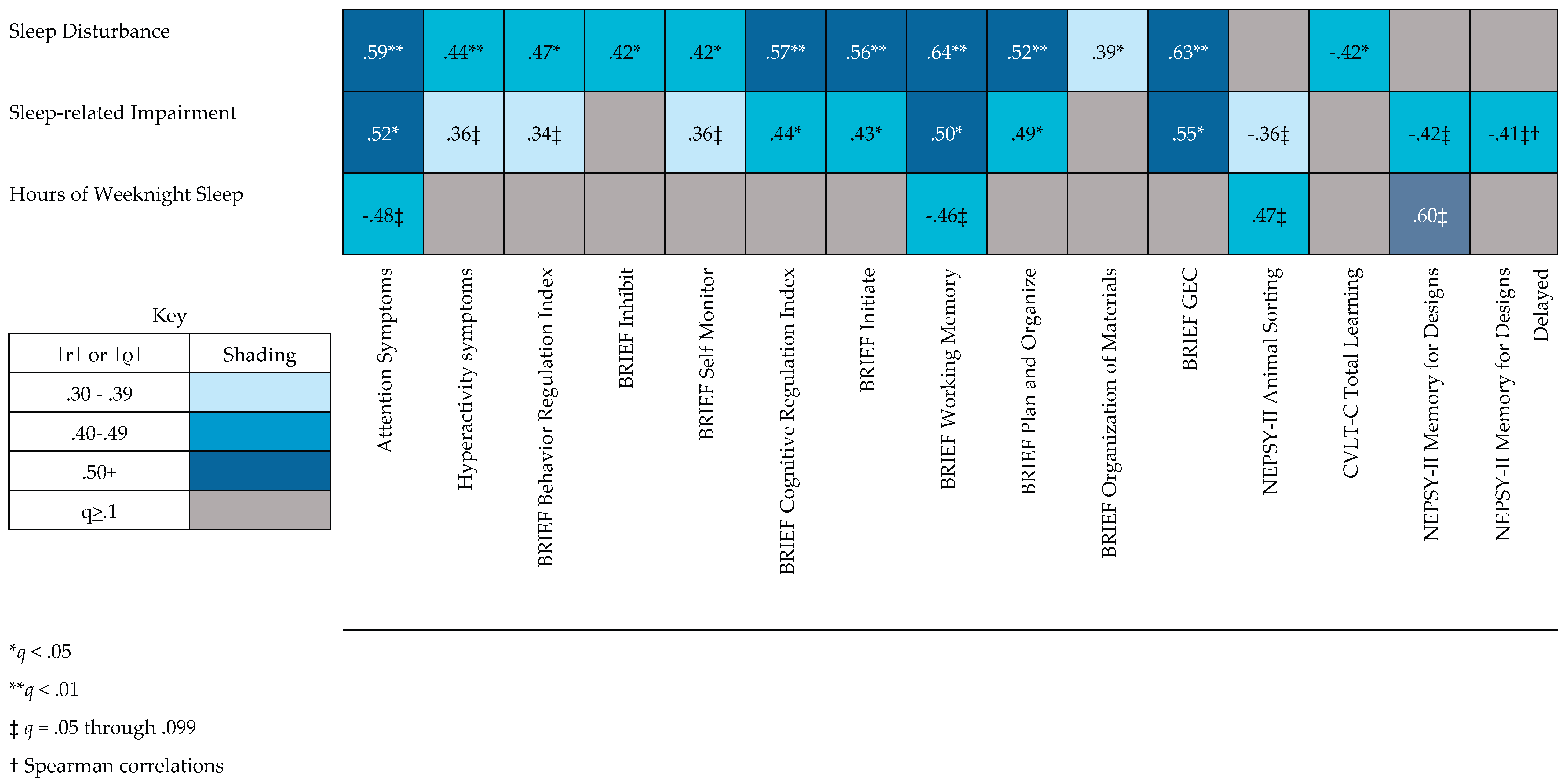
Figure 2.
Mean Caregiver-Reported Attention and Working Memory Problems in Youth With and Without Sleep Problems.
Figure 2.
Mean Caregiver-Reported Attention and Working Memory Problems in Youth With and Without Sleep Problems.
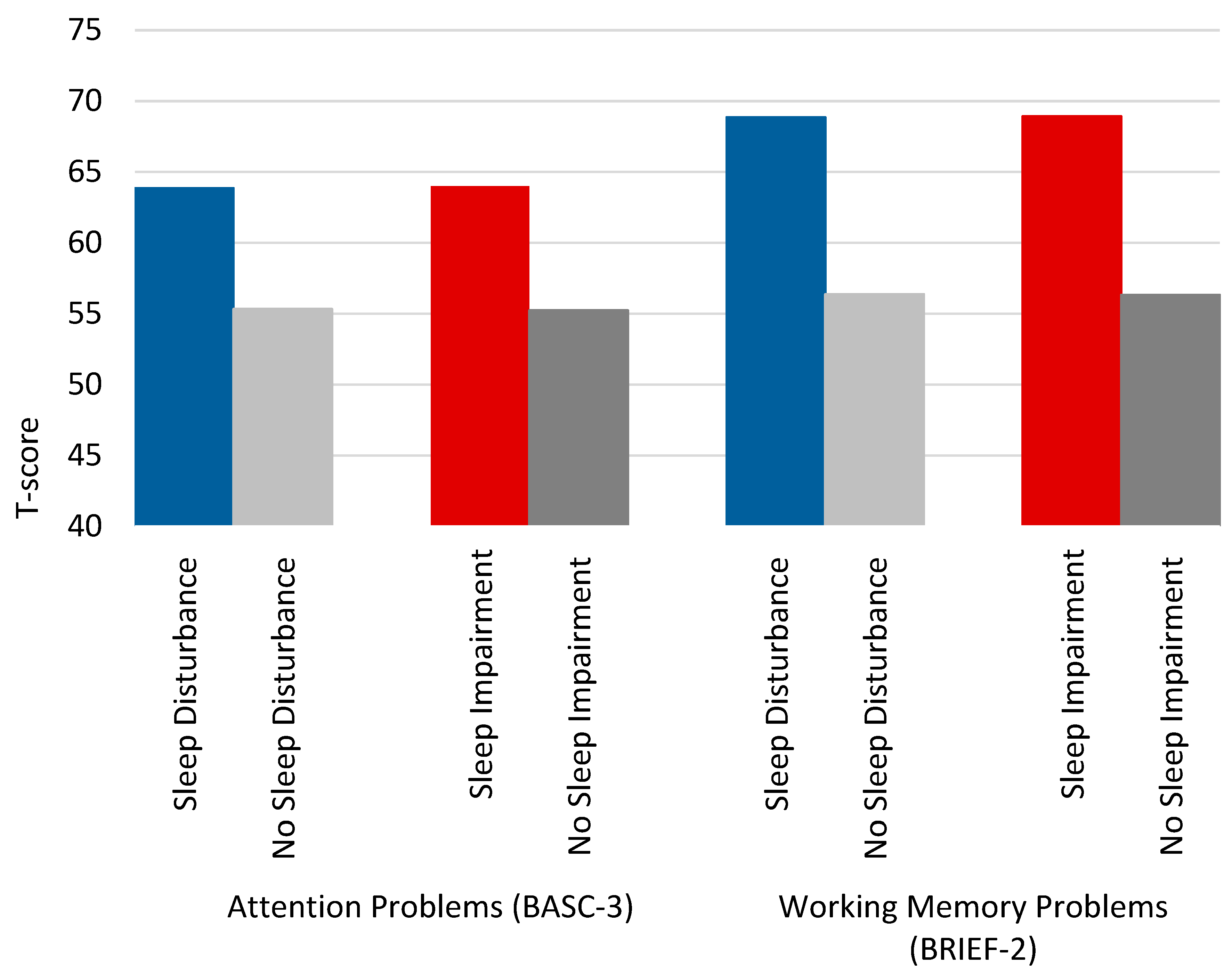

Table 1.
Sample Characteristics (N = 35).
| Age | M = 10.67 years SD = 2.86 Range = 6.42–16.91 |
| n(%) | |
| Sex | |
| Female | 17 (48.6%) |
| Male | 18 (51.4%) |
| Race and Ethnicity | |
| Asian | 5 (14.3%) |
| Black or African American | 4 (11.4%) |
| White | 29 (82.9%) |
| Hispanic or Latino | 5 (14.3%) |
| Parent Education (highest in household) | |
| 12 years (Completed high school diploma/GED) | 4 (11.4%) |
| 14 years (Completed associate’s degree/2-year college) | 1 (2.9%) |
| 16 years (Completed bachelor’s degree) | 9 (25.7%) |
| 18 years (Completed master’s degree) | 13 (37.1%) |
| 20+ years (Completed doctoral degree) | 7 (20.0%) |
| ADHD Diagnosis and Treatment | |
| Diagnosed with ADHD or met criteria based on parent- report symptom count | 19 (54.3%) |
| Currently taking ADHD medication | 11 (31.4%) |
| Stimulant | 9 (25.7%) |
| Nonstimulant | 2 (5.7%) |
Table 2.
Correlations Between Sleep variables and Cognitive Outcomes.
| Sleep Disturbance | Sleep-Related Impairment | Weeknight Sleep Duration | |
| Parent-Report Questionnaires | r / ρ | r / ρ | r / ρ |
| BASC-3 | |||
| Attention Symptoms | .59** | .52* | -.48‡ |
| Hyperactivity Symptoms | .44* | .36‡ | -.24 |
| BRIEF-2 | |||
| Behavior Regulation Index | .47* | .34‡ | -.27 |
| Inhibit | .42* | .30 | -.20 |
| Self-Monitor | .42* | .36 | -.36 |
| Cognitive Regulation Index | .57** | .44* | -.24 |
| Initiate | .56** | .43* | -.10 |
| Working Memory | .64** | .50* | -.46‡ |
| Plan/Organize | .52** | .49* | -.18 |
| Task-Monitor | .13 | .16 | -.08 |
| Organization of Materials | .39* | .28 | -.13 |
| Global Executive Composite | .63** | .55* | -.31 |
| Performance-Based Testing | |||
| Executive Functioning | |||
| Digit Span Forward | -.33 | -.28 | .07 |
| Digit Span Total | -.15 | -.20 | -.04 |
| Picture Span | -.28 | -.24 | .22 |
| Working Memory Index | -.21 | -.22 | .10 |
| Animal Sorting Total | -.23 | -.36‡ | .47‡ |
| Inhibition Total Errors | -.07 | -.08 | .36 |
| Learning and Memory | |||
| CVLT Trial 1 Free Recall | -.29 | -.14 | .08 |
| CVLT Total Learning | -.42* | -.27 | .33 |
| CVLT Long-Delay Free Recall | -.31† | -.19† | .23† |
| Memory for Designs | -.31 | -.42‡ | .60* |
| Memory for Designs Delayed | -.22† | -.41‡ † | .35† |
| Academics | |||
| Word Reading | -.11† | -.15† | .34† |
| Math Computation | -.16† | -.04† | -.00† |
Note. Statistical significance was evaluated using a two-tailed alpha level of .05. The Benjamini-Hochberg false discovery rate (FDR) procedure was applied to p-values to account for multiple comparisons. † Spearman correlations. *q < .05. **q < .01. ‡ q = .05 through .099.
Table 3.
Group Differences in Cognitive Outcomes by Sleep Disturbance and Sleep-Related Impairment.
| Sleep Disturbance |
No Sleep Disturbance | T / Z† | Sleep-Related Impairment | No Sleep-Related Impairment | T / Z† | |
| Parent-Report Questionnaires | Mean (SD) | Mean (SD) | Mean (SD) | Mean (SD) | ||
| BASC-3 | ||||||
| Attention Symptoms | 63.86 (7.29) | 55.33 (8.92) | 2.97 | 64.00 (7.79) | 55.24 (8.55) | 3.08* |
| Hyperactivity Symptoms | 61.43 (10.73) | 55.67 (10.70) | 1.56 | 62.00 (10.10) | 55.29 (10.86) | 1.84 |
| BRIEF-2 (T-Scores) | ||||||
| Behavior Regulation Index (T) | 61.00 (9.86) | 56.29 (11.82) | 1.23 | 61.93 (8.89) | 55.67 (12.02) | 1.67 |
| Inhibit | 62.00 (9.84) | 56.24 (12.49) | 1.45 | 61.71 (10.33) | 56.43 (12.33) | 1.32 |
| Self-Monitor | 56.86 (12.45) | 54.86 (10.23) | 0.52 | 59.64 (9.90) | 53.00 (11.17) | 1.80 |
| Cognitive Regulation Index | 66.14 (9.26) | 57.57 (9.92) | -2.18† | 66.29 (8.33) | 57.48 (10.36) | 2.66 |
| Initiate | 60.43 (11.13) | 52.52 (8.86) | -2.16† | 60.86 (9.09) | 52.24 (10.02) | -2.70†* |
| Working Memory | 68.86 (9.17) | 56.38 (10.52) | -3.14†* | 68.93 (9.51) | 56.33 (10.26) | 3.66* |
| Plan/Organize | 62.64 (9.92) | 55.33 (9.36) | 2.21 | 63.93 (8.98) | 54.48 (9.16) | -2.79†* |
| Task-Monitor | 62.64 (7.64) | 62.38 (10.93) | 0.08 | 64.36 (7.78) | 61.24 (10.68) | 0.94 |
| Organization of Materials | 61.93 (9.87) | 56.48 (11.78) | 1.43 | 61.79 (10.93) | 56.57 (11.20) | 1.36 |
| Global Executive Composite | 65.71 (8.49) | 57.62 (10.07) | -2.48† | 67.14 (7.07) | 56.67 (9.86) | 3.42* |
| Performance-Based Testing | ||||||
| Executive Functioning | ||||||
| Digit Span Forward | 9.15 (3.91) | 9.71 (3.13) | 0.27† | 8.36 (3.75) | 10.30 (2.98) | -1.68 |
| Digit Span Total | 9.93 (3.89) | 9.05 (2.94) | -1.12† | 8.50 (4.45) | 10.00 (2.24) | -1.32 |
| Picture Span | 8.43 (3.69) | 9.24 (3.42) | -0.66 | 8.21 (4.00) | 9.38 (3.14) | -0.96 |
| Working Memory Index | 95.43 (18.10) | 94.62 (17.00) | 0.13 | 90.71 (20.34) | 97.76 (14.58) | -1.20 |
| Animal Sorting Total | 8.54 (4.37) | 9.28 (3.29) | -0.54 | 7.54 (3.86) | 10.00 (3.36) | -1.89 |
| Inhibition Total Errors | 8.08 (5.06) | 7.39 (4.09) | 0.42 | 6.62 (5.42) | 8.44 (3.57) | -1.13 |
| Learning and Memory | ||||||
| CVLT Trial 1 Free Recall | -0.57 (1.09) | -0.21 (1.06) | -0.97 | -0.64 (1.08) | -0.16 (1.05) | -1.31 |
| CVLT Total Learning | 45.79 (12.17) | 49.30 (9.48) | -0.95 | 44.71 (12.09) | 50.05 (9.18) | -1.46 |
| CVLT Long-Delay Free Recall | -0.54 (0.95) | -0.21 (0.94) | -0.99 | -0.54 (0.91) | -0.21 (0.97) | -0.99 |
| Memory for Designs | 7.33 (4.70) | 8.05 (3.25) | -0.51 | 6.00 (4.13) | 8.85 (3.23) | -2.17 |
| Memory for Designs Delayed | 8.15 (4.02) | 9.00 (3.63) | 0.12† | 7.08 (4.23) | 9.78 (3.00) | 1.41† |
| Academics | ||||||
| Word Reading | 91.00 (23.83) | 94.30 (13.80) | 0.02† | 87.86 (22.67 | 96.50 (14.13) | 1.19† |
| Math Computation | 93.43 (15.36) | 96.52 (17.23) | -0.14† | 90.64 (17.02) | 98.38 (15.52) | 0.46† |
Note. Statistical significance was evaluated using a two-tailed alpha level of .05. The Benjamini-Hochberg false discovery rate (FDR) procedure was applied to p-values to account for multiple comparisons. † Mann-Whitney U Test, z-score reported. *q < .05. **q < .01.
Table 4.
Hierarchical Regression Results.
| Attention Problems | Hyperactivity | Global Executive Composite | Working Memory Index | Animal Sorting | Memory Composite | |
| Step 1: Demographic Covariates | ||||||
| β (p) | β (p) | β (p) | β (p) | β (p) | β (p) | |
| Age | -.04 (.822) | -.23 (.184) | -.05 (.775) | -.07 (.679) | -.32 (.120) | -.38 (.095) |
| Sex | .07 (.698) | .02 (.908) | -.07 (.699) | -.04 (.811) | -.15 (.448) | -.05 (.799) |
| ADHD Diagnosis | .33 (.145) | .47 (.037) | .31 (174) | .46 (.049) | -.11 (707) | -.21 (.491) |
| ADHD Medication | .18 (.427) | .05 (.828) | .16 (.490) | -.03 (.913) | .11 (.719) | .19 (.529) |
| R2 | .22 | .26 | .19 | .20 | .13 | .16 |
| Adjusted R2 | .11 | .16 | .07 | .08 | -.01 | .01 |
| F | 1.95 (.131) | 2.52 (.064) | 1.62 (.198) | 1.71 (.177) | 0.91 (.477) | 1.05 (.403) |
| Step 2: Sleep Variables | ||||||
| β (p) | β (p) | β (p) | β (p) | β (p) | β (p) | |
| Age | -.25 (.228) | -.32 (.175) | -.05 (.822) | -.36 (.070) | -.03 (.910) | -.12 (.643) |
| Sex | -.04 (.816) | -.04 (.840) | -.07 (.681) | -.20 (.241) | .12(.598) | .16 (.461) |
| ADHD Diagnosis | .12 (.559) | .37 (.127) | .26 (.228) | .20 (.318) | .07 (.820) | .07(.790) |
| ADHD Medication | .07 (.742) | -.04 (.859) | -.03 (.897) | -.14 (.449) | .17 (.560) | .23 (.388) |
| Sleep Disturbance | .34 (.152) | .19 (.479) | .41 (.086) | .31 (.162) | .22 (.471) | -.23 (.400) |
| Sleep-Related Impairment | .15 (.475) | .16 (.506) | .31 (.162) | .19 (.356) | -.34 (.224) | -.26 (.328) |
| Weeknight Sleep Duration | -.31(.254) | -.11 (.710) | .11 (.684) | -.45(.086) | .55 (.131) | .40 (.253) |
| R2 | .51 | .37 | .50 | .56 | .31 | .48 |
| Adjusted R2 | .37 | .19 | .36 | .44 | .08 | .29 |
| F | 3.67 (.007) | 2.10 (.081) | 3.55 (.009) | 4.60 (.002) | 1.35 (.276) | 2.53 (0.51) |
| Δ R2 | .29 | .11 | .31 | .37 | .18 | .32 |
| ΔF | 4.89 (.008) | 1.41 (.264) | 5.17 (.006) | 7.01 (.001) | 1.83 (.173) | 3.93 (.024) |
Bold = p < .05.
Disclaimer/Publisher’s Note: The statements, opinions and data contained in all publications are solely those of the individual author(s) and contributor(s) and not of MDPI and/or the editor(s). MDPI and/or the editor(s) disclaim responsibility for any injury to people or property resulting from any ideas, methods, instructions or products referred to in the content. |
© 2026 by the authors. Licensee MDPI, Basel, Switzerland. This article is an open access article distributed under the terms and conditions of the Creative Commons Attribution (CC BY) license (http://creativecommons.org/licenses/by/4.0/).
Copyright: This open access article is published under a Creative Commons CC BY 4.0 license, which permit the free download, distribution, and reuse, provided that the author and preprint are cited in any reuse.