
Submitted:
14 September 2026
Posted:
15 September 2026
You are already at the latest version
Abstract
Psammomys obesus is a diurnal herbivorous rodent widely distributed across the arid regions of North Africa and the Arabian Peninsula. Although it has ecological, agricultural, public-health, and biomedical importance, its helminth fauna remains poorly known. This study provides the first inventory of helminth parasites infecting P. obesus in southern Tunisia and examines variations in parasitism according to host sex, age, body condition and sampling region. A total of 152 specimens of P. obesus were captured between September 2023 and March 2026 in Tamaghza and Djebel Dahar regions. Parasitological examination revealed four helminth species: three cestodes, Sudarikovina aegyptica, Gerbillitaenia psammomi and Mesocestoides sp. larvae, and one nematode, Syphacia sp. Their respective prevalences were 63.82%, 12.50%, 0.66% and 16.45%. The findings of Mesocestoides and Syphacia species represent new records for P. obesus. Furthermore, S. aegyptica constitutes a new record for Tunisia. Host age and sampling region significantly influenced the occurrence and abundance of G. psammomi, as adults were more likely to be infected and harbored a significantly higher parasite burden than juveniles. In contrast, host sex and body condition had no significant effect. For S. aegyptica and Syphacia sp. no significant association was found between parasite occurrence or abundance and the host’s sex, age or body condition.
Keywords:
helminth fauna
; infection parameters
; host–parasite interactions
1. Introduction
The fat sand rat, Psammomys obesus, is a diurnal rodent that inhabits dense and complex burrow systems excavated in sandy substrates beneath shrubs of the family Chenopodiaceae. These shrubs provide the rodents with protection from avian predators [1,2,3,4,5]. The species is widely distributed throughout the arid and semi-arid regions of North Africa, extending from Mauritania to Egypt and Sudan and further east into Arabian Peninsula [6,7]. The fat sand rat plays a significant role in the functioning of arid terrestrial ecosystems and is also of considerable interest in medical research. It serves as an important link in the food chain and constitutes prey for several predators, including snakes, owls, diurnal raptors, and golden jackals [8]. In biomedical research, the fat sand rat is widely used as an experimental model for metformin-sensitive nutritional type 2 diabetes and its associated complications, notably cataracts, pancreatic atrophy, and impaired renal function [9]. However, this rodent species also poses a significant risk to public health and agriculture. It serves as the main reservoir of certain vector-borne diseases, particularly the leishmaniasis caused by Leishmania major [10,11,12,13]. In addition, it can cause considerable damage to crops and to earthen dikes used to catch rainwater (known as “Tabias”).
Over the past few decades, numerous studies have focused on the role of P. obesus in the transmission cycle of L. major in arid areas of the Middle East and North Africa [14,15,16]. In contrast, knowledge of the helminth fauna of the fat sand rat remains limited and scattered. Indeed, the earliest reports of helminths in P. obesus mainly originated from parasitological surveys conducted, from the mid-twentieth century onwards, on rodents inhabiting Saharan regions [17,18,19]. These studies revealed a helminth fauna composed primarily of nematodes and cestodes. To date, several nematode species have been recorded in P. obesus. In Tunisia, Bernard [20,21] reported the presence of Trichuris muris psammomysi, Longistriata seurati, Trichosomoides crassicauda, and Gongylonema brevispiculum. In the same country, Gongylonema neoplasticum was subsequently reported by Jrijer et al. [22]. In Israel, a representative of the genus Trichostrongylus was identified by Wertheim and Durette-Desset [23], whereas Trichuris muris was recorded in Egypt by Anwar et al. [24]. The cestode fauna of P. obesus also includes several species reported from different geographical regions. Sudarikovina aegyptica was recorded in Egypt by Mikhail and Fahmy [25], while Pseudocatenotaenia matovi was reported in Syria by Schmidt et al. [26]. Gerbillitaenia psammomi has been documented in several studies conducted in Egypt [27,28,29,30,31,32] and recently in Tunisia [33]. In addition, Raillietina trapezoides was recorded in Egypt, Palestine, and Tunisia [24,34,35]. Finally, the hymenolepidid Rodentolepis nana was reported in captive individuals [36].
Furthermore, the ecological and environmental drivers of the occurrence and abundance of helminths associated with P. obesus, are still poorly investigated, even though such data are essential for gaining a better understanding of their potential role in the occurrence and dynamics of co-infections with other parasites.
The aim of the present study was to investigate the helminth fauna of P. obesus in southern Tunisia by determining the prevalence, mean abundance, and mean intensity of the helminth parasites infecting this host. In addition, the study assessed the effects of host sex, age class, sampling site, and body condition on these parasitological parameters.
2. Materials and Methods
2.1. Hosts and Parasites Identification
Between September 2023 and March 2026, a total of 21 field trips were conducted across the Djebel Dahar and Tamaghza areas for animal capture and sampling. These field surveys resulted in the collection of 152 Psammomys obesus specimens, including 100 individuals from Tamaghza and 52 from the Djebel Dahar (Figure 1).
The animals were captured using snap traps placed at burrow entrances. Traps were set either after individuals had been directly observed returning to their burrows at sunrise or at burrows showing recent signs of activity, such as freshly displaced sand outside the burrow or cut fragments of Haloxylon salicornicum near the entrance.
The captured individuals were weighed, to the nearest 0.1 g, using a pan balance, and the total body length, including the head, was measured by means of a digital caliper, to the nearest 0.1 mm. Sex was determined by macroscopic examination of the gonads following dissection. The sample comprised 81 females and 71 males. Age was estimated using a combination of craniometric measurements and the assessment of dental wear patterns. Two distinct age classes were distinguished: young individuals are generally characterized by smaller cranial dimensions and by upper and lower third molars that are either unerupted or only recently erupted, showing little or no wear. Their molars display well-defined cusps, laminae, and labial cusplets, with high enamel relief and limited dentine exposure. In contrast, adults generally exhibit larger cranial dimensions. Their third molars are fully erupted, and dental wear is more pronounced, resulting in a progressive reduction of enamel relief, greater dentine exposure, and, in older individuals, partial coalescence of some laminae and cusps as well as a loss of definition of the labial cusplets. Thus, cranial size, the eruption status of the third molars, and the degree of dental wear constitute relevant criteria for distinguishing juvenile from adult individuals [37].
The body cavity and internal organs were thoroughly examined for helminths under a stereomicroscope. Recovered platyhelminths were gently flattened between a microscope slide and coverslip and fixed in either 70% ethanol or Bouin’s solution. The specimens were subsequently stained with Semichon’s acetocarmine, dehydrated through a graded ethanol series, cleared in clove oil, and permanently mounted in Canada balsam. Nematodes were cleared in Amann’s lactophenol prior to morphological examination. Helminth species were identified according to the relevant literature [25,28,32,33,38,39,40,41,42].
2.2. Data Analysis
Infection parameters, including prevalence, mean abundance, and mean intensity, were calculated for each parasite species following the definitions proposed by Bush et al. [43].
Generalized linear mixed models (GLMMs) were then used to assess the relationships of host sex (two classes: male = 0; female = 1), age [two classes: juveniles (1-2 year-old) = 0 vs adults (>2year-old) = 1] and body condition, as fixed effects, on the occurrence probability and abundance of recorded helminth species, while considering the sampling period (seven classes) as a random factor to account for potential non-independence among observations collected at the same period. Body condition was assessed through the scaled mass index (SMI), following the procedure proposed by Peig and Green [44]. This index provides an estimation of the predicted body mass of an individual when the structural body size of that individual was standardized to a reference value: SMI = M × (L/L0)βSMA, where M is the body mass of the individual concerned, L is a linear body measurement (body length in our study), and L0 is a reference value of L (the mean body length of the studied sample). The scaling exponent βSMA corresponds to the estimated slope of a log-log standardized major axis (SMA) regression of M on L [44].
Because of the particular structure of the data, different GLMMs were conducted for the different species recorded. One species occurred in the two regions sampled (see results), so we also entered region (Dahar vs Tamaghza) as a further fixed effect to assess whether the occurrence probability and abundance of this species differed between these two areas. However, this was not done for the other species as they only occurred in one region each. Occurrence was always modeled by considering a binomial distribution and a logit link function. Abundance was modeled using a negative binomial distribution and log link function, except for one species where the model did not converge. For this species, data were log(x+1)-transformed and we run a GLMM considering a normal distribution and an identity link function.
Results are reported as parameter estimates with their associated standard errors (β ± SE), test statistics, and P-values. Effects were considered statistically significant at P< 0.05. All statistical analyses were performed using the GLIMMIX procedure in SAS (SAS Institute Inc., 2008).
3. Results
Four helminth species were identified: three cestodes, Sudarikovina aegyptica (Anoplocephalidae), Gerbillitaenia psammomi (Catenotaeniidae) and tetrathyridium larvae of the genus Mesocestoides (Mesocestoididae), and one nematode, Syphacia sp. (Oxyuridae) (Figure 2). Their prevalence rates were 63.82%, 12.50%, 0,66% and 16.45%, respectively. The four species exhibited distinct geographical distributions.
G. psammomi was recorded in both Djebel Dahar and Tamaghza, whereas S. aegyptica was detected exclusively in Djebel Dahar and Syphacia sp. exclusively in Tamaghza. Mesocestoides sp. was found only in one fat sand rat from Djebel Dahar.
The results of the generalized linear mixed models (GLMMs) showed that host age and sampling region significantly influenced both the occurrence and abundance of G. psammomi in P. obesus. By contrast, neither host sex nor the scaled mass index (SMI) had a statistically significant effect at the 5% significance level.
Adult P. obesus had a significantly higher probability of harboring G. psammomi than juveniles (β = 0.935 ± 0.411, p = 0.024). More specifically, the odds of occurrence were approximately 2.55 times higher in adults than in juveniles. Sampling region also had a significant effect: individuals collected in Djebel Dahar had approximately 4.10 times higher odds of harboring G. psammomi than those collected in Tamaghza (β = 1.412 ± 0.592, p = 0.018).
Host age also had a highly significant effect on parasite abundance (β = 1.266 ± 0.313, p < 0.001). The expected abundance of G. psammomi was approximately 3.55 times higher in adults than in juveniles. Similarly, abundance was significantly higher in Djebel Dahar than in Tamaghza (β = 1.031 ± 0.316, p = 0.001), with an expected abundance approximately 2.80 times greater in Djebel Dahar (Table1, Figure 3).
In contrast, host sex had no statistically significant effect on either the occurrence (p = 0.189) or abundance (p = 0.128) of G. psammomi. The SMI was also not significantly associated with parasite occurrence (p = 0.283). Although its estimated effect on abundance was positive, it remained non-significant at the 5% level (β = 0.013 ± 0.007, p = 0.086) (Table1, Figure 3).

Table 1.
Results of GLMMs of the occurrence probability and abundance of G. psammomi as functions of sex (female = 1 vs male = 0), age (adult = 1 vs young = 0), region (Dahar = 1 vs Tamaghza = 0) and SMI (scaled mass index; continuous variable) as fixed effects, while accounting for sampling period (seven classes) as a random factor. Occurrence was modeled by considering a binomial distribution with a logit link function, while abundance was modeled using a negative binomial distribution and a log link function. Significant effects are highlighted in bold.
Table 1.
Results of GLMMs of the occurrence probability and abundance of G. psammomi as functions of sex (female = 1 vs male = 0), age (adult = 1 vs young = 0), region (Dahar = 1 vs Tamaghza = 0) and SMI (scaled mass index; continuous variable) as fixed effects, while accounting for sampling period (seven classes) as a random factor. Occurrence was modeled by considering a binomial distribution with a logit link function, while abundance was modeled using a negative binomial distribution and a log link function. Significant effects are highlighted in bold.
| Effect | Occurrence | Abundance | |||||||
|---|---|---|---|---|---|---|---|---|---|
| β ± SE | DF | t | P | β ± SE | DF | t | P | ||
| Intercept | -1.679 ± 1.479 | 6 | -1.14 | 0.299 | -0.534 ± 1.022 | 6 | -0.52 | 0.620 | |
| Sex | -0.521 ± 0.395 | 141 | -1.32 | 0.189 | -0.464 ± 0.303 | 141 | -1.53 | 0.128 | |
| Age | 0.935 ± 0.411 | 141 | 2.28 | 0.024 | 1.266 ± 0.313 | 141 | 4.05 | < 0.001 | |
| Region | 1.412 ± 0.592 | 141 | 2.39 | 0.018 | 1.031 ± 0.316 | 141 | 3.26 | 0.001 | |
| SMI | 0.011 ± 0.010 | 141 | 1.08 | 0.283 | 0.013 ± 0.007 | 141 | 1.73 | 0.086 | |
For S. aegyptica, sex, age, and scaled mass index (SMI) had no statistically significant effect on either the probability of occurrence or abundance (p > 0.05; Table 2).
For Syphacia sp., neither age nor the standardized mass index (SMI) of P. obesus had a statistically significant effect on either the probability of occurrence or parasite abundance (p > 0.05; Table 3).
Regarding the probability of occurrence of Syphacia sp., female P. obesus showed a very slightly higher estimated probability than males (β = 0.023). However, this effect was nearly null and not statistically significant (p = 0.963). Likewise, adult individuals appeared to have a higher probability of infestation than juveniles (β = 0.675), but this difference was not statistically significant (p = 0.208). The SMI was associated with a negative coefficient (β = -0.025), suggesting that the probability of occurrence may decrease as body condition increases. Nevertheless, this trend remained non-significant (p = 0.188).
With regard to the abundance of Syphacia sp., females showed a slightly lower estimated abundance than males (β = −0.203; p = 0.623), whereas adult individuals exhibited a slightly higher abundance than juveniles (β = 0.151; p = 0.719). However, these differences were small and not statistically significant. The SMI was also negatively associated with the abundance of Syphacia sp. (β = −0.022; p = 0.106). Although this relationship was the closest to the significance threshold, it does not provide sufficient evidence to conclude that a statistically significant effect exists.
4. Discussion
The present study constitutes the first finding of S. aegyptica in Tunisia. Furthermore, the findings of Mesocestoides sp., and Syphacia sp. represent new records infecting P. obesus. Concerning cestodes, the anoplocephalid S. aegyptica was previously cited in fat sand rats from Egypt [25]. The catenotaeniid G. psammomi was found parasitizing Meriones shawi in Morocco [45] and P. obesus in Egypt and Tunisia [27,28,29,30,31,32,33]. Adult stages of three species of the genus Mesocestoides, namely Mesocestoides corti, Mesocestoides lineatus and Mesocestoides litteratus have been reported in Tunisia. Of these three species, M. lineatus is the most frequently reported due to its presence both in dogs and cats [46,47,48,49].
In other studies, Lahmar et al. [50,51] reported species of Mesocestoides such as M. lineatus and M. litteratus in rural and stray dogs. Regarding other wild carnivores, M. corti, M. lineatus and M. litteratus were reported in the red fox (Vulpes vulpes) and the golden jackal (Canis aureus) with prevalences quite high, particularly for M. lineatus: 22% (M. corti), 55.6% (M. lineatus) and 33% (M. litteratus) in the red fox; and 12.9% (M. corti), 74% (M. lineatus) and 23% (M. litteratus) in the golden jackal [52].
Regarding the oxyurid of the genus Syphacia, the present work represents the first report of this genus in P. obesus. In Tunisia, Syphacia obvelata has been reported in various Gerbillinae rodents (Gerbillus campestris, G. gerbillus, G. pyramidum, Meriones shawi, and Jaculus jaculus) [21]. However, the author himself stated that this species was synonymous with Syphacia nigeriana. Subsequently, Hugot [40] considered the findings in Tunisian gerbillines to belong to the species S. nigeriana. The Syphacia found parasitizing the fat sand rat in our study shows certain similarities to S. nigeriana such as the distance between amphids or the egg size in females, although the spicule in males is clearly smaller in our specimens (57–77 µm vs. 70–95 µm).
The prevalence and abundance of G. psammomi were significantly higher in adult rodents than in juveniles. This difference may be explained by the longer exposure period experienced by adult individuals, which promotes the gradual accumulation of infections throughout their lifetime [53,54]. In addition, adults generally occupy larger home ranges while searching for food or mates, thereby increasing their likelihood of coming into contact with the parasite’s intermediate hosts. Although the life cycle of G. psammomi remains to be clarified, these intermediate hosts may include the mite Glyciphagus domesticus, as reported for certain species of the family Catenotaeniidae, particularly Catenotaenia pusilla [55,56,57].
Furthermore, P. obesus specimens captured in Djebel Dahar exhibited a higher prevalence and abundance of G. psammomi than those collected in Tamaghza. These variations may be attributed to local ecological or epidemiological conditions that are more favorable to parasite transmission in Djebel Dahar, such as a greater availability of potential intermediate hosts or environmental conditions conducive to their development and survival.
In contrast, neither sex nor body condition appeared to be a major determinant of infection in P. obesus in the present study. The absence of differences between sexes may be explained by the fact that males and females share broadly similar habitats, behaviors, and diets, resulting in comparable levels of exposure to the parasite. The lack of a clear trend in the relationship between parasitic infestation and body condition highlights the fact that this relationship is often dynamic, as different, even opposing, trends can occur simultaneously within the same population. For example, a low parasite load might allow the host to make better use of its energy resources and maintain good body condition, thereby increasing its defenses against other parasites. At the same time, a host in good condition would be active and occupy a large home range, making it more susceptible to encountering parasites. It would also possess the necessary resources to tolerate a high parasite load and survive [58,59].
S. aegyptica appears to have a restricted biogeographical distribution, confined to the arid regions inhabited by its definitive host, P. obesus. This anoplocephalid cestode was first reported in P. obesus in Egypt by Mikhail and Fahmy [25]. In the present study, we document S. aegyptica for the first time in the fat sand rat in Tunisia, specifically in the Djebel Dahar region. This finding therefore extends the known geographical range of the cestode.
The absence of S. aegyptica from the Tamaghza region may be associated with the absence or limited availability of suitable intermediate hosts. These hosts may include oribatid mites, which have been identified as intermediate hosts for other members of the family Anoplocephalidae, particularly species belonging to the genera Anoplocephaloides, Bertiella, and Moniezia [60,61].
The lack of significant effects of sex, age, and body mass index on the prevalence and abundance of S. aegyptica suggests that infection may be influenced more strongly by environmental exposure than by the individual characteristics of P. obesus. Breeding pairs and their offspring generally share the same burrow and display similar feeding habits, with no marked dietary differences between the sexes. Their diet consists primarily of succulent halophytic plants, particularly species traditionally assigned to the family Chenopodiaceae [6,7,62]. This shared use of habitat and food resources may expose individuals to similar levels of contact with potential intermediate hosts, such as oribatid mites, and may consequently explain the comparable infection levels observed among the different host categories.
5. Conclusions
Knowledge of the diversity of the helminth fauna infecting the fat sand rat, P. obesus, in North Africa remains limited. The present study revealed a relatively diverse helminth community in this host species, comprising three cestodes (S. aegyptica, G. psammomi, and Mesocestoides sp.) and one nematode (Syphacia sp.). The occurrence of Mesocestoides sp. and Syphacia sp. represents new host records for P. obesus, while S. aegyptica is reported for the first time in Tunisia.
Sampling region and host age significantly influenced both the occurrence and abundance of G. psammomi. The significant variation observed between sampling localities suggests that local environmental and ecological conditions may play an important role in shaping the transmission dynamics of this parasite. Among the host-related factors examined, including sex, age, and body condition, only age showed a significant association with G. psammomi infection. Adult hosts were more likely to be infected and harbored significantly higher parasite burdens than juveniles. In contrast, neither host sex nor body condition had a significant effect on parasite occurrence or abundance. For S. aegyptica and Syphacia sp., no significant associations were detected between parasite occurrence or abundance and the host characteristics examined, namely sex, age, and body condition. These findings indicate that the determinants of helminth infection in P. obesus are parasite-specific and may reflect differences in transmission pathways, host–parasite interactions, and local ecological conditions. Further studies incorporating larger sample sizes, seasonal variation, habitat characteristics, and the availability of intermediate hosts would help to clarify the ecological factors underlying the spatial distribution and transmission dynamics of these helminths.
Author Contributions
Conceptualization, J.M. and H.K.; methodology, A.B., J.M., S.S. and H.K.; investigation, A.B., J.M. and H.K.; resources, J.M. and H.K.; writing—original draft preparation, A.B., J.M., S.S. and H.K.; writing—review and editing, A.B., J.M., S.S. and H.K.; supervision, J.M. and H.K.; project administration, J.M. and H.K. All authors have read and agreed to the published version of the manuscript.
Funding
This research received no external funding.
Institutional Review Board Statement
Gundis were trapped under the permission of the “Direction Générale des Forêts (Ministère de l’Agriculture, des Resources Hydrauliques et de la Pêche Maritime)” of Tunisia, references 1822/2023 (2 October 2023), 1728/2024 (30 September 2024), 437/25 (13 July 2025) and 50/2026 (15 January 2026). Animal work was conducted in accordance with the European Directive 2010/63/UE and the Spanish Government Laws 42/2007 and RD 630/2013.
Informed Consent Statement
Not applicable.
Data Availability Statement
Type specimens of the studied species were deposited in the “Museu de Ciències Naturals de Barcelona” (Spain) under the following accession numbers: MZB 2025-7284 and MZB 2025-7285 (two specimens of S. aegyptica); MZB 2024-3090 to 2024-3093 (four specimens of G. psammomi); and MZB 2026-0443 to MZB 2026-0451 (35 males and 35 females of Syphacia sp.). Additional specimens of all species were deposited in the Jordi Miquel helminth collection at the University of Barcelona (“Secció de Parasitologia, Departament de Biologia, Sanitat i Medi Ambient, Facultat de Farmàcia i Ciències de l’Alimentació”).
Acknowledgments
The authors are grateful to the staff of the “Direction Générale des Forêts (Ministère de l’Agriculture, des Resources Hydrauliques et de la Pêche Maritime)” of Tunisia for granting permission to trap rodents during fieldwork conducted in southern Tunisia. Hédy Boubakri are also acknowledged for their valuable help during fieldwork. Ahlem Boubakri received a doctoral scholarship from the University of Gabès, funded by the Tunisian Ministry of Higher Education and Scientific Research and a scholarship from Coimbra Group that supported research stays at the University of Barcelona.
Conflicts of Interest
The authors declare no conflicts of interest.
References
- Daly, M.; Daly, S. Behavior of Psammomys obesus (Rodentia: Gerbillinae) in the Algerian Sahara. Z. Tierpsychol. 1975, 37, 298–321. [Google Scholar] [CrossRef]
- Harrison, D.L.; Bates, P. The mammals of Arabia, 2nd edition; Harrison Zool. Mus. Publ.: Sevenoaks, 1991. [Google Scholar]
- Fichet-Calvet, E.; Jomaâ, I.; Giraudoux, P.; Ashford, R.W. Estimation of fat sand rat Psammomys obesus abundance using surface indices. Acta Theriol. 1999, 44, 353–362. [Google Scholar] [CrossRef]
- Tchabovsky, A.V.; Krasnov, B.R.; Khokhlova, I.S.; Shenbrot, G.I. The effect of vegetation cover on vigilance and foraging tactics in the fat sand rat, Psammomys obesus. J. Ethol. 2001, 19, 107–115. [Google Scholar] [CrossRef]
- Tchabovsky, A.V.; Popov, S.V.; Krasnov, B.R. Intra- and interspecific variation in vigilance and foraging of two gerbillid rodents, Rhombomys opimus and Psammomys obesus: the effect of social environment. Anim. Behav. 2001, 62, 965–972. [Google Scholar] [CrossRef]
- Harrison, D.L. The Mammals of Arabia: Lagomorpha and Rodentia. Vol. III; Ernest Benn Ltd.: London, 1972; pp. 385–670. [Google Scholar]
- Mendelssohn, H.; Yom-Tov, Y. A report of birds and mammals which have increased their distribution and abundance in Israel due to human activity. Isr. J. Zool. 1999, 45, 35–47. [Google Scholar]
- Amr, Z.S.; Abu Baker, M.A.; Qumsiyeh, M.; Eid, E. Systematics, distribution and ecological analysis of rodents in Jordan. Zootaxa 2018, 4397, 1–94. [Google Scholar] [CrossRef] [PubMed]
- Gouaref, I.; Detaille, D.; Wiernsperger, N.; Khan, N.A.; Leverve, X.; Koceir, E.A. The desert gerbil Psammomys obesus as a model for metformin-sensitive nutritional type 2 diabetes to protect hepatocellular metabolic damage: Impact of mitochondrial redox state. PLoS ONE 2017, 12, e0172053. [Google Scholar] [CrossRef] [PubMed]
- Fichet-Calvet, E.; Jomaâ, I.; Ben Ismail, R.; Ashford, R.W. Leishmania major infection in the fat sand rat Psammomys obesus in Tunisia: interaction of host and parasite populations. Ann. Trop. Med. Parasitol. 2003, 97, 593–603. [Google Scholar] [CrossRef] [PubMed]
- Ghawar, W.; Toumi, A.; Snoussi, M.A.; Chlif, S.; Zâatour, A.; Boukthir, A.; Hamida, N.B.H.; Chemkhi, J.; Diouani, M.F.; Ben-Salah, A. Leishmania major Infection Among Psammomys obesus and Meriones shawi: Reservoirs of Zoonotic Cutaneous Leishmaniasis in Sidi Bouzid (Central Tunisia). Vector-Borne Zoonotic Dis. 2011, 11, 1561–1568. [Google Scholar] [CrossRef] [PubMed]
- Ghawar, W.; Attia, H.; Bettaieb, J.; Yazidi, R.; Laouini, D.; Ben Salah, A. Genotype profile of Leishmania major strains isolated from tunisian rodent reservoir hosts revealed by multilocus microsatellite typing. PLoS ONE 2014, 9, e107043. [Google Scholar] [CrossRef] [PubMed]
- Ben Othman, S.; Ghawar, W.; Chaouch, M.; Ayari, C.; Chemkhi, J.; Cancino-Faure, B.; Tomás-Pérez, M.; Alcover, M.M.; Riera, C.; Ben Salah, A.; Fisa, R.; Ben Ismail, R.; Ben Abderrazak, S. First detection of Leishmania DNA in Psammomys obesus and Psammomys vexillaris: Their potential involvement in the epidemiology of leishmaniasis in Tunisia. Infect. Genet. Evol. 2018, 59, 7–15. [Google Scholar] [CrossRef] [PubMed]
- Boudrissa, A.; Cherif, K.; Kherrachi, I.; Benbetka, S.; Bouiba, L.; Boubidi, S.C.; Benkhlef, R.; Arrar, L.; Hamrioui, B.; Harrat, Z. Spread of Leishmania major to the north of Algeria. Bull. Soc. Pathol. Exot. 2012, 105, 30–35. [Google Scholar] [PubMed]
- Samy, A.M.; Annajar, B.B.; Dokhan, M.R.; Boussaa, S.; Peterson, A.T. Coarse-resolution ecology of etiological agent, vector, and reservoirs of zoonotic cutaneous leishmaniasis in Libya. PLoS Negl. Trop. Dis. 2016, 10, e0004381. [Google Scholar] [CrossRef] [PubMed]
- Beniklef, R.; Aoun, K.; Boudrissa, K.; Ben Abid, M.; Cherif, K.; Aissi, W.; Benrekta, S.; Boubidi, S.C.; Späth, G.F.; Bouratbine, A.; Sereno, D.; Harrat, Z. Cutaneous leishmaniasis in Algeria; highlight on the focus of M’Sila. Microorganisms 2021, 9, 962. [Google Scholar] [CrossRef] [PubMed]
- Petter, A.J. Redescription et analyse critique de quelques espèces d’oxyures de la tortue grecque (Testudo graeca L.); diversité des structures céphaliques. Ann. Parasitol. Hum. Comp. 1961, 36, 648–671. [Google Scholar] [CrossRef]
- Durette-Desset, M.C. Essai de classification des nématodes héligmosomes: Corrélations avec la paléobiogéographie des hôtes. Mém. Mus. Natn. Hist. Nat. Sér. A 1971, 18, 1–126. [Google Scholar]
- Quentin, J.C. Essai de classification des oxyures Heteroxynematidae. Mém. Mus. Natn. Hist. Nat. Sér. A Zool. 1975, 94, 51–96. [Google Scholar]
- Bernard, J. Quelques Nématodes parasites nouveaux ou non encore signalés en Tunisie. Arch. Inst. Pasteur Tunis. 1969, 46, 397–411. [Google Scholar]
- Bernard, J. Faune des nématodes parasites des mammifères de Tunisie et des contrées voisines. Arch. Inst. Pasteur Tunis. 1987, 64, 265–319. [Google Scholar] [PubMed]
- Jrijer, J.; Bordes, F.; Morand, S.; Neifar, L. A survey of nematode parasites of small mammals in Tunisia, North Africa: Diversity of species and zoonotic implications. Comp. Parasitol. 2015, 82, 204–210. [Google Scholar] [CrossRef]
- Wertheim, G.; Durette-Desset, M.C. Helminthes de mammifères et d’oiseaux d’Israël VI.- La taxonomie et l’écologie des nématodes trichostrongyloides. Ann. Parasitol. Hum. Comp. 1975, 50, 735–762. [Google Scholar] [PubMed]
- Anwar, F.A.S.; Tolba, M.; Abdel-Gahfar, S.Kh.; Omar, H. El-Din M.; Abed, G.H.; Alkafafy, M. Intestinal helminth infestation of sand rats (Psammomys obesus) collected from north coast Egypt: ecological, morphological and histopathological approach. Fresenius Environ. Bull. 2022, 31, 1–11. [Google Scholar]
- Mikhail, J.W.; Fahmy, M.A.M. A new species of the genus Hymenandrya with a short review of the family Anoplocephalidae. Zool. Anz. 1968, 180, 436–441. [Google Scholar]
- Schmidt, G.D.; Greenberg, Z.; Wertheim, G. Tapeworms from Turkey and Syria in the Collection of the Late George G. Witenberg. Proc. Helminthol. Soc. Wash. 1985, 52, 312–313. [Google Scholar]
- Wolfgang, R.W. Helminth Parasites of Reptiles, Birds, and Mammals in Egypt: II. Catenotaenia aegyptica sp. nov. from Myomorph Rodents, with Additional Notes on the Genus. Can. J. Zool. 1956, 34, 6–20. [Google Scholar] [CrossRef]
- Mikhail, J.W.; Fahmy, M.A.M. Study on some members of genus Skrjabinotaenia with a description of a new species and a review of the subfamily Catenotaeniinae Spasski, 1946. Zool. Anz. 1968, 181, 439–450. [Google Scholar]
- Fahmy, M.A.M.; Mikhail, J.W.; McConnell, E. A survey of the helminth parasites collected from Egyptian small mammals. J. Egypt. Soc. Parasitol. 1971, 1, 47–58. [Google Scholar]
- Elmahy, R.A. Flatworms of some wild mammals with special reference to hymenolepidids from Egypt. Thesis, Tanta University, Tanta, Egypt, 2012. [Google Scholar]
- Elmahy, R.A. A scanning electron microscopic study on Meggittina gerbilli (Wertheim, 1954) and Skrjabinotaenia oranensis (Joyeux and Foley, 1930) (Cyclophyllidea: Catenotaeniidae) from Rodents in Egypt. Delta J. Sci. 2022, 45, 115–124. [Google Scholar] [CrossRef]
- Haukisalmi, V.; Elmahy, R.A. Taxonomic review of Skrjabinotaenia Akhumyan, Meggittina Lynsdale and Gerbillitaenia gen. nov. (Cestoda: Catenotaeniidae), parasites of rodents. Zootaxa 2025, 5590, 185–208. [Google Scholar] [CrossRef] [PubMed]
- Boubakri, A.; Kacem, H.; Martín-Carrillo, N.; Foronda, P.; Selmi, S.; Miquel, J. New data on the catenotaeniid cestode Gerbillitaenia psammomi (Mikhail and Fahmy, 1968) parasitizing Fat sand rats, Psammomys obesus (Muridae: Gerbillinae), in Tunisia. J. Helminthol. 2025, 99, 62. [Google Scholar] [CrossRef] [PubMed]
- Wertheim, G.; Schmidt, G.D.; Greenberg, Z. Witenbergitaenia sinaica gen. n., sp. n. (Anoplocephalidae) and other cestodes from small mammals in Israel and in the Sinai Peninsula. Bull. Mus. Natn. Hist. Nat. 1986, 8, 543–550. [Google Scholar] [CrossRef]
- Fichet-Calvet, E.; Wang, J.; Jomâa, I.; Ben Ismail, R.; Ashford, R.W. Patterns of the tapeworm Raillietina trapezoides infection in the fat sand rat Psammomys obesus in Tunisia: season, climatic conditions, host age and crowding effects. Parasitology 2003, 126, 481–492. [Google Scholar] [CrossRef] [PubMed]
- Gruber, H.E.; Johnson, T.L.; Kinsella, J.M.; Greiner, E.C.; Gordon, B.E. Tapeworm Identification in the Fat Sand Rat (Psammomys obesus obesus). Contemp. Top. 2001, 40, 22–24. [Google Scholar]
- Musser, G.G.; Heaney, L.R. Philippine rodents: definitions of Tarsomys and Limnomys plus a preliminary assessment of phylogenetic patterns among native Philippine murines (Murinae, Muridae). Bull. Am. Mus. Nat. Hist. 1992, 211. [Google Scholar]
- Quentin, J.-C. Morphologie comparée des structures céphaliques et génitales des Oxyures du genre. Syphacia Ann. Parasitol. 1971, 46, 15–60. [Google Scholar] [CrossRef]
- Quentin, J.-C. Les Oxyurinae des Rongeurs. Bull. Mus. Natn. Hist. Nat. Zool. 112, 3ème Sér. 1973, 167, 1045–1096. [Google Scholar] [CrossRef]
- Hugot, J.P. Les nématodes Syphaciinae parasites de Rongeurs et de Lagomorphes. Taxon. Zoogeographie. Evol. Mém. Mus. Natn. Hist. Nat. Zool. 1988, 141, 1–148. [Google Scholar]
- Khalil, L.F.; Jones, A.; Bray, R.A. Keys to the Cestode Parasites of Vertebrates; CAB International: Wallingford, UK, 1991; p. 751. [Google Scholar]
- Anderson, R.C.; Chabaud, A.G.; Willmott, S. Keys to the Nematode Parasites of Vertebrates Archival Volume; CAB International: Wallingford, UK, 2009; p. 463. [Google Scholar]
- Bush, A.O.; Lafferty, K.D.; Lotz, J.M.; Shostak, A.W. Parasitology meets ecology on its own terms: Margolis et al. revisited. J. Parasitol. 1997, 83, 575–583. [Google Scholar] [CrossRef]
- Peig, J.; Green, A.J. New perspectives for estimating body condition from mass/length data: the scaled mass index as an alternative method. Oikos 2009, 118, 1883–1891. [Google Scholar] [CrossRef]
- Joyeux, C.; Baer, J.G.; Gaud, J. Recherches helminthologiques marocaines. Cestodes (deuxième note). Arch. Inst. Pasteur Maroc. 1951, 4, 93–102. [Google Scholar]
- Juminer, B.; Durand, M. Polyparasitisme grave chez un chien tunisien. Arch. Inst. Pasteur Tunis. 1960, 37, 391–394. [Google Scholar]
- Bernard, J. Helminthes parasites du Chat sauvage (Felis libyca Forster) dans le Cap Bon. Arch. Inst. Pasteur Tunis. 1964, 41, 373–384. [Google Scholar]
- Bernard, J.; Ben Osman, F.; Juminer, B. Note sur les Cestodes du chat à Tunis. Arch. Inst. Pasteur Tunis. 1964, 41, 53–57. [Google Scholar]
- Bernard, J.; Ben Osman, F.; Juminer, B. Enquête sur les Helminthes parasites du Chien (Canis familiaris L.) à Tunis-Ville. Arch. Inst. Pasteur Tunis. 1967, 44, 1–89. [Google Scholar]
- Lahmar, S.; Sarciron, M.E.; Rouiss, M.; Mensi, M. Echinococcus granulosus and other intestinal helminths in semi-stray dogs in Tunisia: infection and re-infection rates. Tunis. Méd 2008, 86, 657–664. [Google Scholar] [PubMed]
- Lahmar, S.; Arfa, I.; Ben Othmen, S.; Jguirim, W.; Said, Y.; Aida, D.; Boufana, B. Intestinal helminths of stray dogs from Tunisia with special reference to zoonotic infections. Parasitol. Open 2017, 3, e18. [Google Scholar] [CrossRef]
- Lahmar, S.; Boufana, B.; Ben Boubaker, S.; Landolsi, F. Intestinal helminths of golden jackals and red foxes from Tunisia. Vet. Parasitol. 2014, 204, 297–303. [Google Scholar] [CrossRef] [PubMed]
- Behnke, J.M.; Lewis, J.W.; Zain, S.N.; Gilbert, F.S. Helminth infections in Apodemus sylvaticus in southern England: interactive effects of host age, sex and year on the prevalence and abundance of infections. J. Helminthol. 1999, 73, 31–44. [Google Scholar] [CrossRef]
- Mohd Zain, S.N.; Behnke, J.M.; Lewis, J.W. Helminth communities from two urban rat populations in Kuala Lumpur, Malaysia. Parasite Vectors 2012, 5, 47. [Google Scholar] [CrossRef] [PubMed]
- Joyeux, C.; Baer, J.G. Morphologie, évolution et position systématique de Catenotaenia pusilla (Goeze, 1782). Rev. Suisse Zool. 1945, 52, 13–51. [Google Scholar] [CrossRef]
- Prokopic, J.; Genov, T. Distribution of helminths in micromammals (Insectivora and Rodentia) under different ecological and geographical conditions. Ceskoslovenska Akademie, Praha, 1974, 159 pp.
- Chervy, L. The terminology of larval cestodes or metacestodes. Syst. Parasitol. 2002, 52, 1–33. [Google Scholar] [CrossRef] [PubMed]
- Debeffe, L.; McLoughlin, P.D.; Medill, S.A.; Stewart, K.; Andres, D.; Shury, T.; Wagner, B.; Jenkins, E.; Gilleard, J.S.; Poissant, J. Negative covariance between parasite load and body condition in a population of feral horses. Parasitology 2016, 143, 983–997. [Google Scholar] [CrossRef] [PubMed]
- Hasegawa, R.; Otsuki, Y.; Uemura, Y.; Furusawa, C.; Naka, M.; Kanno, Y.; Koizumi, I. Positive feedback between parasite infection and poor host body condition reduces host survival in the wild. Func. Ecol. 2025, 39, 723–736. [Google Scholar] [CrossRef]
- Denegri, G.; Bernadinaz, W.; Perez-Serrano, J.; Rodriguez-Caabeiro, F. Anoplocephalid cestodes of veterinary and medical significance: a review. Folia Parasitol. 1998, 45, 1–8. [Google Scholar] [PubMed]
- Sapp, S.G.H.; Bradbury, R.S. The forgotten exotic tapeworms: A review of uncommon zoonotic Cyclophyllidea. Parasitology 2020, 147, 533–558. [Google Scholar] [CrossRef] [PubMed]
- Nowak, R.M. Walker’s mammals of the world; Johns Hopkins University Press: Baltimore, MA, USA, 1999; p. ??? [Google Scholar]
Figure 1.
Geographical distribution of the Psammomys obesus sampling sites in the Djebel Dahar and Tamaghza regions of Tunisia. The number of specimens captured at each location is shown in parentheses. The images were obtained using Google Earth Pro and subsequently edited with Adobe Illustrator, version 29.8.7 (Adobe, San Jose, CA, USA).
Figure 1.
Geographical distribution of the Psammomys obesus sampling sites in the Djebel Dahar and Tamaghza regions of Tunisia. The number of specimens captured at each location is shown in parentheses. The images were obtained using Google Earth Pro and subsequently edited with Adobe Illustrator, version 29.8.7 (Adobe, San Jose, CA, USA).
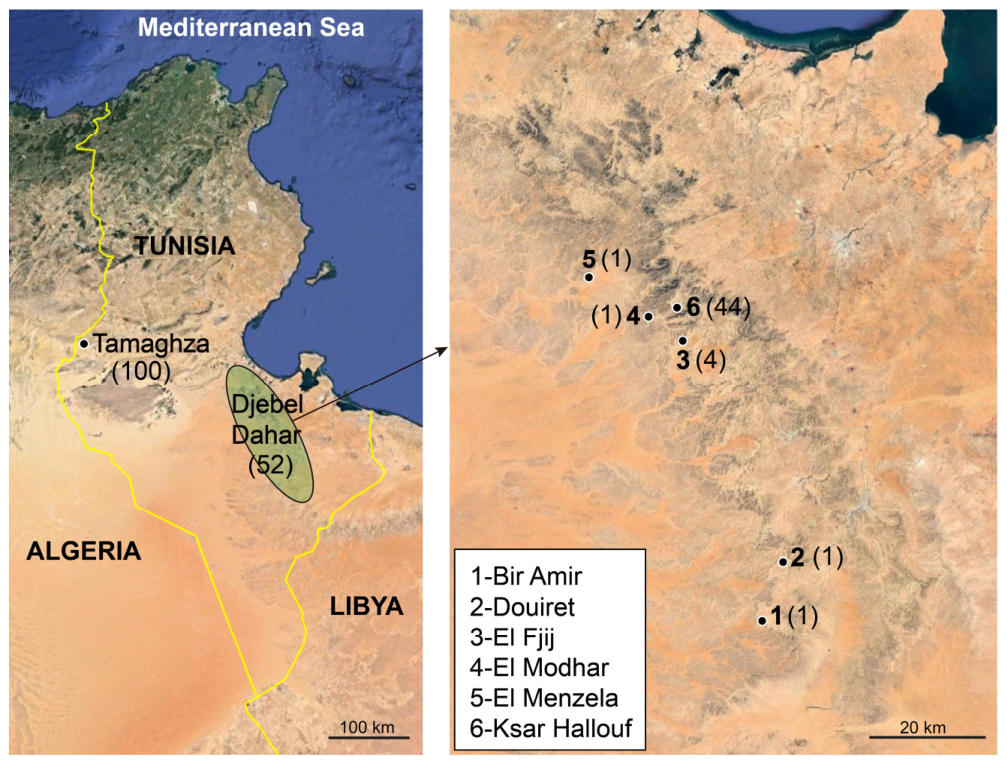
Figure 2.
Helminths found parasitizing Psammomys obesus. (a) Gerbillitaenia psammomi, entire worm. (b) Sudarikovina aegyptica, mature proglottids. (c) Sudarikovina aegyptica, pregravid proglottids. (d) Syphacia sp., male. (e) Syphacia sp., anterior end of female. (f) Syphacia sp., egg. (g) Mesocestoides sp., tetrathyridium larvae.
Figure 2.
Helminths found parasitizing Psammomys obesus. (a) Gerbillitaenia psammomi, entire worm. (b) Sudarikovina aegyptica, mature proglottids. (c) Sudarikovina aegyptica, pregravid proglottids. (d) Syphacia sp., male. (e) Syphacia sp., anterior end of female. (f) Syphacia sp., egg. (g) Mesocestoides sp., tetrathyridium larvae.
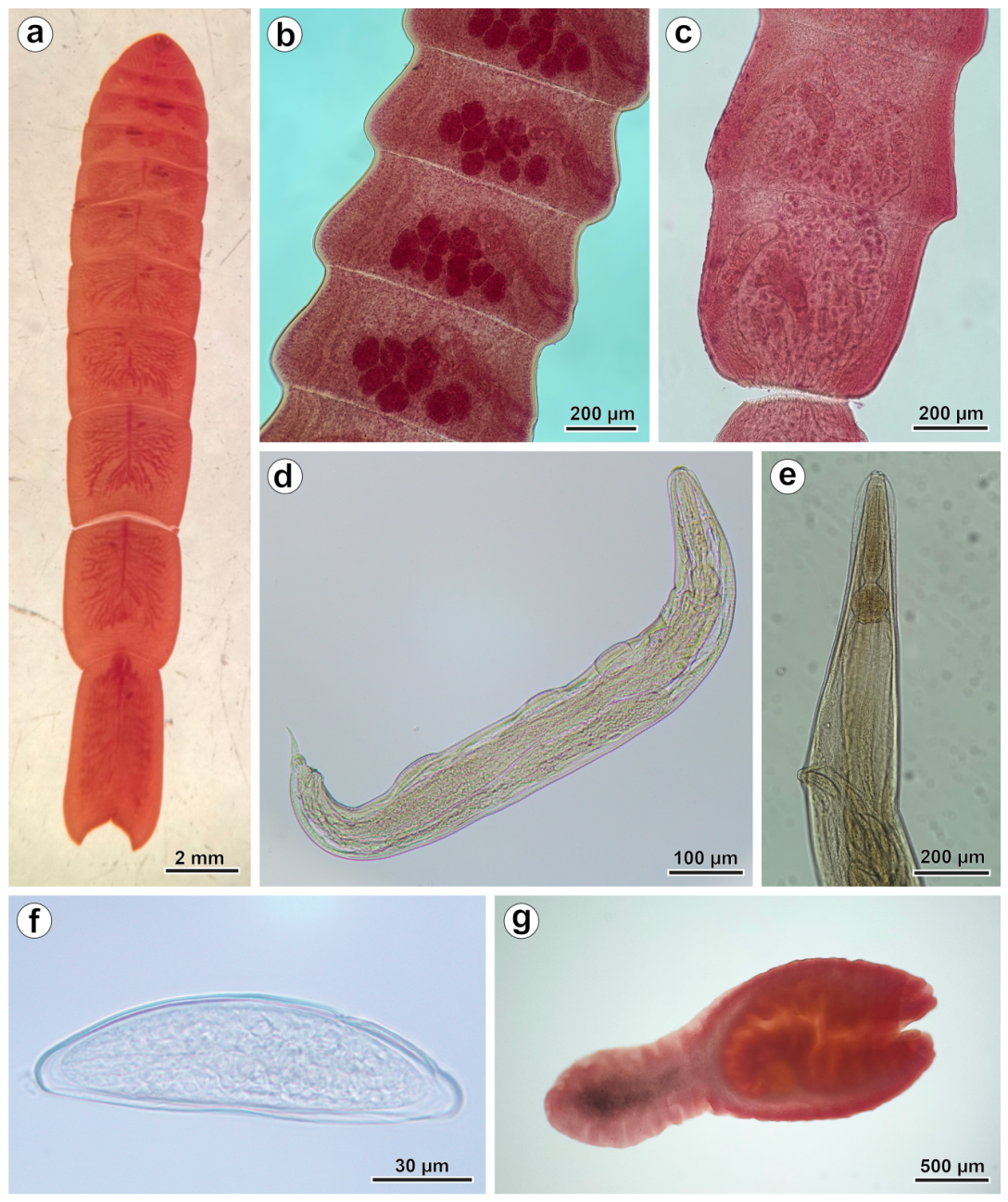
Figure 3.
Variation in the occurrence probability and mean abundance of G. psammomi according to age and region, as estimated from GLMMs accounting for sex and SMI as other fixed effects and sampling period as a random factor.
Figure 3.
Variation in the occurrence probability and mean abundance of G. psammomi according to age and region, as estimated from GLMMs accounting for sex and SMI as other fixed effects and sampling period as a random factor.
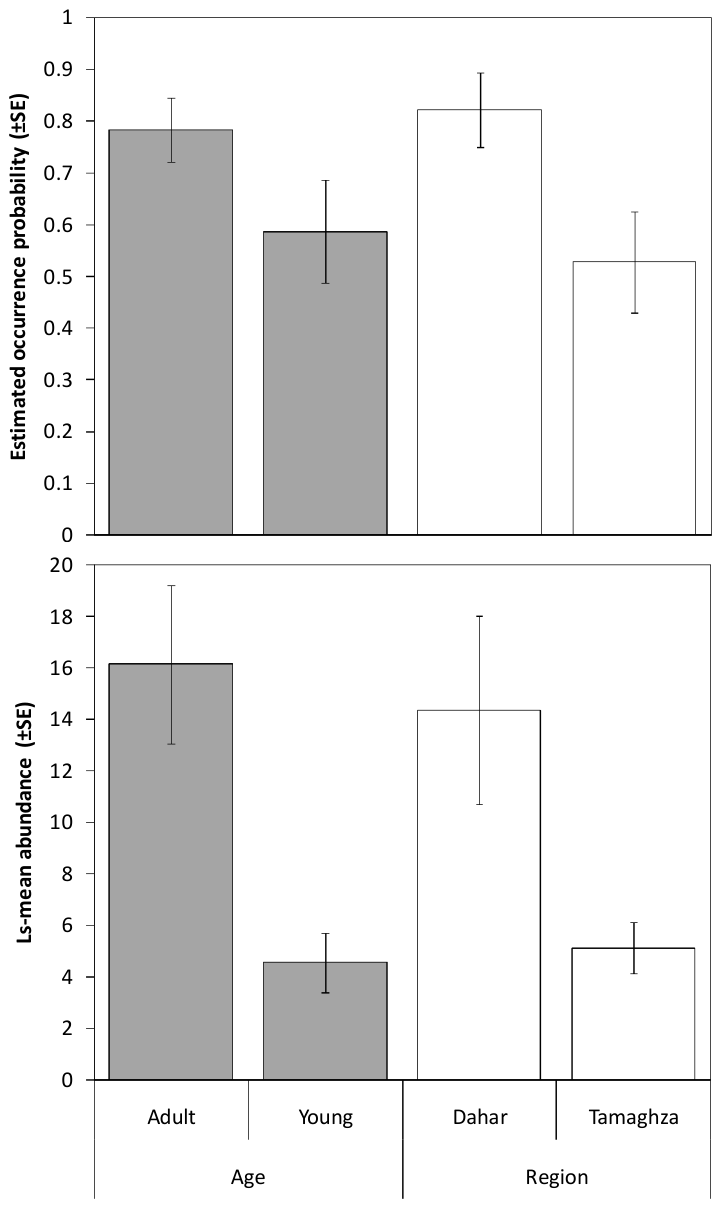
Table 2.
Results of GLMMs of the occurrence probability and abundance of S. aegyptica as functions of sex (female = 1 vs male = 0), age (adult = 1 vs young = 0) and SMI (scaled mass index; continuous variable) as fixed effects, while accounting for sampling period (six classes) as a random factor. Occurrence was modeled by considering a binomial distribution with a logit link function, while abundance was modeled using a negative binomial distribution and a log link function.
Table 2.
Results of GLMMs of the occurrence probability and abundance of S. aegyptica as functions of sex (female = 1 vs male = 0), age (adult = 1 vs young = 0) and SMI (scaled mass index; continuous variable) as fixed effects, while accounting for sampling period (six classes) as a random factor. Occurrence was modeled by considering a binomial distribution with a logit link function, while abundance was modeled using a negative binomial distribution and a log link function.
| Effect | Occurrence | Abundance | |||||||
|---|---|---|---|---|---|---|---|---|---|
| β ± SE | DF | t | P | β ± SE | DF | t | P | ||
| Intercept | -2.703 ± 1.610 | 5 | -1.680 | 0.154 | -0.873 ± 2.033 | 5 | -0.43 | 0.685 | |
| Sex | 0.054 ± 0.666 | 43 | 0.080 | 0.935 | 0.727 ± 0.853 | 43 | 0.85 | 0.399 | |
| Age | 0.778 ± 0.748 | 43 | 1.040 | 0.304 | 0.855 ± 0.892 | 43 | 0.96 | 0.343 | |
| SMI | 0.008 ± 0.008 | 43 | 0.990 | 0.326 | 0.015 ± 0.012 | 43 | 1.33 | 0.190 | |
Table 3.
Results of GLMMs of the occurrence probability and abundance of Syphacia sp. as functions of sex (female = 1 vs male = 0), age (adult = 1 vs young = 0) and SMI (scaled mass index; continuous variable) as fixed effects, while accounting for sampling period (three classes) as a random factor. Occurrence was modeled by considering a binomial distribution with a logit link function, while abundance was modeled using log(x+1)-transformed data by considering a normal distribution and an identity link function.
Table 3.
Results of GLMMs of the occurrence probability and abundance of Syphacia sp. as functions of sex (female = 1 vs male = 0), age (adult = 1 vs young = 0) and SMI (scaled mass index; continuous variable) as fixed effects, while accounting for sampling period (three classes) as a random factor. Occurrence was modeled by considering a binomial distribution with a logit link function, while abundance was modeled using log(x+1)-transformed data by considering a normal distribution and an identity link function.
| Effect | Occurrence | Abundance | |||||||
|---|---|---|---|---|---|---|---|---|---|
| β ± SE | DF | t | P | β ± SE | DF | t | P | ||
| Intercept | 1.777 ± 2.423 | 2 | 0.730 | 0.540 | 3.983 ± 1.783 | 2 | 2.230 | 0.155 | |
| Sex | 0.023 ± 0.503 | 94 | 0.050 | 0.963 | -0.203 ± 0.411 | 94 | -0.490 | 0.623 | |
| Age | 0.675 ± 0.533 | 94 | 1.270 | 0.208 | 0.151 ± 0.418 | 94 | 0.360 | 0.719 | |
| SMI | -0.025 ± 0.019 | 94 | -1.330 | 0.188 | -0.022 ± 0.013 | 94 | -1.630 | 0.106 | |
Disclaimer/Publisher’s Note: The statements, opinions and data contained in all publications are solely those of the individual author(s) and contributor(s) and not of MDPI and/or the editor(s). MDPI and/or the editor(s) disclaim responsibility for any injury to people or property resulting from any ideas, methods, instructions or products referred to in the content. |
© 2026 by the authors. Licensee MDPI, Basel, Switzerland. This article is an open access article distributed under the terms and conditions of the Creative Commons Attribution (CC BY) license.
Copyright: This open access article is published under a Creative Commons CC BY 4.0 license, which permit the free download, distribution, and reuse, provided that the author and preprint are cited in any reuse.