
Submitted:
14 September 2026
Posted:
15 September 2026
You are already at the latest version
Abstract
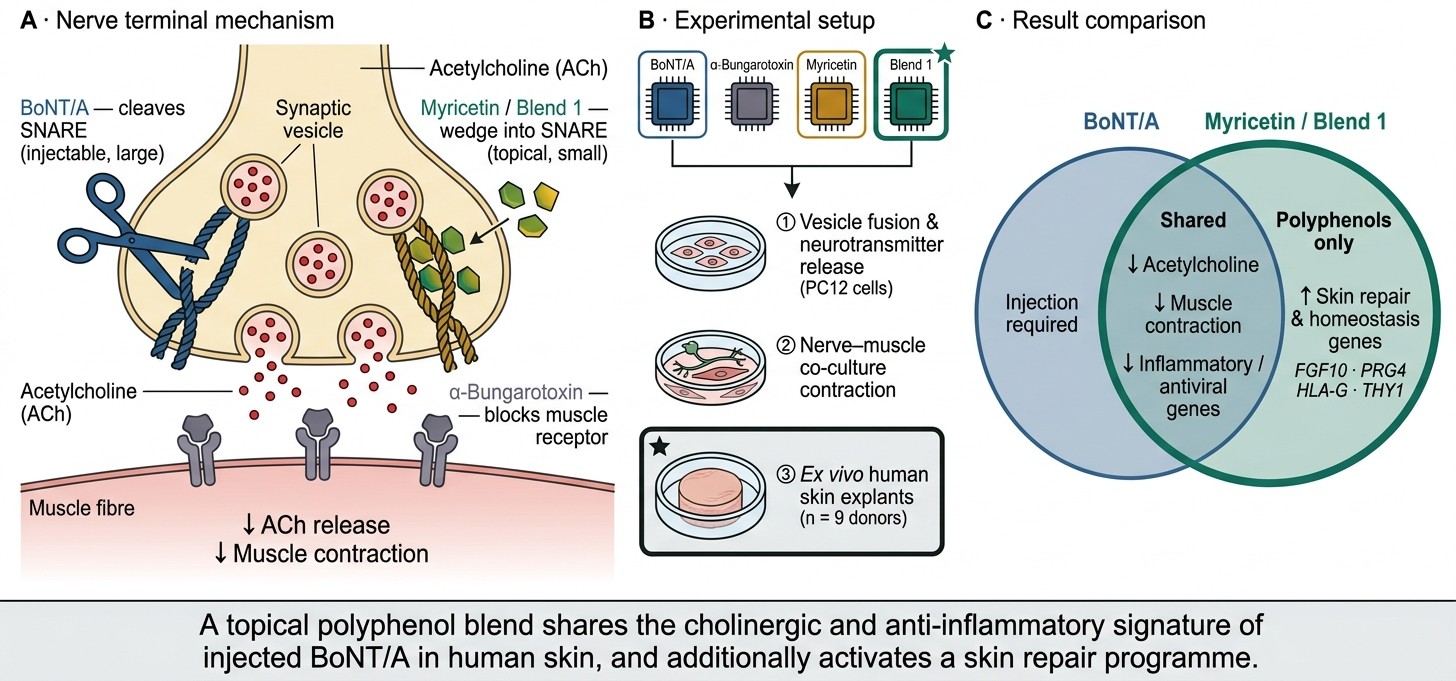
Injected botulinum neurotoxins (BoNT) reduce dynamic wrinkles by cleaving SNARE proteins at the neuromuscular junction; however, their large size mostly limits their use to injectable procedures. Certain polyphenols, including myricetin, have been shown in neuronal systems to reduce acetylcholine (ACh)-induced muscle contraction via inhibition of SNARE complex zippering, suggesting potential for topical use as modulators of skin cholinergic activity. This study aimed to identify a natural extract blend similarly capable of attenuating ACh release followed by characterization of the activity of this extract on human skin explants, alongside reference molecules BoNT/A, α-bungarotoxin, and myricetin. The natural extract blend (“Blend 1”) inhibited vesicle fusion and attenuated norepinephrine release in a cell culture system, inhibited muscle cell contraction within nerve/muscle co-culture, and attenuated ACh release consistent with myricetin and reference neurotoxins within human skin explants. Bulk transcriptomics of treated ex vivo skin explants revealed that BoNT/A, myricetin and Blend 1 all shared a similar downregulated inflammatory and anti-viral gene profile separate from α-bungarotoxin, but that myricetin and Blend 1 shared a large degree of overlap for upregulated genes associated with skin homeostasis and repair that was not observed for either toxin. These data support Blend 1 as a candidate for topical cosmetic use through modulation of BoNT/A-like cholinergic pathways, alongside activation of additional pathways associated with skin homeostasis and repair.
Keywords:
botulinum toxin type A
; myricetin
; polyphenol
; SNARE complex
; acetylcholine
; ex vivo human skin explant
; bulk transcriptomics
; neurocutaneous
; topical cosmetic ingredient
Copyright: This open access article is published under a Creative Commons CC BY 4.0 license, which permit the free download, distribution, and reuse, provided that the author and preprint are cited in any reuse.