

Submitted:
14 September 2026
Posted:
15 September 2026
You are already at the latest version
Abstract
Gas well productivity prediction serves as a critical bridge connecting petroleum geology, engineering, and economic evaluation, playing an indispensable role throughout the entire natural gas development process. In response to the challenges posed by the low porosity, low permeability, and strong heterogeneity of tight gas reservoirs, this paper systematically reviews relevant domestic and international research achievements and summarizes five mainstream prediction techniques: analytical methods, numerical simulation, physical simulation, analogical empirical methods, and gas-water two-phase analysis. These methods are comparatively analyzed in terms of their principles, accuracy, applicability conditions, advantages, and limitations. The study indicates that existing approaches still face bottlenecks such as difficulties in multi-scale coupling, inadequate characterization of dynamic parameters, and insufficient integration between mechanistic understanding and data-driven methodologies. Although various methods can be adapted to different stages of the full gas reservoir development cycle, each individual technique has inherent limitations. Drawing on the latest advances in flow mechanisms and intelligent algorithms, future efforts should focus on promoting hybrid modeling that integrates physical mechanisms with artificial intelligence, incorporating multi-field coupling and digital twin technologies to build a full-cycle intelligent productivity prediction system, thereby providing solid technical support for the efficient development of tight gas reservoirs.
Keywords:
tight gas reservoir
; productivity prediction
; heterogeneity
; multi-field coupling
; artificial intelligence
; hybrid modeling
1. Introduction
Globally, tight gas reservoirs are characterized by substantial resource volumes and extensive distribution, positioning them as a critical succession domain for ensuring natural gas supply. Against the backdrop of the ongoing energy transition and sustained growth in natural gas demand, tight gas has emerged as a key practical field for safeguarding national energy security and promoting oil and gas reserve accretion and production enhancement. China possesses abundant tight gas resources, predominantly hosted in the Ordos, Sichuan, and Tarim basins. However, these reservoirs typically exhibit complex geological attributes, including deep burial depths, micro- to nano-scale pore throats, extremely low matrix permeability (generally below 0.1×10⁻³ μm2), and strong heterogeneity. Under natural conditions, they fail to yield commercial productivity and thus necessitate large-scale hydraulic fracturing stimulation for economically viable development [1,2,3].
Gas well productivity prediction serves as the core link connecting geological characterization, engineering design, and economic evaluation, and plays an indispensable role throughout the entire lifecycle of tight gas exploration and development. During the exploration and appraisal phase, accurate productivity forecasting forms the basis for assessing block commercial viability and designing exploration well test programs; during development plan formulation, it directly dictates optimization strategies for well pattern deployment, fracturing scale, and production scheduling; and during field production management, it provides essential support for dynamic analysis, intervention adjustments, and potential tapping [4,5,6].
Nevertheless, the complex flow physics inherent in tight gas reservoirs—including threshold pressure gradients, stress-sensitive damage, gas slippage effects, high-velocity non-Darcy flow, gas–water two-phase interference, and dynamic fracture conductivity degradation—render conventional productivity prediction methods rooted in classical Darcy’s law prone to significant deviations. Prediction errors commonly exceed 15%, and in highly heterogeneous reservoirs may even surpass 30% [7,8,9].
Over an extended period, numerous studies have been devoted to tight gas productivity prediction, yielding a diverse array of technical approaches, including analytical methods, numerical simulation, physical simulation, empirical analogy, and gas–water two-phase analysis. However, most of these investigations are tailored to specific blocks or well types, resulting in pronounced methodological divergence. A systematic synthesis and comparative evaluation of the physical foundations, data requirements, applicability domains, and prediction accuracies of these various methods remain conspicuously absent. This fragmented state of development poses challenges for field engineers in selecting the most appropriate technique for site-specific problems, and concurrently impedes technological integration and paradigm evolution within the discipline [10].
To this end, the present paper aims to establish a systematic cognitive framework. First, we categorize tight gas productivity prediction techniques into five major methodological families, and systematically review their fundamental principles, representative field applications, and applicable conditions, followed by an objective assessment of their respective strengths and limitations. Second, we distill the core bottlenecks that currently constrain technological advancement in this field. Finally, in light of recent progress in porous-media flow mechanics and the transformative potential of artificial intelligence, we project future development trajectories, with the goal of providing theoretical underpinnings and practical guidelines for the efficient and intelligent development of tight gas reservoirs.
Figure 1.
Classification and Exploration of Conversion Strategies for Reservoir Capacity Prediction Techniques in Tight Gas Reservoirs.
Figure 1.
Classification and Exploration of Conversion Strategies for Reservoir Capacity Prediction Techniques in Tight Gas Reservoirs.
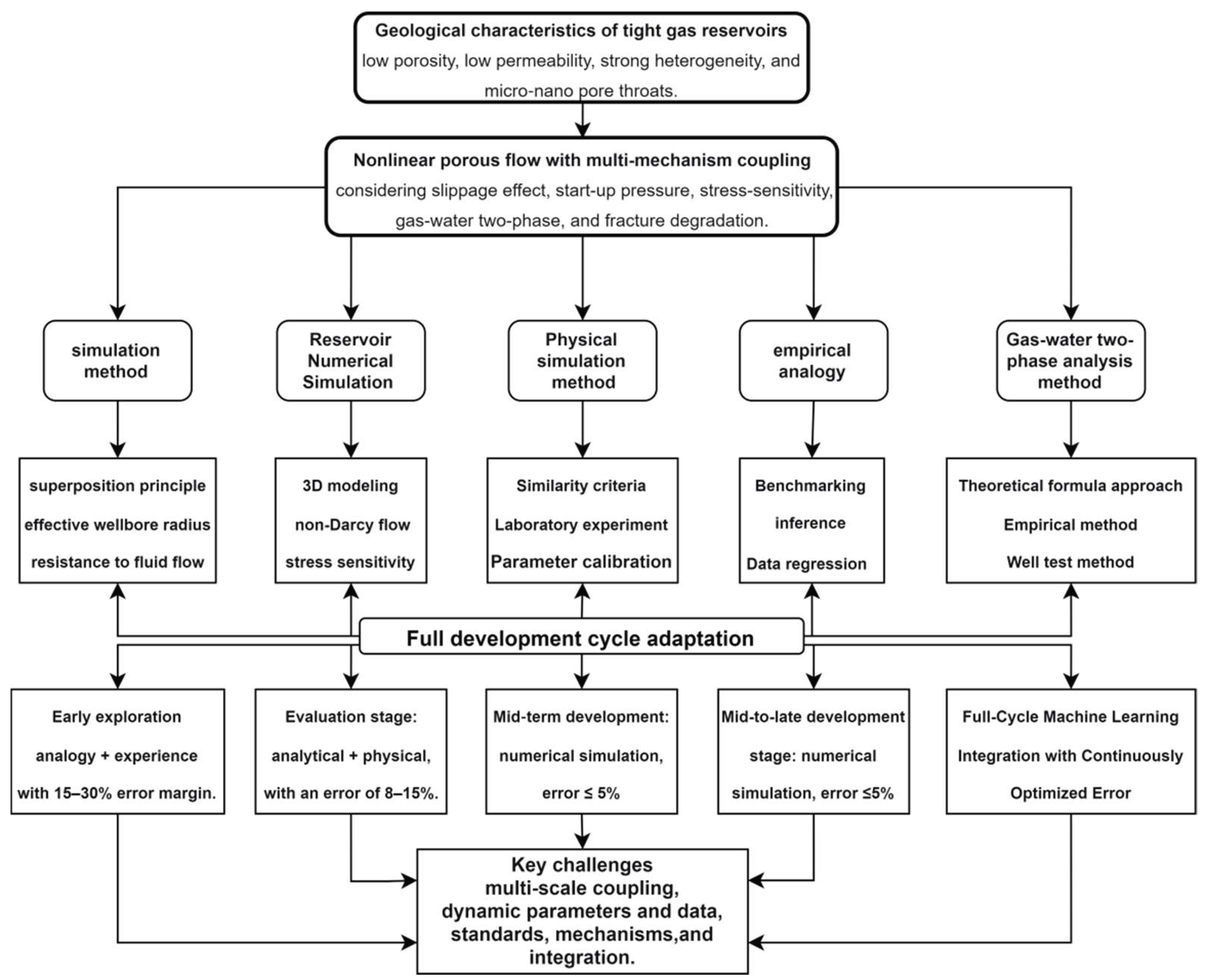
2. Methodology System for Productivity Prediction in Tight Gas Reservoirs
Tight gas reservoir productivity prediction is theoretically grounded in the mechanics of fluid flow through porous media. Owing to advances in reservoir characterization techniques and the growth of computational power, multiple methodological pathways have progressively emerged, generally classified as mechanism-driven, data-driven, and hybrid-driven approaches. These methods differ considerably in their theoretical foundations, data requirements, computational efficiency, and applicability to specific field scenarios.
2.1. Analytical Methods
The core of classical analytical methods lies in the physical abstraction and mathematical simplification of complex flow systems, enabling rapid productivity estimation through closed-form mathematical expressions. Their theoretical foundations primarily include potential theory, pressure-drop superposition, the equivalent flow resistance method, and conformal mapping. Based on potential theory with pressure-drop superposition, vertical-well equivalence transformation, and the equivalent flow resistance approach, these methods constitute a productivity-prediction framework centered on physical simplification and analytical solutions. However, all three are constrained by idealized assumptions such as homogeneity, single-phase flow, and steady-state conditions, rendering them inadequate for effectively characterizing the strong heterogeneity and coupled multi-factor flow behavior typical of tight gas reservoirs.
First, the method based on potential theory and pressure-drop superposition decomposes multi-fracture systems into point-sink and line-sink elements, superimposing pressure disturbances to compute productivity. This approach is applicable to both steady-state and transient flow, establishing a “decomposition–superposition” technical paradigm [11]. Subsequent refinements incorporated fracture internal flow resistance to improve the flow-resistance network [12], and proposed a “three-segment” model to calculate both total productivity and individual fracture contributions [13]. Extensions to transient flow have been achieved using transient source functions and Duhamel’s principle, forming a complete theoretical framework [14,15].
Second, vertical-well equivalence transformation, drawing on conformal mapping [16] and the effective wellbore radius model [17], converts horizontal wells or fractured wells into equivalent vertical-well systems. Some studies have also established a fully coupled “reservoir–fracture–wellbore” model [18] to simplify the computation of multi-well interference and fracture interactions.
Third, the equivalent flow resistance method, widely applied and well-established in porous-media flow mechanics, is based on the hydraulic-electric analogy. It partitions flow resistances in the matrix–fracture–wellbore system and superimposes pressure drops to obtain productivity. Although computationally straightforward, this method is only suitable for steady-state flow and offers limited consideration of reservoir and engineering factors.
Early classical analytical studies primarily targeted vertically fractured wells. Prats [19] in 1961 pioneered productivity calculation and fracture-parameter optimization for fractured vertical wells. Gringarten et al. [20] and Cinco-Ley et al. [21] developed well-test theory for finite-conductivity vertical fractures, laying the foundation for transient productivity analysis. For horizontal wells, Lang et al. [22] derived a steady-state productivity formula for multi-stage fractured horizontal wells based on potential superposition; Ning et al. [23] subsequently incorporated stress sensitivity and gas slippage to establish a semi-analytical model more representative of tight reservoir characteristics. Regarding model refinement, Xu et al. [24] proposed a fully coupled “reservoir–fracture–wellbore” three-segment productivity model that separately calculates total and individual fracture production. Lei et al. [25] extended analytical methods to transient flow, constructing a more rigorous theoretical system using transient source functions and Duhamel’s principle. Furthermore, Zeng et al. [14] and Wei et al. [26] conducted extensive numerical experiments to systematically analyze the influence and importance ranking of parameters such as fracture conductivity, fracture length, and fracture spacing on productivity, providing a basis for parameter selection in analytical formulas.
The classical analytical method offers distinct advantages: clear physical meaning, extremely high computational speed, and convenient sensitivity analysis of parameters. It is particularly suitable for early-stage well-test interpretation, rapid productivity assessment, and preliminary optimization of fracture parameters. However, this approach heavily relies on idealized assumptions of homogeneity, single-phase flow, and steady-state conditions, and thus cannot effectively characterize strong heterogeneity, multiphase flow, or coupled multi-factor effects. Field cases show that in relatively homogeneous blocks of the Ordos Basin, initial prediction errors can be controlled within 8%–12% [27]; yet in areas with complex fracture networks and intricate gas–water relationships, errors often exceed 15% [28] because three-dimensional fracture propagation is neglected. Moreover, the method is inapplicable for long-term post-fracturing performance prediction, as it cannot account for the time-dependent degradation of fracture conductivity ; the oversight of three-dimensional fracture extent also renders it unsuitable for productivity forecasting after reservoir fracturing [29].
2.2. Numerical Simulation Methods
Numerical simulation methods discretize the reservoir domain into a grid system, construct a three-dimensional geological model, and solve the corresponding partial differential equations to finely characterize complex flow behavior. These approaches flexibly incorporate various nonlinear mechanisms, including threshold pressure gradients, stress sensitivity, gas–water two-phase relative permeability, and time-dependent fracture conductivity degradation.
Yang et al. [30], based on core measurements from low-permeability gas reservoirs in the Daqing Oilfield, quantified the stress sensitivity of porosity and permeability, and established a numerical model accounting for formation deformation, which was solved using the IMDES method. Xu et al. [31] developed a three-dimensional gas–water dual-porosity model for low-permeability abnormally high-pressure gas reservoirs, effectively characterizing fluid exchange between fractures and the matrix. In the realm of development-scheme optimization, Zhang et al. [32] employed detailed numerical simulation to predict the performance of the Jingbian Gas Field under booster compression, determining a reasonable production scale by integrating well productivity and compressor operating conditions. Chen et al. [33] utilized numerical simulation to optimize the drilling azimuth and horizontal-section length for sidetracked horizontal wells in mature wells. Yang et al. [34] pioneered a mathematical model for full-field fracturing simulation in low-permeability tight gas reservoirs from a block-scale stimulation perspective, and developed a dedicated simulation software package. In recent years, advances in computational power have enabled large-scale parallel simulation, and emerging techniques such as the embedded discrete fracture model (EDFM) have further enhanced both the accuracy and efficiency of numerical simulation [35].
Numerical simulation offers comprehensive mechanistic representation and high prediction accuracy; after history matching, relative errors are typically within 5%. It is an indispensable tool for performance forecasting, development-scheme comparison, and optimization during the mid- to late-stage development of complex heterogeneous gas reservoirs. The method can couple threshold pressure gradients, permeability stress sensitivity, fracture-conductivity degradation, and other mechanisms to enable fracture-parameter optimization, production-decline prediction, and adjustment of development strategies. By embedding productivity equations that incorporate threshold pressure gradients and stress-sensitivity effects into the three-dimensional geological model, and through grid assignment and production-data matching, the method precisely verifies equation applicability and calibrates parameters. It simulates parameter variations under different stimulation scenarios, providing multi-scenario data support for dynamic calibration, substantially reducing field-test costs and time.
Nevertheless, certain limitations exist: its accuracy is highly dependent on the geological model and the completeness of basic data such as relative permeability and rock compressibility. The modeling process is time-consuming and requires specialized expertise, making it difficult to meet the demands of rapid on-site decision-making. In practice, for a given block in the Sulige Gas Field, constructing a detailed three-dimensional geological model and performing history matching often take three to six months; moreover, when production strategies undergo major adjustments, re-matching is required, resulting in a relatively slow response time [36].
2.3. Physical Simulation Methods
Physical simulation methods reproduce flow environments under reservoir high-temperature and high-pressure conditions on laboratory platforms based on similarity criteria, acquiring key flow parameters through direct measurement and validating theoretical models.
These methods can be categorized into four types according to the chronological evolution of technology. (1) Basic similarity simulation, which relies on scaling criteria to conduct single-phase and two-phase flow experiments in homogeneous reservoirs; deviations between experimental data and theoretical calculations are typically within 15%, making it suitable for conventional low-permeability gas reservoirs with good homogeneity. Jiao et al. [37], using a low-permeability gas reservoir in the Ordos Basin as an example, established a systematic set of physical-simulation similarity criteria, providing a theoretical basis for experimental design. (2) Stress-sensitivity and dynamic-fracture simulation, which models coupled fracture–matrix flow while accounting for reservoir stress sensitivity and fracture-conductivity degradation, using permeability change rate and conductivity decline coefficient as evaluation metrics. Hu et al. [38] employed a long-core multi-pressure-tap physical simulation setup to test pore-pressure depletion processes in water-bearing reservoirs with different permeabilities, and developed a quantitative method for evaluating recoverable reserves based on area proportion. (3) Multi-field coupling and complex-boundary simulation, which comprehensively considers factors such as threshold pressure gradients, reservoir heterogeneity, and elliptical flow boundaries, requiring a goodness-of-fit greater than 0.85. Gao et al. [39], Liu et al. [33,40], and Wei et al. [41], focusing on the Sulige Gas Field in the Ordos Basin, systematically investigated the feasibility of CCUS-EGR and CO2-EGR through integrated physical and numerical simulations, providing key parameters for pilot tests. (4) Machine learning-assisted physical simulation, an emerging frontier, which combines experimental data with intelligent algorithms to rapidly predict simulation outcomes and optimize experimental parameters, achieving prediction accuracy exceeding 90% and improving parameter-optimization efficiency by more than 30% [42].
Physical simulation offers more realistic flow parameters and mechanistic insights compared to numerical simulation, and serves as an essential benchmark for calibrating analytical and numerical models. Its limitations, however, are equally prominent: high experimental costs, long durations, and difficulty in fully replicating fluid–rock interactions at micro-/nano-pore scales or the full-lifecycle evolution of complex fracture networks. Consequently, it is primarily employed as a supplementary mechanistic tool and for parameter validation.
In summary, physical simulation can reproduce reservoir flow conditions based on similarity criteria and visually demonstrate gas–water distribution and reserve-mobilization patterns; experimental data can support development-scheme optimization. Nevertheless, it is challenging to accurately simulate fluid–rock interactions at micro-nano pore throats, and reproducing complex fracture networks coupled with adsorption-desorption effects remains difficult. Moreover, the long experimental cycle and high cost hinder comprehensive coverage of multi-scale heterogeneity. A systematic analysis of the characteristics and evolving evaluation metrics of physical simulation methods for tight gas productivity prediction has been conducted, revealing their developmental patterns; the detailed comparative results are presented in Table 1.
As shown in Table 1, in order of technological evolution, physical simulation methods can be categorized into four types: fundamental similarity simulation, stress-sensitivity and fracture-dynamics simulation, multi-field coupling and complex boundary simulation, and machine-learning-assisted physical simulation. Each method has clearly defined core characteristics, evaluation indicators, and applicable scenarios. Fundamental similarity simulation, based on similarity criteria, conducts single-phase and two-phase flow simulations in homogeneous reservoirs with data deviations below 15%, suitable for conventional low-permeability gas reservoirs with good homogeneity. Stress-sensitivity and fracture-dynamics simulation enables fracture-matrix coupled seepage simulation, addressing both stress sensitivity and fracture conductivity degradation, using permeability change rate and conductivity decay coefficient as evaluation indicators, with relative errors ranging from 5% to 12%, and is primarily used for post-fracturing productivity evaluation in tight sandstone gas reservoirs. Multi-field coupling and complex boundary simulation comprehensively considers threshold pressure gradient, reservoir heterogeneity, and elliptical seepage boundaries, requiring goodness of fit above 0.85 and relative error below 8%, and is mainly applied to multi-fractured horizontal wells and multi-layer commingled production in tight gas reservoirs. As a cutting-edge approach, machine-learning-assisted physical simulation integrates experimental data with intelligent algorithms to rapidly predict simulation outcomes and optimize experimental parameters, with prediction accuracy exceeding 90% and parameter optimization efficiency improved by 30%, suitable for rapid productivity evaluation and parameter optimization in tight gas reservoirs.
2.4. Analogical and Empirical Formula Methods
Analogy methods are based on the principle of “reasoning by similarity,” whereby the productivity range of a target block is rapidly estimated by benchmarking geological and engineering parameters against those of already developed analogous gas reservoirs. Empirical correlation methods, in turn, rely on extensive field-measured data and establish statistical mapping relationships between productivity and key controlling parameters (e.g., permeability, net pay thickness, fracturing scale, etc.) through regression analysis.
Fu et al. [43] incorporated the equivalent wellbore theory and the generalized pseudo-pressure function to derive, via regression, a multi-factor empirical productivity formula that simultaneously accounts for stress sensitivity, slippage effects, threshold pressure gradients, and non-Darcy flow. Xie et al. [44], based on a discrete fracture network model combined with the finite element method, developed a regressed empirical productivity equation applicable to multi-stage fractured horizontal wells in low-permeability reservoirs. In field practice, these methods are widely employed for rapid estimation during the early exploration phase owing to their convenience.
Both approaches do not rely on complex mechanistic models or elaborate modeling, and yield prediction errors in the range of 15%–30%. However, they suffer from a weak theoretical foundation—being essentially data-fitting exercises rather than mechanistic representations—and their reliability declines significantly when extrapolated to blocks with substantially different geological conditions, with prediction errors typically between 15% and 30% [45]. They are therefore only suitable for providing basic decision-making reference during the initial development stage. To present these two categories more clearly, a comparative evaluation index system for analogy and empirical correlation methods in tight gas productivity prediction has been established (Table 2), which contrasts the two major branches in terms of technical characteristics, typical evaluation metrics, and applicable scenarios.
The analogy method relies on benchmarking against similar reservoirs to estimate productivity through reasoning, with prediction relative errors ranging from 15% to 30%, and is primarily used for preliminary productivity estimation in early tight gas reservoir development stages with limited basic data and small-sample conditions. The empirical formula method constructs models based on field or experimental data regression, divided into classical simplified and multi-parameter integrated types; some models can incorporate non-Darcy effects, with prediction relative errors between 8% and 20%, and are widely applied in rapid productivity estimation scenarios for conventional and tight gas reservoirs, including vertical and fractured wells.
2.5. Gas-Water Two-Phase Productivity Analysis
Tight gas reservoirs commonly contain irreducible or movable water, making gas–water two-phase flow the prevailing condition. The gas–water two-phase productivity analysis method, based on the generalized Darcy’s law and two-phase pseudo-pressure theory, is specifically designed to model this complex flow behavior.
International research in this area began relatively early. From the 1960s to the 1980s, numerous scholars pioneered productivity studies for vertically fractured vertical wells. Prats [46] established a productivity calculation method and fracture-parameter optimization for fractured vertical wells. Gringarten [47] refined the well-test theory for fractured wells neglecting fracture-storage effects, while Cinco-Ley [48] constructed a well-test framework for finite-conductivity vertical fractures. Guppy [49] introduced the high-velocity non-Darcy effect within fractures, progressively improving the foundational productivity theory for vertical fractured wells. Raghavan [50], Joshi [51], and Rahman [52], among others, developed productivity formulas for fractured vertical wells and multi-stage fractured horizontal wells under various fracture-conductivity conditions, using the effective wellbore radius and pressure-superposition approaches. Gringarten [53], Soliman [54], and Wang [55] further refined well-test theory by distinguishing six distinct flow regimes in multi-stage fractured horizontal wells, providing theoretical support for productivity evaluation via well testing. Empirical productivity methods, relying on vast field data, gave rise to the classic exponential and binomial empirical formulas proposed by Rawlins [56]. Well-testing techniques can accurately characterize gas-well production performance; however, conventional stabilized well tests are time-consuming and costly, so transient well-test schemes are often preferred for tight gas reservoirs to mitigate economic drawbacks. Compared with vertical and horizontal wells, research on deviated wells—especially fractured deviated wells—started later. Cinco-Ley [57] and Besson [58] were among the first to establish calculation methods for transient flow and pseudo-skin factors in deviated wells, clarifying the relationship between well inclination angle and productivity.
Domestic research on productivity has lagged behind international efforts. Early scholars such as Liu [59], Guo [60], Wang [61], and Jiang [62] developed productivity models for vertical fractured wells based on conformal mapping, and confirmed that high-velocity non-Darcy flow must be considered in high-rate gas-well productivity calculations. Subsequently, Lang [63], Ning [64], Xiong [65], and others, using potential superposition, effective wellbore radius, and elliptical coordinates, successively incorporated stress sensitivity, gas slippage, and low-velocity non-Darcy flow—specific to tight reservoirs—into their models, continuously improving single-phase productivity equations for fractured horizontal wells. Addressing the common challenge of simultaneous gas-water production in tight gas reservoirs, domestic research began with Li [66] in 2001, who first constructed a gas-water two-phase productivity equation. Thereafter, He [67], Jiang [68], Zhang [69], Wei [70], Sun [71], Xiao [72], Wang [73], Xu [74], Yuan [75], and others iteratively refined the models over the years, gradually incorporating downhole throttling, threshold pressure gradients, water invasion, abnormally high pressure, and reservoir heterogeneity. Their studies quantitatively confirmed that water-gas ratio, stress sensitivity, and threshold pressure gradient are the primary controlling factors causing productivity decline. During the same period, international scholars such as H. Zhang [76], X. Huang [77], and W. Wen [78] integrated formation dip angle and stress-sensitivity characteristics to improve two-phase productivity models for water-bearing gas reservoirs. In recent years, Zhu [79], He [80], Liu [81], and Zhang [82] have employed various mathematical approaches to develop a series of semi-analytical two-phase productivity models for different well types and reservoir conditions. Zhang [83], Yang [84], and Xin [85] have addressed the domestic research gap on deviated and fractured deviated wells, deriving productivity calculation formulas using equivalent flow resistance and Laplace transform.
This method accounts for multiple complex flow factors, achieving higher accuracy than conventional single-phase analytical methods while maintaining computational efficiency far superior to numerical simulation. However, some early models incorporate incomplete coupling of mechanisms, and most models are developed for specific blocks or well types, leading to limited applicability and strong specificity but weak generalizability. For example, a particular model validated well in vertical wells in the Sulige Gas Field (error <8%) yielded errors exceeding 15% when directly applied to horizontal wells in the same block [86].
Based on a synthesis of existing research, a classification and evaluation-metric evolution of gas-water two-phase productivity prediction models for tight gas reservoirs is summarized (Table 3). This table clearly presents four mainstream model categories, with comparative analysis across four dimensions: technical characteristics, typical evaluation metrics, degree of quantification, and application scenarios.
Classical Darcy derivative models, based on traditional Darcy’s law, simplify gas-water interactions with relative errors below 15% and medium-high quantification; they are suitable for medium-high permeability conventional gas reservoirs and low-water-saturation formations. Non-Darcy coupled models incorporate stress sensitivity, threshold pressure gradient, gas slippage, and other non-Darcy factors with defined generalized pressure, achieving relative errors of 5%–15% with relatively high quantification; they are widely used for low-permeability gas reservoirs and gas-water co-producing vertical and horizontal wells. Specialized models for fractured wells are designed for complex well types including fractured vertical wells and fractured horizontal wells, accounting for fracture parameters and inter-well interference, with relative errors below 8% and relatively high quantification; they are commonly used for productivity prediction in various fractured wells in tight gas reservoirs. Multi-factor coupled semi-analytical models comprehensively integrate reservoir anisotropy, water influx, and fracturing fluid flowback with semi-analytical solutions, achieving relative errors below 5% with excellent goodness of fit and the highest quantification; they are primarily applied to deep shale gas reservoirs, abnormally high-pressure gas reservoirs, and productivity prediction for various complex-structure wells.
2.6. Comparison of Method Systems
The five mainstream productivity prediction methods for tight gas reservoirs—analytical methods, numerical simulation, physical simulation, analogical and empirical formula methods, and gas-water two-phase productivity analysis—exhibit significant differences in accuracy, efficiency, cost, and applicability. The selection of methods depends on the development stage and reservoir complexity: analogy and empirical methods are used in early exploration; analytical and physical simulation methods are employed in the evaluation stage; numerical simulation is applied in the mid-development stage; and machine learning can be integrated throughout the full cycle to improve efficiency. A comprehensive comparison of the five methods is provided in Table 4, describing their core principles, core advantages, major limitations, prediction error ranges, computational efficiency, and applicable scenarios.
Analytical methods rely on potential theory, pressure superposition, equivalent seepage resistance, and other theoretical simplifications to construct seepage mathematical models. They feature standardized formulas, clear physical meaning, and fast computation, but are constrained by idealized assumptions of homogeneity, single-phase flow, and steady-state conditions, making it difficult to characterize strong heterogeneity and multi-factor coupled seepage. Prediction errors range from 8% to 15% with extremely high computational efficiency, suitable for conventional low-permeability gas reservoirs, early-development well-test analysis, and rapid productivity evaluation. Numerical simulation methods construct three-dimensional geological models through grid discretization and embed various seepage correction terms, offering comprehensive mechanism representation and high prediction accuracy, capable of optimizing fracture parameters and development plans. However, these methods impose stringent requirements on basic data completeness, involve high modeling complexity, demand substantial computational resources, and require lengthy matching cycles. Prediction errors are ≤5% with low computational efficiency, making them the core method for refined scheme design and dynamic prediction in complex heterogeneous tight gas reservoirs during mid-to-late development stages. Physical simulation methods conduct laboratory experiments based on similarity criteria to reproduce reservoir seepage environments, yielding intuitive experimental results that can be used for theoretical model validation and parameter calibration. However, they cannot effectively simulate micro-nano pore-throat networks and complex fracture systems, and are characterized by long experimental cycles and high costs. Prediction errors are <8% with extremely low computational efficiency, primarily used for seepage mechanism research, prediction model parameter calibration, and development mechanism validation. Analogical and empirical formula methods establish relationships through benchmarking against similar reservoirs or field data regression, offering simple operation and low implementation barriers, but lack robust theoretical support, cannot characterize special seepage mechanisms, and exhibit poor extrapolation performance. Prediction errors range from 15% to 30% with extremely high computational efficiency, mainly used for rough productivity estimation in early exploration stages with scarce data. Gas-water two-phase productivity analysis combines generalized Darcy’s law and two-phase pseudo-pressure theory to comprehensively characterize gas-water two-phase nonlinear seepage behavior, with accuracy superior to traditional analytical methods and computational efficiency higher than numerical simulation. However, some early models have incomplete mechanism coupling and limited applicability boundaries. Prediction errors range from 5% to 15% with relatively high computational efficiency, widely applied in low-permeability and tight gas reservoirs, gas-water co-producing blocks, abnormally high-pressure gas reservoirs, and productivity analysis for various fractured well types.
3. Core Bottlenecks in Tight Gas Reservoir Productivity Prediction
Domestic research has conducted more in-depth theoretical investigations into mechanisms such as stress sensitivity, threshold pressure gradients, and slippage effects, specifically targeting the strongly heterogeneous, low-pressure, and low-productivity geological conditions prevalent in China. Substantial progress has been made in developing multi-mechanism coupled analytical models. Nevertheless, numerous bottlenecks persist in fundamental theory, data support, and methodological integration, which constrain further improvements in prediction accuracy and engineering applicability.
Tight gas reservoirs exhibit strong multi-scale flow characteristics, spanning from micro-/nano-scale matrix pore throats to millimeter- to centimeter-scale natural fractures, and further to hundred-meter-scale hydraulic fractures. The flow mechanisms differ across scales—low-velocity non-Darcy flow in the matrix, potential slippage effects in natural fractures, and high-velocity non-Darcy flow in hydraulic fractures—with complex cross-scale coupling and pressure interference among these scales [87]. Existing analytical and numerical models often simplify or homogenize one particular scale, making it difficult to precisely characterize such cross-scale nonlinear flow behavior within a unified mathematical framework.
Key petrophysical parameters of tight gas reservoirs are not static but evolve dynamically throughout the production process. For instance, effective stress increases as reservoir pressure depletes, causing stress-induced permeability damage in both matrix and fractures, with the degree of sensitivity varying significantly across different reservoirs [88]. Fracture conductivity in hydraulic fractures gradually declines during production due to proppant embedment, crushing, and formation compaction, with decay patterns differing markedly among blocks . Furthermore, water-blocking effects and threshold pressure gradients also change dynamically with varying water saturation. Quantitative field characterization of these time-varying parameters is extremely challenging; most current estimates rely on limited laboratory core experiments, which often differ considerably from actual reservoir conditions, introducing substantial uncertainty in parameter values [56,89].
In recent years, machine learning methods have been introduced into productivity prediction. Liu et al. [90] developed a productivity prediction model for Block SM based on a KNN-BP hybrid algorithm, demonstrating good fitting capability. However, such methods generally suffer from the “black-box” drawback: purely data-driven models lack embedded physical constraints, and their predictions may violate fundamental physical laws, casting doubt on their reliability in scenarios outside the training data domain [91]. Given the limited number of appraisal wells in tight gas reservoirs, training samples are often confined to a single block or well type, and small-sample learning tends to cause overfitting, severely impairing model generalizability across different blocks and well types [92].
Most productivity prediction models are developed based on the geological characteristics of specific blocks and specific well types, with parameter systems and equation structures tailored accordingly. For example, an empirical formula regressed from vertical-well data in Block A, when directly applied to horizontal wells in Block B, yields significantly larger errors due to differences in reservoir heterogeneity and gathering-system configurations [86]. This situation of high specificity but low generalizability results in the industry lacking a standardized, widely applicable productivity prediction methodology and toolset. Domestic approaches to tight gas productivity prediction are subject to excessive constraints, and the omission of certain relevant geological parameters across different gas fields often leads to inaccurate long-term or dynamic predictions. Three common generic shortcomings can be identified: (1) pronounced divergence among technical pathways—mechanistic analysis, empirical correlation, and machine learning methods have evolved independently, with limited effective integration between physics and data; (2) low coupling among controlling factors—key mechanisms such as water-block damage, stress sensitivity, dynamic fracture evolution, and wellbore liquid loading are difficult to incorporate simultaneously within a single model; and (3) poor model adaptability—most results are developed for a single block or well type, and the scarcity of industry-scale general-purpose prediction models is exacerbated by inter-block heterogeneity and differences in gathering-system designs.
4. Development Trends in Tight Gas Reservoir Productivity Prediction
In response to the aforementioned bottlenecks in tight gas reservoir productivity prediction, both domestic and international scholars, along with oilfield service companies, are actively exploring new technical pathways. The productivity prediction technology for tight gas reservoirs is currently exhibiting four major development trends.
First, hybrid modeling that integrates flow physics with artificial intelligence algorithms represents an effective approach to overcoming the black-box limitations of purely data-driven models. The core concept involves embedding physical governing equations—such as non-Darcy flow, stress sensitivity, and water-blocking effects—as regularization constraints or prior knowledge into intelligent learning frameworks (e.g., BP, KNN, LSTM), thereby using flow mechanisms to confine the parametric boundaries of machine-learning models [93]. This hybrid strategy preserves the physical interpretability of mechanistic models while leveraging the strong fitting capability of data-driven approaches for complex nonlinear mappings. In recent studies, Physics-Informed Neural Networks (PINN) have been preliminarily applied to solve multi-phase flow problems [94], and their application in tight gas productivity prediction represents a significant frontier.
Second, traditional analytical models and empirical correlations typically provide instantaneous productivity estimates at a given time point (e.g., absolute open-flow potential), failing to characterize the decline behavior of productivity over production time. Future model development should aim to construct prediction frameworks capable of describing the full-lifecycle dynamics. This requires the simultaneous coupling of four key time-varying mechanisms within the model: the nonlinear water-blocking threshold pressure gradient that evolves with water saturation, reservoir stress damage induced by pressure depletion, the progressive decline of hydraulic fracture conductivity during production, and the wellbore critical liquid-carrying condition constrained by wellhead pressure [95]. By establishing gas-water two-phase non-Darcy flow equations and adopting iterative solution strategies, a transition from static single-point estimation to full-cycle production decline curve prediction can be realized.
Third, international oilfield service companies have taken the lead in deploying intelligent productivity prediction and production optimization platforms. Schlumberger’s DELFI cognitive exploration and production environment integrates geological modeling, numerical simulation, machine learning, and real-time data streams on the cloud, enabling multidisciplinary collaboration and rapid scheme iteration [96]. Baker Hughes has launched an AI-based production prediction and optimization system capable of automatically learning production patterns across different blocks and assisting decision-making [97]. Domestically, leading enterprises such as Changqing Oilfield are leveraging their long-term accumulated massive data from well logging, fracturing operations, and dynamic production testing to build a digital twin oilfield framework. By back-iteratively optimizing prediction models using measured production data from newly commissioned wells, they are driving the transformation of productivity evaluation from static manual estimation to dynamic automated intelligent forecasting [98]. In the future, the introduction of edge computing technology will enable closed-loop interaction between downhole real-time data and cloud-based models, supporting real-time adjustment of fracturing parameters and dynamic optimization of production schedules.
Fourth, to bridge the gap between cutting-edge theory and field application, converting complex prediction models into standardized tools that are “understandable and usable” for field engineers is a crucial direction. Specific measures include: developing lightweight, modular computational plugins tailored to different reservoir types (homogeneous, heterogeneous, water-bearing, etc.) and well types (vertical, horizontal, fractured); implementing a one-click workflow from key parameter input to productivity indicator output in Excel or Python environments; and establishing a “block-specific principal controlling factor weight table” based on big-data analysis, enabling users to quickly identify core influencing factors while avoiding parameter redundancy and cognitive fragmentation [10]. Such advances in tool standardization and platformization will effectively enhance the pertinence of productivity evaluation and the efficiency of on-site decision-making.
5. Conclusions
Based on the preceding comprehensive review and analysis, the following conclusions and recommendations are drawn:
(1) Productivity prediction technologies for tight gas reservoirs have evolved into five major methodological systems: classical analytical methods, numerical simulation, physical simulation, empirical analogy, and gas–water two-phase analysis. These approaches differ substantially in theoretical basis, prediction accuracy, data requirements, and applicable scenarios. In engineering practice, the principle of “classification-based method selection according to reservoir conditions” should be followed: analytical methods are preferred for homogeneous reservoirs, numerical simulation or gas–water two-phase analysis are recommended for complex reservoirs, and empirical analogy serves as a supplementary tool when data are scarce.
(2) The core bottlenecks currently constraining the improvement of productivity prediction accuracy in tight gas reservoirs are rooted in three aspects: the theoretical difficulty of multi-scale coupled flow, the experimental and data challenges in characterizing dynamic parameters, and the methodological limitations arising from insufficient integration between physics-based models and data-driven approaches.
(3) Hybrid physics-data modeling, full-lifecycle dynamic prediction, construction of digital twin platforms, and development of standardized tools are identified as the four major future trends. In field applications, over-reliance on any single method should be abandoned, and the development of hybrid models under physical constraints should be actively promoted.
(4) It is recommended that the industry accelerate the establishment of unified data standards and evaluation indicator systems for tight gas productivity prediction, and promote cross-block and cross-well-type data sharing and model iteration. These efforts will facilitate the paradigm shift from experience-based decision-making to data-intelligence-driven development strategies in tight gas reservoir exploitation.
References
- Zou, C. N.; Yang, Z.; Zhu, R. K.; et al. Progress in China’s unconventional oil & gas exploration and development and theoretical technologies[J]. Acta Geol. Sin. 2015, 89(6), 979–1007. [Google Scholar] [CrossRef]
- Jia, A. L.; Wei, Y. S.; Guo, J. L.; et al. Challenges and countermeasures for tight sandstone gas development in China[J]. Nat. Gas. Ind. 2020, 40(6), 1–11. [Google Scholar]
- Li, J. Z.; Guo, B. C.; Zheng, M.; et al. Resource potential and exploration direction of tight gas in China[J]. Nat. Gas. Geosci. 2022, 33(1), 1–11. [Google Scholar]
- Zhu, H. Y.; Zhou, K. M.; Yang, H. Z.; et al. Study on productivity evaluation methods for low-permeability tight gas reservoirs[J]. Nat. Gas. Ind. 2019, 39(4), 50–57. [Google Scholar]
- Liu, X. J.; Xiong, J.; Liang, L. X.; et al. A new productivity prediction model for multi-stage fractured horizontal wells in tight sandstone gas reservoirs[J]. Acta Pet. Sin. 2017, 38(10), 1150–1159. [Google Scholar]
- Guo, P.; Du, J. F.; Li, M.; et al. Research progress of tight gas reservoir development technology[J]. Nat. Gas. Ind. 2023, 43(1), 112–124. [Google Scholar]
- Wang, X. X.; Li, X. F.; Shi, J. T. Effect of stress sensitivity on productivity of tight gas reservoirs[J]. Pet. Explor. Dev. 2016, 43(3), 442–448. [Google Scholar]
- Wei, Y. S.; Jia, A. L.; Guo, J. L.; et al. Experimental study on threshold pressure gradient in tight gas reservoirs[J]. Pet. Geol. Exp. 2018, 40(5), 709–714. [Google Scholar]
- Sun, H. D.; Ouyang, W. P.; Zhang, M.; et al. Advanced production decline analysis of tight gas wells with variable fracture conductivity[J]. Pet. Explor. Dev. 2018, 45(3), 455–463. [Google Scholar] [CrossRef]
- Wang, Xuefei; Wu, Liwei; Gao, Kechao; Zhang, Xinghua; Luo, Peng; Feng, Jiahao. A Review of the Current Status and Development of Oil Reservoir Productivity Forecast Technology. Oil Drill. Prod. Technol. 2025, 47(no. 5), 621–631. [Google Scholar]
- Lan, Zhaoxin; Zhang, Lihua; Cheng, Linsong. Study on the Productivity of Fractured Horizontal Wells. J. China Univ. Pet. (Natural Science) 1994, 2, 43–46. [Google Scholar]
- Ning, Zhengfu; Han, Shugang; Cheng, Linsong; et al. Methods for Calculating the Productivity of Fractured Horizontal Wells in Low-Permeability Oil and Gas Reservoirs. Pet. Sci. 2002, 2, 68–71+2. [Google Scholar]
- Xu, Yanbo; Qi, Tao; Yang, Fengbo; et al. A New Model for Predicting the Productivity of Fractured Horizontal Wells. Pet. Sci. 2006, 1, 89–91+96. [Google Scholar]
- Zeng, Fanhui; Guo, Jianchun; Xu, Yanbo; et al. Factors Influencing the Productivity of Fractured Horizontal Wells [J]. Pet. Explor. Dev. 2007, (04), 474–477+482. [Google Scholar]
- Lei, Zhengdong; Li, Xiangfang; Zheng, Hongjun. Study on the Productivity of Horizontal Gas Wells Fractured under Unsteady-State Seepage Conditions [J]. Nat. Gas. Ind. 2006, (04), 102–104+162. [Google Scholar]
- Zifei, Fan. Study on the Steady-State Solution Formula for Horizontal Wells in Fractured Gas Reservoirs [J]. Pet. Explor. Dev. 1997, (05), 67-71+122-123. [Google Scholar]
- Ding, Yiping; Wang, Xiaodong; Xing, Jing. A Method for Calculating the Productivity of Fractured Horizontal Wells [J]. Spec. Oil Gas. Reserv. 2008, (02), 64–68+109. [Google Scholar]
- Wei, Jiangguang; Wang, Zhiming; Zhang, Xin. Analysis of the Influence of Fracture Parameters on the Productivity of Fractured Horizontal Wells and Their Importance Ranking [J]. J. Hydrodyn. Ser. A 2009, 24(05), 631–639. [Google Scholar]
- PRATS, M. Effect of Vertical Fractures on Reservoir Behavior-Incompressible Fluid Case[J]. SPE J. 1961, 1(2), 105–118. [Google Scholar] [CrossRef]
- GRINGARTEN, A. C.; RAMEY, H. J., Jr.; RAGHAVAN, R. Unsteady-State Pressure Distributions Created by a Well with a Single Infinite-Conductivity Vertical Fracture[J]. SPE J. 1974, 14(4), 347–360. [Google Scholar] [CrossRef]
- CINCO-LEY, H.; SAMANIEGO, V. F.; DOMINGUEZ, N. A. Transient Pressure Behavior of a Well with a Finite-Conductivity Vertical Fracture[J]. SPE J. 1978, 18(3), 253–264. [Google Scholar] [CrossRef]
- Lang, Z. X.; Zhang, L. H.; Cheng, L. S. Investigation on productivity of fractured horizontal well[J]. J. China Univ. Pet. 1994, 18(2), 43–46. [Google Scholar]
- Ning, Z. F.; Han, S. G.; Cheng, L. S.; et al. Productivity calculation method of fractured horizontal wells in low permeability oil or gas field[J]. Acta Pet. Sin. 2002, 23(2), 68–71. [Google Scholar]
- Xu, Y. B.; Qi, T.; Yang, F. B.; et al. New model for productivity test of horizontal well after hydraulic fracturing[J]. Acta Pet. Sin. 2006, 27(1), 89–91. [Google Scholar]
- Lei, Z. D.; Li, X. F.; Zheng, H. J. Study on productivity of fractured horizontal gas well based on unsteady seepage[J]. Nat. Gas. Ind. 2006, 26(4), 102–104. [Google Scholar]
- Wei, J. G.; Wang, Z. M.; Zhang, X. Influence of fissure feature parameters on the productivity of fractured horizontal wells and the ranking method[J]. Chin. J. Hydrodyn. 2009, 24(5), 631–639. [Google Scholar]
- Li, Y.; Li, Y.; Liu, X. J.; et al. Productivity analysis of fractured horizontal wells in tight gas reservoirs considering non-Darcy seepage effect[J]. Petrochem. Ind. Appl. 2016, 35(2), 49–53. [Google Scholar]
- Li, X. P.; Liu, Q. G. Study on productivity equation of gas wells under gas-water two-phase seepage conditions[J]. Nat. Gas. Ind. 2001, 21(5), 65–67. [Google Scholar]
- Xinfang, M.A. Analytical method for optimization of hydraulic fracturing parameters[J]. J. China Univ. Pet. 2011, 35(1), 102–105. [Google Scholar]
- Yang, E. L.; Zhang, J. G.; Song, K. P.; et al. Numerical simulation study of Daqing Wuzhan low-permeability gas reservoir[J]. Nat. Gas. Ind. 2008, 28(3), 102–104. [Google Scholar]
- Xu, J. N.; Zhang, Z. J.; Li, J. S.; et al. Numerical simulation study of low-permeability abnormal high-pressure gas reservoir[J]. Pet. Geol. Recovery Effic. 2011, 18(1), 80–86. [Google Scholar]
- Zhang, J. G.; Ai, F.; Liu, J. H. Reasonable pressure-boosting stimulation for low-permeability and heterogeneous gas reservoir[J]. Nat. Gas. Explor. Dev. 2012, 36(1), 43–46. [Google Scholar]
- Chen, J.; Feng, G. Q.; Zhang, L. H.; et al. Study on sidetracking horizontal wells from old wells in low-permeability gas reservoir[J]. Nat. Gas. Explor. Dev. 2003, 26(4), 38–42. [Google Scholar]
- Yang, Z. Z.; Li, Y.; Xu, X. R.; et al. Establishment and solution of overall fracturing simulation model for low-permeability tight fractured gas reservoir[J]. Nat. Gas. Ind. 2001, 21(5), 77–79. [Google Scholar]
- Huang, Z. Q.; Yao, J.; Zhang, K. Application of embedded discrete fracture model in numerical simulation of shale gas reservoirs[J]. Sci. Sin. Technol. 2019, 49(6), 717–726. [Google Scholar]
- Jia, A. L.; Wei, Y. S.; Guo, J. L.; et al. Development practices and understandings of Sulige gas field, Ordos Basin[J]. Pet. Explor. Dev. 2019, 46(6), 1153–1164. [Google Scholar]
- Jiao, C. Y.; Liu, H. X.; Liu, P. F.; et al. Similarity criteria for physical simulation experiment of development performance in low-permeability tight gas reservoir[J]. Pet. Geol. Oilfield Dev. Daqing 2019, 38(1), 155–161. [Google Scholar]
- Hu, Y.; Li, X. Z.; Xu, X.; et al. A new evaluation method for recoverable reserves of water-bearing tight sandstone gas reservoir and its application[J]. Acta Pet. Sin. 2021, 42(3), 332–340. [Google Scholar]
- Gao, S. S.; Liu, H. X.; Lü, W. F.; et al. CCUS-EGR of Sulige tight sandstone gas reservoirs in the Ordos Basin: Physical and numerical simulation[J]. Nat. Gas. Ind. 2025, 45(9), 125–137. [Google Scholar]
- Liu, H. X.; Gao, S. S.; Li, X. G.; et al. Model of cross-flow interference index and application for multi-layer commingled production in Sulige tight sandstone gas reservoir, Ordos Basin[J]. Nat. Gas. Geosci. 2023, 34(6), 950–962. [Google Scholar]
- Wei, Y. S.; Cheng, G.; Guo, J. L.; et al. Key technologies for CO2-EGR of tight sandstone gas reservoirs in the Ordos Basin: From experimental study to field application[J]. Nat. Gas. Ind. 2025, 45(9), 47–58. [Google Scholar]
- Zhu, W. Y.; Yue, M.; Song, Z. Y.; et al. Application of machine learning in oil and gas field development[J]. Acta Pet. Sin. 2023, 44(8), 1395–1408. [Google Scholar]
- FU, J.; LI, C.; ZHANG, Y.; et al. A productivity prediction model for fractured horizontal wells in tight sandstone gas reservoirs: Accounting for reservoir heterogeneity and non-uniform fracture distribution[J]. Phys. Fluids 2025, 37(4). [Google Scholar] [CrossRef]
- XIE, Y.; HE, Y.; HU, Y.; et al. Study on Productivity Prediction of Multi-Stage Fractured Horizontal Well in Low-Permeability Reservoir Based on Finite Element Method[J]. Transp. Porous Media 2022, 141(3), 629–648. [Google Scholar] [CrossRef]
- Chen, Yuanqian. Practical Methods of Petroleum Reservoir Engineering; Petroleum Industry Press: Beijing, 1999. [Google Scholar]
- PRATS, M. Effect of Vertical Fractures on Reservoir Behavior-Incompressible Fluid Case[J]. SPE J. 1961, 1(2), 105–118. [Google Scholar] [CrossRef]
- GRINGARTEN, A. C.; RAMEY, H. J., Jr.; RAGHAVAN, R. Unsteady-State Pressure Distributions Created by a Well with a Single Infinite-Conductivity Vertical Fracture[J]. SPE J. 1974, 14(4), 347–360. [Google Scholar] [CrossRef]
- CINCO-LEY, H.; SAMANIEGO, V. F.; DOMINGUEZ, N. A. Transient Pressure Behavior of a Well with a Finite-Conductivity Vertical Fracture[J]. SPE J. 1978, 18(3), 253–264. [Google Scholar] [CrossRef]
- GUPPY, K. L.; CINCO-LEY, H.; RAMEY, H. J., Jr. Transient Flow Behavior of Vertically Fractured Wells with Turbulence in the Fracture[J]. SPE J. 1982, 22(4), 569–578. [Google Scholar]
- RAGHAVAN, R.; JOSHI, S. D. Productivity of Multiple Drainholes or Fractured Horizontal Wells[J]. SPE J. 1993, 3(6), 505–512. [Google Scholar]
- JOSHI, S. D. A Review of Horizontal Well Productivity Equations[J]. J. Pet. Technol. 1988, 40(6), 729–739. [Google Scholar]
- RAHMAN, S. S.; CHEN, H. Productivity Modelling of Multistage Hydraulically Fractured Horizontal Wells Using Equivalent Wellbore Radius Method[C]//SPE Asia Pacific Oil and Gas Conference and Exhibition; SPE: Kuala Lumpur, 2002; pp. SPE–78715. [Google Scholar]
- GRINGARTEN, A. C.; RAMEY, H. J., Jr. The Use of Source and Green’s Functions in Solving Unsteady-Flow Problems in Reservoirs[J]. SPE J. 1973, 13(5), 285–296. [Google Scholar] [CrossRef]
- SOLIMAN, M. Y.; HUNT, J. L.; EL RABAA, A. W. Analysis of Multiply-Fractured Horizontal Wells[J]. SPE Prod. Facil. 1999, 14(4), 229–236. [Google Scholar]
- WANG, Y.; WAN, J. Transient Pressure Behavior and Six Flow Regimes for Multistage Hydraulically Fractured Horizontal Wells in Tight Formations[C]//SPE Annual Technical Conference and Exhibition; SPE: Houston, 1999; pp. SPE–56753. [Google Scholar]
- RAWLINS, E. L.; SCHELLHARDT, M. A. Back-pressure Data on Natural-gas Wells and Their Application to Production Practices[M]; Lord Baltimore Press: Baltimore, 1935. [Google Scholar]
- CINCO-LEY, H.; MILLER, F. G.; RAMEY, H. J. Unsteady-State Pressure Distribution Produced by an Inclined Well in an Anisotropic Reservoir[J]. SPE J. 1975, 15(4), 353–366. [Google Scholar]
- BESSON, P. Pressure Transient Response of Deviated Wells in Homogeneous Formations[C]//SPE Annual Technical Conference and Exhibition; SPE: New Orleans, 1990; pp. SPE–20702. [Google Scholar]
- Ciqun, Liu. Analytical Solution for Unsteady Flow in Vertically Fractured Wells [J]. Acta Pet. Sin. 1982, 3(3), 63–72. [Google Scholar]
- Guo, Dali; Zhao, Jinzhou. Optimization of Hydraulic Fracturing Fracture Parameters and Productivity Prediction Model [J]. Pet. Explor. Dev. 2000, 27(3), 65–68. [Google Scholar]
- Wang, Xiaodong; Zhang, Jianguo. Analytical Model for Productivity of Gas Wells with Vertical Fractures under Non-Darcy Flow Conditions [J]. Nat. Gas. Ind. 2005, 25(7), 78–80. [Google Scholar]
- Jiang, Tingxue; Wang, Yongli. Study on a Method for Calculating the Productivity of Fractured Gas Wells with High-Speed Non-Darcy Flow [J]. Oil Drill. Prod. Technol. 2002, 24(4), 45–48. [Google Scholar]
- Lang, Zhaoxin; Zhang, Lihua. Steady-State Productivity Calculation Formula for Multi-stage Fractured Horizontal Wells [J]. J. Univ. Pet. (Natural Science Edition) 1995, 19(4), 52–56. [Google Scholar]
- Ning, Zhengfu; Hu, Changpeng. Productivity Model for Fractured Horizontal Wells Considering Stress Sensitivity and Slippage Effects [J]. Acta Pet. Sin. 2009, 30(2), 245–249. [Google Scholar]
- Xiong, Jian; Ran, Qiquan. Productivity Model for Fractured Horizontal Wells in Tight Reservoirs Based on Elliptic Coordinate Transformation [J]. Fault-Block Oil Gas. Fields 2015, 22(1), 89–93. [Google Scholar]
- Li, Xiaoping; Liu, Qiguo. Study on the Productivity Equation for Gas Wells under Gas-Water Two-Phase Flow Conditions [J]. Nat. Gas. Ind. 2001, 21(5), 65–67. [Google Scholar]
- Zunyi, He. A Dynamic Prediction Method for Two-Phase Productivity of Gas-Water Co-produced Wells [J]. Oil Gas. Well Test. 2003, 12(3), 12–15. [Google Scholar]
- Jiang, Biwu; Wang, Hongxun. A Productivity Model for Gas-Water Two-Phase Gas Wells Considering the Starting Pressure Gradient [J]. Spec. Oil Gas. Reserv. 2007, 14(2), 78–81. [Google Scholar]
- Zhang, Hewen; Feng, Qihong. Productivity Evaluation of Gas-Water Two-Phase Flow in Gas Reservoirs with Abnormally High Pressure Due to Water Influx [J]. Pet. Explor. Dev. 2012, 39(3), 348–353. [Google Scholar]
- Wei, Yunsheng; Jia, Ailin. Two-phase gas-water productivity model for heterogeneous reservoirs in tight gas reservoirs [J]. Nat. Gas. Geosci. 2014, 25(8), 1246–1252. [Google Scholar]
- Sun, Enhui; Li, Xiangfang. Study on the Mechanism of Stress-Induced Productivity Decline in Tight Gas Reservoirs with Coexisting Water and Gas [J]. Acta Pet. Sin. 2016, 37(5), 632–638. [Google Scholar]
- Xiao, Xiangjiao; Wang, Bin. Production Capacity Calculation for Gas-Water Two-Phase Gas Wells under Downhole Choke Conditions [J]. Xinjiang Pet. Geol. 2018, 39(2), 216–220. [Google Scholar]
- Wang, Tianlong; He, Shunli. Coupled Productivity Model for Tight Gas Reservoirs Incorporating Starting Pressure Gradient and Water-to-Gas Ratio [J]. Oil Gas. Geol. Recovery Effic. 2019, 26(3), 82–88. [Google Scholar]
- Xu, Mo; Liu, Jianjun. A Semi-Analytical Productivity Model for Two-Phase Flow in Heterogeneous Water-Saturated Tight Gas Reservoirs [J]. Fault-Block Oil Gas. Fields 2020, 27(4), 472–476. [Google Scholar]
- Yuan, Lin; Li, Xiaoping. An Iterative Algorithm for Gas-Water Two-Phase Productivity in Tight Gas Reservoirs Under Multi-Factor Coupling[J]. Nat. Gas. Explor. Dev. 2021, 44(2), 91–98. [Google Scholar]
- ZHANG, H.; LIU, Q. Two-phase productivity model of water-bearing tight gas reservoirs considering formation dip and stress sensitivity[J]. J. Pet. Sci. Eng. 2019, 179, 106132. [Google Scholar]
- HUANG, X.; LI, X. P. Stress-dependent gas-water two-phase flow productivity equation for tight sandstone gas wells[J]. Fuel 2020, 279, 118395. [Google Scholar]
- WEN, W.; ZHANG, S. Effect of formation inclination on two-phase deliverability of fractured gas wells with aquifer influx[J]. SPE Reserv. Eval. Eng. 2021, 24(3), 547–560. [Google Scholar]
- Zhu, Guangya; Yang, Shenglai. Semi-analytical Production Model for Gas-Water Two-Phase Flow in Multi-Fractured Horizontal Wells in Tight Reservoirs [J]. Acta Pet. Sin. 2022, 43(1), 92–101. [Google Scholar]
- He, Jixiang; Yuan, Xiangchun. Semi-analytical Solution for Two-Phase Productivity of Tight Gas Coupled with Multiple Mathematical Methods[J]. Oil Gas. Geol. Recovery Effic. 2022, 29(5), 112–119. [Google Scholar]
- Liu, Zhiqiang; Li, Yongming. Productivity规律 of Fractured Horizontal Wells in Gas-Water Two-Phase Flow under Different Reservoir Architectures [J] Note: the Chinese word “规律” was retained in the original English translation; however, as per request, I have kept the English text as given. If you need it corrected to “Productivity Patterns” or similar, please let me know. Spec. Oil Gas. Reserv. 2023, 30(1), 95–102. [Google Scholar]
- Zhang, Jiqiang; Zhang, Lei. A Semi-Analytical Productivity Model for Two-Phase Flow in Horizontal Wells with Variable-Permeability Fractures [J]. Fault-Block Oil Gas. Fields 2023, 30(3), 391–396. [Google Scholar]
- Zhang, Jifen; Chen, Mingxin; et al. Solving the Single-phase Productivity Formula for Fractured Inclined Wells Using the Equivalent Seepage Resistance Method [J]. Oil Drill. Prod. Technol. 2010, 32(5), 68–71. [Google Scholar]
- Yang, Zhanwei; Wang, Xiaodong. Unsteady Productivity Model for Inclined Fractured Wells under Laplace Transform [J]. Oil Gas. Well Test. 2017, 26(2), 1–6. [Google Scholar]
- Xin, Yingjuan; Yu, Xuefu. A Method for Calculating Gas-Water Two-Phase Productivity in Fractured Deviated Wells in Tight Reservoirs [J]. Xinjiang Pet. Nat. Gas. 2022, 18(3), 56–61. [Google Scholar]
- Sun, P. K.; Xu, H. M.; Zheng, X. M. Influences of water lock starting pressure gradient and stress sensitivity on tight gas reservoir deliverability: A case study of XX4 gas well in Sulige Gas Field, Changqing Oilfield[J]. Xinjiang Pet. Geol. 2015, 36(5), 565–569. [Google Scholar]
- Yao, J.; Huang, Z. Q.; Zhang, K. Multi-scale seepage mechanism and numerical simulation of shale gas reservoirs[J]. J. China Univ. Pet. 2020, 44(6), 79–88. [Google Scholar]
- Xiao, W. L.; Li, M.; Zhao, J. Z.; et al. Experimental study of stress sensitivity in tight sandstone[J]. Chin. J. Rock Mech. Eng. 2015, 34(S1), 2968–2974. [Google Scholar]
- Yang, Y. L. Study of water locking damage mechanism and water unlocking of low permeability reservoir[J]. J. Southwest Pet. Univ. (Science & Technology Edition) 2013, 35(3), 137–141. [Google Scholar]
- Liu, J.; Tian, L.; Liu, S. X.; et al. Productivity prediction model of tight gas wells based on composite machine algorithm: Taking SM block in Ordos Basin as an example[J]. Pet. Geol. Oilfield Dev. Daqing 2024, 43(5), 69–78. [Google Scholar]
- Dong, W. Q.; Meng, Z. P.; Shen, Z.; et al. Research on coalbed methane well gas production forecast method based on cyclic neural network[J]. Coal Sci. Technol. 2021, 49(9), 176–183. [Google Scholar]
- Li, J. H.; Chen, J. Y.; Qin, S. L.; et al. Research on predicting the productivity of fractured horizontal wells in shale reservoirs based on the tree regression method[J]. J. Yangtze Univ. (Natural Science Edition) 2024, 21(3), 47–54. [Google Scholar]
- RAISSI, M.; PERDIKARIS, P.; KARNIADAKIS, G. E. Physics-informed neural networks: A deep learning framework for solving forward and inverse problems involving nonlinear partial differential equations[J]. J. Comput. Phys. 2019, 378, 686–707. [Google Scholar] [CrossRef]
- Zhao, H.; Liu, W.; Cao, R. Y. Application of physics-informed neural networks in seepage mechanics[J]. Chin. Sci. Bull. 2022, 67(14), 1527–1539. [Google Scholar]
- Yue, J. W.; Duan, Y. G.; Qing, S. X.; et al. Study on production performance of fractured horizontal gas wells with several vertical fractures[J]. Nat. Gas. Ind. 2004, 24(10), 102–104. [Google Scholar]
- Schlumberger. DELFI cognitive E&P environment[EB/OL]. 21 08 2026. Available online: https://www.slb.com/delfi.
- Hughes, Baker. AI optimization for production forecasting[EB/OL]. 21 08 2026. Available online: https://www.bakerhughes.com/ai.
- Yan, L.; Zhou, Z.; Li, B.; Fang, Q.; Kai, Y.; Shi, Z. A reservoir dynamic prediction model based on the REROSIM method: Digital twin and simulation studies driven by digital transformation [Paper presentation]. Middle East Oil, Gas and Geosciences Show (MEOS GEO), Manama, Bahrain, 2025, September 16. [Google Scholar]

Table 1.
Classification of productivity forecast methods and evolution of evaluation indicators.
| Method Category | technical feature | Typical Evaluation Indicators | application scenarios |
| Basic Similarity Simulation Method | Based on similarity criteria, simulate single-phase/two-phase flow in homogeneous reservoirs with emphasis on fundamental parameter testing. | The deviation between experimental data and theoretical calculations is <15%. | Conventional hypotonic gas reservoirs exhibit good reservoir homogeneity. |
| stress sensitivity and dynamic simulation methods for cracks | Considering stress sensitivity and the attenuation of crack flow guidance capacity, simulate fracture-matrix coupled seepage. | Change rate of permeability, attenuation coefficient of flow diversion capacity; relative error: 5%–12%. | Production capacity assessment of a tight sandstone gas reservoir after fracturing treatment |
| Multi-field Coupling and Complex Boundary Simulation Method | By integrating threshold pressure gradients, reservoir heterogeneity, and elliptical seepage boundaries, the multi-factor coupling effects were simulated. | Goodness of fit> 85%, relative error <8% | Multi-fractured horizontal wells and multi-layer combined extraction of tight gas reservoirs |
| Machine learning-assisted physical simulation method | Quickly predict simulation results and optimize experimental parameters by combining experimental data with machine learning. | Prediction accuracy>90%, parameter optimization efficiency increased by 30% | Rapid Evaluation of Production Capacity and Parameter Optimization for Dense Gas Reservoirs |
Table 2.
Comparison of Evaluation Indicators for Analog and Empirical Formula Methods in Tight Gas Reservoir Productivity Prediction.
Table 2.
Comparison of Evaluation Indicators for Analog and Empirical Formula Methods in Tight Gas Reservoir Productivity Prediction.
| Method Category | technical feature | Typical Evaluation Indicators | application scenarios |
| analogism,synectics,method of analogue | Based on similarity reasoning and by comparing with reference reservoir production capacity data, the matching degree can be optimized through feature screening. | fractional error 15%-30% | In the initial stage of developing tight gas reservoirs, there was a lack of basic data and limited sampling conditions. |
| Empirical Formula Method | Based on regression analysis of mine/factory experimental data, the models are categorized into classical simplified types and multi-parameter integrated types, with some incorporating the non-Darcy effect. | fractional error 8%-20% | Conventional – Dense gas reservoirs, vertical/fractionated wells; requires rapid production capacity estimation scenarios |
Table 3.
Classification of Methods and Evolution of Evaluation Indicators for Two-Phase Gas-Water Productivity Prediction Models in Tight Gas Reservoirs.
Table 3.
Classification of Methods and Evolution of Evaluation Indicators for Two-Phase Gas-Water Productivity Prediction Models in Tight Gas Reservoirs.
| Method Category | technical feature | Typical Evaluation Indicators | Level of Quantification | application scenarios |
| Derivative model of the classical Darcy flow equation | Based on Darcy’s law, assuming linear seepage and simplifying the gas-water interaction. | fractional error<15% | ★★✩✩ (above-average) |
Conventional gas reservoirs with medium to high permeability and low water saturation |
| Non-Farcy-Darcy Coupling Model | Considering non-Darcy factors such as stress sensitivity, initial pressure gradient, and slip effects, a generalized pressure concept is defined. | fractional error5%~15% | ★★★✩ (perior) |
Low-permeability gas reservoirs; vertical/horizontal wells for simultaneous gas-water production |
| Special Model for Segmented Fractured Wells | For complex well types such as fractured vertical wells and horizontal wells, consideration must be given to fracture parameters and inter-well interference. | fractional error<8% | ★★★✩ (superior) |
Fractured wells for dense gas reservoirs; segmented fractured horizontal wells |
| Multifactor Coupled Semi-Analytic Model | A semi-analytical solution is employed to account for complex factors such as reservoir anisotropy, water-infiltrated zones, and fracturing fluid backflow. | fractional error<5% High goodness of fit |
★★★★ (high) |
Deep shale gas reservoirs, abnormally high-pressure gas reservoirs, wells with complex geological structures |
Table 4.
Comprehensive Comparison of Methods for Predicting Productivity in Tight Gas Reservoirs.
| prediction technique | Core Principle | core advantage | Main Limitations | predictive encoding | computational efficiency | applicable scene |
| analytic method | A simplified mathematical model for seepage flow was developed based on potential theory, pressure drop superposition, isotonic flow resistance, and angle-preserving transformation. | Standardized formula, clear physical meaning, fast calculation speed, and capable of calculating production capacity for individual fractures. | Under the assumption of homogeneity, single-phase nature, and steady-state conditions, it is impossible to accurately describe multi-factor coupling and strongly heterogeneous seepage phenomena. | 8%~15% | polar altitude, sky-high | Conventional hypotonic gas reservoirs; well testing analysis during the initial development phase; preliminary assessment of rapid production capacity |
| Numerical Simulation Method | Grid discretization modeling incorporating multiple types of seepage correction terms to fit production data and simulate dynamic development processes | It offers comprehensive mechanism characterization, high prediction accuracy, enables optimization of fracturing parameters and development strategies, and is suitable for complex gas reservoirs. | Dependent on comprehensive high-precision baseline data, modeling is challenging, requires substantial computational power, and has a long fitting cycle. | ≤5% | low | Mid-to-late stages of gas reservoir development; complex, heterogeneous tight gas reservoirs; refined design approaches and dynamic forecasting. |
| Physical Simulation Method | Based on similarity criteria, indoor experiments replicate the reservoir seepage environment and fluid migration patterns. | The experimental results are genuine and intuitive, capable of validating theoretical models, and provide precise calibration of seepage parameters. | Cannot simulate micro-nano pore channels and complex fracture networks, with prolonged experimental duration and high costs. | <8% | Very low | Research on seepage mechanisms, parameter calibration of various prediction models, and validation of development mechanisms |
| The methods of analogy and empirical formulas | Similar gas reservoirs were analyzed using benchmarking methods, while empirical formulas were developed through regression fitting based on actual measurement data from mining sites. | Easy to operate, no modeling requirements, convenient implementation, and suitable for scenarios with limited data. | Without a well-established theoretical foundation, it cannot adequately characterize the unique seepage mechanisms and exhibits poor extrapolation applicability. | 15%~30% | polar altitude | In the early stages of gas reservoir exploration, basic data is scarce, and on-site production capacity estimates are made quickly but roughly. |
| Gas-Water Two-Phase Production Capacity Analysis Method | Based on the generalized Da Vinci law and the two-phase pseudo-pressure theory, coupled with the nonlinear flow mechanisms of gas-water two phases | It takes into account various complex flow phenomena, offers superior accuracy compared to traditional analytical methods, and demonstrates higher efficiency than numerical simulations. | Some early models exhibited incomplete mechanism coupling, limited applicability boundaries, and high specificity. | 5%~15% | polar altitude | Production capacity prediction for low-permeability/tight gas reservoirs, gas-water co-production blocks, abnormally high-pressure gas reservoirs, and various types of fracturing wells |
Disclaimer/Publisher’s Note: The statements, opinions and data contained in all publications are solely those of the individual author(s) and contributor(s) and not of MDPI and/or the editor(s). MDPI and/or the editor(s) disclaim responsibility for any injury to people or property resulting from any ideas, methods, instructions or products referred to in the content. |
© 2026 by the authors. Licensee MDPI, Basel, Switzerland. This article is an open access article distributed under the terms and conditions of the Creative Commons Attribution (CC BY) license (http://creativecommons.org/licenses/by/4.0/).
Copyright: This open access article is published under a Creative Commons CC BY 4.0 license, which permit the free download, distribution, and reuse, provided that the author and preprint are cited in any reuse.