

Submitted:
14 September 2026
Posted:
15 September 2026
You are already at the latest version
Abstract
Coffee production faces interacting environmental, biological, and socioeconomic pressures that threaten yield stability and producer livelihoods. This review integrates scientific literature, international databases, and sectoral reports to examine how plant responses, crop management, and global value chains shape coffee sustainability. Climate variability, water limitation, vapor pressure deficit, and soil constraints affect physiological performance, while recurrent pest and disease damage generates cumulative losses across production cycles. These pressures interact with market volatility, unequal value distribution, and increasing requirements for traceability and deforestation-free sourcing, particularly challenging smallholder producers. Genetic improvement, integrated pest and disease management, improved soil management, and diversified production systems offer complementary adaptation pathways. However, the benefits of agroforestry and organic management depend on environmental conditions, system design, and available resources, with trade-offs affecting productivity and adoption. Sustaining coffee production therefore requires locally adapted strategies that combine crop resilience and resource efficiency with institutional support and more equitable participation in value chains. Coordinated investment in breeding, extension, and governance is essential to improve producers’ capacity to respond to environmental and market change.
Keywords:
Coffea arabica
; Coffea canephora
; climate variability
; plant ecophysiology
; agroforestry systems
; sustainability transitions
; value chains
; traceability
; biotic pressures
; yield stability
1. Introduction
Coffee plants belong to the family Rubiaceae family and the genus Coffea, which comprises tropical species native to Africa and to islands of the Indian Ocean. This genus exhibits broad diversity, with more than 130 species currently described (Davis e Rakotonasolo 2021). Among them, Coffea arabica L. and Coffea canephora Pierre ex A. Froehner form the foundation of global coffee cultivation, shaping both the agronomic diversity and the sensory variation currently observed (Carvalho et al. 2008; FAOSTAT, 2024) The origin and domestication of coffee consumption trace back to the Ethiopia–Yemen axis, where historical accounts place the earliest use of the fruits and the subsequent dissemination of cultivation during the modern period. This process integrated the species into the economies of Asia and the Americas and established coffee as one of the most culturally and economically significant agricultural commodities worldwide (Montagnon et al. 2025). In this context, Brazil has consolidated its position as the world leading producer and exporter of coffee (Table 1). For the 2025/26 crop year, production is estimated at approximately 69 million bags, of which nearly 48 million correspond to C. arabica and slightly more than 20 million to C. canephora, reaffirming the country leadership in both crop segments (U.S. DEPARTMENT OF AGRICULTURE 2025) (Table 1 and Figure 1). These volumes reflect a recent period of high, stable production near 3.3 million tonnes between 2020 and 2023, together with expanding export flows that reinforce the country strategic role in global coffee value chains (FAOSTAT 2024; INTERNATIONAL COFFEE ORGANIZATION 2024).
Across producing regions, cultivation is concentrated within the intertropical “coffee belt”, an intertropical zone encompassing approximately 12.1 million hectares and sustaining an average production of about 11 million tonnes of green coffee between 2020 and 2023 (FAOSTAT, 2024). The Americas account for slightly more than half of this volume, followed by Asia with 31% and Africa with 17.3%, with Brazil standing as the largest producer (FAOSTAT, 2024). Recent global output amounted to approximately 95 million bags of C. arabica, led by Brazil, and 76 million bags of C. canephora, led by Vietnam (U.S. DEPARTMENT OF AGRICULTURE, 2025). The species C. arabica predominates at elevations of 1000 to 2000m, under optimal temperatures between 18 and 22 °C and annual precipitation of roughly 1400 to 1500mm, whereas C. canephora is adapted to elevations below 1300 m, tolerates higher temperatures up to 26–30 °C, and typically occurs in regions with precipitation around 2000 mm (Rodrigues et al. 2016; DaMatta e Ramalho 2006). The coffee plant is a perennial shrub reaching 2 to 6m in height under cultivation, with a productive lifespan of up to three decades. The fruits are drupes, commonly referred to as cherries, which typically contain two seeds enclosed by an exocarp, mesocarp, and endocarp, with the endosperm constituting the commercial coffee bean used for consumption and trade (Aguiar et al. 2004; da Silva Angelo et al. 2019; Morais et al. 2008). The cycle from flowering to fruit ripening lasts on average nine months, although it varies with altitude and water availability, and production is subject to biennial fluctuations driven by climatic conditions and by the incidence of diseases such as coffee leaf rust (Hemileia vastatrix), factors that contribute to structural instability in the crop (Bianco 2020; de Oliveira Aparecido et al. 2025; Privat et al. 2008).
The genetic diversity underlying global coffee cultivation is shaped mainly by contrasts within and between C. arabica and C. canephora, which in turn influence environmental adaptation and market segmentation. C. arabica, an allotetraploid derived from hybridization between C. eugenioides and C. canephora, includes long-established varieties such as Bourbon, Typica, and Mundo Novo, recognized for vigor and broad adaptation (Carvalho et al. 1952; Lashermes et al. 1999; Lashermes e Anthony 2007; Montagnon et al. 2022; 2025). In C. canephora, diversity is organized largely around the Conilon and Robusta groups, which differ in plant architecture, stress responses, and grain chemistry (Aguiar et al. 2004; Garavito et al. 2016; Hamon et al. 2025; Montagnon et al. 1998). Additional variation comes from wild species such as C. liberica and C. liberica var. dewevrei, valued for vigor and resistance (Davis et al. 2022), and C. stenophylla, a West African species combining high-temperature tolerance with an Arabica-like flavour profile (Bertrand et al. 2022; Jan-Smith et al. 2025). This intra- and interspecific diversity guides breeding priorities and adaptation strategies, shaping both geographic suitability and the requirements of contemporary value chains.
Global coffee supply has shown limited expansion in recent years, with production and harvested area remaining stable between 2020 and 2023 (FAOSTAT, 2024). This stability contrasts with rising demand, reduced stocks, and heightened price volatility influenced by logistical and regulatory disruptions (INTERNATIONAL COFFEE ORGANIZATION, 2024). Climate projections indicate declining suitability for C. arabica in low-altitude regions by mid-century, with production shifting toward higher elevations (Bunn et al. 2015; Grüter et al. 2022; Läderach et al. 2017). Physiological evidence, however, suggests that elevated atmospheric CO₂ may soften part of the expected thermal impacts (DaMatta et al. 2019). These combined signals point to the need for coordinated adaptation strategies and spatial adjustments in the crop’s global distribution.
On the demand side, coffee consumption has maintained a long-term expansion, despite recent fluctuations related to economic adjustments and regional disparities. Global use reached roughly 173 million bags in 2022/23, with a decline concentrated in non-producing countries and moderate growth among producing nations, particularly Brazil (INTERNATIONAL COFFEE ORGANIZATION, 2023). Forecasts point to a renewed momentum, with U.S. DEPARTMENT OF AGRICULTURE (USDA) estimates indicating consumption near 176 million bags in 2023/24 and more than 180 million bags in 2025/26, driven mainly by Asia and strengthening domestic markets in major producing countries. The European Union and the United States remain the principal destinations, jointly exceeding 60 million bags per year, though their growth rates have become more gradual. Together, these dynamics reveal a demand trajectory that continues to expand but exhibits marked heterogeneity across regions.
In many producing regions, coffee supply chains rely heavily on smallholder farmers, who account for around two thirds of global coffee production and represent between 80–85% of all producers worldwide (Poncet et al. 2024; Siles et al. 2022). These farmers often operate under low-input conditions and face persistent limitations in soil fertility, plant nutrition, and pest and disease management (INTERNATIONAL COFFEE ORGANIZATION 2024). Low yields and income volatility increase vulnerability and drive agricultural expansion into native vegetation. Additional pressures stem from the slow adoption of resilient varieties, labor shortages, and heightened exposure to climate risks (Bunn et al. 2015). At the same time, new traceability requirements and stricter environmental regulations in major importing countries call for production systems that reconcile efficiency with sustainability (INTERNATIONAL COFFEE ORGANIZATION 2024). Together, these constraints highlight the crop strategic role and the need for integrated assessments to support future responses.
2. Dynamics and Asymmetries in Global Coffee Value Chains
Coffee holds a central place in the economies and rural landscapes of many tropical countries, supporting the livelihoods of more than 25 million farming households and contributing to employment, income generation, and foreign exchange earnings across Africa, Asia, and Latin America (INTERNATIONAL COFFEE ORGANIZATION 2024). It is among the most widely traded agricultural commodities, linking smallholder-dominated production systems to highly concentrated roasting and distribution sectors in consuming countries, where most value added is captured (Ponte 2002). In several low- and middle-income nations, the crop remains a strategic component of rural development, shaping land-use patterns, migration dynamics, and economic stability in communities exposed to fluctuations in global prices (Hernandez-Aguilera et al. 2018; Valbuena et al. 2021). These social and economic functions position coffee as more than an export commodity and place it at the core of contemporary development agendas across the tropics.
Production is sustained largely by smallholder farmers, with an estimated 12.5 million production units worldwide, most cultivating less than five hectares under low-input conditions (INTERNATIONAL COFFEE ORGANIZATION, 2024). This structure creates marked contrasts among producing countries, exemplified by mechanized and high-yield systems in Brazil, intensive small-scale production in Vietnam and traditional rainfed agriculture in Ethiopia (Poncet et al. 2024). In many regions, reliance on rainfed agriculture, constraints to mechanization, and restricted investment capacity limit productivity and weaken household resilience (Harvey et al. 2018; Schmidt e Bunn 2021). Technological adoption remains slow and uneven, shaped by limited extension services, fragile governance structures, and barriers to credit and information (Morales et al. 2015). These conditions interact with an asymmetric global value chain in which most value is captured during roasting, distribution, and retail, while producers absorb climate and market risks (Ponte, 2002; INTERNATIONAL COFFEE ORGANIZATION, 2023).
Coffee operates within an interdependent global market in which supply shocks or institutional decisions in major producing countries rapidly influence prices, trade flows, and industrial strategies. The Robusta shortage in Brazil in 2016 and 2017 illustrates how disruptions can lead to broad distributive effects (Otgun et al., 2023). Historical evidence indicates that competitiveness and resilience in coffee economies depend on institutional capacity, technological renewal, and coordination across sectors, which shape responses to price cycles, production shifts, and external pressures (Saenz et al. 2021). At the same time, markets have become more segmented, with growing demand for special coffees emphasizing quality, traceability, and sustainability (Wright et al. 2024).
Market segmentation has expanded niches built around sensory quality, traceability, and socio-environmental criteria that require coordination and substantial investment capacity (Bager e Lambin 2020; WIPO et al. 2017). Differentiation through specialty coffees, microlots, and certification schemes creates opportunities for added value, but access remains largely limited to growers supported by cooperatives or favorable institutional settings (Jacobi et al. 2024). Specialty production relies on rigorous post-harvest and sensory management protocols that demand technical and infrastructural resources often unavailable to most farmers, limiting inclusiveness in these markets (Poltronieri e Rossi 2016). As a result, the expansion of differentiated segments, while economically attractive, can reinforce regional inequalities and underscores the need for targeted development strategies.
Despite its economic and social relevance, structural asymmetries continue to constrain investment capacity and productive inclusion, particularly among smallholders with limited access to technology and governance. Growing market segmentation and rising demands for quality and sustainability require ongoing adaptation, resulting in a dynamic but vulnerable sector shaped by persistent inequalities and shifting external pressures (Bager and Lambin 2020). These elements form the basis for understanding how coffee production expanded and diversified into the global system observed today.
3. Environmental Context
3.1. Environmental Drivers of Coffee Production
Coffee production is intrinsically linked to environmental conditions, reflecting the perennial nature of the crop and its predominance in tropical regions with high ecological sensitivity. Cultivation typically occurs across heterogeneous landscapes shaped by complex terrain and strong climatic gradients, where interactions among temperature regimes, rainfall patterns, altitude, and soil features jointly determine productivity and exposure to environmental stress. These conditions are most prevalent within the intertropical belt, spanning diverse settings from lowland areas to plateaus and mountainous regions, and underpin both yield potential and vulnerability across coffee-growing systems (Bracken et al. 2023; Pettazzoni et al., s. d.).
Environmental impacts associated with coffee cultivation are context-dependent and emerge from the interaction between regional climate, land-use patterns, and management systems (DaMatta et al. 2007; 2018; Moguel e Toledo 1999). Differences in altitude, slope, soil depth, and water-holding capacity generate pronounced spatial variability in growth, yield stability, and stress sensitivity across producing regions (DaMatta et al. 2007). Within this framework, climate change has become the principal environmental axis structuring contemporary assessments of coffee sustainability, as rising temperatures and altered rainfall regimes directly affect both physiological performance and geographic suitability of the crop (Bunn et al. 2015; DaMatta et al. 2019; Läderach et al. 2017)
3.2. Climate, Water Availability and Physiological Stress
Water availability and temperature are key drivers of coffee physiology, regulating photosynthesis, carbon assimilation, and reproductive development. Water deficit conditions commonly induce stomatal closure, leading to rapid declines in net photosynthesis and growth, particularly during flowering and early fruit development stages (DaMatta et al. 2019). As drought intensifies, biochemical limitations increasingly constrain carbon fixation, while photochemical activity often remains partially sustained, leading to excess excitation energy in the photosynthetic apparatus (Lima et al. 2002; Marraccini et al. 2012; Pinheiro et al. 2004; Rakocevic et al. 2024).
Experimental evidence indicates that coffee plants subjected to drought frequently maintain electron transport despite strong reductions in carbon assimilation, promoting alternative electron sinks such as photorespiration and the Mehler reaction (Menezes-Silva et al. 2017). These processes increase the generation of reactive oxygen species, requiring effective antioxidant defense mechanisms to limit cellular damage (Pinheiro et al. 2004). Considerable genotypic variation has been documented, particularly in C. canephora, where drought-tolerant clones exhibit enhanced antioxidant capacity, reduced lipid peroxidation, and greater membrane stability compared to sensitive genotypes (Lima et al. 2002; Marques et al. 2022).
Temperature interacts closely with water stress in shaping coffee responses to climate variability. Supra-optimal temperatures accelerate respiratory losses and exacerbate metabolic imbalances under drought, while moderate warming can shorten phenological phases and alter source–sink relationships (DaMatta e Ramalho 2006; Marias et al. 2017a; 2017b). Recent physiological studies demonstrate that elevated atmospheric CO₂ concentrations can partially mitigate the negative effects of high temperatures by improving photosynthetic efficiency and water-use efficiency, thereby buffering thermal stress on leaf metabolism and bean quality (DaMatta et al. 2019; Hatangi et al. 2025). Importantly, evidence from irrigated systems indicates that apparent temperature limitations on photosynthesis largely reflect vapor pressure deficit–induced stomatal constraints rather than direct thermal inhibition of the photosynthetic machinery (DaMatta 2025). These responses suggest that the sensitivity of coffee to climate change is modulated by physiological plasticity and genotype-specific traits, rather than being uniformly constrained by temperature thresholds.
3.3. Soil Conditions, Nutrition, and Environmental Buffering
Soil properties are a critical determinant of the environmental context for coffee production, particularly in tropical regions dominated by highly weathered soils with low natural fertility and limited organic matter content. These conditions restrict nutrient availability, root development, and water-holding capacity, amplifying the effects of climatic constraints on plant performance (Bracken et al. 2023). Limitations in nutrients, especially nitrogen, potassium, and calcium, interact with water deficit to amplify reductions in photosynthetic capacity and accelerate senescence (Pompelli et al. 2010; Ramalho et al. 2025).
Under drought conditions, reduced nutrient mobility further constrains plant metabolism, impairing both carbon assimilation and antioxidant defenses involved in stress mitigation (DaMatta et al. 2019). Soil depth and structure influence coffee root ability to access deeper moisture reserves, contributing to observed differences in drought tolerance among genotypes and production regions (Chekol et al. 2024; Padovan et al. 2015; Schmidt et al. 2024; Silva et al. 2021). These soil-mediated effects help explain why climatic impacts on coffee yield and stability vary substantially across landscapes with similar temperature and rainfall regimes (Le et al. 2023; Parada-Molina et al. 2025).
Management practices aimed at improving soil structure and nutrient cycling can partially buffer environmental stress, although their effectiveness is strongly conditioned by local edaphic constraints and investment capacity (Martinez et al. 2024). As such, soil and nutrient management act primarily as modulators of climatic stress rather than as independent drivers of resilience, reinforcing the central role of climate as the dominant environmental determinant of coffee performance.
3.4. Environmental Change and Adaptive Constraints
Climate change projections consistently indicate a contraction of climatically suitable areas for C. arabica at lower elevations, accompanied by an upward shift toward cooler environments by mid-century (Bunn et al. 2015; Läderach et al. 2017; Ovalle-Rivera et al. 2015). These spatial adjustments are constrained by land availability, environmental regulations, and competing land uses, limiting the feasibility of large-scale relocation in many producing regions (Läderach et al., 2017).
Physiological evidence suggests that rising atmospheric CO₂ concentrations may partially offset thermal stress by enhancing photosynthetic performance and water-use efficiency, thereby moderating some negative effects of warming (DaMatta 2004; DaMatta et al. 2019; Martins et al. 2025). However, this buffering effect is unlikely to fully counterbalance the impacts of more frequent temperature extremes, shifts in precipitation patterns, and increased interannual climate variability (Rodrigues et al. 2016). Moreover, adaptive capacity remains uneven across producing regions, reflecting disparities in genetic resources, soil conditions, and socioeconomic contexts, which collectively influence the capacity of farmers to respond to environmental change (Campos Trigoso et al. 2025; Rahn et al. 2014).
Together, these elements position climate change as the dominant environmental force shaping the future of coffee production. Its effects operate through direct physiological constraints on the plant and indirect limitations imposed by soils, landscapes, and resource availability, providing the foundation for subsequent discussions on pests, diseases, and sustainability within coffee agroecosystems (Bracken et al. 2021).
4. Pests and Diseases
Biotic constraints represent one of the main limitations to coffee production because their effects are not restricted to a single harvest season, but accumulate over time in a perennial crop whose yield depends on vegetative growth formed in previous years. In this context, yield losses are more appropriately defined as the gap between the attainable yield under local environmental conditions and the actual yield achieved under pest and disease pressure, encompassing both immediate and delayed impacts on productivity (Oerke 2006; Savary et al. 2006). In coffee, foliar injuries associated with pests and diseases often trigger defoliation and branch dieback, processes that compromise not only the current harvest but also the productive potential of subsequent seasons, a dynamic that cannot be mitigated through crop rotation or replanting as in annual systems (Cerda et al. 2017) (Table 2).
This cumulative damage pattern provides a basis to distinguish yield losses in coffee as primary losses, expressed during the season of injury, and secondary losses, which arise from structural damage carried over across years. Because fruits are produced on one-year-old wood, reductions in vegetative vigor, loss of productive branches, and decreases in the number of fruiting nodes directly constrain future yields. Experimental evidence demonstrates that such secondary losses may equal or even exceed primary losses, highlighting that disease impacts in coffee are embedded in long-term alterations of plant architecture rather than confined to isolated epidemic events (Avelino et al. 2018; Cerda et al. 2020).
4.1. Major Diseases Constraining Global Coffee Production
At the global scale, coffee production is constrained by multiple diseases that differ in affected plant organs, epidemiological dynamics, and regional distribution, but converge in their capacity to destabilize productivity (Table 2). Within this spectrum, foliar diseases represent a major driver because they directly regulate leaf area, photosynthetic supply, and the persistence of productive branches, thereby shaping both yield formation in the current season and the structural basis of subsequent harvests. Coffee leaf rust (Hemileia vastatrix Berk. and Broome) (Figure 2) (Ward 1882) represents the most widespread and historically consequential example, having repeatedly driven yield instability, long recovery periods, and shifts in management strategies across major producing regions (Talhinhas et al. 2017). Other foliar diseases, including cercosporiosis (Cercospora coffeicola) (Figure 2), brown leaf spot (Boeremia exigua var. coffea) (Figure 2) (Aveskamp et al. 2010; Lorenzetti et al. 2015; Silva et al. 2025), coffee berry disease (CBD) (Colletotrichum kahawe Waller & Bridge) (Figure 2) (Alemu 2025; Loureiro et al. 2011), fusarium complex (Fusarium sp.) (Belan et al. 2018; Bertrand et al. 2000; Gamboa-Becerra et al. 2021) and coffee bacterial blight (CBB) (Pseudomonas syringae pv. garcae) (Figure 2) (Belan et al. 2016; Zoccoli et al. 2011), become locally important under specific climatic conditions, canopy structures, and nutritional or physiological stress. Diseases affecting fruits, vascular tissues, and root systems, although often more geographically circumscribed, further contribute to yield reduction by inducing direct crop losses, impairing bean quality, or promoting chronic decline and plant mortality. Taken together, these disease syndromes reflect the multiplicity of biotic pressures shaping coffee agroecosystems and establish the basis for analyzing their primary and secondary impacts on productivity (Waller 1985).
4.2. Coffee Leaf Rust
Coffee leaf rust, caused by H. vastatrix (Figure 2), is widely recognized as the most important disease affecting coffee production worldwide, both because of its broad geographic distribution and the magnitude of its productive impacts (Talhinhas et al. 2017). Since its historical emergence in the nineteenth century, coffee leaf rust has repeatedly triggered yield instability, prolonged recovery periods, and structural changes in production systems, including cultivar replacement and shifts in disease management strategies (Talhinhas et al. 2017; Waller 1985). Its contemporary relevance remains high across regions once considered marginal for epidemic development, reflecting marked epidemiological plasticity of this pathogen.
Premature leaf abscission is the primary impact of coffee leaf rust, reducing functional leaf area and directly constraining photosynthetic capacity (Silva et al. 2022). This effect is particularly critical because yield formation depends on vegetative growth produced during the preceding season. Foliar injury reduces yields in the current season and undermines the structural basis for future productions (Aristizábal e Johnson 2022; Zambolim 2016). Recurrent cycles of defoliation and regrowth progressively weaken canopy structure, promote the loss of productive branches, and lead to substantial secondary yield losses that often exceed those observed during the season of infection (Silva et al. 2006; Talhinhas et al. 2017; Zambolim 2016).
From an epidemiological and evolutionary perspective, H. vastatrix is an obligate biotrophic fungus whose interaction with coffee largely follows a gene-for-gene framework (Castro et al. 2022; Rodrigues et al. 2022; Silva et al. 2022). The existence of numerous physiological races and the frequent breakdown of major resistance genes in commercial cultivars highlight strong adaptive potential in the pathogen, particularly in genetically uniform production systems (Silva et al. 2006; Talhinhas et al. 2017). Several studies have shown that compatible interactions are characterized by efficient mesophyll colonization, abundant haustorium formation, and high sporulation rates, whereas resistant genotypes restrict fungal development at early infection stages, effectively limiting disease progress (Castro et al. 2022; Porto et al. 2019; Silva et al. 2022; Talhinhas et al. 2014).
These factors make coffee leaf rust a structural constraint on coffee productivity, whose management cannot rely solely on single resistance genes or isolated chemical control (Talhinhas et al. 2017; Waller 1985). Durable disease regulation depends on combining stable genetic resistance, agronomic practices that reduce inoculum pressure, and control strategies responsive to pathogen seasonal dynamics. In this sense, coffee leaf rust provides a paradigmatic example of how foliar diseases in perennial crops exert cumulative and system-level effects, shaping productivity across multiple production cycles and imposing persistent challenges to coffee-growing systems (Avelino et al., 2018; Silva et al., 2006; Talhinhas et al., 2017).
4.3. Pests
Insect pests represent a recurrent constraint on coffee production because their injury affects leaves and fruits that directly sustain yield formation. In perennial systems, repeated infestations weaken plant structure and reduce productive capacity beyond the season of damage. These pressures often intensify under environmental stress, reinforcing the role of insect pests as a persistent limitation in coffee agroecosystems (Cerda et al. 2017; Johnson et al. 2020; Piato et al. 2021; Venzon 2021).
In addition to insects, plant-parasitic nematodes, particularly root-knot species such as Meloidogyne paranaensis, impose severe belowground constraints on coffee plants by disrupting root system integrity, impairing water and nutrient uptake, altering plant physiological processes, and causing substantial reductions in vigor, yield, and longevity across different coffee production systems (Azevedo et al. 2022; Ismail et al. 2023; Luz et al. 2025; Santos et al. 2018).
The coffee berry borer (Hypothenemus hampei Ferrari) (Figure 2) is the most damaging insect pest of coffee worldwide because its entire life cycle is associated with the coffee fruit, allowing direct access to the seed that constitutes the commercial product (Infante et al. 2014; Johnson et al. 2020; Mariño et al. 2021). Females bore into developing or mature cherries, where oviposition and larval development occur within the endosperm, resulting in weight loss, deterioration of beverage quality, and increased incidence of defective beans (Azrag et al. 2020; Johnson et al. 2020). Damage is often underestimated at field level because infestation may not cause visible external symptoms (Aristizábal et al. 2018) (Table 2), yet it translates into substantial post-harvest losses and quality downgrading along the value chain (Aristizábal et al. 2018; Escobar-Ramírez et al. 2019; Silva et al. 2024). In perennial coffee systems, persistent borer populations across seasons amplify economic losses, as infestations are maintained by residual fruits and asynchronous fruiting, making H. hampei a structural constraint on yield and quality in both C. arabica and C. canephora production systems (Dufour et al. 2019; Johnson e Manoukis 2020; Oliva et al. 2023).
The coffee leaf miner (Leucoptera coffeella Guérin-Mèneville and Perrottet) (Figure 2) , represents the main foliar insect pest of coffee in most producing regions, particularly in warm environments where multiple generations may occur within a single year (Dantas et al. 2021; Guerreiro Filho 2006). Larval feeding takes place within the leaf mesophyll, forming characteristic mines that reduce functional leaf area and accelerate premature defoliation (Dantas et al. 2021; Motta et al. 2021) (Table 2 and Figure 2). Because leaves are the primary source of assimilates sustaining fruit development and branch growth, repeated miner outbreaks directly constrain photosynthetic capacity and weaken vegetative vigor (Dantas et al. 2021; Guerreiro Filho 2006; Santos et al. 2022). Chronic defoliation reduces the formation of productive nodes and compromises yield potential in subsequent harvests, even when damage during the current season appears moderate (Orlando et al. 2024; Picanço Filho et al. 2024; Vilela et al. 2024). These effects are frequently intensified under drought and high-temperature conditions, which favor population growth of L. coffeella and limit plant compensatory responses, reinforcing its role as a key driver of yield instability in coffee agroecosystems (Dantas et al. 2021; Venzon 2021).
4.4. Management and Control of Major Coffee Pests and Diseases
Effective mitigation of biotic constraints in coffee production requires an integrated management framework that combines preventive practices, continuous monitoring, and interventions adjusted to local risk, particularly because damage in a perennial crop accumulates across seasons and generates substantial secondary yield losses. For coffee leaf rust, durable regulation depends on the integration of genetic resistance (Silva et al. 2006) with agronomic practices that reduce canopy favorability to infection, including pruning systems that enhance aeration and shorten periods of leaf wetness, together with balanced nutrition that sustains vegetative renewal without promoting excessive production of highly susceptible tissues (Zambolim 2016). Fungicides act as complementary tools when disease pressure exceeds the buffering capacity of these measures and are more effective when guided by monitoring and protection intervals rather than fixed spray schedules, thereby reducing selection pressure on active ingredients (Adolfo et al. 2024; Belan et al. 2015; 2020; Zambolim 2016).
For insect pests, management effectiveness depends largely on disrupting population carryover between seasons and preserving functional leaf area. In the case of the coffee berry borer, complete harvesting and removal of residual fruits constitute the central control measure, as remaining berries sustain populations and amplify losses over successive cycles (Dufour et al. 2019; Wilyus et al. 2025). Monitoring through structured sampling and trapping refines intervention timing and improves decision-making, reducing unnecessary applications (Aristizábal et al. 2018; Hollingsworth et al. 2020). For the coffee leaf miner, regular monitoring, conservation of parasitoids (Marques et al. 2023), and selective use of insecticides (Fragoso et al. 2002; Melo et al. 2020) with rotation of modes of action are essential to protect photosynthetic capacity and limit resistance development, with behavioral tools offering complementary options where operationally feasible (Fanela et al. 2020; Leite et al. 2020).
5. Sustainability
Environmental pressures associated with contemporary coffee production systems are increasingly expressed as structural characteristics of dominant management pathways rather than as isolated agronomic shortcomings. In many producing regions, the pursuit of yield stability and quality consistency has reinforced coffee expansion or intensification in marginal environments, often accompanied by soil degradation, loss of ground cover, and increased reliance on external inputs to compensate for declining soil function (Harvey et al. 2018). Simplification of production systems, particularly under full-sun cultivation, has reduced on-farm structural diversity and weakened ecological buffering capacity, while historical linkages between coffee expansion and deforestation in some regions continue to shape sustainability debates (Arellanos et al. 2025; Latini et al. 2020). In this context, sustainability emerges as a response to cumulative environmental pressures embedded in production systems and land-use trajectories rather than as an optional attribute of the crop.
Agroforestry and other diversified systems are frequently proposed as technical pathways to mitigate these impacts by restoring vegetation structure, moderating microclimate, and supporting ecosystem services (Arellanos et al. 2025; Cerda et al. 2020; Latini et al. 2020). Empirical evidence indicates, however, that environmental benefits are strongly contingent on system design and management intensity. Diverse agroforestry systems incorporating multiple native tree species are consistently associated with lower biodiversity losses, whereas simplified shade systems may offer limited ecological gains relative to intensive monocultures (Flores-Ortiz et al. 2025; Nesper et al. 2019; Osuri et al. 2025). These systems can enhance environmental stability, but they also involve agronomic trade-offs related to light availability, nutrient competition, and management complexity, which may constrain productivity in certain environments (Arai et al. 2023; Wynter et al. 2025). As such, agroforestry represents a conditional sustainability pathway whose outcomes depend on local context rather than a universally optimal model.
Within this continuum of production strategies, organic coffee systems constitute a distinct approach centered on the exclusion of synthetic fertilizers and pesticides, with potential benefits related to reduced chemical loads and enhanced soil biological processes (Jiang et al. 2023; Krause et al. 2024; Urgiles-Gómez et al. 2021) Organic management relies on organic amendments, mulching, cover crops, and cultural controls, which can improve soil structure and nutrient cycling under favorable conditions (Méndez et al. 2009; Souza et al. 2012). Nonetheless, yield levels in organic systems are frequently lower and more variable, particularly in regions with high disease pressure or limited access to organic nutrient sources (Piato et al. 2021). These constraints restrict scalability and highlight that organic production, while environmentally relevant in specific contexts, does not inherently resolve broader sustainability challenges when evaluated at landscape or supply-chain scale.
The environmental footprint of coffee production is also shaped by the intensity and efficiency of input use. Fertilization and pest control are not intrinsically incompatible with sustainability, but their impacts increase when applied reactively or without alignment to crop demand, soil buffering capacity, and monitoring (Dalazen et al. 2022; Kiup et al. 2025). Excessive or poorly targeted inputs amplify environmental risks and economic vulnerability, whereas integrated strategies combining soil management, pest monitoring, and threshold-based interventions can reduce dependence on external inputs without assuming that low-input systems are universally feasible (Kiup et al. 2025; Wynter et al., 2025). This interaction between management intensity and environmental outcomes links sustainability directly to pest and disease regulation in perennial coffee systems.
Sustainability in coffee production is increasingly reinforced by external pressures associated with certification schemes, traceability requirements, and regulatory frameworks in consumer markets. Commitments to deforestation-free sourcing, environmental reporting, and supply-chain transparency have expanded sustainability beyond farm-level practices, introducing new compliance demands that interact with existing agronomic constraints (Lambin e Furumo 2023; Solar et al. 2025). Reports from the International Coffee Organization emphasize that sustainability transitions are conditioned by market volatility, institutional capacity, and unequal access to infrastructure and technical support, limiting uniform adoption across origins (INTERNATIONAL COFFEE ORGANIZATION, 2023). Consequently, transitions toward more sustainable coffee systems remain heterogeneous, shaped by bio-physical limits, management feasibility, and governance structures, underscoring that sustainability is a gradient conditioned by context rather than a uniform or automatic outcome.
6. Conclusions
Coffee production in the 2020s is being reshaped by the combined action of environmental stressors, market dynamics, and governance demands that operate across multiple scales. Climatic exposure is increasing in many origins, with higher temperatures, altered rainfall regimes, and more frequent extremes affecting yield stability and geographic suitability, particularly for C. arabica in lower-elevation landscapes (Bunn et al. 2015; Läderach et al. 2017; Ovalle-Rivera et al. 2015). At the same time, physiological evidence indicates that the crop response to warming is not uniform and can be partly moderated by genotype-dependent acclimation and the effects of elevated atmospheric CO₂ on photosynthesis and water-use efficiency (DaMatta et al. 2019; Rodrigues et al. 2016). These interacting signals clarify why adaptation in coffee cannot be framed as a single technological package, but rather as a coordinated adjustment of genetics, spatial planning, and management under highly heterogeneous landscapes.
Biotic constraints remain a structural determinant of production outcomes because damage accumulates over multiple seasons in a perennial crop, converting foliar injury and fruit loss into delayed effects on branch architecture, fruiting nodes, and subsequent yield potential (Cerda et al. 2017; Oerke 2006; Savary et al., 2006). The centrality of coffee leaf rust and the coffee berry borer in this decade illustrates how epidemic and chronic pressures translate into both direct losses and longer recovery trajectories, reinforcing the need for management guided by monitoring, sanitation, and integration of genetic and agronomic controls, rather than reliance on isolated interventions (Avelino et al. 2018; Dufour et al. 2019; Johnson et al., 2020; Talhinhas et al. 2017). In this framework, sustainability is inseparable from effective pest and disease regulation, because unstable control intensifies input dependence and raises both environmental risks and production costs over time (Belan et al. 2020; Martinez et al. 2024).
Sustainability pathways, including diversified shade systems, agroforestry designs, and organic production, can reduce environmental externalities and increase buffering capacity, but their performance depends on local constraints, system design, and management quality, with trade-offs in productivity and feasibility in high-pressure disease environments (Cerda et al. 2020; Nesper et al. 2019; Piato et al. 2021; Wynter et al. 2025). The decade also consolidates sustainability as an external requirement shaped by certification, traceability, and deforestation-related regulation in consumer markets, which tends to amplify asymmetries in compliance costs and technical capacity among producing regions and farm types (INTERNATIONAL COFFEE ORGANIZATION 2023; Bager and Lambin 2020; Lambin and Furumo 2023). Consequently, the most plausible route to resilience combines context-specific agronomy with governance arrangements that improve access to technology, extension, and fair value distribution along the chain, given the persistent imbalance between producer risk and downstream value capture (Bager and Lambin 2020; Ponte 2002; Wright et al. 2024).
Funding
This work was supported by the São Paulo Research Foundation (FAPESP) and the Brazilian National Council for Scientific and Technological Development (CNPq). The first author is supported by a FAPESP doctoral fellowship (grant no. 2024/23401-5). Research on Arabica coffee conducted by the corresponding author is currently funded by FAPESP research grants 2022/11773-0 and 2023/03353-3, as well as by CNPq grants 405096/2024-0 and 445271/2024-8. The corresponding author is also a recipient of a CNPq Research Productivity Fellowship (grant no. 313174/2022-9).
Conflict of interest declaration
The authors declare no competing interests.
Ethics statement confirming that all relevant guidelines were followed
Not applicable.
Availability of data and materials
Not applicable.
References
- Adolfo, Gustavo; Franco, Ferney López; Vásquez, Juan Manuel López; Calle, e Carlos Ariel Angel. A Validation of the Chemical Control for Coffee Leaf Rust in the Susceptible Variety Caturra in the South of the Department of Huila. REVISTA DE AGRICULTURA 2024, 99(2), 13–35. [Google Scholar] [CrossRef]
- Aguiar; Da Eira, Adriano Tosoni; Guerreiro-Filho, Oliveiro; Maluf, Mirian Perez; Gallo, Paulo Boller; Fazuoli, Luiz Carlos. “Caracterização de cultivares de Coffea arabica mediante utilização de descritores mínimos”. Bragantia 2004, 63(2), 179–92. [Google Scholar] [CrossRef]
- Alemu, Kumlachew. “Coffee Berry Disease: A Threat to Arabica Coffee Production in Ethiopia”. Discover Life 2025, 55(1), 12. [Google Scholar] [CrossRef]
- Arai, Yuki; Hundera, Kitessa; Yoshikura, e Toshihide. “Challenges in Conserving Forest Ecosystems through Coffee Certification: A Case Study from Southwestern Ethiopia”. Frontiers in Environmental Science 2023, 11. [Google Scholar] [CrossRef]
- Arellanos, Erick; López, Gerlin Milquito; Guadalupe, Grobert; García, e Ligia. “Balancing tree and crop biodiversity and yield in coffee plantations of the Peruvian Amazon: The role of shade and certification as indicators of sustainable management”. Environmental Challenges 2025, 20 (setembro), 101223. [Google Scholar] [CrossRef]
- Aristizábal, Luis F.; Johnson, e Melissa A. “Monitoring Coffee Leaf Rust (Hemileia Vastatrix) on Commercial Coffee Farms in Hawaii: Early Insights from the First Year of Disease Incursion”. Agronomy 2022, 12(5), 1134. [Google Scholar] [CrossRef]
- Aristizábal, Luis F.; Shriner, Suzanne; Hollingsworth, Robert; et al. “Field Sampling Strategies for Coffee Berry Borer (Coleoptera: Curculionidae: Scolytinae) Infesting Berries in Coffee Farms in Hawaii”. International Journal of Tropical Insect Science 2018, 38(4), 418–26. [Google Scholar] [CrossRef]
- Avelino, Jacques; Allinne, Clémentine; Cerda, Rolando; Willocquet, Laetitia; Savary, e Serge. “Multiple-Disease System in Coffee: From Crop Loss Assessment to Sustainable Management”. Annual Review of Phytopathology 2018, 56((Volume 56), 611–35. [Google Scholar] [CrossRef]
- Aveskamp, M.; de Gruyter, J.; Woudenberg, J.H.C.; Verkley, G.J.M.; Crous, e P.W. “Highlights of the Didymellaceae: A polyphasic approach to characterise Phoma and related pleosporalean genera”. Studies in Mycology 2010, 65, 1–60. [Google Scholar] [CrossRef]
- Azevedo, Lillian Magalhães; de Andrade, Francisco Hélio Alves; Acosta, Lermen Forigua; et al. “Coffea Arabica Rootstock Resistant to Meloidogyne Paranaensis Nematodes”. Crop Science 2022, 62(3), 1149–61. [Google Scholar] [CrossRef]
- Azrag, A. G. A.; Yusuf, A. A.; Pirk, C. W. W.; Niassy, S.; Mbugua, K. K.; Babin, e R. “Temperature-Dependent Development and Survival of Immature Stages of the Coffee Berry Borer Hypothenemus Hampei (Coleoptera: Curculionidae)”. Bulletin of Entomological Research 2020, 110(2), 207–18. [Google Scholar] [CrossRef]
- Bager, Simon L.; Lambin, e Eric F. “Sustainability Strategies by Companies in the Global Coffee Sector”. Business Strategy and the Environment 2020, 29(8), 3555–70. [Google Scholar] [CrossRef]
- Belan, L. L.; Belan, L. L.; Rafael, A. M.; et al. “First Report of Fusarium Species Associated with Fusarium Wilt in Coffea canephora Plants in Brazil”. Plant Disease 2018, 102(9), 1859–1859. [Google Scholar] [CrossRef]
- Belan, Leônidas Leoni; Junior, Waldir Cintra de Jesus; de Souza, Antônio Fernando; et al. “Monitoring of Leaf Rust in Conilon Coffee Clones to Improve Fungicide Use”. Australasian Plant Pathology 2015, 44(1), 5–12. [Google Scholar] [CrossRef]
- Belan, Leônidas Leoni; Junior, Waldir Cintra de Jesus; de Souza, Antônio Fernando; et al. “Management of Coffee Leaf Rust in Coffea Canephora Based on Disease Monitoring Reduces Fungicide Use and Management Cost”. European Journal of Plant Pathology 2020, 156(3), 683–94. [Google Scholar] [CrossRef]
- Belan, Leônidas; Pozza, Edson Ampélio; Freitas, Marcelo Loran De Oliveira; Raimundi, Melina Korres; de Souza, Ricardo Magela; Machado, José Da Cruz. “Occurrence of ‘Pseudomonas syringae pv. garcae’ in coffee seeds”. Occurrence of “Pseudomonas syringae pv. garcae” in coffee seeds 2016, 10(7), 1015–21. [Google Scholar] [CrossRef]
- Bertrand, B.; Davis, A.; Maraval, I.; Forestier, N.; Mieulet, D. Potential beverage quality of three wild coffee species (Coffea brevipes, C. congensis and C. stenophylla) and consideration of their agronomic use. Journal of the science of food and agriculture publicação prévia em linha. 2022. [Google Scholar] [CrossRef]
- Bertrand, B.; Nuñez, C.; Sarah, e J.-L. “Disease Complex in Coffee Involving Meloidogyne Arabicida and Fusarium Oxysporum”. Plant Pathology 2000, 49(3), 383–88. [Google Scholar] [CrossRef]
- Bianco, Gino B. “Climate Change Adaptation, Coffee, and Corporate Social Responsibility: Challenges and Opportunities”. International Journal of Corporate Social Responsibility 2020, 5(1), 3. [Google Scholar] [CrossRef]
- Bracken, Phoebe; Burgess, Paul J.; Girkin, Nicholas T. Enhancing the climate resilience of coffee production. agriRxiv 2021, 2021 (dezembro), 20210490350. [Google Scholar] [CrossRef]
- Bracken, Phoebe; Burgess, Paul J; Girkin, e Nicholas T. “Opportunities for enhancing the climate resilience of coffee production through improved crop, soil and water management”. Agroecology and Sustainable Food Systems 2023, 47(8), 1125–57. [Google Scholar] [CrossRef]
- Bunn, Christian; Läderach, Peter; Ovalle Rivera, Oriana; Kirschke, e Dieter. “A Bitter Cup: Climate Change Profile of Global Production of Arabica and Robusta Coffee”. Climatic Change 2015, 129(1), 89–101. [Google Scholar] [CrossRef]
- Trigoso, Campos; Alberto, Jonathan; Rituay, Pablo; Aldea, Carlos; del Pilar Bustos Chavez, Meliza; García, Ligia; Ramos-Sandoval, e Rosmery. “Sensitivity and Adaptive Capacity to Climate Change in Organised Coffee Growers in Amazonas, Peru”. Sustainability 2025, 17(23), 10666. [Google Scholar] [CrossRef]
- Carvalho, A.; Krug, C. A.; Mendes, J. E. T.; et al. “Melhoramento do cafeeiro: IV - Café Mundo Novo”. Bragantia 1952, 12, 97–130. [Google Scholar] [CrossRef]
- de Carvalho, Carlos Henrique Siqueira; Fazuoli, L. C.; Carvalho, G. R; Guerreiro-Filho, Oliveiro. “Cultivares de café arábica de porte baixo”. In Em Cultivares de café: origem, características e recomendações.; 2008. [Google Scholar]
- Castro, Isabel Samila Lima; Freitas-Lopes, Rejane do Livramento; Ferreira, Sávio de Siqueira; et al. “Transcriptome Analysis Uncovers the Gene Expression Profile of Hemileia Vastatrix (Race XXXIII) during the Interactions with Resistant and Susceptible Coffee”. Agronomy 2022, 12(2), 444. [Google Scholar] [CrossRef]
- Cerda, Rolando; Avelino, Jacques; Gary, Christian; Tixier, Philippe; Lechevallier, Esther; Allinne, e Clémentine. “Primary and Secondary Yield Losses Caused by Pests and Diseases: Assessment and Modeling in Coffee”. PLOS ONE 2017, 12(1), e0169133. [Google Scholar] [CrossRef]
- Cerda, Rolando; Avelino, Jacques; Harvey, Celia A.; Gary, Christian; Tixier, Philippe; Allinne, e Clémentine. “Coffee agroforestry systems capable of reducing disease-induced yield and economic losses while providing multiple ecosystem services”. Crop Protection 2020, 134 (agosto), 105149. [Google Scholar] [CrossRef]
- Chekol, Habtamu; Warkineh, Bikila; Shimber, Tesfaye; Mierek-Adamska, Agnieszka; Dąbrowska, Grażyna B.; Degu, e Asfaw. “Drought Stress Responses in Arabica Coffee Genotypes: Physiological and Metabolic Insights”. Plants 2024, 13(6), 828. [Google Scholar] [CrossRef]
- Dalazen, Jéssica Rodrigues; Valani, Gustavo Pereira; Vieira, Henrique Duarte; et al. “Nutrient Accumulation in Fruits and Grains of Black Pepper at Different Ripening Stages”. Ciência Rural 2022, 52, e20210470. [Google Scholar] [CrossRef]
- DaMatta, Fábio M. “Ecophysiological constraints on the production of shaded and unshaded coffee: a review”. Field Crops Research 2004, 86(2), 99–114. [Google Scholar] [CrossRef]
- DaMatta, Fábio M. “Vapor Pressure Deficit, Not Temperature per Se, Limits Coffee Photosynthesis under Irrigation”. Agricultural & Environmental Letters 2025, 10(2), e70050. [Google Scholar] [CrossRef]
- DaMatta, Fábio M.; Rahn, Eric; Läderach, Peter; Ghini, Raquel; Ramalho, e José C. Why Could the Coffee Crop Endure Climate Change and Global Warming to a Greater Extent than Previously Estimated? Climatic Change 2019, 152(1), 167–78. [Google Scholar] [CrossRef]
- DaMatta, Fábio M.; Ramalho, e José D. Cochicho. “Impacts of Drought and Temperature Stress on Coffee Physiology and Production: A Review”. Brazilian Journal of Plant Physiology 2006, 18(1), 55–81. [Google Scholar] [CrossRef]
- DaMatta, Fábio M.; Ronchi, Cláudio P.; Maestri, Moacyr; Barros, e Raimundo S. “Ecophysiology of Coffee Growth and Production”. Brazilian Journal of Plant Physiology 2007, 19(4), 485–510. [Google Scholar] [CrossRef]
- DaMatta, Fábio M. “Coffee tree growth and environmental acclimation”. In Em Achieving sustainable cultivation of coffee; Burleigh Dodds Science Publishing, 2018. [Google Scholar]
- Dantas, Juliana; Motta, Isabela O.; Vidal, Leonardo A.; et al. “A Comprehensive Review of the Coffee Leaf Miner Leucoptera Coffeella (Lepidoptera: Lyonetiidae)—A Major Pest for the Coffee Crop in Brazil and Others Neotropical Countries”. Insects 2021, 12(12), 1130. [Google Scholar] [CrossRef]
- Davis, Aaron P.; Kiwuka, Catherine; Faruk, Aisyah; Walubiri, Mweru J.; Kalema, e James. “The Re-Emergence of Liberica Coffee as a Major Crop Plant”. Nature Plants 2022, 8(12), 1322–28. [Google Scholar] [CrossRef]
- Davis, Aaron P.; Rakotonasolo, e Franck. “Six New Species of Coffee (Coffea) from Northern Madagascar”. Kew Bulletin 2021, 76(3), 497–511. [Google Scholar] [CrossRef]
- Dufour, Bernard Pierre; Kerana, I Wayan; Ribeyre, e Fabienne. “Effect of coffee tree pruning on berry production and coffee berry borer infestation in the Toba Highlands (North Sumatra)”. Crop Protection 2019, 122 (agosto), 151–58. [Google Scholar] [CrossRef]
- Escobar-Ramírez, Selene; Grass, Ingo; Armbrecht, Inge; Tscharntke, e Teja. “Biological control of the coffee berry borer: Main natural enemies, control success, and landscape influence”. Biological Control 2019, 136 (setembro), 103992. [Google Scholar] [CrossRef]
- Fanela, Thiago Luis Martins; Bentivenha, José Paulo Franco; Baldin, Edson Luiz Lopes; Santana, e Alisson Silva. “Assessing Potential Plants Extracts to Reduce Leucoptera Coffeella (Lepidoptera: Lyonetiidae) Attack in Coffee”. Coffee Science - ISSN 1984-3909 2020, 15 (junho), e151653–e151653. [Google Scholar] [CrossRef]
- Flores-Ortiz, Cesar Mateo; Davila, Patricia; Rodríguez-Arevalo, Isela; et al. “Prioritisation of Native Trees for Enhancing Carbon Sequestration in Shade-Grown Coffee Plantations in the State of Veracruz (México): Linking Conservation and Ecological Traits to Community Needs”. Agroforestry Systems 2025, 99(3), 55. [Google Scholar] [CrossRef]
- Fragoso, D. B.; Guedes, R. N. C.; Picanço, M. C.; Zambolim, e L. “Insecticide Use and Organophosphate Resistance in the Coffee Leaf Miner Leucoptera Coffeella (Lepidoptera: Lyonetiidae)”. Bulletin of Entomological Research 2002, 92(3), 203–12. [Google Scholar] [CrossRef]
- Gamboa-Becerra, Roberto; López-Lima, Daniel; Villain, Luc; Breitler, Jean-Christophe; Carrión, Gloria; Desgarennes, e Damaris. “Molecular and Environmental Triggering Factors of Pathogenicity of Fusarium Oxysporum and F. Solani Isolates Involved in the Coffee Corky-Root Disease”. Journal of Fungi 2021, 7(4), 253. [Google Scholar] [CrossRef]
- Garavito, Andrea; Montagnon, Christophe; Guyot, Romain; Bertrand, e Benoît. “Identification by the DArTseq Method of the Genetic Origin of the Coffea Canephora Cultivated in Vietnam and Mexico”. BMC Plant Biology 2016, 16(1), 242. [Google Scholar] [CrossRef]
- Grüter, Roman; Trachsel, Tim; Laube, Patrick; Jaisli, e Isabel. “Expected Global Suitability of Coffee, Cashew and Avocado Due to Climate Change”. PLOS ONE 2022, 17(1), e0261976. [Google Scholar] [CrossRef]
- Guerreiro Filho, Oliveiro. “Coffee Leaf Miner Resistance”. Brazilian Journal of Plant Physiology 2006, 18(1), 109–17. [Google Scholar] [CrossRef]
- Hamon, Perla; Hamon, Serge; Dupeyron, Mathilde; et al. “Evolution and organization of Coffea genomes”. In Em Coffee in Health and Disease Prevention (Second Edition); Preedy, Victor R., Patel, e Vinood B., Eds.; Academic Press, 2025. [Google Scholar] [CrossRef]
- Harvey, Celia A.; Saborio-Rodríguez, Milagro; Martinez-Rodríguez, M. Ruth; et al. “Climate Change Impacts and Adaptation among Smallholder Farmers in Central America”. Agriculture & Food Security 2018, 7(1), 57. [Google Scholar] [CrossRef]
- Hatangi, Yves; Tas, An-Sofie; Depecker, Jonas; et al. “Spatiotemporal variation in Coffea canephora leaf traits and iWUE in Congo Basin forests”. Annals of Botany 2025, mcaf305. [Google Scholar] [CrossRef]
- Hernandez-Aguilera, J Nicolas; Gómez, Miguel I; Rodewald, Amanda D; et al. “Quality as a Driver of Sustainable Agricultural Value Chains: The Case of the Relationship Coffee Model”. Business Strategy and the Environment 2018, 27(2), 179–98. [Google Scholar] [CrossRef]
- Hollingsworth, Robert G.; Aristizábal, Luis F.; Shriner, Suzanne; Mascarin, Gabriel M.; Moral, Rafael de Andrade; Arthurs, Steven P. “Incorporating Beauveria Bassiana Into an Integrated Pest Management Plan for Coffee Berry Borer in Hawaii”. Frontiers in Sustainable Food Systems 2020, 4. [Google Scholar] [CrossRef]
- Infante, F.; Pérez, J.; Vega, e F. E. “The Coffee Berry Borer: The Centenary of a Biological Invasion in Brazil”. Brazilian Journal of Biology 2014, 74, S125–26. [Google Scholar] [CrossRef]
- Ismail, Ahmad Arif; Pa’ee, F.; Abd Rani, Muhammad Naim Fadzli; Nor, Azlan Azizi Mohd; Radhi, Mohd Zafrul Arif; Ismail, e K. “Effect of Different Growing Media on Growth Performance of Liberica Coffee Rootstock”. Journal of Sustainable Natural Resources publicação prévia em linha. 2023. [Google Scholar] [CrossRef]
- Jacobi, Johanna; Lara, Derly; Opitz, Sebastian; et al. “Making specialty coffee and coffee-cherry value chains work for family farmers’ livelihoods: A participatory action research approach”. World Development Perspectives 2024, 33, 100551. [Google Scholar] [CrossRef]
- Jan-Smith, Eliot; Downes, Harley; Davis, Aaron P.; et al. “Metabolomic Insights into the Arabica-like Flavour of Stenophylla Coffee and the Chemistry of Quality Coffee”. Npj Science of Food 2025, 9(1), 33. [Google Scholar] [CrossRef]
- Jiang, Zeyin; Lou, Yuqiang; Liu, Xiaogang; et al. “Combined Application of Coffee Husk Compost and Inorganic Fertilizer to Improve the Soil Ecological Environment and Photosynthetic Characteristics of Arabica Coffee”. Agronomy 2023, 13(5), 1212. [Google Scholar] [CrossRef]
- Johnson, Melissa A.; Manoukis, e Nicholas C. “Abundance of Coffee Berry Borer in Feral, Abandoned and Managed Coffee on Hawaii Island”. Journal of Applied Entomology 2020, 144(10), 920–28. [Google Scholar] [CrossRef]
- Johnson, Melissa A.; Ruiz-Diaz, Claudia Patricia; Manoukis, Nicholas C.; Rodrigues, e Jose Carlos Verle. “Coffee Berry Borer (Hypothenemus Hampei), a Global Pest of Coffee: Perspectives from Historical and Recent Invasions, and Future Priorities”. Insects 2020, 11(12), 882. [Google Scholar] [CrossRef]
- Kiup, Emma; Swan, Tom; Field, e Damien. “Soil Management Practices in Coffee Farming Systems in the Asia-Pacific Region and Their Relevance to Papua New Guinea: A Systematic Review”. Soil Use and Management 2025, 41(2), e70068. [Google Scholar] [CrossRef]
- Krause, Hans-Martin; Mäder, Paul; Fliessbach, Andreas; Jarosch, Klaus A.; Oberson, Astrid; Mayer, e Jochen. “Organic Cropping Systems Balance Environmental Impacts and Agricultural Production”. Scientific Reports 2024, 14(1), 25537. [Google Scholar] [CrossRef]
- Läderach, Peter; Ramirez–Villegas, Julian; Navarro-Racines, Carlos; Zelaya, Carlos; Martinez–Valle, Armando; Jarvis, e Andy. “Climate Change Adaptation of Coffee Production in Space and Time”. Climatic Change 2017, 141(1), 47–62. [Google Scholar] [CrossRef]
- Lambin, Eric F.; Furumo, e Paul R. Deforestation-Free Commodity Supply Chains: Myth or Reality? Annual Review of Environment and Resources 2023, 48((Volume 48), 237–61. [Google Scholar] [CrossRef]
- Lashermes, P.; Combes, M. C.; Robert, J.; et al. “Molecular Characterisation and Origin of the Coffea Arabica L. Genome”. Molecular & General Genetics: MGG 1999, 261(2), 259–66. [Google Scholar] [CrossRef]
- Lashermes, Philippe; Anthony, François. “Coffee”. In Em Technical Crops; Kole, Chittaranjan, Ed.; Springer, 2007. [Google Scholar] [CrossRef]
- Latini, Anderson Oliveira; Silva, Daniel Paiva; Souza, Fernando Mantouvane Lanza; Ferreira, Marcela Costa; de Moura, Maíse Soares; Suarez, e Natália Ferreira. “Reconciling coffee productivity and natural vegetation conservation in an agroecosystem landscape in Brazil”. Journal for Nature Conservation 2020, 57 (outubro), 125902. [Google Scholar] [CrossRef]
- Le, Vinh Huu; Truong, Canh Thanh; Le, Anh Hung; Nguyen, e Binh Thanh. “A Combination of Shade Trees and Soil Characteristics May Determine Robusta Coffee (Coffea Canephora) Yield in a Tropical Monsoon Environment”. Agronomy 2023, 13(1), 65. [Google Scholar] [CrossRef]
- Leite, Suzany Aguiar; Guedes, Raul Narciso Carvalho; dos Santos, Mateus Pereira; et al. “Profile of Coffee Crops and Management of the Neotropical Coffee Leaf Miner, Leucoptera Coffeella”. Sustainability 2020, 12(19), 8011. [Google Scholar] [CrossRef]
- Lima, Ana Lúcia S; DaMatta, Fábio M; Pinheiro, Hugo A; Totola, Marcos R; Loureiro, e Marcelo E. “Photochemical responses and oxidative stress in two clones of Coffea canephora under water deficit conditions”. Environmental and Experimental Botany 2002, 47(3), 239–47. [Google Scholar] [CrossRef]
- Lorenzetti, Emi Rainildes; Pozza, Edson Ampélio; de Souza, Paulo Estevão; et al. “Effect of Temperature and Leaf Wetness on Phoma Tarda and Phoma Leaf Spot in Coffee Seedlings”. Coffee Science - ISSN 1984-3909 2015, 10(1), 1–9. [Google Scholar]
- Loureiro, Andreia; Guerra-Guimarães, Leonor; Lidon, Fernando C.; Bertrand, Benoit; Silva, Maria C.; Várzea, e Vítor. “Isoenzymatic Characterization of Colletotrichum Kahawae Isolates with Different Levels of Aggressiveness”. Tropical Plant Pathology 2011, 36, 287–93. [Google Scholar] [CrossRef]
- Luz, Silvana Ramlow Otto Teixeira; Da, Lívia Pimenta; Teixeira; Salgado, Sonia Maria De Lima; et al. “Potential of New Coffea Arabica Cultivars for Renewal of Meloidogyne Paranaensis Infested Crop”. Bragantia 2025, 84, e20250022. [Google Scholar] [CrossRef]
- Marias, Danielle E.; Meinzer, Frederick C.; Still, e Christopher. “Impacts of Leaf Age and Heat Stress Duration on Photosynthetic Gas Exchange and Foliar Nonstructural Carbohydrates in Coffea Arabica”. Ecology and Evolution 2017a, 7(4), 1297–310. [Google Scholar] [CrossRef]
- Marias, Danielle E.; Meinzer, Frederick C.; Still, e Christopher. “Leaf Age and Methodology Impact Assessments of Thermotolerance of Coffea Arabica”. Trees 2017b, 31(3), 1091–99. [Google Scholar] [CrossRef]
- Mariño, Yobana A.; Bayman, Paul; Sabat, e Alberto M. “Demography and Perturbation Analyses of the Coffee Berry Borer Hypothenemus Hampei (Coleoptera: Curculionidae): Implications for Management”. PLOS ONE 2021, 16(12), e0260499. [Google Scholar] [CrossRef]
- Marques, Isabel; Gouveia, Duarte; Gaillard, Jean-Charles; et al. “Next-Generation Proteomics Reveals a Greater Antioxidative Response to Drought in Coffea Arabica Than in Coffea Canephora”. Agronomy 2022, 12(1), 1. [Google Scholar] [CrossRef]
- Marques; Cecília, Kulian Basil Santa; Fernandes, Lêda Gonçalves; Morais, Ludmila Caproni; Haddi, Khalid; Silveira, e Luís Cláudio Paterno. “Diversity of Hymenopteran Parasitoids in Coffee Plantations under Agroecological Transition and Its Impact on Coffee Leaf Miner (Leucoptera Coffeella) Infestations”. Diversity 2023, 15(1), 2. [Google Scholar] [CrossRef]
- Marraccini, Pierre; Vinecky, Felipe; Alves, Gabriel S.C.; et al. “Differentially expressed genes and proteins upon drought acclimation in tolerant and sensitive genotypes of Coffea canephora”. Journal of Experimental Botany 2012, 63(11), 4191–212. [Google Scholar] [CrossRef]
- Martinez, Herminia Emilia Prieto; de Andrade, Sara Adrián López; Santos, Ricardo Henrique Silva; Baptistella, João Leonardo Corte; Mazzafera, Paulo. “Agronomic Practices toward Coffee Sustainability. A Review”. Scientia Agricola 2024, 81, e20220277. [Google Scholar] [CrossRef]
- Martins, Joana I.; Rodrigues, Ana P.; Marques, Isabel; et al. “Ecophysiological Responses of Coffee Plants to Heat and Drought, Intrinsic Resilience and the Mitigation Effects of Elevated Air [CO2] in a Context of Climate Changes”. In Em Advances in Botanical Research; Elsevier, 2025; Volume v. 114. [Google Scholar] [CrossRef]
- Melo, Thiago Lima; Raetano, Carlos Gilberto; Cardoso, Adriana Dias; Moreira, Aldenise Alves; Leite, Suzany Aguiar; Castellani, e Maria Aparecida. “Insecticide Application Rate in Coffee Crop: Qualitative and Quantitative Aspects and Efficacy of Leaf Miner Control”. Coffee Science - ISSN 1984-3909 2020, 15 (agosto), e151722–e151722. [Google Scholar] [CrossRef]
- Méndez, V. Ernesto; Shapiro, Elizabeth N.; Gilbert, e Gregory S. “Cooperative Management and Its Effects on Shade Tree Diversity, Soil Properties and Ecosystem Services of Coffee Plantations in Western El Salvador”. Agroforestry Systems 2009, 76(1), 111–26. [Google Scholar] [CrossRef]
- Menezes-Silva, Paulo E; Sanglard, Lilian M V P; Ávila, Rodrigo T; et al. “Photosynthetic and metabolic acclimation to repeated drought events play key roles in drought tolerance in coffee”. Journal of Experimental Botany 2017, 68(15), 4309–22. [Google Scholar] [CrossRef]
- Moguel, Patricia; Toledo, e Victor M. “Biodiversity Conservation in Traditional Coffee Systems of Mexico”. Conservation Biology 1999, 13(1), 11–21. [Google Scholar] [CrossRef]
- Montagnon, C.; Guyot, B.; Cilas, C.; Leroy, e T. “Genetic Parameters of Several Biochemical Compounds from Green Coffee, Coffea Canephora”. Plant Breeding 1998, 117(6), 576–78. [Google Scholar] [CrossRef]
- Montagnon, Christophe; Sheibani, Faris; Benti, Tadesse; Daniel, Darrin; Adugna, e; Debela Bote. “Deciphering Early Movements and Domestication of Coffea Arabica through a Comprehensive Genetic Diversity Study Covering Ethiopia and Yemen”. Agronomy 2022, 12(12), 3203. [Google Scholar] [CrossRef]
- Montagnon, Christophe; Sheibani, Faris; Bertrand, Benoît. The history and genetic diversity of cultivated Coffea arabica. In Em Advances in Botanical Research, organizado por Fábio M. Damatta e JOSÉ C. Ramalho, v. 114. Coffee – A Glimpse into the Future; Academic Press, 2025. [Google Scholar] [CrossRef]
- Morais, Heverly; Caramori, Paulo Henrique; Koguishi, Mirian Sei; Ribeiro, e Ana Maria de Arruda. “Escala fenológica detalhada da fase reprodutiva de Cooffea arabica”. Bragantia 2008, 67, 257–60. [Google Scholar] [CrossRef]
- Morales, Rafael GF; Resende, Luciane V; Maluf, Wilson R; Peres, Lázaro EP; Bordini, e Isadora C. “Selection of Tomato Plant Families Using Characters Related to Water Deficit Resistance”. Horticultura Brasileira 2015, 33(1), 27–33. [Google Scholar] [CrossRef]
- Motta, Isabela O.; Dantas, Juliana; Vidal, Leonardo; Bílio, João; Pujol-Luz, José Roberto; Albuquerque, e Érika V. S. “The Coffee Leaf Miner, Leucoptera Coffeella (Lepidoptera: Lyonetiidae): Identification of the Larval Instars and Description of Male and Female Genitalia”. Revista Brasileira de Entomologia 2021, 65, e20200122. [Google Scholar] [CrossRef]
- Nesper, Maike; Kueffer, Christoph; Krishnan, Smitha; Kushalappa, Cheppudira G.; Ghazoul, e Jaboury. “Simplification of Shade Tree Diversity Reduces Nutrient Cycling Resilience in Coffee Agroforestry”. Journal of Applied Ecology 2019, 56(1), 119–31. [Google Scholar] [CrossRef]
- Oerke, E.-C. “Crop Losses to Pests”. The Journal of Agricultural Science 2006, 144(1), 31–43. [Google Scholar] [CrossRef]
- Oliva, Manuel; Rubio, Karol B.; Chinguel, Diomedes; Carranza, Joel; Bobadilla, Leidy G.; Santos Leiva, e. “Coffee Berry Borer Infestation and Population per Fruit Relationship with Coffee Variety, Shade Level, and Altitude on Specialty Coffee Farms in Peru”. International Journal of Agronomy 2023, 2023(1), 6782173. [Google Scholar] [CrossRef]
- de Oliveira Aparecido, Lucas Eduardo; Torsoni, Guilherme Botega; Lorençone, João Antonio; et al. “Future Climate Suitability of Hemileia Vastatrix in Arabica Coffee under CMIP6 Scenarios”. Journal of the Science of Food and Agriculture 2025, 105(1), 394–421. [Google Scholar] [CrossRef]
- Organization; World Intellectual Property; Samper, Luis F.; Giovannucci, Daniele; Vieira, e Luciana Marques. The Powerful Role of Intangibles in the Coffee Value Chain; WIPO, 2017. [Google Scholar]
- Orlando, Vinicius Silva Werneck; Galo, Maria de Lourdes Bueno Trindade; Martins, George Deroco; Lingua, Andrea Maria; de Assis, Gleice Aparecida; Belcore, e Elena. “Hyperspectral Characterization of Coffee Leaf Miner (Leucoptera Coffeella) (Lepidoptera: Lyonetiidae) Infestation Levels: A Detailed Analysis”. Agriculture 2024, 14(12), 2173. [Google Scholar] [CrossRef]
- Osuri, Anand M.; Kumar, Vijay S.; Dutta, Vedika; et al. “Shade Coffee Agroforests as Native Plant Sources for Restoration”. Journal of Applied Ecology 2025, 62(6), 1330–36. [Google Scholar] [CrossRef]
- Otgun, Hanifi; Beghin, John; Maximiliano, e Fernando. The Bitter Taste of Brazil’s Temporary Import Ban on Robusta Coffee. [CrossRef]
- Ovalle-Rivera, Oriana; Läderach, Peter; Bunn, Christian; Obersteiner, Michael; Schroth, e Götz. “Projected Shifts in Coffea Arabica Suitability among Major Global Producing Regions Due to Climate Change”. PLOS ONE 2015, 10(4), e0124155. [Google Scholar] [CrossRef]
- Padovan, M. P.; Cortez, V. J.; Navarrete, L. F.; et al. “Root Distribution and Water Use in Coffee Shaded with Tabebuia Rosea Bertol. and Simarouba Glauca DC. Compared to Full Sun Coffee in Sub-Optimal Environmental Conditions”. Agroforestry Systems 2015, 89(5), 857–68. [Google Scholar] [CrossRef]
- Parada-Molina, Paulo César; Cerdán-Cabrera, Carlos Roberto; Cervantes-Pérez, Juan; Barradas, Víctor L.; Ortiz-Ceballos, e Gustavo Celestino. “Impact of Climate on Water Status, Growth, Yield, and Phenology of Coffee (Coffea Arabica) Plants in the Central Region of the State of Veracruz, Mexico”. PLOS ONE 2025, 20(4), e0319670. [Google Scholar] [CrossRef]
- Pettazzoni, I.; Benati, G.; Monari, S.; et al. “Geographic Provenance and Environmental Growing Conditions as Factors Influencing Phytochemical Composition of Arabica Green Coffee Beans”. Plant Biology n/a. [CrossRef]
- Piato, Kevin; Subía, Cristian; Pico, Jimmy; Calderón, Darío; Norgrove, Lindsey; Lefort, e François. “Organic Farming Practices and Shade Trees Reduce Pest Infestations in Robusta Coffee Systems in Amazonia”. Life 2021, 11(5), 413. [Google Scholar] [CrossRef]
- Filho, Picanço; Coutinho, Marcelo; Lima, Eraldo; das Graças do Carmo, Daiane; et al. “Economic Injury Levels and Economic Thresholds for Leucoptera Coffeella as a Function of Insecticide Application Technology in Organic and Conventional Coffee (Coffea Arabica), Farms”. Plants 2024, 13(5), 585. [Google Scholar] [CrossRef]
- Pinheiro, Hugo A.; DaMatta, Fábio M.; Chaves, Agnaldo R. M.; Fontes, Elizabeth P. B.; Loureiro, e Marcelo E. “Drought tolerance in relation to protection against oxidative stress in clones of Coffea canephora subjected to long-term drought”. Plant Science 2004, 167(6), 1307–14. [Google Scholar] [CrossRef]
- Poltronieri, Palmiro; Rossi, e Franca. “Challenges in Specialty Coffee Processing and Quality Assurance”. Challenges 2016, 7(2), 19. [Google Scholar] [CrossRef]
- Pompelli, Marcelo F.; Martins, Samuel C. V.; Antunes, Werner C.; Chaves, Agnaldo R. M.; DaMatta, e Fábio M. “Photosynthesis and photoprotection in coffee leaves is affected by nitrogen and light availabilities in winter conditions”. Journal of Plant Physiology 2010, 167(13), 1052–60. [Google Scholar] [CrossRef]
- Poncet, Valérie; van Asten, Piet; Millet, Claude P; Vaast, Philippe; Allinne, Clémentine. Which diversification trajectories make coffee farming more sustainable? Current Opinion in Environmental Sustainability 2024, 68, 101432. [Google Scholar] [CrossRef]
- Ponte, Stefano. “The `Latte Revolution’? Regulation, Markets and Consumption in the Global Coffee Chain”. World Development 2002, 30(7), 1099–122. [Google Scholar] [CrossRef]
- Porto, Brenda Neves; Caixeta, Eveline Teixeira; Mathioni, Sandra Marisa; et al. “Genome Sequencing and Transcript Analysis of Hemileia Vastatrix Reveal Expression Dynamics of Candidate Effectors Dependent on Host Compatibility”. PLOS ONE 2019, 14(4), e0215598. [Google Scholar] [CrossRef]
- Privat, Isabelle; Foucrier, Séverine; Prins, Anneke; et al. “Differential Regulation of Grain Sucrose Accumulation and Metabolism in Coffea Arabica (Arabica) and Coffea Canephora (Robusta) Revealed through Gene Expression and Enzyme Activity Analysis”. New Phytologist 2008, 178(4), 781–97. [Google Scholar] [CrossRef]
- Rahn, Eric; Läderach, Peter; Baca, María; et al. Climate Change Adaptation, Mitigation and Livelihood Benefits in Coffee Production: Where Are the Synergies? Mitigation and Adaptation Strategies for Global Change 2014, 19(8), 1119–37. [Google Scholar] [CrossRef]
- Rakocevic, Miroslava; Matsunaga, Fabio Takeshi; Pazianotto, Ricardo Antônio Almeida; Ramalho, José Cochicho; Costes, Evelyne; Ribeiro, Rafael Vasconcelos. “Drought Responses in Coffea Arabica as Affected by Genotype and Phenophase. I – Leaf Distribution and Branching”. Experimental Agriculture 2024, 60 (janeiro), e7. [Google Scholar] [CrossRef]
- Ramalho, José C.; Marques, Isabel; Pais, Isabel P.; et al. “Stress Resilience in Coffea Arabica and Coffea Canephora under Harsh Drought and/or Heat Conditions: Selected Genes, Proteins, and Lipid Integrated Responses”. Frontiers in Plant Science 2025, 16. [Google Scholar] [CrossRef]
- Rodrigues, Ana Sofia B.; Silva, Diogo Nuno; Várzea, Vitor; Paulo, Octávio S.; Batista, e Dora. “Worldwide Population Structure of the Coffee Rust Fungus Hemileia vastatrix Is Strongly Shaped by Local Adaptation and Breeding History”. Phytopathology® 2022, 112(9), 1998–2011. [Google Scholar] [CrossRef]
- Rodrigues, Weverton P.; Martins, Madlles Q.; Fortunato, Ana S.; et al. “Long-Term Elevated Air [CO2] Strengthens Photosynthetic Functioning and Mitigates the Impact of Supra-Optimal Temperatures in Tropical Coffea Arabica and C. Canephora Species”. Global Change Biology 2016, 22(1), 415–31. [Google Scholar] [CrossRef]
- Saenz, Mariana; Alvarez, Diego; Brock, e Gregory. “Lessons from Long-Run (1975–2017) Structural Change in Colombia’s Coffee Production”. Agricultural and Resource Economics Review 2021, 50(2), 201–25. [Google Scholar] [CrossRef]
- dos Santos, Luana Mendes; Ferraz, Gabriel Araújo e Silva; Marin, Diego Bedin; et al. “Vegetation Indices Applied to Suborbital Multispectral Images of Healthy Coffee and Coffee Infested with Coffee Leaf Miner”. AgriEngineering 2022, 4(1), 311–19. [Google Scholar] [CrossRef]
- Santos, M. F. A.; Correa, V. R.; Peixoto, J. R.; et al. “Genetic Variability of Meloidogyne Paranaensis Populations and Their Aggressiveness to Susceptible Coffee Genotypes”. Plant Pathology 2018, 67(1), 193–201. [Google Scholar] [CrossRef]
- Savary, Serge; Teng, Paul S.; Willocquet, Laetitia; Nutter, e Forrest W. “Quantification and Modeling of Crop Losses: A Review of Purposes”. Annual Review of Phytopathology 2006, 44(1), 89–112. [Google Scholar] [CrossRef]
- Schmidt, Paul Günter; Bunn, e Christian. “Coordinated Implementation of Climate-Smart Practices in Coffee Farming Increases Benefits at Farm, Landscape and Global Scale”. Frontiers in Climate 2021, 3. [Google Scholar] [CrossRef]
- Schmidt, Raquel; Silva, Larícia Olária Emerick; Ferreira, Adésio; et al. “Root System of Coffea Canephora Cv. Robusta Genotypes Cultivated in the Brazilian Amazon”. Discover Agriculture 2024, 2(1), 32. [Google Scholar] [CrossRef]
- Siles, Pablo; Cerdán, Carlos R.; Staver, e Charles. “Smallholder Coffee in the Global Economy—A Framework to Explore Transformation Alternatives of Traditional Agroforestry for Greater Economic, Ecological, and Livelihood Viability”. Frontiers in Sustainable Food Systems 2022, 6. [Google Scholar] [CrossRef]
- da Silva Angelo, Paula Cristina ; Ferreira, Iran Bueno; de Carvalho, Carlos Henrique Siqueira; Matiello, José Braz; Sera, Gustavo Hiroshi. “Arabica Coffee Fruits Phenology Assessed through Degree Days, Precipitation, and Solar Radiation Exposure on a Daily Basis”. International Journal of Biometeorology 2019, 63(7), 831–43. [Google Scholar] [CrossRef]
- Silva, Humberson Rocha; Pozza, Edson Ampélio; de Freitas, Aurivan Soares; Freitas, Marcelo Loran de Oliveira; Junior, Mauro Peraro Barbosa; Cirillo, Marcelo Angelo. “Temporal Analysis of Phoma Leaf Spot of Coffee Plants at Different Altitudes”. Revista Ceres 2025, 72, e72009. [Google Scholar] [CrossRef]
- Silva; do Céu, Maria; Guerra-Guimarães, Leonor; Diniz, Inês; et al. “An Overview of the Mechanisms Involved in Coffee-Hemileia Vastatrix Interactions: Plant and Pathogen Perspectives”. Agronomy 2022, 12(2), 326. [Google Scholar] [CrossRef]
- Silva; do Céu, Maria; Várzea, Victor; Guerra-Guimarães, Leonor; et al. “Coffee Resistance to the Main Diseases: Leaf Rust and Coffee Berry Disease”. Brazilian Journal of Plant Physiology 2006, 18, 119–47. [Google Scholar] [CrossRef]
- da Silva, Rodrigo Fonseca; Severiano, Eduardo da Costa; de Oliveira, Geraldo César; et al. “Changes in soil profile hydraulic properties and porosity as affected by deep tillage soil preparation and Brachiaria grass intercropping in a recent coffee plantation on a naturally dense Inceptisol”. Soil and Tillage Research 2021, 213 (setembro), 105127. [Google Scholar] [CrossRef]
- Silva, Sabrina Alves; Pereira, Rosemary Gualberto Fonseca Alvarenga; Chalfoun, Sara Maria; Teixeira, e Alexandre Resende. “Physical and Chemical Attributes of Beans Damaged by the Coffee Berry Borer at Different Levels of Infestation”. Bragantia 2024, 83, e20230251. [Google Scholar] [CrossRef]
- Solar, Jimena; Ivanova, Yovita; Oberlack, e Christoph. “Human Rights and Environmental Due Diligence Regulations for Deforestation-Free Value Chains? Exploring the Implementation of the EU Regulation on Deforestation-Free Products in the Cocoa and Coffee Sectors of Peru”. Global Policy 2025, 16(4), 602–14. [Google Scholar] [CrossRef]
- de Souza, Helton Nonato; de Goede, Ron G. M.; Brussaard, Lijbert; et al. “Protective shade, tree diversity and soil properties in coffee agroforestry systems in the Atlantic Rainforest biome”. Agriculture, Ecosystems & Environment 2012, 146(1), 179–96. [Google Scholar] [CrossRef]
- Talhinhas, Pedro; Gil Azinheira, Helena; Vieira, Bruno; et al. “Overview of the Functional Virulent Genome of the Coffee Leaf Rust Pathogen Hemileia Vastatrix with an Emphasis on Early Stages of Infection”. Frontiers in Plant Science 2014, 5. [Google Scholar] [CrossRef]
- Talhinhas, Pedro; Batista, Dora; Diniz, Inês; et al. “The coffee leaf rust pathogen Hemileia vastatrix: one and a half centuries around the tropics”. Molecular Plant Pathology 2017, 18(8), 1039–51. [Google Scholar] [CrossRef]
- Urgiles-Gómez, Narcisa; Avila-Salem, María Eugenia; Loján, Paúl; et al. “Plant Growth-Promoting Microorganisms in Coffee Production: From Isolation to Field Application”. Agronomy 2021, 11(8), 1531. [Google Scholar] [CrossRef]
- Valbuena, Diego; Chenet, Julien G.; Gaitán-Cremaschi, e Daniel. “Options to Support Sustainable Trajectories in a Rural Landscape: Drivers, Rural Processes, and Local Perceptions in a Colombian Coffee-Growing Region”. Sustainability 2021, 13(23), 13026. [Google Scholar] [CrossRef]
- Venzon, Madelaine. “Agro-Ecological Management of Coffee Pests in Brazil”. Frontiers in Sustainable Food Systems 2021, 5. [Google Scholar] [CrossRef]
- Vilela, Emerson Ferreira; de Castro, Gabriel Dumbá Monteiro; Marin, Diego Bedin; et al. “Remote Monitoring of Coffee Leaf Miner Infestation Using Machine Learning”. AgriEngineering 2024, 6(2), 1697–711. [Google Scholar] [CrossRef]
- Waller, J. M. “Control of Coffee Diseases”. In Em Coffee: Botany, Biochemistry and Production of Beans and Beverage; Clifford, M. N., Willson, K. C., Eds.; Springer US, 1985. [Google Scholar] [CrossRef]
- Ward, H. Marshall. “On the Morphology of Hemileia Vastatrix, Berk, and Br. (the Fungus of the Coffee Disease of Ceylon)”. Journal of Cell Science 1882, s2-22(85), 1–11. [Google Scholar] [CrossRef]
- Wilyus, Wilma Yunita; Futri, Fadila Amelia; Joshi, e Ravindra C. “Effective Sanitation Practices Mitigate Coffee Berry Borer, Hypothenemus Hampei (Ferrari, 1867) (Coleoptera, Curculionidae) Infestation in Robusta Coffee”. ENTOMON 2025, 50(1), 67–72. [Google Scholar] [CrossRef]
- Wright, Dale R.; Bekessy, Sarah A.; Lentini, Pia E.; et al. “Sustainable Coffee: A Review of the Diverse Initiatives and Governance Dimensions of Global Coffee Supply Chains”. Ambio 2024, 53(7), 984–1001. [Google Scholar] [CrossRef]
- Wynter, Vanessa; Milner-Gulland, E. J.; Poore, e Joseph. “A global comparison of the biodiversity impacts of coffee agricultural systems––From monoculture to diverse agroforestry”. Agricultural Systems 2025, 229 (outubro), 104449. [Google Scholar] [CrossRef]
- Zambolim, Laércio. “Current Status and Management of Coffee Leaf Rust in Brazil”. Tropical Plant Pathology 2016, 41(1), 1–8. [Google Scholar] [CrossRef]
- Zoccoli, Débora Maria; Takatsu, Armando; Uesugi, Carlos Hidemi. “Ocorrência de mancha aureolada em cafeeiros na Região do Triângulo Mineiro e Alto Paranaíba”. Bragantia 2011, 70, 843–49. [Google Scholar] [CrossRef]
Figure 1.
Global coffee production by species in the 2020s. Global coffee production expressed in million 60-kg bags over the 2021/22–2025/26 period, showing total output and the relative contributions of Coffea arabica and Coffea canephora. The figure highlights species-specific production patterns across this time span and their contribution to the global coffee supply.
Figure 1.
Global coffee production by species in the 2020s. Global coffee production expressed in million 60-kg bags over the 2021/22–2025/26 period, showing total output and the relative contributions of Coffea arabica and Coffea canephora. The figure highlights species-specific production patterns across this time span and their contribution to the global coffee supply.
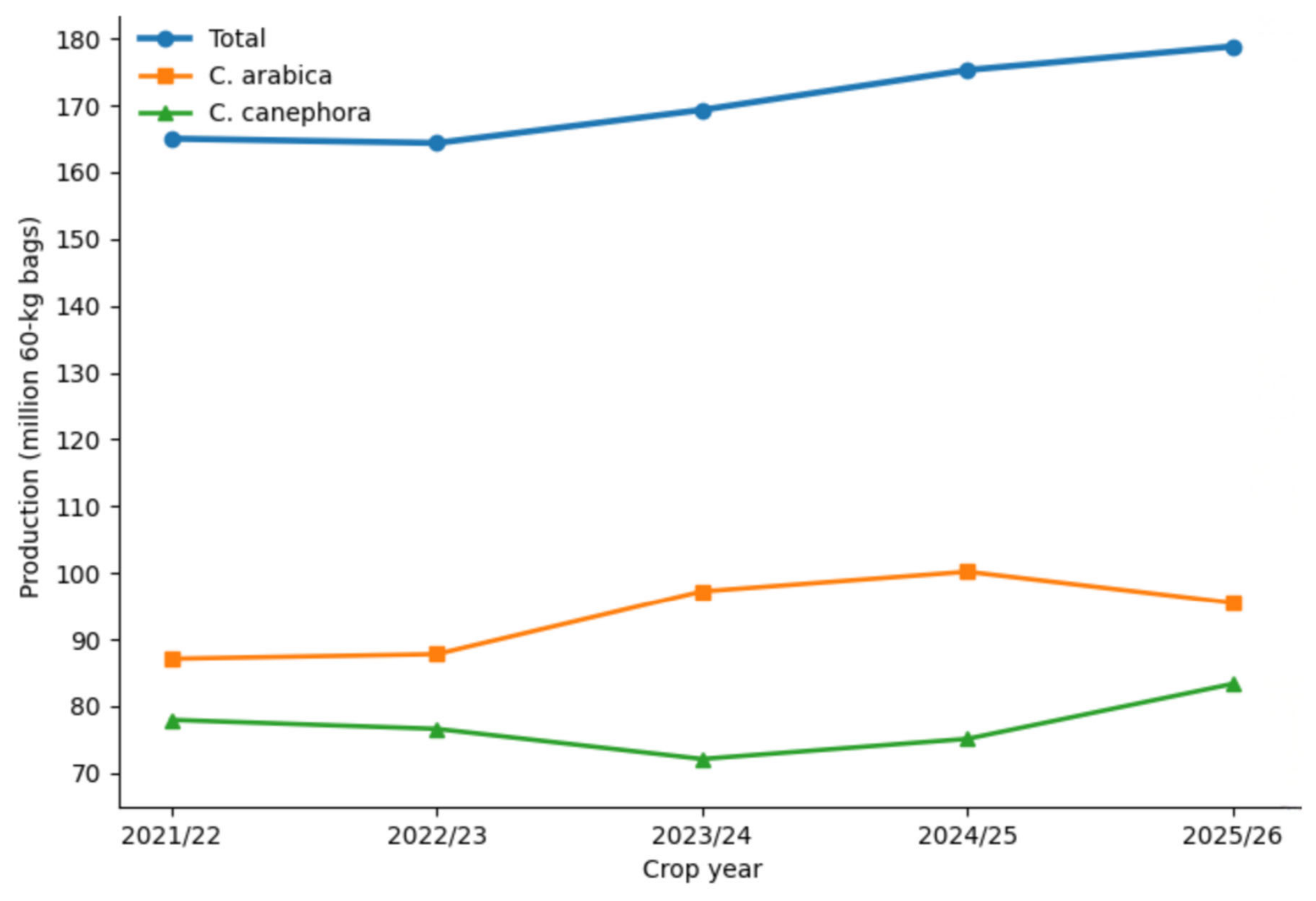
Figure 2.
Major disease symptoms observed in coffee plants. (a) coffee leaf rust caused by Hemileia vastatrix, showing visible chlorotic lesions on the adaxial leaf surface (left) and urediniospore production on the abaxial surface (right); (b) cercosporiosis caused by Cercospora coffeicola; (c) phoma leaf blight caused by Boeremia exigua; (d) bacterial blight (halo blight) caused by Pseudomonas syringae pv. garcae; (e) anthracnose caused by Colletotrichum spp.; (f) coffee leaf miner (Leucoptera coffeella), showing the pupa (left) and characteristic leaf mining damage (right); (g) coffee berry borer (Hypothenemus hampei), showing larval infestation in a mature fruit of Coffea liberica (left) and characteristic damage to the seed of Coffea arabica (right). Unless otherwise indicated, all leaf images correspond to Coffea arabica.
Figure 2.
Major disease symptoms observed in coffee plants. (a) coffee leaf rust caused by Hemileia vastatrix, showing visible chlorotic lesions on the adaxial leaf surface (left) and urediniospore production on the abaxial surface (right); (b) cercosporiosis caused by Cercospora coffeicola; (c) phoma leaf blight caused by Boeremia exigua; (d) bacterial blight (halo blight) caused by Pseudomonas syringae pv. garcae; (e) anthracnose caused by Colletotrichum spp.; (f) coffee leaf miner (Leucoptera coffeella), showing the pupa (left) and characteristic leaf mining damage (right); (g) coffee berry borer (Hypothenemus hampei), showing larval infestation in a mature fruit of Coffea liberica (left) and characteristic damage to the seed of Coffea arabica (right). Unless otherwise indicated, all leaf images correspond to Coffea arabica.
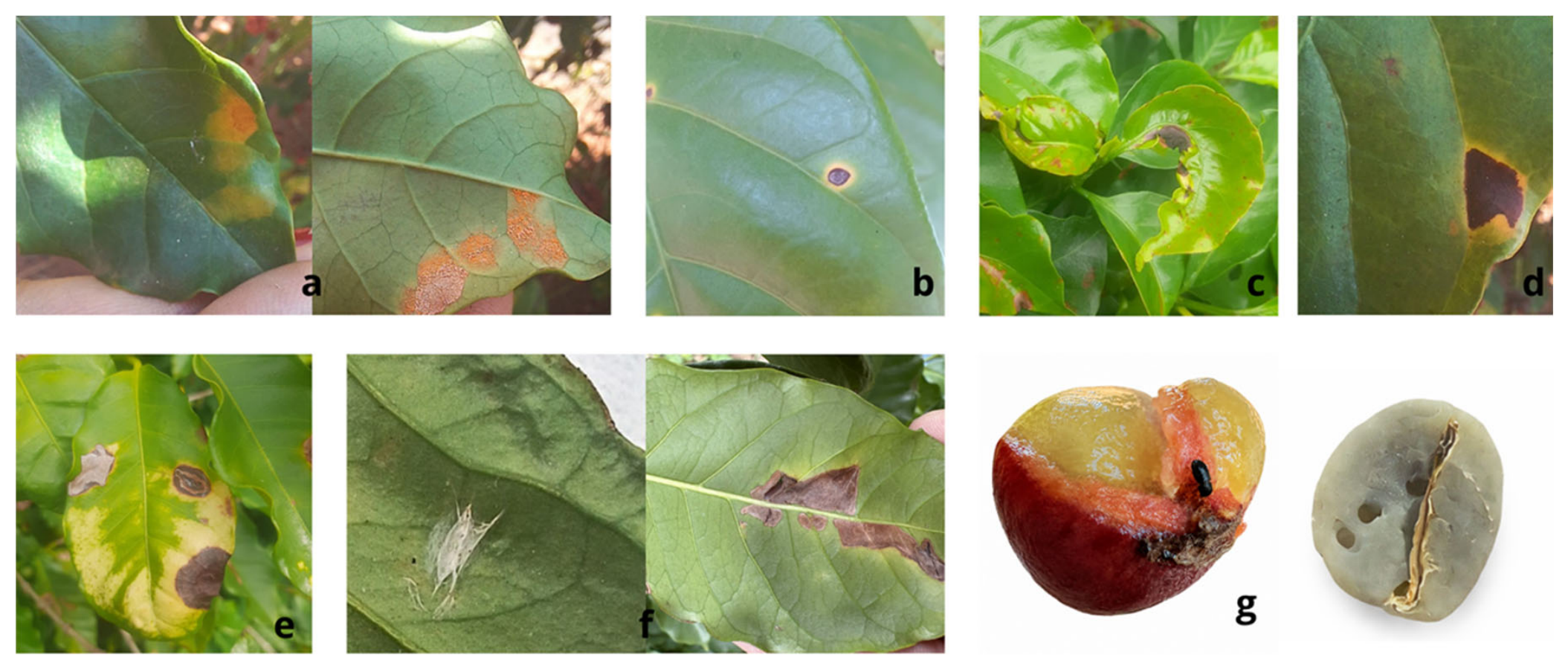

Table 1.
Coffee production (thousand 60-kg bags) by species, country, and crop year.
| Species | Country | 2020/21 | 2021/22 | 2022/23 | 2023/24 | 2024/25 | 2025/26 |
|---|---|---|---|---|---|---|---|
| C. arabica | Brazil | 49,7 | 36,4 | 39,8 | 44,9 | 43,7 | 38,0 |
| C. arabica | Colombia | 13,4 | 11,8 | 10,7 | 12,76 | 13,2 | 13,8 |
| C. arabica | Ethiopia | 7,6 | 8,15 | 7,3 | 9,13 | 10,63 | 11,56 |
| C. arabica | Honduras | 6,5 | 4,8 | 5,7 | 5,05 | 5,52 | 5,8 |
| C. arabica | Peru | 3,369 | 4,2 | 3,475 | 3,912 | 3,882 | 4,2 |
| C. canephora | Vietnam | 28,05 | 30,48 | 27,3 | 26,55 | 28 | 29,6 |
| C. canephora | Brazil | 20,2 | 21,7 | 22,8 | 21,4 | 21 | 25,0 |
| C. canephora | Indonesia | 9,4 | 9,3 | 9,5 | 6,8 | 9,3 | 11,0 |
| C. canephora | Uganda | 5,9 | 5,06 | 5,575 | 5,4 | 5,67 | 5,815 |
| C. canephora | India | 3,917 | 4,117 | 4,2 | 5,08 | 4,8 | 4,7 |
Source: USDA – Foreign Agricultural Service (2025).
Table 2.
Principal diseases affecting coffee worldwide, their causal agents, dominant production contexts, and associated impacts on productivity and plant longevity.
Table 2.
Principal diseases affecting coffee worldwide, their causal agents, dominant production contexts, and associated impacts on productivity and plant longevity.
| Disease category | Disease | Causal agent | Main occurrence or conditions | Primary impact | Secondary or cumulative impact |
|---|---|---|---|---|---|
| Foliar | Coffee leaf rust | Hemileia vastatrix | Global | Defoliation | Branch dieback |
| Foliar | Cercosporiosis | Cercospora coffeicola | Global | Leaf necrosis | Quality loss |
| Foliar | Phoma leaf blight | Boeremia exigua | Cool and humid regions | Shoot necrosis | Vigor decline |
| Foliar | Bacterial blight | Pseudomonas syringae pv. garcae | High-altitude regions | Leaf blight | Shoot dieback |
| Fruit | Coffee berry disease | Colletotrichum kahawae | Africa and Central America | Berry necrosis | Crop loss |
| Vascular / Dieback | Fusarium dieback | Fusarium spp. | Tropical regions | Vascular damage | Plant decline |
Disclaimer/Publisher’s Note: The statements, opinions and data contained in all publications are solely those of the individual author(s) and contributor(s) and not of MDPI and/or the editor(s). MDPI and/or the editor(s) disclaim responsibility for any injury to people or property resulting from any ideas, methods, instructions or products referred to in the content. |
© 2026 by the authors. Licensee MDPI, Basel, Switzerland. This article is an open access article distributed under the terms and conditions of the Creative Commons Attribution (CC BY) license (http://creativecommons.org/licenses/by/4.0/).
Copyright: This open access article is published under a Creative Commons CC BY 4.0 license, which permit the free download, distribution, and reuse, provided that the author and preprint are cited in any reuse.