

Submitted:
14 September 2026
Posted:
15 September 2026
You are already at the latest version
Abstract
We formulate a Möbius-chain mechanism for passive (topological, geometric) cancellation of co herent quantum errors. This work is the second step in a broader research program on M¨obius Quantum Computation : (i) In Paper I, we introduced MQC (Möbius Quantum Computation) as a topological boundary framework for quantum information processing, where non-orientable boundary conditions act as active ingredients in the effective quantum evolution of the quantum states and information processing. (ii) Here we investigate within such framework one concrete consequence and mechanism: the suppression of coherent errors by Möbius chain boundary con ditions. (iii) In contrast with conventional quantum error correction, which relies on redundant logical encoding, syndrome extraction, and active recovery operations, the present approach uses a global topological and non-orientable identification. (iv) A quantum chain is endowed with a M¨obius boundary condition such that a quantum amplitude returning after one complete traversal is compared with a twisted copy of itself. (v) We show that coherent phase errors accumulated along the ordinary branch can act against their topologically reflected contribution and they can cellate themselves. (vi) The resulting mechanism is geometric, boundary-driven, and passive. (vii) We formulate the boundary condition, derive the basic cancellation relation, discuss residual errors due to imperfect symmetry, and compare the proposal with dynamical decoupling, decoherence free subspaces, stabilizer codes, and topological quantum computation. (viii) The present results establish Möbius boundary conditions as a promising and efficient geometric resource that may com plement and optimize conventional quantum error mitigation and fault-tolerant architectures. (ix) Our quantum approach is theoretical and conceptual, its ingeneering and experimental architecture desserves investigation.
Keywords:
quantum computation
; Möbius chain
; geometric error cancellation
; topological boundary conditions
; quantum information processing
; coherent errors
1. Introduction
Quantum computation has emerged as one of the most promising developments in contemporary science and technology. Since Feynman’s seminal proposal that quantum systems could be efficiently simulated by computers governed by quantum-mechanical principles [1], the field has developed into a general framework for information processing [2] based on superposition, entanglement, and quantum interference, as systematically formulated by Nielsen and Chuang [3].
Potential applications range from the simulation of complex quantum systems and the discovery of new materials to cryptography, optimization, and problems that remain intractable for classical computers [4]. Despite remarkable theoretical and experimental progress, however, the realization of large-scale and reliable quantum processors continues to face a central challenge: the extreme sensitivity of quantum states to noise, decoherence, and operational imperfections [5].
Quantum information processing is fundamentally limited by the unavoidable interaction of quantum systems with their environment, which produces decoherence, phase instability, and the accumulation of computational errors [6,7]. Conventional quantum-error-correction strategies, beginning with the pioneering schemes of Shor and Steane [8,9] and the general conditions formulated by Knill and Laflamme [10], address these effects through logical redundancy, ancillary qubits, and repeated syndrome measurements, often at the cost of considerable physical and operational resources. Topological quantum computation offers an alternative route in which information is protected through nonlocal geometric properties [11,12].
In this paper, within our new research on Möbius quantum computation [13], we investigate a new and complementary approach on quantum-error cancellation based on the global topology of the quantum system. We show here that Möbius-chain boundary conditions can efficiently correlate apparently distinct error pathways and produce their destructive interference, thereby providing a geometric mechanism for intrinsic quantum-error cancellation.
Very recently, Google Quantum AI and Google DeepMind introduced an artificial-intelligence-based strategy for the continuous control of quantum error correction [14] using error-detection signals to compensate for processor drift computation. Our Möbius approach is conceptually different: Rather than relying primarily on external adaptive control, we exploit non-orientable boundary conditions to correlate error pathways and promote their destructive quantum interference. In addition, our intrinsic geometrical mechanism could operate independently or be incorporated into adaptive schemes such as that of Google Ref. [14], potentially reducing the residual error burden and providing the learning agent with a more stable and structured error landscape.
These results provide a timely experimental context for exploring different and complementary approaches—such as the Möbius boundary mechanism proposed here—in which error suppression arises intrinsically from geometry, topology and quantum interference.
Our quantum approach here is theoretical and conceptual, rather than ingeneering and experimental, its practical and quantitative implementation, and combination with the new Google IA error control [14] and other controls desserves investigation.
Quantum computation is limited not only by stochastic decoherence but also by coherent and systematic errors. Such errors include phase drifts, calibration imperfections, systematic over-rotations, residual couplings, and slowly varying control errors. Because coherent errors can add constructively over many operations, they may be especially damaging in long quantum circuits.
Standard quantum error correction suppresses errors by encoding logical qubits into larger Hilbert spaces, measuring stabilizers, and applying active recovery operations. This strategy is essential for fault-tolerant architectures, but it is resource intensive. It is therefore useful to investigate complementary passive mechanisms capable of suppressing specific classes of errors before, or in parallel with, active correction.
In Paper I [13], we proposed Möbius quantum computation (MQC) as a topological boundary framework for quantum information processing, based on the idea that non-orientable boundary conditions can act as active constraints on quantum evolution rather than as merely geometrical illustrations.
The Möbius strip, owing to its single-sided non-orientable structure, provides a simple mathematical setting in which global boundary identification, geometric phase, and quantum-state evolution can be connected.
In this paper here we develop the next step of that program, we focus on one concrete new mechanism: coherent error cancellation by using a Möbius quantum chain, which was not considered before for such purpose.
The essential idea of this paper is that a quantum state propagating on a closed chain with a Möbius boundary identification does not return to itself trivially: Instead, the return amplitude is related to the initial amplitude by a twist. This global constraint can force opposite coherent phase contributions to interfere destructively. Therefore, the cancellation is not produced by measurement or redundancy, but by the global topology of the boundary condition itself.
The results of this paper are the following:
(i) We formulate a quantum Möbius-chain model,
(ii) We derive the cancellation of symmetric coherent phase perturbations,
(iii) We identify the residual error for imperfect symmetry, and
(iv) We discuss the physical meaning of Möbius boundary conditions as a topological resource for passive quantum error suppression.
The present work shows the advantages and physical consequences of the general Möbius quantum computing framework (MQC), namely the passive (geometric/topological) coherent error cancellation induced by the Möbius boundary conditions. In addition, this new mechanism is particularly economic with respect to the physical and operational resources. And can be also considered to complete and optimize the other known conventional approachs.
Further developments, including topological gate implementations and quantum algorithms based on Möbius topology, will be investigated in future work.
This paper is organized as follows: Section I describes the contextual background, current interest, purposes and results of this paper. In Section II we implement the Möbius Boundary Conditions as a Quantum Resource. In Sections III and IV we describe the Möbius Quantum Chain and the Coherent Phase Error on an Ordinary Chain. Section V shows the Möbius Error Cancellation and Section VI the Boundary Cancellation and the Quantum Gates. In Section VIII we discuss Physical Interpretation and Experimental Implementations, and Section IX summarizes the Conclusions.
2. Möbius Boundary Conditions as a Quantum Resource
The Möbius strip is the simplest non-orientable surface with a single boundary component. Its standard identification may be represented as
where labels the coordinate along the strip.
The important physical point is not the literal construction of a mechanical strip, but the existence of an effective boundary rule that identifies the end of a quantum trajectory with a reversed or twisted copy of its beginning.
In quantum information language, such a rule may be represented by a Möbius boundary operator . Acting on a state , this operator imposes a global constraint on the admissible evolution,
where is a twist phase and is an internal twist operation.
(i) Depending on the physical realization, may act on spin, pseudospin, qubit orientation, path degree of freedom, or another internal two-level structure.
(ii) Such boundary condition is the basic resource considered here.
(iii) It enriches the usual Hilbert-space evolution by imposing a non-orientable global identification.
(iv) In this sense, the Möbius boundary condition is not an additional local interaction. It is a topological rule selecting how amplitudes are compared after a complete traversal.
3. Möbius Quantum Chain
Consider a one-dimensional quantum chain of length L, parametrized by
For an ordinary periodic chain, the wavefunction satisfies
For a Möbius quantum chain, we impose instead
The simplest idealization is obtained when the twist acts as a sign or orientation inversion,
A full traversal of the chain therefore combines dynamical propagation with a topological return rule. The state does not simply come back to the same local orientation. It comes back as a twisted copy of itself.
The effective propagation around the chain may be written schematically as
where denotes the ordinary dynamical evolution and encodes the Möbius boundary identification.
In regimes where the topological contribution can be represented by a global phase, one may write
where denotes a geometric or topological phase associated with the Möbius traversal.
In the present paper, however, we emphasize not only the phase itself but the cancellation of coherent error contributions induced by the twisted return.
4. Coherent Phase Error on an Ordinary Chain
Let a coherent phase error be described by a slowly varying perturbation , so that the wavefunction acquires the local phase
On an ordinary chain, the accumulated coherent phase after one traversal is
If the same systematic perturbation is repeated over many cycles, the accumulated phase may grow coherently,
This constructive accumulation is one of the reasons coherent errors can be more dangerous than purely random errors.
Random errors may partially average out, while systematic coherent errors can reinforce themselves.
On the contrary, as we show here, the presence of a Möbius strip topology (Möbius boundary conditions) naturally produces in a clean (geometric) annhilation of one error by each other, instead of the error construction which operates in the trivial topology.
5. Möbius Error Cancellation
The Möbius boundary condition changes the global phase balance. Because the state returns through a twisted identification, the second contribution to the accumulated phase is effectively compared with a topologically reversed branch. We write the total Möbius phase mismatch as
where denotes the error field seen on the twisted branch after the Möbius identification.
For a symmetric coherent perturbation,
Equation (12) gives
Thus the coherent error cancels at the level of the global boundary condition. The cancellation is not local. It is a result of comparing the forward branch with its topologically related Möbius return, as a consequence of the non-global orientation of the Möbius manifold.
More generally, if the perturbation is not perfectly symmetric, we may write
and the residual Möbius phase becomes
The remaining error is therefore controlled by the asymmetry of the perturbation rather than by its full magnitude. This is the key suppression mechanism.
Figure 3 below illustrates these key features.
6. Boundary Cancellation and Quantum Gates
Let be a quantum gate acting locally or sequentially on the chain, and let denote the global Möbius propagation operator. A circuit layer may be represented schematically as
The Möbius operation is not a replacement for the logical gate. Rather, it acts as a topological boundary filter that modifies the way coherent errors accumulate.
If a gate suffers from a coherent over-rotation,
then, an ordinary repeated circuit accumulates the systematic shift .
On the contrary, in a Möbius chain, the topological return can pair the over-rotation with a reversed or twisted (with opposite sign) contribution. The leading residual error is then determined by the mismatch between the two branches,
For , the leading coherent contribution does cancel.
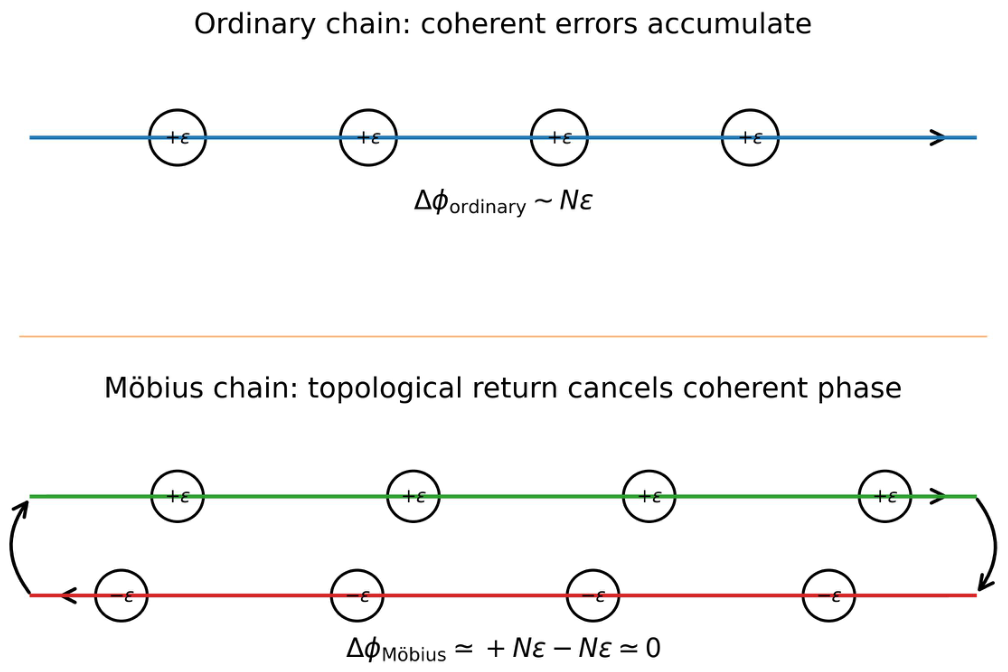
In realistic implementations, the cancellation will be approximate, and its quality will depend on the degree to which the Möbius branch reproduces the same systematic error with the exact required topological sign or orientation relation (Figure 4). However, and in any case, the topological Möbius mechanism produces an efficient coherent error mitigation effect.
7. Comparison with Other Error-Suppression Mechanisms
The Möbius mechanism is distinct from standard stabilizer quantum error correction. It does not require syndrome extraction, measurement feedback, or redundant logical encoding.
It is also distinct from dynamical decoupling, where time-dependent pulse sequences average unwanted interactions. On the contrary, in our topological framework here the error suppression arises from static global boundary constraints.
Our paper here is related in spirit to decoherence-free subspaces, because both approaches use structure to reduce sensitivity to selected perturbations. However, decoherence-free subspaces rely on symmetry in the system-environment coupling and do encode information in protected subspaces.
The Möbius mechanism here instead uses a non-orientable boundary identification to compare two topologically related error contributions.
The framework of this paper is also related to geometric and topological approaches, but it differs from the known topological computing requiring anyons or braiding. We notice too that our quantum Möbius approach can be used to complement and generalize such standard known approachs as anyons, braiding and others.
In the present paper, topology enters through boundary identification and global phase cancellation. The Möbius chain may therefore be viewed as a boundary-engineered passive error-suppression layer.
Finally, and as we mentioned in the Introduction, very recently [14], Google (QAI and DeepMind) used a reinforcement-learning strategy for quantum error correction control: error detection signals are used to continuously compensate for processor drift .
These results emphasize the growing importance of adaptive autonomous error-control mechanisms and provide a timely experimental context for exploring different and complementary approaches—such as the Möbius boundary mechanism proposed here—in which error suppression arises intrinsically from geometry, topology and quantum interference.
Our quantum approach here is theoretical and conceptual, rather than ingeneering and experimental, its practical and quantitative implementation, and combination with the new Google IA error control [14] desserves investigation.
8. Physical Interpretation and Possible Implementations
The cancellation mechanism can be summarized as follows:
(i) In an ordinary (topologically trivial) closed chain, a coherent error accumulated over a full loop returns with the same orientation and can reinforce itself.
(ii) In a Möbius chain instead, the returning amplitude is identified with a twisted copy of the initial amplitude. This twist reverses or compares the contribution of symmetric coherent perturbations. The error is therefore converted from an accumulated global phase into a difference between two topologically related branches of different sign.
(iii) This mechanism is expected to be most effective for slowly varying, systematic, and spatially correlated errors. It is not expected to cancel arbitrary local stochastic noise.
(iv) Therefore, Möbius error cancellation should be regarded as complementary to, not a replacement for, conventional quantum error correction.
(v) Possible physical settings include photonic waveguide arrays with engineered path topology, superconducting circuits with synthetic boundary conditions, cold atoms in programmable optical potentials, trapped-ion chains with controlled phase-space loops, and topological materials supporting non-trivial boundary modes.
(vi) In each case, the essential requirement is not the literal construction of a physical Möbius strip, but the implementation of an effective non-orientable boundary identification in the quantum dynamics.
9. Conclusions
We have formulated a Möbius boundary mechanism for coherent quantum error cancellation. This paper extends the Möbius quantum computation program introduced in Paper I by focusing on a concrete application: passive error suppression in a Möbius quantum chain.
A chain with a twisted Möbius identification can force symmetric coherent phase errors to cancel after a complete traversal. The leading residual error is controlled by the asymmetry between the two ordinary and twisted branches.
The central result is the cancellation relation
for symmetric coherent perturbations.
This result shows that global topology can act as a passive error-suppression resource.
This framework can be applied in numerical simulations, circuit realizations, and experimental implementations in superconducting qubits, photonic circuits, trapped ions, cold atoms, and synthetic quantum matter platforms.
The present analysis establishes the theoretical feasibility of the coherent error cancellation induced by Möbius boundary conditions.
The approach here was intentionally conceptual to illustrate the essential principle and does not yet include hardware-dependent noise models, finite-temperature environments, or device-specific imperfections.
These aspects will require dedicated numerical simulations and experimental implementations.
Consequently, the present work should be regarded as a proof of principle demonstrating a new topological mechanism for passive quantum error suppression.
Beyond its immediate application to coherent error suppression, the Möbius framework suggests that non-orientable topological boundary conditions may constitute a broader design principle for quantum information processing.
This perspective opens new directions connecting topology, quantum dynamics, and quantum computation.
References
- Feynman, R. P. Simulating Physics with Computers. Int. J. Theor. Phys. 1982, 21, 467–488. [Google Scholar] [CrossRef]
- Deutsch, D. Quantum theory, the Church–Turing principle and the universal quantum computer. Proc. R. Soc. Lond. A 1985, 400, 97. [Google Scholar] [CrossRef]
- Nielsen, M. A.; Chuang, I. L. Quantum Computation and Quantum Information; Cambridge University Press: Cambridge, 2010. [Google Scholar]
- Shor, P. W. Algorithms for Quantum Computation: Discrete Logarithms and Factoring. In Proceedings of the 35th Annual Symposium on Foundations of Computer Science; IEEE, 1994; pp. 124–134. [Google Scholar] [CrossRef]
- Preskill, J. Quantum computing in the NISQ era and beyond. Quantum 2018, 2, 79. [Google Scholar] [CrossRef]
- W. H. Zurek, Decoherence, Einselection, and the Quantum Origins of the Classical. Rev. Mod. Phys. 2003, 75, 715–775. [CrossRef]
- Breuer, H.-P. F. Petruccione, The Theory of Open Quantum Systems; Oxford University Press: Oxford, 2002. [Google Scholar]
- Shor, P. W. Scheme for reducing decoherence in quantum computer memory. Phys. Rev. A 1995, 52, R2493. [Google Scholar] [CrossRef] [PubMed]
- Steane, A. M. Error correcting codes in quantum theory. Phys. Rev. Lett. 1996, 77, 793. [Google Scholar] [CrossRef] [PubMed]
- Knill, E.; Laflamme, R. Theory of Quantum Error-Correcting Codes. Phys. Rev. 1997, A55, 900–911. [Google Scholar] [CrossRef]
- Kitaev, A. Y. Fault-tolerant quantum computation by anyons. Ann. Phys. 2003, 303, 2. [Google Scholar] [CrossRef]
- Nayak, C.; Simon, S. H.; Stern, A.; Freedman, M.; Das Sarma, S. Non-Abelian anyons and topological quantum computation. Rev. Mod. Phys. 2008, 80, 1083. [Google Scholar] [CrossRef]
- Mac Loughlin, J. L.; Sanchez, N. G. Möbius Quantum Computation: A New Topological Boundary framework for Quantum Information Processing. Researchgate 2026, 1–7. [Google Scholar]
- Sivak, V.; Morvan, A.; Broughton, M.; et al. Reinforcement Learning Control of Quantum Error Correction. Nature 2026, 655, 879–884. [Google Scholar] [CrossRef] [PubMed]
- Gottesman, D. Stabilizer codes and quantum error correction. Ph.D. thesis, California Institute of Technology, 1997. [Google Scholar]
- Lidar, D. A.; Whaley, K. B. Decoherence-free subspaces and subsystems, in Irreversible Quantum Dynamics; Benatti, F., Floreanini, R., Eds.; Springer: Berlin, 2003. [Google Scholar]
- Viola, L.; Lloyd, S. Dynamical suppression of decoherence in two-state quantum systems. Phys. Rev. A 1998, 58, 2733. [Google Scholar] [CrossRef]
- Simon, B. Holonomy, the quantum adiabatic theorem, and Berry’s phase. Phys. Rev. Lett. 1983, 51, 2167. [Google Scholar] [CrossRef]
- Berry, M. V. Quantal phase factors accompanying adiabatic changes. Proc. R. Soc. Lond. A 392 1984, 45. [Google Scholar]
- Aharonov, Y.; Anandan, J. Phase change during a cyclic quantum evolution. Phys. Rev. Lett. 1987, 58, 1593. [Google Scholar] [CrossRef] [PubMed]
- Zanardi, P.; Rasetti, M. Holonomic quantum computation. Phys. Lett. A 264 1999, 94. [Google Scholar] [CrossRef]
- Terhal, B. M. Quantum error correction for quantum memories. Rev. Mod. Phys. 2015, 87, 307. [Google Scholar] [CrossRef]
- Hasan, M. Z.; Kane, C. L. Colloquium: Topological insulators. Rev. Mod. Phys. 2010, 82, 3045. [Google Scholar] [CrossRef]
- Qi, X.-L.; Zhang, S.-C. Topological insulators and superconductors. Rev. Mod. Phys. 2011, 83, 1057. [Google Scholar] [CrossRef]
- Moore, J. E. The birth of topological insulators. Nature 2010, 464, 194. [Google Scholar] [CrossRef] [PubMed]
- Xue, Z.-Y.; Ding, C.-Y. Recent Advances on Nonadiabatic Geometric Quantum Computation. quant-ph 2511.07119. 2025. [Google Scholar] [CrossRef]
Figure 1.
Möbius quantum chain with a twisted boundary condition. The two ends of the chain are not identified trivially, as in an ordinary periodic chain, but through a Möbius rule . This global identification acts as a topological boundary resource.
Figure 1.
Möbius quantum chain with a twisted boundary condition. The two ends of the chain are not identified trivially, as in an ordinary periodic chain, but through a Möbius rule . This global identification acts as a topological boundary resource.
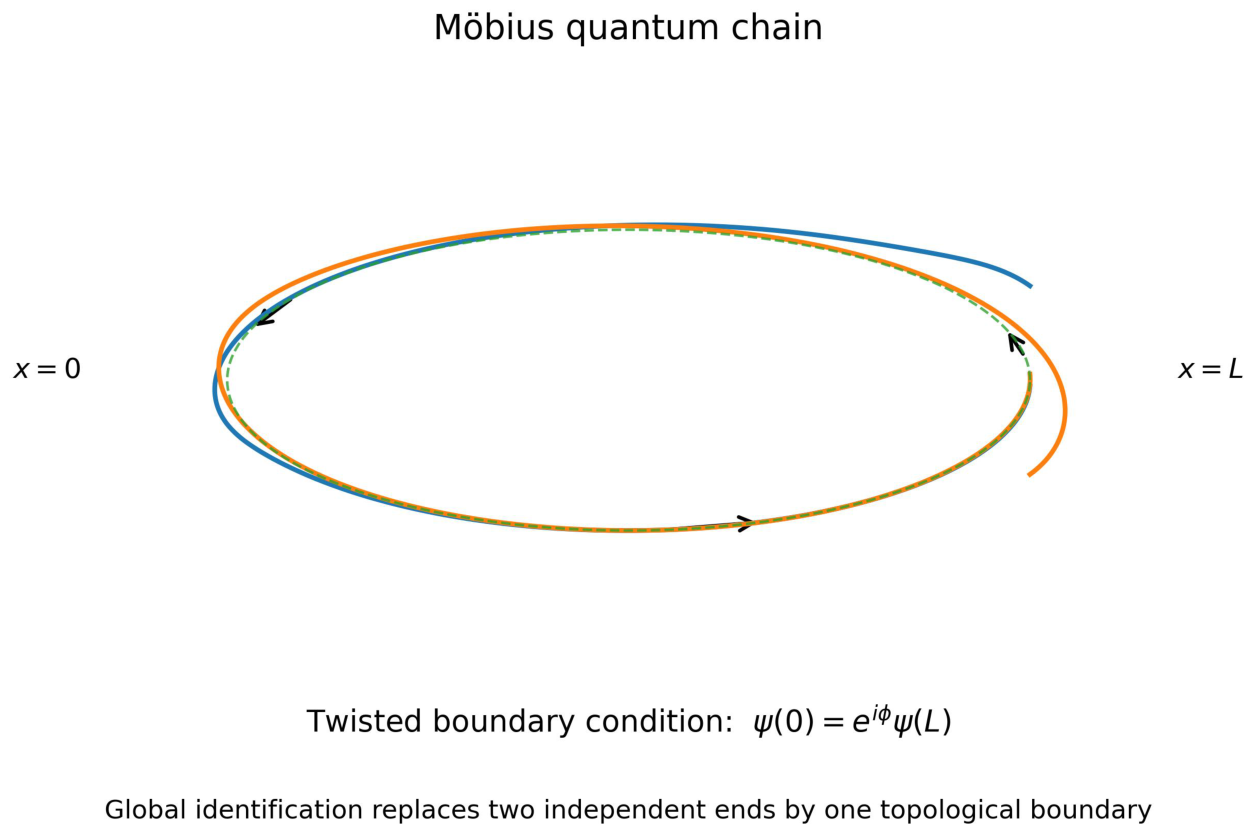
Figure 2.
Error Accumulation in Ordinary Topology versus Passive Cancellation in Möbius Topology. Ordinary versus Möbius quantum Topologies. In the ordinary geometry, coherent phase errors accumulate during propagation. The Möbius boundary identification generates opposite contributions, and , producing passive cancellation after a complete traversal.
Figure 2.
Error Accumulation in Ordinary Topology versus Passive Cancellation in Möbius Topology. Ordinary versus Möbius quantum Topologies. In the ordinary geometry, coherent phase errors accumulate during propagation. The Möbius boundary identification generates opposite contributions, and , producing passive cancellation after a complete traversal.
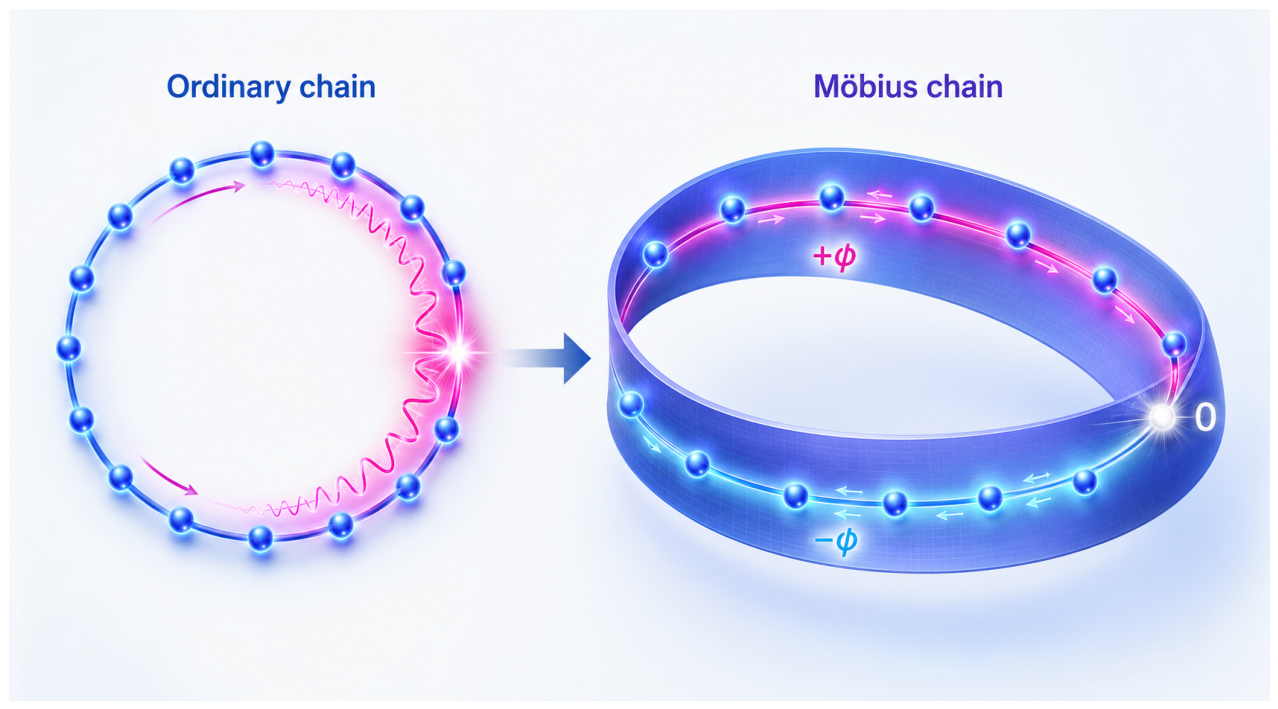
Figure 3.
Coherent phase-error cancellation in a Möbius quantum chain. A phase accumulated along the ordinary branch is compared with the contribution accumulated along the twisted return branch. For symmetric coherent perturbations, the two contributions cancel in the global Möbius boundary condition.
Figure 3.
Coherent phase-error cancellation in a Möbius quantum chain. A phase accumulated along the ordinary branch is compared with the contribution accumulated along the twisted return branch. For symmetric coherent perturbations, the two contributions cancel in the global Möbius boundary condition.
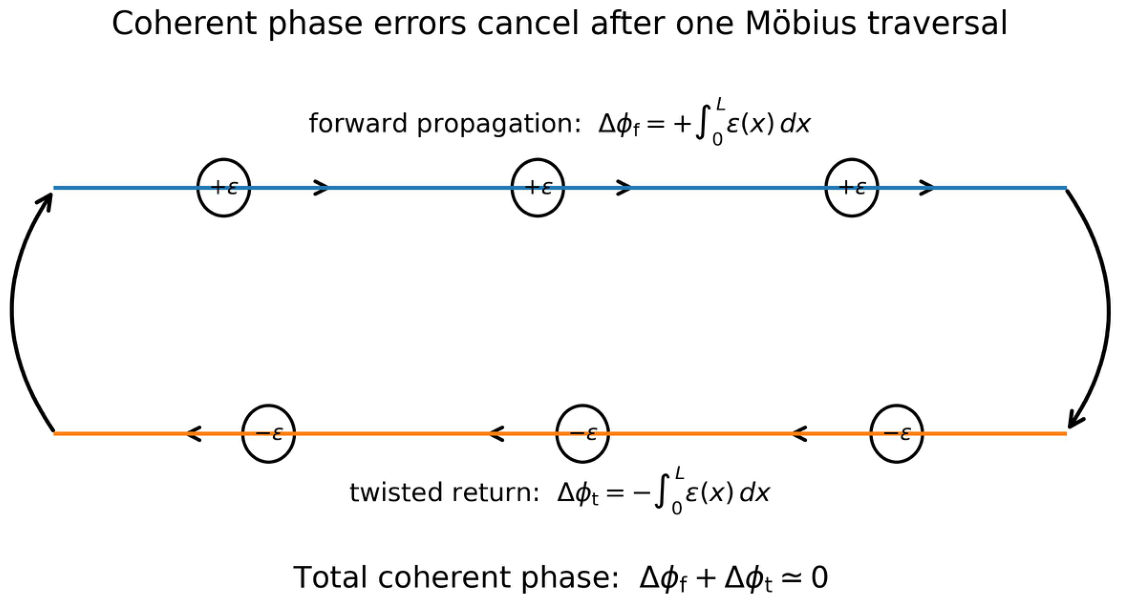
Figure 4.
Quantum Errors: Comparison between an ordinary chain and a Möbius chain. In an ordinary chain, coherent errors can accumulate constructively. In a Möbius chain, the twisted return branch can cancel the leading coherent contribution, leaving only the asymmetry between the two branches.
Figure 4.
Quantum Errors: Comparison between an ordinary chain and a Möbius chain. In an ordinary chain, coherent errors can accumulate constructively. In a Möbius chain, the twisted return branch can cancel the leading coherent contribution, leaving only the asymmetry between the two branches.
Disclaimer/Publisher’s Note: The statements, opinions and data contained in all publications are solely those of the individual author(s) and contributor(s) and not of MDPI and/or the editor(s). MDPI and/or the editor(s) disclaim responsibility for any injury to people or property resulting from any ideas, methods, instructions or products referred to in the content. |
© 2026 by the authors. Licensee MDPI, Basel, Switzerland. This article is an open access article distributed under the terms and conditions of the Creative Commons Attribution (CC BY) license (http://creativecommons.org/licenses/by/4.0/).
Copyright: This open access article is published under a Creative Commons CC BY 4.0 license, which permit the free download, distribution, and reuse, provided that the author and preprint are cited in any reuse.