

Submitted:
11 September 2026
Posted:
14 September 2026
You are already at the latest version
Abstract
Long-duration human exploration beyond low-Earth orbit exposes crews to a convergent hazard field that includes galactic cosmic radiation, solar particle events, hypogravity, hypokinesia, immune dysregulation, microbiome disturbance, circadian disruption, psychological stress, and constrained habitat conditions. Current radioprotection strategies (exposure limitation, active dosimetry, space-weather forecasting, physical shielding, storm-shelter logic, ALARA-style dose management, and biomedical countermeasures) remain essential, but they will not fully solve the biological problem of cumulative radiation injury during Mars-class missions. This article proposes a hypoxia-centred integrated radioprotection framework in which habitat atmosphere composition and oxygen partial pressure are treated as active design variables rather than passive life-support parameters. Controlled normobaric hypoxic engineering may reduce oxygen-dependent fixation of radiation injury, lower oxidative pressure, support mitochondrial resilience, and improve fire safety in enclosed vehicles and habitats. This approach is not a replacement for shielding, monitoring, or pharmacological countermeasures. It is a missing environmental layer designed to integrate with them. The central operational concept is a two-level architecture: long-term adaptation to moderate habitat hypoxia, provisionally corresponding to approximately 16-12% O2 under carefully controlled normobaric conditions, combined with short, monitored, deeper hypoxic excursions to approximately 9-10% O2 during solar particle event sheltering, when crew are already in structurally protected niches with minimal physical activity and reduced oxygen consumption. These values are proposed research windows, not operational recommendations, and require staged validation before any mission use. The proposed framework integrates mechanistic rationale, operational architecture, safety objections, fire-safety co-benefits, adjunctive countermeasures, and a four-prototype validation pathway for controlled oxygen modulation. Controlled hypoxic habitat engineering emerges as a mission-critical countermeasure candidate for deep-space exploration and as a possible translational bridge to terrestrial geromedicine through mitochondrial resilience, hypoxic conditioning, and healthspan infrastructure.
Keywords:
radioprotection
; radioresistance
; deep-space exploration
; normobaric hypoxia
; oxygen partial pressure
; solar particle events
; mitochondrial resilience
; mitophagy
; cellular senescence
; hypoxic preconditioning
; reduced-oxygen fire safety
; ALARA
; space medicine
; habitat engineering
; geromedicine
; healthspan
1. The Deep-Space Radioprotection Problem
Human expansion beyond low-Earth orbit is entering a phase in which radioprotection must be treated as a mission-enabling strategy rather than a specialist biomedical concern. Lunar surface operations, commercial stations, long-duration transit vehicles and Mars-class mission concepts all expose crew to radiation environments that differ fundamentally from those encountered in terrestrial medicine or low-Earth orbit.
The problem is especially acute for long-duration Mars transit and flyby scenarios. Transit vehicles cannot be converted into massive radiation bunkers without major penalties in mass, fuel, internal layout and mission design. Acute solar particle events can be partially addressed through forecasting, monitoring and shielded storm shelters, but chronic exposure to galactic cosmic radiation remains difficult to eliminate. Biological countermeasures therefore become central to mission feasibility.
The earlier Vive la radiorésistance framework established enhanced human radioresistance as a prerequisite for deep-space exploration, one with meaningful spillover into biogerontology and regenerative medicine [1]. The present article retains that strategic logic while focusing on an intervention that is more immediate, operationally feasible, and empirically testable: controlled modulation of oxygen partial pressure within engineered habitat atmospheres.
The central claim is straightforward and scientifically grounded: reducing pO₂ in the breathing environment confers meaningful radioprotection [22,23,24]. Oxygen partial pressure is both a biological and an operational variable, yet it remains conspicuously absent from current deep-space radioprotection architectures. We argue this represents a missed opportunity. If validated through systematic testing, atmospheric oxygen modulation could serve as an additional fortifying layer within the multilevel defence systems already employed by space habitat design agencies, complementing shielding, pharmacological countermeasures, and biological mitigation strategies rather than replacing them.
2. Current Integrated Radioprotection Frameworks and the Missing Atmosphere Engineering Layer
NASA and other space agencies already use an integrated radioprotection logic: mission planning, exposure limitation, active dosimetry, space-weather forecasting, physical shielding, storm-shelter procedures, biomedical monitoring, operational constraints and the principle of keeping doses as low as reasonably achievable. This integrated framework is necessary, but has limitations.
Notably, the trajectory of agency planning already points toward hypoxic habitats. It is anticipated by NASA that planned deep-space exploration missions, particularly surface-exploration missions, will not be normoxic or normobaric. To enable rapid egress without many hours of pre-breathe decompression, these missions are instead planned around a mildly hypoxic “exploration atmosphere,” with intermittent extravehicular activity conducted from a hypoxic suit, allowing egress within minutes rather than hours. The precise atmosphere is being determined through ground investigations in a vehicle-simulation atmospheric chamber at the Johnson Space Center, with 8.2 psi and 34% oxygen among the options evaluated. Initial data from three such missions indicate that living at mild hypoxia with hyperoxic EVAs has a pronounced impact on immunity and inflammation [49]. In other words, the operational question is no longer whether crews will inhabit altered atmospheres, but how those atmospheres should be engineered, which is precisely the gap this framework addresses.
A foundational limitation of current habitat design is that cabin atmosphere parameters are treated almost exclusively as an analogue of Earth’s sea-level environment. Oxygen is maintained to sustain performance and prevent hypoxia, while radioprotection is pursued through shielding, mission timing, monitoring, and biomedical countermeasures. This has entrenched an operational dogma: any degree of hypoxia is a hazard to be eliminated, as it risks impairing crew reliability and degrading mission performance.
Yet the evidence base invites a more precise question, one that this dogma has discouraged from being asked. Can crew gradually adapted to stable, moderate physiological hypoxia safely tolerate defined, deeper hypoxic states during solar-event sheltering, under continuous monitoring and reduced operational load? That question has not been adequately tested within the architecture of a Mars-class mission.
Figure 1.
Current integrated radioprotection approach and the missing atmosphere-engineering layer.
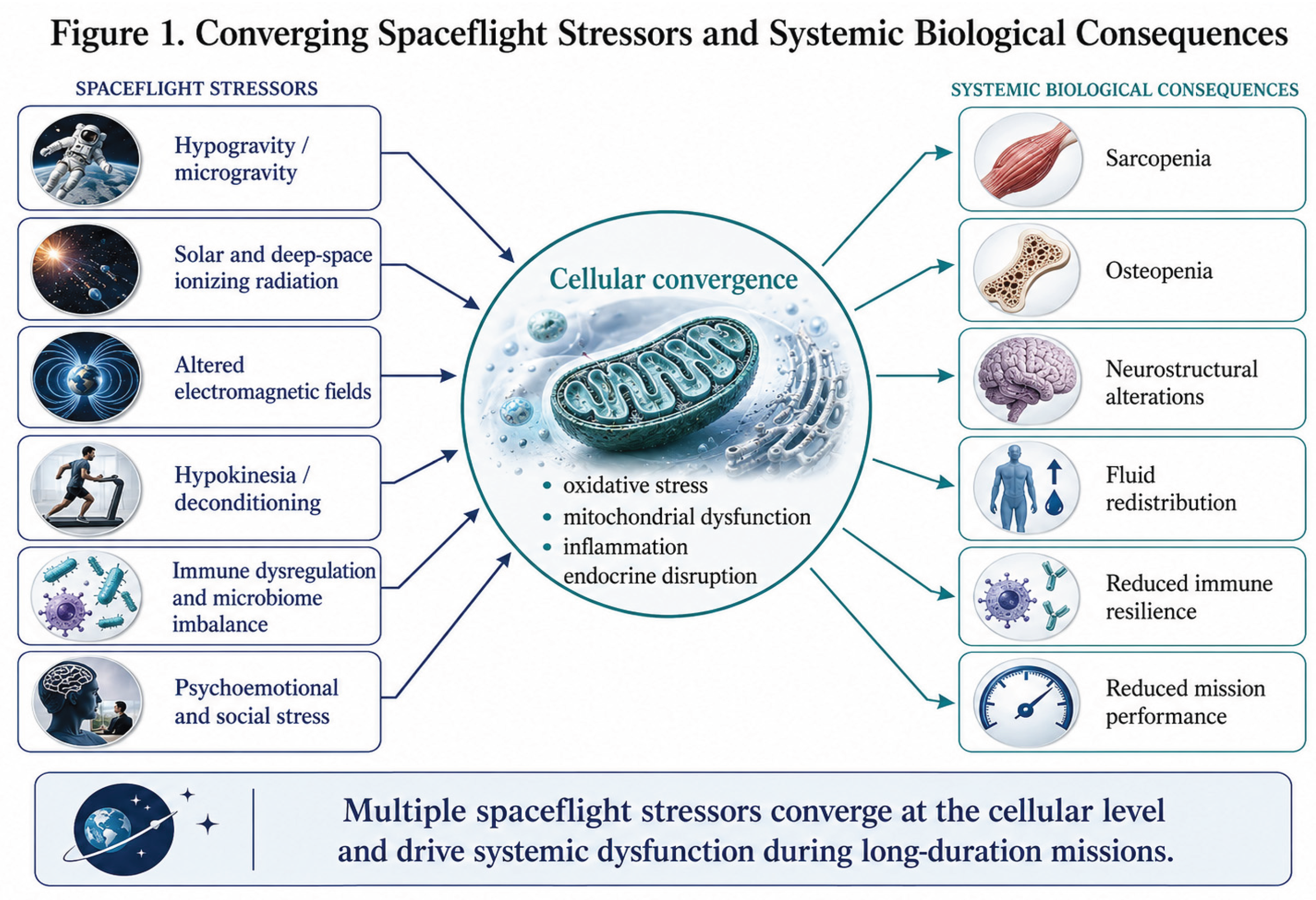
The Controlled Hypoxic Engineering concept reframes the habitat atmosphere itself as an active countermeasure layer. Rather than a fixed life-support parameter, atmospheric oxygen becomes a tunable variable, one that can be strategically modulated in response to radiation threat levels. Realizing this requires a dedicated research programme addressing oxygen variability ranges, synergistic interactions with other spaceflight hazards, adaptation windows, cognitive performance thresholds, cardiovascular responses, sleep architecture, exercise constraints, individual variability, emergency reversal procedures, and integration with radiation monitoring and storm-shelter protocols.
3. Spaceflight Injury as a Mitochondrial and Systems-Biology Problem
Spaceflight is not a single-stressor exposure. Radiation, microgravity, hypokinesia, altered fluid distribution, circadian disruption, confinement, immune change, microbiome disturbance and psychological stress converge on common biological denominators: mitochondrial dysfunction, oxidative stress, inflammation, neurovascular injury, endocrine disruption, impaired tissue repair and reduced systemic resilience.
Recent space-mitochondria literature emphasizes that space exposure is associated with duration-dependent reactive oxygen species accumulation, impaired oxidative phosphorylation, immune-metabolic dysfunction, inflammation, increased circulating cell-free mitochondrial DNA (cf-mtDNA), and persistent epigenetic or transcriptional changes after return to Earth [9,10,55]. Space radiation and microgravity interact through mitochondrial pathways, and mitochondrial vulnerability varies by tissue and genetic background.
Current evidence indicates that GCR and SPE exposures differ not only in dose rate and temporal pattern, but also in particle composition, energy spectrum and track structure; these factors influence clustered DNA damage, repair fidelity, cellular senescence, neurovascular injury and late cancer and degenerative risks [3,4,5,6,7,8]. Spaceflight studies further associate the combined environment with reactive oxygen species accumulation, altered oxidative phosphorylation, immune-metabolic dysfunction and persistent epigenetic or transcriptional changes after return to Earth [9,10]. Because radiation, microgravity and other mission stressors converge on mitochondrial and inflammatory pathways, tissue response cannot be inferred reliably from radiation quality alone.
This matters for radioprotection because mitochondria are both radiation targets and adaptive control systems. Radiation-induced oxidative stress damages mitochondrial DNA, proteins, and membranes; mitochondrial dysfunction then amplifies inflammatory and immune stress. Conversely, mitochondrial biogenesis, mitophagy, antioxidant defence, and metabolic flexibility are plausible targets for resilience-building countermeasures. Importantly, mitochondrial dysfunction is tightly interlinked with cellular senescence as considered below.
Space-mitochondria analyses indicate that oxidative phosphorylation (OXPHOS; complexes I-V) is suppressed systemically across tissues after spaceflight [10]. The onset and persistence of this suppression appear to vary with tissue radiosensitivity: relatively radiosensitive systems, including immune cells, skin and ocular tissues, show early OXPHOS suppression that can persist after return to Earth, while more radioresistant tissues such as muscle, bone and brain may show later onset but comparable long-lasting bioenergetic disruption [10].
This mitochondrial dysfunction can drive downstream effects including increased inflammation, suppressed immune activity, cellular senescence, apoptosis, and cell death; sustained dysfunction may therefore contribute to elevated long-term health risks. The same mitochondrial-driven cascade can increase reactive oxygen species (ROS) production, which may in turn exacerbate cellular and tissue hypoxia and also drive cellular senescence. These points strengthen the rationale for treating mitochondrial respiration, tissue-specific bioenergetic recovery, and inflammatory response as core validation endpoints rather than background biology [10].
Controlled hypoxia is relevant because oxygen sensing and mitochondrial function are inseparable. Poorly controlled oxygen deficit impairs performance and can endanger crew. Carefully titrated oxygen reduction may activate adaptive programmes, reduce oxygen-dependent radical chemistry and alter mitochondrial stress responses in ways that merit rigorous testing.
4. Controlled Hypoxic Engineering as a Missing Countermeasure Layer
Oxygen is normally defined as a life-support requirement. In radiobiology, however, oxygen is also a chemical amplifier of radiation damage. Oxygen can stabilize radiation-induced radical lesions, increasing the probability that transient damage becomes biologically fixed. This oxygen effect is well established in radiobiology and radiation oncology [22,23].
More precisely, oxygen enhances radiation effects mainly through the rapid rise in radiosensitivity as tissue pO2 increases from 0 to about 30 mmHg (approximately 5% O2), with further oxygenation adding little benefit. The oxygen enhancement ratio (OER), about 2.5-3.5 for low-LET radiation such as X-rays, declines as linear energy transfer rises above roughly 30 keV/μm and approaches unity near 150-200 keV/μm, reflecting the diminishing role of the oxygen-fixation mechanism as densely ionizing direct damage dominates over indirect free-radical-mediated damage [23,26].
This LET dependence has a direct operational consequence for deep-space radioprotection. The two dominant radiation environments differ fundamentally in ionization density: SPEs are dominated by lower-energy, predominantly low-LET protons, whereas GCR comprises high-energy, high-LET heavy ions whose densely ionizing tracks cause direct damage that is far less oxygen-dependent. Controlled hypoxia is therefore expected to confer its greatest benefit against the low-LET SPE component and progressively less benefit as LET increases toward the GCR regime [26]. We are explicit about this boundary: the hypoxic approach is proposed as a strong countermeasure for SPE-dominated exposures and as a partial contributor for GCR, rather than a universal shield. For the high-LET GCR component, the most promising path is combination and synergy, pairing controlled hypoxia with pharmacological radioprotectors and antioxidant or supplement-based agents that act through oxygen-independent mechanisms [34,35,36,47,48] as well as senolytic drugs that selectively eliminate GCR- (and SPE-) induced senescent cells, as considered below. Defining and testing such combined regimens is one of the central experimental questions this framework invites.
More precisely, oxygen enhances radiation effects mainly through the rapid rise in radiosensitivity as tissue pO2 increases from near-anoxia to about 20-30 mmHg, above which much of the effect is already expressed. The oxygen enhancement ratio (OER), commonly about 2.5-3.5 for cell killing by low-LET radiation at conventional experimental doses, decreases as LET rises and may approach unity for densely ionizing tracks [23,26]. However, OER is endpoint-, dose-, dose-rate- and cell-context-dependent; values derived from acute X-ray or radiotherapy experiments cannot be transferred quantitatively to chronic, low-dose-rate, mixed-field space exposure without direct validation.
These radiobiological thresholds can be placed on a physiological oxygen scale, which explains why a controlled hypoxic habitat is biologically testable without implying that protection is assured. In round terms, atmospheric oxygen at sea level is about 21% (roughly 160 mmHg), whereas tissue pO2 is substantially lower and heterogeneous among organs, microenvironments and physiological states. Lowering inspired oxygen would alter arterial and tissue oxygenation nonlinearly, with potentially different effects across radiosensitive tissues. The intended research question is whether a reversible downward shift in tissue oxygenation can reduce selected oxygen-dependent components of injury while preserving physiological and operational function. Any benefit is expected to be more relevant to low-LET components and less pronounced for densely ionizing tracks; chronic hypoxia may also activate adaptive, inflammatory or vascular responses that are not captured by the classical oxygen-fixation model. Consequently, inspired oxygen fraction must not be used as a surrogate for tissue pO2, and both dosimetric benefit and biological cost must be measured directly [23,26].
This LET dependence has a direct operational consequence for deep-space radioprotection. SPEs are typically proton-dominated and can produce high acute dose rates, whereas GCR is a chronic, complex field composed predominantly of high-energy protons and helium ions, with a small but biologically important HZE-ion component and secondary particles generated in shielding and tissue [3,4,6]. Thus, the likely benefit of controlled hypoxia cannot be assigned simply by labelling SPE as low-LET and GCR as high-LET: it must be resolved by particle species, energy, dose rate, endpoint and tissue oxygenation. Hypoxia may have greater relevance to proton-dominated exposure components, whereas protection against densely ionizing HZE tracks is expected to be more limited [26]. For GCR, the appropriate strategy is therefore multilayered and should combine physical shielding, mission operations and carefully selected biological countermeasures. Putative combinations with pharmacological radioprotectors, antioxidants or metabolic interventions must be tested for additive, synergistic, neutral and antagonistic effects rather than assuming synergy [34,35,36,47,48].
The translational logic is straightforward but must be treated cautiously. If lower tissue oxygenation can reduce oxygen-dependent fixation of radiation injury, then carefully controlled hypoxic conditions may be protective during defined exposure windows. The objective is not to expose astronauts to unsafe oxygen deprivation. The objective is to identify whether monitored, reversible oxygen modulation can provide a protective state under mission-relevant conditions.
Figure 2.
Controlled hypoxic engineering as a missing environmental countermeasure layer.
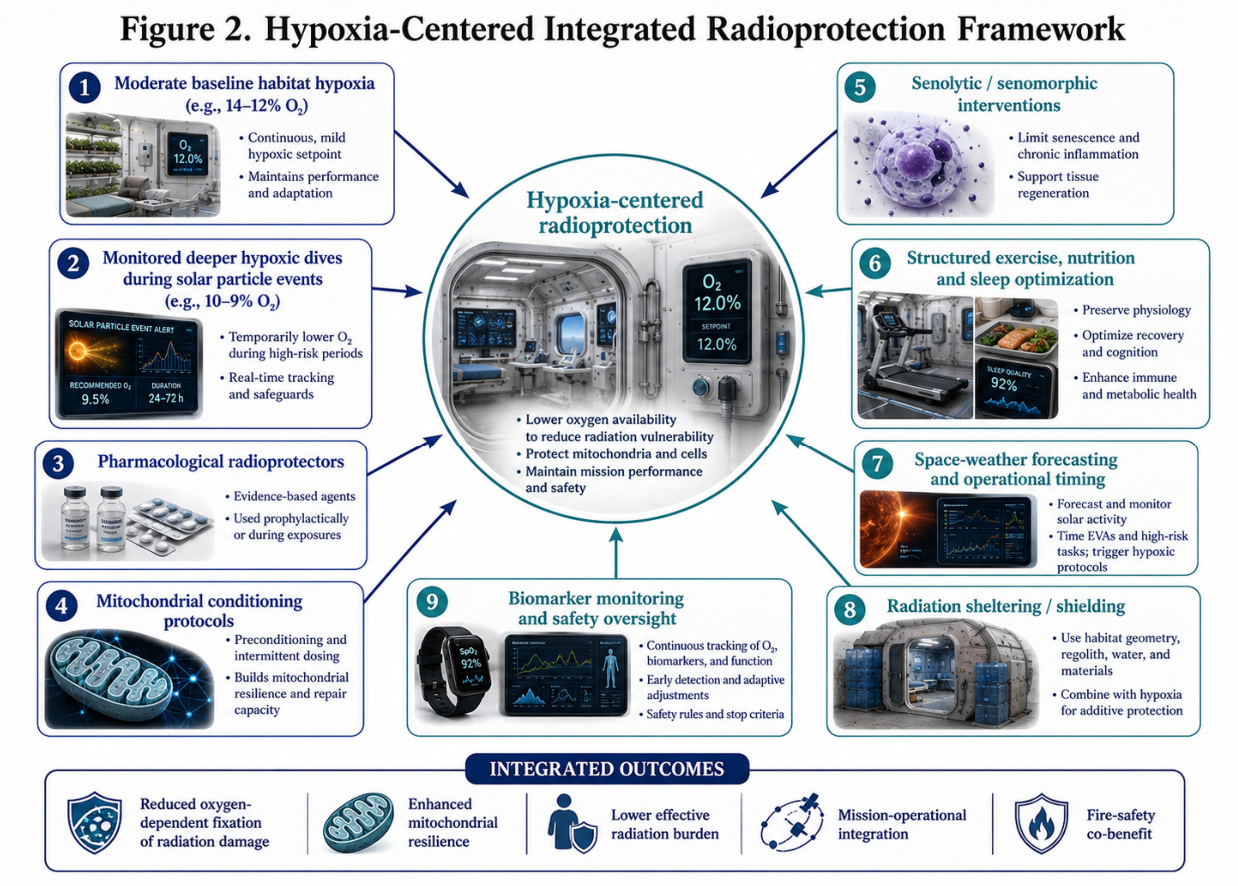
Extravehicular activity adds an additional mission-relevant hypoxic stressor that should be considered in the protocol design. EVA suit and prebreathe procedures expose astronauts to altered pressure and oxygen environments, and future lunar operations may involve repeated long-duration EVA shifts. These exposures may intensify body-wide hypoxic and oxidative stress, increase ROS production and interact with the same mitochondrial pathways targeted by the proposed hypoxic radioprotection framework. EVA history, workload and recovery status should therefore be treated as variables when defining baseline habitat oxygen levels and any deeper sheltering-period hypoxic dives.
The habitat concept has two complementary layers. First, a moderate baseline hypoxic atmosphere may support adaptation, reduce oxygen-dependent oxidative pressure and lower fire risk. Second, short deeper hypoxic excursions may be used during solar particle event sheltering, when crew are already in radio-protected niches, physical activity is minimized and oxygen consumption is reduced.
Historical work on modified breathing air for spacecraft and planetary habitats, along with reduced-oxygen fire-safety research in aerospace and naval contexts, supports the broader feasibility of considering oxygen-reduced human-occupied environments [2,15,16,17,18,19]. The concept is system-agnostic and rests on a general engineering principle: oxygen partial pressure can be managed as a combined biological, operational and fire-safety variable.
Moreover, there is a well - documented clinical experience in applying normobaric hypoxia in cancer radiotherapy for radioprotection of healthy tissues during the irradiation procedure. In addition to radioprotection of healthy tissues, it allowed the therapeutic dose of radiation to be increased up to 25% without inducing collateral healthy tissue damage. Collectively, hypoxic radiotherapy significantly improved life quality and 5-year survival score in patients. Noteworthy, O2 concentrations down to 8-9% were well tolerated even by profoundly ill cancer patients [24].
5. Operational Architecture: Moderate Habitat Hypoxia and Solar-Event Hypoxic Dives
The proposed architecture has two levels. The first is moderate continuous or long-duration normobaric hypoxia. In this setting, total pressure remains normal or near-normal, while oxygen fraction is reduced and balanced with inert gas. The choice of inert balance gas is itself an open design variable. Beyond nitrogen, the noble gases argon and helium merit consideration. Argon is biologically active and has documented organ- and neuro-protective effects in hypoxic-ischemic and oxidative-stress settings, acting in part through hypoxia-adaptive and preconditioning pathways [37,38,39,46]. Helium is already used extensively in saturation diving, which establishes both its physiological tolerability and its availability at scale. Xenon shows comparable protective activity but is less suited to habitat use, given its anaesthetic action and its cost.
This raises the possibility that an argon- or helium-enriched habitat atmosphere could improve tolerance of, and protection during, deeper hypoxic states, for example during solar-flare sheltering. Argon in particular is inexpensive and readily available. Experimental work on argon-containing hypoxic gas mixtures has reported altered survival, brain energy metabolism and oxygen consumption relative to nitrogen-based mixtures at matched low oxygen levels [43,44,45]; establishing the magnitude and mechanism of any such effect for habitat use is a concrete direction for experimental collaboration. Candidate values require experimental definition, but the operative principle is that meaningful radioprotection requires more than a token reduction in oxygen.
It is useful to distinguish two thresholds. The minimal effective threshold, meaning the point below which oxygen reduction begins to confer measurable radioprotective and adaptive benefit, lies well below ordinary cabin or aircraft-cabin levels: an oxygen fraction near 16%, corresponding to an altitude of roughly 2,400 m, is physiologically sub-threshold and not meaningfully radioprotective, and even 14% is marginal. Practical benefit is expected below approximately 14% O2, with the moderate-adaptation research range therefore centred near 14-12% after staged acclimatization. The maximum-benefit threshold, meaning the deeper hypoxia that maximizes protection during acute high-risk windows, lies lower still, in the region of approximately 10% O2 or below, applied transiently and under continuous monitoring.
Terrestrial correlates support the tolerability of the moderate range: permanent high-altitude populations (for example La Paz, and Andean mining communities living and working near 4,000-4,500 m) sustain comparable chronic hypoxia, a condition more demanding than an engineered habitat in which supplemental oxygen can be restored on demand. Staged adaptation of this kind is mediated substantially by the peripheral chemoreflex: the carotid body senses reductions in arterial oxygen and recalibrates ventilatory, autonomic and metabolic responses, and comparative physiology of high-altitude and microgravity exposure indicates that carotid-body plasticity is central to tolerating and adapting to sustained hypoxia [33].
Figure 3.
Two-level operational architecture: moderate baseline habitat hypoxia and monitored solar-event hypoxic dives.
Figure 3.
Two-level operational architecture: moderate baseline habitat hypoxia and monitored solar-event hypoxic dives.
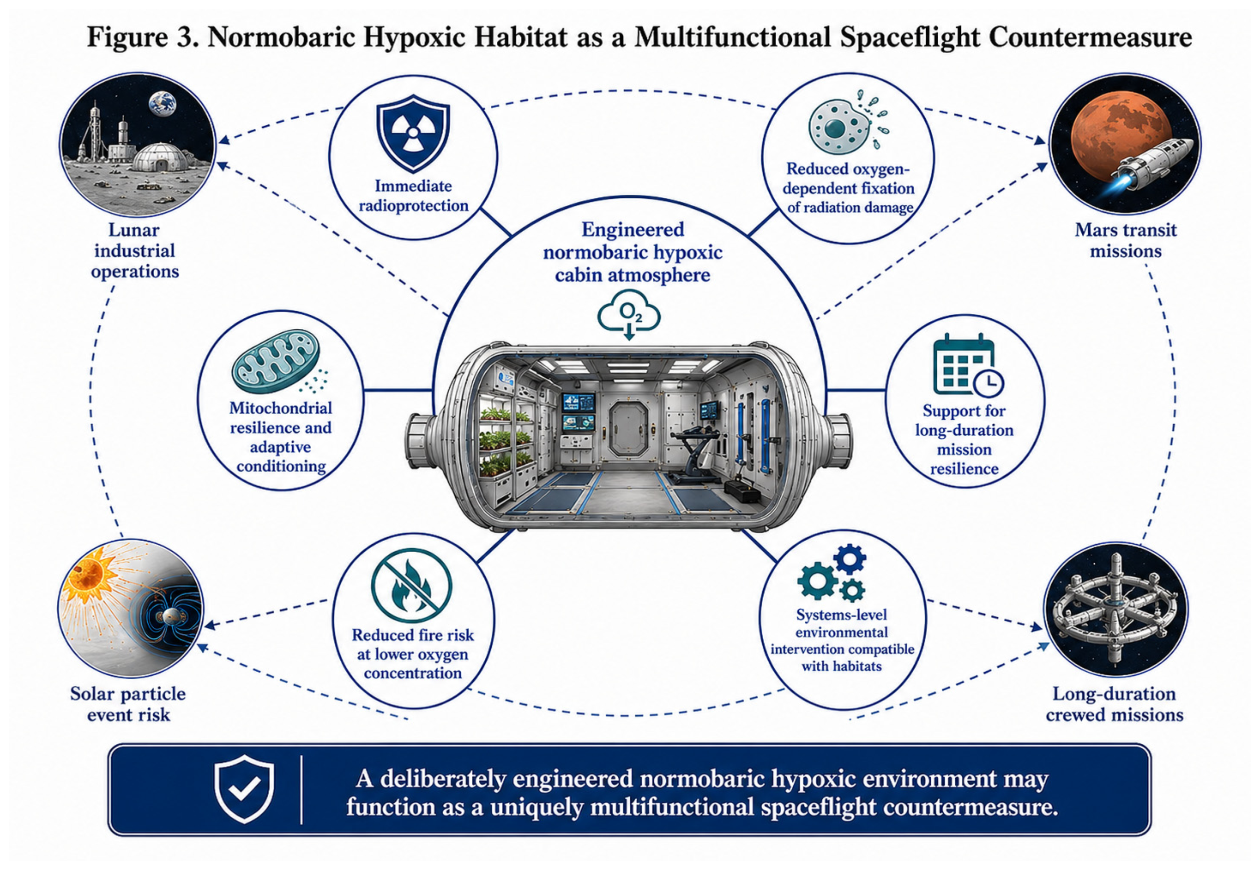
The second level is the temporary hypoxic dive. During high-risk solar particle event warnings, crew would enter structurally protected zones. In those conditions, deeper short-term oxygen reduction to approximately 9-10% O2 could be tested as an emergency radioprotective state, with continuous physiological monitoring, minimal task demand, immediate reversibility and predefined termination criteria.
The physiological rationale is strongest when the two levels are linked. A crew adapted to moderate hypoxia may tolerate short deeper excursions better than an unadapted crew. The deeper excursion is not imposed during normal work. It is layered onto a protected, low-activity sheltering phase, when crew are already minimizing movement and oxygen consumption.
The research question is therefore operationally specific: can moderate baseline hypoxic adaptation plus monitored solar-event hypoxic dives reduce biological radiation injury without unacceptable cognitive, cardiovascular, sleep, immune or mission-performance costs? A mission-ready protocol can exist only after this question is tested in controlled human and biological models.
6. Mechanistic Basis: Radiochemistry, Mitophagy, and Adaptive Stress Responses
A hypoxia-centred radioprotection strategy rests on several mechanisms. The first is direct radiochemistry: reduced oxygen availability may lower oxygen-dependent fixation of DNA lesions and reduce propagation of reactive oxygen species during and after irradiation [20,21]. A recent biogerontology review of hypoxia and hyperoxia exposure similarly collates classical evidence that low oxygen tension reduces radiation injury by a factor of roughly two to three across diverse tissues [31]. The second is adaptive biology: controlled hypoxia can activate oxygen-sensing pathways, alter metabolism, and engage stress-resilience programmes. The third is mitochondrial quality control: resilience depends not only on preventing damage, but on clearing damaged mitochondria or cells harbouring damaged mitochondria and restoring bioenergetic function. The fourth relates to the potential involvement of senescent cells in amplifying and perpetuating these processes.
Hypoxic postconditioning evidence supports the plausibility of this mitochondrial logic. A 2023 experimental study reported that hypoxic postconditioning restored mitophagy after transient global cerebral ischemia through a Parkin-dependent K63-linked ubiquitination mechanism involving TBK1 activation and p62 phosphorylation [11]. This is not direct proof of space radioprotection. It lends mechanistic support for the broader claim that hypoxic interventions can modulate mitochondrial quality control under injury conditions.
This is especially relevant because spaceflight-associated mitochondrial dysfunction may include impaired mitophagy. If damaged mitochondria cannot be efficiently cleared, the result may be persistent ROS generation, inflammatory signalling and reduced bioenergetic recovery. The validation programme should therefore measure not only mitochondrial respiration and ROS, but also mitophagy markers, mitochondrial turnover and recovery kinetics after combined radiation, microgravity and hypoxic exposures [10,11].
Senescence biology adds a second and highly related systems-level pathway. Cellular senescence is a cell fate. It entails essentially irreversible cell cycle arrest, resistance to cell death, increases in cell size, mTOR activity, and protein production, development of a senescence-associated secretory phenotype (SASP), failed autophagy, metabolic shifts with increased dependence on glucose vs. lipids (Warburg shift), mitochondrial dysfunction, and release of ROS, among other changes [57,58,62]. Most if not all types of cells can become senescent. Senescence and the SASP, which take days or weeks to become fully established, can occur in response to factors that induce cell stress. Among others, these include radiation, mechanical/ shear stress, metabolic dysfunction, repeated replication, oncogene expression, high insulin/ IGF-1/ growth hormone, DNA damage, pathogens, and signals of tissue damage (damage-associated molecular patterns such as ROS, cell-free nucleotides, aggregated proteins, inflammatory factors). Regarding spaceflight, SPE and GCR, shear stresses related to microgravity and high G forces (experienced during take-off and re-entry), oxygen tension and changes in barometric pressure can induce cellular senescence and release of SASP factors [12,25,59]. Indeed, solar and cosmic radiation more potently induce cellular senescence than x-ray or γ-radiation [60].
SASP factors can include inflammatory cytokines and chemokines, pro-inflammatory molecules including bradykinins, ceramides and prostanoids, ROS, release of senescence-propagating and immune system-dysregulating cell-free mitochondrial DNA (cf-mtDNA), and factors that interfere with the macrophage cell surface CD38 enzymatic activity that metabolizes and reduces tissue NAD, hence increasing ROS generation by non-senescent cells [55,56,61,62]. SASP factors and the processes induced by them in non-senescent cells can, in turn, lead to further generation of senescent cells both locally and systemically, potentially establishing a self-amplifying vicious cycle [63]. The SASP and spread of senescence can lead to or cause physical and cognitive dysfunction and a range of disorders and diseases both acutely and over the long-term [63,64]. Transplanting even small numbers of senescent cells is sufficient to cause spread of senescence, frailty and accelerated mortality from multiple diseases in mice [65,66]. Related work shows that cells from old donors, old organs and cell-type-specific senescence models can likewise promote systemic senescence, physical impairment and metabolic dysfunction [67,68,69].
The SASP can include many inflammatory factors. Increases in circulating cf-mtDNA and markers of inflammation, oxidative stress and DNA damage have been reported in astronauts on the day of landing and 3 days after return compared with preflight values [55]. Since these inflammatory markers can be shared between the SASP of senescent cells and causes of acute inflammation other than cellular senescence, evidence for persisting (as opposed to transient) increases in circulating SASP factors or for increases in numbers of tissue or circulating directly assayed senescent cells is needed to ascertain if space flight indeed induces senescent cell accumulation. Notably, preliminary results of senescence markers in blood tests from astronauts before launch compared to after return to Earth who were on the 17-day Axiom 1 mission indicated increased SASP factors 30 days after return to earth and in circulating senescent cells in all 3 astronauts (Supplemental Figure 1&2; Supplemental Methods). These findings need to be tested in larger numbers of astronauts, across flights of different durations, and in astronauts travelling beyond the Van Allen belts.
Senescence biology adds a second systems-level pathway. Radiation can induce cellular senescence and inflammatory secretory phenotypes; oxygen tension influences senescence-associated signalling [12,25]. In addition to directly irradiated cells, bystander signalling, damage-associated molecular patterns, cytokine networks and immune-cell trafficking can propagate responses across tissues, contributing to non-targeted and systemic effects that may persist beyond the initial exposure [5,8]. A hypoxia-centered approach should therefore be tested not only against DNA damage markers, but also against mitochondrial respiration, mitophagy, clonal and chromosomal endpoints, inflammatory signalling, immune-cell function, senescence-associated markers and tissue-specific functional outcomes.
The key standard is mechanistic specificity. The concept must be tested against measurable endpoints: dose-response relationships, oxygen windows, time windows, biological injury markers, operational-performance metrics, safety margins and recovery trajectories. Without that discipline, hypoxic radioprotection remains an idea. With it, it becomes a testable countermeasure programme.
The integrated countermeasure stack must not dilute the hypoxic angle. Hypoxic habitat engineering is the central environmental intervention. Other countermeasures are adjunctive layers that may enhance, stabilize, or personalize the primary oxygen-modulation strategy.
Pharmacological radioprotectors, mitochondrial-targeted antioxidants, metabolic regulators, interventions that target senescent cells (senolytics) and/ or the SASP (senomorphics), exercise, nutrition, sleep optimization, and individual preconditioning protocols may all have roles. Contemporary space-mitochondria research increasingly points toward combination countermeasures and optimized mitochondrial-support protocols rather than single-agent solutions.
7. Adjunctive Countermeasures Within a Hypoxia-Centred Framework
The integrated countermeasure strategy should not presume that any single intervention is dominant. Controlled hypoxic engineering should be evaluated as one possible environmental component within a multilayered architecture that retains shielding, exposure limitation, space-weather forecasting, dosimetry, operational procedures and biomedical countermeasures as indispensable elements.
Pharmacological radioprotectors, mitochondrial-targeted antioxidants, metabolic regulators, senolytic or senomorphic interventions, exercise, nutrition, sleep optimization and individual preconditioning protocols may all have roles. Because interventions can share pathways or impose competing metabolic and physiological demands, combination regimens require factorial testing of efficacy, toxicity, timing and interaction effects under mission-relevant co-exposures rather than extrapolation from single-agent studies.
A specific and underappreciated dimension of this stack is the effect of oxygen modulation on immune function, which is strongly oxygen-sensitive and bidirectional. Acutely, a hypoxic environment promotes cellular survival and, in the immune system, enhances mature effector-cell activity such as cytotoxicity and inflammatory signaling, through stabilization of HIF transcription factors and glycolytic metabolic reprogramming [50]. Under chronic hypoxia, however, prolonged shifts away from oxidative phosphorylation can reduce cellular diversity and promote terminal differentiation, exhaustion phenotypes and genomic instability. The metabolic requirements of developing, basally inactive and actively functioning immune cells differ, are tightly regulated, and are extremely sensitive to oxygen fluctuations, so that hypoxia can destabilize these programs and reshape immune and inflammatory plasticity. This acute-versus-chronic distinction reinforces the central design principle of controlled, staged and reversible exposure rather than indiscriminate oxygen reduction.
This is directly relevant to spaceflight, where crews already experience immune dysregulation, altered inflammatory signalling and latent-herpesvirus reactivation. Interdisciplinary countermeasures used on the ISS, particularly aerobic and resistive exercise, can improve several physiological outcomes [51], but upcoming deep-space missions will be more constrained in habitable volume, mass, storage and communications. Any hypoxia-based intervention should therefore be evaluated for both beneficial and adverse immune consequences, including leukocyte subset distribution, cytokine profiles, innate and adaptive function, latent-virus reactivation and recovery after exposure. Whether oxygen modulation enhances, diminishes or has no effect on other countermeasures remains an empirical question.
Several nutraceuticals and other compounds capable of boosting mitochondrial biogenesis and overall mitochondrial health are being explored as potential countermeasures to mitigate mitochondrial damage. One such candidate is the flavonoid kaempferol (KMP), which may promote mitochondrial biogenesis through the PGC-1α pathway and related downstream targets; in terrestrial settings, KMP has been associated with improved performance and mitigation of hypoxia-related stress responses, including high-altitude-like stress contexts [32].
Senolytics selectively eliminate senescent cells. Using a mechanism-based approach, the first senolytics reported were dasatinib, the flavanol quercetin, and their combination [70]. Since then, many other senolytic lifestyle interventions, natural products, repurposed drugs and new chemical entities have been discovered [71,72,73,74,75,76]. Clinical trials have indicated these agents can remove senescent cells, reduce inflammation and attenuate or treat age-related diseases, and the senolytics used in human trials for the most part appear to have acceptable safety profiles so far [77,78,80,81]. Fluorescent C12FDG has also undergone clinical validation as a marker associated with senescence and osteoarthritic phenotypes [79]. Separately, human and preclinical multiomic data suggest that zoledronate and related bisphosphonates can modulate ageing- and SASP-associated signatures, but this does not establish them as senolytics in clinical practice [82]. Since it takes days to weeks for new senescent cells to appear and senescent cells are in a state of replicative arrest, senolytics with short elimination half-lives can be administered intermittently, potentially reducing chances of side- or off-target effects [83]. Indeed, after exposure of one hindleg in younger mice to focal senescence-inducing radiation, after several months the animals had difficulty walking on the radiated leg; a single, brief course of senolytics resulted in improved walking ability for many months [70].
Thus, senolytic administration based on senescence biomarker detection in blood or urine may prove to be a post-radiation exposure mitigating solution. Of relevance to space radiation exposure, different senolytics target the different senescent cell types that are induced by simulated solar vs. cosmic radiation [60]. Hence, depending on the type of radiation exposure and the tissues affected, different combinations or sequences of senolytics may be needed, an issue it will be important to study in greater depth. Interestingly, intermittent hypobaric pressure had senolytic effects with alleviation of age-related osteoporosis in a preclinical study in which oxygen partial pressure was deliberately held at sea-level values while total pressure was reduced, isolating pressure from hypoxia [84]. It will be important to test whether intermittent hypoxic exposure produces similar effects.
With respect to spaceflight, KMP and related mitochondrial-support compounds should be evaluated for their potential to rescue mitochondrial damage caused by combined microgravity and radiation stress. This should remain framed as an adjunctive strategy, not as a replacement for controlled oxygen-modulation itself: the useful research question is whether a broader mitochondrial-support “cocktail” can stabilize OXPHOS, reduce ROS, support mitophagy, reduce pre- and post-exposure senescent cell burden, attenuate the SASP, and improve recovery when layered onto habitat-level hypoxic engineering [10,32].
As an additional preventive layer, intermittent hypoxia conditioning (IHC) may serve as a pre-flight measure that prepares crews for in-flight hypoxia rather than replacing the habitat concept. Typical IHC protocols alternate 3-8-minute hypoxic exposures (FiO2 0.16-0.09) with a 2-5 minute normoxic or hyperoxic recovery, activating hypoxia-inducible factors and Nrf2-linked responses that help sustain ATP production and manage reactive oxygen species during acute hypoxic challenge. Applied daily or every other day over two to eight weeks, IHC could reduce initial in-flight oxidative and inflammatory stress and may also induce a degree of radio-resistance [27,28,29,30]. An open research question is whether IHC can prevent or attenuate radiation induced cellular senescence and SASP factor release. Particularly in astronauts in whom senescence related biomarkers become elevated during flight, senolytics and senomorphics need to be studied as a possible inflight treatment strategy.
Senomorphics inhibit release of SASP factors by senescent cells, as opposed to acutely eliminating senescent cells. Senomorphics, such as metformin, rapamycin or JAK/STAT inhibitors (e.g., ruxolitinib), can have narrower or broader effects across different subsets of SASP factors [63,84]. Generally, senomorphics need to be administered for longer intervals than senolytics, but eventually senomorphics can result in decreased senescent cell abundance, possibly because certain SASP factors can cause spread of senescence and if this spread is prevented, the immune system may have more time to clear persisting senescent cells, a speculation that requires further research. Interestingly, KMP appears to be senomorphic [86].
A useful hierarchy is therefore: conventional shielding, exposure limitation, space-weather forecasting and dosimetry as the indispensable operational base; biosensors and adaptive monitoring as safety infrastructure; and controlled hypoxic engineering, pharmacological, mitochondrial, senescence-related and behavioural interventions as candidate biological or environmental layers whose individual and combined value remains to be established. Additionally, post-exposure radiation mitigation strategies need to be developed.
Quantitative efficacy should not be specified in advance as though it were established. Validation should instead define effect sizes and uncertainty for prespecified endpoints, determine whether benefits persist across radiation qualities and tissues, and identify physiological trade-offs. An integrated strategy would be supported only if it reduces clinically and operationally relevant injury without introducing unacceptable hypoxic, immune, cardiovascular, neurocognitive or interaction-related risks.
| Layer | Role | Mission Relevance | Validation Need |
| Moderate normobaric hypoxic habitat | Baseline environmental countermeasure | Adaptation, reduced oxygen-dependent chemistry, lower fire risk | Safe O2 range; cognition, sleep, exercise, immune effects |
| Temporary solar-event hypoxic dive | Emergency exposure-window countermeasure | Short deeper hypoxia during sheltering and minimal activity | Duration, reversibility, physiological safety, operational feasibility |
| Radiation monitoring and shielding | Standard mission-protection layer | Dose awareness, storm shelters, mission routing, ALARA implementation | Integration with atmosphere protocols and emergency transitions |
| Mitochondrial conditioning | Biological resilience layer | Supports energy metabolism, mitophagy and stress tolerance | Biomarkers, responder stratification, tissue-specific endpoints |
| Pharmacological / senescence countermeasures | Adjunctive biomedical layer and/or post-radiation exposure mitigating intervention | Potential support for DNA repair, inflammation, senescence and tissue protection and removal of senescent cells persisting after radiation exposure | Safety, interactions, dosing windows, combined-protocol testing |
| Fire-safe atmosphere engineering | Operational safety layer | Lower ignition probability and flame propagation in enclosed habitats | Combustion thresholds, human tolerability, ventilation, emergency control |
8. Fire Safety and Oxygen-Modulated Habitat Resilience
Fire safety is an independent reason to take oxygen modulation seriously. In enclosed vehicles and habitats, fire can rapidly become a catastrophic systems failure. Oxygen concentration influences ignition probability, flame propagation and fire suppression. Reduced-oxygen atmospheres may therefore have operational value beyond radioprotection.
Reducing oxygen levels to 15% and 13% in normobaric conditions is equivalent to altitudes of approximately 2,700 m and 3,850 m, respectively. At these oxygen partial pressures, healthy individuals respond within minutes to hours by increasing ventilation rate and heart rate. Acute mountain sickness occurs frequently under these conditions, although the full syndrome is rare when exposure is limited to six hours. Mild impairments in mood, cognitive function and psychomotor performance may also occur. Overall, working in environments with oxygen concentrations down to 13% does not pose a health hazard, provided that appropriate precautions are followed, including medical examination and limited exposure times [53].
Historical aerospace and naval materials show that low-oxygen, fire-suppressing environments have been considered for space cabins [15,16,17]. Terrestrial fire-preventative and fire-suppressive hypoxic air systems demonstrate that human-occupiable reduced-oxygen environments can be engineered in selected contexts, provided oxygen partial pressure windows, exposure durations, health screening and emergency procedures are respected [18,19].
Moreover, over recent decades the multiple health benefits induced by the application of controlled hypoxia have been studied fundamentally and applied clinically for prevention, treatment and rehabilitation across a range of conditions [54].
The relevant scientific and engineering concept focuses on the possibility of maintaining a breathing atmosphere that is physiologically tolerable, fire-preventative, and radioprotective during defined exposure windows.
For spacecraft, lunar habitats, and Mars transit vehicles, this convergence is strategically important. A single atmosphere-management architecture could support radioprotection research, fire-risk reduction, emergency solar-event response, and future habitat resilience in general.
9. Four-Prototype Validation Architecture
The proposed framework requires staged validation before any mission claim. A four-prototype architecture allows the concept to be tested progressively, without prematurely transferring terrestrial or radiotherapy assumptions into flight conditions.
Ground validation should combine terrestrial habitat and isolation analogues with accelerator-based radiation platforms. Studies should progress from cells and three-dimensional human tissue models to appropriately justified animal models and monitored human hypoxia protocols, while reproducing relevant oxygen histories, dose rates, particle sequences and co-stressors such as simulated microgravity where feasible. Facilities capable of sequential mixed-ion exposures, including the NASA Space Radiation Laboratory GCR simulator, provide an important platform for testing tissue-specific efficacy and countermeasure interactions, although no terrestrial facility fully reproduces the chronic space radiation field. Cross-platform replication, sham and normoxic controls, blinded endpoint assessment, sex-balanced designs and longitudinal follow-up should therefore be built into the programme [52].
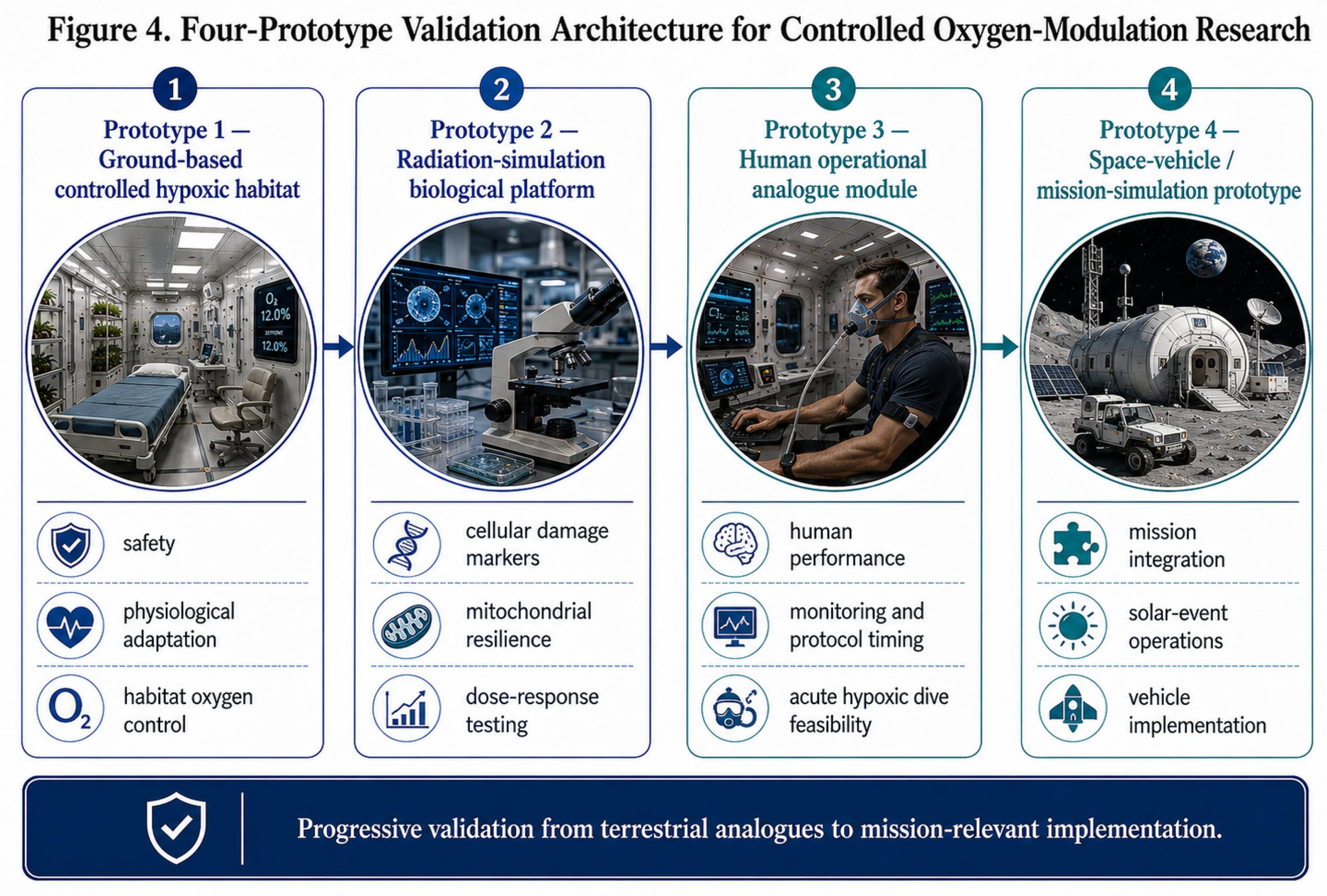
Figure 4.
Four-prototype validation architecture for staged testing of controlled oxygen modulation.
Figure 4.
Four-prototype validation architecture for staged testing of controlled oxygen modulation.
| Prototype | Primary Question | Representative Endpoints |
| Ground-based controlled hypoxic habitat | Can humans safely adapt to candidate oxygen ranges under normobaric conditions? | SpO2, HRV, sleep, cognition, exercise, symptoms, adaptation kinetics |
| Radiation-simulation / biological platform | Does hypoxia modify radiation-response biology in relevant models? | DNA damage, repair kinetics, ROS, mitochondria, mitophagy, senescence, inflammation |
| Human operational analogue module | Can protocols preserve performance and emergency reliability? | Task performance, sheltering procedures, mood, workload, reaction time, team operations |
| Space-vehicle / mission-simulation prototype | Can atmosphere protocols integrate with life support and mission architecture? | Atmosphere control, pressure, CO2, fire risk, autonomy, sensors, emergency reversal |
10. Safety, Monitoring, and Operational Reliability
The strongest objection to hypoxic habitat engineering is operational reliability. Hypoxia can impair cognition, judgment, sleep, exercise capacity and cardiovascular stability. These risks are real. They are also precisely why the approach requires staged adaptation, individualized monitoring, conservative thresholds and immediate reversibility.
It is worth confronting the reflexive assumption that hypoxia necessarily degrades cognition, because the evidence points the other way once adaptation is accounted for. Controlled, staged hypoxic adaptation has been shown to preserve cognitive function, and in aging populations to improve it, rather than to impair it. High-altitude physiology provides striking natural evidence: acclimatized climbers retain function at extreme altitude (summit oxygen levels below those of any proposed habitat) and fighter pilots routinely undergo hypoxia-tolerance and gravitational-hypoxia training precisely because adaptation confers resilience. A growing clinical literature on intermittent hypoxic conditioning further reports cognitive and functional benefit, including in older adults [28,29,30,40,41,42]. The appropriate design posture is therefore not to disclaim hypoxia during high-alertness windows but to build in graded pre-adaptation so that crews enter hypoxic states already conditioned, converting a perceived liability into a source of resilience. Individual variation in hypoxia tolerance is real and argues for personalized adaptation protocols and screening, not for abandoning the approach.
Hypoxia can impair cognition and operational performance, particularly when exposure is acute, severe or insufficiently acclimatized. Some studies of controlled intermittent hypoxia report preserved or improved selected cognitive and functional outcomes, including in older adults [28,29,30,40,41,42], but these findings cannot be generalized to healthy astronaut crews, sustained habitat hypoxia or emergency SPE operations. High-altitude and aviation experience supports the feasibility of acclimatization and individualized screening, while also documenting substantial inter-individual variability. The appropriate design posture is therefore to treat cognitive safety as a critical endpoint, use graded pre-adaptation where justified, and define conservative task-specific termination and recovery criteria.
A responsible validation programme should measure oxygen saturation, tissue and organ oxygenation where feasible, heart-rate variability, ventilation, sleep, cognition, fine motor performance, mood, reaction time, exercise tolerance, immune and inflammatory markers, mitochondrial markers and subjective symptoms. It should also test emergency transition procedures between baseline habitat hypoxia, normoxic recovery and solar-event deeper hypoxic sheltering.
In practice, these markers should be linked to monitoring methods that can function in analogue modules and, eventually, in flight: wearable SpO2 and heart-rate sensors, HRV tracking, sleep and activity monitoring, cognitive-performance testing, point-of-care inflammatory, SASP, and metabolic assays, and periodic biospecimen collection for mitochondrial, immune, senescence-associated, and oxidative-stress readouts. This turns the framework from a theoretical oxygen-setting proposal into a measurable mission-health system that could eventually be coupled with personized data-guided interventions above and beyond O2 modulation.
The operational hypothesis is that stable adaptation to moderate hypoxia may reduce the hazard of brief deeper dives during protected, low-activity phases. Alpinists, altitude workers, hypoxic conditioning studies and hypoxic radiotherapy contexts suggest that severe short hypoxic exposures can be tolerated under defined conditions [13,14,24], but spacecraft protocols demand a higher evidentiary standard.
This is why the article argues for validation, not immediate deployment. The outcome may be positive, negative or conditional. Even a conditional result would be valuable because it would define where oxygen modulation is useful, where it is unsafe and how it should interact with conventional radioprotection.
11. Translational Bridge to Terrestrial Healthspan Medicine
The primary focus of this article is deep-space mission safety. Nevertheless, controlled oxygen-modulation research may provide a translational bridge to terrestrial healthspan medicine (or “geromedicine”). Spaceflight compresses many biological stressors relevant to aging: mitochondrial dysfunction, oxidative stress, inflammation, senescent cell accumulation, immune dysregulation, muscle and bone loss, vascular strain, and impaired repair. Countermeasures validated in space-relevant models may therefore illuminate resilience mechanisms relevant on Earth.
A concrete illustration of this two-way translation is the peripheral chemoreflex. High-altitude hypoxia and microgravity, though physically dissimilar, elicit strikingly convergent physiological responses. These include autonomic imbalance, sympathoexcitation, metabolic and mitochondrial stress, oxidative load, muscle and cardiovascular deconditioning, and reduced exercise capacity. A growing body of comparative physiology identifies carotid-body chemoreceptor control as a shared mechanistic hub linking these adaptations across both environments. The carotid body senses reductions in arterial oxygen and drives ventilatory, autonomic and metabolic recalibration; its plasticity under sustained or intermittent hypoxia underlies acclimatization in mountaineers and, by the same logic, the staged adaptation to moderate habitat hypoxia proposed here. This convergence runs in both directions: terrestrial altitude medicine and intermittent-hypoxia conditioning become a testbed for spaceflight countermeasures, while space-relevant hypoxia protocols illuminate chemoreflex-mediated resilience mechanisms that are directly relevant to healthy aging on Earth [33].
In terrestrial settings, healthy aging means the measurable extension of healthspan, functional capacity, recovery reserve, and resilience to acute and chronic disease processes, not a vague aspiration. In this context, controlled hypoxic environments can be studied as tools for mitochondrial conditioning, metabolic flexibility, neurovascular adaptation, inflammatory regulation, and recovery biology.
Concrete terrestrial disease-relevance should be defined through measurable pathways rather than broad claims: mitochondrial dysfunction, senescent cell accumulation, increased SASP factors, inflammation, oxidative stress, impaired vascular adaptation, cardiometabolic deconditioning, and post-illness recovery. These are the clinical domains in which controlled hypoxia, oxygen-window safety, mitochondrial-support, and potentially, senolytic and senomorphic countermeasures can be tested without overextending the spaceflight hypothesis. Oxygen-modulated clinics, recovery rooms and training settings would require their own safety, regulatory and clinical validation pathways, distinct from those addressed here.
12. Conclusions
Deep-space radioprotection cannot rely on shielding alone. The mission environment requires multilevel protection: exposure limitation, monitoring, forecasting, shielding, storm shelters, biomedical countermeasures, and operational discipline. A key missing layer is atmosphere engineering. Oxygen partial pressure can become an active design variable in space medicine and habitat architecture.
Controlled hypoxic habitat engineering offers a coherent and testable hypothesis. Moderate baseline hypoxia may support adaptation and alter oxygen-dependent oxidative processes; deeper monitored hypoxic excursions may be investigated during SPE sheltering; and reduced oxygen concentration may simultaneously influence fire-safety resilience in enclosed habitats. None of these potential benefits should be considered operationally established until biological efficacy, human performance and systems safety have been validated together.
The concept challenges a prevailing assumption that hypoxia must always be avoided because it threatens operational reliability. The safer and more scientific framing is narrower: uncontrolled hypoxia is dangerous, but controlled, staged, monitored and reversible hypoxic engineering may be feasible and potentially beneficial under defined conditions. That possibility deserves urgent validation before Mars-class mission architectures are finalized.
The immediate next step is a disciplined research programme: define oxygen windows, test biological endpoints, measure operational performance, establish safety margins, integrate radiation and atmosphere monitoring, and validate the pathway from terrestrial analogue chambers and accelerator-based mixed-field platforms to progressively higher-fidelity mission simulations. Advancement between stages should depend on predefined safety and efficacy criteria, independent replication and demonstration that combined countermeasures do not create adverse interactions. If successful, controlled hypoxic radioprotection could become an additional mission-enabling layer for deep-space exploration and a translational bridge to resilience medicine on Earth.
Finally, this article is deliberately framed as an open invitation. The strength of the concept lies in the integration of independently established lines of evidence rather than in any single new experiment, and its advancement will require expertise the present authors do not claim to hold in full. We therefore invite researchers, institutions and mission organizations working on radiobiology, aerospace medicine, altitude and hypoxia physiology, pharmacological and supplement-based radioprotection, inert-gas and atmosphere engineering, and habitat fire-safety to engage with, test, extend or challenge this framework. In particular, we welcome exact experimental references and datasets (including unpublished data, appropriately labelled) bearing on radioprotective supplements and pharmacological agents effective against high-energy, high-LET particles, on noble-gas substitution, and on cognitive and physiological outcomes of controlled hypoxic adaptation. Serious contributions may form the basis of collaborative experimental follow-up and co-authorship on subsequent work. Correspondence is welcome via the corresponding authors.
Supplementary Materials
The following supporting information can be downloaded at: Preprints.org.
Author Contributions
Conceptualization: A.P., D.K.. Methodology: A.P., A.B., S.B., B.C., D.D., J.L.K.. Investigation: M.S., T.P., L.G.L-P.. Formal analysis: M.S., T.P., L.G.L-P., T.T.. Supervision: T.T., J.L.K., D.K.. Writing – original draft: A.P., F.C.. Writing – review and editing: all authors. Project administration: F.C.. Funding acquisition: D.K., J.L.K.. All authors read and approved the final manuscript.
Funding
This work was supported in part by the OxyWave Foundation. The authors gratefully acknowledge the OxyWave Foundation for its support of research into controlled hypoxic environments for radioprotection and resilience medicine. J.L.K. is supported by Cedars-Sinai Health Sciences University, the Connor Fund, Robert J. and Theresa W. Ryan, the Hevolution Foundation (HF-GRO-23-1199148-3), and the Noaber Foundation. The authors, J.L.K. and T.T. but not the other authors, were supported in part by United States National Institutes of Health grant R33AG 061456 (Translational Geroscience Network). The content is solely the responsibility of the authors and does not necessarily represent the official views of the National Institutes of Health.
Acknowledgments
The authors are grateful to the Axiom 1 mission astronauts who participated in the studies reported in Supplemental Figures S1 and S2, for administrative support from Tamara Evans, and for laboratory technical support from Nino Giorgadze, Ailing Xue, Jair Machado Espindola Netto and Aaron Deisinger.
References
- Cortese, F.; Klokov, D.; Osipov, A.N.; et al. Vive la radiorésistance: converging research in radiobiology and biogerontology to enhance human radioresistance for deep space exploration and colonization. Oncotarget 2018, 9, 14692–14722. [Google Scholar] [CrossRef] [PubMed]
- Prokopov, A.; Kotliar, I. Benefits of Modified Breathing Air for Spacecraft and Planetary Habitats. Mars Society Convention / Mars Papers. 2001. Available online: http://www.marspapers.org/paper/Kotliar_2001_1.pdf.
- Wilson, J.W.; Shinn, J.L.; Tripathi, R.K.; et al. Issues in deep space radiation protection. Acta Astronaut. 2001, 49, 289–312. [Google Scholar] [CrossRef] [PubMed]
- Zeitlin, C.; Hassler, D.M.; Cucinotta, F.A.; et al. Measurements of energetic particle radiation in transit to Mars on the Mars Science Laboratory. Science 2013, 340, 1080–1084. [Google Scholar] [CrossRef] [PubMed]
- Cucinotta, F.A.; Cacao, E. Non-targeted effects models predict significantly higher Mars mission cancer risk than targeted effects models. Sci. Rep. 2017, 7, 1832. [Google Scholar] [CrossRef] [PubMed]
- Nelson, G.A. Space radiation and human exposures, a primer. Radiat. Res. 2016, 185, 349–358. [Google Scholar] [CrossRef] [PubMed]
- Parihar, V.K.; Allen, B.; Tran, K.K.; et al. What happens to your brain on the way to Mars. Sci. Adv. 2015, 1, e1400256. [Google Scholar] [CrossRef] [PubMed]
- Fernandez-Gonzalo, R.; Baatout, S.; Moreels, M. Impact of particle irradiation on the immune system: from the clinic to Mars. Front. Immunol. 2017, 8, 177. [Google Scholar] [CrossRef] [PubMed]
- Sercel, A.J. Mitochondria in Space; (non-peer-reviewed article; cited as unpublished source); MitoWorld, 2025. [Google Scholar]
- Guarnieri, J.W.; Maghsoudi, Z.; et al. Guardians of the mitochondria: Space mitochondria 2.0 systemic analysis reveals bioenergetic dysregulation across species. MitoWorld. [CrossRef]
- Wen, H.; Zuo, Y.; Li, L.; et al. Hypoxic postconditioning restores mitophagy against transient global cerebral ischemia via Parkin-induced posttranslational modification of TBK1. Neurobiol. Dis. 2023, 179, 106043. [Google Scholar] [CrossRef] [PubMed]
- van Vliet, T.; Varela-Eirin, M.; Wang, B.; et al. Physiological hypoxia restrains the senescence-associated secretory phenotype via AMPK-mediated mTOR suppression. Mol. Cell 2021, 81, 2041–2052.e6. [Google Scholar] [CrossRef] [PubMed]
- Bhaumik, G.; Dass, D.; Ghosh, D.; et al. Effect of intermittent normobaric hypoxia exposures on acute mountain sickness during acute ascent to 3500 m in Indian Army personnel. Def. Life Sci. J. 2018, 3, 209–215. [Google Scholar] [CrossRef]
- Voss, J.D.; Allison, D.B.; Webber, B.J.; Otto, J.L.; Clark, L.L. Lower obesity rate during residence at high altitude among a military population with frequent migration: a quasi experimental model for investigating spatial causation. PLoS ONE 2014, 9, e93493. [Google Scholar] [CrossRef] [PubMed]
- Shvartz, E. Advantages of a low-oxygen environment in space cabins. Aviat. Space Environ. Med. 1990, 61, 272–276. [Google Scholar] [PubMed]
- Lamb, L.E. Hypoxia - an anti-deconditioning factor for manned space flight. Aerosp. Med. 1965, 36, 97–100. [Google Scholar]
- Fire Safety Concerns in Space Operations. NASA; Technical Memorandum 89848. NASA Lewis Research Center, 1987.
- Naval Submarine League. Reduced Oxygen for Fire Suppression. 1987. [Google Scholar]
- Nilsson, M.; Van Hees, P. Advantages and challenges with using hypoxic air venting as fire protection. Fire Mater. 2014, 38, 559–575. [Google Scholar] [CrossRef]
- Ward, J.F. The complexity of DNA damage: relevance to biological consequences. Int. J. Radiat. Biol. 1994, 66, 427–432. [Google Scholar] [CrossRef] [PubMed]
- Sage, E.; Shikazono, N. Radiation-induced clustered DNA lesions: repair and mutagenesis. Free Radic. Biol. Med. 2017, 107, 125–135. [Google Scholar] [CrossRef] [PubMed]
- Gray, L.H.; Conger, A.D.; Ebert, M.; Hornsey, S.; Scott, O.C.A. The concentration of oxygen dissolved in tissues at the time of irradiation as a factor in radiotherapy. Br. J. Radiol. 1953, 26, 638–648. [Google Scholar] [CrossRef] [PubMed]
- Grimes, D.R.; Partridge, M. A mechanistic investigation of the oxygen fixation hypothesis and oxygen enhancement ratio. Biomed. Phys. Eng. Express 2015, 1, 045209. [Google Scholar] [CrossRef] [PubMed]
- Strnad, V.; Sauer, R.; Tacev, T. Hypoxic radiotherapy: the radioprotective effect of acute hypoxia in the radiotherapy of tumors in the abdominal area. Strahlenther. Und Onkol. 1994, 170(12), 700–703. [Google Scholar]
- Semenza, G.L. Hypoxia-inducible factors in physiology and medicine. Cell 2012, 148, 399–408. [Google Scholar] [CrossRef] [PubMed]
- Wozny, A.S.; Rodriguez-Lafrasse, C. The oxygen enhancement ratio and its dependence on linear energy transfer in charged-particle radiobiology. Cancers 2021, 13(12), 2997. [Google Scholar] [CrossRef] [PubMed]
- Burtscher, J.; Hüfner, K.; Xi, L.; Burtscher, M. Hypoxia conditioning: a reappraisal of its preventive and therapeutic potential. Eur. Respir. J. 2026, 67(5). [Google Scholar] [CrossRef] [PubMed]
- Serebrovskaya, T.V.; Xi, L. Intermittent hypoxia training as non-pharmacologic therapy for cardiovascular diseases: practical analysis on methods and equipment. Exp. Biol. Med. 2016, 241(15), 1708–1723. [Google Scholar] [CrossRef] [PubMed]
- Burtscher, J.; Citherlet, T.; Camacho-Cardenosa, A.; Camacho-Cardenosa, M.; Raberin, A.; Krumm, B.; et al. Mechanisms underlying the health benefits of intermittent hypoxia conditioning. J. Physiol. 2024, 602(21), 5757–5783. [Google Scholar] [CrossRef] [PubMed]
- Zhang, Q.; Zhao, W.; Li, S.; Ding, Y.; Wang, Y.; Ji, X. Intermittent hypoxia conditioning: a potential multi-organ protective therapeutic strategy. Int. J. Med. Sci. 2023, 20(12), 1551–1561. [Google Scholar] [CrossRef] [PubMed]
- Burtscher, J.; Burtscher, M.; et al. Evidence for putative radioprotection and radiomitigation effects of hypoxia and hyperoxia exposure. Biogerontology 2024. [Google Scholar] [CrossRef] [PubMed]
- Scarpulla, R.C. Metabolic control of mitochondrial biogenesis through the PGC-1 family regulatory network. Biochim. Et. Biophys. Acta 2011, 1813(7), 1269–1278. [Google Scholar] [CrossRef] [PubMed]
- Andrade, D.C.; Salazar-Ardiles, C.; García-Ordenes, B.; Bueno, J.; Arce-Alvarez, A.; Rodriguez-Fernandez, M.; Iturriaga, R.; Millet, G.P. Carotid body chemoreceptors: from mountain to space. Physiology 2026. [Google Scholar] [CrossRef] [PubMed]
- Kennedy, A.R. Biological effects of space radiation and development of effective countermeasures. Life Sci. Space Res. 2014, 1, 10–43. [Google Scholar] [CrossRef] [PubMed]
- Weiss, J.F.; Landauer, M.R. Protection against ionizing radiation by antioxidant nutrients and phytochemicals. Toxicology 2003, 189, 1–20. [Google Scholar] [CrossRef] [PubMed]
- Smith, T.A.; Kirkpatrick, D.R.; Smith, S.; et al. Radioprotective agents to prevent cellular damage due to ionizing radiation. J. Transl. Med. 2017, 15, 232. [Google Scholar] [CrossRef] [PubMed]
- Dickinson, R.; Franks, N.P. Bench-to-bedside review: molecular pharmacology and clinical use of inert gases in anesthesia and neuroprotection. Crit. Care 2010, 14, 229. [Google Scholar] [CrossRef] [PubMed]
- Ma, D.; Hossain, M.; Chow, A.; et al. Xenon and hypothermia combine to provide neuroprotection from neonatal asphyxia. Ann. Neurol. 2005, 58, 182–193. [Google Scholar] [CrossRef] [PubMed]
- Ryang, Y.M.; Fahlenkamp, A.V.; Rossaint, R.; et al. Neuroprotective effects of argon in an in vivo model of transient middle cerebral artery occlusion in rats. Crit. Care Med. 2011, 39, 1448–1453. [Google Scholar] [CrossRef] [PubMed]
- Schega, L.; Peter, B.; Brigadski, T.; Leßmann, V.; Isermann, B.; Hamacher, D.; Törpel, A. Effect of intermittent normobaric hypoxia on aerobic capacity and cognitive function in older people. J. Sci. Med. Sport. 2016, 19(11), 941–945. [Google Scholar] [CrossRef] [PubMed]
- Bayer, U.; Likar, R.; Pinter, G.; Stettner, H.; Demschar, S.; Trummer, B.; Neuwersch-Sommeregger, S.; Glazachev, O.; Burtscher, M. Intermittent hypoxic-hyperoxic training on cognitive performance in geriatric patients. Alzheimer’s Dement. Transl. Res. Clin. Interv. 2017, 3(1), 114–122. [Google Scholar] [CrossRef] [PubMed]
- Behrendt, T.; Bielitzki, R.; Behrens, M.; Glazachev, O.S.; Schega, L. Effects of intermittent hypoxia-hyperoxia exposure prior to aerobic cycling exercise on physical and cognitive performance in geriatric patients: a randomized controlled trial. Front. Physiol. 2022, 13, 899096. [Google Scholar] [CrossRef] [PubMed]
- Soldatov, P.E.; D’iachenko, A.I.; Pavlov, B.N.; Fedotov, A.P.; Chuguev, A.P. Survival of laboratory animals in argon-containing hypoxic gaseous environments. Aviakosmicheskaia I Ekol. Meditsina 1998, 32(4), 33–37. [Google Scholar]
- Vdovin, A.V.; Nozdracheva, L.V.; Pavlov, B.N. Parameters of energy metabolism of the rat brain during inhalation of hypoxic mixtures containing nitrogen and argon. Bull. Exp. Biol. Med. 1998, 125, 618–619. [Google Scholar] [CrossRef]
- Shulagin, Y.A.; D’yachenko, A.I.; Pavlov, B.N. Effects of argon on oxygen consumption in humans during physical exercise under hypoxic conditions. Hum. Physiol. 2001, 27(1), 84–90. [Google Scholar] [CrossRef]
- Höllig, A.; Schug, A.; Fahlenkamp, A.V.; Rossaint, R.; Coburn, M. Argon Organo-Protective Network. Argon: systematic review on neuro- and organoprotective properties of an “inert” gas. Int. J. Mol. Sci. 2014, 15(10), 18175–18196. [Google Scholar] [CrossRef] [PubMed]
- Langell, J.; Jennings, R.; Clark, J.; Ward, J.B., Jr. Pharmacological agents for the prevention and treatment of toxic radiation exposure in spaceflight. Aviat. Space Environ. Med. 2008, 79(7), 651–660. [Google Scholar] [CrossRef] [PubMed]
- Kennedy, A.R.; Guan, J.; Ware, J.H. Countermeasures against space radiation induced oxidative stress in mice. Radiat. Environ. Biophys. 2007, 46(2), 201–203. [Google Scholar] [CrossRef] [PubMed]
- Crucian, B.; Diak, D.M.; Garbino, A.; Gutierrez, C.; Bustos-Lopez, S.; Colorado, A.; Young, M.; Smith, S.M.; Zwart, S.R.; Oswald, T.M.; Hew-Yang, M.Y.; Estep, P.; Marshall-Goebel, K.; Mehta, S. Effects of hypoxia/hyperoxia exposure on immune function: results from a spacecraft-relevant hypobaric chamber study. Front. Physiol. 2025, 16, 1637834. [Google Scholar] [CrossRef] [PubMed]
- Chen, Y.; Gaber, T. Hypoxia/HIF modulates immune responses. Biomedicines 2021, 9(3), 260. [Google Scholar] [CrossRef] [PubMed]
- Crucian, B.E.; Makedonas, G.; Sams, C.F.; Pierson, D.L.; Simpson, R.; Stowe, R.P.; Smith, S.M.; Zwart, S.R.; Krieger, S.S.; Rooney, B.; Douglas, G.; Downs, M.; Nelman-Gonzalez, M.; Williams, T.J.; Mehta, S. Countermeasures-based improvements in stress, immune system dysregulation and latent herpesvirus reactivation onboard the International Space Station: relevance for deep space missions and terrestrial medicine. Neurosci. Biobehav. Rev. 2020, 115, 68–76. [Google Scholar] [CrossRef] [PubMed]
- Simonsen, L.C.; Slaba, T.C.; Guida, P.; Rusek, A. NASA’s first ground-based Galactic Cosmic Ray Simulator: enabling a new era in space radiobiology research. PLoS Biol. 2020, 18(5), e3000669. [Google Scholar] [CrossRef] [PubMed]
- Angerer, P.; Nowak, D. Working in permanent hypoxia for fire protection — impact on health. Int. Arch. Occup. Environ. Health 2003, 76(2), 87–102. [Google Scholar] [CrossRef] [PubMed]
- Prokopov, A.F. Intermittent Hypoxia and Health: From Evolutionary Aspects to Mitochondria Rejuvenation. In Intermittent Hypoxia and Human Diseases; Xi, L., Serebrovskaya, T., Eds.; Springer: London, 2012. [Google Scholar] [CrossRef]
- Bisserier, M.; Shanmughapriya, S.; Rai, A.K.; Gonzalez, C.; Brojakowska, A.; Garikipati, V.N.S.; et al. Cell-free mitochondrial DNA as a potential biomarker for astronauts’ health. J. Am. Heart Assoc. 2021, 10(21), e022055. [Google Scholar] [CrossRef] [PubMed]
- Iske, J.; Seyda, M.; Heinbokel, T.; Maenosono, R.; Minami, K.; Nian, Y.; et al. Senolytics prevent mt-DNA-induced inflammation and promote the survival of aged organs following transplantation. Nat. Commun. 2020, 11(1), 4289. [Google Scholar] [CrossRef] [PubMed]
- Zhu, Y.; Anastasiadis, Z.P.; Espindola Netto, J.M.; Evans, T.; Tchkonia, T.; Kirkland, J.L. Past and future directions for research on cellular senescence. Cold Spring Harb. Perspect. Med. 2024, 14(2), a041205. [Google Scholar] [CrossRef] [PubMed]
- López-Otín, C.; Blasco, M.A.; Partridge, L.; Serrano, M.; Kroemer, G. Hallmarks of aging: an expanding universe. Cell 2023, 186(2), 243–278. [Google Scholar] [CrossRef] [PubMed]
- Hayslip, N.; Kim, J.; Ashiqueali, S.A.; Zhu, X.; Hussein, R.; Alam, M.T.; et al. Space radiation and microgravity as models of accelerated aging: modulation of hepatic miRNA-TGF-β networks associated with senescence and fibrosis. GeroScience. Online ahead of print. 23 Jun 2026. [CrossRef]
- Pitcher, L.E.; Mukherjee, B.; Saathoff, A.M.; Eduvas, Z.A.; Bartz, J.; Zhang, X.; et al. Space radiation induces distinct senescent phenotypes: implications for space travel. npj Aging 2025, 11(1), 95. [Google Scholar] [CrossRef] [PubMed]
- Chini, C.C.S.; Peclat, T.R.; Warner, G.M.; Kashyap, S.; Espindola-Netto, J.M.; de Oliveira, G.C.; et al. CD38 ecto-enzyme in immune cells is induced during aging and regulates NAD+ and NMN levels. Nat. Metab. 2020, 2(11), 1284–1304. [Google Scholar] [CrossRef] [PubMed]
- Tchkonia, T.; Zhu, Y.; van Deursen, J.; Campisi, J.; Kirkland, J.L. Cellular senescence and the senescent secretory phenotype: therapeutic opportunities. J. Clin. Invest. 2013, 123(3), 966–972. [Google Scholar] [CrossRef] [PubMed]
- Xu, M.; Tchkonia, T.; Ding, H.; Ogrodnik, M.; Lubbers, E.R.; Pirtskhalava, T.; et al. JAK inhibition alleviates the cellular senescence-associated secretory phenotype and frailty in old age. Proc. Natl. Acad. Sci. U S A 2015, 112(46), E6301–E6310. [Google Scholar] [CrossRef] [PubMed]
- Kirkland, J.L.; Tchkonia, T. Cellular senescence: a translational perspective. EBioMedicine 2017, 21, 21–28. [Google Scholar] [CrossRef] [PubMed]
- Xu, M.; Bradley, E.W.; Weivoda, M.M.; Hwang, S.M.; Pirtskhalava, T.; Decklever, T.; et al. Transplanted senescent cells induce an osteoarthritis-like condition in mice. J. Gerontol. A Biol. Sci. Med. Sci. 2017, 72(6), 780–785. [Google Scholar] [CrossRef] [PubMed]
- Xu, M.; Pirtskhalava, T.; Farr, J.N.; Weigand, B.M.; Palmer, A.K.; Weivoda, M.M.; et al. Senolytics improve physical function and increase lifespan in old age. Nat. Med. 2018, 24(8), 1246–1256. [Google Scholar] [CrossRef] [PubMed]
- Wang, B.; Liu, Z.; Chen, V.P.; Wang, L.; Inman, C.L.; Zhou, Y.; et al. Transplanting cells from old but not young donors causes physical dysfunction in older recipients. Aging Cell 2020, 19(3), e13106. [Google Scholar] [CrossRef] [PubMed]
- Iske, J.; Roesel, M.J.; Martin, F.; Schroeter, A.; Matsunaga, T.; Maenosono, R.; et al. Transplanting old organs promotes senescence in young recipients. Am. J. Transplant. 2024, 24(3), 391–405. [Google Scholar] [CrossRef] [PubMed]
- Suda, M.; Chaib, S.; Langhi Prata, L.G.P.; Zhu, Y.; Tripathi, U.; Paul, K.H.; et al. Endothelial senescent-cell-specific clearance alleviates metabolic dysfunction in obese mice. Cell Metab. 2025, 37(12), 2455–2465.e6. [Google Scholar] [CrossRef] [PubMed]
- Zhu, Y.; Tchkonia, T.; Pirtskhalava, T.; Gower, A.C.; Ding, H.; Giorgadze, N.; et al. The Achilles’ heel of senescent cells: from transcriptome to senolytic drugs. Aging Cell 2015, 14(4), 644–658. [Google Scholar] [CrossRef] [PubMed]
- Roos, C.M.; Zhang, B.; Palmer, A.K.; Ogrodnik, M.B.; Pirtskhalava, T.; Thalji, N.M.; et al. Chronic senolytic treatment alleviates established vasomotor dysfunction in aged or atherosclerotic mice. Aging Cell 2016, 15(5), 973–977. [Google Scholar] [CrossRef] [PubMed]
- Zhu, Y.; Doornebal, E.J.; Pirtskhalava, T.; Giorgadze, N.; Wentworth, M.; Fuhrmann-Stroissnigg, H.; et al. New agents that target senescent cells: the flavone, fisetin, and the BCL-XL inhibitors, A1331852 and A1155463. Aging 2017, 9(3), 955–963. [Google Scholar] [CrossRef] [PubMed]
- Fuhrmann-Stroissnigg, H.; Ling, Y.Y.; Zhao, J.; McGowan, S.J.; Zhu, Y.; Brooks, R.W.; et al. Identification of HSP90 inhibitors as a novel class of senolytics. Nat. Commun. 2017, 8(1), 422. [Google Scholar] [CrossRef] [PubMed]
- Xu, Q.; Fu, Q.; Li, Z.; Liu, H.; Wang, Y.; Lin, X.; et al. The flavonoid procyanidin C1 has senotherapeutic activity and increases lifespan in mice. Nat. Metab. 2021, 3(12), 1706–1726. [Google Scholar] [CrossRef] [PubMed]
- Samakkarnthai, P.; Saul, D.; Zhang, L.; Aversa, Z.; Doolittle, M.L.; Sfeir, J.G.; et al. In vitro and in vivo effects of zoledronic acid on senescence and senescence-associated secretory phenotype markers. Aging 2023, 15(9), 3331–3355. [Google Scholar] [CrossRef] [PubMed]
- Zhang, H.; Xu, Q.; Jiang, Z.; Sun, R.; Wang, Q.; Liu, S.; et al. Targeting senescence with apigenin improves chemotherapeutic efficacy and ameliorates age-related conditions in mice. Adv. Sci. (Weinh) 2025, 12(20), e2412950. [Google Scholar] [CrossRef] [PubMed]
- Justice, J.N.; Nambiar, A.M.; Tchkonia, T.; LeBrasseur, N.K.; Pascual, R.; Hashmi, S.K.; et al. Senolytics in idiopathic pulmonary fibrosis: results from a first-in-human, open-label, pilot study. EBioMedicine 2019, 40, 554–563. [Google Scholar] [CrossRef] [PubMed]
- Hickson, L.J.; Langhi Prata, L.G.P.; Bobart, S.A.; Evans, T.K.; Giorgadze, N.; Hashmi, S.K.; et al. Senolytics decrease senescent cells in humans: preliminary report from a clinical trial of dasatinib plus quercetin in individuals with diabetic kidney disease. EBioMedicine 2019, 47, 446–456. [Google Scholar] [CrossRef] [PubMed]
- Hambright, W.S.; Duke, V.R.; Goff, A.D.; Goff, A.W.; Minas, L.T.; Kloser, H.; et al. Clinical validation of C12FDG as a marker associated with senescence and osteoarthritic phenotypes. Aging Cell 2024, 23(5), e14113. [Google Scholar] [CrossRef] [PubMed]
- Farr, J.N.; Atkinson, E.J.; Achenbach, S.J.; Volkman, T.L.; Tweed, A.J.; Vos, S.J.; et al. Effects of intermittent senolytic therapy on bone metabolism in postmenopausal women: a phase 2 randomized controlled trial. Nat. Med. 2024, 30(9), 2605–2612. [Google Scholar] [CrossRef] [PubMed]
- Millar, C.L.; Iloputaife, I.; Baldyga, K.; Norling, A.M.; Boulougoura, A.; Vichos, T.; et al. A pilot study of senolytics to improve cognition and mobility in older adults at risk for Alzheimer’s disease. EBioMedicine 2025, 113, 105612. [Google Scholar] [CrossRef] [PubMed]
- Lu, J.; Rao, S.R.; Knowles, H.; Zhan, H.; Gamez, B.; Qin, M.; et al. Multiomic profiling of responses to clinical and novel bisphosphonates reveals extraskeletal effects on ageing-related signatures. Signal Transduct. Target Ther. 2026, 11(1), 277. [Google Scholar] [CrossRef] [PubMed]
- Kirkland, J.L.; Tchkonia, T. Senolytic drugs: from discovery to translation. J. Intern Med. 2020, 288(5), 518–536. [Google Scholar] [CrossRef] [PubMed]
- Meng, B.; Qu, Y.; Yang, B.; Fu, C.; He, Y.; Li, J.; et al. Intermittent hypobaric pressure induces selective senescent cell death and alleviates age-related osteoporosis. Nat. BioMed Eng. Online ahead of print. 2026. [Google Scholar] [CrossRef] [PubMed]
- Singh, M.; Jensen, M.D.; Lerman, A.; Kushwaha, S.; Rihal, C.S.; Gersh, B.J.; et al. Effect of low-dose rapamycin on senescence markers and physical functioning in older adults with coronary artery disease: results of a pilot study. J. Frailty Aging 2016, 5(4), 204–207. [Google Scholar] [CrossRef] [PubMed]
- Delenko, J.; Hyman, N.; Chatterjee, P.K.; Safaric Tepes, P.; Shih, A.J.; Xue, X.; et al. Targeting cellular senescence to enhance human endometrial stromal cell decidualization and inhibit their migration. Biomolecules 2025, 15(6), 873. [Google Scholar] [CrossRef] [PubMed]
Disclaimer/Publisher’s Note: The statements, opinions and data contained in all publications are solely those of the individual author(s) and contributor(s) and not of MDPI and/or the editor(s). MDPI and/or the editor(s) disclaim responsibility for any injury to people or property resulting from any ideas, methods, instructions or products referred to in the content. |
© 2026 by the authors. Licensee MDPI, Basel, Switzerland. This article is an open access article distributed under the terms and conditions of the Creative Commons Attribution (CC BY) license (http://creativecommons.org/licenses/by/4.0/).
Copyright: This open access article is published under a Creative Commons CC BY 4.0 license, which permit the free download, distribution, and reuse, provided that the author and preprint are cited in any reuse.