
Submitted:
11 September 2026
Posted:
14 September 2026
You are already at the latest version
Abstract
Ship safety assessment must accommodate aleatory variability, epistemic incompleteness, and heterogeneous representations of uncertainty. This study develops a generalized probability theory (GPT) as an extended probabilistic framework that interfaces with classical probability, fuzzy theory, grey system theory, and Dempster-Shafer (D-S) evidence theory while preserving their distinct semantics. Generalized random numbers (GRNs) represent information at different levels of precision; the degree of overlap (DOO) characterizes shared information structures; and the residual event W retains probability mass outside the currently identified factor set. Generalized total probability and generalized Bayesian inference enable forward propagation and backward diagnostic updating, respectively. Using multi-factor coupling data from complex waters, the framework distinguishes empirical co-occurrence from information overlap, corrects double counting among coupled factors, and supports higher-order propagation and posterior updating. The case study is limited to real-valued coupling data. Within this validation boundary, the generalized probability theory provides a consistent and interpretable interface for uncertainty representation and probabilistic inference in ship safety assessment.
Keywords:
ship safety assessment
; uncertainty representation
; generalized probability theory
; generalized random number
; degree of overlap
; multi-factor coupling
; probabilistic inference
1. Introduction
Maritime transport is a fundamental component of global supply chains. Larger and increasingly automated ships, alternative fuels, and expanding ship-shore connectivity are broadening the scope of maritime safety risk. The traditional human-ship-environment relationship now extends to organizations, software, communications, and cyber-physical systems. Safety evidence has likewise expanded from accident reports to Automatic Identification System (AIS)/Voyage Data Recorder (VDR) records, equipment-monitoring data, and shore-based information. The European Maritime Safety Agency (EMSA) continuously compiles casualties and incidents reported by Member States, underscoring the continuing value of accident data for risk analysis [1]. Meanwhile, maritime safety research has progressed from accident frequencies, event trees, and fault trees to Bayesian networks, fuzzy inference, evidence fusion, and data-driven prediction. Related reviews show that risk definition, representation, and validation are as important as algorithmic accuracy [2,3].
The information used in ship safety assessment has also become increasingly heterogeneous. Accident statistics and equipment failure rates may be expressed as point probabilities or intervals. Crew fatigue, safety culture, and management effectiveness often depend on linguistic judgments. Emerging risks associated with alternative fuels, autonomous navigation, and cybersecurity may involve small samples, conflicting evidence, and distributional drift. Bayesian networks, fuzzy Bayesian networks, and dynamic Bayesian networks have been used to analyze accident causation, human reliability, and risk updating [4,5,6,7]. Other studies have addressed uncertainty in Formal Safety Assessment (FSA), cloud models, and multi-source information fusion [8,9,10,11,12]. These approaches are useful under different conditions, but their input semantics, structural assumptions, and output interpretations differ. Integrating such information within a single risk network therefore raises challenges related to measure conversion, information compression, and structural simplification.
These developments raise four methodological questions for ship safety assessment. First, how can point values, intervals, fuzzy linguistic information, and evidential information enter a common inference framework without unnecessary loss of precision? Second, how can co-occurrence, information overlap, and deviation from independence be distinguished when factors share causes, responsibilities, or activation states? Third, how can a model retain risk that lies outside the identified factor set? Fourth, how can risk judgments be updated as AIS/VDR data, meteorological information, equipment alarms, and operational evidence accumulate? These questions concern heterogeneous information, non-independent coupling, model incompleteness, and dynamic updating, respectively, and define the analytical thread of this study.
Generalized probability theory (GPT) is proposed here to extend classical probabilistic representation and inference. The framework uses three components: the generalized random number (GRN), the degree of overlap (DOO), and the residual event W. The GRN represents probabilistic information at different levels of precision, the DOO describes shared information structures, and W retains probability mass outside the current factor set. Generalized total probability supports forward propagation from factors to outcomes, whereas generalized Bayesian inference supports backward diagnostic updating. Together, these components provide a common computational interface for heterogeneous, overlapping, incomplete, and evolving information while retaining the logic of classical probability and its limiting cases.
This study makes three contributions:
- (1)
- It links ship-safety uncertainty to an information formation chain comprising physical variation, information acquisition, limits of knowledge, and mathematical representation. This perspective is used to compare the domains of applicability of classical probability, interval probability, fuzzy and rough sets, evidence theory, and grey systems.
- (2)
- It maps heterogeneous information, non-independent coupling, model incompleteness, and dynamic updating to the GRN, DOO, residual event W, generalized total probability, and generalized Bayesian inference. This mapping treats generalized probability as an extended probabilistic interface rather than as a claim of semantic equivalence among uncertainty theories.
- (3)
- Coupling-state data publicly reported for complex waters [13] are used to evaluate two-, three-, and four-factor joint probability, overlap, and deviation from independence. Higher-order coupling events are then used to examine forward propagation and posterior updating.
The paper proceeds from uncertainty formulation to probabilistic representation, ship-safety mapping, case-study evaluation, and discussion. Section 2 identifies the cognitive and information-acquisition mechanisms that generate four representation requirements. Section 3 compares the scope of major uncertainty theories. Section 4 presents the materials and methods for generalized representation, axioms, total-probability formulation, and Bayesian updating. Section 5 maps these components onto human, equipment, environmental, management, and technological factors. Section 6 reports the multi-level overlap, forward-propagation, and backward-updating results obtained from coupling data for complex waters. Section 7 discusses the methodological implications and validation boundaries, and Section 8 summarizes the conclusions and priorities for further testing.
2. Conceptual Basis and Cognitive Mechanisms of Uncertainty
2.1. Concept of Uncertainty and Its Multidisciplinary Evolution
Uncertainty in complex systems arises from both variability in the system and limitations in how that system is observed and represented. Across probability theory, information theory, decision science, and artificial intelligence, the concept has therefore expanded beyond randomness to include measurement error, incomplete information, and limits of human knowledge [14].
From an information-theoretic perspective, limited information can make state descriptions non-unique [15]. Decision and systems sciences also treat uncertainty as limited confidence in future states, probability distributions, or interpretations of evidence [16,17,18]. Dempster-Shafer evidence theory and Bayesian inference render parts of this epistemic uncertainty computationally tractable through belief representation and probability updating [19,20].
The U.S. National Research Council defined uncertainty in 2009 as a "lack or incompleteness of information." This incompleteness can arise from measurement limitations [21] or from limits in the explanatory capacity of current cognitive frameworks [22]. Even when marine-structure properties are characterized at very fine scales, observations and measurement paradigms still influence how evidence is represented [23]. Uncertainty should therefore be treated as a product of both variation in physical systems and limitations in observation and interpretation.
2.2. Environmental Uncertainty and Mechanisms of Information Incompleteness
2.2.1. Dual Nature of Environmental Uncertainty
Hoffman [24] and Oberkampf [25] distinguish aleatory uncertainty, which represents inherent variability, from epistemic uncertainty, which arises from insufficient knowledge. This distinction captures two fundamental sources of uncertainty. In complex engineering systems, however, it may not fully describe information loss or interactions between the physical environment and the environment as perceived by decision makers.
From an ontological perspective, uncertainty concerns variability and disorder in physical systems. From an epistemological perspective, it concerns limits in observing, interpreting, and predicting system states. These sources interact in practice. During a pirate attack, for example, decisions may depend on known hazards, subjective states such as emotion or belief, and external conditions such as sea state or escort support. Changes in any of these components can alter behavior and subsequent risk.
Accordingly, the environment in ship safety assessment should not be represented only as an exogenous random variable with a fixed distribution. The physical environment and the environment perceived by decision makers are interrelated but not identical. Differences between them motivate the later treatment of information representation and overlap.
2.2.2. Information-Acquisition Bottlenecks and Cognitive Limitations
Information unreliability and incompleteness can be traced to two broad sources: limitations in objective acquisition and limitations in subjective cognition [26].
Acquisition limitations include sampling frequency, sensor precision, equipment failure, data transmission, and missing records [27]. Ship data also vary in source and precision across design, construction, operation, maintenance, and decommissioning. After an accident, AIS and VDR records, engine-room logs, environmental data, and investigation texts may be asynchronous, incomplete, or heterogeneous in precision. Historical statistics and monitoring records therefore provide only a partial representation of physical reality.
Cognitive limitations arise because people cannot observe or interpret all interactions in a complex system [28]. Natural language adds further ambiguity. Terms such as "personal negligence," "failure to maintain a proper lookout," and "insufficient communication" must therefore be interpreted in context during accident investigation. Under small-sample or emerging-risk conditions, experts may also estimate probabilities, levels, or intervals from experience. Stakeholder incentives can introduce selective reporting or biased interpretation, further increasing uncertainty in model inputs.
2.2.3. Mathematical Representations and Measure Incompatibility
Uncertainty theories use different mathematical languages for different information states. Classical probability uses point probabilities and distributions, while interval probability uses lower and upper bounds. Fuzzy theory uses membership functions, Dempster–Shafer (D-S) evidence theory uses basic probability assignments and belief intervals, and grey theory uses grey numbers and whitening functions. These approaches should not be ranked from better to worse; each is suited to particular information conditions. Problems arise when they must coexist in one ship-safety model. Midpoint selection, defuzzification, reweighting, or other mappings may compress heterogeneous inputs into a common form and thereby obscure information lost during transformation.
Here, "measure incompatibility" refers to differences in value spaces, normalization rules, and operational semantics. Equipment failure rates may be point values or intervals, crew fatigue may be linguistic, management conditions may be expressed through expert evidence, and emerging technological risks may be supported by only a few observations. Reducing all such inputs to point values before inference can discard their original structure and obscure shared relationships among factors. Generalized probability is therefore used to retain different levels of precision and to incorporate non-independent relationships within the inference process.
2.3. Knowledge Limitations and Cognitive Biases
2.3.1. Incompleteness and Evolution of Knowledge Representation
Scientific knowledge is continually revised, and mathematical models are necessarily conditional on the information and assumptions available at a given time [23]. The development of probability, fuzzy theory, D-S evidence theory, grey system theory, and related approaches illustrates how representations of uncertainty change with observation tools, knowledge structures, and research questions. A model that explains the currently observable domain should therefore not be treated as an exhaustive description of physical reality.
This changing knowledge boundary is particularly relevant to modern ship safety. Alternative fuels, autonomous navigation, cybersecurity, remote control, and increasing automation introduce failure modes that are poorly represented in historical accident databases. Even conventional risks may be difficult to compare across periods because investigation systems, classification standards, and onboard technologies evolve. Ship safety assessment must therefore address both variability in known factors and changes in what the model can observe and explain.
2.3.2. Cognitive Characteristics and Subjective Bias
Knowledge limitations define what information is available, whereas cognitive limitations affect how that information is processed and interpreted. Human judgment depends on experience, emotion, role, and preference, so the same evidence may be interpreted differently by different actors. This does not invalidate expert knowledge; rather, it means that expert judgment should itself be represented as an uncertain input.
Masters, deck officers, pilots, engineers, shore-based Vessel Traffic Service (VTS) personnel, and company managers often work from different information sets. Loss of situational awareness, communication bias, overlapping responsibilities, and differences in safety culture can therefore alter risk propagation. Human and management factors are also less directly observable than physical variables such as wind speed or temperature. In accident investigation and FSA, their probabilities often need to be inferred from historical data, expert language, and indirect evidence. Subjective cognition is therefore part of the uncertainty model rather than noise that can simply be removed.
2.3.3. Representing Cognitive Limitations with Generalized Probability
Classical probability has a rigorous foundation when the sample space, event structure, and probability parameters are well defined. Stronger assumptions are required when information is incomplete, represented at different levels of precision, or associated with overlapping factors. Generalized probability does not reject classical probability; instead, it retains discrepancies between physical reality and the current information model within an extended probabilistic representation. The GRN represents different levels of precision, the DOO describes shared structures, and the residual event W retains the portion not covered by the current model.
In ship safety assessment, accident statistics, monitoring data, interval estimates, and expert linguistic judgments can therefore enter the framework under different information conditions. Simultaneous activation and overlapping responsibilities among human, equipment, environmental, management, and technological factors can be represented through overlap measures. Insufficient sample coverage, omitted factors, and emerging risks can be retained through the residual event W rather than being forced into existing categories.
Section 2 therefore yields four requirements for the subsequent framework. Heterogeneous inputs should retain their precision as far as possible, shared information should not be double counted, uncovered risk should remain explicit, and probability judgments should update as evidence changes. These requirements correspond to the GRN, DOO, residual event W, generalized total probability, and generalized Bayesian inference developed in Section 4.
3. Evolution and Scope of Major Uncertainty Theories
3.1. Philosophical Origins and Logical Foundations
Theories of uncertainty reflect both mathematical development and changes in how incomplete knowledge is represented. Their intellectual roots include philosophical treatments of contingency, necessity, ignorance, and change [29], which were later formalized through probability, statistics, physics, and systems science.
3.1.1. Uncertainty from a Philosophical Perspective: Early Eastern and Western Views
Reflection on uncertainty predates modern probability theory. Western philosophy considered contingency, necessity, knowledge, and ignorance [30], themes that later informed discussions of epistemic uncertainty. Eastern traditions emphasized change, relation, and adaptation through concepts such as Daoist transformation, Confucian contextual judgment, and Buddhist impermanence and dependent origination. Despite their distinct conceptual systems, these traditions distinguish variation in the world from limitations in what an observer can know about it.
This distinction is relevant to ship safety because risk reflects both changing physical conditions and incomplete information about those conditions. Sea state, equipment degradation, and traffic disturbances interact with missing records, limits of accident investigation, and differences in expert judgment. The methodological task is therefore to distinguish these sources of uncertainty and represent them with mathematical forms suited to their information content.
3.1.2. Evolution Toward Mathematical and Physical Formalization
Since the seventeenth century, uncertainty analysis has progressively shifted from qualitative judgment toward probabilistic and statistical modeling. Classical probability developed from games of chance into frequency, Bayesian, and measure-theoretic formulations [31]. Statistical mechanics and quantum mechanics further changed scientific treatments of randomness and certainty [32]. The important transition was not the replacement of causality by randomness, but the use of probability to describe regularities under incomplete information.
Engineering safety consequently developed quantitative methods based on failure frequency, reliability, and accident probability. Early maritime risk studies relied on accident frequencies, failure rates, event trees, and fault trees. Bayesian-network approaches later incorporated conditional dependence and evidence updating. As linguistic fuzziness, small samples, human factors, and heterogeneous data became more important, additional representations of uncertainty were introduced.
3.2. From Deterministic Descriptions to Probabilistic Representation
Scientific models have moved from predominantly deterministic descriptions toward broader use of probabilistic representations, but causality and uncertainty are not mutually exclusive. Safety analysis assumes that accident development contains structures that can be investigated, while also recognizing that every observation and model is constrained by available information and current knowledge.
3.2.1. Deterministic Science and the Bohr-Einstein Debate
Classical science from Newton and Laplace to Einstein placed strong emphasis on deterministic causal descriptions. Developments in statistical physics and quantum mechanics later made probability central to scientific description. The Bohr-Einstein debate concerned the status of determinism and probability at the microscopic scale [33]. For the present study, its relevance lies in showing that causal explanation and probabilistic representation can operate at different descriptive levels, rather than in adjudicating between the historical positions.
3.2.2. Coexistence of Causality and Uncertainty
Cui [33] describes a "dual coexistence" perspective in which uncertainty is treated as general and certainty as a limiting special case. The same perspective retains causal structure as a working premise for scientific inquiry while allowing its probabilistic representation to depend on available information.
In ship safety, a purely deterministic model may reduce an accident to one linear causal chain, whereas an unstructured random description may hide identifiable interaction pathways. Maritime accidents often involve multiple interacting human, equipment, environmental, and organizational factors, yet available data support only approximate models. Generalized probability is used here to retain causal-structure analysis while representing overlap, incomplete coverage, and changing information within the same probabilistic framework.
3.3. Evolution and Differentiation of Major Uncertainty Approaches
As research expanded from random events to fuzzy concepts, information-poor conditions, and conflicting evidence, multiple theories of uncertainty emerged. They address different information problems and provide the theoretical background for the generalized representation developed below.
3.3.1. Set Theory: A Logical Foundation of Modern Mathematics
Cantorian set theory and later axiomatic systems such as Zermelo–Fraenkel (ZF), von Neumann–Bernays–Gödel (NBG), and New Foundations (NF) provide a common language for probability, fuzzy sets, rough sets, and related measure theories [34,35]. Despite different operations, these approaches all depend on formal definitions of objects, sets, and relations [36].
In ship safety, classifying risk factors, grouping accident events, and decomposing the human-equipment-environment-management-technology system are fundamentally problems involving sets and relations. If factors are defined as mutually exclusive and collectively exhaustive, subsequent probability calculations inherit those assumptions. Dependence or omitted factors require more general event relations and measurement rules. Set-level choices therefore directly affect probabilistic results.
3.3.2. Modeling Randomness: From Frequency Intuition to Measure Theory
Classical probability developed from frequency-based intuition into the Kolmogorov axiomatic system, providing a rigorous measure-space foundation for modern reliability and risk analysis. Frequentist approaches emphasize regularities in repeated samples, whereas Bayesian approaches incorporate prior information and evidence updating.
Classical probability remains appropriate when samples are sufficient, variables are well defined, and dependence can be modeled adequately. Difficulties arise when probability parameters are imprecise or when information is heterogeneous. Ben-Haim showed that parameter deviations can materially affect reliability estimates in complex systems [37]. Cui and Blockley further described a trade-off between precision and correctness, in which increasing specificity can reduce the chance that a statement remains valid [38,39]. Interval probability addresses part of this problem by replacing precise values with bounds. However, interval propagation can become conservative in high-dimensional systems and does not by itself represent fuzzy semantics, conflicting evidence, or event overlap.
Classical ship-safety models may also simplify factor relationships. Bayesian networks represent conditional dependence rather than assuming universal independence, but finite graph structures can still simplify common causes, overlapping responsibilities, and higher-order coupling in large safety networks. The move toward generalized probability is therefore not a rejection of conditional probability; rather, it asks how probability measures can be extended when event structures overlap and probability inputs have different levels of precision.
3.3.3. Modeling Fuzziness: Moving Beyond Binary Membership Logic
Zadeh's fuzzy sets made partial membership computationally representable [40]. Intuitionistic and interval-valued fuzzy sets added non-membership, hesitation, and interval membership, while rough sets use indiscernibility relations and lower and upper approximations without requiring a prespecified probability distribution [41]. These methods preserve concepts that should not be forced into binary states, although membership functions and defuzzification rules still depend on modeling choices. Cross-measure conversion again becomes necessary when fuzzy information must propagate with frequencies, intervals, or evidence-based inputs.
Human, management, and environmental variables in ship safety are often naturally expressed linguistically, for example as fatigue, poor visibility, or weak safety culture. Fuzzy approaches include comprehensive evaluation, risk matrices, fuzzy Failure Mode and Effects Analysis (FMEA), Analytic Hierarchy Process (AHP)/ Analytic Network Process (ANP), Technique for Order Preference by Similarity to Ideal Solution (TOPSIS), intuitionistic fuzzy sets, hesitant fuzzy sets, and interval type-2 formulations [42,43,44]. Many are combined with Bayesian networks and evidential reasoning. Their primary value lies in structured ranking and comparison when inputs are dominated by expert language and multi-criteria judgments, rather than in directly estimating real-world accident probabilities.
3.3.4. Modeling Under Poor Information: Evidence Fusion and Grey System Theory
When information is sparse or conflicting, uncertainty modeling extends beyond randomness and fuzziness to the representation and fusion of incomplete evidence. D-S evidence theory assigns probability mass to sets of propositions through basic probability assignments, belief, and plausibility functions [19,20]. Grey system theory uses grey numbers, relational analysis, and whitening functions to extract patterns from limited information and support analysis, prediction, and decision making [45,46].
D-S evidence theory has been used in ship safety for AIS uncertainty propagation and collision-risk fusion [47,48]. Grey relational analysis and grey prediction also support accident analysis with limited samples. These approaches represent incomplete evidence more explicitly than classical point probabilities. D-S results can nevertheless depend strongly on the combination rule under conflicting evidence, and grey models depend on whitening and sequence construction. A further challenge arises when probabilistic, fuzzy, evidential, and grey information must propagate jointly through a single accident-coupling model.
The evolution of uncertainty theory is therefore better understood as an expansion of representable information states than as a progression from incorrect to correct methods. Classical probability addresses randomness, interval probability addresses parameter imprecision, fuzzy and rough sets address semantic or structural approximation, and D-S and grey methods address incomplete or information-poor conditions. Ship safety may contain all of these information forms together with factor overlap, model omissions, and newly arriving evidence. The need is therefore for a probabilistic interface that preserves semantic boundaries while accommodating overlap, uncovered information, and updating. Section 4 develops that interface.
4. Materials and Methods: Generalized Probability Representation and Inference
Classical probability theory (CPT), fuzzy set theory (FST), D-S evidence theory, and grey system theory (GST) are designed for different information states. Their coexistence therefore reflects differences in representation rather than a single hierarchy of methods. The generalized-probability perspective adopted here treats scientific regularities through models whose adequacy depends on available information [49,50]. This framing motivates an extended representation in which heterogeneous information can be incorporated into a single probabilistic inference process without implying semantic identity among the underlying theories.
Generalized probability therefore does not reject existing uncertainty frameworks. It provides a broader representation space for information from different sources and levels of precision. The common inference chain explicitly retains assumptions about the original meaning of each input.
4.1. Theoretical Foundations of the Generalized Framework
4.1.1. Theoretical Differentiation and Unified Representation
Different uncertainty theories emphasize different information states. Classical probability represents randomness when event boundaries are well defined. Fuzzy theory represents graded membership when conceptual boundaries are imprecise. Bayesian methods update degrees of belief from prior information and observations, evidence theory represents support under incomplete evidence, and grey system theory addresses small-sample and information-poor settings. These distinctions produce different mathematical representations for randomness, fuzziness, evidential incompleteness, and information scarcity.
This specialization is useful when one uncertainty type dominates. In complex systems, however, information sources may differ simultaneously in precision, semantics, and credibility, while factors may interact or overlap. Separate measure spaces then require rule-dependent conversions, complicating joint propagation. GPT addresses this problem by using the GRN to extend probability values and by incorporating overlap relationships and generalized probabilistic operations into the same inference chain.
4.1.2. Philosophical Reframing: Mathematics as a Generalized Language
The differences among uncertainty theories reflect differences in research objects, information states, and levels of knowledge. These theories need not be treated as mutually exclusive because each provides a representation suited to a particular information condition.
Two ideas motivate this interpretation. First, scientific models seek to identify regularities that support explanation and prediction, but their adequacy is limited by available information and current knowledge [51]. Second, the mathematical representation of one phenomenon may change as the amount, precision, or completeness of information changes. Real numbers, intervals, fuzzy numbers, grey numbers, and random quantities can therefore represent different information states. GPT uses GRNs to provide a common representation interface across these states.
4.1.3. Physical Interpretation: From Objective Frequency to Degree of Belief
This representation is implemented at the level of probability measures. Frequency interpretations of classical probability rely primarily on statistical regularities from repeated observations. Many engineering risks, however, are rare, difficult to repeat, or supported by heterogeneous information. Ship safety therefore often requires the joint use of accident statistics, AIS/VDR records, monitoring data, investigation evidence, and expert judgment.
GPT extends a probability measure from a single real-valued point to a generalized random-number space. Depending on information precision, an event can therefore be represented by a point value, interval, distribution, or another probabilistic form. The semantics of these inputs must remain distinct. Frequency data describe statistical occurrence under repeated observations, whereas expert and evidence-based inputs primarily express degrees of belief under specified information conditions. They may share a computational interface without becoming epistemologically equivalent. When the representation reduces to a real-valued point, GPT recovers the classical form.
4.1.4. Measure Unification Through Renormalization-Based Mapping
To integrate heterogeneous uncertainty within one probabilistic model, GPT uses renormalization-based mappings into GRNs. Each mapping requires explicit conditions for applicability, normalization rules, and semantic boundaries.
Fuzzy membership functions and probability density functions have different meanings and normalization rules. Under explicit renormalization, support-domain, and interpretive assumptions, a fuzzy representation can be mapped into a random form for probabilistic propagation. This constitutes a computational compatibility mapping and does not make fuzzy membership equivalent to probability density.
For interval-to-random-distribution mapping, an interval [a,b] provides only the bounds of possible values and does not automatically imply equal probability within the interval. Only under the modeling assumption of "no further preference/equiprobability within the interval" may it be mapped to ; if additional evidence exists, a distribution consistent with that evidence should be selected or the interval-valued representation should be retained.
For real-to-Dirac mapping, a real number is regarded as the limiting case of an interval whose lower and upper bounds are equal (a=b), corresponding to a Dirac distribution with variance tending to zero.
For grey-number-to-whitening-distribution mapping, a whitening weight function and its interpretation must first be specified. Normalization can then produce a random representation for probabilistic propagation. As with fuzzy mapping, this establishes computational compatibility rather than axiomatic equivalence among grey values, whitening weights, and probability densities.
4.2. Axiomatic Framework
The GRN, DOO, and residual event W must satisfy basic consistency requirements before they can support ship-safety inference. Measures must be nonnegative, the universal event must be normalized, aggregation must account for overlap, and representations at different precision levels must remain compatible with classical probability under appropriate conditions. The following four axioms retain the existing mathematical definitions while extending probability values from real-valued points to the GRN space .
Definition 1: The probability space of generalized probability theory is defined as a triplet (, , ), where:
is the sample space.
is defined on and constitutes the -algebra.
is the generalized probability measure defined on , with values mapped to the GRN space .
Based on this definition, GPT introduces the following four core axioms:
Axiom 1: Generalized Non-negativity
For any event , its generalized probability satisfies:
Here, is a partial order defined in the generalized random number space. Zero denotes the measure of "certain non-occurrence" (for example, the real number 0 or a distribution identically equal to 0). This means that whether the information is strongly fuzzy (a fuzzy number) or fragmented (an interval number), its degree of support for the existence of an event cannot be negative.
Axiom 2: Generalized Normalization
For the certain event , its generalized probability satisfies:
where represents a complete representation of the information in the universal set.
In GPT, normalization depends on both information precision and the selected mapping rule. Point-valued, interval-valued, or fuzzy ship-safety inputs can enter a common calculation only after the corresponding normalization conditions are satisfied. Compatibility here refers to consistency of the computational interface, not unconditional equivalence among the semantics of different theories.
Axiom 3: Coupled Additivity
Coupled additivity is used to aggregate probabilities when information overlap or event coincidence exists among ship safety factors. For any two events, the probability of their union is no longer handled solely by linear addition, but is corrected by the Overlap Degree Operator [22,39]:
The operator adjusts the measure of the union according to the degree of overlap.
When , events A and B are mutually exclusive and the expression reduces to classical addition.
When , events A and B partially intersect, corresponding to an intermediate overlap state:
Proposition 1 (Range of the DOO and compatibility with classical probability): When , Eq. (4.3) yields .
Furthermore, it follows that
When generalized probability reduces to real-valued probability, substituting this relationship into Eq. (4.4) recovers the classical two-event inclusion-exclusion formula.
Within the generalized probability framework, Eq. (4.4) can be rewritten as
In the real-valued reduction, the DOO does not replace the classical inclusion-exclusion identity. It parameterizes the overlapping component so that absolute co-occurrence probability can be distinguished from shared coverage relative to the constituent factors.
To remain consistent with the multi-factor calculations in Section 6, a multi-factor degree of overlap can be further defined for any nonempty factor set S⊆{1,...,n}:
The denominator must be positive. If any constituent event has zero probability, its joint activation probability is also zero, so an overlap ratio is unnecessary. Equation (4.4a) provides the common DOO definition used for the two-, three-, and four-factor calculations in Section 6.
When , events A and B have an inclusion relationship, including equality, representing a complete-overlap state.
Axiom 4: Consistency of Measure Spaces
If the generalized random number space reduces to point values in the measure space, the framework reduces to classical probability theory.
If the GRN space takes values as interval sets and lower- and upper-bound envelope operations are adopted, the result corresponds to interval probability or to the Bayesian approximate calculation of belief functions in evidence theory [52]:
where is the basic probability assignment; is the Bayesian constant of the belief function; and denotes the cardinality of C.
If the GRN space takes fuzzy-number values, the mathematical expectation of the membership function of a fuzzy event can be used to calculate the probability of the fuzzy event [53,54]:
where is the membership function of the fuzzy event and is the mathematical expectation of .
If is the probability value of over the interval and is continuously integrable, the probability of fuzzy event A can be transformed into a calculation based on the probability density function of random variable x [55]:
where f(x) is the probability density function of random variable x.
In addition, if the fuzzy measure space is finite, the probability of fuzzy event A can also be expressed as:
If , the event does not occur.
If , the event is believed to occur.
Under the specified mapping conditions, fuzzy information can form a representation compatible with probabilistic propagation. Its semantics nevertheless remain distinct from those of a classical random-event probability.
If the GRN space takes grey-number values, a grey number is essentially an interval-number set . If the probability of grey event is represented by grey number and this is a true-value interval grey number, it may be regarded as a random variable x whose weight can be represented by its mathematical expectation [56]:
where is the probability density function of x.
In addition, if the information is discrete, the probability of a grey event can also be defined as:
where denotes the greyness function and denotes the probability value of information in the set.
After the whitening and normalization rules are specified, grey information can form a probabilistic computational representation. This compatibility does not imply axiomatic equivalence between grey theory and classical probability.
GPT reduces to classical probability when GRNs reduce to real-valued points, event dependence can be handled within the classical framework, and the factor set is sufficiently complete. Its added value arises when these conditions are not all satisfied.
4.3. Dynamic Information Propagation and Bayesian Inference
Ship safety states change as AIS/VDR records, meteorological warnings, equipment alarms, maintenance results, and operational evidence accumulate. A useful probabilistic representation must therefore support both forward and backward inference. Forward inference propagates information from human, equipment, environmental, management, and technological factors to risk outcomes. Backward inference updates support for factor configurations after an accident, near miss, or abnormal state is observed. The classical law of total probability and Bayes' rule provide the basic operations, but incomplete factor sets and overlapping events require explicit treatment of uncovered information and shared contributions.
GPT extends these operations by combining residual and overlap corrections with total-probability and Bayesian updating. The residual event W retains probability mass outside the current factor set, while overlap terms prevent shared contributions from being counted repeatedly. Generalized total probability then supports forward propagation, and generalized Bayesian inference supports backward diagnostic updating. These operations provide the probabilistic basis for the dynamic ship-safety mapping in Section 5.3.
4.3.1. Forward Propagation: Generalized Total Probability with Residual Correction
The total-probability formula describes the process of predicting system behavior from causes to consequences. In classical probability theory, let be a complete partition of the sample space ; the probability of event A is then the weighted sum of the branch probabilities. In complex engineering systems such as maritime accident causation, however, the identified causes usually exhibit both incompleteness and non-independence.
On the one hand, incompleteness means that the known factor set does not exhaust all possible causes, and unknown or unobserved latent variables remain.
On the other hand, non-independence means that coupling or overlap exists among the factors, i.e.,
To avoid forcing all probability mass onto identified factors, Generalized probability theory (GPT) introduces the residual event W for effects outside the current factor set, not yet observed, or not yet attributable. W represents a boundary of model coverage rather than a specific unknown physical cause.
To avoid treating an "unknown factor" as a specific physical cause, this study defines the residual event W as the complement, within the sample space Ω, of the region covered by the currently identified factors. Accordingly, W is mutually exclusive with , and together they provide complete coverage of Ω. Let . The extended event group then forms a complete cover of the sample space .
According to probability additivity and the generalized additivity axiom (Axiom 3), the generalized probability of event A is derived as follows:
Expanding it in the form of a coupled sum gives:
Expanding the coupled sum yields the corresponding inclusion-exclusion form.
When n=2, assume , where are the identified factors and W is the residual term; then:
Extending this relationship to the general case of n subsets, with the generalized summation symbol representing coupled addition, gives:
To make the structure of higher-order overlap terms clearer, for any nonempty index set , let . If is expanded according to the inclusion-exclusion principle and W is mutually exclusive with , Eq. (4.14) can be written as:
Proposition 2 (Reduction of generalized total probability to the classical form): If the identified factors are pairwise mutually exclusive, i.e., , then all higher-order overlap terms with |S|≥2 are zero. Furthermore, when the factor set is complete and , Eq. (4.14a) reduces to the classical total-probability formula.
Proof: When are pairwise mutually exclusive, every intersection containing two or more factors is empty and all corresponding higher-order terms vanish. When , the residual term also disappears and the remaining expression is exactly the classical total-probability formula. If , then forms an extended complete partition and classical total probability can still be calculated over this extended partition. Thus, the principal mathematical extension of Eq. (4.14a) lies in explicitly retaining higher-order shared contributions when the factors overlap.
Conceptually, the expression contains three components: a linear contribution, an overlap correction, and a residual contribution.
The linear contribution term represents the linear contribution in classical total probability.
The overlap-correction term adjusts the information contribution shared or overlapped among identified factors. When the same environmental, management, or operational information enters the model through multiple pathways, this term reduces double counting caused by simple addition. Its direction and magnitude should be determined by the specific definition and data-based estimation of the DOO, rather than being prespecified as a one-way "risk reduction."
The residual term reserves probability mass for risk that remains unexplained by the current model. As evidence increases, factor identification improves, or the model structure is revised, the residual event W may be reallocated or reduced. When the factor set can be regarded as complete and the remaining unknown component can be neglected, W tends to zero and the generalized form reduces to classical total probability.
The calculation used within GPT should match the available information. Deterministic inputs can be used directly, while partial information may be represented through membership relations, evidential support, grey information, overlap relationships, or other evidence-appropriate structures.
4.3.2. Backward Diagnosis: Generalized Bayesian Inference.
Bayes' formula describes the evidence-updating process from consequences back to causes. For pairwise mutually exclusive causal events, classical Bayes' formula can directly update the posterior probability of each cause. When information overlap exists among , however, the same observed state may belong simultaneously to several factor events. Treating these factors directly as mutually exclusive causes would confound the "posterior participation probability of a factor" with the "exclusive attribution probability of that factor." This study therefore first refines overlapping factors into mutually exclusive atomic states and then performs posterior updating at the atomic-state level.
Definition 2 (Mutually exclusive atomic state): For any activation vector , define the atomic state as the intersection of all activated factors and the complements of all non-activated factors:
Atomic states corresponding to different activation vectors are pairwise mutually exclusive. The union of states that can be described by the current model constitutes the covered region ; if an uncovered region remains, it forms a complete partition together with the residual event W. In this way, originally non-mutually exclusive factor events can be transformed into mutually exclusive states that permit direct Bayesian normalization without deleting overlap information.
For general GRN inputs, a probabilistic representation satisfying the relevant operational conditions should first be obtained according to the mapping rules in Section 4.1.4. To remain consistent with the real-valued probability example used in Section 6, when generalized probability reduces to real-valued probability, posterior updating of atomic states can be written as:
where the summation is taken over all mutually exclusive atomic states contained in the current model. If the posterior participation of a particular causal factor after observation of event A is required, the posterior probabilities of all atomic states containing should be summed:
The posterior probability of the residual event is:
Proposition 3 (Posterior normalization and reduction to classical Bayes' rule): Because the atomic states and W form a mutually exclusive and complete partition, their posterior probabilities satisfy the normalization condition. When are themselves pairwise mutually exclusive and , each effective atomic state corresponds directly to one , and Eq. (4.16) reduces to classical Bayes' formula.
Proof: Eqs. (4.16) and (4.18) have the same total-probability normalization denominator. Summing the numerators over all mutually exclusive atomic states and W gives exactly that denominator, so the posterior probabilities sum to one. When and the causal events are mutually exclusive, the denominator reduces to , thereby recovering classical Bayesian updating.
The atomic-state representation also clarifies the posterior quantities reported in Section 6. An atomic-state posterior gives the composition of a specific multi-factor state conditional on the observed higher-order coupling event. A factor posterior from Eq. (4.17) gives the probability that the factor participates in those states. Neither quantity constitutes an exclusive probability that a single factor caused an accident. A large P(W|A) would indicate that a substantial portion of the observation remains outside the current factor set and would motivate further evidence collection or model expansion.
4.3.3. Computational Workflow for Generalized Probabilistic Inference
The computational procedure begins by identifying whether each input is a point value, interval, fuzzy quantity, evidential quantity, or grey quantity. Each input is then mapped to a probabilistic representation under the compatibility rules in Section 4.1.4. Real-valued inputs correspond directly to point probabilities.
Next, at the event-structure construction stage, factor events are established and their coverage region is calculated, after which the residual event W is defined using Eq. (4.11a) so that the information space not covered by the current model is explicitly retained.
The next stage estimates second- and higher-order DOOs using Eqs. (4.3) and (4.4a), while retaining the corresponding joint probabilities. Keeping both quantities separates the probability of co-occurrence from the degree of shared coverage.
At the forward probability-propagation stage, Eq. (4.14a) incorporates the linear contribution, higher-order overlap corrections, and residual contribution into the same total-probability calculation. If the factors are mutually exclusive and , the expression automatically reduces to Eq. (4.14b).
For posterior updating, a newly observed accident, near miss, or higher-order coupling state A is first represented through mutually exclusive atomic states under Eq. (4.15). State posteriors are updated using Eq. (4.16), and factor participation probabilities are then aggregated using Eq. (4.17).
As new AIS/VDR records, meteorological information, equipment alarms, or investigation evidence become available, factor probabilities, overlap relationships, and W can be re-estimated. Repeating the forward and backward calculations allows both risk judgments and the represented model boundary to evolve as evidence accumulates.
The resulting workflow links heterogeneous input representation, event coverage, overlap estimation, forward propagation, and atomic-state posterior updating. The GRN preserves different levels of precision, the DOO characterizes shared structures, and W retains uncovered information. Generalized total probability and atomic-state Bayesian updating then provide forward and backward inference, respectively. Propositions 1-3 specify the conditions under which these operations recover classical inclusion-exclusion, total probability, and Bayes' rule for real-valued probabilities. Section 5 maps the framework to ship-safety factors, and Section 6 evaluates overlap correction and bidirectional inference using coupling data from complex waters.
5. Application of Generalized Probability to Multi-Factor Ship-Safety Coupling
Section 2, Section 3 and Section 4 identify four requirements for ship-safety uncertainty representation: heterogeneous inputs, non-independent coupling, model incompleteness, and dynamic updating. This section maps those requirements to a safety network comprising human, equipment, environmental, management, and technological factors. It relates the GRN, DOO, residual event W, and dynamic inference operations to practical sources of uncertainty in accident analysis. The aim is to connect the theoretical framework with the application context and the case study in Section 6.
The EMSA Annual Overview of Marine Casualties and Incidents 2025 summarizes casualties and incidents reported to EMCIP through 31 December 2024 [1]. Collisions, groundings, fires, loss-of-control events, and casualties continue to arise from interacting technical, environmental, and organizational conditions. A single year of accident counts cannot establish a universal trend. The methodological implication is that accident evidence varies across time, ship type, operating area, and reporting regime; uncertainty representations should therefore be matched to the information actually available.
5.1. Key Factors Influencing Ship Safety
5.1.1. Human Factors: Subjectivity and Limited Observability
Human factors are important contributors to maritime accidents, but reported proportions depend on database coverage, classification definitions, and coding methods. A single percentage should therefore not be treated as universal. Human behavior interacts with equipment, environmental, and organizational conditions and can trigger or amplify risk propagation [57]. Since the 1990s, the IMO and related studies have incorporated the human element into FSA, safety culture, fatigue, and training [58]. Fatigue, situational awareness, communication, and propensity for violations are less directly observable than physical parameters and are strongly mediated by cognition. Ship-safety models must therefore accommodate linguistic judgments, latent variables, and changing human states.
Fan et al. combined expert questionnaires, fuzzy theory, Cognitive Reliability and Error Analysis Method (CREAM), and Bayesian networks to convert linguistic judgments into updatable human-error probabilities [5].
Han estimated human-factor probabilities in offshore-platform maintenance using a Bayesian network with four failure modes: errors, violations, mistakes, and negligence [59]. Wang and Hu used an Hidden Markov Model (HMM) and the forward algorithm to examine how workload, psychological state, and other human factors affect equipment outages [60].
Xu and Wu used rough-set reduction to identify relationships among age, educational background, experience, and accident severity [61].
Together, these studies show that human influences are partly subjective and often indirectly observed. Although improved technology and materials can increase technical reliability, unsafe behavior under specific operating conditions can still alter the safety state and contribute to accident development.
5.1.2. Ship-Related Factors: Fleet Aging and Manning Constraints
Ship condition is a fundamental determinant of safety and includes maneuverability, equipment condition, manning, cargo stowage, and related characteristics. United Nations Conference on Trade and Development (UNCTAD) reports that maritime transport carries about 80% of international merchandise trade by volume [62]. Changes in fleet size, age structure, fuels, and automation can therefore alter both exposure and equipment reliability. Ship-related risk should not be reduced to fleet age alone; maintenance, redundancy, manning capability, and failure modes introduced by new technologies must also be considered.
Clarkson data indicate that the average age of the global fleet reached 13.7 years in December 2023, while the average ages of container ships and tankers were at 20-year highs. Under decarbonization policies and uncertainty about alternative-fuel technologies, slower fleet renewal may increase exposure to age-related equipment degradation.
Manning constraints and skills mismatch are additional concerns. International shipping data indicate high crew turnover, with about 150,000 seafarers requiring replacement each month and relatively short crew-change cycles. As ships become larger and more automated, crew numbers may fall while critical operations remain complex. Automation can therefore introduce new hazards when staffing or competence is insufficient for the operational demands [63].
5.1.3. Environmental Factors: External Drivers and Psychophysiological Effects
Environmental conditions act as external drivers of maritime risk. Extreme weather, sea-state changes, and updates to waterway information can affect both vessel behavior and crew performance through psychophysiological pathways.
Survey statistics report that 47.8% of seafarers regard wind and waves as a major source of psychological instability [64,65]. Jet lag and noise can also reduce operational capability. Qiao et al. combined Human Factors Analysis and Classification System (HFACS), intuitionistic fuzzy sets, and dynamic Bayesian networks to analyze temporal changes in human-factor states [6].
Xu et al. used grey relational analysis to examine associations among ship type, operating area, season, and accidents in approximately 1,600 New Zealand cases from 2015 to 2018 [66]. Göksu and Arslan updated berthing and unberthing risk dynamically across operational stages and environmental conditions [67].
5.2. Multi-Factor Coupling and Limitations of Existing Approaches
5.2.1. Nonlinear Characteristics of Coupling Effects
Maritime accidents can arise from interactions among human, equipment, environmental, management, and technological factors. Their effects therefore cannot always be represented as a linear sum of independent contributions.
Cloud-theory simulations by Hu et al. reported higher system risk under multi-factor coupling than under single-factor conditions [68]. Cao et al. likewise found high accident frequencies in coupling patterns that involved environmental factors, including human-environment and human-environment-ship combinations [69].
Using an N-K model, Liu and Wang found the largest interaction information for four-factor coupling, indicating the greatest deviation from an independence-based expectation [13]. Zhang and Lv similarly used a C5.0 decision tree to show that major and severe accident risk increased as more factors were coupled [70].
5.2.2. Limitations of Existing Uncertainty Approaches
The comparison in Section 3 shows that hybrid probability-fuzzy, fuzzy-evidence, probability-rough-set, and grey-fuzzy approaches broaden the range of representable uncertainty. Their main limitation is not simply the accuracy of any individual method. Three structural problems remain relative to the requirements identified in Section 2: simplification of non-independent coupling, information loss during conversion among heterogeneous measures, and incomplete treatment of dynamic evidence and model incompleteness.
First, non-independent coupling may be simplified. Bayesian networks represent conditional dependence through graph structure, but finite networks or weighted models may still compress common causes, overlapping responsibilities, and higher-order interactions in a large safety system. Direct addition of overlapping contributions can double count shared information, whereas restrictive conditional-independence assumptions can omit genuine coupling.
Second, converting heterogeneous measures can discard information. Ship-safety inputs may include point values, intervals, probability distributions, linguistic assessments, and evidential information. Hybrid models often require defuzzification, representative-value selection, or reweighting before joint calculation. The final estimate then depends on both the original evidence and the transformation rule, making it difficult to preserve different levels of precision within one representation layer.
Third, models must address dynamic evidence and incomplete factor coverage. Warnings, equipment alarms, rescue information, and operational interventions continuously alter system state, while no predefined factor set can be assumed to include every rare or emerging risk. A useful framework should therefore update as evidence arrives and retain an explicit representation for information that remains outside the current model.
5.3. Mapping Heterogeneous Information and Dynamic Inference to Ship Safety
Section 5.3 maps the mechanisms developed in Section 4 onto the ship-safety network rather than introducing an independent model. GRNs represent mixed inputs, the DOO accounts for shared contributions, and the residual event W retains information outside the factor set. Generalized total probability and generalized Bayesian inference then support forward propagation and backward diagnosis. The objective is to reduce information loss and structural oversimplification, rather than to claim exact recovery of accident risk.
5.3.1. Mapping Framework for Heterogeneous Variables
The mixed-parameter mapping framework specifies how different data forms enter a common probabilistic inference interface and how the DOO represents shared structures among events. Real-valued, interval-valued, fuzzy-number, grey-number, and related inputs require explicit normalization, distributional assumptions, and semantic boundaries. The purpose is to preserve information structure where possible, rather than to treat different uncertainty measures as identical probabilities.
5.3.2. System Decomposition and Dynamic Interaction Mechanisms
The ship-safety system is decomposed into five core subsystems: human, equipment, environment, management, and technology (Figure 1). This decomposition is consistent with International Convention for the Safety of Life at Sea (SOLAS), the International Safety Management (ISM) Code, related requirements, and systems principles of hierarchy and integrated coordination.
Two dynamic interactions are particularly relevant: propagation of newly arriving information through total probability and correction for shared contributions among dependent or overlapping factors.
In the first mechanism, generalized total probability represents how external information changes the probabilities assigned to system states and subsequent risk pathways.
External rescue, VTS instructions, or effective warnings may, for example, alter crew behavior and subsequent risk pathways. An individual accident should be used for quantitative updating only when its investigation source, temporal sequence, and parameterization are traceable. Case narratives should not substitute for model validation.
Conversely, sudden low visibility, strong winds, or changes in traffic organization may alter environmental and maneuvering states and thereby change risk propagation. Quantitative use of such cases likewise requires traceable evidence and explicit parameterization rules.
The second mechanism uses generalized Bayesian inference to update overlapping factor configurations while retaining their shared structure.
Bayesian networks already represent conditional dependence, but generalized Bayesian inference is used here to retain overlap explicitly when factor events are not mutually exclusive. Historical data and expert knowledge can estimate overlap among related factors, such as master-pilot responsibilities or human-machine interaction. The residual event W simultaneously retains probability mass outside the sample or predefined factor set. These quantities are corrections for shared information and model boundaries, not exact recovery of an unobservable true state.
5.3.3. Application Value in Ship Safety Assessment
The added value of GPT in ship safety should not be characterized simply as higher predictive accuracy. The framework instead targets three representational capabilities: preservation of heterogeneous information, explicit treatment of model boundaries, and probabilistic updating under changing evidence. These capabilities complement the marginal and conditional probabilities already available in conventional probabilistic models.
(1) heterogeneous information should retain its precision for as long as the evidence permits, rather than being reduced to point values before inference.
Ship-safety inputs may include accident frequencies, sensor measurements, failure-rate intervals, linguistic judgments, and evidential information. Hybrid models often reduce these inputs through representative values, defuzzification, or reweighting. The GRN instead provides a common probabilistic representation through which interval, distributional, or fuzzy structure can be retained during propagation when the mapping assumptions permit it. This reduces premature information compression, but it still requires explicit normalization, support domains, and distributional assumptions. Computational compatibility should therefore not be interpreted as semantic equivalence among uncertainty theories.
(2) model incompleteness should be represented explicitly rather than hidden by an assumption that the event set is exhaustive.
Classical total-probability calculations require a complete event partition within the specified model, but maritime factor sets may omit rare or emerging risks. The residual event W retains probability mass outside the currently modeled region. This structural residual must be distinguished from numerical rounding error. In practice, W should be informed by unclassified accidents, out-of-sample states, unobserved coupling, or new failure modes. A non-negligible W would motivate further investigation, expansion of the factor set, or more conservative decision making.
(3) forward propagation and backward diagnosis allow the risk representation to change as evidence accumulates.
Traffic conditions, equipment alarms, human actions, management interventions, and technological changes continually alter the ship-safety state. Generalized total probability propagates updated information forward, whereas generalized Bayesian inference updates factor participation probabilities after an accident or abnormal event. Factor probabilities, the DOO, and W can then be re-estimated as new samples arrive. In the complex-waters case, changes in navigation restrictions, VTS supervision, or traffic organization could therefore be represented as changes in the coupling structure. The framework is thus intended as an updating probabilistic inference process rather than a one-time risk ranking.
6. Results: Validation Using Multi-Factor Risk-Coupling Data from Complex Waters
This section uses publicly reported coupling-state data for complex waters from Ref. [13] to test whether GPT can extend static coupling identification to shared-structure representation, forward probability propagation, and backward updating. Because the original study did not report normal-navigation or non-accident exposure data, coupling-state frequencies are not interpreted as conditional accident probabilities. States with simultaneous activation of three or more factors are treated as higher-order coupling events, following the original 0/1 records. Joint probability, DOO, the relative independence baseline, generalized total probability, and generalized Bayesian posteriors are then calculated.
The dataset contains four factor classes-waterway conditions, hydro-meteorological conditions, traffic conditions, and navigational support-with two-, three-, and four-factor activation states. It therefore provides an explicit overlap structure for evaluating DOO and higher-order propagation. Ref. [13] originally analyzed these data with an N-K model. Here, the reported state combinations and frequencies are used as inputs to the generalized-probability calculations developed in Section 4 rather than to repeat the original N-K analysis.
6.1. Generalized Probabilistic Representation of Multi-Factor Coupling
Ref. [13] used an N-K model and interaction information to describe the overall degree to which the joint distribution of multiple factors deviates from independence. Risks in complex waters were divided into four factor classes—waterway conditions, hydro-meteorological conditions, traffic conditions, and navigational support—denoted by , , , and , respectively. The following values are obtained from the state frequencies reported in the original study:
Generalized probability theory (GPT) further characterizes the reported coupling structure through joint occurrence, shared information coverage, and deviation from independence.
Joint probability is calculated first. Here it is the empirical intersection probability of simultaneous activation of multiple risk factors calculated from the 15 recorded 0/1 states in Ref. [13], rather than the probability of an accident conditional on a given factor combination. To provide a unified treatment of two-, three-, and four-factor cases, the normalized state frequency is defined for any factor set as follows:
where N denotes the number of risk-coupling records and denotes the number of records in a given coupling state.
Second, normalized overlap is adopted as the empirical measure of DOO for the present multivariate state data, with reference to Eq. (4.3):
where represents the degree of information coverage shared by simultaneously activated factors.
Finally, to further distinguish event overlap from statistical dependence, is used as the theoretical joint probability under complete independence according to the classical definition of independent events, and the relative independence baseline is calculated by comparing the observed joint probability with the theoretical joint probability under factor independence:
where indicates consistency with the independence assumption, indicates joint activation above the independent expectation, and indicates joint activation below the independent expectation.
Table 1 separates three aspects of multi-factor coupling. Joint probability gives the empirical frequency of simultaneous activation, the DOO measures shared coverage relative to the constituent factors, and the relative independence baseline indicates deviation from an independence expectation. The three indicators therefore answer distinct questions: how often factors co-occur, how much coverage they share, and whether their joint occurrence departs from independence.
For two-factor coupling, the joint probability and degree of overlap for traffic conditions -navigational support are 0.4547 and 0.6989, respectively, indicating relatively high frequencies of joint activation and shared coverage. =1.0532 indicates that observed joint occurrence is approximately 5.32% higher than the theoretical expectation under independence, showing a positive deviation from the independence baseline. Hydro-meteorological conditions -traffic conditions have =1.0360 and likewise show a certain positive deviation. By contrast, is below 1 for the other two-factor combinations, indicating that a high frequency of co-occurrence does not necessarily correspond to a stronger positive deviation from independence.
This distinction becomes more apparent for three-factor coupling. The combination of hydro-meteorological conditions -traffic conditions -navigational support has a joint probability of 0.3124 and a degree of overlap of 0.4801, both the highest among the three-factor combinations. Its =1.0903 indicates joint activation approximately 9.03% above the independent expectation, representing the largest positive deviation among the three-factor combinations. The for waterway conditions -traffic conditions -navigational support is 1.0137, only slightly above 1 and therefore closer to a weak positive deviation. is below 1 for the other combinations, indicating that higher-order co-occurrence is not necessarily accompanied by stronger positive dependence.
Joint probability and DOO tend to decrease as coupling order increases. For four-factor coupling, the joint probability is 0.1848 and the DOO is 0.2841, both below the corresponding two- and three-factor values. The relative independence baseline nevertheless remains close to 1. Higher-order coupling should therefore not be interpreted as a monotonic increase in coupling strength; co-activation probability, shared coverage, and deviation from independence describe different aspects of the structure.
Table 1 is not intended to rank accident risk directly. It decomposes coupling into joint occurrence, shared coverage, and deviation from independence, which then serve as inputs to subsequent probability propagation. If normal-navigation exposure or conditional accident probabilities become available, they could be combined with these state probabilities to estimate contributions to overall accident risk. For the present dataset, the three dimensions should remain analytically distinct.
6.2. Bidirectional Probabilistic Inference for Higher-Order Coupling Events
To demonstrate multi-order overlap correction and posterior updating, the three-factor and four-factor simultaneous-activation states in Ref. [13] are treated as the higher-order coupling event in the present case. Direct counting of the original states gives:
Because the factors overlap, simply adding their individual contributions would lead to double counting. Let , and denote the overlap contribution of order as:
The generalized total probability can then be written as:
All 15 observed states in Ref. [13] are assigned to the predefined four-factor combinations. To avoid introducing additional information, the in-sample residual is therefore set to . Aggregating the counts reported in the original study gives , , , and , and hence:
The overlap-corrected result matches the direct state count in Eq. (6.4). Without overlap correction, the first-order linear sum is 1.9815. Including second-, third-, and fourth-order terms gives 0.5989, the same value obtained by direct counting. This agreement demonstrates internal consistency between the probability decomposition and the empirical discrete-state distribution. The DOO therefore functions as an operational correction for shared contributions, not only as a descriptive indicator. The value 0.5989 is the probability of simultaneous activation of three or more factors within these coupling records, not an accident probability under normal-navigation conditions.
Next, mutually exclusive atomic states are constructed from the original 0/1 combinations. When the higher-order coupling event has been observed, the generalized Bayesian update is:
For the five atomic states constituting , , giving the results in Table 2. In this case, all of these higher-order atomic states are contained in event , and therefore ; Eq. (6.8) can thus be regarded as a direct special case of Eq. (4.16) under W=0 and real-valued probability.
Table 2 shows that the posterior probability of the four-factor simultaneous-activation state is the highest, at 0.3086, meaning that this state has the largest relative share among the observed higher-order coupling events. In conjunction with the analysis of higher-order interactions in Ref. [13], simultaneous activation of all four factors represents a complex coupling situation in which multiple classes of risk factors participate concurrently and can therefore be regarded as one of the higher-order coupling states requiring particular attention in safety management for complex waters. The value 0.3086 is a posterior compositional probability within the higher-order coupling states and does not directly represent the probability of an accident under four-factor coupling. If the original states are further aggregated back to individual factors, then:
which gives
It follows that, conditional on the occurrence of higher-order coupling, traffic conditions and navigational support have higher posterior participation, indicating that they participate more frequently in complex higher-order coupling structures. This result is directionally consistent with the discussion in Ref. [13] concerning multi-factor coupling risk and the role of navigational support, and further indicates from the posterior-participation perspective that traffic conditions and navigational-support factors, including VTS supervision, aids to navigation, and traffic organization, have relatively high joint participation in complex higher-order coupling structures. Risk management in complex waters should therefore consider not only individual risk factors but also simultaneous changes in traffic conditions and navigational-support conditions. These posterior results represent factor participation probabilities in higher-order coupling, not conditional probabilities that a single factor causes an accident. Aggregating atomic-state posteriors by factor is consistent with Eq. (4.17).
7. Discussion
The case study connects three analytical steps. First, it decomposes co-occurrence, overlap, and deviation from independence. Second, it propagates the higher-order coupling event forward. Third, it updates posteriors after that event is observed. Its added value lies in connecting static coupling structure to an explicit inference sequence rather than introducing another coupling-strength index.
At the structural level, the N-K interaction information from Ref. [13] provides an overall measure of departure from independence, while GPT separates that structure into joint probability, DOO, and the relative independence baseline. The results show that frequent co-occurrence does not necessarily imply a larger positive departure from independence. This distinction provides the structural quantities required for second-, third-, and fourth-order overlap correction.
At the propagation level, the key result is the agreement between the overlap-corrected probability and the direct empirical count. This shows that multi-order DOO terms can correct overlapping contributions while preserving the observed higher-order state probability. The calculation is a numerical realization of Eq. (4.14a) for real-valued inputs with W=0 and extends the analysis from structural description to forward propagation.
At the diagnostic level, generalized Bayesian inference updates mutually exclusive atomic-state posteriors and factor participation after a higher-order coupling event is observed. The four-factor state has a posterior share of 0.3086, while traffic conditions and navigational support have relatively high posterior participation. These quantities describe the composition of observed higher-order states, not exclusive causal attribution. The present case uses real-valued inputs and fully covered in-sample states, so the GRN reduces to a real-valued form and W is not activated empirically. The validation therefore supports the proposed inference sequence for overlapping, real-valued coupling states; interval, fuzzy, evidential, and incomplete-information cases remain to be tested.
8. Conclusions
This study develops a GPT as a probabilistic interface for four recurring challenges in ship safety assessment: heterogeneous information, shared or non-independent factor structure, incomplete model coverage, and evidence updating. Classical probability, interval probability, fuzzy and rough sets, evidence theory, and grey systems retain distinct semantics and domains of use. GPT is intended to connect such inputs within one inference framework while preserving those semantic boundaries.
Methodologically, the GRN represents different levels of precision, the DOO parameterizes shared coverage, and the residual event W marks the boundary of the current factor set. Generalized total probability and generalized Bayesian inference then provide forward propagation and backward diagnostic updating. GPT reduces to the classical framework when GRNs reduce to real values, the event structure can be represented adequately within classical probability, and W is negligible.
The complex-waters case provides a numerical test of this inference structure. Multi-order overlap correction reduces the uncorrected first-order sum of 1.9815 to 0.5989, matching the higher-order state probability obtained by direct counting. The four-factor state accounts for a posterior share of 0.3086, and traffic conditions and navigational support show relatively high posterior participation. These results support forward probability decomposition and posterior updating within the observed coupling sample but should not be interpreted as accident probabilities under normal navigation or as exclusive causal probabilities for individual factors.
The validation boundary is therefore clear. The case uses real-valued coupling states and does not directly test whether GRNs preserve interval, fuzzy, or evidential inputs. Normal-navigation exposure data are unavailable, so conditional accident probabilities cannot be estimated. Because the predefined factors cover the observed in-sample states, the identification and dynamic reduction of W also remain untested. Future work should combine normal-exposure and accident data from AIS/VDR records, environmental monitoring, equipment systems, investigations, and expert evidence. Predictive calibration, missing-information perturbation, temporal updating, and comparisons with Bayesian, D-S, and fuzzy approaches can then test the reliability, transferability, and incremental decision value of GPT.
Author Contributions
Decai Tang: Inception of the Study, Data curation, Investigation, Methodology, and Manuscript writing. Weicheng Cui: Conceptualization, Manuscript revision, Supervision, Resources. Qi Liu: Manuscript preparation and revision, Writing–review & editing, Supervision, Resources.
Funding
This research received no external funding.
Institutional Review Board Statement
Not applicable.
Informed Consent Statement
Not applicable.
Data Availability Statement
The data used in this study were derived from the coupling-state frequencies reported in Ref. [13]. The source data are available in the cited publication, and the values used for the present calculations are summarized in this article.
Acknowledgments
The authors would like to thank Dr. Jingze Wang and Dr. Yu Liu for valuable discussions and constructive suggestions on the theoretical development of this study. During the preparation of this manuscript, ChatGPT (OpenAI) was used solely for English-language editing, phrasing, and formatting assistance. The authors carefully reviewed and revised all AI-assisted outputs and take full responsibility for the content of this publication.
Conflicts of Interest
The authors declare no conflicts of interest.
References
- European Maritime Safety Agency (EMSA). Annual Overview of Marine Casualties and Incidents 2025; EMSA: Lisbon, Portugal, 2025.
- Goerlandt, F.; Montewka, J. Maritime transportation risk analysis: Review and analysis in light of some foundational issues. Reliab. Eng. Syst. Saf. 2015, 138, 115-134. [CrossRef]
- Huang, X.; Wen, Y.; Zhang, F.; Han, H.; Huang, Y.; Sui, Z. A review on risk assessment methods for maritime transport. Ocean Eng. 2023, 279, 114577. [CrossRef]
- Hänninen, M.; Valdez Banda, O.A.; Kujala, P. Bayesian network model of maritime safety management. Expert Syst. Appl. 2014, 41, 7837–7846. [CrossRef]
- Fan, H.; Enshaei, H.; Jayasinghe, S.G. Human error probability assessment for LNG bunkering based on fuzzy Bayesian network-CREAM model. J. Mar. Sci. Eng. 2022, 10, 333. [CrossRef]
- Qiao, W.; Liu, Y.; Ma, X.; Liu, Y. Human factors analysis for maritime accidents based on a dynamic fuzzy Bayesian network. Risk Anal. 2020, 40, 957–980. [CrossRef]
- Chen, P.; Zhang, Z.; Huang, Y.; Dai, L.; Hu, H. Risk assessment of marine accidents with fuzzy Bayesian networks and causal analysis. Ocean Coast. Manag. 2022, 228, 106323. [CrossRef]
- Sun, M.; Zheng, Z.; Gang, L. Uncertainty analysis of the estimated risk in formal safety assessment. Sustainability 2018, 10, 321. [CrossRef]
- Vojković, L.; Kuzmanić Skelin, A.; Mohovic, D.; Zec, D. The development of a Bayesian network framework with model validation for maritime accident risk factor assessment. Appl. Sci. 2021, 11, 10866. [CrossRef]
- Liao, S.; Weng, J.; Zhang, Z.; Li, Z.; Li, F. Probabilistic modeling of maritime accident scenarios leveraging Bayesian network techniques. J. Mar. Sci. Eng. 2023, 11, 1513. [CrossRef]
- Li, Z.; Zhu, X.; Liao, S.; Yin, J.; Gao, K.; Liu, X. Integrating Bayesian network and cloud model to probabilistic risk assessment of maritime collision accidents in China’s coastal port waters. J. Mar. Sci. Eng. 2024, 12, 2113. [CrossRef]
- Jiang, X.; Xu, H.; Zhu, Y.; Gu, Y.; Zheng, S. Lifecycle risk assessment for steel cargo vessel sinkings: An interpretive structural modeling and fuzzy Bayesian network approach. J. Mar. Sci. Eng. 2025, 13, 165. [CrossRef]
- Liu, Q.; Wang, G.X. Analysis of the coupling mechanism of ship navigation safety risks in complex waters. J. Wuhan Univ. Technol. (Transp. Sci. Eng.) 2014, 38, 59–63. (In Chinese).
- Li, D.Y.; Liu, C.Y.; Du, Y.; Han, X. Artificial intelligence with uncertainty. J. Softw. 2004, 15, 1583-1594. (In Chinese).
- Shannon, C.E. A mathematical theory of communication. ACM SIGMOBILE Mob. Comput. Commun. Rev. 2001, 5, 3-55. [CrossRef]
- Tannert, C.; Elvers, H.D.; Jandrig, B. The ethics of uncertainty. In the light of possible dangers, research becomes a moral duty. EMBO Rep. 2007, 8, 892-896. [CrossRef]
- Blockley, D.I. Uncertainty-prediction or control? Int. J. Eng. Under Uncertainty Hazards Assess. Mitig. 2009, 1, 73-80.
- Hubbard, D.W. How to Measure Anything: Finding the Value of Intangibles in Business, 2nd ed.; John Wiley & Sons: Hoboken, NJ, USA, 2010.
- Dempster, A.P. Upper and lower probabilities induced by a multivalued mapping. Ann. Math. Stat. 1967, 38, 325-339. [CrossRef]
- Shafer, G. A Mathematical Theory of Evidence; Princeton University Press: Princeton, NJ, USA, 1976.
- Doty, D.H.; Bhattacharya, M.; Wheatley, K.K. Divergence between informant and archival measures of the environment: Real differences, artifact, or perceptual error? J. Bus. Res. 2006, 59, 268-277. [CrossRef]
- Cui, W.C. On a systematic identification of key factors on safety of marine structures and their potential treatment methods. In Proceedings of the ASME 2017 36th International Conference on Ocean, Offshore and Arctic Engineering (OMAE2017), Trondheim, Norway, 25–30 June 2017; Paper OMAE2017-62294. [CrossRef]
- Cui, W.C. On some fundamental issues about the safety of marine structures. Proc. Inst. Mech. Eng. Part M J. Eng. Marit. Environ. 2021, 235, 834-843. [CrossRef]
- Hoffman, F.O.; Hammonds, J.S. Propagation of uncertainty in risk assessments: The need to distinguish between uncertainty due to lack of knowledge and uncertainty due to variability. Risk Anal. 1994, 14, 707-712. [CrossRef]
- Oberkampf, W.L.; Helton, J.C.; Joslyn, C.A.; Wojtkiewicz, S.F.; Ferson, S. Challenge problems: Uncertainty in system response given uncertain parameters. Reliab. Eng. Syst. Saf. 2004, 85, 11-19. [CrossRef]
- Lu, W.X. Research on group decision-making methods and applications under missing information. Ph.D. Thesis, Hefei University of Technology, Hefei, China, 2015. (In Chinese).
- Song, Y.F. Comprehensive system reliability assessment integrating multi-source uncertainty and complex failure characteristics. Ph.D. Thesis, University of Electronic Science and Technology of China, Chengdu, China, 2021. (In Chinese). [CrossRef]
- Oberkampf, W.L.; Helton, J.C.; Sentz, K. Mathematical representation of uncertainty. In Proceedings of the AIAA Non-Deterministic Approaches Forum, Seattle, WA, USA, 16-19 April 2001; AIAA Paper 2001-1645. [CrossRef]
- Mayants, L.S. Probabilistics: A lost science. Found. Phys. 1982, 12, 797-811. [CrossRef]
- Nie, M.L. Aristotle on accidents. J. Yunnan Univ. Soc. Sci. Ed. 2015, 14, 12-22, 111. (In Chinese).
- Zhu, C.H. A Historical Study of the Ideas and Methods of Probability Theory; University of Electronic Science and Technology of China Press: Chengdu, China, 2007. (In Chinese).
- Pearson, E.S. Studies in the history of probability and statistics. XX. Some early correspondence between W.S. Gosset, R.A. Fisher and Karl Pearson, with notes and comments. Biometrika 1968, 55, 445-457. [CrossRef]
- Cui, W.C. A simple idea on the unification of Einstein-Bohr controversy. Ann. Soc. Sci. Manag. Stud. 2019, 2, 555597. [CrossRef]
- Huang, Q.A. The set-theoretic revolution and the transformation of the paradigm of mathematical knowledge in the twentieth century. Stud. Dialectics Nat. 2016, 32,22-28. (In Chinese).
- Li, N. A study of set theory based on philosophical logic. J. Zhejiang Univ. Humanit. Soc. Sci. 2017, 47, 215-216. (In Chinese).
- Lin, D.H. Set theory: The common foundation of modern mathematics. Res. Adv. Math. 2019, 22, 83. (In Chinese).
- Ben-Haim, Y. A non-probabilistic concept of reliability. Struct. Saf. 1994, 14, 227-245. [CrossRef]
- Cui, W.; Blockley, D.I. Interval probability theory for evidential support. Int. J. Intell. Syst. 1990, 5, 183-192. [CrossRef]
- Cui, W.C. Uncertainty Analysis in Structural Safety Assessment. Ph.D. Thesis, University of Bristol, Bristol, UK, 1990.
- Zadeh, L.A. Fuzzy sets. Inf. Control 1965, 8, 338-353. [CrossRef]
- Pawlak, Z. Rough sets. Int. J. Comput. Inf. Sci. 1982, 11, 341-356.
- Wan, C.; Yan, X.; Zhang, D.; Qu, Z.; Yang, Z. An advanced fuzzy Bayesian-based FMEA approach for assessing maritime supply chain risks. Transp. Res. Part E Logist. Transp. Rev. 2019, 125, 222-240. [CrossRef]
- Pai, S.P.; Prabhu Gaonkar, R.S. Using interpretive structural modelling, fuzzy analytical network process, and evidential reasoning to estimate fire risk onboard ships. Int. J. Perform. Eng. 2020, 16, 1321-1331. [CrossRef]
- Feng, W.; Wang, Z.; Dai, X.; Dong, S.; Qiao, W.; Ma, X. Ship-to-ship liquefied natural gas bunkering risk assessment by integrating fuzzy failure mode and effect analysis and the technique for order preference by similarity to an ideal solution. J. Mar. Sci. Eng. 2025, 13, 710. [CrossRef]
- Deng, J.L. Introduction to grey system theory. Inner Mong. Electr. Power 1993, 3, 51-52. (In Chinese).
- Liu, S.F. Chronicle of the establishment and development of grey system theory (1982–2021). J. Nanjing Univ. Aeronaut. Astronaut. Soc. Sci. 2022, 24, 39-40. (In Chinese).
- Talavera, A.; Aguasca, R.; Galván, B.; Cacereño, A. Application of Dempster-Shafer theory for the quantification and propagation of the uncertainty caused by the use of AIS data. Reliab. Eng. Syst. Saf. 2013, 111, 95-105. [CrossRef]
- Li, B.; Pang, F.W. An approach of vessel collision risk assessment based on the D-S evidence theory. Ocean Eng. 2013, 74, 16–21. [CrossRef]
- Cui, W.C. On the trajectory prediction of a throwing object using new general system theory. Philos. Study 2022, 12, 53-64. [CrossRef]
- Cui, W.C. On an axiomatic foundation for a theory of everything. Philos. Study 2021, 11, 241-267. [CrossRef]
- Cui, W.C. On the philosophical ontology for a general system theory. Philos. Study 2021, 11, 443-458. [CrossRef]
- Voorbraak, F. A computationally efficient approximation of Dempster-Shafer theory. Int. J. Man-Mach. Stud. 1989, 30, 525-536.
- Zadeh, L.A. Is probability theory sufficient for dealing with uncertainty in AI? A negative view. In Uncertainty in Artificial Intelligence; Kanal, L.N.; Lemmer, J.F., Eds.; North-Holland: Amsterdam, The Netherlands, 1986; pp. 103–116. [CrossRef]
- Zadeh, L.A. Fuzzy sets as a basis for a theory of possibility. Fuzzy Sets Syst. 1978, 1, 3-28. [CrossRef]
- Lv, Z.W. Research on the fuzzy total probability formula and fuzzy Bayes formula. J. Taiyuan Univ. Nat. Sci. Ed. 2016, 3, 37–43. (In Chinese).
- Chen, D.W. Introduction to Grey Fuzzy Sets; Heilongjiang Science and Technology Press: Harbin, China, 1994. (In Chinese).
- Dominguez-Péry, C.; Tassabehji, R.; Corset, F.; Chreim, Z. A holistic view of maritime navigation accidents and risk indicators: Examining IMO reports from 2011 to 2021. J. Shipp. Trade 2023, 8, 11. [CrossRef]
- Eriksson, P.; Mejia, M. IMO’s Work on the Human Element in Maritime Safety; Lund University: Lund, Sweden, 2003.
- Han, Y. Dynamic risk assessment and preventive maintenance optimization methods for safety-critical equipment on offshore platforms. Ph.D. Thesis, Dalian University of Technology, Dalian, China, 2022. (In Chinese).
- Wang, Y.; Hu, Y. A hidden Markov model of equipment forced outage rate considering human factors. Power Syst. Prot. Control 2018, 46, 108-113. (In Chinese).
- Xu, D.H.; Wu, Z.L. Research on the causes of maritime accidents based on rough-set data reduction. J. Dalian Marit. Univ. 2009, 35, 37-39. (In Chinese). [CrossRef]
- United Nations Conference on Trade and Development (UNCTAD). Review of Maritime Transport 2025: Staying the Course in Turbulent Waters; United Nations: Geneva, Switzerland, 2025.
- Fan, C.L. Research on navigation risk identification and assessment methods for remotely controlled ships. Ph.D. Thesis, Wuhan University of Technology, Wuhan, China, 2021. (In Chinese).
- Nielsen, M.B.; Bergheim, K.; Eid, J. Relationships between work environment factors and workers’ well-being in the maritime industry. Int. Marit. Health 2013, 64, 80-88.
- Mallam, S.C.; Lundh, M. The physical work environment and end-user requirements: Investigating marine engineering officers’ operational demands and ship design. Work 2016, 54, 989-1000.
- Xu, T.; Liu, X.; Hu, S. Maritime accidents in New Zealand from 2015 to 2018: Revealing recommendations from statistical review. J. R. Soc. N. Z. 2020, 50, 509-522. [CrossRef]
- Göksu, S.; Arslan, O. A quantitative dynamic risk assessment for ship operation using the fuzzy FMEA: The case of ship berthing/unberthing operation. Ocean Eng. 2023, 287, 115548. [CrossRef]
- Hu, S.P.; Li, F.M.; Xi, Y.T.; Wu, J.J. Simulation of the coupling mechanism of risk causation in marine traffic systems. J. Basic Sci. Eng. 2015, 23, 409-419. (In Chinese). [CrossRef]
- Cao, J.H.; Xi, Y.T.; Hu, S.P.; Chen, J.; Guo, Y. A Coupling Model of Causal Factors for Port Ship Navigation Risk Based on System Dynamics. J. Saf. Environ. 2015, 15, 65-71. (In Chinese).
- Zhang, L.L.; Lv, J. Coupling analysis of influencing factors of water traffic accidents based on decision trees. J. Shanghai Marit. Univ. 2018, 39, 63-69. (In Chinese).
Figure 1.
Factors Influencing Ship Safety and Their Interrelationships.
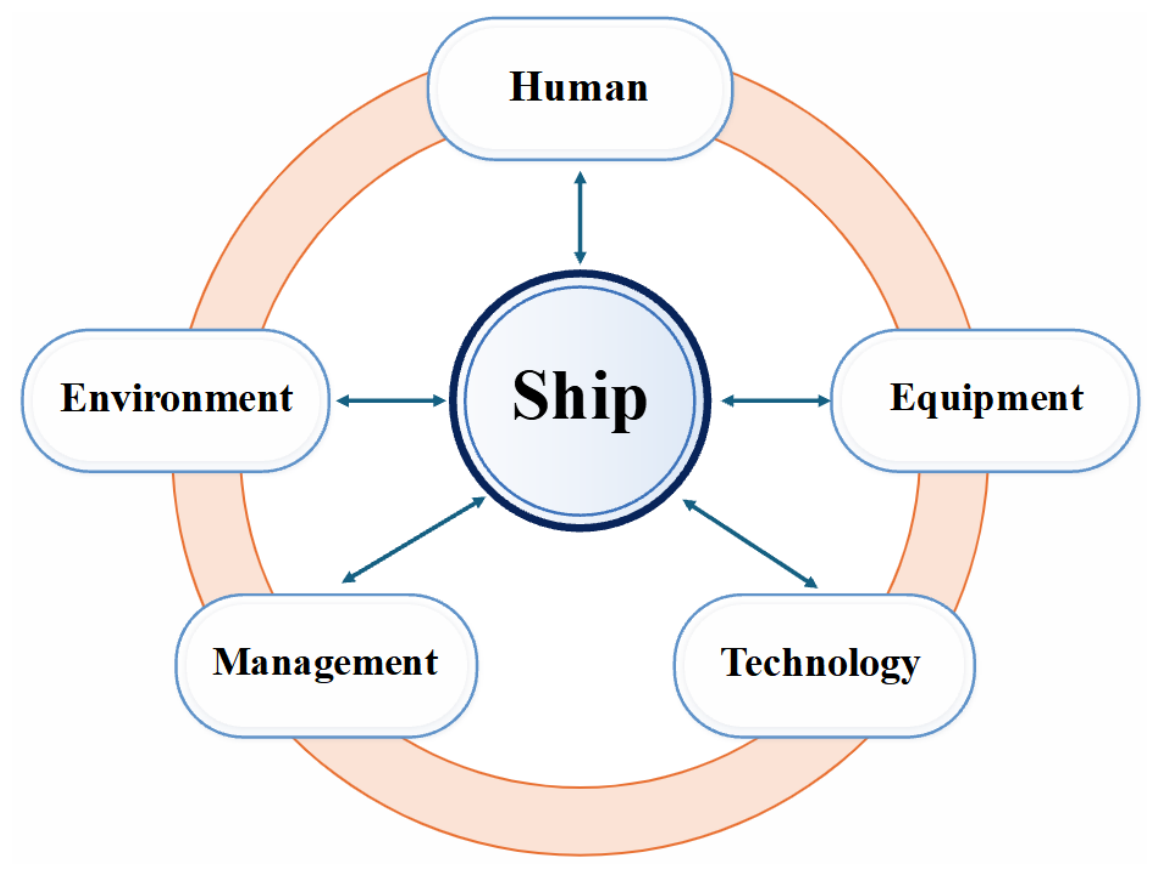

Table 1.
Summary of Generalized Probability Results for Multi-Factor Risk Coupling in Complex Waters.
Table 1.
Summary of Generalized Probability Results for Multi-Factor Risk Coupling in Complex Waters.
| Factor level | Factor combination | Joint probability | Degree of overlap | Relative independence baseline |
|---|---|---|---|---|
| Two-factor | 0.4104 | 0.6184 | 0.9267 | |
| Two-factor | 0.4288 | 0.6591 | 0.9877 | |
| Two-factor | 0.4362 | 0.6574 | 0.9852 | |
| Two-factor | 0.4473 | 0.6875 | 1.0360 | |
| Two-factor | 0.4362 | 0.6574 | 0.9907 | |
| Two-factor | 0.4547 | 0.6989 | 1.0532 | |
| Three-factor | 0.2773 | 0.4261 | 0.9624 | |
| Three-factor | 0.2717 | 0.4095 | 0.9247 | |
| Three-factor | 0.2921 | 0.4489 | 1.0137 | |
| Three-factor | 0.3124 | 0.4801 | 1.0903 | |
| Four-factor | 0.1848 | 0.2841 | 0.9668 |
Note: Values were calculated from the 15 risk-coupling states and their frequencies reported in Ref. [13] using Eqs. (6.1)-(6.3).
Table 2.
Generalized Bayesian Posterior Results Conditional on a Higher-Order Coupling Event.
| Original risk-coupling state | Number of occurrences of the original risk-coupling state | |
|---|---|---|
| 50 | 0.1543 | |
| 47 | 0.1451 | |
| 58 | 0.1790 | |
| 69 | 0.2130 | |
| 100 | 0.3086 |
Note: Posterior values were calculated from the coupling-state frequencies in Ref. [13] using Eq. (6.8).
Disclaimer/Publisher’s Note: The statements, opinions and data contained in all publications are solely those of the individual author(s) and contributor(s) and not of MDPI and/or the editor(s). MDPI and/or the editor(s) disclaim responsibility for any injury to people or property resulting from any ideas, methods, instructions or products referred to in the content. |
© 2026 by the authors. Licensee MDPI, Basel, Switzerland. This article is an open access article distributed under the terms and conditions of the Creative Commons Attribution (CC BY) license (http://creativecommons.org/licenses/by/4.0/).
Copyright: This open access article is published under a Creative Commons CC BY 4.0 license, which permit the free download, distribution, and reuse, provided that the author and preprint are cited in any reuse.