

Submitted:
10 September 2026
Posted:
14 September 2026
You are already at the latest version
Abstract
Population-based threshold models have organized quantitative seed biology for four decades: each seed is held to commit to germination when its accumulated suprathreshold hydrothermal dose reaches afixed total, with commitment thresholds distributed across the seed lot. That architecture has been refined extensively from within but rarely tested from without, against models that deny its two central commitments — per-seed binary commitment and distributed thresholds. Here the test is run on apublished Hordeum spontaneum factorial (six temperatures by six water potentials, 2,880 seeds,interval-censored counts to 480 h). Against graded first-order kinetic rivals given matched flexibility, including a thermal optimum and a free Weibull shape, the gated two-channel population-threshold model wins by ΔAICc ≈ 2,480, takes 29 of 36 leave-one-condition-out folds, and outperforms in every individual condition; a sharp common threshold is rejected by ΔAICc ≈ 52,600. The gate-forcing result replicates on three further seed lots from two additional species: decisively in two montane grasses(ΔAICc 1,959 and 580 over the graded rival; 7 of 7 held-out folds each), and in rapeseed once a viability confound is resolved — the three-parameter forms tie out-of-sample, and matched viability parameters restore a 68-point gated advantage. Fitted parameters independently reproduce a published fit of the same data, with the temperature–threshold displacement slope agreeing to the third decimal (0.076 vs 0.074 MPa/°C). Supra-optimal temperature localizes to the gate parameter rather than the dose rate —the same intervention-localization signature that chloramphenicol produces on ribosome engagement in Escherichia coli under the identical analysis form. A conjunctive dormancy-capture model is shown to be likelihood-equivalent to threshold displacement on constant-condition assays (nested ΔnLL = 3.2 for three parameters), and a simulated transfer experiment separates the two mechanisms by a predicted plateau difference of 0.92. The same analysis form applied to Saccharomyces cerevisiae growth physiology forces the same third factor inside a eukaryotic cell (ΔAICc = 19.4 against a reserve-free law; the affine form wins all five leave-one-study-out folds; inferred engagement ≈ 0.71 at fast growth against ≈ 0.75 measured independently). These instances define Architectura Recurrens Vitae, a class established not by shared ancestry but by an operational diagnosis: conjunctive suprathreshold drive, integral accumulation to a fixed commitment dose, binary commitment at the unit with thresholds distributed across the population, and perturbation that localizes to the gate parameter. Membership is decided by model comparison against matched rivals and never by vocabulary, so what each instance has actually been shown to satisfy is recorded criterion by criterion; of the three certified here, the seed alone meets all four and is designated the type.
Keywords:
seed germination
; hydrothermal time
; population threshold models
; biological commitment
; distributed thresholds
; dormancy
; model selection
; cross-validation
; threshold-gated integration
; phenotypic heterogeneity
1. Introduction
The hydrothermal time framework describes seed germination as the accumulation of a conjunctive suprathreshold dose: a seed at water potential Ψ and temperature T progresses toward germination at a rate proportional to (Ψ − Ψb)(T − Tb), and completes germination when the accumulated product reaches a constant θHT. The framework was assembled across a short and remarkable sequence of papers: thermal time in pearl millet (Garcia-Huidobro et al. 1982), the hydrothermal synthesis in sugar beet (Gummerson 1986), the population formulation in which the base water potential Ψb is distributed across seeds of a lot (Bradford 1990), the consolidation of that population logic into a general tool (Bradford 2002; Bewley et al. 2013), and the extension to supra-optimal temperatures, at which the Ψb distribution is displaced upward as temperature rises (Alvarado and Bradford 2002). Distribution families for the thresholds have been compared within the framework (Mesgaran et al. 2013), and modern estimation treats the data in their native interval-censored time-to-event form (Onofri et al. 2018).
Throughout that development, the architecture itself — per-seed binary commitment at a threshold, thresholds distributed across the population, dose accumulated as a product of suprathreshold excesses — has functioned as an assumption. Model comparison inside the tradition asks which distribution family or which submodel best serves the architecture; it does not ask whether the data force the architecture over rivals that deny it. A graded alternative is easy to state: each seed germinates stochastically at a rate set by the environment, with no per-seed threshold and no distributed commitment points, and with population sigmoids arising from the kinetics rather than from a threshold distribution. Whether such rivals fail, and where, has to my knowledge not been established.
The question matters beyond seed biology because the gated structure recurs at other scales. In a companion analysis of compiled Escherichia coli growth physiology (data of Scott et al. 2010; Dai et al. 2016; compiled by Chure and Cremer 2023), the steady-state growth law λ = γ(v) · f · φR requires a third factor f — the engaged fraction of ribosomes — beyond machinery abundance and elongation drive, and the antibiotic chloramphenicol perturbs f while leaving the drive curve intact. Dai et al. (2016) measured that inactive fraction directly; the model-comparison route recovers it as a forced residual. The general claim under test, developed as a threshold-gated multiplicative account of biological commitment (Rahman et al. 2025; Rahman and Zorumski 2026), is that execution across scales is governed by conjunctive suprathreshold products crossing thresholds, with commitment binary at the unit and graded only in the population. The seed lot is the cleanest macroscopic candidate for that class, because per-seed commitment is directly observable rather than inferred.
This paper asks three questions of one published dataset. First, is the gated population-threshold architecture forced by the data, against matched-flexibility graded rivals? Second, when temperature exceeds its optimum, does the perturbation localize to the dose rate or to the gate? Third, can the canonical account of supra-optimal loss — displacement of the threshold distribution — be distinguished, on standard assay designs, from a mechanistically different account in which seeds are captured into a competing dormant state?
2. Methods
2.1. Data
Germination data for wild barley (Hordeum spontaneum [C. Koch] Thell.) were taken from Mesgaran et al. (2017) as distributed in the drcSeedGerm R package (Onofri et al. 2018). Seeds were incubated at six constant temperatures (8, 12, 16, 20, 24, 28 °C) by six water potentials (0 to −1.5 MPa in 0.3 MPa steps, PEG-8000), four dishes of twenty seeds per condition, with radicle protrusion scored daily for 20 days. The data are interval-censored: each record gives the count of seeds germinating within a scoring interval, with seeds not germinated at the final observation right-censored. In total 2,880 seeds, of which 1,729 germinated within 480 h.
2.2. Likelihood
All models were fit by maximum likelihood on the interval-censored binomial form. An interval (t0, t1] in which n seeds germinate contributes n · log[G(t1) − G(t0)], where G is the model’s cumulative germinated fraction for that condition; a right-censored record contributes n · log [1 − G(tlast)]. The censored term deserves emphasis: scoring censored seeds as germinating after the final observation, G(∞) − G(tlast), silently confiscates the never-germinable mass from any model with G(∞) < 1 — every threshold-distribution model, and capture models most of all — while leaving graded models with G(∞) = 1 untouched, and biases comparisons toward graded kinetics. A second numerical trap concerns models computed over threshold-quantile grids: a staircase approximation to G zeroes interval probabilities that the continuous model supports, and each observed germination landing in a zeroed interval incurs an unbounded penalty. Capture models were therefore computed as the exact continuous cumulative distribution minus a discretized captured-mass correction (200-point quantile grid), for which the residual discretization error is second-order.
2.3. Models
G1 (gated, two-channel). Seed g commits when its accumulated dose (Ψ − Ψb(g)) · (T − Tb) · t reaches θHT, with Ψb(g) ~ Normal(μb(T), σ) and μb(T) = μ0 + k · max(0, T − To). Sub-optimal temperature drives the dose; supra-optimal temperature displaces the gate — the Alvarado–Bradford (2002) architecture, in the variant with displacement beginning at an onset temperature. Six parameters.
G1c (gated, one channel). G1 with k = 0: the textbook conjunctive model with a static threshold distribution. Four parameters.
G4 (sharp threshold). G1 with σ fixed at 0.005 MPa: all seeds share one commitment point. Five free parameters. G2 and G3 (graded rivals). First-order kinetics with no threshold distribution: each seed germinates stochastically with rate set by suprathreshold environmental excesses, combined multiplicatively (G2) or additively (G3), damped above a thermal optimum by exp(−q · max(0, T − Tor)), and with a free Weibull shape m allowing sigmoid time courses: G = 1 − exp[−(rate · t)m]. Six and seven parameters respectively. These rivals were deliberately given the same thermal freedoms as the gated models, so that any deficit is structural rather than an artifact of starved flexibility.
G5b (gate plus capture). A static gate (G1c) supplemented by a competing absorbing state: while a seed waits for its dose to complete, it is captured into dormancy at hazard λ = d · max(0, T − Td) · max(0, Ψc − Ψ). Captured seeds never germinate within the model. Seven parameters. A temperature-only variant (hazard independent of Ψ) was also fit. G6 nests displacement and capture together (nine parameters) to test whether capture adds likelihood once displacement is present.
2.4. Selection, Uncertainty, and Computation
Models were compared by AICc (Hurvich and Tsai 1989; Burnham and Anderson 2002) and by 36-fold leave-one-condition-out cross-validation, holding out one full temperature-by-water-potential cell per fold and scoring held-out per-seed log-loss. Optimization used bounded Nelder–Mead (Nelder and Mead 1965) with extensive multi-start. Parameter uncertainty for the selected model was obtained by dish- level bootstrap (150 resamples, dishes resampled with replacement within condition). AICc treats seeds as independent within dish; the dish-level bootstrap, not the information criterion, carries the replicate structure, and the cross-validation — which is immune to within-dish dependence in a way absolute AICc differences are not — agrees with the AICc ordering throughout. All analyses are reproduced by a single documented pipeline (Data and code availability).
2.5. Companion Analyses in Two Translation Systems, and the Transfer Simulation
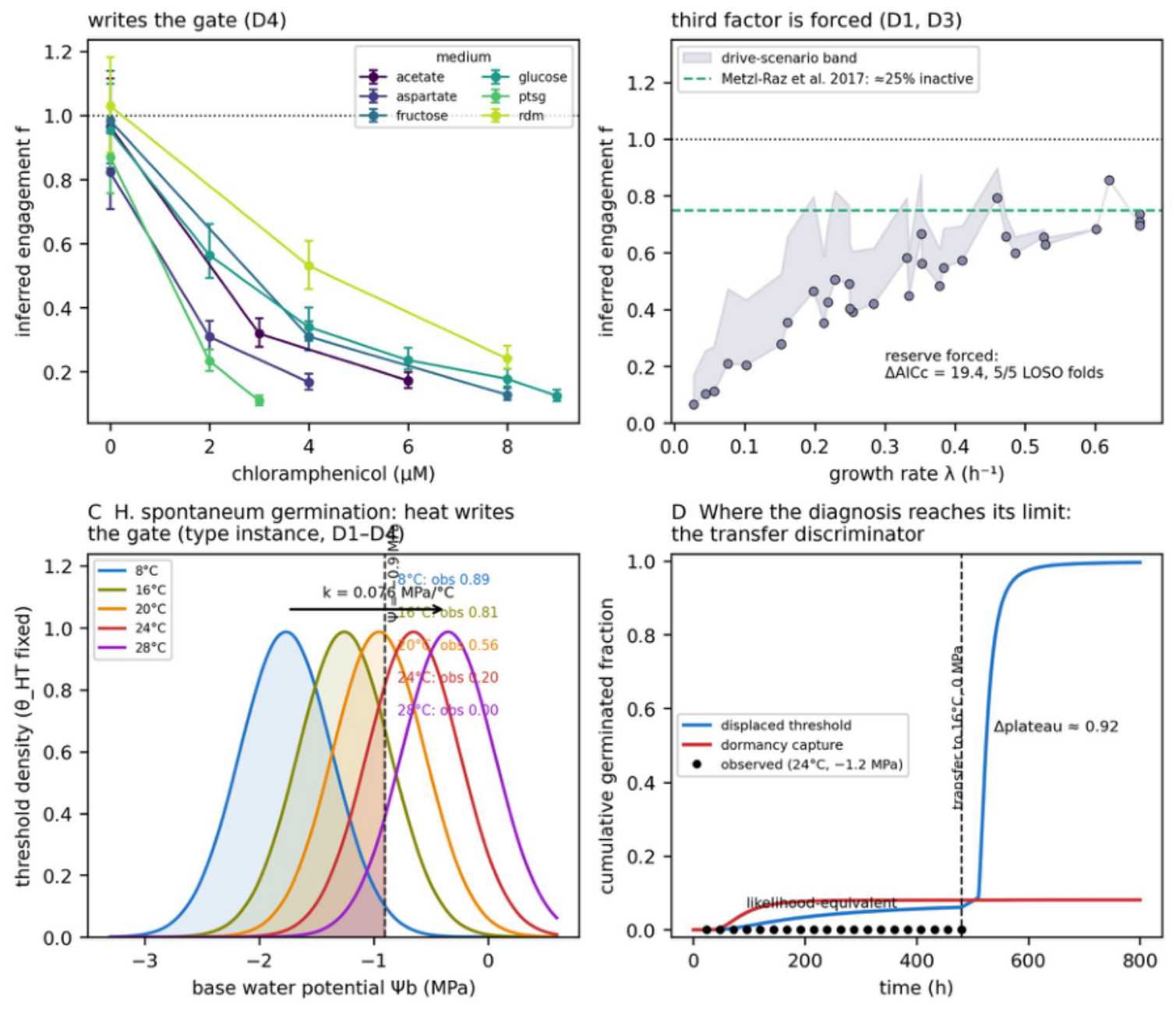
The E. coli comparison in Figure 2A derives from compiled steady-state proteome and elongation measurements (271 ribosomal mass-fraction points across 15 studies; 66 elongation-rate points across 17 studies; chloramphenicol series of Dai et al. 2016), assembled in the repository of Chure and Cremer (2023). An affine ribosomal growth law and a saturating drive curve v(λ) were fit, the engaged fraction inferred per condition as f = λ / (φR · γ(v)), and an engagement-free null rejected (ΔAICc ≈ 103). The transfer simulation in Figure 2D propagates both fitted seed models — displacement (G1) and capture (G5b) — through 480 h at 24 °C, −1.2 MPa followed by transfer to 16 °C, 0 MPa, with accumulated hydrothermal dose carried across the transfer and, in G1, thresholds re-equilibrating to the new temperature.
2.6. Replication Datasets
Three further seed lots were analyzed with the identical pipeline in its water-potential-only reduction, since none varies temperature factorially: rapeseed (Brassica napus var. oleifera; Pace et al. 2012, distributed with drcSeedGerm; 14 water potentials from 0 to −1.5 MPa, three dishes of 50 seeds, scored to 14 d) and two montane grasses (Anisantha rubens and Bromus hordeaceus; Fernández-Pascual 2020, seedr package; seven water potentials, 25-seed dishes at 20/10 °C, interval counts). The reduced ladder comprises the gated hydrotime model H1, G = Φ[(Ψ − θH/t − μ)/σ] (three parameters); a matched three- parameter graded rival H2 with Weibull shape, G = 1 − exp[−(c · max(0, Ψ − Ψb) · t)m]; and the sharp threshold H4 (σ fixed at 0.005 MPa). Likelihood, censoring, optimization, and leave-one-water- potential-out cross-validation follow Section 2.2 and Section 2.4. For rapeseed, a matched four-parameter pairing was also fit — gated with a viability fraction v (H1v: G = v · Φ[·]) against graded with a free asymptote (H2v) — to separate seed-lot viability from kinetic structure.
The eukaryotic comparison in Figure 2B uses the yeast compilation from the same repository (Appendix 1 of Chure and Cremer 2023): 32 paired growth-rate and ribosomal mass-fraction measurements drawn from five studies (Waldron and Lacroute 1975; Paulo et al. 2015, 2016; Metzl-Raz et al. 2017; Xia et al. 2022, labelled 2021 in the compilation) together with five elongation-rate determinations. An affine law λ = γ · (φR − φ0) was fit against a proportional law with no reserve (φ0 = 0), compared by AICc and by leave-one-study-out cross-validation, with parameter intervals from a nonparametric bootstrap (3,000 resamples). Engagement was then inferred per condition as f = λ · mRb/(3600 · v · φR), bracketed between two drive scenarios (v at its maximum, and v interpolated through the direct elongation measurements), using the ribosome mass and maximal elongation constants of the source repository.
3. Results
3.1. The Gate Is Forced
Table 1 gives the model ladder. The sharp common threshold is annihilated (ΔAICc ≈ 52,600; held-out log-loss 11.3 versus 1.5 nats per seed): germination times are far too dispersed within conditions for a single commitment point. Distributed thresholds are therefore mandatory — but the graded rivals also produce dispersion, through their kinetics, so the decisive comparison is G1 against G2 and G3. The gated two-channel model wins by ΔAICc ≈ 2,480 over the better graded rival, takes 29 of 36 leave-one- condition-out folds against 0 for either graded model, and, in a per-condition decomposition, achieves lower held-out loss in all 36 cells. The graded models’ free Weibull shape went essentially unused (fitted m ≈ 1.08), indicating that their deficit is not one of curve shape but of structure: they lack per-seed commitment points, and the data demand them. The population-threshold architecture, assumed since Bradford (1990), is here an inference.
3.2. Parameters, and an Independent Reproduction
Table 2 gives the selected model’s parameters with dish-bootstrap intervals, alongside the published fit of the same dataset by Onofri et al. (2018), obtained with different machinery (log-logistic germination- time distribution, shifted-exponential extent submodel, a free germinable fraction, time-to-event estimation in the drcte framework). The displacement slope k — the rate at which supra-optimal temperature moves the gate — agrees to the third decimal (0.076 versus 0.074 MPa/°C, intervals overlapping), and the base temperature agrees within overlapping intervals near 0 °C. The apparent discrepancies in θHT and median Ψb trace to parameterization: their displacement runs linearly from Tb while G1’s begins at a fitted onset To ≈ 9.3 °C, so their effective median at 8 °C is −2.91 + 0.074 · 8.75 ≈ −2.26 MPa against G1’s constant −1.77, and θ trades off against the excess. Both parameterizations are codified as variants in the source package (Mesgaran et al. 2017; Onofri et al. 2018). The product that touches data agrees: at 8 °C and Ψ = 0, their parameters give a median germination time of 66 h, G1 gives 62 h, and the observed value is 64 h.
3.3. Temperature Is Two-Channel, and the Supra-Optimal Channel Writes the Gate
The data dissociate germination rate from germination extent: median time is minimal at 12–20 °C while final fraction declines monotonically with temperature, steepest under water stress (Mesgaran et al. 2017). A single temperature channel cannot produce slow-but-complete germination at 8 °C and fast- but-partial germination at 20–24 °C; the one-channel conjunctive model G1c accordingly loses to G1 by ΔAICc ≈ 1,420. In G1 the two channels have distinct loci and distinct strengths. The sub-optimal channel — thermal drive on the dose — is real but weak, with Tb ≈ −0.2 °C, consistent with a Mediterranean winter annual. The supra-optimal channel is strong and acts on the gate: above To = 9.3 °C the threshold distribution slides upward at 0.076 MPa/°C with θHT fixed. The model contains no optimum parameter, yet reconstructs the observed non-monotone median times at Ψ = 0 across 8/12/16/20/24/28 °C as 62/48/44/47/57/93 h against observed 64/44/42/43/48/75 h: the speed optimum emerges from rising thermal drive crossing shrinking hydro-excess. The supra-optimal side is over- slowed by roughly 20%, a residual localized exactly where displacement and capture are confounded (Section 3.4). Figure 1 shows the fit, the conjunctive rate fan with its supra-optimal intercept slide, the ladder, and the extent surface.
3.4. Extent Without an Asymptote, and the Capture Equivalence
Final germinated fraction across all 36 conditions is predicted with R² = 0.965 and no free asymptote: extent is the tail of the displaced threshold distribution, where the published fit of the same data carries a fitted ceiling (G = 0.988). The hot–dry corner of the factorial — exact zeros at 20–28 °C under strong water stress — is thereby captured by a static, temperature-conditioned distribution. But the biology offers a mechanistically different account of the same corner: secondary dormancy induction, a competing absorbing program. Three results define its evidential status here. First, temperature-only capture rejects itself: the fitted hazard goes to zero, because a hazard that does not depend on water stress cannot empty the dry corner without also emptying wet–warm conditions the data keep full. Second, conjunctive capture — hazard requiring heat and drought jointly (fitted onset 18.8 °C and −0.51 MPa) — is genuinely competitive standing alone, recovering most of what displacement explains (ΔAICc 987 versus 1,423 for no supra-optimal channel at all). Third, nested with displacement, capture collapses: three additional parameters buy ΔnLL = 3.2, and the fitted hazard falls to near zero. On constant-condition data, threshold displacement and dormancy capture are likelihood-equivalent, with displacement preferred only because it also slows the surviving germinators, which capture cannot do.
3.5. The Transfer Experiment Separates What the Assay Cannot
Figure 2D makes the equivalence and its resolution quantitative. Through the entire 480-hour assay at 24 °C and −1.2 MPa, the two fitted mechanisms never differ by more than 0.046 in cumulative germinated fraction, both lying on the observed zeros. Upon simulated transfer to 16 °C and 0 MPa, they separate by a predicted plateau difference of 0.92: the displacement model releases essentially the whole viable population (0.996), because thresholds re-equilibrate to the benign temperature and accumulated dose carries over, while the capture model releases almost nothing (0.081), because absorbed seeds remain absorbed until dormancy is broken by cues outside the model. One incubator move discriminates mechanisms that the standard design provably cannot.
Figure 2.
Three certified instances of Architectura Recurrens Vitae, and the point at which the diagnosis reaches its limit. (A) E. coli translation: inferred ribosome engagement f collapses under chloramphenicol in all six growth media while ribosomal mass fraction rises — the intervention writes the gate, criterion D4 (compiled data: Scott et al. 2010; Dai et al. 2016; Chure and Cremer 2023). (B) S. cerevisiae translation: the same third factor is forced (ΔAICc = 19.4 over the reserve-free law; five of five leave-one-study-out folds), inferred engagement near 0.71 at fast growth against ≈ 0.75 obtained independently by Metzl-Raz et al. (2017), collapsing at slow growth; the band spans two drive scenarios. (C) H. spontaneum germination, the type instance: the fitted base-water-potential distribution slides upward at 0.076 MPa/°C above 9.3 °C with θ_HT fixed, shaded tails giving germinable fractions at Ψ = −0.9 MPa beside the observed finals. (D) The discriminator: at 24 °C and −1.2 MPa the fitted displacement and capture models differ by at most 0.046 through 480 h, both on the observed zeros, and separate by Δplateau ≈ 0.92 upon simulated transfer. Panels A–C are data plus fit; panel D is fitted-model prediction only, which is the intended epistemic status of a decisive-experiment panel.
Figure 2.
Three certified instances of Architectura Recurrens Vitae, and the point at which the diagnosis reaches its limit. (A) E. coli translation: inferred ribosome engagement f collapses under chloramphenicol in all six growth media while ribosomal mass fraction rises — the intervention writes the gate, criterion D4 (compiled data: Scott et al. 2010; Dai et al. 2016; Chure and Cremer 2023). (B) S. cerevisiae translation: the same third factor is forced (ΔAICc = 19.4 over the reserve-free law; five of five leave-one-study-out folds), inferred engagement near 0.71 at fast growth against ≈ 0.75 obtained independently by Metzl-Raz et al. (2017), collapsing at slow growth; the band spans two drive scenarios. (C) H. spontaneum germination, the type instance: the fitted base-water-potential distribution slides upward at 0.076 MPa/°C above 9.3 °C with θ_HT fixed, shaded tails giving germinable fractions at Ψ = −0.9 MPa beside the observed finals. (D) The discriminator: at 24 °C and −1.2 MPa the fitted displacement and capture models differ by at most 0.046 through 480 h, both on the observed zeros, and separate by Δplateau ≈ 0.92 upon simulated transfer. Panels A–C are data plus fit; panel D is fitted-model prediction only, which is the intended epistemic status of a decisive-experiment panel.
3.6. Replication on Additional Seed Lots
Table 3 gives the reduced ladder on the three replication lots. In both grasses the gated model is forced outright: ΔAICc of 1,959 (Anisantha rubens) and 580 (Bromus hordeaceus) over the matched graded rival, with the gated model taking all seven leave-one-water-potential-out folds in each species and the sharp threshold annihilated (ΔAICc 17,300 and 18,900). Rapeseed is the instructive case. At three parameters the graded form holds a 53-point in-sample edge while cross-validation is a dead tie (0.777 versus 0.779 nats per seed; folds split 7–7 of 14) — and the graded model achieves its edge with a fitted Weibull shape of m = 0.59, a decelerating heavy tail. The tail is doing the work of dead seeds: roughly 2–4% of this lot never germinates even at Ψ = 0 within the 14-day horizon, which a tail-free normal threshold distribution cannot represent. With matched viability parameters on both sides, the gated model leads by ΔAICc = 68, the fitted viable fraction is 0.958, and the graded model’s shape parameter relaxes to m = 1.57 — the heavy tail vanishes the moment it is no longer needed to impersonate mortality. Across all four lots and three species, no comparison at matched parameterization favors graded kinetics, and the sharp threshold loses by roughly four orders of magnitude in AICc everywhere.
4. Discussion
4.1. From Assumption to Inference
The contribution of the model ladder is epistemic. The population-threshold architecture has organized the field since Gummerson (1986) and Bradford (1990), but organization is not evidence: a framework can structure four decades of measurement while remaining, formally, a choice. The comparison here converts the choice into an inference — distributed binary thresholds accumulating a conjunctive dose defeat sharp thresholds catastrophically and defeat equally flexible graded kinetics decisively, in- sample, out-of-sample, and cell by cell. The fitted structure then reproduces an independent published fit at the level of its most theory-laden parameter. Nothing in this establishes new seed biology; it establishes that the seed biology everyone assumed is the seed biology the data force.
4.2. The Localization Result Recurs Across Scales
The reason to run the test at all comes from outside seed science. Under the identical analysis form — fit the multiplicative law, force the residual, perturb, and ask which term moves — E. coli translation yields the same two findings. A third factor beyond machinery and drive is forced (the engaged ribosome fraction, which Dai et al. 2016 measured directly and the comparison recovers as a residual), and the targeted intervention localizes to it: chloramphenicol collapses engagement while the drive curve stands (Figure 2A). In the seed, supra-optimal heat collapses the germinable fraction by displacing the threshold distribution while the dose constant stands (Figure 2C). Two kingdoms, two perturbations, one localization signature. A third instance closes the comparison inside the eukaryotic cell. The same ladder applied to compiled Saccharomyces cerevisiae growth physiology rejects the reserve-free law by ΔAICc = 19.4 across 32 points from five studies, the affine form winning all five leave-one-study-out folds; the fitted slope implies a marginal elongation rate of 10.4 aa/s [9.0–11.7] against a maximum of 10 aa/s, so idle capacity resides entirely in an intercept of φ0 = 0.105 [0.084–0.122]. Inferred engagement is ≈ 0.71 at fast growth, against the ≈ 0.75 that Metzl-Raz et al. (2017) obtained independently by direct accounting, and falls to 0.11–0.26 at slow growth. As in the bacterium, the residual method and the direct method agree to within 0.04. Prokaryotic cell, eukaryotic cell and plant organism thus return one structural result under one analysis form, and Architectura Recurrens Vitae is the name for exactly that.
4.3. An Identifiability Boundary the Field Has Met but Not Formalized
The displacement–capture equivalence is not an abstract worry; the field has encountered it. Dormancy models in the population-threshold tradition parameterize dormancy loss and induction as movement of Ψb(50), with the other hydrotime parameters held fixed (Batlla and Benech-Arnold 2004; Allen et al. 2007) — that is, the field’s own dormancy formalism is the displacement horn of the equivalence, adopted as a modeling convention rather than proven against the capture horn. Windauer et al. (2012) met the ambiguity explicitly in Jatropha curcas, finding supra-optimal Ψb(50) shifts that their incubation data could not assign between dormancy expression and dormancy induction. What the present analysis adds is the formal statement: on constant-condition designs the two mechanisms are likelihood- equivalent up to a nested ΔnLL of 3.2, and the transfer protocol is the discriminator, with a predicted effect size of Δplateau ≈ 0.92 under the fitted parameters. Transfer and dormancy-cycling experiments are routine in the thermoinhibition and seed-bank literatures, and both qualitative outcomes — prompt germination on relief, and persistent secondary dormancy requiring chilling — are documented phenomena, likely species-dependent. A systematic reading of that literature against the quantitative prediction is therefore the necessary first step, and it is possible the discriminating experiment has already been run for some species without being framed as one; where it has, the corresponding species simply occupies one horn of the taxonomy. The equivalence also echoes, at organism scale, a general identifiability limit: a threshold phenomenon observed under constant conditions underdetermines the temporal computation that generates it, and only condition-switching protocols resolve it.
4.4. Limitations
The gate-forcing comparison now spans four seed lots of three species, but the two-channel temperature result rests on the hordeum factorial alone, since the replication designs vary water potential only; temperature-factorial replication in further species is the outstanding structural test. The rapeseed lot also exposes a general hazard of the comparison: a small non-germinating fraction lets a heavy-tailed graded model impersonate mortality, so matched viability parameters are required before the structural question is cleanly posed. The strongest surviving rival family is graded kinetics with a freely parameterized extent surface, which purchases with parameters what the gate distribution yields for free; the comparison here holds extent-parsimony fixed against the gated models, and the parsimony argument should be treated as part of the claim rather than left implicit. Constant-condition data cannot identify the dose-accumulation algorithm itself (integral dose versus alternatives); ramp and step protocols are required. The permissive-field term of the general framework is uninstantiated here: the displacement parameter k is where an abscisic acid/gibberellin control loop would act, and hormone interventions (fluridone, exogenous GA) shifting k or the threshold location constitute the corresponding test, but no hormonal variable was measured. Finally, the class rests on three certified instances, two of them translation systems whose per-unit binarity is inferred rather than observed and whose integral- dose criterion the steady-state design cannot test at all (Table 4). A class earns its keep by continuing to license transfers, and a fourth instance requiring special pleading would count against it.
4.5. Predictions
(1) Replication: temperature-factorial datasets in further species select the gated two-channel class under the full ladder, as the water-potential designs here selected the gated core. (2) Transfer: for this lot, non- germinated seeds from hot–dry conditions moved to 16 °C and water germinate to near-completion within days if displacement is the mechanism, and remain near-zero pending chilling if capture is; intermediate outcomes measure the mixture. (3) Hormonal instantiation: fluridone shifts the displacement slope k toward zero and exogenous ABA increases it, moving the gate without moving θ. (4) Cross-scale: interventions on other members localize to their gate terms under the same analysis form — in yeast, cycloheximide should write engagement while rapamycin writes the allocation trajectory, a two-intervention dissociation within one equation that the bacterial system has never been asked for; the bet-hedging optimality literature (Cohen 1966) then plays, for the seed gate’s set point, the role that flux optimization plays for the bacterial one — the framework classifies the gate, the optimality theory explains where evolution put it.
5. Architectura Recurrens Vitae
5.1. Definition and Diagnosis
Architectura Recurrens Vitae is the class of biological commitment systems governed by threshold- gated multiplicative integration. The participle carries two properties deliberately: the architecture recurs across life, and it runs back upon itself, since in several members the execution it governs is what builds the machinery that executes. The name arrives with a diagnosis, so that membership is a finding rather than a description, and every claim of membership below is reported at the strength the data support. A system belongs to the class when four criteria hold. D1, conjunctive drive: execution rate is a product of suprathreshold excesses over the required inputs, so that any zero vetoes the whole. D2, integral commitment: that product accumulates toward a fixed dose, and commitment occurs at crossing. D3, unit binarity with population dispersion: commitment is all-or-none in the individual unit, thresholds are distributed across units, and graded population output follows from the distribution rather than from graded individual response. D4, gate localization: a targeted perturbation of the permissive variable moves the gate parameter while leaving the drive relation intact. Certification proceeds by model comparison and never by vocabulary. The gated form must defeat matched-flexibility graded rivals and a sharp common threshold, in-sample and out-of-sample, at matched parameterization for nuisance structure such as viability. That last clause is load-bearing rather than formal: Section 3.6 showed a heavy-tailed graded model impersonating mortality and inverting the rapeseed comparison until viability was matched on both sides. A system mapped to the vocabulary but not put through this comparison is a candidate, not a member.
5.2. Certified Members, and What Each Criterion Has Actually Tested
Table 4 sets the three certified instances against the four criteria and records equally what remains untested in each. The two translation systems satisfy conjunctive drive and gate structure, but their per- unit binarity is recovered as a model residual rather than observed, and steady-state growth data cannot address integral accumulation at all. The seed satisfies all four: dose accumulation is measured as θ_HT, per-seed commitment is scored directly as radicle protrusion, thresholds are distributed with a fitted σ, and supra-optimal temperature localizes to the displacement parameter. Hordeum spontaneum is therefore designated the type instance — not because it is the founding case, which is the bacterium, but because it is the one member in which every clause of the diagnosis has been tested and met.
5.3. A Recurrent Architecture, Not a Body Plan
The class is not a Bauplan and should not be defended as one. A body plan is a homology class: a ground plan shared by descent, bounded to a clade, maintained by developmental entrenchment, and explained by genealogy. Membership in Architectura Recurrens Vitae is established operationally rather than genealogically, and its instances share no ancestral gate token — the seed’s gate is built of hormonal and chromatin machinery, the ribosome’s of hibernation and initiation factors. The nearer analogy is the network motif: an architecture recurring because independent lineages converge on it under a shared functional constraint, tested against a null rather than against a phylogeny. Islands of genuine homology sit inside the class, since the germination gate is very likely homologous across seed plants and the translation recursion is maximally entrenched wherever it exists, but those islands are connected to one another by convergence.
Naming a class carries the obligation to state what would dissolve it, and three outcomes would. If graded kinetics with matched nuisance parameterization win the ladder in further systems, the diagnosis fails at its first criterion. If the transfer experiment of Section 3.5 shows seed dormancy and ribosome hibernation to be mechanistically unrelated states that merely fit similar curves, the class is a curve- fitting coincidence. And if each new candidate requires its own exemption before it can be certified, the diagnosis is not doing work. Named after the third instance rather than before the first, with a diagnosis attached and a type designated, the class is a claim that can be lost.
5.4. Candidates
Systems already mapped to the vocabulary but not put through the ladder are candidates only. The most demanding of them is mammalian sperm, where the permissive variable is membrane cholesterol rather than an abstraction: capacitation requires sterol efflux, cyclodextrin-mediated cholesterol depletion confers agonist responsiveness on a subpopulation over roughly three hours, and restoring cholesterol abolishes the effect — a bidirectional intervention on the gate with the agonist drive left intact. Certification there requires per-condition counts of acrosome-reacted cells across an agonist dose series at several capacitation times with viability scored separately, and the rapeseed lesson transfers unchanged, since dead cells undergo acrosomal loss and a heavy-tailed graded model would otherwise win by impersonating mortality.
6. Conclusions
Four decades of population-threshold seed biology survive their first confrontation with structured rivals, and emerge as inference rather than convention: the germination gate is forced in four lots of three species, its supra-optimal perturbation writes the gate parameter and not the dose, and its per-seed binarity with population-distributed thresholds places it, alongside the bacterial and yeast ribosome pools, in Architectura Recurrens Vitae, a class whose membership is decided by that same comparison and by nothing else. Where the framework meets its limit — displacement versus capture — it does so with a named experiment, a predicted effect size, and a literature ready to be read against both. Data and code availability All data derive from published sources: the hordeum dataset of Mesgaran et al. (2017) as distributed in drcSeedGerm (github.com/OnofriAndreaPG/drcSeedGerm, commit d68b6e2), the replication lots of Pace et al. (2012) via the same package and of Fernández-Pascual (2020) via seedr (github.com/cran/seedr, commit 530ed29), and the compiled E. coli and S. cerevisiae physiology of the flux-parity repository (github.com/cremerlab/flux_parity, commit 35f26bf; Chure and Cremer 2023). Analysis code and all derived results are archived at Zenodo, doi 10.5281/zenodo.22556332, under the MIT License for code and CC BY 4.0 for derived data. That record contains three documented pipelines (seed_gate_pipeline.py; replication_lots.py; yeast_growthlaw.py) which regenerate every fitted number, table entry and figure panel reported here, including the cross-validation, the bootstrap intervals and the transfer simulation, together with a script that retrieves the upstream sources at the pinned commits above and a statement of the software versions used.
Acknowledgments
Model specification, fitting, verification against published parameter estimates, and manuscript drafting were performed with the assistance of a large language model (Claude, Anthropic), under the author’s direction; the author is responsible for all content.
Conflicts of Interest
The author declares no competing interests.
References
- Allen, P.S.; Benech-Arnold, R.L.; Batlla, D.; Bradford, K.J. Modelling of seed dormancy. In Seed Development, Dormancy and Germination (Annual Plant Reviews 27); Bradford, K.J., Nonogaki, H., Eds.; Blackwell, Oxford, 2007; pp. 72–112. [Google Scholar]
- Alvarado, V.; Bradford, K.J. A hydrothermal time model explains the cardinal temperatures for seed germination. Plant Cell Environ. 2002, 25, 1061–1069. [Google Scholar] [CrossRef]
- Batlla, D.; Benech-Arnold, R.L. A predictive model for dormancy loss in Polygonum aviculare L. seeds based on changes in population hydrotime parameters. Seed Sci. Res. 2004, 14, 277–286. [Google Scholar] [CrossRef]
- Bewley, J.D.; Bradford, K.J.; Hilhorst, H.W.M.; Nonogaki, H. Seeds: Physiology of Development, Germination and Dormancy, 3rd ed.; Springer: New York, 2013. [Google Scholar]
- Bradford, K.J. A water relations analysis of seed germination rates. Plant Physiol. 1990, 94, 840–849. [Google Scholar] [CrossRef] [PubMed]
- Bradford, K.J. Applications of hydrothermal time to quantifying and modeling seed germination and dormancy. Weed Sci. 2002, 50, 248–260. [Google Scholar] [CrossRef]
- Burnham, K.P.; Anderson, D.R. Model Selection and Multimodel Inference, 2nd ed.; Springer: New York, 2002. [Google Scholar]
- Chure, G.; Cremer, J. An optimal regulation of fluxes dictates microbial growth in and out of steady state. eLife 2023, 12, e84878. [Google Scholar] [CrossRef] [PubMed]
- Cohen, D. Optimizing reproduction in a randomly varying environment Reduction of translating ribosomes enables Escherichia coli to maintain elongation rates during slow growth. In Journal of Theoretical Biology;Nature Microbiology; Dai, X., Zhu, M., Warren, M., Balakrishnan, R., Patsalo, V., Okano, H., Williamson, J.R., Fredrick, K., Wang, Y.-P., Hwa, T., Eds.; 1966; Volume 12 2, pp. 119–129 16231. [Google Scholar]
- Fernández-Pascual, E. seedr: Hydro and Thermal Time Seed Germination Models in R. R package version 0.3.0. 2020. [Google Scholar] [PubMed]
- Garcia-Huidobro, J.; Monteith, J.L.; Squire, G.R. Time, temperature and germination of pearl millet (Pennisetum typhoides S. & H.). I. Constant temperature. J. Exp. Bot. 1982, 33, 288–296. [Google Scholar] [CrossRef]
- Gummerson, R.J. The effect of constant temperatures and osmotic potentials on the germination of sugar beet. J. Exp. Bot. 1986, 37, 729–741. [Google Scholar] [CrossRef]
- Hurvich, C.M.; Tsai, C.-L. Regression and time series model selection in small samples. Biometrika 1989, 76, 297–307. [Google Scholar] [CrossRef]
- Mesgaran, M.B.; Mashhadi, H.R.; Alizadeh, H.; Hunt, J.; Young, K.R.; Cousens, R.D. Importance of distribution function selection for hydrothermal time models of seed germination. Weed Res. 2013, 53, 89–101. [Google Scholar] [CrossRef]
- Mesgaran, M.B.; Onofri, A.; Mashhadi, H.R.; Cousens, R.D. Water availability shifts the optimal temperatures for seed germination: a modelling approach. Ecol. Model. 2017, 351, 87–95. [Google Scholar] [CrossRef]
- Metzl-Raz, E.; Kafri, M.; Yaakov, G.; Soifer, I.; Gurvich, Y.; Barkai, N. Principles of cellular resource allocation revealed by condition-dependent proteome profiling. eLife 2017, 6, e28034. [Google Scholar] [CrossRef]
- Nelder, J.A.; Mead, R. A simplex method for function minimization. Comput. J. 1965, 7, 308–313. [Google Scholar] [CrossRef]
- Onofri, A.; Benincasa, P.; Mesgaran, M.B.; Ritz, C. Hydrothermal-time-to-event models for seed germination. Eur. J. Agron. 2018, 101, 129–139. [Google Scholar] [CrossRef]
- Pace, R.; Benincasa, P.; Ghanem, M.E.; Quinet, M.; Lutts, S. Germination of untreated and primed seeds in rapeseed (Brassica napus var. oleifera Del.) under salinity and low matric potential. Exp. Agric. 2012, 48, 238–251. [Google Scholar]
- Paulo, J.A.; O’Connell, J.D.; Gaun, A.; Gygi, S.P. Proteome-wide quantitative multiplexed profiling of protein expression: carbon-source dependency in Saccharomyces cerevisiae. Mol. Biol. Cell 2015, 26, 4063–4074. [Google Scholar] [CrossRef] [PubMed]
- Paulo, J.A.; O’Connell, J.D.; Everley, R.A.; O’Brien, J.; Gygi, M.A.; Gygi, S.P. Quantitative mass spectrometry-based multiplexing compares the abundance of 5000 S. cerevisiae proteins across 10 carbon sources. J. Proteom. 2016, 148, 85–93. [Google Scholar] [CrossRef] [PubMed]
- Rahman, T.; Zorumski, C.F. ARCH × Φ: sterols and the evolution of gated biological execution. BioSystems 2026, 265, 105812. [Google Scholar] [CrossRef] [PubMed]
- Rahman, T.; Zorumski, C.F.; Meloy, J.R. The ARCH model: a neuroevolutionary framework for behavioral execution. Front. Psychiatry 2025, 16, 1669530. [Google Scholar] [CrossRef] [PubMed]
- Scott, M.; Gunderson, C.W.; Mateescu, E.M.; Zhang, Z.; Hwa, T. Interdependence of cell growth and gene expression: origins and consequences. Science 2010, 330, 1099–1102. [Google Scholar] [CrossRef] [PubMed]
- Waldron, C.; Lacroute, F. Effect of growth rate on the amounts of ribosomal and transfer ribonucleic acids in yeast. J. Bacteriol. 1975, 122, 855–865. [Google Scholar] [CrossRef] [PubMed]
- Xia, J.; Sánchez, B.J.; Chen, Y.; Campbell, K.; Kasvandik, S.; Nielsen, J. Proteome allocations change linearly with the specific growth rate of Saccharomyces cerevisiae under glucose limitation. Nat. Commun. 2022, 13, 2819. [Google Scholar] [CrossRef] [PubMed]
- Windauer, L.; Martinez, J.; Rapoport, D.; Wassner, D.F.; Benech-Arnold, R.L. Germination responses to temperature and water potential in Jatropha curcas seeds: a hydrotime model explains the difference between dormancy expression and dormancy induction at different incubation temperatures. Ann. Bot. 2012, 109, 265–273. [Google Scholar] [CrossRef] [PubMed]
Figure 1.
The germination gate in Hordeum spontaneum (data of Mesgaran et al. 2017). (A) Interval-censored time courses at 20 °C across water potentials with the fitted two-channel gated model G1; partial plateaus arise from the threshold-distribution tail, not from fitted asymptotes. (B) Empirical median germination rates fan linearly over Ψ within temperature; supra-optimal temperatures slide the intercepts rightward — the gate-displacement signature. (C) Model ladder: ΔAICc (log scale) and 36-fold leave-one-condition-out log-loss for the gated, graded, capture, and sharp-threshold models. (D) Observed versus predicted final germinated fraction across all 36 conditions (color = temperature), R² = 0.965 with no free asymptote.
Figure 1.
The germination gate in Hordeum spontaneum (data of Mesgaran et al. 2017). (A) Interval-censored time courses at 20 °C across water potentials with the fitted two-channel gated model G1; partial plateaus arise from the threshold-distribution tail, not from fitted asymptotes. (B) Empirical median germination rates fan linearly over Ψ within temperature; supra-optimal temperatures slide the intercepts rightward — the gate-displacement signature. (C) Model ladder: ΔAICc (log scale) and 36-fold leave-one-condition-out log-loss for the gated, graded, capture, and sharp-threshold models. (D) Observed versus predicted final germinated fraction across all 36 conditions (color = temperature), R² = 0.965 with no free asymptote.
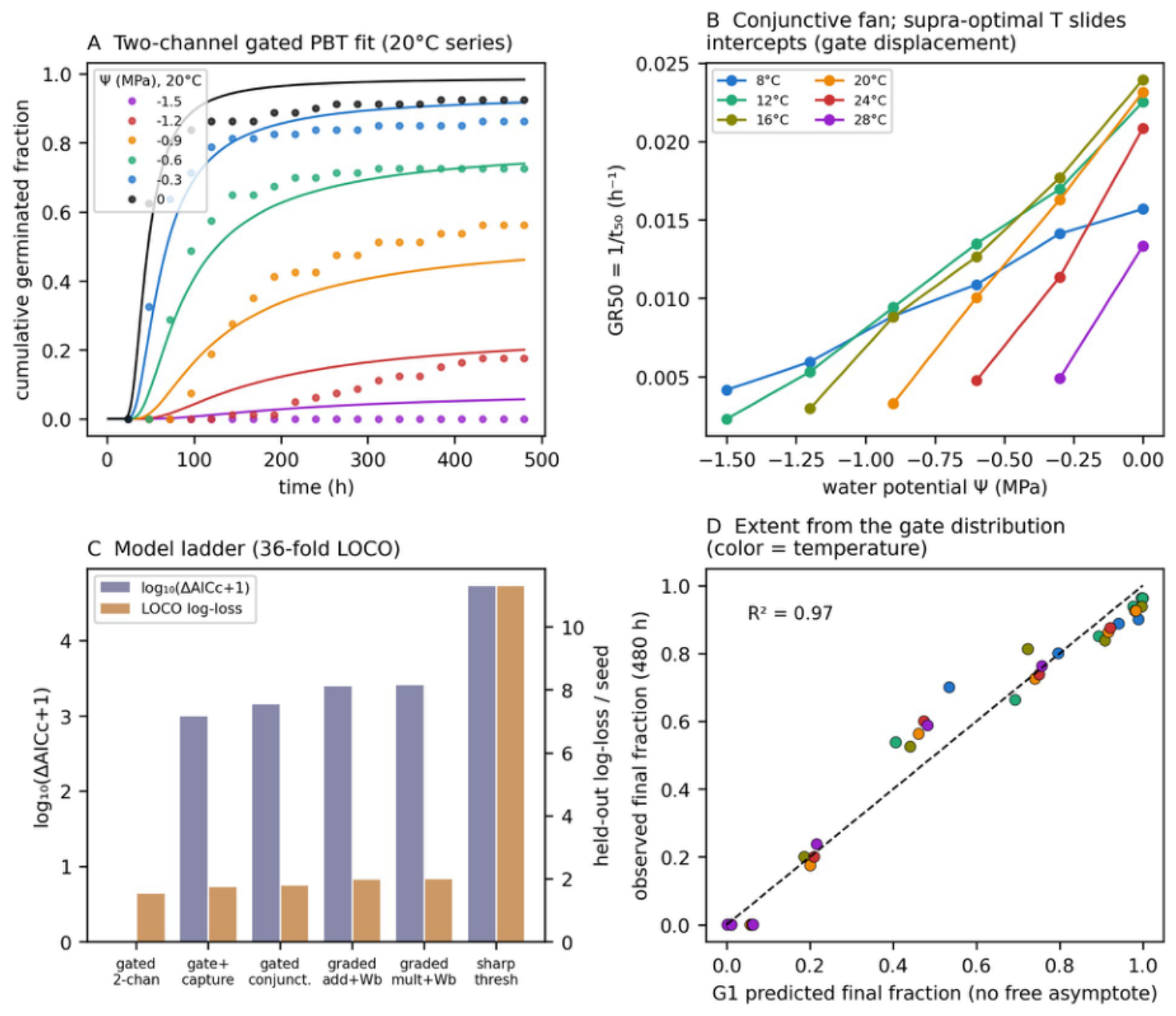

Table 1.
Model ladder on the full factorial (2,880 seeds, 36 conditions). ΔAICc relative to G1; LOCO CV is mean held-out log-loss per seed over 36 leave-one-condition-out folds; fold wins count folds with the lowest held-out loss among the six cross-validated models. *G4’s fold wins occur in empty cells where predicting pure censoring is trivially optimal; its mean tells the story. G6 was not cross-validated separately because it collapses onto G1 (Section 3.4).
Table 1.
Model ladder on the full factorial (2,880 seeds, 36 conditions). ΔAICc relative to G1; LOCO CV is mean held-out log-loss per seed over 36 leave-one-condition-out folds; fold wins count folds with the lowest held-out loss among the six cross-validated models. *G4’s fold wins occur in empty cells where predicting pure censoring is trivially optimal; its mean tells the story. G6 was not cross-validated separately because it collapses onto G1 (Section 3.4).
| Model | k | nLL | ΔAICc | LOCO CV | Fold wins |
| G1 gated, two-channel | 6 | 4346.4 | 0 | 1.516 | 29/36 |
| G6 shift + capture | 9 | 4343.2 | 0.5 | — | — |
| G5b gate + capture | 7 | 4839.1 | 987 | 1.721 | 0 |
| G1c gated, one-channel | 4 | 5059.7 | 1423 | 1.783 | 1 |
| G3 graded additive + Weibull | 7 | 5587.1 | 2483 | 1.967 | 0 |
| G2 graded multiplicative + Weibull | 6 | 5627.5 | 2562 | 1.978 | 0 |
| G4 sharp threshold | 5 | 30638.1 | 52581 | 11.282 | 6* |
Table 2.
Parameters of the selected model G1 (dish-level bootstrap, 150 resamples) beside the independent published fit of the same data (Onofri et al. 2018, cluster-robust standard errors). The final column’s Ψ_b and θ_HT differ by parameterization, not by disagreement about the data (see text).
Table 2.
Parameters of the selected model G1 (dish-level bootstrap, 150 resamples) beside the independent published fit of the same data (Onofri et al. 2018, cluster-robust standard errors). The final column’s Ψ_b and θ_HT differ by parameterization, not by disagreement about the data (see text).
| Parameter | Estimate | 95% CI (bootstrap) | Onofri et al. (2018) |
| theta_HT (MPa · °C · h) | 906 | 857–949 | 1309 ± 41 |
| T_b (°C) | −0.22 | −0.83 to +0.43 | −0.75 ± 0.35 |
| median Psi_b (MPa) | −1.77 | −1.81 to −1.72 | −2.91 ± 0.03 |
| sigma_Psi_b (MPa) | 0.40 | 0.39–0.42 | 0.55 ± 0.03 |
| k, displacement slope (MPa/°C) | 0.076 | 0.073–0.078 | 0.074 ± 0.001 |
| T_o, displacement onset (°C) | 9.27 | 8.61–9.85 | (runs from T_b) |
Table 3.
Replication of the gate-forcing comparison on three additional seed lots (water-potential-only designs; reduced ladder of Section 2.6). ΔAICc values are relative to the gated model H1; CV is mean held-out log-loss per seed over leave-one-water-potential-out folds; fold wins count folds where the gated model achieves the lowest held-out loss. *Rapeseed at matched four parameters (gated + viability vs graded + asymptote): gated leads by ΔAICc = 68 (see text).
Table 3.
Replication of the gate-forcing comparison on three additional seed lots (water-potential-only designs; reduced ladder of Section 2.6). ΔAICc values are relative to the gated model H1; CV is mean held-out log-loss per seed over leave-one-water-potential-out folds; fold wins count folds where the gated model achieves the lowest held-out loss. *Rapeseed at matched four parameters (gated + viability vs graded + asymptote): gated leads by ΔAICc = 68 (see text).
| Lot (species) | N | Ψ levels | ΔAICc graded | ΔAICc sharp | CV gated / graded | Fold wins (gated) |
| Anisantha rubens | 696 | 7 | +1,959 | +17,283 | 2.68 / 4.00 | 7/7 |
| Bromus hordeaceus | 698 | 7 | +580 | +18,867 | 2.66 / 4.55 | 7/7 |
| Brassica napus, 3-par | 2,100 | 14 | −53 | +39,309 | 0.777 / 0.779 | 7/14 |
| Brassica napus, +viability* | 2,100 | 14 | +68 | — | — | — |
Table 4.
The certified instances against the four diagnostic criteria. Entries record what the available data test rather than what the framework asserts: ‘inferred’ marks a property recovered as a model residual rather than observed, and ‘untested’ marks a criterion the available design cannot address. The type instance is the member for which all four criteria are met.
Table 4.
The certified instances against the four diagnostic criteria. Entries record what the available data test rather than what the framework asserts: ‘inferred’ marks a property recovered as a model residual rather than observed, and ‘untested’ marks a criterion the available design cannot address. The type instance is the member for which all four criteria are met.
| Instance | Scale | Gate variable | D1 conjunctive | D2 integral | D3 unit-binary | D4 localization |
| E. coli translation | prokaryotic cell | engaged ribosome fraction | met | untested | inferred | met (Cm) |
| S. cerevisiae translation | eukaryotic cell | engaged ribosome fraction | met | untested | inferred | untested |
| H. spontaneum germination (type) | plant organism | base water potential distribution | met | met | observed | met (supra-opt. T) |
| B. napus, A. rubens, B. hordeaceus | plant organism | base water potential distribution | met | met | observed | untested |
Disclaimer/Publisher’s Note: The statements, opinions and data contained in all publications are solely those of the individual author(s) and contributor(s) and not of MDPI and/or the editor(s). MDPI and/or the editor(s) disclaim responsibility for any injury to people or property resulting from any ideas, methods, instructions or products referred to in the content. |
© 2026 by the authors. Licensee MDPI, Basel, Switzerland. This article is an open access article distributed under the terms and conditions of the Creative Commons Attribution (CC BY) license (http://creativecommons.org/licenses/by/4.0/).
Copyright: This open access article is published under a Creative Commons CC BY 4.0 license, which permit the free download, distribution, and reuse, provided that the author and preprint are cited in any reuse.