
Submitted:
09 September 2026
Posted:
14 September 2026
You are already at the latest version
Abstract
Mass polarization is often considered a partisan phenomenon, but is partisanship a necessary condition for mass polarization? To answer this question, we examine whether policy disagreement, specifically opinion divergence, can contribute to affective polarization independently of partisanship. We test three theoretical and empirical premises of partisan-centric accounts relating to opinion divergence. First, we test whether opinion divergence has remained stable, as previous conclusions of stability were instrumental in leading subsequent theories to de-center policy disagreement and prioritize partisanship. Using the Wasserstein Bipolarization Index that axiomatizes the distributional intuitions of bipolarization, we find increasing opinion divergence in the general electorate contrary to previous findings. Second, we test whether this increase extends beyond partisans by examining non-leaning Independents, whom partisan-centric models assume remain centrist over time. We find that non-leaners diverge comparably to weak partisans and leaning Independents, demonstrating that opinion divergence is not confined to the partisan framework. Third, to examine whether non-leaners' policy opinions have affective consequences, we test their association with affective differentiation based on agreement or disagreement and find a positive and growing correlation. Together, these findings provide evidence consistent with opinion divergence operating as a path to affective polarization independently of partisan identity. To reconcile this pathway with existing partisan-centric models, we propose a substantive-identity dual model of polarization.
Keywords:
opinion polarization
; partisan sorting
; wasserstein distance
; public opinion
1. Introduction
The political literature has identified mass polarization, the increasing division and conflict among the American public, as predominantly a partisan phenomenon. While this division manifests across multiple dimensions, recent studies emphasize affective polarization, the social conflict rising from the levels of between-group animosity and in-group affinity, as a central manifestation of mass polarization and an important consequence of other forms of polarization [1,2].
Contemporary theories of mass polarization consider partisan identity a central source of this conflict, but is partisan identity necessary for affective polarization? Traditional literature framed policy disagreement and partisanship as competing sources of polarization [3,4]. In this context, our question is equivalent to asking whether policy disagreement can lead to affective polarization independently of partisan identity.
Public opinion researchers have discussed policy disagreement through two related but distinct concepts, each of which has theoretical potential to contribute to affective polarization [5,6,7]: partisan opinion differentiation, the distinction in policy preferences between partisan groups; and opinion divergence, whether the public’s policy opinions have divided into two distinct and opposing groups. Although partisan opinion differentiation continued to increase, the empirical consensus of stable opinion divergence led to the de-centering of policy disagreement as an independent source of mass polarization. Subsequent research instead focused predominantly on partisanship, with rising partisan opinion differentiation interpreted primarily as a consequence of partisan sorting and identity [8]. Only recently have empirical studies reconsidered the direct affective consequences of policy disagreement [9,10].
Opinion divergence, unlike partisan opinion differentiation, does not depend on the partisan framework. Therefore, our question of whether policy disagreement can contribute to polarization independently of partisan identity becomes a question of whether opinion divergence can serve as a source of affective polarization. We examine this question by testing three theoretical and empirical premises of partisan-centric models relating to opinion divergence. First, we test whether opinion divergence is increasing. We argue that common measures of opinion divergence do not capture its distributional characteristics. Instead, we introduce a Wasserstein Bipolarization Index that axiomatizes these intuitions and find that opinion divergence increases on a majority of policy issues across the general electorate.
Second, an increasing opinion divergence in the entire electorate does not on its own establish independence from partisanship, because partisans could be driving the increase. Non-leaning, “pure” Independents who reject any partisan labels provide a crucial test. We find that opinion divergence also increases among non-leaners, demonstrating that this increase is not limited to partisans.
Finally, demonstrating that opinion divergence extends beyond partisans does not establish its contribution to affective polarization. While partisans’ policy opinions are already known to be associated with affective consequences, this connection remains to be tested for non-leaners. We therefore examine whether their policy opinions are aligned with affective differentiation based on agreement and disagreement and find a positive association. Together, the second and third tests provide evidence consistent with opinion divergence operating as a path to affective polarization independently of partisan identity.
These three tests provide evidence that partisanship or partisan identity is not necessary for an opinion-divergence pathway to affective polarization. To reconcile this pathway with existing partisan-centric models, we propose a substantive-identity dual model of polarization, where partisan identity and policy disagreement constitute overlapping yet distinct pathways to affective conflict. This model addresses two limitations of partisan-centric models: their difficulty incorporating policy disagreement as a distinct source of polarization and their limited attention to Independents.
More broadly, our findings present a concerning picture of American mass polarization. Previous accounts suggested that mass polarization could appear exaggerated due to the disproportionate visibility of strong partisans and political activists; at most, mass polarization was understood to involve partisan groups while a middle ground remained detached. Our findings suggest that this middle ground itself is becoming more divided, with even non-leaning Independents, traditionally treated as the least politically involved group in the electorate, participating. The concern therefore is not only that political conflict has escalated, but also that it may now extend across the entire electorate.
The remainder of the paper proceeds as follows. Section 2 reviews the historical foundations of theories on American mass polarization. Section 3 develops the theoretical argument of the paper. Section 4 describes the data, selected from the American National Election Studies (ANES) and the General Social Survey (GSS). Section 5 operationalizes opinion divergence as bipolarization, introducing the Wasserstein Bipolarization Index and demonstrating why traditional measures fail to measure these concepts. Section 6 presents the empirical findings, and Section 7 concludes.
2. Background: Opinion Polarization, Partisan Sorting, and Identity
In early theories of mass polarization, policy disagreement was widely understood as a major source of political conflict, often through its affective consequences. For researchers focusing on partisan opinion differentiation, a well-defined difference in opinions was considered a structural source of social conflict [5,6], generating animosity directly from disagreement. This mechanism was supported by psychological research on repulsion theory [11], symbolic politics [6] and moral conviction [12], among others.
Research on opinion divergence outlined two different types of consequences. Rationalists focused on its direct democratic consequences, positing that the emergence of two opposing groups with few people to bridge them in between is “the condition that should generate the most issue-voting and the least real control of policy,” where “elections are virtual lotteries because the two sides cancel each other out” [13, p. 115]. On the other hand, the social conflict consequences can be explained through two different theoretical mechanisms. First, DiMaggio et al. [7] adopt the social conflict characterization of income polarization [14] for opinion distributions, where polarization consists of concentration of people into clusters based on shared characteristics, producing within-cluster identification and across-cluster alienation that ultimately leads to social tension. Second, researchers often describe opinion divergence as an increase in extremists [4,8]. While the public opinion literature does not directly address the consequences of this shift, the behavioral or comparative literature has associated extremism in ideology or policy opinions with strong affect.
The famed debate between Fiorina et al. [3] and Abramowitz and Saunders [15] questioned whether opinion divergence (which they refer to as ‘polarization”) or sorting—the latter referring to an increased alignment between voters’ partisanship, issue positions, and ideology—was driving mass polarization. More broadly this debate presented policy disagreement and partisan sorting as competing explanations of mass polarization, highlighting the theoretical possibility that policy disagreements can serve as a source of mass polarization independent of partisanship. Levendusky [8] takes the middle ground, concluding that the electorate is significantly sorted, while divergence has increased slightly at best, reflected in a decline in the proportion of centrists but little evidence of an increase in extremists. This conclusion of stable divergence was empirically corroborated by multiple subsequent studies [16,17,18,19].
This debate contributed to a broader account of the American electorate as partisan voters for whom partisanship serves as the central connection between vote choice, ideology, and policy opinions [20]. Combined with the conclusion of stable opinion divergence, this account established a consensus in subsequent research that mass polarization was predominantly driven by increasing partisan alignment rather than policy disagreement. This interpretation persisted despite consistent empirical evidence that partisan opinion differentiation was growing [16,19,21??,22]. In fact, this growing difference was explained to be a byproduct of sorting rather than an independent source of polarization [8].
As partisanship increasingly came to be understood as a social identity [23,24,25], theories of mass polarization increasingly emphasized identity as the central source of political conflict in the public. Subsequent research further characterized affective polarization based on group identity as the primary contemporary manifestation of political conflict, distinguished by in-group affinity and out-group hostility across partisan lines [26,27,28].
More recently, the partisan identity literature has incorporated policy disagreements back into its theories on polarization through partisan opinion differentiation, with studies empirically highlighting its connection with affect. Orr and Huber [9] use vignette experiments to establish a causal link between differences in policy positions and affective conflict, finding that “some policy positions are more important to interpersonal evaluations than partisanship” (p. 584). Dias and Lelkes [10] conduct survey experiments to establish that while policy preferences alone can cause polarization, “partisan identity is the principal mechanism of affective polarization, and ...policy preferences factor into affective polarization largely by signaling partisan identity” (p.775). The recent literature therefore recognizes the connection between policy preferences and affective polarization but leaves unresolved whether policy disagreement contributes to this contemporary political conflict independently of partisan identity.
3. Opinion Divergence and Polarization
3.1. Policy Disagreement and Necessity of Partisanship
Is partisanship a necessary condition for mass polarization? The shift towards partisan-centric accounts of mass polarization leaves unresolved whether policy disagreement can contribute to mass polarization independently of partisanship.
The two types of policy disagreements often discussed in the literature, partisan opinion differentiation and opinion divergence, are conceptually distinct despite their overlapping implications for political conflict. Partisan opinion differentiation focuses on opinion differences between partisan groups and therefore inherently embeds a partisan structure while excluding nonpartisans. In contrast, opinion divergence does not depend on the partisan framework. It accounts for the distribution of opinions across the entire electorate while not presuming partisan identification. This distinction helps explain how the two phenomena do not operate in tandem. A stable opinion divergence and increasing partisan opinion differentiation may seem contradictory, but this co-occurrence can be theoretically explained by existing partisan-centric models: partisan sorting can widen the gap between partisans while the electorate altogether remains stable.
Opinion divergence therefore provides a useful basis for evaluating both the state of policy disagreement in the general electorate and whether partisanship is a necessary condition for mass polarization. If opinion divergence increases, this would reopen the possibility that policy disagreement contributes to mass polarization beyond the partisan structure.
Despite the theoretical link between opinion divergence and political conflict, its empirical connection with affective polarization remains relatively undetermined. The conclusion of stable opinion divergence discouraged further research into its potential consequences, because if divergence had not increased, it could not explain the observed increase in affective polarization. Subsequent research instead focused on explaining how affective polarization could increase without an increase in opinion divergence [27].
The possibility that policy disagreements, specifically opinion divergence, can contribute to affective polarization independently of partisan identity therefore warrants reconsideration. We do so through three tests. First, we revisit the empirical conclusion that opinion divergence has remained stable, which was instrumental to the development of partisan-centric theories by de-centering policy disagreement as an independent source of polarization. We therefore ask whether this empirical premise continues to hold. Second, we examine opinion divergence among non-leaning Independents. This establishes whether opinion divergence, and more broadly policy disagreement, extends beyond partisan groups. Third, we examine whether non-leaners’ policy opinions are associated with affective differentiation. Together, T2 and T3 provide evidence consistent with an opinion-divergence pathway to affective polarization that operates independently of partisan identity.
3.2. The Empirical Premise of Stable Opinion Divergence
The public opinion literature commonly operationalizes opinion divergence as bipolarization across a set of policy preferences. Although the literature lacks a formal definition of bipolarization, shared intuitions exist. Fiorina and Abrams [29] characterize a bipolarized distribution as bimodal, with a larger spread between the two clusters resulting in higher polarization (see their Figure 1 and Figure 2). Levendusky [8] similarly associates higher polarization with less moderates and more extremists, invoking the concept of spread. The broader social science literature has formalized these intuitions, conceptualizing bipolarization as a “hollowing out” of the middle class, involving increased spread away from the center and emergence of two distinct clusters [30,31].
Despite these intuitions, existing measures of bipolarization capture these properties only partially at best. Studies have relied on visual inspection [29], ideological consistency scores [4,15], variance [16,19], and bimodality coefficient [32]. We later show in Section 5 that existing measures capture these properties partially at best.
T1 (General Electorate Divergence). Does a measure of opinion divergence that accounts for both spread and bi-clustering reveal increasing opinion divergence in the general electorate not captured by existing measures?
If true, this test reveals two important implications. First, evidence of increasing opinion divergence would undermine the previous empirical premise for de-centering policy disagreement as a potential cause of affective polarization and, more broadly, political conflict. Second, an increase in opinion divergence on its own carries the potential to produce affective consequences independently of partisanship.
3.3. Independents and Opinion Divergence
Even if T1 reveals an increase in opinion divergence, we cannot immediately interpret this as an electorate-wide phenomenon because partisans could be driving this shift, in which case the necessity of partisanship still holds. Independents provide a critical test of whether this opinion divergence still depends on partisan identity. If opinion divergence is occurring among those with no partisan identification, we can interpret an increase in opinion divergence as an electorate-wide phenomenon extending beyond partisanship.
Despite comprising up to 45% of the electorate, Independents remain largely absent from the discussion on polarization due to its focus on partisans [?]. There exist competing characterizations of their policy preferences. While the public opinion literature often reduces them to detached centrists based on their aggregate policy preference [33??], a robust behavioral literature describes them as “closet partisans” [?], [p. 4], whose voting behavior and policy preferences are functionally indistinguishable from that of partisans [?], yet go “undercover” to avoid the social cost of a partisan label [?], [p. 107]. This tendency is pronounced for leaners [?], who are sometimes functionally categorized as partisans [8], whereas “pure” Independents are considered a detached middle ground [??].
Standard interpretations of the partisan sorting theory strengthen the notion of non-leaning Independents as centrists by implicitly assuming they turn even more centrist over time [8]. If partisans and leaners change their opinions to match their partisan affiliation following the partisan model of sorting and produce a distinct partisan opinion differentiation while the overall opinion distribution remained unchanged, then non-leaners must have shifted toward more moderate positions to offset that divergence.
This implication leads to a clear empirical test. If non-leaners also exhibit opinion divergence, then mass polarization cannot be fully reduced to partisan sorting or, more broadly, a partisan phenomenon. Instead, opinion divergence extends to the broader electorate, including among voters who strongly reject partisan labels.
T2 (Non-Leaner Divergence). Do non-leaning Independents exhibit increased opinion divergence?
An increase in divergence alone cannot determine whether it has affective consequences. If such a connection exists, then we should be able to observe an affective differentiation based on policy agreement and disagreement among non-leaners, independently of partisan identity, consistent with the political and psychological mechanisms that directly connect opinions to affect [5,6,11,12,13].
T3 (Non-Leaner Affective Conflict). Are non-leaners’ policy opinions associated with affective differentiation?
If supported, T3 provides preliminary evidence that opinion divergence among non-leaners is associated with affective polarization. It also has the broader implication for the interpretation of opinion divergence in the general electorate. Many studies have already demonstrated this association among partisans, but the growing alignment between partisanship and voters’ policy opinions introduces a severe identification problem: affective differentiation could reflect partisan identity, policy opinion, or both. Fowler [34] also points to this difficulty in the context of vote choice, where he argues that partisan and policy voting are “observationally equivalent” in most elections (p 141). A positive result for T3 would indicate that the affective consequences of opinion divergence in the general electorate are not only due to partisan identity.
Positive results for both T2 and T3 would be consistent with a pathway connecting policy disagreement and affective polarization that is independent of partisanship. Moreover, such findings indicate that non-leaners, traditionally understood as the last remaining unopinionated and uninvested middle ground, may no longer be immune to polarization, revealing a hollowing out of the middle.
3.4. Substantive-Identity Dual Model of Polarization
Our three tests reveal two limitations of contemporary partisan-centric models of mass polarization, which center a single pathway from partisan identity to affective polarization. First, T1 suggests that the theoretical shift away from treating policy disagreement as a potential pathway to affective polarization was unwarranted, calling for its reconsideration. Second, T2 and T3 suggest that this model does not account for opinion divergence as a component of the policy-disagreement pathway that operates independently of partisan identity.
We instead propose a substantive-identity dual model of polarization to resolve this tension, illustrated in Figure 1. This model identifies two distinct but overlapping pathways leading to affective polarization, starting from partisan identity and policy disagreement, respectively. The partisan-identity pathway encompasses the previously established mechanism leading from a traditional source-cueing [35] to sorting [8], development of partisan identities [2], and affective conflict [27].
The policy-disagreement pathway contains two distinct forms of policy disagreement, partisan opinion differentiation and opinion divergence. The former captures a subset of policy disagreement that intersects with partisan identity and applies only to partisans, representing the intersection of the two pathways. The latter constitutes a component of the policy-disagreement pathway that is independent of partisan identity and applies to the entire electorate.
The two pathways therefore overlap for partisans, who can contribute to affective polarization through three sources: partisan identity alone; partisan opinion differentiation, which constitutes the intersection of the policy disagreement and partisan identity pathways; and opinion divergence as a subset of the policy disagreement pathway that is independent of partisan identity. For nonpartisans, only the last source applies.
While we remain agnostic about the exact mechanism of each link, we employ well-established findings from the literature to suggest plausible mechanisms underlying the pathway. At the beginning of both pathways, elite cues sort existing partisans and also provide simplified and competing policy frames [36] that, combined with increased political information, allow voters to form divisive political opinions regardless of partisan labels [37,38]. These policy opinions can evoke affective reactions when voters encounter (in)congruent views [6,11,12]. On this account, policy disagreement constitutes a structurally independent pathway to polarized conflict that can operate in the absence of partisanship.
While a full empirical test of the dual model is outside the scope of this paper, T1-T3 evaluate three central implications of partisan-centric accounts. These tests suggest that policy disagreement may contribute to affective polarization beyond its intersection with partisan identity through opinion divergence.
4. Data
To evaluate changes in polarization among both partisans and Independents, we require time-series survey data. We bring together 12 opinion items from the American National Election Studies (ANES) and 8 items from the General Social Survey (GSS). While these items cover different periods between 1968 and 2020, we begin our analysis in 1992. This start year aligns with the 1992-1996 ANES panel data traditionally used to verify the partisan sorting model [8] and also matches the scholarly consensus that, though the elite-level sorting began in the 1960s, it became a significant public influence around the Republican revolution in 1994. A complete list of items is provided in Table A1. Sample sizes vary over the years and across surveys: for ANES, the smallest is 1212 in 2004, and the largest is 8280 in 2020; for GSS, 1372 in 1990 and 4510 in 2006.
ANES thermometer items are measured on a 0-100 scale with 100 indicating warmest feeling, for which we assume a metric distance. Ordinal items are measured on 1-5 or 1-7 scales, where the middle category indicates a neutral preference. Following standard practice, we assume equal distances between successive categories. Researchers may choose to adopt different distance metrics if appropriate. To facilitate comparisons across items, we translate and scale each item so that its minimum and maximum values are mapped to 0 and 1, respectively.
Item selection followed several criteria. First, we only included items with five or more ordinal response options, allowing for a meaningful gradient of opinion necessary to assess polarization. Second, we prioritized items with frequent data collection over at least 20 years and with observations extending beyond 2010 to ensure contemporary relevance. Third, all items retained consistent wording across years. Finally, we chose items with an immediate policy relevance and an “ideological” implication that conceptually defines the left-right divide in the US. The selected items approximately span 9 policy categories: income and tax, welfare, labor, healthcare, race, immigration, sex/gender, law enforcement, and military. A full list of items and discussion can be found in the Appendix.
For both datasets, we apply the provided post-stratification weights to ensure representative samples. Missing responses were excluded from the analysis.
Though it is common practice to aggregate an individual’s responses across multiple items, for instance by using latent factor models, we avoid this approach and examine each item individually for two reasons. First, polarization could vary significantly across policy areas, and with aggregation we risk flattening these patterns. Public interest and opinion often vary across items in the same policy area depending on salience and media presence [35,39]. For example, we will soon observe that items on giving governmental aid to economically disadvantaged Black people elicit an entirely different result from those on affirmative action, phrased as giving “extra help” to Blacks, though when aggregated they would often fall in the same category.
Second, the interpretation of aggregate policy responses remains conceptually ambiguous. The use of aggregation is based on two assumptions: first, that there is an essential quality such as “ideology” causing these opinions, and second, that it can be captured in a summary statistic, such as “ideal points” of elites estimated from latent factor models [40]. Many researchers have questioned the first assumption, arguing that Americans are not ideologically motivated [41] and that partisan motivated reasoning dominates [42], especially for Democrats who are motivated by group interest [43]. The second assumption is challenged by the limitations of the models themselves. Because these models simply detect dimensions with the largest variance, there is no statistical guarantee that the latent factors represent a coherent political ideology rather than a partisan alignment, and what is interpreted as a growing ideological gap may simply be manifesting an increased partisan consistency [?].
5. Measuring Opinion Divergence
In this section, we take the common operationalization of opinion divergence as bipolarization and first discuss its mathematical characterizations. Then, we introduce its measurement through the Wasserstein Bipolarization Index (WBI) [?] and illustrate how previous measures of bipolarization in the political literature fail to capture the concept. The distinction between concept, operationalization, and measure is illustrated in Figure 2.
5.1. Axioms of Bipolarization: Spread and Bi-clustering
Previously, Section 3.2 argued that both public opinion and economics literatures associate uni-dimensional bipolarization with two definitive shifts in the distribution: bi-clustering, the emergence of two opposing clusters, and spread, a divergence of the two clusters toward the extreme poles. These two characterizations of bipolarization are illustrated in Figure 3. In this section, we follow ?] and explain how these two intuitions can be formalized into axioms that an index of polarization must satisfy. This approach adopts the axiomatic framework developed by economists in the income polarization literature [14,44].
Bi-clustering is often equated to bimodality in the political literature [29,32]. Economists instead define it as a Pigou-Dalton transfer below or above the median, a transfer of income between two people that preserves the sum but reduces the difference [31]. This notion can be generalized to a definition of bi-clustering as a mean-preserving increase in clustering on either side of a center.
Spread is described in two ways in the political literature: (1) a decrease in centrists accompanied by an increase in extremists [4,8]; and (2) given a bimodal distribution, a movement of the two modes away from each other toward the poles [29]. We adopt the following definition of spread that formalizes these two descriptions: a distributional shift of any mass of voters from the left (right) of a center toward the left (right) pole [?].
5.2. Variance and Sarle’s Bimodality Coefficient
Variance [16,19] and Sarle’s bimodality coefficient [32] are some of the most widely used measures of bipolarization in the public opinion literature. However, both measures do not comply with our axioms. We illustrate counterexamples in Figure 4. Distribution (b) has increased bi-clustering compared to (a), but variance decreases, which violates our bi-clustering axiom. Similarly, (d) with point masses of 0.5 at 0.2 and 0.8 has increased spread compared to (c), but Sarle’s bimodality coefficient b does not change, which violates our spread axiom.
5.3. The Wasserstein Bipolarization Index
We conceptualize an index of bipolarization as the dissimilarity between the observed distribution and a distribution representing maximum bipolarization. Following the intuition from the broader social science literature that a distribution is maximally bipolarized when voters are separated into two groups at opposite poles, we construct a benchmark distribution that represents maximal bipolarization, which we call the maximally separated distribution, , illustrated in Figure 5. Given an observed distribution , this benchmark is constructed by choosing a center c and assigning all probability mass on the left (right) of c to the left (right) pole. Any probability mass at the center is divided between the two poles.
The Wasserstein Bipolarization Index [?] measures the dissimilarity between and using the Wasserstein distance, , which satisfies the spread and bi-clustering axioms [?]. Different applications may motivate different choices of c and the corresponding . For public opinion, we follow the conventional intuition that maximum polarization consists of two groups of equal size at opposite extremes. This corresponds to choosing the median as a center, which leads to the maximum polarization distribution , a special case of illustrated in Figure 5b. We use as the benchmark in our paper.
The Wasserstein distance quantifies the dissimilarity between two probability distributions as the cost of moving one probability distribution to another: if we think of the two distributions as piles of sand with known costs between each coordinate, the Wasserstein distance is equal to the minimum cost to move one pile to another over an optimized “map”. The Wasserstein distance famously captures “key geometric properties of the underlying ground space” that other statistical distances do not [45, p.1]. For instance, for , the transport cost depends on the distance that the probability mass moves from the observed distribution toward the extreme poles, so this distance decreases when voters move toward the poles.
To obtain a standardized index , we scale such that minimum polarization, when the observed distribution is a consensus at the median, corresponds to an index value of 0 and maximum polarization to an index value of 1. In this paper, we use the special case , so the resulting index is . We report confidence intervals to quantify the uncertainty of our estimates. For a full statement of the Wasserstein distance, the index, and its confidence intervals, see the Appendix.
6. Results
6.1. Opinion Divergence in the General Electorate
We first examine T1 in Figure 6, which demonstrates a significant increase in bipolarization in the general electorate for a majority of the selected items. This trend is not universal, with some notable differences between ANES and GSS items for healthcare and immigration, as well as the decrease in one item (ANES: Military). However, there is a consistent increase for a majority of policy areas, such as income and welfare (GSS: Income difference, ANES: Guaranteed jobs & income, GSS: Gov help, standard of living), welfare toward Black people (ANES: Aid to Blacks, GSS: Gov help, Black people), affirmative action toward Blacks (ANES: Blacks, no special favors, GSS: Black people, no special favors), immigration (ANES: Illegal aliens, ANES: Number of immigrants, GSS: Number of immigrants), and police violence (GSS: Police violence).
These results demonstrate a significant increase in opinion bipolarization in the general electorate, providing empirical support for T1. These findings directly challenge previous studies that have reported no significant changes [18] or showed “no trend or a slight decrease” [16, p.1066], suggesting that traditional measures may have underestimated bipolarization. As we argued in Section 3.2, these conclusions of stable opinion divergence may result from measures that do not capture both spread and bi-clustering. Using the Wasserstein Bipolarization Index which captures both properties, we identify an increase in bipolarization that previous measures may have underestimated. These findings reopen the possibility that rising opinion divergence contributes to the contemporary political conflict.
Notably, bipolarization trends among partisans closely match those in the general electorate. If Independents formed a stagnant, moderate middle, their inclusion would dilute aggregate bipolarization, producing a visible difference between the two measures. The absence of a substantial difference suggests that Independents may have tracked partisan opinion divergence. We investigate this possibility directly in the following section.
6.2. The Myth of the Static Independents
We next examine T2, whether opinion divergence is unique to partisans. We measure bipolarization separately among strong partisans, weak partisans, leaning Independents (leaners), and non-leaning (“pure”) Independents (non-leaners) in Figure 7. Contrary to conventional views of non-leaners as consistently inattentive moderates, we find that they bipolarize across five items (GSS: Gov help, standard of living, ANES: Blacks, no special favors, GSS: Blacks, no special favors, ANES: Number of immigrants, GSS: Police violence). Importantly, non-leaners do not significantly differ in their frequency or magnitude of bipolarization compared to weak partisans and leaners, and all three groups generally show weaker patterns of bipolarization compared to strong partisans.
This pattern provides empirical support for T2, showing that opinion divergence, and more broadly policy disagreement, is not unique to partisans. Another crucial observation from Figure 7 is that non-leaners bipolarize with other groups, for instance in GSS: Police violence, a highly polarizing partisan issue over the years, where they even exceed every other group. This suggests that non-leaners may selectively respond to salient political conflicts rather than remain uniformly moderate.
These findings also challenge the implicit distributional assumption of partisan sorting theory: pure Independents would have had to shift toward more moderate positions over time to offset partisans sorting toward more leaning positions to keep the overall distribution largely stable. Instead, non-leaning Independents also bipolarize alongside the rest of the electorate, suggesting that opinion divergence extends beyond the partisan sorting framework. Mass polarization therefore cannot be fully explained by existing partisan-centric accounts.
6.3. The Affective Consequences of Non-Partisan Opinions
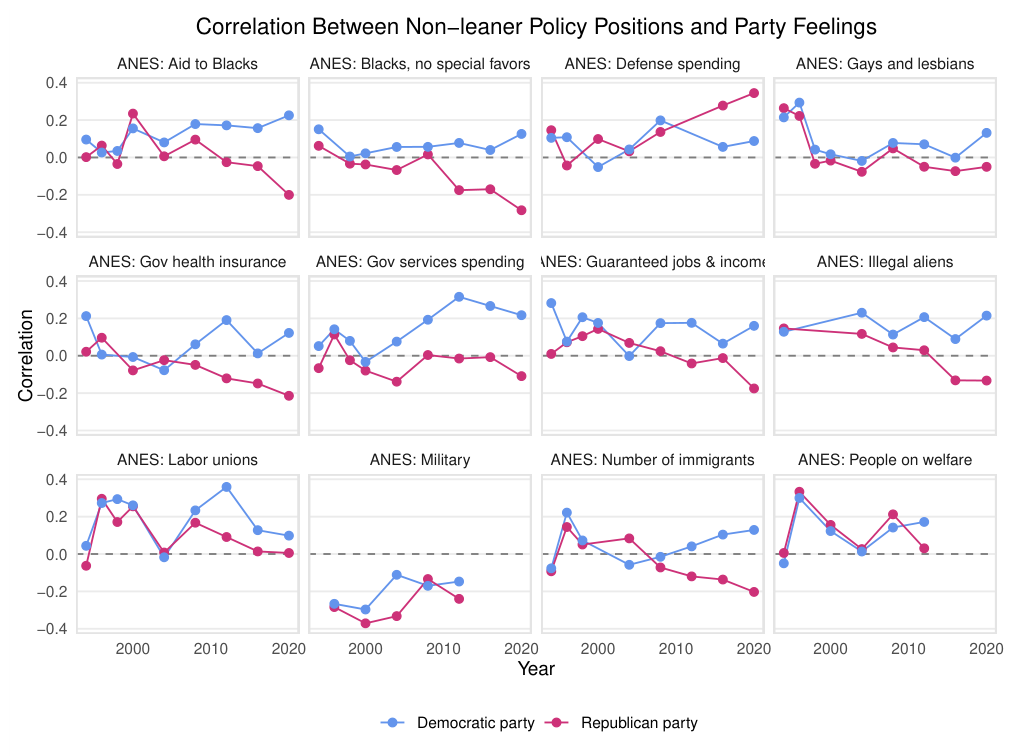
We next examine T3, whether non-leaners’ policy opinions are associated with affective differentiation. While a full causal study of this question is outside the scope of this paper, we examine preliminary evidence of whether non-leaners’ opinions are associated with their affective feelings toward people or political parties that might disagree with them. We operationalize this association as the correlation between non-leaners’ policy opinions and their feelings toward the Democratic and Republican parties.
Figure 8 shows these correlations over time for ANES items, where all items were scaled so that the maximum pole of the scale corresponds to the position more often associated with Democrats or broader liberalism, and the minimum pole corresponds with Republicans or conservatism1. We find that for a majority of items, this association grows over time, indicated by a simultaneously growing positive correlation with feelings toward the Democratic party and a negative correlation with feelings toward the Republican party. While this pattern is not consistent across all items, there is a steadily growing difference in correlation for the two items where non-leaners bipolarize (ANES: Blacks, no special favors, ANES: Number of immigrants). Furthermore, with the exception of ANES: Defense spending, whether or not the correlations are directionally polarized is associated exactly with whether opinion divergence increases in the general electorate for that item.
These results are consistent with T3 and suggest that non-leaning Independents have developed affect toward the parties that are associated with their policy opinions over a majority of items. This alignment between opinion divergence and affect is consistent with the policy-disagreement pathway in the dual model. Because non-leaners reject both partisan identification and leaning, these findings indicate that policy disagreement can be associated with affective conflict outside of the framework of partisanship or partisan identity.
Taken together with T2, these findings provide preliminary evidence that the opinion divergence to affect pathway extends beyond partisans. Non-leaners not only exhibit increasing opinion divergence, but also their policy opinions show increasing affective differentiation towards both parties. This suggests that the affective consequences of opinion divergence in the general electorate are not necessarily dependent on partisan identity.
7. Discussion
7.1. Reassessing Partisan-Centric Accounts of Polarization
This paper reconsidered the necessity of partisanship in mass polarization through three tests: whether opinion divergence in the general electorate has remained stable; whether opinion divergence extends beyond partisans; and whether non-leaners’ policy opinions are associated with affective differentiation.
First, the increase in opinion divergence suggests that the empirical foundation for de-centering policy disagreement and considering partisanship a predominant source of polarization no longer holds. This result reopens the possibility that increasing policy disagreements in the general electorate may also contribute more than previously assumed. Second, our analysis of non-leaners demonstrates that opinion divergence extends beyond partisans and that their opinions are associated with affective differentiation. These findings suggest that the policy-disagreement pathway to affective polarization can operate independently of partisanship through opinion divergence.
Taken together, our findings question the assumption of many contemporary theories of mass polarization that mechanisms based only on partisanship and identity provide a complete account of mass polarization. While we do not challenge the role of partisan identity in shaping political perception, organizing social conflict, and intensifying affective polarization, our results suggest that policy disagreements can operate as an independent source of conflict, rather than merely emerging from partisan identity.
Our findings also challenge the standard interpretation of partisan sorting, which attributes polarization primarily to partisans realigning their party identification with their preexisting issue positions, rather than a fundamental shift towards more extreme issue positions. While our findings do not preclude such a membership realignment, they indicate that partisans may have concurrently shifted their positions, and these shifts constitute an additional source of the growing partisan gap.
Our findings on non-leaners suggest non-leaners may be responsive to the same salient political conflicts that structure partisan polarization, even without partisan identification. This indicates that non-leaners should not be conceptualized simply as a moderate middle between polarized partisan groups, but rather as attentive participants in broader patterns of polarization in the electorate, whose opinions and affect respond to salient political conflicts.
7.2. Implication for Models of American Mass Polarization
Our findings motivate the substantive-identity dual model as a framework for integrating opinion- and identity-based accounts of polarization. The model should not be interpreted as a causally identified mechanism, but as a theoretical framework for understanding why policy disagreements are difficult to fully explain with purely partisan accounts of polarization. If affective polarization is produced exclusively through partisan identity, systematic affective differentiation aligned with policy opinions among non-leaners would be difficult to explain. By integrating policy disagreement as an additional independent, though possibly correlated, source of conflict, the dual model preserves the central role of partisanship and identity in polarization while also accommodating evidence that polarization operates beyond partisanship.
The dual model, alongside our empirical results, also suggests a different role for Independents in theories of mass polarization. The broader political literature has often portrayed non-leaning Independents as a detached centrist middle ground removed from the partisan debate. The model instead places Independents within the broader process of mass polarization despite their lack of formal partisan identification. Their lack of formal partisan identification makes them especially informative for identifying the policy-disagreement pathway that operates beyond partisan identity.
7.3. Limitations and Future Research
7.3.1. Causal Limitations
A central limitation of this study is causal identification. Given the observational nature of the dataset and the aforementioned identification problem, we cannot empirically establish whether opinions causally produce polarization across the contexts examined in this paper. For instance, we cannot show whether opinion divergence causes affective polarization, nor whether the link between policy opinions and affective differentiation among non-leaners is causal. Furthermore, existing literature has established some causal evidence for opinion-based affective polarization among partisans, but this link remains to be studied for Independents, also in an experimental setting. Relatedly, the relationship between opinions and affect may be circular, where policy disagreements may generate affective conflict, but existing affective attachments, for instance to a partisan group identity, may also influence voters’ policy opinions. Future research should examine the feedback effect in this relationship.
7.3.2. Conceptual Limitations
We remain agnostic about the exact mechanism connecting policy opinions to affective differentiation, which remains a subject of future study. We suggest two possible explanations from the psychological literature, which may apply heterogeneously for different groups. First, psychologists suggest that opinions can produce affective attachment, through symbolic politics, moral conviction, or repulsion. Second, the literature also suggests that shared opinions themselves can become identities that generate group dynamics [46].
Much future work also remains to be done about the source of opinion change. Although our findings of shared divergence of subgroups on select issues suggest responsiveness to salient issues amplified by the elites and media coverage, we do not directly prove this connection between elite cues and public opinion divergence or extremism. It also remains unclear whether these trends reflect existing voters changing their opinions over time or a generational shift.
Another limitation involves the interpretation of non-leaning Independents. Some political scientists posit that Independents may be hidden partisans who refuse partisan identification but are functionally partisans. Though this explanation is more commonly applied to partisan-leaning Independents rather than non-leaners, self-reported partisan identification of non-leaners may not adequately capture underlying partisan attachments. Therefore, our findings demonstrate that formal partisan identification is not a necessary condition for an opinion-divergence pathway to affective polarization, rather than demonstrating a complete absence of partisan leaning. Even if some non-leaners have unreported partisan leanings, our results challenge the existence of pure detached centrists that sorting-based accounts assume.
Finally, although we conceptually distinguish partisan opinion differentiation and opinion divergence, the two processes may interact. Future research should examine the relationship between these two processes and the conditions under which one takes precedence. Similarly, our analysis establishes evidence consistent with policy disagreement and partisan identity as independent pathways to polarization, but it does not determine how these pathways interact or their relative contribution to polarization, which remain important tasks for future research.
7.3.3. Scope Limitations
The heterogeneity in opinion divergence across groups and issues poses difficulties in aggregation. While opinion divergence in the general electorate increases for most items, there was some variance in trend based on subgroup and policy issue. This heterogeneity leads to two factors affecting robustness in aggregate results: sampling and item selection. The first is a pronounced issue for Independents, as the weight assigned to them varies significantly by survey: ANES assigns on average 37% of the total weight to Independents and GSS assigns 42%, whereas other public opinion polls argue that the proportion is closer to 50%.
For robustness issues relating to item selection or availability, we have taken precautions such as adopting items from a wide range of policy areas guided by previous studies in public opinion and employing equivalent items from both surveys when possible. However, we also acknowledge that a different selection of items could result in a different aggregate conclusion. We also anticipate that our estimates may be conservative because our selection is limited to items with reliable measurements across two to three decades, and many contemporary polarizing issues lack comparable long-term measurements, including those related to LGBTQIA+, race and incarceration, and foreign policies.
Acknowledgments
For comments on earlier drafts and helpful discussions, I thank Michael Sobel, Naoki Egami, Cassandra Handan-Nader, and Bob Shapiro. I also thank participants at the 2026 Society for Political Methodology Annual Conference and APSA Annual Meeting poster sessions.
Appendix A. Items

Table A1.
Full list of survey items by source and scale. All item descriptions are direct quotes from the respective survey.
Table A1.
Full list of survey items by source and scale. All item descriptions are direct quotes from the respective survey.
| # | Source | Item Description | Min | Max |
|---|---|---|---|---|
| Income and Tax | ||||
| 1 | ANES | The government should provide fewer services ... in order to reduce spending. | 1 | 7 |
| 2 | GSS | Should the government reduce income differences? | 1 | 7 |
| 3 | ANES | Using the thermometer, how would you rate Labor union? | 0 | 100 |
| Social Welfare | ||||
| 4 | ANES | The government ...should see to it that every person has a job and a good standard of living. | 1 | 7 |
| 5 | ANES | Using the thermometer, how would you rate People on welfare? | 0 | 100 |
| 6 | GSS | Government in Washington should do everything possible to improve the standard of living of all poor Americans. | 1 | 5 |
| Healthcare | ||||
| 7 | ANES | There should be a government insurance plan which would cover all medical and hospital expenses. | 1 | 7 |
| 8 | GSS | Should the government help pay for doctors and hospital bills? | 1 | 5 |
| Race | ||||
| 9 | ANES | The government should aid Blacks and minority groups. | 1 | 7 |
| 10 | ANES | Blacks should [work their way up] without any special favors. | 1 | 5 |
| 11 | GSS | Should the government aid Black people? | 1 | 5 |
| 12 | GSS | Black people should work their way up without special favors | 1 | 5 |
| Immigration | ||||
| 13 | ANES | Using the thermometer, how would you rate Illegal aliens? | 0 | 100 |
| 14 | ANES | Do you think the number of immigrants ...should be [increased or decreased]? | 1 | 5 |
| 15 | GSS | Number of immigrants should be increased or reduced? | 1 | 5 |
| Gender/sex | ||||
| 16 | GSS | [Should it] be possible for a pregnant woman to obtain a legal abortion? | 0 | 7 |
| 17 | ANES | Using the thermometer, how would you rate Gays and lesbians? | 0 | 100 |
| Police and Law enforcement | ||||
| 18 | GSS | Police Violence | 0 | 5 |
| Military | ||||
| 19 | ANES | Using the thermometer, how would you rate Military? | 0 | 100 |
| 20 | ANES | We should spend much less money for defense. | 1 | 7 |
The full list of included items is listed in Table A1. All items were retrieved as-is from the ANES time series study and GSS, except for abortion and police violence items from the GSS. For the abortion item, we use seven binary items from the GSS that assess support for legal abortion under varying circumstances. Following previous approaches [7], we sum the number of affirmative responses per respondent to create an aggregate score ranging from 0 to 7. The police violence item was similarly constructed from 5 binary items.
From the ANES, we include several thermometer items that measure respondents’ feelings toward specific topics, preceded by an explanation of the thermometer as gauging a warm (100), neutral (50), or cold (0) feeling towards a given group. In public opinion research, these thermometer items are typically interpreted as indicators of affect toward an issue. However, we include our chosen thermometer items for two reasons: first, for labor union and gays and lesbians, we could not find any other items in the related policy area that passed our item selection criteria, and this item serves as a proxy; second, for all others, we believe that the item has direct policy relevance, and the measurement of “affect” closely reflects the respondent’s political attitude on the issue.
Appendix B. Mathematical Details
We restate several definitions from [?] for completeness. For formal definitions and derivations, we represent probability distributions as probability measures. Let denote the probability measure associated with responses ; the observed distribution corresponds to . Similarly, the maximally separated distribution corresponds to the measure , and the maximum polarization distribution corresponds to , where refers to a dirac delta measure at x.
We first define the maximally separated measure, which depends on the observed measure, a chosen center c, and a predetermined proportional constant that decides how much mass exactly on c is sent to each of the poles.
Definition (The Maximally Separated Measure). For , with probability measure , the maximally separated measure , with center , assigns all probability to the points ℓ and L as follows: , , where .
Next, while the exact statements of the two substantive axioms are too long to be reproduced here, we review their heuristic structures. The spread axiom is first defined by the left spread, where mass left of c moves further toward ℓ. An equivalent right spread is defined. Then, the axiom states that a left or right spread should correspond to a smaller dissimilarity with the maximally separated measure.
Similarly, the bi-clustering axiom is defined in three steps. We first define a mean-preserving clustering, where masses cluster closer together without changing the overall mean. The mean-preserving clustering, which allows characterization of clustering independently of spread, is a generalization of a Pigou-Dalton transfer in the context of income, which involves shifts between two incomes such as the sum remains unchanged but the difference between the two incomes is reduced by the transfer. Then, a left merge is defined as a mean-preserving clustering occurring on mass left of c; an equivalent right merge is defined. Finally, the axiom states that a left or right merge should correspond to a smaller dissimilarity with the maximally separated measure.
We next take the definition of the Wasserstein distance from Villani [47] and a formal definition of the Wasserstein Bipolarization Index.
Definition (p-Wasserstein distance). Let be a Polish metric space, and let . For any two probability measures on , the Wasserstein distance of order p is defined by
where is the set of all joint probability measures on with marginals and , respectively.
Definition (Wasserstein Bipolarization Index). The Wasserstein Bipolarization Index is defined as follows:
For discrete measures, the Wasserstein distance can be computed through a linear program. Let and denote the supports of and , respectively, and let and denote the corresponding probability masses on the support. Then, the p-Wasserstein distance is the solution to the linear program,
with a dual expression,
The asymptotic confidence intervals of the index, based on existing work by Sommerfeld [48], rely on the dual solution and an empirical measure constructed from a sample of size n from :
where and is the quantile of the standard normal distribution. To simplify notation, we write .
References
- Iyengar, S.; Sood, G.; Lelkes, Y. Affect, Not Ideology: A Social Identity Perspective on Polarization. Public Opinion Quarterly 2012, 76, 405–431.
- Mason, L. Uncivil Agreement: How Politics Became Our Identity; University of Chicago Press: Chicago, IL, 2018.
- Fiorina, M.P.; Abrams, S.J.; Pope, J.C. Culture War?: The Myth of a Polarized America; Pearson Longman: New York, NY, 2005.
- Abramowitz, A.I. Disconnected, or Joined at the Hip?—Comment. In Red and Blue Nation? Characteristics and Causes of America’s Polarized Politics; Nivola, P.S.; Brady, D.W., Eds.; Brookings Institution Press and Hoover Institution Press: Washington, DC and Stanford, CA, 2006; Vol. 1, pp. 72–85.
- Layman, G.C.; Carsey, T.M. Party Polarization and "Conflict Extension" in the American Electorate. American Journal of Political Science 2002, 46, 786–802. [CrossRef]
- Sears, D.O. Symbolic Politics: A Socio-Psychological Theory. In Explorations in Political Psychology; Iyengar, S.; McGuire, W.J., Eds.; Duke University Press: New York, 1993; pp. 113–149. [CrossRef]
- DiMaggio, P.; Evans, J.; Bryson, B. Have American’s social attitudes become more polarized? American Journal of Sociology 1996, 102, 690–755. [CrossRef]
- Levendusky, M. The Partisan Sort: How Liberals Became Democrats and Conservatives Became Republicans; Chicago Studies in American Politics, University of Chicago Press, 2009.
- Orr, L.; Huber, G.A. The Policy Basis of Measured Partisan Animosity in the United States. American Journal of Political Science 2020, 64, 569–586. [CrossRef]
- Dias, N.; Lelkes, Y. The Nature of Affective Polarization: Disentangling Policy Disagreement from Partisan Identity. American Journal of Political Science 2022, 66, 775–790. [CrossRef]
- Rosenbaum, M.E. The repulsion hypothesis: On the nondevelopment of relationships. Journal of personality and social psychology 1986, 51, 1156.
- Skitka, L.J. The Psychology of Moral Conviction. Social and Personality Psychology Compass 2010, 4, 267–281. [CrossRef]
- Rabinowitz, G.; Macdonald, E.S. A Directional Theory of Issue Voting. American Political Science Review 1989, 83, 93–121. [CrossRef]
- Esteban, J.; Ray, D. On the measurement of polarization. Econometrica 1994, 62, 819–851.
- Abramowitz, A.I.; Saunders, K.L. Is Polarization a Myth? The Journal of Politics 2008, 70, 542–555. [CrossRef]
- Hill, S.J.; Tausanovitch, C. A disconnect in representation? Comparison of trends in congressional and public polarization. The Journal of Politics 2015, 77, 1058–1075. [CrossRef]
- Fiorina, M.P. Unstable Majorities: Polarization, Party Sorting, and Political Stalemate; Hoover Institution Press: Stanford, CA, 2017.
- McCarty, N. Polarization: What Everyone Needs to Know; Oxford University Press, 2019.
- Enders, A.M. Issues versus affect: How do elite and mass polarization compare? The Journal of Politics 2021, 83, 1872–1877. [CrossRef]
- Bafumi, J.; Shapiro, R.Y. A new partisan voter. The Journal of Politics 2009, 71, 1–24.
- Caughey, D.; Dunham, J.; Warshaw, C. Polarization and Partisan divergence in the American public, 1946-2012. In Proceedings of the Midwest Political Science Association Conference, 2016.
- Ura, J.D.; Ellis, C.R. Partisan moods: Polarization and the dynamics of mass party preferences. The Journal of Politics 2012, 74, 277–291.
- Greene, S. Social Identity Theory and Party Identification. Social Science Quarterly 2004, 85, 136–153.
- Tajfel, H. Human Groups and Social Categories: Studies in Social Psychology; Cambridge University Press: Cambridge, 1981.
- Tajfel, H.; Turner, J.C. An Integrative Theory of Intergroup Conflict. In The Social Psychology of Intergroup Relations; Austin, W.G.; Worchel, S., Eds.; Brooks/Cole: Monterey, CA, 1979; pp. 33–47.
- Iyengar, S.; Westwood, S.J. Fear and Loathing across Party Lines: New Evidence on Affective Polarization. American Journal of Political Science 2015, 59, 690–707.
- Iyengar, S.; Lelkes, Y.; Levendusky, M.; Malhotra, N.; Westwood, S.J. The origins and consequences of affective polarization in the United States. Annual Review of Political Science 2019, 22, 129–146. [CrossRef]
- Druckman, J.N.; Levy, J., Chapter 18: Affective Polarization in the American Public. In Handbook on Politics and Public Opinion; Edward Elgar Publishing: Cheltenham, UK, 2022; pp. 257 – 270. [CrossRef]
- Fiorina, M.P.; Abrams, S.J. Political polarization in the American public. Annual Review of Political Science 2008, 11, 563–588. [CrossRef]
- Foster, J.; Wolfson, M.C. Polarization and the decline of the middle class: Canada and the US. Oxford Poverty & Human Development Initiative Working Paper 1992.
- Wang, Y.Q.; Tsui, K.Y. Polarization orderings and new classes of polarization indices. Journal of Public Economic Theory 2000, 2, 349–363. [CrossRef]
- Lelkes, Y. Mass polarization: Manifestations and measurements. Public Opinion Quarterly 2016, 80, 392–410, [https://academic.oup.com/poq/article-pdf/80/S1/392/6864582/nfw005.pdf]. [CrossRef]
- Converse, P.E. The nature of belief systems in mass publics. In Ideology and Discontent; Apter, D.E., Ed.; Free Press: New York, 1964; pp. 206–261.
- Fowler, A. Partisan Intoxication or Policy Voting? Quarterly Journal of Political Science 2020, 15, 141–179, [https://www.emerald.com/qjps/article-pdf/15/2/141/11095949/100.00018027aen.pdf]. [CrossRef]
- Zaller, J.R. The Nature and Origins of Mass Opinion; Cambridge University Press: Cambridge, UK, 1992.
- Chong, D.; Druckman, J.N. Framing Public Opinion in Competitive Democracies. American Political Science Review 2007, 101, 637–655. [CrossRef]
- Boudreau, C.; MacKenzie, S.A. Informing the Electorate? How Party Cues and Policy Information Affect Public Opinion about Initiatives. American Journal of Political Science 2014, 58, 48–62.
- Zingher, J.N. Political Choice in a Polarized America: How Elite Polarization Shapes Mass Behavior; Oxford University Press, 2022. [CrossRef]
- McCombs, M.E.; Shaw, D.L. The agenda-setting function of mass media. Public Opinion Quarterly 1972, 36, 176–187.
- Poole, K.T.; Rosenthal, H.L. Ideology and Congress; Transaction Publishers, 2011.
- Kinder, D.R.; Kalmoe, N.P. Neither Liberal nor Conservative: Ideological Innocence in the American Public; University of Chicago Press, 2017.
- Druckman, J.N.; Peterson, E.; Slothuus, R. How Elite Partisan Polarization Affects Public Opinion Formation. American Political Science Review 2013, 107, 57–79. [CrossRef]
- Grossmann, M.; Hopkins, D.A. Asymmetric politics: Ideological Republicans and group interest Democrats; Oxford University Press, 2016.
- Foster, J.; Wolfson, M. Polarization and the decline of the middle class in Canada and the USA. Journal of Economic Inequality 2010, 8, 247–273. [CrossRef]
- Peyré, G.; Cuturi, M. Computational optimal transport: With applications to data science. Foundations and Trends in Machine Learning 2019, 11, 355–607. [CrossRef]
- Musgrove, L.; McGarty, C. Opinion-based group membership as a predictor of collective emotional responses and support for pro-and anti-war action. Social Psychology 2008, 39, 37.
- Villani, C. Optimal Transport: Old and New; Springer: New York, NY, 2009.
- Sommerfeld, M. Wasserstein distance on finite spaces: Statistical inference and algorithms. PhD thesis, Universität Göttingen, 2017.
| 1 | GSS items are unmeasured due to unavailability of affective items |
Figure 1.
Diagram of the Substantive-Identity Dual Model.
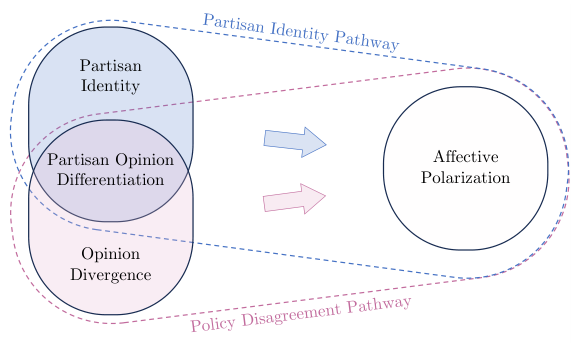
Figure 2.
Distinguishing the concept from its operationalization and the measure.

Figure 3.
Illustrations of the two characterizations of bipolarization: increased bi-clustering and spread.
Figure 3.
Illustrations of the two characterizations of bipolarization: increased bi-clustering and spread.
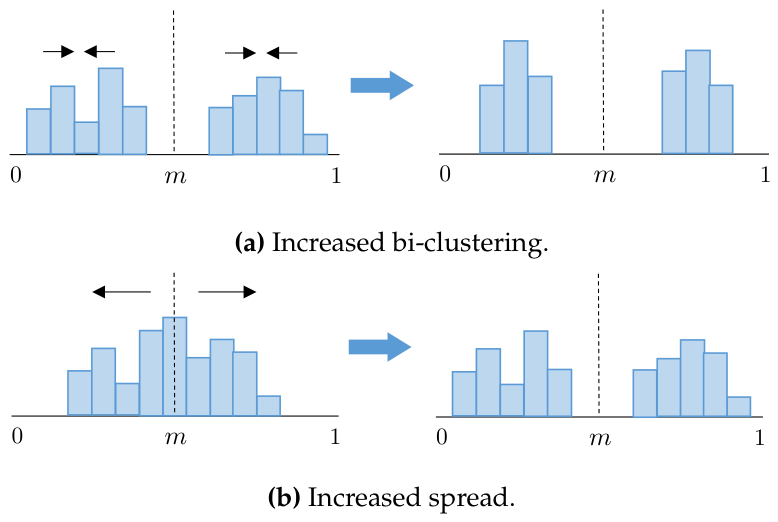
Figure 4.
Counterexamples for variance and Sarle’s bimodality coefficient b.

Figure 5.
Illustrations of the maximally separated distribution and the maximum polarization distribution . is a special case of .
Figure 5.
Illustrations of the maximally separated distribution and the maximum polarization distribution . is a special case of .
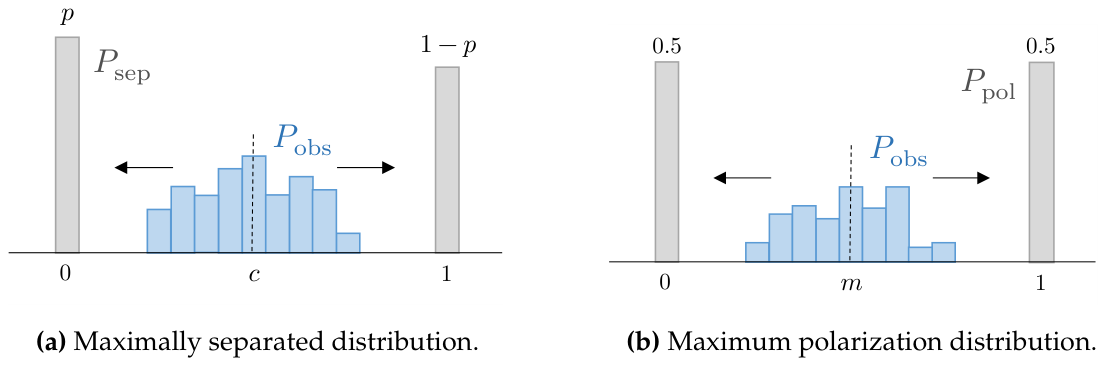
Figure 6.
A fitted regression line was added to the plot if the null hypothesis of the slope was rejected at the 95% confidence level.
Figure 6.
A fitted regression line was added to the plot if the null hypothesis of the slope was rejected at the 95% confidence level.
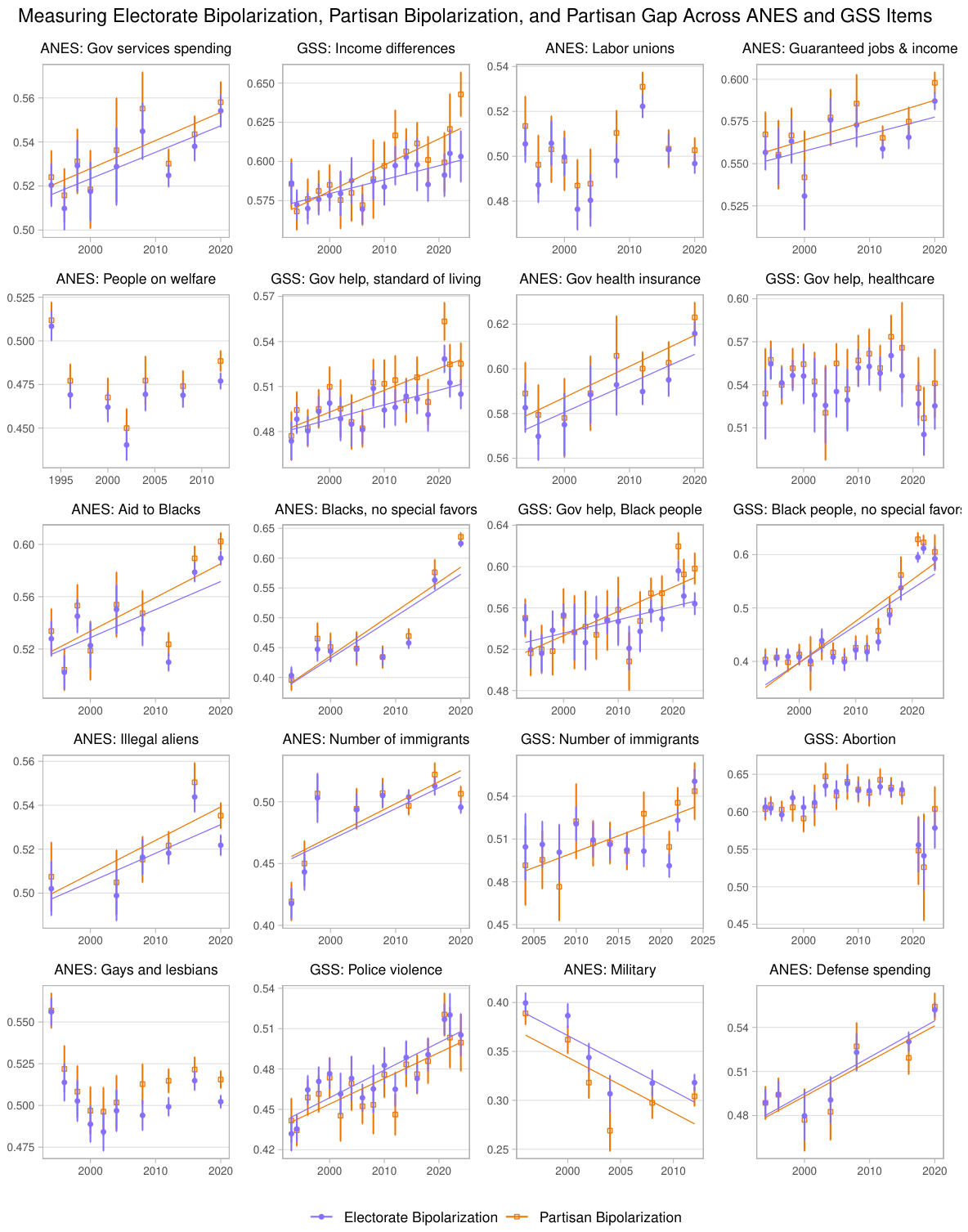
Figure 7.
Measurements of the Wasserstein bipolarization index across strong partisans, weak partisans, leaning Independents, and non-leaning Independents.
Figure 7.
Measurements of the Wasserstein bipolarization index across strong partisans, weak partisans, leaning Independents, and non-leaning Independents.
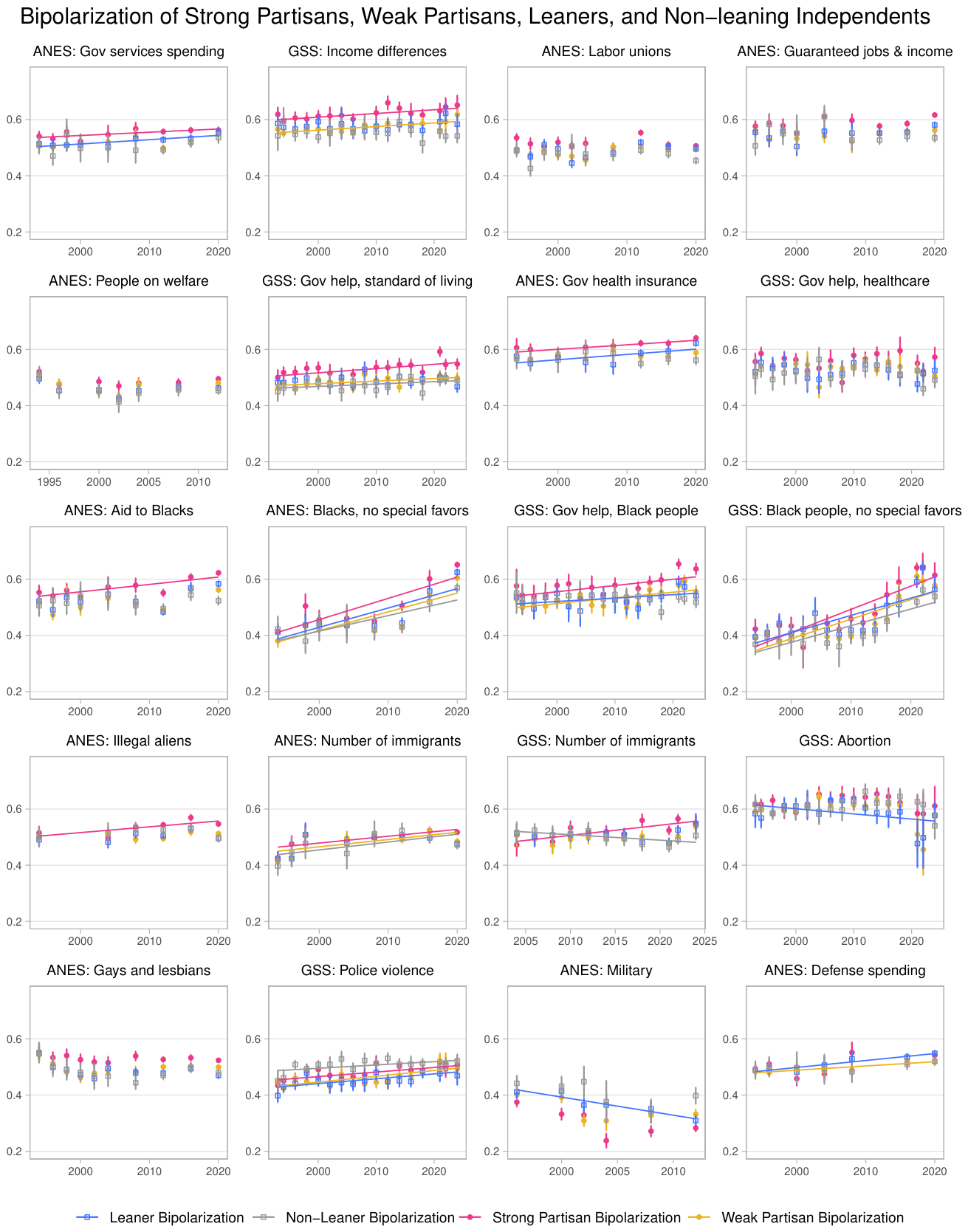
Figure 8.
Correlation between non-leaners’ policy positions and their feelings toward political parties
Figure 8.
Correlation between non-leaners’ policy positions and their feelings toward political parties
Disclaimer/Publisher’s Note: The statements, opinions and data contained in all publications are solely those of the individual author(s) and contributor(s) and not of MDPI and/or the editor(s). MDPI and/or the editor(s) disclaim responsibility for any injury to people or property resulting from any ideas, methods, instructions or products referred to in the content. |
© 2026 by the authors. Licensee MDPI, Basel, Switzerland. This article is an open access article distributed under the terms and conditions of the Creative Commons Attribution (CC BY) license (http://creativecommons.org/licenses/by/4.0/).
Copyright: This open access article is published under a Creative Commons CC BY 4.0 license, which permit the free download, distribution, and reuse, provided that the author and preprint are cited in any reuse.