

Submitted:
09 September 2026
Posted:
10 September 2026
You are already at the latest version
Abstract
Significant challenges are faced by oil palm and rubber plantations, and by natural and managed forestry systems as the climate crisis unfolds. These sectors are vital to the Malaysian and wider regional economies and its environmental resilience, but face increasing risks from erratic weather patterns, soil degradation, deforestation, and global market fluctuations. New technologies and economic tools are now emerging that present powerful opportunities to address such challenges at both regional and international scales. For example, tropical crops and forests have strong carbon sequestration potential that, if harnessed through better plantation practices, can create new income streams in the form of carbon credits. As announced at the 2025 COP30 meeting in Brazil and subsequently, new forms of carbon trading include using selected crops and forestry systems as mechanisms for monetizing these valuable resources in Malaysia and other tropical countries.
Keywords:
anthropocene era
; carbon trading
; climate crisis
; greenhouse gas (GHG)
; measurement
; reporting
; and verification (MRV)
; traceability
; sustainability
1. Introduction
A major challenge for agriculture and environmental management are to develop sustainable crop and forestry systems as part of efforts to mitigate the ongoing climate crisis that has been called the ‘Anthropocene Era’ (Murphy, 2025a). This era is characterized by the sudden increase in net CO2 and methane emissions that stared around the year 1950 and coincided with a sustained surge in the global use of fossil-derived carbon fuels such as oil, coal and natural gas. During this period of several decades levels of atmospheric CO2 have increased by about 50% to over 433 ppm (3400 billion tonnes), with entirely predicable climatic effects such as erratic weather patterns and a generalized increase in average temperatures in many regions of the world. While the Anthropocene is not a bona fide geological stage similar to the Holocene Epoch that started with the development of agriculture about 11,000 years ago (Edgeworth et al., 2023; Walker et al., 2024), the former is a convenient way to mark the momentous human-caused global climatic processes initiated in the 1950s.
As of mid-2026 the wider implications of the climate crisis are becoming ever more apparent. For example, there is growing evidence that the 1.5 °C limit in average global temperature rises that was adopted as part of the 2015 Paris Agreement has already been exceeded with further rises looking increasingly likely (UK Parliament, 2026; United Nations Environment Programme, 2026; World Meteorological Organization, 2026). Climate-related factors relevant to tropical crops and forests include increased incidence of droughts, flooding, higher temperatures, wildfires, soil degradation, and deforestation (Climate Impacts Tracker Asia, 2026). In parallel geopolitical factors such as warfare and tariffs causing supply chain disruptions and wider global market fluctuations that impact directly on commodity distribution and availability (Jha, 2026; Oxford College of Procurement & Supply, 2026).
It is well established by scientific evidence that the current climate crisis is directly linked to the vast increases in fossil-related carbon emissions, particularly the two most abundant greenhouse gases, CO2 and methane. This has led to worldwide efforts to reduce such emissions and to achieve net carbon neutrality across as many sectors of human activity as possible. However, a focus on carbon emissions alone is fraught with problems as follows. Firstly as the 2020s decade has unfolded there has been a backlash in some political and economic sectors resulting in a generalized dilution of climate related goals, such as net zero commitments (Patterson et al., 2025).
Secondly, even if anything approaching net zero is achieved in the coming decades there will still be an extra 850 billion tonnes of atmospheric CO2 compared to the amount in the 1950s. This means that even a successful net zero policy will still leave a huge amount of surplus CO2 with its consequent climatic effects.
The only way to reduce levels of atmospheric CO2 is to physically remove it on a long term basis, for example through increased photosynthesis or via novel engineering approaches such as direct air capture (Murphy, 2025b). So-called novel Carbon Dioxide Removal (CDR) strategies remain largely experimental and small-scale with the most optimistic projections for CO2 capture only in the tens of millions of tonnes/year. In contrast, enhanced photosynthesis by natural vegetation and crops is one of the major forms of so-called Nature-based Solutions (NbS, also called conventional CDR) with estimated annual removal rates of billions of tonnes CO2 (Bastin et al., 2019). Alongside emissions reductions, the timely deployment of conventional and novel CDR strategies will reduce the growing the global carbon imbalance and hence directly address the root cause of climatic change due to the greenhouse effect that is mainly due to excessive levels of atmospheric CO2.
Nature-based Solutions (NbS) strategies will additionally address issues such as food security, biodiversity loss and environmental resilience for key crops such as oil palm, rubber as well as natural or managed forestry systems in the tropics. One of the key contributors to such a vision is a new generation of economic, digital political and regulatory tools for the monetization of these plant resources in Malaysia and other tropical countries, namely carbon trading (Murphy & Yong, 2026). These will require more transparent supply chains and digital sustainability on a global scale, not only for agricultural production but also as major biological carbon systems. Moreover, tropical countries could use innovative carbon trading systems to defray costs incurred in land management changes such as reforestation, regenerative farming, and intercropping to benefit smallholders and other rural communities. In the following sections of this chapter we will examine these aspects in more detail.
2. The Role of Tropical Plantation Systems in Climate Change Mitigation
In this section the roles of the following plant systems in climate change mitigation will be compared: natural and managed forestry plus oil palm and rubber plantations.
2.1. Natural and Managed Forestry
One of the most intractable issues in discussing so-called natural and managed forestry systems is the lack of any consensus about what constitutes a ‘natural’ versus a ‘managed’ system. For example, a natural forest may defined vaguely as ‘a forest area that has developed free from the influence of humans and remains largely unaffected by their activities.’ A more rigorous definition states that an Intact Forest Landscape (IFL) is ‘an unbroken expanse of natural ecosystems within the zone of current forest extent, showing no signs of significant human activity and large enough that all native biodiversity, including viable populations of wide-ranging species, could be maintained’ where some areas some may contain extensive naturally tree-less areas, including grasslands, wetlands, lakes, alpine areas, and ice.’ (Bryant et al., 1997). More recently, the FAO has defined a forest as ‘land spanning more than 0.5 ha with trees higher than five metres and a canopy cover of more than 10%, or trees able to reach these thresholds in situ’ (Leijten et al., 2023).
In reality only a tiny proportion of the world’s so-called pristine or ‘natural’ forests have escaped direct or indirect impacts by human activity. For example, many seemingly ‘natural’ forests have been used for millennia by people for such resources as fruits, foliage, wood, and animals. Such activities can have significant, but largely hidden, impacts on such forest ecosystems. For example, tropical hardwood forests occupying as much as 1150 million hectares have been partially logged and allowed to regenerate (Murphy, 2024b). There is also evidence that in pre-Colombian times, large parts of the Amazon rainforest were inhabited by people who managed the woodland landscape in a mixed fashion reminiscent of modern agroforestry.
The major biomass in both natural and managed forestry systems is made up of perennial tree species with lifetimes measured in decades or centuries with by high rates of carbon sequestration potential. In many cases their rates of carbon sequestration may be limited by factors such as suboptimal soil structure or nutrient content and, with a degree of management, these rates could be significantly increased without adversely affecting existing ecosystem services such as biodiversity or recreational potential. There is increasing interest in leveraging forestry carbon sequestration potential to generate income for local communities as discussed at COP30 in Brazil (United Nations Framework Convention on Climate Change, 2025) with some important recent pointers to effective monetization strategies such as data element marketization (Liu et al., 2026).
2.2. Oil Palm: High Biological Productivity and Managed Carbon Sequestration
Oil palm represents a substantially different carbon system to forestry. As a perennial tropical crop with high rates of biomass production, oil palm continuously fixes atmospheric CO2 throughout its productive lifespan. Carbon accumulates in trunks, fronds, roots, and associated soil pools, while additional carbon flows through harvested fresh fruit bunches and the downstream processing system. Murphy (2024b) compared the carbon sequestration potential of oil palm with tropical forests and other oil crops and highlighted the substantial biomass accumulation associated with the crop’s high photosynthetic productivity. Sustainably managed oil palm systems may sequester as much as 64.5 t CO2 ha−1 yr−1 under particular conditions, although sequestration rates vary considerably according to plantation age, management intensity, soil, climate, and accounting boundaries (Murphy & Yong 2026).
The climate role of oil palm is inseparable from its land-use history. Conversion of natural forests or carbon-rich peatlands to plantation agriculture can create substantial initial carbon losses that may dominate the GHG balance for extended periods. For this reason, biological carbon uptake by oil palm should not be used to disregard emissions associated with deforestation, peat drainage, or other high-carbon land conversion. The appropriate question is not whether oil palm stores a great deal of carbon, it clearly does, but whether a specific plantation system generates a net climate benefit over time relative to a scientifically defensible baseline and after all material emission sources and carbon-stock changes have been considered.
This distinction between gross biological sequestration and net climate mitigation is fundamental to carbon integrity. Gross carbon uptake measures the atmospheric CO2 assimilated and stored within plantation biomass and other carbon pools. Net mitigation must additionally account for land-use change, fertiliser-related emissions, fossil-energy consumption, methane emissions from palm oil mill effluent (POME), biomass decomposition, transport, processing, and carbon released during replanting. We have recently provided a scientific basis for recognising oil palm as a potentially significant biological carbon system (Murphy, 2024b; Murphy & Yong, 2026), but this potential must be interpreted through complete carbon accounting and conservative baseline design. In another recent study it was reported that oil palm biodiversity footprints for mammals, birds and reptiles are particularly high, but under threats that can be mitigated by improved monitoring and by practices such as deforestation mitigation, land zonation and carbon offset initiatives (Zhu et al., 2026).
Sustainable management can improve the net carbon performance of existing oil palm landscapes. Soil conservation, residue retention, organic amendments, improved nutrient management, cover crops, biomass recycling, methane capture, and agroforestry or intercropping approaches can strengthen soil health and reduce emissions while supporting long-term productivity (Fahad et al., 2022). The circular utilisation of empty fruit bunches, fibres, palm kernel shells, fronds, and trunks can also alter the carbon lifecycle of plantation biomass. Where biomass is rapidly decomposed or burned, stored biological carbon returns relatively quickly to the atmosphere. Where it is converted into more durable products or stable carbon forms such as appropriately produced biochar, a proportion of the carbon may remain sequestered outside the atmosphere for much longer periods that can extend to many decades.
Oil palm therefore illustrates the transition from conventional plantation accounting towards whole-system carbon management. The plantation, mill, biomass streams, energy system, soil, and replanting cycle must be considered as connected carbon pools and emission pathways. This perspective aligns directly with other chapters in this book, such as the discussion of advanced GHG measurement and oil-palm biomass-derived biochar. This book already positions high-frequency GHG measurement and biochar carbon stability as important technologies for sustainable oil palm production. In climate mitigation, the future value of oil palm is therefore unlikely to arise from generic claims that plantations are carbon sinks. It will depend on the ability to distinguish high-integrity, low-emission, carbon-enhancing plantation systems from conventional or land-conversion-intensive systems. The roll-out of transparent and verifiable traceability, carbon accounting, and Measurement, Reporting and Verification (MRV) will be essential to demonstrate this difference.
2.3. Rubber: Perennial Biomass, Agroforestry and Long-Term Carbon Management
Rubber (Hevea brasiliensis) is another perennial plantation system with substantial biological carbon dynamics. During plantation development, rubber trees accumulate carbon in trunks, branches, leaves, and root systems while maintaining productive latex harvesting over an extended rotation. Lestari & Noor’An (2022) reported substantial sequestration potential in rubber plantations in East Kalimantan, while Murphy & Yong (2026) cite estimated sequestration of approximately 30.6–35.2 t CO2 ha−1 at seven years of age, depending on plantation age, environmental conditions, and management intensity.
As with oil palm, the carbon value of rubber depends on the baseline and previous land use. Establishing rubber plantations through the conversion of carbon-rich natural forests cannot be equated with establishing rubber on degraded agricultural land or improving the management of existing plantations. The carbon balance must account for the difference between pre-project and post-project carbon stocks, changes in soil organic carbon, plantation inputs, biomass accumulation, and carbon released or retained at the end of the rotation.
Rubber is particularly interesting because its carbon lifecycle does not necessarily end when latex production ceases. At replanting, rubberwood can enter furniture, construction, panels, or other harvested wood-product pathways and rubber polymers can be durable for many decades. The duration of carbon storage then depends on product lifetime, recycling, cascading use, and end-of-life treatment. Biogenic carbon accounting and life-cycle assessment are therefore important for determining whether harvested biomass provides meaningful extended carbon storage or merely delays atmospheric release for a short period (Van den Auwelant, 2025).
The integration of rubber within agroforestry systems may provide additional climate and ecological benefits. Agroforestry combines trees with crops or other vegetation layers, potentially increasing total above- and below-ground carbon storage while improving soil condition, nutrient cycling, microclimate regulation, and biodiversity (Dhyani et al., 2021; Fahad et al., 2022). Villarreal (2025) specifically identifies Hevea brasiliensis agroforestry as a landscape-based strategy with potential carbon and biodiversity benefits. More broadly, synergies between tropical tree crops and surrounding ecosystems may enhance ecological resilience when plantation management incorporates landscape connectivity, mixed vegetation, and soil protection (Dissanayaka et al., 2024).
Rubber therefore demonstrates that carbon mitigation should be considered over the entire plantation rotation and post-harvest biomass lifecycle. Standing-tree carbon is only one component. Root carbon, soil organic carbon, agroforestry integration, replanting emissions, rubberwood utilisation, and product longevity all influence the net climate outcome. Advanced traceability systems capable of linking plantation age, geospatial location, biomass inventories, harvesting records, and downstream wood utilisation could substantially improve the credibility of rubber carbon accounting.
3. Advanced Technologies for Traceability in Plantation Systems
Reliable and rapid technologies and verification systems are required for the fully transparent traceability that underlies the real-life operation of plant sequestration systems. These technologies include remotely controlled aerial optical systems such as satellite and drone-based LiDAR that can scan and upload data covering anything from individual trees to large plantations and even vast regions extending over many hundreds or even thousands of square kilometers. (Beese et al., 2022).
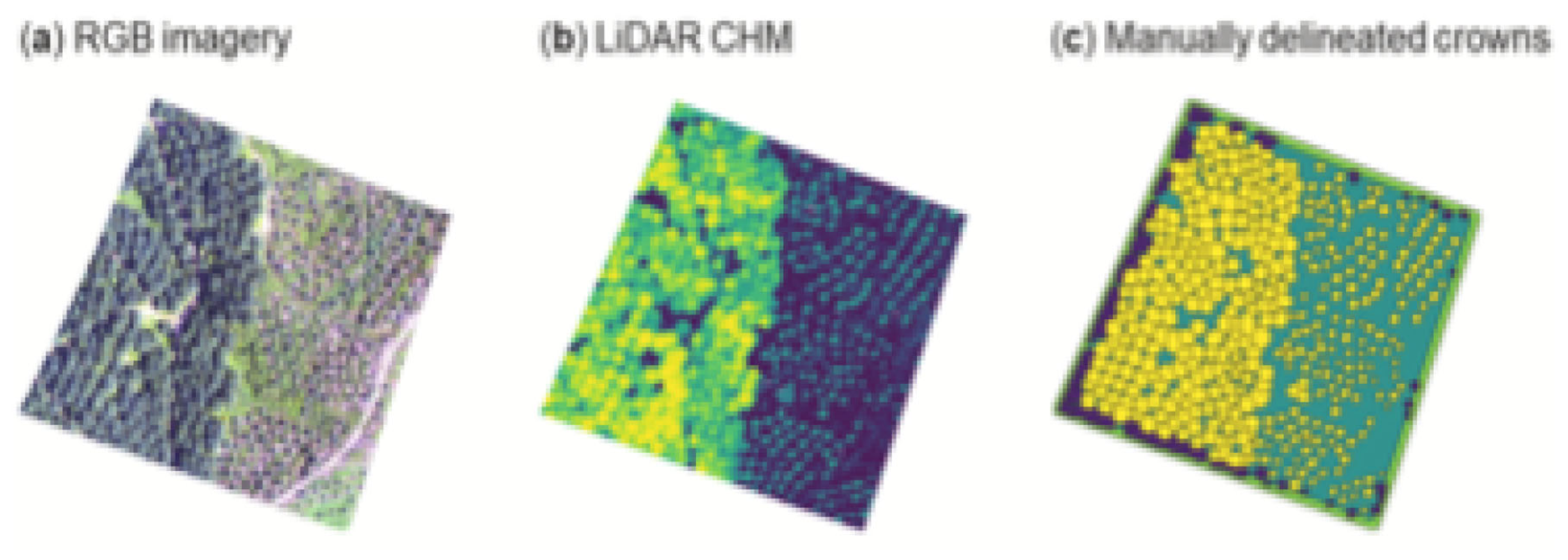
Figure 1.
Assessing the accuracy of automated oil palm detection and tree delineation. True colour RGB imagery (a) and LiDAR-derived canopy height model (CHM) data (b) manually delineated individual oil palm tree crowns in an area of approximately 4.5 ha. Crowns falling within a 5 m buffer from the area edge were excluded (purple polygons in (c)), leaving a total of 410 manually delineated crowns for validating algorithms (yellow polygons in (c)). Data from Beese et al., 2022.
Figure 1.
Assessing the accuracy of automated oil palm detection and tree delineation. True colour RGB imagery (a) and LiDAR-derived canopy height model (CHM) data (b) manually delineated individual oil palm tree crowns in an area of approximately 4.5 ha. Crowns falling within a 5 m buffer from the area edge were excluded (purple polygons in (c)), leaving a total of 410 manually delineated crowns for validating algorithms (yellow polygons in (c)). Data from Beese et al., 2022.
At the other end of the scale there are arrays of ultra-sensitive lab-based analytical techniques that can establish the geographical provenance of samples at molecular and even atomic levels. Examples include atomic absorption spectrometry, direct/ambient mass spectrometry, fluorescence spectroscopy, high-performance liquid chromatography, 1D and 2D gas chromatography, nuclear magnetic resonance spectroscopy, immunoassays, isotope ratio analysis, and DNA/RNA-based molecular methods to name just a few.
Over the past decade surveillance based on manned aerial systems have been almost completely replaced by more agile and cheaper technologies employing unmanned satellite and drone systems capable of 24/7/365 coverage of target terrain. The latter can range from individual trees on small plantations to entire national areas that can be subject to constant real-time remote surveillance via ever-improving detection techniques such as low-cost photogrammetry using methods such as terrestrial laser scanning (TLS) and airborne LiDAR systems (Kaya et al., 2026).
These methods generate vast quantities of data that can only be effectively analysed via AI tools such as machine learning that in turn require extensive computational networks using dispersed cloud-based server facilities. The captured data can then be shared securely via encrypted systems such as blockchain, or alternatively uploaded as open-source information available freely to global audiences.
3.1. Satellite, GPS and GIS as the Geospatial Foundations
Satellite observation, the Global Positioning System (GPS), and geographic information systems (GIS) collectively form the geospatial foundations of modern plantation traceability. GPS assigns precise coordinates to plantation boundaries, production blocks, sampling sites, trees, harvesting points, collection centres, mills, and forest compartments. GIS then organises these coordinates into spatial layers that may include land ownership, crop type, plantation age, soil, topography, rivers, protected areas, biodiversity corridors, roads, processing facilities, fire occurrence, and carbon-stock estimates. Satellite imagery provides repeated observations of these landscapes, enabling changes to be assessed over time.
The combined system answers three fundamental traceability questions:
- Where was the commodity produced?
- What environmental conditions and land uses surround the production area?
- How has that location changed over time?
This capability is essential because sustainability and carbon claims are location-specific. Two consignments of palm oil or rubber may be chemically identical, yet their environmental profiles may differ substantially if one originated from a long-established plantation and the other from recently converted forest or peatland while forest carbon credits depend on accurately delineated areas and credible evidence of avoided loss or enhanced carbon storage.
For oil palm, satellite imagery and GIS can establish estate and smallholder boundaries, identify planted areas, estimate plantation age classes, detect changes in canopy cover, and assess proximity to forests, peatlands, riparian zones, and protected habitats. Remote sensing is already used to define plantation boundaries and evaluate spatial patterns in land cover and habitat connectivity, providing important information for plantation sustainability assessment. When linked to mill sourcing records, these data can support traceability from fresh fruit bunch production areas to processing facilities and help identify supply originating outside approved sourcing boundaries.
In rubber plantations, geospatial systems can distinguish rubber-growing areas from other tree cover, document plantation establishment and replanting cycles, and associate production blocks with latex collection and processing records. Plantation age is particularly relevant because biomass accumulation, latex productivity, replanting decisions, and carbon stocks change throughout the rotation. Spatial traceability allows these changes to be linked to particular parcels instead of relying on generalized regional estimates.
In forestry, GPS and GIS can identify forest compartments, conservation areas, harvesting zones, restoration sites, roads, fire-prone areas, and community-managed territories. Repeated satellite observations can provide timeline evidence of forest-cover loss, degradation, recovery, fire scars, storm damage, and restoration progress. GIS also allows carbon information to be overlaid with biodiversity, hydrology, land tenure, and social data, supporting a broader interpretation of forest sustainability than carbon measurement alone. Remote sensing and GIS are therefore not merely mapping tools; they provide the spatial evidence required to connect biological carbon claims with identifiable areas of land.
3.2. Drones and LiDAR for High-Resolution Plantation Evidence
Satellite systems provide landscape-scale coverage, but their resolution, revisit intervals, and sensitivity to cloud cover may limit field-level observation in tropical environments. Unmanned aerial vehicles (drones), complement satellite monitoring by producing high-resolution imagery at selected times and locations. Drones may carry conventional red–green–blue cameras, multispectral sensors, thermal cameras, hyperspectral instruments, or LiDAR systems. This enables close-range assessment of crop condition, canopy structure, individual trees, drainage, disease symptoms, erosion, fires, and localized land disturbance.
LiDAR measures the time taken for emitted laser pulses to return after interacting with vegetation and the ground. From these returns, three-dimensional information can be generated on canopy height, tree structure, terrain, and vegetation density. The fusion of optical imagery and LiDAR improves the assessment of forest structure and emissions-reduction outcomes because optical data describe surface characteristics while LiDAR provides vertical information on vegetation and terrain (Jiao et al., 2023). Drone-based systems have also shown increasing potential for assessing biomass and carbon stocks, particularly where detailed field-scale information is required (Budiarto & Dewanto, 2025).
For oil palm, drones and LiDAR can support palm counting, canopy-condition assessment, height estimation, disease detection, drainage inspection, yield-related observations, and biomass modelling. Individual palms or plantation blocks can be linked with planting year, treatment history, harvesting records, and carbon estimates. Drone imagery may also identify encroachment into riparian buffers, unauthorized clearing, fire damage, and areas where ground cover or soil protection has deteriorated.
For rubber, high-resolution aerial imagery can assist in tree counting, canopy-gap detection, disease monitoring, replanting assessment, storm-damage evaluation, and plantation-age classification. LiDAR-derived canopy height and structure may strengthen biomass estimates when combined with field measurements of tree diameter, height, and wood density. These data can support a traceable carbon inventory in which plantation carbon estimates are attached to defined blocks and measurement dates.
For forestry, drones and LiDAR are especially valuable because forests contain vertically complex vegetation that cannot be adequately represented through two-dimensional canopy cover alone. LiDAR can estimate canopy height and structural variation, while drone imagery can document individual trees, gaps, roads, illegal logging, windthrow, fire damage, and restoration survival. Reviews of drone- and AI-based tree identification show that automated systems are increasingly capable of distinguishing individual tree species and crowns, although performance depends on forest complexity, sensor quality, season, and model training data (Abreu-Dias et al., 2025).
These technologies improve traceability because they create dated and georeferenced visual records. However, they do not eliminate the need for ground measurement. Biomass and carbon estimates derived from imagery remain dependent on calibration with field inventories and suitable allometric models. Drones and LiDAR should therefore strengthen, rather than replace, scientifically designed field sampling.
3.3. Digital Sensors, IoT and Continuous Operational Traceability
Satellites and drones observe plantations from above, while digital sensors measure processes occurring within fields, soils, trees, water systems, storage facilities, transport systems, and processing operations. Sensors may measure soil moisture, soil temperature, water depth, rainfall, humidity, nutrient concentrations, gas fluxes, energy consumption, machinery activity, product weight, storage conditions, and geographic movement. The so-called ‘Internet of Things’ (IoT) connects these devices through wired or wireless communication networks so that data can be transmitted, stored, analysed, and incorporated into operational decisions.
This connectivity transforms traceability from an occasional documentary exercise into a potentially continuous data system that can be carried out remotely, including by third parties. IoT-enabled agricultural models have demonstrated how sensor data and blockchain records can be combined to create more transparent and tamper-resistant supply-chain information (Ferrández-Pastor et al., 2022). Digital agriculture more broadly potentially allows producers, supply chain members and regulatory agencies to access real-time or near-real-time information concerning plant health, soil condition, environmental variables, pest pressure, and resource use (Abiri et al., 2023). Note however that, if required, such data can also be encrypted and only shared with trusted partners, for example via blockchain or similar systems (Kilimuthu & PrabuPelavendran, 2024).
In oil palm plantations, IoT systems can connect weather stations, soil-moisture sensors, fertiliser applications, machinery, harvesting records, weighbridges, transport vehicles, mills, methane-capture systems, and energy equipment. Fresh fruit bunches can be recorded at harvest and linked to a block, collection point, vehicle, delivery time, and mill intake. This improves the ability to distinguish verified supply from unregistered or unknown sources. At the processing stage, sensors can monitor mill energy consumption, POME treatment, methane capture, biogas generation, and biomass utilisation, allowing product traceability to be connected with operational carbon performance.
In rubber systems, sensors may support monitoring of soil moisture, weather conditions, tree health, latex collection timing, collection volumes, storage temperature, transport, and processing conditions. Digital weighing and collection records can link latex batches to specific plantation blocks or smallholder groups. This is important because physical blending during collection and processing can weaken identity preservation unless digital records are maintained throughout aggregation.
In forestry, IoT-enabled sensors can support fire detection, weather monitoring, soil-moisture measurement, equipment tracking, road-use monitoring, and timber movement. GPS-enabled machinery and vehicle tracking can show where harvesting occurred and whether timber followed approved routes. Sensors attached to logs or transport units may support chain-of-custody controls from forest compartments to mills and manufacturers. In remote forest areas, practical constraints include limited telecommunications coverage, energy supply, sensor durability, and maintenance capacity. Traceability systems therefore require designs appropriate to local infrastructure rather than assumptions of uninterrupted connectivity.
3.4. Artificial Intelligence and Machine Learning as Analytical Layers
The large volume of data generated by satellites, drones, LiDAR, field sensors, GPS devices, mills, and supply-chain systems cannot be efficiently interpreted through manual analysis alone. Artificial intelligence and machine learning provide the analytical layer that converts these data into classifications, predictions, alerts, and decision-support outputs.
Machine-learning models can identify patterns within historical and real-time datasets, while deep-learning methods can analyse complex imagery and high-dimensional sensor data. In plantation traceability, these methods can be used to classify crop types, delineate field boundaries, identify individual trees, detect land-cover change, diagnose stress, forecast yields, estimate biomass, recognize unusual supply-chain activity, and identify possible inconsistencies between reported and observed conditions. Digital agricultural systems increasingly combine remote sensing, GPS, GIS, IoT, sensors, and machine-learning analytics to manage spatial and temporal variability in production systems.
For oil palm, AI can identify palms, estimate age or canopy condition, detect disease symptoms, distinguish plantations from other land cover, assess fire or clearing activity, and integrate harvesting and mill-sourcing data. Machine learning may also identify anomalous supply patterns, such as delivery volumes that appear inconsistent with the registered productive area of a farm or dealer. While not by itself proving irregularity, it can direct audits towards higher-risk transactions.
For rubber, AI can assist in mapping plantation areas, distinguishing rubber from other tree crops, evaluating canopy condition, detecting replanting, and estimating structural characteristics relevant to biomass. Models can also analyse production patterns from smallholders and collection centres to identify gaps in supply-chain documentation.
For forestry, AI and machine learning support forest-type classification, individual-tree identification, biomass estimation, disturbance detection, illegal-logging alerts, fire-risk assessment, restoration monitoring, and carbon modelling. Deep-learning approaches using aerial imagery have been developed to improve tropical forest carbon-stock estimation, illustrating the growing role of automated methods in forest MRV (Cornell University, 2023). Murphy and Yong (2026) similarly emphasise that AI-assisted monitoring can improve the precision and scalability of carbon-stock measurement in tropical landscapes.
The use of AI nevertheless creates new governance requirements. A traceability system must document the source and quality of training data, model assumptions, uncertainty, accuracy, update frequency, and conditions under which human review is required. An algorithmic output should not be treated as automatically correct merely because it was generated by AI. Models trained in one crop, country, age class, or climatic zone may not perform equally well elsewhere. Explainability, validation, uncertainty disclosure, and independent review are therefore essential where AI outputs support sustainability certification or carbon-credit issuance.
3.5. Blockchain and the Integrity of Supply-Chain Records
Blockchain is frequently presented as a solution to agricultural traceability because it creates a distributed and difficult-to-alter record of transactions (Kilimuthu & PrabuPelavendran, 2024). Information entered into a blockchain may include farm identity, product batch, harvest date, volume, certification status, processing event, transfer of ownership, carbon attribute, or credit retirement. Permissioned blockchain systems can restrict participation to approved entities, while smart contracts can automate selected transactions when predefined conditions are satisfied.
The principal value of blockchain is not that it discovers environmental performance, but that it can strengthen the integrity and continuity of records after information has been entered. Agricultural traceability studies indicate that blockchain may improve transparency, record sharing, and product tracking across multiple supply-chain participants. However, standardisation, participation costs, interoperability, and tracing bulk products after blending remain major barriers (Pang et al., 2024).
This distinction is crucial. Blockchain can make an incorrect record difficult to alter, but it cannot ensure that the original measurement was correct. This is often described as the ‘oracle problem’ or ‘garbage in, garbage out’ problem. Blockchain must therefore receive data from credible sources, including calibrated sensors, verified documents, geospatial evidence, accredited laboratories, field audits, and approved carbon methodologies.
For oil palm, blockchain may link plantations and smallholders to dealers, transporters, mills, refineries, manufacturers, and product buyers. Each transfer can be recorded together with geospatial origin, volume, sustainability status, and carbon data. However, palm oil supply chains frequently involve aggregation and physical mixing. The system must therefore clearly distinguish identity-preserved, segregated, mass-balance, and book-and-claim models instead of implying a level of physical traceability that the supply chain does not maintain.
For rubber, blockchain may document the movement of latex or cup lump from farms through collection centres, processors, manufacturers, and downstream customers. Because rubber is often aggregated from numerous smallholders, digital batch identity, weighing records, timestamps, and transfer documentation are essential for preventing traceability gaps.
For forestry, blockchain can support timber chain of custody by recording the forest compartment, permit, tree or log identifier, harvest event, transporter, sawmill, processor, manufacturer, and product. When combined with satellite and field verification, it may help distinguish legally and sustainably sourced timber from material whose origin cannot be substantiated.
Blockchain is therefore most effective when it is treated as one component of an integrated assurance architecture. It protects continuity of records, while other technologies establish the accuracy of the environmental and operational evidence supporting those records.
3.6. Digital Twins for Integrated Plantation and Carbon Traceability
A digital twin is a dynamic digital representation of a physical asset, process, or system. Unlike a static GIS map or database, a digital twin is intended to be updated through data received from the real system and may include predictive models capable of simulating future conditions. In agriculture, digital twins are increasingly associated with remote monitoring, predictive analytics, resource optimisation, and risk management, although adoption remains less mature than in industrial sectors and tends to be limited to the major commercial crops (Shamshiri et al., 2024).
For traceability, a digital twin can integrate several separate information streams as follows:
- geospatial boundaries and maps;
- satellite and drone observations;
- LiDAR-derived structure;
- sensor measurements;
- weather and climate data;
- crop or tree inventories;
- production records;
- input applications;
- processing data;
- carbon stocks and emissions;
- biodiversity and water indicators;
- supply-chain transactions; and
- projected future scenarios.
An oil palm digital twin could represent palms, plantation blocks, mills, biomass streams, and energy systems. It could integrate planting dates, canopy condition, yields, fertiliser use, POME management, methane capture, biochar production, replanting schedules, and carbon stocks. This would allow managers to model how changes in plantation or mill operations might affect the carbon performance of the wider system.
A rubber digital twin could track plantation age, tree condition, latex production, soil and weather variables, replanting schedules, standing biomass, and rubberwood pathways. By modelling the entire rotation, it could show how management and harvesting choices affect both productivity and long-term carbon outcomes.
A forest digital twin could combine forest inventories, LiDAR structure, satellite disturbance detection, biodiversity data, soil information, fire risk, harvesting records, restoration activity, and carbon projections. It could simulate alternative management scenarios, such as conservation, selective harvesting, restoration, or increased disturbance risk. Digital twins can therefore move traceability beyond documenting what has already occurred towards anticipating how future management may affect carbon permanence and ecosystem resilience.
However, a digital twin should not be mistaken for the physical system itself. Its reliability depends on the completeness of sensor coverage, the quality of models, the frequency of updates, and the treatment of uncertainty. A sophisticated virtual model built on incomplete or biased data may create an impression of precision without delivering reliable evidence. Digital-twin systems must therefore preserve a clear distinction between directly measured data, remotely observed data, modelled estimates, and future scenarios.
3.7. Integrated Traceability Architecture Across the Four Systems
The greatest value of these technologies is achieved when they operate as an integrated system rather than as independent applications. The architecture can be summarised as follows:
GPS identifies the location; GIS organises the landscape; satellites observe regional change; drones and LiDAR provide detailed evidence; digital sensors and IoT record field and operational conditions; AI and machine learning interpret patterns; blockchain preserves the transaction history; and digital twins integrate the system and model its future performance.
For oil palm, it can link the plantation and individual production blocks to fresh fruit bunches, transporters, mills, processing operations, biomass flows, carbon performance, and final products. For rubber, it can connect smallholders and plantation blocks with latex collection, aggregation, processing, product manufacture, biomass growth, and replanting. For forestry, it can link forest compartments, tree inventories, harvesting permits, logs, processors, manufactured wood products, restoration outcomes, and carbon stocks.

Table 1.
Integrated technological functions in plantation traceability.
| Technology | Oil Palm | Rubber | Forestry |
|---|---|---|---|
| Satellite imagery | Plantation boundaries, age classes, fire and land-use-change detection | Plantation mapping and replanting detection | Forest-cover, disturbance, fire and restoration monitoring |
| GPS | Block, harvest and vehicle location | Farm, collection point and transport location | Compartment, tree, log and vehicle location |
| GIS | Land cover, peat, rivers, habitats and sourcing maps | Age, soil, terrain and collection networks | Tenure, conservation, harvest, biodiversity and carbon layers |
| Drones | Palm counting, disease, drainage and canopy assessment | Tree condition, canopy gaps and replanting | Tree identification, gaps, illegal logging and restoration |
| LiDAR | Palm height, structure and biomass modelling | Canopy height and biomass modelling | Three-dimensional forest structure and biomass estimation |
| Digital sensors | Soil, weather, machinery, mill and methane systems | Weather, soil, latex collection and storage | Fire, weather, soil, equipment and timber movement |
| IoT | Plantation–mill operational integration | Farm–collector–processor data connectivity | Remote monitoring and chain-of-custody connectivity |
| AI and machine learning | Palm detection, anomaly analysis, disease and biomass estimation | Plantation classification, condition and biomass estimation | Species identification, disturbance, fire and carbon modelling |
| Blockchain | Plantation-to-product and carbon records | Smallholder-to-manufacturer chain of custody | Forest-to-wood-product chain of custody |
| Digital twin | Plantation, mill, biomass and carbon simulation | Rotation, latex, biomass and rubberwood simulation |
Forest growth, disturbance, management and carbon scenarios |
The integrated approach transforms traceability from a narrow product-identification function into a system for demonstrating the relationship between land, management, commodities, sustainability performance, and carbon outcomes. This is essential for oil palm, rubber, and forestry because their environmental impacts cannot be determined from final products alone. Traceability must preserve the history of how those products and carbon claims were created.
3.8. Limitations and Governance Requirements
Advanced technologies can strengthen plantation traceability, but they also introduce technical, financial, ethical, and governance risks. Satellite and drone observations may be affected by cloud cover, sensor limitations, seasonal changes, and classification error. IoT systems require reliable communications, energy, calibration, cybersecurity, and maintenance. Blockchain adoption may be constrained by cost, interoperability, standardisation, and participation barriers. AI models may reproduce biases in training data or generate inaccurate outputs outside the conditions in which they were developed. Digital twins may create false confidence when modelled values are not clearly distinguished from measured observations.
Smallholders face additional barriers, including limited connectivity, equipment costs, data-literacy requirements, unclear data ownership, and dependence on platforms controlled by large buyers or technology providers. Reviews of digital agriculture adoption in low- and middle-income countries show that adoption depends on multiple factors extending beyond the availability of technology, including affordability, infrastructure, institutional support, skills, trust, and perceived usefulness. An inclusive traceability system should therefore not transfer disproportionate compliance costs to smallholders or exclude producers unable to purchase sophisticated equipment.
Data governance is equally important. Plantation traceability systems must specify:
- who ‘owns’ farm, plantation, forest, and carbon data;
- who is permitted to access or modify records;
- how consent is obtained;
- how commercially sensitive and personal information is protected;
- how errors can be corrected without destroying audit trails;
- how systems exchange data through common standards; and
- how long records must be retained.
These requirements show that traceability is not simply a technology issue. It is a governance system supported by technology. The credibility of a digital platform depends on clear institutional responsibilities, independent verification, transparent methodologies, and the capacity of affected producers and communities to participate.
Advanced technologies nevertheless create an important opportunity to transform plantation transparency. When appropriately integrated and governed, they allow oil palm, rubber and forestry systems to move from fragmented and retrospective records towards continuous, location-specific, and auditable evidence. This evidence forms the basis for the end-to-end traceability of commodities and carbon assets examined in the next section.
4. End-to-End Traceability from Plantation to Carbon Asset
End-to-end traceability links the biological origin of a commodity to its production history, processing pathway, final product, sustainability attributes, and associated carbon outcome. In oil palm, rubber, and forestry, traceability must therefore extend beyond physical product tracking. It must connect land parcels, management practices, emissions, carbon stocks, processing records, and ownership transfers so that sustainability and carbon claims can be verified. Murphy & Yong (2026) emphasise that transparent carbon trading depends on reliable measurement, reporting, and verification, supported by technologies capable of tracing carbon outcomes back to identifiable tropical forests and crop systems.
A complete traceability system begins with a georeferenced production unit and continues through every transformation and transfer. Each stage should create a time-stamped digital record containing the origin, quantity, management conditions, sustainability status, carbon data, and responsible entity. GPS, GIS, sensors, IoT systems, satellite observations, blockchain, and digital databases can collectively provide this evidence. The resulting digital chain of custody allows auditors, buyers, regulators, and carbon-market participants to reconstruct the history of a product or carbon claim.
4.1. Oil Palm: From Seed to Carbon Credit
The oil-palm traceability pathway extends through highly complex networks of plantation and processing chains as follows:
Seed → Nursery → Estate → Mill → Refinery → Products → Carbon credits
Traceability begins with planting material. Seed source, genetic identity, nursery location, planting date, and estate block should be digitally recorded. The nursery and estate stages then generate information on land-use history, plantation age, fertiliser and pesticide application, soil management, harvesting, biodiversity buffers, water systems, and carbon stocks. Geospatial evidence is critical because the climate profile of oil palm differs substantially depending on whether the plantation was established on existing agricultural land, degraded land, forest, or peat.
Fresh fruit bunches should be linked to the production block, harvest date, transporter, weighbridge record, and receiving mill. At the mill, data should include extraction volumes, energy consumption, palm oil mill effluent treatment, methane capture, biomass use, and by-product generation. Refinery records then connect crude palm oil to refined oil, oleochemicals, food ingredients, bioenergy products, or other downstream materials.
The carbon-credit stage must remain separate from generic product certification. Carbon credits may arise from additional and verified interventions, such as methane capture from palm oil mill effluent, biochar production, renewable-energy substitution, improved soil-carbon management, or enhanced biomass retention. Murphy and Yong (2026) argue that tropical crops can participate in carbon markets where sequestration and emissions-reduction outcomes are transparently measured and verified.
However, biological growth alone does not automatically create a credit. The credit must be additional to the baseline, quantified conservatively, protected against double counting, and connected to a clear project boundary and ownership record. A digital chain of custody is therefore required to connect plantation origin, physical product movement, operational emissions, carbon removals, and credit issuance. This allows the system to show whether a carbon claim belongs to the plantation, mill, refinery, product buyer, or separate project developer.
Note that in a few cases a single large plantation company might own most or all of the upstream and midstream components of the supply chain that could even extend all the way from seed production to refinery and even to shipping and packaging the oil and acting as a wholesaler in a particular overseas destination. However, even in this rather extreme case there are a myriad of subsequent routes for the oil through processors to retailers for a set of palm oil-containing ingredients that could be present in half of average supermarket items (WWF, 2009), although it is claimed that the true figure could be somewhat lower—but still significant (Meijaard et al., 2025).
4.2. Rubber: From Planting to Carbon Reporting
The rubber traceability pathway is as follows:
Planting → Latex collection → Processing → Manufacturing → Carbon reporting
At the planting stage, records should establish plantation location, planting year, clone or variety, previous land use, soil condition, management system, and expected rotation. These data are important because standing biomass and carbon accumulation change as rubber trees mature. Plantation age and replanting history should therefore form part of the traceability record.
Latex collection introduces significant aggregation challenges. Smallholders may deliver latex or cup lump to dealers or collection centres, where material from different farms is combined. Digital weighing, timestamps, farm identifiers, collection-point records, and transporter data are needed to preserve traceability. Where identity preservation is impossible, the system should clearly state whether a segregated or mass-balance model is used.
During processing and manufacturing, rubber may be transformed into sheets, blocks, compounds, tyres, medical products, and other materials. Product traceability must connect these transformations with the original sourcing pool and sustainability data. Carbon reporting may include plantation biomass, soil carbon, fertiliser and fuel use, processing emissions, transport, and carbon retained in rubberwood after replanting. Lestari and Noor’An (2022) demonstrate the substantial biomass-carbon potential of rubber plantations, while agroforestry-based rubber systems may also provide biodiversity and soil benefits (Villarreal, 2025).
Carbon reporting should therefore reflect the whole rotation. It should include carbon accumulated during growth, emissions released during production, and carbon retained or released when rubber trees are harvested. Where rubberwood enters furniture or construction products, product life and end-of-life treatment affect the duration of carbon storage.
4.3. Forestry: From Inventory to Long-Term Carbon Storage
The forestry traceability pathway is as follows:
Forest inventory → Harvest → Timber → Wood products → Long-term carbon storage
Forest traceability begins with a georeferenced inventory of forest type, species, tree dimensions, biomass, carbon pools, tenure, conservation areas, and management status. Satellite imagery, field plots, drones, and LiDAR can support repeated assessment of forest structure and disturbance (Jiao et al., 2023). Every authorised harvest should then be linked to a compartment, permit, date, tree or log identifier, volume, transporter, and processing facility.
At the timber stage, chain-of-custody records must preserve origin through sawmills and subsequent processors. This is necessary to prevent legal or certified timber from being mixed with material of unknown or illegal origin. Wood products may store biogenic carbon for different periods depending on whether the timber is used in construction, furniture, panels, paper, or short-lived products. Long-term carbon accounting must therefore distinguish standing forest carbon from carbon transferred into harvested wood products.
Forest carbon claims may arise from avoided deforestation, reduced degradation, improved forest management, restoration, or increased long-term storage in wood products. Each claim requires a credible baseline, safeguards against leakage, monitoring of reversal risk, and clear ownership. Pan et al. (2024) demonstrate the global significance of forest carbon sinks, but long-term integrity depends on continuing protection and monitoring rather than a one-time inventory.
4.4. Digital Chain of Custody, Product Passport, and Carbon Passport
The digital chain of custody records every transfer and transformation from biological origin to final product. It establishes who handled the material, when the transfer occurred, what quantity was involved, and whether sustainability and carbon attributes were preserved. Blockchain may strengthen the immutability of records, but it cannot verify inaccurate input data. Credible chain of custody therefore depends on validated field data, calibrated sensors, geospatial evidence, and independent assurance.
A digital product passport consolidates information about the physical commodity. It may include origin, production method, certification, processing history, environmental footprint, recycled or renewable content, and supply-chain transfers.
A carbon passport is more specialised. It tracks the carbon identity of a product, project, or credit by recording the baseline, project boundary, emission sources, carbon pools, methodology, monitoring data, verification status, ownership, issuance, transfer, and retirement. It should also show whether the carbon benefit is embedded in the physical product or issued separately as a tradable credit. This distinction reduces the risk of the same climate benefit being claimed simultaneously by the producer, buyer, and carbon-credit holder.
Together, the digital chain of custody, product passport, and carbon passports transform traceability from a logistics function into a system of environmental accountability. For oil palm, rubber, and forestry, they provide the evidence needed to link land management with physical commodities and verified carbon outcomes. This creates the foundation for credible sustainability reporting, carbon accounting, and high-integrity carbon trading.
5. Carbon Accounting Across Oil Palm, Rubber and Forestry
Carbon accounting is the technical foundation for converting plantation and forest climate performance into measurable, reportable, and potentially tradable outcomes. Unlike conventional corporate greenhouse gas (GHG) accounting, which largely records emissions arising from organisational activities, biological carbon accounting must simultaneously account for emissions, removals, carbon-stock changes, biological transfers, and the duration of carbon storage. This is particularly important for oil palm, rubber, and forestry because each system interacts with atmospheric carbon through fundamentally different biological and management processes.
Murphy & Yong (2026) emphasise that tropical forests and crops are active components of the global carbon cycle and that their climate value must be assessed through measurable sequestration and mitigation outcomes. Photosynthetic assimilation converts atmospheric CO2 into organic carbon stored in leaves, stems, trunks, roots, fruits, and soils, while harvesting, decomposition, combustion, land-use change, and industrial processing can return part of this carbon to the atmosphere. Carbon accounting must therefore distinguish gross biological carbon uptake from net climate mitigation. A credible accounting system asks not simply how much carbon is present, but how carbon enters, moves through, remains within, and leaves the biological production system.
5.1. Oil Palm: Biomass, Soil Carbon, POME Methane and Circular Carbon
Oil palm carbon accounting is more complex because the system combines a perennial biological carbon sink with an industrial processing chain. Carbon is continuously captured through photosynthesis and accumulated in trunks, fronds, roots, and soils. Sustainably managed oil palm plantations can achieve substantial sequestration rates under suitable conditions, highlighting the importance of tropical perennial crops as biological carbon systems (Murphy & Yong 2026). However, accounting must consider plantation age, previous land use, replanting cycles, soil conditions, and management practices. Carbon accumulated in a mature plantation cannot be interpreted independently from carbon lost during earlier land conversion or subsequently released during replanting.
Above-ground biomass may be estimated through field inventories, allometric relationships, remote sensing, LiDAR, or integrated modelling. Below-ground biomass and root systems are more difficult to measure directly and commonly require validated root-to-shoot relationships or crop-specific models. SOC should be treated as a separate carbon pool because its response to residue retention, ground cover, fertiliser management, erosion, and organic amendments may differ from changes in standing biomass. It is also the case that soil-focused interventions may contribute more durable carbon storage than above-ground biomass alone (Murphy & Yong 2026).
A major oil palm emission source occurs at the mill through palm oil mill effluent (POME). Under anaerobic treatment, organic matter in POME generates methane. Where methane is captured and destroyed or used as biogas, the mitigation outcome should be calculated as the difference between credible baseline methane emissions and monitored project emissions. Carbon accounting must avoid crediting the same methane benefit more than once. Capturing POME methane may generate a methane-avoidance outcome; combustion of the captured methane should not automatically create a second carbon credit. Where biogas subsequently displaces fossil fuel, only the verified fossil CO2 equivalent displaced should be separately considered under an appropriate substitution boundary. This separation of methane avoidance and fossil-energy displacement is necessary to prevent double counting.
Biochar creates a different carbon pathway. Empty fruit bunches, mesocarp fibre, trunks, or other suitable biomass may be converted through controlled thermal processes into carbon-rich material with greater resistance to biological decomposition. The carbon-storage claim depends on biomass origin, conversion efficiency, carbon content, stability, project emissions, and the final use of the biochar. Carbon already counted as standing biomass accumulation cannot simultaneously be claimed again as durable biochar storage without a clear transfer and allocation rule. The carbon is being transferred from one pool into another, not newly removed from the atmosphere at each accounting stage.
Biogas, biochar, compost, biomass energy, and long-lived biomass products demonstrate the importance of the circular economy in oil palm carbon accounting. Conventional waste accounting may classify empty fruit bunches, fibre, shells, POME, and trunks as residues. Carbon accounting instead follows the physical fate of carbon through decomposition, combustion, energy recovery, soil incorporation, or durable storage. The oil palm system is therefore a biological and industrial carbon network in which carbon is captured, transferred, transformed, stored, and eventually released. This whole-system interpretation is consistent with the book’s emphasis on advanced GHG measurement and oil-palm biomass-derived biochar, which explicitly connects process monitoring and biomass transformation with sustainable plantation management.
5.2. Rubber: Standing Biomass, Roots, Latex and Wood Utilisation
Rubber carbon accounting is centred on the plantation rotation. Carbon accumulates as Hevea brasiliensis trees develop from planting to maturity, with major pools in trunks, branches, foliage, and root systems. Standing biomass should be quantified by plantation age class, planting density, mortality, tree dimensions, and appropriate allometric relationships. As an alternative to petroleum-based synthetic rubber, natural rubber is currently making a comeback as a significant perennial crop carbon system with high rates of sequestration during plantation development (Murphy, 2024b).
Root systems are particularly relevant to long-term carbon accounting because below-ground carbon can persist after changes in above-ground biomass and may contribute organic material to soil pools. Nevertheless, root carbon should not be assumed to be permanently stored. Root turnover, decomposition, soil disturbance, and replanting affect the duration of below-ground carbon retention. Accounting should distinguish living root biomass from SOC and avoid treating modelled below-ground biomass as directly measured carbon where field evidence is absent.
Latex represents a biological carbon flow out of the plantation. Carbon fixed by rubber trees is converted in lactifers into a liquid latex that can be repeated harvested from trunks over several decades and subsequently into processed rubber products. From a carbon-stock perspective, latex extraction is different from standing biomass accumulation because the harvested material leaves the plantation boundary. Its downstream climate significance depends on processing emissions, product lifetime, material substitution, recycling, and end-of-life treatment. Carbon contained in a short-lived rubber product cannot be assumed to provide long-term storage.
At the end of the plantation rotation, rubberwood creates an important carbon-accounting pathway. If trees are burned or rapidly decomposed, much of the stored carbon returns to the atmosphere. If, however, rubberwood is converted into more durable furniture, panels, construction materials, or other longer-lived products, a portion of the biogenic carbon may remain stored beyond the plantation cycle. Accounting for harvested wood or biomass products requires information on product allocation, expected service life, recycling, and end-of-life fate. The carbon transferred into a durable product must also be deducted from the standing biomass pool to prevent the same carbon from being counted simultaneously in the plantation and product.
Rubber accounting should therefore follow carbon through biomass accumulation → latex extraction → root and soil systems → replanting → wood utilisation or decomposition. The complete rotation is the appropriate temporal boundary. Short measurement periods may overestimate sequestration if biomass accumulation is recorded during growth while carbon releases at replanting are ignored.
5.3. Forestry: Standing Carbon, Harvest Cycles and Harvested Wood Products
Forestry carbon accounting begins with the standing forest carbon stock. Major pools include above-ground biomass, below-ground biomass, deadwood, litter, and SOC. Forests have maintained a major global terrestrial carbon sink, although climate stress and disturbance increasingly threaten its persistence (Pan et al., 2024). Moreover the particularly high sequestration capacity of tropical forests underscores the need to protect and strengthen these powerful biological sinks (Murphy & Yong 2026).
A forest carbon inventory must establish a spatial boundary and quantify carbon stocks using field plots, tree measurements, species or wood-density data, allometric equations, and, increasingly, satellite, drone, and LiDAR observations. Carbon-stock change is then assessed over time. The accounting objective differs according to the intervention. Avoided-deforestation projects quantify emissions avoided relative to a credible baseline; restoration and afforestation quantify additional carbon accumulation; improved forest management may quantify changes associated with altered harvesting, rotation, regeneration, or silvicultural practices.
Harvest cycles complicate forest carbon accounting because harvesting transfers carbon rather than immediately eliminating all stored carbon. A proportion may enter harvested wood products (HWPs), while residues may decompose, be burned, or enter energy systems. Carbon retained in buildings, furniture, and other durable wood products may remain stored for years or decades. The European Union’s carbon-removal framework now explicitly recognises carbon storage in products as a distinct accounting category, reflecting increasing policy attention to the duration of biogenic carbon storage (EU Commission, 2026).
Long-term storage nevertheless depends on product lifetime and end-of-life pathways. Construction timber may retain carbon considerably longer than paper or packaging. Reuse and cascading material systems can extend storage, whereas combustion or decomposition returns carbon to the atmosphere. Forest accounting must therefore link standing stocks, harvest removals, product categories, and end-of-life outcomes.
Permanence is especially important. A standing forest carbon stock may be reversed through fire, drought, pests, illegal logging, or future land conversion. Long-term accounting consequently requires repeated monitoring, risk assessment, and provisions for reversals. The existence of a large carbon stock does not itself establish an additional carbon credit; crediting requires evidence that a management intervention avoided a credible loss or generated additional storage relative to the baseline. It is also important that risk factors are included in liability calculations that may affect carbon credit values, although such calculations are already highly routine aspects of the vast majority of economic activities.
5.4. Comparing the Three Carbon Accounting Systems
These three systems demonstrate why a single plantation carbon formula is insufficient. Oil palm requires stock-and-flow accounting, integrating perennial biomass, soil carbon, mill methane, biomass conversion, and circular carbon pathways. Rubber requires rotation-based accounting, following standing biomass, roots, latex carbon flows, replanting, and rubberwood utilisation. Finally, forestry combines large carbon-stock accounting with long-term stock-change, harvest, reversal, and HWP accounting.
Table 2.
Comparison of the Three Carbon Accounting Systems.
| System | Principal Carbon Accounting Focus | Major Carbon Pools or Gases | Critical Accounting Risk |
|---|---|---|---|
| Oil palm | Biological and industrial carbon flows | Biomass, roots, SOC, POME CH4, biochar, biogas | Double counting carbon across biomass, methane, energy and circular pathways |
| Rubber | Full plantation rotation | Standing biomass, roots, soil, latex, rubberwood | Counting growth without accounting for replanting and end-of-life release |
| Forestry | Carbon stocks and long-term stock change | Living biomass, roots, deadwood, litter, soil, HWPs | Baseline inflation, reversal, leakage and overstated permanence |
The technical principle connecting all four systems is carbon mass-balance integrity. Carbon should be traced from atmospheric uptake or avoided emission through biological storage, material transfer, processing, use, and eventual release. A carbon pool cannot be counted twice merely because the carbon changes physical location or form. Similarly, emission reductions and carbon removals must remain conceptually separate: avoiding methane from a POME system is not equivalent to removing CO2 from the atmosphere and storing it in biomass, soil, biochar, or a long-lived wood product.
We have previously provided the broader scientific basis for recognising tropical forests and crops as increasingly important biological carbon systems and potential participants in transparent carbon markets (Murphy, 2025b; Murphy & Yong, 2026). This includes the need for improved land management, soil carbon enhancement, remote monitoring, and credible MRV to convert sequestration potential into verifiable climate outcomes. Carbon accounting is therefore the bridge between biological science and carbon finance. Without rigorous boundaries, temporal accounting, carbon-pool separation, and prevention of double counting, carbon trading risks monetising assumptions rather than climate outcomes. With scientifically robust accounting, oil palm, rubber, and forestry can be evaluated according to their distinct carbon dynamics and rewarded for measurable improvements in net GHG performance.
6. Digital MRV for Plantation Carbon Systems
Measurement, Reporting and Verification (MRV) forms the scientific backbone of carbon accounting and carbon trading because it determines whether greenhouse gas (GHG) emissions, emission reductions, carbon removals, and carbon-stock changes can be measured accurately, reported transparently, and independently verified. Traditional MRV has relied primarily on field sampling, manual records, laboratory analysis, and periodic site audits. Although these methods remain fundamental, they are often labour-intensive, spatially limited, and unable to detect rapid changes occurring between verification periods. The future of plantation carbon accounting requires digital MRV systems that effectively integrate remote sensing, artificial intelligence (AI), drones, LiDAR, and digital monitoring technologies to improve the transparency, scalability, and integrity of biological carbon assessment.
Modern MRV is therefore no longer a single inspection process but an integrated digital ecosystem. Satellite imagery and remote sensing provide repeated landscape observations, drones collect high-resolution field evidence, LiDAR measures vegetation structure and biomass, IoT devices and digital sensors continuously monitor environmental conditions, while AI analyses large datasets and identifies anomalies that require verification. Rather than replacing conventional field measurements, these technologies complement them by increasing monitoring frequency, improving spatial coverage, and strengthening the audit trail from plantation management to carbon reporting.
Jiao et al. (2023) demonstrated that integrating optical imagery with LiDAR substantially improves biomass estimation and forest carbon assessment, while Murphy and Yong (2026) highlighted digital MRV as an essential component of future tropical carbon markets. Despite sharing the same technological platform, MRV requirements differ considerably between oil palm, rubber and forestry because each system contains different carbon pools, emission sources, and management activities.
For oil palm, MRV must integrate both plantation carbon stocks and industrial processing emissions. Satellite imagery and GIS establish plantation boundaries, monitor land-use change, detect replanting, and assess canopy development. Drones and LiDAR improve biomass estimation by measuring canopy structure and plantation growth, while field inventories validate above- and below-ground carbon stocks. At the mill, IoT systems and digital sensors continuously monitor palm oil mill effluent (POME), methane capture, biogas production, energy consumption, biomass utilisation, and biochar production. AI can integrate plantation, mill, and processing data to identify inconsistencies between reported production and carbon performance. Oil palm therefore requires one of the most comprehensive MRV systems because carbon accounting spans biological sequestration, methane avoidance, renewable energy generation, and circular biomass utilisation.
For rubber plantations, MRV centres on standing biomass, plantation growth, and harvested biomass utilisation. Satellite imagery and drones monitor plantation extent, canopy condition, and replanting activities, while field measurements remain essential for estimating biomass and root carbon using species-specific allometric equations. Digital records are also required to trace latex collection, plantation age, and harvesting history. Following tree removal, MRV should document whether rubberwood enters furniture, construction materials, bioenergy, or decomposition pathways, since each option results in different carbon-storage durations. Rubber MRV therefore extends beyond plantation growth and continues throughout the harvesting and wood-utilisation lifecycle.
For forestry, MRV is the most comprehensive strategy because forests contain multiple carbon pools and are exposed to long-term permanence risks. Remote sensing provides continuous monitoring of forest cover, degradation, restoration, fire, and illegal logging, while LiDAR supports three-dimensional biomass estimation across complex forest structures. Drones verify disturbances and restoration activities, and AI enables rapid identification of forest loss or abnormal changes requiring field inspection. Forest inventories remain indispensable for measuring tree dimensions, species composition, deadwood, litter, and soil carbon. Unlike plantation systems, forestry MRV must also monitor leakage, reversal risk, harvested wood products, and long-term carbon permanence. Pan et al. (2024) demonstrated that forests remain one of the world’s largest terrestrial carbon sinks, highlighting the importance of continuous monitoring to maintain carbon integrity over time.
Although each plantation system has different monitoring priorities, the technological architecture remains remarkably similar. Satellite imagery provides landscape-scale monitoring; drones and LiDAR generate detailed structural information; IoT devices and digital sensors collect continuous operational data; AI analyses large datasets and identifies anomalies; while field measurements provide the scientific calibration necessary to validate remote observations. Modern MRV therefore operates as a hybrid verification system, combining direct measurement with digital observation and predictive analytics.
The comparison also illustrates that MRV should be designed according to biological processes rather than commodity type. Oil palm integrates biological carbon with industrial emissions; rubber follows the complete plantation rotation from biomass accumulation to wood utilisation; and forestry emphasises long-term carbon stocks, disturbance, and permanence. Murphy & Yong (2026) conclude that digital MRV provides the scientific foundation for transparent plantation carbon accounting because it enables continuous, location-specific, and verifiable evidence linking management practices with measurable carbon outcomes. Consequently, digital MRV is becoming the essential bridge between sustainable plantation management, credible carbon accounting, and high-integrity carbon markets.
7. Carbon Integrity and Traceability
Carbon markets depend not only on the quantity of carbon claimed but also on the credibility of the environmental benefit being delivered. A carbon credit represents a measurable climate outcome, and its value depends on whether the associated greenhouse gas (GHG) reduction or carbon removal is scientifically robust, independently verifiable, and protected against overestimation or duplication. Consequently, carbon integrity has become one of the most important principles in voluntary and compliance carbon markets. Tropical forests and plantation systems can make significant contributions to climate mitigation only when carbon sequestration is supported by transparent measurement, reporting, verification (MRV), and traceability systems that provide confidence to regulators, investors, buyers, and local communities. Carbon integrity is therefore inseparable from traceability because carbon cannot be trusted if its biological origin, ownership, monitoring history, and environmental performance cannot be demonstrated.
The first principle of carbon integrity is additionality, which requires that a carbon benefit would not have occurred under business-as-usual conditions. Additionality distinguishes genuine climate interventions from activities that would have taken place regardless of carbon finance. In forest carbon projects, additionality commonly involves avoided deforestation, improved forest management, afforestation, and/or ecological restoration beyond existing legal or commercial obligations. For oil palm, additionality may arise from methane capture at palm oil mills, conversion of biomass into stable biochar, improved soil-carbon management, renewable-energy substitution, or rehabilitation of degraded land rather than conventional plantation practices. In rubber plantations, additionality may result from agroforestry integration, enhanced biomass management, improved soil conservation, or extended carbon storage through durable rubberwood utilisation. Demonstrating additionality requires credible baselines, transparent methodologies, and evidence that the intervention was implemented because of the carbon project rather than normal business operations (Mitchell et al., 2024; Murphy & Yong, 2026).
A second principle is leakage, which occurs when emission reductions achieved within the project boundary are offset by increased emissions outside that boundary. Leakage is particularly significant in forest carbon projects, where protecting one forest area may unintentionally shift logging or agricultural expansion to neighbouring forests. Similar risks exist in oil palm if production displaced from one certified estate expands into previously uncultivated forest elsewhere. In rubber systems, restricting plantation expansion in one location may encourage new land conversion in another region. Carbon accounting must therefore evaluate not only the project itself but also its broader landscape and market effects. Robust traceability helps identify supply-chain displacement and provides evidence that carbon benefits are not simply transferred geographically.
The third principle is permanence, which concerns the duration for which carbon remains stored. Biological carbon differs fundamentally from geological carbon because it is vulnerable to disturbance. Carbon stored in forests or plantations may be released through fire, drought, disease, harvesting, storms, or future land-use change. Permanence therefore varies considerably among plantation systems. Forest carbon generally offers the largest carbon stocks but also faces long-term risks from wildfire, illegal logging, and climate-induced disturbance. Oil palm carbon changes through plantation growth and replanting cycles, requiring lifecycle accounting that includes biomass removal and residue management. Rubber carbon follows a similar rotational pattern, with carbon retained in standing trees before being transferred into harvested wood products or released during decomposition. We conclude that permanence should be evaluated according to the biological characteristics of each production system rather than through a single universal assumption.
To manage permanence risk, many carbon programmes establish buffer pools, whereby a proportion of issued carbon credits is withheld as a collective insurance reserve. Buffer credits are not immediately traded but remain available to compensate for unforeseen carbon reversals caused by fire, disease, natural disasters, or other verified losses. Buffer pools are especially important for forests because of their long crediting periods and higher exposure to natural disturbance. However, they are increasingly relevant for plantation systems where biological carbon stocks are vulnerable to climatic and operational risks. Appropriate buffer allocation should reflect project-specific risks, management quality, and monitoring capability rather than applying identical percentages across different ecosystems.
Another essential principle is the prevention of double counting, which occurs when the same carbon benefit is claimed more than once by different entities or under different accounting systems. Double counting may occur if a carbon removal is simultaneously reported by the project developer, landowner, commodity buyer, and national greenhouse gas inventory, or if carbon transferred between biological pools is counted repeatedly. This risk is particularly relevant in oil palm, where standing biomass, palm oil mill effluent methane capture, biogas production, biochar, and biomass utilisation may all generate climate benefits within the same production system. Carbon accounting must clearly distinguish between emission reductions, carbon removals, and carbon transfers to ensure that each environmental benefit is recognised only once. Similar principles apply to rubberwood, where carbon stored in harvested wood products should not be counted simultaneously as standing plantation biomass, and to forest products, where harvested timber and remaining forest stocks must be accounted for separately.
Digital technologies are increasingly strengthening carbon integrity through digital verification. Satellite imagery, drones, LiDAR, IoT sensors, AI, and digital MRV platforms provide continuous evidence of land management, biomass changes, methane capture, water management, harvesting, and restoration activities. Rather than relying solely on periodic field audits, digital verification creates a transparent audit trail linking environmental observations with carbon-accounting records. Here we argue that advanced monitoring technologies significantly improve the credibility of tropical carbon projects by enabling repeated, location-specific verification across extensive plantation and forest landscapes.
Equally important is the digital chain of custody, which records every transfer of a commodity or carbon asset throughout its lifecycle. Beginning with a georeferenced production unit, the chain of custody links harvesting, processing, transportation, manufacturing, carbon quantification, verification, ownership transfer, and eventual retirement of the associated carbon credit. This digital record reduces opportunities for fraud, substitution, and duplicate claims by preserving a chronological history of both physical products and environmental attributes.
Building upon the chain of custody, the emerging concept of a carbon passport provides a digital identity for each carbon asset. A carbon passport records the project boundary, baseline, methodology, carbon pools, monitoring data, verification reports, ownership history, issuance, transfers, retirement status, and any corresponding adjustments associated with the carbon credit. Unlike a conventional product passport, which primarily describes the physical commodity, the carbon passport follows the environmental value created by the project throughout its lifecycle. It therefore provides transparent evidence of where the carbon benefit originated, how it was measured, who owns it, and whether it has already been claimed or retired.
Ultimately, traceability is the foundation of market confidence. Carbon markets operate on trust that every credit represents a real, measurable, additional, and verifiable climate benefit. Investors, governments, financial institutions, and buyers cannot directly observe carbon removals occurring within oil palm plantations, rubber estates, or forests. They therefore rely on transparent traceability systems supported by digital MRV, chain-of-custody records, independent verification, and scientifically robust carbon accounting. We conclude that high-integrity carbon markets will increasingly depend on the integration of biological carbon science with advanced digital technologies capable of tracing carbon from its biological origin to its final retirement. In this context, traceability is no longer merely a supply-chain function; it has become the critical mechanism through which confidence, transparency, and integrity are established in the emerging carbon economy.
8. Carbon Markets for Tropical Plantation Systems
Carbon markets have become one of the principal financial mechanisms for mobilising private and public investment towards climate change mitigation. By assigning economic value to verified GHG reductions and carbon removals, carbon markets create incentives for land managers, plantation companies, forest owners, governments, and local communities to adopt lower-emission and carbon-sequestering practices. Tropical forests and perennial crops possess considerable potential to contribute to climate mitigation through transparent carbon trading systems supported by robust measurement, reporting, verification (MRV), and traceability. However, the future success of plantation carbon markets depends not on the quantity of credits generated, but on the integrity, transparency, and environmental quality of those credits.
Carbon markets can broadly be divided into voluntary carbon markets (VCMs) and compliance carbon markets. Voluntary markets allow corporations, financial institutions, and individuals to purchase verified carbon credits to support net-zero commitments, corporate sustainability strategies, or climate-risk management. Compliance markets operate under government regulations that require entities to reduce emissions or surrender emission allowances and eligible carbon credits. The adoption of Article 6 of the Paris Agreement has further expanded international opportunities for carbon cooperation by establishing frameworks for internationally transferred mitigation outcomes (ITMOs) and high-integrity carbon-credit mechanisms between countries (World Bank, 2022). Together with the outcomes of COP30, Article 6 is expected to strengthen international carbon-market governance by improving transparency, avoiding double counting, and encouraging greater consistency in carbon accounting and corresponding adjustments (United Nations Framework Convention on Climate Change [UNFCCC], 2025).
Nature-based solutions (NbS) have become one of the fastest-growing sectors within both voluntary and emerging compliance markets because forests, agricultural landscapes, wetlands, and perennial plantation systems remove atmospheric carbon while simultaneously supporting biodiversity, water regulation, food production, and rural livelihoods. We have recently emphasised that tropical ecosystems provide unique opportunities to combine biological carbon sequestration with ecosystem restoration and sustainable agricultural development (Murphy & Yong 2026). Financing initiatives such as the Tropical Forests Forever Facility (TFFF) further demonstrate the growing international recognition that long-term investment in tropical ecosystems should reward verified environmental performance rather than short-term resource extraction (Barber et al., 2025).
The participation of oil palm, rubber, and forestry differs according to their biological characteristics and carbon-accounting pathways. Oil palm may generate carbon value through methane capture from palm oil mill effluent (POME), renewable-energy generation from biogas, biomass utilisation, biochar production, soil-carbon improvement, and rehabilitation of degraded land. Rubber contributes through standing biomass sequestration, agroforestry systems, improved soil management, and long-term carbon storage in harvested rubberwood products. Forestry remains the largest nature-based carbon sector, participating through avoided deforestation, improved forest management, afforestation, reforestation, ecological restoration, and long-term carbon storage in standing forests and harvested wood products (Murphy & Yong, 2026; Pan et al., 2024).
Increasingly, carbon markets are shifting from high-volume credits towards high integrity carbon credits that demonstrate scientific credibility, robust governance, transparent traceability, biodiversity protection, and measurable social benefits. Buyers are also showing greater interest in premium carbon credits that deliver multiple co-benefits beyond carbon sequestration, including biodiversity conservation, watershed protection, climate resilience, indigenous and community participation, and sustainable rural development. We propose that tropical plantation systems supported by digital traceability, advanced MRV, and transparent carbon accounting are well positioned to supply these higher-quality carbon assets. Community participation is equally important because smallholders, indigenous peoples, and local communities manage substantial areas of tropical agricultural and forest landscapes. Fair benefit-sharing mechanisms, transparent governance, and equitable access to carbon finance are therefore essential to ensure that carbon markets contribute not only to climate mitigation but also to inclusive and sustainable economic development.
Carbon finance should be viewed as a mechanism that rewards measurable environmental performance rather than simply the existence of biological carbon stocks. Oil palm, rubber, and forestry each possess distinct carbon dynamics and therefore require different accounting methodologies, monitoring systems, and market structures. Nevertheless, they share a common requirement for scientifically robust MRV, transparent traceability, and high-integrity governance. As international carbon markets continue to evolve under Article 6, COP30 implementation, and emerging tropical financing mechanisms such as the TFFF plantation systems that can demonstrate credible environmental outcomes through digital verification and transparent chain-of-custody systems are likely to attract greater investor confidence and command higher-value premium carbon credits.
9. Conclusions
The future of plantation systems is no longer defined solely by yield or productivity, but by their ability to deliver traceable sustainability, verified carbon performance, and climate resilience. Oil palm, rubber, and forestry each contribute differently to carbon sequestration and emissions management, yet all benefit from advanced technologies such as AI, remote sensing, IoT, digital twins, and blockchain. These technologies can, and in some cases already are, transforming plantations into transparent, measurable, and financeable natural assets, enabling participation in high-integrity carbon markets while supporting food security, biodiversity conservation, and sustainable rural development. This conclusion also reinforces the central message of this book that advanced technology is the bridge between sustainable plantation management and global climate action.
References
- Abrar, M.M.; Waqas, M.A.; Mehmood, K.; Fan, R.; Memon, M.S.; Khan, M.A.; Siddique, N.; Xu, M.; Du, J. Organic carbon sequestration in global croplands: Evidenced through a bibliometric approach. Front. Environ. Sci. 2025, 13, 1495991. [Google Scholar] [CrossRef]
- Abiri, R.; Rizan, N.; Balasundram, S.K.; Shahbazi, A.B.; Abdul-Hamid, H.; et al. Application of digital technologies for ensuring agricultural productivity. Heliyon 2023, 9. [Google Scholar] [CrossRef] [PubMed]
- Abreu-Dias, R.; Santos-Gago, J.M.; Martín-Rodríguez, F.; Álvarez-Sabucedo, L.M. Advances in the automated identification of individual tree species: A systematic review of drone- and AI-based methods in forest environments. Technologies 2025, 13, 187. [Google Scholar] [CrossRef]
- Ameray, A.; Bergeron, Y.; Valeria, O.; Montoro Girona, M.; Cavard, X. Forest carbon management: A review of silvicultural practices and management strategies across boreal, temperate, and tropical forests. Curr. For. Rep. 2021, 7, 245–266. [Google Scholar] [CrossRef]
- Anderegg, W.R.L.; et al. Towards more effective nature-based climate solutions in global forests. Nature 2025, 643, 1214–1222. [Google Scholar] [CrossRef] [PubMed]
- Barber, C.; Davey, E.; Zalles, V.; Oliveira, M. The Tropical Forests Forever Facility Could Finally Finance Nature Conservation: Will Funders Back it? World Resources Institute . 2025. Available online: https://www.wri.org/insights/financing-nature-conservation-tropical-forest-forever-facility.
- Bastin, J.F.; Finegold, Y.; et al. The global tree restoration potential. Science 2019, 365, 76–79. [Google Scholar] [CrossRef]
- Beese, L.; Dalponte, M.; Asner, G.P.; Coomes, D.A.; Jucker, T. Using repeat airborne LiDAR to map the growth of individual oil palms in Malaysian Borneo during the 2015–2016 El Niño. Int. J. Appl. Earth Obs. Geoinf. 2022, 115, 103117. [Google Scholar] [CrossRef]
- Bryant, D.; Nielsen, D.; Tangey, L. The Last Frontier Forests, World Resources Institute. 1997. Available online: https://intactforests.org/pdf.publications/Last.Frontier.Forests.1997.pdf.
- Budiarto, R.; Dewanto, B.G. Unmanned aerial vehicles for assessing biomass and carbon stocks in mangrove forests: A systematic review. Sustain. Futur. 2025, 10, 101425. [Google Scholar] [CrossRef]
- Climate Impacts Tracker Asia. Climate Change in 2026: What Scientists Predict, Climate Policy Institute. 2026. Available online: https://climateimpactstracker.com/climate-change-2026/.
- Cornell University. ReforesTree: A Dataset for Estimating Tropical Forest Carbon Stock with Deep Learning and Aerial Imagery . 2023. Available online: https://ojs.aaai.org/index.php/AAAI/article/view/21471.
- Dhyani, S.; Murthy, I.K.; Kadaverugu, R.; Dasgupta, R.; Kumar, M.; Gadpayle, K.A. Agroforestry to achieve global climate adaptation and mitigation targets: Are South Asian countries sufficiently prepared? Forests 2021, 12, 303. [Google Scholar] [CrossRef]
- Dissanayaka, D.M.N.S.; Udumann, S.S.; Atapattu, A.J. Synergies between tree crops and ecosystems in tropical agroforestry. In Agroforestry; Wiley: Hoboken, NJ, USA, 2024; pp. 49–87. [Google Scholar] [CrossRef]
- Edgeworth, M.; Gibbard, P.; Walker, M.; Merritts, D.; Finney, S.; Maslin, M. The stratigraphic basis of the Anthropocene Event. Quat. Sci. Adv. 2023, 11, 100088. Available online: https://pure.aber.ac.uk/ws/portalfiles/portal/68283889/1_s2.0_S2666033423000205_main.pdf. [CrossRef]
- EU Commission. Carbon Removals and Carbon Farming (CRCF) Regulation. 2026. Available online: https://climate.ec.europa.eu/areas-action/carbon-removals-and-carbon-farming/carbon-removals-and-carbon-farming-crcf-regulation_en.
- Fahad, S.; et al. Agroforestry systems for soil health improvement and maintenance. Sustainability 2022, 14, 14877. [Google Scholar] [CrossRef]
- Ferrández-Pastor, F.J.; Mora, H.; Jimeno-Morenilla, A.; Volckaert, B. Agricultural traceability model based on IoT and blockchain. J. Ind. Inf. Integr. 2022, 27, 100310. [Google Scholar] [CrossRef]
- Hassoun, A.; Aït-Kaddour, A.; Abu-Mahfouz, A.M.; Rathod, N.B.; Bader, F.; Barba, F.J.; et al. A short update on Traceability 4.0: Industry 4.0 technologies for the traceability of fruits and vegetables. Food Chem. 2023, 409, 135303. [Google Scholar] [CrossRef] [PubMed]
- Jha, G.S. Impact of Global Geopolitical Conflicts on International Trade and Global Supply Chains. SSRN 2026. [Google Scholar] [CrossRef]
- Jiao, Y.; Wang, D.; Yao, X.; Wang, S.; Chi, T.; Meng, Y. Forest emissions reduction assessment using optical–LiDAR data fusion. Remote Sens. 2023, 15, 1410. [Google Scholar] [CrossRef]
- Kaya, Y.; Yigit, A.Y.; Atas, N. Scalable Urban Forest Monitoring: High-Precision Individual Tree Inventory Using Low-Cost Oblique UAV Photogrammetry. Photogramm. Rec. 2026, 41, e70061. [Google Scholar] [CrossRef]
- Kilimuthu, V.K.; PrabuPelavendran, M.J. Blockchain Based Secure Data Sharing in Precision Agriculture: A Comprehensive Methodology Incorporating Deep learning and Hybrid Encryption Model. Braz. Arch. Biol. Technol. 2024, 67. [Google Scholar] [CrossRef]
- Lal, R.; Smith, P.; Jungkunst, H.F.; Mitsch, W.J.; Lehmann, J.; Nair, P.K.R.; McBratney, A.B. The carbon sequestration potential of terrestrial ecosystems. J. Soil Water Conserv. 2018, 73, 145A–152A. [Google Scholar] [CrossRef]
- Leijten, F.; Lantz, C.; Baldos, U.; Johnson, J.A.; Sim, S.; Verburg, P.H. Projecting global oil palm expansion under zero-deforestation commitments: Direct and indirect land use change impacts. iScience 2023, 26, 106971. [Google Scholar] [CrossRef] [PubMed]
- Lestari, N.S.; Noor’An, R.F. Carbon sequestration potential of rubber plantation in East Kalimantan. IOP Conf. Ser. Earth Environ. Sci. 2022, 1109, 012102. Available online: https://iopscience.iop.org/article/10.1088/1755-1315/1109/1/012102. [CrossRef]
- Liu, X.; Zhang, G.; Zhong, S.; Ma, X. Can the Marketization of Data Elements Improve Forest Carbon Sink Efficiency?—An Empirical Study from Hebei, China. Forests 2026, <italic>in press</italic>. [Google Scholar]
- Manzoor, F.; Wei, L.; Siraj, M. Digital agriculture technology adoption in low- and middle-income countries: A systematic review. Front. Sustain. Food Syst. 2025, 9, 1621851. Available online: https://www.frontiersin.org/journals/sustainable-food-systems#editorial-board. [CrossRef]
- Meijaard, E.M.; Carlson, K.M.; Shiel, D.; Zaini, S.; Meijaard, E. Does palm oil really rule the supermarket? An assessment of three Western supermarket chains. Environ. Res. Food Syst. 2025, 2, 041001. Available online: https://iopscience.iop.org/article/10.1088/2976-601X/ae12f6/pdf. [CrossRef]
- Milne, S.; Beaver, S.; Baljak, C.; Cox, A.; Howden, M. Carbon farming co-benefits: A review of concepts, policy and potential in Australian landscapes. Rangel. J. 2024, 46. [Google Scholar] [CrossRef]
- Mitchell, E.; Takeda, N.; Grace, L.; Grace, P.; Day, K.; Ahmadi, S.; Badgery, W.; Cowie, A.; Simmons, A.; Eckard, R.; et al. Making soil carbon credits work for climate change mitigation. Carbon Manag. 2024, 15, 2430780. [Google Scholar] [CrossRef]
- Murphy, D.J. Biological carbon sequestration: From deep history to the present day. Earth 2024, 5, 195–213. [Google Scholar] [CrossRef]
- Murphy, D.J. Carbon sequestration by tropical trees and crops: A case study of oil palm. Agriculture 2024, 14, 1133. [Google Scholar] [CrossRef]
- Murphy, D.J. Carbon sequestration for global-scale climate change mitigation: Overview of strategies plus enhanced roles for perennial crops. Crops 2025, 5, 39. [Google Scholar] [CrossRef]
- Murphy, D.J.; Cardona, T. Photosynthetic Life: Origin, Evolution and Future; Oxford University Press: Oxford, UK, 2022. [Google Scholar]
- Murphy, D.J.; Yong, S. Global carbon sequestration and the roles of tropical forests and crops: Prospects for using innovative carbon trading approaches to address the climate emergency. Earth 2026, 7, 22. [Google Scholar] [CrossRef]
- Nayak, N.; Mehrotra, R.; Mehrotra, S.S. Carbon biosequestration strategies: A review. Carbon Capture Sci. Technol. 2022, 4, 100065. [Google Scholar] [CrossRef]
- Oxford College of Procurement and Supply. How Geopolitics Impacts Supply and Demand in 2026. 2026. Available online: https://www.oxfordcollegeofprocurementandsupply.com/how-geopolitics-impacts-supply-and-demand-in-2026/.
- Pan, Y.; Birdsey, R.A.; Phillips, O.L.; Houghton, R.A.; Fang, J.; Kauppi, P.E.; et al. The enduring world forest carbon sink. Nature 2024, 631, 563–569. [Google Scholar] [CrossRef] [PubMed]
- Pang, S.; Chen, M.; Zhang, N.; et al. A survey on evaluation of blockchain-based agricultural traceability. Comput. Electron. Agric. 2024, 226, 109364. [Google Scholar] [CrossRef]
- Patterson, J.; Anisimova, K.; Logg-Scarvell, J.; Kaiser, C. Reactions to policy action: Socio-political conditions of backlash to climate change policy. Policy Sci. 2025, 29, 287–320. [Google Scholar] [CrossRef] [PubMed]
- Shamshiri, R.R.; Hameed, I.A.; Balasundram, S.K.; Ahmad, D.; Weltzien, C.; Yamin, M. Digitalization of agriculture for sustainable crop production: Digital twins, artificial intelligence and intelligent systems. Front. Environ. Sci. 2024, 12, 1375193. [Google Scholar] [CrossRef]
- UK Parliament. Understanding the 1.5 °C global warming level: Implications for policy and adaptation, Parliamentary Office of Science and Technology. 2026. [CrossRef]
- United Nations Framework Convention on Climate Change. Draft Standard: Addressing Leakage in Mechanism Methodologies. A6.4-MEP004-A03, Version 01.0 . 2024. Available online: https://unfccc.int/sites/default/files/resource/MEP004_CfI_Addressing_Leakage_Tupsee.pdf.
- United Nations Framework Convention on Climate Change. COP30 Outcomes and Article 6 Implementation Guidance . 2025. Available online: https://unfccc.int/process-and-meetings/the-paris-agreement/article6.
- Van den Auwelant, E. Towards Actionable Life Cycle Assessment of Wood Systems for the Circular Bioeconomy: Biogenic Carbon Accounting, Afforestation, and Tropical Hardwood Alternatives. Doctoral Dissertation, University of Antwerp, Antwerp, Belgium, 2025. Available online: https://hdl.handle.net/10067/2187110151162165141.
- Verra. Verified Carbon Standard Program Guide. Latest Version . 2025. Available online: https://registry.verra.org/verra/public/program/VCS.
- Verra. VM0042 Methodology for Improved Agricultural Land Management, Version 2.2 . 2025. Available online: https://verra.org/wp-content/uploads/2024/09/VM0042v2.2.pdf.
- Villarreal, L. Agroforestry with Hevea brasiliensis: A landscape-based strategy for carbon sequestration and biodiversity in post-conflict Colombia. Preprint 2025. [Google Scholar] [CrossRef]
- Walker, M.J.C.; Bauer, A.M.; Edgeworth, M.; Ellis, E.C.; Finney, S.C.; Gibbard, P.L.; Maslin, M. The Anthropocene is best understood as an ongoing, intensifying, diachronous event. Boreas 2024, 53, 1–3. [Google Scholar] [CrossRef]
- Wong, Y.B.; Tan, Y.P.; et al. Smallholder oil palm plantation sustainability assessment using remote sensing and spatial indicators. Environ. Monit. Assess. 2023, 195, 515. [Google Scholar] [CrossRef] [PubMed]
- World Bank. What You Need to Know About Article 6 of the Paris Agreement, Climate Explainer Series. 2022. Available online: https://www.worldbank.org/en/news/feature/2022/05/17/what-you-need-to-know-about-article-6-of-the-paris-agreement.
- World Meteorological Organization (WMO). New Report Suggests More Global Temperature Records Ahead, WMO. 2026. Available online: https://wmo.int/news/media-centre/new-report-suggests-more-global-temperature-records-ahead.
- WWF. Wwf Palm Oil Buyers’ Scorecard 2009. How ‘Green’ Is the Palm Oil Purchased by European Companies? (WWF International/Forest Conversion Programme). 2009. Available online: https://wwfeu.awsassets.panda.org/downloads/wwfpalmoilbuyerscorecard2009.pdf.
- Yue, X.; et al. Large potential of strengthening the land carbon sink in China through anthropogenic interventions. Sci. Bull. 2024, 69, 2622–2631. [Google Scholar] [CrossRef] [PubMed]
- Zhu, Y.; Choo, J.; Xia, C.; Carrasco, L.R. The pantropical biodiversity footprint of oil palm. Conserv. Sci. Pract. 2026, e70394. [Google Scholar] [CrossRef] [PubMed]
Disclaimer/Publisher’s Note: The statements, opinions and data contained in all publications are solely those of the individual author(s) and contributor(s) and not of MDPI and/or the editor(s). MDPI and/or the editor(s) disclaim responsibility for any injury to people or property resulting from any ideas, methods, instructions or products referred to in the content. |
© 2026 by the authors. Licensee MDPI, Basel, Switzerland. This article is an open access article distributed under the terms and conditions of the Creative Commons Attribution (CC BY) license (http://creativecommons.org/licenses/by/4.0/).
Copyright: This open access article is published under a Creative Commons CC BY 4.0 license, which permit the free download, distribution, and reuse, provided that the author and preprint are cited in any reuse.