
Submitted:
09 September 2026
Posted:
10 September 2026
You are already at the latest version
Abstract
Balancing strength and ductility remains a central challenge in low-alloy Mg–Al–Ca–Mn alloys. In this study, a Mg–12Al₂Y master alloy was added to Mg–1.2Al–0.8Ca–0.4Mn to obtain nominal Al₂Y contents of 0, 1, 3, and 5 wt.%. The composites were prepared by stir casting and hot extrusion. In the as-cast condition, Al₂Y particles occurred both within α-Mg grains and in interdendritic regions; the 3 wt.% Al₂Y composite had the finest structure. Extrusion produced a bimodal microstructure of fine dynamically recrystallized (DRXed) grains and coarse unrecrystallized regions, and fragmented Al₂Y and Al₂Ca particles formed stringers along the extrusion direction. The 1 wt.% Al₂Y composite showed the highest tensile yield strength (346 MPa) and ultimate tensile strength (361 MPa), with an elongation of 5.8%. At 3 wt.%, the yield strength, ultimate tensile strength, and elongation were 316 MPa, 332 MPa, and 11.8%, respectively, representing the best strength–ductility balance among the compositions examined. Increasing the Al₂Y content to 5 wt.% raised the elongation to 12.6% but reduced the strength because of particle agglomeration and microstructural coarsening. The variation in mechanical response is discussed in relation to recrystallized grain size, retained deformation, texture, and particle distribution. Within the processing window examined here, master-alloy addition offers a practical route for controlling Al₂Y reinforcement in Mg–Al–Ca–Mn composites.
Keywords:
magnesium matrix composite
; Al₂Y reinforcement
; master alloy
; dynamic recrystallization
; bimodal microstructure
; tensile properties
1. Introduction
Magnesium alloys combine low density with high specific strength and are therefore attractive for lightweight structural components [1,2,3]. Their broader application, however, is constrained by low stiffness, moderate strength, and limited formability at room temperature. Alloying and microstructural control can improve mechanical performance while preserving the weight advantage of Mg. In Mg–Al alloys, rare-earth additions alter the morphology of Mg₁₇Al₁₂ and promote thermally stable intermetallic phases [4,5,6,7]. Calcium provides a less expensive option: secondary phases formed during solidification refine the microstructure and can improve tensile properties [8,9].
The mechanical response of Mg–Al–Ca alloys is governed in large part by the type, size, and distribution of their secondary phases. For example, rolled Mg–Al–Ca–Zn–Mn alloys containing dense nanoscale Mg₁₇Al₁₂ precipitates retain appreciable elongation at high ultimate strength [10]. In extruded Mg–6Al–1Ca, deformable Al₂Ca and dislocation accumulation around Al₂Ca precipitates enhanced work hardening and yielded an elongation of 27% [11]. Thus, suitably controlled secondary phases can provide strengthening without necessarily suppressing strain accommodation.
Introducing reinforcing particles is another way to strengthen Mg matrices [12,13,14]. Zhang et al. [15] found that 1 vol.% SiC provided nucleation sites for Al₂Ca in a Mg–Al–Ca composite, refining the phase and restricting grain growth. The accompanying loss of elongation also illustrates the penalties associated with interfacial reactions, chemical incompatibility, and thermal-expansion mismatch [16]. Al₂Y is of interest because it is stable and forms a favorable interface with Mg. In AZ91–1Y, coarse Al₂Y particles together with submicrometer Mg₁₇Al₁₂ precipitates controlled a bimodal grain structure and improved the strength–ductility balance [17]. In rolled AZ31, Al₂Y promoted particle-stimulated nucleation (PSN), grain refinement, and changes in rolling texture [18].
Previous work has established that Al₂Y affects recrystallization, texture, and mechanical behavior in Mg–Al alloys, but its concentration-dependent effects in a low-alloy Mg–Al–Ca–Mn matrix have not been resolved. Here, Mg–1.2Al–0.8Ca–0.4Mn composites with 0, 1, 3, and 5 wt.% nominal Al₂Y were gravity-cast using a Mg–12Al₂Y master alloy and then hot-extruded. The as-cast and extruded microstructures were related to room-temperature tensile properties. Particular attention was given to the strength maximum at 1 wt.% Al₂Y, the improved strength–ductility balance at 3 wt.%, and the decline in strength at 5 wt.%.
2. Materials and Methods
Table 1 lists the nominal compositions of the Mg–Al–Ca–Mn composites. The designation AXMW1208X uses X (0, 1, 3, or 5) to indicate the nominal Al₂Y content in wt.%. Inductively coupled plasma atomic-emission spectroscopy (ICP-AES) gave measured compositions of Mg–1.18Al–0.75Ca–0.43Mn, Mg–1.60Al–0.77Ca–0.38Mn–0.61Y, Mg–2.37Al–0.81Ca–0.40Mn–1.8Y, and Mg–3.20Al–0.78Ca–0.37Mn–3.15Y.
2.1. Composite Preparation
The as-cast composites were prepared in an electric resistance furnace at 720 °C. The charge consisted of pure Mg (>99.9 wt.%), pure Al (>99.9 wt.%), Mg–18 wt.% Ca, Mg–3.5 wt.% Mn, and Mg–12 wt.% Al2Y master alloys. The Al2Y particles were synthesized as described previously [19] and introduced through the Mg–12 wt.% Al2Y master alloy. Stir casting was performed in a stainless-steel crucible under a protective atmosphere of 99 vol.% CO2 and 1 vol.% SF6. After refining and slag removal, the melt was held at 720 °C for 20 min and poured into a cylindrical permanent mold preheated to 250 °C.
2.2. Homogenization and Hot Extrusion
The composite ingots were homogenized in two steps, first at 450 °C for 8 h and then at 500 °C for 4 h, followed by water quenching. Cylindrical billets (Φ30 mm × 34 mm) were machined from the homogenized ingots and preheated at 300 °C for 30 min. Hot extrusion was conducted at 300 °C with a ram speed of 2 mm/s and an extrusion ratio of 7:1. The extruded rods (Φ11 mm) were immediately quenched in water.
2.3. Microstructural Characterization
Specimens for microstructural characterization were taken from the central region of the extruded rods. Optical microscopy (OM) specimens were mechanically ground, polished, etched with an acetic–picric solution, and examined using an LSXTL18A microscope. Further characterization used a field-emission scanning electron microscope (SEM; GeminiSEM 300) equipped with energy-dispersive X-ray spectroscopy (EDS). Electron backscatter diffraction (EBSD) was performed with an Oxford Instruments Symmetry detector at 20 kV and a step size of 0.12 μm. Kernel average misorientation (KAM) was calculated using first-nearest-neighbor points with a 5° cutoff angle. The KAM data were used to compare local lattice distortion and the relative geometrically necessary dislocation (GND) density among specimens. SEM specimens were etched in 4 vol.% nitric acid and 96 vol.% ethanol. EBSD specimens were electropolished in ACII solution at −20 °C for 90 s at 20 V DC. Transmission electron microscopy (TEM) was conducted using an FEI Tecnai G2 F20 microscope operated at 200 kV. X-ray diffraction (XRD) patterns were collected using a PANalytical Empyrean 03030502 diffractometer over 2θ = 15°–90° at 45 kV and 40 mA with a step size of 0.01°.
2.4. Mechanical Testing
Room-temperature tensile tests were conducted on the as-extruded rods using a WD-200 electronic universal testing machine at a crosshead speed of 1 mm min⁻¹. Dog-bone specimens had a gauge length of 34 mm, a width of 3 mm, and a thickness of 1.9 mm. Three specimens were tested for each composition.
3. Results
3.1. Microstructure of the As-Cast Composites
The X-ray diffraction (XRD) patterns of the as-cast composites are presented in Figure 1. AXMW12080 consisted predominantly of α-Mg, with weak peaks assigned to cubic C15 Al₂Ca. No β-Mg₁₇Al₁₂ peak was resolved, which is compatible with preferential formation of Al₂Ca in the Ca-containing matrix. Characteristic Al₂Y peaks appeared in AXMW12081, AXMW12083, and AXMW12085 after addition of the Mg–12Al₂Y master alloy, and their relative intensities increased with nominal Al₂Y content. No other principal matrix phase was detected.
The as-cast optical microstructures (Figure 2) contained primary α-Mg dendrites and interdendritic secondary phases in every composition. AXMW12083 had the finest dendritic structure and a relatively uniform distribution of secondary phases. At 5 wt.% Al₂Y, the particles were coarser and more strongly clustered, and refinement was less pronounced. Al₂Y can act as a heterogeneous nucleation substrate for α-Mg [20]; particle coarsening and clustering would reduce the effective number density of such dispersed sites.
Figure 3 presents the morphology and distribution of the secondary phases in the as-cast composites, and the corresponding EDS results are summarized in Table 2. In AXMW12080, the combined XRD and EDS evidence identifies the interdendritic phase as Al₂Ca. Points A and B had Al/Ca atomic ratios close to 2. The granular, filamentary, and lamellar morphologies within interdendritic channels are characteristic of a constituent formed from solute-enriched residual liquid.
Addition of the Mg–12Al₂Y master alloy introduced a second phase. At points C and D, the Al/Y atomic ratio was approximately 2, identifying this phase as Al₂Y. Although Al₂Y and Al₂Ca both have the cubic C15 Laves structure, their morphologies were distinct. Al₂Y was mainly present as faceted polygonal particles, with occasional discontinuous network-like features near dendrite boundaries. Al₂Ca formed in situ during the final stage of solidification and remained concentrated in interdendritic channels. Al₂Y, by contrast, entered with the master alloy and retained the faceted morphology of primary Al₂Y crystallites; particles were consequently also found inside α-Mg grains.
The Al₂Y particle population evolved with nominal content. At 1 wt.%, relatively fine particles were dispersed mainly within α-Mg grains. Raising the content to 3 wt.% increased the number density without substantially degrading the dispersion. At 5 wt.%, particles coarsened and agglomerated, particularly in interdendritic regions. Among the casting conditions studied, 3 wt.% produced the most favorable combination of particle size, number density, and dispersion.
3.2. Microstructure of the As-Extruded Composites
Longitudinal optical micrographs of the extruded composites are shown in Figure 4. Extrusion refined the grains and broke the secondary phases into stringers parallel to the extrusion direction (ED). All four compositions developed a bimodal structure containing fine dynamically recrystallized (DRXed) grains and coarse unrecrystallized regions [21,22].
Dark bands parallel to the ED were present in all four composites. They originated from interdendritic networks that fragmented and redistributed during extrusion [12], although individual phases cannot be distinguished at this magnification. The bands were sparse in AXMW12080 and became more numerous after Al₂Y addition as the total secondary-phase population increased.
The micrographs further indicate that Al₂Y changed the relative proportions of DRXed and unrecrystallized material; AXMW12085 had the smallest apparent fraction of coarse unrecrystallized regions. Grain size and boundary character were quantified by EBSD.
Figure 5 shows the secondary phases after extrusion, with the ED horizontal. In AXMW12080 (Figure 5a), fragmented particles were dispersed through the matrix and aligned with the ED. A representative particle at point A (Figure 5e) contained mainly Al and Ca at an atomic ratio of about 2:1. In conjunction with the XRD results, this identifies the particle as Al₂Ca. The phase persisted at 300 °C but fragmented under the applied strain. Fine equiaxed grains were commonly found next to the fragments.
The Al₂Y-containing composites also contained bright polygonal particles several μm across (Figure 5b–d). The Al/Y atomic ratio at point B (Figure 5f) was approximately 2:1; the EDS composition, particle morphology, and XRD patterns identify these particles as Al₂Y.
Fine equiaxed grains surrounded both fragmented Al₂Ca and polygonal Al₂Y particles in all four composites, and deformation zones were visible beside the particles. Particle size is known to affect dynamic recrystallization in Mg-matrix composites [23,24], making these local features compatible with PSN during extrusion. The images do not, however, separate the contributions of Al₂Ca and Al₂Y to the overall DRXed fraction.
Figure 6a–d present inverse pole figure (IPF) maps of the extruded composites with the ED horizontal; the corresponding DRXed grain-size distributions are given in Figure 6e-h. Each composite contained fine equiaxed DRXed grains and coarse elongated unrecrystallized grains. Low-angle grain boundaries (LAGBs, 2°–15°) are marked in white and high-angle grain boundaries (HAGBs, >15°) in black. LAGBs occurred primarily within the elongated unrecrystallized grains, which retained a predominant <01-10>//ED orientation.
Both LAGB density and mean DRXed grain size varied nonmonotonically with Al₂Y content. The mean DRXed grain size fell from 2.4 μm in AXMW12080 to 0.7 μm in AXMW12083, then increased at 5 wt.% Al₂Y (Figure 6e–h). Thus, the finest DRXed structure occurred at 3 wt.% rather than at the highest particle content.
The phase content also altered the balance between recrystallized and unrecrystallized material. The unrecrystallized area fraction first increased and then decreased, while the DRXed fraction changed in the opposite direction. In each case, fine DRXed grains coexisted with coarse regions that retained the deformation structure [25,26].
The pole figures in Figure 7a-1–d-1 reveal an extrusion-fiber texture in all four composites, with the {0001} basal planes and <10-10> direction of α-Mg aligned with the ED. Basal texture intensity rose with Al₂Y content. Likewise, the IPFs in Figure 7a-2–d-2 show a progressively stronger <10-10>//ED component and greater intensity near the prismatic orientation. Al₂Y addition therefore affected both recrystallization and the retained extrusion texture.
For loading parallel to the ED, the stronger basal texture is likely to influence the tensile response. It cannot by itself explain the strength trend, because strength peaked at 1 wt.% Al₂Y rather than at the composition with the strongest texture.
Texture is known to influence room-temperature plastic deformation in Mg alloys [27,28]. It is therefore treated here as one contribution to strength, alongside the other microstructural changes, rather than as a stand-alone explanation for the maximum. In the KAM maps (Figure 7a-3–d-3), the highest local values occur within coarse unrecrystallized grains, indicating greater lattice curvature and a higher relative density of geometrically necessary dislocations (GNDs). Fine DRXed grains have lower KAM values because dynamic recrystallization removes part of the deformation-induced dislocation structure. Mean KAM values for AXMW12080, AXMW12081, AXMW12083, and AXMW12085 were 0.49°, 0.72°, 0.68°, and 0.62°, respectively. The maximum at 1 wt.% Al₂Y and subsequent decline indicate a corresponding nonmonotonic variation in the relative retained GND density [29].
The relative GND density was estimated from the KAM data using Equation (1) [30].
In Equation (1), ρGND denotes the estimated GND density, θKAM the mean local misorientation in radians, x the effective kernel distance, and b the Burgers-vector magnitude. For the first-nearest-neighbor calculation, x was taken as twice the EBSD step size (240 nm), and b was set to 0.32 nm for Mg-based systems. The resulting relative GND densities were 2.23 × 10¹⁴ m⁻² for AXMW12080, 3.27 × 10¹⁴ m⁻² for AXMW12081, 3.09 × 10¹⁴ m⁻² for AXMW12083, and 2.82 × 10¹⁴ m⁻² for AXMW12085. The highest value in AXMW12081 agrees with its mean KAM of 0.72°. Because the estimate depends on the KAM neighborhood, angular conversion, and length convention, these values are used only to compare specimens acquired under identical conditions.
The bright-field TEM image of AXMW12083 (Figure 8a) reveals numerous rod-shaped particles in the α-Mg matrix. TEM-EDS detected mainly Al and Mn. Preferential formation of an Al–Mn compound is thermodynamically plausible given the strongly negative mixing enthalpy of this pair [31].
3.3. Mechanical Properties of the Composites
The room-temperature engineering stress–strain curves are plotted in Figure 9, and Table 3 lists the tensile properties. Strength rose sharply at 1 wt.% Al₂Y and declined with further additions. AXMW12081 reached a tensile yield strength (TYS) of 346 MPa and an ultimate tensile strength (UTS) of 361 MPa, compared with 285 and 300 MPa for AXMW12080, while elongation fell from 6.5% to 5.8%. AXMW12083 retained TYS and UTS values of 316 and 332 MPa and reached 11.8% elongation. AXMW12085 had the greatest elongation (12.6%) but lower TYS and UTS values of 296 and 315 MPa. On this basis, AXMW12083 offered the best strength–elongation balance among the compositions tested.
4. Discussion
4.1. Origin of the Composition-Dependent Strength
Grain size, secondary phases, retained deformation, and texture all contributed to the tensile response. The Hall–Petch relationship provides the conventional description of grain-boundary strengthening [35].
The Hall–Petch relation is useful qualitatively, but its contribution cannot be isolated from the present data because both the DRXed fraction and the grain-size distribution vary across the bimodal microstructures. In particular, AXMW12083 had the smallest DRXed grains but did not show the highest strength; grain refinement was therefore not the controlling factor on its own.
Strengthening by secondary phases depends on particle size, volume fraction, morphology, and spacing. Fine non-shearable particles impede dislocation motion through Orowan bypassing [39,40], whereas coarse particles and agglomerates strengthen less efficiently and can concentrate local stress.
A fine, uniform particle dispersion should therefore provide more effective strengthening than a coarsened or agglomerated distribution. The available data do not include the particle-size, volume-fraction, and interparticle-spacing measurements needed to calculate an Orowan increment.
The nonmonotonic tensile response arose from competition among these microstructural contributions. At 1 wt.% Al₂Y, the mean KAM was highest, indicating the greatest retained deformation, while dispersed particles and texture supplied additional strengthening. This condition produced the maximum TYS and UTS but the lowest elongation. At 3 wt.%, the fine DRXed grains, bimodal structure, relatively uniform Al₂Y and Al₂Ca dispersions, and Al₈Mn₅ precipitates maintained high strength while allowing substantially more elongation. At 5 wt.%, particle agglomeration and microstructural coarsening reduced strength, whereas the larger DRXed fraction favored ductility. AXMW12083 consequently gave the best overall strength–elongation balance, although it was neither the strongest nor the most ductile composition.
4.2. Strength–Ductility Synergy and Fracture Behavior
All fracture surfaces contained dimples, tear ridges, and quasi-cleavage facets (Figure 10), indicating mixed ductile and brittle fracture. AXMW12081 (Figure 10b) had a dimple morphology similar to that of AXMW12080 (Figure 10a). The dimples became larger and deeper at higher Al₂Y contents, most clearly in AXMW12085 (Figure 10d). This change matches the tensile elongation: AXMW12085 was the most ductile composition, whereas AXMW12081 had the lowest elongation.
Al₂Y particles may redistribute strain near the particle–matrix interface and thereby improve local deformation compatibility [41]. Crack deflection by the particles is also possible. Although both mechanisms would delay crack initiation or increase fracture-path tortuosity, the post-fracture surfaces alone do not establish the sequence of crack initiation and propagation.
The fracture morphologies are thus compatible with the tensile results and with the proposed role of the heterogeneous microstructure. A moderate Al₂Y addition improved the strength–elongation balance, whereas agglomeration at the highest addition reduced strength. These conclusions apply to the compositions, extrusion condition, and room-temperature tensile tests examined here.
5. Conclusions
Mg–1.2Al–0.8Ca–0.4Mn composites containing 0, 1, 3, and 5 wt.% Al₂Y were prepared by stir casting with a Mg–12Al₂Y master alloy and then hot-extruded. The main findings are as follows:
- (1)
- Master-alloy addition controlled the amount and distribution of Al₂Y reinforcement. In the as-cast composites, Al₂Y particles were present both within α-Mg grains and in interdendritic regions. The 3 wt.% Al₂Y condition produced the finest structure, while 5 wt.% led to particle coarsening and agglomeration.
- (2)
- Extrusion at 300 °C and a ratio of 7:1 produced fine DRXed grains alongside coarse unrecrystallized regions, while fragmented secondary phases aligned with the ED. Mean DRXed grain size decreased from 2.4 μm in AXMW12080 to 0.7 μm in AXMW12083. Rod-shaped Al₈Mn₅ particles in AXMW12083 may also contribute to dispersion strengthening.
- (3)
- AXMW12081 had the highest strength (TYS 346 MPa; UTS 361 MPa) and an elongation of 5.8%. AXMW12083 combined a TYS of 316 MPa and a UTS of 332 MPa with 11.8% elongation, giving the best strength–elongation balance. At 5 wt.% Al₂Y, elongation increased to 12.6%, but particle agglomeration and microstructural coarsening were accompanied by lower strength.
- (4)
- The mechanical response depended on grain refinement, retained deformation, particle distribution, and extrusion texture. Under the processing and testing conditions used here, 3 wt.% Al₂Y provided the most effective balance of particle dispersion, bimodal microstructure, strength, and elongation.
Author Contributions
Conceptualization, Z.J. and M.W.; methodology, J.Z.; investigation, J.Z., Y.Z. and S.W.; writing, original draft preparation, J.Z.; writing, review and editing, Z.J. and M.W.; supervision, Z.J. and M.W.; funding acquisition, Z.J. All authors have read and agreed to the published version of the manuscript.
Funding
This research was funded by the Natural Science Foundation of Chongqing, grant number CSTB2022NSCQ-MSX0352, and the Postgraduate Research Innovation Projects of CUAS, grant number CUAS-GSG2024011.
Data Availability Statement
The data presented in this study are available from the corresponding author upon reasonable request.
Conflicts of Interest
The authors declare no conflicts of interest.
References
- Tan, J.; Ramakrishna, S. Applications of magnesium and its alloys: a review. Appl. Sci. 2021, 11, 6861. [Google Scholar] [CrossRef]
- Kim, Y.J.; Kim, Y.M.; Bae, J.H.; Joo, S.H.; Park, S.H. Microstructural characteristics and low-cycle fatigue properties of AZ91 and AZ91–Ca–Y alloys extruded at different temperatures. J. Magnes. Alloys 2023, 11, 892–902. [Google Scholar] [CrossRef]
- Song, J.; She, J.; Chen, D.; Pan, F. Latest research advances on magnesium and magnesium alloys worldwide. J. Magnes. Alloys 2020, 8, 1–41. [Google Scholar] [CrossRef]
- Jo, S.; Letzig, D.; Yi, S. Effect of Al content on texture evolution and recrystallization behavior of non-flammable magnesium sheet alloys. Metals 2021, 11, 468. [Google Scholar] [CrossRef]
- Zha; Wang, S.C.; Jia, H.L.; Yang, Y.; Ma, P.K.; Wang, H.Y. Effect of minor Ca addition on microstructure and mechanical properties of a low-alloyed Mg–Al–Zn–Sn alloy. Mater. Sci. Eng. A 2023, 862, 144457. [Google Scholar] [CrossRef]
- Zhu, G.; Wang, L.; Zhou, H.; Wang, J.; Shen, Y.; Tu, P.; Zhu, H.; Liu, W.; Jin, D.; Zeng, X. Improving ductility of a Mg alloy via non-basal ⟨a⟩ slip induced by Ca addition. Int. J. Plast. 2019, 120, 164–179. [Google Scholar] [CrossRef]
- Pan, H.; Kang, R.; Li, J.; Xie, H.; Zeng, Z.; Huang, Q.; Yang, C.; Ren, Y.; Qin, G. Mechanistic investigation of a low-alloy Mg–Ca-based extrusion alloy with high strength–ductility synergy. Acta Mater. 2020, 186, 278–290. [Google Scholar] [CrossRef]
- Trang, T.T.T.; Zhang, J.H.; Kim, J.H.; Zargaran, A.; Hwang, J.H.; Suh, B.C.; Kim, N.J. Designing a magnesium alloy with high strength and high formability. Nat. Commun. 2018, 9, 2522. [Google Scholar] [CrossRef]
- Zhang, W.; Shen, Z.; Pan, H.; Wang, T.; Fu, T.; Xie, D.; Tang, A.; Teng, C.; Wu, L.; Qin, G. Enhancing strength and irradiation tolerance of Mg alloy via co-addition of Mn and Ca elements. J. Mater. Sci. Technol. 2025, 216, 38–51. [Google Scholar] [CrossRef]
- Zhang, M.Q.; Nakata, T.; Xu, C.; Tang, G.Z.; Deng, K.K.; Wang, X.J.; Wang, G.S.; Kamado, S.; Geng, L. Role of Ca content on microstructure, mechanical properties and strain evolution of as-rolled Mg-Al-Ca-Zn-Mn alloy. J. Magnes. Alloys 2025. [Google Scholar] [CrossRef]
- Zhu, G.; Wang, L.; Wang, J.; Wang, J.; Park, J.S.; Zeng, X. Highly deformable Mg–Al–Ca alloy with Al2Ca precipitates. Acta Mater. 2020, 200, 236–245. [Google Scholar] [CrossRef]
- Jiang, Z.; Jiang, B.; Yang, H.; Yang, Q.; Dai, J.; Pan, F. Influence of the Al2Ca phase on microstructure and mechanical properties of Mg–Al–Ca alloys. J. Alloys Compd. 2015, 647, 357–363. [Google Scholar] [CrossRef]
- He, B.; Li, Y.; Xiong, Z.; Chu, S.; Chen, K.; Li, M.; Zhou, L.; Zeng, X. Effect of high-temperature hydrogenation on mechanical properties of a Mg-B4C composite. J. Alloys Compd. 2024, 975, 172949. [Google Scholar] [CrossRef]
- Yang, Q.; Li, X.; Xu, J.; Yin, C.; Zhang, X.; Yang, H.; Zhou, N.; Zhang, J.; Zheng, K.; Jiang, B.; Pan, F. Effect of SiC particles on the microstructures and mechanical properties of Mg–9Al–1Zn based composites. J. Alloys Compd. 2025, 1016, 178908. [Google Scholar] [CrossRef]
- Zhang, X.; Deng, K.K.; Li, W.J.; Wang, H.X.; Nie, K.B.; Xu, F.J.; Liang, W. Microstructure and mechanical properties of Mg–Al–Ca alloy influenced by SiCp size. Mater. Sci. Eng. A 2015, 647, 15–27. [Google Scholar] [CrossRef]
- Babaremu, K.O.; Udoh, M.; Joseph, O.O.; Fayomi, O.S.I.; John, M.E. Production of magnesium matrix composite and the corresponding mechanical properties: a review. IOP Conf. Ser. Mater. Sci. Eng. 2021, 1107, 012199. [Google Scholar] [CrossRef]
- Li, Y.K.; Zha, M.; Jia, H.L.; Wang, S.Q.; Zhang, H.M.; Ma, X.; Tian, T.; Ma, P.K.; Wang, H.Y. Tailoring bimodal grain structure of Mg-9Al-1Zn alloy for strength-ductility synergy: co-regulating effect from coarse Al2Y and submicron Mg17Al12 particles. J. Magnes. Alloys 2021, 9, 1556–1566. [Google Scholar] [CrossRef]
- Hao, H.; Liu, X.; Fang, C.; Zhang, X. Effect of in-situ Al2Y particles on the as-cast/as-rolled microstructure and mechanical properties of AZ31 alloy. Mater. Sci. Eng. A 2017, 698, 27–35. [Google Scholar] [CrossRef]
- Jiang, Z.; Feng, J.; Chen, Q.; Jiang, S.; Dai, J.; Jiang, B.; Pan, F. Preparation and characterization of magnesium alloy containing Al2Y particles. Materials 2018, 11, 1748. [Google Scholar] [CrossRef]
- Cao, J.; Wei, S.; Wang, X.; Li, X.; Li, M.; Shi, H.; Hu, X.; Wang, X. Effect of adding Y elements on microstructure refinement and mechanical properties of Mg-9Al-1Zn alloy. Materials 2025, 18, 259. [Google Scholar] [CrossRef]
- Rong, W.; Zhang, Y.; Wu, Y.; Chen, Y.; Sun, M.; Chen, J.; Peng, L. The role of bimodal-grained structure in strengthening tensile strength and decreasing yield asymmetry of Mg-Gd-Zn-Zr alloys. Mater. Sci. Eng. A 2019, 740–741, 262–273. [Google Scholar] [CrossRef]
- Peng, P.; Tang, A.; She, J.; Zhang, J.; Zhou, S.; Song, K.; Pan, F. Significant improvement in yield stress of Mg-Gd-Mn alloy by forming bimodal grain structure. Mater. Sci. Eng. A 2021, 803, 140569. [Google Scholar] [CrossRef]
- Wang, X.J.; Wu, K.; Zhang, H.F.; Huang, W.X.; Chang, H.; Gan, W.M.; Zheng, M.Y.; Peng, D.L. Effect of hot extrusion on the microstructure of a particulate reinforced magnesium matrix composite. Mater. Sci. Eng. A 2007, 465, 78–84. [Google Scholar] [CrossRef]
- Nie, K.B.; Wang, X.J.; Wu, K.; Hu, X.S.; Zheng, M.Y.; Xu, L. Microstructure and tensile properties of micro-SiC particles reinforced magnesium matrix composites produced by semisolid stirring assisted ultrasonic vibration. Mater. Sci. Eng. A 2011, 528, 8709–8714. [Google Scholar] [CrossRef]
- Zhao, W.; Wang, D.; Dong, X.; Jia, H.; Yang, Y.; Xu, J.; Wang, X.; Zha, M.; Wang, H. Exploring the corrosion behavior of bimodal-grained structured Mg-2.5Zn-0.2Ce alloy with a high strength-ductility synergy. Corros. Sci. 2025, 255, 113062. [Google Scholar] [CrossRef]
- Huang, Y.; Liu, W.; Zhang, C.; Wu, M.; Li, Z.; Wang, J.; Chen, B.; Xiao, D.; Huang, L. Enhanced strength-ductility synergy via bimodal-grained structure in a pre-thermomechanical treated Al-Mg-Zn alloy. Mater. Lett. 2025, 392, 138545. [Google Scholar] [CrossRef]
- Yu, Y.; Deng, K.; Wang, C.J.; Nie, K.; Li, Y.J.; Zhao, J. Effect of multidirectional forging on microstructure and mechanical properties of a micro-alloyed rare-earth magnesium alloy. J. Alloys Compd. 2025, 1036, 181583. [Google Scholar] [CrossRef]
- Liu, W.; Zhang, C.; Shi, Q.; Han, F.; Cao, P. Dynamic recrystallization, texture evolution, and improved mechanical properties of Mg–Y–Zn–V alloy during forging and subsequent extrusion deformation. Metals 2024, 14, 259. [Google Scholar] [CrossRef]
- Li, Q. Geometrically necessary dislocation analysis of deformation mechanism for magnesium under fatigue loading at 0 °C. Crystals 2023, 13, 490. [Google Scholar] [CrossRef]
- Li, J.; Zhou, X.; Su, J.; Breitbach, B.; Lipińska-Chwałek, M.; Wang, H.; Dehm, G. Elucidating dynamic precipitation and yield strength of rolled Mg–Al–Ca–Mn alloy. Mater. Sci. Eng. A 2022, 856, 143898. [Google Scholar] [CrossRef]
- Zuo, J.; Nakata, T.; Xu, C.; Xia, Y.P.; Shi, H.L.; Wang, G.S.; Tang, G.Z.; Fan, G.H.; Kamado, S.; Geng, L. Effect of annealing on microstructure evolution and age-hardening behavior of dilute Mg–Al–Ca–Mn alloy. J. Mater. Res. Technol. 2022, 18, 1754–1762. [Google Scholar] [CrossRef]
- Wang, X.; Luo, T.; Huang, Q.; Zheng, C.; Li, Y.; Yang, Y. Effect of Sn content on the microstructure and mechanical properties of high-Ca Mg-Al-Ca-Mn alloys. J. Alloys Compd. 2025, 1039, 182904. [Google Scholar] [CrossRef]
- Zhang, Y.; Han, S.; Gao, P.; Chen, P.; Xia, J.; Li, J.; She, J.; Chen, X.; Zheng, K.; Pan, F. Regulating the bimodal structure and strength-ductility synergy of Zn-decorated Ti particles reinforced AZ91 composite through high-volume fraction Mg17Al12 precipitations. Compos. Part A Appl. Sci. Manuf. 2024, 185, 108376. [Google Scholar] [CrossRef]
- Zhang, B.; Sun, Y.; Liang, T.; Li, Y.; Li, T.; Wang, J.; Cai, R.; Yang, C. Simultaneously enhancing the strength and ductility of as-extruded AlN/AZ91 composites via nano-precipitation and pyramidal slip. J. Mater. Sci. Technol. 2024, 172, 240–254. [Google Scholar] [CrossRef]
- Hansen, N. Hall–Petch relation and boundary strengthening. Scr. Mater. 2004, 51, 801–806. [Google Scholar] [CrossRef]
- Yuan, W.; Panigrahi, S.K.; Su, J.Q.; Mishra, R.S. Influence of grain size and texture on Hall–Petch relationship for a magnesium alloy. Scr. Mater. 2011, 65, 994–997. [Google Scholar] [CrossRef]
- Yu; Li, C.; Xin, Y.; Chapuis, A.; Huang, X.; Liu, Q. The mechanism for the high dependence of the Hall-Petch slope for twinning/slip on texture in Mg alloys. Acta Mater. 2017, 128, 313–326. [Google Scholar] [CrossRef]
- Wen, Y.; Guan, B.; Xin, Y.; Liu, C.; Wu, P.; Huang, G.; Liu, Q. Solute atom mediated Hall-Petch relations for magnesium binary alloys. Scr. Mater. 2022, 210, 114451. [Google Scholar] [CrossRef]
- He, Q.; Pan, F.; Guo, F.; Wang, D.; Liu, H.; Wang, J.; Zhou, D.; Wu, W.; Chai, L.; Ding, Q. Synergistic strengthening by bimodal co-precipitates: strengthen mechanisms in a new directly aged corrosion-resistance nickel-based alloy. J. Mater. Res. Technol. 2025, 36, 9840–9850. [Google Scholar] [CrossRef]
- Zhang, Z.; Kim, J.; Pu, H.; Zhou, S.; Hu, Y.; Dong, Z.; Huang, G.; Jiang, B. Achieving high strength in ZK60-based Mg alloy with a low RE content through numerous precipitates. J. Alloys Compd. 2025, 1023, 180118. [Google Scholar] [CrossRef]
- Bhattacharyya, J.J.; Faberman, S.; Sullivan, A.; Saha, M.; Sasaki, T.; Agnew, S.R. Strain partitioning-induced anisotropy in thermomechanically processed magnesium alloys comprised of earth-abundant elements. Scr. Mater. 2025, 262, 116659. [Google Scholar] [CrossRef]
Figure 1.
XRD patterns of the as-cast AXMW1208X composites.
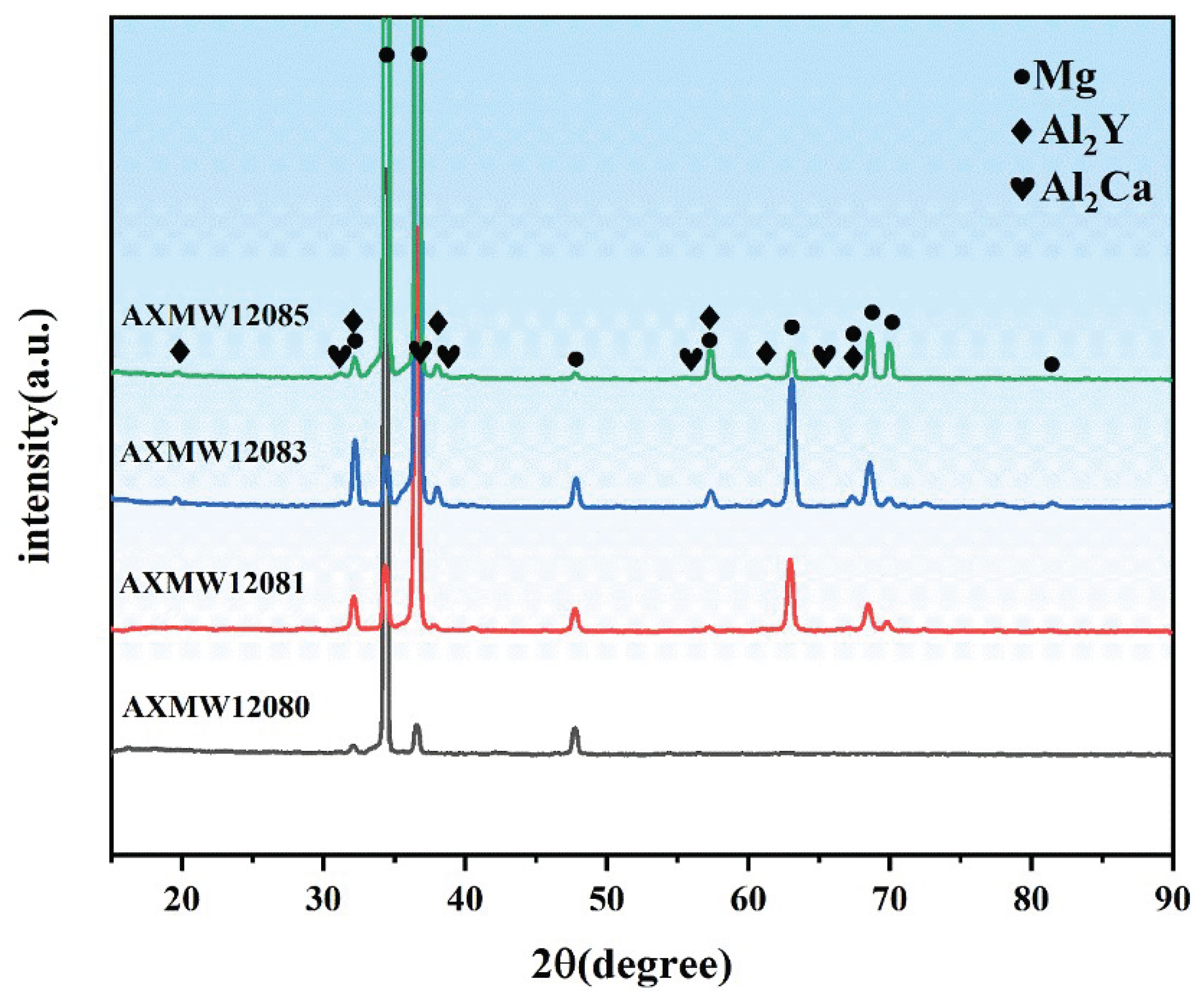
Figure 2.
Optical micrographs of the as-cast AXMW1208X composites: (a) AXMW12080; (b) AXMW12081; (c) AXMW12083; (d) AXMW12085.
Figure 2.
Optical micrographs of the as-cast AXMW1208X composites: (a) AXMW12080; (b) AXMW12081; (c) AXMW12083; (d) AXMW12085.
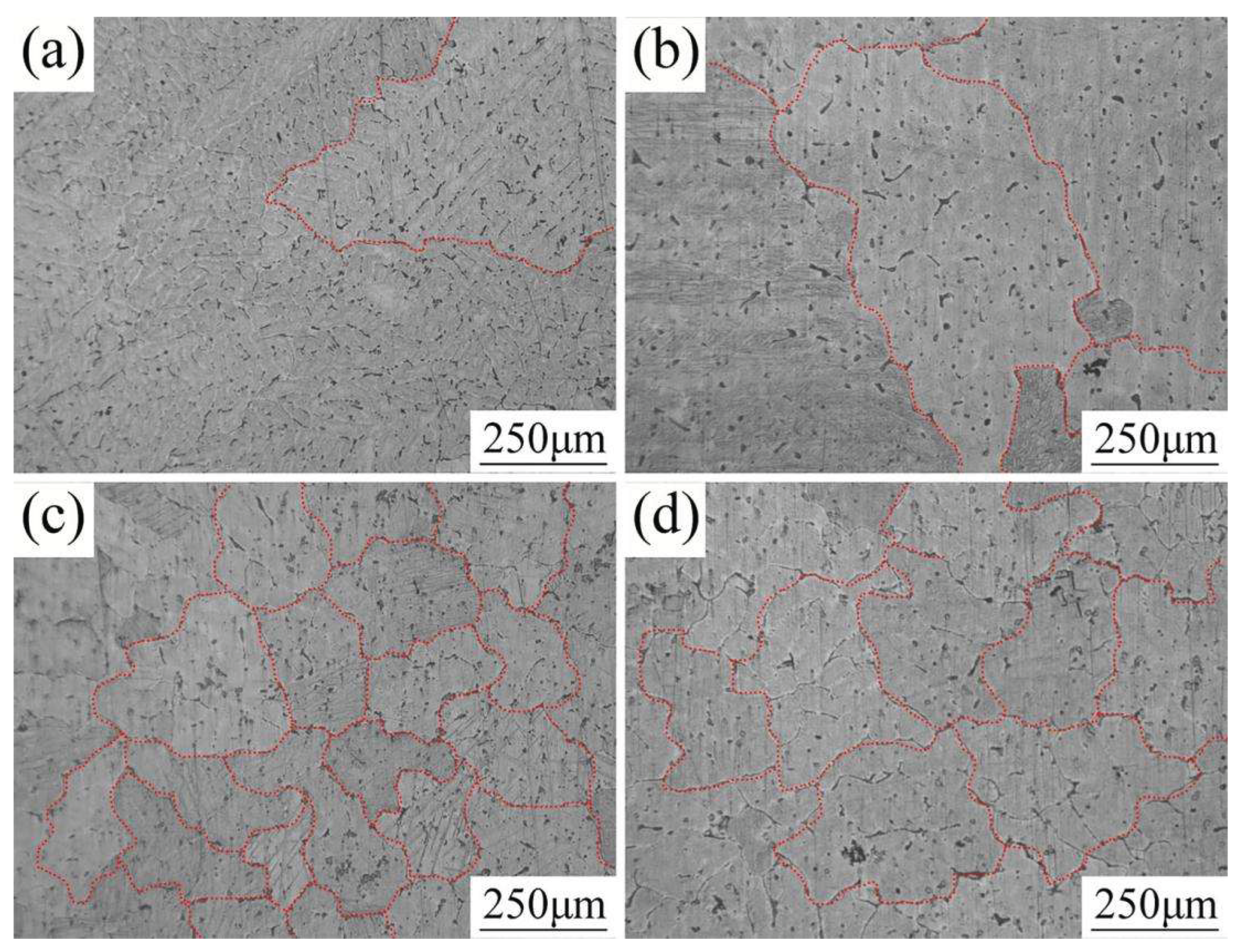
Figure 3.
SEM images of the as-cast AXMW1208X composites: (a) AXMW12080; (b) AXMW12081; (c) AXMW12083; (d) AXMW12085.
Figure 3.
SEM images of the as-cast AXMW1208X composites: (a) AXMW12080; (b) AXMW12081; (c) AXMW12083; (d) AXMW12085.
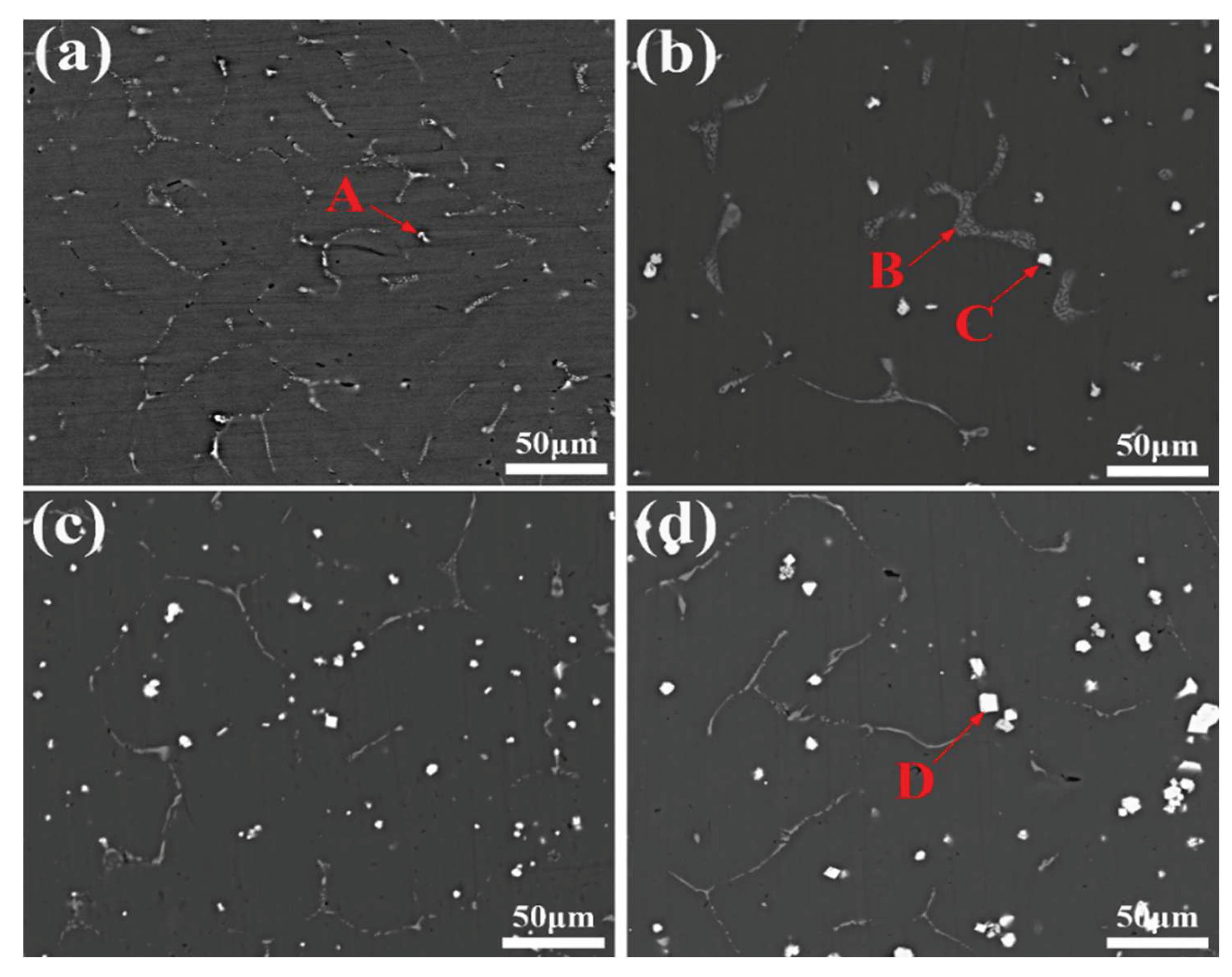
Figure 4.
Optical micrographs of the as-extruded AXMW1208X composites in the longitudinal section: (a) AXMW12080; (b) AXMW12081; (c) AXMW12083; (d) AXMW12085.
Figure 4.
Optical micrographs of the as-extruded AXMW1208X composites in the longitudinal section: (a) AXMW12080; (b) AXMW12081; (c) AXMW12083; (d) AXMW12085.
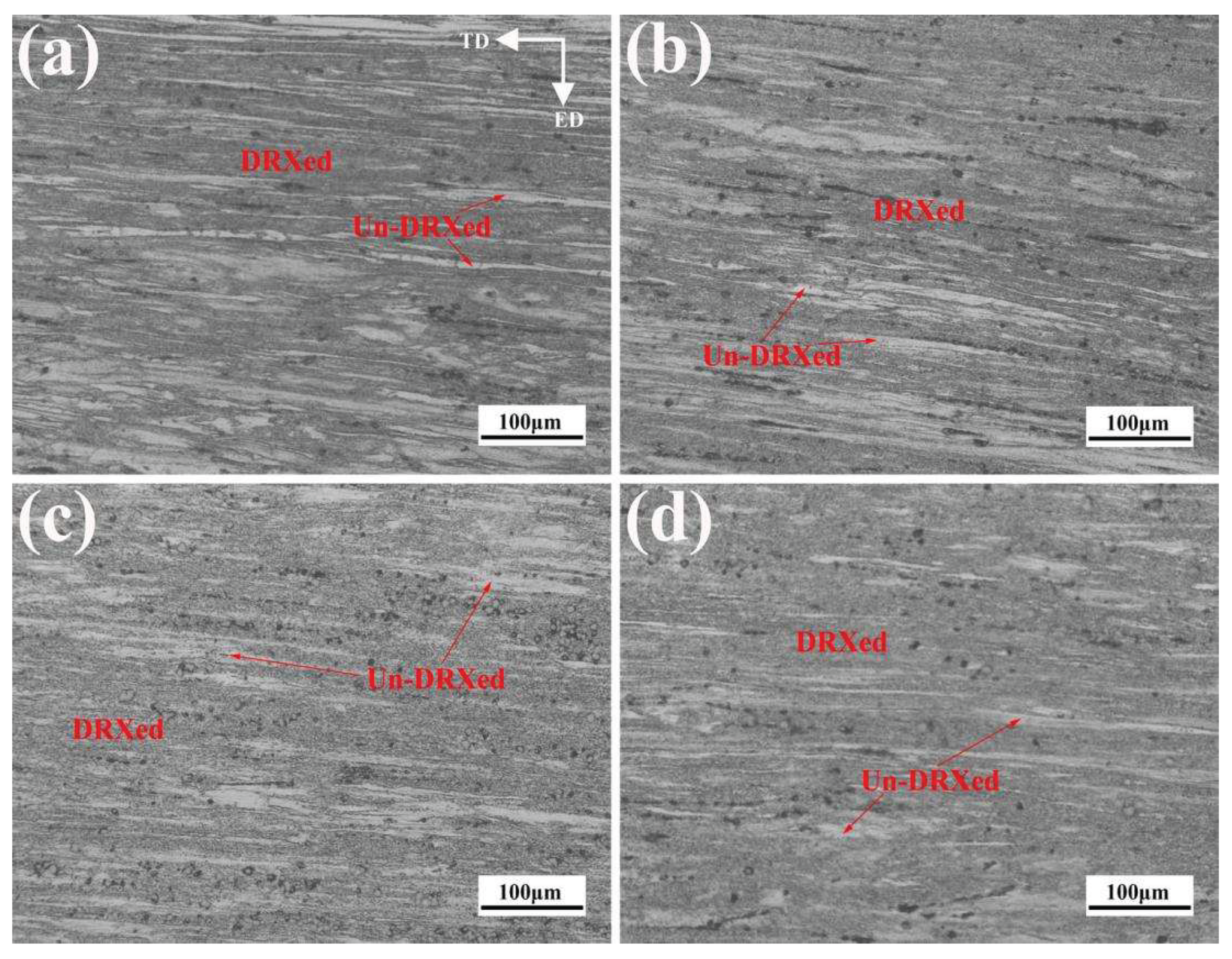
Figure 5.
SEM images of the as-extruded AXMW1208X composites: (a) AXMW12080; (b) AXMW12081; (c) AXMW12083; (d) AXMW12085 (e) EDS results acquired at point A (f) EDS results acquired at point B.
Figure 5.
SEM images of the as-extruded AXMW1208X composites: (a) AXMW12080; (b) AXMW12081; (c) AXMW12083; (d) AXMW12085 (e) EDS results acquired at point A (f) EDS results acquired at point B.
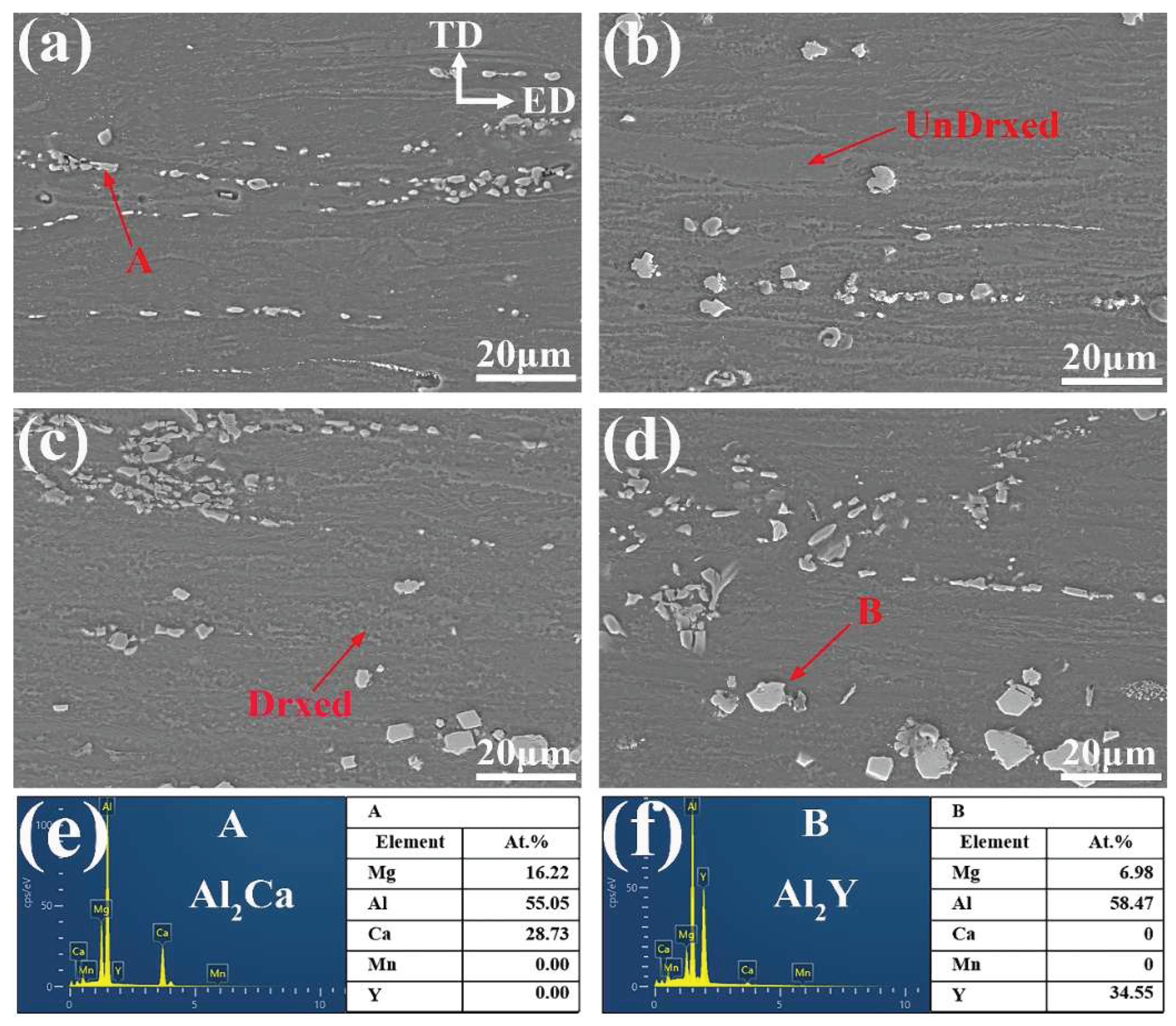
Figure 6.
Inverse pole figure (IPF) maps and dynamically recrystallized (DRXed) grain size distributions of the as-extruded AXMW1208X composites: (a, e) AXMW12080; (b, f) AXMW12081; (c, g) AXMW12083; (d, h) AXMW12085.
Figure 6.
Inverse pole figure (IPF) maps and dynamically recrystallized (DRXed) grain size distributions of the as-extruded AXMW1208X composites: (a, e) AXMW12080; (b, f) AXMW12081; (c, g) AXMW12083; (d, h) AXMW12085.
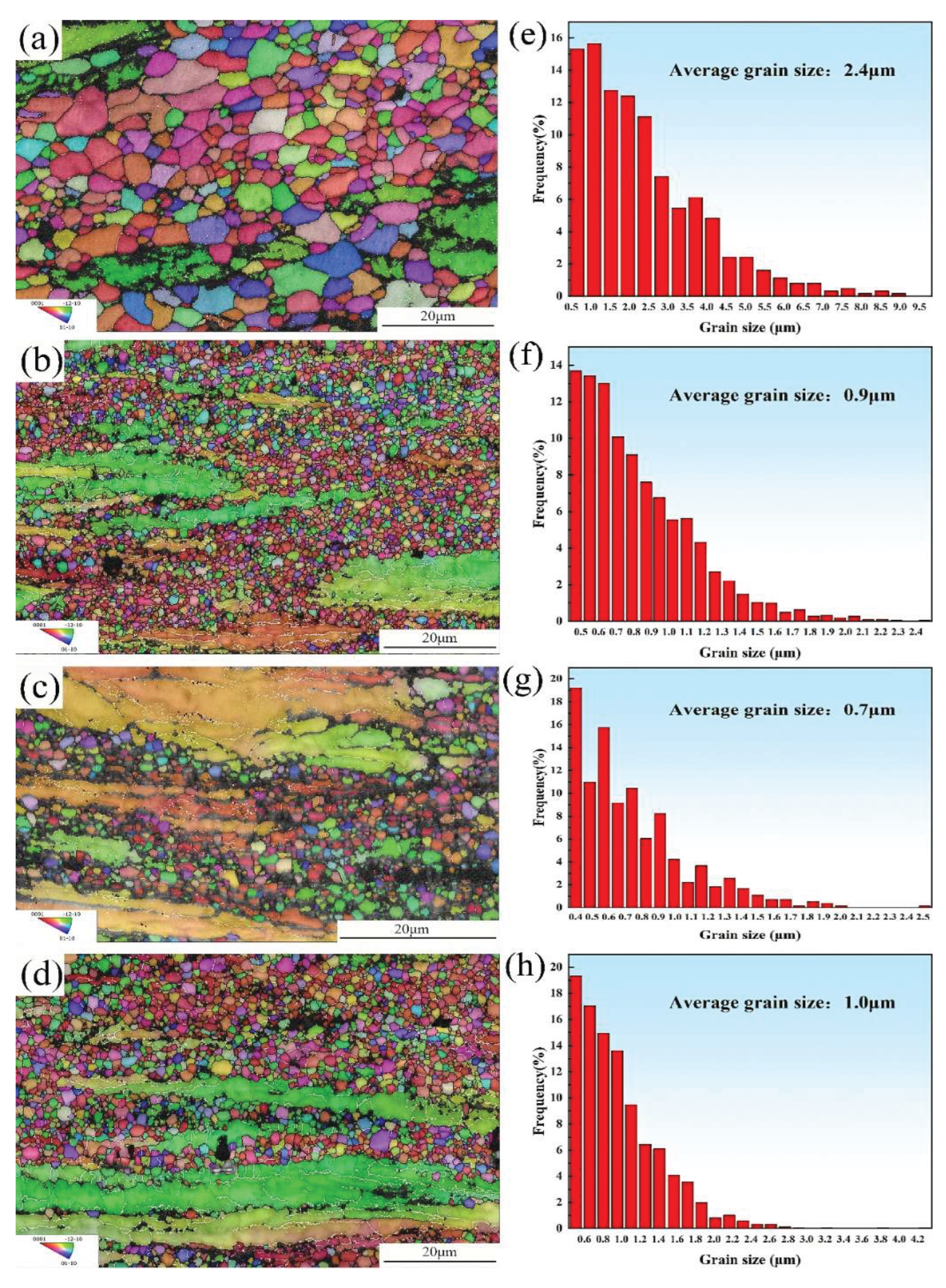
Figure 7.
EBSD analyses of the as-extruded AXMW1208X composites: (a-1)–(a-3) AXMW12080; (b-1)–(b-3) AXMW12081; (c-1)–(c-3) AXMW12083; (d-1)–(d-3) AXMW12085. (a-1)–(d-1) pole figures; (a-2)–(d-2) IPFs referred to ED; (a-3)–(d-3) KAM maps.
Figure 7.
EBSD analyses of the as-extruded AXMW1208X composites: (a-1)–(a-3) AXMW12080; (b-1)–(b-3) AXMW12081; (c-1)–(c-3) AXMW12083; (d-1)–(d-3) AXMW12085. (a-1)–(d-1) pole figures; (a-2)–(d-2) IPFs referred to ED; (a-3)–(d-3) KAM maps.
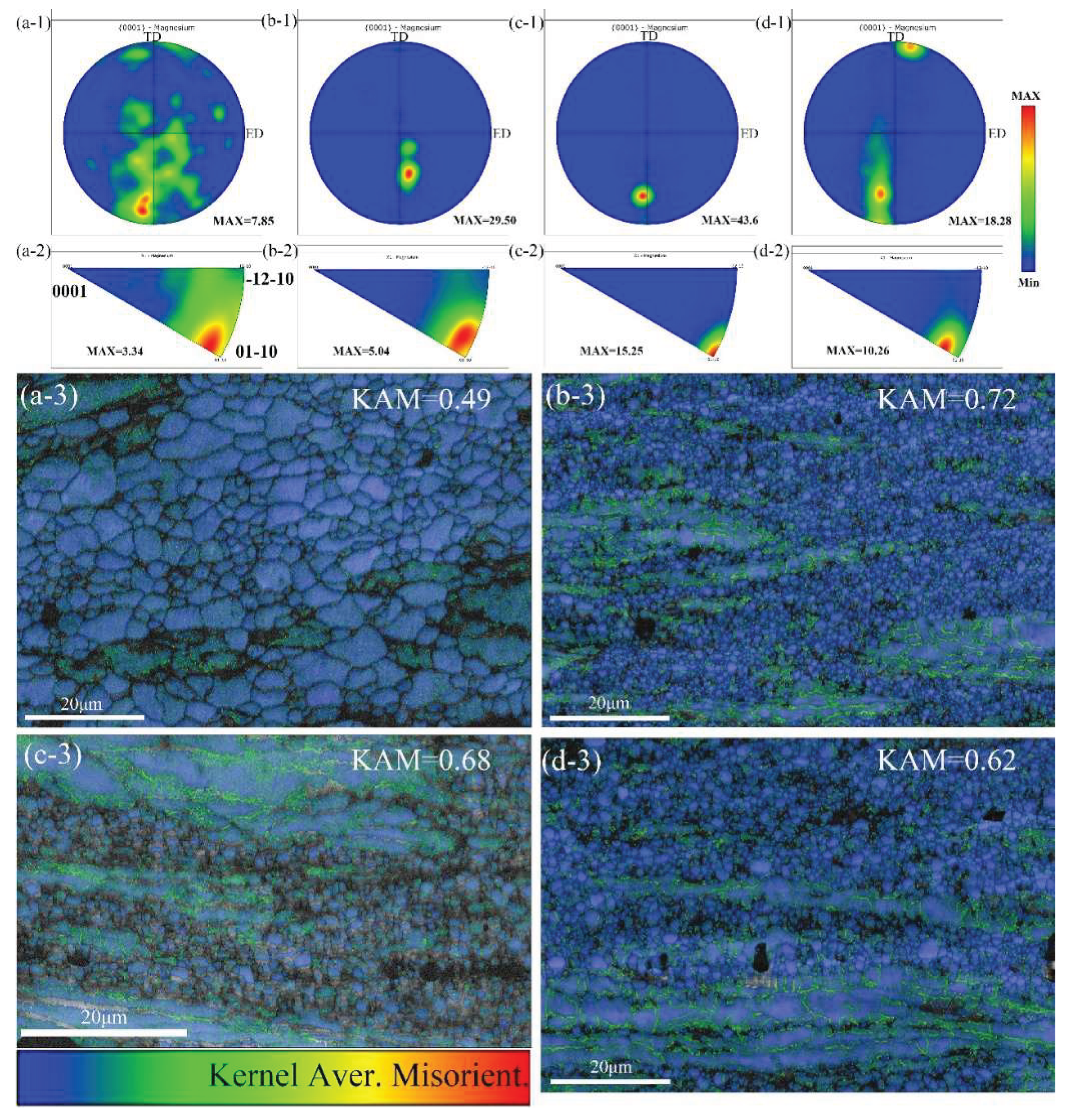
Figure 8.
(a) Bright-field TEM image of the as-extruded AXMW12083 composite; (b) magnified bright-field TEM image showing fine particles; (c) HRTEM image; (d) corresponding SAED pattern.
Figure 8.
(a) Bright-field TEM image of the as-extruded AXMW12083 composite; (b) magnified bright-field TEM image showing fine particles; (c) HRTEM image; (d) corresponding SAED pattern.
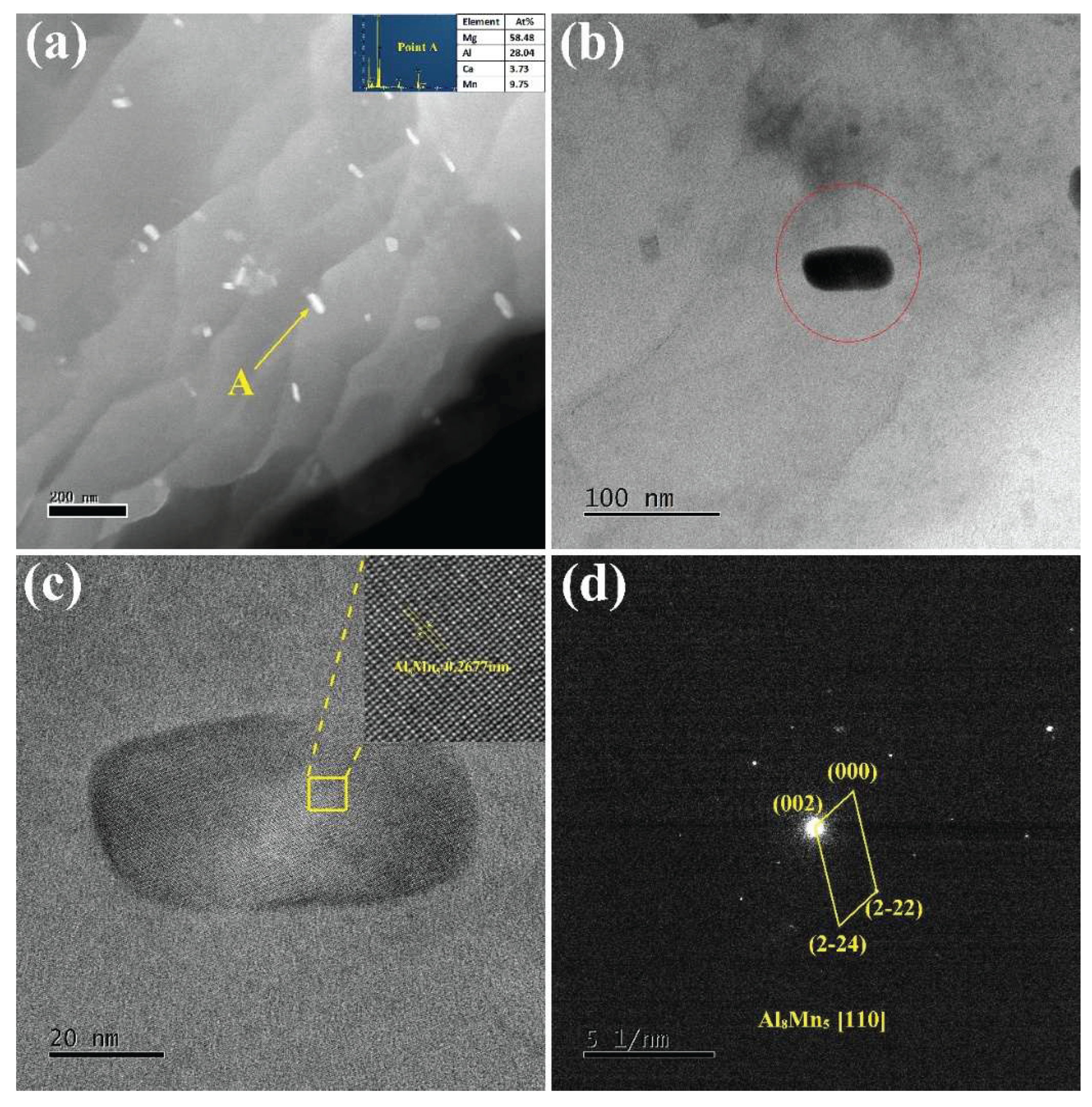
Figure 9.
Tensile stress–strain curves of the as-extruded AXMW1208X composites.
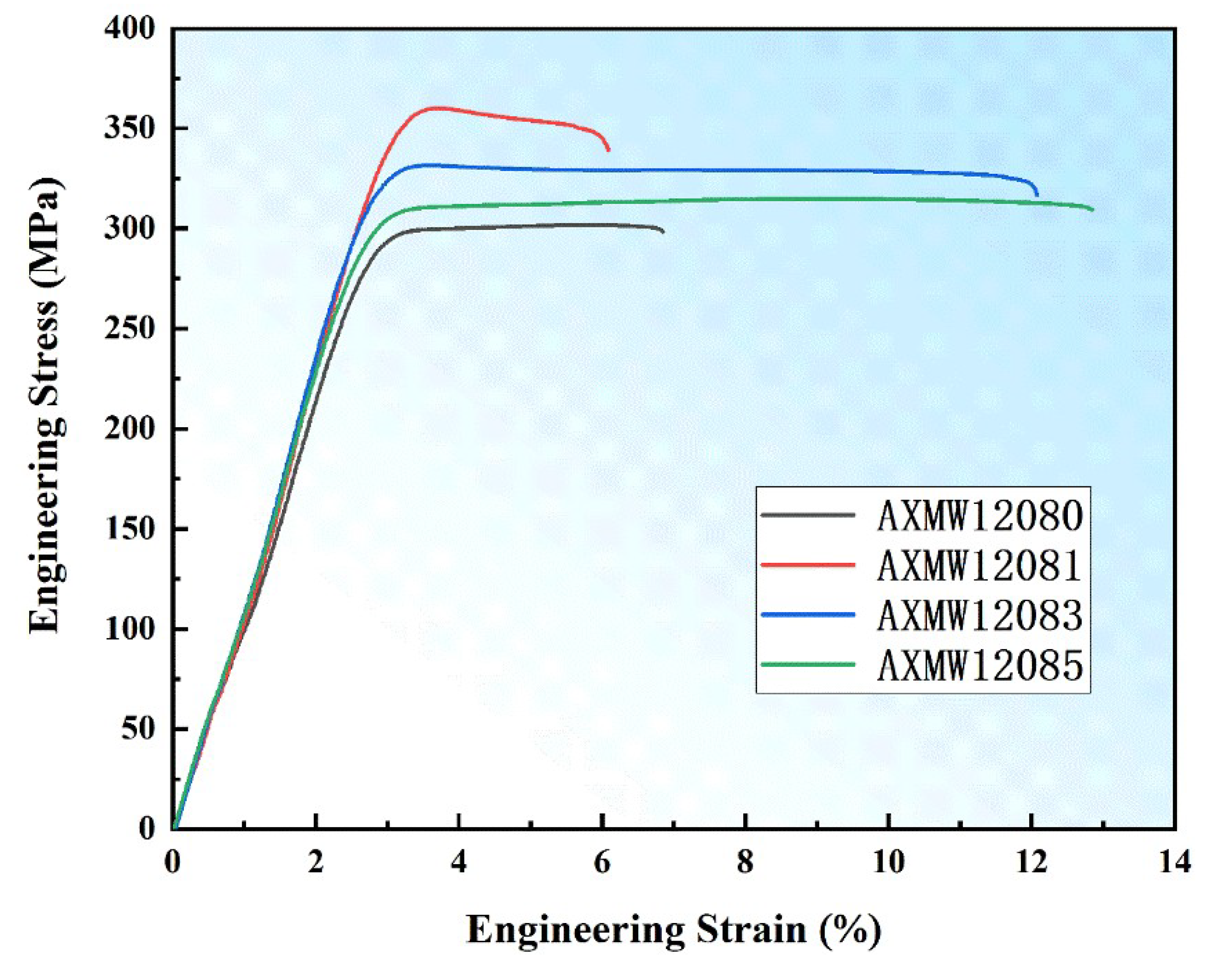
Figure 10.
Fracture surfaces of the as-extruded AXMW1208X composites: (a) AXMW12080; (b) AXMW12081; (c) AXMW12083; (d) AXMW12085.
Figure 10.
Fracture surfaces of the as-extruded AXMW1208X composites: (a) AXMW12080; (b) AXMW12081; (c) AXMW12083; (d) AXMW12085.
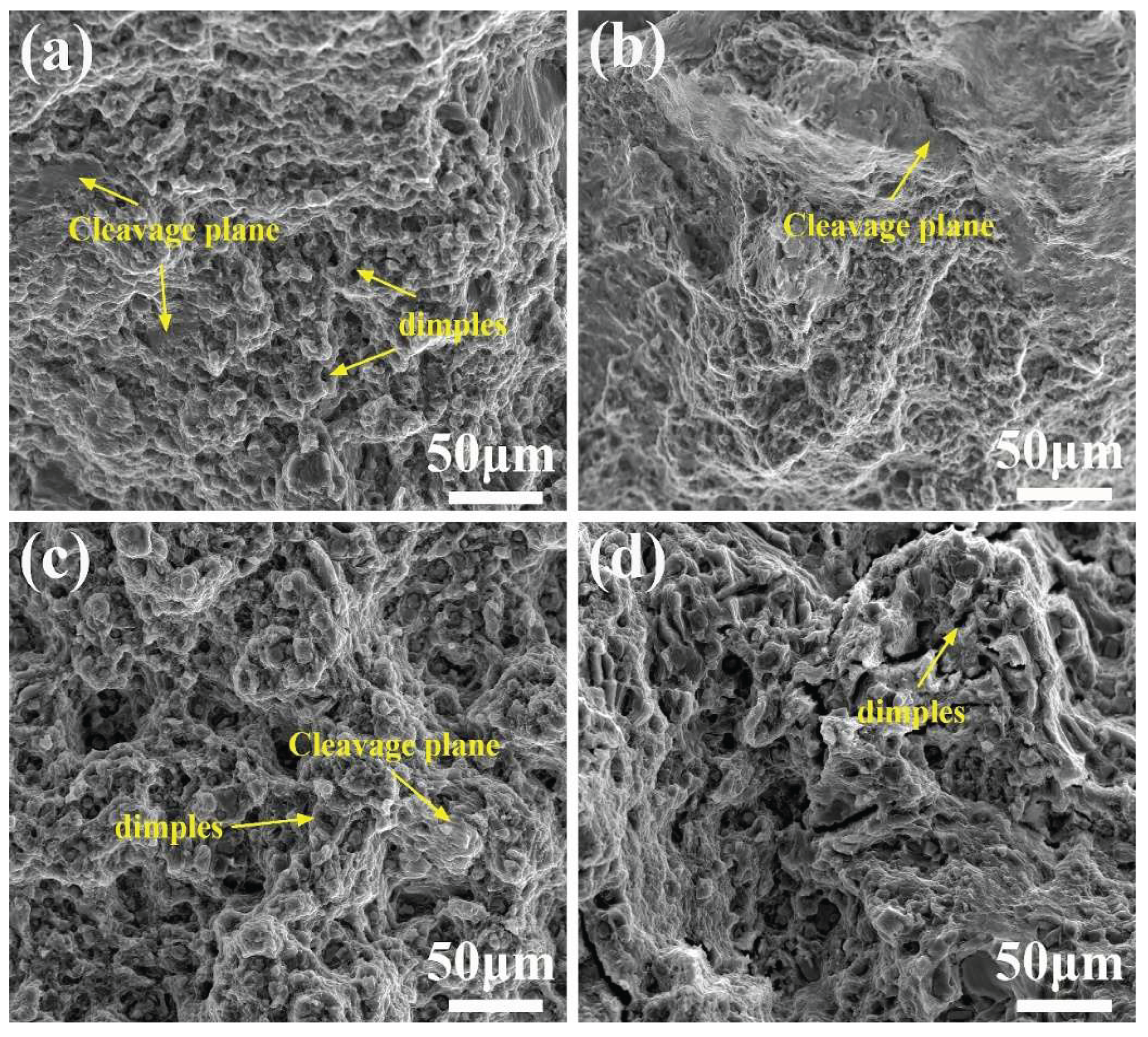

Table 1.
Nominal compositions of the AXMW1208X composites.
| Designation | Al2Y content (wt.%) | Matrix |
|---|---|---|
| AXMW12080 | 0 | Mg-1.2Al-0.8Ca-0.4Mn (wt.%) |
| AXMW12081 | 1 | |
| AXMW12083 | 3 | |
| AXMW12085 | 5 |
Table 2.
EDS results of the as-cast composites shown in Figure 3 (at.%).
Table 2.
EDS results of the as-cast composites shown in Figure 3 (at.%).
| Position A B C D |
Element | ||||
| Mg | Al | Ca | Mn | Y | |
| 91.35 | 5.29 | 2.84 | 0.13 | 0 | |
| 87.61 | 8.54 | 3.51 | 0.14 | 0 | |
| 9.37 | 57.70 | 1.68 | 0 | 31.24 | |
| 48.62 | 34.44 | 0 | 1.71 | 15.23 | |
Table 3.
Summary of tensile properties of the as-extruded composites at room temperature.
| Designation | TYS (MPa) | UTS (MPa) | EL (%) |
| AXMW12080 | 285±5 | 300±9 | 6.5±0.4 |
| AXMW12081 | 346±3 | 361±8 | 5.8±0.3 |
| AXMW12083 | 316±6 | 332±6 | 11.8±0.5 |
| AXMW12085 | 296±8 | 315±8 | 12.6±0.7 |
Disclaimer/Publisher’s Note: The statements, opinions and data contained in all publications are solely those of the individual author(s) and contributor(s) and not of MDPI and/or the editor(s). MDPI and/or the editor(s) disclaim responsibility for any injury to people or property resulting from any ideas, methods, instructions or products referred to in the content. |
© 2026 by the authors. Licensee MDPI, Basel, Switzerland. This article is an open access article distributed under the terms and conditions of the Creative Commons Attribution (CC BY) license (http://creativecommons.org/licenses/by/4.0/).
Copyright: This open access article is published under a Creative Commons CC BY 4.0 license, which permit the free download, distribution, and reuse, provided that the author and preprint are cited in any reuse.