

Submitted:
09 September 2026
Posted:
09 September 2026
You are already at the latest version
Abstract
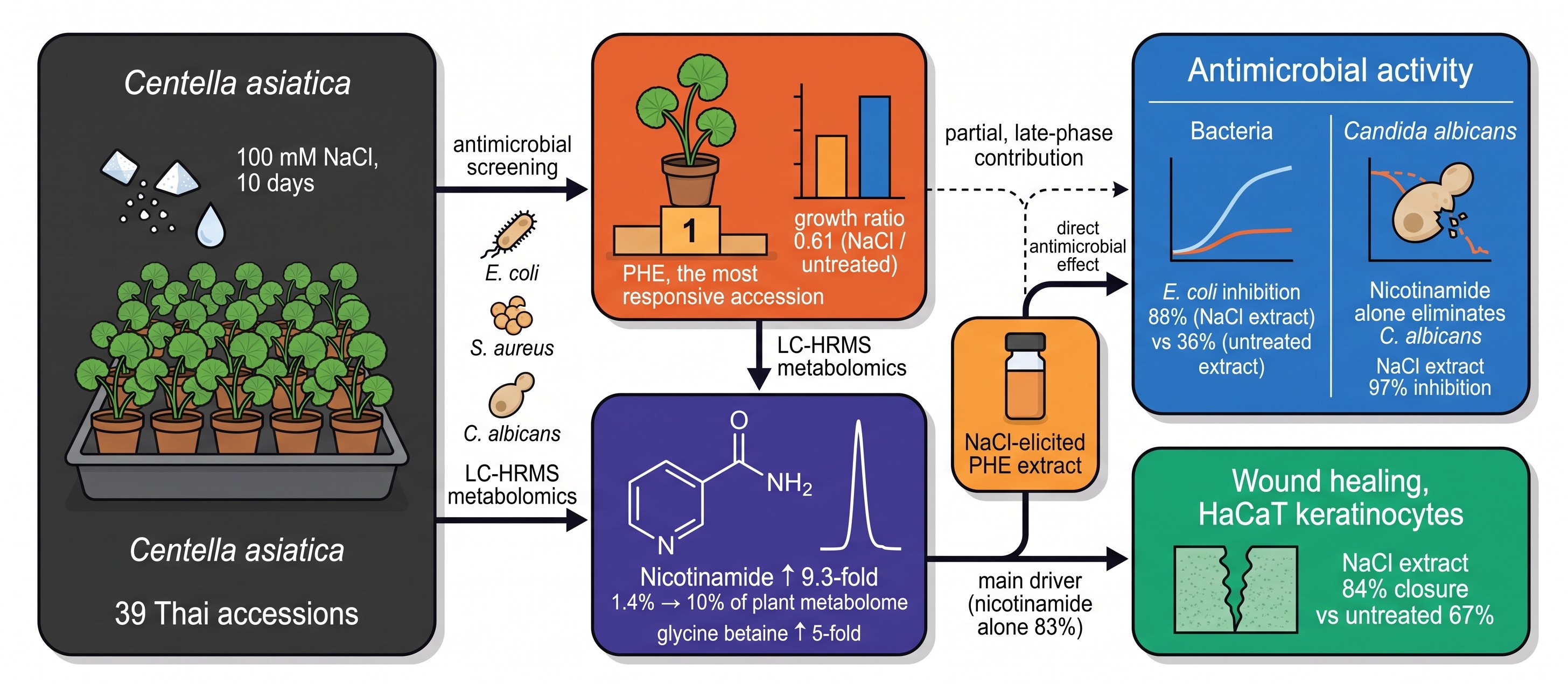
Centella asiatica (L.) Urb. is valued for skin repair. Salt (NaCl) treatment is an inexpensive way to alter its active molecules, but its effect on bioactivity across germplasm is unknown. Thirty-nine Thai accessions were grown with or without 100 mM NaCl for 10 days, and methanol leaf extracts were screened against Escherichia coli, Staphylococcus aureus and Candida albicans using a growth ratio (GR), growth with the NaCl ex-tract relative to the untreated extract. The most responsive accession, PHE, was profiled by untargeted LC-HRMS and assessed in a 24 h kinetic growth assay and in Ha-CaT keratinocyte viability and wound-healing assays. NaCl extracts reduced bacterial growth to 0.88 (E. coli) and 0.90 (S. aureus) of the untreated level, with wide variation among accessions. In PHE, nicotinamide was the most strongly induced metabolite (9.3-fold) and reached one tenth of the plant-derived signal. The NaCl extract inhibited E. coli by 88% versus 36% for the untreated extract, was non-cytotoxic, stimulated keratinocyte proliferation and raised wound closure to 84% of the positive control, matched by nicotinamide alone (83%). Salt elicitation therefore confers antimicrobial and wound-healing activity on C. asiatica, with nicotinamide largely explaining the latter and contributing with other constituents to the former.
Keywords:
Centella asiatica
; NaCl elicitation
; untargeted metabolomics
; nicotinamide
; antimicrobial activity
; wound healing
Copyright: This open access article is published under a Creative Commons CC BY 4.0 license, which permit the free download, distribution, and reuse, provided that the author and preprint are cited in any reuse.