

Submitted:
08 September 2026
Posted:
09 September 2026
You are already at the latest version
Abstract
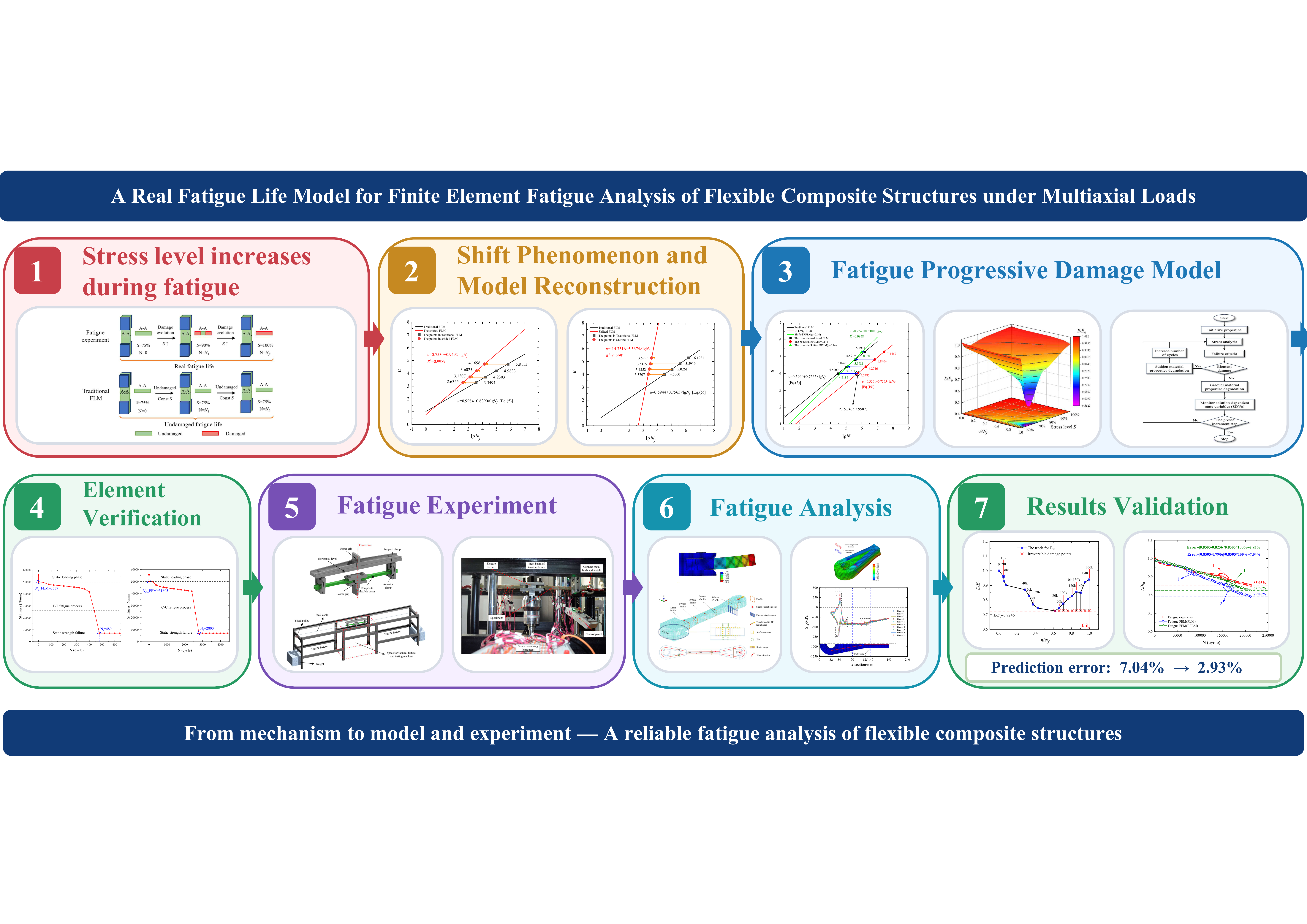
In the process of finite element fatigue analysis, the undamaged fatigue life will be used. The undamaged fatigue life can be obtained by fatigue tests of standard specimens, in which the stress level is assumed to be constant. In fact, stress level gradually increases during fatigue process, as the sectional area of specimen decreases with increase of fatigue cycle, but the loading remains constant. As a result, the undamaged fatigue life obtained by tests is usually less than that corresponding to the certain stress level, so that finite element fatigue analysis using such undamaged fatigue life will largely underestimate fatigue life. Therefore, it is desired to construct a real fatigue life model (RFLM) through considering change of stress level caused by decrease of material properties. To this end, a novel RFLM has been constructed for the first time by carefully studying the relationship between the RFLM and the existing fatigue life model. Then, the fatigue progressive damage model (FPDM) based on RFLM has been implemented into finite element model. By fatigue analysis within one element, it is found that the proposed RFLM is accurate and effective. To further evaluate performance of the RFLM, fatigue failure behaviors of the flexible composite structures (FCSs) has been analyzed by using the proposed model. To verify the accuracy of the RFLM, the fatigue experiments have been conducted to explore the failure modes and stiffness degradation process. Numerical results show that the fatigue stiffness degradation and failure modes obtained by the proposed model are in good agreement with experiments. It shows that the RFLM has ability to more accurately predict real fatigue performance of FCSs than the traditional FLM, even in wide range of stress levels under different stress states.
Keywords:
glass fiber
; flexible composite structure
; real fatigue life model
; fatigue experiment
; multiaxial loads
Copyright: This open access article is published under a Creative Commons CC BY 4.0 license, which permit the free download, distribution, and reuse, provided that the author and preprint are cited in any reuse.