
Submitted:
05 September 2026
Posted:
08 September 2026
You are already at the latest version
Abstract
Livestock ammonia (NH₃) is the volatile expression of incomplete nitrogen retention and microbial transformation of excreta. It links feed formulation, housing microclimate and manure handling with indoor air quality, animal welfare, occupational exposure, fine particulate matter and ecosystem nitrogen loading. This review examines NH₃ formation and emission dynamics, distinguishes concentration from mass flux, synthesizes animal and human health outcomes, and evaluates mitigation across the feed-to-field nitrogen cascade. Urea or uric acid conversion supplies ammoniacal nitrogen, whereas pH, temperature, moisture, residence time, exposed area and airflow govern volatilization. Controlled animal studies demonstrate ocular, respiratory, metabolic, behavioural and production responses that depend on concentration and exposure duration; livestock workers and neighbouring communities encounter NH₃ within complex mixtures containing dust, endotoxin and other pollutants. Effective management therefore requires multiple barriers: precision protein nutrition, rapid excreta removal, litter and slurry stabilization, ventilation integrated with capture, covered storage and low-emission land application. Recent studies show that climate warming can erode mitigation performance and that housing design, seasonal ventilation and practical amendments materially alter emissions. Whole-system assessment must track nitrogen, co-pollutants, animal outcomes, worker exposure, cost and downstream fate. It proposes a measurement framework and research priorities for durable, health-protective and circular nitrogen management.
Keywords:
ammonia
; livestock housing
; nitrogen management
; indoor air quality
; animal welfare
; occupational health
; secondary PM₂.₅
; manure management
; mitigation
1. Introduction
Ammonia (NH₃) occupies a distinctive position in livestock production because it is simultaneously a nutrient loss, an indoor air contaminant and an atmospheric precursor. Nitrogen enters the production system mainly as dietary protein, is partitioned into animal product and excreta, and can be transferred rapidly to air when urinary urea or avian uric acid is converted to ammoniacal nitrogen. The emitted molecule may irritate animal and human airways close to the source, react with atmospheric acids to form secondary inorganic aerosol, deposit to sensitive ecosystems, or be captured and returned to productive use. This mobility makes NH₃ a defining component of the wider reactive-nitrogen cascade rather than an isolated odour problem [1,2].
Agriculture dominates anthropogenic NH₃ emissions in most intensively farmed regions, with livestock manure and fertilizer application providing the largest source categories. Historical inventories established the global importance of animal excreta, while satellite observations later revealed numerous agricultural hotspots that were absent from, or underestimated by, bottom-up inventories [3,4]. A global supply-chain assessment showed that livestock nitrogen losses are distributed across feed production, housing, manure management and field application; a measure applied at one stage can therefore conserve nitrogen only to permit its loss later [2]. Long-term modelling further indicates that agricultural NH₃ emissions and their contribution to nitrogen deposition have increased markedly since 1980 [5].
The air-quality consequence is not restricted to the farm boundary. NH₃ neutralizes sulfuric and nitric acids to form ammonium sulfate and ammonium nitrate, both important fractions of fine particulate matter (PM₂.₅). The amount formed depends on precursor availability, temperature, relative humidity and atmospheric transport; a kilogram of NH₃ emitted at one location cannot be converted to a fixed kilogram of PM₂.₅ without accounting for these conditions [6,7]. Global and regional modelling nonetheless shows that agricultural NH₃ abatement can materially reduce population exposure to PM₂.₅ and may be more cost-effective than additional nitrogen-oxide control in ammonia-rich regimes [8,9,10]. A laboratory reactor study published in 2026 found that approximately 76.6% of recovered particulate mass formed from controlled NH₃-SO₂ reactions fell within the PM₂.₅ size range; the authors appropriately described their derived factors as screening estimates rather than predictions of ambient concentrations [11].
Livestock buildings are also occupied environments. Animals can be exposed continuously at breathing height, whereas workers experience repeated, task-dependent peaks. NH₃ dissolves readily in ocular and airway lining fluid and occurs with organic dust, endotoxin, microorganisms, carbon dioxide, hydrogen sulfide and volatile organic compounds. Controlled studies isolate the toxicological contribution of NH₃ but simplify the commercial mixture; occupational studies capture the mixture but often cannot separate its correlated components [12,13]. These complementary designs show why a single concentration cannot serve simultaneously as an animal no-effect level, a worker exposure limit and an emission standard.
Recent work has increased both the relevance and the complexity of this field. A 2025 national spatial analysis in the United States identified 8763 cattle and 6963 hog operations and reported PM₂.₅ concentrations 28% higher in census tracts containing cattle operations and 11% higher in tracts containing hog farms than in tracts without them; the spatial design establishes association at the tract level, not the ammonia-specific contribution of an individual facility [14]. In 2026, global modelling projected that warming alone could increase agricultural NH₃ emissions by 5-22% late in the century and reduce the effectiveness of linked mitigation packages [15]. Climate adaptation, air-quality protection and nutrient management must consequently be evaluated together.
This review examines livestock NH₃ across a source-pathway-receptor-control continuum (Figure 1). Its objectives are to explain the transformation of feed nitrogen into airborne NH₃; distinguish the measurements needed for indoor exposure, facility emissions and regional air quality; synthesize consequences for animals, workers, communities and ecosystems; critically compare mitigation from nutrition to land application; and define research designs capable of detecting pollution transfer. The organizing principle is that successful mitigation must both reduce dose at the intended receptor and reduce whole-chain reactive-nitrogen loss.
2. Review Approach
This article was developed as a critical integrative review rather than a systematic review or meta-analysis. Peer-reviewed studies and authoritative technical guidance were selected to represent the complete livestock-ammonia pathway: nitrogen intake and excretion, manure chemistry, housing and ventilation, measurement, controlled animal exposure, occupational and community health, atmospheric transformation, and mitigation at housing, storage and field stages. Targeted searches were updated through 31 August 2026 using combinations of ammonia, livestock, poultry, swine, cattle, housing, emission, air quality, health, PM₂.₅, manure and mitigation. Titles, author lists, publication years and DOI links were checked against the publication record.
Interpretation followed four safeguards. First, air concentration was not treated as emission: concentration is affected by source strength, airflow, mixing and sampling position, whereas emission requires a mass-flow or dispersion calculation. Second, excreted nitrogen was not treated as emitted NH₃ because hydrolysis, acid-base partitioning and management intervene. Third, health associations near livestock operations were not assigned to NH₃ alone when dust, endotoxin, microorganisms and other gases co-varied. Fourth, a percentage reduction at one manure stage was not described as a whole-farm benefit unless downstream nitrogen fate and co-pollutants were considered. These safeguards provide the basis for the measurement framework in Table 1.
3. Formation and Emission Dynamics
The potential NH₃ source is established upstream by nitrogen intake, digestibility, amino-acid balance, animal requirement and productive retention. Nitrogen not retained in growth, milk or eggs enters faeces and urine. In cattle and pigs, urinary urea is rapidly hydrolysed after contact with faecal urease. In poultry, uric acid and other nitrogenous compounds undergo sequential microbial mineralization. Faecal organic nitrogen is generally less immediately volatile but can replenish total ammoniacal nitrogen (TAN) during storage. Species, production stage and manure system therefore determine the temporal pattern of substrate supply [16,17,18].
Urea hydrolysis can be summarized as CO(NH₂)₂ + H₂O → 2NH₃ + CO₂, although aqueous systems contain both NH₃ and ammonium (NH₄⁺). Their equilibrium is NH₄⁺ ⇌ NH₃ + H⁺. Only the un-ionized fraction readily transfers to the gas phase, so increasing pH sharply raises volatilization potential. Temperature both changes the dissociation equilibrium and accelerates biological conversion and mass transfer. Figure 2 calculates the equilibrium fraction of TAN present as un-ionized NH₃ across representative temperatures using the relationship reported by Emerson et al. [19]. At pH values typical of acidified manure, the fraction is small; as pH approaches and exceeds the dissociation constant, the available gaseous fraction rises nonlinearly. The curves describe thermodynamic partitioning, not an emission rate, because substrate supply, buffering, boundary-layer resistance and ventilation still control flux.
Moisture has similarly non-linear effects. Water enables enzyme activity, solute diffusion and contact between nitrogenous substrates and microbes; wet or caked poultry litter commonly sustains NH₃ generation. Very dry material can suppress microbial conversion, whereas excess liquid may dilute concentrations but enlarge emitting area and promote anaerobic zones. Drinker leakage, condensation and inadequate litter renewal therefore interact with stocking density, bedding type and ventilation. In slurry systems, urine-feces mixing, pit surface area, crust formation and the interval between removal events are decisive. Reviews of pig and cattle housing consistently identify diet, floor design, manure-removal method, temperature, ventilation and cleanliness as major determinants [20,21].
Mass transfer occurs when the partial pressure of NH₃ at the manure surface exceeds that in the overlying air. Turbulence and air speed reduce boundary-layer resistance and can increase release even while diluting the indoor concentration. This distinction creates the ventilation paradox: greater airflow generally lowers the concentration inhaled inside the building, but may increase or leave unchanged the mass exported outdoors. A simplified steady-state balance is Cᵢ ≈ Cₒ + S/Q, where Cᵢ and Cₒ are indoor and inlet concentrations, S is source rate and Q is ventilation rate. The relation is useful conceptually but assumes adequate mixing and a stable source, conditions rarely satisfied throughout a production cycle. Emission is instead estimated as E = Q(Cₒᵤₜ - Cᵢₙ), with synchronized concentration and airflow measurements and explicit treatment of uncertainty.
Historical multi-country monitoring illustrates the scale of between-system variation. Mean concentrations in Northern European buildings were generally below 8 ppm in cattle housing, approximately 5-18 ppm in pig housing and approximately 5-30 ppm in poultry housing, with strong effects of building and management [22]. Those values are descriptive of the monitored systems and period, not universal emission factors. Contemporary datasets reinforce the need to normalize emissions to animal place, live mass, product and time and to report housing, ventilation and manure-management metadata [23,24].
Seasonal concentration and emission can move in opposite directions. In a Korean laying-hen house, winter NH₃ concentration reached 9.33 ppm, whereas the NH₃ emission factor was greatest in summer and lowest in winter because ventilation volume changed substantially [25]. This finding is an especially clear demonstration that a high indoor reading does not necessarily identify the season of greatest exported mass. A 2026 analysis of the DATAMAN database likewise reported lower poultry emission factors in European than North American datasets and lower post-2010 than pre-2010 values; design, litter practice, climate, measurement method and technological change remain intertwined, so regional factors should not be transferred without qualification [26].
Within a building, spatial and temporal variability can be as important as the flock or herd mean. Freshly wetted zones, manure channels, pits and exhaust paths form hotspots. Animal growth, litter age, outside weather, controller setpoints and minimum-ventilation schedules produce diurnal and production-cycle patterns. Measurements should therefore capture breathing-zone means, peaks and cumulative duration as well as ventilation-weighted mass. Low-cost electrochemical or metal-oxide sensors can support continuous surveillance, but drift, humidity interference, cross-sensitivity, calibration range and placement must be reported. Reference-grade analysers remain necessary for calibration and periodic validation.
The mechanistic determinants, measurement consequences and corresponding control points are summarized in Table 2. The table emphasizes that no single variable is sufficient: TAN indicates substrate, pH and temperature indicate partitioning, surface and airflow indicate transfer, and downstream management determines whether conserved nitrogen remains conserved.
4. Air Quality and Health Consequences
4.1. Animal Health, Welfare and Productivity
NH₃ is highly soluble and reacts with moisture on ocular, nasal and respiratory surfaces. Local alkalinity can disrupt epithelial integrity, impair mucociliary clearance and increase susceptibility to secondary challenges. The dose received by an animal depends on concentration, duration, respiratory rate, life stage, microclimate and co-exposure. Controlled chambers are valuable for isolating concentration and duration, but commercial buildings add dust, pathogens, endotoxin, variable humidity and behavioural avoidance. Findings should therefore be interpreted as biological response ranges rather than a universal threshold.
Broilers provide the most developed controlled-exposure literature. Exposure to 0, 25, 50 or 75 ppm from days 1 to 28 produced concentration- and duration-dependent ocular lesions; abnormalities developed even at 25 ppm, more slowly and less severely than at 50 or 75 ppm, and recovery after exposure was incomplete at the higher concentrations [27]. Studies at 0, 30 and 60 ppm reported conjunctival injury and poorer feed-use efficiency at the highest concentration, while separate work linked sustained exposure to impaired modern-broiler performance [28,29]. These experiments do not imply that every commercial flock at a particular reading will experience the same loss, but they establish dose-responsive injury and show that ocular endpoints may change before mortality or gross clinical disease.
Subclinical responses extend beyond the eye. High atmospheric NH₃ altered hepatic protein expression and breast-muscle transcription in broilers, including pathways related to metabolism, oxidative stress and growth [30,31]. Such molecular findings strengthen mechanistic plausibility but should not be translated directly into farm-level production loss without replicated field validation. The critical management implication is that normal average daily gain cannot be treated as proof of biological neutrality.
Pigs show a comparable separation between overt production effects and earlier physiological change. Young pigs exposed to high concentrations in classic chamber work developed respiratory signs and growth impairment [32]. At 35 or 50 ppm, nursery-pig studies examined haematology, stress, behaviour and performance over acute and prolonged periods, demonstrating that endpoint and duration materially shape interpretation [33]. In a 15-week factorial experiment, pigs exposed to approximately 20 ppm showed lower salivary cortisol, larger adrenal cortices and less early play, while productivity was unchanged; the direction of cortisol should not be interpreted simplistically as reduced stress because chronic hypothalamic-pituitary-adrenal adaptation was plausible [34]. More recent work associates chronic NH₃ exposure with pulmonary oxidative stress, enhanced glycolysis, hindgut dysbiosis and altered microbial metabolites [35,36]. A 2024 long-duration study also reported reduced performance and multiple pathological lesions in exposed pigs [37].
Evidence for calves is less complete. A systematic review found only a small number of studies that formally examined NH₃ in relation to bovine respiratory disease and concluded that heterogeneity and risk of bias prevented a defensible threshold [38]. One longitudinal field study associated cumulative barn exposure with ultrasonographic lung lesions, airway inflammation and infection, but the measured air-quality variables and group-housing conditions were correlated [39]. For calf housing, the strongest conclusion is methodological: continuous duration metrics, thoracic ultrasound, clinical scoring, ventilation, bedding, microbial load, dust and endotoxin should be evaluated together.
Table 3 compares representative animal and human studies while keeping direct endpoints separate from inference. Across species, four patterns recur: concentration and duration interact; ocular, behavioural, inflammatory or molecular responses may precede growth loss; commercial mixtures can modify the response; and experimental-unit limitations, particularly one chamber per treatment, can overstate precision.
4.2. Human Health, Community Air Quality and Environmental Fate
Livestock workers encounter complex bioaerosol mixtures. Swine-facility studies linked ammonia, endotoxin and dust metrics with chronic symptoms and pulmonary-function changes, while repeated poultry studies demonstrated cross-shift or prospective changes associated with the mixed exposure profile [40,41,42,44]. Experimental and occupational synthesis indicates that dust and NH₃ may interact, yet their correlation and the presence of endotoxin, microorganisms and disinfectants constrain single-pollutant attribution [13,45]. Worker protection should therefore control the mixture at source, monitor tasks and peaks, and use respiratory protection as a residual barrier rather than as the primary emission-control strategy.
Occupational limits also require careful interpretation. The NIOSH recommended exposure limit for NH₃ is 25 ppm as a 10-hour time-weighted average and 35 ppm as a 15-minute short-term limit [46]. These values were developed for adult workers and specific exposure periods; they are not animal no-effect concentrations, community ambient standards or substitutes for good housing management. Animals may be exposed continuously, including during vulnerable developmental stages, and welfare endpoints such as ocular injury or play behaviour differ from the endpoints used to establish occupational limits.
Community studies extend concern beyond the workplace but add greater source-attribution uncertainty. Repeated measurements in an agricultural community linked 24-hour ambient NH₃ variation with short-term reductions in lung function among children with asthma [43]. Studies near concentrated swine operations reported associations between livestock-related air pollution, symptoms and pulmonary function, and a systematic review found that proximity-based findings were suggestive but heterogeneous [47,48]. In the Netherlands, livestock-related air pollution was associated with airway obstruction in neighbouring residents and with acute respiratory responses in a panel of people with chronic obstructive pulmonary disease [49,50]. These studies support exposure reduction but do not justify assigning all observed risk to NH₃ because farm density, endotoxin, primary particles, microbes and secondary aerosol co-vary.
The 2025 United States spatial analysis adds national-scale resolution by locating cattle and hog operations and comparing census-tract PM₂.₅ burdens [14]. It’s finding that socially vulnerable populations were disproportionately represented in affected tracts makes distributional impact a legitimate mitigation criterion. However, tract-level association remains distinct from a facility-specific causal estimate. Fence-line monitoring, source tracers, dispersion modelling, particulate chemical speciation and longitudinal health measurements are needed to connect source, pathway and receptor.
Atmospheric processing determines how far the impact travels and in which chemical form. NH₃ has a comparatively short lifetime where dry deposition is efficient, but reaction with nitric or sulfuric acid can extend transport as particulate ammonium. The PM response to NH₃ control is larger in ammonia-rich, acid-limited regimes and smaller where other precursors or thermodynamics limit aerosol formation. Scenario studies estimate substantial health benefits from agricultural control, but their numerical results depend on emissions inventories, chemical transport, exposure surfaces, concentration-response functions and valuation [9,51,52]. The WHO PM₂.₅ guideline provides a receptor-based health benchmark for ambient fine particles, not a direct conversion factor for farm NH₃ [53].
Deposition transfers reactive nitrogen to terrestrial and aquatic systems. Chronic nitrogen enrichment can acidify soils, alter plant competition and reduce species richness, particularly in nutrient-sensitive grasslands and habitats [54,55]. Source apportionment using concentration gradients and nitrogen-isotope ratios has demonstrated livestock plume transport across landscapes, but fractionation, background mixing and deposition complicate quantitative allocation [56]. Integrated farm and regional policy must therefore address both the directly inhaled gas and the deposited or particle-bound nitrogen formed after emission.
Figure 3 assembles quantitative anchors from four different intervention and exposure contexts. Panel A shows full-cycle pig-house emission reductions under amino-acid-balanced crude-protein reduction; Panel B shows high short-term removal by a full-scale indoor acid-scrubber prototype; Panel C shows the concentration-duration pattern of broiler ocular injury; and Panel D shows primary-PM reduction accompanied by increases in NH₃ and odour in manure-drying-tunnel operation. The panels are deliberately not pooled: their denominators, system boundaries and outcomes differ. Together they demonstrate why effect magnitude must always be reported with experimental context.
5. Mitigation Across the Nitrogen Cascade
5.1. Nutritional, Litter and Manure Controls
The first mitigation barrier is to avoid creating surplus excreted nitrogen. Precision and phase feeding, formulation on digestible amino acids, appropriate protein quality, reduced feed wastage and maintenance of animal health can lower the substrate available for NH₃ formation. In finishing pigs, lowering dietary crude protein changed manure composition and NH₃ emissions, and full-cycle room monitoring later showed that amino-acid-balanced crude-protein reduction decreased mean NH₃ emissions by 33.0% and 57.2% in moderate and deeper reduction treatments [57,60]. The response is not a licence for indiscriminate protein restriction: indispensable amino-acid adequacy, intake, growth, carcass quality, reproductive performance and diet cost must be retained.
Across cattle and pig manure studies, meta-analysis supports lower NH₃ potential when dietary crude protein is reduced, although the size of the response varies with species, baseline protein, nitrogen partitioning and manure management [61]. Poultry formulation can likewise reduce nitrogen excretion, but excretion should not be presented as measured atmospheric emission unless litter conversion and airflow were quantified [62]. Nutritional trials should report analysed diet, intake, animal product nitrogen, urinary and fecal nitrogen where feasible, litter or slurry TAN, and directly measured emission.
A 2026 commercial pig-house study illustrates both promise and interpretive caution. A novel feed-based intervention reduced high-frequency indoor NH₃ concentration by 81.7% in an emptied weaning unit but by 20.9% in a growing unit containing pre-existing slurry [63]. The contrast suggests that legacy manure can buffer or delay a fresh-excreta intervention. Because the primary endpoint was indoor concentration, ventilation-weighted mass emission and downstream nitrogen fate remain necessary before the result can be generalized as whole-system abatement.
After excretion, rapid separation or removal can interrupt the contact between urinary nitrogen and fecal enzymes. Partly slatted floors that remain clean, reduced pit area, frequent scraping or flushing, urine-feces separation and manure belts can reduce residence time and exposed area. Their efficacy depends on reliable operation: fouled solid floors, stagnant channels and infrequent removal can negate the design [20]. Mechanical removal also transfers nitrogen to another stage, so storage must be ready to receive the higher ammonium load.
In poultry, litter moisture, pH and caking are central. Drinker management, ventilation sufficient for moisture control, appropriate bedding depth and removal of wet zones reduce hydrolysis and volatilization. Acidifying amendments lower the un-ionized NH₃ fraction, whereas adsorbents and mineral amendments may bind ammonium or alter water activity. A 2026 experiment with 476 broilers found that a 40% zeolite-clay-rice-husk-ash supplement reduced end-of-cycle in-house NH₃ by about 50%, improved stress and footpad indicators, and did not impair growth [64]. The formulation is promising for humid systems, but commercial adoption requires assessment of amendment mass, dust, spent-litter nutrient value, soil effects and cost.
Windrowing, turning and drying require multi-pollutant attention. Manipulation can accelerate stabilization and pathogen reduction but may expose new surfaces and generate short emission peaks. Broiler-house downtime windrowing has been associated with NH₃ and nitrous oxide emissions that vary strongly during the management cycle [65]. Similarly, manure-drying tunnels evaluated as dust filters reduced primary PM₁₀ while increasing NH₃ and odour relative to a calculated no-tunnel comparator [59]. A control device should not be selected from one pollutant column alone.
5.2. Housing, Exhaust Treatment, Storage and Land Application
Ventilation remains essential for heat, humidity, carbon dioxide and contaminant control. The goal is not simply maximum airflow, but demand-responsive ventilation that maintains thermal and respiratory conditions while limiting unnecessary turbulence over emitting surfaces. Source-oriented extraction, localized manure-channel capture and balanced inlet design can separate clean occupied zones from source zones. Continuous sensors can trigger corrective actions, but concentration control should be paired with outlet mass measurement to determine whether the intervention reduced or merely exported NH₃.
Residual NH₃ in mechanically exhausted air can be captured by acid scrubbers, biofilters or biotrickling filters. Acid scrubbing converts NH₃ to an ammonium salt that may have fertilizer value. An early ARS scrubber demonstrated the engineering concept, and a 2025 full-scale indoor prototype achieved approximately 87-99% removal during controlled shop tests across 10-100 ppm and two airflow rates [58,66]. These short-duration tests establish technical efficacy but not annual performance in an occupied, dusty building. Field evaluation must measure pressure drop, energy, reagent use, corrosion, fouling, water consumption, maintenance, captured-nitrogen quality, worker safety and uptime.
Biological treatment can reduce NH₃ and odour but may transform nitrogen into nitrous oxide. Literature-based assessment has shown that N₂O from biological treatment can materially erode greenhouse-gas benefits [67]. Acid systems shift the burden toward chemical supply and an ammonium-rich residual, whereas biological systems require control of oxygen, alkalinity, temperature and microbial pathways. The appropriate comparison is avoided receptor exposure plus recovered nitrogen minus energy, reagent, greenhouse-gas and residual-management burdens.
Storage and field application complete the intervention. Covers reduce wind exchange; cooling and acidification lower volatilization; and shorter storage may reduce cumulative loss where logistics permit. At land application, injection, trailing hose or shoe systems and prompt incorporation can reduce surface exposure, although soil type, slope, crop stage, compaction, fuel use and worker safety affect suitability. Reviews of manure-management chains show that technologies interact and that control of NH₃ can change methane or nitrous oxide [68,69]. Guidance therefore places feeding, housing, storage and field measures within a single sequence [70].
The conservation paradox is fundamental: successful barn control retains more ammonium in manure. If the material is stored uncovered or surface-applied outside crop demand, part of the conserved nitrogen can be re-emitted or lost as nitrate and N₂O. A defensible assessment follows nitrogen from feed to animal product, excreta, housing, storage, treatment, field, crop and residual loss. The numerator should be useful nitrogen retained in animal or crop product; the accompanying ledger should include NH₃, N₂O, nitrate, energy and cost.
Table 4 organizes interventions as a hierarchy rather than a menu of independent percentages. Prevention precedes suppression, exposure control, capture and downstream conservation. Each barrier is paired with a failure mode and a minimum verification metric, because local removal efficiency alone is insufficient.
6. Integration, Trade-Offs and Research Priorities
Four paradoxes define the next stage of livestock-ammonia science. The first is dilution: lower indoor concentration can coexist with unchanged or greater exported mass. The second is conservation: nitrogen retained at one stage remains available for loss at the next. The third is single-pollutant optimization: control of NH₃ may increase N₂O, odour, particulate matter, energy use or aqueous nitrogen, and control of primary dust may increase NH₃. The fourth is productivity neutrality: animals can maintain average gain while experiencing ocular, behavioural, inflammatory or molecular injury. Each paradox is resolved by widening the system boundary and measuring the intended receptor together with nitrogen mass and co-pollutants.
Climate change adds a fifth challenge. Temperature increases the fraction of TAN present as NH₃ and accelerates biological and physical transfer. Jiang et al. [15] estimated 5-22% greater global agricultural NH₃ emissions under plausible late-century warming and found that six linked mitigation measures would deliver smaller percentage reductions under warmer conditions. These are global model results rather than farm trials, but they identify a practical need: emission factors, housing controls, manure storage and national commitments should be stress-tested under future temperature and ventilation regimes.
Standardized reporting is essential. Housing studies should provide animal category, live mass, productivity, diet, manure system, floor and pit geometry, litter or slurry properties, weather, ventilation method, analyser calibration, averaging interval, missing-data treatment and uncertainty. Concentration should be reported separately from emission rate; emission factors should include their denominator and system boundary. Comparative databases can reveal large regional and temporal differences, but apparent improvement may partly reflect study design and should be confirmed with harmonized measurements [23,26].
Animal studies require genuine replication at the chamber or room level. Assigning many animals to one room per treatment creates pseudoreplication because the room, not the animal, receives the airborne treatment. Future experiments should emphasize lower, fluctuating concentrations representative of commercial conditions, include recovery phases, and measure ocular, respiratory, immune, behavioural and performance outcomes. Field studies should use longitudinal designs and combine sensor time series with pathology or validated clinical endpoints. For calves and pigs, hierarchical models should account for pen, room and farm clustering.
Human studies should move from proximity alone to source-pathway-receptor designs. Personal and fence-line NH₃, size-fractionated particles, ammonium, nitrate, sulfate, endotoxin, microbial markers, meteorology and work task should be measured concurrently. Repeated lung function, symptom, medication and vulnerability data can then be linked to time-resolved exposures. Community analyses should assess distributional impacts explicitly, following the spatial inequities identified in recent national work [14]. Causal attribution will remain limited without chemical speciation, dispersion analysis and suitable comparison populations.
Monitoring innovation should focus on traceability rather than novelty alone. Sensor networks need reference co-location, humidity and temperature challenge tests, documented drift correction, data-completeness thresholds and uncertainty propagation into emissions. Facility-scale inverse dispersion, mobile monitoring and satellite constraints can provide independent checks on bottom-up factors. Nitrogen-isotope ratios offer an additional means of tracing agricultural plumes across landscapes [56], and controlled sheep-manure incubation suggests that isotope discrimination can support estimation of cumulative NH₃ loss under defined conditions [71]. Such methods are promising verification tools but require source-specific calibration and cannot replace direct flux measurement without validation.
Intervention trials should report sequential remaining mass rather than add percentage reductions. If source prevention reduces NH₃ formation by 50% and a downstream device removes 80% of the remaining mass, the combined reduction is 90%, not 130%, provided that the second device treats the full residual flow under comparable conditions. Commercial studies should extend for at least one annual cycle, report uptime and maintenance, and follow retained nitrogen through storage and crop uptake. Techno-economic evaluation should include capital, energy, reagent, labour, corrosion, safety, fertilizer credit and farm-scale distribution.
Policy instruments act at different points and should not be conflated. Occupational limits protect workers; animal-welfare rules address housing conditions; permits and national commitments regulate emission mass; ambient standards address receptor concentration; and nutrient policies influence storage and land application. The European National Emission Reduction Commitments Directive establishes national NH₃ commitments, while the recast ambient-air directive strengthens PM₂.₅ protection and monitoring of rural-background ammonia and particulate ions [72,73]. Policy portfolios should reward verified whole-chain reduction and avoid incentives that shift nitrogen to another pollutant, location or farm stage.
Table 5 translates these needs into answerable research questions and minimum study designs. The priorities are deliberately cross-disciplinary because the most consequential knowledge gaps sit between nutrition, building engineering, toxicology, atmospheric science and agronomy.
7. Conclusions
Livestock NH₃ is best understood as a mobile form of reactive nitrogen whose impacts change across space, time and chemical form. Dietary surplus and incomplete retention create the source pool; species-specific excreta chemistry and microbial conversion generate TAN; pH, temperature, moisture, residence time, exposed area and airflow determine release. Indoors, the gas contributes to ocular and respiratory injury and occurs within a mixed exposure environment. Outdoors, it deposits to ecosystems or forms secondary ammonium-containing PM₂.₅, extending the health and environmental footprint beyond the farm.
No single technology can resolve this continuum. The most robust strategy prevents surplus nitrogen, separates or removes excreta rapidly, controls moisture and pH, uses ventilation to protect occupied zones while measuring mass export, captures residual NH₃ where feasible, and conserves the retained ammonium through storage and crop-timed application. Recent 2025-2026 findings reinforce the need for seasonal emission measurements, climate-sensitive policy, updated housing factors and commercially practical feed, bedding and scrubbing interventions. They also show why concentration reduction, device efficiency and regional association must each retain their correct interpretation.
Future progress depends on paired outcomes: nitrogen mass and receptor dose; NH₃ and co-pollutants; animal productivity and welfare; device efficacy and annual durability; barn reduction and downstream fate. When these endpoints are measured together, ammonia abatement becomes more than pollution control. It becomes a framework for improving nitrogen-use efficiency, air quality, animal and human health, ecosystem protection and fertilizer circularity.
Author Contributions
Conceptualization, I.U.G..; methodology, I.U.G.; investigation, I.U.G.; writing—original draft preparation, I.U.G.; writing—review and editing, I.U.G..; visualization, I.U.G. The author has read and agreed to the published version of the manuscript.
Funding
This research received no external funding.
Institutional Review Board Statement
Not applicable.
Informed Consent Statement
Not applicable.
Data Availability Statement
No new data were created or analyzed in this review. Data sharing is not applicable to this article.
Use of Artificial Intelligence
During preparation of this manuscript, the author used OpenAI ChatGPT/Codex to assist with language refinement, spelling, grammar checking, English language phrasing and reference-metadata checking to enhance readability and clarity. The authors have reviewed, edited and verified the content and take full responsibility for the publication.
Conflicts of Interest
The author declares no conflict of interest.
Abbreviations
NH₃, ammonia; NH₄⁺, ammonium; TAN, total ammoniacal nitrogen; TKN, total Kjeldahl nitrogen; PM₂.₅, particulate matter with aerodynamic diameter ≤2.5 µm; TWA, time-weighted average; N₂O, nitrous oxide; NOₓ, nitrogen oxides; SO₂, sulfur dioxide; N, nitrogen; NUE, nitrogen-use efficiency.
References
- Fowler, D.; Coyle, M.; Skiba, U.; Sutton, M.A.; Cape, J.N.; Reis, S.; Sheppard, L.J.; Jenkins, A.; Grizzetti, B.; Galloway, J.N.; Vitousek, P.; Leach, A.; Bouwman, A.F.; Butterbach-Bahl, K.; Dentener, F.; Stevenson, D.; Amann, M.; Voss, M. The global nitrogen cycle in the twenty-first century. Philos. Trans. R. Soc. B Biol. Sci. 2013, 368, 20130164. [Google Scholar] [CrossRef] [PubMed]
- Uwizeye, A.; de Boer, I.J.M.; Opio, C.I.; Schulte, R.P.O.; Falcucci, A.; Tempio, G.; Teillard, F.; Casu, F.; Rulli, M.; Galloway, J.N.; Leip, A.; Erisman, J.W.; Robinson, T.P.; Steinfeld, H.; Gerber, P.J. Nitrogen emissions along global livestock supply chains. Nat. Food 2020, 1, 437–446. [Google Scholar] [CrossRef]
- Bouwman, A.F.; Lee, D.S.; Asman, W.A.H.; Dentener, F.J.; Van Der Hoek, K.W.; Olivier, J.G.J. A global high-resolution emission inventory for ammonia. Glob. Biogeochem. Cycles 1997, 11, 561–587. [Google Scholar] [CrossRef]
- Van Damme, M.; Clarisse, L.; Whitburn, S.; Hadji-Lazaro, J.; Hurtmans, D.; Clerbaux, C.; Coheur, P.-F. Industrial and agricultural ammonia point sources exposed. Nature 2018, 564, 99–103. [Google Scholar] [CrossRef] [PubMed]
- Liu, L.; Xu, W.; Lu, X.; Zhong, B.; Guo, Y.; Lu, X.; Zhao, Y.; He, W.; Wang, S.; Zhang, X.; Liu, X.; Vitousek, P. Exploring global changes in agricultural ammonia emissions and their contribution to nitrogen deposition since. Proc. Natl. Acad. Sci. USA 2022, 119, e2121998119. [Google Scholar] [CrossRef] [PubMed]
- Behera, S.N.; Sharma, M.; Aneja, V.P.; Balasubramanian, R. Ammonia in the atmosphere: a review on emission sources, atmospheric chemistry and deposition on terrestrial bodies. Environ. Sci. Pollut. Res. Int. 2013, 20, 8092–8131. [Google Scholar] [CrossRef] [PubMed]
- Wyer, K.E.; Kelleghan, D.B.; Blanes-Vidal, V.; Schauberger, G.; Curran, T.P. Ammonia emissions from agriculture and their contribution to fine particulate matter: A review of implications for human health. J. Environ. Manag. 2022, 323, 116285. [Google Scholar] [CrossRef] [PubMed]
- Pinder, R.W.; Adams, P.J.; Pandis, S.N. Ammonia emission controls as a cost-effective strategy for reducing atmospheric particulate matter in the Eastern United States. Environ. Sci. Technol. 2007, 41, 380–386. [Google Scholar] [CrossRef] [PubMed]
- Pozzer, A.; Tsimpidi, A.P.; Karydis, V.A.; de Meij, A.; Lelieveld, J. Impact of agricultural emission reductions on fine-particulate matter and public health. Atmos. Chem. Phys. 2017, 17, 12813–12826. [Google Scholar] [CrossRef]
- Gu, B.; Zhang, L.; Van Dingenen, R.; Vieno, M.; Van Grinsven, H.J.M.; Zhang, X.; Zhang, S.; Chen, Y.; Wang, S.; Ren, C.; Rao, S.; Holland, M.; Winiwarter, W.; Chen, D.; Xu, J.; Sutton, M.A. Abating ammonia is more cost-effective than nitrogen oxides for mitigating PM2.5 air pollution. Science 2021, 374, 758–762. [Google Scholar] [CrossRef] [PubMed]
- Baticados, E.J.; Capareda, S. Laboratory-Based Estimation of Ammonia-Derived Secondary PM2.5 for Air Quality Assessment of Concentrated Animal Feeding Operations. Air 2026, 4, 9. [Google Scholar] [CrossRef]
- Heederik, D.; Sigsgaard, T.; Thorne, P.S.; Kline, J.N.; Avery, R.; Bønløkke, J.H.; Chrischilles, E.A.; Dosman, J.A.; Duchaine, C.; Kirkhorn, S.R.; Kulhánková, K.; Merchant, J.A. Health effects of airborne exposures from concentrated animal feeding operations. Environ. Health Perspect. 2007, 115, 298–302. [Google Scholar] [CrossRef] [PubMed]
- Donham, K.J.; Cumro, D.; Reynolds, S. Synergistic Effects of Dust and Ammonia on the Occupational Health Effects of Poultry Production Workers. J. Agromedicine 2002, 8, 57–76. [Google Scholar] [CrossRef] [PubMed]
- Chamanara, S.; Gounaridis, D.; Goldstein, B.; Newell, J.P. Geography of animal feeding operations and their contribution to fine particulate matter pollution in vulnerable communities in the United States. Commun. Earth Environ. 2025, 6, 620. [Google Scholar] [CrossRef]
- Jiang, J.; Stevenson, D.S.; Uwizeye, A.; Casu, F.A.M.; Tempio, G.; Falcucci, A.; Sutton, M.A. Global warming increases ammonia emissions and reduces the efficacy of mitigation actions. Commun. Earth Environ. 2026, 7, 398. [Google Scholar] [CrossRef]
- Hristov, A.N.; Hanigan, M.; Cole, A.; Todd, R.; McAllister, T.A.; Ndegwa, P.M.; Rotz, A. Review: Ammonia emissions from dairy farms and beef feedlots. Can. J. Anim. Sci. 2011, 91, 1–35. [Google Scholar] [CrossRef]
- Ritz, C.W.; Fairchild, B.D.; Lacy, M.P. Implications of ammonia production and emissions from commercial poultry facilities: A review. J. Appl. Poult. Res. 2004, 13, 684–692. [Google Scholar] [CrossRef]
- Oliveira, M.D.; Sousa, F.C.; Saraz, J.O.; Calderano, A.A.; Tinôco, I.F.F.; Carneiro, A.P.S. Ammonia emission in poultry facilities: A review for tropical climate areas. Atmosphere 2021, 12, 1091. [Google Scholar] [CrossRef]
- Emerson, K.; Russo, R.C.; Lund, R.E.; Thurston, R.V. Aqueous ammonia equilibrium calculations: Effect of pH and temperature. J. Fish. Res. Board Can. 1975, 32, 2379–2383. [Google Scholar] [CrossRef]
- Philippe, F.-X.; Cabaraux, J.-F.; Nicks, B. Ammonia emissions from pig houses: Influencing factors and mitigation techniques. Agric. Ecosyst. Environ. 2011, 141, 245–260. [Google Scholar] [CrossRef]
- Vitaliano, S.; D’Urso, P.R.; Arcidiacono, C.; Cascone, G. Ammonia emissions and building-related mitigation strategies in dairy barns: A review. Agriculture 2024, 14, 1148. [Google Scholar] [CrossRef]
- Groot Koerkamp, P.W.G.; Metz, J.H.M.; Uenk, G.H.; Phillips, V.R.; Holden, M.R.; Sneath, R.W.; Short, J.L.; White, R.P.P.; Hartung, J.; Seedorf, J.; Schröder, M.; Linkert, K.H.; Pedersen, S.; Takai, H.; Johnsen, J.O.; Wathes, C.M. Concentrations and emissions of ammonia in livestock buildings in Northern Europe. J. Agric. Eng. Res. 1998, 70, 79–95. [Google Scholar] [CrossRef]
- Sommer, S.G.; Webb, J.; Hutchings, N.D. New emission factors for calculation of ammonia volatilization from European livestock manure management systems. Front. Sustain. Food Syst. 2019, 3, 101. [Google Scholar] [CrossRef]
- Rzeźnik, W.; Mielcarek, P. Greenhouse gases and ammonia emission factors from livestock buildings for pigs and dairy cows. Pol. J. Environ. Stud. 2016, 25, 1813–1821. [Google Scholar] [CrossRef] [PubMed]
- Kim, H.-J.; Hong, E.-C.; Son, J.; Kim, H.-S.; Kim, J.-H. Seasonal variability of particulate matter and ammonia emissions in a laying hen house in Korea. J. Anim. Sci. Technol. 2025, 67, 1395–1405. [Google Scholar] [CrossRef] [PubMed]
- Umar, W.; Mautone, A.; Dragoni, F.; Hassouna, M.; Noble, A.; van der Weerden, T.J.; Amon, B. Effect of European and North American poultry housing design and manure management on ammonia emission factors. Waste Manag. 2026, 215, 115425. [Google Scholar] [CrossRef] [PubMed]
- Miles, D.M.; Miller, W.W.; Branton, S.L.; Maslin, W.R.; Lott, B.D. Ocular Responses to Ammonia in Broiler Chickens. Avian Dis. 2006, 50, 45–49. [Google Scholar] [CrossRef] [PubMed]
- Beker, A.; Vanhooser, S.L.; Swartzlander, J.H.; Teeter, R.G. Atmospheric Ammonia Concentration Effects on Broiler Growth and Performance. J. Appl. Poult. Res. 2004, 13, 5–9. [Google Scholar] [CrossRef]
- Miles, D.M.; Branton, S.L.; Lott, B.D. Atmospheric Ammonia is Detrimental to the Performance of Modern Commercial Broilers. Poult. Sci. 2004, 83, 1650–1654. [Google Scholar] [CrossRef] [PubMed]
- Zhang, J.; Li, C.; Tang, X.; Lu, Q.; Sa, R.; Zhang, H. High Concentrations of Atmospheric Ammonia Induce Alterations in the Hepatic Proteome of Broilers (Gallus gallus): An iTRAQ-Based Quantitative Proteomic Analysis. PLoS ONE 2015, 10, e0123596. [Google Scholar] [CrossRef] [PubMed]
- Yi, B.; Chen, L.; Sa, R.; Zhong, R.; Xing, H.; Zhang, H. Transcriptome Profile Analysis of Breast Muscle Tissues from High or Low Levels of Atmospheric Ammonia Exposed Broilers (Gallus gallus). PLoS ONE 2016, 11, e0162631. [Google Scholar] [CrossRef] [PubMed]
- Drummond, J.G.; Curtis, S.E.; Simon, J.; Norton, H.W. Effects of aerial ammonia on growth and health of young pigs. J. Anim. Sci. 1980, 50, 1085–1091. [Google Scholar] [CrossRef]
- von Borell, E.; Özpinar, A.; Eslinger, K.M.; Schnitz, A.L.; Zhao, Y.; Mitloehner, F.M. Acute and prolonged effects of ammonia on hematological variables, stress responses, performance, and behavior of nursery pigs. J. Swine Health Prod. 2007, 15, 137–145. [Google Scholar] [CrossRef] [PubMed]
- O’Connor, E.A.; Parker, M.O.; McLeman, M.A.; Demmers, T.G.M.; Lowe, J.C.; Cui, L.; Davey, E.L.; Owen, R.C.; Wathes, C.M.; Abeyesinghe, S.M. The impact of chronic environmental stressors on growing pigs, Sus scrofa (Part 1): Stress physiology, production and play behaviour. Animal 2010, 4, 1899–1909. [Google Scholar] [CrossRef] [PubMed]
- Qin, W.; Shen, L.; Wang, Q.; Gao, Y.; She, M.; Li, X.; Tan, Z. Chronic exposure to ammonia induces oxidative stress and enhanced glycolysis in lung of piglets. Environ. Toxicol. 2022, 37, 179–191. [Google Scholar] [CrossRef] [PubMed]
- Tang, S.; Zhong, R.; Yin, C.; Su, D.; Xie, J.; Chen, L.; Liu, L.; Zhang, H. Exposure to high aerial ammonia causes hindgut dysbiotic microbiota and alterations of microbiota-derived metabolites in growing pigs. Front. Nutr. 2021, 8, 689818. [Google Scholar] [CrossRef] [PubMed]
- Oh, B.; Park, J.; Kim, E.; Seo, S.; Kim, B.; Oh, S.I. Alteration of growth performance and characterization of pathological lesions in long-term ammonia-exposed pigs. Ecotoxicol. Environ. Saf. 2024, 287, 117318. [Google Scholar] [CrossRef] [PubMed]
- Donlon, J.D.; McAloon, C.G.; Hyde, R.; Aly, S.; Pardon, B.; Mee, J.F. A systematic review of the relationship between housing environmental factors and bovine respiratory disease in preweaned calves – Part 1: Ammonia, air microbial count, particulate matter and endotoxins. Vet. J. 2023, 300–302, 106031. [Google Scholar] [CrossRef] [PubMed]
- van Leenen, K.; Jouret, J.; Demeyer, P.; Van Driessche, L.; De Cremer, L.; Masmeijer, C.; Boyen, F.; Deprez, P.; Pardon, B. Associations of barn air quality parameters with ultrasonographic lung lesions, airway inflammation and infection in group-housed calves. Prev. Vet. Med. 2020, 181, 105056. [Google Scholar] [CrossRef] [PubMed]
- Donham, K.J.; Reynolds, S.J.; Whitten, P.; Merchant, J.A.; Burmeister, L.; Popendorf, W.J. Respiratory dysfunction in swine production facility workers: Dose-response relationships of environmental exposures and pulmonary function. Am. J. Ind. Med. 1995, 27, 405–418. [Google Scholar] [CrossRef] [PubMed]
- Preller, L.; Heederik, D.; Boleij, J.S.M.; Vogelzang, P.F.J.; Tielen, M.J.M. Lung function and chronic respiratory symptoms of pig farmers: Focus on exposure to endotoxins and ammonia and use of disinfectants. Occup. Environ. Med. 1995, 52, 654–660. [Google Scholar] [CrossRef] [PubMed]
- Senthilselvan, A.; Beach, J.; Feddes, J.; Cherry, N.; Wenger, I. A prospective evaluation of air quality and workers’ health in broiler and layer operations. Occup. Environ. Med. 2011, 68, 102–107. [Google Scholar] [CrossRef] [PubMed]
- Loftus, C.; Yost, M.; Sampson, P.; Torres, E.; Arias, G.; Breckwich Vasquez, V.; Hartin, K.; Armstrong, J.; Tchong-French, M.; Vedal, S.; Bhatti, P.; Karr, C. Ambient Ammonia Exposures in an Agricultural Community and Pediatric Asthma Morbidity. Epidemiology 2015, 26, 794–801. [Google Scholar] [CrossRef] [PubMed]
- Radon, K.; Weber, C.; Iversen, M.; Danuser, B.; Pedersen, S.; Nowak, D. Exposure assessment and lung function in pig and poultry farmers. Occup. Environ. Med. 2001, 58, 405–410. [Google Scholar] [CrossRef] [PubMed]
- Douglas, P.; Robertson, S.; Gay, R.; Hansell, A.L.; Gant, T.W. A systematic review of the public health risks of bioaerosols from intensive farming. Int. J. Hyg. Environ. Health 2018, 221, 134–173. [Google Scholar] [CrossRef] [PubMed]
- National Institute for Occupational Safety and Health (NIOSH). Ammonia. NIOSH Pocket Guide to Chemical Hazards. Available online: https://www.cdc.gov/niosh/npg/npgd0028.html (accessed on 1 September 2026).
- Schinasi, L.; Horton, R.A.; Guidry, V.T.; Wing, S.; Marshall, S.W.; Morland, K.B. Air pollution, lung function, and physical symptoms in communities near concentrated swine feeding operations. Epidemiology 2011, 22, 208–215. [Google Scholar] [CrossRef] [PubMed]
- O’Connor, A.M.; Auvermann, B.W.; Dzikamunhenga, R.S.; Glanville, J.M.; Higgins, J.P.T.; Kirychuk, S.P.; Sargeant, J.M.; Totton, S.C.; Wood, H.; Von Essen, S.G. Updated systematic review: Associations between proximity to animal feeding operations and health of individuals in nearby communities. Syst. Rev. 2017, 6, 86. [Google Scholar] [CrossRef] [PubMed]
- Borlée, F.; Yzermans, C.J.; Aalders, B.; Rooijackers, J.; Krop, E.; Maassen, C.B.M.; Schellevis, F.; Brunekreef, B.; Heederik, D.; Smit, L.A.M. Air Pollution from Livestock Farms is Associated with Airway Obstruction in Neighboring Residents. Am. J. Respir. Crit. Care Med. 2017, 196, 1152–1161. [Google Scholar] [CrossRef] [PubMed]
- van Kersen, W.; Oldenwening, M.; Aalders, B.; Bloemsma, L.D.; Borlée, F.; Heederik, D.; Smit, L.A.M. Acute respiratory effects of livestock-related air pollution in a panel of COPD patients. Environ. Int. 2020, 136, 105426. [Google Scholar] [CrossRef] [PubMed]
- McCubbin, D.R.; Apelberg, B.J.; Roe, S.; Divita, F. Livestock Ammonia Management and Particulate-Related Health Benefits. Environ. Sci. Technol. 2002, 36, 1141–1146. [Google Scholar] [CrossRef] [PubMed]
- Lelieveld, J.; Evans, J.S.; Fnais, M.; Giannadaki, D.; Pozzer, A. The contribution of outdoor air pollution sources to premature mortality on a global scale. Nature 2015, 525, 367–371. [Google Scholar] [CrossRef] [PubMed]
- World Health Organization. WHO Global Air Quality Guidelines: Particulate Matter (PM2.5 and PM10), Ozone, Nitrogen Dioxide, Sulfur Dioxide and Carbon Monoxide; World Health Organization: Geneva, Switzerland, 2021; Available online: https://www.who.int/publications/i/item/9789240034228 (accessed on 1 September 2026)ISBN 978-92-4-003422-.
- Stevens, C.J.; Dise, N.B.; Mountford, J.O.; Gowing, D.J. Impact of nitrogen deposition on the species richness of grasslands. Science 2004, 303, 1876–1879. [Google Scholar] [CrossRef] [PubMed]
- Bobbink, R.; Hicks, K.; Galloway, J.; Spranger, T.; Alkemade, R.; Ashmore, M.; Bustamante, M.; Cinderby, S.; Davidson, E.; Dentener, F.; Emmett, B.; Erisman, J.-W.; Fenn, M.; Gilliam, F.; Nordin, A.; Pardo, L.; De Vries, W. Global assessment of nitrogen deposition effects on terrestrial plant diversity: a synthesis. Ecol. Appl. 2010, 20, 30–59. [Google Scholar] [CrossRef] [PubMed]
- David Felix, J.; Elliott, E.M.; Gish, T.; Maghirang, R.; Cambal, L.; Clougherty, J. Examining the transport of ammonia emissions across landscapes using nitrogen isotope ratios. Atmos. Environ. 2014, 95, 563–570. [Google Scholar] [CrossRef]
- Liu, S.; Ni, J.-Q.; Radcliffe, J.S.; Vonderohe, C.E. Mitigation of ammonia emissions from pig production using reduced dietary crude protein with amino acid supplementation. Bioresour. Technol. 2017, 233, 200–208. [Google Scholar] [CrossRef] [PubMed]
- Moore, P.A., Jr.; Anderson, K.; Martin, J.; Li, H.; Purswell, J.L. Development and testing of an indoor air scrubber for removing ammonia from air within poultry houses. J. Appl. Poult. Res. 2025, 34, 100599. [Google Scholar] [CrossRef]
- Winkel, A.; Mosquera, J.; Aarnink, A.J.A.; Groot Koerkamp, P.W.G.; Ogink, N.W.M. Evaluation of manure drying tunnels to serve as dust filters in the exhaust of laying hen houses: Emissions of particulate matter, ammonia, and odour. Biosyst. Eng. 2017, 162, 81–98. [Google Scholar] [CrossRef]
- Portejoie, S.; Dourmad, J.-Y.; Martinez, J.; Lebreton, Y. Effect of lowering dietary crude protein on nitrogen excretion, manure composition and ammonia emission from fattening pigs. Livest. Prod. Sci. 2004, 91, 45–55. [Google Scholar] [CrossRef]
- Sajeev, E.P.M.; Amon, B.; Ammon, C.; Zollitsch, W.; Winiwarter, W. Evaluating the potential of dietary crude protein manipulation in reducing ammonia emissions from cattle and pig manure: A meta-analysis. Nutr. Cycl. Agroecosyst. 2018, 110, 161–175. [Google Scholar] [CrossRef]
- Nahm, K.H. Feed formulations to reduce N excretion and ammonia emission from poultry manure. Bioresour. Technol. 2007, 98, 2282–2300. [Google Scholar] [CrossRef] [PubMed]
- Chiodini, M.E.; Aspesi, D.; Poggianella, L.; Acutis, M. Ammonia (NH3) Mitigation in Intensive Pig Housing via a Novel Feed-Based Intervention: Real-Scale Evidence from High-Frequency Indoor Concentration Monitoring. Atmosphere 2026, 17, 462. [Google Scholar] [CrossRef]
- Nguyen, N.T.T.; Angkanaporn, K.; Nuengjamnong, C.; Buggakupta, W. Ammonia mitigation and welfare enhancement in broilers using zeolite–clay–rice husk ash bedding supplement. Poult. Sci. 2026, 105, 106491. [Google Scholar] [CrossRef] [PubMed]
- Ro, K.S.; Moore, P.A.; Szogi, A.A.; Millner, P.D. Ammonia and nitrous oxide emissions from broiler houses with downtime windrowed litter. J. Environ. Qual. 2017, 46, 498–504. [Google Scholar] [CrossRef] [PubMed]
- Moore, P.A., Jr.; Li, H.; Burns, R.; Miles, D.; Maguire, R.; Ogejo, J.; Reiter, M.S.; Buser, M.D.; Trabue, S. Development and Testing of the ARS Air Scrubber: A Device for Reducing Ammonia Emissions from Animal Rearing Facilities. Front. Sustain. Food Syst. 2018, 2, 23. [Google Scholar] [CrossRef]
- Dumont, É. Impact of the treatment of NH3 emissions from pig farms on greenhouse gas emissions. Quantitative assessment from the literature data. New Biotechnol. 2018, 46, 31–37. [Google Scholar] [CrossRef] [PubMed]
- Hou, Y.; Velthof, G.L.; Oenema, O. Mitigation of ammonia, nitrous oxide and methane emissions from manure management chains: A meta-analysis and integrated assessment. Glob. Chang. Biol. 2015, 21, 1293–1312. [Google Scholar] [CrossRef] [PubMed]
- Webb, J.; Pain, B.; Bittman, S.; Morgan, J. The impacts of manure application methods on emissions of ammonia, nitrous oxide and on crop response—A review. Agric. Ecosyst. Environ. 2010, 137, 39–46. [Google Scholar] [CrossRef]
- United Nations Economic Commission for Europe. Guidance Document for Preventing and Abating Ammonia Emissions from Agricultural Sources; United Nations: Geneva, Switzerland, 2014; p. 100 p. Available online: https://unece.org/DAM/env/documents/2012/EB/ECE_EB.AIR_120_ENG.pdf (accessed on 1 September 2026).
- Khanaki, H.; Dewhurst, R.J.; Leury, B.J.; Song, Y.; Chen, D.; Cheng, L. Incubation experiments using nitrogen isotope discrimination to estimate ammonia emission from amended sheep manure treatments. J. Agric. Sci. 2024, 162, 67–76. [Google Scholar] [CrossRef]
- European Parliament; Council of the European Union. Directive (EU) 2016/2284 of the European Parliament and of the Council of 14 December 2016 on the reduction of national emissions of certain atmospheric pollutants, amending Directive 2003/35/EC and repealing Directive 2001/81/EC. Off. J. Eur. Union 2016, L 344, 1. Available online: https://eur-lex.europa.eu/eli/dir/2016/2284/oj/eng (accessed on 1 September 2026).
- European Parliament; Council of the European Union. Directive (EU) 2024/2881 of the European Parliament and of the Council of 23 October 2024 on ambient air quality and cleaner air for Europe (recast). Off. J. Eur. Union. 2024, L 2024. Available online: https://eur-lex.europa.eu/eli/dir/2024/2881/oj/eng (accessed on 1 September 2026).
Figure 1.
Livestock-ammonia source–exposure–impact continuum and the location of control barriers. Nitrogen moves from feed and excreta through manure chemistry and volatilization to indoor and downwind receptors. NH₄⁺, ammonium; NH₃, ammonia; PM₂.₅, particulate matter with aerodynamic diameter ≤2.5 µm; TAN, total ammoniacal nitrogen. Original synthesis.
Figure 1.
Livestock-ammonia source–exposure–impact continuum and the location of control barriers. Nitrogen moves from feed and excreta through manure chemistry and volatilization to indoor and downwind receptors. NH₄⁺, ammonium; NH₃, ammonia; PM₂.₅, particulate matter with aerodynamic diameter ≤2.5 µm; TAN, total ammoniacal nitrogen. Original synthesis.
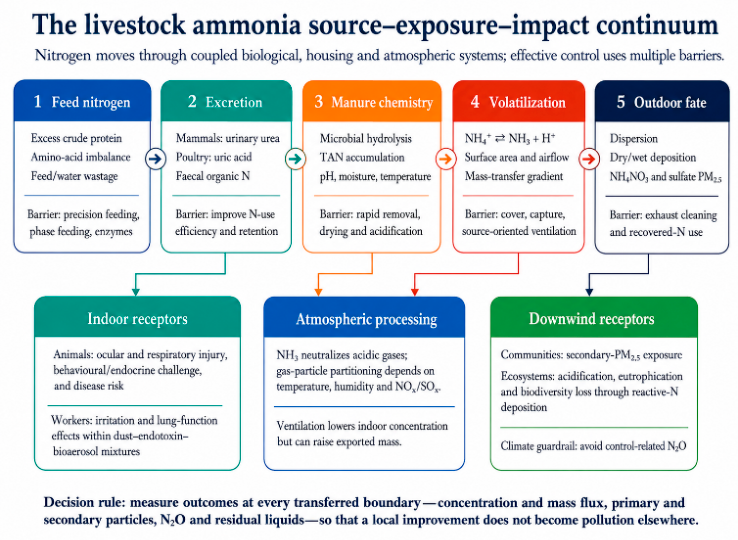
Figure 2.
Calculated equilibrium fraction of total ammoniacal nitrogen present as un-ionized NH₃ across pH at 10, 20 and 30 °C. Curves use the Emerson et al. [19] relationship. They represent thermodynamic partitioning rather than emission rate.
Figure 2.
Calculated equilibrium fraction of total ammoniacal nitrogen present as un-ionized NH₃ across pH at 10, 20 and 30 °C. Curves use the Emerson et al. [19] relationship. They represent thermodynamic partitioning rather than emission rate.
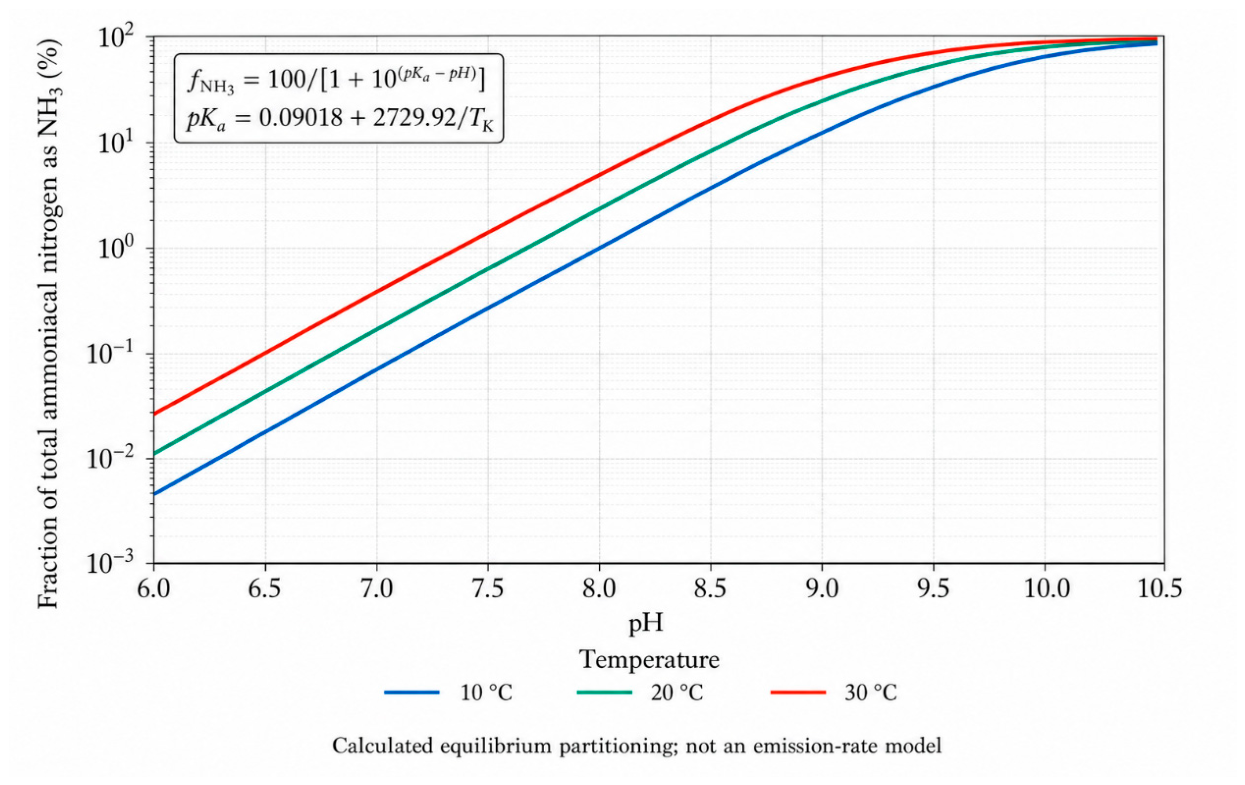
Figure 3.
Quantitative anchors demonstrating the importance of intervention context. (A) Full-cycle pig-house NH₃ emissions under amino-acid-balanced crude-protein reduction [57]. (B) Removal efficiency of a full-scale indoor sulfuric-acid scrubber prototype during controlled shop challenges [58]. (C) Concentration–duration pattern of broiler ocular injury and recovery [27]. (D) Changes in primary PM₁₀, NH₃ and odour after adapted manure-drying-tunnel operation relative to a calculated comparator [59]. Values are not directly comparable across panels.
Figure 3.
Quantitative anchors demonstrating the importance of intervention context. (A) Full-cycle pig-house NH₃ emissions under amino-acid-balanced crude-protein reduction [57]. (B) Removal efficiency of a full-scale indoor sulfuric-acid scrubber prototype during controlled shop challenges [58]. (C) Concentration–duration pattern of broiler ocular injury and recovery [27]. (D) Changes in primary PM₁₀, NH₃ and odour after adapted manure-drying-tunnel operation relative to a calculated comparator [59]. Values are not directly comparable across panels.
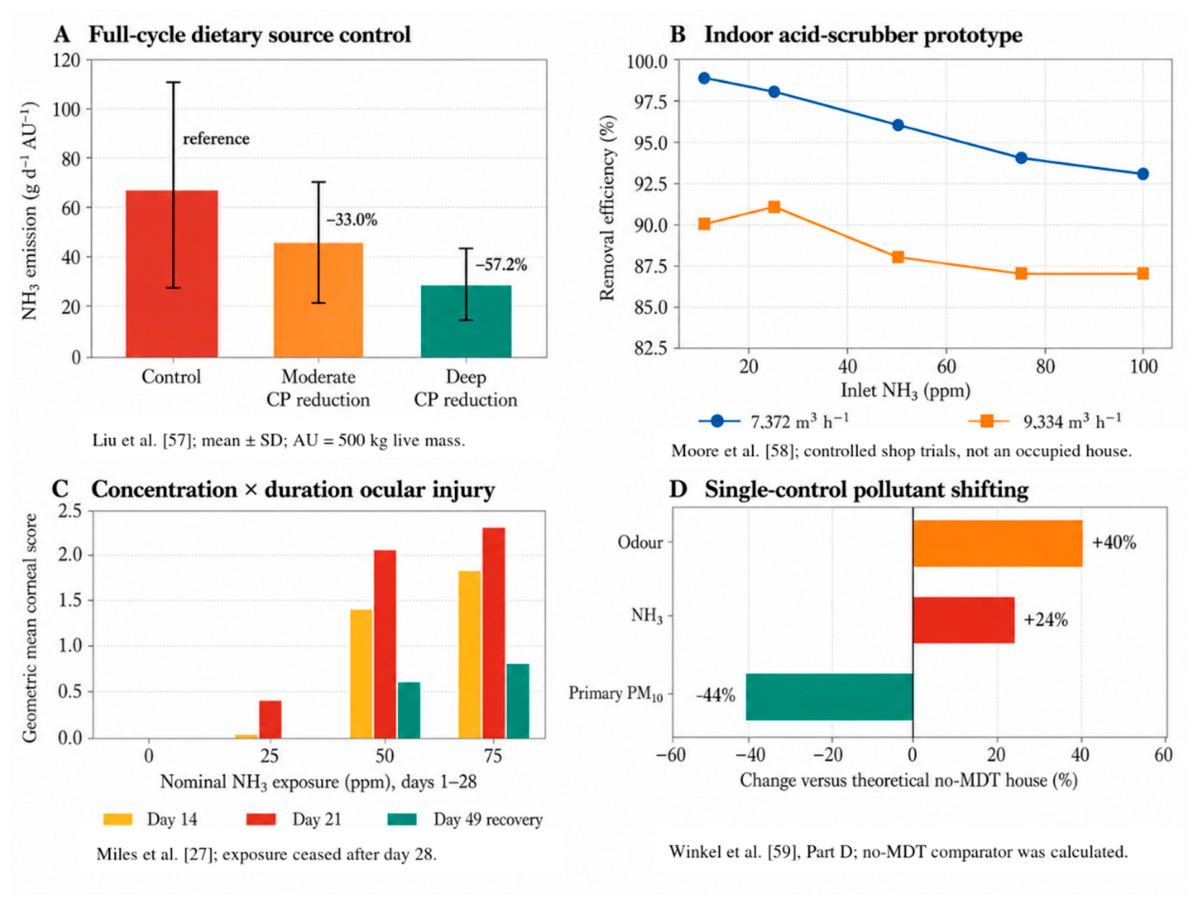

Table 1.
Measurement domains required to distinguish livestock-house concentration, facility emission, exposure and downwind impact.
Table 1.
Measurement domains required to distinguish livestock-house concentration, facility emission, exposure and downwind impact.
| Domain | Core metric | Typical units | What it answers | Required companion information |
|---|---|---|---|---|
| Indoor concentration | Time-resolved NH₃ at the animal or worker breathing zone | ppm or mg m⁻³ | Inhaled environment, peaks and duration | Location, interval, temperature, relative humidity, task, airflow and co-pollutants |
| Facility emission rate | Q(Cout − Cin) or validated dispersion flux | g NH₃ h⁻¹ or kg NH₃ d⁻¹ | Mass exported from the facility | Airflow, uncertainty, mixing, calibration and boundary definition |
| Emission factor | Emission normalized by animal place, live mass, product or time | g animal⁻¹ d⁻¹; kg animal-place⁻¹ yr⁻¹; g kg product⁻¹ | Inventory development and system comparison | Species, stage, occupancy, denominator, boundary and manure system |
| Exposure-dose proxy | Concentration × duration or time above an action level | ppm·h, TWA or peaks | Cumulative or episodic exposure | Breathing rate, individual position and repeated measurements |
| Manure source pool | TAN, TKN, manure mass, pH and dry matter | g N kg⁻¹; kg N; pH; % dry matter | Substrate available for conversion and release | Diet and intake, excreta separation, residence time and material balance |
| Atmospheric or receptor response | NH₃, NH₄⁺, nitrate/sulfate PM₂.₅ and deposition | µg m⁻³; kg N ha⁻¹ yr⁻¹ | Downwind transformation and fate | Acid precursors, meteorology, dispersion and atmospheric chemistry |
Table 2.
Mechanistic determinants of livestock NH₃ generation, their measurement consequences and principal control levers.
Table 2.
Mechanistic determinants of livestock NH₃ generation, their measurement consequences and principal control levers.
| Determinant | Mechanistic effect | Measurement implication | Primary control lever |
|---|---|---|---|
| Dietary N and amino-acid balance | Set the excretable nitrogen pool | Record analyzed diets, intake, performance and nitrogen balance | Precision and phase feeding |
| Excreta form and species | Urea, uric acid and organic N differ in conversion rate | Do not transfer coefficients between slurry and litter systems | Species-specific formulation and manure processing |
| TAN and organic N | Provide immediate and mineralizable substrate | Measure TAN, TKN and manure mass | Reduce N input; separate or remove excreta |
| pH and buffering | Higher pH increases the un-ionized NH₃ fraction | Measure spatial and temporal pH and acid demand | Safe acidification |
| Temperature | Accelerates conversion and mass transfer and shifts equilibrium | Measure manure and air temperature | Cooling where feasible and rapid processing |
| Moisture and water activity | Enable hydrolysis, microbial activity and transport | Measure litter dry matter, caking and leakage | Drinker maintenance, drying and separation |
| Residence time | Allows hydrolysis and mineralization | Report accumulation and cleanout schedules | Scraping, belts or flushing |
| Exposed area and fouling | Increase emitting surface and urine–feces contact | Include floors, pits, channels and stores | Clean floors and reduce exposed area |
| Airflow and turbulence | Alter mass transfer, mixing and dilution | Pair concentration with ventilation | Demand-responsive or source-oriented ventilation with capture |
| Storage and application | Determine whether conserved N volatilizes later | Follow nitrogen through storage and field stages | Covers, low-emission spreading, incorporation and crop timing |
Table 3.
Representative animal and human health findings and the boundaries required for causal interpretation.
Table 3.
Representative animal and human health findings and the boundaries required for causal interpretation.
| Source and population | Exposure context | Direct response | Interpretation boundary |
|---|---|---|---|
| Miles et al. [27], broilers | 0, 25, 50 or 75 ppm on days 1–28; recovery through day 49 | Concentration- and duration-dependent ocular injury; slower development at 25 ppm and incomplete high-dose recovery | Clean chamber exposure without the commercial pollutant mixture |
| Beker et al. [28], broilers | 0, 30 or 60 ppm for 21 days | Conjunctival lesions and impaired feed use at the highest exposure | Small, early-life chamber study |
| O’Connor et al. [34], pigs | Approximately 20 versus 3–4 ppm for 15 weeks with noise and light treatments | Lower cortisol, larger adrenal cortices and less early play; growth unchanged | Limited room replication and interacting environmental stressors |
| Qin et al. [35], piglets | Chronic controlled exposure | Pulmonary oxidative stress and enhanced glycolysis | Mechanistic endpoints require field validation |
| Donlon et al. [38], calves | Systematic review | Few heterogeneous studies of NH₃ and bovine respiratory disease; no defensible universal threshold | Exposure, case definitions and clustering differed |
| Donham et al. [40], swine workers | Mixed personal and area sampling; 207 workers | Exposure–response relation for respiratory dysfunction | Correlated dust and endotoxin and model uncertainty |
| Preller et al. [41], pig farmers | Personal time-weighted and mixed exposures | Lung-function associations with NH₃ and endotoxin | Cross-sectional design, selection and co-exposure |
| Senthilselvan et al. [42], poultry workers | Repeated breathing-zone monitoring | Prospective pulmonary-function changes within a changing pollutant mixture | Small sample; production stage and pollutant mixture co-varied |
| Loftus et al. [43], children with asthma | Repeated ambient 24-hour NH₃ measurements | Short-term lung-function decrement at higher NH₃ | Observational community plume mixture |
| Chamanara et al. [14], communities | National spatial analysis of animal operations and census tracts | PM₂.₅ was 28% higher in cattle-operation tracts and 11% higher in hog-operation tracts | Not an ammonia-specific or facility-level causal estimate |
Table 4.
Multi-barrier mitigation hierarchy and the measurements required to detect pollution transfer.
Table 4.
Multi-barrier mitigation hierarchy and the measurements required to detect pollution transfer.
| Barrier | Representative measures | Direct purpose or co-benefit | Failure mode | Minimum verification |
|---|---|---|---|---|
| 1. Avoid surplus N | Precision and phase feeding, digestible amino acids and reduced feed waste | Prevent source formation and improve efficiency | Amino-acid deficiency, carcass loss or cost | Analyzed diet, intake, product N, excreted N and NH₃ flux |
| 2. Interrupt conversion | Separation, clean floors, short residence, dry litter and pH control | Suppress ureolysis or uricolysis | Dust, odour, corrosion or later re-emission | TAN, TKN, pH, dry matter, manure mass and emission |
| 3. Control occupied air | Demand-responsive ventilation, source capture and breathing-zone monitoring | Manage heat, humidity, CO₂ and inhalation | Dilution without mass abatement and higher energy use | Spatial time series plus outlet mass |
| 4. Capture residual NH₃ | Acid scrubber, validated biofilter or biotrickling filter and N recovery | Lower indoor or exhaust NH₃ and recover N | Acid, energy, wastewater, fouling or N₂O | Inlet/outlet mass, uptime, residual N, energy and N₂O |
| 5. Conserve through storage and field | Covers, cooling or acidification, low-emission application and incorporation | Retain fertilizer N | N₂O, nitrate, soil, crop or fuel risks | Storage and field NH₃, N₂O, nitrate and crop recovery |
| 6. Protect residual-risk tasks | Alarms, restricted entry, respiratory protection and training | Reduce worker dose | Does not reduce the source or emission | Task exposure, fit testing, incidents and maintenance records |
Table 5.
Priority research questions and minimum designs for resolving persistent livestock-ammonia uncertainties.
Table 5.
Priority research questions and minimum designs for resolving persistent livestock-ammonia uncertainties.
| Priority question | Minimum design | Decisive outcomes |
|---|---|---|
| Does an integrated intervention bundle deliver One Health benefit? | Multi-season controlled commercial-farm trial | Animal welfare and health, personal worker exposure, barn and fence-line NH₃, PM chemistry and cost |
| Where does conserved nitrogen go? | Closed or isotope-supported feed-to-crop nitrogen balance | Product and manure N, storage and field NH₃, N₂O, nitrate and crop recovery |
| When does NH₃ reduction lower PM₂.₅? | NH₃–HNO₃–particle speciation plus perturbation modelling | Seasonal chemical regime, source–receptor response and validation |
| How large is pollution swapping? | Harmonized multi-pollutant field measurement plus life-cycle assessment | NH₃, PM, odour, CH₄, N₂O, nitrate, energy and residuals |
| What causes chronic low-level health effects? | Prospective repeated animal and worker cohorts with mixture models | Personal time series, ocular and lung endpoints, endotoxin, microbes, dust and task |
| Do prototypes remain effective in practice? | Cluster or stepped-wedge evaluation over at least one annual cycle | Removal, uptime, fouling, safety, productivity and economics |
| Can sensor networks support verification? | Traceable calibration with reference analysers and top-down checks | Drift, uncertainty, event capture and data completeness |
| Which policies support durable and equitable adoption? | Distributional cost–benefit and behavioural trials | Uptake, persistence, farm income, food cost and verified reduction |
Disclaimer/Publisher’s Note: The statements, opinions and data contained in all publications are solely those of the individual author(s) and contributor(s) and not of MDPI and/or the editor(s). MDPI and/or the editor(s) disclaim responsibility for any injury to people or property resulting from any ideas, methods, instructions or products referred to in the content. |
© 2026 by the authors. Licensee MDPI, Basel, Switzerland. This article is an open access article distributed under the terms and conditions of the Creative Commons Attribution (CC BY) license (http://creativecommons.org/licenses/by/4.0/).
Copyright: This open access article is published under a Creative Commons CC BY 4.0 license, which permit the free download, distribution, and reuse, provided that the author and preprint are cited in any reuse.