

Submitted:
06 September 2026
Posted:
08 September 2026
You are already at the latest version
Abstract
Artificial-intelligence infrastructure increasingly uses prefabricated modules, yet deployment boundaries need not match the different renewal clocks of computing and supporting assets. Here we introduce Modular Integrated AI Infrastructure (MiAI), a paradigm that co-designs physical assemblies, functional interfaces and renewal boundaries across computing, power, cooling, energy storage, communication and sensing-and-control. Drawing on modular integrated construction (MiC), multi-trade integrated mechanical, electrical and plumbing (MiMEP), and prefabricated modular data centres, MiAI combines factory integration and testing, transportable assemblies and standardized, reversible physical--digital connections to support staged deployment, selective renewal, relocation and multi-cycle reuse. It is physically modular, functionally integrated and temporally decoupled. We demonstrate its lifecycle-renewal mechanism through a differential lifecycle global-warming potential framework for compute transitions and exposed support infrastructure. Service-weighted effective retention, \(R_{\mathrm{eff}}=q\Delta r v\), combines transition-exposed support scope, additional physical retention relative to a deployment-oriented modular baseline that already retains support assets, and qualified remaining service. Favourable outcomes arise above the burden threshold, \(R_{\mathrm{eff}}>R_{\mathrm{eff}}^*\), so that retained-service credits exceed interface and transition burdens. In an illustrative normalized same-site configuration, the additional physical-retention threshold within the transition-exposed subset is \(\Delta r^*=0.20\). Combining this break-even condition with physical retention limits separates favourable, burden-dominated and physically infeasible configurations. MiAI makes the renewal boundary an explicit design object, extending modularity from how AI infrastructure is delivered to what it preserves across technology generations.
Keywords:
modular integrated AI infrastructure (MiAI)
; lifecycle modularity
; renewal boundaries
; selective renewal
; effective retention
; life-cycle assessment
1. Introduction
Modular construction has changed how infrastructure is delivered [1,2]. For artificial-intelligence (AI) infrastructure, a further design question is how modularity can support renewal across technology generations. Computing depends on power, cooling, energy storage, communication and sensing-and-control systems that must operate together to provide a reliable service. Factory-integrated computing, networking and cooling assemblies organize this physical system into transportable units for installation, commissioning and capacity expansion [3,4,5]. These delivery objectives meet a different temporal problem once infrastructure enters service. Compute equipment and supporting infrastructure have heterogeneous replacement and service-life horizons, allowing longer-lived support assets to span successive compute generations [6,7]. A technology transition can nevertheless alter their requirements before useful service is exhausted. Boundaries suited to initial deployment therefore need to be reconsidered at renewal. AI infrastructure is delivered as an integrated system, but its functions do not become obsolete together.
Existing practices provide the building blocks for addressing this mismatch. Modular integrated construction (MiC) brings factory-completed volumetric assemblies to site for lifting, placement and connection. Multi-trade integrated mechanical, electrical and plumbing (MiMEP) extends off-site coordination to building services, through prefabricated, integrated MEP assemblies and planned site connection [1,8]. Prefabricated modular data centres organize computing and cooling in deployable units, with modular architectures supporting pre-integration and staged capacity addition [3,4,5]. Lifecycle-oriented design adds principles for disassembly and adaptability, making access, reversible connections and future transformation part of initial design [9,10]. Circular-design research further links product-life extension to maintenance, upgrading and reuse [11]. Together, these practices connect construction, functional integration and planned change. The remaining architectural task is to align this capability with heterogeneous technology-renewal cycles: a module boundary that facilitates delivery does not by itself specify which assets should be reassessed, preserved or replaced when one function changes. This renewal-boundary gap links modular design to the service that infrastructure can preserve across generations.
Here we introduce Modular Integrated AI Infrastructure (MiAI), an infrastructure paradigm that co-designs the physical assemblies, functional interfaces and renewal boundaries of computing, power, cooling, energy storage, communication and sensing-and-control systems. Its interoperable physical–digital modules are factory-integrated and tested, transported and assembled on site through standardized, reversible connections, and remain identifiable and accessible for staged deployment, selective renewal, relocation and multi-cycle reuse. Drawing on the factory-first, transportable and interface-based assembly logic exemplified by MiC and MiMEP, MiAI extends modular integration from coordinated delivery to selective renewal across technology generations. Construction-and-assembly modularity determines how an assembly reaches and enters service. Functional modularity determines what service it provides and how it interoperates. Lifecycle modularity determines whether and when it can be independently renewed. MiAI is therefore physically modular, functionally integrated and temporally decoupled. Its modules are defined by the alignment of physical assembly, functional service and renewal addressability, making MiAI a system architecture.
Within this architecture, a delivery unit comprises what is manufactured, transported, installed and commissioned together; a renewal unit comprises what can be independently assessed, retained, adapted, replaced and reintegrated during a specified transition. Renewal addressability is the capacity to isolate and renew one infrastructure function while unaffected service-bearing assets remain in use. A compute transition propagates through affected power, thermal or communication interfaces, defining a transition-specific renewal boundary that can cross delivered assemblies. For example, a shift from air to liquid cooling brings coolant distribution and hydraulic connections into the assessment [6,12]. Retention decisions then depend on asset condition, compatibility and remaining service. Qualified retained service measures preservation through assets’ continued ability to meet service requirements. The resulting design question is how much additional qualified service selective renewal can preserve relative to the interface and transition burdens it requires. This makes the renewal boundary a design variable that can be evaluated before construction.
Here we establish MiAI’s delivery–renewal architecture and demonstrate its lifecycle mechanism through a differential lifecycle global-warming potential (GWP) framework. Against a deployment-oriented modular baseline that already retains support assets, we define service-weighted effective retention, , combining transition-exposed support scope, additional physical retention and service qualification. We derive the favourable condition , where the break-even threshold represents the interface and transition burdens allocated per transition. An illustrative normalized same-site configuration yields , a lifecycle-GWP difference normalized to the support-infrastructure manufacturing reference, and an additional-retention threshold of within the exposed subset. Mapping this balance against feasible retention separates favourable, burden-dominated and physically infeasible configurations, connecting lifecycle outcomes to engineering choices. A compact event-based consistency check identifies a feasible internal crossing in each of 24 schedule-and-accounting combinations. These results establish a conceptual architecture, an analytical mechanism and a bounded design space for lifecycle modularity. The transition from deployment modularity to lifecycle modularity expands the design question beyond how AI infrastructure is assembled to include what it preserves as technology changes.
2. Results
2.1. MiAI Extends Modular Integration from Deployment to Intergenerational Renewal
Modular Integrated AI Infrastructure (MiAI) organizes computing, power, cooling, energy storage, communication and sensing-and-control through co-designed physical assemblies, functional interfaces and renewal boundaries (Figure 1). We define MiAI as an infrastructure paradigm in which interoperable physical–digital modules are integrated and tested in a factory, transported and assembled on site through standardized, reversible connections, and kept identifiable and accessible for staged deployment, selective renewal, relocation and multi-cycle reuse. This definition joins three properties: MiAI is physically modular because assemblies have boundaries through which they can be manufactured, installed, isolated and exchanged; functionally integrated because the six functions operate as one service system; and temporally decoupled because each function can be renewed according to its own technology clock and qualified remaining service. MiAI is consequently a system architecture rather than an enclosure type.
Its technical genealogy joins three established lines of practice. Modular integrated construction (MiC) uses factory-completed volumetric units that are transported, lifted, placed and connected on site [1,13]. Multi-trade integrated mechanical, electrical and plumbing (MiMEP) applies off-site integration to building-service assemblies, through coordinated design, prefabrication and planned site connection [8]. Prefabricated modular data centres bring pre-integration and deployable computing and cooling units into data-centre architecture, enabling coordinated installation and staged capacity addition [3,4,5]. These delivery practices are summarized in Figure 1a. Lifecycle-oriented design contributes design-for-disassembly and adaptability principles that make later transformation an upfront design concern [9,10]. Together, these precedents supply MiAI with a factory-first workflow, transportable assemblies, front-loaded interface coordination, verified site connection and planned adaptability. MiAI reorganizes these building blocks around an additional infrastructure question: how each function remains independently addressable when technology generations change.
The six MiAI classes are defined by service across physical scales (Figure 1b). Compute modules provide processing, memory and rack-level capacity; power modules convert, protect and distribute electricity; cooling modules collect, transfer and reject heat; storage modules buffer electrical or thermal energy; communication modules transport data; and sensing-and-control modules observe and coordinate system state. A module may therefore be a rack, skid, pod, plant-room assembly or building-scale unit, and one delivered assembly may contain several functions. Standardized physical–digital interfaces connect these functions and preserve access for later renewal. A delivery unit is what is manufactured, transported, installed and commissioned together; a renewal unit is what can be independently assessed, retained, adapted, replaced and reintegrated during a specified transition. A renewal boundary may coincide with a delivery boundary, enclose part of one delivered assembly, or span several delivery units.
This distinction matters because AI infrastructure is functionally integrated but renewed on multiple clocks (Figure 1c). A published data-centre life-cycle assessment assumed a six-year server life, while its public equipment evidence records 25-year product lives for chiller and generator proxies and 30 years for a transformer proxy [6,7]. These values establish a representative timescale contrast: support assets can retain service through more than one compute generation. A compute transition can nevertheless change the requirements imposed on them. For example, a shift from air to liquid cooling changes rack-level heat collection and hydraulic topology, bringing coolant-distribution units, pipework and heat-rejection interfaces into assessment [6,12]. Compatible chillers, power equipment, structural assemblies and other unaffected assets remain candidates for continued service. The boundary of the original delivered package therefore need not be the boundary of renewal.
MiAI makes this renewal-boundary gap an explicit design object (Figure 1d). For each technology transition, the new service requirement is traced through affected interfaces to the support assets that require reassessment. The illustrated boundary crosses two delivery units while leaving parts of both outside it. Assets inside are assessed for retention, adaptation or replacement and then reintegrated; assets outside can continue in service when their condition and compatibility remain qualified. B1, the deployment-oriented modular baseline used in the quantitative comparison, already retains a non-zero share of exposed support assets. Renewal addressability is the capacity to isolate and renew one function while unaffected service-bearing assets remain in use. MiAI adds this capacity through standardized access, isolation, information and reconnection, allowing an additional share to be retained and qualified beyond B1. It standardizes interfaces without freezing the technologies inside them. This architecture directly supplies the three factors used in the lifecycle model. The affected support assets define the transition-exposed share q of the total support stock; comparison with B1 within that subset identifies the additional physical retention ; and condition, compatibility and remaining service determine the qualification factor v. Together they lead to the service-weighted effective retention formalized in Figure 2. MiAI thus aligns integrated operation with selective renewal: the infrastructure functions as one system while remaining addressable across multiple technology clocks. Its lifecycle value follows from the balance between qualified service preserved and the burdens of enabling its preservation.
2.2. Effective Retention Creates a Lifecycle Break-Even Condition
Once renewal units become independently addressable, their lifecycle value depends on the service they continue to provide rather than on the number or mass of components left in place. We therefore compared the additional qualified service retained by MiAI with that retained by B1, a deployment-oriented modular baseline, under the same compute-generation transition (Figure 2). B1 already retains a non-zero fraction, , of the support assets exposed to that transition. MiAI adds a physical-retention increment, , within the same subset, so that
Three quantities convert this physical increment into lifecycle value. The transition-exposed fraction q locates the affected subset within the total support stock; measures MiAI’s additional retention within that subset; and the service-qualification factor v represents the retained assets’ compatible, usable remaining service. Their product defines service-weighted effective retention,
the additional qualified support service retained per transition. Effective retention therefore measures usable service carried across a compute transition, rather than hardware retention alone.
The qualification factor makes this distinction operational. At , the additional retained share receives its full reference-service credit; a lower v reduces the credited share in proportion to the service that remains usable. At , physical retention contributes no qualified-service credit. Thus, two renewal designs can retain the same physical share while producing different lifecycle balances if the retained assets differ in compatibility or remaining capability. Conversely, preserving a smaller but fully qualified share can provide the same effective retention as preserving a larger share with limited remaining service. Figure 2a separates these physical and service-weighted quantities.
We balanced this retained-service credit against the burdens required to enable selective renewal. Let denote the one-off interface and enabling premium, b the burden per transition-exposed unit at each update, and N the number of compute transitions within the study horizon. With as the support-infrastructure manufacturing reference, the normalized same-site differential lifecycle global-warming potential (GWP) is
Setting gives the required effective retention per transition,
MiAI therefore produces a favourable differential when
because qualified service retained per transition then exceeds the interface and transition burden allocated to that transition.
The difference between the two sides is the net retained-service margin per transition. Multiplying it by N recovers the magnitude of the cumulative differential, with the sign reversed under the definition of g. This representation places interface investment, renewal work and preserved service on the same support-reference scale. It also distinguishes the share of assets exposed to change from the share retained within that exposure: the model first locates the renewal boundary, then evaluates the incremental service preserved inside it.
The illustrative normalized same-site configuration used , , , , , , and . MiAI consequently retained of the exposed subset, compared with 0.40 for B1. Its additional physical retention was of the total support stock, and service qualification reduced this to per transition. Across two transitions, the retained-service credit was , whereas the interface and transition burdens totalled . The resulting balance was
For this configuration, , below the achieved value of 0.1125 (Figure 2b,c). Expressed as an engineering retention requirement within the transition-exposed subset, the same crossing is
This corresponds to of the total support stock. At the crossing, MiAI retains of the exposed subset. Qualifying its additional retention gives per transition, or 0.150 over the horizon, exactly matching the enabling burdens. The selected therefore exceeds the required increment by 0.10, producing the net credit of 0.075 shown in the waterfall. The reduction equals 7.5% of the support-manufacturing reference. Because lies within the feasible interval , the central crossing is physically attainable. MiAI thus creates lifecycle value when its renewal architecture preserves enough qualified support service to repay the burdens required to make that service independently renewable. At fixed q and v, the retained-service margin increases linearly with additional retention, while the primary transition-work allocation remains fixed. Figure 2c therefore compares achieved and required service on one common scale. Extending this crossing across parameter combinations defines the bounded applicability space examined next.
2.3. Effective Retention Defines an Engineerable Lifecycle-GWP Boundary
The break-even crossing becomes an applicability space when the design variables are allowed to vary. Under the primary all-transition-exposed burden allocation, the additional-retention threshold can be written as
The required retention therefore falls as the interface premium or transition burden b is reduced, or as repeated transitions N, the transition-exposed share q or service qualification v increases. The baseline retention does not move this primary algebraic crossing, but it limits whether that crossing can be reached by setting the remaining physical capacity for additional retention.
Equation (8) also separates one-off and recurrent design effects. Repeated cycles and a wider relevant support base amortize the interface term , whereas transition work leaves a floor of that repetition alone cannot remove. A longer renewal horizon can therefore recover an efficient enabling investment, but it cannot compensate indefinitely for transition work that consumes more value at every update.
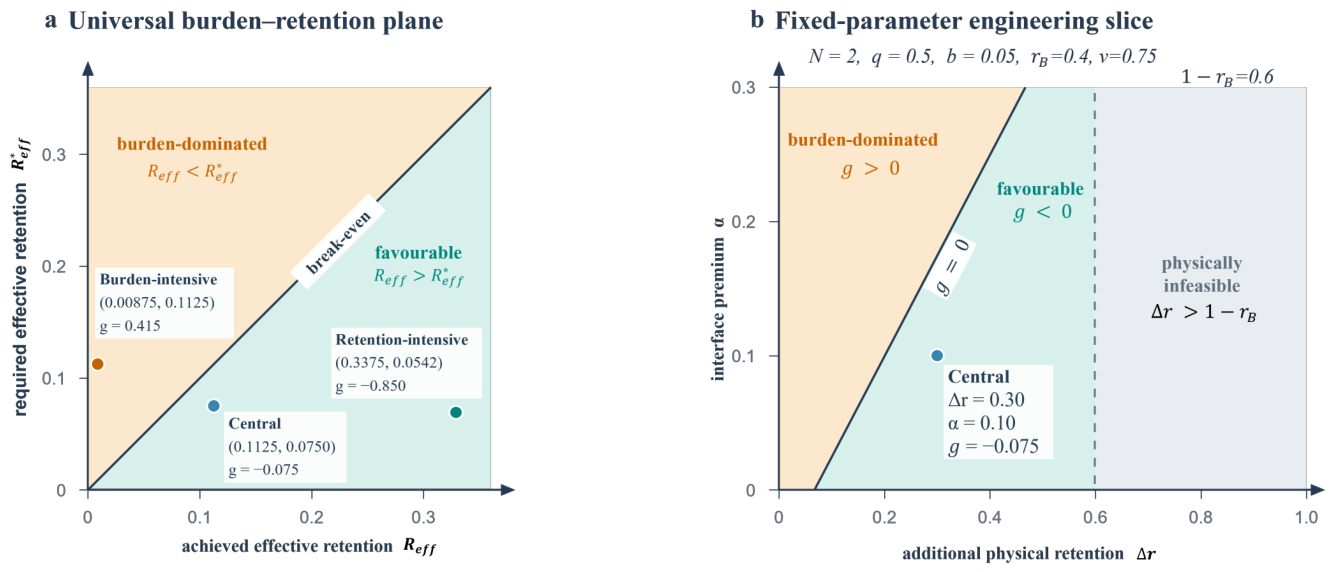
The sign of g and the physical domain divide this space into three regions (Figure 3). Within the feasible domain, configurations for which are favourable, or retention-dominated, because qualified retained service exceeds the enabling burdens. Configurations below this requirement are burden-dominated: their interface or transition burdens exceed the retained service realized over the study horizon. The third region is physically infeasible rather than unfavourable; here , so the assumed incremental retention is larger than the share not already retained by B1. The break-even line and feasibility limit thus answer different questions: whether a feasible configuration creates lifecycle value, and whether the specified retention can exist at all.
Three composite configurations show how simultaneous design choices populate the universal – plane (Figure 3a). The burden-intensive configuration combined a high interface premium and transition burden with low exposure, additional retention and service qualification; remained below , giving . The central illustrative configuration crossed into the favourable region, with and . The retention-intensive configuration moved farther into that region: exceeded , giving . Because each configuration changes several variables together, these points summarize contrasting design regimes rather than one-factor movements on the fixed-parameter slice in Figure 3b.
The boundary also retained the same physical meaning under three allocations of transition work. Charging work to all transition-exposed assets, all retained assets within the exposed subset, or only the additional assets retained by MiAI produced central additional-retention thresholds of 0.2, 0.171 and 0.143, respectively. A narrower burden allocation lowers the crossing, but each convention asks the same design question: whether the retained service attributed to MiAI is sufficient to repay the work assigned to its renewal architecture.
These movements translate the analytical map into engineering levers. The interface premium can be reduced through material-efficient standardized connections and shared utility spines, while b can be reduced through accessible joints, rapid inspection, plug-and-verify procedures and module-level commissioning. The exposed fraction q is controlled by aligning renewal boundaries with the functions that actually change. Additional retention depends on making support assets independently assessable, and v depends on condition evidence, compatibility and remaining-life verification. Interfaces and qualification therefore act directly on the position of the lifecycle boundary.
We finally tested whether an internal boundary remained identifiable when transitions were represented as discrete events and retained assets as age-tracked cohorts. Across a 15-year horizon, refresh intervals of 3, 4, 5 and 6 years generated 4, 3, 2 and 2 counted transitions, respectively. Combining these schedules with two interface-premium recurrence modes and the three burden allocations produced 24 schedule-and-accounting combinations. Every combination contained one feasible internal crossing, with . This multi-cycle consistency check shows that the burden–retention boundary persists when renewal is accounted for event by event. The differential lifecycle-GWP boundary for MiAI configurations can therefore be shifted through interface architecture, renewal isolation and retained-service qualification.
3. Discussion
3.1. The Renewal Boundary Becomes a Design Object
The decisive feature of MiAI is that physical assembly, functional integration and technological renewal are designed as one infrastructure architecture. A delivery unit organizes manufacture, transport and installation; a renewal unit specifies what can later be isolated, assessed, adapted or replaced and reintegrated. Bringing this distinction into initial design gives owners and engineers a way to anticipate how a technology transition will propagate through an integrated facility. The resulting renewal boundary can cross delivered assemblies, allowing the scope of intervention to follow changing service requirements while preserving compatible infrastructure.
The lifecycle value of modularity lies in the service preserved across technology generations, complementing the delivery value of modular packaging. Interoperable interfaces enable selective renewal; qualification determines how much of the retained stock can continue providing useful service and thereby avoid premature replacement. The comparison with B1 makes this contribution incremental: MiAI builds on retention already achievable in deployment-oriented modular infrastructure. Effective retention therefore connects a physical design choice to a service outcome. An asset contributes when its condition, compatibility and remaining capability support the next service requirement.
The balance can be read as a design principle:
Here, represents an upfront investment in future decoupling, while b is the recurring work required per exposed support-reference unit. The term measures additional qualified retained service within that exposed subset, and q scales both recurring terms to the total support stock. When , successive counted transitions help repay the initial premium. This interpretation makes the applicability boundary useful before construction: designers can compare the burden of enabling an independent renewal unit with the service it could preserve over the intended horizon. MiAI treats interface design as an investment repaid through repeated retention of useful service.
3.2. Interfaces Become Lifecycle Infrastructure
Interfaces determine whether this investment can be realized. Access, isolation, safe disconnection, adaptation and recommissioning must remain possible when one generation is replaced. Design-for-disassembly and adaptability principles provide a foundation for these provisions [9,10]. In MiAI, they can be applied to the specific transitions that compute and support functions must accommodate. Accessible joints and verifiable connection procedures can reduce transition burden, while independently assessable support assets create opportunities for additional retention. Interface design thus connects the initial assembly plan to the future scope and execution of renewal.
MiAI standardizes interfaces without freezing the technologies inside them. The relatively stable elements are the connection requirements: structural and logistical provisions, electrical and thermal operating envelopes, data-and-control exchanges, safety functions and lifecycle information. Within these envelopes, compute, storage, cooling and communication technologies can evolve. Where requirements move beyond an existing envelope, a defined adaptation path can preserve compatible parts of the support system. Compatibility windows should therefore be stated explicitly, so adaptation can be planned against a defined range of future requirements. The engineering objective is to select interface provisions that enable useful future transitions with a proportionate material and integration premium.
Physical reversibility enables a module to be removed; digital traceability supports the decision to trust, credit and reuse it. A persistent module identity should connect installation dates, service and maintenance histories, condition evidence, compatibility requirements and requalification outcomes, extending the information-continuity logic of material passports [14]. These records support estimation of v by showing what service the retained asset can still deliver. Their value depends on the underlying inspection and performance evidence. Linking the record to each renewed configuration also makes the retained-service claim reviewable when assets pass between operators, suppliers or locations.
Procurement can reinforce this architecture by specifying an infrastructure platform capable of absorbing successive technology generations. Contracts can include compatibility windows, upgrade and take-back provisions, responsibilities for recertification and redeployment, and delivery of module records. Circular-design research connects life extension and resource recovery with product and business-model choices [11]. Building on that lifecycle perspective, renewal-oriented acceptance criteria could require evidence that retained assets remain suitable after a specified transition. Assigning responsibility for inspection, adaptation and recommissioning at procurement would connect promised renewal capability to the work and evidence needed to realize it.
3.3. From Lifecycle Modularity to Field-Ready MiAI
Construction-and-assembly modularity supplies MiAI’s physical implementation, functional modularity organizes its services, and lifecycle modularity provides the cross-generation mechanism quantified here. These foundations also support a broader research programme. Capacity modularity concerns when, where and at what granularity modules are added or withdrawn. Control modularity concerns coordination among compute, power, cooling and energy storage during operation. Networked modularity concerns resource allocation, relocation and sharing across sites. Their development can build on the same principle of integrated service with independently addressable functions, extending the architecture across deployment, operation and renewal.
The analytical boundary links interface and transition burdens to the additional qualified service retained across compute generations. Field validation should populate this boundary with facility inventories and observed renewal events. Records from comparable projects can establish the exposed scope q, baseline retention and additional retention ; interface inventories and measured disassembly, inspection, adaptation and recommissioning work can determine and b. Condition, compatibility and remaining-service assessments should support retention qualification. Following these assets across successive compute generations would test whether the anticipated service is delivered, while recording costs, reliability, downtime and operational performance. This would connect the analytical boundary to observed renewal decisions and their consequences.
AI technologies can evolve through several generations while the buildings, power systems and thermal infrastructure supporting them remain serviceable. MiAI offers an architecture in which obsolete or no-longer-qualified functions can be renewed while compatible assets continue to provide useful service. It makes preservation an explicit objective of infrastructure design. The next generation of AI infrastructure should be designed for the day it is deployed and for every technology generation it must outlive.
4. Methods
4.1. Matched Differential Lifecycle Model
We evaluated lifecycle renewal using a matched comparison between MiAI and B1. The two paths deliver the same compute-supported service, follow the same compute-generation transition schedule, maintain matched operational performance and remain at the same site. We defined the differential impact as
Under these matching conditions, common compute manufacturing, common operation and the support share retained by both paths cancel from . The remaining ledger contains the interface and enabling premium introduced by MiAI, transition work incurred during renewal, and the qualified retained-service credit that MiAI adds beyond B1.
Impacts were normalized by , the manufacturing GWP of the reference support-infrastructure stock, which was set to unity in the analytical model. Hence , and , and denote a favourable differential, break-even and a burden-dominated differential, respectively. The central configuration used a 15-year horizon and a 5-year compute-refresh interval. Transitions at years 5 and 10 were counted, whereas no new transition was initiated at the terminal boundary in year 15, giving . The analytical model holds its scenario parameters constant across these transitions.
For each transition, is the share of the total support stock exposed to reassessment or replacement. Within that subset, B1 retains and MiAI retains , subject to
The additional physical retention relative to the total support stock is therefore . We used to qualify this increment for condition, compatibility, performance and usable remaining service. The effective retention per transition is , and its cumulative credit over N transitions is . Baseline retention cancels from the incremental credit but determines the physical upper bound .
The unnormalized differential ledger is
where is the one-off normalized interface and enabling premium, and is the normalized transition burden per exposed support-reference unit and transition. In this normalized formulation, one unit of qualified retained share represents avoidance of the same fraction of the support-manufacturing reference burden. Dividing Equation (12) by gives Equation (3). For , setting yields
A feasible break-even point lies in , and a strictly internal crossing requires . A zero at either endpoint is classified as endpoint break-even; otherwise, endpoint signs classify the feasible interval. For , the original ledger is evaluated directly.
The central configuration used the following parameter values:
4.2. Applicability Scenarios and Multi-Cycle Consistency Check
We mapped the normalized same-site model over deterministic scenario ranges: , , , and , with refresh intervals of 3, 4, 5 or 6 years. We evaluated the – boundary on a grid. We held , , , and at their central values, varied from 0 to 0.30 and from 0 to 1, and classified feasible cells by the sign of g. Cells with are classified as physically infeasible.
We evaluated three composite configurations in the – plane. In the order , their parameter tuples were
Each configuration was mapped to using Eqs. 2 and 4; the diagonal provides a parameter-independent classification.
We evaluated three rules for allocating transition burden. The primary convention charges all transition-exposed support assets,
The alternatives charge all retained assets within the exposed subset or only MiAI’s additional retained share:
Their closed-form thresholds are
The retention-dependent conventions require . For every convention, a strictly internal crossing requires . Endpoint zeroes are classified separately, and endpoint signs classify cases without an internal root.
The multi-cycle check used an event/cohort model with years, a 30-year support-asset service life, , , , and . Events strictly before H were counted. Refresh intervals of 3, 4, 5 and 6 years therefore produced events at years , , and , giving . For each schedule, we crossed initial-only and every-new-module premium modes with the three burden bases. Assets remain at the same site, and no support asset reaches the end of its service life during the study horizon. Under these conditions, the normalized difference reduces to
where
In the event model, remaining service is represented through cohort age and service life; the analytical model uses the scalar qualification factor v. Each of the 24 combinations was solved numerically over the feasible interval , and internal break-even points were identified from the corresponding sign change in .
References
- Abdelmageed, S.; Zayed, T. A study of literature in modular integrated construction—Critical review and future directions. J. Clean. Prod. 2020, 277, 124044. [Google Scholar] [CrossRef]
- Kamali, M.; Hewage, K. Life cycle performance of modular buildings: A critical review. Renew. Sustain. Energy Rev. 2016, 62, 1171–1183. [Google Scholar] [CrossRef]
- Hamilton, J. An Architecture for Modular Data Centers. In Proceedings of the Proceedings of the Third Biennial Conference on Innovative Data Systems Research (CIDR), Asilomar, California, USA, 2007; pp. 306–313. [Google Scholar]
- Vishwanath, K.V.; Greenberg, A.; Reed, D.A. Modular data centers: How to design them? In Proceedings of the Proceedings of the 1st ACM Workshop on Large-Scale System and Application Performance, 2009; Association for Computing Machinery; pp. 3–10. [Google Scholar]
- Ham, S.W.; Kim, M.H.; Choi, B.N.; Jeong, J.W. Energy saving potential of various air-side economizers in a modular data center. Appl. Energy 2015, 138, 258–275. [Google Scholar] [CrossRef]
- Alissa, H.; Nick, T.; Raniwala, A.; Arribas Herranz, A.; Frost, K.; Manousakis, I.; Lio, K.; Warrier, B.; Oruganti, V.; DiCaprio, T.J.; et al. Using life cycle assessment to drive innovation for sustainable cool clouds. Nature 2025, 641, 331–338. [Google Scholar] [CrossRef] [PubMed]
- Alissa, H.; Nick, T.; Sinistore, J. Life cycle assessment (LCA) tools used for “Using life cycle assessment to drive innovation for a sustainable and cool cloud” by Alissa et al. Zenodo. https://doi.org/10.5281/zenodo.14268168, 2024. Version 2; research data, https://doi.org/10.5281/zenodo.14268168. [CrossRef]
- Yan, G.; Yang, Y.; Zhang, H.; Li, Z.; Chen, S.; Zhao, X.; Sun, Z.; Fan, X.; Zhang, M.; Huang, L.; et al. A Review of Life Cycle Construction Process and Cutting-Edge Technology in Prefabricated MEP Installation Engineering. Buildings 2024, 14, 630. [Google Scholar] [CrossRef]
- Ostapska, K.; Rüther, P.; Loli, A.; Gradeci, K. Design for Disassembly: A systematic scoping review and analysis of built structures Designed for Disassembly. Sustain. Prod. Consum. 2024, 48, 377–395. [Google Scholar] [CrossRef]
- Roberts, M.; Allen, S.; Clarke, J.; Searle, J.; Coley, D. Understanding the global warming potential of circular design strategies: Life cycle assessment of a design-for-disassembly building. Sustain. Prod. Consum. 2023, 37, 331–343. [Google Scholar] [CrossRef]
- Bocken, N.M.P.; de Pauw, I.; Bakker, C.; van der Grinten, B. Product design and business model strategies for a circular economy. J. Ind. Prod. Eng. 2016, 33, 308–320. [Google Scholar] [CrossRef]
- Habibi Khalaj, A.; Halgamuge, S.K. A review on efficient thermal management of air- and liquid-cooled data centers: From chip to the cooling system. Appl. Energy 2017, 205, 1165–1188. [Google Scholar] [CrossRef]
- Pan, W.; Hon, C.K. Briefing: Modular integrated construction for high-rise buildings. Proc. Inst. Civ. Eng. – Munic. Eng. 2020, 173, 64–68. [Google Scholar] [CrossRef]
- Honic, M.; Kovacic, I.; Sibenik, G.; Rechberger, H. Data- and stakeholder management framework for the implementation of BIM-based Material Passports. J. Build. Eng. 2019, 23, 341–350. [Google Scholar] [CrossRef]
Figure 1.
MiAI shifts modular integration from delivery to intergenerational renewal. a, MiC/MiMEP and prefabricated modular data centres provide the factory-first, interface-based delivery lineage. b, Six service-defined module classes. c, Different renewal clocks allow compatible, qualified support assets to serve successive compute generations. d, Transition-specific renewal boundaries can cross delivery units, selecting compute and the exposed support share q for assessment and selective renewal while other qualified assets continue in service.
Figure 1.
MiAI shifts modular integration from delivery to intergenerational renewal. a, MiC/MiMEP and prefabricated modular data centres provide the factory-first, interface-based delivery lineage. b, Six service-defined module classes. c, Different renewal clocks allow compatible, qualified support assets to serve successive compute generations. d, Transition-specific renewal boundaries can cross delivery units, selecting compute and the exposed support share q for assessment and selective renewal while other qualified assets continue in service.
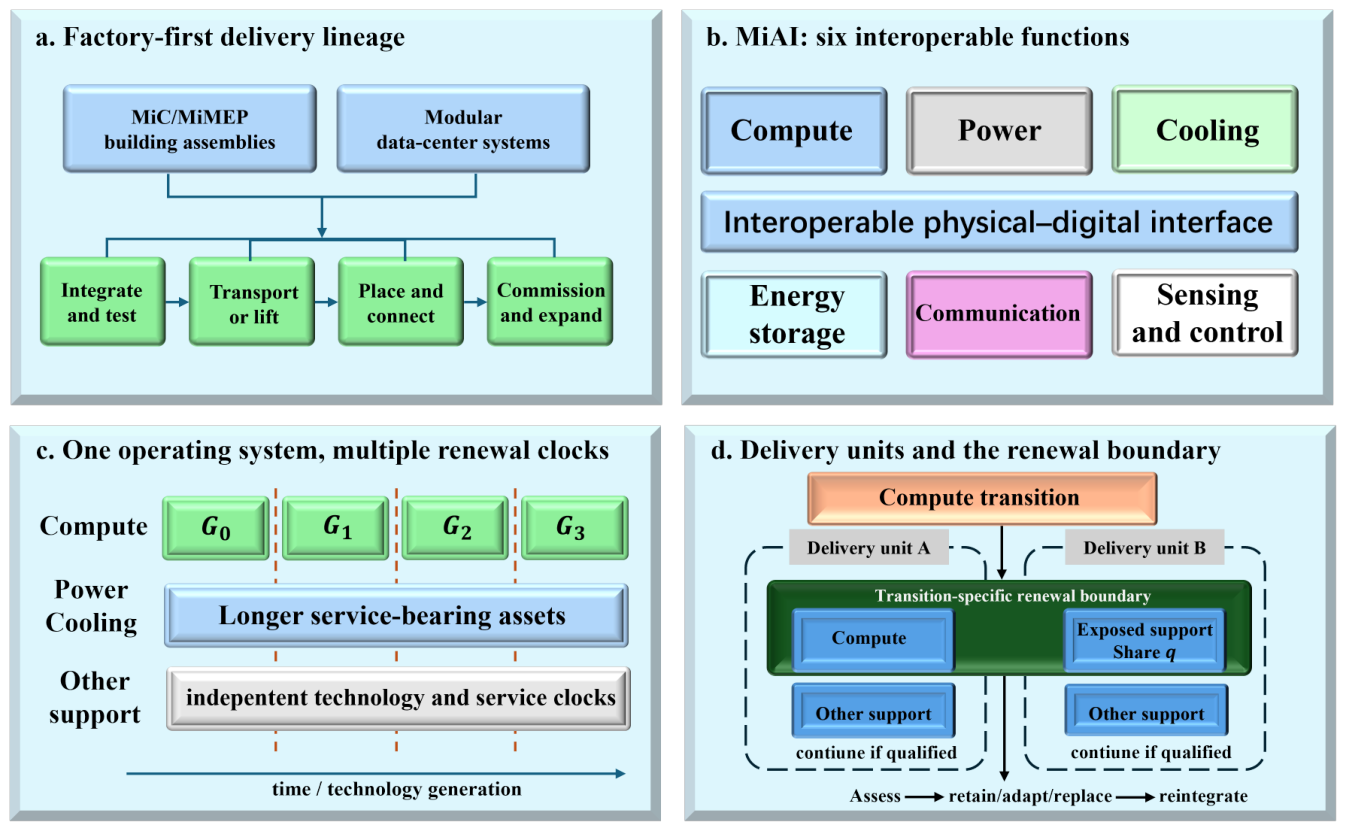
Figure 2.
Qualified retained service sets the lifecycle balance. a, MiAI adds to B1 retention within the exposed support subset; service qualification yields . b, In the illustrative normalized same-site case, cumulative retained-service credits (0.225) exceed interface and transition burdens (0.150), giving . c, Break-even occurs at , equivalent to for and ; the central is favourable.
Figure 2.
Qualified retained service sets the lifecycle balance. a, MiAI adds to B1 retention within the exposed support subset; service qualification yields . b, In the illustrative normalized same-site case, cumulative retained-service credits (0.225) exceed interface and transition burdens (0.150), giving . c, Break-even occurs at , equivalent to for and ; the central is favourable.
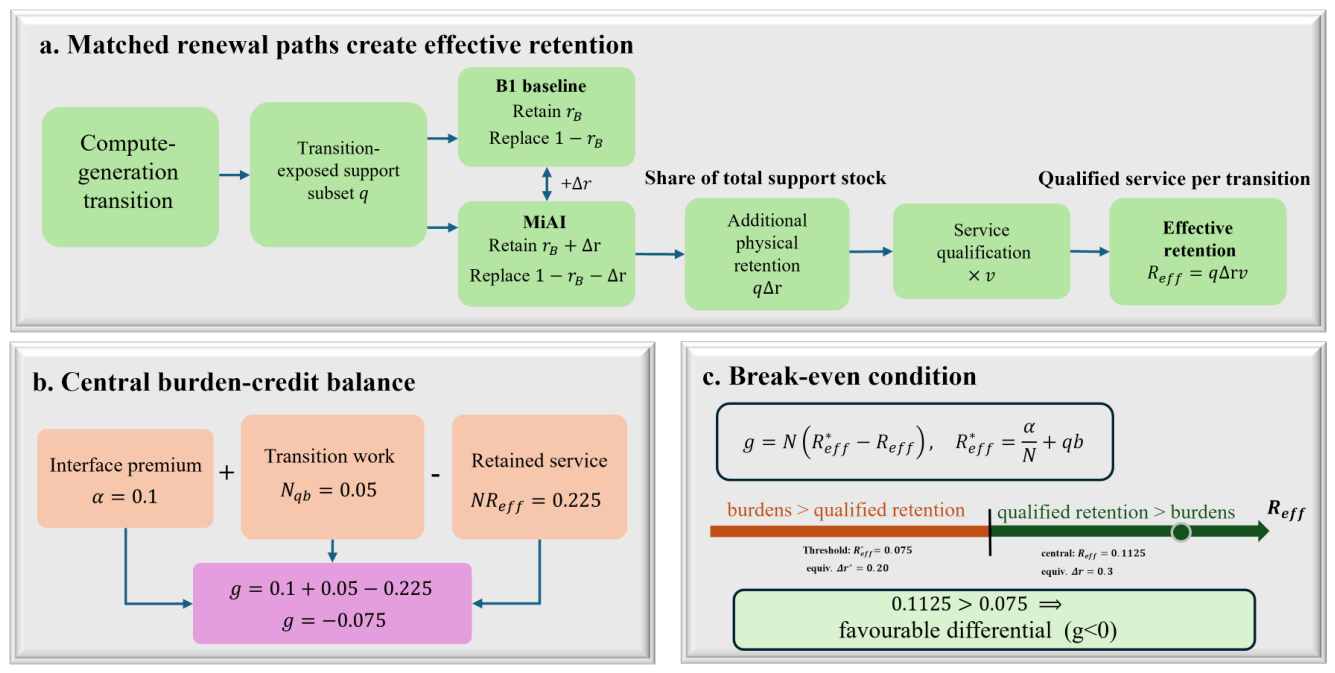
Figure 3.
Effective retention defines a bounded differential lifecycle-GWP applicability space. a, separates favourable and burden-dominated configurations. The three composite points vary multiple parameters; pairs denote . b, In the central fixed-parameter – slice, marks break-even and is physically infeasible. The central point is favourable and feasible. GWP quantities are normalized to .
Figure 3.
Effective retention defines a bounded differential lifecycle-GWP applicability space. a, separates favourable and burden-dominated configurations. The three composite points vary multiple parameters; pairs denote . b, In the central fixed-parameter – slice, marks break-even and is physically infeasible. The central point is favourable and feasible. GWP quantities are normalized to .
Disclaimer/Publisher’s Note: The statements, opinions and data contained in all publications are solely those of the individual author(s) and contributor(s) and not of MDPI and/or the editor(s). MDPI and/or the editor(s) disclaim responsibility for any injury to people or property resulting from any ideas, methods, instructions or products referred to in the content. |
© 2026 by the authors. Licensee MDPI, Basel, Switzerland. This article is an open access article distributed under the terms and conditions of the Creative Commons Attribution (CC BY) license (http://creativecommons.org/licenses/by/4.0/).
Copyright: This open access article is published under a Creative Commons CC BY 4.0 license, which permit the free download, distribution, and reuse, provided that the author and preprint are cited in any reuse.