

Submitted:
04 September 2026
Posted:
08 September 2026
You are already at the latest version
Abstract
White-fruited bitter melon (Momordica charantia L.) is a rare species of Momordica charantia L, valued for its pearl-like white pericarp. However, limited research is available regarding its supporting cultivation techniques and fruit quality. Two-season field trials were performed using ‘Kuzhongle’ as scion to evaluate the applicability of luffa rootstocks and seasonal variation in rootstock-mediated effects. Three luffa inbred lines (SS07, SS11, SS26) were screened in spring, and the superior SS26 was further compared with the commercial rootstock ’Yinzhen No.1’ in autumn. All rootstocks thickened stems, shortened internodes and promoted female flower formation in spring, with genotypically divergent influences on fruit quality. SS26 exhibited the highest survival rate and significantly enhanced soluble solid content, water content, crude protein content and vitamin C content, while reducing crude fiber content and total acid content. Seasonal comparison revealed consistent quality-modulating effects of SS26 across seasons, except for crude fiber, with a comprehensive performance comparable to the commercial rootstock. Overall, luffa rootstocks consistently modulate vegetative and flowering traits within a season, whereas their impacts on fruit quality show genotypic differences. SS26 exhibits stable and superior grafting performance, providing important material support for bitter gourd rootstock breeding research.
Keywords:
bitter melon
; fruit quality
; luffa rootstocks
; cucurbits grafting
1. Introduction
The Bitter melon (Momordica charantia L) is a widely consumed cucurbit vegetable with rich health-promoting fuctions[1]. It is valued for its superior eating and sensory qualities, exhibiting crisp flesh texture, high water content, and bitterness. Nutritionally, it is abundant in vitamin C, soluble dietary fiber, potassium, and multiple bioactive compounds such as saponin and glycosylated terpenoids, which confer outstanding health-promoting properties[2,3]. White-fruited bitter melon, a distinctive kind of cultivars, renowbale for its nearly white skin resembling white pearls[4], were found to contain significantly lower saponin concentrations (0.25%) compared to green varieties[5]. In recent years, with the breeding and popularization of new hybrid white-fruited bitter melon varieties, including ‘Quku No.1’, ’Bai yu’and ‘Kuzhongle’, the cultivation scale of white-fruited bitter melon has expanded gradually[4,6]. However, the rapid expansion of planting scale is not matched with high-efficiency supporting cultivation techniques.
Grafting, as an important asexual plant propagation technology, has been extensively applied in commercial horticulture, particularly for solanaceous and cucubitaceous vegetables [7,8,9]. This technique involves the combination of two plant components: a scion (above-ground shoot tissue) and a rootstock (underground root tissue), which fuse to form a complete new plant[10]. Benefiting from the Rootstock-derived robust roots and excellent growth vigor of scion, grafted seedlings exhibit vigorous vegetative growth [11]. This grafting practice effectively enhances crop tolerance to biotic and abiotic stresses, boosts fruit yield, optimizes comprehensive fruit quality, as well as regulates flowering and harvest periods[12,13]. Grafting has been extensively adopted in commercial bitter melon production, yet scientific information on grafting in bitter gourd is meager [14,15].
In commercial bitter melon production, Pumpkin (Cucurbita moschata) and luffa (Luffa cylindrica) seedlings serve as the predominant rootstock materials for grafting cultivation[16,17,18]. Previous studies have verified the favorable applicability of luffa rootstocks in bitter melon grafting. For instance, grafting bitter melon onto resistant luffa rootstock can effectively improve plant resistance to Fusarium wilt without causing obvious adverse impacts on fruit quality[19]. Another study demonstrated that grafting bitter melon onto luffa rootstock significantly enhance the heat tolerance of scion plants. Compared with non-grafted and self-rooted bitter melon, luffa-grafted plants exhibit elevated antioxidant capacity and higher activities of key enzymes related to carbon and nitrogen metabolism[15]. In a comprehensive rootstock screening trial, Chen et al.[16] evaluated the effects of three luffa and four pumpkin rootstocks on the yield, fruit quality, and disease resistance of ‘Lanshan’ bitter melon, and ultimately screened one optimal pumpkin rootstock and two superior luffa rootstock suitable for this cultivar. Nevertheless, current research on bitter melon grafting predominantly concentrates on improving plant stress resistance and disease tolerance. Systematic investigations regarding the regulatory effects of luffa rootstocks on the nutritional and commercial quality of grafted bitter melon remain insufficient.
Given the lack of specialized luffa rootstock techniques adaptable to white-fruited bitter melon across different growing seasons, this study adopted a two-phase field experiment. Three luffa rootstocks were initially evaluated in spring, and the best performing rootstock screened was further compared with a commercially available luffa rootstock in autumn. The study aimed to quantify grafting effects on major fruit quality traits, and provide theoretical basis and practical guidance for the sustainable high-quality production of white-fruited bitter melon.
2. Results
2.1. The Influences of Luffa Rootstocks on Survival and Growth of Grafted ‘Kuzhongle’ in Spring
As shown in Table 1, the graft survival rates of white-fruited bitter melon cv.‘Kuzhongle’grafted onto the three different luffa rootstocks were all exceeded 95.00%. Among them, SS26 exhibited the highest graft survival rate at 97.50%, whereas SS11 showed the lowest of 95.00%. The transplant field survival rates followed a descending order: SS26 (95.00%) > SS07 (90.00%) > SS11(86.67%). Compared with the ungrafted control, all three graft combinations significantly increased the scion stem diameter and reduced main vine internode length. Notably, although grafting onto SS26 significantly shortened the main vine internode length, plant height measured at 7, 14 and 21 days after transplanting remained comparable to that of the ungrafted control (Figure S1). These results suggest that rootstock SS26 facilitates robust vegetative growth of bitter melon.
2.2. The Influences of Luffa Rootstocks on Flowering Traits and External Fruit Quality of Grafted‘Kuzhongle’ in Spring
Furthermore, two flower-related traits, including the first female flower node and female flower rate, were evaluated among treatments. The results showed that the first female flower node of bitter melon cv. ‘Kuzhongle’ grafted onto different rootstocks was not significantly different from each other; however, all grafted plants exhibited significantly lower first female flower nodes than the ungrafted control (Figure 1a). The female flower rate of ungrafted plants was 40.5%, whereas grafting with rootstock SS26, SS11and SS07 elevated this value to 58.3%, 53.3% and 48.4%, respectively (Figure 1b). Since white pericarp is a distinctive fruit characteristic of white-fruited bitter melon and an important trait influencing consumer preference, we further investigated whether grafting with luffa rootstocks affect fruit skin color. Our results showed that the color parameters L*, a* and b* exhibited no significant differences among ‘Kuzhongle’ plants grafted onto different rootstocks and the non-grafted control (Figure 2a-d). Similarly, no significant differences were observed in fruit length, fruit diameter, single-fruit weight, or pedicel length across all treatments (Figure 2e-h).
2.3. The Influences of Luffa Rootstocks on Internal Fruit Quality of Grafted ‘Kuzhongle’ in Spring
Grafting with different luffa rootstocks exerted significant effects on all measured indicators of internal fruit quality in white-fruited bitter melon (Figure 3). The content of soluble solids in fruits grafted onto rootstock SS26 was significantly higher than that in fruits from all other treatments(Figure 3a). The lowest water content was detected in the the ungrafted control, which was significantly lower than that of the three grafted treatments (Figure 3b). The highest vitamin C content was determined in fruits from plants grafted on SS07 (459.7μg/g), followed by those grafted onto SS26 (354.2 μg/g). However, fruits from SS11-grafted plants had the lowest vitamin C content (172.6 μg/g), which was lower than that of the non-grafted plant (Figure 3c). The total acid content of fruits from SS11-grafted and non-grafted plants was significantly higher than that of SS07- and SS26-grafted plants (Figure 3d). The highest crude protein content was observed in SS11-grafted fruits, whereas the ungrafted control exhibited the lowest value(Figure 3e). Regarding crude fiber content, SS11-grafted fruits showed the highest level, while SS26-grafted fruits had the lowest (Figure 3f). Collectively, these results indicate that luffa rootstocks exerted differential regulatory effects on internal fruit quality traits, including soluble solids, vitamin C, acid, crude protein and crude fiber contents, in white-fruited bitter melon. Among the tested rootstocks, SS26 showed potential for improving fruit quality for fresh consumption by increasing soluble solids, water content, and vitamin C content while reducing total acid and crude fiber accumulation.
2.4. The Influences of SS26 Rootstock on Survival and Growth of Grafted‘Kuzhongle’ in Autumn
Since SS26 exhibited more super performance as a rootstock during spring cultivation, a further grafting experiment was conducted to determine the stability of its effects. Meanwhile, a commercial rootstock ‘Yinzhen No.1‘ was included as a reference for comparison. As shown in Table 2, both the graft survival rate and transplant survival rate of white-fruited bitter melon cv. ‘Kuzhongle‘ grafted onto ‘Yinzhen No.1‘ reached 100%, which were 2.67% and 8.89% higher, respectively, than those of plants grafted onto SS26. Consistent with the results obtained from spring , grafting with SS26 significantly reduced main vine internode length. Howerver, unlike the spring experiment, grafting with SS26 did not significantly affect stem diameter under the current experimental conditions. Similarly, the commercial rootstock ‘Yinzhen No.1‘ reduced main vine internode length but had no significant effect on stem diameter compared with ungrafted plants.
2.5. The Influences of SS26 Rootstock on Fruit Quality of Grafted‘Kuzhongle’ in Autumn
Different from the results obtained from the spring experiment, grafting using luffa stocks affected several fruit external traits, including fruit length, singal fruit weight and pedicel length (Figure 4 ). Ungrafted plants produced significantly longer fruits than those grafted onto SS26 and YZ rootstocks, whereas fruit diameter showed no significant differences among all treatments. The maximum single-fruit weight and pedicel length were recorded in ungrafted bitter melon plants, which were significantly greater than those of SS26 grafted plants. The YZ-grafted group displayed intermediate values for both indicators.
In autumn, SS26 and ‘Yinzhen No.1‘ exhibited similar effects on most internal fruit quality traits, including soluble solids content, water content, crude protein content and crude fiber content. The highest soluble solids content and vitamin C content were recorded in SS26-grafted plants, both of which were significantly higher than those in ungrafted control (Figure 5a). In addition, vitamin C content in SS26-grafted plants was significantly higher than that in ‘Yinzhen No.1‘-grafted plants (Figure 5c). The water content of ungrafted fruits was significantly lower than that of fruits from both SS26- and ‘Yinzhen No.1‘-grafted plants (Figure 5b). The total acid content was significantly reduced by SS26 grafting but increased by ‘Yinzhen No.1‘ grafting compared with the ungrafted control(Figure 5d). Both crude protein and crude fiber contents were highest in ‘Yinzhen No.1‘-grafted plants, followed by SS26-grafted plants, whereas the lowest values were detected in the non-grafted plants (Figure 5e and Figure 5f). These results indicate that the fruit quality-modifying effects of SS26 were largely consistent between spring and autumn cultivation, and its regulatory performance was comparable to that of the commercial rootstock ‘Yinzhen No.1‘ in terms of most fruit quality traits.
3. Discussion
Grafting is an extensively adopted technique in cucurbit production to enhance plant growth, stress adaptation and fruit yield [19,20,21]. Nevertheless, grafting commonly leads to a decline of fruit quality[22]. Previous studies have confirmed that luffa germplasm possesses excellent graft compatibility with bitter melon and serve as a dominant rootstock in bitter melon cultivation, attributed to its strong resistance to Fusarium wilt and robust tolerance to heat and waterlogging [21,23]. However, available information regarding the quality-modulating effects of luffa rootstocks on bitter melon, especially white-fruited cultivars, remains limited. In this study, three luffa rootstock genotypes (SS07, SS11, and SS26) were used to graft white-fruited bitter melon cv.‘Kuzhongle’to evaluate their differences in grafting compatibility, reproductive growth performance and fruit quality regulation. Furthermore, the elite rootstock SS26 was assayed for seasonal adaptability and compared with the commercial rootstock YZ to clarify its practical application potential and targeted production advantages in white-fruited bitter melon production.
The effectiveness of grafting largely depends on the compatibility between scion and rootstock genotypes[9,24]. In the present study, all tested luffa rootstocks exhibited high graft compatibility with white-fruited bitter melon cv. ‘Kuzhongle’, with graft survival rates exceeding 95% under spring cultivation. Among them, SS26 achieved the highest graft and transplant survival rates, reflecting superior graft affinity compared with SS07 and SS11. The enhanced survival performance of SS26 may be associated with better vascular reconnection, efficient water transport, and stronger root activity after graft union formation, which have been recognized as critical factors determining graft success in cucurbit crops[25,26]. Beyond graft survival, rootstock genotype markedly influenced vegetative architecture, flowering and fruit quality. Relative to ungrafted controls, all luffa rootstocks thickened stems and shortened internodes on the main vine, while lowering the node of the first female flower and increasing female flower proportion. Notably, SS26, which improved early plant establishment and maintained normal plant height despite shortened internodes, generated the highest female flower rate. Such regulation may be attributed to root-derived nutrient acquisition and long-distance hormonal signals transported from the rootstock as detected in other grafted vegetables[27,28]. Elevated female flower proportion represents a critical agronomic advantage for bitter melon production, as because it directly determines potential fruit setting capacity, though actual yield improvements require further field validation.
Fruit quality is a major consideration for the commercial production of grafted vegetables because rootstocks can either improve or negatively affect scion fruit characteristics [22,29]. In this study, grafting with luffa rootstocks did not alter the white pericarp color or major external fruit traits during spring cultivation, However, large genotypic differences existed for internal quality attributes. SS26 increased soluble solids, water content and vitamin C while decreasing total acid and crude fibre, jointly improving fruit tenderness, juiciness and nutritional value. The distinct effects among SS07, SS11, and SS26 further indicate that rootstock selection is a key factor determining fruit quality outcomes after grafting. Direct comparison with the commercial rootstock YZ further illuminated the practical positioning of SS26. YZ exhibited marginally higher graft-survival rates, confirming its reliable commercial graft compatibility. However, SS26 delivered comparable or superior performance for key fresh-market quality traits.SS26 produced higher soluble solids and vitamin C, whereas YZ favoured accumulation of crude protein and crude fibre. The differences between SS26 and YZ may reflect genetic variation in root system characteristics and rootstock-mediated metabolic regulation [30].
The rootstock-mediated effects exhibited by SS26 are subject to seasonal environmental fluctuations, highlighting genotype-by-environment interaction. SS26 increased stem diameter under spring conditions, whereas this vegetative advantage was not observed in autumn. Similarly, grafting showed limited effects on external fruit traits in spring but significantly influenced fruit length, single-fruit weight, and pedicel length in autumn. These differences indicate that the interaction between rootstock genotype and seasonal environmental factors may determine the final phenotype of grafted plants. Seasonal variation in temperature, solar radiation and humidity reshape root activity, mineral uptake, source-sink balance and carbohydrate partitioning, thereby reshaping grafted-plant phenotypes. Although SS26 consistently improved fresh-consumption-related fruit traits across both growing seasons, the extent of changes in external fruit quality varied between seasons. This suggests that rootstock-mediated fruit quality is controlled by both genetic and environmental factors rather than being solely determined by genotype. Previous studies have demonstrated that grafting can regulate fruit quality through modifications of mineral absorption, photosynthetic efficiency, water transport, and hormone signaling, all of which are highly responsive to environmental conditions [28,31]. Therefore, multi-season and multi-location evaluations are necessary before large-scale application of specific rootstocks.
This study provides convincing phenotypic evidence that SS26 is a promising luffa rootstock for high-quality production of white-fruited bitter melon; however, several limitations remain. First, yield-related traits were not quantified. Since yield improvement is one of the primary objectives of vegetable grafting, future studies should determine whether the increased female flower ratio and enhanced vegetative growth induced by SS26 can ultimately translate into yield advantages. Second, broader screening of luffa germplasm resources and breeding populations may facilitate the identification of rootstocks with stronger graft compatibility and quality-enhancing capacity. In addition, comparisons with widely used pumpkin rootstocks are needed to determine whether luffa rootstocks possess unique advantages for bitter melon production. Finally, the physiological and molecular mechanisms underlying SS26-mediated improvements in fruit quality remain unclear. Integrating physiological analyses with transcriptomic, metabolomic, and root system investigations will provide deeper insights into how luffa rootstocks regulate scion growth and fruit quality.
4. Materials and Methods
4.1. Plant Material and Grafting
In this study, four luffa rootstocks, including SS07, SS11, SS26 and ‘Yinzhen No. 1’, and one scion cultivar, ‘Kuzhongle’, were used. SS07, SS11 and SS26 are inbred lines and their seeds were produced and saved in Quzhou Academy of Agricultural and Forestry Sciences. The white-fruited bitter melon ‘Kuzhongle’ and the commercial rootstock ‘Yinzhen No.1’ were puchased from Letuzhongye company (Zhejiang. China) .
The experiments were conducted in 2025. Seeds were sown in the 50-cell plug trays. Before sowing, the seeds were treated by cutting the seed coat opposite the embryo site, followed by soaking in water and incubated at 30 °C for 24 hours to achieve uniform germination. The pretreated seeds were directly sown into 50-cell plug trays containing an autoclaved peat moss and perlite soil mixture (3:1, v/v) and cultivated in a climate chamber under dark condition at 28 °C. After approximately one-third of the seedlings had emerged, the conditions were adjusted to a 14 h light/10 h dark photoperiod, with temperatures of 28 °C/20 °C (day/night), a light intensity of 20,000 Lux, and relative humidity of 60-70%.
When the cotyledons of the scion seedlings had fully opened and the first true leaves of rootstock seedlings had fully unfolded, bitter gourd seedlings were grafted onto luffa rootstocks using the splice grafting method[32]. The grafted plants were maintained at a condition of approximately 95% relative humidity for five days with a day/night temperature cycle of 26 °C/18 °C. The light intensity was maintained at 3,000 Lux. Subsequently, the plants were transferred to the climate chamber for further cultivation.
4.2. Filed Growth Condition
Grafted plants were transplanted on April 10, 2025, and September, 4, 2025, in a plastic-covered greenhouse sing a double-row, high-ridge system covered with plastic film. The wide and narrow row spacings were 150 cm and 60 cm, respectively. The treatments were arranged in a randomized complete block design with three replicates, and each replicates contained 20 plants. The field trails were conducted at the Donghu Science and Technology Innovation Base of the Quzhou Academy of Agricultural Sciences, Zhejiang Province (118°01‘E, 28°14’N). Standard field management practices were used.
4.3. Graft Survival Rate and Transplant Survival Rate
The graft survival rate was assessed 10 days after the grafting. Grafted plants were regarded as survived if the scion leaves showed exhibited turgidity and obvious expansion.Fifteen days after transplanting, the transplant survival rate was calculated by counting the number of surviving plants.
Graft survival rate (%)=(survival plants number/total number of grafted plants)×100%
Transplant survival rate (%) =(survival plants number/total number of transplanted plants)×100%
4.4. Measurements of Growth- and Flower-Related Traits
Stem diameter and internode length of the main vine were measured at 40 d after transplanting. The average length from the 1st to the 10th node on the main vine was taken as the internode length. Stem diameter at 10 cm above ground was detected using a digital vernier calliper (CJW888, AIRAJ, Qingdao, China) . The node position of the first female flower borne on the main vine of bitter gourd was recorded as the first flower node. At the peak fruiting stage, the proportion of female-flower nodes among total nodes on the main vine was calculated as the female flower rate.
4.5. External Quality Measurements of Fruits
Fruits were randomly selected from the experimental area at the peak fruiting stage of bitter gourd, and the external quality factors including fruit length (cm), diameter (cm), single fruit weight (g), pedicel length (cm) and fruit color were measured. Fruit color (L*, a*, and b*) was detected using a color meter (CS-10, Color Spectrum Technology, Hangzhou, China).
4.6. Measurements of Water and Soluble Solids Content
Water content was detected using the oven drying gravimetric method according to a publicated chinese standard[33]. Soluble solids content was determined by refractometric method. A droplet of juice from mature fruit was placed over the prism of a digital pocketable refractometer PAL-1 (Atago, Guangzhou, China).Results were expressed as °Brix.
4.7. Measurements of Vitamin C Content
Vitamin C content was measured using a kit (Suzhou Keming Biotechnology Co., Ltd. Suzhou, China) based on fast blue salt B spectrophotometric method[34]. Fresh samples (0.1 g) were homogenized with 1 mL of extraction solution, then transferred to a 1.5 mL centrifuge tube. Subsequently, the samples were centrifuged at 8000 ×g for 5 min at 4℃. The resulting supernatant was assayed for vitamin C content at 420 nm according to the protocol provided with the assay kit.
4.8. Measurements of Crude Protein Content
Crude protein content was measured according to the Chinese national food-safety standard[35]. Briefly, dried fruit samples were ground and passed through a 40-mesh sieve. Approximately 0.3 g of each sample was digested with concentrated sulfuric acid and hydrogen peroxide using a graphite digestion system with a programmed heating procedure: 100 °C for 10 min, 280 °C for 10 min, and 400 °C for 40 min. After cooling, 1 mL hydrogen peroxide was added for decolorization, followed by a second digestion procedure (200 °C for 10 min, 320 °C for 30 min, 400 °C for 30 min). After cooling again, an additional 0.5 mL of hydrogen peroxide was added, and the samples were further digested (200 °C for 10 min, 320 °C for 30 min, 400 °C for 60 min) until the digestion solution became clear. The digested solutions were analyzed using an automatic Kjeldahl distillation-titration system (K1100, Haineng, Shandong, China).
4.9. Measurements of Total Acid Content
Total acid content was determined according to the Chinese national food-safety standard [36] with minor modifications for sample extraction. Briefly, 1 g of fresh sample was homogenized with 10 mL distilled water, and the homogenate was subsequntly centrifuged at 8000 ×g for 10 min at 4 °C. A volume of 0.5 mL supernatant was transferred into a small beaker and diluted with 9.5 mL of distilled water. Subsequently, 10 μL Reagent I (1% phenolphthalein indicator: 1 g phenolphthalein dissolved in a mixture of 60 mL absolute ethanol and 40 mL distilled water) was added. The mixture was titrated with 0.01 mol/L NaOH solution until a persistent faint pink colour appeared, and the consumed volume of NaOH solution was recorded.
Total acid content (%) = (VNaOH× CNaOH) × 10-3× 67 × 100) / W.
4.10. Measurements of Crude Fiber Content
Crude fiber content was measured according to the Chinese national standard[37]. Briefly, appropriate 10 g fresh sample was accurately weighed and recorded as W1. The sample was digested using 1.25% H2SO4 at 150 °C for 40 min. The residue was further digested with 50 mL of 1.25% NaOH, at 150 °C for 40 min. The mixture was filtered through six-layer gauze and the residue was washed with water until non-alkaline. The residue was washed twice with 10 mL of 95% ethanol and filtered. The obtained residue was dried at 105 °C to a constant weight, which was recorded as W2. Subsequently, the crucible containing the dried residue was incinerated in a muffle furnace at 500 °C for 3 h, and the ash weight together with crucible was recorded as W3.
Crude fiber content (%) = (W2-W3)/W1×100%
4.11. Data Analysis
Date analysis was conducted using ANOVA followed by Tukey’s test (p-value at 0.05). Data are shown as the average of three replicates. All statistical analyses were performed using SPSS package (SPSS 19.0, Chicago, IL, USA).
5. Conclusions
This study demonstrated that luffa rootstocks exhibited high graft compatibility with white-fruited bitter melon and significantly affected plant growth, flower-related traits, and fruit quality. Among the tested genotypes, SS26 showed superior grafting performance, with higher survival rates, enhanced vegetative growth, and increased female flower ratio. Moreover, SS26 consistently improved important fresh-consumption-related fruit quality traits across seasons. Compared with the commercial rootstock YZ, SS26 showed comparable graft compatibility and greater advantages in quality improvement, highlighting its potential for high-quality white-fruited bitter melon production. However, seasonal environmental variation influenced SS26-mediated effects, indicating the importance of genotype-by-environment interactions. Further studies on yield performance and underlying physiological mechanisms are needed to facilitate its broader application.
Supplementary Materials
The following supporting information can be downloaded at the website of this paper posted on Preprints.org, Figure S1: The plant height recorded in bitter melon plants grafted on various luffa stocks in spring.
Author Contributions
Conceptualization, P.F. and Q.G.; methodology, H.M.; validation, X.W. and J.W.; investigation, H.M. and H.M; resources, T.Z.; data curation, H.M. and Y.X; writing—original draft preparation, P.F; writing—review and editing, T.S. and Q.G.; visualization, H.M.; supervision, Q.G.; funding acquisition, P.F. and Q.G. All authors have read and agreed to the published version of the manuscript.
Funding
This research was funded by the China Postdoctoral Science Foundation [2025M773722], Quzhou Science and Technology Project [2024K063, 2025K177] and Zhejiang Agricultural Talents Workstation.
Data Availability Statement
All data generated or analyzed during this study are included in this published article.
Acknowledgments
We thank Zhifei Fu from Tianjin University of Traditional Chinese Medicine for her invaluable suggestions.
Conflicts of Interest
The authors declare no conflicts of interest.
References
- Renner, S.S. Bitter gourd from Africa expanded to Southeast Asia and was domesticated there: A new insight from studies. Proc. Natl. Acad. Sci. USA 2020, 117, 24630–24631. [Google Scholar] [CrossRef] [PubMed]
- Cuong, D.M.; Sathasivam, R.; Park, C.H.; Yeo, H.J.; Park, Y.E.; Kim, J.K.; Park, S.U. Analysis of triterpenoids, carotenoids, and phenylpropanoids in the flowers, leaves, roots, and stems of white bitter melon (Cucurbitaceae, Momordica charantia). Trop. J. Pharm. Res. 2021, 20, 155–160. [Google Scholar] [CrossRef]
- Xue, S.; Sajjad, M.; Zhou, M.; Xu, Y.; Luo, W.; Lin, Y.; Jin, Q.; Zheng, X.; Zhong, Y. Multi-omics study uncovered key differences in taste and nutritional quality among three distinct bitter gourd (Momordica charantia L.) cultivars. Food Chem. Mol. Sci. 2025, 11, 100308. [Google Scholar] [CrossRef] [PubMed]
- Fan, S.Y.; Wu, C.J.; Zhang, A.B. Breeding of a New Bitter Gourd Hybrid ‘Baiyu No. 3’. Acta Agric. Univ. Jiangxiensis 2002, 777–779. [Google Scholar] [CrossRef]
- Wang, Y.; Yan, L.; Xing, N.; Gu, B.; Huang, Y.; Wang, Y. Effects of grafting on the prevention of Monosporascus cannonballus and fruit quality in melon. J. Zhejiang Agric. Sci. 2021, 62, 2051–2053. [Google Scholar]
- Zhou, C. J.; Zheng, J. Breeding of a new pure white bitter gourd variety ‘Kuzhongle’. Vegetables 2020, (10), 73. [Google Scholar] [CrossRef]
- Nie, W.J.; Wen, D. Study on the Applications and Regulatory Mechanisms of Grafting on Vegetables. Plants-Basel 2023, 12. [Google Scholar] [CrossRef] [PubMed]
- He, W.; Chai, J.F.; Xie, R.; Wu, Y.; Wang, H.; Wang, Y.; Chen, Q.; Wu, Z.W.; Li, M.Y.; Lin, Y.X.; et al. The Effects of a New Citrus Rootstock Citrus junos cv. Shuzhen No. 1 on Performances of Ten Hybrid Citrus Cultivars. Plants-Basel 2024, 13. [Google Scholar] [CrossRef] [PubMed]
- Yang, W.; Zhou, J.; Yu, R.; Du, H.; Tian, M.; Guo, S.; Li, H.; Zhang, Y.; Yu, Y. Assessment of fruit quality and volatile profiles in watermelons grafted onto various rootstocks. Veg. Res. 2024, 4, e036. [Google Scholar] [CrossRef]
- Feng, M.; Augstein, F.; Kareem, A.; Melnyk, C.W. Plant grafting: Molecular mechanisms and applications. Mol. Plant 2024, 17, 75–91. [Google Scholar] [CrossRef] [PubMed]
- Tedesco, S.; Fevereiro, P.; Kragler, F.; Pina, A. Plant grafting and graft incompatibility: A review from the grapevine perspective. Sci. Hortic. 2022, 299. [Google Scholar] [CrossRef]
- Zhou, X.Z.; Wu, Y.F.; Chen, S.; Chen, Y.; Zhang, W.G.; Sun, X.T.; Zhao, Y.J. Using Cucurbita Rootstocks to educe Fusarium Wilt Incidence and Increase Fruit Yield and Carotenoid Content in Oriental Melons. Hortscience 2014, 49, 1365–1369. [Google Scholar] [CrossRef]
- Razi, K.; Suresh, P.; Mahapatra, P.P.; Al Murad, M.; Venkat, A.; Notaguchi, M.; Bae, D.W.; Prakash, M.A.S.; Muneer, S. Exploring the role of grafting in abiotic stress management: Contemporary insights and automation trends. Plant Direct 2024, 8. [Google Scholar] [CrossRef] [PubMed]
- Aslam, W.; Noor, R.S.; Hussain, F.; Ameen, M.; Ullah, S.; Chen, H. Evaluating Morphological Growth, Yield, and Postharvest Fruit Quality of Cucumber (Cucumis Sativus L.) Grafted on Cucurbitaceous Rootstocks. Agriculture-Basel 2020, 10. [Google Scholar] [CrossRef]
- Liang, H.; Zhu, J.H.; Ge, M.H.; Wang, D.H.; Liu, K.; Zhou, M.B.; Sun, Y.H.; Zhang, Q.; Jiang, K.; Shi, X.F. A Comparative Analysis of the Grafting Efficiency of Watermelon with a Grafting Machine. Horticulturae 2023, 9. [Google Scholar] [CrossRef]
- Chen, W.P.; Jiang, W.; Zhang, W.Z.; Guo, Z.J.; Huang, L.; Yang, L.Y.; Sun, X.C.; Kang, J.; Tan, Y.T.; Peng, Y.Q.; et al. Screening of Rootstock Varieties for Grafting Bitter Gourd in Summer and Autumn in Hunan Province. J. Anhui Agric. Sci. 2024, 52, 50–53+62. [Google Scholar]
- Peng, Y.; Tong, H.; Yuan, Y.; Yuan, Z.H.; Hu, X.J.; Yin, W.P. Pumpkin Rootstocks Improve the Low-temperature Resistance of Bitter Gourd through Physiological Regulation. Hortscience 2025, 60, 81–86. [Google Scholar] [CrossRef]
- Karatas, A.; Savsatli, Y. Characterization of volatile compounds nongrafted and pumpkin-grafted bitter gourd (Momordica charantia L.). Turk. J. Agric. For. 2022, 46, 327–339. [Google Scholar] [CrossRef]
- Namisy, A.; Chen, S.Y.; Sritongkam, B.; Unartngam, J.; Thanarut, C.; Chung, W.H. Evaluation of Luffa Rootstocks to Improve Resistance in Bitter Gourd (Momordica charantia L.) Against Fusarium Wilt. Plants-Basel 2025, 14. [Google Scholar] [CrossRef] [PubMed]
- Tamilselvi, N.A.; Pugalendhi, L. Studies on Effect of Grafting Technique on Growth and Yield of Bitter Gourd (Momordica Charantia L.). J. Sci. Ind. Res. 2017, 76, 654–661. [Google Scholar]
- Kavitha, M.; Sakthivel, M.; Vanitha, K.; Thangamani, C.; Raja, G.S.; Divya, K.; Rani, C.I. Advancing cucurbit production: the role of grafting in enhancing yield and quality. Plant Sci. Today 2025, 12, 6917. [Google Scholar] [CrossRef]
- Zhang, S.S.; Nie, L.C.; Zhao, W.S.; Cui, Q.; Wang, J.H.; Duan, Y.Q.; Ge, C. Metabolomic analysis of the occurrence of bitter fruits on grafted oriental melon plants. PLoS ONE 2019, 14. [Google Scholar] [CrossRef] [PubMed]
- Peng, Y.Q.; Zhu, J.; Li, W.J.; Gao, W.; Shen, R.Y.; Meng, L.J. Effects of grafting on root growth, anaerobic respiration enzyme activity and aerenchyma of bitter melon under waterlogging stress. Sci. Hortic. 2020, 261. [Google Scholar] [CrossRef]
- Ye, H.X.; Zhang, C.Y.; Wang, B.L. Effects of Grafting with Different Rootstocks on Fruit Yield and Quality of Muskmelon Under Continuous Cropping. Horticulturae 2025, 11. [Google Scholar] [CrossRef]
- Devi, P.; DeVetter, L.; Kraft, M.; Shrestha, S.; Miles, C. Micrographic View of Graft Union Formation Between Watermelon Scion and Squash Rootstock. Front. Plant Sci. 2022, 13. [Google Scholar] [CrossRef] [PubMed]
- Manoharan, B.; Vidalakis, G.; El-kereamy, A. Physiological, Environmental, and Molecular Factors Govern the Success of Grafting in Plants. J. Plant Growth Regul. 2026. [Google Scholar] [CrossRef]
- van Hooijdonk, B.; Woolley, D.; Warrington, I.; Tustin, S. Rootstocks Modify Scion Architecture, Endogenous Hormones, and Root Growth of Newly Grafted ‘Royal Gala’ Apple Trees. J. Am. Soc. Hortic. Sci. 2011, 136, 93–102. [Google Scholar] [CrossRef]
- Lal, N.; Ramteke, V.; Diwan, G.; Singh, P.; Sahu, N.; Hota, D.; Maneesha, S.R.; Meena, N.K.; Sharma, K.M.; Shiurkar, G.B.; et al. Physiological, Biochemical, and Molecular Responses During Grafting in Horticultural Crops. Plant Mol. Biol. Report. 2025, 43, 1790–1811. [Google Scholar] [CrossRef]
- Ning, K.; Zhou, W.X.; Cai, X.Q.; Yan, L.Y.; Ma, Y.C.; Xie, A.; Wang, Y.H.; Xu, P. Rootstock-Scion Exchanging mRNAs Participate in Watermelon Fruit Quality Improvement. Int. J. Mol. Sci. 2025, 26. [Google Scholar] [CrossRef] [PubMed]
- Tedesco, S.; Erban, A.; Gupta, S.; Kopka, J.; Fevereiro, P.; Kragler, F.; Pina, A. The Impact of Metabolic Scion-Rootstock Interactions in Different Grapevine Tissues and Phloem Exudates. Metabolites 2021, 11. [Google Scholar] [CrossRef] [PubMed]
- Kaleem, M.M.; Wang, L.; Cui, L.; Ateeq, M.; Ashraf, M.A.; Ahamd, M.; Bie, Z. A rootstock-oriented paradigm for fruit quality regulation in vegetables and fruit crops. Hortic. Adv. 2026, 4, 28. [Google Scholar] [CrossRef]
- Devi, P.; Lukas, S.; Miles, C. Advances in Watermelon Grafting to Increase Efficiency and Automation. Horticulturae 2020, 6. [Google Scholar] [CrossRef]
- National Health and Family Planning Commission of PRC. GB 5009.3-2016; National Food Safety Standard-Determination of Moisture in Food[S]. China Standards Press: Beijing, 2016.
- Zhang, W.D.H.; H.G. Spectrophotometric Determination of Ascorbic Acid With Fast Blue Salt B in Pharmaceutical Preparation. Chin. J. Anal. Chem. 1993, 597–600. [Google Scholar]
- National Health and Family Planning Commission of the People’s Republic of China; China National Food and Drug Administration. GB/T 5009.5-2016; Determination of protein in food[S]. China Standard Press: Beijing, 2016.
- The National Health Commission of the People’s Republic of China, State.
Figure 1.
The effects of luffa rootstocks on flower-related traits of grafted ‘Kuzhongle’ in Spring. (a) First flower node. (b) Female flower rate. Values represent the means of six plants per plot across three randomized plots ± SD. Different letters indicate significant differences (P < 0.05) according to Tukey’s test.
Figure 1.
The effects of luffa rootstocks on flower-related traits of grafted ‘Kuzhongle’ in Spring. (a) First flower node. (b) Female flower rate. Values represent the means of six plants per plot across three randomized plots ± SD. Different letters indicate significant differences (P < 0.05) according to Tukey’s test.
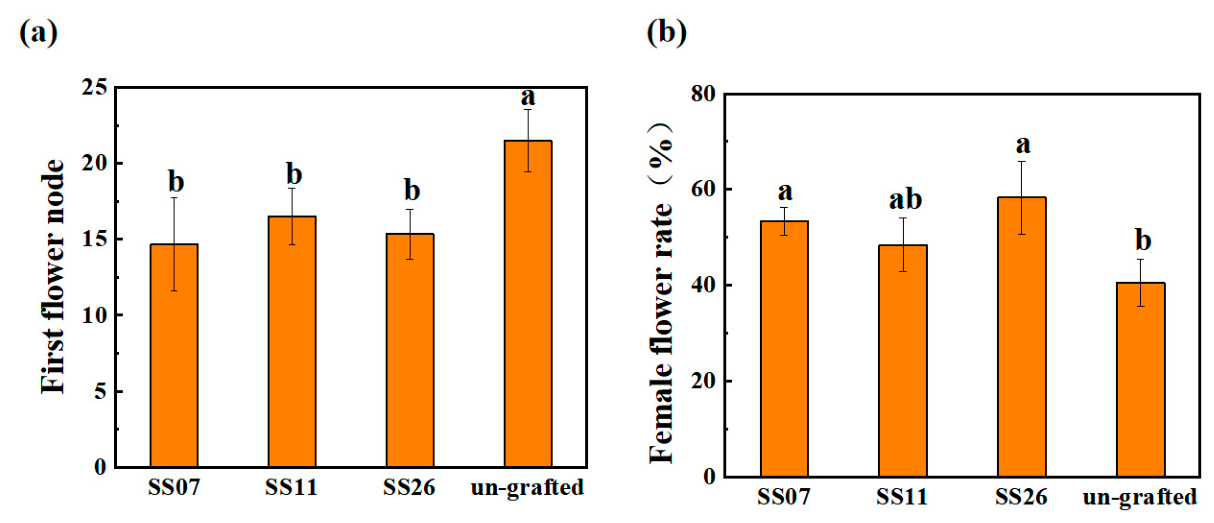
Figure 2.
The effects of luffa rootstocks on external fruit quality of grafted ‘Kuzhongle’ in Spring.(a) photos of harvest fruits; (b)-(d) L* (b), a*(c) and b*(d) detected using a color meter; (e) Fruit length; (f) Fruit diameter; (g) Single fruit weight; (h) Pedicel length. Values represent the means of six fruits per plot across three randomized plots±SD. Different letters indicate significant differences (P < 0.05) according to Tukey’s test.
Figure 2.
The effects of luffa rootstocks on external fruit quality of grafted ‘Kuzhongle’ in Spring.(a) photos of harvest fruits; (b)-(d) L* (b), a*(c) and b*(d) detected using a color meter; (e) Fruit length; (f) Fruit diameter; (g) Single fruit weight; (h) Pedicel length. Values represent the means of six fruits per plot across three randomized plots±SD. Different letters indicate significant differences (P < 0.05) according to Tukey’s test.
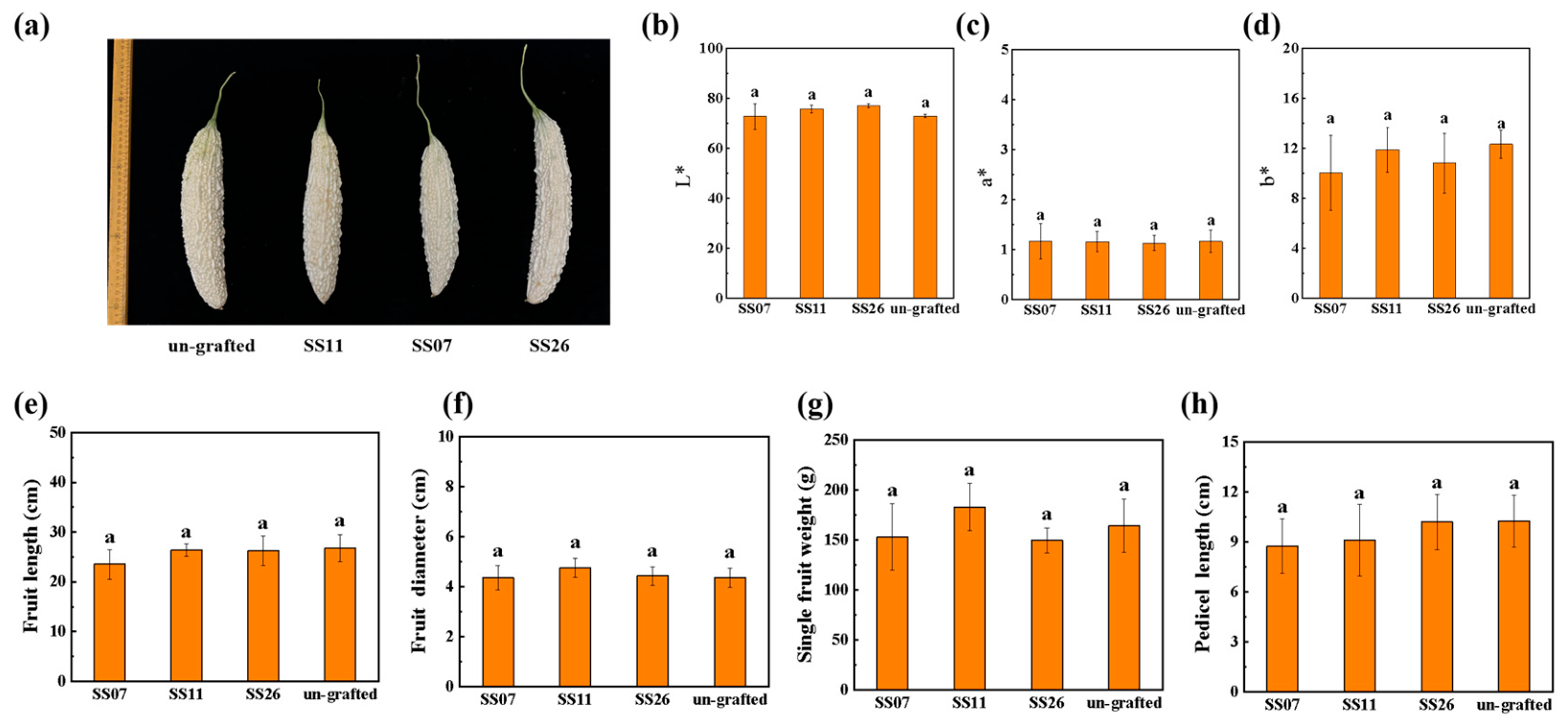
Figure 3.
The effects of luffa rootstocks on internal fruit quality of grafted ‘Kuzhongle’ in Spring. (a) Soluble solids content; (b) water content; (c) Vitamin C content; (d) Total acid content; (e) Crude protein content; (f) Crude fiber content; Values represent the means of three biological replicate ±SD. Different letters indicate significant differences (P < 0.05) according to Tukey’s test.
Figure 3.
The effects of luffa rootstocks on internal fruit quality of grafted ‘Kuzhongle’ in Spring. (a) Soluble solids content; (b) water content; (c) Vitamin C content; (d) Total acid content; (e) Crude protein content; (f) Crude fiber content; Values represent the means of three biological replicate ±SD. Different letters indicate significant differences (P < 0.05) according to Tukey’s test.
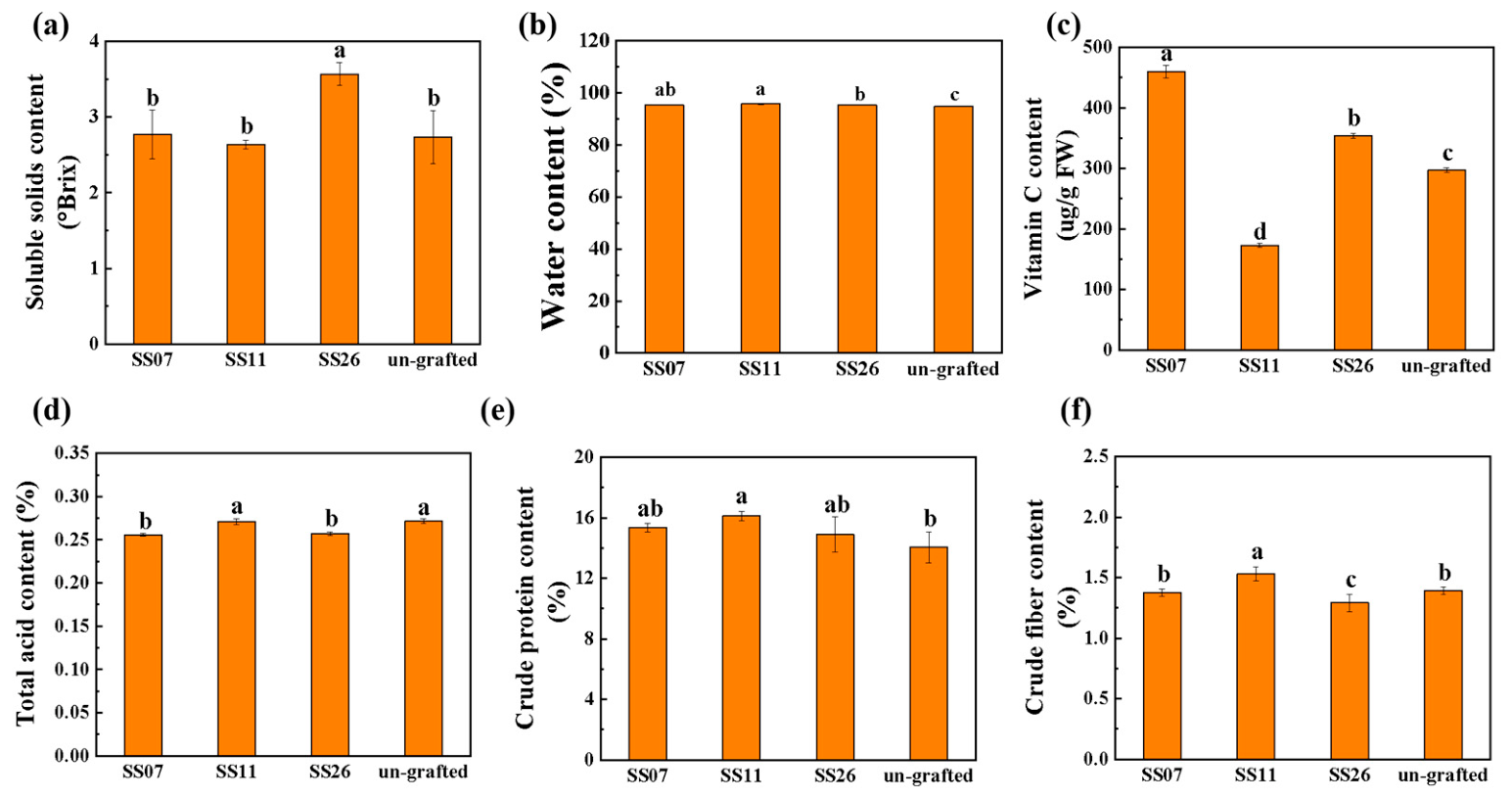
Figure 4.
The effects of luffa rootstocks on external fruit quality of grafted ‘Kuzhongle’ in Autumn. (a) photos of harvest fruits; (b)-(d) L* (b), a*(c) and b*(d) detected using a color meter; (e) Fruit length; (f) Fruit diameter; (g) Single fruit weight; (h) Pedicel length. Values represent the means of six fruits per plot across three randomized plots±SD. Different letters indicate significant differences (P < 0.05) according to Tukey’s test.
Figure 4.
The effects of luffa rootstocks on external fruit quality of grafted ‘Kuzhongle’ in Autumn. (a) photos of harvest fruits; (b)-(d) L* (b), a*(c) and b*(d) detected using a color meter; (e) Fruit length; (f) Fruit diameter; (g) Single fruit weight; (h) Pedicel length. Values represent the means of six fruits per plot across three randomized plots±SD. Different letters indicate significant differences (P < 0.05) according to Tukey’s test.
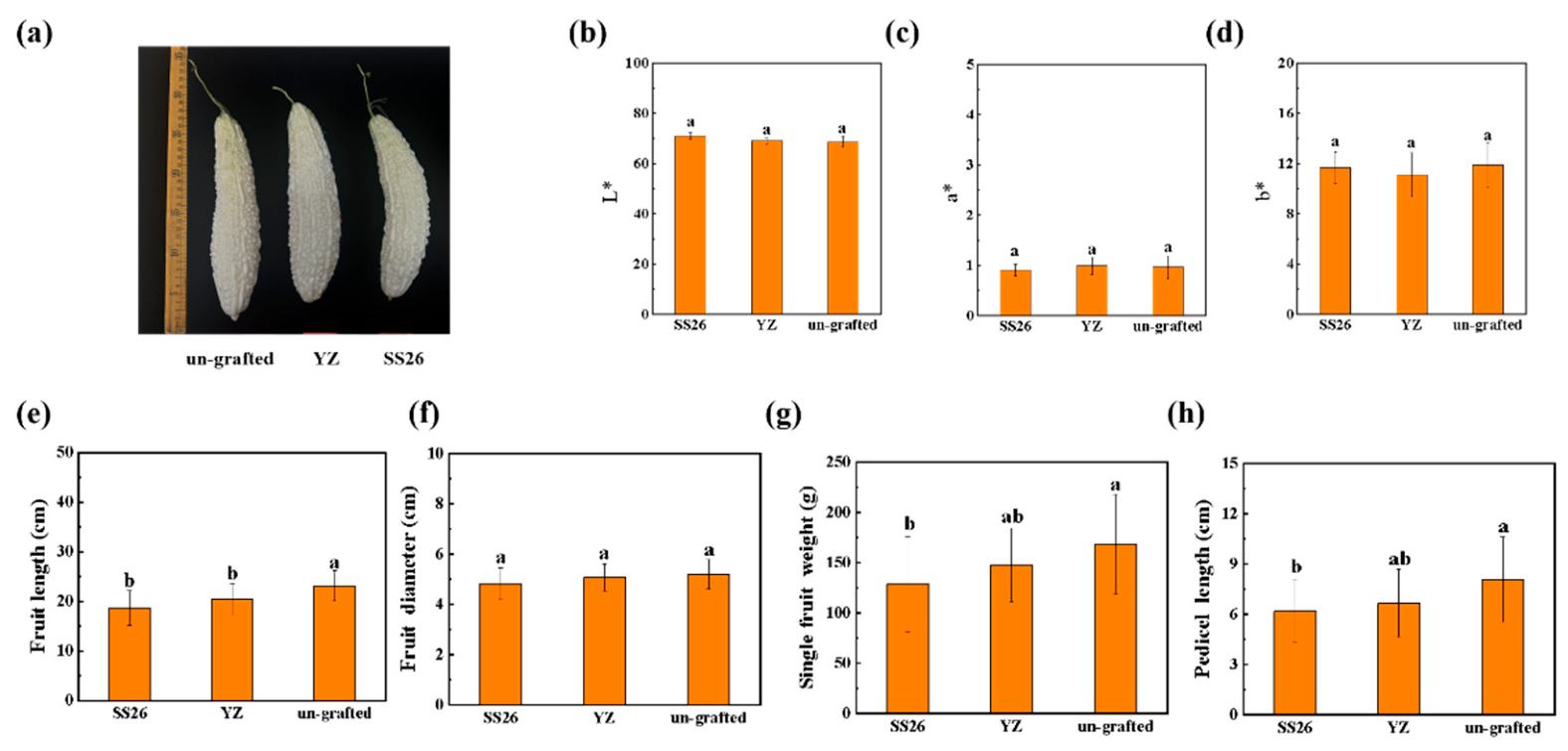
Figure 5.
The effects of luffa rootstocks on internal fruit quality of grafted ‘Kuzhongle’ in Autumn. (a) Soluble solids content; (b) water content; (c) Vitamin C content; (d) Total acid content; (e) Crude protein content; (f) Crude fiber content; Values represent the means of three biological replicate ±SD. Different letters indicate significant differences (P < 0.05) according to Tukey’s test.
Figure 5.
The effects of luffa rootstocks on internal fruit quality of grafted ‘Kuzhongle’ in Autumn. (a) Soluble solids content; (b) water content; (c) Vitamin C content; (d) Total acid content; (e) Crude protein content; (f) Crude fiber content; Values represent the means of three biological replicate ±SD. Different letters indicate significant differences (P < 0.05) according to Tukey’s test.
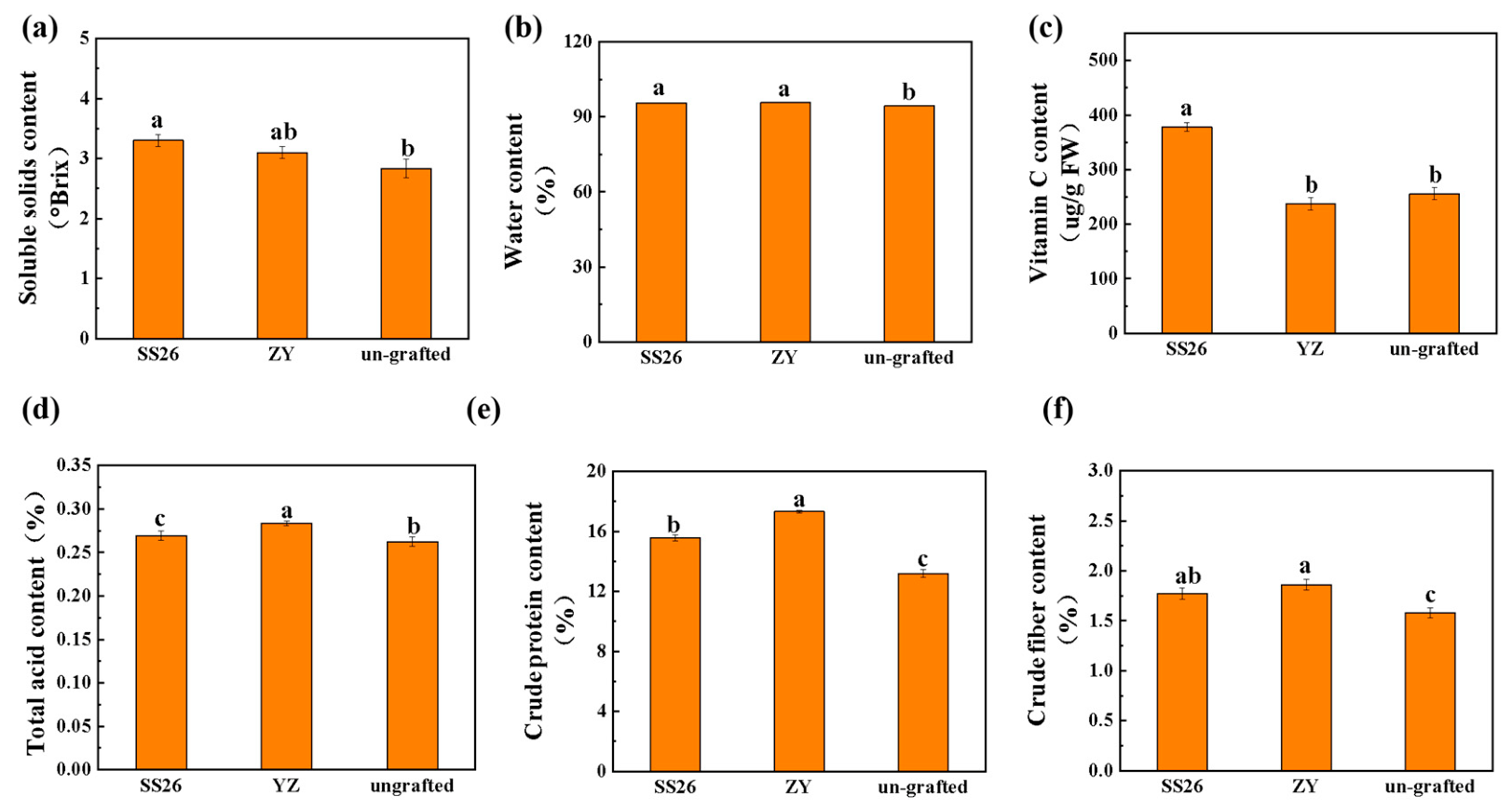

Table 1.
Evalution of scion-rootstock graft compatibility in spring season.
| Rootstock | Graft survival rate (%) | Transplant survival rate (%) | Stem diameter (mm) |
Internode length (cm) |
|---|---|---|---|---|
| SS07 | 95.00 | 90.00 | 9.26±0.12 ab | 30.11±3.98 b |
| SS11 | 96.25 | 86.67 | 9.03±0.26 b | 32.20±7.45 b |
| SS26 | 97.50 | 95.00 | 9.41±0.16 a | 33.82±4.87 b |
| un-grafted | 100 | 8.54±0.32 c | 40.77±2.98 a |
Values for Stem diameter and Internode length represent the means of six plants per plot across three randomized plots±SD. Different letters indicate significant differences (P < 0.05) according to Tukey’s test.
Table 2.
Evalution of scion-rootstock graft compatibility in autumn season.
| Rootstock | Graft survival rate (%) | Transplant survival rate (%) | Stem diameter (mm) |
Internode length (cm) |
|---|---|---|---|---|
| SS26 | 97.33 | 91.11 | 10.68±0.79 ab | 40.89±3.27 b |
| YZ |
100 | 100 | 10.71±0.25 b | 39.12±2.37 b |
| un-grafted | 10.62±0.27 a | 51.04±4.73 a |
Values for Stem diameter and Internode length represent the means of six plants per plot across three randomized plots±SD. Different letters indicate significant differences (P < 0.05) according to Tukey’s test.
Disclaimer/Publisher’s Note: The statements, opinions and data contained in all publications are solely those of the individual author(s) and contributor(s) and not of MDPI and/or the editor(s). MDPI and/or the editor(s) disclaim responsibility for any injury to people or property resulting from any ideas, methods, instructions or products referred to in the content. |
© 2026 by the authors. Licensee MDPI, Basel, Switzerland. This article is an open access article distributed under the terms and conditions of the Creative Commons Attribution (CC BY) license (http://creativecommons.org/licenses/by/4.0/).
Copyright: This open access article is published under a Creative Commons CC BY 4.0 license, which permit the free download, distribution, and reuse, provided that the author and preprint are cited in any reuse.