
Submitted:
05 September 2026
Posted:
08 September 2026
You are already at the latest version
Abstract
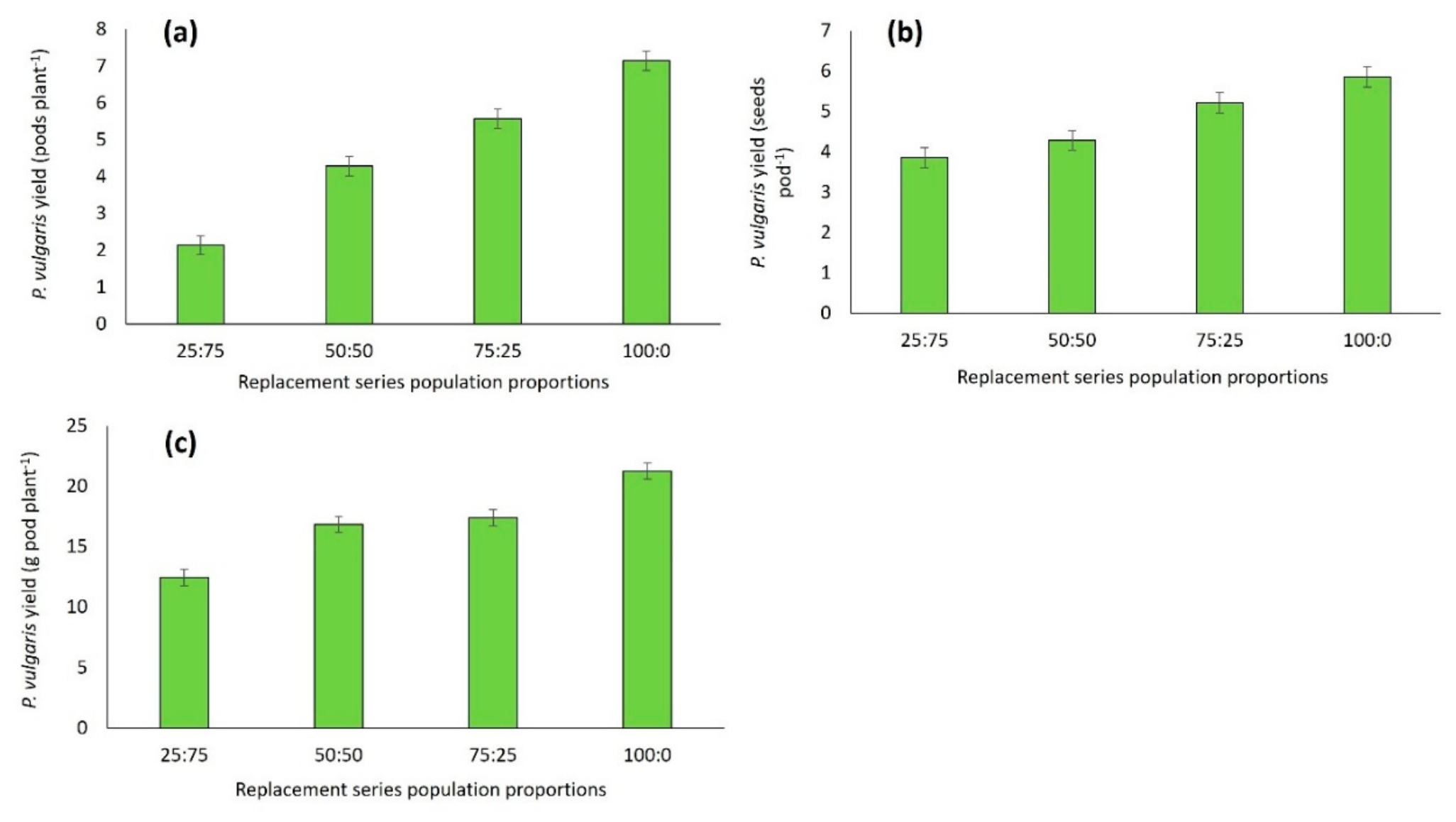
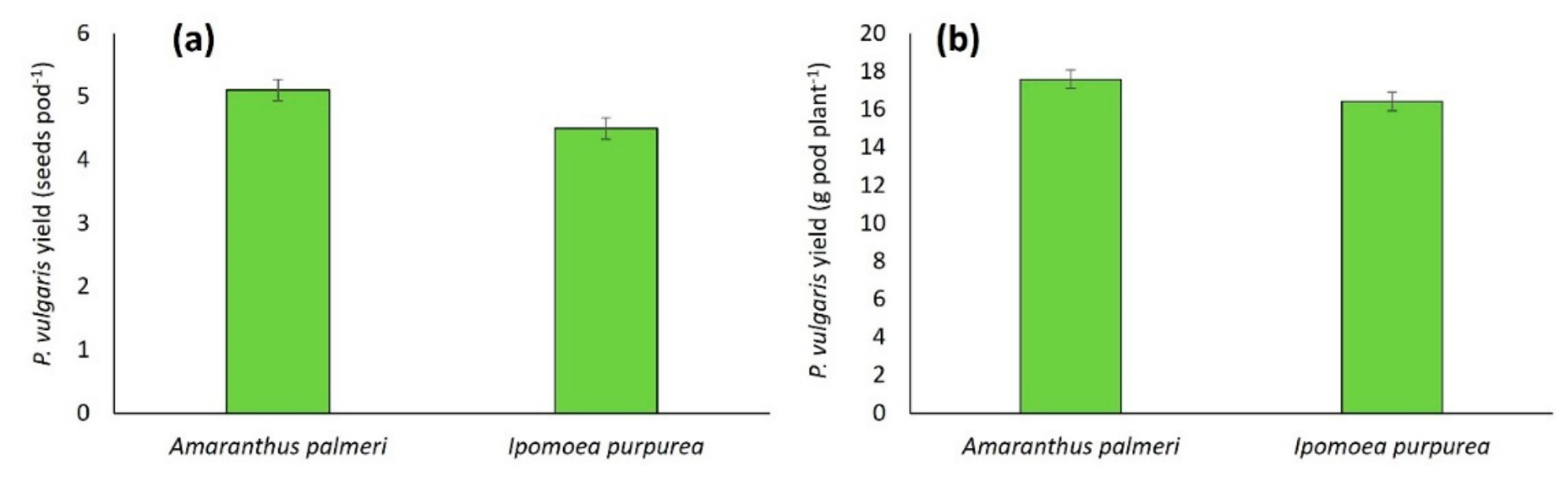
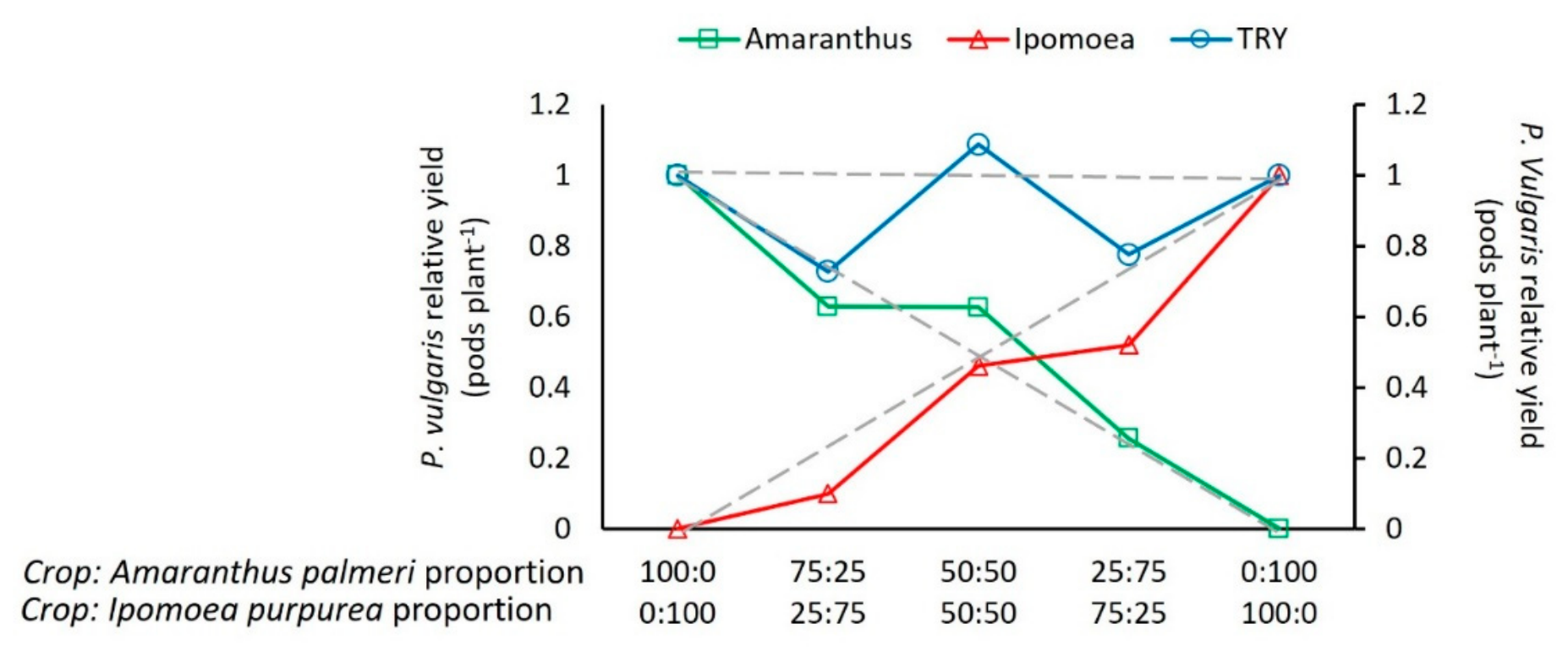
This study examines the competitive interactions between common bean (Phaseolus vulgaris L.) and two problematic weed species, Amaranthus palmeri S. Watson (Palmer amaranth) and Ipomoea purpurea L. (common morningglory), using a replacement series design. The analysis evaluates important competition indices namely relative yield (RY), total relative yield (TRY), and key growth parameters, height and biomass produced by the crop and weeds, along with common bean yield components (i.e., pods per plant, seeds per pod, and pod weight) across the varying proportions of crop-to-weed ratios (100:0, 75:25, 50:50, 25:75, and 0:100). Results demonstrate that I. purpurea exerts significantly greater competitive pressure than A. palmeri, with significant suppression of common bean yield at high weed densities. Total relative yield analysis reveals overyielding at the 50:50 proportion, suggesting niche differentiation or competitive equivalence between species. Yield component analysis indicates that weed competition primarily reduces pod number per plant, with secondary effects on seed set and pod biomass. These findings have provided insights into common bean-weed competition while exerting important implications for integrated weed management strategies in bean production systems.
Keywords:
1. Introduction
2. Materials and Methods
2.1. Plant Material and Experimental Site
2.2. Experimental Design
2.3. Data Collection and Calculations
2.4. Statistical Analysis
3. Results
3.1. Crop and Weed Growth Parameters as Affected by Replacement Series Population Proportions
3.2. Effects of Replacement Series Proportions on Total Chlorophyll Content in Bean and Weeds
3.3. Effects of Competition on Bean Yield and Yield Components at Various Replacement Series Proportions
3.4. Relative Yield and Total Relative Yield
4. Discussion
4.1. Crop and Weed Growth Parameters as Affected by Replacement Series Population Proportions
4.2. Effects of Replacement Series Proportions on Total Chlorophyll Content
4.3. Effects of Competition on Bean Yield and Yield Components at Various Replacement Series Proportions
5. Conclusions
Author Contributions
Funding
Data Availability Statement
Conflicts of Interest
Abbreviations
| RY | Relative Yield |
| TRY | Total Relative Yield |
| CRBD | Complete Randomized Block Design |
References
- Galon, L.; Balla, C.D.; Henz Neto, O.D.; Tedesco, L.; Concenço, G.; Franco, A.M.P.; Ribeiro Dos Anjos, A.D.; Dassoler, O.A.; Trezzi, M.M.; Perin, G.F. Morphophysiological and nutritional responses of bean cultivars in competition with Digitaria insularis. Plants 2025, 14, 2684. [Google Scholar] [CrossRef] [PubMed]
- Wallace, J.M.; Knezevic, S.Z.; VanGessel, M.J. Associations among weed communities, management practices, and environmental factors in U.S. snap bean (Phaseolus vulgaris) production. Agronomy 2025, 12, 2392. [Google Scholar]
- Pavlovic, P.; Colquhoun, J.B.; Korres, N.E.; Landau, C.A.; Liu, R.; Lowry, C.J.; Martin, N.F.; Peachey, E.D.; Scott, B.; Sosnoskie, L.M.; VanGessel, M.J.; Williams, M.M., Jr. Associations among weed communities, management practices, and environmental factors in US snap bean (Phaseolus vulgaris) production. PLoS ONE 2025, 20, e0332925. [Google Scholar] [CrossRef] [PubMed]
- Miranda, J.W.A.; Jhale, A.J.; Bradshaw, J.; Lawrence, N.C. Palmer amaranth (Amaranthus palmeri) interference and seed production in dry edible bean. Weed Tech. 2021, 35, 995–1006. [Google Scholar] [CrossRef]
- Mahoney, D.J.; Jordan, D.L.; Hare, A.T.; Leon, R.G.; Burgos, R.N.; Vann, M.C.; Jennings, K.M.; Everman, W.J.; Cahoon, C.W. Palmer amaranth (Amaranthus palmeri) growth and seed production when in competition with peanut and other crops in North Carolina. Agronomy 2021, 11, 1734. [Google Scholar] [CrossRef]
- Soltani, N.; Dille, J.A.; Gulden, R.H.; Sprague, C.; Zollinger, R.K.; Morishita, D.W.; Lawrence, N.C.; Sbatella, G.M.; Kniss, A.R.; Jha, P.; Sikkema, P.H. Potential yield loss in dry bean crops due to weeds in the United States and Canada. Weed Tech. 2018, 32, 342–346. [Google Scholar] [CrossRef]
- Korres, N.E.; Norsworthy, J.K.; Mauromoustakos, A. Effects of Palmer amaranth (Amaranthus palmeri) establishment time and distance from the crop row on biological and phenological characteristics of the weed: Implications on soybean yield. Weed Sci. 2019, 67, 126–135. [Google Scholar] [CrossRef]
- Korres, N.E.; Norsworthy, J.K.; FitzSimons, T.; Roberts, T.L.; Oosterhuis, D.M.; Govindjee, C. Evaluation of secondary sexual dimorphism of the dioecious Amaranthus palmeri under abiotic stress. Sci. Rep. 2023, 13, 13156. [Google Scholar] [CrossRef] [PubMed]
- Ram, B.G.; Zhang, Y.; Costa, C.; Ahmed, M.R.; Peters, T.; Jhala, A.; Howatt, K.; Sun, X. Palmer amaranth identification using hyperspectral imaging and machine learning technologies in soybean field. Comp. Electron Agri 2023, 215, 108444. [Google Scholar] [CrossRef]
- Matzrafi, M.; Scarabel, L.; Milani, A.; Iamonico, I.; Torra, J.; Recasens, J.; Montull, J.M.; Llenes, J.M.; Gazoulis, I.; Tataridas, A.; Rubin, B.; Pardo, G.; Cirujeba, A.; Mari, A.I.; Mennan, H.; Kanatas, P.; Dogan, M.N. Amaranthus palmeri S. Watson: A new threat to agriculture in Europe and the Mediterranean. Weed Res. 2023, 63, 423–438. [Google Scholar] [CrossRef]
- Ward, S.M.; Webster, T.M.; Steckel, L.E. Palmer amaranth (Amaranthus palmeri): A review. Weed Tech. 2013, 27, 12–27. [Google Scholar] [CrossRef]
- Horak, M.J.; Loughin, T.M. Growth analysis of four Amaranthus species. Weed Sci. 2000, 48, 347–355. [Google Scholar]
- Pagnoncelli, F.D.B.; Trezzi, M.M.; Brum, B.; Vidal, R.A.; Portes, A.F.; Scalcon, E.L.; Machado, A. Interference of morning glory species on soybean yield. Planta Daninha 2018, 36, e018150988. [Google Scholar] [CrossRef]
- Korres, N.E.; Norsworthy, J.K.; Brye, K.R.; Vaughn, S.J., Jr.; Mauromoustakos, A. Relationships between soil properties and the occurrence of the most agronomically important weed species in the field margins of eastern Arkansas: implications for weed management in field margins. Weed Res. 2017, 57, 159–171. [Google Scholar] [CrossRef]
- Sankula, S.; Everts, K.L.; Whalen, J.M.; VanGessel, M.J. Influence of weed species and density on lime bean yield and other pests. Front Agron. 2024, 6, 1364232. [Google Scholar] [CrossRef]
- Mircea, D.M.; Li, R.; Blasco Gimenez, L.; Vicente, O.; Sestras, A.F.; Sestras, R.E.; Boscaiu, M.; Mir, R. Salt and water stress tolerance in Ipomoea purpurea and Ipomoea tricolor, two ornamentals with invasive potential. Agronomy 2023, 13, 2198. [Google Scholar] [CrossRef]
- Radosevich, S.R. Methods to study interactions among crops and weeds. Weed Tech. 1987, 1, 190–198. [Google Scholar] [CrossRef]
- Norsworthy, J.K.; Korres, N.E.; Bagavathiannan, M.V. Weed seedbank management: Revisiting how herbicides are evaluated. Weed Sci. 2018, 66, 415–417. [Google Scholar] [CrossRef]
- Korres, N.E.; Norsworthy, J.K.; Mauromoustakos, A.; Williams, M.M. Soybean density and Palmer amaranth (Amaranthus palmeri) establishment time. Effects on weed biology, crop yield and economic returns. Weed Sci. 2020, 68, 467–475. [Google Scholar] [CrossRef]
- Cousens, R.; O'Neill, M. Density dependence of replacement series experiments. Oikos 1993, 66, 347–352. [Google Scholar] [CrossRef]
- Swanton, C.J.; Nkoa, R.; Blackshaw, R.E. Experimental methods for crop-weed competition studies. Weed Sci. 2015, 63, 2–11. [Google Scholar] [CrossRef]
- Rogers, I.S. The effect of plant density on the yield of three varieties of French beans (Phaseolus vulgaris L.). J. Hort. Sci. 1976, 51, 481–488. [Google Scholar] [CrossRef]
- Nkumbula, S. The effect of plant population, spatial arrangement and weed competition on growth and yield of dwarf beans (Phaseolus vulgaris L.). MSc Thesis, University of Canterbury, Lincoln College, UK, 1982. [Google Scholar]
- Centro Internacional de Agricultura Tropical (CIAT). Stages of Development of the Common Bean Plant. CIAT, Cali, Colombia, 1986.
- Kalaitzidis, A.; Zotou, A.; Loka, D.; Mpeza, P.; Archimandriti, P.; Korres, N.E. Effects of water stress on the morpho-physiological characteristics of Gossypium hirsutum (cotton) and Abutilon theophrasti (velvetleaf). Phyton. J. Exp. Bot. 2026, 95, 9. [Google Scholar] [CrossRef]
- Hock, S.M.; Knezevic, S.Z.; Martin, A.R. Soybean row spacing and weed emergence time influence weed competitiveness and competitive indices. Weed Sci. 2006, 54, 38–46. [Google Scholar] [CrossRef]
- Willey, R.W.; Rao, M.R. A competitive ratio for quantifying competition between intercrops. Exp. Agr. 1980, 16, 117–125. [Google Scholar] [CrossRef]
- Doubi, B.T.S.; Kouassi, K.I.; Kouakou, K.L.; Koffi, K.K.; Baudoin, J.P.; Zoro, B.I.A. Existing competitive indices in the intercropping system of Manihot esculenta Crantz and Lagenaria siceraria (Molina) Standley. J. Plant Inter 2016, 11, 178–185. [Google Scholar] [CrossRef]
- Corre-Hellou, G.; Dibet, A.; Hauggaard-Nielsen, H.; Crozat, Y.; Gooding, M.; Ambus, P.; Dahlmann, C.; von Fragstein, P.; Pristeri, A.; Monti, M.; Jensen, E.S. The competitive ability of pea-barley intercrops against weeds and the interactions with crop productivity and soil N availability. Field Crops Res. 2011, 122, 264–272. [Google Scholar] [CrossRef]
- Swanton, C.J.; Afifi, M.; Soltani, N.; Robinson, D.E. Weed-induced crop yield loss: a new paradigm and new challenges. Trends Plant Sci. 2023, 28, 312–322. [Google Scholar] [CrossRef] [PubMed]
- Zambelli, A.; Nocito, F.F.; Araniti, F. Exploring the Role of Root Exudates in Plant Interactions and Agricultural Practices. Agrosus Res. 2025, 47. [Google Scholar]
- Kong, C.H.; Zhang, S.X.; Li, Y.H.; Xia, Z.C.; Xuan, T.D.; Tan, F. Root exudate signals in plant–plant interactions. Plant Cell Environ. 2020, 43, 2831–2846. [Google Scholar] [CrossRef] [PubMed]
- Scavo, A.; Restuccia, A.; Fontanazza, S.; Abbott, L.K.; Mauromicale, G. A Framework for Understanding Crop-Weed Competition in Agroecosystems. Agronomy 2025, 15, 2366. [Google Scholar] [CrossRef]
- Gaba, S.; Fried, G.; Cazelles, B.; Delos, M.; Reboud, X. Functional trait-mediated limiting similarity shapes weed communities under competitive filtering. J. Appl. Ecol. 2024, 61, 892–903. [Google Scholar] [PubMed Central]
- Savic, A.; Popovic, A.; Đurovic, S.; Pisinov, B.; Ugrinovic, M.; Todorovic, M.J. A Framework for Understanding Crop–Weed Competition in Agroecosystems. Agronomy 2025, 15, 2366. [Google Scholar] [CrossRef]
- Hardarson, G.; Zapata, F. Effect of plant genotype and nitrogen fertilizer on symbiotic nitrogen fixation by soybean cultivars. Plant Soil 1984, 82, 397–405. [Google Scholar] [CrossRef]
- Lindemann, W.; Glover, C. Nitrogen fixation by legumes. New Mexico State University. Cooperative Extension Services. 2003. Available online: http://www.soilcropandmore.info/crops/alfalfa/Nitrogen-Fixation-by-Legumes-a-129.pdf.
- McKenzie-Gopsill, A.G.; Amirsadeghi, S.; Fillmore, S.; Swanton, C.J. Duration of weed presence influences the recovery of photosynthetic efficiency and yield in common bean (Phaseolus vulgaris L.). Front. Agron. 2020, 2, 593570. [Google Scholar] [CrossRef]
- Ronay, I.; Ephrath, J.E.; Eizenberg, H.; Blumberg, D.G.; Maman, S. Hyperspectral Reflectance and Indices for Characterizing the Dynamics of Crop–Weed Competition for Water. Remote Sens. 2021, 13, 513. [Google Scholar] [CrossRef]
- Shi, S.; Mia, H.; Du, X.; Gu, J.; Xia, K. GmSGR1, a stay-green gene in soybean (Glycine Max L.) plays an important role in regulating early leaf-yellowing phenotype and plant productivity under nitrogen deprivation. Acta Physiol. Planta 2016, 38, 97. [Google Scholar] [CrossRef]
- Gong, X.; Liu, C.; Ferdinand, U.; Dang, K.; Zhao, G.; Yang, P.; Feng, B. L. Effect of intercropping on leaf senescence related to physiological metabolism in proso millet (Panicum miliaceum L.). Photosynthetica 2019, 57, 993–1006. [Google Scholar] [CrossRef]
- Yin, W.; Chai, Q.; Fan, Z.; Hu, F.; Zhao, L.; Fan, H.; He, W.; Zhao, C.; Yu, A.; Sun, Y.; Wang, F. Review on physiological and ecological characteristics and agronomic regulatory pathways of intercropping to delay root and canopy senescence of crops. J. Integr. Agri 2025, 24, 1–22. [Google Scholar]
- Ariel, C.E.; Eduardo, O.A.; Benito, G.E.; Lidia, G. Effects of two plant arrangements in corn (Zea mays L.) and soybean (Glycine max L. Merrill) intercropping on soil nitrogen and phosphorus status and growth of component crops at an Argentinean Argiudoll. Am. J. Agri For. 2013, 1, 22–31. [Google Scholar] [CrossRef]
- Hu, F.L.; Gao, Q.Y.; Jiao, J.G.; Huang, Q.R.; Zhou, J.; Hu, F. Comparison of photosynthesis efficiency in different intercropping patterns of cassava with peanut. Agri Food Sci. 2012, 44, 332–337. [Google Scholar]
- Carvalho, S.J.P.; Christoffoleti, P.J. Competitividade de cultivares de feijoeiro com plantas de Amaranthus sp. em diferentes densidades de plantas. Planta Daninha 2008, 26, 87–97. [Google Scholar]
- Severino, L.S.; Auld, D.L. A framework for the study of the growth and development of castor plant. Ind. Crops Prod. 2013, 46, 25–38. [Google Scholar] [CrossRef]
- Wang, Z.Y.; Klessig, D.F.; Berry, J.O. Regulation of C4 gene expression in Amaranthus palmeri. Plant Physiol. 1992, 99, 863–871. [Google Scholar]
- Ehleringer, J.R.; Forseth, I.N. Solar tracking by plants. Science 1980, 210, 1094–1098. [Google Scholar] [CrossRef] [PubMed]
- Green-Tracewicz, E.; Page, E.R.; Swanton, C.J. Seed density affects the relative competitiveness of glyphosate-resistant and glyphosate-susceptible common waterhemp (Amaranthus rudis) biotypes. Weed Sci. 2011, 59, 503–510. [Google Scholar]
- Webster, T.M.; Coble, H.D. Changes in the weed species composition of the southern United States: 1974-1995. Weed Tech. 1997, 11, 308–317. [Google Scholar] [CrossRef]
- Procopio, S.D.O.; Soares, A.M.; Ferreira, L.R.; Bastos, E.A. Crescimento e acúmulo de nutrientes em cultivares de feijoeiro de porte ereto e de porte semi-prostrado. Rev. Caatinga 2004, 17, 35–42. [Google Scholar]
- Jolliffe, P.A. The replacement series. J. Ecol. 2000, 88, 371–385. [Google Scholar] [CrossRef]
- Leon, R.G.; Oreja, F.H.; Mirsky, S.B.; Reberg-Horton, C.S. Addressing biases in replacement series: The importance of reference density selection for interpretation of competition outcomes. Weed Sci. 2023, 71, 606–614. [Google Scholar] [CrossRef]

| Parameter | Description |
|---|---|
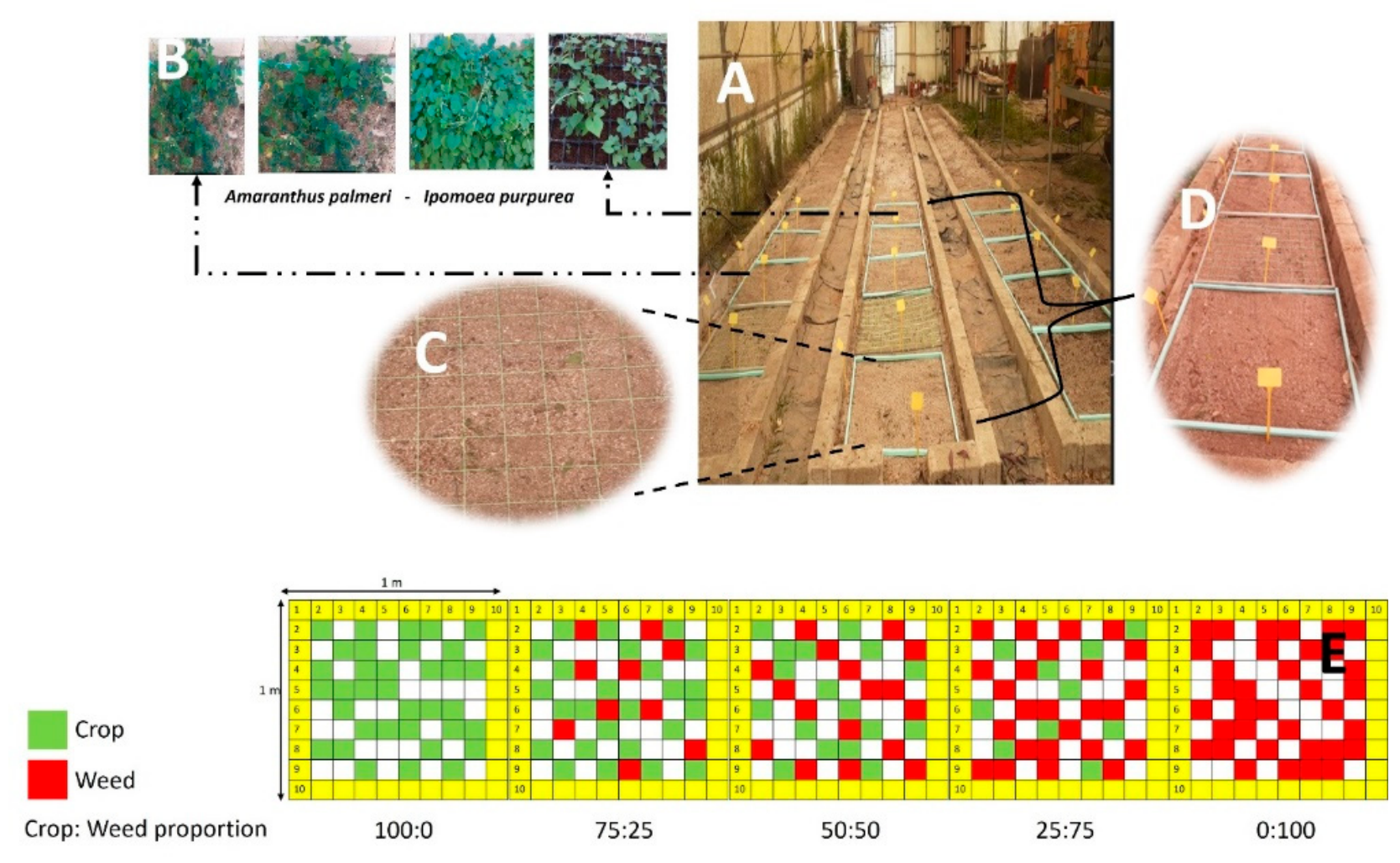
| Crop species | Phaseolus vulgaris L. (cv. Quartz, common name French bean)) |
| Weed species | Amaranthus palmeri S. Watson; Ipomoea purpurea (L.) Roth |
| Experimental design | Replacement series (de Wit, 1960) |
| Crop: weeds (A. palmeri/I. purpurea) mixture ratios | 100:0, 75:25, 50:50, 25:75, 0:100 |
| Total density | Constant at 35 plants m⁻² |
| Plot size | 1 m × 1 m |
| Replications | n = 4 (CRBD) |
| Growing season | June-October, 2025 |
| Index | Formula | Interpretation |
|---|---|---|
| Relative Yield (RY) | Ymixture / Ymonoculture | Crop yield in mixture with weeds relative to monoculture; RY = 1.0 indicates no competition effect. |
| Total Relative Yield (TRY) | RYweed absent + RYweed present | >1.0: overyielding (niche differentiation/facilitation); <1.0: under yielding (weed competition) |
| Bean: weed ratio | A. palmeri | I. purpurea | A. palmeri | I. purpurea | |
|---|---|---|---|---|---|
| Bean dry weight (g m-2) | Bean height (cm) | ||||
| 100:0 | 95.1a | 88.5a | 49.9a | 47.8a | |
| 75:25 | 68.0ab | 29.9c | 55.0a | 44.1a | |
| 50:50 | 52.5b | 19.2cd | 51.7a | 59.4a | |
| 25:75 | 31.7b | 11.8d | 59.4a | 41.3a | |
| 0:100 | No bean | No bean | No bean | No bean | |
| Bean: weed ratio | A. palmeri | I. purpurea | A. palmeri | I. purpurea |
|---|---|---|---|---|
| Dry weight (g m-2) | Height (cm) | |||
| 100:0 | No weed | No weed | No weed | No weed |
| 75:25 | 115.0cd | 205.0a | 108.0b | 192.0a |
| 50:50 | 111.0d | 207.0a | 79.1c | 193.3a |
| 25:75 | 151.9bc | 239.0a | 98.0b | 208.5a |
| 0:100 | 162.1b | 268.9a | 103.6b | 205.1a |
| Crop: weed ratio | 33 DAE | 38 DAE | 47 DAE |
|---|---|---|---|
| 100:0 | 4.78b | 8.40a | 11.80a |
| 75:25 | 3.00c | 5.80b | 8.50a |
| 50:50 | 2.50c | 4.70bc | 6.50ab |
| 25:75 | 1.50cd | 2.90c | 2.90c |
| 0:100 | No bean plants | No bean plants | No bean plants |
Disclaimer/Publisher’s Note: The statements, opinions and data contained in all publications are solely those of the individual author(s) and contributor(s) and not of MDPI and/or the editor(s). MDPI and/or the editor(s) disclaim responsibility for any injury to people or property resulting from any ideas, methods, instructions or products referred to in the content. |
© 2026 by the authors. Licensee MDPI, Basel, Switzerland. This article is an open access article distributed under the terms and conditions of the Creative Commons Attribution (CC BY) license (http://creativecommons.org/licenses/by/4.0/).