
Submitted:
05 September 2026
Posted:
07 September 2026
You are already at the latest version
Abstract
Capparis spinosa L. (caper) is a resilient, perennial xerophytic shrub widely distributed across the Mediterranean and other seasonally dry regions. Due to its remarkable physiological capacity to persist under severe water limitation and adapt to degraded, rocky soils, there is growing interest in integrating this species into diversified and sustainable agroecosystems. Beyond its ecological resilience, C. spinosa is highly valued for its deep cultural heritage and diverse phytochemical profile, which includes an array of phenolic compounds, flavonoids, glucosinolates, phytosterols, vitamins, and organic acids. However, recent literature indicates that both biological activities and phytochemical expressions vary significantly depending on the plant organ, genotype, developmental stage, environmental fluctuations, and post-harvest processing methods. Agronomic evaluations similarly reveal substantial phenotypic and metabolic variations among caper biotypes, highlighting the critical need for targeted genotype selection, optimized propagation strategies, and site-specific management. Implementing efficient water conservation practices, bio-inputs, sustainable harvesting, and advanced valorization techniques (such as controlled fermentation and drying) can further maximize resource-use efficiency and economic viability. This review synthesizes current scientific evidence regarding the historical heritage, physiological and biochemical abiotic-stress responses, agronomic dynamics, and phytochemical characteristics of C. spinosa. Particular emphasis is placed on distinguishing individual physiological persistence from systemic agronomic productivity, while integrating the interactions between genotype, environment, management, and product quality to support the sustainable cultivation of caper in vulnerable marginal lands.
Keywords:
Capparis spinosa
; caper
; marginal lands
; drought tolerance
; salinity stress
; sustainable agriculture
; phytochemical composition
; crop diversification
; physiological adaptation
1. Introduction
Capparis spinosa L. (Capparaceae), commonly known as caper, is a perennial, salt- and drought-tolerant xerophytic shrub characterized by rounded, fleshy leaves and large white to pinkish-white flowers. This resilient species is widely distributed across the Mediterranean basin and other warm, seasonally dry regions worldwide, including the Mediterranean and Aegean regions of Turkey and the Middle East. It typically thrives in rocky, disturbed, and nutrient-poor habitats, demonstrating a remarkable capacity to persist under high temperatures, intense solar radiation, and severe seasonal water limitations [1,2,3,4]. These ecological traits, combined with a rich history of dietary and medicinal applications, have intensified scientific interest in C. spinosa as a strategic component for diversified agricultural systems in environmentally constrained regions [3,4,5,6].
The agricultural potential of C. spinosa is deeply rooted in its capacity to maintain metabolic homeostasis under environmental conditions that severely restrict conventional crop production. Its perennial growth habit, extensive root architecture, strict stomatal regulation, osmotic adjustments, and coordinated antioxidant networks collectively drive its survival under extreme water deficits. Drought stress induces dynamic modifications in antioxidant enzyme activities, osmolyte accumulation, and photosynthetic pigment stability. These adjustments indicate that persistence under water limitations is governed by active physiological defense mechanisms rather than a passive absence of stress effects. Similarly, the natural occurrence of C. spinosa in arid and salinity-affected zones highlights its potential for marginal land restoration. However, adaptations to drought and salinity must be interpreted as a physiological capacity for long-term persistence rather than evidence of unrestricted vegetative growth or stable agronomic productivity under prolonged stress [9,10,11].
This critical distinction between individual stress adaptation and broad agronomic productivity is paramount when evaluating C. spinosa as a viable crop for marginal lands. Factors such as seedling establishment, biomass accumulation, flower-bud yield, bio-product quality, and resource-use efficiency fluctuate heavily based on genotype, plant age, propagation methods, soil properties, macroclimate variations, and field management practices. Significant phenotypic variation among C. spinosa populations has been reported across morphological, agronomic, physiological, and phytochemical traits. This intra-specific diversity poses distinct challenges for production standardization while simultaneously offering valuable opportunities to select superior, climate-adapted ideotypes [12,13,14,15]. Recent population-level studies further corroborate the vital role of genotype × environment interactions in determining both overall plant vigor and harvested product quality.
Beyond its ecological plasticity and agronomic value, C. spinosa exhibits exceptional nutritional and phytochemical properties. Although flower buds and fruits represent the primary commercial edible products, alternative plant organs have attracted attention due to their unique chemical profiles and traditional ethnobotanical uses. Diverse tissues synthesize substantial quantities of phenolic compounds, flavonoids, glucosinolates, phytosterols, alkaloids, fatty acids, vitamins, and organic acids. However, the accumulation and concentration of these secondary metabolites vary considerably depending on the plant organ, developmental stage, genotype, geographical origin, environmental microclimates, and post-harvest processing techniques [16,17,18]. This biochemical variability is particularly critical for marginal land cultivation, as adverse environmental factors influence not only crop survival and biomass but also the nutritional efficacy and market value of the harvested raw materials.
The profound phytochemical diversity of C. spinosa has catalyzed innovative applications across the functional food, nutraceutical, and cosmetic industries. Phenolic compounds and flavonoids are highly valued for their radical-scavenging capacities, while other distinct secondary metabolites exhibit diverse biological profiles. Extensive research has documented antioxidant, antibacterial, antifungal, anti-inflammatory, antidiabetic, and hepatoprotective activities in C. spinosa extracts and fractions. Nevertheless, current empirical evidence originates largely from heterogeneous experimental systems, including chemical assays, in vitro cultures, animal models, and a scarce number of human clinical trials. Consequently, while these findings strongly support the bioactive potential of C. spinosa, they should not be translated as definitive proof of therapeutic efficacy in humans. Standardizing planting material, extraction protocols, chemical profiling, and toxicological safety assessments remains an absolute prerequisite for reliable commercial product development.
Fluctuating environmental conditions heavily modulate internal phytochemical composition and antioxidant potential. Variations linked to tissue differentiation, growth stages, genotype expressions, and processing technologies have also been verified. Accordingly, genotype × environment (G × E) dynamics must be carefully weighed when selecting planting stocks for marginal zones, especially when target goals demand a balance between acceptable agronomic yield and optimized phytochemical density. Recent advances in micropropagation, metabolite characterization, processing, and bio-resource management offer promising pathways to improve C. spinosa utilization. For instance, advanced propagation protocols facilitate the rapid mass-multiplication of selected elites, while optimized post-harvest processing maximizes the recovery and preservation of labile bioactive fractions. Furthermore, biological inputs—such as inoculation with arbuscular mycorrhizal fungi—have demonstrated significant capacity to boost plant biomass and physiological performance under water scarcity. However, most of these innovative practices still lack large-scale field validation before they can be integrated into standardized, commercial agronomic operations.
The species also retains a profound archaeological and cultural footprint. Its ancient history as a staple food and medicinal remedy provides essential context for evaluating its modern agricultural relevance. Linking archaeobotanical data, ethnobotanical oral histories, and historical archives allows for the comprehensive reconstruction of ancient human–plant relationships. However, these analytical categories must be rigorously segregated. Specifically, the conspicuous growth of C. spinosa on historical stone structures within the archaeological landscape of Miletus—visually documented in this review—represents a modern field observation rather than direct archaeobotanical evidence of ancient caper exploitation at that site. Despite surging scientific interest, existing research on C. spinosa remains fragmented across isolated ecological, physiological, agronomic, phytochemical, ethnobotanical, and processing disciplines. A major knowledge gap persists regarding the holistic integration of genotype, environment, management, agronomic productivity, phytochemical quality, resource-use efficiency, and economic feasibility within field-scale, marginal land production systems. Moreover, physiological responses observed under tightly controlled, single-stress drought or salinity experiments cannot be directly extrapolated to heterogeneous field conditions, where drought, salinity, heat stress, nutrient deficiencies, and soil degradation occur concurrently.
To address these limitations, this review evaluates C. spinosa through an integrated agro-environmental lens. We synthesize its archaeobotanical and cultural heritage, physiological and biochemical responses to drought and salinity, low-input agronomic production dynamics, nutritional profiles, sustainable harvesting strategies, and value-added processing workflows. A central emphasis is placed on distinguishing individual physiological stress tolerance from macro-scale agronomic productivity, ultimately establishing a comprehensive genotype × environment × management × product-quality (G × E × M × P) operational framework to guide the sustainable cultivation and industrial valorization of caper in vulnerable marginal agroecosystems.
2. Archaeobotanical Heritage, Historical Use and Ecological Context
2.1. Archaeobotanical and Historical Significance
Capparis spinosa L. has a long history of human utilization across the Mediterranean, North Africa, and western Asia, where its flower buds, fruits, and other plant parts have been used as food and traditional medicinal resources [5,22,23,24]. This historical continuity is relevant to its contemporary valorization because it demonstrates the persistence of the species as a culturally recognized plant resource and provides a basis for examining its transition from traditional collection to managed production. It is reported to be used by the Sumerians, and later by the Greeks and Romans [38].
Archaeobotanical evidence can provide valuable information on past plant use, food practices, and human–plant relationships. However, archaeological remains, historical records, and ethnobotanical observations represent distinct categories of evidence and should not be treated as interchangeable [23,25,38]. The identification of C. spinosa remains at archaeological sites may provide evidence of past utilization, whereas ethnobotanical records primarily document traditional knowledge and more recent patterns of use. Integrating these evidence sources can therefore provide a broader understanding of the historical significance of the species without overstating the available evidence.
The historical and cultural importance of C. spinosa also provides a useful context for its contemporary agricultural development. Traditional knowledge concerning harvesting, preparation, and utilization may contribute to the development of sustainable production and value chains. Nevertheless, historical use alone does not establish agronomic suitability, product safety, or pharmacological efficacy. These aspects require independent experimental and field-based evaluation [16,23].
2.2. Contemporary Occurrence and Mediterranean Landscapes
C. spinosa is commonly associated with Mediterranean and semi-arid environments characterized by seasonal drought, high temperature, strong solar radiation, and limited water availability [2,3,4,7]. The species can occur in rocky habitats, field margins, disturbed areas, walls, and relatively nutrient-poor soils, indicating ecological flexibility that may be relevant to agricultural diversification under environmental constraints [3,7,26].
Marginal lands are highly heterogeneous and may be affected by combinations of water scarcity, salinity, erosion, shallow soils, low fertility, and climatic stress. Therefore, the occurrence of C. spinosa in stressful habitats should not be interpreted as evidence that all marginal lands are suitable for cultivation. Site-specific assessment of soil properties, water availability, climate, salinity, and erosion risk is required before establishing production systems.
These ecological characteristics are particularly relevant to Mediterranean regions, where increasing water scarcity and land degradation are creating pressure to diversify agricultural production [26,27]. Perennial species capable of maintaining growth or surviving periods of environmental stress may contribute to the productive use of selected marginal areas while potentially reducing dependence on intensive irrigation. However, these potential environmental benefits require field-scale validation through assessments of water use, soil effects, yield stability, and economic performance.
2.3. Miletus Field Observation and Cultural Landscape
Contemporary observations of C. spinosa can provide additional ecological context for understanding its occurrence within Mediterranean cultural landscapes. In the present review, photographic documentation of C. spinosa growing on stone structures within the archaeological landscape of Miletus, Türkiye, illustrates the present-day persistence of the species in a historically modified environment (Figure 1).
The attached field photographs (Figure 1) showcase how this resilient halophyte and medicinal-aromatic species occurs in marginal microhabitats within a historically modified landscape. C. spinosa exhibits highly specialized root adaptations that allow it to penetrate the micro-fissures of ancient limestone and marble masonry, by utilizing minimal soil substrates and trapped moisture within the mortar joints, it thrives in hyper-arid micro-habitats where standard flora cannot survive. The masonry may provide a localized rocky substrate and altered thermal and moisture conditions; however, these observations should not be interpreted as experimental evidence of enhanced thermal tolerance.
This localized ecosystem underscores the core thesis of sustainable exploitation in marginal areas. The pendulous and vertical growth habits observed on vertical stone facades (Figure 1) illustrate the extreme architectural plasticity of the species. The Miletus observation provides qualitative ecological context for the species’ occurrence in a dry, rocky, human-modified environment, but it does not quantify water requirements, fertilizer response, sustainability, or agronomic productivity. The observation is consistent with the species’ capacity to persist in dry, rocky microhabitats, but it cannot be used to infer zero-irrigation production or successful cultivation across all degraded or desertified marginal lands.
2.4. From Traditional Resource to Contemporary Crop
The transition of C. spinosa from a traditionally collected resource to a cultivated crop requires more than confirmation of its ecological adaptation. Reliable propagation, selection of suitable planting material, successful establishment, yield stability, harvesting efficiency, product quality, and market development are important components of a viable production system [12,13,28]. Considerable variation among C. spinosa populations and biotypes has been reported for morphological, agronomic, physiological, and phytochemical traits [12,13,14,15]. This variability represents both a challenge for production standardization and an opportunity to select genotypes suited to specific combinations of environmental conditions and production objectives. Recent population-level studies further support the need to characterize genetic and phenotypic variation before large-scale cultivation [15].
Accordingly, the historical importance of C. spinosa should be considered together with its ecological and agronomic characteristics. A sustainable transition toward cultivation should conserve genetic resources and traditional knowledge while applying evidence-based approaches to genotype selection, propagation, resource management, harvesting, and product quality. This integrated perspective provides a link between the cultural heritage of the species and its potential role in contemporary marginal-land agriculture.
3. Physiological Responses to Abiotic Stress
In marginal Mediterranean agroecosystems, plants are rarely subjected to isolated environmental pressures; rather, they must simultaneously navigate a complex matrix of drought, salinity, and extreme heat. As illustrated in Figure 2, Capparis spinosa L. exhibits a sophisticated, multi-layered stress adaptation framework that coordinates specific cellular defense pathways to counteract these concurrent challenges.
3.1. Drought and Water Deficit
The persistence of C. spinosa in seasonally dry environments is associated with a combination of morphological, anatomical, and physiological characteristics. Earlier studies indicated that soil drying affects water relations, osmotic adjustment, root development, and stomatal behavior, supporting the role of coordinated water-conservation mechanisms in drought adaptation [29,30]. Anatomical characteristics of the root, stem, and leaf systems may further contribute to water acquisition and regulation under dry conditions [31].
Recent experimental research confirms that drought induces active biochemical responses in C. spinosa. Water deficit can alter antioxidant enzyme activities, osmolyte accumulation, photosynthetic pigments, and other physiological parameters, indicating that drought persistence involves substantial metabolic regulation rather than the absence of stress effects [8,9]. Increased activities of superoxide dismutase, peroxidase, catalase, and ascorbate peroxidase have been reported under water limitation, together with changes in proline and carotenoid concentrations [8].
Drought responses may also differ among plant materials. Increasing water deficit can reduce leaf development, plant height, relative water content, and photosynthetic pigment concentrations while stimulating mechanisms associated with osmotic adjustment and oxidative-stress protection [32]. These responses demonstrate that drought adaptation should not be equated with drought insensitivity. A plant may survive prolonged water limitation while experiencing reductions in growth, photosynthesis, and reproductive productivity.
For agricultural applications, the critical question is therefore whether selected genotypes can maintain acceptable flower-bud production and product quality under realistic water-limited conditions. Future studies should combine physiological indicators with yield, water-use efficiency, reproductive performance, and economic parameters.
3.2. Salinity and Ion-Related Stress
Salinity is an important constraint for marginal-land agriculture because soil salinization and water scarcity frequently occur together in Mediterranean and semi-arid regions [26,27]. The persistence of C. spinosa in saline-influenced environments supports its consideration for selected salt-affected areas; however, plant responses depend on salinity intensity and environmental context [9,10].
Experiments combining drought with different salt compositions have shown that C. spinosa can maintain physiological activity while modifying antioxidant and osmotic responses under stress [9]. Nevertheless, increasing salinity can affect growth and biomass allocation. Changes in shoot/root ratios and salt-sensitivity indices under increasing NaCl proportions demonstrate that physiological adjustment does not eliminate the growth costs associated with salinity [9].
Accordingly, C. spinosa should be considered relatively salt-adapted within an appropriate ecological range rather than capable of unrestricted production under high salinity. Field experiments across realistic soil electrical-conductivity gradients are needed to establish genotype-specific responses and practical production thresholds.
3.3. Heat Stress and Molecular Responses
High temperature is an increasingly relevant constraint in Mediterranean agriculture, particularly when combined with drought and salinity. Direct physiological evidence for heat stress in C. spinosa remains more limited than evidence for drought and salinity, although emerging molecular research is beginning to clarify the genetic basis of stress responses.
Recent genomic research has characterized heat-shock-factor (HSF) genes in C. spinosa and examined their responses to high-temperature conditions [33]. HSFs are important regulators of heat-response pathways and may provide candidate targets for future stress-physiology and breeding research. However, gene identification or differential expression alone does not establish superior agronomic heat tolerance.
Future studies should therefore connect molecular responses with physiological and agronomic traits, including photosynthetic stability, reproductive success, flower-bud development, water-use efficiency, and yield under combined heat and drought conditions.
3.4. Combined Abiotic Stress
Marginal environments rarely expose plants to a single stress factor. Drought may occur simultaneously with high temperature, salinity, nutrient limitation, and soil degradation, and combined stresses can produce responses that differ from those observed under individual stress treatments [9,34].
Studies combining drought and salinity in C. spinosa provide an important basis for understanding these interactions [9]. Nevertheless, experimental combinations remain simpler than the conditions encountered in degraded Mediterranean agricultural landscapes. Further research should therefore evaluate multiple stress combinations under field-relevant conditions while incorporating genotype variation.
An important research priority is the identification of genotypes capable of maintaining reproductive performance and product quality under combined stress rather than simply maximizing survival. This approach would provide a more meaningful basis for selecting C. spinosa for marginal-land agriculture.
3.5. Biological Interactions and Stress Mitigation
Plant–microbe interactions may provide an additional strategy for improving C. spinosa performance under water-limited conditions. Arbuscular mycorrhizal fungi (AMF) have been reported to improve growth, biomass production, nutrient acquisition, photosynthetic performance, and physiological responses in C. spinosa seedlings subjected to water deficit [21].
These findings suggest that biological soil management may complement the intrinsic stress-adaptation mechanisms of the species. However, the available evidence is largely based on seedlings and controlled experimental conditions. The effectiveness of AMF inoculation in mature field plantations, different soil types, and variable climatic conditions remains insufficiently established.
AMF and other beneficial microbial associations should therefore be considered promising management tools rather than established production practices. Long-term field trials are required to determine whether improved physiological performance translates into higher harvestable yield, greater water-use efficiency, and improved economic returns.
3.6. From Stress Adaptation to Agronomic Performance
Overall, available evidence indicates that C. spinosa possesses multiple morphological, anatomical, physiological, biochemical, and potentially molecular mechanisms that contribute to persistence under drought, salinity, and high-temperature conditions [8,9,10,29,30,31,32,33]. For marginal-land agriculture, suitability should therefore be evaluated using indicators that extend beyond survival. Establishment success, vegetative growth, flower-bud yield, reproductive stability, water-use efficiency, phytochemical quality, and economic return should be considered together with genotype and environmental conditions. Such an integrated assessment is essential for determining whether the ecological adaptation of C. spinosa can be translated into reliable agricultural value. However, these mechanisms do not demonstrate that the species maintains maximum productivity under all stressful conditions. The major physiological responses of C. spinosa to abiotic stresses are summarized in Figure 2 and Table 1.
The conceptual flowchart systematically delineates the multi-tiered trajectory required to transition C. spinosa L. from a rustic, wild chasmophyte into a highly structured perennial crop. The architectural design of this framework is horizontally stratified into three interconnected functional modules that bridge the gap between basic physiology and applied field agronomy.
Figure 2 illustrates the translational agronomy framework of C. spinosa L. through interconnected functional modules. The framework maps intrinsic physiological survival traits—such as deep root networks, osmotic adjustment via proline synthesis, and photoprotective antioxidant cascades—and converts these wild evolutionary mechanisms into practical, low-input agronomic tools. By managing cellular turgor maintenance and extended canopy duration, this system secures high plant establishment rates and continuous photosynthetic capacity during hyper-arid seasons. Ultimately, this physiological endurance translates into concrete ecological and economic outputs, enabling the species to serve as a living mulch for sand dune stabilization, integrate seamlessly into sustainable intercropping systems with olive or almond orchards, and perform phytodesalination via vacuolar Na+ sequestration to actively remediate degraded, salt-affected marginal soils.
The physiological responses and agronomic implications of Capparis spinosa under major abiotic stresses are summarized in Table 1. Under drought, C. spinosa increases antioxidant activity and proline accumulation, supporting osmotic adjustment and ROS control [8,9,29,30,32]. However, these responses may be accompanied by reduced growth under severe water deficit [32]. Salinity induces osmotic and ionic responses, with tolerance depending on stress intensity and genotype [9,10]. Heat stress activates HSF-related responses, suggesting a potential role in thermotolerance, although further physiological validation is required [33]. Under drought, AMF inoculation may improve nutrient uptake and photosynthetic performance, indicating potential as a biological management input [21]. Combined stresses generate more complex physiological responses than individual stresses, highlighting the need for genotype-specific and field-based validation [9,34]. Overall, these responses indicate that stress adaptation can support plant persistence but does not necessarily ensure stable agronomic productivity [8,9,10,32,33,34].
Overall, available evidence indicates that C. spinosa possesses multiple morphological, anatomical, physiological, biochemical, and potentially molecular mechanisms that contribute to persistence under drought, salinity, and high-temperature conditions [8,9,10,29,30,31,32,33]. However, these mechanisms do not demonstrate that the species maintains maximum productivity under all stressful conditions. The major physiological responses of C. spinosa to abiotic stresses are summarized in Table 1, with emphasis on the relationship between stress-response mechanisms, physiological consequences, and agronomic implications.
Under drought, C. spinosa responds through coordinated regulation of water relations, stomatal behavior, root development, osmotic adjustment, and antioxidant metabolism [20,21,22,23,29]. Earlier physiological observations showed that soil drying can stimulate osmotic adjustment and changes in root development, while stomatal closure contributes to the regulation of water loss before severe loss of leaf turgor occurs [20]. Anatomical characteristics of the leaves, including a relatively thick mesophyll and a high photosynthetic surface area, may also contribute to the maintenance of photosynthetic activity under seasonal water limitation [22]. More recent experimental evidence demonstrates that drought induces substantial biochemical responses, including increased activities of superoxide dismutase (SOD), peroxidase (POD), catalase (CAT), and ascorbate peroxidase (APX), together with increased proline and carotenoid accumulation [1]. These responses indicate that drought adaptation involves active regulation of cellular water status and oxidative stress rather than passive tolerance.
Salinity produces a partially overlapping but physiologically distinct set of responses. Salt exposure imposes both osmotic stress and ion-related stress, requiring regulation of cellular water status and ionic balance. In C. spinosa, experimental work involving different salt compositions indicates that the effects of salinity are dependent on stress intensity and may interact with drought conditions [1]. Importantly, the response is not necessarily proportional to salt concentration alone; the relative composition of salts and the interaction between salinity and water availability can influence physiological performance. This suggests that assessments based on a single NaCl concentration may not adequately represent the complexity of saline environments encountered in Mediterranean marginal lands.
The interaction between drought and salinity is especially relevant because these stresses frequently occur together under field conditions. In the experimental study of Afzali et al. [1], different salt ratios did not significantly modify all antioxidant and pigment responses independently, whereas drought exerted a stronger influence on several physiological parameters. Nevertheless, combined drought–salinity treatments affected growth and photosynthetic characteristics, demonstrating that the interaction among stresses cannot be predicted simply by adding the effects of individual stresses [1]. Consequently, the designation of C. spinosa as salt-tolerant should be interpreted within a defined environmental range rather than as evidence of unrestricted productivity under severe salinity.
High temperature represents a further component of the stress environment in Mediterranean production systems. Although direct physiological evidence for heat stress in C. spinosa remains less extensive than that available for drought, the species occurs naturally in environments characterized by high summer temperatures and intense solar radiation [3,22]. Molecular studies involving heat-shock factors (HSFs) provide an emerging basis for investigating heat-responsive regulatory mechanisms in the species [33]. Nevertheless, the identification or differential expression of HSF-related genes should not itself be interpreted as proof of superior agronomic heat tolerance. Functional validation is required to establish relationships among molecular responses, photosynthetic stability, reproductive performance, flower-bud development, and yield under realistic high-temperature conditions.
Biological interactions provide another dimension of stress mitigation. Arbuscular mycorrhizal fungi (AMF) can improve nutrient acquisition, biomass production, photosynthetic performance, and physiological adjustment in C. spinosa under water deficit [2]. In a controlled experiment, AMF inoculation improved nutrient uptake, photosynthetic pigments, photochemical efficiency, and biomass-related traits, particularly under moderate and severe water deficit. The authors therefore proposed AMF inoculation as a potential biological strategy for improving caper performance in drought-prone and degraded environments. However, these results were obtained primarily from seedlings under controlled conditions, and the consistency of AMF effects under mature field plantations, different soil types, and variable climatic conditions remains to be established.
An important implication of these findings is that stress adaptation in C. spinosa should be evaluated as a multidimensional process rather than through a single physiological trait. Antioxidant activity, proline accumulation, stomatal regulation, root development, photosynthetic pigments, ion regulation, and microbial interactions may all contribute to stress persistence, but their relative importance can change according to genotype, developmental stage, stress intensity, soil characteristics, and combinations of environmental factors [1,2,3,20,21,22,23]. The physiological response observed under controlled conditions may therefore differ from the response of mature plants exposed simultaneously to drought, salinity, high temperature, nutrient limitation, and soil degradation.
From an agronomic perspective, the most important question is consequently not whether C. spinosa can survive abiotic stress, but whether stress-adapted genotypes can maintain economically acceptable productivity and product quality under realistic field conditions. This requires integration of physiological measurements with flower-bud yield, biomass production, reproductive performance, water-use efficiency, phytochemical composition, harvesting efficiency, and economic return. Such an integrated approach would allow physiological resilience to be translated into measurable agricultural performance and would provide a stronger scientific basis for selecting C. spinosa genotypes for sustainable production on selected marginal lands.
4. Agronomic Production and Low-Input Management
Successful cultivation of Capparis spinosa L. depends on appropriate propagation, genotype selection, establishment, and site-specific management. Seed propagation may be limited by dormancy and irregular germination, whereas vegetative and in vitro propagation can facilitate the multiplication of selected planting material [7,14,17]. Improving establishment uniformity is particularly important for commercial production because early plant development may influence subsequent productivity.
Considerable variation has been reported among C. spinosa populations in morphological, agronomic, and phytochemical traits [14,16]. This variability presents both a challenge for production standardization and an opportunity to select genotypes adapted to specific environments. For marginal-land production, genotype selection should therefore consider establishment capacity, drought and salinity responses, yield stability, and phytochemical quality in addition to flower-bud yield.
Although C. spinosa is adapted to relatively dry environments, water availability remains an important determinant of growth and productivity. Low-input cultivation should therefore emphasize efficient resource use rather than complete elimination of inputs. Supplemental irrigation may be beneficial during establishment and severe drought periods, while nutrient management should be based on local soil conditions and crop requirements [1,3,7]. Site-specific management can help minimize unnecessary resource use while maintaining plant performance.
Biological inputs may further improve crop establishment and stress performance. Arbuscular mycorrhizal fungi (AMF) have been reported to improve growth, nutrient acquisition, photosynthetic performance, and physiological responses of C. spinosa under water deficit [18]. These plant–microbe interactions may complement the intrinsic stress-adaptation mechanisms of the species. However, current evidence remains largely experimental, and field-scale studies are required to determine their consistency under commercial conditions.
Flower buds are the principal commercial product of C. spinosa, and their production is influenced by genotype, plant age, environmental conditions, and management practices [7,14]. Repeated manual harvesting can also increase labor requirements and production costs. Consequently, future breeding and management strategies should consider yield stability, harvesting efficiency, and product quality together rather than maximizing flower-bud yield alone.
Environmental conditions may also influence product quality through changes in secondary metabolism. Drought, salinity, and soil characteristics can affect phenolic and other bioactive compounds [5,8]. Marginal-land cultivation may therefore influence both biomass production and phytochemical characteristics. However, increased environmental stress should not automatically be assumed to improve product quality, and this relationship requires systematic field validation.
Overall, C. spinosa has several characteristics compatible with low-input production, including perennial growth, adaptation to seasonal water limitation, and potential responsiveness to biological inputs. Nevertheless, physiological adaptation should not be equated with high or stable agricultural productivity. Future research should evaluate genotype × environment × management interactions under field conditions and identify production systems that combine acceptable yield, product quality, water-use efficiency, and economic viability (Table 2).
Table 2 outlines the critical production components and recommended management approaches necessary to systematically exploit target species in degraded and marginal areas. Foundational to this workflow is genotype selection, where prioritizing site-specific genotypes is vital to successfully balancing environmental adaptation with commercial biomass yield and quality [12,13,14,15,16]. To overcome poor establishment uniformity in degraded soils, optimized seed and vegetative propagation protocols must be deployed. Resource scarcity in marginal zones dictates a shift toward precision agronomy; utilizing supplemental irrigation during critical developmental phases alongside site-specific nutrient management efficiently mitigates the challenges of low soil fertility and severe land degradation. Furthermore, ecological stress mitigation can be driven by biological inputs, including AMF and beneficial microorganisms. To resolve socio-economic constraints, harvesting efficiency must be enhanced to lower labor-intensive collection tasks. Moreover, since environmental fluctuations induce high phytochemical variability, breeding and selection programs must evaluate yield and quality traits concurrently [5,8,16,17,18]. Ultimately, long-term agro-environmental sustainability depends on integrating strict resource-use efficiency with holistic economic assessments.
5. Nutritional, Phytochemical and Bioactive Potential
Capparis spinosa L. is an important source of nutritional and secondary metabolites, with the flower buds and fruits representing the main edible products. Different plant organs contain phenolic compounds, flavonoids, glucosinolates, phytosterols, alkaloids, fatty acids, vitamins, and organic acids other secondary metabolites [6,9,19,41,42,43]. The composition of these compounds varies considerably with genotype, plant organ, developmental stage, geographical origin, environmental conditions, and processing method [5,9,20,41,44]. This variability is particularly relevant when C. spinosa is considered for standardized food and value-added products.
Phenolic compounds and flavonoids are among the most investigated constituents because of their antioxidant activity and potential contribution to the functional properties of caper-derived products [5,19,41,47]. Recent research has also emphasized the importance of advanced analytical and biotechnological approaches for characterizing the phenolic profile of C. spinosa and identifying compounds with potential industrial value [5]. Metabolomic, transcriptomic, proteomic, and in vitro culture approaches may further improve the characterization and utilization of valuable secondary metabolites.
Environmental conditions may substantially influence phytochemical composition. Recent evidence indicates that differences in soil characteristics and growing conditions can affect the concentration of bioactive compounds and antioxidant capacity in C. spinosa [20]. This finding is important for marginal-land agriculture because the same environmental factors that influence plant growth may also modify product quality. Consequently, future selection programs should consider genotype × environment effects on both yield and phytochemical composition.
Several biological activities have been reported for C. spinosa extracts, including antioxidant, antimicrobial, anti-inflammatory, antidiabetic, hepatoprotective, and other effects [9,19,21]. However, the available evidence comes from different experimental models, ranging from chemical assays and in vitro studies to animal experiments and limited clinical investigations. Therefore, these findings indicate bioactive potential rather than established therapeutic efficacy [9,21]. Further toxicological, pharmacological, mechanistic, and clinical studies are required before specific health claims can be scientifically established.
Processing is another important factor affecting the quality and potential applications of caper products. Drying, fermentation, salting, extraction, and other processing conditions can modify phenolic composition and antioxidant activity [9,19]. Standardized processing protocols are therefore necessary to ensure reproducible product quality and to facilitate comparisons among genotypes and production regions.
The phytochemical potential of C. spinosa also supports a broader valorization strategy. Flower buds and fruits can continue to serve as food products, whereas selected non-edible plant fractions may provide sources of phenolics and other compounds for food, cosmetic, nutraceutical, or other industrial applications [5,19,22,44,45,46]. Such diversification could increase the economic value of cultivation while contributing to more efficient use of plant biomass.
An important future direction is therefore the integration of agronomic productivity and phytochemical quality. Rather than selecting genotypes exclusively according to flower-bud yield, breeding and cultivation programs could identify genotypes that combine stable production, drought and salinity adaptation, desirable phytochemical profiles, and processing suitability. This approach would strengthen the potential of C. spinosa as a multifunctional crop for selected marginal lands.
5.1. Major Phytochemical Groups and Potential Applications
The major phytochemical groups identified in Capparis spinosa and their strategic relevance for sustainable bio-economic valorization are systematically structured in Table 3.
Phenolic compounds and flavonoids represent the primary classes of bioactive secondary metabolites in this species, exhibiting exceptional antioxidant capacities and functional properties that make them highly attractive for integration into advanced food, nutraceutical, and cosmetic formulations. Additionally, the presence of unique glucosinolates serves as a distinctive chemical marker, offering significant research potential within food science and specialized phytochemical industries [5,9,19,20,21].
Capparis spinosa also exhibits substantial nutritional and functional value due to its phytosterol and vitamin profiles, which directly support its application in health-promoting functional foods and nutritional supplements (Table 3). Furthermore, the organic acid content contributes heavily to the organic, nutritional, and distinct sensory properties of its derivatives, ensuring consumer acceptance (Table 3). Collectively, the immense chemical diversity driven by these secondary metabolites highlights that C. spinosa is a highly viable, value-added crop capable of driving bio-economic diversification in marginal and degraded agro-ecosystems.
6. Sustainable Harvesting, Processing and Value-Added Utilization
C. spinosa has economic potential beyond primary flower-bud production through sustainable harvesting, processing, and utilization of different plant fractions. Flower buds and fruits are the principal commercial products, whereas leaves, stems, and other fractions may also contain valuable phenolic and bioactive compounds [19,23,24]. Differences in phytochemical composition among plant organs support the development of organ-specific utilization strategies [23,24].
Harvesting is particularly important because caper production requires repeated collection of immature flower buds. Excessive or poorly timed harvesting may affect plant development and subsequent productivity. Sustainable harvesting should therefore maintain sufficient vegetative and reproductive capacity while ensuring acceptable marketable yield. Further field studies are needed to clarify the effects of harvest frequency, plant age, genotype, and bud size on long-term yield stability.
Processing can substantially modify the chemical and sensory characteristics of caper products. Pickling, salting, drying, and other preservation methods may alter phenolic composition, antioxidant activity, and nutritional properties [8,19,25,48]. Studies of raw and processed buds and berries have demonstrated that processing conditions can influence the phenolic profile of C. spinosa, emphasizing the importance of standardized processing procedures [25].
Extraction technology represents another important component of caper valorization. Extraction conditions can influence both the phytochemical composition and biological activity of C. spinosa extracts [26]. Differences in solvent systems, extraction conditions, and plant material may contribute to variability among reported results. Standardized extraction procedures are therefore needed for the development of reproducible food, cosmetic, and nutraceutical ingredients [26].
Advanced analytical and biotechnological approaches, including metabolomics, transcriptomics, proteomics, and in vitro culture systems, may further support the identification and characterization of valuable secondary metabolites [5]. These approaches could contribute to the development of standardized high-value products and potentially reduce dependence on uncontrolled harvesting of wild populations.
The utilization of non-primary plant fractions may further increase biomass value. For example, leaves can contain phenolic and flavonoid compounds and may exhibit antioxidant activity [24]. Similarly, fruit extracts can show different phytochemical profiles depending on extraction procedures [26]. Such findings support a more comprehensive biomass-utilization strategy in which suitable plant fractions are directed toward appropriate food, cosmetic, nutraceutical, or other applications [49,50].
However, biological activity alone should not determine commercial utilization. Safety, contaminant control, extraction reproducibility, toxicological assessment, regulatory requirements, and economic feasibility must also be considered. Although preclinical evidence indicates promising biological potential, stronger therapeutic claims require further mechanistic and clinical validation [21,27]. Therefore, chemical composition, biological activity, and clinically demonstrated efficacy should be clearly distinguished.
6.1. Circular Valorization of Capparis spinosa
A circular approach could integrate primary food production with the recovery of valuable compounds from suitable plant fractions and processing residues. Such a strategy could increase biomass utilization, reduce waste, and generate additional value without requiring expansion of cultivated land.
A potential circular value chain can be structured around three interconnected outputs:
- Primary food products, particularly flower buds and fruits;
- Value-added phytochemical products, obtained from selected plant organs or biomass fractions; and
- Residual biomass utilization, through appropriate recovery, processing, or environmentally sound applications.
This diversification may improve the economic resilience of C. spinosa cultivation and reduce dependence on a single commercial product.
6.2. From Crop Adaptation to Sustainable Valorization
The potential of C. spinosa in marginal-land agriculture extends beyond its ability to survive environmental stress. Its perennial growth, stress adaptation, phytochemical diversity, and multiple utilization pathways provide a basis for integrated agricultural and economic valorization.
Environmental conditions may also influence the bioactive composition of C. spinosa, supporting the need to link production environment with product quality [15]. Consequently, future production systems should move toward a genotype × environment × management × product-quality framework, rather than evaluating caper cultivation solely according to biomass or flower-bud yield (Table 4). The strategic valorization pathways for different biomass fractions of Capparis spinosa and their associated sustainability benefits are systematically classified in Table 4.
The flower buds remain the primary commercial driving force, processed predominantly into pickled or salted capers as the principal economic output of cultivation. Beyond the buds, the integration of fruits into both food markets and bioactive extraction protocols substantially upgrades total biomass utility. To minimize agro-environmental waste, leaves can be processed into phenolic-rich fractions targeted at nutraceutical and cosmetic industries, while other plant fractions are routed toward specialized extract pipelines to ensure high resource-use efficiency. Crucially, the recovery of bioactive molecules from processing residues supports the development of secondary products. Finally, allocating the remaining residual biomass into appropriate organic matter recycling routes establishes a comprehensive, zero-waste circular biomass management loop [23,24,25,26], cementing C. spinosa as a model crop for sustainable bio-economic systems in marginal lands (Table 4).
7. Sustainable Exploitation Framework for Marginal Lands
The potential of Capparis spinosa L. in marginal-land agriculture should be evaluated as an integrated production system rather than solely on the basis of drought or salinity tolerance. Recent evidence confirms that C. spinosa can maintain growth and physiological function under saline conditions through morphological and ion-regulation mechanisms, supporting its potential for selected salt-affected environments [28]. However, environmental tolerance must be considered together with genotype, establishment, yield stability, resource requirements, product quality, and economic return.
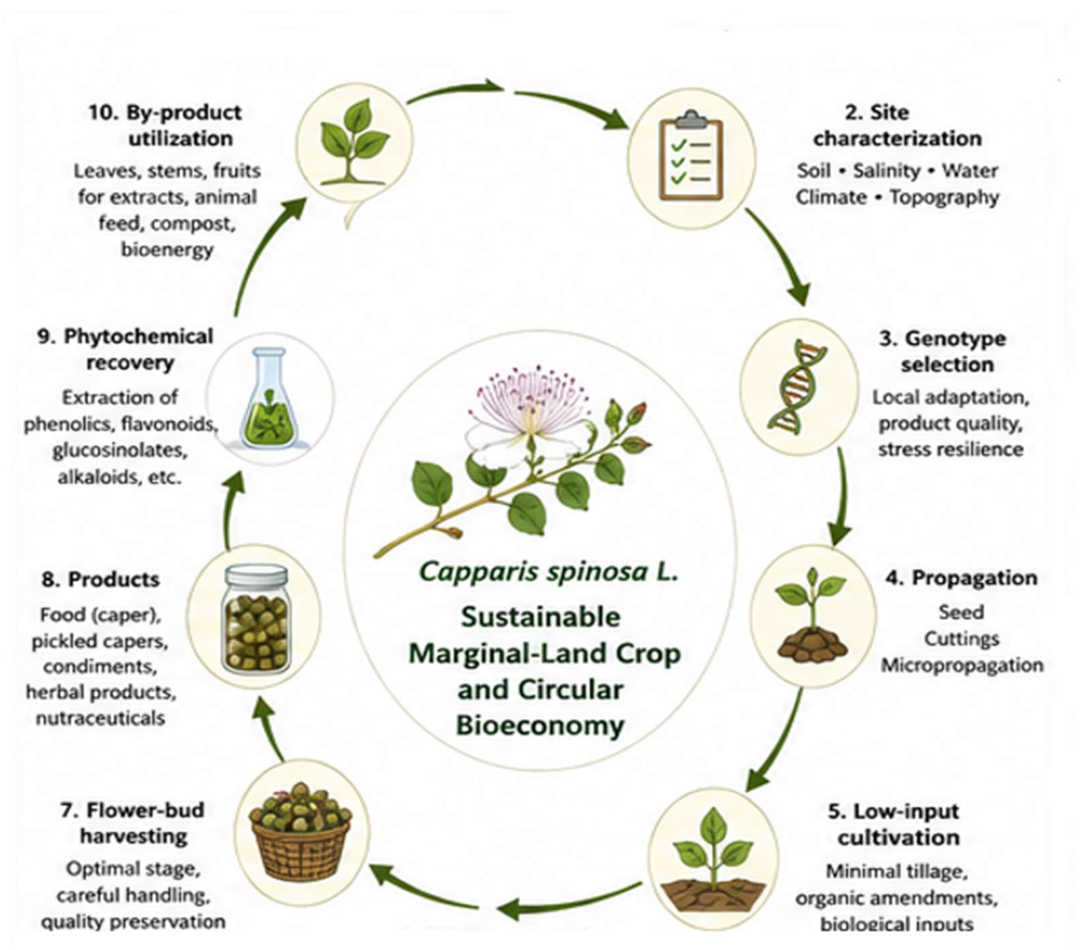
Figure 3.
Sustainable production and circular valorization framework for Capparis spinosa L. in selected marginal lands. The framework links site characterization, genotype selection, propagation, low-input cultivation, water and nutrient management, harvesting, product development, phytochemical recovery and by-product utilization.
Figure 3.
Sustainable production and circular valorization framework for Capparis spinosa L. in selected marginal lands. The framework links site characterization, genotype selection, propagation, low-input cultivation, water and nutrient management, harvesting, product development, phytochemical recovery and by-product utilization.
7.1. Genotype × Environment × Management Approach
Genotype selection represents a central component of sustainable caper production. Recent studies demonstrate substantial variation in physiological, biochemical, proteomic, and phytochemical responses among populations and environmental conditions [16,20,29]. This variation provides an opportunity to identify genotypes that combine stress adaptation with acceptable productivity and desirable product quality.
The appropriate genotype should therefore be selected according to the target environment rather than assuming the existence of a universally superior planting material. Soil salinity, texture, water availability, temperature, and nutrient status may interact with genotype to determine plant establishment and productivity. The recently reported salinity plasticity of C. spinosa, including changes in root development, ion accumulation, and selective ion transport, further supports the need for site-specific genotype evaluation [28].
7.2. Efficient Use of Water and Soil Resources
Water management should focus on maintaining sufficient plant performance while minimizing unnecessary irrigation. Supplemental irrigation may be particularly important during establishment and periods of severe drought, whereas mature plants may be managed with lower water inputs depending on site conditions. Recent drought studies indicate that severe water limitation can reduce biomass and growth even when biochemical mechanisms of stress protection are activated [20,29].
Soil management is similarly important. Marginal lands may differ substantially in salinity, texture, fertility, gypsum content, and water-holding capacity. A recent study showed that C. spinosa growing in harsh gypsum soils can maintain production while exhibiting differences in bioactive compounds and antioxidant capacity compared with plants from non-gypsum soils [30]. Thus, marginal-land cultivation should be based on soil-specific management rather than a uniform low-input model.
7.3. Biological Inputs and Establishment
Biological soil management may complement the intrinsic stress-adaptation capacity of C. spinosa. Recent research on native arbuscular mycorrhizal fungi demonstrated substantial improvements in caper seedling biomass, root development, and nutrient uptake following inoculation [31]. These results strengthen the case for considering AMF as an establishment technology for marginal soils.
Nevertheless, most available evidence concerns seedlings or controlled environments. The practical value of AMF should therefore be evaluated through long-term field trials measuring survival, flower-bud yield, water-use efficiency, and economic return rather than biomass alone.
7.4. Integration of Yield and Phytochemical Quality
A major opportunity for C. spinosa is the simultaneous evaluation of agronomic performance and phytochemical quality. Recent studies demonstrate that soil conditions, phenological stage, plant organ, and environmental stress can substantially modify phenolic compounds and antioxidant activity [5,20,32]. In particular, severe drought may increase concentrations of certain phenolic compounds while reducing total biomass, illustrating why concentration-based quality indicators should not be evaluated independently from yield [29]. This suggests that future production systems should select genotypes according to a broader criterion: productive biomass × flower-bud yield × phytochemical quality × resource-use efficiency rather than maximizing a single trait.
7.5. Circular and Value-Added Utilization
Sustainability should also extend beyond primary cultivation. Flower buds and fruits can remain the principal food products, while appropriate plant fractions and processing residues may be investigated as sources of phenolics and other valuable compounds [5,23,24]. Recent research on drying methods demonstrates that post-harvest processing can significantly affect phenolic composition and antioxidant activity, emphasizing the importance of processing optimization [33]. Despite increasing interest in Capparis spinosa L., important knowledge gaps remain before its wider adoption as a marginal-land crop can be fully supported. The major limitation is the lack of long-term, field-based studies integrating stress responses with yield, product quality, resource use, and economic performance.
8.1. Field Validation of Stress Adaptation
Much of the available evidence on drought and salinity responses has been obtained under controlled or short-term experimental conditions. Recent studies demonstrate that C. spinosa activates antioxidant, osmotic, and ion-regulation mechanisms under stress, although severe water or salt stress can still reduce growth and physiological performance [20,28,29]. Multi-year field experiments across contrasting soil and climatic conditions are therefore required.
Particular attention should be given to combined stresses. Mediterranean marginal lands may experience drought together with high temperature, salinity, nutrient limitation, and soil degradation. Evaluating these factors simultaneously would provide more realistic estimates of crop performance than single-stress experiments.
8.2. Genetic Resources and Genotype Selection
Considerable variation among C. spinosa populations provides an important opportunity for crop improvement [14,16,29]. Future studies should integrate morphological, physiological, genomic, and phytochemical characteristics to identify genotypes with stable performance under specific environmental conditions.
Priority traits should include establishment and survival, drought and salinity response, flower-bud yield, yield stability, harvesting efficiency, water-use efficiency, and phytochemical quality. Developing genotype × environment databases could facilitate the selection of planting material according to regional production conditions.
8.3. Propagation and Crop Establishment
Propagation remains an important constraint to the wider commercialization of C. spinosa. Seed dormancy and variable germination may limit uniform establishment, whereas vegetative and in vitro approaches can facilitate the multiplication of selected genotypes [7,17]. Future research should focus on scalable propagation systems that maintain the genetic and phytochemical characteristics of selected material while reducing production costs. High-quality nursery material is particularly important for marginal lands, where poor soil conditions and water limitation may increase establishment losses.
8.4. Linking Phytochemical Quality with Agronomic Performance
An important research priority is the simultaneous evaluation of agronomic productivity and phytochemical quality. Environmental conditions can modify phenolic concentration and antioxidant activity [5,20,30]. However, increased concentration of a bioactive compound may occur together with reduced biomass or flower-bud yield.
Future studies should therefore avoid evaluating phytochemical concentration independently of agronomic productivity. A more comprehensive assessment should consider:
total yield × compound concentration × compound recovery × resource input
This framework could provide a more meaningful estimate of the value of stress-grown C. spinosa.
8.5. Biological Inputs and Soil Microbiome
AMF and other beneficial microorganisms represent promising tools for improving plant establishment and nutrient acquisition under water limitation [18,31]. However, current evidence from controlled experiments is insufficient to establish their commercial value.
Future research should investigate native microbial communities, AMF–genotype interactions, soil microbiome dynamics, and long-term effects on flower-bud yield. Combining microbial inoculation with reduced irrigation and site-specific nutrient management may be particularly relevant to low-input production.
8.6. Processing, Safety and Standardization
Phytochemical variability among genotypes, plant organs, environments, and processing methods remains a major challenge for standardized C. spinosa products [19,23,24,25,26]. Future studies should establish harmonized analytical procedures for major phenolics, flavonoids, glucosinolates, and other relevant compounds.
Processing studies should also consider compound retention, sensory quality, food safety, contaminant accumulation, and storage stability. These aspects are particularly important for plants cultivated on marginal soils, where salinity, heavy metals, or other environmental contaminants may affect product safety.
8.7. Economic and Environmental Assessment
Although the ecological characteristics of C. spinosa suggest potential advantages for marginal-land agriculture, comprehensive production-economic data remain limited. Future studies should quantify establishment costs, irrigation requirements, labor demand, harvesting costs, processing expenses, product revenues, and profitability.
Life-cycle and resource-use assessments could further determine whether C. spinosa provides measurable environmental benefits compared with alternative crops or unmanaged land. Important indicators should include water-use efficiency, land-use efficiency, energy consumption, carbon footprint, input requirements, biomass utilization, and economic return. The key research priorities, current structural limitations, and recommended strategic directions for the wider adoption and sustainable cultivation of C. spinosa L. as a marginal-land crop are systematically integrated in Table 5.
While individual and combined stress adaptations require multi-environment field trials to provide concrete data beyond controlled short-term experiments, immediate research attention must focus on scalability and biological enhancement. To overcome variable field establishment, focused field validation of biological inputs, particularly Arbuscular Mycorrhizal Fungi (AMF) and microbiome-based trials, is essential to confirm efficacy under harsh field conditions [18,31]. Furthermore, managing the high phytochemical variability driven by strong genotype and environmental interactions demands the urgent implementation of standardized analytical protocols [5,20,30]. Post-harvest processing also requires significant optimization to guarantee stable bioactive compound retention during processing and long-term storage [19,23,24,25,26,33]. Given that cultivation typically occurs on degraded or marginal soils, comprehensive contaminant and toxicological assessments are vital to ensuring rigorous food safety and regulatory compliance [19,23,24,25,26].
Finally, transitioning from isolated agricultural practices to an integrated commercial crop model requires a full value-chain economic analysis combined with holistic life-cycle and resource-use assessments to solidify the long-term economic and ecological viability of C. spinosa systems (Table 5).

Table 6.
Evidence strength and key translational limitations across the main evidence domains.
| Evidence domain | Main evidence base | Confidence for field translation | Priority validation |
| Drought physiology | Controlled drought experiments and physiological measurements | Moderate | Multi-year field trials under realistic water deficits |
| Salinity response | Controlled salinity and combined drought–salinity experiments | Moderate | Soil EC gradients and genotype × salinity trials |
| Agronomic performance | Propagation, biotype/population and production studies | Moderate | Multi-environment yield and harvest-efficiency trials |
| Phytochemical quality | Chemical profiling across organs, stages and environments | Moderate–High for composition; lower for health claims | Standardized sampling, metabolomics and processing protocols |
| Biological inputs | AMF and seedling experiments | Low–Moderate | Mature-plant field validation and economic assessment |
| Sustainable valorization | Processing, extraction and food-quality studies | Moderate | Integrated value-chain, safety and life-cycle studies |
9. Conclusions and Future Perspectives
C. spinosa L. is a multipurpose plant which provides a valuable opportunity to enhance greenery and prevent soil erosion having remarkable adaptability to harsh climatic environments. Mediterranean countries are in a region of the world threatened by global warming and caper is a promising crop for arid or semi-arid regions within the climate change context, since it is highly tolerant to drought, heat and salt stress.
The transition of C. spinosa L. from a wild, rustic chasmophyte to a structured perennial crop offers a transformative paradigm for biosaline and climate-resilient agriculture. As documented through both rigorous physiological literature and concrete field observations within the highly modified, degraded cultural landscape of Miletus, Türkiye (Figure 1), the species demonstrates an well-documented capacity to persist under abiotic stress while retaining potential agronomic value and potentially generate value on selected lands where conventional crop production is constrained, subject to site-specific validation. It represents a promising multifunctional perennial species for the sustainable utilization of selected marginal lands. Its occurrence in Mediterranean and seasonally dry environments, together with its capacity to persist under water limitation, provides an ecological basis for its inclusion in diversified agricultural systems [1,3,4,7]. However, drought and salinity adaptation should be interpreted primarily as mechanisms supporting persistence and establishment rather than as guarantees of high productivity under severe stress [8,9,10,29,30].
The agronomic potential of C. spinosa is strongly influenced by genotype, propagation method, soil characteristics, water availability, plant age, and management practices [12,13,14,15,16,17]. The substantial variation among populations provides opportunities to identify planting material combining stress adaptation, stable flower-bud production, desirable product quality, and efficient resource use. Future cultivation strategies should therefore move beyond species-level assessments toward genotype × environment × management approaches supported by multi-environment field trials.
The phytochemical diversity of C. spinosa further increases its potential value. Phenolics, flavonoids, glucosinolates, phytosterols, vitamins, and other secondary metabolites provide opportunities for food, nutraceutical, cosmetic, and other value-added applications [5,16,19,20,21,22,23,24]. Nevertheless, variation associated with genotype, environment, plant organ, developmental stage, extraction, and processing emphasizes the need for standardized analytical procedures and safety assessment [19,23,24,25,26,27]. Reported biological activities should be considered evidence of bioactive potential rather than definitive evidence of therapeutic efficacy until supported by stronger mechanistic, toxicological, and clinical studies [21,27].
The archaeological and cultural heritage of C. spinosa provides an additional dimension to its contemporary valorization. Its long-standing association with Mediterranean food and traditional medicinal practices demonstrates its historical importance [5,22,23,24,25]. Contemporary observations, including its occurrence on stone structures in archaeological landscapes such as Miletus, can provide ecological and cultural context but should remain clearly distinguished from direct archaeobotanical evidence of ancient utilization.
From a sustainability perspective, the potential of C. spinosa extends beyond primary flower-bud production. Efficient water management, improved propagation, biological inputs, sustainable harvesting, phytochemical recovery, and utilization of suitable plant fractions could increase resource-use efficiency and diversify economic outputs [18,19,23,24,25,26]. These approaches are consistent with circular bioeconomy principles and may reduce biomass losses while generating additional value streams.
Overall, the central research challenge is not simply to demonstrate survival under drought or salinity, but to determine where, under which management conditions, and with which genotypes the species can produce stable, safe, and economically valuable products while maintaining environmental sustainability. Long-term field experiments integrating agronomic performance, physiological responses, phytochemical quality, water-use efficiency, soil characteristics, resource use, and economic feasibility will be essential for translating the ecological resilience of C. spinosa into reliable agricultural practice. Mediterranean countries are in a region of the world threatened by global warming and caper is a promising crop for arid or semi-arid regions within the climate change context, since it is highly tolerant to drought, heat and salt stress.
Author Contributions
Conceptualization, F.E.P.; methodology, F.E.P.; investigation, F.E.P.; resources, F.E.P.; data curation, F.E.P.; writing—original draft preparation, F.E.P.; writing—review and editing, F.E.P.; visualization, F.E.P. The author has read and agreed to the published version of the manuscript.
Funding
This research received no external funding.
Data Availability Statement
No new data were created or analyzed in this study. Data sharing is not applicable to this article.
Acknowledgments
During the preparation of this manuscript, the author used generative AI tools for the purposes of literature synthesis, linguistic refinement, and structural auditing of the text. The author has reviewed and edited the output and takes full responsibility for the content of this publication.
Conflicts of Interest
The author declares no conflicts of interest.
Abbreviations
The following abbreviations are used in this manuscript:
| Abbreviation | Full Term |
| AMF | Arbuscular mycorrhizal fungi |
| APX | Ascorbate peroxidase |
| CAT | Catalase |
| HSF | Heat-shock factor |
| MAPs | Medicinal and aromatic plants |
| NaCl | Sodium chloride |
| POD | Peroxidase |
| ROS | Reactive oxygen species |
| SOD | Superoxide dismutase |
References
- Afzali, S.F.; Sadeghi, H.; Taban, A. A comprehensive model for predicting the development of defense system of Capparis spinosa L.: A novel approach to assess the physiological indices. Sci. Rep. 2023, 13, 12413.
- Bouskout, M.; Bourhia, M.; Al Feddy, M.N.; Dounas, H.; Salamatullah, A.M.; Soufan, W.; Nafidi, H.-A.; Ouahmane, L. Mycorrhizal fungi inoculation improves Capparis spinosa’s yield, nutrient uptake and photosynthetic efficiency under water deficit. Agronomy 2022, 12, 149.
- Chedraoui, S.; Abi-Rizk, A.; El-Beyrouthy, M.; Chalak, L.; Ouaini, N.; Rajjou, L. Capparis spinosa L. in a systematic review: A xerophilous species of multi values and promising potentialities for agrosystems under the threat of global warming. Front. Plant Sci. 2017, 8, 1845.
- Foschi, M.L.; Juan, M.; Pascual, B.; Pascual-Seva, N. Collection guidelines to achieve a viable caper commercial propagation. Agronomy 2022, 12, 74.
- Mohaddab, M.; Genva, M.; Fakiri, M.; El-Goumi, Y.; Zeroual, A.; Fauconnier, M.-L. Capparis spinosa: A rich source of phenolic compounds—A comprehensive review of its phytochemistry, health benefits, and biotechnological applications. Biocatal. Agric. Biotechnol. 2024, 61, 103409.
- Sun, Y.; Yang, T.; Wang, C. Capparis spinosa L. as a potential source of nutrition and its health benefits in foods: A comprehensive review of its phytochemistry, bioactivities, safety, and application. Food Chem. 2023, 409, 135258.
- Annaz, H.; Sane, S.; Bitchagno, G.T.M.; Ben Bakrim, W.; Drissi, B.; Mahdi, I.; El Bouhssini, M.; Sobeh, M. Caper (Capparis spinosa L.): An updated review on its phytochemistry, nutritional value, traditional uses, and therapeutic potential. Front. Pharmacol. 2022, 13, 878749.
- Jiménez-López, J.; Ruiz-Medina, A.; Ortega-Barrales, P.; Llorent-Martínez, E.J. Phytochemical profile and antioxidant activity of caper berries (Capparis spinosa L.): Evaluation of the influence of the fermentation process. Food Chem. 2018, 250, 54–59.
- Mohtashami, S.; Ghani, A.; Rowshan, V. Organ-specific variation of phenolic compounds and antioxidant potential in Capparis spinosa L. from Iran. Sci. Rep. 2026, 16, 62209.
- Al-Safadi, B.; Elias, R. Improvement of caper (Capparis spinosa L.) propagation using in vitro culture and gamma irradiation. Sci. Hortic. 2011, 127, 290–297.
- Chalak, L.; Abi-Rizk, A.; et al. In vitro propagation of caper (Capparis spinosa L.): A review. Horticulturae 2022, 8, 737.
- Legua, P.; Martínez, J.J.; Melgarejo, P.; Martínez, R.; Hernández, F. Phenological growth stages of caper plant (Capparis spinosa L.) according to the BBCH scale. Ann. Appl. Biol. 2013, 163, 135–141.
- Orphanos, P.I. Germination of caper (Capparis spinosa L.) seeds. J. Hortic. Sci. 1983, 58, 267–270.
- Pascual, B.; San Bautista, A.; Ferreros, N.; López-Galarza, S.; Maroto, J.V. Analysis of germination of caper seeds as influenced by the position of fruit on the mother plant, fruit maturation stage and fruit weight. J. Hortic. Sci. Biotechnol. 2003, 78, 73–78.
- Rodríguez, R.; Rey, M.; Cuozzo, L.; Ancora, G. In vitro propagation of caper (Capparis spinosa L.). In Vitro Cell. Dev. Biol. 1990, 26, 531–536.
- Salem, A.; Zemni, H.; Ghorbel, A. Propagation of caper (Capparis spinosa L.) by herbaceous cuttings and in vitro culture. Agric. Mediterr. 2001, 31, 42–48.
- Sozzi, O.G.; Chiesa, A. Improvement of caper (Capparis spinosa L.) seed germination by breaking seed coat-induced dormancy. Sci. Hortic. 1995, 62, 255–261.
- Sozzi, O.G. Caper bush: Botany and horticulture. Hortic. Rev. 2001, 27, 125–188.
- Sozzi, O.G.; Vicente, A.R. Capers and caperberries. In Handbook of Herbs and Spices; Peter, K.V., Ed.; Woodhead Publishing: Cambridge, UK, 2006; pp. 230–256.
- Rhizopoulou, S. Physiological responses of Capparis spinosa L. to drought. J. Plant Physiol. 1990, 136, 341–348.
- Rhizopoulou, S.; Heberlein, K.; Kassianou, A. Field water relations of Capparis spinosa L. J. Arid Environ. 1997, 36, 237–248.
- Rhizopoulou, S.; Psaras, G.K. Development and structure of drought-tolerant leaves of the Mediterranean shrub Capparis spinosa L. Ann. Bot. 2003, 92, 377–383.
- Levizou, E.; Drilias, P.; Kyparissis, A. Exceptional photosynthetic performance of Capparis spinosa L. under adverse conditions of Mediterranean summer. Photosynthetica 2004, 42, 229–235.
- Psaras, G.K.; Sofroniou, I. Wood anatomy of Capparis spinosa from an ecological perspective. IAWA J. 1999, 20, 419–429.
- Sakçalı, M.; Bahadır, H.; Öztürk, M. Eco-physiology of Capparis spinosa L.: A plant suitable for combating desertification. Pak. J. Bot. 2008, 40, 1481–1486.
- Zuo, W.; Ma, M.; Ma, Z.; Gao, R.; Guo, Y.; Jiang, W.; et al. Study of photosynthetic physiological characteristics of desert plant Capparis spinosa L. J. Shihezi Univ. 2012, 3, 6.
- Wang, Q.; Zhang, M.L.; Yin, L.K. Phylogeographic structure of a Tethyan relict Capparis spinosa traces Pleistocene geologic and climatic changes in the western Himalayas, Tianshan Mountains, and adjacent desert regions. BioMed Res. Int. 2016, 5792708.
- Liu, C.; Xue, P.G.; Cheng, B.; Wang, X.; He, J.; Liu, H.G.; et al. Genetic diversity analysis of Capparis spinosa L. populations by using ISSR markers. Genet. Mol. Res. 2015, 14, 16476–16483.
- Özbek, O.; Kara, A. Genetic variation in natural populations of Capparis from Turkey, as revealed by RAPD analysis. Plant Syst. Evol. 2013, 299, 1911–1933.
- Silvestre, G.A.; Silvio, F.; Mirko, S.; Ignazio, F.; Giuseppe, G.; Francesco, C. Hybridization in Capparis spinosa L.: Molecular and morphological evidence from a Mediterranean island complex. Flora 2014, 209, 733–741.
- Saadaoui, E.; Guetat, A.; Tlili, N.; El Gazzah, M.; Khaldi, A. Subspecific variability of Tunisian wild populations of Capparis spinosa L. J. Med. Plants Res. 2011, 5, 4339–4348.
- Saifi, N.; Ibijbijen, J.; Echchghadda, G. Genetic diversity of caper plant (Capparis sp.) from Morocco. J. Food Agric. Environ. 2011, 9, 299–304.
- Nosrati, H.; Feizi, H.A.M.; Mazinani, M.; Haghighi, R.A. Effect of population size on genetic variation levels in Capparis spinosa detected by RAPDs. EurAsia J. BioSci. 2012, 6, 70–75.
- Khouildi, S.; Pagnotta, M.A.; Tanzarella, O.A.; Ghorbel, A.; Porceddu, E. Suitability of RAPD technique for estimating genetic variation in natural genotypes of Tunisian and Italian caper. Agric. Mediterr. 2000, 130, 72–77.
- Inocencio, C.; Rivera, D.; Obón, C.; Alcaraz, F.; Barreña, J.A. A systematic revision of Capparis section Capparis in the Mediterranean and the Near East. Ann. Mo. Bot. Gard. 2006, 93, 122–149.
- Fici, S. A taxonomic revision of the Capparis spinosa group (Capparaceae) from the Mediterranean to Central Asia. Phytotaxa 2014, 174, 1–24.
- Rivera, D.; Inocencio, C.; Obón, C.; Alcaraz, F. Review of food and medicinal uses of Capparis L. subgenus Capparis (Capparidaceae). Econ. Bot. 2003, 57, 515–534.
- Rivera, D.; Inocencio, C.; Obón, C.; Carreño, E.; Reales, A.; Alcaraz, F. Archaeobotany of capers (Capparis) (Capparaceae). Veg. Hist. Archaeobot. 2002, 11, 295–314.
- Renfrew, J.M. Palaeoethnobotany: The Prehistoric Food Plants of the Near East and Europe; Columbia University Press: New York, NY, USA, 1973.
- Van Zeist, W.; Bakker-Heeres, J.A.H. Archaeobotanical studies in the Levant. 4. Bronze Age sites on the North Syrian Euphrates. Palaeohistoria 1988, 27, 247–316.
- Tlili, N.; Khaldi, A.; Triki, S.; Munné-Bosch, S. Phenolic compounds and vitamin antioxidants of caper (Capparis spinosa). Plant Foods Hum. Nutr. 2010, 65, 260–265.
- Tlili, N.; El Guizani, T.; Nasri, N.; Khaldi, A.; Triki, S. Protein, lipid, aliphatic and triterpenic alcohol content of caper seeds (Capparis spinosa). J. Am. Oil Chem. Soc. 2011, 88, 265–270.
- Tlili, N.; El-Fallah, W.; Saadaoui, E.; Khaldi, A.H.; Triki, S.; Nasri, N. The caper (Capparis L.): Ethnopharmacology, phytochemical and pharmacological properties. Fitoterapia 2011, 82, 93–101.
- Tlili, N.; Feriani, A.; Saadoui, E.; Nasri, N.; Khaldi, A. Capparis spinosa leaves extract: Source of bioantioxidants with nephroprotective and hepatoprotective effects. Biomed. Pharmacother. 2017, 87, 171–179.
- Matthäus, B.; Özcan, M. Glucosinolates and fatty acid, sterol, and tocopherol composition of seed oils from Capparis spinosa var. spinosa and Capparis ovata. J. Agric. Food Chem. 2005, 53, 7136–7141.
- Matthäus, B.; Özcan, M. Glucosinolate composition of young shoots and flower buds of capers (Capparis species) growing wild in Turkey. J. Agric. Food Chem. 2002, 50, 7323–7325.
- Mansour, B.R.; Jilani, H.B.I.; Bouaziz, M.; Gargouri, B.; Elloumi, N.; Attia, H.; et al. Phenolic contents and antioxidant activity of ethanolic extract of Capparis spinosa. Cytotechnology 2016, 68, 135–142.
- Kulisic-Bilusic, T.; Balzevic, I.; Dejanovic, B.; Milos, M.; Pifat, G. Evaluation of the antioxidant activity of essential oils from caper (Capparis spinosa) and sea fennel. J. Food Biochem. 2010, 34, 286–302.
- Zhou, H.; Jian, R.; Kang, J.; Huang, X.; Li, Y.; Zhuang, C.; et al. Anti-inflammatory effects of caper (Capparis spinosa L.) fruit aqueous extract and the isolation of main phytochemicals. J. Agric. Food Chem. 2010, 58, 12717–12721.
- Yang, T.; Wang, C.; Liu, H.; Chou, G.; Cheng, X.; Wang, Z. A new antioxidant compound from Capparis spinosa. Pharm. Biol. 2010, 48, 589–594.
Figure 1.
Capparis spinosa L. growing on stone structures in the archaeological landscape of Miletus, Türkiye. (A) General view of the plant growing on a stone wall; (B) close-up view showing vegetative and reproductive structures. Photographs were taken by the author (June 2025).
Figure 1.
Capparis spinosa L. growing on stone structures in the archaeological landscape of Miletus, Türkiye. (A) General view of the plant growing on a stone wall; (B) close-up view showing vegetative and reproductive structures. Photographs were taken by the author (June 2025).
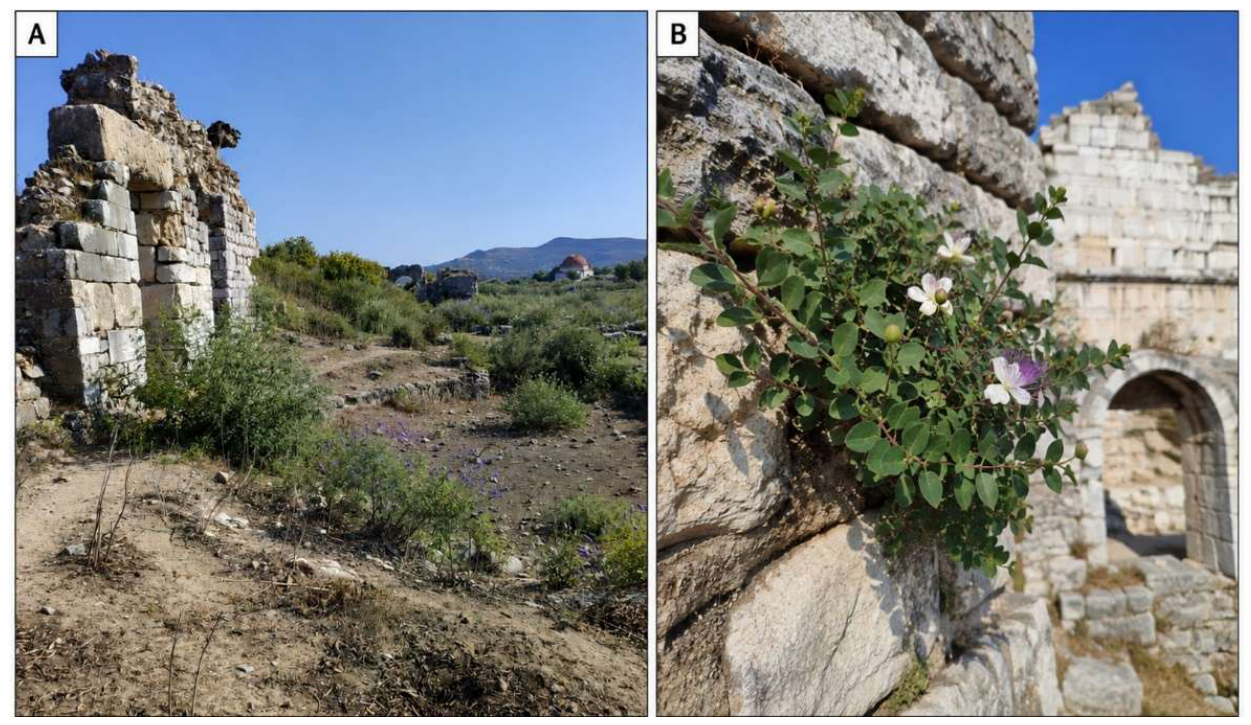
Figure 2.
Integrated physiological responses of Capparis spinosa L. to drought, salinity and heat stress. Conceptual synthesis of water relations, ion regulation, osmotic adjustment, antioxidant defense and photosynthetic protection.
Figure 2.
Integrated physiological responses of Capparis spinosa L. to drought, salinity and heat stress. Conceptual synthesis of water relations, ion regulation, osmotic adjustment, antioxidant defense and photosynthetic protection.
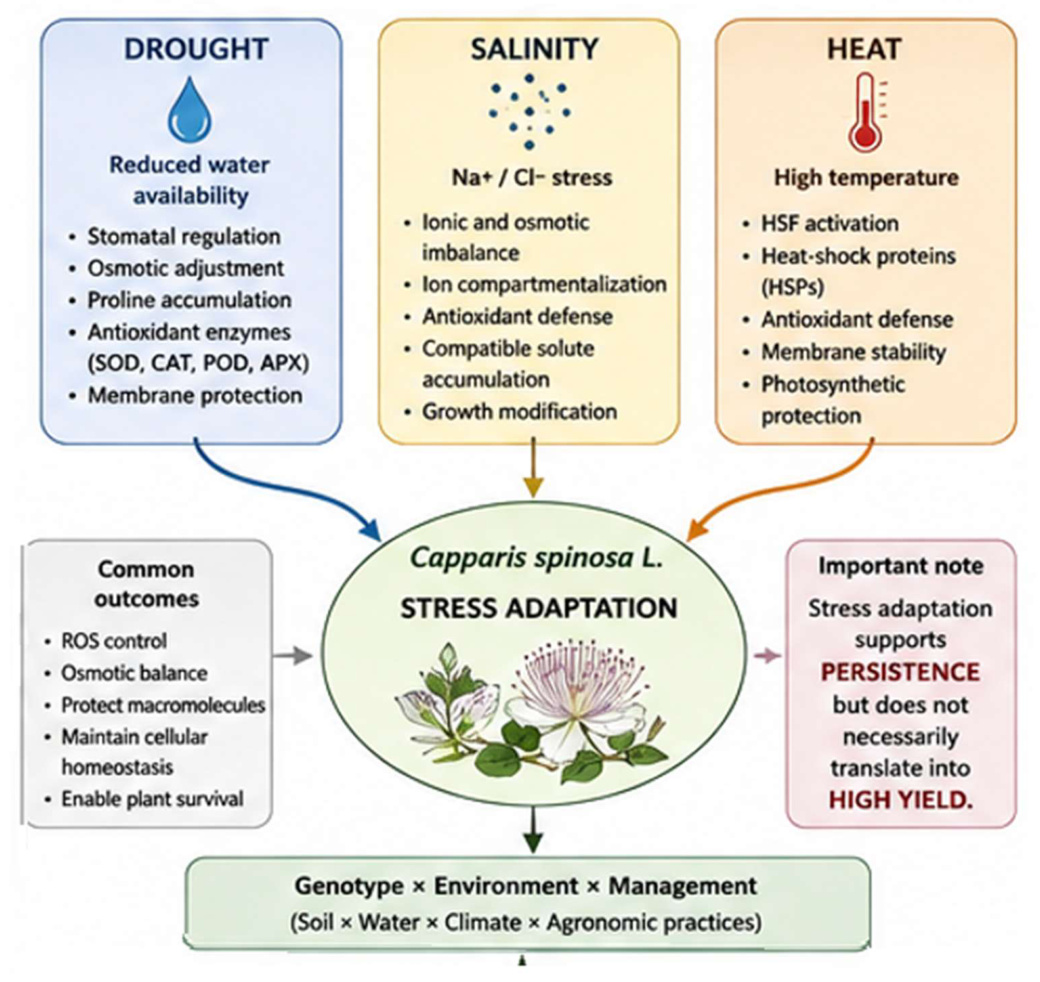
Figure 2.
Conceptual flowchart illustrating the translational agronomy framework of Capparis spinosa L.
Figure 2.
Conceptual flowchart illustrating the translational agronomy framework of Capparis spinosa L.
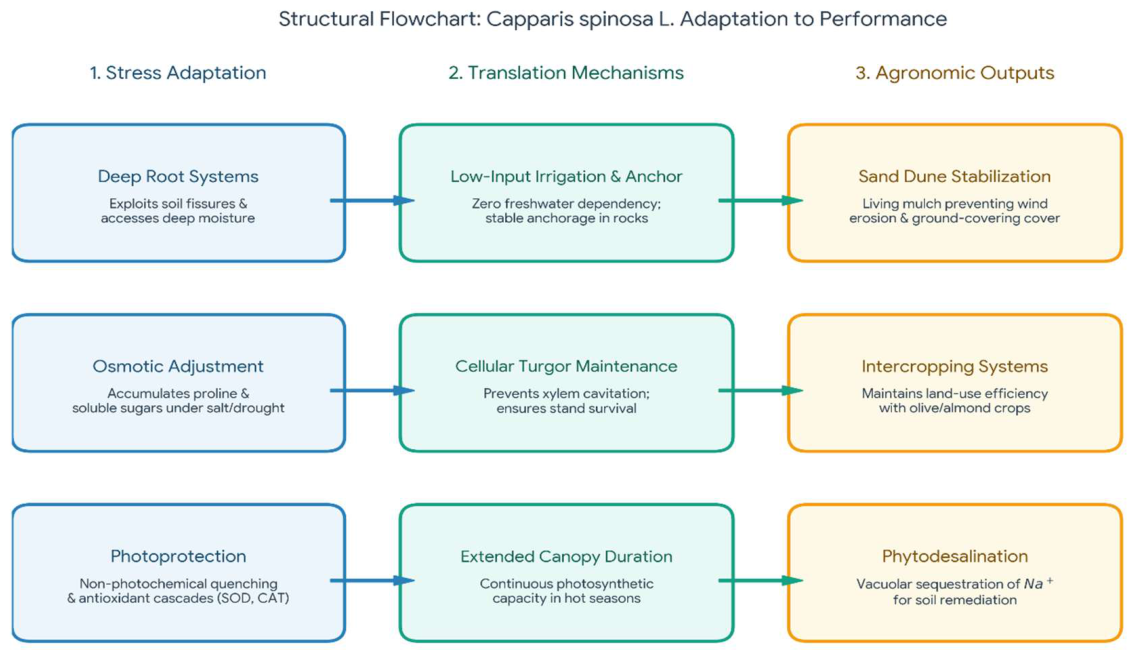
Table 1.
Main physiological responses, consequences, and agronomic implications of halophytes and medicinal/aromatic plants under individual and combined environmental stresses in marginal areas.
Table 1.
Main physiological responses, consequences, and agronomic implications of halophytes and medicinal/aromatic plants under individual and combined environmental stresses in marginal areas.
| Stress | Main Response | Physiological Consequence | Agronomic Implication | References |
| Drought | ↑ Antioxidant enzymes; ↑ proline |
Osmotic adjustment; ROS control | Growth may decline | [8,9,29,30,32] |
| Salinity | Osmotic and ionic responses | Altered water relations and growth |
Tolerance depends on stress level and genotype | [9,10] |
| Heat | HSF-related responses | Heat-response activation | Potential thermotolerance | [33] |
| Drought + AMF | ↑ Nutrient uptake; ↑ photosynthesis | Improved stress response |
Promising biological input | [21] |
| Combined stress | Interacting stress responses |
Increased physiological complexity | Field validation needed | [9,34] |
Table 2.
Key production components, main considerations, and recommended management approaches for sustainable cultivation in marginal areas.
Table 2.
Key production components, main considerations, and recommended management approaches for sustainable cultivation in marginal areas.
|
Production Component |
Main Consideration | Recommended Approach | References |
|
Genotype selection |
Adaptation, yield, and quality |
Select site-specific genotypes | [12,13,14,15,16] |
| Propagation | Establishment uniformity | Improve seed and vegetative propagation | [7,14,17] |
|
Water management |
Efficient use of limited water | Supplemental irrigation during critical periods | [1,3,7] |
|
Soil management |
Low fertility and degradation | Site-specific nutrient management | [1,3,7,26,27] |
|
Biological inputs |
Stress mitigation | Evaluate AMF and beneficial microorganisms | [18,21] |
| Harvesting | Repeated labor-intensive collection |
Improve harvesting efficiency | [7,14] |
|
Product quality |
Phytochemical variability | Combine yield and quality selection | [5,8,16,17,18] |
| Sustainability | Long-term productivity | Integrate resource efficiency and economic assessment | [26,27] |
Table 3.
Major phytochemical groups identified in Capparis spinosa, their potential relevance for sustainable valorization, and associated literature references [5,9,19,20,21,22].
| Phytochemical group | Main relevance | Potential application | References |
| Phenolic compounds |
Antioxidant and functional properties | Food, nutraceutical and cosmetic products |
[5,19] |
| Flavonoids | Antioxidant and bioactive potential | Functional foods and extracts |
[9,20] |
| Glucosinolates | Characteristic secondary metabolites | Food and phytochemical research |
[21] |
| Phytosterols | Nutritional and functional importance | Food and nutraceutical applications |
[5,22] |
| Organic acids | Contribution to nutritional and sensory properties | Food products | [9] |
| Vitamins | Nutritional value | Food and functional products | [19,22] |
| Other secondary metabolites |
Chemical diversity and bioactive potential | Value-added extracts | [19,20,21] |
Table 4.
Biomass fractions of Capparis spinosa, main products, valorization pathways, sustainability benefits, and associated literature references.
Table 4.
Biomass fractions of Capparis spinosa, main products, valorization pathways, sustainability benefits, and associated literature references.
|
Biomass fraction |
Main product |
Valorization pathway | Sustainability benefit | References |
| Flower buds | Pickled/salted capers |
Food production | Primary economic output | [19,23,25] |
| Fruits | Food and extracts |
Food and bioactive products | Increased biomass value | [23,26] |
| Leaves | Phenolic-rich extracts |
Nutraceutical/cosmetic applications | Reduced biomass waste | [23,24] |
|
Other plant fractions |
Bioactive compounds |
Extract production | Improved resource efficiency | [5,23,24] |
|
Processing residues |
Recovered compounds |
Secondary product development | Waste reduction | [19,25,26] |
|
Residual biomass |
Organic material |
Appropriate reuse/recovery | Circular biomass management | [23,24,25,26] |
Table 5.
Key research priorities, current limitations, recommended strategic directions, and associated literature references for the sustainable exploitation of Capparis spinosa L.
Table 5.
Key research priorities, current limitations, recommended strategic directions, and associated literature references for the sustainable exploitation of Capparis spinosa L.
|
Research Priority |
Current Limitation | Recommended Direction | References |
|
Biological inputs |
Limited field validation | AMF and microbiome-based trials | [18,31] |
|
Phytochemical quality |
Strong genotype and environmental effects |
Standardized analytical protocols | [5,20,30] |
| Processing | Variable compound retention | Optimized processing and storage |
[19,23,24,25,26,33] |
| Food safety | Limited evidence for marginal soils | Contaminant and toxicological assessment | [19,23,24,25,26] |
| Economics | Few integrated cost–benefit studies | Full value-chain analysis | [19,23,24,25,26] |
| Sustainability | Practices assessed separately | Life-cycle and resource-use assessment | [23,24,25,26] |
Disclaimer/Publisher’s Note: The statements, opinions and data contained in all publications are solely those of the individual author(s) and contributor(s) and not of MDPI and/or the editor(s). MDPI and/or the editor(s) disclaim responsibility for any injury to people or property resulting from any ideas, methods, instructions or products referred to in the content. |
© 2026 by the authors. Licensee MDPI, Basel, Switzerland. This article is an open access article distributed under the terms and conditions of the Creative Commons Attribution (CC BY) license (http://creativecommons.org/licenses/by/4.0/).
Copyright: This open access article is published under a Creative Commons CC BY 4.0 license, which permit the free download, distribution, and reuse, provided that the author and preprint are cited in any reuse.