

Submitted:
05 September 2026
Posted:
07 September 2026
You are already at the latest version
Abstract
Electric energy-release events occur across natural, industrial, and engineered systems, from static discharge and dielectric failure to lightning, electrical arcing, and deliberate spark ignition. This article examines these phenomena as related threshold-driven transitions in which electric energy accumulates within a charge-separated system and is released when an insulating, resistive, or incompletely conducting region can no longer sustain the imposed electric organization. The interpretation is developed through Photony theory, in which surface-associated electrons transduce predominantly static elemental charge photons into linked electric chains that provide a proposed physical organization underlying electric field lines. Electric-field loading may increase through charge separation, surface charge accumulation, geometric field concentration, capacitance, material properties, and limited charge redistribution. When local conditions exceed the capacity for stable accommodation, partial discharge, corona, streamer development, spark formation, dielectric breakdown, or sustained arcing may occur. The article compares these processes with magnetic breakdown, emphasizing differences in transduction pathway, chain geometry, conductivity environment, stored-energy organization, and post-threshold evolution. Static-electricity generation, natural and accidental discharges, and purpose- ful high-voltage spark and arc generation for ignition are examined within a common energy-release framework. Conventional electrostatic, dielectric, and gas-discharge relations remain the quantitative basis for describing these systems, while the Photony interpretation is presented as a complementary physical model whose proposed chain-level mechanisms require further experimental evaluation.
Keywords:
Photony theory
; electric energy release
; voltage breakdown
; electric breakdown
; electric chains
; static electricity
; electrostatic discharge
; dielectric breakdown
; spark discharge
; electrical arcing
; lightning
; surface-electron transduction
; ignition
; electrical fire
- Voltage breakdown is presented as a threshold-driven transition in which a charge-supported electric organization can no longer be maintained and a substantially more conductive pathway develops.
- In the Photony interpretation, surface-associated electrons transduce predominantly static elemental charge photons into electric chains, with conductivity, geometry, charge accumulation, and material properties governing the approach to breakdown.
What are the implications of the main findings?
- Electric energy-release events ranging from electrostatic discharge and dielectric failure to sparks, arcs, lightning, and ignition can be compared within a common loading-and-breakdown framework.
- Distinguishing electric breakdown from magnetic breakdown clarifies how transduction pathway, chain organization, and conductivity environment affect whether rapid energy release creates a new conducting path or destabilizes an existing current-supported structure.
1. Introduction
Electric energy-release events occur across natural, industrial, and engineered systems, including electrostatic sparks, dielectric failure, surface flashover, lightning, electrical arcs, and deliberately generated ignition discharges. Although these phenomena differ greatly in scale and application, they share a common physical progression: electric energy can accumulate while charge redistribution is restricted and can then be transferred rapidly when an insulating, resistive, or incompletely conducting region develops a substantially more conductive pathway.
The present article is the electric companion to Beyond Field-Line Descriptions: Magnetic Energy-Release Regimes. Both regimes involve stored field energy, progressive loading, finite accommodation, a threshold transition, and rapid energy conversion, but their pre-threshold conditions differ. Electric breakdown creates or substantially enlarges a conducting path through a region that was initially insulating, resistive, or incompletely conducting. Magnetic breakdown, as proposed in the companion article, concerns the destabilization of an energetic magnetic organization that is already supported by current in a conducting environment. [1]
An earlier article, From Magnetic and Electric Fields to Fires, examined a broader pathway from magnetic disturbances through induced electric fields, voltage stress, arcing, and ignition. The present article focuses specifically on the electric portion of that sequence, including static-electricity generation, electric-chain formation, electric-field loading, voltage and dielectric breakdown, electrostatic discharge, lightning, electrical arcing, and accidental and purposeful ignition. [2]
Charge separation may arise through contact and separation of materials, electrostatic induction, movement of liquids or powders, spraying, material-handling processes, or direct application of voltage. Whether the resulting electric field persists depends on conductivity, geometry, permittivity, surface condition, leakage pathways, and the rate at which charge or energy is supplied. The system may remain stable, redistribute charge gradually, undergo localized discharge, or progress to complete breakdown. [3]
Conventional electrostatics, dielectric theory, gas-discharge physics, and plasma physics provide the established quantitative descriptions of these processes. Measurable quantities such as charge, voltage, electric-field strength, capacitance, conductivity, dielectric strength, pressure, gap distance, current, and deposited energy determine the observable behavior. Breakdown is therefore not governed by voltage alone; local field concentration and the electrical and material environment are also essential.
This article develops a complementary interpretation through Photony theory. In this framework, surface-associated electrons transduce predominantly static elemental charge photons into linked electric chains that provide a proposed physical organization underlying conventional electric field lines. The term static describes the configuration and motion state of the elemental charge photon rather than the waveform of the macroscopic source. Electric-chain organization may therefore occur under electrostatic, steady, alternating, pulsed, or transient electrical conditions.
Electric-field loading is interpreted as increasing energy and organizational stress within this charge-supported electric-chain system. When established material or discharge processes cause part of the surrounding region to become substantially more conductive, localized discharge or complete breakdown may occur. Within the Photony interpretation, this conductivity transition corresponds to rapid reorganization or loss of continuity of the pre-breakdown electric-chain structure.
A central distinction of this article is that the breakdown transition must be separated from the energy subsequently transferred through the resulting path. An isolated electrostatic discharge may be limited primarily by stored charge and capacitance, whereas a path connected to an external source can continue to receive energy and develop into a sustained arc. The consequences of breakdown therefore depend not only on the threshold event but also on the electrical and material energy reservoirs available afterward.
Electric breakdown is also not inherently an undesirable failure. The same general transition may occur unintentionally in electrostatic discharges, insulation faults, flashovers, and ignition hazards or it may be deliberately produced in spark plugs, burner igniters, flare-ignition systems, and related devices. This distinction allows accidental and purposeful electrical breakdowns to be examined within the same physical framework.
The central hypothesis is that voltage breakdown can be interpreted as a threshold-driven transition in which a charge-supported electric organization can no longer be maintained within the available insulating or weakly conducting environment and a substantially more conductive pathway develops. Photony theory provides a proposed chain-level interpretation of that transition while conventional electromagnetic, dielectric, discharge, and plasma theories remain the quantitative basis for describing the measurable system.
2. Essential Photony Foundation for Physical Field Structures
Photony theory does not replace the established mathematical descriptions of electric and magnetic fields. Maxwell’s equations, electromagnetic energy densities, magnetohydrodynamic models, and plasma diagnostics remain the principal quantitative descriptions of the systems considered here. Photony theory is applied as a complementary physical interpretation in which conventional field lines correspond to organized chains of elemental charge photons. This chain interpretation allows field structures to be discussed in terms of formation, continuity, density, curvature, compression, interaction, reassignment, and fragmentation.
The complete Photony framework begins with energy filaments and their motion within discrete Planck Space [4]. A full treatment of Planck-scale geometry is beyond the scope of this article. Accordingly, the present section introduces only the structures required to explain elemental charge photons, electron transduction, electric-chain formation, electric-field organization, energy storage, loading, and voltage breakdown.
The distinction between conventional electric and magnetic field-line representations and the proposed chain-based interpretations is illustrated in Figure 1. Conventional field lines indicate field direction and geometry, whereas the Photony interpretation proposes linked physical chain structures underlying the corresponding electric and magnetic fields.
The figure does not imply that conventional field-line descriptions are incorrect. The two representations serve different purposes. Conventional field lines describe the direction and geometry of electric and magnetic fields at the macroscopic level, whereas the Photony interpretation proposes underlying physical chain structures whose organization depends on the associated electron-transduction pathway. In the present article, the electric-chain pathway is the principal subject, while the magnetic-chain representation is included only for comparison with the companion magnetic article. [1]
2.1. Elemental Charge Photons and Classical Photons
Photony theory begins with the energy filament as the fundamental energetic structure. The filament follows admissible pathways through Planck Space and cannot move laterally as an independent extended structure. Its geometry, curvature, indexing, and direction of motion determine the configurations that can be formed.
An elemental charge photon is a closed filament configuration that carries the fundamental structure identified with electric charge. Elemental charge photons occur in two principal forms. A static elemental charge photon is a closed ground-state loop associated with stored charge and electric potential. A dynamic elemental charge photon is a reconfigured helical form that possesses forward motion and is associated with charge transport and current.
The terms static and dynamic describe the configuration and motion of the elemental charge photon rather than the waveform of a macroscopic source. Static elemental charge photons are associated primarily with stored charge and electric-chain formation, whereas dynamic elemental charge photons possess directed filament motion and participate in current-associated magnetic-chain formation. The term dynamic is therefore not used as a synonym for alternating current.
A classical photon is formed from a chainlet of two interlinked elemental charge photons. Unlike a static elemental charge photon, a classical photon is a propagating energy quantum and cannot remain at rest. Classical photons may be emitted when stored chain energy is released, and they can also serve as linked units within extended chain structures. The relationship among these structures may be summarized as
This sequence is not intended to replace the conventional energy relation . It identifies the proposed physical organization associated with the photon and with the longer chains used in the present interpretation of electric and magnetic field lines.
2.2. Surface-Electron Transduction and Electric-Chain Formation
The distinction between electric and magnetic field organization emerges most directly at the electron-transduction stage. Photony theory uses the term transduction for the interaction through which electrons organize participating elemental charge photons into larger field-associated chain structures. [4]
For the electric regime considered in this article, the essential pathway is surface-electron transduction.
Surface-associated electrons transduce predominantly static elemental charge photons into linked electric chains. These chains extend outward from, or between, charge-supporting regions and provide the proposed physical organization underlying conventional electric field lines. The process may be represented schematically as
where denotes surface-electron transduction, denotes the participating static elemental charge photons, and denotes an electric chain. Equation (2) is a structural representation and does not replace conventional electrostatic or electromagnetic field equations.
The term surface-associated electron is used broadly enough to include electrons associated with charge-supporting boundaries and material interfaces.
In a conductor approaching electrostatic equilibrium, excess charge is redistributed primarily toward the surface, where the available surface-associated electron population establishes the conditions for transduction of predominantly static elemental charge photons into electric chains. At dielectric interfaces, by contrast, limited conductivity and charge trapping can maintain localized surface or interfacial charge for much longer periods, allowing the associated electric-chain organization to persist and, under continued loading, become increasingly concentrated.
Real materials may also exhibit polarization, finite leakage, surface contamination, adsorbed species, defects, and charge trapping. These established material processes remain part of the macroscopic description. The Photony interpretation adds the proposal that the available surface-associated electron population participates in organizing the electric-chain structure associated with the resulting electric field.
Electric-chain formation therefore depends on both charge availability and the surrounding electrical environment. Material conductivity, permittivity, geometry, surface condition, charge distribution, leakage pathways, and the rate at which charge or energy is supplied all affect whether electric organization can accumulate or is rapidly redistributed. A highly conductive path generally permits charge to redistribute readily, whereas an insulating or resistive region can allow charge separation and electric-field energy to persist.
The corresponding magnetic pathway begins from a different electron population and elemental charge-photon state. Internal free electrons associated with current transduce dynamic elemental charge photons into magnetic-chain loops. That process is developed in the companion article Beyond Field-Line Descriptions: Magnetic Energy-Release Regimes and is included here only to establish the physical distinction between the two transduction pathways.
2.3. Electric Chains and Electric-Field Organization
An electric chain is an extended photon-chain structure produced through surface-electron transduction of predominantly static elemental charge photons. Collections of electric chains provide the proposed physical organization underlying an electric field.
Electric and magnetic chains share the same underlying filament and photon hierarchy, but their larger-scale organizations differ. Magnetic chains form closed loops. Electric chains, by contrast, may terminate on like-spinning free electrons. Their endpoints therefore have direct physical significance within the proposed electric-chain interpretation.
An additional distinction is required between the electron that participates in chain transduction and an electron that subsequently interacts with an already established chain. Within the Photony interpretation, once a chain has been transduced and its continuity established, an electron can become associated with that chain and move along, or “ride,” the pre-existing chain structure. The electron is not itself a constituent link of the chain and need not be the electron that originally transduced it. Rather, the established chain provides an organized energetic pathway with which the electron can interact.
This behavior is proposed to occur for both electric and magnetic chain organizations, although the resulting physical manifestations differ. For an electric chain, electron motion along a previously established chain provides the proposed Photony interpretation associated with electron transport in the photoelectric effect, in which energy supplied through the photon-chain organization can permit an electron to leave its initially bound state and move along the available chain structure. For a magnetic chain, an electron can likewise remain associated with and ride a previously transduced closed-loop chain. Within the Photony description of atomic structure, this provides the proposed physical basis for an electron occupying and moving around a nucleus along an established atomic-shell chain.
Chain transduction and electron riding should therefore be treated as distinct processes. Transduction establishes or reorganizes the photon-chain structure; riding describes the subsequent interaction and motion of an electron along an already existing chain. This distinction allows the same underlying chain framework to participate both in field organization and in electron transport or confinement without identifying the electron itself with the chain.
Electric chains may extend between oppositely charged regions, from an isolated charged body toward surrounding charge-supporting structures, or through dielectric regions whose polarization and boundary conditions shape the macroscopic field. Their orientation and spatial concentration vary with the charge distribution and geometry of the system.
Conventional electric field lines indicate field direction and are commonly drawn with greater graphical density where the field is stronger. These field lines are mathematical and visual representations rather than physical objects in conventional electrodynamics. Photony theory retains the measurable electric field and its established mathematical description but proposes that the field-line representation corresponds to an underlying population of physical electric chains.
A conceptual relation between electric-chain density and measurable electric-field strength may be written as
where is the number of electric chains intersecting a representative area A, and is a proportionality factor associated with the proposed chain organization, local geometry, and material environment. Equation (3) is not presented as a replacement for Gauss’s law or as an experimentally calibrated constitutive relation. It provides a conceptual bridge between measurable electric-field strength and the proposed density of electric-chain organization.
Geometry is particularly important because electric-field loading is rarely uniform in practical systems. A broad, smooth conducting surface may support a relatively distributed charge density, whereas sharp edges, points, small radii of curvature, narrow gaps, electrode irregularities, and dielectric interfaces can strongly concentrate the local electric field. Conventional electrostatics accounts for these effects through charge distributions and boundary conditions. In the Photony interpretation, the same conditions correspond to local concentration and altered spacing of electric chains.
This distinction becomes important when evaluating breakdown. A system may have a moderate total potential difference while a small region experiences a much larger local electric field because of geometry or material inhomogeneity. Voltage alone is therefore not sufficient to characterize electric loading or breakdown susceptibility. The spatial distribution of the field, the material through which the field extends, and the ability of charge to redistribute are also essential.
2.4. Electric-Field Energy, Loading, and Structural Response
The electric-chain interpretation provides a proposed physical basis for distinguishing stored electric-field energy from the processes through which that energy is accumulated, redistributed, and released. Conventional electromagnetic theory quantifies electric-field energy density through
where is the permittivity of the medium. For an ideal lumped capacitive system, the stored electric energy is
where C is capacitance and V is the potential difference. Photony theory does not alter these measurable relations. Instead, it proposes that the stored electric-field energy is physically organized through electric chains whose arrangement reflects the charge distribution, geometry, and surrounding material.
A charge-separated electric system may therefore contain substantial stored energy before any rapid discharge begins. Additional loading may develop through greater charge separation, continued surface-charge accumulation, increased potential difference, geometric field concentration, reduced electrode separation, material polarization, or continued energy delivery from an external source.
The amount of energy available during a later discharge is not determined by voltage alone. Capacitance, charge, geometry, source impedance, resistance, inductance, and continuing source power may influence the magnitude and duration of the energy release. This distinction is particularly important when comparing an isolated electrostatic discharge with an arc supplied by an external electrical source.
As electric loading develops, the system does not need to proceed directly to complete failure. Charge may redistribute along a conducting surface or leak through a finite resistance. A dielectric may polarize while maintaining its insulating function. The localized corona or partial discharge may release or redistribute part of the accumulated charge without immediately forming a conducting path across the entire stressed region.
The principal structural responses may therefore be summarized as
The first response preserves the principal insulating or charge-supporting configuration while reducing or redistributing local electric stress. The second produces localized energy release but does not necessarily establish a complete conducting path between the principal charged regions. Corona and partial discharge are important examples because they demonstrate that electric energy release can begin locally without immediately producing a spark or sustained arc.
The third response defines the principal electric energy-release regime developed in this article. Voltage breakdown occurs when an insulating, resistive, or incompletely conducting region can no longer sustain the imposed electric organization and a substantially more conductive pathway develops. Depending on the medium, geometry, and available source, this transition may appear macroscopically as a spark, streamer channel, dielectric puncture, surface flashover, lightning channel, or electrical arc.
Within the Photony interpretation, breakdown corresponds to localized failure or rapid reorganization of electric-chain continuity when the previous charge-supported organization can no longer be maintained. Stored electric-field energy may then be transferred rapidly into charge-carrier motion, ionization, radiation, heating, plasma formation, acoustic emission, and material change.
The formation of a conducting pathway does not necessarily mark the end of the energy-release process. If the initial system is an isolated charged body or capacitor, the available stored charge may be depleted rapidly and the discharge may terminate. If an external source remains connected, however, the newly formed conducting pathway can permit substantially greater current to flow. Continued source-supplied energy may then sustain a plasma channel and transform the initial breakdown event into a longer-duration electrical arc.
This distinction separates the breakdown transition from the total energy ultimately released through the resulting conducting path. A small electrostatic spark and a sustained power arc may both originate through electric breakdown, but their subsequent energy histories can differ by many orders of magnitude because the latter continues to receive energy from an external source.
The same distinction is important for ignition. A brief electrostatic discharge may contain sufficient energy to ignite a sensitive combustible mixture even though its total energy is small. A source-fed arc can transfer substantially greater energy and may ignite, melt, vaporize, or damage nearby materials. Purposefully generated ignition systems exploit the same general transition by controlling the location, timing, geometry, and available energy of the discharge.
Electric and magnetic energy-release regimes therefore share the broader features of energy storage, increasing loading, finite accommodation, a threshold transition, and rapid energy conversion, while differing in their initial physical organization. Voltage breakdown creates or substantially enlarges a conducting pathway through a region that was initially insulating, resistive, or incompletely conducting. Magnetic breakdown, as proposed in the companion article, destabilizes an energetic magnetic organization that is already maintained by current in a conducting medium. These differences in transduction pathway, chain topology, conductivity environment, stored-energy organization, and post-threshold development provide the basis for treating the two mechanisms as related but distinct energy-release regimes.
3. Static Electricity: Formation, Storage, and Redistribution
Static electricity provides one of the clearest examples of electric energy accumulating before a rapid release event. The term static in this section refers to a macroscopic condition in which separated charge persists for an appreciable time rather than flowing continuously as current. This usage should be distinguished from the Photony term static elemental charge photon, which refers to the configuration and motion state of the elemental charge photon itself.
Static charge can be generated through several mechanisms, including contact and separation of dissimilar materials, electrostatic induction, movement of liquids and particles, spraying, material transfer, and the motion of people or objects across insulating surfaces. The resulting charge may remain localized, redistribute through available conducting paths, leak gradually through the surrounding material, or discharge abruptly when the local electric field becomes sufficiently large to initiate a conducting pathway.
From the Photony perspective, these processes alter the population and distribution of surface-associated charge and therefore the electric-chain organization supported by that charge. Static-electricity generation does not require electric chains to arise from a fundamentally different structure than other electric fields. Rather, it provides conditions in which charge separation and surface-electron transduction can persist long enough for a substantial electric-field organization to develop. [3]
3.1. Contact, Separation, and Charge Transfer
One of the most familiar routes to static electrification is contact between two materials followed by their separation. Although this process is often described as frictional or triboelectric charging, friction is not strictly required. Contact establishes an interface at which charge transfer or redistribution may occur, and subsequent separation leaves the two surfaces with a net charge imbalance.
Repeated rubbing can increase charging because it produces repeated contact, separation, deformation, and renewal of the interacting surface regions. However, the magnitude and polarity of the resulting charge depend on the materials, surface condition, contamination, humidity, temperature, contact area, separation rate, and previous charging history. The microscopic origin of contact electrification is not described by a single mechanism that is applicable to all combinations of materials. Electron transfer, ion transfer, material transfer, surface-state effects, and adsorbed species may contribute under different conditions.
However, the basic macroscopic result is well established. After separation, one body may contain an excess of negative charge while the other contains a corresponding deficiency. If the materials or surrounding environment do not provide a sufficiently conductive return path, the charge imbalance can persist.
For an approximately isolated charged body, the relationship between charge, capacitance, and electric potential may be written as
where Q is the stored charge, C is the effective capacitance of the body relative to its surroundings, and V is its electric potential. This relation demonstrates why a relatively small quantity of charge can produce a large potential difference when the effective capacitance is small.
Within the Photony interpretation, charge separation alters the surface-associated electron population available for transduction. Predominantly static elemental charge photons are organized into electric chains whose distribution reflects the resulting charge configuration. Continued charge transfer can therefore increase the number or concentration of electric chains and increase the associated electric-field energy.
The process may be represented conceptually as
This sequence does not specify a unique microscopic charge-transfer mechanism. It identifies the macroscopic progression that produces the charge-separated state required for later electric-field buildup and possible discharge.
3.2. Electrostatic Induction
Static electrification may also occur without direct charge transfer from the initially charged object. In electrostatic induction, an external electric field redistributes mobile charge within a nearby conductor or polarizable material. Opposite charge is attracted toward the region nearest the external source, while like charge is displaced farther away.
If the induced object remains electrically isolated and the external source is removed, the redistributed charge generally returns toward its previous configuration. If a temporary conducting connection to ground or another reservoir is provided while the inducing field is present, however, charge may enter or leave the object. Removal of the grounding path followed by removal of the inducing source can leave the object with a net charge.
Electrostatic induction therefore demonstrates an important feature of electric-field loading: charge accumulation at a particular location does not always require mechanical transfer across that same interface. Existing charge can be redistributed through an electric field and through available conducting pathways.
In the Photony interpretation, an externally imposed electric-chain organization changes the distribution of surface-associated electrons on the nearby body. This redistribution changes the local transduction conditions and produces a corresponding reorganization of electric chains. When a grounding or charge-transfer path is temporarily available, the final surface-electron population may differ from the initial state, allowing a new electric-chain organization to persist after the external inducing body is removed.
Electrostatic induction also helps explain why nearby grounded structures, conductors, tools, personnel, and equipment can strongly alter electric-field geometry even without direct contact with the initially charged object. Such structures change capacitance, boundary conditions, and local field concentration and may therefore either reduce charge accumulation or create preferred locations for discharge.
3.3. Flow, Spraying, and Material-Handling Electrification
Static charge generation is not limited to solid objects rubbed together. Industrial systems provide many examples in which charge develops during the movement of liquids, gases containing droplets or particles, powders, granular solids, films, belts, and other materials.
When a liquid moves through pipes, hoses, filters, valves, or nozzles, repeated contact between the liquid and surrounding surfaces can produce charge separation. The transported liquid may carry one polarity downstream while an opposing charge remains on the containing surface. Similar charging can occur during pouring, pumping, filtration, atomization, spraying, and splash filling.
Powders and granular materials can become charged through repeated particle–particle and particle–surface contacts. Pneumatic transport, mixing, grinding, conveying, filling, and emptying operations may therefore produce substantial charge separation. Because many powders and polymeric materials are poor conductors, accumulated charge may persist long enough to produce large potential differences.
Droplets and sprays introduce additional charging mechanisms because fragmentation creates large numbers of newly separated surfaces. Charged droplets can also transport charge through space, allowing electric fields to develop between the spray and nearby equipment, containers, structures, or personnel.
A similar process occurs when insulating belts, sheets, films, clothing, or footwear repeatedly contact and separate from other materials. Motion can continuously generate charge faster than it is removed. In such cases, the important variable is not simply whether charge is being generated, but the balance between the rate of generation and the rate of dissipation.
This balance may be represented conceptually as
where represents the rate of charge generation or delivery and represents charge removal through conduction, leakage, grounding, ionization, or other dissipative processes.
When
the net stored charge increases and the electric field may continue to build.
Within the Photony interpretation, this condition corresponds to continued growth or concentration of the charge-supported electric-chain organization because surface-electron transduction is being driven faster than the system can redistribute or reduce the accumulated electric loading.
The principal static-electricity generation and retention pathways discussed in this section are summarized in Figure 2.
3.4. Charge Retention, Leakage, and Electrical Relaxation
The persistence of static electricity strongly depends on conductivity. Charge deposited on a good conductor can rapidly redistribute across the available conducting surface and, if a suitable connection exists, flow to ground or another charge reservoir. Charge deposited on a highly resistive material may remain localized for much longer periods.
A useful conventional measure of the characteristic rate at which free charge relaxes within a material is the dielectric relaxation time
where is the permittivity and is the electrical conductivity of the material. A small relaxation time indicates that charge redistributes or dissipates rapidly, whereas a large relaxation time permits charge separation to persist.
This relationship helps explain why insulating materials are particularly important in electrostatic hazards. Their low conductivity can allow charge to remain localized while additional charge continues to accumulate. The resulting potential and local electric field may increase substantially before an effective leakage path develops.
Environmental conditions can strongly modify this behavior. Humidity may increase surface conductivity for many materials and thereby promote charge dissipation, although the magnitude of the effect is material dependent. Contamination, dust, surface films, temperature, material aging, and absorbed moisture may likewise change the effective resistance of a charge-retaining surface.
Grounding and bonding provide engineered means of reducing persistent potential differences in conducting equipment. [6] Grounding connects a conducting object to a reference potential, whereas bonding electrically connects separate conductive objects so that significant potential differences do not develop between them. These measures are especially important in systems containing flammable gases, vapors, liquids, or powders because a small spark can provide sufficient ignition energy under suitable conditions.
Within the Photony interpretation, a short dielectric relaxation time favors rapid surface-electron redistribution and continual adjustment of the electric-chain organization, limiting sustained local loading. A long relaxation time allows charge-supported electric-chain organization to persist and become increasingly concentrated as additional charge is supplied.
3.5. From Static Charge Accumulation to Discharge
Static electricity becomes an energy-release problem when the accumulated charge produces an electric field capable of initiating ionization, dielectric failure, surface flashover, or another substantial increase in conductivity. The transition is controlled by the local field rather than by voltage alone.
Two objects may differ by many kilovolts without discharging if their geometry, separation, and surrounding medium keep the local electric field below the relevant threshold. Conversely, strong field enhancement near a sharp point, narrow gap, contaminated surface, or dielectric defect may initiate discharge at a substantially lower overall voltage.
The progression from static charge generation to rapid energy release may therefore be summarized as
Not every charging event reaches the final stage. Charge may dissipate through leakage, grounding, corona, environmental ionization, or contact with another conductor before complete breakdown occurs. The outcome therefore depends on competition between continued loading and available mechanisms of charge redistribution.
Within the Photony framework, the same progression is interpreted as the formation and increasing loading of a surface-supported electric-chain organization followed, when accommodation becomes insufficient, by localized chain reorganization or failure and the development of a more conductive pathway. The detailed physics of that transition depends strongly on the surrounding medium and is developed in the following section on electric-field loading and voltage breakdown.
4. Electric-Field Loading and Voltage Breakdown
Electric breakdown is not controlled by voltage alone. The relevant physical state depends on how electric potential is distributed through space and through the surrounding material. Electrode geometry, separation distance, permittivity, conductivity, pressure, temperature, surface condition, waveform, pulse duration, and the availability of free charge carriers can all influence whether a system remains insulating, develops localized discharge, or forms a conducting pathway.
For that reason, voltage breakdown is best treated as a progression from electric-field loading toward a threshold condition rather than as a single universal field value. The same applied voltage may be safely sustained in one geometry and produce discharge in another. Likewise, a region with relatively modest average field strength may contain a localized enhancement large enough to initiate ionization or dielectric failure.
Within the Photony interpretation, these conventional loading variables alter the density, spacing, continuity, and local organization of electric chains. Breakdown is proposed to occur when the existing charge-supported electric organization can no longer be maintained within the available insulating, resistive, or incompletely conducting environment and a substantially more conductive pathway develops.
4.1. Electric Stress, Geometry, and Field Concentration
The electric field is related to the spatial variation of the electric potential. In electrostatic form,
This relation makes clear why a large potential difference does not determine the breakdown by itself. The same voltage distributed across a large distance can produce a much smaller electric field than when concentrated across a narrow gap.
For an approximately uniform field between parallel electrodes,
where d is the electrode separation. However, real breakdown configurations are rarely perfectly uniform. Local curvature can strongly enhance the field near points, edges, scratches, voids, protrusions, electrode defects, or dielectric interfaces.
A useful conceptual expression is
where represents a geometry-dependent field-enhancement factor. Equation (15) is not intended as a universal constitutive relation; it emphasizes that the local threshold condition may be reached well before the average field becomes critical.
In the Photony interpretation, such a local enhancement corresponds to an increase in electric-chain concentration within a restricted region. The macroscopic voltage may therefore remain nearly unchanged while the local chain density and electric stress become highly nonuniform. These concentrated regions are natural candidates for the initiation of corona, partial discharge, streamer growth, surface flashover, or dielectric puncture.
4.2. Breakdown Is Material and Environment Dependent
No single breakdown field applies to all materials and conditions. Gases, liquids, solids, vacuum gaps, contaminated surfaces, and composite insulation systems respond differently because the mechanisms by which conductivity increases are different.
In gases, breakdown is strongly dependent on pressure, electrode separation, gas composition, polarity, field uniformity, and the availability of initial charge carriers. In solid dielectrics, defects, voids, interfaces, thermal history, aging, and local field enhancement may dominate. In liquids, impurities, bubbles, dissolved gases, electrode condition, and streamer formation can be important. Along surfaces, contamination, moisture, roughness, and creepage distance can lower the effective breakdown threshold.
The dielectric strength of a material, therefore, represents a useful engineering quantity but not an immutable physical constant. It depends on how the measurement is performed and the geometry, thickness, waveform, duration, temperature, and condition of the specimen.
From the Photony perspective, the surrounding medium determines how readily surface-associated charge can redistribute and how effectively the existing electric-chain organization can be maintained. Low conductivity favors persistent charge separation and field buildup, whereas increased conductivity promotes leakage and redistribution. The same nominal material may therefore behave differently as temperature, humidity, contamination, or ionization changes.
4.3. Gas Breakdown: Electron Avalanches and Streamer Formation
Gas breakdown provides a particularly useful example of the transition from an initially weakly conducting medium to a substantially more conductive discharge path. In the established gas-discharge description, a neutral gas contains relatively few free charge carriers before breakdown. An available free electron may be accelerated by the applied electric field and, if it acquires sufficient kinetic energy between collisions, may ionize a neutral atom or molecule. The resulting additional electrons can undergo similar acceleration and ionizing collisions, producing a rapidly increasing population of electrons and positive ions. This conventional process is referred to as an electron avalanche. [7]
The process may be represented schematically as
The term avalanche multiplication therefore refers to multiplication of free charge carriers in the gas; it does not describe multiplication of the electric chains proposed in the Photony interpretation.
As the avalanche grows, the newly produced positive and negative charge can modify the local electric field. In established streamer theory, sufficiently large space-charge effects can permit the discharge to evolve from an avalanche into a self-propagating ionization structure. Meek described this transition in terms of the electric field produced by the avalanche space charge becoming comparable with the externally applied field. [7]
A streamer is a rapidly propagating ionization front that extends a conductive or partially conductive region into previously weakly ionized gas. Streamer propagation therefore provides a mechanism by which the conducting region can advance through a gap without requiring the entire gas volume to reach the same ionization condition simultaneously.
The conventional gas-discharge progression may be summarized as
The Photony interpretation addresses a different physical level of this same transition. The pre-breakdown electric field is proposed to consist of electric chains formed from linked photon structures through surface-electron transduction. These electric chains are not composed of the free electrons participating in the conventional avalanche process. Rather, the avalanche and streamer processes describe changes occurring in the gas through which the electric-chain organization extends.
This distinction provides a direct point of compatibility between the two descriptions. In the conventional description, collision ionization and avalanche multiplication increase the population of free charge carriers and therefore increase the conductivity of the gas. In the Photony interpretation, that increasing conductivity changes the material environment within which the pre-existing electric-chain organization is maintained. As the gas changes from weakly conducting toward a discharge-supported state, the original charge-supported electric-chain organization can no longer be maintained in the same form and must reorganize as a conducting pathway develops.
Streamer propagation can therefore be interpreted, within Photony, not as propagation of an electric chain or as an electron process occurring within the photon chain, but as the advancing material transition that progressively changes the conductivity environment surrounding the electric-chain organization. The conventional avalanche and streamer mechanisms describe how the gas acquires conductivity, while the Photony interpretation proposes how the associated electric-field organization responds structurally to that change.
The Photony interpretation is therefore complementary to, rather than a replacement for, established gas-discharge physics. Conventional avalanche, space-charge, and streamer theory remains the quantitative description of carrier multiplication and conducting-channel development in the gas, while Photony provides a proposed structural interpretation of the electric field before and during that conductivity transition.
4.4. Paschen-Type Behavior and Gap Dependence
For relatively uniform gas gaps, conventional gas-discharge theory relates breakdown behavior to both gas pressure and electrode separation. This dependence is commonly expressed through Paschen-type behavior, in which the breakdown voltage varies nonlinearly with the product , where p is gas pressure and d is the gap distance.
A general representation may be written as
The physical basis of this dependence lies in the interaction between the applied electric field and the collisional environment of the gas. Electrons available within the gas must acquire sufficient kinetic energy between collisions to produce ionization, while enough collisions must also occur for the resulting free-carrier population to grow. The breakdown condition therefore depends on the balance between electron acceleration, collision frequency, ionization probability, and the distance available for carrier multiplication.
This behavior is not simply proportional to gap distance. At relatively high gas density or short electron mean free path, electrons may undergo frequent collisions before acquiring sufficient energy for effective ionization. At lower gas density, electrons may gain more energy between collisions, but the number of collisions available across a finite gap may become too small to support sustained multiplication. The resulting competition produces the characteristic nonmonotonic dependence associated with Paschen-type breakdown.
Practical systems can depart substantially from ideal Paschen behavior. Strongly nonuniform electric fields, very small gaps, surface condition, electrode geometry, short-duration voltage pulses, and other departures from the assumptions of the idealized gas-gap model can modify the observed breakdown voltage. Hourdakis, Simonds, and Zimmerman, for example, reported departures from conventional Paschen behavior in submicrometer air gaps [8].
Within the Photony interpretation, the pressure and gap dependence does not alter the photon-chain composition of the pre-breakdown electric field. Rather, these variables determine how readily the gas through which the electric-chain organization extends can undergo the conventional transition from a weakly conducting medium to a substantially more conductive one.
The compatibility between the two descriptions is therefore direct. In the conventional gas-discharge description, pressure and gap distance govern the conditions under which free carriers can be accelerated, collide, ionize the gas, and multiply. In the Photony interpretation, those same processes alter the conductivity environment that supports the pre-breakdown electric-chain organization. When the gas can no longer remain sufficiently insulating under the imposed electric loading, the developing conductive region forces rapid reorganization of the associated electric-chain structure.
Paschen-type behavior may therefore be interpreted as a macroscopic measurement of the material conditions required for the conductivity transition, while Photony provides a proposed structural interpretation of how the electric-field organization responds when that transition occurs. The conventional gas-discharge relations remain the quantitative basis for predicting breakdown voltage.
4.5. Corona and Partial Discharge
Electric breakdown does not necessarily produce a conducting path across the entire electrically stressed region. Established discharge and insulation physics recognizes several localized forms of electrical activity in which only a limited region becomes substantially more conductive while the remainder of the insulation or gas gap continues to sustain the applied potential difference [9].
Corona is an important gas-discharge example. Near a small-radius electrode, sharp point, edge, or other region of strong field concentration, the local electric field may become sufficiently large for conventional gas-ionization processes to occur even though the field throughout the remainder of the gap remains below the condition required for complete breakdown. The resulting localized discharge can produce charge transport, optical emission, acoustic emission, chemical species such as ozone, and electromagnetic radiation without establishing a complete conducting path across the principal gap.
Partial discharge is a broader insulation-system phenomenon in which electrical breakdown occurs within only part of the insulating structure. Gas-filled voids in solid insulation, interfaces between materials, surface regions, and other localized high-field zones may become conducting while the overall insulation system remains capable of sustaining the applied voltage. Such discharges may extinguish after the local charge distribution and field are modified and may recur when electric loading is subsequently re-established.
Corona and partial discharge are therefore important examples of electric energy release that does not immediately constitute complete conducting-path breakdown. They also demonstrate that the electrical state after a localized discharge can remain capable of further loading. Repeated partial discharge may progressively alter an insulating material through erosion, heating, chemical change, surface modification, or other degradation, thereby changing the local electric-field distribution and increasing the likelihood of later discharge or complete breakdown.
A simplified conventional progression may be represented as
Within the Photony interpretation, these localized discharge processes do not require failure of the entire electric-chain organization. Instead, the increase in conductivity within the affected region changes the material environment through which a local portion of the electric-chain structure is maintained. That portion of the structure may therefore reorganize rapidly while the larger charge-supported electric-chain system remains substantially intact.
This provides a direct correspondence between the conventional and Photony descriptions. Conventional discharge physics explains how a localized region becomes ionized or otherwise more conductive and how that discharge modifies the surrounding material and charge distribution. Photony interprets the same event as a localized structural response of the electric-chain organization to the changed conductivity and boundary conditions.
If the localized discharge extinguishes, charge can again accumulate and the electric-chain organization can be re-established or further loaded, allowing the discharge to recur. If repeated discharge progressively damages the material or enlarges the conductive region, the capacity of the surrounding system to maintain the original electric-chain organization may decrease until complete conducting-path breakdown becomes possible.
The Photony interpretation therefore supplements, rather than replaces, established corona and partial-discharge physics. The conventional theory describes the ionization, charge transport, material degradation, and discharge dynamics, whereas Photony provides a proposed structural interpretation of how localized changes in conductivity correspond to localized reorganization of the electric field.
4.6. Spark Formation and Conducting-Path Breakdown
A spark occurs when electrical breakdown establishes a transient conducting channel through a region that was previously insulating, resistive, or only weakly conducting. In the conventional discharge description, the newly formed channel contains a substantially increased population of mobile charge carriers and behaves as a plasma or highly conducting discharge path. Charge can then redistribute rapidly through a pathway that was not available before breakdown.
For an isolated capacitive system, the electrical energy stored immediately before the discharge is approximately
and the reduction in stored electric energy during the discharge may be represented as
where C is the effective capacitance and and are the potential differences before and after the discharge. These relations describe the measurable electrical energy available from the pre-breakdown charge-separated state.
During the spark, part of this energy may be transferred into charge-carrier motion, ionization, excitation, radiation, gas heating, electrode heating or erosion, acoustic emission, and chemical processes. The relative partition depends on the geometry, medium, discharge duration, circuit impedance, and other properties of the system.
The essential conventional transition is therefore not merely a reduction in voltage but the creation of a substantially more conductive path through the previously insulating or weakly conducting region. The rapid fall in potential difference is a consequence of the charge redistribution permitted by that newly formed path.
Within the Photony interpretation, the pre-breakdown electric field is associated with a charge-supported electric-chain organization established through surface-electron transduction. The electric chains themselves are photon-chain structures and are distinct from the mobile electrons and ions that constitute the conventional conducting discharge channel.
Spark formation is therefore interpreted as a rapid structural response of the pre-existing electric-chain organization to the abrupt change in the conductivity environment. As the conducting channel forms, the insulating region that previously supported the electric-chain organization no longer maintains the same electrical boundary conditions. The local electric-chain structure must therefore reorganize as charge is transferred through the new conducting pathway.
The two descriptions are complementary. Conventional discharge physics describes the formation and properties of the conducting plasma channel and the subsequent transport of charge and energy. Photony proposes that the same transition corresponds to rapid reorganization of the photon-chain structure associated with the pre-breakdown electric field.
For an isolated system, the spark may terminate after the stored charge has been sufficiently redistributed and the potential difference has decreased. If an external source continues to supply energy, however, the newly formed conducting path may persist and develop into a source-fed arc, as discussed in the following subsection.
4.7. From Spark to Sustained Arc
A spark may terminate after the available stored charge is redistributed and the conducting channel loses conductivity. If an external source continues to supply current, however, the newly formed conducting path may remain sufficiently conductive to develop into a sustained arc. The energy delivered after breakdown can then greatly exceed the electric-field energy stored locally before the conducting path formed.
Within the Photony interpretation, the initial conducting path results from reorganization of the pre-breakdown electric-chain structure. As substantial directed current develops, internal free electrons associated with that current transduce dynamic elemental charge photons into magnetic chains. A sustained arc can therefore evolve from an initiating electric-breakdown regime into a coupled electric–magnetic energy-transfer state.
4.8. Solid and Liquid Dielectric Breakdown
The formation of a conducting path is not limited to gases. Solid and liquid dielectrics can also undergo localized or complete electrical breakdown, although the established physical mechanisms differ substantially from those of gas discharges.
In solid insulation, breakdown may initiate at voids, defects, interfaces, regions of high electric stress, or locations that have been altered by thermal, mechanical, chemical, or electrical aging. Repeated partial discharge can erode or chemically modify the insulating material and can progressively alter the local electric-field distribution. Branched conductive or carbonized structures may develop through electrical treeing, while surface contamination and material degradation can promote tracking or flashover along an interface rather than through the bulk dielectric.
These processes are important because solid-dielectric breakdown may develop progressively rather than occurring as a single instantaneous transition. Local damage can increase conductivity or concentrate the electric field, making subsequent discharge more likely and allowing a preferred conductive path to extend through or along the material.
Liquid dielectrics follow different established mechanisms. Strong electric stress near electrodes, impurities, suspended particles, bubbles, dissolved gases, local heating, and fluid motion can contribute to the development of localized conductive structures. Streamer-like discharge channels may propagate through the liquid, and if a sufficiently conductive structure bridges the stressed region, the effective resistance can decrease rapidly and substantial charge transfer can occur.
The specific microscopic mechanisms therefore depend strongly on the material, geometry, interfaces, temperature, contamination, and electrical history of the system. At the macroscopic level, however, these different routes share a common progression:
Within the Photony interpretation, the pre-breakdown electric field is associated with an electric-chain organization extending through and around the dielectric according to the charge distribution, material properties, interfaces, and geometry of the system. The electric chains themselves are photon-chain structures and should be distinguished from conductive, carbonized, ionized, or otherwise modified material pathways that may develop during breakdown.
The conventional material processes provide the mechanism by which the dielectric environment changes. Defect growth, partial-discharge damage, treeing, tracking, bubble formation, impurity effects, heating, or other material changes can locally increase conductivity or alter the electric-field distribution. In the Photony interpretation, these same changes modify the environment and boundary conditions required to maintain the existing electric-chain organization.
The compatibility between the two descriptions is therefore direct. As a localized region of a solid or liquid dielectric becomes less insulating, the pre-existing electric-chain organization can no longer remain unchanged through that region. The associated chains are proposed to reorganize as the conductive pathway develops and charge redistribution becomes increasingly possible. If the conductive region continues to grow until it bridges the stressed region, complete conducting-path breakdown occurs.
The Photony interpretation does not replace the established physics of dielectric degradation, electrical treeing, tracking, streamer development, or material failure. Those mechanisms determine how and where conductivity changes occur. Photony instead provides a proposed structural interpretation of how the electric-field organization responds to those material changes as the system progresses from insulation toward conduction.
4.9. A Conceptual Electric-Breakdown Threshold
The preceding mechanisms show that electric breakdown should not be treated as the consequence of a single universal critical voltage. Established breakdown behavior depends on the combined electrical, material, geometric, and temporal state of the stressed region. Relevant variables may include the local electric-field strength, conductivity, permittivity, characteristic distance, gas pressure where applicable, temperature, geometry, material or surface condition, and the duration of the applied electrical stress.
For the present discussion, these dependencies may be collected into a conceptual electric-loading parameter,
where is local electric-field strength, is conductivity, is permittivity, d is a characteristic distance, p is pressure where relevant, T is temperature, G represents geometry, S represents material or surface condition, and represents the characteristic duration of the applied electrical stress.
A breakdown condition may then be represented schematically as
This expression is not an established constitutive law and is not intended to replace Paschen relations, dielectric-strength measurements, streamer criteria, material-specific breakdown models, or other quantitative descriptions. The symbol is used only to emphasize that the threshold depends on the combined state of the field, medium, geometry, and timescale rather than on voltage alone.
Within the Photony interpretation, the same threshold can be viewed at a structural level. The pre-breakdown electric field is proposed to correspond to a charge-supported electric-chain organization whose stability depends on the surrounding electrical and material environment. As the conventional breakdown variables change, the conditions that permit that electric-chain organization to remain stable also change.
The proposed quantity therefore does not represent a separate Photony material constant. Rather, it marks conceptually the point at which the surrounding medium can no longer maintain the pre-breakdown electric-chain organization in its existing form and a substantially more conductive pathway begins to develop.
The compatibility between the two descriptions is therefore that established breakdown theory determines the measurable conditions under which the medium loses its insulating capability, while Photony interprets that same threshold as the point at which the associated electric-chain organization must reorganize in response to the changed conductivity and boundary conditions.
A quantitative relation between any proposed chain-level measure and experimentally established breakdown criteria has not yet been demonstrated. Such a relation would require independent experimental evaluation before or could be assigned predictive physical meaning.
4.10. Summary of the Electric Breakdown Sequence
The preceding subsections show that electric breakdown is best understood as a family of material-dependent pathways leading from electric-field loading toward a substantial increase in conductivity. The detailed mechanism depends on the medium. In gases, conventional free-carrier acceleration, collision ionization, avalanche growth, and streamer development may participate. In solid and liquid dielectrics, defects, interfaces, material degradation, streamer-like structures, tracking, treeing, heating, and other material-specific processes may control the transition. Corona and partial discharge may remain localized and need not progress immediately to complete conducting-path breakdown.
The common macroscopic progression can therefore be expressed without requiring a single universal microscopic sequence:
Complete electric breakdown occurs when an insulating, resistive, or incompletely conducting region develops a substantially more conductive pathway capable of significant charge transfer. The particular route by which that pathway develops is determined by the surrounding material, geometry, pressure where applicable, surface condition, temperature, waveform, timescale, and available charge carriers.
A further distinction must be made between formation of the conducting path and the energy subsequently transferred through it. In an isolated electrostatic or capacitive system, the discharge may terminate after the available stored charge has been substantially redistributed. If an external source remains connected, however, continued current can sustain the newly formed conducting path and develop the initial breakdown into a longer-duration arc.
Within the Photony interpretation, the same sequence is described at the level of electric-field organization. Before breakdown, the stressed region is proposed to support a charge-associated electric-chain structure whose distribution reflects the applied loading, geometry, and surrounding material. The established material processes described in the preceding subsections determine how the conductivity environment changes.
As conductivity increases locally, the conditions required to maintain the pre-existing electric-chain organization also change. Localized events such as corona or partial discharge correspond to reorganization within only part of that structure, while the larger electric organization may remain substantially intact. Complete conducting-path breakdown corresponds to a more extensive reorganization associated with formation of a substantially more conductive route for charge transfer.
The relationship between pre-breakdown loading, conducting-path formation, and post-threshold evolution is summarized in Figure 3.
The compatibility between the conventional and Photony descriptions is therefore that established discharge and dielectric physics explains the mechanisms by which the surrounding medium changes from insulating or weakly conducting toward conduction, whereas Photony proposes how the associated electric-chain organization responds structurally to that change.
5. Natural Electric Energy-Release Regime: Lightning
Lightning provides a large-scale natural example of the electric energy-release regime developed in the preceding sections. Charge separation within a thunderstorm establishes strong electric fields within the cloud, between different cloud regions, and between the cloud and its surrounding environment. The detailed charging mechanisms and discharge development are complex and depend on cloud microphysics, particle interactions, atmospheric conditions, and continuously evolving charge distributions.
Unlike a laboratory gap between fixed electrodes, lightning initiation cannot be characterized by a single applied voltage or uniform breakdown field. The atmosphere is spatially nonuniform, the charge distribution evolves with time, and conductive or partially conductive regions may develop progressively over large distances. Conventional atmospheric-discharge physics therefore describes lightning through processes that include streamer and leader development, channel extension, attachment, and subsequent high-current charge transfer.
A leader is a longer-lived, partially conducting discharge channel that advances through the atmosphere in successive extensions and provides a region from which further streamer activity can develop. Streamers and leaders progressively extend conductive or partially conductive regions through the air before a high-current connection becomes established [10].
From the standpoint of the electric-breakdown framework developed in this article, the essential distinction is between conducting-path formation and the energy subsequently transferred through that path. Leader and streamer development establish or extend portions of the conducting pathway. Once an effective electrical connection develops between regions of substantially different electric potential, much larger charge transfer can occur through the established channel.
The resulting current may produce intense optical emission, rapid heating, gas expansion, electromagnetic radiation, acoustic energy, and substantial material effects. Repeated current pulses may also occur through an established or partially re-established channel. The energy released during these later stages can greatly exceed the energy involved in the localized processes that initially enabled conducting-path development.
The broad progression may be represented as
Within the Photony interpretation, storm-scale charge separation establishes an extensive charge-supported electric-chain organization. The electric chains are proposed photon-chain structures and should be distinguished from the free electrons, ions, plasma, and partially conducting channels described by conventional atmospheric-discharge physics.
The conventional streamer and leader processes describe changes in the conductivity of the atmosphere through which the electric-chain organization extends. As conductive regions progressively develop, the material environment capable of maintaining the pre-existing electric organization changes. The associated electric-chain structure is therefore proposed to reorganize as the conducting pathway grows.
When a sufficiently conductive connection is established, rapid charge redistribution becomes possible and the pre-existing electric-chain organization changes correspondingly. The formation of this conducting atmospheric pathway is classified here as an electric-breakdown transition because a region that was initially weakly conducting becomes capable of substantial charge transport.
As large current subsequently develops through the established lightning channel, the physical regime becomes increasingly coupled. Within the Photony interpretation, internal free electrons associated with the directed current transduce dynamic elemental charge photons into magnetic chains. The mature lightning discharge can therefore contain both electric and magnetic organization even though the threshold event that establishes the conducting pathway is identified as electric breakdown.
Lightning consequently provides an important natural example of the distinction between the initiating breakdown regime and the subsequent energy-transfer regime. It is consistent with the general electric loading-and-threshold framework developed in this article, but it should not be treated simply as a scaled-up laboratory spark. Its atmospheric geometry, propagation distances, evolving charge reservoirs, channel dynamics, and large-current stages require the established atmospheric and plasma descriptions appropriate to lightning.
6. Purposeful Electrical Breakdown and Ignition
Electric breakdown is not inherently an undesirable event. In many engineered systems, a sufficiently strong electric field is deliberately established so that an insulating or weakly conducting gap undergoes breakdown at a selected location and time. The resulting spark or arc can then provide a controlled source of ionization, heating, plasma formation, or ignition.
The physical transition is fundamentally similar to accidental breakdown: electric-field loading increases until the intervening region develops a substantially more conductive pathway. The important differences are that the electrode geometry, timing, available energy, source impedance, and discharge location are intentionally designed.
Within the Photony interpretation, purposeful breakdown begins with the same surface-electron transduction and electric-chain organization described for other electric fields. The distinction lies in how the system is loaded and in how the resulting breakdown is used. Rather than avoiding the threshold, the engineered system is designed to reach it reproducibly and to control the energy transferred after the conducting path forms.
6.1. Controlled Spark Ignition
Spark ignition systems deliberately produce a high electric field across a small electrode gap. When the local field becomes sufficient to ionize the intervening gas, breakdown creates a transient plasma channel through which charge can flow. Energy deposited in and around this channel produces a hot ignition kernel that may initiate combustion when the surrounding mixture is within an ignitable range.
A simplified sequence is
The ignition system need not supply the energy released during combustion. Its function is to deposit sufficient energy, at the correct location and time, to initiate a self-sustaining chemical reaction. Once ignition occurs, the chemical energy of the fuel–oxidizer mixture becomes the dominant energy source.
Automotive spark-ignition systems provide a familiar example. Energy is stored electrically or magnetically and converted into a high-voltage pulse that produces breakdown across the spark-plug gap. The resulting discharge must occur reliably despite variations in pressure, temperature, electrode condition, mixture composition, and flow.
Capacitive-discharge systems store energy primarily in a capacitor before rapidly applying it to the ignition circuit. Inductive systems store energy in a magnetic field associated with current through an ignition coil and release that energy when the current is interrupted. Although their energy-storage stages differ, both can ultimately generate an electric-field breakdown across the ignition gap.
This provides an important connection between electric and magnetic energy-release processes. A magnetic energy-storage stage may be used to generate the high voltage, but the final event at the ignition gap is an electric breakdown because a previously nonconducting gaseous region becomes conducting.
Within the Photony interpretation, the distinction remains one of regime. Internal free electrons associated with current transduce dynamic elemental charge photons into magnetic chains during the upstream magnetic energy-storage process, while surface-associated electrons support the electric-chain organization across the ignition gap. Breakdown occurs when the gap can no longer support that electric organization.
6.2. Source-Supplied Arc and High-Energy Ignition
Some ignition systems require more sustained energy deposition than a brief spark can provide. High-voltage igniters, burner systems, flare igniters, and related devices may therefore establish an arc or repeated discharge so that energy continues to be delivered after the initial breakdown.
The distinction between initiation and sustained energy transfer is central. Breakdown establishes the conducting channel, but the connected electrical source determines whether that channel rapidly extinguishes or develops into a longer-duration arc. [11]
The energy delivered after breakdown may be expressed as
where the integration interval extends over the duration of the useful discharge. The deposited energy may be substantially greater than the electric-field energy stored locally in the gap immediately before the breakdown.
A sustained arc can be advantageous when the combustible mixture is moving rapidly, is difficult to ignite, has a broad or changing ignition region, or requires repeated opportunities for successful ignition. Burner and flare systems may therefore employ repeated high-voltage sparks or longer-duration arcs to increase ignition reliability.
The same physical capability also increases the importance of source control. Once a conductive plasma channel exists, the continuing current can produce substantial heating, electrode erosion, electromagnetic effects, and material damage if the discharge persists outside its intended operating condition.
From the Photony perspective, the transition again begins as an electric breakdown event. However, after the conducting channel becomes established, the directed charge transport increases and the current-associated magnetic organization becomes increasingly important. Purposeful arcing therefore illustrates how an initiating electric regime can evolve into a coupled electric–magnetic discharge state without eliminating the physical distinction between the mechanisms that established the path and those that subsequently sustain current through it.
Controlled and uncontrolled electrical breakdown can involve the same underlying physical transition. In engineered ignition systems, electrode geometry, timing, source impedance, and available energy are selected so that breakdown occurs reproducibly at a desired location. In accidental events, the corresponding conditions develop without such control. The distinction is therefore primarily one of system design and consequence rather than a different fundamental breakdown mechanism.
7. Comparison of Electric and Magnetic Energy-Release Regimes
Electric and magnetic energy-release regimes share a common broad structure: energy is stored, loading increases, the existing organization responds through finite accommodation, and a threshold transition permits rapid energy conversion. The similarity is useful, but it should not obscure the physical differences between the two regimes. In the Photony interpretation, the electric and magnetic cases begin from different elemental charge-photon states, different electron-transduction pathways, different chain organizations, and different conductivity environments.
The electric regime considered in this article is associated primarily with surface-associated electrons transducing predominantly static elemental charge photons into electric chains. Charge separation and restricted redistribution allow the resulting electric organization to persist across an insulating, resistive, or incompletely conducting region. Breakdown occurs when that region can no longer sustain the imposed electric organization and a substantially more conductive pathway develops.
The magnetic regime developed in the companion article begins from directed charge transport in an already conducting environment. Internal free electrons associated with current transduce dynamic elemental charge photons into magnetic chains. Larger magnetic structures can then store energy through current-supported organization, curvature, compression, interaction, and related forms of magnetic loading. Magnetic breakdown corresponds to the loss of stability of that pre-existing current-supported organization rather than to the initial creation of a conducting path. [1]
The principal distinctions are summarized in Table 1.
The most important distinction is the state of the conducting pathway before the threshold is crossed. In electric breakdown, the pathway required for substantial current transfer is initially absent, weak, resistive, or incomplete. The threshold event creates or greatly enlarges that pathway. In magnetic breakdown, by contrast, current already flows through the system and the magnetic organization depends on that current. The threshold therefore concerns the stability of an existing current-supported structure.
Figure 4.
Conceptual comparison of electric and magnetic energy-release regimes within the Photony interpretation. Electric breakdown begins in an initially insulating, resistive, or incompletely conducting region and creates or substantially enlarges a conducting pathway, requiring reorganization of the pre-breakdown electric-chain structure. Magnetic breakdown occurs in an already conducting, current-supported environment and involves destabilization of the existing magnetic-chain organization. Air and plasma are shown as illustrative environments rather than universal requirements for the two regimes.
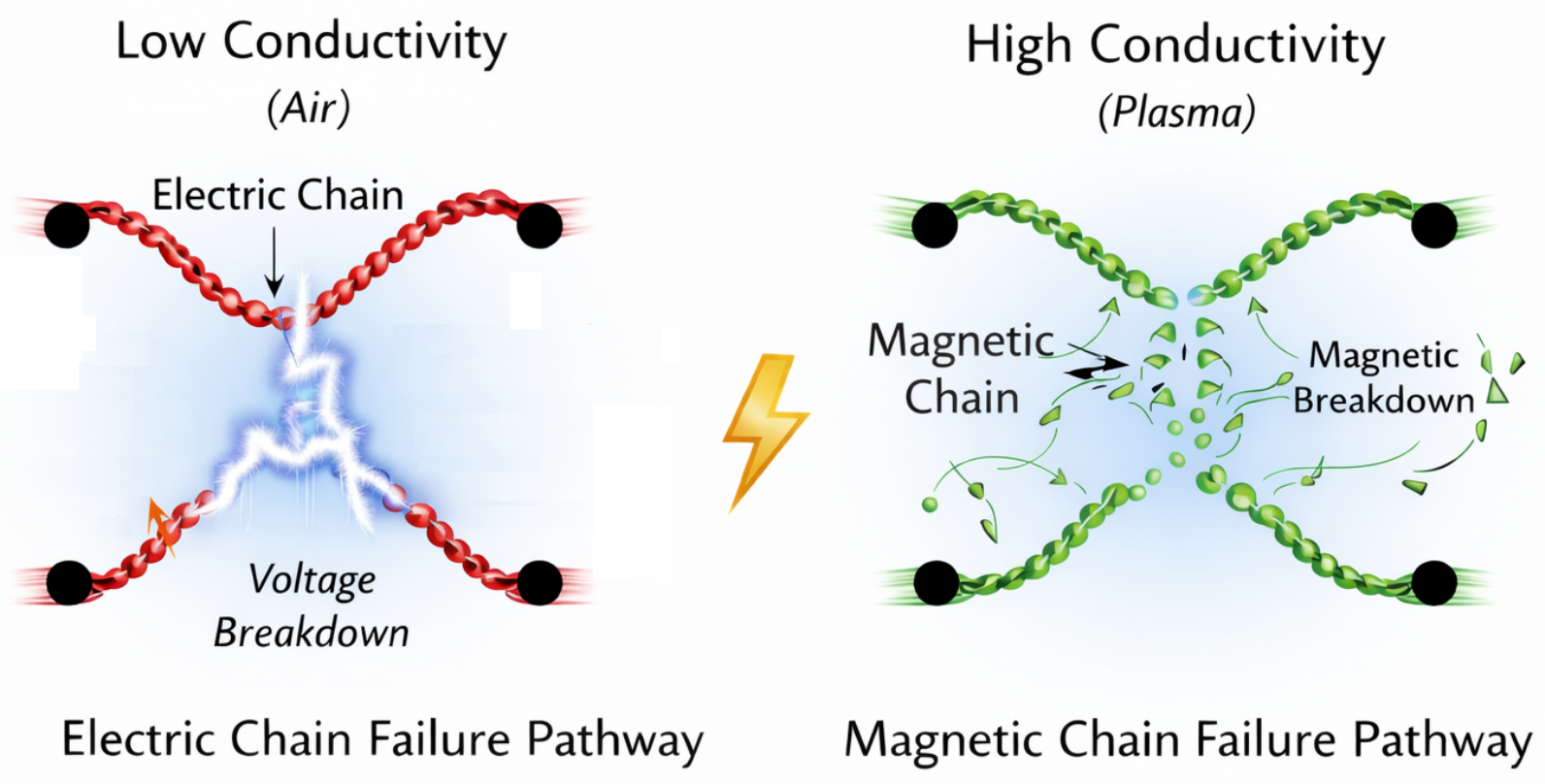
This distinction also changes the interpretation of stored energy. Electric-field energy can accumulate while charge remains separated and redistribution is inhibited. A capacitor, charged dielectric, isolated body, or cloud charge region may therefore store substantial energy before a major conducting path forms. Magnetic energy, by contrast, is associated with current-supported organization and is stored within a system in which directed charge transport is already present.
Chain topology provides another distinction. Electric chains may terminate on like-spinning free electrons and can therefore extend between spatially separated charge-supporting regions. Magnetic chains form closed loops. In the Photony interpretation, these different geometries arise from the different electron-transduction pathways and elemental charge-photon states associated with electric and magnetic fields.
The two regimes can nevertheless become strongly coupled. An electric breakdown event may create a conducting channel through which substantial current subsequently flows. Once that current develops, internal free electrons associated with it transduce dynamic elemental charge photons into magnetic chains around the new conducting path. Conversely, changing magnetic organization can induce electric fields and voltage stresses elsewhere in a system. A single physical event may therefore contain both electric and magnetic stages even though the threshold mechanism at a particular location can still be classified according to the local physical conditions.
Purposeful ignition systems illustrate this coupling clearly. An inductive ignition system may first store energy magnetically in a current-carrying coil. Interruption of that current produces a high voltage, and the resulting electric field across an ignition gap then produces voltage breakdown. The upstream energy-storage mechanism is magnetic, while formation of the plasma path across the gap is electric.
The same distinction is useful in natural systems. A magnetic disturbance can produce changing electromagnetic conditions that lead to electric-field induction and voltage stress in a separate region. If an insulating gap or weakly conducting pathway subsequently breaks down, the local initiating event is electric even though the broader energy pathway may have originated in a magnetic disturbance.
The comparison therefore supports a unified but non-identical view of field energy release. Both regimes involve stored energy, increasing loading, limited accommodation, a threshold transition, and rapid conversion into observable forms. The electric regime is distinguished principally by the creation or enlargement of a conducting path through a previously less conductive region, whereas the magnetic regime is distinguished by the destabilization of an already conducting, current-supported magnetic organization.
This distinction provides an operational basis for comparing the two mechanisms without collapsing them into a single generic breakdown process. It also identifies experimentally relevant features for evaluating the proposed Photony interpretation, including the electrical state before threshold, the presence or absence of a conducting path, and the temporal development of current and energy release.
8. Discussion
The electric energy-release regimes examined in this article share a common physical progression despite substantial differences in scale, material environment, and application. Charge separation and restricted redistribution permit electric-field energy to accumulate, while geometry, material properties, conductivity, pressure, and surface condition determine how that loading is distributed. The system may initially accommodate the stress through leakage or polarization, or undergo localized energy release through corona or partial discharge, before a sufficiently severe local condition produces a substantially more conductive pathway and rapid redistribution of electrical energy.
This distinction between electric loading and conducting-path formation is central to the interpretation developed here. Voltage alone does not define the breakdown condition, nor does the occurrence of breakdown determine the total energy ultimately released. An isolated electrostatic discharge may be limited primarily by the charge and capacitance present before breakdown, whereas a newly formed conducting path connected to an external source can support a much larger and longer-duration arc. The breakdown transition and the subsequent source-supplied energy should therefore be treated as related but distinct stages.
The same framework applies to both accidental and purposeful electrical breakdown. Electrostatic sparks, insulation failure, flashover, lightning, and unintended arcs represent cases in which a conducting pathway develops under uncontrolled or naturally evolving conditions. Spark plugs, burner igniters, flare igniters, and related systems deliberately create the same general transition at a selected location and time. Breakdown is therefore not inherently a failure; its significance depends on the function and environment of the system in which it occurs.
Within the Photony interpretation, the pre-breakdown electric field is associated with surface-electron transduction of predominantly static elemental charge photons into electric chains. Increasing electric loading is interpreted as increasing or concentrating this charge-supported chain organization. When established material or discharge processes cause the surrounding insulating, resistive, or incompletely conducting region to become substantially more conductive, the pre-existing electric-chain organization is proposed to undergo rapid reorganization or loss of continuity. The observable breakdown mechanisms remain those described by conventional electrostatic, dielectric, gas-discharge, and plasma physics.
Comparison with magnetic breakdown further clarifies the proposed distinction between the two regimes. Electric breakdown creates or substantially enlarges a conducting path through a region in which that path was previously absent, weak, or incomplete. Magnetic breakdown instead concerns instability within an already conducting, current-supported magnetic organization. The two regimes can occur sequentially or become strongly coupled, but their threshold conditions and pre-breakdown physical states remain different.
The resulting framework therefore connects static charge accumulation, localized discharge, dielectric failure, sparks, arcs, lightning, and electrical ignition through a common loading-and-threshold description while preserving the established physics specific to each phenomenon. Photony theory adds a proposed chain-level organization to this description and is presented as complementary to, rather than a replacement for, conventional electromagnetic and discharge theory.
9. Conclusions
Electric energy-release events ranging from electrostatic discharge and dielectric breakdown to lightning, electrical arcing, and deliberate spark ignition can be described within a common loading-and-threshold framework. Charge separation and restricted redistribution permit electric-field energy to accumulate, while local geometry, material properties, conductivity, and the surrounding environment determine whether that loading is accommodated, produces localized discharge, or progresses to complete breakdown.
A principal conclusion is that voltage breakdown should not be identified with voltage alone. The decisive condition is the local electric stress within the actual material and geometric environment. Breakdown occurs when an initially insulating, resistive, or incompletely conducting region develops a substantially more conductive pathway.
The energy released after breakdown is also not determined solely by the pre-breakdown voltage. An isolated electrostatic discharge may be limited by the stored charge and capacitance of the system, whereas a conducting path connected to an external source can support substantially greater source-supplied energy and develop into a sustained arc.
Electric breakdown is not inherently a failure. The same general physical transition can occur accidentally in insulation faults, electrostatic discharges, and ignition hazards or be generated deliberately in spark plugs, burner igniters, and other high-voltage ignition systems.
Within the Photony interpretation, the pre-breakdown electric field is associated with surface-electron transduction of predominantly static elemental charge photons into electric chains. When established material or discharge processes cause the surrounding region to become substantially more conductive, the associated charge-supported electric-chain organization is proposed to undergo rapid reorganization or loss of continuity. This chain-level interpretation is complementary to the established quantitative treatment provided by electrostatics, dielectric physics, gas-discharge physics, and plasma physics.
Electric and magnetic energy-release regimes therefore share the broad features of stored energy, increasing loading, finite accommodation, threshold behavior, and rapid energy conversion, but differ in their pre-threshold physical states. Electric breakdown creates or substantially enlarges a conducting pathway through a previously less conductive region, whereas magnetic breakdown concerns instability within an already conducting, current-supported magnetic organization.
References
- Martin, F.L. Beyond Field-Line Descriptions: Magnetic Energy-Release Regimes, 2026. Preprinted Companion manuscript. [CrossRef]
- Martin, F.L. From Magnetic and Electric Fields to Fires. In OAJAST; 2026. [Google Scholar]
- Sobarzo, J.C.; Pertl, F.; Balazs, D.M.; et al. Spontaneous Ordering of Identical Materials into a Triboelectric Series. Nature 2025, 638, 664–669. [Google Scholar] [CrossRef] [PubMed]
- Martin, F.L. Photony Math. Compend. Vol. VI, unpublished as of 8/9/2026. 2026. [CrossRef]
- Lin, S.; Xu, L.; Wang, A.C.; et al. Quantifying Electron-Transfer in Liquid–Solid Contact Electrification and the Formation of Electric Double-Layer. Nat. Commun. 2020, 11, 399. [Google Scholar] [CrossRef] [PubMed]
- Occupational Safety and Health Administration. Occupational Safety and Health Administration. 29 CFR 1910.106: Flammable Liquids. U.S. Department of Labor, 2026. Accessed 8 August 2026.
- Meek, J.M. A Theory of Spark Discharge. Phys. Rev. 1940, 57, 722–728. [Google Scholar] [CrossRef]
- Hourdakis, E.S.; Simonds, B.; Zimmerman, N.M. Sub-Micron Gap Capacitor for Measurement of Breakdown Voltage in Air. Rev. Sci. Instrum. 2006, 77, 034702. [Google Scholar] [CrossRef]
- Van Brunt, R.J. Physics and Chemistry of Partial-Discharge and Corona: Recent Advances and Future Challenges. IEEE Trans. Dielectr. Electr. Insul. 1994, 1. [Google Scholar] [CrossRef] [PubMed]
- Hill, J.D.; Uman, M.A.; Jordan, D.M. High-Speed Video Observations of a Lightning Stepped Leader. J. Geophys. Res. Atmos. 2011. [Google Scholar] [CrossRef]
- Wang, X.; Patel, A.; Bane, S.; Shashurin, A. Experimental Study of Atmospheric Pressure Single-Pulse Nanosecond Discharge in Pin-to-Pin Configuration. J. Appl. Phys. 2021, 130, 103303. [Google Scholar] [CrossRef]
Figure 1.
Comparison between conventional electric and magnetic field-line representations and the proposed Photony chain-based interpretations. Electric chains are shown as linked structures associated with surface-electron transduction, whereas magnetic chains are shown as closed-loop structures associated with internal-electron transduction. The conventional field lines remain geometrical representations of the corresponding macroscopic fields.
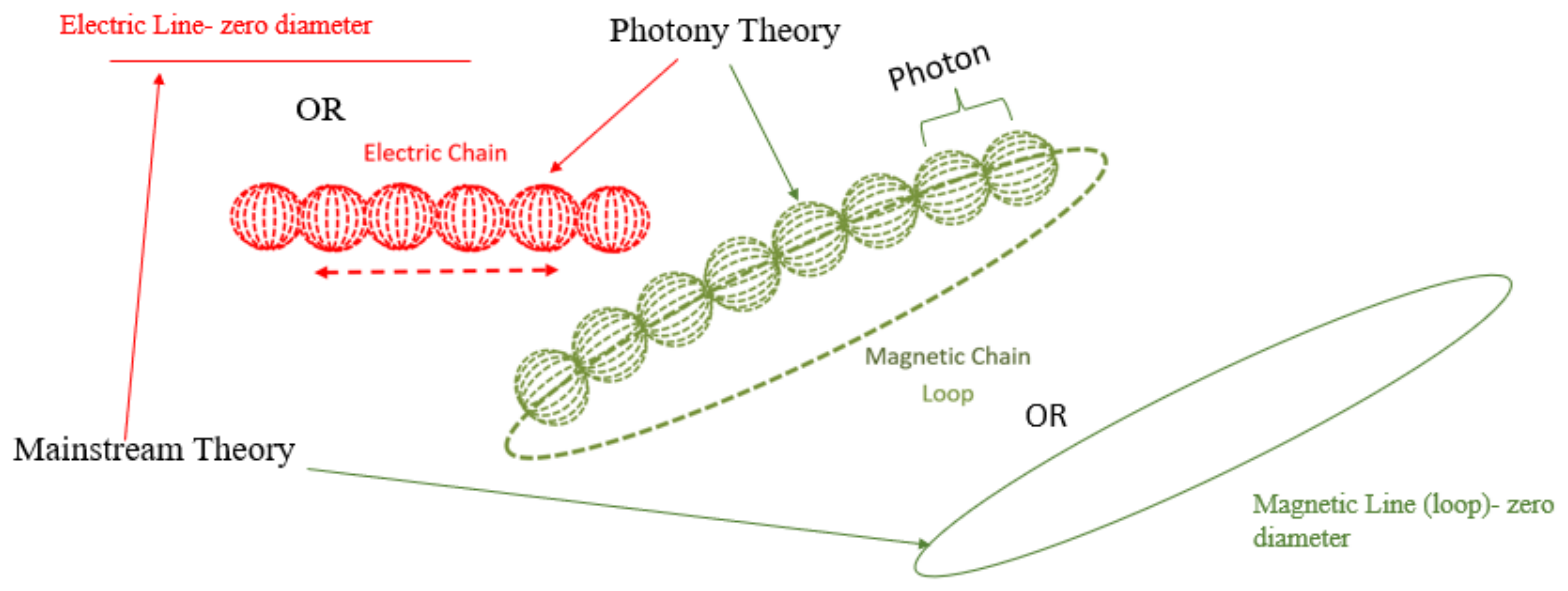
Figure 2.
Major pathways through which static charge may be generated and retained. Contact and separation, electrostatic induction, liquid flow and spraying, powder or particle transfer, and motion of insulating materials can produce persistent charge separation when dissipation is limited. [5] Continued charge accumulation can increase electric-field loading until the system responds through leakage, localized discharge, or breakdown.
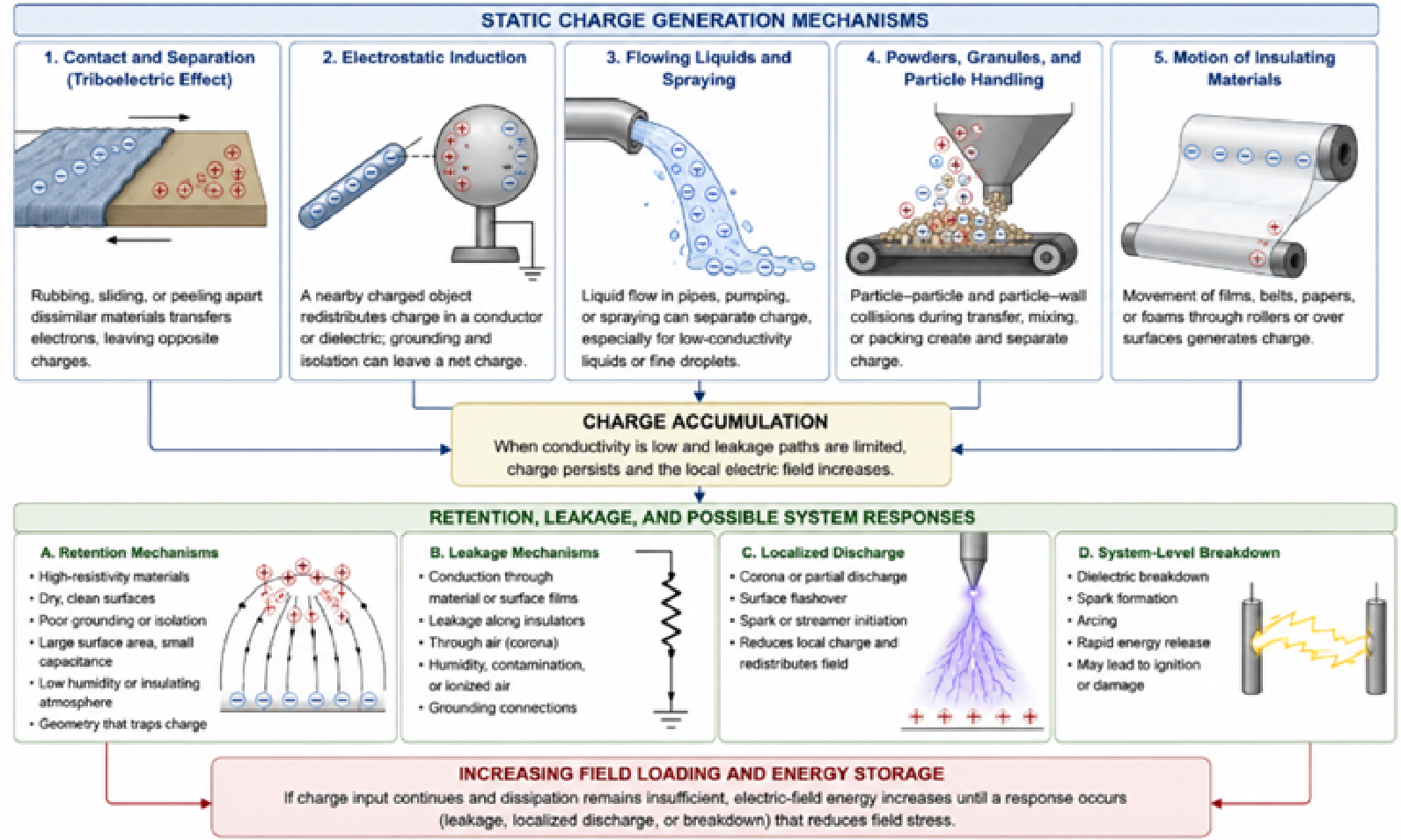
Figure 3.
Conceptual progression of electric-field loading, electric breakdown, and post-threshold evolution. Before breakdown, charge separation supports electric-field energy across an insulating, resistive, or incompletely conducting region. Within the Photony interpretation, surface-associated electrons organize predominantly static elemental charge photons into electric chains. Increasing electrical loading and medium-dependent local processes can produce a localized increase in conductivity. When a substantially more conductive pathway develops, the pre-breakdown electric-chain organization must reorganize in response to the changed electrical environment. If the system is limited primarily to stored charge, redistribution may reduce the potential difference and terminate the discharge. If an external source continues to supply energy, substantial current may persist through the new conducting path, allowing development of a sustained arc and associated magnetic-chain organization.
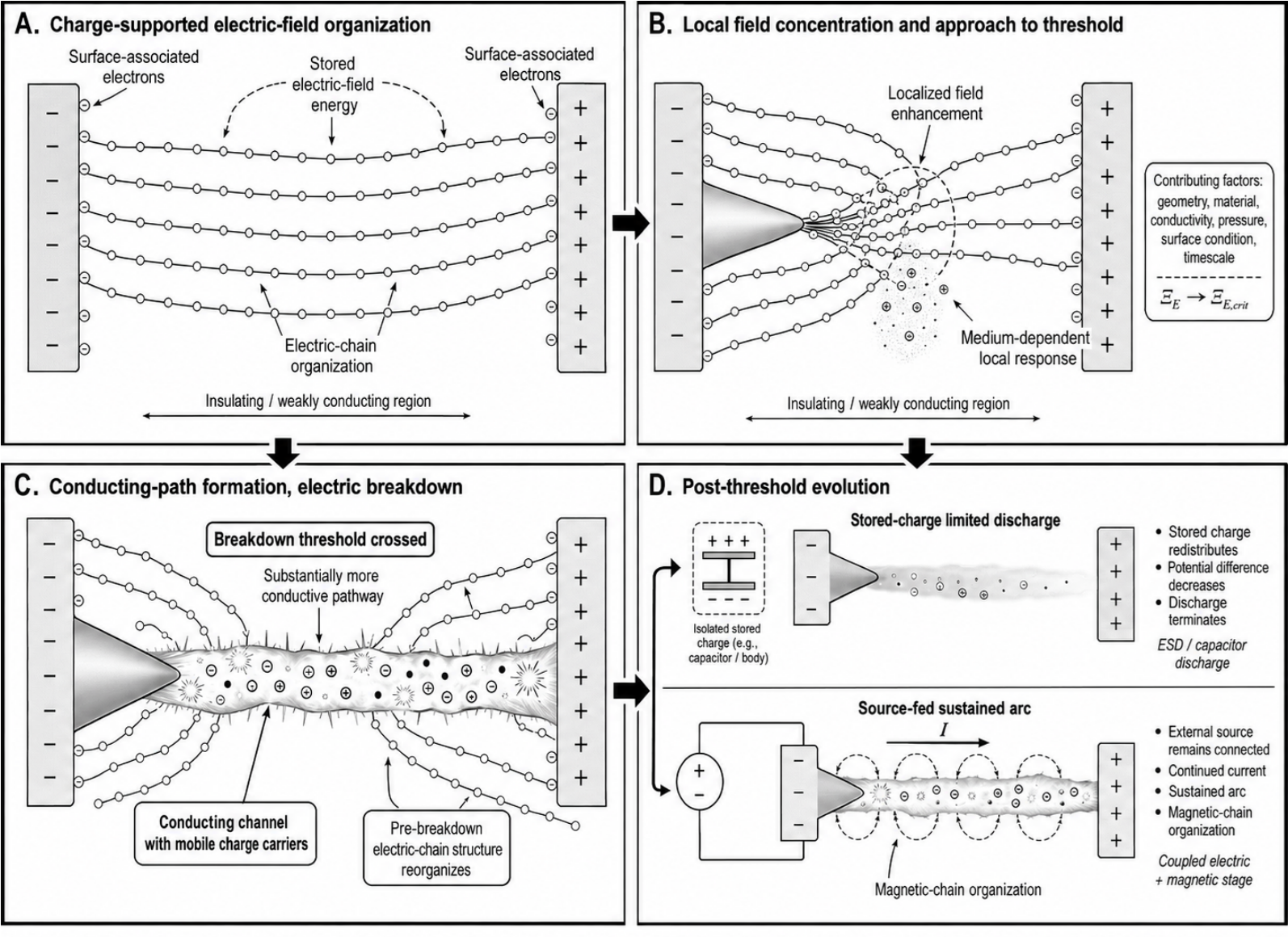

Table 1.
Principal distinctions between electric and magnetic energy-release regimes within the Photony interpretation.
Table 1.
Principal distinctions between electric and magnetic energy-release regimes within the Photony interpretation.
| Characteristic | Electric Regime | Magnetic Regime |
|---|---|---|
| Primary elemental charge-photon state | Predominantly static | Dynamic |
| Electron-transduction pathway | Surface-associated free electrons | Internal free electrons associated with current |
| Chain organization | Electric chains may terminate on like-spinning free electrons | Magnetic chains form closed loops |
| Typical conductivity environment | Insulating, resistive, or incompletely conducting region | Conducting, current-supported medium |
| Principal stored-energy condition | Charge separation and electric-field energy | Current-supported magnetic-field energy |
| Threshold event | Formation or substantial enlargement of a conducting pathway | Destabilization of an existing energetic magnetic organization |
| Conducting path before threshold | Absent, weak, resistive, or incomplete | Already present and supporting current |
| Post-transduction electron interaction | Electron may ride an established electric chain; the photoelectric effect provides a proposed example | Electron may ride an established closed magnetic chain; atomic-shell electron motion provides a proposed example |
Disclaimer/Publisher’s Note: The statements, opinions and data contained in all publications are solely those of the individual author(s) and contributor(s) and not of MDPI and/or the editor(s). MDPI and/or the editor(s) disclaim responsibility for any injury to people or property resulting from any ideas, methods, instructions or products referred to in the content. |
© 2026 by the authors. Licensee MDPI, Basel, Switzerland. This article is an open access article distributed under the terms and conditions of the Creative Commons Attribution (CC BY) license (http://creativecommons.org/licenses/by/4.0/).
Copyright: This open access article is published under a Creative Commons CC BY 4.0 license, which permit the free download, distribution, and reuse, provided that the author and preprint are cited in any reuse.